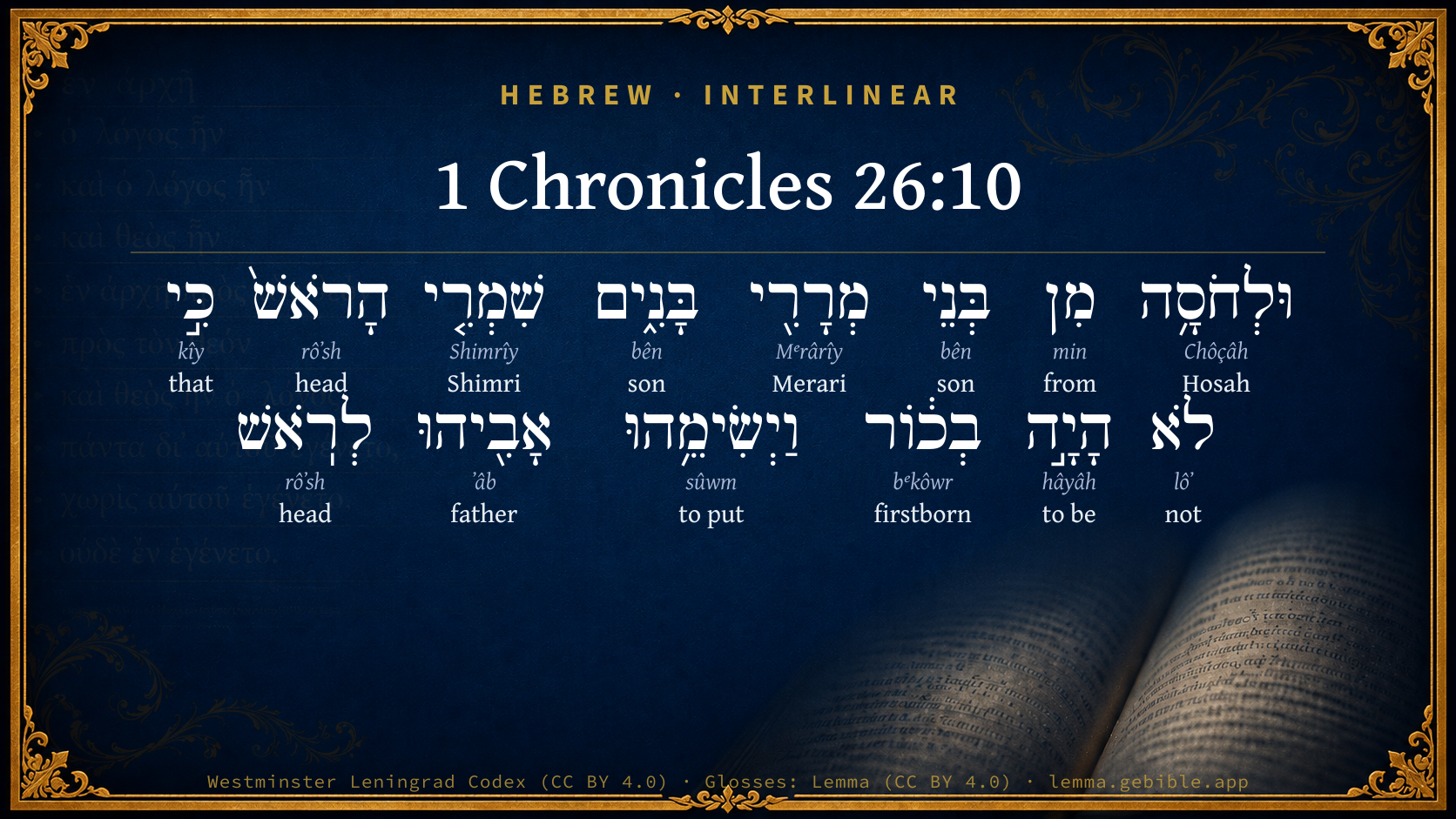
1 Chronicles 26:10

Hebrew (Westminster Leningrad Codex) 1 Chronicles 26:10 appears in the Hebrew Old Testament. The text above is from the Westminster Leningrad Codex. Each word links to its Strong’s number, a concise gloss, and parsing drawn from the Open Scriptures Hebrew Bible morphology. Click any word for its full Brown-Driver-Briggs (BDB) entry.
Download image
Cite this verse

1 Chronicles 26:10 (World English Bible). Public Domain. Lemma interlinear Bible study tool, https://lemma.gebible.app/v/1-chronicles/26/10.

Show BibTeX & RIS
BibTeX
RIS
English Translation
Also Hosah, of the children of Merari, had sons: Shimri the chief, (for though he was not the firstborn, yet his father made him chief),
World English Bible · Public Domain
Download a study sheet

One document with this verse’s original text, its word-by-word gloss line, the meaning frame, cross-references with their text, attributed commentary, and full source and license credits — printable, and it pastes into notes with its structure intact.

This verse Autodidact and up

Study sheet (.html) Plain text (.txt)

A passage Seminary Student

Up to 50 verses in one chapter. A passage sheet keeps up to 6 commentary sources and 12 cross-references per verse, in the order this page ranks them, and says so on the sheet whenever that leaves anything out. Ask for a single verse and you get the Autodidact verse sheet above.

Everything on this page stays free to read, with no account — the sheet is a download of what is already on screen, not access to it.

Want to remove ads? Support Godless Engineer
Compare translations 3

The same verse in 3 English versions, stacked beneath the original-language interlinear above. Click any original word for its lexicon entry.

Each is an independent rendering of the whole verse — the interlinear is not word-aligned to these translations.

Highlighted words mark where these versions differ — a whole-verse word diff, not a word-by-word alignment.

  • World English Bible Public Domain
    Also Hosah, of the children of Merari, had sons: Shimri the chief, (for though he was not the firstborn, yet his father made him chief),
  • King James Version Public Domain
    Also Hosah, of the children of Merari, had sons; Simri the chief, (for though he was not the firstborn, yet his father made him the chief;)
  • unfoldingWord Literal Text CC BY-SA 4.0
    And sons to Hosah from the sons of Merari: Shimri, the head (although he was not the firstborn, yet his father set him as the head);

unfoldingWord Literal Text — © unfoldingWord, licensed CC BY-SA 4.0. Word-aligned USFM3 via Door43 (git.door43.org/unfoldingWord/en_ult).

Versions to compare (up to 4)

3 of 4 selected

Show all 18 translations

Every available English version of this verse, each an independent rendering of the whole verse.

  • World English Bible Public Domain
    Also Hosah, of the children of Merari, had sons: Shimri the chief, (for though he was not the firstborn, yet his father made him chief),
  • Berean Standard Bible Public Domain
    Hosah the Merarite also had sons: Shimri the first (although he was not the firstborn, his father had appointed him as the first),
  • Majority Standard Bible Public Domain
    Hosah the Merarite also had sons: Shimri the first (although he was not the firstborn, his father had appointed him as the first),
  • King James Version Public Domain
    Also Hosah, of the children of Merari, had sons; Simri the chief, (for though he was not the firstborn, yet his father made him the chief;)
  • American Standard Version (1901) Public Domain
    Also Hosah, of the children of Merari, had sons: Shimri the chief, (for though he was not the first-born, yet his father made him chief),
  • Revised Version (1885) Public Domain
    Also Hosah, of the children of Merari, had sons; Shimri the chief, (for though he was not the firstborn, yet his father made him chief;)
  • Geneva Bible (1599) Public Domain
    And of Hosah of the sonnes of Merari, the sonnes were Shuri the chiefe, and (though he was not the eldest, yet his father made him the chiefe)
  • Douay-Rheims (1899) Public Domain
    And of Hosa, that is, of the sons of Merari: Semri the chief, (for he had not a firstborn, and therefore his father made him chief.)
  • Young's Literal Translation Public Domain
    and to Hosah, of the sons of Merari, `are' sons: Shimri the head (though he was not first-born, yet his father setteth him for head),
  • Literal Standard Version CC BY-SA 4.0
    and of Hosah, of the sons of Merari, [are these] sons: Shimri the head (though he was not firstborn, yet his father sets him for head),
  • Unlocked Literal Bible CC BY-SA 4.0
    Hosah, a descendant of Merari, had sons: Shimri the leader (although he was not the firstborn, his father made him leader),
  • unfoldingWord Literal Text CC BY-SA 4.0
    And sons to Hosah from the sons of Merari: Shimri, the head (although he was not the firstborn, yet his father set him as the head);
  • Darby Bible Public Domain
    -- And Hosah, of the sons of Merari, had sons: Shimri the head, for though he was not the firstborn, yet his father made him the head;
  • World Messianic Bible Public Domain
    Also Hosah, of the children of Merari, had sons: Shimri the chief (for though he was not the firstborn, yet his father made him chief),
  • Webster's Bible Public Domain
    Also Hosah of the children of Merari, had sons; Simri the chief, (for though he was not the first-born, yet his father made him the chief;)
  • Free Bible Version CC BY-SA 4.0
    Hosah, one of the sons of Merari, made Shimri as leader among his sons, though he was not the firstborn.
  • Bible in Basic English Public Domain
    And Hosah, a son of the children of Merari, had sons: Shimri the chief (for though he was not the oldest, his father made him chief);
  • JPS Tanakh (1917) Public Domain
    Also Hosah, of the children of Merari, had sons: Shimri the chief — for though he was not the firstborn, yet his father made him chief —

Literal Standard Version (2020), Covenant Press — licensed CC BY-SA 4.0. Text via the HelloAO Bible API (eBible.org). Unlocked Literal Bible (unfoldingWord) — licensed CC BY-SA 4.0. Text via the HelloAO Bible API (eBible.org). unfoldingWord Literal Text — © unfoldingWord, licensed CC BY-SA 4.0. Word-aligned USFM3 via Door43 (git.door43.org/unfoldingWord/en_ult). Free Bible Version, Dr. Jonathan Gallagher — licensed CC BY-SA 4.0. Text via the HelloAO Bible API (eBible.org).

Word by word

More ways to search: Search by grammar → Find every occurrence → Compare this word →

Practice this passage: Drill this verse → Learn its vocabulary →

שִׁמְרִ֤י
Shimrîy
H8113
“Shimri”
Noun, Proper
Part of Speech
Noun
Type
Proper
Full BDB Definition

Origin: from H8105 in its original sense

TWOT: None

Shimri = "vigilant" - a Simeonite, son of Shemaiah and father of Jedaiah - father of Jediael, one of David's mighty warriors - a Merarite Levite, son of Hosah - a Kohathite Levite of the sons of Elizaphan
  1. וּלְחֹסָ֥ה Chôçâh H2621 “and · to/for · Hosah” Conjunction + Preposition + Noun, Proper
  2. מִן min H4480 “from” Preposition
  3. בְּנֵי bên H1121 “sons of” Noun, Common, Masculine, Plural, Construct
  4. מְרָרִ֖י Mᵉrârîy H4847 “Merari” Noun, Proper
  5. בָּנִ֑ים bên H1121 “sons” Noun, Common, Masculine, Plural, Absolute
  6. הָרֹאשׁ֙ rôʼsh H7218 “the · head” Particle, Definite Article + Noun, Common, Masculine, Singular, Absolute
  7. כִּ֣י kîy H3588 “that” Conjunction
  8. לֹא lôʼ H3808 “not” Particle, Negative
  9. הָיָ֣ה hâyâh H1961 “to be” Verb, Qal, Perfect, 3rd Person, Masculine, Singular
  10. בְכ֔וֹר bᵉkôwr H1060 “firstborn” Noun, Common, Masculine, Singular, Absolute
  11. וַיְשִׂימֵ֥הוּ sûwm H7760 “and · to put · him” Conjunction + Verb, Qal, Sequential Imperfect, 3rd Person, Masculine, Singular + Suffix, Personal, 3rd Person, Masculine, Singular
  12. אָבִ֖יהוּ ʼâb H1 “father · his” Noun, Common, Masculine, Singular, Construct + Suffix, Personal, 3rd Person, Masculine, Singular
  13. לְרֹֽאשׁ rôʼsh H7218 “to/for · head” Preposition + Noun, Common, Masculine, Singular, Absolute

About this verse

These counts appear in no published source. They are computed here, from the morphology-tagged text and Lemma’s own curated glosses. What Lemma adds →

14
words
12
distinct lemmas
Historical
section

Notable vocabulary

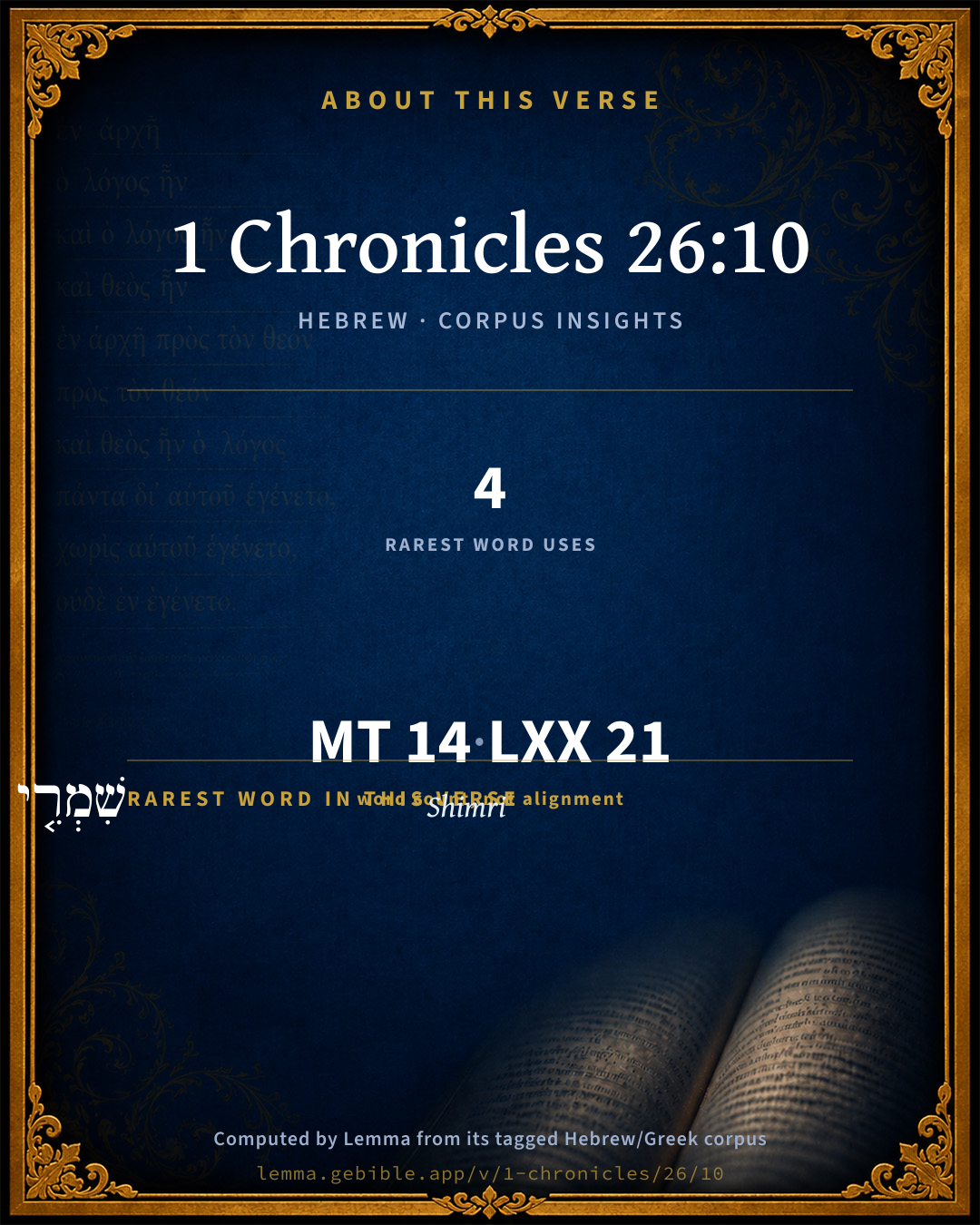
The rarest word here is שִׁמְרִ֤י Shimri H8113 — appearing just 4 times in the whole Hebrew Bible.

Shared distinctive vocabulary

שִׁמְרִ֤י Shimri H8113 occurs in 4 verses of the Hebrew Bible. Also found in:

Grammatical profile

  • 2 verbs
  • 9 nouns
  • 1 preposition
  • 1 conjunction
  • 1 particle

Verb forms

  • הָיָ֣ה Qal · Perfect
  • וַיְשִׂימֵ֥הוּ Qal · Sequential Imperfect

Repetition

Words recur within this verse — often emphatic in Hebrew:

  • בְּנֵי son H1121 ×2
  • הָרֹאשׁ֙ head H7218 ×2

Hebrew & Septuagint length

In English translation the verse runs 25 words from the Hebrew and 31 from the Septuagint (LXX English) — closely comparable.

A rough comparison of the two English renderings, which tokenize alike — not a word-level alignment.

Word counts can differ between the Hebrew and the Greek without any difference in meaning — e.g. the Hebrew direct-object marker אֵת has no separate Greek word, and Greek often adds the article ὁ.

In the original languages it is 14 Hebrew tokens and 21 Greek tokens — but the two are counted differently (Hebrew bundles its prefixes and suffixes into one token; the Greek is in lemma form), so that isn’t a like-for-like length.

Cross-references

2

Topical passages linked to 1 Chronicles 26:10 in the Treasury of Scripture Knowledge — connected by theme and wording, ordered by reader-vote popularity; previews shown in the World English Bible.

  • 1 Chronicles 16:38 and Obed-edom with their brothers, sixty-eight; Obed-edom also the son of Jeduthun and Hosah to be doorkeepers;
  • 1 Chronicles 5:1–2 The sons of Reuben the firstborn of Israel (for he was the firstborn; but, because he defiled his father's couch, his birthright was given to the sons of Joseph the son of Israel; and the genealogy is not to be reckoned after the birthright.

Cross-references courtesy of OpenBible.info (CC BY 4.0).

Hebrew and Greek witnesses Masoretic Hebrew ↔ Greek Septuagint

The same verse in the two great witnesses to the Old Testament, shown verse-for-verse.

These are two independent witnesses, not word-aligned to each other, and the Septuagint is shown in lemma (dictionary) form.

Hebrew 1 Chronicles 26:10 Masoretic · Westminster Leningrad Codex

וּלְחֹסָ֥ה מִן בְּנֵי מְרָרִ֖י בָּנִ֑ים שִׁמְרִ֤י הָרֹאשׁ֙ כִּ֣י לֹא הָיָ֣ה בְכ֔וֹר וַיְשִׂימֵ֥הוּ אָבִ֖יהוּ לְרֹֽאשׁ

Also Hosah, of the children of Merari, had sons: Shimri the chief, (for though he was not the firstborn, yet his father made him chief),

World English Bible · Public Domain

Greek LXX 1 Chronicles 26:10 Septuagint · lemma form

καί ὁ ωσα ὁ υἱός μεραρι υἱός φυλάσσω ὁ ἀρχή ὅτι οὐ εἰμί πρωτότοκος καί ποιέω αὐτός ὁ πατήρ αὐτός ἄρχων

And to Osa of the sons of Merari there were born sons, keeping the dominion; though he was not the firstborn, yet his father made him chief of the second division.

LXX2012 (modern English Septuagint) · Public Domain

On this verse, Haydock's Catholic Bible Commentary discusses the Septuagint’s reading. Read the note in Commentary ↓

Hebrew: Westminster Leningrad Codex (CC BY 4.0). Greek: Septuagint (public domain); English from LXX2012 (modern English Septuagint) (Public Domain). How the Septuagint differs from the Hebrew →

Commentary

Notes on 1 Chronicles 26:10 from classic Christian and Jewish commentators (each source and its license shown beneath its notes). The classic Christian expositions comment on the surrounding passage and are grouped to its opening verse, so a note may address several verses; the Jewish commentaries on the Tanakh (Rashi and others) are per-verse, so they appear only where the commentator wrote on this verse.

Lemma curates 59 commentaries, every one of them public domain or Creative Commons licensed, each selected and text-cleaned for this edition rather than reprinted as found. About our sources →

Ellicott's Commentary for English Readers

(10) Also Hosah, of the children of Merari.—Four chiefs of the sons of Hosah are named, and thirteen assigned as the total number of families belonging to this clan (1Ch_26:10-11). Adding them to the 18 of Meshelemiah and the 62 of Obed-edom, we get a total of 93 principal porters, presiding over the 4,000 Levites appointed to that work (1Ch_23:5).

Simri (Shimri) the chief (for though he was not his firstborn . . .).—This may mean either that the oldest family had died out, or that none of these families could prove its seniority to the rest.

A Bible Commentary for English Readers, edited by Charles John Ellicott (1878–1897) — public domain. Text from a community e-Sword module.

Trapp's Complete Commentary

John Trapp

1Ch 26:10 Also Hosah, of the children of Merari, had sons; Simri the chief, (for [though] he was not the firstborn, yet his father made him the chief;)

Ver. 10. Yet his father made him the chief.] Not in the right of first born, but in his office of a warder. {a}

{a} Jun.

John Trapp, A Commentary or Exposition upon All the Books of the Old and New Testament (1647–1656) — public domain. Text from a community e-Sword module.

Joseph Benson's Commentary

1Ch 26:10. His father made him the chief — Not in inheriting the estate, (this was forbidden by the law,) but in this service, for which he was better qualified than his elder brother.

Joseph Benson's Commentary on the Old and New Testaments (1811–1818) — public domain. Text from a community e-Sword module.

Jamieson, Fausset & Brown

Robert Jamieson, A. R. Fausset & David Brown

Simri the chief . . . though . . . not the first-born--probably because the family entitled to the right of primogeniture had died out, or because there were none of the existing families which could claim that right.

Jamieson, Fausset & Brown — Commentary Critical and Explanatory on the Whole Bible (1871) — public domain (CC PDM 1.0). Text via the HelloAO Bible API.

The Cambridge Bible for Schools and Colleges

gen. ed. J. J. S. Perowne

10. Hosah] He is mentioned as a doorkeeper along with Obed-edom in 1Ch_16:38.

Simri] R.V. Shimri.

The Cambridge Bible for Schools and Colleges (gen. ed. J. J. S. Perowne; Cambridge University Press, 1878–1918) — public domain. Text from a community e-Sword module.

John Gill's Exposition

Hilkiah the second, Tebaliah the third, Zechariah the fourth; all the sons and brethren of Hosah were thirteen. Four sons, and nine brethren or kinsmen.

Hilkiah the second, Tebaliah the third, Zechariah the fourth; all the sons and brethren of Hosah were thirteen. Four sons, and nine brethren or kinsmen.

1 Chronicles 26:12

ch1 26:12

ch1 26:12

ch1 26:12Among these were the divisions of the porters, even among the chief men,.... These before named were the principal men of the porters, among which was a division or distribution of them into classes or courses, in which they served weekly in turn:

having wards one against another, to minister in the house of the Lord; meaning either to watch in, as on the north against the south, and the east against the west, and "vice versa". The Jews say (t), the priests kept ward in three places in the house of the sanctuary; in the house of Abtines, in the house of Nitzotz, and in the house of Moked; and the Levites in twenty one places, five at the five gates of the mountain of the house, four at the four corners of it within, five at the five gates of the court, four at the four corners of it without, one at the chamber of the offering, one at the chamber of the vail, and another behind the house of atonement, the holy of holies; but rather the sense is, that they had wards or courses answerable to those of the priests, and the other Levites, the singers, and were distributed into twenty four classes or courses as they, which are thus reckoned by Kimchi; at the east six, at the north four, at the south four, at Asuppim two and two, which were four, at the west four, and at Parbar two; lo, twenty four; see Ch1 26:17.

(t) Misn. Middot, c. 1. sect. 1.

John Gill's Exposition of the Whole Bible (1746–1763) — public domain (CC PDM 1.0). Text via the HelloAO Bible API.

Haydock's Catholic Bible Commentary

He had not a first-born. That is, his first-born was either dead or not fit to be chief, and therefore he made Semri the chief, (Worthington; Challoner) who was the second son (Tirinus) of Hosa. Hebrew, "for, or though he was not the first-born, yet his father made him chief." Septuagint add, "of the second division," but without reason, as they interpret, "keeping the command," instead of Semri, the chief, which leaves us without a proper name. (Haydock)

George Leo Haydock (1774–1849), Haydock's Catholic Family Bible and Commentary, 1859 edition — public domain. Excludes Psalms (Douay-Rheims chapter numbering differs from Protestant) and Deuterocanonical books (Catholic canon only).

Matthew Poole's English Annotations

Taking away the birthright from the first-born, either absolutely for some gross miscarriage, as Gen 49:4; or only in this respect, because he wanted either strength or valour, or some other qualification necessary for his office.

Matthew Poole's English Annotations on the Holy Bible (1683–1685) — public domain. Text from a community e-Sword/MySword module.

The Pulpit Commentary

Vers. 10, 11. The porters from the descendants of Merari are given in these two verses, in all thirteen. Hosah, it will be remembered, is found together with Obed-edom in 1Ch_16:38, as one of the porters of the the ark. These thirteen bring up the number of porters to ninety-three. We have read (1Ch_9:22) that later the number became two hundred and twelve. Though yet. The likelier translation of the Hebrew would be, For there was not a firstborn (i.e. the issue of the firstborn had failed, and his line was therefore extinct), and his father made him the chief. Moreover, it is but probable that, if it had been a case of superseding the firstborn, the fact would not have been stated without an explanation of what had led to it or justified it.

The Pulpit Commentary (1880–1919), ed. H.D.M. Spence-Jones & Joseph S. Exell — public domain. Text from a community e-Sword module.

John Wesley's Explanatory Notes

Made him the chief - Not in inheriting the estate; (this was forbidden by the law) but in this service, for which he was better qualified than his elder brother.

John Wesley, Explanatory Notes Upon the Whole Bible (1754–1765) — public domain. Text via the GEBible commentary corpus.

Keil & Delitzsch

C. F. Keil & F. Delitzsch

Hilkiah the second, Tebaliah the third, Zechariah the fourth; all the sons and brethren of Hosah were thirteen. Four sons, and nine brethren or kinsmen.

Hilkiah the second, Tebaliah the third, Zechariah the fourth; all the sons and brethren of Hosah were thirteen. Four sons, and nine brethren or kinsmen.

1 Chronicles 26:12

ch1 26:12

ch1 26:12

ch1 26:12Among these were the divisions of the porters, even among the chief men,.... These before named were the principal men of the porters, among which was a division or distribution of them into classes or courses, in which they served weekly in turn:

having wards one against another, to minister in the house of the Lord; meaning either to watch in, as on the north against the south, and the east against the west, and "vice versa". The Jews say (t), the priests kept ward in three places in the house of the sanctuary; in the house of Abtines, in the house of Nitzotz, and in the house of Moked; and the Levites in twenty one places, five at the five gates of the mountain of the house, four at the four corners of it within, five at the five gates of the court, four at the four corners of it without, one at the chamber of the offering, one at the chamber of the vail, and another behind the house of atonement, the holy of holies; but rather the sense is, that they had wards or courses answerable to those of the priests, and the other Levites, the singers, and were distributed into twenty four classes or courses as they, which are thus reckoned by Kimchi; at the east six, at the north four, at the south four, at Asuppim two and two, which were four, at the west four, and at Parbar two; lo, twenty four; see Ch1 26:17.

(t) Misn. Middot, c. 1. sect. 1.

Keil & Delitzsch — Biblical Commentary on the Old Testament (1861–1891) — public domain (CC PDM 1.0). Text via the HelloAO Bible API. (Old Testament only.)

unfoldingWord translationNotes

Door43 World Missions Community

General Information:

This continues the list of gatekeepers which started in 1 Chronicles 26:1.

Hosah ... Merari ... Shimri ... Hilkiah ... Tabaliah ... Zechariah

These are the names of men. (See: How to Translate Names)

the second ... the third ... the fourth

This shows the order in which the sons were born. If it is more natural in your language, you may say "the next" for each son. (See: Ordinal Numbers)

All of Hosah's sons and kinsmen were thirteen in number

"There were 13 of Hosah's sons and kinsmen." (See: Numbers)

translationWords

kin

unfoldingWord translationNotes — © Distant Shores Media and the Door43 World Missions Community, licensed CC BY-SA 4.0. Source: git.door43.org/Door43/en_tn.

Lesson kit

Teaching starters — assembled from the data on this page, not authored interpretation. Every prompt links to the verse data it draws on. Edit before teaching.

1 Chronicles, in the Historical, opens this verse with 14 words (12 distinct Hebrew lemmas). Its most distinctive word is Shimrîy (“Shimri”). A historical commentator’s framing appears above. Read the whole chapter for the surrounding context.

Discussion questions

  1. How does “Shimri” (Shimrîy) shape what this verse is saying?
  2. 1 Chronicles 4:37 shares the word «Shimri» with this verse. How do the two illuminate each other?
  3. “son” occurs 2× in this one verse. What is the effect of the repetition?
  4. These translations render this verse differently. What is at stake in choosing one wording over another?
  5. The verb «הָיָ֣ה» is Qal Perfect. How does its form color the action?
  6. Reading how Ellicott's Commentary for English Readers and Trapp's Complete Commentary read this verse, where do the two commentators agree and where do they part?

Things to notice

Reading settings

Reading text

Shown beneath each verse's original-language words.

Old Testament
Old Testament edition

Read the OT as the Masoretic Hebrew (MT) or the Greek Septuagint (LXX).

English shown for the Greek Septuagint (in the Hebrew ↔ Greek comparison).

Comparing translations? Open the Compare panel on any verse page to stack up to four side by side.