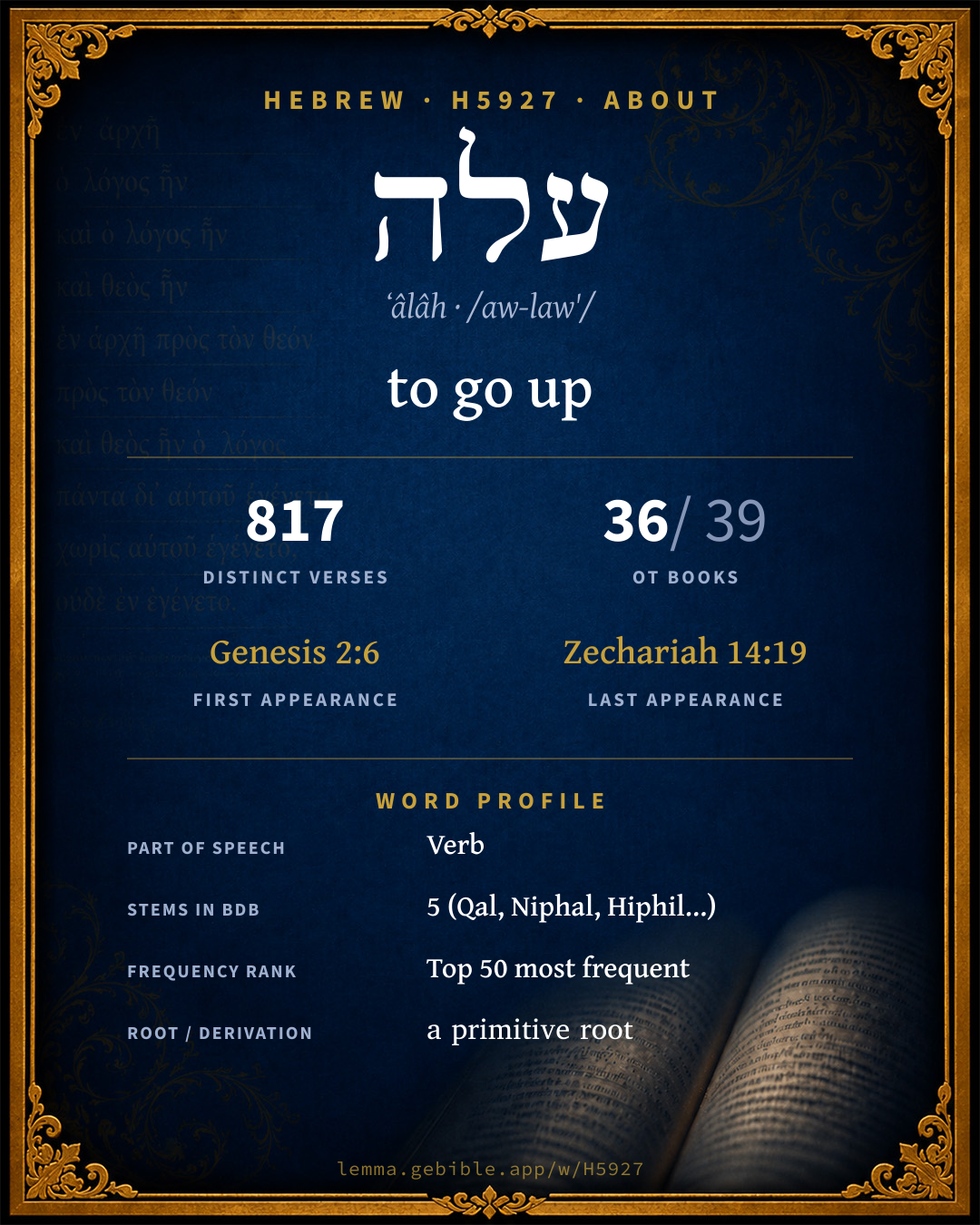
עָלָה
to go up
also: ascend, climb fuller range ↓
Full lexicon entry — Brown-Driver-Briggs (BDB)
From Brown-Driver-Briggs (BDB)
Where this word appears
See every Qal verb in the Hebrew Bible →
Grammar key — what these labels mean
Part of speech
- Verb
- An action or state-of-being word.
Stem
- Qal
- The basic, simple active stem — the plain form of the verb (“he wrote”). Here: ‘of persons’
- Hiphil
- The causative active stem (“he caused / brought about”). Here: ‘bring up persons’
- Niphal
- Usually the simple passive or reflexive of the Qal (“he was written”). Here: ‘be brought up’
- Hophal
- The passive counterpart of the Hiphil (“he was caused to…”). Here: ‘be carried away’
- Hithpael
- The reflexive or reciprocal stem (the subject acts on itself). Here: ‘lift oneself’
Form
- Sequential Imperfect
- An imperfect with prefixed waw — the standard past-narrative form (waw-consecutive imperfect).
- Perfect
- A completed action or state — Hebrew marks aspect (completeness) more than strict tense (“he wrote”).
- Imperfect
- An incomplete, ongoing, or future action (“he will / would write”).
- Infinitive Construct
- A bound verbal noun, frequently with prepositions (“to write / in writing”).
- Imperative
- A direct command (“write!”).
- Participle Active
- A verbal adjective expressing ongoing or characteristic action (“writing / one who writes”).
- Sequential Perfect
- A perfect with prefixed waw continuing a preceding imperfect or command (waw-consecutive perfect).
- Cohortative
- A first-person volitional form expressing wish or resolve (“let me / let us write”).
- Jussive
- A third- or second-person volitional form expressing wish or command (“let him write”).
- Infinitive Absolute
- An unbound verbal noun, often intensifying or standing in for a finite verb.
State
- Absolute
- The independent form of a noun, not bound to a following word.
- Construct
- A noun bound to a following noun in a possessive / “of” relationship (the construct chain).
Person
- 3rd Person
- The one spoken about (“he / she / it / they”).
- 2nd Person
- The one addressed (“you”).
- 1st Person
- The speaker (“I / we”).
Gender
- Masculine
- Grammatically masculine.
- Common
- Either gender — not distinguished for this form.
- Feminine
- Grammatically feminine.
Number
- Singular
- One.
- Plural
- More than one (in Hebrew, generally three or more).
Grammatical forms 92 distinct
- Verb, Qal, Sequential Imperfect, 3rd Person, Masculine, Singular 85 times (10%)
- Verb, Qal, Perfect, 3rd Person, Masculine, Singular 74 times (8%)
- Verb, Qal, Infinitive Construct 53 times (6%)
- Verb, Qal, Imperfect, 3rd Person, Masculine, Singular 51 times (6%)
- Verb, Qal, Sequential Imperfect, 3rd Person, Masculine, Plural 44 times (5%)
- Verb, Hiphil, Infinitive Construct 42 times (5%)
- Verb, Hiphil, Sequential Imperfect, 3rd Person, Masculine, Singular 41 times (5%)
- Verb, Qal, Imperative, 2nd Person, Masculine, Singular 37 times (4%)
+84 more forms (467 occurrences)
Parsed forms decoded from the imported morphology (morphhb / Westminster Leningrad Codex — WLC text public domain, morphhb tagging CC BY 4.0), counted across 894 parsed occurrences — not distinct verses.
Page 1 of 5 — showing verses 1–200 of 817 distinct verses where H5927 appears, across 36 books. Click any verse to open its interlinear word-by-word view. Verse text shown in the World English Bible for context — . Each verse’s Hebrew form is shown with its reference; the English is not keyword-highlighted, since the data carries no word-level English alignment. Use “Compare translations” on any verse to read it across multiple English versions. This concordance covers the Hebrew Bible; Septuagint (Greek Old Testament) occurrences are not indexed here.
Genesis 48 verses
- Genesis 2:6 יַֽעֲלֶ֣ה Qal impf 3ms but a mist went up from the earth, and watered the whole surface of the ground.
- Genesis 8:20 וַ/יַּ֥עַל conj + Hiphil wimpf 3ms Noah built an altar to Yahweh, and took of every clean animal, and of every clean bird, and offered burnt offerings on the altar.
- Genesis 13:1 וַ/יַּעַל֩ conj + Qal wimpf 3ms Abram went up out of Egypt: he, his wife, all that he had, and Lot with him, into the South.
- Genesis 17:22 וַ/יַּ֣עַל conj + Qal wimpf 3ms When he finished talking with him, God went up from Abraham.
- Genesis 19:15 עָלָ֔ה Qal pf 3ms When the morning arose, then the angels hurried Lot, saying, "Arise, take your wife, and your two daughters who are here, lest you be consumed in the iniquity of the city."
- Genesis 19:28 עָלָה֙ Qal pf 3ms He looked toward Sodom and Gomorrah, and toward all the land of the plain, and looked, and saw that the smoke of the land went up as the smoke of a furnace.
- Genesis 19:30 וַ/יַּעַל֩ conj + Qal wimpf 3ms Lot went up out of Zoar, and lived in the mountain, and his two daughters with him; for he was afraid to live in Zoar. He lived in a cave with his two daughters.
- Genesis 22:2 וְ/הַעֲלֵ֤/הוּ conj + Hiphil impv 2ms + sfx pers 3ms He said, "Now take your son, your only son, whom you love, even Isaac, and go into the land of Moriah. Offer him there for a burnt offering on one of the mountains which I will tell you of."
- Genesis 22:13 וַ/יַּעֲלֵ֥/הוּ conj + Hiphil wimpf 3ms + sfx pers 3ms Abraham lifted up his eyes, and looked, and saw that behind him was a ram caught in the thicket by his horns. Abraham went and took the ram, and offered him up for a burnt offering instead of his son.
- Genesis 24:16 וַ/תָּֽעַל conj + Qal wimpf 3fs The young lady was very beautiful to look at, a virgin, neither had any man known her. She went down to the spring, filled her pitcher, and came up.
- Genesis 26:23 וַ/יַּ֥עַל conj + Qal wimpf 3ms He went up from there to Beersheba.
- Genesis 28:12 עֹלִ֥ים Qal ptcp.act mp He dreamed. Behold, a stairway set up on the earth, and the top of it reached to heaven. Behold, the angels of God ascending and descending on it.
- Genesis 31:10 הָ/עֹלִ֣ים ptcl def.art + Qal ptcp.act mp It happened at the time that the flock conceive, that I lifted up my eyes, and saw in a dream, and behold, the male goats which leaped on the flock were streaked, speckled, and grizzled.
- Genesis 31:12 הָ/עֹלִ֣ים ptcl def.art + Qal ptcp.act mp He said, 'Now lift up your eyes, and behold, all the male goats which leap on the flock are streaked, speckled, and grizzled, for I have seen all that Laban does to you.
- Genesis 32:24 עֲל֥וֹת Qal inf.cs Jacob was left alone, and wrestled with a man there until the breaking of the day.
- Genesis 32:26 עָלָ֖ה Qal pf 3ms The man said, "Let me go, for the day breaks." Jacob said, "I won't let you go, unless you bless me."
- Genesis 35:1 עֲלֵ֥ה Qal impv 2ms God said to Jacob, "Arise, go up to Bethel, and live there. Make there an altar to God, who appeared to you when you fled from the face of Esau your brother."
- Genesis 35:3 וְ/נַעֲלֶ֖ה conj + Qal coh 1cp Let us arise, and go up to Bethel. I will make there an altar to God, who answered me in the day of my distress, and was with me in the way which I went."
- Genesis 35:13 וַ/יַּ֥עַל conj + Qal wimpf 3ms God went up from him in the place where he spoke with him.
- Genesis 37:28 וַ/יַּֽעֲל֤וּ conj + Hiphil wimpf 3mp Midianites who were merchants passed by, and they drew and lifted up Joseph out of the pit, and sold Joseph to the Ishmaelites for twenty pieces of silver. They brought Joseph into Egypt.
- Genesis 38:12 וַ/יַּ֜עַל conj + Qal wimpf 3ms After many days, Shua's daughter, the wife of Judah, died. Judah was comforted, and went up to his sheep-shearers to Timnah, he and his friend Hirah, the Adullamite.
- Genesis 38:13 עֹלֶ֥ה Qal ptcp.act ms It was told Tamar, saying, "Behold, your father-in-law is going up to Timnah to shear his sheep."
- Genesis 40:10 עָלְתָ֣ה Qal pf 3fs and in the vine were three branches. It was as though it budded, its blossoms shot forth, and the clusters of it brought forth ripe grapes.
- Genesis 41:2 עֹלֹת֙ Qal ptcp.act fp Behold, there came up out of the river seven cattle, well-favored and fat-fleshed, and they fed in the reed-grass.
- Genesis 41:3 עֹל֤וֹת Qal ptcp.act fp Behold, seven other cattle came up after them out of the river, ill-favored and lean-fleshed, and stood by the other cattle on the brink of the river.
- Genesis 41:5 עֹל֛וֹת Qal ptcp.act fp He slept and dreamed a second time: and, behold, seven heads of grain came up on one stalk, healthy and good.
- Genesis 41:18 עֹלֹת֙ Qal ptcp.act fp and, behold, there came up out of the river seven cattle, fat-fleshed and well-favored. They fed in the reed-grass,
- Genesis 41:19 עֹל֣וֹת Qal ptcp.act fp and, behold, seven other cattle came up after them, poor and very ill-favored and lean-fleshed, such as I never saw in all the land of Egypt for ugliness.
- Genesis 41:22 עֹלֹ֛ת Qal ptcp.act fp I saw in my dream, and, behold, seven heads of grain came up on one stalk, full and good:
- Genesis 41:27 הָ/עֹלֹ֣ת ptcl def.art + Qal ptcp.act fp The seven lean and ill-favored cattle that came up after them are seven years, and also the seven empty heads of grain blasted with the east wind; they will be seven years of famine.
- Genesis 44:17 עֲל֥וּ Qal impv 2mp He said, "Far be it from me that I should do so. The man in whose hand the cup is found, he will be my bondservant; but as for you, go up in peace to your father."
- Genesis 44:24 עָלִ֔ינוּ Qal pf 1cp It happened when we came up to your servant my father, we told him the words of my lord.
- Genesis 44:33 יַ֥עַל Qal juss 3ms Now therefore, please let your servant stay instead of the boy, a bondservant to my lord; and let the boy go up with his brothers.
- Genesis 44:34 אֶֽעֱלֶ֣ה Qal impf 1cs For how will I go up to my father, if the boy isn't with me? Lest I see the evil that will come on my father."
- Genesis 45:9 וַ/עֲל֣וּ conj + Qal impv 2mp Hurry, and go up to my father, and tell him, 'This is what your son Joseph says, "God has made me lord of all Egypt. Come down to me. Don't wait.
- Genesis 45:25 וַֽ/יַּעֲל֖וּ conj + Qal wimpf 3mp They went up out of Egypt, and came into the land of Canaan, to Jacob their father.
- Genesis 46:4 אַֽעַלְ/ךָ֣ עָלֹ֑ה Hiphil impf 1cs + sfx pers 2ms Qal inf.abs I will go down with you into Egypt. I will also surely bring you up again. Joseph will close your eyes."
- Genesis 46:29 וַ/יַּ֛עַל conj + Qal wimpf 3ms Joseph made ready his chariot, and went up to meet Israel, his father, in Goshen. He presented himself to him, and fell on his neck, and wept on his neck a good while.
- Genesis 46:31 אֶעֱלֶ֖ה Qal impf 1cs Joseph said to his brothers, and to his father's house, "I will go up, and speak with Pharaoh, and will tell him, 'My brothers, and my father's house, who were in the land of Canaan, have come to me.
- Genesis 49:4 עָלִ֖יתָ עָלָֽה Qal pf 2ms Qal pf 3ms Boiling over as water, you shall not have the pre-eminence; Because you went up to your father's bed; Then defiled it. He went up to my couch.
- Genesis 49:9 עָלִ֑יתָ Qal pf 2ms Judah is a lion's cub. From the prey, my son, you have gone up. He stooped down, he crouched as a lion, As a lioness. Who will rouse him up?
- Genesis 50:5 אֶֽעֱלֶה Qal coh 1cs 'My father made me swear, saying, "Behold, I am dying. Bury me in my grave which I have dug for myself in the land of Canaan." Now therefore, please let me go up and bury my father, and I will come again.'"
- Genesis 50:6 עֲלֵ֛ה Qal impv 2ms Pharaoh said, "Go up, and bury your father, just like he made you swear."
- Genesis 50:7 וַ/יַּ֥עַל וַ/יַּֽעֲל֨וּ conj + Qal wimpf 3ms conj + Qal wimpf 3mp Joseph went up to bury his father; and with him went up all the servants of Pharaoh, the elders of his house, all the elders of the land of Egypt,
- Genesis 50:9 וַ/יַּ֣עַל conj + Qal wimpf 3ms There went up with him both chariots and horsemen. It was a very great company.
- Genesis 50:14 הָ/עֹלִ֥ים ptcl def.art + Qal ptcp.act mp Joseph returned into Egypt--he, and his brothers, and all that went up with him to bury his father, after he had buried his father.
- Genesis 50:24 וְ/הֶעֱלָ֤ה conj + Hiphil wpf 3ms Joseph said to his brothers, "I am dying, but God will surely visit you, and bring you up out of this land to the land which he swore to Abraham, to Isaac, and to Jacob."
- Genesis 50:25 וְ/הַעֲלִתֶ֥ם conj + Hiphil wpf 2mp Joseph took an oath of the children of Israel, saying, "God will surely visit you, and you shall carry up my bones from here."
Exodus 59 verses
- Exodus 1:10 וְ/עָלָ֥ה conj + Qal wpf 3ms Come, let us deal wisely with them, lest they multiply, and it happen that when any war breaks out, they also join themselves to our enemies, and fight against us, and escape out of the land."
- Exodus 2:23 וַ/תַּ֧עַל conj + Qal wimpf 3fs It happened in the course of those many days, that the king of Egypt died, and the children of Israel sighed because of the bondage, and they cried, and their cry came up to God because of the bondage.
- Exodus 3:8 וּֽ/לְ/הַעֲלֹת/וֹ֮ conj + prep + Hiphil inf.cs + sfx pers 3ms I have come down to deliver them out of the hand of the Egyptians, and to bring them up out of that land to a good and large land, to a land flowing with milk and honey; to the place of the Canaanite, the Hittite, the Amorite, the Perizzite, the Hivite, and the Jebusite.
- Exodus 3:17 אַעֲלֶ֣ה Hiphil impf 1cs and I have said, I will bring you up out of the affliction of Egypt to the land of the Canaanite, the Hittite, the Amorite, the Perizzite, the Hivite, and the Jebusite, to a land flowing with milk and honey."'
- Exodus 8:3 וְ/עָלוּ֙ conj + Qal wpf 3cp and the river shall swarm with frogs, which shall go up and come into your house, and into your bedchamber, and on your bed, and into the house of your servants, and on your people, and into your ovens, and into your kneading-troughs:
- Exodus 8:4 יַעֲל֖וּ Qal impf 3mp and the frogs shall come up both on you, and on your people, and on all your servants.'"
- Exodus 8:5 וְ/הַ֥עַל conj + Hiphil impv 2ms Yahweh said to Moses, "Tell Aaron, 'Stretch forth your hand with your rod over the rivers, over the streams, and over the pools, and cause frogs to come up on the land of Egypt.'"
- Exodus 8:6 וַ/תַּ֨עַל֙ conj + Qal wimpf 3fs Aaron stretched out his hand over the waters of Egypt; and the frogs came up, and covered the land of Egypt.
- Exodus 8:7 וַ/יַּעֲל֥וּ conj + Hiphil wimpf 3mp The magicians did in like manner with their enchantments, and brought up frogs on the land of Egypt.
- Exodus 10:12 וְ/יַ֖עַל conj + Qal juss 3ms Yahweh said to Moses, "Stretch out your hand over the land of Egypt for the locusts, that they may come up on the land of Egypt, and eat every herb of the land, even all that the hail has left."
- Exodus 10:14 וַ/יַּ֣עַל conj + Qal wimpf 3ms The locusts went up over all the land of Egypt, and rested in all the borders of Egypt. They were very grievous. Before them there were no such locusts as they, neither after them shall be such.
- Exodus 12:38 עָלָ֣ה Qal pf 3ms A mixed multitude went up also with them, with flocks, herds, and even very much cattle.
- Exodus 13:18 עָל֥וּ Qal pf 3cp but God led the people around by the way of the wilderness by the Red Sea; and the children of Israel went up armed out of the land of Egypt.
- Exodus 13:19 וְ/הַעֲלִיתֶ֧ם conj + Hiphil wpf 2mp Moses took the bones of Joseph with him, for he had made the children of Israel swear, saying, "God will surely visit you, and you shall carry up my bones away from here with you."
- Exodus 16:13 וַ/תַּ֣עַל conj + Qal wimpf 3fs It happened at evening that quail came up and covered the camp; and in the morning the dew lay around the camp.
- Exodus 16:14 וַ/תַּ֖עַל conj + Qal wimpf 3fs When the dew that lay had gone, behold, on the surface of the wilderness was a small round thing, small as the hoar-frost on the ground.
- Exodus 17:3 הֶעֱלִיתָ֣/נוּ Hiphil pf 2ms + sfx pers 1cp The people were thirsty for water there; and the people murmured against Moses, and said, "Why have you brought us up out of Egypt, to kill us, our children, and our livestock with thirst?"
- Exodus 17:10 עָל֖וּ Qal pf 3cp So Joshua did as Moses had told him, and fought with Amalek; and Moses, Aaron, and Hur went up to the top of the hill.
- Exodus 19:3 עָלָ֖ה Qal pf 3ms Moses went up to God, and Yahweh called to him out of the mountain, saying, "This is what you shall tell the house of Jacob, and tell the children of Israel:
- Exodus 19:12 עֲל֥וֹת Qal inf.cs You shall set bounds to the people round about, saying, 'Be careful that you don't go up onto the mountain, or touch its border. Whoever touches the mountain shall be surely put to death.
- Exodus 19:13 יַעֲל֥וּ Qal impf 3mp No hand shall touch him, but he shall surely be stoned or shot through; whether it is animal or man, he shall not live.' When the trumpet sounds long, they shall come up to the mountain."
- Exodus 19:18 וַ/יַּ֤עַל conj + Qal wimpf 3ms Mount Sinai, the whole of it, smoked, because Yahweh descended on it in fire; and its smoke ascended like the smoke of a furnace, and the whole mountain quaked greatly.
- Exodus 19:20 וַ/יַּ֥עַל conj + Qal wimpf 3ms Yahweh came down on Mount Sinai, to the top of the mountain. Yahweh called Moses to the top of the mountain, and Moses went up.
- Exodus 19:23 לַ/עֲלֹ֖ת prep + Qal inf.cs Moses said to Yahweh, "The people can't come up to Mount Sinai, for you charged us, saying, 'Set bounds around the mountain, and sanctify it.'"
- Exodus 19:24 וְ/עָלִ֥יתָ לַ/עֲלֹ֥ת conj + Qal wpf 2ms prep + Qal inf.cs Yahweh said to him, "Go down and you shall bring Aaron up with you, but don't let the priests and the people break through to come up to Yahweh, lest he break forth on them."
- Exodus 20:26 תַעֲלֶ֥ה Qal impf 2ms Neither shall you go up by steps to my altar, that your nakedness may not be exposed to it.'
- Exodus 24:1 עֲלֵ֣ה Qal impv 2ms He said to Moses, "Come up to Yahweh, you, and Aaron, Nadab, and Abihu, and seventy of the elders of Israel; and worship from a distance.
- Exodus 24:2 יַעֲל֖וּ Qal impf 3mp Moses alone shall come near to Yahweh, but they shall not come near, neither shall the people go up with him."
- Exodus 24:5 וַ/יַּֽעֲל֖וּ conj + Hiphil wimpf 3mp He sent young men of the children of Israel, who offered burnt offerings and sacrificed peace-offerings of oxen to Yahweh.
- Exodus 24:9 וַ/יַּ֥עַל conj + Qal wimpf 3ms Then Moses, Aaron, Nadab, Abihu, and seventy of the elders of Israel went up.
- Exodus 24:12 עֲלֵ֥ה Qal impv 2ms Yahweh said to Moses, "Come up to me on the mountain, and stay here, and I will give you the tables of stone with the law and the commands that I have written, that you may teach them."
- Exodus 24:13 וַ/יַּ֥עַל conj + Qal wimpf 3ms Moses rose up with Joshua, his servant, and Moses went up onto God's Mountain.
- Exodus 24:15 וַ/יַּ֥עַל conj + Qal wimpf 3ms Moses went up on the mountain, and the cloud covered the mountain.
- Exodus 24:18 וַ/יַּ֣עַל conj + Qal wimpf 3ms Moses entered into the midst of the cloud, and went up on the mountain; and Moses was on the mountain forty days and forty nights.
- Exodus 25:37 וְ/הֶֽעֱלָה֙ conj + Hiphil wpf 3ms You shall make its lamps seven, and they shall light its lamps to give light to the space in front of it.
- Exodus 27:20 לְ/הַעֲלֹ֥ת prep + Hiphil inf.cs "You shall command the children of Israel, that they bring to you pure olive oil beaten for the light, to cause a lamp to burn continually.
- Exodus 30:8 וּ/בְ/הַעֲלֹ֨ת conj + prep + Hiphil inf.cs When Aaron lights the lamps at evening, he shall burn it, a perpetual incense before Yahweh throughout your generations.
- Exodus 30:9 תַעֲל֥וּ Hiphil impf 2mp You shall offer no strange incense on it, nor burnt offering, nor meal-offering; and you shall pour no drink-offering on it.
- Exodus 32:1 הֶֽעֱלָ֨/נוּ֙ Hiphil pf 3ms + sfx pers 1cp When the people saw that Moses delayed to come down from the mountain, the people gathered themselves together to Aaron, and said to him, "Come, make us gods, which shall go before us; for as for this Moses, the man who brought us up out of the land of Egypt, we don't know what has become of him."
- Exodus 32:4 הֶעֱל֖וּ/ךָ Hiphil pf 3cp + sfx pers 2ms He received what they handed him, and fashioned it with an engraving tool, and made it a molten calf; and they said, "These are your gods, Israel, which brought you up out of the land of Egypt."
- Exodus 32:6 וַ/יַּעֲל֣וּ conj + Hiphil wimpf 3mp They rose up early on the next day, and offered burnt offerings, and brought peace-offerings; and the people sat down to eat and to drink, and rose up to play.
- Exodus 32:7 הֶעֱלֵ֖יתָ Hiphil pf 2ms Yahweh spoke to Moses, "Go, get down; for your people, who you brought up out of the land of Egypt, have corrupted themselves!
- Exodus 32:8 הֶֽעֱל֖וּ/ךָ Hiphil pf 3cp + sfx pers 2ms They have turned aside quickly out of the way which I commanded them. They have made themselves a molten calf, and have worshiped it, and have sacrificed to it, and said, 'These are your gods, Israel, which brought you up out of the land of Egypt.'"
- Exodus 32:23 הֶֽעֱלָ֨/נוּ֙ Hiphil pf 3ms + sfx pers 1cp For they said to me, 'Make us gods, which shall go before us; for as for this Moses, the man who brought us up out of the land of Egypt, we don't know what has become of him.'
- Exodus 32:30 אֶֽעֱלֶ֣ה Qal impf 1cs It happened on the next day, that Moses said to the people, "You have sinned a great sin. Now I will go up to Yahweh. Perhaps I shall make atonement for your sin."
- Exodus 33:1 עֲלֵ֣ה הֶֽעֱלִ֖יתָ Qal impv 2ms Hiphil pf 2ms Yahweh spoke to Moses, "Depart, go up from here, you and the people that you have brought up out of the land of Egypt, to the land of which I swore to Abraham, to Isaac, and to Jacob, saying, 'I will give it to your seed.'
- Exodus 33:3 אֶֽעֱלֶ֜ה Qal impf 1cs to a land flowing with milk and honey: for I will not go up in the midst of you, for you are a stiff-necked people, lest I consume you in the way."
- Exodus 33:5 אֶֽעֱלֶ֥ה Qal impf 1cs Yahweh said to Moses, "Tell the children of Israel, 'You are a stiff-necked people. If I were to go up into your midst for one moment, I would consume you. Therefore now take off your jewelry from you, that I may know what to do to you."
- Exodus 33:12 הַ֚עַל Hiphil impv 2ms Moses said to Yahweh, "Behold, you tell me, 'Bring up this people:' and you haven't let me know whom you will send with me. Yet you have said, 'I know you by name, and you have also found favor in my sight.'
- Exodus 33:15 תַּעֲלֵ֖/נוּ Hiphil juss 2ms + sfx pers 1cp He said to him, "If your presence doesn't go with me, don't carry us up from here.
- Exodus 34:2 וְ/עָלִ֤יתָ conj + Qal pf 2ms Be ready by the morning, and come up in the morning to Mount Sinai, and present yourself there to me on the top of the mountain.
- Exodus 34:3 יַעֲלֶ֣ה Qal impf 3ms No one shall come up with you; neither let anyone be seen throughout all the mountain; neither let the flocks nor herds feed before that mountain."
- Exodus 34:4 וַ/יַּ֨עַל֙ conj + Qal wimpf 3ms He chiseled two tablets of stone like the first; and Moses rose up early in the morning, and went up to Mount Sinai, as Yahweh had commanded him, and took in his hand two stone tablets.
- Exodus 34:24 בַּ/עֲלֹֽתְ/ךָ֗ prep + Qal inf.cs + sfx pers 2ms For I will drive out nations before you and enlarge your borders; neither shall any man desire your land when you go up to appear before Yahweh, your God, three times in the year.
- Exodus 40:4 וְ/הַעֲלֵיתָ֖ conj + Hiphil wpf 2ms You shall bring in the table, and set in order the things that are on it. You shall bring in the lampstand, and light the lamps of it.
- Exodus 40:25 וַ/יַּ֥עַל conj + Hiphil wimpf 3ms He lit the lamps before Yahweh, as Yahweh commanded Moses.
- Exodus 40:29 וַ/יַּ֣עַל conj + Hiphil wimpf 3ms He set the altar of burnt offering at the door of the tent of the tent of meeting, and offered on it the burnt offering and the meal-offering, as Yahweh commanded Moses.
- Exodus 40:36 וּ/בְ/הֵעָל֤וֹת conj + prep + Niphal inf.cs When the cloud was taken up from over the tent, the children of Israel went onward, throughout all their journeys;
- Exodus 40:37 יֵעָלֶ֖ה הֵעָלֹתֽ/וֹ Niphal impf 3ms Niphal inf.cs + sfx pers 3ms but if the cloud wasn't taken up, then they didn't travel until the day that it was taken up.
Leviticus 13 verses
- Leviticus 2:12 יַעֲל֖וּ Qal impf 3mp As an offering of firstfruits you shall offer them to Yahweh: but they shall not come up for a sweet savor on the altar.
- Leviticus 11:3 מַעֲלַ֥ת Hiphil ptcp.act fs cs Whatever parts the hoof, and is cloven-footed, and chews the cud among the animals, that you may eat.
- Leviticus 11:4 מִֽ/מַּעֲלֵי֙ מַעֲלֵ֨ה prep + Hiphil ptcp.act mp cs Hiphil ptcp.act ms cs "'Nevertheless these you shall not eat of those that chew the cud, or of those who part the hoof: the camel, because he chews the cud but doesn't have a parted hoof, he is unclean to you.
- Leviticus 11:5 מַעֲלֵ֤ה Hiphil ptcp.act ms cs The coney, because he chews the cud but doesn't have a parted hoof, he is unclean to you.
- Leviticus 11:6 מַעֲלַ֤ת Hiphil ptcp.act fs cs The hare, because she chews the cud but doesn't part the hoof, she is unclean to you.
- Leviticus 11:26 מַעֲלָ֔ה Hiphil ptcp.act fs "'Every animal which parts the hoof, and is not cloven-footed, nor chews the cud, is unclean to you. Everyone who touches them shall be unclean.
- Leviticus 11:45 הַֽ/מַּעֲלֶ֤ה ptcl def.art + Hiphil ptcp.act ms For I am Yahweh who brought you up out of the land of Egypt, to be your God. You shall therefore be holy, for I am holy.
- Leviticus 14:20 וְ/הֶעֱלָ֧ה conj + Hiphil wpf 3ms and the priest shall offer the burnt offering and the meal offering on the altar. The priest shall make atonement for him, and he shall be clean.
- Leviticus 16:9 עָלָ֥ה Qal pf 3ms Aaron shall present the goat on which the lot fell for Yahweh, and offer him for a sin offering.
- Leviticus 16:10 עָלָ֨ה Qal pf 3ms But the goat, on which the lot fell for the scapegoat, shall be presented alive before Yahweh, to make atonement for him, to send him away for the scapegoat into the wilderness.
- Leviticus 17:8 יַעֲלֶ֥ה Hiphil impf 3ms "You shall say to them, 'Any man there is of the house of Israel, or of the strangers who live as foreigners among them, who offers a burnt offering or sacrifice,
- Leviticus 19:19 יַעֲלֶ֖ה Qal impf 3ms "'You shall keep my statutes. "'You shall not crossbreed different kinds of animals. "'you shall not sow your field with two kinds of seed; "'neither shall there come upon on you a garment made of two kinds of material.
- Leviticus 24:2 לְ/הַעֲלֹ֥ת prep + Hiphil inf.cs "Command the children of Israel, that they bring to you pure olive oil beaten for the light, to cause a lamp to burn continually.
Numbers 37 verses
- Numbers 8:2 בְּ/הַעֲלֹֽתְ/ךָ֙ prep + Hiphil inf.cs + sfx pers 2ms "Speak to Aaron, and tell him, 'When you light the lamps, the seven lamps shall give light in front of the lampstand.'"
- Numbers 8:3 הֶעֱלָ֖ה Hiphil pf 3ms Aaron did so. He lit its lamps to light the area in front of the lampstand, as Yahweh commanded Moses.
- Numbers 9:17 הֵעָלֹ֤ת Niphal inf.cs Whenever the cloud was taken up from over the Tent, then after that the children of Israel traveled; and in the place where the cloud remained, there the children of Israel encamped.
- Numbers 9:21 וְ/נַעֲלָ֧ה וְ/נַעֲלָ֥ה conj + Niphal wpf 3ms conj + Niphal wpf 3ms Sometimes the cloud was from evening until morning; and when the cloud was taken up in the morning, they traveled: or by day and by night, when the cloud was taken up, they traveled.
- Numbers 9:22 וּ/בְ/הֵעָלֹת֖/וֹ conj + prep + Niphal inf.cs + sfx pers 3ms Whether it was two days, or a month, or a year that the cloud stayed on the tabernacle, remaining on it, the children of Israel remained encamped, and didn't travel; but when it was taken up, they traveled.
- Numbers 10:11 נַעֲלָה֙ Niphal pf 3ms It happened in the second year, in the second month, on the twentieth day of the month, that the cloud was taken up from over the tent of the testimony.
- Numbers 13:17 עֲל֥וּ וַ/עֲלִיתֶ֖ם Qal impv 2mp conj + Qal wpf 2mp Moses sent them to spy out the land of Canaan, and said to them, Go up this way by the South, and go up into the hill-country:
- Numbers 13:21 וַֽ/יַּעֲל֖וּ conj + Qal wimpf 3mp So they went up, and spied out the land from the wilderness of Zin to Rehob, to the entrance of Hamath.
- Numbers 13:22 וַ/יַּעֲל֣וּ conj + Qal wimpf 3mp They went up by the South, and came to Hebron; and Ahiman, Sheshai, and Talmai, the children of Anak, were there. (Now Hebron was built seven years before Zoan in Egypt.)
- Numbers 13:30 עָלֹ֤ה נַעֲלֶה֙ Qal inf.abs Qal impf 1cp Caleb stilled the people before Moses, and said, Let us go up at once, and possess it; for we are well able to overcome it.
- Numbers 13:31 עָל֤וּ לַ/עֲל֣וֹת Qal pf 3cp prep + Qal inf.cs But the men who went up with him said, We aren't able to go up against the people; for they are stronger than we.
- Numbers 14:13 הֶעֱלִ֧יתָ Hiphil pf 2ms Moses said to Yahweh, Then the Egyptians will hear it; for you brought up this people in your might from among them;
- Numbers 14:40 וַ/יַּֽעֲל֥וּ וְ/עָלִ֛ינוּ conj + Qal wimpf 3mp conj + Qal pf 1cp They rose up early in the morning, and got them up to the top of the mountain, saying, Behold, we are here, and will go up to the place which Yahweh has promised: for we have sinned.
- Numbers 14:42 תַּעֲל֔וּ Qal juss 2mp Don't go up, for Yahweh isn't among you; that you not be struck down before your enemies.
- Numbers 14:44 לַ/עֲל֖וֹת prep + Qal inf.cs But they presumed to go up to the top of the mountain: nevertheless the ark of the covenant of Yahweh, and Moses, didn't depart out of the camp.
- Numbers 16:12 נַעֲלֶֽה Qal impf 1cp Moses sent to call Dathan and Abiram, the sons of Eliab; and they said, We won't come up:
- Numbers 16:13 הֶֽעֱלִיתָ֨/נוּ֙ Hiphil pf 2ms + sfx pers 1cp is it a small thing that you have brought us up out of a land flowing with milk and honey, to kill us in the wilderness, but you must needs make yourself also a prince over us?
- Numbers 16:14 נַעֲלֶֽה Qal impf 1cp Moreover you haven't brought us into a land flowing with milk and honey, nor given us inheritance of fields and vineyards: will you put out the eyes of these men? we won't come up.
- Numbers 16:24 הֵֽעָלוּ֙ Niphal impv 2mp Speak to the congregation, saying, Get away from around the tent of Korah, Dathan, and Abiram.
- Numbers 16:27 וַ/יֵּעָל֗וּ conj + Niphal wimpf 3mp So they got them up from the tent of Korah, Dathan, and Abiram, on every side: and Dathan and Abiram came out, and stood at the door of their tents, and their wives, and their sons, and their little ones.
- Numbers 19:2 עָלָ֥ה Qal pf 3ms This is the statute of the law which Yahweh has commanded, saying, Speak to the children of Israel, that they bring you a red heifer without spot, in which is no blemish, [and] on which never came yoke.
- Numbers 20:5 הֶֽעֱלִיתֻ֨/נוּ֙ Hiphil pf 2mp + sfx pers 1cp Why have you made us to come up out of Egypt, to bring us in to this evil place? it is no place of seed, or of figs, or of vines, or of pomegranates; neither is there any water to drink.
- Numbers 20:19 נַעֲלֶה֒ Qal impf 1cp The children of Israel said to him, We will go up by the highway; and if we drink of your water, I and my cattle, then will I give the price of it: let me only, without [doing] anything [else], pass through on my feet.
- Numbers 20:25 וְ/הַ֥עַל conj + Hiphil impv 2ms Take Aaron and Eleazar his son, and bring them up to Mount Hor;
- Numbers 20:27 וַֽ/יַּעֲלוּ֙ conj + Qal wimpf 3mp Moses did as Yahweh commanded: and they went up into Mount Hor in the sight of all the congregation.
- Numbers 21:5 הֶֽעֱלִיתֻ֨/נוּ֙ Hiphil pf 2mp + sfx pers 1cp The people spoke against God, and against Moses, Why have you brought us up out of Egypt to die in the wilderness? for there is no bread, and there is no water; and our soul loathes this light bread.
- Numbers 21:17 עֲלִ֥י Qal impv 2fs Then sang Israel this song: Spring up, well; sing you to it:
- Numbers 21:33 וַֽ/יַּעֲל֔וּ conj + Qal wimpf 3mp They turned and went up by the way of Bashan: and Og the king of Bashan went out against them, he and all his people, to battle at Edrei.
- Numbers 22:41 וַֽ/יַּעֲלֵ֖/הוּ conj + Hiphil wimpf 3ms + sfx pers 3ms It happened in the morning, that Balak took Balaam, and brought him up into the high places of Baal; and he saw from there the utmost part of the people.
- Numbers 23:2 וַ/יַּ֨עַל conj + Hiphil wimpf 3ms Balak did as Balaam had spoken; and Balak and Balaam offered on every altar a bull and a ram.
- Numbers 23:4 וָ/אַ֛עַל conj + Hiphil wimpf 1cs God met Balaam: and he said to him, I have prepared the seven altars, and I have offered up a bull and a ram on every altar.
- Numbers 23:14 וַ/יַּ֛עַל conj + Hiphil wimpf 3ms He took him into the field of Zophim, to the top of Pisgah, and built seven altars, and offered up a bull and a ram on every altar.
- Numbers 23:30 וַ/יַּ֛עַל conj + Hiphil wimpf 3ms Balak did as Balaam had said, and offered up a bull and a ram on every altar.
- Numbers 27:12 עֲלֵ֛ה Qal impv 2ms Yahweh said to Moses, Go up into this mountain of Abarim, and see the land which I have given to the children of Israel.
- Numbers 32:9 וַֽ/יַּעֲל֞וּ conj + Qal wimpf 3mp For when they went up to the valley of Eshcol, and saw the land, they discouraged the heart of the children of Israel, that they should not go into the land which Yahweh had given them.
- Numbers 32:11 הָ/עֹלִ֣ים ptcl def.art + Qal ptcp.act mp Surely none of the men who came up out of Egypt, from twenty years old and upward, shall see the land which I swore to Abraham, to Isaac, and to Jacob; because they have not wholly followed me:
- Numbers 33:38 וַ/יַּעַל֩ conj + Qal wimpf 3ms Aaron the priest went up into Mount Hor at the commandment of Yahweh, and died there, in the fortieth year after the children of Israel were come out of the land of Egypt, in the fifth month, on the first day of the month.
Deuteronomy 30 verses
- Deuteronomy 1:21 עֲלֵ֣ה Qal impv 2ms Behold, Yahweh your God has set the land before you: go up, take possession, as Yahweh, the God of your fathers, has spoken to you; don't be afraid, neither be dismayed.
- Deuteronomy 1:22 נַעֲלֶה Qal impf 1cp You came near to me everyone of you, and said, Let us send men before us, that they may search the land for us, and bring us word again of the way by which we must go up, and the cities to which we shall come.
- Deuteronomy 1:24 וַ/יַּעֲל֣וּ conj + Qal wimpf 3mp and they turned and went up into the hill-country, and came to the valley of Eshcol, and spied it out.
- Deuteronomy 1:26 לַ/עֲלֹ֑ת prep + Qal inf.cs Yet you wouldn't go up, but rebelled against the commandment of Yahweh your God:
- Deuteronomy 1:28 עֹלִ֗ים Qal ptcp.act mp Where are we going up? our brothers have made our heart to melt, saying, The people are greater and taller than we; the cities are great and fortified up to the sky; and moreover we have seen the sons of the Anakim there.
- Deuteronomy 1:41 נַעֲלֶה֙ לַ/עֲלֹ֥ת Qal impf 1cp prep + Qal inf.cs Then you answered and said to me, We have sinned against Yahweh, we will go up and fight, according to all that Yahweh our God commanded us. You girded on every man his weapons of war, and were forward to go up into the hill-country.
- Deuteronomy 1:42 תַֽעֲלוּ֙ Qal impf 2mp Yahweh said to me, Tell them, Don't go up, neither fight; for I am not among you; lest you be struck before your enemies.
- Deuteronomy 1:43 וַ/תַּעֲל֥וּ conj + Qal wimpf 2mp So I spoke to you, and you didn't listen; but you rebelled against the commandment of Yahweh, and were presumptuous, and went up into the hill-country.
- Deuteronomy 3:1 וַ/נַּ֔עַל conj + Qal wimpf 1cp Then we turned, and went up the way to Bashan: and Og the king of Bashan came out against us, he and all his people, to battle at Edrei.
- Deuteronomy 3:27 עֲלֵ֣ה Qal impv 2ms Go up to the top of Pisgah, and lift up your eyes westward, and northward, and southward, and eastward, and see with your eyes: for you shall not go over this Jordan.
- Deuteronomy 5:5 עֲלִיתֶ֥ם Qal pf 2mp (I stood between Yahweh and you at that time, to show you the word of Yahweh: for you were afraid because of the fire, and didn't go up onto the mountain;) saying,
- Deuteronomy 9:9 בַּ/עֲלֹתִ֣/י prep + Qal inf.cs + sfx pers 1cs When I was gone up onto the mountain to receive the tables of stone, even the tables of the covenant which Yahweh made with you, then I stayed on the mountain forty days and forty nights; I did neither eat bread nor drink water.
- Deuteronomy 9:23 עֲלוּ֙ Qal impv 2mp When Yahweh sent you from Kadesh-barnea, saying, Go up and possess the land which I have given you; then you rebelled against the commandment of Yahweh your God, and you didn't believe him, nor listen to his voice.
- Deuteronomy 10:1 וַ/עֲלֵ֥ה conj + Qal impv 2ms At that time Yahweh said to me, Hew you two tables of stone like the first, and come up to me onto the mountain, and make an ark of wood.
- Deuteronomy 10:3 וָ/אַ֣עַל conj + Qal wimpf 1cs So I made an ark of acacia wood, and hewed two tables of stone like the first, and went up onto the mountain, having the two tables in my hand.
- Deuteronomy 12:13 תַּעֲלֶ֖ה Hiphil impf 2ms Take heed to yourself that you don't offer your burnt offerings in every place that you see;
- Deuteronomy 12:14 תַּעֲלֶ֣ה Hiphil impf 2ms but in the place which Yahweh shall choose in one of your tribes, there you shall offer your burnt offerings, and there you shall do all that I command you.
- Deuteronomy 14:6 מַעֲלַ֥ת Hiphil ptcp.act fs cs Every animal that parts the hoof, and has the hoof cloven in two, [and] chews the cud, among the animals, that may you eat.
- Deuteronomy 14:7 מִ/מַּֽעֲלֵ֣י מַעֲלֵ֧ה prep + Hiphil ptcp.act mp cs Hiphil ptcp.act ms cs Nevertheless these you shall not eat of them that chew the cud, or of those who have the hoof cloven: the camel, and the hare, and the rabbit; because they chew the cud but don't part the hoof, they are unclean to you.
- Deuteronomy 17:8 וְ/עָלִ֔יתָ conj + Qal wpf 2ms If there arise a matter too hard for you in judgment, between blood and blood, between plea and plea, and between stroke and stroke, being matters of controversy within your gates; then shall you arise, and go up to the place which Yahweh your God shall choose;
- Deuteronomy 20:1 הַ/מַּֽעַלְ/ךָ֖ ptcl def.art + Hiphil ptcp.act ms cs + sfx pers 2ms When you go forth to battle against your enemies, and see horses, and chariots, [and] a people more than you, you shall not be afraid of them; for Yahweh your God is with you, who brought you up out of the land of Egypt.
- Deuteronomy 25:7 וְ/עָלְתָה֩ conj + Qal wpf 3fs If the man doesn't want to take his brother's wife, then his brother's wife shall go up to the gate to the elders, and say, My husband's brother refuses to raise up to his brother a name in Israel; he will not perform the duty of a husband's brother to me.
- Deuteronomy 27:6 וְ/הַעֲלִ֤יתָ conj + Hiphil wpf 2ms You shall build the altar of Yahweh your God of uncut stones; and you shall offer burnt offerings thereon to Yahweh your God:
- Deuteronomy 28:43 יַעֲלֶ֥ה Qal impf 3ms The foreigner who is in the midst of you shall mount up above you higher and higher; and you shall come down lower and lower.
- Deuteronomy 28:61 יַעְלֵ֤/ם Hiphil impf 3ms + sfx pers 3mp Also every sickness, and every plague, which is not written in the book of this law, them will Yahweh bring on you, until you are destroyed.
- Deuteronomy 29:23 יַעֲלֶ֥ה Qal impf 3ms [and that] the whole land of it is sulfur, and salt, [and] a burning, [that] it is not sown, nor bears, nor any grass grows therein, like the overthrow of Sodom and Gomorrah, Admah and Zeboiim, which Yahweh overthrew in his anger, and in his wrath:
- Deuteronomy 30:12 יַעֲלֶה Qal impf 3ms It is not in heaven, that you should say, Who shall go up for us to heaven, and bring it to us, and make us to hear it, that we may do it?
- Deuteronomy 32:49 עֲלֵ֡ה Qal impv 2ms Go up into this mountain of Abarim, to Mount Nebo, which is in the land of Moab, that is over against Jericho; and see the land of Canaan, which I give to the children of Israel for a possession;
- Deuteronomy 32:50 עֹלֶ֣ה Qal ptcp.act ms and die on the mountain where you go up, and be gathered to your people, as Aaron your brother died on Mount Hor, and was gathered to his people:
- Deuteronomy 34:1 וַ/יַּ֨עַל conj + Qal wimpf 3ms Moses went up from the plains of Moab to Mount Nebo, to the top of Pisgah, that is over against Jericho. Yahweh shown him all the land of Gilead, to Dan,
Joshua 49 verses
- Joshua 2:6 הֶעֱלָ֣תַ/ם Hiphil pf 3fs + sfx pers 3mp But she had brought them up to the roof, and hid them with the stalks of flax, which she had laid in order on the roof.
- Joshua 2:8 עָלְתָ֥ה Qal pf 3fs Before they were laid down, she came up to them on the roof;
- Joshua 4:16 וְ/יַעֲל֖וּ conj + Qal impf 3mp Command the priests who bear the ark of the testimony, that they come up out of the Jordan.
- Joshua 4:17 עֲל֖וּ Qal impv 2mp Joshua therefore commanded the priests, saying, Come up out of the Jordan.
- Joshua 4:18 ב/עלות כַּ/עֲל֨וֹת prep + Qal inf.cs prep + Qal inf.cs It happened, when the priests who bore the ark of the covenant of Yahweh were come up out of the midst of the Jordan, and the soles of the priests' feet were lifted up to the dry ground, that the waters of the Jordan returned to their place, and went over all its banks, as before.
- Joshua 4:19 עָלוּ֙ Qal pf 3cp The people came up out of the Jordan on the tenth day of the first month, and encamped in Gilgal, on the east border of Jericho.
- Joshua 6:5 וְ/עָל֥וּ conj + Qal wpf 3cp It shall be that when they make a long blast with the ram's horn, and when you hear the sound of the trumpet, all the people shall shout with a great shout; and the wall of the city shall fall down flat, and the people shall go up every man straight before him.
- Joshua 6:15 כַּ/עֲל֣וֹת prep + Qal inf.cs It happened on the seventh day, that they rose early at the dawning of the day, and compassed the city after the same manner seven times: only on the day they compassed the city seven times.
- Joshua 6:20 וַ/יַּ֨עַל conj + Qal wimpf 3ms So the people shouted, and [the priests] blew the trumpets; and it happened, when the people heard the sound of the trumpet, that the people shouted with a great shout, and the wall fell down flat, so that the people went up into the city, every man straight before him, and they took the city.
- Joshua 7:2 עֲל֖וּ וַֽ/יַּעֲלוּ֙ Qal impv 2mp conj + Qal wimpf 3mp Joshua sent men from Jericho to Ai, which is beside Beth Aven, on the east side of Bethel, and spoke to them, saying, Go up and spy out the land. The men went up and spied out Ai.
- Joshua 7:3 יַ֣עַל יַעֲל֖וּ Qal juss 3ms Qal juss 3mp They returned to Joshua, and said to him, Don't let all the people go up; but let about two or three thousand men go up and strike Ai; don't make all the people to toil there; for they are but few.
- Joshua 7:4 וַ/יַּעֲל֤וּ conj + Qal wimpf 3mp So there went up there of the people about three thousand men: and they fled before the men of Ai.
- Joshua 7:6 וַ/יַּעֲל֥וּ conj + Hiphil wimpf 3mp Joshua tore his clothes, and fell to the earth on his face before the ark of Yahweh until the evening, he and the elders of Israel; and they put dust on their heads.
About this entry
At a glance — auto-summarized from this page’s data, not written by a person. Every figure links to its source below. This summary describes the numbers; it doesn’t interpret them.
At its core, עלה (ʻâlâh) means “to go up.” Read the stem: it spans 5 stems, including Qal and Niphal. With 817 verses in 36 books, it is one of the most common word in the Hebrew Bible. Scripture first uses it in Genesis 2:6. Sharing its root, it stands alongside מעל, מעל and מעלה. Each statement above links to its evidence; the full detail follows below.
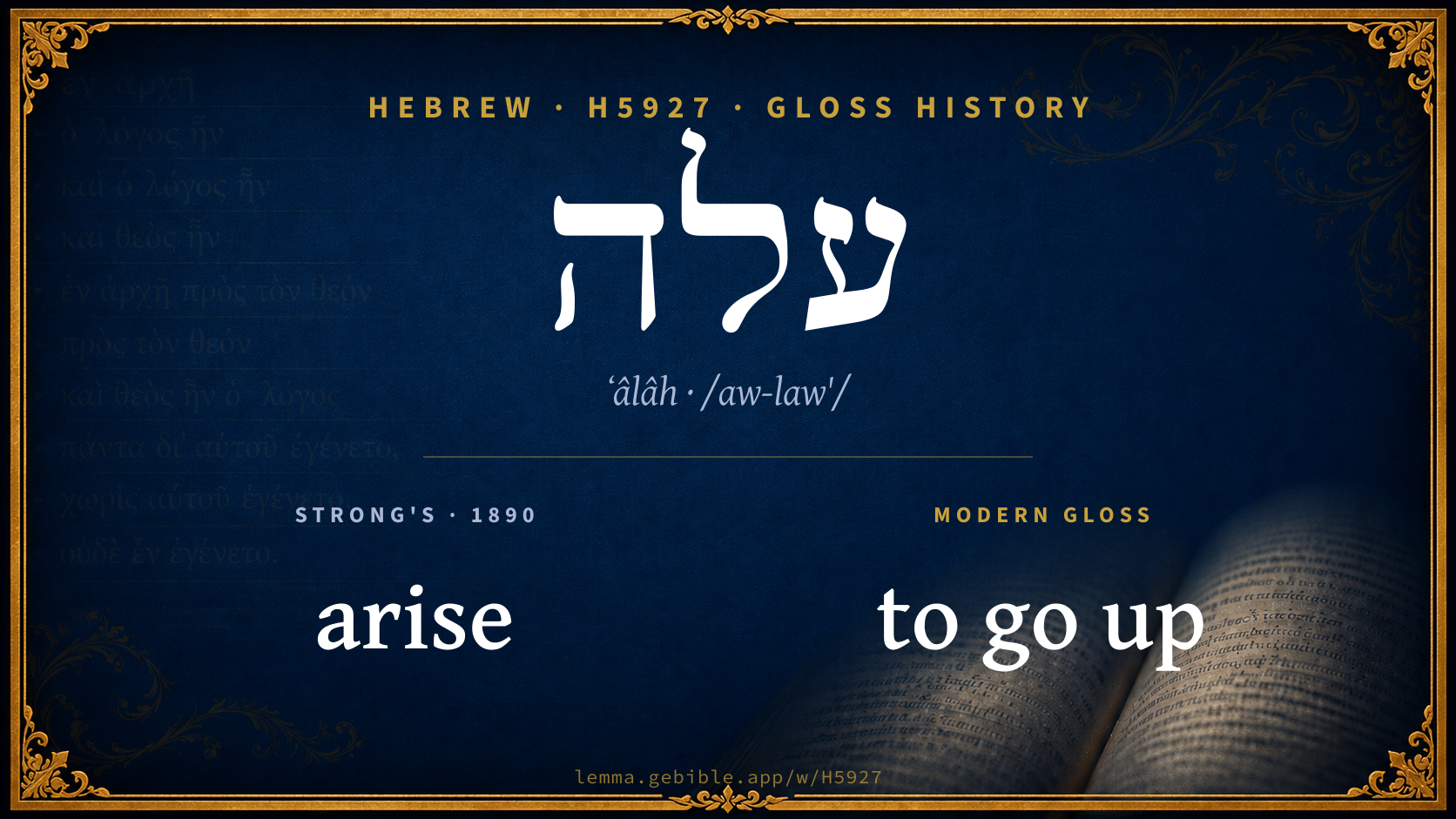
Gloss history
Strong's 1890 vs modern scholarship
About this word
Strong's H5927 catalogs a Hebrew word from the Hebrew Old Testament.
These counts are not copied from any lexicon or concordance. They are computed here, from the morphology-tagged Hebrew Old Testament. What Lemma adds →
- 817
- distinct verses
- The word appears in 817 distinct verses.
- 36 / 39
- OT books
- The word appears in 36 of 39 Old Testament books.
- #47
- by frequency
- Top 50 most frequent Hebrew words (rank 47 of 8,640 Hebrew words by occurrence).
View all 817 occurrences in the concordance →
By section of the Old Testament
By traditional corpus
Conventional, traditional groupings — biblical authorship is debated, so this is a traditional corpus grouping, not an authorship claim. Each share is this word’s portion of its verses in that division of the Hebrew canon. Each figure is a share of the word’s 817 distinct verses.
- Prophets (Nevi'im) 481 verses · 59%
- Torah (Pentateuch) 187 verses · 23%
- Writings (Ketuvim) 149 verses · 18%
How translations render this word
Counts come from each version’s own published word-to-Strong’s tagging or interlinear alignment — an approximate guide to how each version renders this word, not a word-level alignment the data otherwise carries. Because each total is that version’s own tagged count, the per-version totals vary from one another and need not match the appearance or distinct-verse counts above. These counts may also differ from a printed concordance because Lemma counts each distinctly tagged rendering and does not collapse phrase taggings into a single head-word total. This is a fixed set of word-tagged versions (KJV, ASV, BSB, ULT) and does not change with the reading translation you choose elsewhere. Each version’s license is shown beside its name below (and on Sources).
- King James Version: Went up 114×, Go up 55×, Came up 49×
- American Standard Version: Went up 116×, Came up 42×, Go up 37×
- Berean Standard Bible: Went up 75×, Go up 63×, Came up 24×
- unfoldingWord Literal Text: Went up 133×, Go up 107×, And 88×
King James Version Public Domain
Renders H5927 across 894 tagged occurrences — most commonly:
Plus other, less common renderings. Plus 260 renderings that appear only once — usually multi-word phrases or single function words the recovered tagging swept in, not distinct renderings. Not rendered by a distinct English word in 1 further occurrence.
American Standard Version Public Domain
Renders H5927 across 900 tagged occurrences — most commonly:
Plus other, less common renderings. Plus 296 renderings that appear only once — usually multi-word phrases or single function words the recovered tagging swept in, not distinct renderings.
Berean Standard Bible Public Domain
Renders H5927 across 873 tagged occurrences — most commonly:
Plus other, less common renderings. Plus 286 renderings that appear only once — usually multi-word phrases or single function words the recovered tagging swept in, not distinct renderings. Not rendered by a distinct English word in 15 further occurrences.
unfoldingWord Literal Text CC BY-SA 4.0
Renders H5927 across 1,088 tagged occurrences — most commonly:
Plus other, less common renderings. Plus 214 renderings that appear only once — usually multi-word phrases or single function words the recovered tagging swept in, not distinct renderings.
49 senses and sub-senses in the full BDB
Hebrew verbs can shift meaning by stem (binyan): Qal is the basic action, Niphal is often passive or reflexive, Piel often intensifies or makes it factitive, and Hiphil is typically causative. The senses below are grouped under the stem BDB assigns to each. This entry also uses Hophal (the passive of Hiphil) and Hithpael (reflexive or reciprocal).
What do BDB’s symbols mean?
BDB uses these scholarly abbreviations:
| Symbol | Meaning |
|---|---|
| 𝔊 | the Septuagint (the ancient Greek translation, LXX) |
| 𝔙 | the Vulgate (the Latin translation) |
| 𝔖 | the Syriac version (the Peshitta) |
| 𝔗 | the Targum (the Aramaic translation) |
| ψ | the Psalms |
| √ | root (the underlying root or stem) |
| ‖ | parallel passage (a synonymous or contrasted parallel) |
| † | the dagger: every passage where the word occurs is cited |
The 49 senses and sub-senses the full Brown-Driver-Briggs lexicon distinguishes for this word, in lexicon order (not ranked by frequency), with BDB’s own verbatim wording and sub-sense lettering. Shown in Hebrew script with BDB’s own scholarly abbreviations. The condensed entry is in the Lexicon Entry tab. See also the Forms in the corpus table below.
Qal
- Pf. 3 ms. ע׳ Gn 19:15 +; 3 fs. עָֽלְתָה 40:10 +; עָלָ֑תָה Je 14:2 1 S 1:22; 2 ms. עָלִיתָ Gn 49:4 +, etc.; Impf. 3 ms. יַעֲלֶה 2:6 +, יַ֫עַל 44:33 +, וַיַּעַל 13:1 +; sf. יַעֲלֶנָּה Is 35:9, etc.; Inf. abs. עָלֹה Gn 46:4 + 2 times; cstr. עֲלוֹת 32:25 +, etc.; Imv. עֲלֵה 35:1 +; fs. עֲלִי Nu 21:17 +, pl. עֲלוּ Gn 44:17 +; Pt. עֹלֶה 38:13 +; עוֹלֶה Is 24:18 +, pl. עֹלִים Gn 28:12 +, etc.;— e.g. Genesis 19:15
- 1. of persons, go up, ascend, in local relations:
- a. from low place to high, c. מִן, מִמִּצְרַיִם Gn 45:25 (E) + 6 times; מארץ מצרים Ex 13:18 (E) + 3 times; †מִבָּבֶל Ezr 7:6; 8:1; מִן הירדן Jos 4:16, 17, 19 (P); ם(ן־ה)מדבר Ct 3:6; 8:5 etc. e.g. Genesis 45:25
- b. out of a place, c. מִן, מִן הארץ 1 S 28:13; מֵהַבְּאֵר 2 S 17:21; הַפַּחַת (תּוֹךְ)םִ Is 24:18 Je 48:44. e.g. 1 Samuel 28:13
- c. c. acc. of place whither: a city ביתאל Gn 35:1, 3 (E); באר שׁבע 26:23 (J); a mountain ההר Nu 13:17 (JE) Dt 1:24 +, etc.; a bed Gn 49:4(×2) (J) 2 K 1:4, 16, gate Ru 4:1; (הַ)שָּׁיִם Dt 30:12; 2 K 2:11 Am 9:2 + 4 times; c. אֶל־, אל (ה)הר Ex 19:23; 34:2, 4 (J) 24:15, 18 (P) + 5 times P; אֶל־הַמָּקוֹם Dt 17:8, אל ירושׁלם Ezr 7:7; Is 2:3 = Mi 4:2 (אל הר), c. acc. loc. + אֶל־י׳ (v. 2 b) Je 31:6, of going up to Jerusalem (from a distance), etc.; c. לְ to, לירושׁלם Ezr 1:3 (from Babylon); לבית 1 S 25:35, etc.; c. עַד unto, עד־נחל Nu 32:9 (J); †c. בְּ, בְּאַחַת עָרֵי 2 S 2:1 (constr. praegn.); בְּבעל פְּרָצִים 1 Ch 14:11, בָּהָר Dt 5:5; בְּגֹרָלִי Ju 1:3. e.g. Genesis 35:1
- d. to sacred places, Ex 34:24, c. acc. †בית יהוה, from palace 2 K 19:14; 20:5, 8; 23:2; 2 Ch 29:20; 34:30; Is 37:14; 38:22 Je 26:10; במה 1 S 9:13, 14, 19; c. אֶל, אל הר האלהים Ex 24:13 (E); בּבית י׳ 1 S 1:7 (בּ dittogr.); בהר יהוה ψ 24:3. e.g. Exodus 34:24
- e. c. acc. דֶּרֶךְ by the way to †Nu 21:33 (E) Dt 3:1; Ju 8:11; 1 S 6:9; 2 K 3:8; מעלה Je 48:5; חוֹמָה Jo 2:7. e.g. Numbers 21:33
- f. ascent, climb, c. בְּ by, a ladder Gn 28:12 (E), Ez 40:6, 22, 49, etc.; c. עַל upon, altar by (ב) steps, of priest, Ex 20:23 (Gi van d. H. v 26; E) the roof Jos 2:8 Ju 9:51, bed ψ 132:3; עַל־יָדָיו on his hands 1 S 14:13; על במתי עב Is 14:14 (‖ ממעל לכוכבי אֵל), etc. e.g. Genesis 28:12
- 2. go up, in personal relations:
- a. to meet or visit, c. אֶל pers., Gn 44:17, 24, 34; 45:9 (J) Jos 10:4, 6 (all with implication of ascent), Dt 25:7 (to gate of city), +; c. †על pers., Gn 38:12 (+ ה loc., up to Timnah); לקראת 46:29 (J) Ju 6:35; 2 K 1:3, 6, 7 e.g. Genesis 44:17
- b. go up unto (אֶל) God, on a height, אל האלהים Ex 19:3 (E) 1 S 10:3; אל יהוה Ex 24:1 (E) 19:24; 32:30 (J) Ju 21:5(×2), 8 (to war); אֵלַי Ex 24:12 (E) Dt 10:1; unto Deborah Ju 4:5. e.g. Exodus 19:3
- c. go up, in war, c. אֶל against Nu 13:31 (E) Ju 1:1; 12:12:3 1 S 7:7 Is 36:10 (= על 2 K 18:25) +; oftener c. על, 1 S 14:10 Ju 6:3; 15:10; 18:9; 1 K 14:25 +; c. על + לַצָּבָא Jos 22:12, 33 (P); c. בְּ, Is 7:6; Je 48:18; c. לְ, Hb 3:16; + למלחמה Ju 20:18 + 3 times; + במלחמה 1 S 29:9; וַתּעל(ה) המלחמה 1 K 22:35 = 2 Ch 18:34. e.g. Numbers 13:31
- d. go up after, c. אחרי = follow 1 S 25:13; 1 K 1:35, 40. e.g. 1 Samuel 25:13
- e. go up, depart, c. מֵעַל (q.v.) 1 S 6:20 Gn 17:22; 35:13 (P) +, subj. כבוד י׳ Ez 11:23, 24; = withdraw, retreat, 1 K 15:19; 2 K 12:19; Je 21:2, abs. 2 S 23:9, and so read ‖ 1 Ch 11:13 (v. DrSm). e.g. 1 Samuel 6:20
- 3. of animals, go or come up: abs. frogs Ex 7:28 (J) 8:2 (P), quails Ex 16:13 (P); lion Is 35:9; fox Ne 3:25; rise up, fly up, eagle Is 40:31; Je 49:22; c. מִן, cattle out of water Gn 41:2, 3, 18, 19 Ct 4:2; 6:6, lion מִגְּאוֹן הַיַּרְדֵּן Je 49:19 = 50:44, מִסֻּבְּכוֹ Je 4:7, from prey Gn 49:9 (J); climb up into (ב) houses, locusts Jo 2:9; frogs, on (ב) persons Ex 7:29 (J); c. על, of cattle, sexually Gn 31:10, 12 (E); locusts upon the land Ex 10:12, 14 (E) Jo 1:6. e.g. Exodus 7:28
- 4. of vegetation, spring up, grow, shoot forth: trees Is 55:13(×2) Ez 47:12; קיקיון Jon 4:6; grass Dt 29:22; Am 7:1; ears of grain Gn 41:5, 22 (E), also Gn 40:10 (E) Is 5:6; 32:13 cf. sim. 53:2; Ho 10:8; Pr 26:9; ע׳ כֻלּוֹ קמשׂנים Pr 24:31 all of it grown up with thorns, Is 34:13; fig. קֶרֶן Dn 8:3, 8. e.g. Isaiah 55:13
- 5. of natural phenom. go up, rise: dew, Ex 16:14, i.e. disappear (P); אֵד ע׳ מִן־הָאָרֶץ Gn 2:6 (J), cloud 1 K 18:44; Je 4:13; ע׳ הַשַּׁחַר dawn, etc. Gn 19:15 (JE) Ju 19:25; 1 S 9:26 +; smoke Gn 19:28; Ex 19:18 (J) Ju 20:40 +; fire 6:21; flame 13:20; stench Is 34:3; Jo 2:20; incense Ez 8:11; well Nu 21:17 (E); waters Je 47:2; Nile Je 46:7, 8; Am 8:8; 9:5; c. על, of overflow Is 8:7 +. e.g. Exodus 16:14
- 6. of inanimate things (instead of passive construction), abs., shock of grain (to גֹּרֶן) Jb 5:26; of בָּשָׂר (covering bones in Ezek.’s vision) Ez 37:8; c. על, of garments upon the body Lv 19:19 (P) Ez 44:17; razor on head Ju 13:5; 16:17; 1 S 1:11; yoke upon oxen Nu 19:2 (P) 1 S 6:7; lot upon an animal Lv 16:9, 10 (P); c. בְּ, weight in balance ψ 62:10; entry in (ב) a book 1 Ch 27:24; = be offered (of sacrif.) 1 K 18:29; 2 K 3:20; Is 60:7; אֲרוּכָה (q.v.) in healing, Je 8:22, fig. 2 Ch 24:13; Ne 4:1. e.g. Job 5:26
- 7. of thoughts, ע׳ על לב 2 K 12:5; Is 65:17 + 5 times; ע׳ על לבב Je 51:50; Ez 38:10; ע׳ אל לב 14:7; ע׳ על רוּחַ 20:32; of anger 2 S 11:20; 2 Ch 36:16 (ב pers.) + 3 times; temper Ec 10:4 (עָלֶיךָ). e.g. 2 Kings 12:5
- 8. come up before God, arrogance, בְּאָזְנָיו 2 K 19:28 = Is 37:29; cry, אֶל־א׳ Ex 2:23 (P), c. acc. 1 S 5:12, abs. Je 14:2; tumult ψ 74:23; of evil Jon 1:2 (לְפָנַי). e.g. 2 Kings 19:28
- 9. go up, extend, of boundary, c. מִן whence, + acc., אֶל, לְ and even בְ whither Jos 15:3, 6, 8; 18:12(×2) + (all P). e.g. Joshua 15:3
- 10. excel: thou excellest (עַל) them Pr 31:29; be superior to יעלה עליך מעלה מעלה Dt 28:43.—עוֹלֶה Jb 36:33 is difficult, cf. Comm., and v. עַוְלָה. e.g. Proverbs 31:29
Niphal
- Pf. 3 ms. נַעֲלָה Nu 10:11 +; 2 ms. נַעֲלֵיתָ ψ 97:9; Impf. יֵעָלֶה Ex 40:37, etc.; Inf. cstr. הֵעָלוֹת Nu 9:17 +, etc.; Imv. mpl. הֵעָלוּ 16:24;— e.g. Numbers 10:11
- 1.
- a. be brought up: מבבל לירושׁלם Ezr 1:11. e.g. Ezra 1:11
- b. be taken up, וַתֵּעֲלוּ על שׂפת לשׁון Ez 36:3 (Köi 553; talked about). e.g. Ezekiel 36:3
- c. (1) pass., be taken up, away, of (pillar of) cloud, sq. מֵעַל of tabern. Ex 40:36; Nu 9:17; 10:11 (P); abs. Ex 40:37(×2); Nu 9:21(×2), 22 (P); of the glory from upon the cherubim Ez 9:3; (2) reflex., take oneself away from, get up from: מִסָּבִיב Nu 16:24; מֵעַל v 27; of a besieging army Je 37:5, 11. e.g. Exodus 40:36
- 2. reflex.: take oneself away מאחרי pers., from following after, 2 S 2:27. e.g. 2 Samuel 2:27
- 3. be exalted, of God ψ 47:10; c. על, over all gods 97:9. e.g. Psalms 47:10
Hiphil
- Pf. הֶעֱלָה Nu 8:3 +, הֵעֲלָה Hb 1:15 (Ges§ 63 p); sf. הֶעֶלְךָ Ne 9:18, הֶעֱלָנוּ Ex 32:1 + 2 times; 3 fs. וְהַעַלְתָה 1 S 2:19 consec.; sf. הֶעֱלָ֫תַם Jos 2:6; 2 ms. הֶעֱלִיתָ Ex 33:1 +; וְהַעֲלִיתָ Dt 27:6 +; הֶעֱלֵיתָ Ex 32:7; וְהַעֲלֵיתָ consec 40:4; 1 p. הֶעֱלִיתִי Am 2:10; 2 mpl. sf. הֶעֱלִיתֻנוּ Nu 20:5; 21:5, etc.; Impf. יַעֲלֶה Lv 17:8 +; וְיַ֫עַל 2 S 24:22; וַיַּעֲלֶה Je 10:13; וַיַּ֫עַל Gn 8:20 +, sf. יַעְלֵם Dt 28:61, etc.; Inf. abs. הַעֲלֵה Ez 23:46; cstr. הַעֲלוֹת 1 Ch 23:31 +, etc.; Imv. הַ֫עַל Ex 33:12 + 2 times; fs. הַעֲלִי 1 S 28:8, 11 +, etc.; Pt. מַעֲלֶה 7:10 +; cstr. מַעֲלֵה Lv 11:4 +; sf. מַעַלְךָ Dt 20:1 ψ 81:11; f. מַעֲלָה Lv 11:26; cstr. מַעֲלַת Lv 11:3, 6; Dt 14:6, etc.;— e.g. Numbers 8:3
- 1. bring up persons:
- a. from a place, c. מִן: מִן הַסָּ֑לַע Ju 15:13; מִמִּצְרַיִם Ex 17:3 (E) + 3 times E, + 8 times; מארץ מצרים Ex 32:1 (J) + 5 times J, + Lv 11:45 (P), Dt 20:1; Jos 24:17 (E), + 13 times; מארץ צפון Je 16:15 = 23:8. e.g. Judges 15:13
- b. (1) out of a place, c. כן: †םִ(ן הַ)בּוֹר Gn 37:28 (E) ψ 40:3 Je 38:10; 13; משּׁחת Jon 2:7; מקּברות Ez 37:12, 13; מן־שׁאול ψ 30:4, etc.; (2) c. בְּ by means of, בְּחֶרְמִי Ez 32:3 (Hb 1:15 v. 3 infr.). e.g. Genesis 37:28
- c. c. acc. of place whither, Nu 20:25 (P) 22:41 (E) Jos 2:6; 7:24 (J) Ezr 4:2; השׁמים 2 K 2:1; c. אֶל: אֶל־הָעֲלִיָּה 1 K 17:19; c. לְ: לבית 2 Ch 8:11. e.g. Numbers 20:25
- d. cause to ascend, climb: על המרכבה 1 K 20:33 (אֶל 2 K 10:15 prob. error), על־המגדלות 2 Ch 32:5 (𝔙 built towers thereon, i.e. ע׳ עָלָיו); מֵעַל לחומה Ne 12:31 vid. עַל IV 2 e. e.g. 1 Kings 20:33
- 2. in personal relations:
- a. bring up, c. אל, 1 S 19:15 2 K 10:15; 25:6; Je 39:5; 52:9; c. לְ, 1 S 28:8, 11(×2). e.g. 1 Samuel 19:15
- b. in war, c. עַל against 2 Ch 36:17; Je 50:9; Ez 16:40; 23:46; 26:3. e.g. 2 Chronicles 36:17
- c. take away (from life) ψ 102:25 Jb 36:20. e.g. Psalms 102:25
- 3. bring up animals, c. על, frogs על הארץ Ex 8:1, 3 (P); bring up horses to a charge Je 51:27, cf. Na 3:3; draw up men, under fig. of fish (בְּחַכָּה) Hb 1:15; train, young lion Ez 19:3; of cattle, מעלה גֵרָה, i.e. chewing the cud Lv 11:3, 4(×2), 5, 6, 26 Dt 14:6, 7(×2) e.g. Exodus 8:1
- 4. cause to ascend: c. acc. rei, smoke מן העיר Ju 20:38; stench באף Am 4:10, etc.; bring waters upon, על Is 8:7; bring up from (מן loc.) 2 S 6:2, 12; 1 K 8:1; Gn 50:25 (JE), +; c. אֶל loc., Ju 16:3; 1 Ch 15:3, 12, c. acc. loc. 2 Ch 2:15; c. אל pers. 1 S 6:21; c. לְ pers. Ju 16:8; 1 S 2:19; c. על, bring sickness upon Dt 28:61; †הע׳ עפר על ראשׁ throw dust on the head Jos 7:6; La 2:10; Ez 27:30; clothe sackcloth upon Am 8:10; flesh upon Ez 37:6; put ornaments on 2 S 1:24; cf. also 1 K 10:16, 17 = 2 Ch 9:15, 16; 2 Ch 3:5, 14; הע׳ נֵר light lamp (make flame go up; Thes; al. of raising lamp upon the lamp-stand) Ex 25:37; 27:20 + 6 times P; bring up new flesh (heal; v. אֲרוּכָה Je 30:17; 33:6. e.g. Judges 20:38
- 5. mentally: הע׳ גִּלּוּלִים על לב Ez 14:3, אל לב v 7, i.e. make object of thought; rouse, stir up, c. acc. אַף, anger Pr 15:1, cf. Ez 24:8. e.g. Ezekiel 14:3
- 6. הע׳ מנחה ל׳ 2 K 17:4 offer a present; bring up tithe to (ל) Ne 10:39; הע׳מַם raise a levy 1 K 5:27; 9:15, למם v 21 2 Ch 8:8. e.g. 2 Kings 17:4
- 7. exalt: ψ 137:6 if I exalt not Jerus. above (עַל) my chief joy; אנכי אַעַלְךָ גם־(מ)עלה Gn 46:4 (E) I will exalt thee exceedingly (cf; Qal 10; מ lost in MT, after ם; Di and most bring up). e.g. Psalms 137:6
- 8. cause to ascend (in flame; Thes al. to go up on altar), offer sacrifice, usually עֹלָה, either alone or foll. by other sacrif.: העלה עלות Ex 24:5 (E) 32:6 (J) Lv 17:8 (H) Dt 12:13, 14 + (see עֹלָה); seldom: †קטרת Ex 30:9 (P), cf. ψ 66:15; †מנחה Is 57:6; 66:3, also prob. 1 K 18:29, 36; 2 K 3:20 (> Qal); פר(ים) Nu 23:2, 4, 14, 30 (E) ψ 51:21; הטוב בעיניו 2 S 24:22; הע׳ ליהוה Ju 13:16; abs. 2 Ch 8:13; 29:29; †הע׳ לעולה Gn 22:2, 13 (E); c. acc. loc. מַעֲלֶה בָמָה Je 48:35; מזבח(ה) Lv 14:20 (P) Is 60:7 (> Qal); c. לְ loc. 2 Ch 29:27; c. בְּ loc. Gn 8:20 (J) Nu 23:2, 4, 14, 30 (E); עַל־הַחֹמָה 2 K 3:27; usually על loc., על הַצּוּר Ju 13:19, הע׳ על מזבח 1 K 12:32, 33(×2); 2 K 16:12; 2 Ch 1:6; 29:21; 1 S 2:28, פרים על מזבח ψ 51:21; elsewhere הע׳ עלות על מזבח Ex 40:29 (P) Jos 22:23; 1 K 3:4; 9:25; 2 Ch 1:6; 35:16; Ezr 3:2; Ez 43:18, הע׳ עלות ליהוה על מז׳ Dt 27:6;Jos 8:31; 1 Ch 16:40; 2 Ch 8:12; Ezr 3:3. e.g. Exodus 24:5
Hophal
- Pf.;—
- 1. be carried away, 3 fs. הֹעֲלָ֑תָה Na 2:8. e.g. Nahum 2:8
- 2. be taken up into, inserted in 3 ms. הֹעֲלָה 2 Ch 20:34 (על ספר) (pass. of Qal 6). e.g. 2 Chronicles 20:34
- 3. 3 ms. be offered, of פר Ju 6:28 (על המזבח). e.g. Judges 6:28
Hithpael
- lift oneself: Impf. 3 ms. אֶל־יִתְעַל Je 51:3 against (him that) lifts himself, but corrupt; either read אַל־, let him not, etc. (𝔖 𝔗 𝔙 Hi Gf Gie Rothst), or del. אל (𝔊 CoHpt). e.g. Jeremiah 51:3
Senses from the full Brown-Driver-Briggs lexicon (Brown, Driver, Briggs; Oxford 1906 — public domain), digitized via Sefaria, supplemented by the OpenScriptures HebrewLexicon (CC BY 4.0). Full attribution on Sources.
Word origin
vb. go up, ascend, climb (NH id.; MI 33 (?); Ph. עלה; Assyrian elû; Arabic عَلَا; 𝔗 and Syriac in der. species; cf. perhaps Ethiopic ለዐለ: (for ለዐዐለ: ዐልዐለ: Di 54); Sab. עלי = عَلَّى DHMZMG xxxvii. 415, cf. עלוהו = عُلْوَهُ Sab Denkm 91);—
— Brown-Driver-Briggs (Oxford 1906, public domain), digitized via Sefaria, supplemented by the OpenScriptures HebrewLexicon (CC BY 4.0). See Sources.
Origin: a primitive root
Jastrow Dictionary
A second Hebrew/Aramaic lexicon for comparison, covering Aramaic and post-biblical (Talmudic, Targumic, Midrashic) usage that the biblical-Hebrew BDB does not. Matched by lemma rather than by Strong’s number, so a lemma may carry more than one Jastrow headword (shown separately below), and the entries cover usage well beyond the Bible.
עָלֶה
- [cover,] foliage, leaf. Gen. R. s. 19 (play on עֲלֵי תאנה, Gen. III, 7) ע׳ שהביאו תואנה וכ׳ the leaves which brought grief into the world; Yalk. ib. 27 ע׳ שהביא וכ׳. Shebi. VII, 1 עֲלֵה הלוף השוטה, v. לוֹף; a. fr.—Pl. עָלִים, עָלִין; constr. עֲלֵי. Y. ib. V, 35ᵈ bot. מהוצאת ע׳ ועד וכ׳ from the sprouting of leaves to the coming forth of buds of fruits there is an interval of fifty days. Ib. עלי בצלים leaves of onions. Ḥull. 92ᵃ ע׳ שבה וכ׳ the leaves thereon (on the vine Israel) are the untutored, v. אֶשְׁכּוֹל; a. fr. e.g. Genesis 3:7
עִלָּה
- , v. עִילָה
עָלָה
- , v. עלי
עלי
- (b. h.) to go up, rise; to come up, arrive. Pes. VIII, 3 מי שיַּעֲלֶה מכם וכ׳ whichever of you shall first arrive at Jerusalem (for the Passover), v. infra. Snh. X, 3 אינה עתידה לַעֲלוֹת shall not rise (from the grave at the time of resurrection). Y. Peah V, end, 19ᵃ (ref. to גבול עולם, Prov. XXII, 28) זו עוֹלֵי מצרים this refers to those who came up from Egypt; Ḥag. 3ᵇ. Ib. עולי בבל those who came back from Babylonia. Ber. 20ᵃ, a. e. (ref. to Gen. XLIX, 22) א"ת עֲלֵי עין אלא עוֹלֵי עין read not ‘ăle ‘ayin, but ‘ole ‘ayin, those rising above the (evil) eye (whom the evil eye cannot affect). Snh. 111ᵃ כשע׳ משה למרום when Moses came up to heaven. Keth. 61ᵃ עוֹלָה עמו וכ׳ she rises with him, but does not go down with him, i.e. the wife rises to the husband’s social position and can claim its comforts, if it be a higher one than her own, &c.; a. v. fr.—Ḥull. 17ᵇ עוֹלֶה ויורד בסכין a going up and down in a slaughtering knife, i.e. a curved blade.—קרבן עולה ויורד, v. יָרַד.—עלה על דעת, v. דַּעַת.—Esp. to be put on the altar, be offered. Zeb. IX, 1 אם עָלְתָה לא תרד if it has been offered, it must not be taken down again. Ib. 2. Men. 22ᵇ מכאן לעוֹלִין שאינן מבטלין וכ׳ this proves that things which are offered up (e.g. blood of several sacrifices that has become mixed up) do not neutralize one another. Ib. 23ᵃ חיבורי עולין that which is attached to things which go on the altar; a. fr.—Idiomatic uses: a) (sub. לחשבון) to be counted in; to be accounted as. M. Kat. III, 5 שבת עולה ואינה וכ׳ the Sabbath counts as one of the seven days of mourning, and does not discontinue the mourning, i.e. the mourning continues after the Sabbath; רגלים מפסיקין ואינן עולין festivals discontinue (the mourning begun before), but do not count, i.e. if the burial took place on a festive day, the mourning days begin after the festival. Ab. IV, 13 עוֹלָה זדון, v. זָדוֹן. Zeb. I, 3 לא עָלוּ לבעלים משום חובה the owners of the sacrifices are not credited with them as a compliance with their obligation; a. fr.—b) to rise in value; to be esteemed. Ab. l. c. וכתר שם טוב עוֹלֶה על גביהן the crown of a good name is worth more than all of them; a. e.—c) [to rise on the scale, be outweighed,] to be void, be neutralized (cmp. בָּטֵל). Ter. IV, 7 תרומה עולה באחד ומאה T’rumah (mixed up in secular matter) is neutralized in one hundred and one (i.e. one against one hundred). Ib. 11 תַּעֲלֶה באחד ומאה is neutralized in &c.; לא תעלה is not neutralized. Ib. 13; a. fr.—d) ע׳ לרגל, or ע׳ to go up (to Jerusalem and the Temple) for the festival. Yoma 21 בשעה שישראל עולין לרגל when the Israelites were in the Temple on the festivals. Ḥag. I, 1. Ib. 4ᵃ שאינן ראויין לעלות who are not fit for the pilgrimage. Pes. 8ᵇ, a. e. עוֹלֵי רגלים pilgrims; a. fr.—e) ע׳ בידו to obtain, achieve. Ber. 35ᵇ עָלְתָה בידן they were successful. Naz. 23ᵃ מי שנתכוון לעלות בידו בשר חזיר וע׳ בידו בשר טלה he who intended to obtain flesh of the swine, and happened to obtain mutton; a. fr. e.g. Proverbs 22:28
- 1. to elevate, exalt, praise. Sabb. 33ᵇ יהודה שעי׳ יִתְעַלֶּה Judah who elevated (praised the Roman government), shall be elevated (to high office). Y. Snh. X, 29ᶜ top שעִילּוּ אותי וכ׳ who exalted me &c., v. זָבַח. Gen. R. s. 15 (ref. to וישם, Gen. II, 8) עי׳ אותו God raised him (made him a dignitary, by analogy to Deut. XVII, 15); a. fr. e.g. Genesis 2:8
- 2. to prize, to acquire at the highest price, bid for. Gen. R. s. 16 (ref. to ויקח, Gen. II, 15) עי׳ אותו he acquired him (by analogy to Is. XIV, 2; v. infra Hithpa.); Yalk. ib. 22. Gen. R. s. 40 (ref. to ויעלו, Jer. XXXVIII, 13) מְעַלִּין אותו (or מַעֲלִין, Hif.) they bade for him. e.g. Genesis 2:15
- 1. to raise, bring up. Makhsh. VI, 1 המַעֲלֶה פירותיו וכ׳ if one carries his fruits up to the roof, v. כְּנִימָה; Tosef. ib. III, 1. Pesik. R. s. 26 ובקושי הֶעֱלוּהוּ and with hard work they brought him up (out of the pit); a. v. fr.—Esp. to offer on the altar. Zeb. XIV, 3 המַעֲלֶה מבשר וכ׳ he who offers parts of the flesh of a sin offering &c. Ib. XIII, 1 שחט בפנים וה׳ בחוץ if he slaughtered a sacrifice within the Temple precincts, and offered it without; a. v. fr.
- 2. to raise, promote to a higher dignity. Yoma 20ᵇ, a. fr. מַעֲלִין בקדש ולא מורידין we may promote (a person or thing) to a higher grade of sanctity, but must not degrade. Tosef. Ned. VI, 5 שמעלה … מטומאתן which raises (relieves) the unclean from their uncleanness; Ned. 75ᵇ; Y. ib. X, 42ᵃ; a. fr.—לא מעלה ולא מוריד, v. יָרַד.—Idiomatic uses: a) to cause to go up from the reader’s place (which was low, v. תֵּיבה); to remove, discharge. Ber. 29ᵃ ולא הָעֱלוּהוּ and they did not remove him. Ib. טעה … מעלין אותו if a reader makes a mistake in the twelfth section of the T’fillah (v. מִין III), he must be removed; a. fr.—b) (v. Kal, c) to neutralize. Ter. IV, 8 תאנים שחורות מַעֲלוֹת וכ׳ black figs help to neutralize in conjunction with white ones, i.e. the black and the white secular figs are counted together against the admixture of figs of T’rumah whether black or white; a. fr.—c) (v. Kal, a) to account, credit or charge. B. Mets. 69ᵇ אני אעלה לך סלע וכ׳ I will give thee credit for one Sela each month (as a compensation for the use of the cow). Ab. II, 2 מעלה אני עליכם וכ׳ I (the Lord) shall credit you with a large reward, just as if you had accomplished (the good you had intended to do). Ib. III, 7, sq. מעלה עליו הכתוב כאילו וכ׳ the Bible text (the Lord) charges him as if he had endangered his life (v. חוּב). Yoma 81ᵇ מעלה עליו הכתוב כאילו וכ׳ it is accounted to his credit, as if he had fasted on the ninth and the tenth; a. fr.—d) (v. Kal, e) to succeed, profit. Snh. 90ᵇ הֶעֱלֵיתֶם בידכם, v. יָעַל.—f) ה׳ חן to effect grace; to find favor. Gen. R. s. 9 הלואי תהא מַעֲלַת חן לפני … כשם שהֶעֱלִית וכ׳ Oh, that thou wouldst find favor before me (please me) at all times, as thou dost now; a. e.—g) ה׳ חֵמָה [to let anger rise,] to become angry. Gen. R. s. 93 בשעה שהיה יהודה מעלה ח׳ וכ׳ whenever Judah got angry, the hair &c.; a. e.—h) (with or sub. ארוכה) to heal up. Ḥull. 77ᵃ, v. אֲרוּכָה II. Shebi. IV, 6 לא שיַעֲלֶה, v. פָּשַׁח; a. fr.
- to be removed, withdraw. Tosef. Yoma I, 12 בעון … שכינה נַעֲלַת through the sin of bloodshed has the Divine Presence withdrawn (Sifré Num. 161 מסתלקת).
- 1. to be raised, exalted. Sabb. 33ᵇ, v. supra; a. e.
- 2. to be raised in price, to be bargained for at auction. Gen. R. s. 40, end (ref. to וַתֻּקַּח, Gen. XII, 15) מִתְעַלָּה והולכת חד וכ׳ higher and higher prices were offered for her; one said, I give &c.; Esth. R. to II, 16 (ref. to ותלקח, ib.) מתעלה בליקוחין. e.g. Genesis 12:15
A Dictionary of the Targumim, the Talmud Babli and Yerushalmi, and the Midrashic Literature (Marcus Jastrow; London, Luzac, 1903) — Public Domain. Digitized via Sefaria. Digitized via Sefaria. Full attribution on Sources.
Forms in the corpus
The 485 distinct written forms H5927 takes in the Hebrew Bible, most frequent first — each parse links to that stem’s occurrences in the concordance. Hebrew forms include their vowel points and cantillation, so a single lemma takes many written forms.
The 60 most common forms are shown; 425 rarer forms follow in the full concordance.
Same root — word family
Other BDB entries built from the same root as H5927, grouped by Strong’s listed origin. These share a root / origin per the lexicon — not necessarily a shared meaning. Each links to that word’s own entry.
Derived from this word
- מעל maʻal H4605 above
- מעל môʻal H4607 lifting
- מעלה maʻăleh H4608 ascent
- על ʻal H5920 above
- עלה ʻâleh H5929 leaf
- עלה ʻôlâh H5930 burnt offering
- עלה ʻillâh H5931 matter
- עלי ʻĕlîy H5940 pestle
- עלי ʻillîy H5942 upper
- עליה ʻălîyâh H5944 roof chamber
- עלית ʻallîyth H5952 roof chamber
- תעלה tᵉʻâlâh H8585 conduit
Proper names from this root
People and places named from this root — a name, not an additional meaning of the word.
Compare all same-root words → Showing 4 of 17 — not the complete family. 4 of the same-root words are proper names (people or places). They share a root, not necessarily a meaning.
Septuagint verse parallels
This word appears in 768 verses that also exist in the Greek Old Testament (Septuagint), out of the 817 Hebrew verses it occurs in. You can read those verses in Greek by switching the Old Testament edition to the Septuagint.
Read these verses in the Septuagint
- Genesis 2:6
- Exodus 1:10
- Leviticus 2:12
- Numbers 8:2
- Deuteronomy 1:21
- Joshua 2:6
- Judges 1:1
- Ruth 4:1
- 1 Samuel 1:3
- 2 Samuel 1:24
- 1 Kings 1:35
- 2 Kings 1:3
This is a verse-level parallel only — the same verses exist in both the Hebrew and Greek Old Testaments. No word-level Hebrew↔Greek correspondence is claimed: the data carries no such alignment, so no Greek word is shown as this Hebrew word’s translation. Coverage is not total — the Septuagint omits the deuterocanon and renumbers the Psalms, so some Hebrew verses have no direct Greek parallel.