
Exodus 10:14

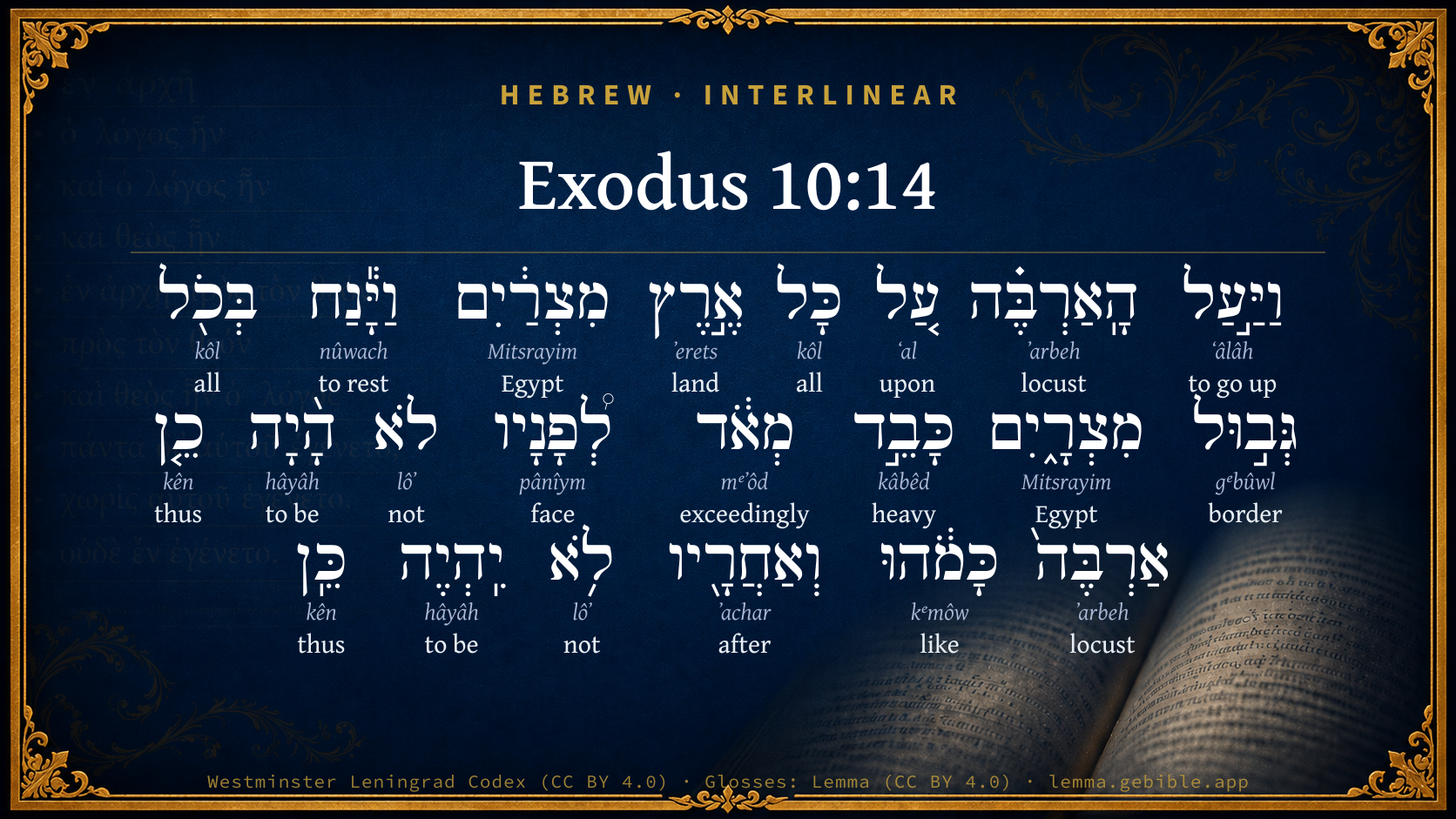
Hebrew (Westminster Leningrad Codex) Exodus 10:14 appears in the Hebrew Old Testament. The text above is from the Westminster Leningrad Codex. Each word links to its Strong’s number, a concise gloss, and parsing drawn from the Open Scriptures Hebrew Bible morphology. Click any word for its full Brown-Driver-Briggs (BDB) entry.
Download image
Cite this verse

Exodus 10:14 (World English Bible). Public Domain. Lemma interlinear Bible study tool, https://lemma.gebible.app/v/exodus/10/14.

Show BibTeX & RIS
BibTeX
RIS
English Translation
The locusts went up over all the land of Egypt, and rested in all the borders of Egypt. They were very grievous. Before them there were no such locusts as they, neither after them shall be such.
World English Bible · Public Domain
Download a study sheet

One document with this verse’s original text, its word-by-word gloss line, the meaning frame, cross-references with their text, attributed commentary, and full source and license credits — printable, and it pastes into notes with its structure intact.

This verse Autodidact and up

Study sheet (.html) Plain text (.txt)

A passage Seminary Student

Up to 50 verses in one chapter. A passage sheet keeps up to 6 commentary sources and 12 cross-references per verse, in the order this page ranks them, and says so on the sheet whenever that leaves anything out. Ask for a single verse and you get the Autodidact verse sheet above.

Everything on this page stays free to read, with no account — the sheet is a download of what is already on screen, not access to it.

Want to remove ads? Support Godless Engineer
Compare translations 3

The same verse in 3 English versions, stacked beneath the original-language interlinear above. Click any original word for its lexicon entry.

Each is an independent rendering of the whole verse — the interlinear is not word-aligned to these translations.

Highlighted words mark where these versions differ — a whole-verse word diff, not a word-by-word alignment.

  • World English Bible Public Domain
    The locusts went up over all the land of Egypt, and rested in all the borders of Egypt. They were very grievous. Before them there were no such locusts as they, neither after them shall be such.
  • King James Version Public Domain
    And the locust went up over all the land of Egypt, and rested in all the coasts of Egypt: very grievous were they; before them there were no such locusts as they, neither after them shall be such.
  • unfoldingWord Literal Text CC BY-SA 4.0
    And the locust rose up over all the land of Egypt and came to rest everywhere within the borders of Egypt. They were extremely numerous. Never before was there such locust like it, and nothing will be like it after.

unfoldingWord Literal Text — © unfoldingWord, licensed CC BY-SA 4.0. Word-aligned USFM3 via Door43 (git.door43.org/unfoldingWord/en_ult).

Versions to compare (up to 4)

3 of 4 selected

Show all 18 translations

Every available English version of this verse, each an independent rendering of the whole verse.

  • World English Bible Public Domain
    The locusts went up over all the land of Egypt, and rested in all the borders of Egypt. They were very grievous. Before them there were no such locusts as they, neither after them shall be such.
  • Berean Standard Bible Public Domain
    The locusts swarmed across the land and settled over the entire territory of Egypt. Never before had there been so many locusts, and never again will there be.
  • Majority Standard Bible Public Domain
    The locusts swarmed across the land and settled over the entire territory of Egypt. Never before had there been so many locusts, and never again will there be.
  • King James Version Public Domain
    And the locust went up over all the land of Egypt, and rested in all the coasts of Egypt: very grievous were they; before them there were no such locusts as they, neither after them shall be such.
  • American Standard Version (1901) Public Domain
    And the locusts went up over all the land of Egypt, and rested in all the borders of Egypt; very grievous were they; before them there were no such locusts as they, neither after them shall be such.
  • Revised Version (1885) Public Domain
    And the locusts went up over all the land of Egypt, and rested in all the borders of Egypt; very grievous were they; before them there were no such locusts as they, neither after them shall be such.
  • Geneva Bible (1599) Public Domain
    So the grashoppers went vp vpon all the land of Egypt, and remained in all quarters of Egypt: so grieuous Grashoppers, like to these were neuer before, neither after them shalbe such.
  • Douay-Rheims (1899) Public Domain
    And they came up over the whole land of Egypt: and rested in all the coasts of the Egyptians innumerable, the like as had not been before that time, nor shall be hereafter.
  • Young's Literal Translation Public Domain
    And the locust goeth up against all the land of Egypt, and resteth in all the border of Egypt -- very grievous: before it there hath not been such a locust as it, and after it there is none such;
  • Literal Standard Version CC BY-SA 4.0
    And the locust goes up against all the land of Egypt, and rests in all the border of Egypt—very grievous: before it there has not been such a locust as it, and after it there is none such;
  • Unlocked Literal Bible CC BY-SA 4.0
    The locusts went through all the land of Egypt and infested all parts of it. Never before had there been such a swarm of locusts in the land, and nothing like this will come after it.
  • unfoldingWord Literal Text CC BY-SA 4.0
    And the locust rose up over all the land of Egypt and came to rest everywhere within the borders of Egypt. They were extremely numerous. Never before was there such locust like it, and nothing will be like it after.
  • Darby Bible Public Domain
    And the locusts went up over all the land of Egypt, and rested in all the borders of Egypt, very grievous; before them there were no such locusts as they, neither after them will be such.
  • World Messianic Bible Public Domain
    The locusts went up over all the land of Egypt, and rested in all the borders of Egypt. They were very grievous. Before them there were no such locusts as they, nor will there ever be again.
  • Webster's Bible Public Domain
    And the locusts went up over all the land of Egypt, and rested in all the borders of Egypt: very grievous were they; before them there were no such locusts as they, neither after them will be such.
  • Free Bible Version CC BY-SA 4.0
    The locusts swarmed across the land and settled in every part of the country. There had never been such a swarm of locusts ever before, and there won't be ever again.
  • Bible in Basic English Public Domain
    And the locusts went up over all the land of Egypt, resting on every part of the land, in very great numbers; such an army of locusts had never been seen before, and never will be again.
  • JPS Tanakh (1917) Public Domain
    And the locusts went up over all the land of Egypt, and rested in all the borders of Egypt; very grievous were they; before them there were no such locusts as they, neither after them shall be such.

Literal Standard Version (2020), Covenant Press — licensed CC BY-SA 4.0. Text via the HelloAO Bible API (eBible.org). Unlocked Literal Bible (unfoldingWord) — licensed CC BY-SA 4.0. Text via the HelloAO Bible API (eBible.org). unfoldingWord Literal Text — © unfoldingWord, licensed CC BY-SA 4.0. Word-aligned USFM3 via Door43 (git.door43.org/unfoldingWord/en_ult). Free Bible Version, Dr. Jonathan Gallagher — licensed CC BY-SA 4.0. Text via the HelloAO Bible API (eBible.org).

Word by word

More ways to search: Search by grammar → Find every occurrence → Compare this word →

Practice this passage: Drill this verse → Learn its vocabulary →

הָֽאַרְבֶּ֗ה
ʼarbeh
H697
“the · locust”
Particle, Definite Article + Noun, Common, Masculine, Singular, Absolute
Part of Speech
Particle + Noun
Type
Common
Gender
Masculine
Number
Singular
State
Absolute
Full BDB Definition

Origin: from H7235

TWOT: 2103a

a kind of locust, locust swarm (collective) - (CLBL) - sudden disappearance (figuratively) - insignificance (figuratively) - activity (figuratively)
  1. וַיַּ֣עַל ʻâlâh H5927 “and · to go up” Conjunction + Verb, Qal, Sequential Imperfect, 3rd Person, Masculine, Singular
  2. עַ֚ל ʻal H5921 “upon” Preposition
  3. כָּל kôl H3605 “all of” Noun, Common, Masculine, Singular, Construct
  4. אֶ֣רֶץ ʼerets H776 “land of” Noun, Common, Both, Singular, Construct
  5. מִצְרַ֔יִם Mitsrayim H4714 “Egypt” Noun, Proper
  6. וַיָּ֕נַח nûwach H5117 “and · to rest” Conjunction + Verb, Qal, Sequential Imperfect, 3rd Person, Masculine, Singular
  7. בְּכֹ֖ל kôl H3605 “in/at · all of” Preposition + Noun, Common, Masculine, Singular, Construct
  8. גְּב֣וּל gᵉbûwl H1366 “border of” Noun, Common, Masculine, Singular, Construct
  9. מִצְרָ֑יִם Mitsrayim H4714 “Egypt” Noun, Proper
  10. כָּבֵ֣ד kâbêd H3515 “heavy” Adjective, Adjective, Masculine, Singular, Absolute
  11. מְאֹ֔ד mᵉʼôd H3966 “exceedingly” Adverb
  12. לְ֠פָנָיו pânîym H6440 “to/for · face(s) · his” Preposition + Noun, Common, Both, Plural, Construct + Suffix, Personal, 3rd Person, Masculine, Singular
  13. לֹא lôʼ H3808 “not” Particle, Negative
  14. הָ֨יָה hâyâh H1961 “to be” Verb, Qal, Perfect, 3rd Person, Masculine, Singular
  15. כֵ֤ן kên H3651 “thus” Adverb
  16. אַרְבֶּה֙ ʼarbeh H697 “locust” Noun, Common, Masculine, Singular, Absolute
  17. כָּמֹ֔הוּ kᵉmôw H3644 “like · him” Preposition + Suffix, Personal, 3rd Person, Masculine, Singular
  18. וְאַחֲרָ֖יו ʼachar H310 “and · after · him” Conjunction + Preposition + Suffix, Personal, 3rd Person, Masculine, Singular
  19. לֹ֥א lôʼ H3808 “not” Particle, Negative
  20. יִֽהְיֶה hâyâh H1961 “to be” Verb, Qal, Imperfect, 3rd Person, Masculine, Singular
  21. כֵּֽן kên H3651 “thus” Particle, Demonstrative

About this verse

These counts appear in no published source. They are computed here, from the morphology-tagged text and Lemma’s own curated glosses. What Lemma adds →

22
words
16
distinct lemmas
Pentateuch
section

Notable vocabulary

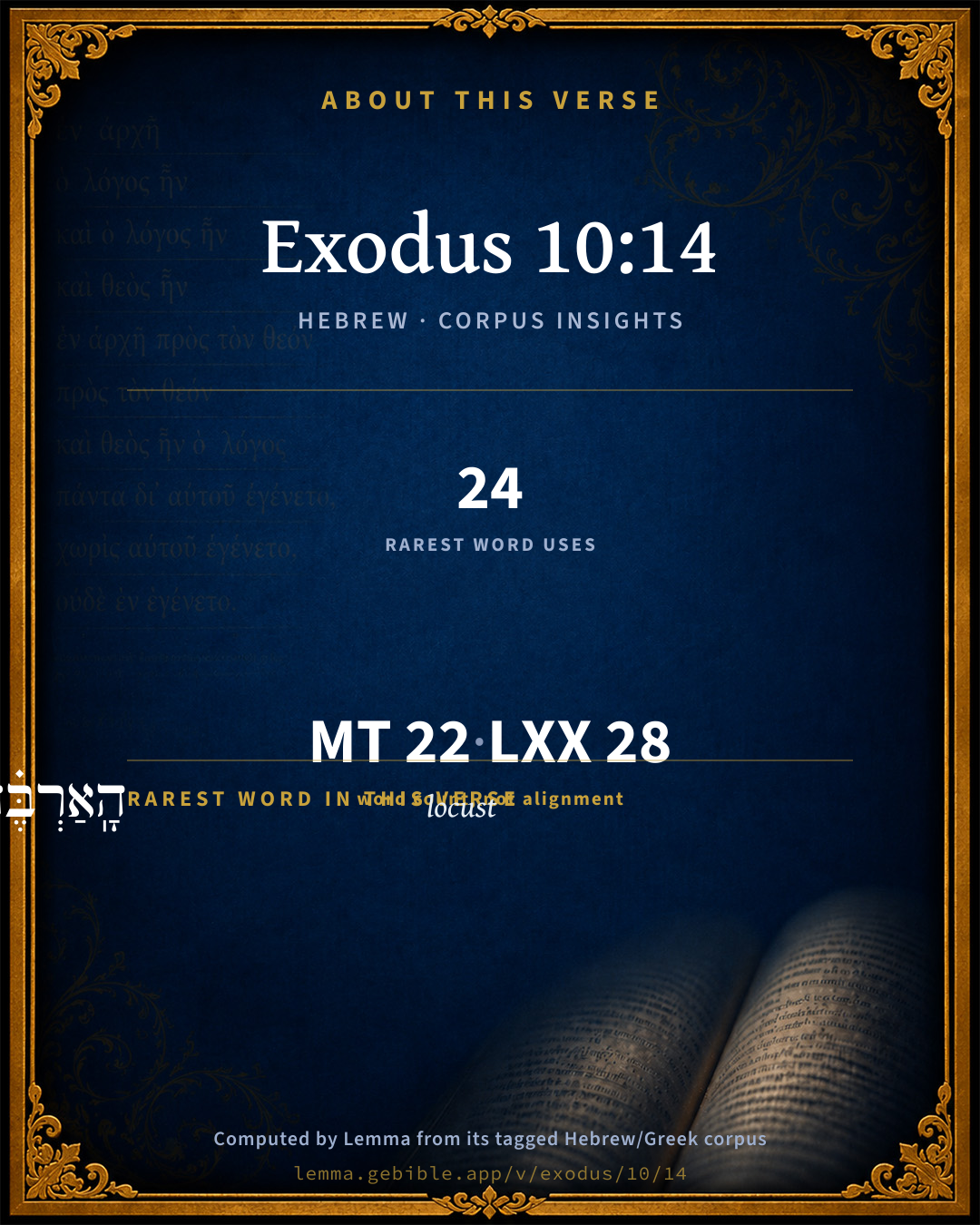
The rarest word here is הָֽאַרְבֶּ֗ה locust H697 — appearing just 24 times in the whole Hebrew Bible.

Shared distinctive vocabulary

הָֽאַרְבֶּ֗ה locust H697 occurs in 21 verses of the Hebrew Bible. Also found in:

Grammatical profile

  • 4 verbs
  • 9 nouns
  • 1 adjective
  • 3 prepositions
  • 2 adverbs
  • 3 particles

Verb forms

  • וַיַּ֣עַל Qal · Sequential Imperfect
  • וַיָּ֕נַח Qal · Sequential Imperfect
  • הָ֨יָה Qal · Perfect
  • יִֽהְיֶה Qal · Imperfect

Repetition

Words recur within this verse — often emphatic in Hebrew:

  • הָֽאַרְבֶּ֗ה locust H697 ×2
  • כָּל all H3605 ×2
  • מִצְרַ֔יִם Egypt H4714 ×2
  • הָ֨יָה to be H1961 ×2
  • כֵ֤ן thus H3651 ×2
  • לֹא not H3808 ×2

Hebrew & Septuagint length

In English translation the verse runs 37 words from the Hebrew and 36 from the Septuagint (LXX English) — closely comparable.

A rough comparison of the two English renderings, which tokenize alike — not a word-level alignment.

Word counts can differ between the Hebrew and the Greek without any difference in meaning — e.g. the Hebrew direct-object marker אֵת has no separate Greek word, and Greek often adds the article ὁ.

In the original languages it is 22 Hebrew tokens and 28 Greek tokens — but the two are counted differently (Hebrew bundles its prefixes and suffixes into one token; the Greek is in lemma form), so that isn’t a like-for-like length.

Cross-references

9

Topical passages linked to Exodus 10:14 in the Treasury of Scripture Knowledge — connected by theme and wording, ordered by reader-vote popularity; previews shown in the World English Bible.

  • Psalms 78:46 He gave also their increase to the caterpillar, And their labor to the locust.
  • Exodus 10:5–6 and they shall cover the surface of the earth, so that one won't be able to see the earth. They shall eat the residue of that which has escaped, which remains to you from the hail, and shall eat every tree which grows for you out of the field.
  • Exodus 11:6 There shall be a great cry throughout all the land of Egypt, such as there has not been, nor shall be any more.
  • Deuteronomy 28:42 All your trees and the fruit of your ground shall the locust possess.
  • 1 Kings 8:37 If there be in the land famine, if there be pestilence, if there be blasting [or] mildew, locust [or] caterpillar; if their enemy besiege them in the land of their cities; whatever plague, whatever sickness there be;
  • Psalms 105:34–35 He spoke, and the locusts came, And the grasshoppers, without number,
  • Joel 1:2–4 Hear this, you elders, And listen, all you inhabitants of the land. Has this ever happened in your days, Or in the days of your fathers?
  • Joel 2:1–11 Blow you the trumpet in Zion, And sound an alarm in my holy mountain! Let all the inhabitants of the land tremble, For the day of Yahweh comes, For it is close at hand:
  • Revelation 9:3–7 Then out of the smoke came forth locusts on the earth, and power was given to them, as the scorpions of the earth have power.

Cross-references courtesy of OpenBible.info (CC BY 4.0).

Hebrew and Greek witnesses Masoretic Hebrew ↔ Greek Septuagint

The same verse in the two great witnesses to the Old Testament, shown verse-for-verse.

These are two independent witnesses, not word-aligned to each other, and the Septuagint is shown in lemma (dictionary) form.

Hebrew Exodus 10:14 Masoretic · Westminster Leningrad Codex

וַיַּ֣עַל הָֽאַרְבֶּ֗ה עַ֚ל כָּל אֶ֣רֶץ מִצְרַ֔יִם וַיָּ֕נַח בְּכֹ֖ל גְּב֣וּל מִצְרָ֑יִם כָּבֵ֣ד מְאֹ֔ד לְ֠פָנָיו לֹא הָ֨יָה כֵ֤ן אַרְבֶּה֙ כָּמֹ֔הוּ וְאַחֲרָ֖יו לֹ֥א יִֽהְיֶה כֵּֽן

The locusts went up over all the land of Egypt, and rested in all the borders of Egypt. They were very grievous. Before them there were no such locusts as they, neither after them shall be such.

World English Bible · Public Domain

Greek LXX Exodus 10:14 Septuagint · lemma form

καί ἀναἄγω αὐτός ἐπί πᾶς γῆ αἴγυπτος καί καταπαύω ἐπί πᾶς ὁ ὅριον αἴγυπτος πολύς σφόδρα πρότερος αὐτός οὐ γίγνομαι τοιοῦτος ἀκρίς καί μετά οὗτος οὐ εἰμί οὕτως

and brought them up over all the land of Egypt. And they rested in very great abundance over all the borders of Egypt. Before them there were not such locusts, neither after them shall there be.

LXX2012 (modern English Septuagint) · Public Domain

Hebrew: Westminster Leningrad Codex (CC BY 4.0). Greek: Septuagint (public domain); English from LXX2012 (modern English Septuagint) (Public Domain). How the Septuagint differs from the Hebrew →

Targum (Aramaic paraphrase)

2

The Targum is the ancient Jewish Aramaic paraphrase of the Hebrew Scriptures — an interpretive translation, not the Hebrew text itself. Onkelos (literal) and Pseudo-Jonathan (expansive) render the Torah, and Jonathan the Prophets. Coverage is partial: where no permissively-licensed English translation exists for a verse, only the Aramaic is shown. This is verse-level text, not a word-by-word alignment to the Hebrew.

  1. Targum Onkelos Torah (Genesis–Deuteronomy)
    וּסְלֵיק גוֹבָא עַל כָּל אַרְעָא דְמִצְרַיִם וּשְׁרָא בְּכָל תְּחוּם מִצְרָיִם תַּקִיף לַחֲדָא קֳדָמוֹהִי לָא הֲוָה כֵן גוֹבָא דִכְוָתֵהּ וּבַתְרוֹהִי לָא יְהֵי כֵן:

    (no public-domain English translation for this verse)

    Targum Onkelos — Aramaic: “Onkelos Genesis” (public domain); “Onkelos Exodus” (public domain); “Onkelos Leviticus” (public domain); “Onkelos Numbers” (public domain); “Onkelos Deuteronomy” (public domain). English: “Sefaria Community Translation” (CC0 1.0 (public-domain dedication)); “J.W. Etheridge. The Targums of Onkelos and Jonathan Ben Uzziel on the Pentateuch. London: Longmans, Green, 1862” (public domain). Text via Sefaria.

  2. Targum Pseudo-Jonathan Torah (Genesis–Deuteronomy)
    וּסְלֵיק גּוֹבָא עַל כָּל אַרְעָא דְּמִצְרָיִם וּשְׁרָא בְּכָל תְּחוּם מִצְרָיִם תַּקִּיף לַחֲדָא קֳדָמוֹי לָא הֲוָה כְדֵין קַשְׁיָין גּוֹבָא דִכְוָותֵיהּ וּבַתְרוֹי לָא עָתִיד דִּיהִי כֵן

    And the locust came up over all the land of Mizraim, and settled in all the limits of Mizraim exceedingly strong. Before him there had been no locust so hard, nor will there be like him.

    Targum Pseudo-Jonathan — Aramaic: “Targum Jonathan on Genesis” (public domain); “Targum Jonathan on Exodus” (public domain); “Targum Jonathan on Leviticus” (public domain); “Targum Jonathan on Numbers” (public domain); “Targum Jonathan on Deuteronomy” (public domain). English: “The Targum of Jonathan ben Uzziel, trans. J. W. Etheridge, London, 1862” (public domain). Text via Sefaria.

Commentary

Notes on Exodus 10:14 from classic Christian and Jewish commentators (each source and its license shown beneath its notes). The classic Christian expositions comment on the surrounding passage and are grouped to its opening verse, so a note may address several verses; the Jewish commentaries on the Tanakh (Rashi and others) are per-verse, so they appear only where the commentator wrote on this verse.

Lemma curates 59 commentaries, every one of them public domain or Creative Commons licensed, each selected and text-cleaned for this edition rather than reprinted as found. About our sources →

Trapp's Complete Commentary

John Trapp

Exo 10:14 And the locusts went up over all the land of Egypt, and rested in all the coasts of Egypt: very grievous [were they]; before them there were no such locusts as they, neither after them shall be such.

Ver. 14. And the locusts went up.] As a formidable army. See a graphical description of a like plague threatened in Joe 2:4-11.

John Trapp, A Commentary or Exposition upon All the Books of the Old and New Testament (1647–1656) — public domain. Text from a community e-Sword module.

Geneva Bible (1599)

Geneva Bible translators

Or, he caused them to remain.

Geneva Bible (1599) marginal notes — public domain. Text via Bolls.life.

Adam Clarke's Commentary

Verse 14. Before them there were no such locusts, &c.] They exceeded all that went before, or were since, in number, and in the devastations they produced. Probably both these things are intended in the passage. See Ex 10:15.

Adam Clarke's Commentary on the Bible (1810–1826) — public domain. Text from a community e-Sword/MySword module.

Ellicott's Commentary for English Readers

(14) The locusts went up over all the land of Egypt.—It is not, perhaps, certain that this is intended literally, since universal expressions are continually used by the sacred writers where something less than universality is meant. But, strengthened as the clause is by the succeeding one, we must suppose a very general visitation to be spoken of. Now Egypt extends, from north to south, a distance of above 500 miles, and the Delta has a width of 150 miles. No column of locusts having nearly such dimensions is recorded in history. Perhaps the visitation was confined to the Delta and the vicinity of Memphis. Even so, it would have covered an area of 7,000 square miles, or one nearly equal to that of Wales.

A Bible Commentary for English Readers, edited by Charles John Ellicott (1878–1897) — public domain. Text from a community e-Sword module.

The Cambridge Bible for Schools and Colleges

gen. ed. J. J. S. Perowne

14. went up] came up (v. 12).

borders (Heb. border)] i.e. territory, as Exo_8:2, Exo_10:4; Exo_10:19 (cf. p. 56).

grievous] Exo_8:24, Exo_9:3; Exo_9:18; Exo_9:24.

before them, &c.] cf. v. 6b, Exo_9:18 b, 24b, Exo_11:6 b; and p. 56.

The Cambridge Bible for Schools and Colleges (gen. ed. J. J. S. Perowne; Cambridge University Press, 1878–1918) — public domain. Text from a community e-Sword module.

John Gill's Exposition

And the locusts went up over all the land of Egypt,.... Being raised up by the wind in the places where they were generated, they flew and spread themselves all over the land, being in a wonderful manner produced and multiplied by the power of God:

and rested in all the coasts of Egypt; in every part of it where the Egyptians dwelt, and where there were meadows, pastures, fields, gardens, orchards; here they lighted and fed, excepting the land of Goshen, where Israel dwelt, which must be thought to be exempted from this plague, as from the rest.

Very grievous were they; because of the mischief that they did, and because of their multitude, for they were innumerable, as the Vulgate Latin version renders it, and as it is, Psa 105:34,

there were no such locusts as they, neither after them shall be such; there were none before, and there would be none afterwards like them, which Moses knew by a spirit of prophecy. If this is to be understood of their size, they must be very large; in the year 1556, there were locusts at Milain that were a span long, and had six feet, and these like the feet of rats, and there was one four times bigger than the rest, which was taken and kept by a citizen, and would hiss like a serpent when it saw that no food was set before it (n); yea, Pliny (o) speaks of locusts in India three feet long; and what Moses here says is not contradicted in Joe 2:2 because his words may be understood of the Chaldean army, of which the locusts were an emblem; and besides, each may be restrained to the country in which they were, as that none ever before or since were seen in Egypt as these, though they might be in other countries; and so those in Joel's time were such as never before or since were seen in the land of Judea, though they might be in other places.

(n) Frantzii Hist. Animal. Sacr. par. 5. c. 4. p. 800. (o) Ut supra. (Nat. Hist. l. 11. c. 29.)

John Gill's Exposition of the Whole Bible (1746–1763) — public domain (CC PDM 1.0). Text via the HelloAO Bible API.

Albert Barnes' Notes on the Bible

Went up - At a distance the locusts appear hanging, as it were, like a heavy cloud over the land; as they approach they seem to rise, and they fill the atmosphere overhead upon their arrival.

Over all the land - Travelers mention a cloud of locusts extending over 500 miles, and so compact while on the wing that it completely hid the sun. This passage describes a swarm unprecedented in extent.

Albert Barnes' Notes on the Bible (1834–1885) — public domain. Text from a community e-Sword/MySword module.

Haydock's Catholic Bible Commentary

Hereafter. Joel i. 2, speaking of locusts which infested Judea, uses the same expressions to denote a very heavy judgment. Two events never perfectly agree. (Calmet)

George Leo Haydock (1774–1849), Haydock's Catholic Family Bible and Commentary, 1859 edition — public domain. Excludes Psalms (Douay-Rheims chapter numbering differs from Protestant) and Deuterocanonical books (Catholic canon only).

Matthew Poole's English Annotations

Quest. How can this be true, when the same words are used of the locusts in Joel’s time?

Answ. It might be true of both in divers respects; of these for number and quality, of them for long continuance, for they lasted three or four years, when these were but for a little time; of these for Egypt, of them for Judea, where they were fixed.

Matthew Poole's English Annotations on the Holy Bible (1683–1685) — public domain. Text from a community e-Sword/MySword module.

The Pulpit Commentary

The locusts went up over all the land of Egypt, and rested in all the coasts of Egypt. This statement is very emphatic, and seems to imply that the plague was more widely extended than any that had preceded it. Egypt extends about 520 miles from north to south, but except in the Delta is not more than about 20 miles wide. Columns of locusts of the length of 500 miles have been noticed by travellers (Moor in Kirby on Entomology, letter 6.), and 20 miles is not an unusual width for them. But such a length and such a breadth are not elsewhere recorded in combination. Thus the visitation was, in its extent as well as in its circumstances, plainly abnormal.

The Pulpit Commentary (1880–1919), ed. H.D.M. Spence-Jones & Joseph S. Exell — public domain. Text from a community e-Sword module.

unfoldingWord translationNotes

Door43 World Missions Community

so that it was darkened

There were so many locusts that the land appeared to be dark. This can be stated in active form. AT: "so that they darkened the land" or "so that the land appeared dark" (See: Active or Passive)

translationWords

locust

unfoldingWord translationNotes — © Distant Shores Media and the Door43 World Missions Community, licensed CC BY-SA 4.0. Source: git.door43.org/Door43/en_tn.

Rashi

Rabbi Shlomo Yitzchaki (Rashi)

ואחריו לא יהיה כן NEITHER AFTER THEM SHALL BE SUCH — That plague of locusts which happened during the days of Joel of which it is said, (Joel 2:2) “there hath not been ever the like” — which statement teaches us that it was more grievous than that in the days of Moses — was, however, caused by many species of locusts, together, those called ארבה and ילק and חסיל and גזם; but that which happened in the days of Moses consisted of only one species (the ארבה) and any ארבה like that there never was and never will be.

Rashi on the Tanakh — English translations: “The Judaica Press complete Tanach with Rashi, translated by A. J. Rosenberg” (CC BY 4.0); “Pentateuch with Rashi's commentary by M. Rosenbaum and A.M. Silbermann, 1929-1934” (public domain); “The Metsudah Tanach series, Lakewood, N.J” (CC BY 4.0); and “The Book of Joshua, Metsudah Publications, 1997” (CC BY 4.0). Text via Sefaria.

Ramban (Nachmanides)

Rabbi Moshe ben Nachman (Ramban / Nachmanides)

NEITHER AFTER THEM SHALL BE SUCH [LOCUSTS]. Scripture informs us by way of prophecy that after them, there would never be such [locusts]. Now Rashi commented: “[The plague of locusts] which occurred during the days of Joel, of which it is said, There hath not been ever the like, teaches us that it was greater than that in the days of Moses. The one that happened in the days of Joel was caused by many species together: locust, caterpillar, canker-worm, palmer-worm. But the one which occurred in the days of Moses consisted only of one species, the like of which there never was and never will be.”I have found difficulty in understanding the explanation of the Rabbi [Rashi]. It is written [of the plague which happened in the days of Moses], He also gave their produce unto the caterpillar, and it is also written, He spoke, and the locust came, and the canker-worm without number., 105:34. Thus it is clear that in the plague which occurred in the days of Moses, there were also many species of locusts involved, unlike Rashi’s explanation above. Perhaps the Rabbi [Rashi] will answer by saying that in the days of Moses, locust proper was greater than that in the days of Joel, but all other species of locusts in the days of Joel were greater than those in the days of Moses. But these are useless arguments. Instead, [we must say that the expression], in all the borders of Egypt, is connected with the end of the verse: before them there were no such locusts as they, neither after them shall be such there [in Egypt, but in other places there may be]. It is possible that because the land of Egypt is exceedingly moistened by the river, locusts are not abundant there, for these naturally come in years of drought, as is mentioned by the prophet Joel. (Joel 1:20).Now Rabbeinu Chananel has written in his commentary on the Torah: “From the time that Moses our teacher prayed [for the removal of the locusts] till now, the locusts have not caused damage to the entire land of Egypt, and if an attack of them does occur in the Land of Israel and they proceed to enter within the border of Egypt, they do not devour the produce of the land. People say that this is known by all. Come and see! In the case of frogs, Moses said, Only in the river they will remain, and therefore the altamtzach — [the Arabic word for frogs] — have remained in the river till now. However, in the case of the locusts it is written, There remained not one locust in all the border of Egypt. It is of a phenomenon of this kind that Scripture says, Speak ye of all His marvellous works. ” Thus the language of the Rabbi.In my opinion, the plain meaning of the verse, [neither after them shall be such], is that because the plague of locusts is known to come in all generations, and moreover since this one [in the days of Moses] came in a natural way, it having been the east wind that brought the locusts, [and there was thus reason to believe that such a plague would again come upon Egypt in a natural way], Scripture therefore states that such locusts were the greatest that ever occurred in the natural order of things. Neither before them were there such locusts as they, nor after them shall be such. Through the magnitude of the plague, the Egyptians thus knew that it was a special act of G-d, since the like never happened before. [The plague] that occurred in the days of Joel was likewise a special act of G-d, [and hence Scripture also describes it by saying, There hath never been the like].

Ramban (Nachmanides) on the Tanakh — English translation: “Commentary on the Torah by Ramban (Nachmanides). Translated and annotated by Charles B. Chavel. New York, Shilo Pub. House, 1971-1976” (CC BY 4.0). Text via Sefaria.

Lesson kit

Teaching starters — assembled from the data on this page, not authored interpretation. Every prompt links to the verse data it draws on. Edit before teaching.

Exodus, in the Pentateuch, opens this verse with 22 words (16 distinct Hebrew lemmas). Its most distinctive word is ʼarbeh (“locust”). A historical commentator’s framing appears above. Read the whole chapter for the surrounding context.

Discussion questions

  1. The word ʼarbeh carries the sense “locust.” How does it shape the verse?
  2. Exodus 10:4 shares the word «locust» with this verse. How do the two illuminate each other?
  3. “locust” occurs 2× in this one verse. What is the effect of the repetition?
  4. These translations render this verse differently; the difference is in the English rendering, not the original. What questions does that raise?
  5. The verb «וַיַּ֣עַל» is Qal Sequential Imperfect. How does its form color the action?
  6. Reading how Trapp's Complete Commentary and Geneva Bible (1599) read this verse, where do the two commentators agree and where do they part?

Things to notice

Reading settings

Reading text

Shown beneath each verse's original-language words.

Old Testament
Old Testament edition

Read the OT as the Masoretic Hebrew (MT) or the Greek Septuagint (LXX).

English shown for the Greek Septuagint (in the Hebrew ↔ Greek comparison).

Comparing translations? Open the Compare panel on any verse page to stack up to four side by side.