
Numbers 32:9

Hebrew (Westminster Leningrad Codex) Numbers 32:9 appears in the Hebrew Old Testament. The text above is from the Westminster Leningrad Codex. Each word links to its Strong’s number, a concise gloss, and parsing drawn from the Open Scriptures Hebrew Bible morphology. Click any word for its full Brown-Driver-Briggs (BDB) entry.
Download image
Cite this verse

Numbers 32:9 (World English Bible). Public Domain. Lemma interlinear Bible study tool, https://lemma.gebible.app/v/numbers/32/9.

Show BibTeX & RIS
BibTeX
RIS
English Translation
For when they went up to the valley of Eshcol, and saw the land, they discouraged the heart of the children of Israel, that they should not go into the land which Yahweh had given them.
World English Bible · Public Domain
Download a study sheet

One document with this verse’s original text, its word-by-word gloss line, the meaning frame, cross-references with their text, attributed commentary, and full source and license credits — printable, and it pastes into notes with its structure intact.

This verse Autodidact and up

Study sheet (.html) Plain text (.txt)

A passage Seminary Student

Up to 50 verses in one chapter. A passage sheet keeps up to 6 commentary sources and 12 cross-references per verse, in the order this page ranks them, and says so on the sheet whenever that leaves anything out. Ask for a single verse and you get the Autodidact verse sheet above.

Everything on this page stays free to read, with no account — the sheet is a download of what is already on screen, not access to it.

Want to remove ads? Support Godless Engineer
Compare translations 3

The same verse in 3 English versions, stacked beneath the original-language interlinear above. Click any original word for its lexicon entry.

Each is an independent rendering of the whole verse — the interlinear is not word-aligned to these translations.

Highlighted words mark where these versions differ — a whole-verse word diff, not a word-by-word alignment.

  • World English Bible Public Domain
    For when they went up to the valley of Eshcol, and saw the land, they discouraged the heart of the children of Israel, that they should not go into the land which Yahweh had given them.
  • King James Version Public Domain
    For when they went up unto the valley of Eshcol, and saw the land, they discouraged the heart of the children of Israel, that they should not go into the land which the LORD had given them.
  • unfoldingWord Literal Text CC BY-SA 4.0
    And they went up as far as the wadi of Eshkol, and they saw the land and discouraged the heart of the sons of Israel to not enter into the land that Yahweh had given to them.

unfoldingWord Literal Text — © unfoldingWord, licensed CC BY-SA 4.0. Word-aligned USFM3 via Door43 (git.door43.org/unfoldingWord/en_ult).

Versions to compare (up to 4)

3 of 4 selected

Show all 18 translations

Every available English version of this verse, each an independent rendering of the whole verse.

  • World English Bible Public Domain
    For when they went up to the valley of Eshcol, and saw the land, they discouraged the heart of the children of Israel, that they should not go into the land which Yahweh had given them.
  • Berean Standard Bible Public Domain
    For when your fathers went up to the Valley of Eshcol and saw the land, they discouraged the Israelites from entering the land that the LORD had given them.
  • Majority Standard Bible Public Domain
    For when your fathers went up to the Valley of Eshcol and saw the land, they discouraged the Israelites from entering the land that the LORD had given them.
  • King James Version Public Domain
    For when they went up unto the valley of Eshcol, and saw the land, they discouraged the heart of the children of Israel, that they should not go into the land which the LORD had given them.
  • American Standard Version (1901) Public Domain
    For when they went up unto the valley of Eshcol, and saw the land, they discouraged the heart of the children of Israel, that they should not go into the land which Jehovah had given them.
  • Revised Version (1885) Public Domain
    For when they went up unto the valley of Eshcol, and saw the land, they discouraged the heart of the children of Israel, that they should not go into the land which the LORD had given them.
  • Geneva Bible (1599) Public Domain
    For when they went vp euen vnto the riuer of Eshcol, and sawe the land: they discouraged the heart of the childre of Israel, that they woulde not goe into the lande, which the Lord had giuen them.
  • Douay-Rheims (1899) Public Domain
    And when they were come as far as the valley of the cluster, having viewed all the country, they overturned the hearts of the children of Israel, that they should not enter into the coasts, which the Lord gave them.
  • Young's Literal Translation Public Domain
    and they go up unto the valley of Eshcol, and see the land, and discourage the heart of the sons of Israel so as not to go in unto the land which Jehovah hath given to them;
  • Literal Standard Version CC BY-SA 4.0
    and they go up to the Valley of Eshcol, and see the land, and discourage the heart of the sons of Israel so as not to go into the land which YHWH has given to them;
  • Unlocked Literal Bible CC BY-SA 4.0
    They went up to the Valley of Eshkol. They saw the land and then discouraged the hearts of the people of Israel so that they refused to enter the land that Yahweh had given them.
  • unfoldingWord Literal Text CC BY-SA 4.0
    And they went up as far as the wadi of Eshkol, and they saw the land and discouraged the heart of the sons of Israel to not enter into the land that Yahweh had given to them.
  • Darby Bible Public Domain
    they went up to the valley of Eshcol, and saw the land, and discouraged the children of Israel, that they should not go into the land that Jehovah had given them.
  • World Messianic Bible Public Domain
    For when they went up to the valley of Eshcol, and saw the land, they discouraged the heart of the children of Israel, that they should not go into the land which the LORD had given them.
  • Webster's Bible Public Domain
    For when they went up to the valley of Eshcol, and saw the land, they discouraged the heart of the children of Israel, that they should not go into the land which the LORD had given them.
  • Free Bible Version CC BY-SA 4.0
    After your fathers traveled up the valley of Eshcol and explored the land, they discouraged the Israelites, persuading them not to enter the country that the Lord had given them.
  • Bible in Basic English Public Domain
    For when they went up to the valley of Eshcol, and saw the land, they took from the children of Israel the desire to go into the land which the Lord had given them.
  • JPS Tanakh (1917) Public Domain
    For when they went up unto the valley of Eshcol, and saw the land, they turned away the heart of the children of Israel, that they should not go into the land which the LORD had given them.

Literal Standard Version (2020), Covenant Press — licensed CC BY-SA 4.0. Text via the HelloAO Bible API (eBible.org). Unlocked Literal Bible (unfoldingWord) — licensed CC BY-SA 4.0. Text via the HelloAO Bible API (eBible.org). unfoldingWord Literal Text — © unfoldingWord, licensed CC BY-SA 4.0. Word-aligned USFM3 via Door43 (git.door43.org/unfoldingWord/en_ult). Free Bible Version, Dr. Jonathan Gallagher — licensed CC BY-SA 4.0. Text via the HelloAO Bible API (eBible.org).

Word by word

More ways to search: Search by grammar → Find every occurrence → Compare this word →

Practice this passage: Drill this verse → Learn its vocabulary →

אֶשְׁכּ֗וֹל
ʼEshkôl
H812
“Eshcol”
Noun, Proper
Part of Speech
Noun
Type
Proper
Full BDB Definition

Origin: the same as H811

TWOT: None

Eshcol = "cluster" - an area of Hebron, the valley of Eshcol - an Amorite, the brother of Mamre, dwelling in Hebron
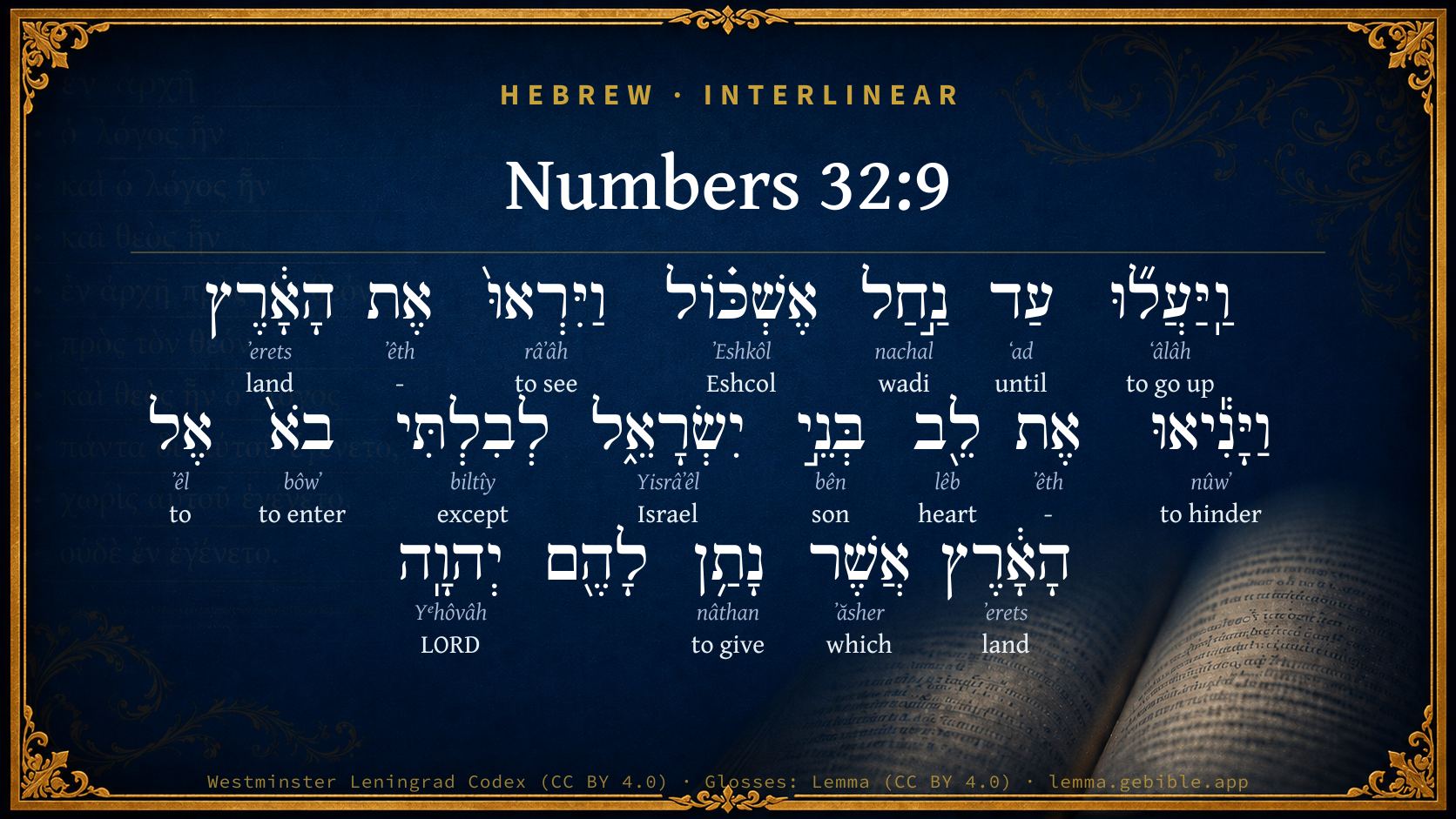
  1. וַֽיַּעֲל֞וּ ʻâlâh H5927 “and · to go up” Conjunction + Verb, Qal, Sequential Imperfect, 3rd Person, Masculine, Plural
  2. עַד ʻad H5704 “until” Preposition
  3. נַ֣חַל nachal H5158 “wadi of” Noun, Common, Masculine, Singular, Construct
  4. וַיִּרְאוּ֙ râʼâh H7200 “and · to see” Conjunction + Verb, Qal, Sequential Imperfect, 3rd Person, Masculine, Plural
  5. אֶת ʼêth H853 “-” Particle, Direct Object
  6. הָאָ֔רֶץ ʼerets H776 “the · land” Particle, Definite Article + Noun, Common, Both, Singular, Absolute
  7. וַיָּנִ֕יאוּ nûwʼ H5106 “and · to hinder” Conjunction + Verb, Hiphil, Sequential Imperfect, 3rd Person, Masculine, Plural
  8. אֶת ʼêth H853 “-” Particle, Direct Object
  9. לֵ֖ב lêb H3820 “heart of” Noun, Common, Masculine, Singular, Construct
  10. בְּנֵ֣י bên H1121 “sons of” Noun, Common, Masculine, Plural, Construct
  11. יִשְׂרָאֵ֑ל Yisrâʼêl H3478 “Israel” Noun, Proper
  12. לְבִלְתִּי biltîy H1115 “to/for · except” Preposition + Conjunction
  13. בֹא֙ bôwʼ H935 “to enter” Verb, Qal, Infinitive Construct
  14. אֶל ʼêl H413 “to” Preposition
  15. הָאָ֔רֶץ ʼerets H776 “the · land” Particle, Definite Article + Noun, Common, Both, Singular, Absolute
  16. אֲשֶׁר ʼăsher H834 “which” Particle, Relative
  17. נָתַ֥ן nâthan H5414 “to give” Verb, Qal, Perfect, 3rd Person, Masculine, Singular
  18. יְהוָֽה Yᵉhôvâh H3068 “LORD” Noun, Proper

About this verse

These counts appear in no published source. They are computed here, from the morphology-tagged text and Lemma’s own curated glosses. What Lemma adds →

20
words
17
distinct lemmas
Pentateuch
section

Notable vocabulary

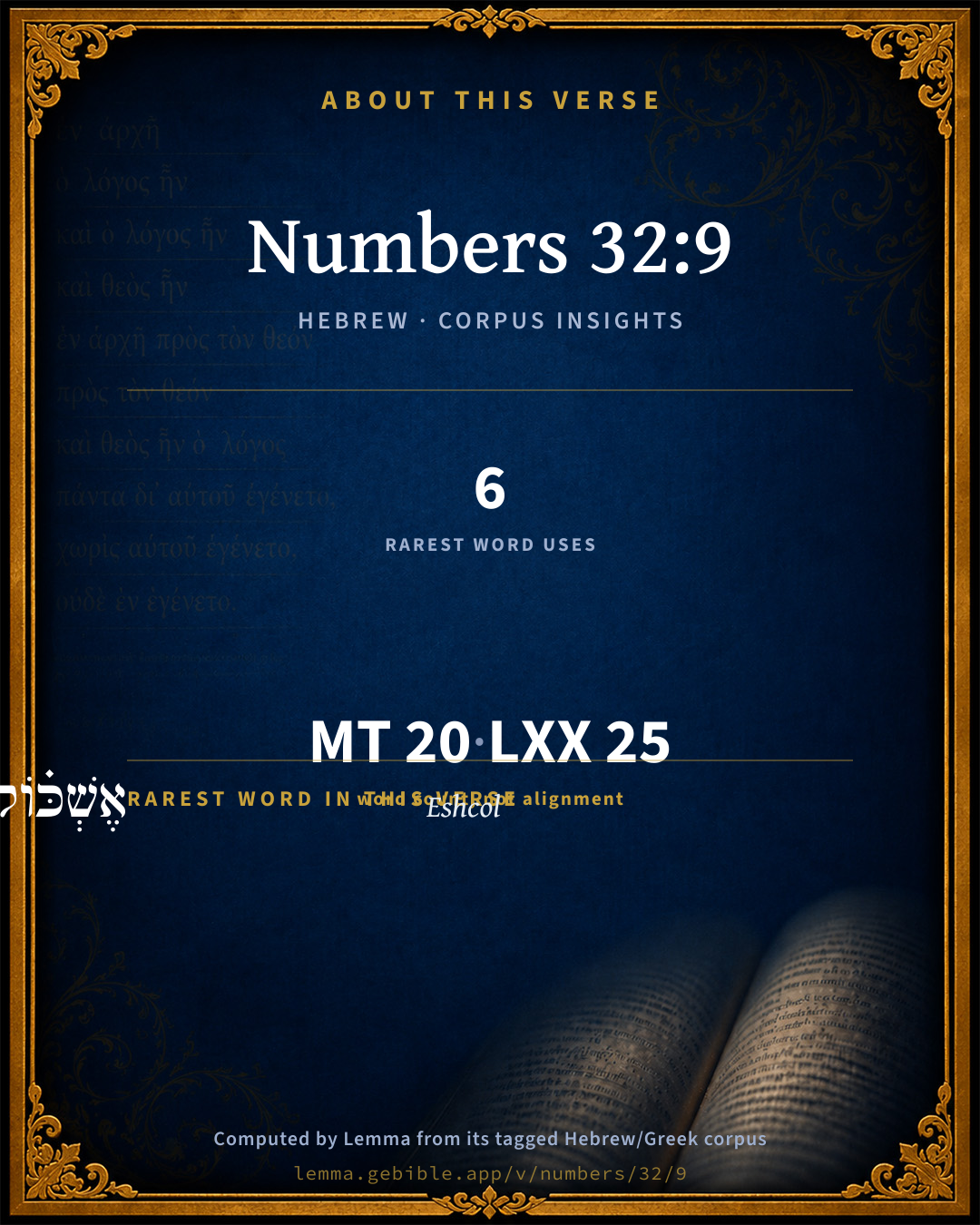
The rarest word here is אֶשְׁכּ֗וֹל Eshcol H812 — appearing just 6 times in the whole Hebrew Bible.

Shared distinctive vocabulary

אֶשְׁכּ֗וֹל Eshcol H812 occurs in 6 verses of the Hebrew Bible. Also found in:

Grammatical profile

  • 5 verbs
  • 8 nouns
  • 3 prepositions
  • 1 conjunction
  • 3 particles

Verb forms

  • וַֽיַּעֲל֞וּ Qal · Sequential Imperfect
  • וַיִּרְאוּ֙ Qal · Sequential Imperfect
  • וַיָּנִ֕יאוּ Hiphil · Sequential Imperfect
  • בֹא֙ Qal · Infinitive Construct
  • נָתַ֥ן Qal · Perfect

Repetition

A word recurs within this verse — often emphatic in Hebrew:

  • הָאָ֔רֶץ land H776 ×2

Hebrew & Septuagint length

In English translation the verse runs 36 words from the Hebrew and 37 from the Septuagint (LXX English) — closely comparable.

A rough comparison of the two English renderings, which tokenize alike — not a word-level alignment.

Word counts can differ between the Hebrew and the Greek without any difference in meaning — e.g. the Hebrew direct-object marker אֵת has no separate Greek word, and Greek often adds the article ὁ.

In the original languages it is 20 Hebrew tokens and 25 Greek tokens — but the two are counted differently (Hebrew bundles its prefixes and suffixes into one token; the Greek is in lemma form), so that isn’t a like-for-like length.

Cross-references

2

Topical passages linked to Numbers 32:9 in the Treasury of Scripture Knowledge — connected by theme and wording, ordered by reader-vote popularity; previews shown in the World English Bible.

  • Numbers 13:23–14:10 They came to the valley of Eshcol, and cut down from there a branch with one cluster of grapes, and they bore it on a staff between two; [they brought] also of the pomegranates, and of the figs.
  • Deuteronomy 1:24–28 and they turned and went up into the hill-country, and came to the valley of Eshcol, and spied it out.

Cross-references courtesy of OpenBible.info (CC BY 4.0).

Hebrew and Greek witnesses Masoretic Hebrew ↔ Greek Septuagint

The same verse in the two great witnesses to the Old Testament, shown verse-for-verse.

These are two independent witnesses, not word-aligned to each other, and the Septuagint is shown in lemma (dictionary) form.

Hebrew Numbers 32:9 Masoretic · Westminster Leningrad Codex

וַֽיַּעֲל֞וּ עַד נַ֣חַל אֶשְׁכּ֗וֹל וַיִּרְאוּ֙ אֶת הָאָ֔רֶץ וַיָּנִ֕יאוּ אֶת לֵ֖ב בְּנֵ֣י יִשְׂרָאֵ֑ל לְבִלְתִּי בֹא֙ אֶל הָאָ֔רֶץ אֲשֶׁר נָתַ֥ן לָהֶ֖ם יְהוָֽה

For when they went up to the valley of Eshcol, and saw the land, they discouraged the heart of the children of Israel, that they should not go into the land which Yahweh had given them.

World English Bible · Public Domain

Greek LXX Numbers 32:9 Septuagint · lemma form

καί ἀναβαίνω φάραγξ βότρυς καί κατανοέω ὁ γῆ καί ἀποἵστημι ὁ καρδία ὁ υἱός ἰσραήλ ὅπως μή εἰςἔρχομαι εἰς ὁ γῆ ὅς δίδωμι κύριος αὐτός

And they went up to the valley of the cluster, and spied the land, and turned aside the heart of the children of Israel, that they should not go into the land, which the Lord gave them.

LXX2012 (modern English Septuagint) · Public Domain

Hebrew: Westminster Leningrad Codex (CC BY 4.0). Greek: Septuagint (public domain); English from LXX2012 (modern English Septuagint) (Public Domain). How the Septuagint differs from the Hebrew →

Targum (Aramaic paraphrase)

2

The Targum is the ancient Jewish Aramaic paraphrase of the Hebrew Scriptures — an interpretive translation, not the Hebrew text itself. Onkelos (literal) and Pseudo-Jonathan (expansive) render the Torah, and Jonathan the Prophets. Coverage is partial: where no permissively-licensed English translation exists for a verse, only the Aramaic is shown. This is verse-level text, not a word-by-word alignment to the Hebrew.

  1. Targum Onkelos Torah (Genesis–Deuteronomy)
    וּסְלִיקוּ עַד נַחֲלָא דְאַתְכָּלָא וַחֲזוֹ יָת אַרְעָא וְאוֹנִיאוּ יָת לִבָּא דִבְנֵי יִשְׂרָאֵל בְּדִיל דְלָא לְמֵיעַל לְאַרְעָא דִיהַּב לְהוֹן יְיָ

    (no public-domain English translation for this verse)

    Targum Onkelos — Aramaic: “Onkelos Genesis” (public domain); “Onkelos Exodus” (public domain); “Onkelos Leviticus” (public domain); “Onkelos Numbers” (public domain); “Onkelos Deuteronomy” (public domain). English: “Sefaria Community Translation” (CC0 1.0 (public-domain dedication)); “J.W. Etheridge. The Targums of Onkelos and Jonathan Ben Uzziel on the Pentateuch. London: Longmans, Green, 1862” (public domain). Text via Sefaria.

  2. Targum Pseudo-Jonathan Torah (Genesis–Deuteronomy)
    וּסְלִיקוּ עַד נַחֲלָא דְאִתְכְּלָא וַחֲמוּן יַת אַרְעָא וּבְטִילוּ רְעוּת לִבָּא דְיִשְרָאֵל בְּגִין דְלָא לְמֵיעַל לְאַרְעָא דִיהַב לְהוֹן יְיָ

    they went up to the brook of Ethkela, and saw the land, but enfeebled the will of Israel's heart, that they would not enter into the land which the Lord had given to them.

    Targum Pseudo-Jonathan — Aramaic: “Targum Jonathan on Genesis” (public domain); “Targum Jonathan on Exodus” (public domain); “Targum Jonathan on Leviticus” (public domain); “Targum Jonathan on Numbers” (public domain); “Targum Jonathan on Deuteronomy” (public domain). English: “The Targum of Jonathan ben Uzziel, trans. J. W. Etheridge, London, 1862” (public domain). Text via Sefaria.

Commentary

Notes on Numbers 32:9 from classic Christian and Jewish commentators (each source and its license shown beneath its notes). The classic Christian expositions comment on the surrounding passage and are grouped to its opening verse, so a note may address several verses; the Jewish commentaries on the Tanakh (Rashi and others) are per-verse, so they appear only where the commentator wrote on this verse.

Lemma curates 59 commentaries, every one of them public domain or Creative Commons licensed, each selected and text-cleaned for this edition rather than reprinted as found. About our sources →

Geneva Bible (1599)

Geneva Bible translators

Or, valley.

Geneva Bible (1599) marginal notes — public domain. Text via Bolls.life.

John Gill's Exposition

And the Lord's anger was kindled, the same time,.... Against the spies that brought the ill report, and against all the people that were disheartened and murmured upon it, and which, above all things, was to be dreaded now:

and he sware, saying; as follows.

John Gill's Exposition of the Whole Bible (1746–1763) — public domain (CC PDM 1.0). Text via the HelloAO Bible API.

Matthew Poole's English Annotations

That they should not attempt to go, but rather return to Egypt. Num 14:4

Matthew Poole's English Annotations on the Holy Bible (1683–1685) — public domain. Text from a community e-Sword/MySword module.

Whedon's Commentary on the Bible

Daniel D. Whedon

9. Valley of Eshcol — Says Dr. Ridgaway, in his account of Hebron and its environs, “I had wondered the day before where grew the grapes of Eshcol, as just below Hebron we had seen no vineyards; but now my wonder was at an end; throughout this valley, as far as the eye can see, are extensive vineyards. They are enclosed with stone walls, with watch towers, and the vines generally look to be very old. The main stalk is thick, is cut down very close, and lies on the ground. The best grapes in Southern Palestine are produced in this valley, thus confirming not only by the traditional name, but also by the superior quality of the fruit, the probable site whence the spies bore the specimen grapes and figs; for here, too, the fig tree abounds.” Num_13:23, note.

Daniel D. Whedon (gen. ed.), Commentary on the Old and New Testaments (1874–1909) — public domain. Text from a community e-Sword module.

The Pulpit Commentary

When they went up, i.e., no doubt the spies, although the word is not expressed. Moses, indeed, in the heat of his displeasure, seemed to charge their "fathers" generally with the wickedness of ten men. No further proof is needed to show that Moses was often disposed to speak unadvisedly with his lips.

The Pulpit Commentary (1880–1919), ed. H.D.M. Spence-Jones & Joseph S. Exell — public domain. Text from a community e-Sword module.

Lesson kit

Teaching starters — assembled from the data on this page, not authored interpretation. Every prompt links to the verse data it draws on. Edit before teaching.

Numbers, in the Pentateuch, opens this verse with 20 words (17 distinct Hebrew lemmas). Its most distinctive word is ʼEshkôl (“Eshcol”). A historical commentator’s framing appears above. Read the whole chapter for the surrounding context.

Discussion questions

  1. What does “Eshcol” (ʼEshkôl) contribute to the verse as a whole?
  2. Genesis 14:13 shares the word «Eshcol» with this verse. How do the two illuminate each other?
  3. “land” occurs 2× in this one verse. What is the effect of the repetition?
  4. These translations render this verse differently; the difference is in the English rendering, not the original. What questions does that raise?
  5. The verb «וַֽיַּעֲל֞וּ» is Qal Sequential Imperfect. How does its form color the action?
  6. Reading how Geneva Bible (1599) and John Gill's Exposition read this verse, where do the two commentators agree and where do they part?

Things to notice

Reading settings

Reading text

Shown beneath each verse's original-language words.

Old Testament
Old Testament edition

Read the OT as the Masoretic Hebrew (MT) or the Greek Septuagint (LXX).

English shown for the Greek Septuagint (in the Hebrew ↔ Greek comparison).

Comparing translations? Open the Compare panel on any verse page to stack up to four side by side.