
Ezekiel 14:3

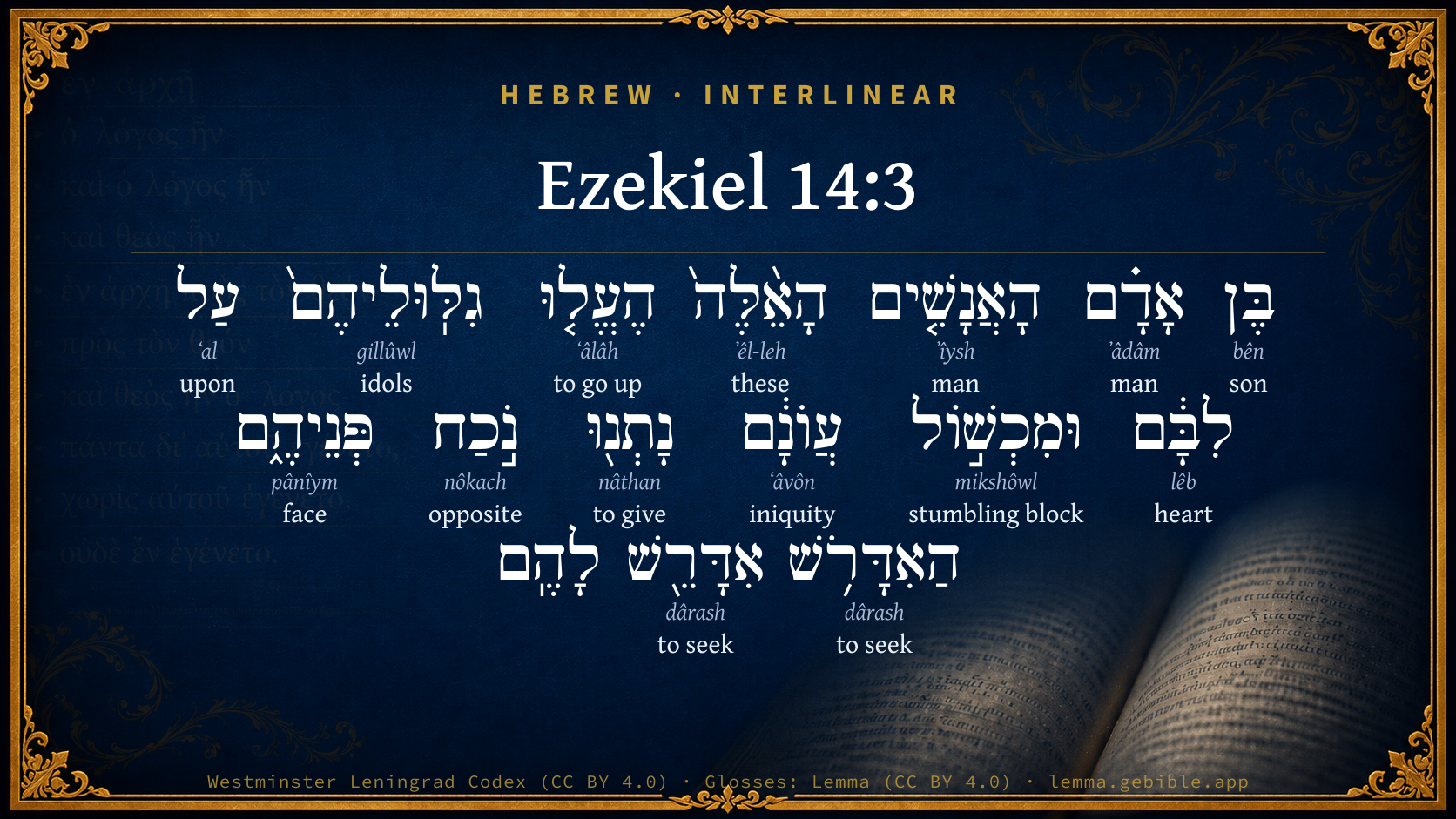
Hebrew (Westminster Leningrad Codex) Ezekiel 14:3 appears in the Hebrew Old Testament. The text above is from the Westminster Leningrad Codex. Each word links to its Strong’s number, a concise gloss, and parsing drawn from the Open Scriptures Hebrew Bible morphology. Click any word for its full Brown-Driver-Briggs (BDB) entry.
Download image
Cite this verse

Ezekiel 14:3 (World English Bible). Public Domain. Lemma interlinear Bible study tool, https://lemma.gebible.app/v/ezekiel/14/3.

Show BibTeX & RIS
BibTeX
RIS
English Translation
Son of man, these men have taken their idols into their heart, and put the stumbling block of their iniquity before their face: should I be inquired of at all by them?
World English Bible · Public Domain
Download a study sheet

One document with this verse’s original text, its word-by-word gloss line, the meaning frame, cross-references with their text, attributed commentary, and full source and license credits — printable, and it pastes into notes with its structure intact.

This verse Autodidact and up

Study sheet (.html) Plain text (.txt)

A passage Seminary Student

Up to 50 verses in one chapter. A passage sheet keeps up to 6 commentary sources and 12 cross-references per verse, in the order this page ranks them, and says so on the sheet whenever that leaves anything out. Ask for a single verse and you get the Autodidact verse sheet above.

Everything on this page stays free to read, with no account — the sheet is a download of what is already on screen, not access to it.

Want to remove ads? Support Godless Engineer
Compare translations 3

The same verse in 3 English versions, stacked beneath the original-language interlinear above. Click any original word for its lexicon entry.

Each is an independent rendering of the whole verse — the interlinear is not word-aligned to these translations.

Highlighted words mark where these versions differ — a whole-verse word diff, not a word-by-word alignment.

  • World English Bible Public Domain
    Son of man, these men have taken their idols into their heart, and put the stumbling block of their iniquity before their face: should I be inquired of at all by them?
  • King James Version Public Domain
    Son of man, these men have set up their idols in their heart, and put the stumblingblock of their iniquity before their face: should I be enquired of at all by them?
  • unfoldingWord Literal Text CC BY-SA 4.0
    “Son of man, these men have taken their idols into their hearts and have put the stumbling block of their iniquity before their own faces. Should I be inquired of at all by them?

unfoldingWord Literal Text — © unfoldingWord, licensed CC BY-SA 4.0. Word-aligned USFM3 via Door43 (git.door43.org/unfoldingWord/en_ult).

Versions to compare (up to 4)

3 of 4 selected

Show all 18 translations

Every available English version of this verse, each an independent rendering of the whole verse.

  • World English Bible Public Domain
    Son of man, these men have taken their idols into their heart, and put the stumbling block of their iniquity before their face: should I be inquired of at all by them?
  • Berean Standard Bible Public Domain
    “Son of man, these men have set up idols in their hearts and put wicked stumbling blocks before their faces. Should I consult with them in any way?
  • Majority Standard Bible Public Domain
    “Son of man, these men have set up idols in their hearts and put wicked stumbling blocks before their faces. Should I consult with them in any way?
  • King James Version Public Domain
    Son of man, these men have set up their idols in their heart, and put the stumblingblock of their iniquity before their face: should I be enquired of at all by them?
  • American Standard Version (1901) Public Domain
    Son of man, these men have taken their idols into their heart, and put the stumblingblock of their iniquity before their face: should I be inquired of at all by them?
  • Revised Version (1885) Public Domain
    Son of man, these men have taken their idols into their heart, and put the stumblingblock of their iniquity before their face: should I be inquired of at all by them?
  • Geneva Bible (1599) Public Domain
    Sonne of man, these men haue set vp their idoles in their heart, and put the stumbling blocke of their iniquitie before their face: should I, being required, answere them?
  • Douay-Rheims (1899) Public Domain
    Son of man, these men have placed their uncleannesses in their hearts, and have set up before their face the stumblingblock of their iniquity: and shall I answer when they inquire of me?
  • Young's Literal Translation Public Domain
    `Son of man, these men have caused their idols to go up on their heart, and the stumbling-block of their iniquity they have put over-against their faces; am I inquired of at all by them?
  • Literal Standard Version CC BY-SA 4.0
    “Son of man, these men have caused their idols to go up on their heart, and they have put the stumbling-block of their iniquity before their faces; am I inquired of at all by them?
  • Unlocked Literal Bible CC BY-SA 4.0
    “Son of man, these men have taken their idols into their hearts and have put the stumbling block of their iniquity before their own faces. Should I be inquired of at all by them?
  • unfoldingWord Literal Text CC BY-SA 4.0
    “Son of man, these men have taken their idols into their hearts and have put the stumbling block of their iniquity before their own faces. Should I be inquired of at all by them?
  • Darby Bible Public Domain
    Son of man, these men have set up their idols in their heart, and put the stumbling-block of their iniquity before their face: should I be inquired of at all by them?
  • World Messianic Bible Public Domain
    “Son of man, these men have taken their idols into their heart, and put the stumbling block of their iniquity before their face. Should I be inquired of at all by them?
  • Webster's Bible Public Domain
    Son of man, these men have set up their idols in their heart, and put the stumbling-block of their iniquity before their face: should I be inquired of at all by them?
  • Free Bible Version CC BY-SA 4.0
    “Son of man, these men are worshiping idols in their minds even though they know this will lead them to sin. Why should I respond to their requests?
  • Bible in Basic English Public Domain
    Son of man, these men have taken their false gods into their hearts and put before their faces the sin which is the cause of their fall: am I to give ear when they come to me for directions?
  • JPS Tanakh (1917) Public Domain
    'Son of man, these men have set up their idols in their mind, and put the stumblingblock of their iniquity before their face; should I be inquired of at all by them?

Literal Standard Version (2020), Covenant Press — licensed CC BY-SA 4.0. Text via the HelloAO Bible API (eBible.org). Unlocked Literal Bible (unfoldingWord) — licensed CC BY-SA 4.0. Text via the HelloAO Bible API (eBible.org). unfoldingWord Literal Text — © unfoldingWord, licensed CC BY-SA 4.0. Word-aligned USFM3 via Door43 (git.door43.org/unfoldingWord/en_ult). Free Bible Version, Dr. Jonathan Gallagher — licensed CC BY-SA 4.0. Text via the HelloAO Bible API (eBible.org).

Word by word

More ways to search: Search by grammar → Find every occurrence → Compare this word →

Practice this passage: Drill this verse → Learn its vocabulary →

וּמִכְשׁ֣וֹל
mikshôwl
H4383
“and · stumbling block of”
Conjunction + Noun, Common, Masculine, Singular, Construct
Part of Speech
Conjunction + Noun
Type
Common
Gender
Masculine
Number
Singular
State
Construct
Full BDB Definition

Origin: from H3782

TWOT: 1050c

a stumbling, means or occasion of stumbling, stumbling block - stumbling, fall - means or occasion of stumbling, stumbling block
  1. בֶּן bên H1121 “son of” Noun, Common, Masculine, Singular, Construct
  2. אָדָ֗ם ʼâdâm H120 “man” Noun, Common, Masculine, Singular, Absolute
  3. הָאֲנָשִׁ֤ים ʼîysh H376 “the · men” Particle, Definite Article + Noun, Common, Masculine, Plural, Absolute
  4. הָאֵ֨לֶּה֙ ʼêl-leh H428 “the · these” Particle, Definite Article + Pronoun, Demonstrative, Common, Plural
  5. הֶעֱל֤וּ ʻâlâh H5927 “to go up” Verb, Hiphil, Perfect, 3rd Person, Common, Plural
  6. גִלּֽוּלֵיהֶם֙ gillûwl H1544 “idols · their” Noun, Common, Masculine, Plural, Construct + Suffix, Personal, 3rd Person, Masculine, Plural
  7. עַל ʻal H5921 “upon” Preposition
  8. לִבָּ֔ם lêb H3820 “heart · their” Noun, Common, Masculine, Singular, Construct + Suffix, Personal, 3rd Person, Masculine, Plural
  9. עֲוֺנָ֔ם ʻâvôn H5771 “iniquity · their” Noun, Common, Both, Singular, Construct + Suffix, Personal, 3rd Person, Masculine, Plural
  10. נָתְנ֖וּ nâthan H5414 “to give” Verb, Qal, Perfect, 3rd Person, Common, Plural
  11. נֹ֣כַח nôkach H5227 “opposite” Preposition
  12. פְּנֵיהֶ֑ם pânîym H6440 “face(s) · their” Noun, Common, Both, Plural, Construct + Suffix, Personal, 3rd Person, Masculine, Plural
  13. הַאִדָּרֹ֥שׁ dârash H1875 “to seek” Particle, Interrogative + Verb, Niphal, Infinitive Absolute
  14. אִדָּרֵ֖שׁ dârash H1875 “to seek” Verb, Niphal, Imperfect, 1st Person, Common, Singular

About this verse

These counts appear in no published source. They are computed here, from the morphology-tagged text and Lemma’s own curated glosses. What Lemma adds →

16
words
14
distinct lemmas
Prophets
section

Notable vocabulary

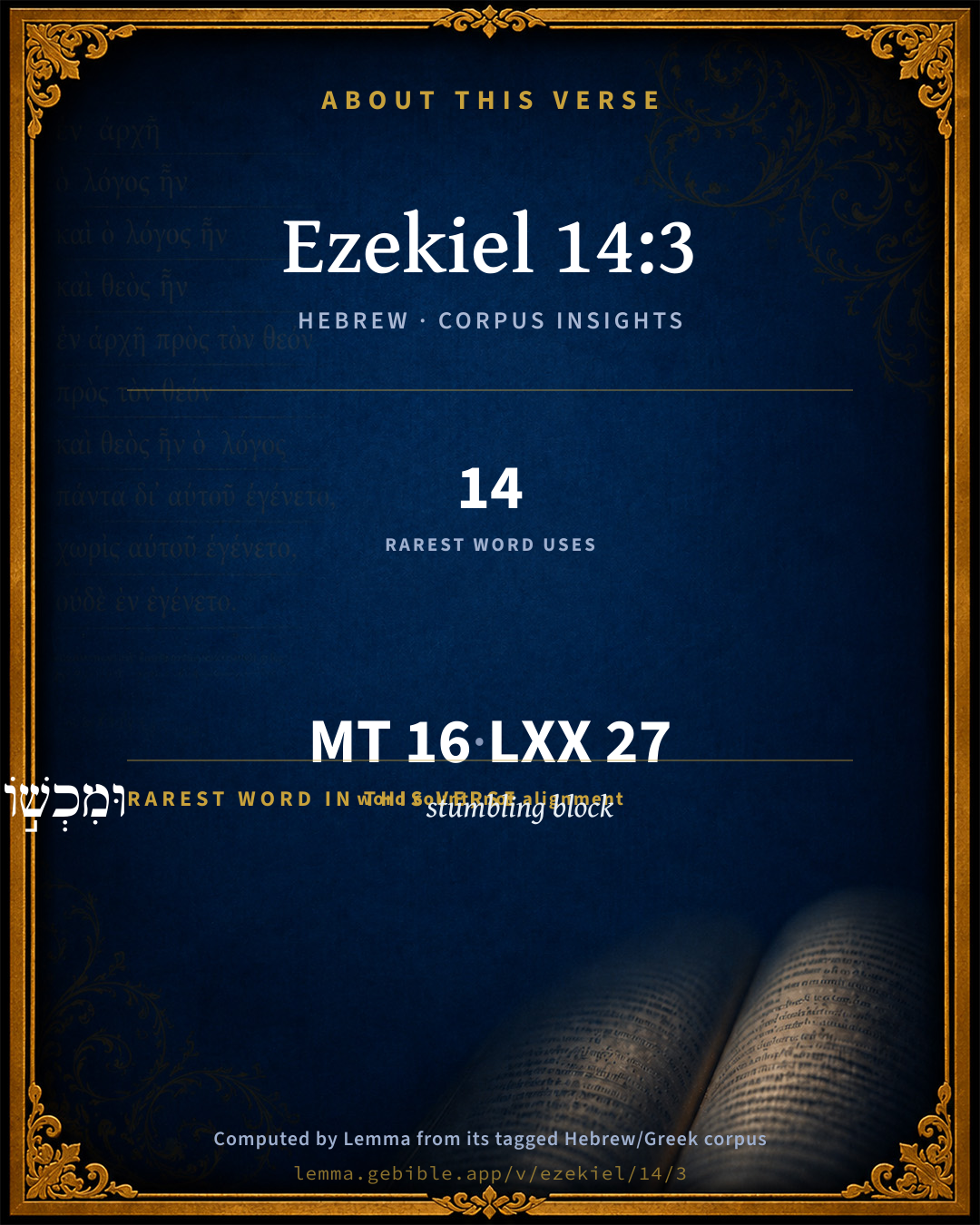
The rarest word here is וּמִכְשׁ֣וֹל stumbling block H4383 — appearing just 14 times in the whole Hebrew Bible.

Shared distinctive vocabulary

וּמִכְשׁ֣וֹל stumbling block H4383 occurs in 14 verses of the Hebrew Bible. Also found in:

Grammatical profile

  • 4 verbs
  • 8 nouns
  • 1 pronoun
  • 3 prepositions

Verb forms

  • הֶעֱל֤וּ Hiphil · Perfect
  • נָתְנ֖וּ Qal · Perfect
  • הַאִדָּרֹ֥שׁ Niphal · Infinitive Absolute
  • אִדָּרֵ֖שׁ Niphal · Imperfect

Repetition

A word recurs within this verse — often emphatic in Hebrew:

  • הַאִדָּרֹ֥שׁ to seek H1875 ×2

Hebrew & Septuagint length

In English translation the verse runs 32 words from the Hebrew and 28 from the Septuagint (LXX English) — closely comparable.

A rough comparison of the two English renderings, which tokenize alike — not a word-level alignment.

Word counts can differ between the Hebrew and the Greek without any difference in meaning — e.g. the Hebrew direct-object marker אֵת has no separate Greek word, and Greek often adds the article ὁ.

In the original languages it is 16 Hebrew tokens and 27 Greek tokens — but the two are counted differently (Hebrew bundles its prefixes and suffixes into one token; the Greek is in lemma form), so that isn’t a like-for-like length.

Cross-references

33

Topical passages linked to Ezekiel 14:3 in the Treasury of Scripture Knowledge — connected by theme and wording, ordered by reader-vote popularity; previews shown in the World English Bible.

  • Ezekiel 14:7 For everyone of the house of Israel, or of the strangers who sojourn in Israel, who separates himself from me, and takes his idols into his heart, and puts the stumbling block of his iniquity before his face, and comes to the prophet to inquire for himself of me; I Yahweh will answer him by myself:
  • Ezekiel 7:19 They shall cast their silver in the streets, and their gold shall be as an unclean thing; their silver and their gold shall not be able to deliver them in the day of the wrath of Yahweh: they shall not satisfy their souls, neither fill their bowels; because it has been the stumbling block of their iniquity.
  • Isaiah 1:15 When you spread forth your hands, I will hide my eyes from you; Yes, when you make many prayers, I will not hear. Your hands are full of blood.
  • Ezekiel 20:3 Son of man, speak to the elders of Israel, and tell them, Thus says the Lord Yahweh: Is it to inquire of me that you have come? As I live, says the Lord Yahweh, I will not be inquired of by you.
  • Ezekiel 20:16 because they rejected my ordinances, and didn't walk in my statutes, and profaned my Sabbaths: for their heart went after their idols.
  • Proverbs 28:9 He who turns away his ear from hearing the law, Even his prayer is an abomination.
  • Ezekiel 14:4 Therefore speak to them, and tell them, Thus says the Lord Yahweh: Every man of the house of Israel who takes his idols into his heart, and puts the stumbling block of his iniquity before his face, and comes to the prophet; I Yahweh will answer him therein according to the multitude of his idols;
  • Ezekiel 20:31 and when you offer your gifts, when you make your sons to pass through the fire, do you pollute yourselves with all your idols to this day? and shall I be inquired of by you, house of Israel? As I live, says the Lord Yahweh, I will not be inquired of by you;
  • Ezekiel 44:12 Because they ministered to them before their idols, and became a stumbling block of iniquity to the house of Israel; therefore have I lifted up my hand against them, says the Lord Yahweh, and they shall bear their iniquity.
  • 1 Samuel 28:6 When Saul inquired of Yahweh, Yahweh didn't answer him, neither by dreams, nor by Urim, nor by prophets.
  • Proverbs 15:29 Yahweh is far from the wicked, But he hears the prayer of the righteous.
  • Jeremiah 11:11 Therefore thus says Yahweh, Behold, I will bring evil on them, which they shall not be able to escape; and they shall cry to me, but I will not listen to them.
  • Ezekiel 11:21 But as for them whose heart walks after the heart of their detestable things and their abominations, I will bring their way on their own heads, says the Lord Yahweh.
  • Ezekiel 36:25 I will sprinkle clean water on you, and you shall be clean: from all your filthiness, and from all your idols, will I cleanse you.
  • 1 Peter 2:8 and, "A stone of stumbling, and a rock of offense." For they stumble at the word, being disobedient, whereunto also they were appointed.
  • Revelation 2:14 But I have a few things against you, because you have there some who hold the teaching of Balaam, who taught Balak to throw a stumbling block before the children of Israel, to eat things sacrificed to idols, and to commit sexual immorality.
  • 2 Kings 3:13 Elisha said to the king of Israel, What have I to do with you? get you to the prophets of your father, and to the prophets of your mother. The king of Israel said to him, No; for Yahweh has called these three kings together to deliver them into the hand of Moab.
  • Psalms 66:18 If I cherished sin in my heart, The Lord wouldn't have listened.
  • Psalms 101:3 I will set no vile thing before my eyes. I hate the deeds of faithless men. They will not cling to me.
  • Proverbs 15:8 The sacrifice made by the wicked is an abomination to Yahweh, But the prayer of the upright is his delight.
  • Proverbs 21:27 The sacrifice of the wicked is an abomination: How much more, when he brings it with a wicked mind!
  • Isaiah 33:15 He who walks righteously, and speaks blamelessly; he who despises the gain of oppressions, who shakes his hands from taking a bribe, who stops his ears from hearing of blood, and shuts his eyes from looking on evil:
  • Jeremiah 7:8–11 Behold, you trust in lying words, that can't profit.
  • Jeremiah 17:1–2 The sin of Judah is written with a pen of iron, [and] with the point of a diamond: it is engraved on the tablet of their heart, and on the horns of your altars;
  • Jeremiah 17:9 The heart is deceitful above all things, and it is exceedingly corrupt: who can know it?
  • Jeremiah 42:20–21 For you have dealt deceitfully against your own souls; for you sent me to Yahweh your God, saying, Pray for us to Yahweh our God; and according to all that Yahweh our God shall say, so declare to us, and we will do it:
  • Jeremiah 44:16–18 As for the word that you have spoken to us in the name of Yahweh, we will not listen to you.
  • Ezekiel 3:20 Again, when a righteous man does turn from his righteousness, and commit iniquity, and I lay a stumbling block before him, he shall die: because you have not given him warning, he shall die in his sin, and his righteous deeds which he has done shall not be remembered; but his blood will I require at your hand.
  • Ezekiel 6:9 Those of you that escape shall remember me among the nations where they shall be carried captive, how that I have been broken with their lewd heart, which has departed from me, and with they eyes, which play the prostitute after their idols: and they shall loathe themselves in their own sight for the evils which they have committed in all their abominations.
  • Zephaniah 1:3 I will sweep away man and animal. I will sweep away the birds of the sky, the fish of the sea, and the heaps of rubble with the wicked. I will cut off man from the surface of the earth, says Yahweh.
  • Zechariah 7:13 It has come to pass that, as he called, and they refused to listen, so they will call, and I will not listen," said Yahweh of Hosts;
  • Luke 20:8 Jesus said to them, "Neither will I tell you by what authority I do these things."
  • Ephesians 5:5 Know this for sure, that no sexually immoral person, nor unclean person, nor covetous man, who is an idolater, has any inheritance in the Kingdom of Christ and God.

Cross-references courtesy of OpenBible.info (CC BY 4.0).

Hebrew and Greek witnesses Masoretic Hebrew ↔ Greek Septuagint

The same verse in the two great witnesses to the Old Testament, shown verse-for-verse.

These are two independent witnesses, not word-aligned to each other, and the Septuagint is shown in lemma (dictionary) form.

Hebrew Ezekiel 14:3 Masoretic · Westminster Leningrad Codex

בֶּן אָדָ֗ם הָאֲנָשִׁ֤ים הָאֵ֨לֶּה֙ הֶעֱל֤וּ גִלּֽוּלֵיהֶם֙ עַל לִבָּ֔ם וּמִכְשׁ֣וֹל עֲוֺנָ֔ם נָתְנ֖וּ נֹ֣כַח פְּנֵיהֶ֑ם הַאִדָּרֹ֥שׁ אִדָּרֵ֖שׁ לָהֶֽם

Son of man, these men have taken their idols into their heart, and put the stumbling block of their iniquity before their face: should I be inquired of at all by them?

World English Bible · Public Domain

Greek LXX Ezekiel 14:3 Septuagint · lemma form

υἱός ἄνθρωπος ὁ ἀνήρ οὗτος τίθημι ὁ διανόημα αὐτός ἐπί ὁ καρδία αὐτός καί ὁ κόλασις ὁ ἀδικία αὐτός τίθημι πρό πρόσωπον αὐτός εἰ ἀποκρίνω ἀποκρίνω αὐτός

Son of man, these men have conceived their devices in their hearts, and have set before their faces the punishment of their iniquities: shall I indeed answer them?

LXX2012 (modern English Septuagint) · Public Domain

On this verse, The Pulpit Commentary discusses the Septuagint’s reading. Read the note in Commentary ↓

Hebrew: Westminster Leningrad Codex (CC BY 4.0). Greek: Septuagint (public domain); English from LXX2012 (modern English Septuagint) (Public Domain). How the Septuagint differs from the Hebrew →

Targum (Aramaic paraphrase)

1

The Targum is the ancient Jewish Aramaic paraphrase of the Hebrew Scriptures — an interpretive translation, not the Hebrew text itself. Onkelos (literal) and Pseudo-Jonathan (expansive) render the Torah, and Jonathan the Prophets. Coverage is partial: where no permissively-licensed English translation exists for a verse, only the Aramaic is shown. This is verse-level text, not a word-by-word alignment to the Hebrew.

  1. Targum Jonathan Prophets (Joshua–Malachi)
    בַּר אָדָם גַבְרַיָא הָאִלֵין אַסִיקוּ פּוּלְחַן טַעֲוַתְהוֹן עַל לִבְּהוֹן וְתַקְלַת חוֹבֵיהוֹן יְהָבוּ לָקֳבֵיל אַפֵּיהוֹן הֲאִשְׁתְּאִילָא יִשְׁתְּאַל בְּמֵימְרִי לְהוֹן:

    (no public-domain English translation for this verse)

    Targum Jonathan — Aramaic: “Mikraot Gedolot” (public domain). English: “Sefaria Community Translation” (CC0 1.0 (public-domain dedication)); “London "Chaldee Paraphrase," 1871” (public domain). Text via Sefaria.

Commentary

Notes on Ezekiel 14:3 from classic Christian and Jewish commentators (each source and its license shown beneath its notes). The classic Christian expositions comment on the surrounding passage and are grouped to its opening verse, so a note may address several verses; the Jewish commentaries on the Tanakh (Rashi and others) are per-verse, so they appear only where the commentator wrote on this verse.

Lemma curates 59 commentaries, every one of them public domain or Creative Commons licensed, each selected and text-cleaned for this edition rather than reprinted as found. About our sources →

Trapp's Complete Commentary

John Trapp

Eze 14:3 Son of man, these men have set up their idols in their heart, and put the stumblingblock of their iniquity before their face: should I be enquired of at all by them?

Ver. 3. These men have set their idols in their hearts.] Though they would seem to abhor idols, yet the devil is at inn with them, and their hearts are no better than so many idol temples, as thou wouldst easily perceive hadst thou but my fiery eyes, and couldst see their insides as I do. Sustulerunt stercoreos deos suos super cor suum, {a} they have laid their dungy deities upon their very hearts; a place where I only should be by right, for it is the bridal bed.

And put the stumblingblock of their iniquity,] i.e., They are impudent sinners, as the scholiast {b} interprets it, and resolved of their course whatever comes of it.

Should I be inquired of {c} at all by them?] q.d., No, never; I scorn the motion, I abhor such ludibrious devotion as this is. Away with it. Piscator rendereth the words, An ergo serio interrogor ab eis? Thinkest thou that I am seriously sought unto by these? q.d., Nothing less.

{a} Piscator.

{b} One who writes explanatory notes upon an author; esp. an ancient commentator upon a classical writer. ŒD

{c} Hoc significat crassum Dei contemptum et quasi professam rebellionem.

John Trapp, A Commentary or Exposition upon All the Books of the Old and New Testament (1647–1656) — public domain. Text from a community e-Sword module.

Geneva Bible (1599)

Geneva Bible translators

They are not only idolaters in heart, but also worship their filthy idols openly, which lead them in blindness, and cause them to stumble, and cast them out of God’s favor, so that he will not hear them when they call unto him, read Jer. 10:15.

Geneva Bible (1599) marginal notes — public domain. Text via Bolls.life.

Jamieson, Fausset & Brown

Robert Jamieson, A. R. Fausset & David Brown

heart . . . face--The heart is first corrupted, and then the outward manifestation of idol-worship follows; they set their idols before their eyes. With all their pretense of consulting God now, they have not even put away their idols outwardly; implying gross contempt of God. "Set up," literally, "aloft"; implying that their idols had gained the supreme ascendancy over them.

stumbling-block of . . . iniquity--See Pro 3:21, Pro 3:23, "Let not them (God's laws) depart from thine eyes, then . . . thy foot shall not stumble." Instead of God's law, which (by being kept before their eyes) would have saved them from stumbling, they set up their idols before their eyes, which proved a stumbling-block, causing them to stumble (Eze 7:19).

inquired of at all--literally, "should I with inquiry be inquired of" by such hypocrites as they are? (Psa 66:18; Pro 15:29; Pro 28:9).

Jamieson, Fausset & Brown — Commentary Critical and Explanatory on the Whole Bible (1871) — public domain (CC PDM 1.0). Text via the HelloAO Bible API.

Adam Clarke's Commentary

Verse 3. These men have set up their idols in their heart] Not only in their houses; in the streets; but they had them in their hearts. These were stumbling-blocks of iniquity; they fell over them, and broke the neck of their souls. And should God be inquired of by such miscreants as these?

Adam Clarke's Commentary on the Bible (1810–1826) — public domain. Text from a community e-Sword/MySword module.

Ellicott's Commentary for English Readers

(3) Have set up their idols in their heart.—It was not the open idolatry of Judæa which is reproved among these elders of the captivity; that had already passed away, but still their heart was not right. Like Lot’s wife, they longed for that which they dared not do. With such a disposition, they were in the greatest danger, putting “the stumbling-block of their iniquity,” the temptation to sin, directly before them. And not only so, but they kept themselves in a state of alienation from God, so that it was idle to imagine He would allow Himself to be enquired of by them. The question implies the negative answer which is fully expressed in the following verses.

A Bible Commentary for English Readers, edited by Charles John Ellicott (1878–1897) — public domain. Text from a community e-Sword module.

The Cambridge Bible for Schools and Colleges

gen. ed. J. J. S. Perowne

3. set up their idols in] Lit. have laid their idols upon their heart, which appears to mean, laid them on their minds, busied their thoughts and filled their affections with them.

stumblingblock of their iniquity] The reference is still to the idols. Stumblingblock of iniquity is that over which one falls and commits iniquity, see on ch. Eze_7:19.

before their face] i.e. have placed them in their view, or, so as to follow them; cf. Eze_14:6 “turn away your faces from all your abominations;” Psa_16:8; Psa_101:3. The language is figurative, and does not imply literal setting-up of idols.

should I be inquired of] Or, shall I let myself be inquired of? that is, shall I give an answer (through the prophet)? cf. Isa_65:1, where “inquired of” is parallel to “was found.”

The Cambridge Bible for Schools and Colleges (gen. ed. J. J. S. Perowne; Cambridge University Press, 1878–1918) — public domain. Text from a community e-Sword module.

John Gill's Exposition

Son of man, these men have set up their idols in their heart,.... Though they look so grave and demure, seem so devout and religious, and hear with so much attention and reverence, and express such a desire of consulting me by thee, they are no other than idolaters; and though they are at such a distance from their native place, and have not their idols with them, yet they have them in their fancy and imagination, and their hearts are after them, and are set upon them; these engross their affections, they are near and dear unto them, notwithstanding all their pretensions: or, they "have caused their idols to ascend upon their heart" (p); their hearts are the altars on which they worship them, and the throne on which they have placed them; they are held in the highest esteem by them, and have the greatest honours done them, and have the ascendant over them; even their "dunghill" gods, as the word (q) signifies; though they are but dung, filthy and abominable, these they lay upon their hearts; and what else is man's righteousness, when made an idol of, trusted to, and depended on? it is no other, as the apostle says, than "loss" and "dung", Phi 3:8; and so every carnal lust that is gratified and indulged is no other than an idol, or a dunghill god, set up in the heart:

and put the stumbling block of their iniquity before their face; whenever they had an opportunity of so doing; for their hearts were not only inwardly affected to idols, but they outwardly worshipped them; set them before them, and bowed the knee to them, and prayed: and these idols are called "the stumbling block of their iniquity", because by worshipping these they fell into sin, and so into ruin; they were the occasion of their sin, and of their punishment; they stumbled at them, and fell, even though they were before their eyes; nay, they set them themselves before their face, which shows their obstinacy and resolution to continue in idolatry, though it would be their ruin:

should I be inquired of at all by them? suffer them to come near me, and put a question to me, or be consulted by them through thee? no, I will not: or, "am I seriously inquired of by them?" so some (r) render the words; no, I am not; or, "being asked, shall I answer them?" so the Targum and Vulgate Latin version: or, "answering shall I answer them" (s)? no, I wilt not, they deserve no answer from me; they shall have none other of me than such an one as follows.

(p) "ascendere fecerunt idola sua in, vel super cor suum", Pagninus, Montanus, Calvin. (q) "stercoreos deos suos", Junius & Tremellius, Piscator; "stercora sua", Cocceius; "stercora ipsorum", Starckius. (r) "an igitur serio interrogor ab eis?" Piscator. (s) "An respondeudo respondebo illis?" Starckius. So Sept. Ar.

John Gill's Exposition of the Whole Bible (1746–1763) — public domain (CC PDM 1.0). Text via the HelloAO Bible API.

Haydock's Catholic Bible Commentary

Uncleanness. That is, their filthy idols, upon which they have set their hearts: and which are a stumbling-block to their souls. (Challoner) --- They came, it seems, to tempt the prophet, (Calmet) as God shewed him. Thus worldlings consult Catholic priests; yet are resolved to join with heretics. (Worthington)

George Leo Haydock (1774–1849), Haydock's Catholic Family Bible and Commentary, 1859 edition — public domain. Excludes Psalms (Douay-Rheims chapter numbering differs from Protestant) and Deuterocanonical books (Catholic canon only).

Matthew Poole's English Annotations

These men; who probably were come from Jerusalem, sent by Zedekiah, and mentioned by Jeremiah, Jer 51:59; some of the courtiers, who, more out of curiosity than religion, give a visit to this famous prophet.

Have set up their idols in their heart; resolved idolaters, their heart was totally addicted to their idolatrous worship and ceremonies, immersed in it.

The stumbling-block of their iniquity; their idols, so expressed, because they were both the object of their sin, and occasion of their ruin. They account these idols to be gods, and worship, fear, trust in, and plead for them; this is their sin, and ere long this shall bring ruin on them. Can these men seriously consult me? Is it fit I should give counsel to obstinate, resolved sinners, who come to inquire, but will not hearken? Should I help them in their distress, who depend on idols which I hate?

Matthew Poole's English Annotations on the Holy Bible (1683–1685) — public domain. Text from a community e-Sword/MySword module.

The Pulpit Commentary

These men, etc. The prophet, taught by the word of the Lord, reads the hearts of those who came to him. The words do not imply, rather they exclude, the open practice of idolatry. The sin of the inquirers was that they had set up idols (gillulim, Ezekiel"s favourite word; see note on Eze_6:4) in their hearts. The LXX gives dianohmata,"thoughts of their hearts," as if to express this. They were hankering after the old false worships in which they had once, taken part. The stumbling block (see Eze_3:20) of their iniquity was set up there. That divided heart, the "double mind" of Jam_1:8, made true inquiry, as it made true prayer for guidance, impossible. Shall I be inquired of at all, etc.? The "at all" represents the emphatic iteration of the verb in the Hebrew. The Vulgate, Numquid interrogatus respondebo eis? gives a fair paraphrase.

Ver. 3. Idols in the heart.

I THE HEART IS THE SEAT OF IDOLATRY. There may be splendid temples in a city, containing innumerable idols horrible monsters or beautiful statues, works of marble, ivory, or gold. Yet if the people do not worship them no sin is committed. We have many idols in our museums. The idols in a missionary society"s museum do no harm to its custodians. On the ether hand, though no idol temple stands in our land, and the last vestige of the old heathenism has been swept away centuries ago, and the very notion of worshipping stocks and stones seems to us ridiculous, yet in our hearts there may be things which alienate us from God. The essential question is as to what is there enthroned as in the citadel of the soul.

II EVERYTHING THAT TAKES THE PLACE OF GOD IN THE HEART IS AN IDOL. It is not everything loved that we are to regard as an idol. God does not claim the only affection of our hearts. We may love God through the love we bear to those earthly friends who are dear to us. But God claims the first place, the throne within. Whatever stands first in our estimation is our god. If some human affection, pleasure, or sin takes this pre-eminent position, and refuses to yield, when required, to the supreme will of God, that is our god, our idol.

III IDOLS IN THE HEART EXCLUDE COMMUNION WITH GOD. It is in reference to people who cherish such idols that God asks, "Should I be inquired of at all by them?" it is not likely that such people would be disposed to seek counsel from the true spiritual God. The idols would seem to be sufficient. But if they should think to add the worship of the supreme God to that of their idols, they would find that this is impossible. There are men for whom all access to God is cut off. They who cherish evil things or any rival affections, made evil by rivalry with the true love of the soul for God, find that they cannot reach to God. "Ye cannot serve God and mammon." Observe, however, this only applies to idolatry in the heart. Heathen people who follow the instincts of natural religion and feel after the unseen spiritual God may find him, though they have scores of idols in their houses, because such a genuine search for God implies the expulsion of idols from the heart.

IV IDOLATRY IN THE HEART WILL NOT BE NEGLECTED BY GOD. We may disown God and substitute our idols. But he will not, cannot, give us up. He is still our Lord, and he must take note of the rebellion of his people. But he is also still our Father, and, though we may not care for him, he has not ceased to love us. Therefore he will seek his idolatrous children and plague them with many a trouble, until he has induced them to see their folly, cast their idols out of their hearts, and welcome back their Lord to his rightful throne.

The Pulpit Commentary (1880–1919), ed. H.D.M. Spence-Jones & Joseph S. Exell — public domain. Text from a community e-Sword module.

John Wesley's Explanatory Notes

Set up - Are resolved idolaters. The stumbling block - Their idols which were both the object of their sin, and occasion of their ruin.

John Wesley, Explanatory Notes Upon the Whole Bible (1754–1765) — public domain. Text via the GEBible commentary corpus.

Rashi

Rabbi Shlomo Yitzchaki (Rashi)

have set their idols upon their heart Their heart is toward their idols to worship [them].

opposite their faces for the idol to always be for them an object of fear and a deity.

Shall I respond to their inquiry? Is it proper that I should respond to them and answer their words? Many rhetorical questions anticipate an affirmative reply.

Rashi on the Tanakh — English translations: “The Judaica Press complete Tanach with Rashi, translated by A. J. Rosenberg” (CC BY 4.0); “Pentateuch with Rashi's commentary by M. Rosenbaum and A.M. Silbermann, 1929-1934” (public domain); “The Metsudah Tanach series, Lakewood, N.J” (CC BY 4.0); and “The Book of Joshua, Metsudah Publications, 1997” (CC BY 4.0). Text via Sefaria.

Lesson kit

Teaching starters — assembled from the data on this page, not authored interpretation. Every prompt links to the verse data it draws on. Edit before teaching.

Ezekiel, in the Prophets, opens this verse with 16 words (14 distinct Hebrew lemmas). Its most distinctive word is mikshôwl (“stumbling block”). A historical commentator’s framing appears above. Read the whole chapter for the surrounding context.

Discussion questions

  1. The word mikshôwl carries the sense “stumbling block.” How does it shape the verse?
  2. How does Leviticus 19:14, which shares the word «stumbling block», read alongside this verse?
  3. What does the repetition of “to seek” (2× in this one verse) do in this verse?
  4. These translations render this verse differently; the difference is in the English rendering, not the original. What questions does that raise?
  5. «הֶעֱל֤וּ» is a Hiphil Perfect verb. How does that grammatical form shape the action described?
  6. Compare how Trapp's Complete Commentary and Geneva Bible (1599) read this verse. Where do they agree or differ?

Things to notice

Reading settings

Reading text

Shown beneath each verse's original-language words.

Old Testament
Old Testament edition

Read the OT as the Masoretic Hebrew (MT) or the Greek Septuagint (LXX).

English shown for the Greek Septuagint (in the Hebrew ↔ Greek comparison).

Comparing translations? Open the Compare panel on any verse page to stack up to four side by side.