
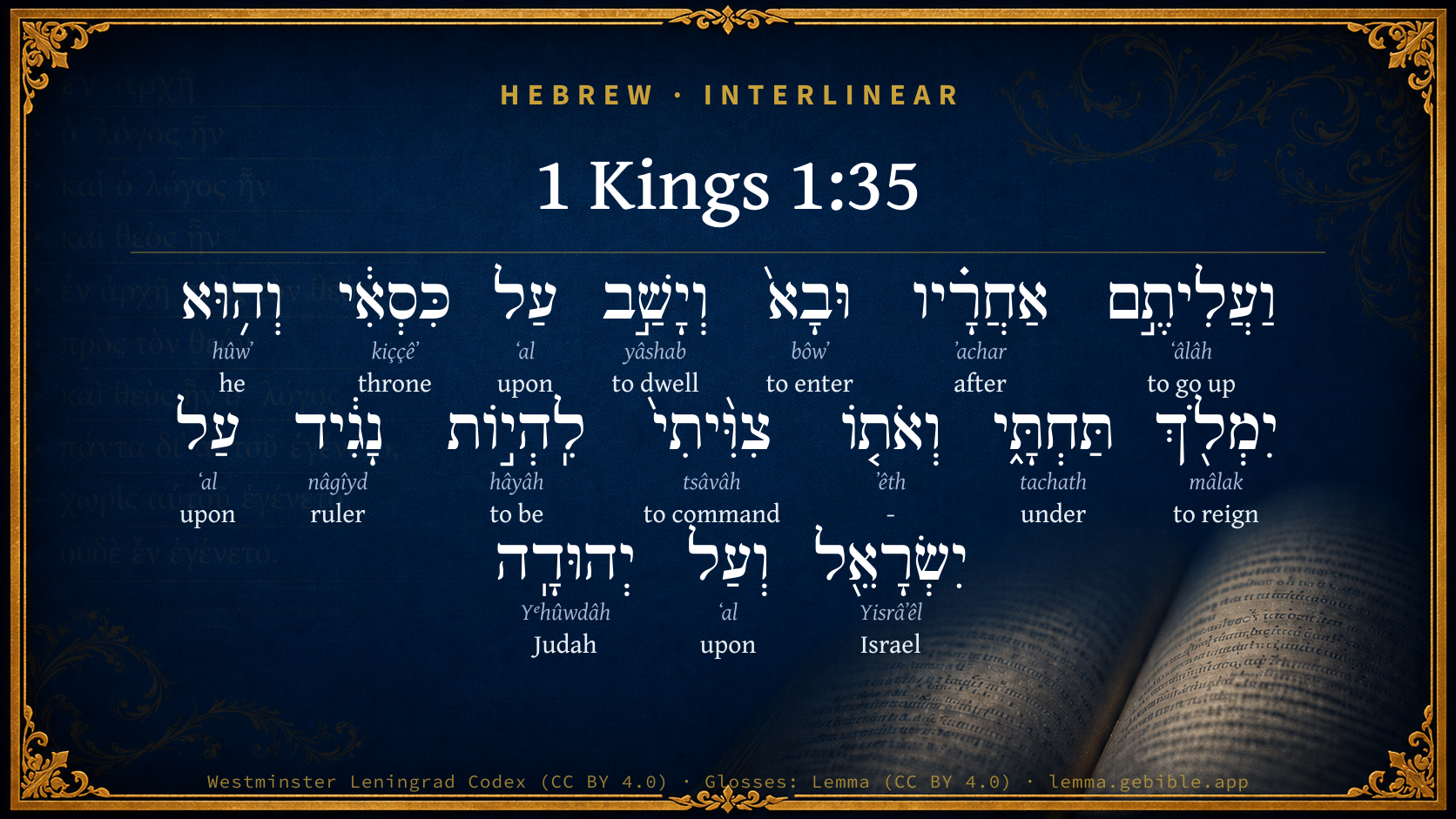
1 Kings 1:35

Hebrew (Westminster Leningrad Codex) 1 Kings 1:35 appears in the Hebrew Old Testament. The text above is from the Westminster Leningrad Codex. Each word links to its Strong’s number, a concise gloss, and parsing drawn from the Open Scriptures Hebrew Bible morphology. Click any word for its full Brown-Driver-Briggs (BDB) entry.
Download image
Cite this verse

1 Kings 1:35 (World English Bible). Public Domain. Lemma interlinear Bible study tool, https://lemma.gebible.app/v/1-kings/1/35.

Show BibTeX & RIS
BibTeX
RIS
English Translation
Then you shall come up after him, and he shall come and sit on my throne; for he shall be king in my place; and I have appointed him to be prince over Israel and over Judah.
World English Bible · Public Domain
Download a study sheet

One document with this verse’s original text, its word-by-word gloss line, the meaning frame, cross-references with their text, attributed commentary, and full source and license credits — printable, and it pastes into notes with its structure intact.

This verse Autodidact and up

Study sheet (.html) Plain text (.txt)

A passage Seminary Student

Up to 50 verses in one chapter. A passage sheet keeps up to 6 commentary sources and 12 cross-references per verse, in the order this page ranks them, and says so on the sheet whenever that leaves anything out. Ask for a single verse and you get the Autodidact verse sheet above.

Everything on this page stays free to read, with no account — the sheet is a download of what is already on screen, not access to it.

Want to remove ads? Support Godless Engineer
Compare translations 3

The same verse in 3 English versions, stacked beneath the original-language interlinear above. Click any original word for its lexicon entry.

Each is an independent rendering of the whole verse — the interlinear is not word-aligned to these translations.

Highlighted words mark where these versions differ — a whole-verse word diff, not a word-by-word alignment.

  • World English Bible Public Domain
    Then you shall come up after him, and he shall come and sit on my throne; for he shall be king in my place; and I have appointed him to be prince over Israel and over Judah.
  • King James Version Public Domain
    Then ye shall come up after him, that he may come and sit upon my throne; for he shall be king in my stead: and I have appointed him to be ruler over Israel and over Judah.
  • unfoldingWord Literal Text CC BY-SA 4.0
    And you shall go up after him, and he shall come and sit on my throne, and he, he will reign in my place. And I have commanded him to be ruler over Israel and over Judah.”

unfoldingWord Literal Text — © unfoldingWord, licensed CC BY-SA 4.0. Word-aligned USFM3 via Door43 (git.door43.org/unfoldingWord/en_ult).

Versions to compare (up to 4)

3 of 4 selected

Show all 18 translations

Every available English version of this verse, each an independent rendering of the whole verse.

  • World English Bible Public Domain
    Then you shall come up after him, and he shall come and sit on my throne; for he shall be king in my place; and I have appointed him to be prince over Israel and over Judah.
  • Berean Standard Bible Public Domain
    Then you shall go up with him, and he is to come and sit on my throne and reign in my place. For I have appointed him ruler over Israel and Judah.”
  • Majority Standard Bible Public Domain
    Then you shall go up with him, and he is to come and sit on my throne and reign in my place. For I have appointed him ruler over Israel and Judah.”
  • King James Version Public Domain
    Then ye shall come up after him, that he may come and sit upon my throne; for he shall be king in my stead: and I have appointed him to be ruler over Israel and over Judah.
  • American Standard Version (1901) Public Domain
    Then ye shall come up after him, and he shall come and sit upon my throne; for he shall be king in my stead; and I have appointed him to be prince over Israel and over Judah.
  • Revised Version (1885) Public Domain
    Then ye shall come up after him, and he shall come and sit upon my throne; for he shall be king in my stead: and I have appointed him to be prince over Israel and over Judah.
  • Geneva Bible (1599) Public Domain
    Then come vp after him, that hee may come and sit vpon my throne: and hee shall bee King in my steade: for I haue appointed him to be prince ouer Israel and ouer Iudah.
  • Douay-Rheims (1899) Public Domain
    And you shall come up after him, and he shall come, and shall sit upon my throne, and he shall reign in my stead: and I will appoint him to be ruler over Israel, and over Juda.
  • Young's Literal Translation Public Domain
    and ye have come up after him, and he hath come in and hath sat on my throne, and he doth reign in my stead, and him I have appointed to be leader over Israel, and over Judah.'
  • Literal Standard Version CC BY-SA 4.0
    and you have come up after him, and he has come in and has sat on my throne, and he reigns in my stead, and I have appointed him to be leader over Israel, and over Judah.”
  • Unlocked Literal Bible CC BY-SA 4.0
    Then you will come up after him, and he will come and sit on my throne; for he will be king in my place. I have appointed him to be ruler over Israel and Judah.”
  • unfoldingWord Literal Text CC BY-SA 4.0
    And you shall go up after him, and he shall come and sit on my throne, and he, he will reign in my place. And I have commanded him to be ruler over Israel and over Judah.”
  • Darby Bible Public Domain
    And ye shall come up after him, that he may come and sit on my throne; for he shall reign in my stead, and I have appointed him to be ruler over Israel and over Judah.
  • World Messianic Bible Public Domain
    Then come up after him, and he shall come and sit on my throne; for he shall be king in my place. I have appointed him to be prince over Israel and over Judah.”
  • Webster's Bible Public Domain
    Then ye shall come up after him, that he may come and sit upon my throne; for he shall be king in my stead: and I have appointed him to be ruler over Israel and over Judah.
  • Free Bible Version CC BY-SA 4.0
    Then follow him back up, and have him come and sit on my throne. He is to be king instead of me. I am placing him in charge as ruler of Israel and Judah.”
  • Bible in Basic English Public Domain
    Then come up after him and he will come in and take his place on the seat of my kingdom; for he is to be king in my place, and I have given orders that he is to be ruler over Israel and over Judah.
  • JPS Tanakh (1917) Public Domain
    Then ye shall come up after him, and he shall come and sit upon my throne; for he shall be king in my stead; and I have appointed him to be prince over Israel and over Judah.'

Literal Standard Version (2020), Covenant Press — licensed CC BY-SA 4.0. Text via the HelloAO Bible API (eBible.org). Unlocked Literal Bible (unfoldingWord) — licensed CC BY-SA 4.0. Text via the HelloAO Bible API (eBible.org). unfoldingWord Literal Text — © unfoldingWord, licensed CC BY-SA 4.0. Word-aligned USFM3 via Door43 (git.door43.org/unfoldingWord/en_ult). Free Bible Version, Dr. Jonathan Gallagher — licensed CC BY-SA 4.0. Text via the HelloAO Bible API (eBible.org).

Word by word

More ways to search: Search by grammar → Find every occurrence → Compare this word →

Practice this passage: Drill this verse → Learn its vocabulary →

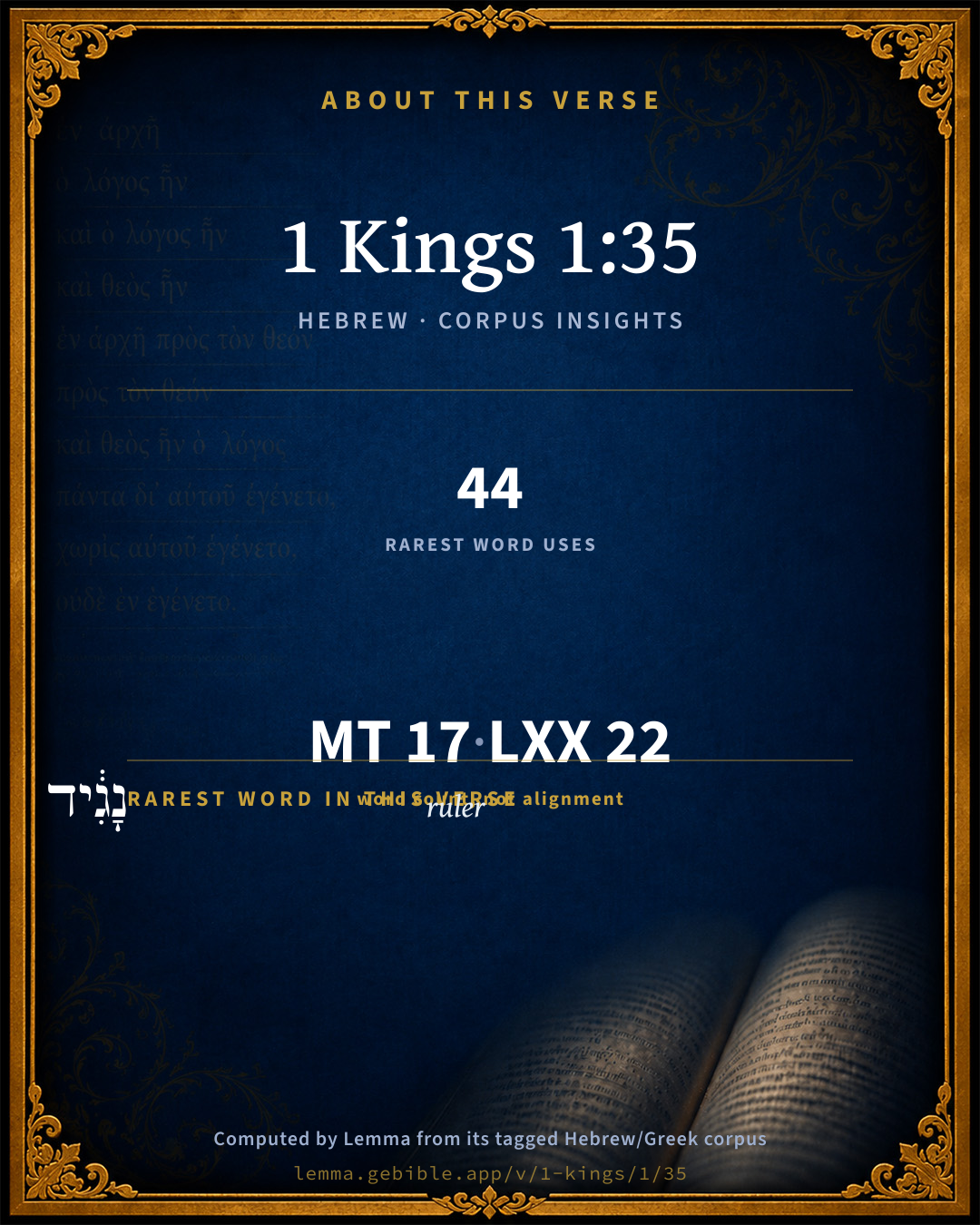
נָגִ֔יד
nâgîyd
H5057
“ruler”
Noun, Common, Masculine, Singular, Absolute
Part of Speech
Noun
Type
Common
Gender
Masculine
Number
Singular
State
Absolute
Full BDB Definition

Origin: from H5046

TWOT: 1289b

leader, ruler, captain, prince - ruler, prince - prince-overseer - ruler (in other capacities) - princely things
  1. וַעֲלִיתֶ֣ם ʻâlâh H5927 “and · to go up” Conjunction + Verb, Qal, Sequential Perfect, 2nd Person, Masculine, Plural
  2. אַחֲרָ֗יו ʼachar H310 “after · him” Preposition + Suffix, Personal, 3rd Person, Masculine, Singular
  3. וּבָא֙ bôwʼ H935 “and · to enter” Conjunction + Verb, Qal, Sequential Perfect, 3rd Person, Masculine, Singular
  4. וְיָשַׁ֣ב yâshab H3427 “and · to dwell” Conjunction + Verb, Qal, Sequential Perfect, 3rd Person, Masculine, Singular
  5. עַל ʻal H5921 “upon” Preposition
  6. כִּסְאִ֔י kiççêʼ H3678 “throne · my” Noun, Common, Masculine, Singular, Construct + Suffix, Personal, 1st Person, Common, Singular
  7. וְה֥וּא hûwʼ H1931 “and · he” Conjunction + Pronoun, Personal, 3rd Person, Masculine, Singular
  8. יִמְלֹ֖ךְ mâlak H4427 “to reign” Verb, Qal, Imperfect, 3rd Person, Masculine, Singular
  9. תַּחְתָּ֑י tachath H8478 “under · me” Preposition + Suffix, Personal, 1st Person, Common, Singular
  10. וְאֹת֤וֹ ʼêth H853 “and · - · him” Conjunction + Particle, Direct Object + Suffix, Personal, 3rd Person, Masculine, Singular
  11. צִוִּ֨יתִי֙ tsâvâh H6680 “to command” Verb, Piel, Perfect, 1st Person, Common, Singular
  12. לִֽהְי֣וֹת hâyâh H1961 “to be” Preposition + Verb, Qal, Infinitive Construct
  13. עַל ʻal H5921 “upon” Preposition
  14. יִשְׂרָאֵ֖ל Yisrâʼêl H3478 “Israel” Noun, Proper
  15. וְעַל ʻal H5921 “and · upon” Conjunction + Preposition
  16. יְהוּדָֽה Yᵉhûwdâh H3063 “Judah” Noun, Proper

About this verse

These counts appear in no published source. They are computed here, from the morphology-tagged text and Lemma’s own curated glosses. What Lemma adds →

17
words
15
distinct lemmas
Historical
section

Shared distinctive vocabulary

נָגִ֔יד ruler H5057 occurs in 44 verses of the Hebrew Bible. Also found in:

Grammatical profile

  • 6 verbs
  • 4 nouns
  • 1 pronoun
  • 5 prepositions
  • 1 particle

Verb forms

  • וַעֲלִיתֶ֣ם Qal · Sequential Perfect
  • וּבָא֙ Qal · Sequential Perfect
  • וְיָשַׁ֣ב Qal · Sequential Perfect
  • יִמְלֹ֖ךְ Qal · Imperfect
  • צִוִּ֨יתִי֙ Piel · Perfect
  • לִֽהְי֣וֹת Qal · Infinitive Construct

Repetition

A word recurs within this verse — often emphatic in Hebrew:

Hebrew & Septuagint length

In English translation the verse runs 37 words from the Hebrew and 28 from the Septuagint (LXX English) — closely comparable.

A rough comparison of the two English renderings, which tokenize alike — not a word-level alignment.

Word counts can differ between the Hebrew and the Greek without any difference in meaning — e.g. the Hebrew direct-object marker אֵת has no separate Greek word, and Greek often adds the article ὁ.

In the original languages it is 17 Hebrew tokens and 22 Greek tokens — but the two are counted differently (Hebrew bundles its prefixes and suffixes into one token; the Greek is in lemma form), so that isn’t a like-for-like length.

Cross-references

8

Topical passages linked to 1 Kings 1:35 in the Treasury of Scripture Knowledge — connected by theme and wording, ordered by reader-vote popularity; previews shown in the World English Bible.

  • 1 Kings 1:13 Go and get you in to king David, and tell him, Didn't you, my lord, king, swear to your handmaid, saying, Assuredly Solomon your son shall reign after me, and he shall sit on my throne? why then does Adonijah reign?
  • 1 Kings 1:17 She said to him, My lord, you swore by Yahweh your God to your handmaid, [saying], Assuredly Solomon your son shall reign after me, and he shall sit on my throne.
  • 1 Kings 2:12 Solomon sat on the throne of David his father; and his kingdom was established greatly.
  • 1 Kings 2:15 He said, You know that the kingdom was mine, and that all Israel set their faces on me, that I should reign: however the kingdom is turned about, and is become my brother's; for it was his from Yahweh.
  • 1 Chronicles 23:1 Now David was old and full of days; and he made Solomon his son king over Israel.
  • 1 Chronicles 28:4–5 However Yahweh, the God of Israel, chose me out of all the house of my father to be king over Israel forever: for he has chosen Judah to be prince; and in the house of Judah, the house of my father; and among the sons of my father he took pleasure in me to make me king over all Israel;
  • Psalms 2:6 "Yet I have set my king on my holy hill of Zion."
  • Psalms 72:1–2 God, give the king your justice; Your righteousness to the royal son.

Cross-references courtesy of OpenBible.info (CC BY 4.0).

Hebrew and Greek witnesses Masoretic Hebrew ↔ Greek Septuagint

The same verse in the two great witnesses to the Old Testament, shown verse-for-verse.

These are two independent witnesses, not word-aligned to each other, and the Septuagint is shown in lemma (dictionary) form.

Hebrew 1 Kings 1:35 Masoretic · Westminster Leningrad Codex

וַעֲלִיתֶ֣ם אַחֲרָ֗יו וּבָא֙ וְיָשַׁ֣ב עַל כִּסְאִ֔י וְה֥וּא יִמְלֹ֖ךְ תַּחְתָּ֑י וְאֹת֤וֹ צִוִּ֨יתִי֙ לִֽהְי֣וֹת נָגִ֔יד עַל יִשְׂרָאֵ֖ל וְעַל יְהוּדָֽה

Then you shall come up after him, and he shall come and sit on my throne; for he shall be king in my place; and I have appointed him to be prince over Israel and over Judah.

World English Bible · Public Domain

Greek LXX 1 Kings 1:35 Septuagint · lemma form

καί καταἵημι ἐπί ὁ θρόνος ἐγώ καί αὐτός βασιλεύω ἀντί ἐγώ καί ἐγώ ἐντέλλομαι ὁ εἰμί εἰς ἡγέομαι ἐπί ἰσραήλ καί ἰουδά

And he shall sit upon my throne, and reign in my stead: and I have given charge that he should be for a prince over Israel and Juda.

LXX2012 (modern English Septuagint) · Public Domain

On this verse, The Pulpit Commentary discusses the Septuagint’s reading. Read the note in Commentary ↓

Hebrew: Westminster Leningrad Codex (CC BY 4.0). Greek: Septuagint (public domain); English from LXX2012 (modern English Septuagint) (Public Domain). How the Septuagint differs from the Hebrew →

Targum (Aramaic paraphrase)

1

The Targum is the ancient Jewish Aramaic paraphrase of the Hebrew Scriptures — an interpretive translation, not the Hebrew text itself. Onkelos (literal) and Pseudo-Jonathan (expansive) render the Torah, and Jonathan the Prophets. Coverage is partial: where no permissively-licensed English translation exists for a verse, only the Aramaic is shown. This is verse-level text, not a word-by-word alignment to the Hebrew.

  1. Targum Jonathan Prophets (Joshua–Malachi)
    וְתִסְקוּן בַּתְרוֹהִי וְיֵיתֵי וְיִתֵּיב עַל כּוּרְסֵי מַלְכוּתִי וְהוּא יִמְלוֹךְ תְּחוֹתָי וְיָתֵיהּ פַּקְדִית לְמֶהֱוֵי מַלְכָּא עַל יִשְׂרָאֵל וְעַל יְהוּדָה:

    (no public-domain English translation for this verse)

    Targum Jonathan — Aramaic: “Mikraot Gedolot” (public domain). English: “Sefaria Community Translation” (CC0 1.0 (public-domain dedication)); “London "Chaldee Paraphrase," 1871” (public domain). Text via Sefaria.

Commentary

Notes on 1 Kings 1:35 from classic Christian and Jewish commentators (each source and its license shown beneath its notes). The classic Christian expositions comment on the surrounding passage and are grouped to its opening verse, so a note may address several verses; the Jewish commentaries on the Tanakh (Rashi and others) are per-verse, so they appear only where the commentator wrote on this verse.

Lemma curates 59 commentaries, every one of them public domain or Creative Commons licensed, each selected and text-cleaned for this edition rather than reprinted as found. About our sources →

Trapp's Complete Commentary

John Trapp

1Ki 1:35 Then ye shall come up after him, that he may come and sit upon my throne; for he shall be king in my stead: and I have appointed him to be ruler over Israel and over Judah.

Ver. 35. For he shall be king in my stead.] The son of our King Henry II was crowned king by his father, who at his coronation renounced the name of a king for that day, and as sewer served at that table. But this young king was so puffed up with his new dignity, that he soon bore arms against his father; and dying of discontent before his father, got not so much by his coronation as to have a name in the catalogue of the kings of England. But Solomon had learned better things both of his father {Pro 4:4} and mother, {Pro 31:10-31} and tutor Nathan.

John Trapp, A Commentary or Exposition upon All the Books of the Old and New Testament (1647–1656) — public domain. Text from a community e-Sword module.

Joseph Benson's Commentary

1Ki 1:35-36. Then ye shall come up after him, that he may sit on my throne — Ye shall attend upon him to Jerusalem, and give him actual possession of the throne. For he shall be king in my stead — My deputy and vice-king while I live, and absolutely king when I die. Over Israel and over Judah — The latter clause is added, lest the men of Judah, who were in a special manner invited by Adonijah, (1Ki 1:9,) should think themselves exempted from his jurisdiction. And Benaiah said, Amen — They all said the same, (1Ki 1:47,) not doubting but God would establish his authority.

Joseph Benson's Commentary on the Old and New Testaments (1811–1818) — public domain. Text from a community e-Sword module.

Tyndale Open Study Notes

Tyndale Open Resources

1:35 sit on my throne: Due to David’s age and infirmities, Solomon officiated publicly for about two years before his father died. Co-regency provided for orderly royal succession and became commonplace during Israel’s divided monarchy. It was also practiced in Egypt. • The Hebrew term for ruler, used for various leadership positions, can have theological significance; the king was seen as both a spiritual and administrative leader of God’s people (see Deut 31:10-11; 1 Chr 28:4-6; Ps 89:3-4; Isa 55:3-4).

Tyndale Open Study Notes — © Tyndale Open Resources, licensed CC BY-SA 4.0. Text via the HelloAO Bible API.

Geneva Bible (1599)

Geneva Bible translators

Hebrew, commanded.

Geneva Bible (1599) marginal notes — public domain. Text via Bolls.life.

Jamieson, Fausset & Brown

Robert Jamieson, A. R. Fausset & David Brown

Then ye shall come up after him, that he may come and sit upon my throne--The public recognition of the successor to the throne, during the old king's lifetime, is accordant with the customs of the East.

Jamieson, Fausset & Brown — Commentary Critical and Explanatory on the Whole Bible (1871) — public domain (CC PDM 1.0). Text via the HelloAO Bible API.

Ellicott's Commentary for English Readers

(35) Over Israel and over Judah.—The phrase clearly refers to the distinction, already tending to become a division, between Israel and Judah in relation to the monarchy. In the case of David himself, it may be observed that the record of his accession to royalty over Israel contains the notice of “a league” made by him with the elders of Israel (2Sa_5:3), to which there is nothing to correspond in the account of his becoming king over Judah (2Sa_2:4). This perhaps indicates from the beginning a less absolute rule over the other tribes. Certainly the history of the rebellion of Absalom (2Sa_15:10; 2Sa_15:13; 2Sa_18:6-7), the disputes about the restoration of David (2Sa_19:41-43), and the attempt of Sheba to take advantage of them (2Sa_20:1-2), show a looser allegiance of Israel than of Judah to the house of David.

A Bible Commentary for English Readers, edited by Charles John Ellicott (1878–1897) — public domain. Text from a community e-Sword module.

The Cambridge Bible for Schools and Colleges

gen. ed. J. J. S. Perowne

35. come up after him] That is, as his supporters and body-guard, just as in 1Ki_1:7 above, the conspirators ‘helped after Adonijah.’ Cf. also below, 1Ki_1:40.

to be ruler over Israel] A better rendering is ‘prince’. The title was that given by God specially to those who should lead His people. Thus Saul is first so called (1Sa_9:16. A.V. ‘captain’ as in 1Sa_10:1. In 2Ch_11:22 A.V. has ‘ruler,’ R.V. ‘prince’), then David (1Sa_25:30, A. V. ‘leader’). It is used also of Hezekiah (2Ki_20:5), and in Daniel (1Ki_9:25) of Him who was to be greater than all these, ‘Messiah the Prince.’

The Cambridge Bible for Schools and Colleges (gen. ed. J. J. S. Perowne; Cambridge University Press, 1878–1918) — public domain. Text from a community e-Sword module.

John Gill's Exposition

Then ye shall come up after him,.... When anointed, proclaimed, and cheered, then he was to mount the mule, and ride before them as their king, at the head of them; they following after, in token of their subjection to him:

that he may come and sit upon my throne; at Jerusalem, in the king's palace, and there exercise his kingly power he would now be invested with:

for he shall be king in my stead; even during David's life, as well as after his decease:

and I have appointed him to be ruler over Israel, and over Judah; that is, over all the twelve tribes of Israel Judah may be particularly mentioned, though included in Israel, because Adonijah had invited the men of Judah to his feast and party, Kg1 1:9; and therefore had they not been named, might think he had no power over them.

John Gill's Exposition of the Whole Bible (1746–1763) — public domain (CC PDM 1.0). Text via the HelloAO Bible API.

Albert Barnes' Notes on the Bible

Over Israel and over Judah - There is no anticipation here of the subsequent division of the kingdom; the antithesis between Judah and Israel already existed in the reign of David 2Sa 2:9; 2Sa 19:11.

Albert Barnes' Notes on the Bible (1834–1885) — public domain. Text from a community e-Sword/MySword module.

Haydock's Catholic Bible Commentary

Stead. Not after me only. David voluntarily abdicates the throne, so that Solomon reigned in his life-time. (Menochius)

George Leo Haydock (1774–1849), Haydock's Catholic Family Bible and Commentary, 1859 edition — public domain. Excludes Psalms (Douay-Rheims chapter numbering differs from Protestant) and Deuterocanonical books (Catholic canon only).

Matthew Poole's English Annotations

King in my stead; my deputy and vice-king whilst I live, and absolutely king when I die. Or if David and Solomon were joint kings, it is no more than was afterwards frequent at Rome, where the father and son, or two other persons, were not seldom joint emperors.

I have appointed, and that by Divine direction.

And over Judah: this is added, partly as being the most eminent and royal tribe; it being frequent, together with the general distinction, to mention one of the most eminent particulars, as 1Ki 11:1; Psa 18:1; Mar 16:7; and partly lest the men of Judah, who were in a special manner invited by Adonijah, 1Ki 1:9, might think themselves exempted from his jurisdiction.

Matthew Poole's English Annotations on the Holy Bible (1683–1685) — public domain. Text from a community e-Sword/MySword module.

The Pulpit Commentary

Then ye shall come up after him (not in the LXX Cod. Vat.) that he may Hebrews and he shall come and sit upon my throne in every possible way his accession was to be proclaimed and confirmed, for he shall be king in my stead David i.e., virtually abdicates in Solomon"s favour. Cf. vers. 46, 51, 53; 1Ch_29:23, 26 and I have appointed him he and him are emphasised in the original to be ruler over Israel and over Judah. It is possible, as Bahr thinks, that Israel and Judah were severally mentioned because David had once been king over Judah only, and because Israel had gone over to the side of Absalom. It is more probable, however, that "Israel and Judah" was even then the current designation of the two component parts of the realm. (see 2Sa_2:9, 10 19:11, 41, etc.) Besides, we can hardly suppose that the historian has in every case, though he probably has in this, preserved the exact words of the speaker; and it need cause us no surprise had he put into David"s mouth the phraseology of a later age. In the nature of things he can only give us the substance of conversations such as these.

The Pulpit Commentary (1880–1919), ed. H.D.M. Spence-Jones & Joseph S. Exell — public domain. Text from a community e-Sword module.

John Wesley's Explanatory Notes

My stead - My deputy and vice-king whilst I live, and absolutely king when I die. And Judah - This is added, lest the men of Judah, who were in a special manner invited by Adonijah, ver. 9, might think themselves exempted from his jurisdiction.

John Wesley, Explanatory Notes Upon the Whole Bible (1754–1765) — public domain. Text via the GEBible commentary corpus.

Keil & Delitzsch

C. F. Keil & F. Delitzsch

After the anointing they were to conduct Solomon up to Zion again; Solomon was then to ascend the throne, as David was about to appoint him prince over Israel and Judah in his own stead. Both the anointing and the appointment of Solomon as prince over the whole of the covenant nation were necessary, because the succession to the throne had been rendered doubtful through Adonijah's attempt, and the aged king was still alive. In cases where there was no question, and the son followed the father after his death, the unanimous opinion of the Rabbins is, that there was no anointing at all. Israel and Judah are mentioned, because David had been the first to unite all the tribes under his sceptre, and after the death of Solomon Israel fell away from the house of David.

Keil & Delitzsch — Biblical Commentary on the Old Testament (1861–1891) — public domain (CC PDM 1.0). Text via the HelloAO Bible API. (Old Testament only.)

unfoldingWord translationNotes

Door43 World Missions Community

General Information:

King David continues to speak on behalf of Solomon as the one who will become king.

he will come and sit on my throne

The words "sit on the throne" are used as a metonym for being king in 1 Kings 1:13, 1 Kings 1:17, and 1 Kings 1:30. Here David speaks of Solomon literally sitting on a physical throne.

So let it be!

They agree and will do what King David said.

May Yahweh, the God of my master the king, confirm

Benaiah speaks to King David as if he were speaking to someone else to show that he respects King David. AT: "My master and king, may Yahweh your God confirm" (See: Pronouns)

has been with my master the king, so

Benaiah speaks to King David as if he were speaking to someone else to show that he respects King David. AT: "has been with you, my master the king, so" (See: Pronouns)

make his throne greater than the throne of my master King David

The word "throne" is a metonym for either 1) the person who sits on the throne. AT: "make the one who sits on the throne greater than my master King David" or 2) the kingdom over which the one who sits on the throne rules. AT: "make his kingdom greater than the kingdom of my master King David" (See: Metonymy)

the throne of my master King David

Benaiah speaks to King David as if he were speaking to someone else to show that he respects King David. AT: "your throne, my master King David" (See: Pronouns)

translationWords

throne

king

appoint

rule

Israel

Judah

unfoldingWord translationNotes — © Distant Shores Media and the Door43 World Missions Community, licensed CC BY-SA 4.0. Source: git.door43.org/Door43/en_tn.

Lesson kit

Teaching starters — assembled from the data on this page, not authored interpretation. Every prompt links to the verse data it draws on. Edit before teaching.

1 Kings, in the Historical, opens this verse with 17 words (15 distinct Hebrew lemmas). Its most distinctive word is nâgîyd (“ruler”). A historical commentator’s framing appears above. Read the whole chapter for the surrounding context.

Discussion questions

  1. How does “ruler” (nâgîyd) shape what this verse is saying?
  2. 1 Samuel 9:16 shares the word «ruler» with this verse. How do the two illuminate each other?
  3. “upon” occurs 3× in this one verse. What is the effect of the repetition?
  4. The translations on this page render this verse differently — a whole-verse word diff, not a word-by-word alignment. What might account for the different wordings?
  5. The verb «וַעֲלִיתֶ֣ם» is Qal Sequential Perfect. How does its form color the action?
  6. Reading how Trapp's Complete Commentary and Joseph Benson's Commentary read this verse, where do the two commentators agree and where do they part?

Things to notice

Reading settings

Reading text

Shown beneath each verse's original-language words.

Old Testament
Old Testament edition

Read the OT as the Masoretic Hebrew (MT) or the Greek Septuagint (LXX).

English shown for the Greek Septuagint (in the Hebrew ↔ Greek comparison).

Comparing translations? Open the Compare panel on any verse page to stack up to four side by side.