
Exodus 17:3

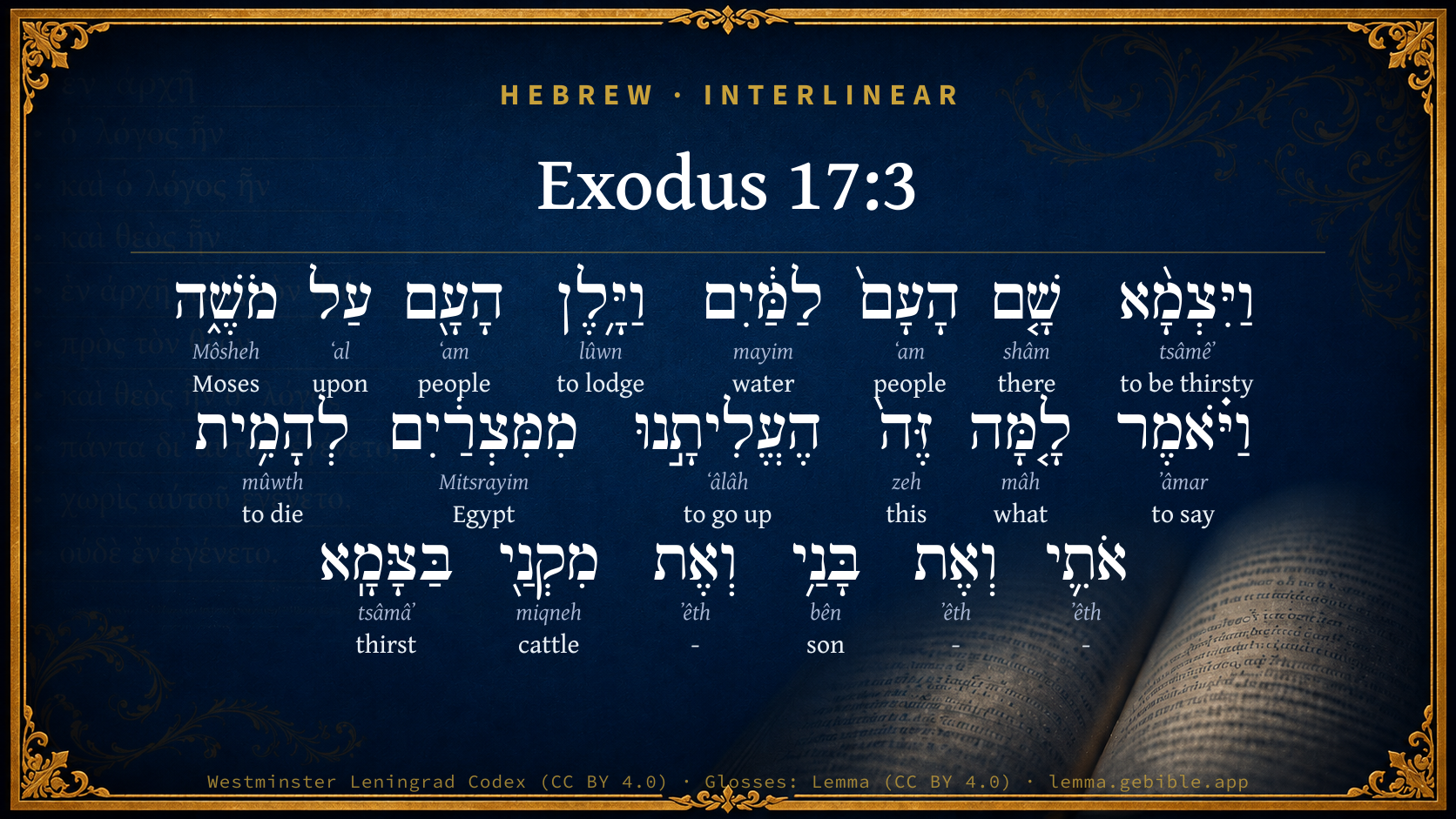
Hebrew (Westminster Leningrad Codex) Exodus 17:3 appears in the Hebrew Old Testament. The text above is from the Westminster Leningrad Codex. Each word links to its Strong’s number, a concise gloss, and parsing drawn from the Open Scriptures Hebrew Bible morphology. Click any word for its full Brown-Driver-Briggs (BDB) entry.
Download image
Cite this verse

Exodus 17:3 (World English Bible). Public Domain. Lemma interlinear Bible study tool, https://lemma.gebible.app/v/exodus/17/3.

Show BibTeX & RIS
BibTeX
RIS
English Translation
The people were thirsty for water there; and the people murmured against Moses, and said, "Why have you brought us up out of Egypt, to kill us, our children, and our livestock with thirst?"
World English Bible · Public Domain
Highlights
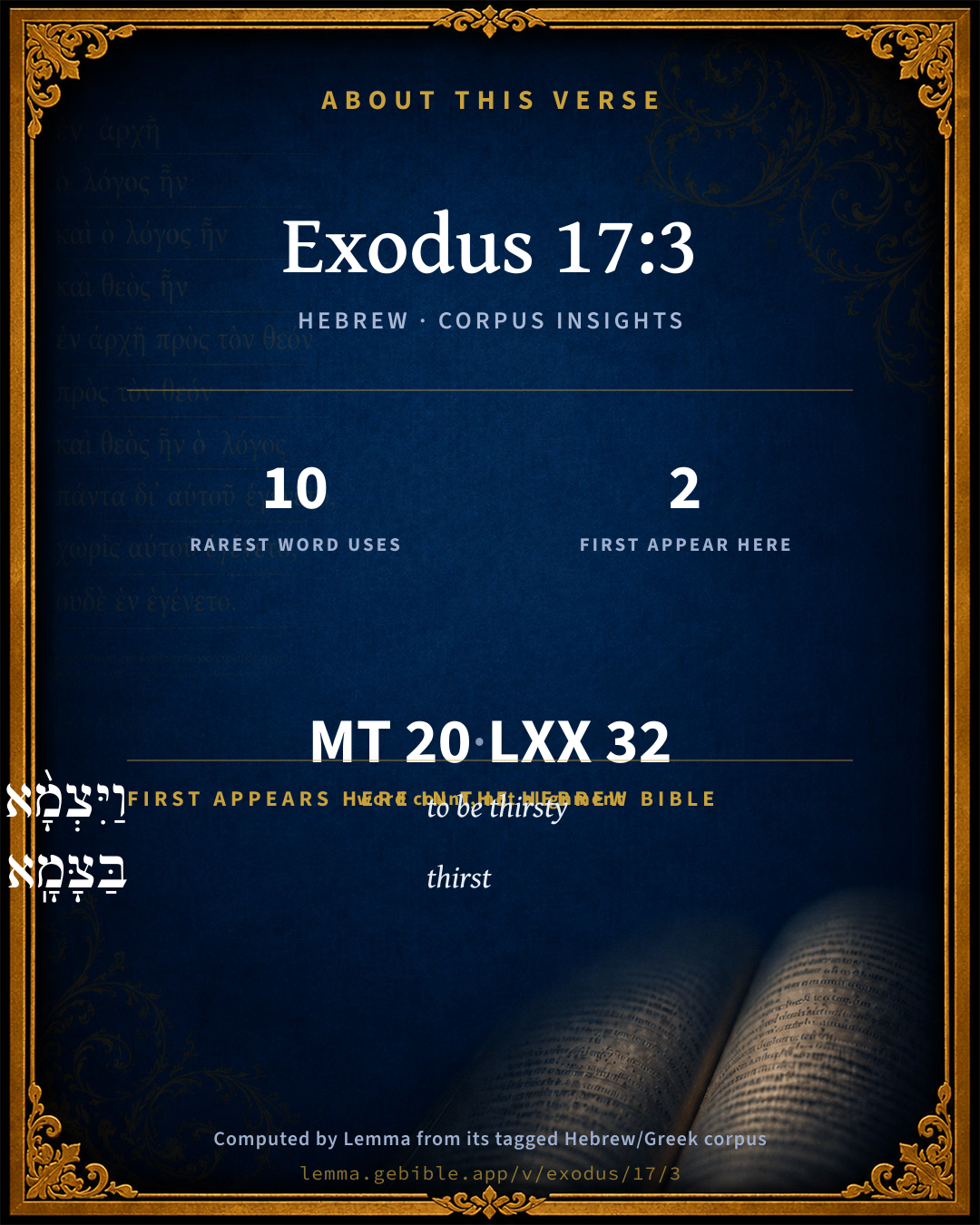
  • 2 first appearances in the Hebrew Bible
Full analysis ↓
Download a study sheet

One document with this verse’s original text, its word-by-word gloss line, the meaning frame, cross-references with their text, attributed commentary, and full source and license credits — printable, and it pastes into notes with its structure intact.

This verse Autodidact and up

Study sheet (.html) Plain text (.txt)

A passage Seminary Student

Up to 50 verses in one chapter. A passage sheet keeps up to 6 commentary sources and 12 cross-references per verse, in the order this page ranks them, and says so on the sheet whenever that leaves anything out. Ask for a single verse and you get the Autodidact verse sheet above.

Everything on this page stays free to read, with no account — the sheet is a download of what is already on screen, not access to it.

Want to remove ads? Support Godless Engineer
Compare translations 3

The same verse in 3 English versions, stacked beneath the original-language interlinear above. Click any original word for its lexicon entry.

Each is an independent rendering of the whole verse — the interlinear is not word-aligned to these translations.

Highlighted words mark where these versions differ — a whole-verse word diff, not a word-by-word alignment.

  • World English Bible Public Domain
    The people were thirsty for water there; and the people murmured against Moses, and said, "Why have you brought us up out of Egypt, to kill us, our children, and our livestock with thirst?"
  • King James Version Public Domain
    And the people thirsted there for water; and the people murmured against Moses, and said, Wherefore is this that thou hast brought us up out of Egypt, to kill us and our children and our cattle with thirst?
  • unfoldingWord Literal Text CC BY-SA 4.0
    And the people were thirsty for water there, and the people murmured against Moses. And he said, “Is this why you brought us up from Egypt? To kill me and my sons and my cattle, with thirst?”

unfoldingWord Literal Text — © unfoldingWord, licensed CC BY-SA 4.0. Word-aligned USFM3 via Door43 (git.door43.org/unfoldingWord/en_ult).

Versions to compare (up to 4)

3 of 4 selected

Show all 18 translations

Every available English version of this verse, each an independent rendering of the whole verse.

  • World English Bible Public Domain
    The people were thirsty for water there; and the people murmured against Moses, and said, "Why have you brought us up out of Egypt, to kill us, our children, and our livestock with thirst?"
  • Berean Standard Bible Public Domain
    But the people thirsted for water there, and they grumbled against Moses: “Why have you brought us out of Egypt—to make us and our children and livestock die of thirst?”
  • Majority Standard Bible Public Domain
    But the people thirsted for water there, and they grumbled against Moses: “Why have you brought us out of Egypt—to make us and our children and livestock die of thirst?”
  • King James Version Public Domain
    And the people thirsted there for water; and the people murmured against Moses, and said, Wherefore is this that thou hast brought us up out of Egypt, to kill us and our children and our cattle with thirst?
  • American Standard Version (1901) Public Domain
    And the people thirsted there for water; and the people murmured against Moses, and said, Wherefore hast thou brought us up out of Egypt, to kill us and our children and our cattle with thirst?
  • Revised Version (1885) Public Domain
    And the people thirsted there for water; and the people murmured against Moses, and said, Wherefore hast thou brought us up out of Egypt, to kill us and our children and our cattle with thirst?
  • Geneva Bible (1599) Public Domain
    So the people thirsted there for water, and the people murmured against Moses, and said, Wherefore hast thou thus brought vs out of Egypt to kill vs and our children and our cattel with thirst?
  • Douay-Rheims (1899) Public Domain
    So the people were thirsty there for want of water, and murmured against Moses, saying: Why didst thou make us go forth out of Egypt, to kill us and our children, and our beasts with thirst?
  • Young's Literal Translation Public Domain
    and the people thirst there for water, and the people murmur against Moses, and say, `Why `is' this? -- thou hast brought us up out of Egypt, to put us to death, also our sons and our cattle, with thirst.'
  • Literal Standard Version CC BY-SA 4.0
    And the people thirst for water there, and the people murmur against Moses, and say, “Why [is] this [that] you have brought us up out of Egypt to put us to death, also our sons and our livestock, with thirst?”
  • Unlocked Literal Bible CC BY-SA 4.0
    The people were very thirsty, and they complained against Moses. They said, “Why have you brought us up out of Egypt? To kill us and our children and our cattle with thirst?”
  • unfoldingWord Literal Text CC BY-SA 4.0
    And the people were thirsty for water there, and the people murmured against Moses. And he said, “Is this why you brought us up from Egypt? To kill me and my sons and my cattle, with thirst?”
  • Darby Bible Public Domain
    And the people thirsted there for water; and the people murmured against Moses, and said, Why is it that thou hast brought us up out of Egypt, to kill us and our children and our cattle with thirst?
  • World Messianic Bible Public Domain
    The people were thirsty for water there; so the people murmured against Moses, and said, “Why have you brought us up out of Egypt, to kill us, our children, and our livestock with thirst?”
  • Webster's Bible Public Domain
    And the people thirsted there for water; and the people murmured against Moses, and said, Why is this that thou hast brought us out of Egypt to kill us and our children and our cattle with thirst?
  • Free Bible Version CC BY-SA 4.0
    But the people were so thirsty for water there that they went on complaining to Moses, saying, “Why did you have to bring us out of Egypt? Are you trying to kill us and our children and livestock by thirst?”
  • Bible in Basic English Public Domain
    And the people were in great need of water; and they made an outcry against Moses, and said, Why have you taken us out of Egypt to send death on us and our children and our cattle through need of water?
  • JPS Tanakh (1917) Public Domain
    And the people thirsted there for water; and the people murmured against Moses, and said: 'Wherefore hast thou brought us up out of Egypt, to kill us and our children and our cattle with thirst?'

Literal Standard Version (2020), Covenant Press — licensed CC BY-SA 4.0. Text via the HelloAO Bible API (eBible.org). Unlocked Literal Bible (unfoldingWord) — licensed CC BY-SA 4.0. Text via the HelloAO Bible API (eBible.org). unfoldingWord Literal Text — © unfoldingWord, licensed CC BY-SA 4.0. Word-aligned USFM3 via Door43 (git.door43.org/unfoldingWord/en_ult). Free Bible Version, Dr. Jonathan Gallagher — licensed CC BY-SA 4.0. Text via the HelloAO Bible API (eBible.org).

Word by word

More ways to search: Search by grammar → Find every occurrence → Compare this word →

Practice this passage: Drill this verse → Learn its vocabulary →

וַיִּצְמָ֨א
tsâmêʼ
H6770
“and · to be thirsty”
Conjunction + Verb, Qal, Sequential Imperfect, 3rd Person, Masculine, Singular
Part of Speech
Conjunction + Verb
Stem
Qal
Form
Sequential Imperfect
Person
3rd Person
Gender
Masculine
Number
Singular
Full BDB Definition

Origin: a primitive root

TWOT: 1926

(Qal) to be thirsty
  1. שָׁ֤ם shâm H8033 “there” Adverb
  2. הָעָם֙ ʻam H5971 “the · people” Particle, Definite Article + Noun, Common, Masculine, Singular, Absolute
  3. לַמַּ֔יִם mayim H4325 “to/for the · water(s)” Preposition, Determined + Noun, Common, Masculine, Plural, Absolute
  4. וַיָּ֥לֶן lûwn H3885 “and · to lodge” Conjunction + Verb, Hiphil, Sequential Imperfect, 3rd Person, Masculine, Singular
  5. הָעָ֖ם ʻam H5971 “the · people” Particle, Definite Article + Noun, Common, Masculine, Singular, Absolute
  6. עַל ʻal H5921 “upon” Preposition
  7. מֹשֶׁ֑ה Môsheh H4872 “Moses” Noun, Proper
  8. וַיֹּ֗אמֶר ʼâmar H559 “and · to say” Conjunction + Verb, Qal, Sequential Imperfect, 3rd Person, Masculine, Singular
  9. לָ֤מָּה mâh H4100 “to/for · what” Preposition + Particle, Interrogative
  10. זֶּה֙ zeh H2088 “this” Pronoun, Demonstrative, Masculine, Singular
  11. הֶעֱלִיתָ֣נוּ ʻâlâh H5927 “to go up · us” Verb, Hiphil, Perfect, 2nd Person, Masculine, Singular + Suffix, Personal, 1st Person, Common, Plural
  12. מִמִּצְרַ֔יִם Mitsrayim H4714 “from · Egypt” Preposition + Noun, Proper
  13. לְהָמִ֥ית mûwth H4191 “to die” Preposition + Verb, Hiphil, Infinitive Construct
  14. אֹתִ֛י ʼêth H853 “- · me” Particle, Direct Object + Suffix, Personal, 1st Person, Common, Singular
  15. וְאֶת ʼêth H853 “and · -” Conjunction + Particle, Direct Object
  16. בָּנַ֥י bên H1121 “sons · my” Noun, Common, Masculine, Plural, Construct + Suffix, Personal, 1st Person, Common, Singular
  17. וְאֶת ʼêth H853 “and · -” Conjunction + Particle, Direct Object
  18. מִקְנַ֖י miqneh H4735 “cattle · my” Noun, Common, Masculine, Plural, Construct + Suffix, Personal, 1st Person, Common, Singular
  19. בַּצָּמָֽא tsâmâʼ H6772 “in/at the · thirst” Preposition, Determined + Noun, Common, Masculine, Singular, Absolute

About this verse

These counts appear in no published source. They are computed here, from the morphology-tagged text and Lemma’s own curated glosses. What Lemma adds →

20
words
17
distinct lemmas
Pentateuch
section

Notable vocabulary

The rarest word here is וַיִּצְמָ֨א to be thirsty H6770 — appearing just 10 times in the whole Hebrew Bible.

First appearance in Scripture

These words make their first canonical appearance in the Hebrew Bible here:

  • וַיִּצְמָ֨א to be thirsty H6770
  • בַּצָּמָֽא thirst H6772

Shared distinctive vocabulary

וַיִּצְמָ֨א to be thirsty H6770 occurs in 10 verses of the Hebrew Bible. Also found in:

Grammatical profile

  • 5 verbs
  • 8 nouns
  • 1 pronoun
  • 1 preposition
  • 1 adverb
  • 4 particles

Verb forms

  • וַיִּצְמָ֨א Qal · Sequential Imperfect
  • וַיָּ֥לֶן Hiphil · Sequential Imperfect
  • וַיֹּ֗אמֶר Qal · Sequential Imperfect
  • הֶעֱלִיתָ֣נוּ Hiphil · Perfect
  • לְהָמִ֥ית Hiphil · Infinitive Construct

Repetition

A word recurs within this verse — often emphatic in Hebrew:

  • הָעָם֙ people H5971 ×2

Hebrew & Septuagint length

In English translation the verse runs 34 words from the Hebrew and 37 from the Septuagint (LXX English) — closely comparable.

A rough comparison of the two English renderings, which tokenize alike — not a word-level alignment.

Word counts can differ between the Hebrew and the Greek without any difference in meaning — e.g. the Hebrew direct-object marker אֵת has no separate Greek word, and Greek often adds the article ὁ.

In the original languages it is 20 Hebrew tokens and 32 Greek tokens — but the two are counted differently (Hebrew bundles its prefixes and suffixes into one token; the Greek is in lemma form), so that isn’t a like-for-like length.

Cross-references

2

Topical passages linked to Exodus 17:3 in the Treasury of Scripture Knowledge — connected by theme and wording, ordered by reader-vote popularity; previews shown in the World English Bible.

  • Exodus 16:2–3 The whole congregation of the children of Israel murmured against Moses and against Aaron in the wilderness;
  • Exodus 15:24 The people murmured against Moses, saying, "What shall we drink?"

Cross-references courtesy of OpenBible.info (CC BY 4.0).

Hebrew and Greek witnesses Masoretic Hebrew ↔ Greek Septuagint

The same verse in the two great witnesses to the Old Testament, shown verse-for-verse.

These are two independent witnesses, not word-aligned to each other, and the Septuagint is shown in lemma (dictionary) form.

Hebrew Exodus 17:3 Masoretic · Westminster Leningrad Codex

וַיִּצְמָ֨א שָׁ֤ם הָעָם֙ לַמַּ֔יִם וַיָּ֥לֶן הָעָ֖ם עַל מֹשֶׁ֑ה וַיֹּ֗אמֶר לָ֤מָּה זֶּה֙ הֶעֱלִיתָ֣נוּ מִמִּצְרַ֔יִם לְהָמִ֥ית אֹתִ֛י וְאֶת בָּנַ֥י וְאֶת מִקְנַ֖י בַּצָּמָֽא

The people were thirsty for water there; and the people murmured against Moses, and said, "Why have you brought us up out of Egypt, to kill us, our children, and our livestock with thirst?"

World English Bible · Public Domain

Greek LXX Exodus 17:3 Septuagint · lemma form

διψάω δέ ἐκεῖ ὁ λαός ὕδωρ καί γογγύζω ἐκεῖ ὁ λαός πρός μωυσῆς λέγω ἵνα τίς οὗτος ἀναβιβάζω ἐγώ ἐκ αἴγυπτος ἀποκτείνω ἐγώ καί ὁ τέκνον ἐγώ καί ὁ κτῆνος ὁ δίψος

And the people thirsted there for water, and there the people murmured against Moses, saying, Why is this? have you brought us up out of Egypt to kill us and our children and our cattle with thirst?

LXX2012 (modern English Septuagint) · Public Domain

Hebrew: Westminster Leningrad Codex (CC BY 4.0). Greek: Septuagint (public domain); English from LXX2012 (modern English Septuagint) (Public Domain). How the Septuagint differs from the Hebrew →

Targum (Aramaic paraphrase)

2

The Targum is the ancient Jewish Aramaic paraphrase of the Hebrew Scriptures — an interpretive translation, not the Hebrew text itself. Onkelos (literal) and Pseudo-Jonathan (expansive) render the Torah, and Jonathan the Prophets. Coverage is partial: where no permissively-licensed English translation exists for a verse, only the Aramaic is shown. This is verse-level text, not a word-by-word alignment to the Hebrew.

  1. Targum Onkelos Torah (Genesis–Deuteronomy)
    וּצְחִי תַמָן עַמָא לְמַיָא וְאִתְרַעַם עַמָא עַל משֶׁה וַאֲמַר לְמָא דְנַן אַסֶקְתָּנָא מִמִצְרַיִם לְקַטָלָא יָתִי וְיָת בָּנַי וְיָת בְּעִירַי בְּצָחוּתָא:

    (no public-domain English translation for this verse)

    Targum Onkelos — Aramaic: “Onkelos Genesis” (public domain); “Onkelos Exodus” (public domain); “Onkelos Leviticus” (public domain); “Onkelos Numbers” (public domain); “Onkelos Deuteronomy” (public domain). English: “Sefaria Community Translation” (CC0 1.0 (public-domain dedication)); “J.W. Etheridge. The Targums of Onkelos and Jonathan Ben Uzziel on the Pentateuch. London: Longmans, Green, 1862” (public domain). Text via Sefaria.

  2. Targum Pseudo-Jonathan Torah (Genesis–Deuteronomy)
    וּצְחִי תַמָּן עַמָּא לְמוֹי וְאִתְרָעַם עַמָּא עַל משֶׁה וַאֲמַר לְמָא דְנַן אַסֵיקְתָּנָא מִמִּצְרַיִם לְקַטְלָא יָתָנָא וְיַת בְּנָנָא וְיַת גֵּיתָנָא בְּצָחוּתָא

    But the people were athirst for water, and the people murmured against Mosheh, and said, Why hast thou made us come up out of Mizraim, to kill us, and our children, and our cattle with thirst?

    Targum Pseudo-Jonathan — Aramaic: “Targum Jonathan on Genesis” (public domain); “Targum Jonathan on Exodus” (public domain); “Targum Jonathan on Leviticus” (public domain); “Targum Jonathan on Numbers” (public domain); “Targum Jonathan on Deuteronomy” (public domain). English: “The Targum of Jonathan ben Uzziel, trans. J. W. Etheridge, London, 1862” (public domain). Text via Sefaria.

Commentary

Notes on Exodus 17:3 from classic Christian and Jewish commentators (each source and its license shown beneath its notes). The classic Christian expositions comment on the surrounding passage and are grouped to its opening verse, so a note may address several verses; the Jewish commentaries on the Tanakh (Rashi and others) are per-verse, so they appear only where the commentator wrote on this verse.

Lemma curates 59 commentaries, every one of them public domain or Creative Commons licensed, each selected and text-cleaned for this edition rather than reprinted as found. About our sources →

Trapp's Complete Commentary

John Trapp

Exo 17:3 And the people thirsted there for water; and the people murmured against Moses, and said, Wherefore [is] this [that] thou hast brought us up out of Egypt, to kill us and our children and our cattle with thirst?

Ver. 3. Murmured against Moses.] Magistrates have many times a weary life with the mutinous multitude. Seneca observeth of Egypt, - it proved true of this people newly come out of Egypt, - that it was loquax et ingeniosa in contumeliam praefectorum provincia: in qua, qui vitaverit culpam, non effugit infamiam; That it was a province apt to prate against their governors, and to cast a slur upon them, though never so well deserving.

John Trapp, A Commentary or Exposition upon All the Books of the Old and New Testament (1647–1656) — public domain. Text from a community e-Sword module.

Tyndale Open Study Notes

Tyndale Open Resources

17:3 Regarding a similar complaint, see study note on 16:3.

Tyndale Open Study Notes — © Tyndale Open Resources, licensed CC BY-SA 4.0. Text via the HelloAO Bible API.

Adam Clarke's Commentary

Verse 3. And the people murmured] The reader must not forget what has so often been noted relating to the degraded state of the minds of the Israelites. A strong argument however may be drawn from this in favour of their supernatural escape from Egypt. Had it been a scheme concerted by the heads of the people, provision would necessarily have been made for such exigencies as these. But as God chose to keep them constantly dependent upon himself for every necessary of life, and as they had Moses alone as their mediator to look to, they murmured against him when brought into straits and difficulties, regretted their having left Egypt, and expressed the strongest desire to return. This shows that they had left Egypt reluctantly; and as Moses and Aaron never appear to have any resources but those which came most evidently in a supernatural way, therefore the whole exodus or departure from Egypt proves itself to have been no human contrivance, but a measure concerted by God himself.

Adam Clarke's Commentary on the Bible (1810–1826) — public domain. Text from a community e-Sword/MySword module.

Ellicott's Commentary for English Readers

(3) To kill us.—This was no exaggeration. Thirst kills as surely as hunger, and more quickly. Whole armies have died of it. (Herod. iii. 26.) Ships’ crews have perished of it on the ocean, with “water, water everywhere, and not a drop to drink.” Unless a supply could somehow or other have been provided speedily, the whole people must have been exterminated.

A Bible Commentary for English Readers, edited by Charles John Ellicott (1878–1897) — public domain. Text from a community e-Sword module.

The Cambridge Bible for Schools and Colleges

gen. ed. J. J. S. Perowne

3. murmured] see on Exo_15:24.

Wherefore, &c.] cf. Num_20:4-5; also Exo_14:11 f., Exo_16:3.

brought us up] into the high ground of the Sin. Peninsula.

us, &c.] Heb. me, and my children, and my cattle,—the first pers. sing denoting the people. So Num_20:19 al.

The Cambridge Bible for Schools and Colleges (gen. ed. J. J. S. Perowne; Cambridge University Press, 1878–1918) — public domain. Text from a community e-Sword module.

John Gill's Exposition

And the people thirsted there for water,.... They saw there was no water when they first came thither, and therefore chid Moses for bringing them to such a place, where they could not subsist; and having stayed some little time here, and all the water they brought with them from Alush being spent, and having none to drink, began to be very thirsty:

and the people murmured against Moses; became more impatient and enraged, and threw out their invectives against him with much acrimony and severity:

wherefore is this that thou hast brought us up out of Egypt? where it would have been much better for us to have continued:

to kill us and our children and our cattle with thirst: which is intolerable to any, and especially to children and cattle, which require frequent drinking: they could not suppose that Moses had such a murderous view in bringing them out of Egypt, or that this was his intention in it, but that this would be the issue and event of it.

John Gill's Exposition of the Whole Bible (1746–1763) — public domain (CC PDM 1.0). Text via the HelloAO Bible API.

The Pulpit Commentary

The people thirsted there for water. There is probably no physical affliction comparable to intense thirst. His thirst was the only agony which drew from the Son of Man an acknowledgment of physical suffering, in the words "I thirst." Descriptions of thirst in open boats at sea are among the most painful of the records of afflicted humanity. Thirst in the desert can scarcely be less horrible. The people murmured and said When the worst comes on men, if they are alone, they bear it silently; but if they can find a scapegoat, they murmur. To lay the blame of the situation on another is a huge satisfaction to the ordinary human mind, which shrinks from responsibility, and would fain shift the burthen on some one else. To kill us. Compare Exo_14:11, Exo_16:3. The circumstances of their life in the wilderness were such, that, until accustomed to them, the people thought that, at each step, they must perish. It may be freely admitted, that without continual miraculous aid this would have been the natural denouement. And our cattle. It is interesting to see that the "cattle" still survived, and were regarded as of great importance. How far they served as a secondary head of subsistance to the people during the 40 years, is a point not yet sufficiently elaborated.

The Pulpit Commentary (1880–1919), ed. H.D.M. Spence-Jones & Joseph S. Exell — public domain. Text from a community e-Sword module.

Ramban (Nachmanides)

Rabbi Moshe ben Nachman (Ramban / Nachmanides)

TO PUT US AND OUR CHILDREN AND OUR CATTLE TO DEATH WITH THIRST. In their complaint, they mentioned the cattle too, thus telling Moses that they need a lot of water and it is therefore necessary to take counsel on the whole matter. This is why it says at the second time [when the incident at the waters of Meribah is recorded], and water came forth abundantly, and the congregation drank, and their cattle., 20:11. Now here it is not mentioned but it is self-understood that when the rock was turned into a pool of water, they drank and they watered their flocks (Ramban in Verse 5 further). In the instance of the waters of Meribah at Kadesh, it is mentioned on account of the mishap that resulted from the entire affair, as explained there; see also Ramban here in Verse 5 for another interpretation. And our Rabbis have said: “They made their cattle equal in importance to themselves. They said: ‘A man’s beast is as his life. If a man travels on the road and his beast is not with him, he suffers.’”Now the reason they mentioned us and our children and did not say generally: “to put us to death with thirst” or “to put to death this whole assembly,” [an expression] which would have included men, women and the little ones, as they said in other places,. is that by mentioning the children to him, they emphasized their murmuring against him so that he should make haste in the matter, since the young ones could not suffer thirst at all and they would thus die before the eyes of their parents. This is something like the expression, The tongue of the sucking child cleaveth to the roof of his mouth for thirst.

Ramban (Nachmanides) on the Tanakh — English translation: “Commentary on the Torah by Ramban (Nachmanides). Translated and annotated by Charles B. Chavel. New York, Shilo Pub. House, 1971-1976” (CC BY 4.0). Text via Sefaria.

Lesson kit

Teaching starters — assembled from the data on this page, not authored interpretation. Every prompt links to the verse data it draws on. Edit before teaching.

Exodus, in the Pentateuch, opens this verse with 20 words (17 distinct Hebrew lemmas). Its most distinctive word is tsâmêʼ (“to be thirsty”). A historical commentator’s framing appears above. Read the whole chapter for the surrounding context.

Discussion questions

  1. How does “to be thirsty” (tsâmêʼ) shape what this verse is saying?
  2. 2 words make their first appearance in Scripture here. What does this debut establish?
  3. How does Judges 4:19, which shares the word «to be thirsty», read alongside this verse?
  4. What does the repetition of “people” (2× in this one verse) do in this verse?
  5. These translations render this verse differently; the difference is in the English rendering, not the original. What questions does that raise?
  6. «וַיִּצְמָ֨א» is a Qal Sequential Imperfect verb. How does that grammatical form shape the action described?
  7. Compare how Trapp's Complete Commentary and Tyndale Open Study Notes read this verse. Where do they agree or differ?

Things to notice

Reading settings

Reading text

Shown beneath each verse's original-language words.

Old Testament
Old Testament edition

Read the OT as the Masoretic Hebrew (MT) or the Greek Septuagint (LXX).

English shown for the Greek Septuagint (in the Hebrew ↔ Greek comparison).

Comparing translations? Open the Compare panel on any verse page to stack up to four side by side.