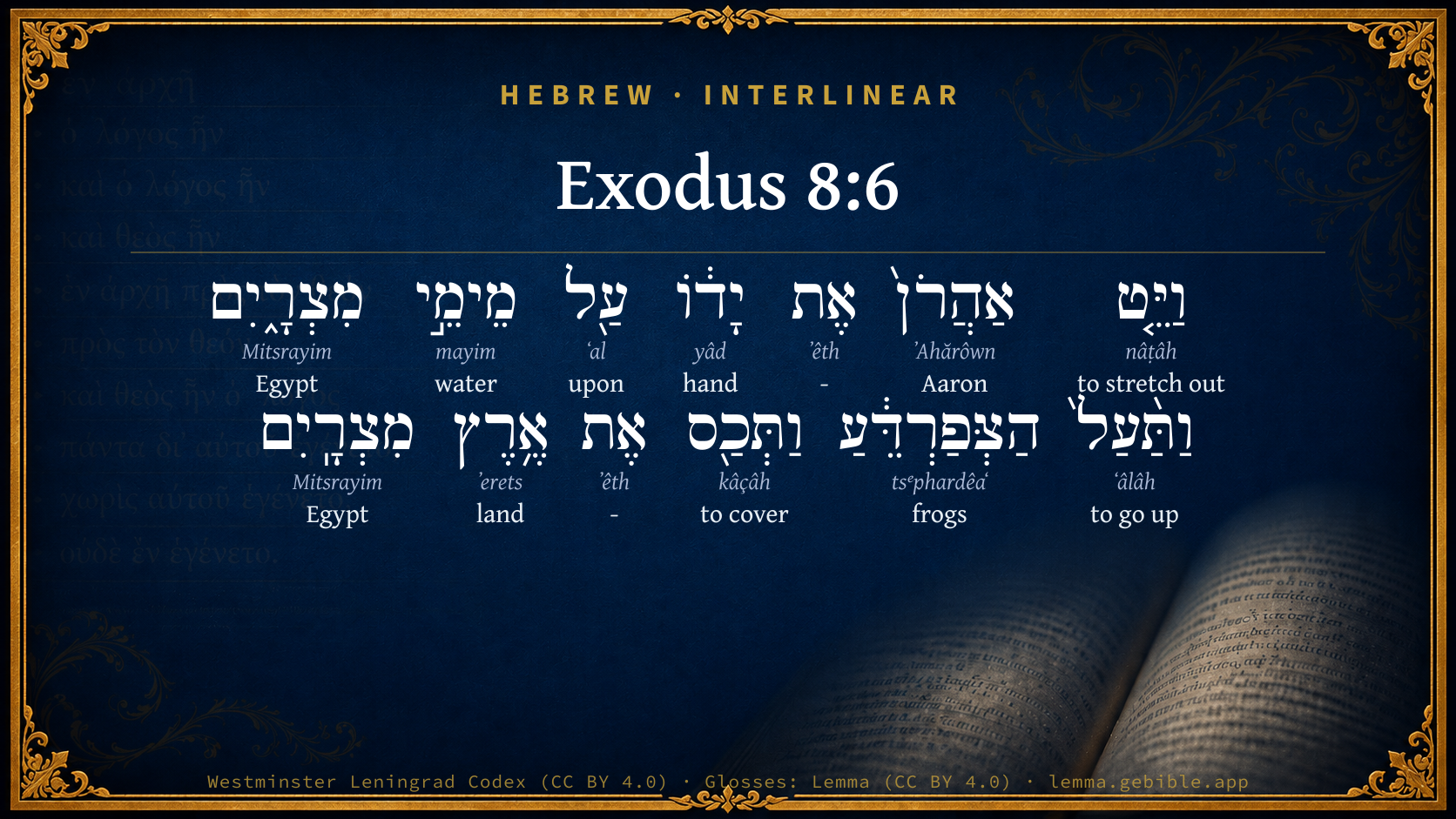
Exodus 8:6

Hebrew (Westminster Leningrad Codex) Exodus 8:6 appears in the Hebrew Old Testament. The text above is from the Westminster Leningrad Codex. Each word links to its Strong’s number, a concise gloss, and parsing drawn from the Open Scriptures Hebrew Bible morphology. Click any word for its full Brown-Driver-Briggs (BDB) entry.
Download image
Cite this verse

Exodus 8:6 (World English Bible). Public Domain. Lemma interlinear Bible study tool, https://lemma.gebible.app/v/exodus/8/6.

Show BibTeX & RIS
BibTeX
RIS
English Translation
Aaron stretched out his hand over the waters of Egypt; and the frogs came up, and covered the land of Egypt.
World English Bible · Public Domain
Download a study sheet

One document with this verse’s original text, its word-by-word gloss line, the meaning frame, cross-references with their text, attributed commentary, and full source and license credits — printable, and it pastes into notes with its structure intact.

This verse Autodidact and up

Study sheet (.html) Plain text (.txt)

A passage Seminary Student

Up to 50 verses in one chapter. A passage sheet keeps up to 6 commentary sources and 12 cross-references per verse, in the order this page ranks them, and says so on the sheet whenever that leaves anything out. Ask for a single verse and you get the Autodidact verse sheet above.

Everything on this page stays free to read, with no account — the sheet is a download of what is already on screen, not access to it.

Want to remove ads? Support Godless Engineer
Compare translations 3

The same verse in 3 English versions, stacked beneath the original-language interlinear above. Click any original word for its lexicon entry.

Each is an independent rendering of the whole verse — the interlinear is not word-aligned to these translations.

Highlighted words mark where these versions differ — a whole-verse word diff, not a word-by-word alignment.

  • World English Bible Public Domain
    Aaron stretched out his hand over the waters of Egypt; and the frogs came up, and covered the land of Egypt.
  • King James Version Public Domain
    And Aaron stretched out his hand over the waters of Egypt; and the frogs came up, and covered the land of Egypt.
  • unfoldingWord Literal Text CC BY-SA 4.0
    And Aaron reached out his hand over the waters of Egypt, and the frog came up and covered the land of Egypt.

unfoldingWord Literal Text — © unfoldingWord, licensed CC BY-SA 4.0. Word-aligned USFM3 via Door43 (git.door43.org/unfoldingWord/en_ult).

Versions to compare (up to 4)

3 of 4 selected

Show all 18 translations

Every available English version of this verse, each an independent rendering of the whole verse.

  • World English Bible Public Domain
    Aaron stretched out his hand over the waters of Egypt; and the frogs came up, and covered the land of Egypt.
  • Berean Standard Bible Public Domain
    So Aaron stretched out his hand over the waters of Egypt, and the frogs came up and covered the land of Egypt.
  • Majority Standard Bible Public Domain
    So Aaron stretched out his hand over the waters of Egypt, and the frogs came up and covered the land of Egypt.
  • King James Version Public Domain
    And Aaron stretched out his hand over the waters of Egypt; and the frogs came up, and covered the land of Egypt.
  • American Standard Version (1901) Public Domain
    And Aaron stretched out his hand over the waters of Egypt; and the frogs came up, and covered the land of Egypt.
  • Revised Version (1885) Public Domain
    And Aaron stretched out his hand over the waters of Egypt; and the frogs came up, and covered the land of Egypt.
  • Geneva Bible (1599) Public Domain
    Then Aaron stretched out his hand vpon the waters of Egypt, and the frogges came vp, and couered the land of Egypt.
  • Douay-Rheims (1899) Public Domain
    And Aaron stretched forth his hand upon the waters of Egypt, and the frogs came up, and covered the land of Egypt.
  • Young's Literal Translation Public Domain
    And Aaron stretcheth out his hand against the waters of Egypt, and the frog cometh up, and covereth the land of Egypt;
  • Literal Standard Version CC BY-SA 4.0
    And Aaron stretches out his hand against the waters of Egypt, and the frog comes up, and covers the land of Egypt;
  • Unlocked Literal Bible CC BY-SA 4.0
    Aaron reached out with his hand over Egypt's waters, and the frogs came up and covered the land of Egypt.
  • unfoldingWord Literal Text CC BY-SA 4.0
    And Aaron reached out his hand over the waters of Egypt, and the frog came up and covered the land of Egypt.
  • Darby Bible Public Domain
    And Aaron stretched out his hand over the waters of Egypt; and the frogs came up, and covered the land of Egypt.
  • World Messianic Bible Public Domain
    Aaron stretched out his hand over the waters of Egypt; and the frogs came up, and covered the land of Egypt.
  • Webster's Bible Public Domain
    And Aaron stretched his hand over the waters of Egypt; and the frogs came up, and covered the land of Egypt.
  • Free Bible Version CC BY-SA 4.0
    So Aaron held out his hand over the waters of Egypt, and frogs came up and covered the land.
  • Bible in Basic English Public Domain
    And when Aaron put out his hand over the waters of Egypt, the frogs came up and all the land of Egypt was covered with them.
  • JPS Tanakh (1917) Public Domain
    (8-2) And Aaron stretched out his hand over the waters of Egypt; and the frogs came up, and covered the land of Egypt.

Literal Standard Version (2020), Covenant Press — licensed CC BY-SA 4.0. Text via the HelloAO Bible API (eBible.org). Unlocked Literal Bible (unfoldingWord) — licensed CC BY-SA 4.0. Text via the HelloAO Bible API (eBible.org). unfoldingWord Literal Text — © unfoldingWord, licensed CC BY-SA 4.0. Word-aligned USFM3 via Door43 (git.door43.org/unfoldingWord/en_ult). Free Bible Version, Dr. Jonathan Gallagher — licensed CC BY-SA 4.0. Text via the HelloAO Bible API (eBible.org).

Word by word

More ways to search: Search by grammar → Find every occurrence → Compare this word →

Practice this passage: Drill this verse → Learn its vocabulary →

הַצְּפַרְדֵּ֔עַ
tsᵉphardêaʻ
H6854
“the · frogs”
Particle, Definite Article + Noun, Common, Feminine, Singular, Absolute
Part of Speech
Particle + Noun
Type
Common
Gender
Feminine
Number
Singular
State
Absolute
Full BDB Definition

Origin: from H6852 and a word elsewhere unused meaning a swamp

TWOT: 1963

frogs
  1. וַיֵּ֤ט nâṭâh H5186 “and · to stretch out” Conjunction + Verb, Qal, Sequential Imperfect, 3rd Person, Masculine, Singular
  2. אַהֲרֹן֙ ʼAhărôwn H175 “Aaron” Noun, Proper
  3. אֶת ʼêth H853 “-” Particle, Direct Object
  4. יָד֔וֹ yâd H3027 “hand · his” Noun, Common, Both, Singular, Construct + Suffix, Personal, 3rd Person, Masculine, Singular
  5. עַ֖ל ʻal H5921 “upon” Preposition
  6. מֵימֵ֣י mayim H4325 “water(s) of” Noun, Common, Masculine, Plural, Construct
  7. מִצְרָ֑יִם Mitsrayim H4714 “Egypt” Noun, Proper
  8. וַתַּ֨עַל֙ ʻâlâh H5927 “and · to go up” Conjunction + Verb, Qal, Sequential Imperfect, 3rd Person, Feminine, Singular
  9. וַתְּכַ֖ס kâçâh H3680 “and · to cover” Conjunction + Verb, Piel, Sequential Imperfect, 3rd Person, Feminine, Singular
  10. אֶת ʼêth H853 “-” Particle, Direct Object
  11. אֶ֥רֶץ ʼerets H776 “land of” Noun, Common, Both, Singular, Construct
  12. מִצְרָֽיִם Mitsrayim H4714 “Egypt” Noun, Proper

About this verse

These counts appear in no published source. They are computed here, from the morphology-tagged text and Lemma’s own curated glosses. What Lemma adds →

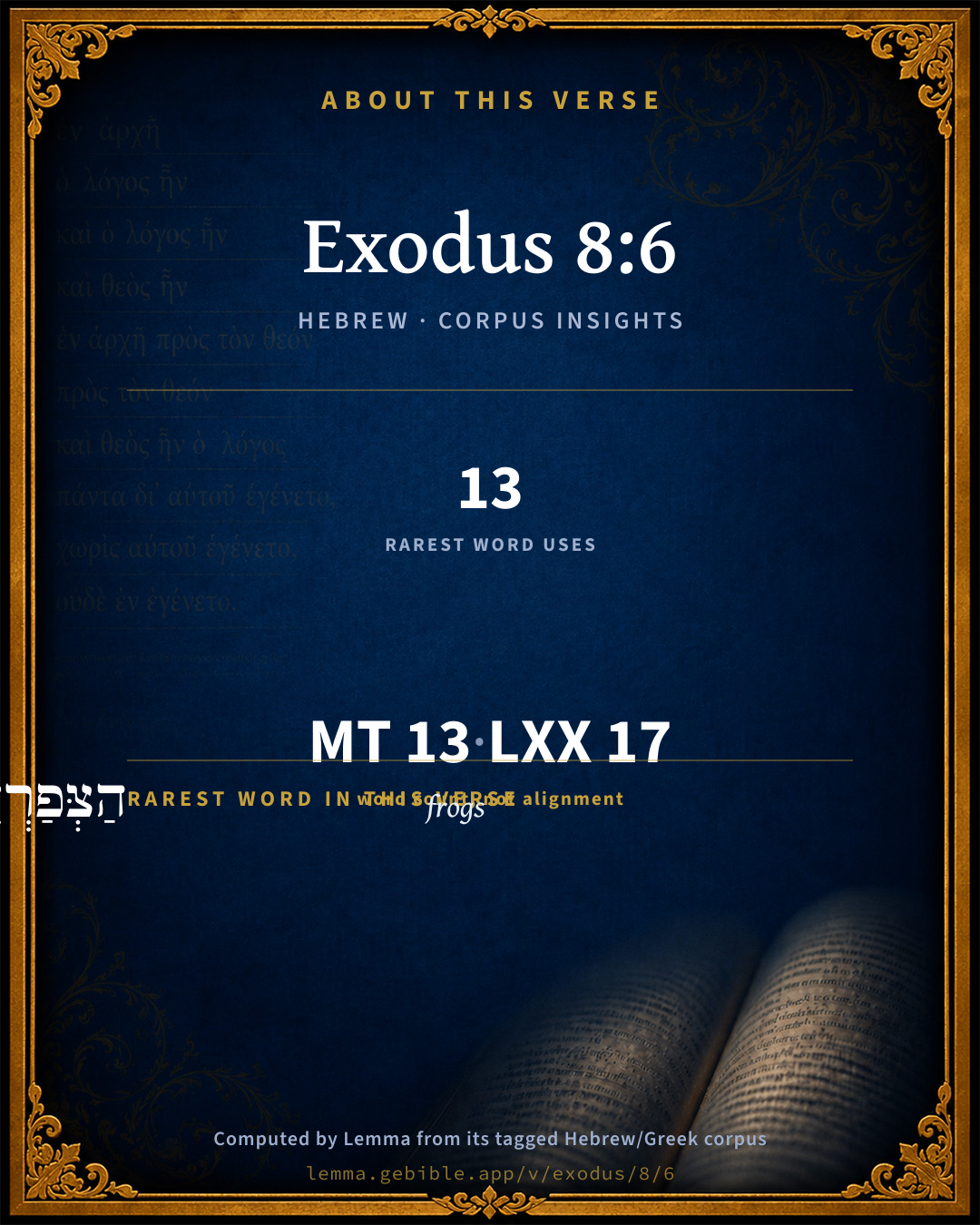
13
words
11
distinct lemmas
Pentateuch
section

Notable vocabulary

The rarest word here is הַצְּפַרְדֵּ֔עַ frogs H6854 — appearing just 13 times in the whole Hebrew Bible.

Shared distinctive vocabulary

הַצְּפַרְדֵּ֔עַ frogs H6854 occurs in 13 verses of the Hebrew Bible. Also found in:

Grammatical profile

  • 3 verbs
  • 7 nouns
  • 1 preposition
  • 2 particles

Verb forms

  • וַיֵּ֤ט Qal · Sequential Imperfect
  • וַתַּ֨עַל֙ Qal · Sequential Imperfect
  • וַתְּכַ֖ס Piel · Sequential Imperfect

Repetition

A word recurs within this verse — often emphatic in Hebrew:

  • מִצְרָ֑יִם Egypt H4714 ×2

Hebrew & Septuagint length

In English translation the verse runs 21 words from the Hebrew and 28 from the Septuagint (LXX English) — closely comparable.

A rough comparison of the two English renderings, which tokenize alike — not a word-level alignment.

Word counts can differ between the Hebrew and the Greek without any difference in meaning — e.g. the Hebrew direct-object marker אֵת has no separate Greek word, and Greek often adds the article ὁ.

In the original languages it is 13 Hebrew tokens and 17 Greek tokens — but the two are counted differently (Hebrew bundles its prefixes and suffixes into one token; the Greek is in lemma form), so that isn’t a like-for-like length.

Cross-references

4

Topical passages linked to Exodus 8:6 in the Treasury of Scripture Knowledge — connected by theme and wording, ordered by reader-vote popularity; previews shown in the World English Bible.

  • Psalms 78:45 He sent among them swarms of flies, which devoured them; And frogs, which destroyed them.
  • Psalms 105:30 Their land swarmed with frogs, Even in the chambers of their kings.
  • Leviticus 11:12 Whatever has no fins nor scales in the waters, that is an abomination to you.
  • Revelation 16:13 I saw coming out of the mouth of the dragon, and out of the mouth of the beast, and out of the mouth of the false prophet, three unclean spirits, something like frogs;

Cross-references courtesy of OpenBible.info (CC BY 4.0).

Hebrew and Greek witnesses Masoretic Hebrew ↔ Greek Septuagint

The same verse in the two great witnesses to the Old Testament, shown verse-for-verse.

These are two independent witnesses, not word-aligned to each other, and the Septuagint is shown in lemma (dictionary) form.

Hebrew Exodus 8:6 Masoretic · Westminster Leningrad Codex

וַיֵּ֤ט אַהֲרֹן֙ אֶת יָד֔וֹ עַ֖ל מֵימֵ֣י מִצְרָ֑יִם וַתַּ֨עַל֙ הַצְּפַרְדֵּ֔עַ וַתְּכַ֖ס אֶת אֶ֥רֶץ מִצְרָֽיִם

Aaron stretched out his hand over the waters of Egypt; and the frogs came up, and covered the land of Egypt.

World English Bible · Public Domain

Greek LXX Exodus 8:6 Septuagint · lemma form

ὁ δέ εἶπον εἰς αὔριον εἶπον οὖν ὡς εἶπον ἵνα οἶδα ὅτι οὐ εἰμί ἄλλος πλήν κύριος

And Aaron stretched forth his hand over the waters of Egypt, and brought up the frogs: and the frog was brought up, and covered the land of Egypt.

LXX2012 (modern English Septuagint) · Public Domain

Hebrew: Westminster Leningrad Codex (CC BY 4.0). Greek: Septuagint (public domain); English from LXX2012 (modern English Septuagint) (Public Domain). How the Septuagint differs from the Hebrew →

Targum (Aramaic paraphrase)

2

The Targum is the ancient Jewish Aramaic paraphrase of the Hebrew Scriptures — an interpretive translation, not the Hebrew text itself. Onkelos (literal) and Pseudo-Jonathan (expansive) render the Torah, and Jonathan the Prophets. Coverage is partial: where no permissively-licensed English translation exists for a verse, only the Aramaic is shown. This is verse-level text, not a word-by-word alignment to the Hebrew.

  1. Targum Onkelos Torah (Genesis–Deuteronomy)
    וַאֲמַר לִמְחָר וַאֲמַר כְּפִתְגָמָךְ בְּדִיל דְתִדַע אֲרֵי לֵית כַּיְיָ אֱלָהָנָא:

    (no public-domain English translation for this verse)

    Targum Onkelos — Aramaic: “Onkelos Genesis” (public domain); “Onkelos Exodus” (public domain); “Onkelos Leviticus” (public domain); “Onkelos Numbers” (public domain); “Onkelos Deuteronomy” (public domain). English: “Sefaria Community Translation” (CC0 1.0 (public-domain dedication)); “J.W. Etheridge. The Targums of Onkelos and Jonathan Ben Uzziel on the Pentateuch. London: Longmans, Green, 1862” (public domain). Text via Sefaria.

  2. Targum Pseudo-Jonathan Torah (Genesis–Deuteronomy)
    וַאֲמֵר לְמָחָר וַאֲמַר כְּפִתְגָמָךְ מִן בִּגְלַל דְתִנְדַע אֲרוּם לֵית כַּיְיָ אֱלָהָנָא

    And he said, Tomorrow. And he said, According to thy word: that thou mayest know that there is none like the Lord our God.

    Targum Pseudo-Jonathan — Aramaic: “Targum Jonathan on Genesis” (public domain); “Targum Jonathan on Exodus” (public domain); “Targum Jonathan on Leviticus” (public domain); “Targum Jonathan on Numbers” (public domain); “Targum Jonathan on Deuteronomy” (public domain). English: “The Targum of Jonathan ben Uzziel, trans. J. W. Etheridge, London, 1862” (public domain). Text via Sefaria.

Commentary

Notes on Exodus 8:6 from classic Christian and Jewish commentators (each source and its license shown beneath its notes). The classic Christian expositions comment on the surrounding passage and are grouped to its opening verse, so a note may address several verses; the Jewish commentaries on the Tanakh (Rashi and others) are per-verse, so they appear only where the commentator wrote on this verse.

Lemma curates 59 commentaries, every one of them public domain or Creative Commons licensed, each selected and text-cleaned for this edition rather than reprinted as found. About our sources →

Trapp's Complete Commentary

John Trapp

Exo 8:6 And Aaron stretched out his hand over the waters of Egypt; and the frogs came up, and covered the land of Egypt.

Ver. 6. And the frogs came up.] With their hateful hearing of "Brekekekex coax, coax." {a}

{a} Aristoph., in Ranis.

John Trapp, A Commentary or Exposition upon All the Books of the Old and New Testament (1647–1656) — public domain. Text from a community e-Sword module.

Geneva Bible (1599)

Geneva Bible translators

The second plague.

But Goshen, where God’s people dwelt, was excepted.

Geneva Bible (1599) marginal notes — public domain. Text via Bolls.life.

Adam Clarke's Commentary

Verse 6. The frogs came up, and covered the land of Egypt.] In some ancient writers we have examples of a similar plague. The Abderites, according to Orosius, and the inhabitants of Paeonia and Dardania, according to Athenaeus, were obliged to abandon their country on account of the great numbers of frogs by which their land was infested.

Adam Clarke's Commentary on the Bible (1810–1826) — public domain. Text from a community e-Sword/MySword module.

Ellicott's Commentary for English Readers

(6) The frogs came up.—Hebrew, the frog. The term designates the species.

A Bible Commentary for English Readers, edited by Charles John Ellicott (1878–1897) — public domain. Text from a community e-Sword module.

John Gill's Exposition

And the magicians did so with their enchantments, &c. By their secret wiles and juggling tricks:

and brought up frogs upon the land of Egypt, that is, some few, as a proof of their art and skill, and to show that Moses and Aaron did but what they could do; but what they did either were only in appearance, deceiving the sight of Pharaoh and his people, or real frogs were brought to them by the help of devils, but not in such numbers: and besides, this was adding to the plague, and not diminishing it; had they done anything to the purpose, they should have removed it at once, or destroyed the frogs; but that they could not do, of which Pharaoh being sensible, he therefore entreated for the removal of them by Moses and Aaron. To this plague there seems to be some reference at the pouring out of the sixth vial, Rev 16:13.

John Gill's Exposition of the Whole Bible (1746–1763) — public domain (CC PDM 1.0). Text via the HelloAO Bible API.

The Pulpit Commentary

The frogs came up. Literally, "The frog came up," the word being used to designate the class or species.

The Pulpit Commentary (1880–1919), ed. H.D.M. Spence-Jones & Joseph S. Exell — public domain. Text from a community e-Sword module.

Rashi

Rabbi Shlomo Yitzchaki (Rashi)

ויאמר למחר AND HE SAID, FOR TO-MORROW — He said: Pray to-day that they may be destroyed by to-morrow.

Rashi on the Tanakh — English translations: “The Judaica Press complete Tanach with Rashi, translated by A. J. Rosenberg” (CC BY 4.0); “Pentateuch with Rashi's commentary by M. Rosenbaum and A.M. Silbermann, 1929-1934” (public domain); “The Metsudah Tanach series, Lakewood, N.J” (CC BY 4.0); and “The Book of Joshua, Metsudah Publications, 1997” (CC BY 4.0). Text via Sefaria.

Ramban (Nachmanides)

Rabbi Moshe ben Nachman (Ramban / Nachmanides)

AND HE SAID, FOR TOMORROW. It is a known fact that it is man’s nature to pray that his misfortune be removed from him at once. [The question then arises: Why did Pharaoh say that the frogs were to be removed tomorrow?] In the name of the Gaon Rav Shmuel ben Chophni, they have explained that Pharaoh thought that perhaps some heavenly constellation brought the frogs upon Egypt, and that Moses [by his knowledge of astrology] knows the time when they will disappear, and therefore Moses had said to him, Have thou this glory over me, thinking that Pharaoh will now tell him to destroy them immediately. Therefore Pharaoh extended the time until the morrow.The correct interpretation appears to me to be that because Moses had said, Against what time shall I entreat for thee, Pharaoh thought that Moses was desirous for time, and so he fixed the shortest time limit, And he said, For tomorrow. Moses answered him, “According to thy word, let it be so, for since you did not ask that they be removed immediately, they shall not be removed until tomorrow.”

Ramban (Nachmanides) on the Tanakh — English translation: “Commentary on the Torah by Ramban (Nachmanides). Translated and annotated by Charles B. Chavel. New York, Shilo Pub. House, 1971-1976” (CC BY 4.0). Text via Sefaria.

Ibn Ezra

Rabbi Abraham ibn Ezra

[Pharaoh] said, “By tomorrow.” Rabbi Shmuel ben Chafni said: Normally, a person would request that a plague be removed immediately. However, Pharaoh believed that the heavenly constellations brought the plague of frogs upon Egypt by natural means, and Moshe just happened to know when this would happen. Pharaoh reckoned that the natural time for the frogs to leave had arrived, and so he tested Moshe by asking for an extension of time and said: “By tomorrow”.

Ibn Ezra on the Tanakh — English translations: “Sefaria Community Translation” (CC0 1.0 (public-domain dedication)); “Yalkut, Sifsei Chachomim Chumash, Metsudah Publications, 2009” (CC BY 4.0); and “Commentary of Ibn Ezra on Isaiah - trans. by M. Friedlander, 1873” (public domain). Text via Sefaria.

Lesson kit

Teaching starters — assembled from the data on this page, not authored interpretation. Every prompt links to the verse data it draws on. Edit before teaching.

Exodus, in the Pentateuch, opens this verse with 13 words (11 distinct Hebrew lemmas). Its most distinctive word is tsᵉphardêaʻ (“frogs”). A historical commentator’s framing appears above. Read the whole chapter for the surrounding context.

Discussion questions

  1. What does “frogs” (tsᵉphardêaʻ) contribute to the verse as a whole?
  2. Exodus 8:2 shares the word «frogs» with this verse. How do the two illuminate each other?
  3. “Egypt” occurs 2× in this one verse. What is the effect of the repetition?
  4. The translations on this page render this verse differently — a whole-verse word diff, not a word-by-word alignment. What might account for the different wordings?
  5. The verb «וַיֵּ֤ט» is Qal Sequential Imperfect. How does its form color the action?
  6. Reading how Trapp's Complete Commentary and Geneva Bible (1599) read this verse, where do the two commentators agree and where do they part?

Things to notice

Reading settings

Reading text

Shown beneath each verse's original-language words.

Old Testament
Old Testament edition

Read the OT as the Masoretic Hebrew (MT) or the Greek Septuagint (LXX).

English shown for the Greek Septuagint (in the Hebrew ↔ Greek comparison).

Comparing translations? Open the Compare panel on any verse page to stack up to four side by side.