Leviticus 24:2

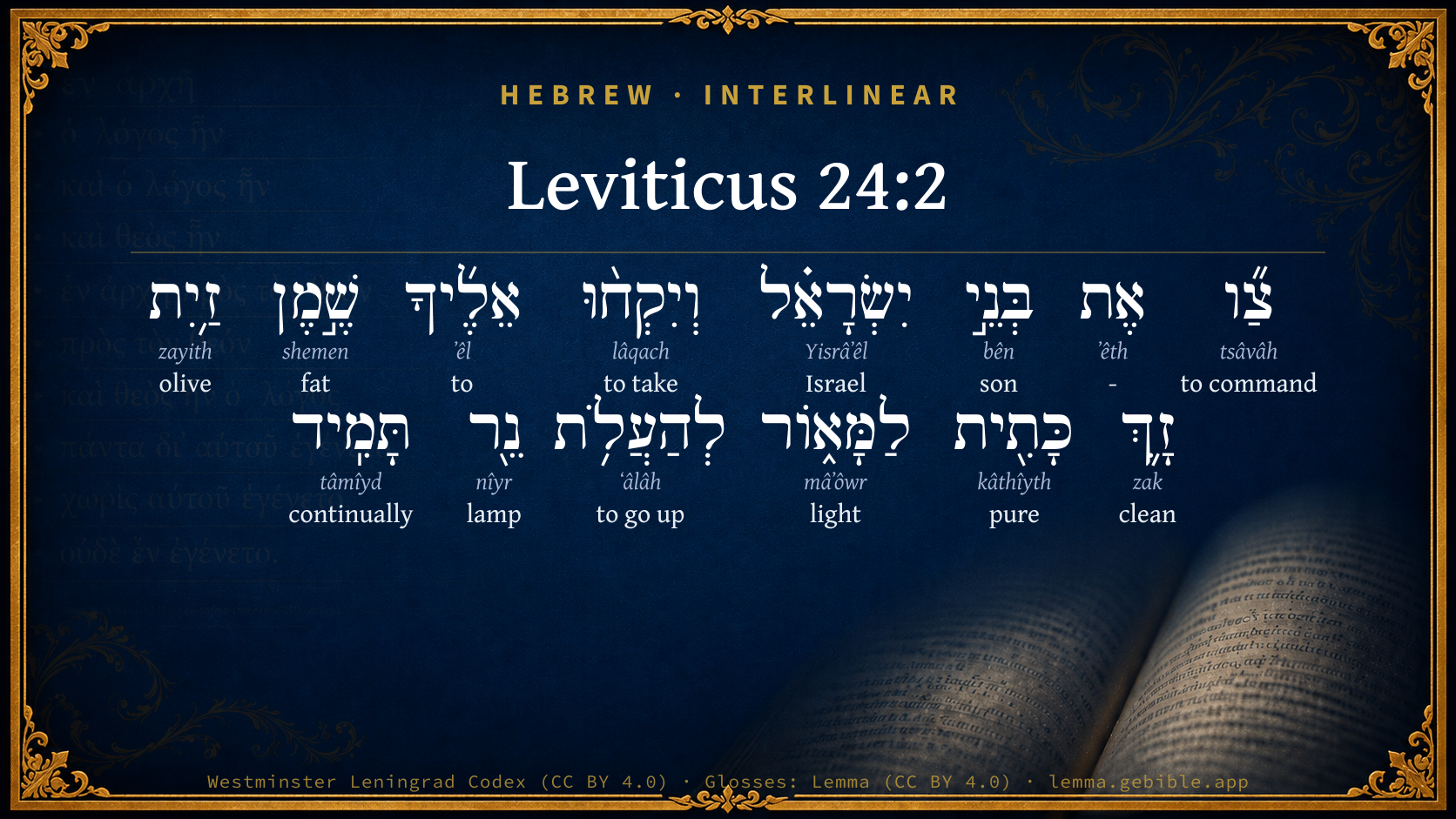
Hebrew (Westminster Leningrad Codex) Leviticus 24:2 appears in the Hebrew Old Testament. The text above is from the Westminster Leningrad Codex. Each word links to its Strong’s number, a concise gloss, and parsing drawn from the Open Scriptures Hebrew Bible morphology. Click any word for its full Brown-Driver-Briggs (BDB) entry.
Download image
Cite this verse

Leviticus 24:2 (World English Bible). Public Domain. Lemma interlinear Bible study tool, https://lemma.gebible.app/v/leviticus/24/2.

Show BibTeX & RIS
BibTeX
RIS
English Translation
"Command the children of Israel, that they bring to you pure olive oil beaten for the light, to cause a lamp to burn continually.
World English Bible · Public Domain
Download a study sheet

One document with this verse’s original text, its word-by-word gloss line, the meaning frame, cross-references with their text, attributed commentary, and full source and license credits — printable, and it pastes into notes with its structure intact.

This verse Autodidact and up

Study sheet (.html) Plain text (.txt)

A passage Seminary Student

Up to 50 verses in one chapter. A passage sheet keeps up to 6 commentary sources and 12 cross-references per verse, in the order this page ranks them, and says so on the sheet whenever that leaves anything out. Ask for a single verse and you get the Autodidact verse sheet above.

Everything on this page stays free to read, with no account — the sheet is a download of what is already on screen, not access to it.

Want to remove ads? Support Godless Engineer
Compare translations 3

The same verse in 3 English versions, stacked beneath the original-language interlinear above. Click any original word for its lexicon entry.

Each is an independent rendering of the whole verse — the interlinear is not word-aligned to these translations.

Highlighted words mark where these versions differ — a whole-verse word diff, not a word-by-word alignment.

  • World English Bible Public Domain
    "Command the children of Israel, that they bring to you pure olive oil beaten for the light, to cause a lamp to burn continually.
  • King James Version Public Domain
    Command the children of Israel, that they bring unto thee pure oil olive beaten for the light, to cause the lamps to burn continually.
  • unfoldingWord Literal Text CC BY-SA 4.0
    “Command the sons of Israel, and they shall bring to you pure oil of olive, beaten, for the light, to make a lamp go up continually.

unfoldingWord Literal Text — © unfoldingWord, licensed CC BY-SA 4.0. Word-aligned USFM3 via Door43 (git.door43.org/unfoldingWord/en_ult).

Versions to compare (up to 4)

3 of 4 selected

Show all 18 translations

Every available English version of this verse, each an independent rendering of the whole verse.

  • World English Bible Public Domain
    "Command the children of Israel, that they bring to you pure olive oil beaten for the light, to cause a lamp to burn continually.
  • Berean Standard Bible Public Domain
    “Command the Israelites to bring you pure oil of pressed olives for the light, to keep the lamps burning continually.
  • Majority Standard Bible Public Domain
    “Command the Israelites to bring you pure oil of pressed olives for the light, to keep the lamps burning continually.
  • King James Version Public Domain
    Command the children of Israel, that they bring unto thee pure oil olive beaten for the light, to cause the lamps to burn continually.
  • American Standard Version (1901) Public Domain
    Command the children of Israel, that they bring unto thee pure olive oil beaten for the light, to cause a lamp to burn continually.
  • Revised Version (1885) Public Domain
    Command the children of Israel, that they bring unto thee pure olive oil beaten for the light, to cause a lamp to burn continually.
  • Geneva Bible (1599) Public Domain
    Commande the children of Israel that they bring vnto thee pure oyle oliue beaten, for the light, to cause ye lampes to burne continually.
  • Douay-Rheims (1899) Public Domain
    Command the children of Israel, that they bring unto thee the finest and dearest oil of olives, to furnish the lamps continually,
  • Young's Literal Translation Public Domain
    `Command the sons of Israel, and they bring unto thee pure olive oil, beaten, for the lamp, to cause a light to go up continually;
  • Literal Standard Version CC BY-SA 4.0
    “Command the sons of Israel, and they bring pure oil of beaten olive to you for the lamp, to cause a light to go up continually;
  • Unlocked Literal Bible CC BY-SA 4.0
    “Command the people of Israel to bring you pure oil beaten from olives to be used in the lamp, that the light may burn continually.
  • unfoldingWord Literal Text CC BY-SA 4.0
    “Command the sons of Israel, and they shall bring to you pure oil of olive, beaten, for the light, to make a lamp go up continually.
  • Darby Bible Public Domain
    Command the children of Israel that they bring unto thee pure beaten olive oil for the light, to light the lamp continually.
  • World Messianic Bible Public Domain
    “Command the children of Israel, that they bring to you pure olive oil beaten for the light, to cause a lamp to burn continually.
  • Webster's Bible Public Domain
    Command the children of Israel, that they bring to thee pure olive oil beaten for the light, to cause the lamps to burn continually.
  • Free Bible Version CC BY-SA 4.0
    “Order the Israelites to bring you pure, pressed olive oil for the lamps, so they will always stay lit.
  • Bible in Basic English Public Domain
    Give orders to the children of Israel to give you clean olive oil for the light, so that a light may be burning at all times,
  • JPS Tanakh (1917) Public Domain
    'Command the children of Israel, that they bring unto thee pure olive oil beaten for the light, to cause a lamp to burn continually.

Literal Standard Version (2020), Covenant Press — licensed CC BY-SA 4.0. Text via the HelloAO Bible API (eBible.org). Unlocked Literal Bible (unfoldingWord) — licensed CC BY-SA 4.0. Text via the HelloAO Bible API (eBible.org). unfoldingWord Literal Text — © unfoldingWord, licensed CC BY-SA 4.0. Word-aligned USFM3 via Door43 (git.door43.org/unfoldingWord/en_ult). Free Bible Version, Dr. Jonathan Gallagher — licensed CC BY-SA 4.0. Text via the HelloAO Bible API (eBible.org).

Word by word

More ways to search: Search by grammar → Find every occurrence → Compare this word →

Practice this passage: Drill this verse → Learn its vocabulary →

כָּתִ֖ית
kâthîyth
H3795
“pure”
Adjective, Adjective, Masculine, Singular, Absolute
Part of Speech
Adjective
Type
Adjective
Gender
Masculine
Number
Singular
State
Absolute
Full BDB Definition

Origin: from H3807

TWOT: 1062a

beaten out, pure, pounded fine (in a mortar), costly - of olive oil
  1. צַ֞ו tsâvâh H6680 “command” Verb, Piel, Imperative, 2nd Person, Masculine, Singular
  2. אֶת ʼêth H853 “-” Particle, Direct Object
  3. בְּנֵ֣י bên H1121 “sons of” Noun, Common, Masculine, Plural, Construct
  4. יִשְׂרָאֵ֗ל Yisrâʼêl H3478 “Israel” Noun, Proper
  5. וְיִקְח֨וּ lâqach H3947 “and · to take” Conjunction + Verb, Qal, Imperfect, 3rd Person, Masculine, Plural
  6. אֵלֶ֜יךָ ʼêl H413 “to · you” Preposition + Suffix, Personal, 2nd Person, Masculine, Singular
  7. שֶׁ֣מֶן shemen H8081 “fat of” Noun, Common, Masculine, Singular, Construct
  8. זַ֥יִת zayith H2132 “olive” Noun, Common, Masculine, Singular, Absolute
  9. זָ֛ךְ zak H2134 “clean” Adjective, Adjective, Masculine, Singular, Absolute
  10. לַמָּא֑וֹר mâʼôwr H3974 “to/for the · light” Preposition, Determined + Noun, Common, Masculine, Singular, Absolute
  11. לְהַעֲלֹ֥ת ʻâlâh H5927 “to go up” Preposition + Verb, Hiphil, Infinitive Construct
  12. נֵ֖ר nîyr H5216 “lamp” Noun, Common, Masculine, Singular, Absolute
  13. תָּמִֽיד tâmîyd H8548 “continually” Noun, Common, Masculine, Singular, Absolute

About this verse

These counts appear in no published source. They are computed here, from the morphology-tagged text and Lemma’s own curated glosses. What Lemma adds →

14
words
14
distinct lemmas
Pentateuch
section

Notable vocabulary

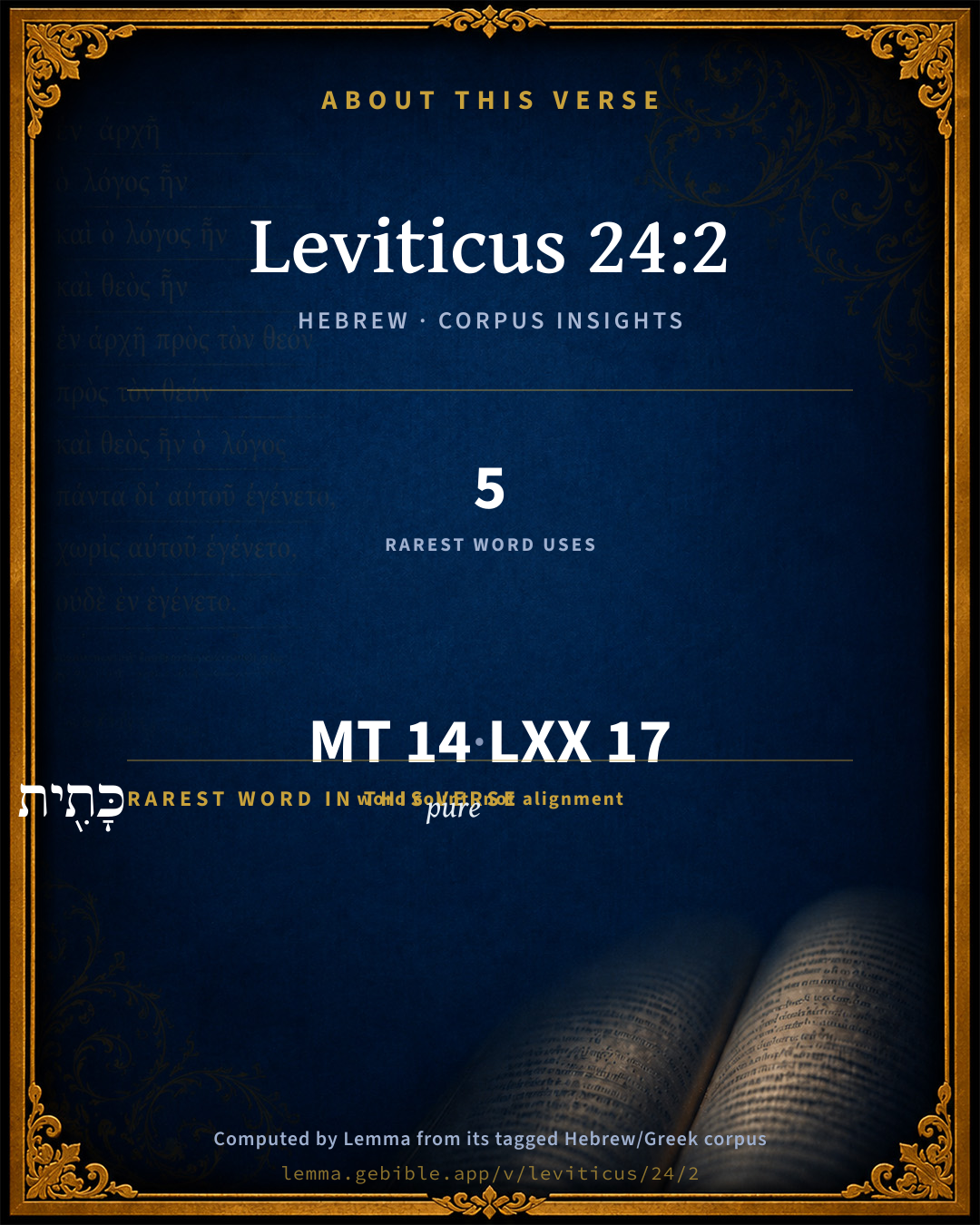
The rarest word here is כָּתִ֖ית pure H3795 — appearing just 5 times in the whole Hebrew Bible.

Shared distinctive vocabulary

כָּתִ֖ית pure H3795 occurs in 5 verses of the Hebrew Bible. Also found in:

Grammatical profile

  • 3 verbs
  • 7 nouns
  • 2 adjectives
  • 1 preposition
  • 1 particle

Verb forms

  • צַ֞ו Piel · Imperative
  • וְיִקְח֨וּ Qal · Imperfect
  • לְהַעֲלֹ֥ת Hiphil · Infinitive Construct

Hebrew & Septuagint length

In English translation the verse runs 24 words from the Hebrew and 23 from the Septuagint (LXX English) — closely comparable.

A rough comparison of the two English renderings, which tokenize alike — not a word-level alignment.

Word counts can differ between the Hebrew and the Greek without any difference in meaning — e.g. the Hebrew direct-object marker אֵת has no separate Greek word, and Greek often adds the article ὁ.

In the original languages it is 14 Hebrew tokens and 17 Greek tokens — but the two are counted differently (Hebrew bundles its prefixes and suffixes into one token; the Greek is in lemma form), so that isn’t a like-for-like length.

Cross-references

25

Topical passages linked to Leviticus 24:2 in the Treasury of Scripture Knowledge — connected by theme and wording, ordered by reader-vote popularity; previews shown in the World English Bible.

  • 2 Corinthians 4:6 seeing it is God who said, "Light will shine out of darkness," who has shone in our hearts, to give the light of the knowledge of the glory of God in the face of Jesus Christ.
  • Ephesians 5:8–14 For you were once darkness, but are now light in the Lord. Walk as children of light,
  • Exodus 27:20–21 "You shall command the children of Israel, that they bring to you pure olive oil beaten for the light, to cause a lamp to burn continually.
  • John 8:12 Again, therefore, Jesus spoke to them, saying, "I am the light of the world. He who follows me will not walk in the darkness, but will have the light of life."
  • Acts 26:18 to open their eyes, that they may turn from darkness to light and from the power of Satan to God, that they may receive remission of sins and an inheritance among those who are sanctified by faith in me.'
  • Ephesians 1:17–18 that the God of our Lord Jesus Christ, the Father of glory, may give to you a spirit of wisdom and revelation in the knowledge of him;
  • Philippians 2:15–16 that you may become blameless and harmless, children of God without blemish in the midst of a crooked and perverse generation, among whom you are seen as lights in the world,
  • Numbers 8:2–4 "Speak to Aaron, and tell him, 'When you light the lamps, the seven lamps shall give light in front of the lampstand.'"
  • 1 Samuel 3:3–4 and the lamp of God hadn't yet gone out, and Samuel had laid down [to sleep], in the temple of Yahweh, where the ark of God was;
  • 2 Chronicles 13:11 and they burn to Yahweh every morning and every evening burnt offerings and sweet incense: the show bread also [set they] in order on the pure table; and the lampstand of gold with the lamps of it, to burn every evening: for we keep the charge of Yahweh our God; but you have forsaken him.
  • Psalms 119:105 Your word is a lamp to my feet, And a light for my path.
  • Psalms 119:130 The entrance of your words gives light. It gives understanding to the simple.
  • Proverbs 6:23 For the commandment is a lamp, And the law is light. Reproofs of instruction are the way of life,
  • Isaiah 8:20 To the law and to the testimony! if they don't speak according to this word, surely there is no morning for them.
  • Isaiah 11:2 The Spirit of Yahweh shall rest on him, the spirit of wisdom and understanding, the spirit of counsel and might, the spirit of knowledge and of the fear of Yahweh.
  • Matthew 4:16 The people who sat in darkness saw a great light, To those who sat in the region and shadow of death, To them light has dawned."
  • Matthew 5:16 Even so, let your light shine before men; that they may see your good works, and glorify your Father who is in heaven.
  • Matthew 25:1–8 "Then the Kingdom of Heaven will be like ten virgins, who took their lamps, and went out to meet the bridegroom.
  • Luke 1:79 To shine on those who sit in darkness and the shadow of death; To guide our feet into the way of peace."
  • Luke 12:35 "Let your loins be girded and your lamps burning.
  • John 1:4 In him was life, and the life was the light of men.
  • John 1:9 The true light that enlightens everyone was coming into the world.
  • John 5:35 He was the burning and shining lamp, and you were willing to rejoice for a while in his light.
  • Exodus 39:37 the pure lampstand, its lamps, even the lamps to be set in order, all its vessels, the oil for the light,
  • Exodus 40:24 He put the lampstand in the tent of meeting, opposite the table, on the side of the tent southward.

Cross-references courtesy of OpenBible.info (CC BY 4.0).

Hebrew and Greek witnesses Masoretic Hebrew ↔ Greek Septuagint

The same verse in the two great witnesses to the Old Testament, shown verse-for-verse.

These are two independent witnesses, not word-aligned to each other, and the Septuagint is shown in lemma (dictionary) form.

Hebrew Leviticus 24:2 Masoretic · Westminster Leningrad Codex

צַ֞ו אֶת בְּנֵ֣י יִשְׂרָאֵ֗ל וְיִקְח֨וּ אֵלֶ֜יךָ שֶׁ֣מֶן זַ֥יִת זָ֛ךְ כָּתִ֖ית לַמָּא֑וֹר לְהַעֲלֹ֥ת נֵ֖ר תָּמִֽיד

"Command the children of Israel, that they bring to you pure olive oil beaten for the light, to cause a lamp to burn continually.

World English Bible · Public Domain

Greek LXX Leviticus 24:2 Septuagint · lemma form

ἐντέλλομαι ὁ υἱός ἰσραήλ καί λαμβάνω ἐγώ ἔλαιον ἐλάϊνος καθαρός κόπτω εἰς φῶς καίω λύχνος διά πᾶς

Charge the children of Israel, and let them take for you pure olive oil beaten for the light, to burn a lamp continually,

LXX2012 (modern English Septuagint) · Public Domain

Hebrew: Westminster Leningrad Codex (CC BY 4.0). Greek: Septuagint (public domain); English from LXX2012 (modern English Septuagint) (Public Domain). How the Septuagint differs from the Hebrew →

Targum (Aramaic paraphrase)

2

The Targum is the ancient Jewish Aramaic paraphrase of the Hebrew Scriptures — an interpretive translation, not the Hebrew text itself. Onkelos (literal) and Pseudo-Jonathan (expansive) render the Torah, and Jonathan the Prophets. Coverage is partial: where no permissively-licensed English translation exists for a verse, only the Aramaic is shown. This is verse-level text, not a word-by-word alignment to the Hebrew.

  1. Targum Onkelos Torah (Genesis–Deuteronomy)
    פַּקֵד יָת בְּנֵי יִשְׂרָאֵל וְיִסְבוּן לָךְ מְשַׁח זֵיתָא דַכְיָא כָּתִישָׁא לְאַנְהָרָא לְאַדְלָקָא בוֹצִינַיָא תְּדִירָא

    (no public-domain English translation for this verse)

    Targum Onkelos — Aramaic: “Onkelos Genesis” (public domain); “Onkelos Exodus” (public domain); “Onkelos Leviticus” (public domain); “Onkelos Numbers” (public domain); “Onkelos Deuteronomy” (public domain). English: “Sefaria Community Translation” (CC0 1.0 (public-domain dedication)); “J.W. Etheridge. The Targums of Onkelos and Jonathan Ben Uzziel on the Pentateuch. London: Longmans, Green, 1862” (public domain). Text via Sefaria.

  2. Targum Pseudo-Jonathan Torah (Genesis–Deuteronomy)
    פַּקֵיד יַת בְּנֵי יִשְרָאֵל וְיִסְבוּן מִן דִילָךְ מְשַׁח זֵיתָא זַכִּיךְ כָּתִישׁ לְאַנְהָרָא לְאַדְלָקָא בּוֹצִינַיָא תְּדִירָא בְּיוֹמָא דְשַׁבְּתָּא וּבְיוֹמָא דְעוּבְדָא

    Command the children of Israel that they bring of their own, pure beaten olive oil for the light, that the lamps may burn continually, on the day of Sabbath, and on the day of work;

    Targum Pseudo-Jonathan — Aramaic: “Targum Jonathan on Genesis” (public domain); “Targum Jonathan on Exodus” (public domain); “Targum Jonathan on Leviticus” (public domain); “Targum Jonathan on Numbers” (public domain); “Targum Jonathan on Deuteronomy” (public domain). English: “The Targum of Jonathan ben Uzziel, trans. J. W. Etheridge, London, 1862” (public domain). Text via Sefaria.

Commentary

Notes on Leviticus 24:2 from classic Christian and Jewish commentators (each source and its license shown beneath its notes). The classic Christian expositions comment on the surrounding passage and are grouped to its opening verse, so a note may address several verses; the Jewish commentaries on the Tanakh (Rashi and others) are per-verse, so they appear only where the commentator wrote on this verse.

Lemma curates 59 commentaries, every one of them public domain or Creative Commons licensed, each selected and text-cleaned for this edition rather than reprinted as found. About our sources →

Trapp's Complete Commentary

John Trapp

Lev 24:2 Command the children of Israel, that they bring unto thee pure oil olive beaten for the light, to cause the lamps to burn continually.

Ver. 2. Beaten for the light.] Ministers must beat their brains, and bend their utmost endeavours to "give light to them that sit in darkness, and in the shadow of death, and to guide their feet into the way of peace": as that "burning and shining light," the Baptist, did. {Luk 1:79}

John Trapp, A Commentary or Exposition upon All the Books of the Old and New Testament (1647–1656) — public domain. Text from a community e-Sword module.

The Biblical Illustrator

Joseph S. Exell

Lev_24:2-9

Pure oil-olive beaten for the light.

Directions for furnishing of the sanctuary

Care is here taken, and orders given, for the decent furnishing of the candlestick and table in Gods house.

I. The lamps must always be kept burning. The law for this we had before (Exo_27:20-21). It is here repeated, probably because now it began to be put in execution when other things were settled.

1. The people were to provide oil (Lev_24:2); and this, as everything else that was to be used in Gods service, must be of the best, pure oil-olive beaten--probably it was double-strained. This was to cause the lamps to burn. All our English copies read it lamps; but in the original it is singular (Lev_24:2), To cause the lamp to burn; but plural (Lev_24:4), He shall order the lamps. The seven lamps made all one lamp. In allusion to which the blessed Spirit of grace is represented by seven lamps of fire before the throne (Rev_4:5); for there are diversities of gifts, but one Spirit (1Co_12:4). Ministers are as burning and shining lights in Christs Church; but it is the duty of people to provide comfortably for them, as Israel for the lamps. Scandalous maintenance makes a scandalous ministry.

2. The priests were to tend the lamps; they-must snuff them, clean the candlestick, supply them with oil morning and evening (Lev_24:3-4). Thus it is the work of the ministers of the gospel to hold forth that Word of life--not to set up new lights, but by expounding and preaching the Word to make the light of it more clear and extensive.

II. The table must always be kept spread. This was appointed before (Exo_25:30). And here also:

1. The table was furnished with bread; not dainties or varieties to gratify a luxurious palate, but twelve loaves or cakes of bread (Lev_24:5-6). Where there is plenty of bread there is no famine; and where bread is not there is no feast. There was a loaf for every tribe; for in our Fathers house there is bread enough. They were all provided for by the Divine bounty, and were all welcome to the Divine grace.

2. A handful of frankincense was put in a golden saucer upon or by each row (Lev_24:7). When the bread was removed and given to the priests this frankincense was burnt upon the golden altar (I suppose) over and above the daily incense. And this was for a memorial instead Of the bread, an offering made by fire, as the handful of the meat-offering which was burnt upon the altar is called the memorial thereof (Lev_2:2). Thus a little was accepted as an humble acknowledgment, and all the loaves were consigned to the priests. All Gods spiritual Israel, typified by the twelve loaves, are made through Christ a sweet savour to Him, and their prayers are said to come up before God for a memorial (Act_10:4). The word is borrowed from the ceremonial law.

3. Every Sabbath it was renewed. When the loaves had stood there a week the priests had them, to eat with other holy things that were to be eaten in the Holy Place (Lev_24:9); and new ones were provided at the public charge, and put in the room of them (Lev_24:8). The Jews say, The hands of those priests that put on were mixed with theirs that took off, that the table might be never empty, but the bread might be before the Lord continually. God is never unprovided for the entertainment of those that visit Him, as men often are (Luk_11:5). (Matthew Henry, D. D.)

The sanctuary and its furniture

To conceive of the shape and appearance of the Tabernacle, you must measure out in your imagination a level ground-plot, about one hundred and fifty feet long, and about seventy-five feet broad; that is, an oblong square enclosed with linen canvas fastened on stakes, and cords about ten feet in height. Everything relating to the Tabernacle was inside of this enclosed area, which was called the court of the Tabernacle. The Tabernacle proper was a smaller enclosure at the far end of this court, equally distant from the two sides of it. It was formed of boards, overlaid with gold, fifteen feet high, set up alongside of each other in sockets of silver, and held together above by golden bars passing through golden rings fastened to the boards on the outside. The roof of this inner enclosure was formed of heavy curtains of several thicknesses thrown over these rows of upright boards from side to side. This was the Tabernacle proper, which was divided again into two apartments by heavy curtains dropped from the roof. The inmost of these covered chambers was the Holy of Holies; and the other, which was the ante-chamber to it, was the sanctuary, otherwise called the Holy Place. You thus observe three departments in this sacred structure: first, the enclosed uncovered space outside of the Tabernacle proper; then the sanctuary, or first room of the covered part; and third, that peculiarly sacred room in the deepest interior, called the Holy of Holies. Nor could any one come to the most Holy Place except by passing in through the court and through the sanctuary. In all this I see a symbolic history of redemption, and of the sinners progress from his state of condemnation and guilt to forgiveness and peace in Christ, and to his final glory in the presence of his Lord. The first apartment was the outside court. It was here that the Jews came to offer their sacrifices. They accordingly appeared there as sinners. The outside court, therefore, represents man in his native condition. It is our place or moral locale so long as we are only beginning to believe on Christ and to cleanse ourselves from our filthy ways. The third and most interior apartment represents the heavenly, post-resurrection, or glorified estate of man. There was the visible presence of the Lord. It was the hidden and guarded place into which vulgar eyes could not look, or unholy ones at all enter. But between the outside court and this inmost chamber of the Tabernacle was the sanctuary, or that department with which the text is directly concerned, and of which I propose more particularly to treat. Its position shows that it refers to a condition of things this side of the heavenly estate, and yet in advance of those rudimental experiences by which we come to be Christians. It was a picture of the Christian Church estate, that is, of the immunities and relations in which we stand as the accepted followers and servants of Jesus while yet we remain in this world. With this idea, then, let us take our station in the holy sanctuary, and simply look around us upon the objects to which the text directs attention. The chapter before us speaks of lamps. These were the burners upon the famous seven-armed candlestick of gold, which God directed Moses to make for the holy Tabernacle. The central and all-supporting shaft represented Christ, or rather the right hand of Christ, on which everything Christian depends. As the seven candlesticks and their lamps were sustained by that massive golden stem, so Christ sustains every member, branch, institution, and minister of His universal Church. It is He alone that is able to keep us from falling. You will observe that the number of lamps and branches of this peculiar fabric was seven--the complete number--indicating that the whole Church was thereby represented. All rested upon the one central shaft; indicating that there is no true Church, and no branch of the true Church, which does not repose in Christ as its great and only foundation and dependence. The whole fabric was of one piece. The parts were all solidly joined together as one continuous mass of solid gold. And so the Holy Catholic Church is one. All the branches are compactly joined together in one central support and stay, which is Christ Jesus. And yet in that unity there was multiplicity and diversity. There were seven branches, and these seven were not all exactly alike. Some were shorter and lighter, and some were longer and heavier; some looked towards the east and some towards the west; some seemed to diverge very far from the central shaft, others rose immediately by its sides. There was multiplicity and diversity, and yet perfect, unbroken, graceful unity. Beautiful picture of the Church of Jesus! It is not confined to one nation, one dispensation, one denomination, but takes in all who are really united to Christ, and built upon Him, as their only dependence, no matter how diverse or remote from each other they may be in other respects. The object of these candlesticks and lamps was to furnish light to the sanctuary. The place had no windows, no other modes of illumination. The light which characterises Christendom as such is not from nature--not from human reason and philosophy--but from Christ and that pure Spirit which flowed and shone through Him and His inspired ministers. Without Christ, and the light which comes from the golden candlesticks of His glory, and the pure olive-oil of His Spirit, mankind are in darkness on all sacred things. But he that doeth truth cometh to the light, and thus is made a son of light, whose path shall ever shine more and more unto the perfect day. But the chapter before us speaks of bread as well as lamps and light. Twelve loaves, baked of fine flour, arranged in piles on a table of gold, ever stood in the holy sanctuary. These loaves were to be renewed every Sabbath, and were to be eaten by the priests in the Holy Place. This golden table, the same as the supporting shaft of the golden candlesticks, represented Christ, and these unleavened loaves upon it, that pure bread from heaven which He giveth for the sustenance of them that are His. Man liveth not by bread alone. There are wants and cravings in our nature which cannot be satisfied with the produce of the fields. There is in us a spiritual man, which must be fed and nourished with spiritual food, or it languishes and dies. We need higher supplies than this world can furnish, and which can be found only in the holy sanctuary. Jesus furnishes those supplies. It has been touchingly remarked that every sigh of Jesus was a crumb of imperishable bread to us. The breaking of His body on the Cross has furnished the sublimest feast of time. There they that hunger and thirst after righteousness are for ever filled. There wisdom hath furnished her table, saying, Come, eat of my bread, and drink of the wine which I have mingled. Here love hath poured out all her lavish fulness for the famishing children of men. There were to be twelve loaves ever on the golden table--a loaf for every name upon the jewelled breastplate of the priest. And they were ample loaves. One omer of manna was enough to serve a man for a day; but each of these loaves contained two omers. The bounties provided for our souls in Christ Jesus are superabundant--far more than enough for all that will ever come to partake. Neither did these loaves ever wax old or become stale. Every Sabbath they were carefully renewed, and thus kept always fresh and sweet. The bread which Jesus gives never moulds, never spoils, and never loses its relish on the tongues of His priests. Having thus looked at the beautiful provisions for light and sustenance which characterised tile holy sanctuary, there is yet a thought or two respecting its relation to the Holy of Holies, to which I will direct your attention. I have said that the Holy of Holies was meant to represent heaven, or that invisible and glorious state into which Christ has entered as our Priest and Forerunner, and into which all His saints shall enter in time to come. Now, the way into this most Holy Place was through the sanctuary. There was no other way of entering it. May not this be meant to signify that the way to heaven is through the Church? If there is any way of salvation outside of this holy Catholic Church I cannot find it revealed in the Scriptures, and fearful is the risk of him who ventures to trust in it. But connected with this is another and more sunny thought. If the sanctuary is the way to heaven, those who are in that way are very near heaven. Every true member of the Church has but a veil between him and the glorious presence of God and angels. (J. A. Seiss, D. D.)

Symbols and their meaning

Among the very first symbols appointed in this chapter, is the pure beaten oil for the lamps that were to burn continually without the veil of the testimony in the Tabernacle of the congregation. Now we find that John in the Apocalypse uses the very imagery that is here to set forth the completeness, the unity, and yet the variety of the Christian Church. The seven candlesticks, or the seven branches of the one candlestick, are seven churches; all the seven knit together in one golden stem; and through that stem rushing into each tube, and supplying each lamp with the most precious and perfumed oil, beaten oil rising from the stem and enabling it thus to burn. Now we have in that image the most complete exhibition of the variety of the Christian Church. It is not one stem, there are seven stems. There is not one visible Church, but many visible congregations, all of them, greater or less, constituting together the one universal or Catholic Church. It was never meant that there should be but one visible economy, but many differing economies; having their unity not in the uniformity of A to B, and B to C, but in the unity of all with the central stem to which they are all knit. So is it now in the Christian Church. The discipline of the Church is temporary, but the doctrines of the Church are eternal. In ecclesiastical polity it has varied, and it will vary; in essential attachment to the Saviour, trust in His sacrifice, love of vital and essential truth, it has been one in every age. The oil that supplied it was oil that rose from the stem, penetrated the branches, and thus fed the flame. I need not remind you how that very image is constantly used to denote the Holy Spirit of God. Then the object of this candlestick was to give light in the Tabernacle. So the object of a Church is to give light; and if it fail to give light it is worthless. The best candlestick would not be that which gave least light, but most; and no exquisite beauty of its chasing, no amount of gold in its composition, would be any compensation for its failing to do that which is its end and its mission, to give light to them that are in the household. The very end and object of a Christian is to be a light; and that is the best Church that casts the light upon the truths of the Bible, the problems of the soul, the hopes of the Christian, the way that leads to glory. After the representation of the candlestick we have the bread for a memorial before the Lord. This bread consisted of twelve loaves upon a table of gold, and had two meanings; probably one was to bring the produce of the fields of the earth under the roof of the sanctuary of God, that it might be seen that the same God who saves the soul and feeds it with living bread also supplies the wants of the body, and makes the corn to grow upon the earth to bring forth abundance for man and for beast. Or, secondly, it may have been designed to show that there was a higher want than the want of the bread that perisheth; that there is in mans soul a need, a hunger for the bread that endureth unto life eternal; which the viands of nature never could furnish, which God must send as He sent the manna--directly and immediately from heaven. And lastly, it was used to be food for Aaron and the priests; everything being consecrated in that sanctuary, and associated in some way with God and the hopes of heaven and of eternity. (J. Cumming, D. D.)

The priest setting the lamps in order daily represents Christ causing His people daily to receive and give forth light and life

In the midst of a dark world believers are set up as lights (see Php_2:15; Mat_5:16). They should be as the Baptist, burning and shining lights. They should be representatives of Christ Himself, who shone as the light in darkness. And they must shine--

1. Not by natural gifts, but by grace. There must be the beaten oil, pressed out of Israels olive-trees; not merely talent or natural fervour and benevolence.

2. Clearly. There were golden snuffers for these lamps, and the use of them was committed to the priest who went in to set things in order. Believers must have their gifts and graces stirred up, so that there be no dulness, indecision, languor.

3. Constantly. Every day in succession shine as before; never hide the light. If there be a place where it is not duty to speak, yet there is no place where it is not duty to think and feel for God.

4. Calmly; for the light of these lamps did not sputter as it burned. The oil was pure. Believers must have the lamb-like spirit of Jesus, putting away all admixture of human temper; not reproving with the heat of human passion, not harshly upbraiding the obstinate sinner, not impatient or hasty or fierce even when enormous wickedness and deceit appear. A calm light generally shines full.

5. In the face of the world. Cast your light fair on the worlds sins, that they may see them. Point out their ungodliness, their lawlessness, their unbelief. Bear your testimony where the truth is denied in your presence. Never be afraid of dazzling the world with too much light, but plainly show them that they are wholly sinful, wholly ruined, wholly helpless; and speak of a present, immediate, free, full pardon in the Saviour.

6. So as to show the golden table and the golden altar. The lights of the candlestick did so. Was not this pointing the eye to Christ, who died and who is risen? The bread on the table is Christ, who gave His life for us; the golden altar and its incense is Jesus exalted and accepted. Here is full salvation.

7. As if you alone were responsible for the enlightening of the dark world. The candlestick was the only light; so is the Church. And let every member feel responsibility. Perhaps if you shine not, some soul shall be left for ever in darkness. If one lighthouse on the sea-shore were obscured, how many ships might be lost in consequence, especially if formerly that lighthouse used to direct to the haven! Oh, then, how many may perish if you backslide and shine not as before! This is our time for shining. When Jesus comes His light will dim ours; we shall shine with Him, but our privilege of bringing others shall be ended. When the sun rises the vessel needs no more the help of the beacon-light. (A. A. Bonar.)

Christ an enlightening presence

Here is the experience of a little blind boy, which shows what a blessed light the presence of Jesus gives. This boy had had an attack of scarlet fever, which left him perfectly blind. One day his minister called to see him. In talking about this affliction, he said, Well, my dear boy, this is hard for you, isnt it? He did not answer for a moment; then he said, I dont know that I ought to say hard; God knows best; but his lips quivered, and a little tear stole down his cheek. Yes, my child; you have a kind Saviour, who loves you, and feels for you, even more than your mother does. I know it, sir, said the little boy, and it comforts me. I wish Jesus was here to cure Frank, said his little sister. Well, said I, He will open the eyes of little Franks soul to see what a dear, loving Saviour He is. He will show him that a blind heart is worse than blind eyes; and He will help him to see and enjoy heavenly things in all their beauty, and this will make him a thousand times happier than many children who have the use of their bodily eyes. Still, I cant help wishing he could see, said Lizzie. I dare say; but I hope you dont try to make Frank discontented? Frank isnt discontented, said Lizzie, earnestly; he loves God. And love makes its own sunshine, doesnt it, Frank? I dont feel cross about it now, said the poor blind boy, meekly. I pray, and think about the sweet hymns I learned in Sabbath School, and I sing, and sing, and then I think that Jesus is with me, and it feels light, and--and--I forget that Im blind at all, and a sweet light played over his pale features as he spoke. That was the light which the presence of Jesus gives. The Tabernacle taught us that His presence with His people was intended to be an enlightening presence. (Richard Newton, D. D.)

Christ a comforting presence

Another thing that the Tabernacle taught, in reference to Christs presence with His people, was that it will be a comforting presence. There was the table of shewbread. This was a table covered over with gold, and on which twelve fresh loaves of bread were placed every Sabbath day. It was intended to teach the Jews what God teaches us in that sweet promise which says, Bread shall be given him; his waters shall be sure (Isa_33:16). This table of shewbread pointed to Jesus. He is the living bread that came down from heaven; if any man eat of this bread he shall live for ever (Joh_6:51). And we know how bread strengthens, or comforts, mens hearts. And then the golden altar of incense taught the same thing. As the priest burnt the incense on this altar, the perfume rose in clouds of fragrant smoke that filled the Tabernacle. This fragrance was most pleasing and refreshing. And the meaning of it was, that when we love and serve Jesus, the prayers that we offer to God, and the work that we do for Him, are just as pleasant to Him as the fragrance of this incense is to us. How much comfort there is in this thought! And then all the things in the Tabernacle-.the brazen altar of burnt-offering, the laver, the candlestick, the table of shewbread, and the golden altar of incense--were intended to lead the thoughts of those who worshipped there to what was on the other side of the veil that hung down in the Holy Place. There, beyond that veil, was the most Holy Place. In it was the ark, with the glory of God shining brightly upon it. That place represented heaven. And so, when we see the Tabernacle showing us how Jesus was to be with His people, to pardon them, and to purify them, and to enlighten them, and strengthen them, we see it teaching us how all that Jesus does for His people now is to make them ready for heaven. And if this is so, we may well say that the presence of Jesus with His people is a comforting presence. We have just had an illustration of one point of our subject from a little blind boy. We have another illustration here from an old blind woman. She lived in North Wales, and was known all through that part of the country as Blind Mary. Wales is a grand old country. Mountains, and rocks, and lakes, and waterfalls in every variety of form are found there. Marys cottage was in one of the wildest parts of this country. Great rocks lay scattered around on every side. Ferns and wild flowers peeped out from under them. There was no more charming view in all that country than was to be seen in front of Marys cottage. One beautiful summer evening she was sitting there, with her large Bible on her knee. She was spelling out its meaning as her fingers went slowly over the raised letters. Just then a traveller who had been climbing the mountain came near. With the usual quickness of the blind Mary heard his footsteps, and asked him to take a seat. As he did so she pointed out to him the most interesting views in the landscape before them. He looked at her with surprise, and said, They told me that blind Mary lived up here; but I can hardly believe that you are blind. You seem to see the mountains and lakes as well as I do. I used to look at them with so much pleasure when I could see, that I know all about them, although I have been blind for years. Doesnt it make you unhappy, Mary, to think that you can never look at them again? The blind womans eyes filled with tears, as she answered, Dont ask me that, sir. At first I felt almost angry with God for afflicting me so; but now I can bless His holy name. I see something better, sir, than rocks and mountains. I see Jesus, my Saviour, and the thought that He loves me makes me happy. Forgive an old womans boldness, sir. You tell me you have good eyesight, and that you can see yonder lakes, and the blue mountains beyond; but, oh I sir, did you ever see that wonderful sight, Jesus Christ laying down His life for you? The traveller looked at blind Mary with great interest, and said, Mary, I am afraid I have not thought about these things as I ought; but I promise you that I will do so; I shall never forget my evenings climb up these mountains, and what you have said to me. God bless you, sir I But what should I, a poor old blind woman, do without my Saviour? Im never alone, for He is with me. Im not afraid to die, either, because He has washed away my sins in His blood; and when I leave these mountains and lakes I shall go, I know, to a better country. Mine eyes shall see the King in His beauty; they shall behold the land that is very far off. And I believe I shall meet you there, because I shall ask my Saviour to open your eyes, that you may see yourself first as a sinner, and then see Jesus as your Redeemer. Certainly the presence of Jesus was a comforting presence to poor blind Mary. (Richard Newton, D. D.)

Take fine flour, and bake twelve cakes thereof.

The shewbread as typical of Christ

Twelve loaves were always on the golden table, answering to the number of the twelve tribes; and Christ is all-sufficient; His salvation can suffice for every case; Christ for every man--refused, indeed, and rejected by numbers, but sufficient for all. They were fresh, as week by week they were placed there; and Christ is ever the same gracious Saviour, and His salvation ever fresh and ever satisfying. He is able to save to the uttermost all who come unto God by Him. He is the continual Bread. At all times His words apply--I am the Bread of Life, &c. The shewbread also was eaten by the priests in the sanctuary on the Sabbath. And here we may discern a blessed type of privilege and communion; for we remember that all true believers in the Lord Jesus Christ, all who have been born again of the Spirit, and are led and taught by the Spirit, answer to these privileged priests. All true believers are addressed as a holy priesthood, whose office it is to offer up spiritual sacrifices acceptable to God by Jesus Christ, as a royal priesthood, a peculiar people, that they should show forth the praises of Him who hath called them out of darkness into His marvellous light. The arrangement of the Tabernacle may remind us that such have come to this communion with God by blood. They have passed, in the Tabernacle court, the brazen altar of burnt-offering, that which told of atonement through the propitiatory sacrifice of Jesus, the Lamb of God. Through this sacrifice they have found pardon and acceptance. They have been cleansed in the laver, having received the washing of regeneration and renewing of the Holy Ghost; and thus they reach the Holy Place, where they may have sweet communion and fellowship with God through His dear Son, may feed upon Christ the living Bread, may rejoice in the light of Christ, and in the prevailing efficacy of His intercession. (J. H. Holford, M. A.)

The table for the bread of faces

1. Here remark,

(1) Bread is the staple of life. The manna is called bread from heaven. In the present case the bread is made of fine flour, ground between the millstones.

(2) It is most likely unleavened, though the book nowhere affirms this expressly. The Passover bread, and most, if not all else offered unto the Lord, was unleavened (Lev_2:5-11; Lev_6:14-17).

(3) It remained on the table from one Sabbath until the next; even on their journeys it was not omitted (see Num_4:7). Therefore is it called shewbread-bread of faces--bread continually before faces of the Lord. This renders it the more likely to be unleavened; for in that climate where the manna remaining overnight spoiled, leavened bread a week old would be sour.

(4) The frankincense was probably placed in some of the dishes provided, and was removed and burnt in the censers or on the incense altar on the Sabbath.

2. Let us inquire into the typical meaning of the table, its furniture, and its contents. In general it exhibits Messiah as the Bread of God, that comes down from heaven and sustains the life of the Church (Joh_6:35-39). But particularly,

(1) The wood and the gold, as throughout, symbolise the human and the Divine natures in the person of Christ.

(2) The sufferings of the Saviour may be alluded to in the grinding of the flour and the action of the fire in baking.

(3) The twelve cakes or loaves are the twelve tribes of Israel, for each and all of whom bread was provided.

(4) The frankincense, when offered, expresses prayers and thanksgivings of the Church.

(5) The continual presence of the bread is a guarantee that spiritual food shall never fail, but a store is perpetually on hand.

(6) The exchange of the bread and the priests eating it in the Holy Place on the Sabbath sets forth clearly and forcibly that abundant provision of spiritual food and nourishment which the Lords day always brings with it to the people of His love.

(7) Its exclusive appropriation to the priests intimates the limited privileges of the people, and prepares for the contrast of a later day, when they become elevated as kings and priests unto God.

(8) The unleavened bread indicates the absence of any process of decay. Leaven is the first step towards dissolution, and its prohibition assuredly intimates the absence of all tendency to corruption in the Redeemer, who, even in a physical sense, saw no corruption. Does not this teach that in the sacramental supper we ought not to use leavened bread, bread in the first stage toward utter putrefaction? Moreover, the other idea, suggested by the unleavened bread of the Passover as an indication of being hastily driven out on a pilgrimage journey, is still applicable: we are travelling through a strange land toward the heavenly Canaan. (George Junkin, D. D.)

Christ the true Presence Bread

Christ Jesus is the True Presence Bread. On Him the eye of Jehovah ever looks with infinite complacency. He is the Bread of God. All that God is, finds sweet refreshment in Him. We, too, by faith, see Him, and in Him are seen. His place is ours. We are made to sit together with Him in heavenly places. Where He is there, representatively, are we. His perfect obedience, too, is ours. What He is, that are we. Christ, too, is our Staff of Life. He who is the Bread of God is our Bread also. The Bread of our life. By faith we eat His flesh, and drink His blood. He is the true, the proper nourishment of our souls. We live only as we feed upon Him. It was not lawful for any of the priests to eat of the shewbread of the Tabernacle (Mat_12:4). Under the new covenant the priesthood includes every believer. All, who by faith are born unto the Israel of God, may eat of the True Shewbread. God has spread a table in the wilderness of which all His people are called to be partakers. He Himself invites them to feast upon its rich provison. He says, Eat, O My friends, yea, drink abundantly. (F. H. White)

.

The table and shewbread typical of Christ and His Church

.--

I. The mystery or the gospel of the table, upon which this bread was set every Sabbath, and there continued all the week, until a fresh set of loaves were placed in their room. This table was a type of our Lord Jesus Christ, and of communion with Him, in the administration of the Word and ordinances. It was typical of the person of Christ, in both His natures: for there are two natures in Him, human and Divine. The human nature of Christ may be signified by the wood of which this table was made, and His Divine nature by the gold it was overlaid with. And this shewbread table was not only typical of Christ, as to the matter of it; being made of such excellent, incorruptible wood, and that overlaid with pure gold; but also with respect to the decorations of it. It had a crown of gold upon it, which may be expressive of that honour and glory which is due to Christ, and is given unto Him as the King of kings and Lord of lords. The border of gold, with the crown upon it, about this table of shewbread, is also significant of what may be observed in Christ. For as this phrase, when applied to the Church of Christ, where it is said, We will make thee borders of gold, with studs of silver (Son_3:11), may denote the graces of the Spirit of God bestowed upon His people, which is as ornamental to them as borders of gold and studs of silver; so this, being applied to Christ, may denote that fulness of grace that there is in Him. He is full of grace and truth. He hath received the Spirit, and the gifts and graces thereof without measure. Thus this table was typical of the person of Christ. It may also be considered as typical of communion with Him. A table among men is an emblem of communion and fellowship. Here men sit, eat, drink, and converse together: and this shewbread table is an emblem of the saints communion with Christ, in the present state more especially. There is the table of the Lord, to which His people are now admitted, where He sits down with them, and they with Him, to have fellowship with Him in the ministration of the Word and ordinances, cf which He is the sum and substance. Before I dismiss this head, give me leave to observe unto you that there were rings upon the shewbread table, and staves to be put in there rings, which were for the removing and carrying it from place to place, and which was done by the Levites, when it was necessary; as while they were in the wilderness, and before the Tabernacle had a fixed place for it. For wherever the Tabernacle was carried, the ark and the table were also.

II. I proceed in the second place to give you some account of the gospel, and the mystery of the shewbread set upon his table. This may be considered as typical of the Church of God, who are called bread. We being many, are one bread, and one body (1Co_10:17). They are all one bread; and they may be fitly signified by the shewbread, by these twelve cakes of unleavened bread, set continually upon the table every Sabbath-day. As they were made of fine flour, and into unleavened cakes, so they may denote those that are upright in heart and conversation. Israelites, indeed, who have the truth of grace in them; who are such as keep the feast, not with the leaven of malice and wickedness, but with the unleavened bread of sincerity and truth. The twelve cakes had reference to the twelve tribes of Israel; so these may signify the whole of the spiritual Israel of God, whether consisting of Jews or Gentiles; even that general assembly and Church of the first-born, whose names are written in heaven. In the original text it is the bread of faces; because this bread was always before the face or faces of God, before all the Three Divine Persons in the Trinity; before God the Father, Son, and Spirit; before Jehovah, before the Divine Shechinah, which dwelt between the cherubim, over the mercy-seat of the ark, a symbol of the Divine presence. It was continually before the Lord, as our text expresses it; and this may denote the people of Gods constant and continual presentation of themselves before the Lord in acts of public and religious worship. But it may still have a higher sense than this; it may have respect unto these persons, being always under the eye and care of God. Not only are the eyes of His providence upon them which run to and fro throughout the whole earth, to show Himself strong in the behalf of those whose hearts are upright towards Him, to see that no hurt comes to them, that they stand in need of nothing, and to protect, preserve, and defend them; but His eyes of love, grace and mercy are always upon them. He never withdraws His eyes from them. Again, this shewbread, and the twelve loaves thereof, were placed upon the table, where they stood firm and safe. This may denote the standing and security of the saints and people of God upon our Lord Jesus Christ, that sure foundation God has laid in Sion: that foundation of the apostles and prophets. Here they have a sure and safe standing, as on a rock--the Rock of Ages--against which the powers of hell and earth can never prevail. And as about this shewbread table there was a border of gold, to keep everything put upon it from falling off, this may still further point out unto us the safety of the people of God, who are set upon the shewbread table, our Lord Jesus Christ. And then you may further observe, this shewbread was placed upon the table every Sabbath-day; there was a constant succession; the table was never empty. This may denote the constancy of true believers, that have the interest of Christ at heart, in assembling continually before the Lord. Not forsaking the assembling of themselves together, but, like the primitive Christians, continuing steadfastly in the apostles doctrine, and in fellowship, and in breaking of bread, and in prayers. Or, rather, it may denote the constant succession of the children and people of God in the world. This shewbread, set upon the table, may also be emblematical of Christ Himself; and that as He is the spiritual food of His people. And there being twelve of these loaves upon the table, may denote the fulness and sufficiency of Christ. Here is bread enough and to spare. And as this bread was continual bread, was always upon the table, so it may denote the permanency of Christ. He is always the same--the same yesterday, to-day, and for ever. And as this was set upon the table by the priests, and only by them, and none ate of this bread but the priests only, Aaron and his sons (who may be significant of the ministers of the Word, or of Christians in common under the gospel dispensation); if we understand it of the ministers of the Word, it points out that they set before the people the shewbread, even the wholesome and salutary words of our Lord Jesus Christ, and feed the people with knowledge and understanding. But if we understand it (as I rather do) as expressive of the people of God in common, who under the gospel dispensation are all made kings and priests to God, it denotes that these, and these only, eat of this spiritual food. None but they do it; none but they can do it. (John Gill, D. D.)

The Biblical Illustrator, edited by Joseph S. Exell (c. 1880s–1900s) — public domain. Text from a community e-Sword module.

Joseph Benson's Commentary

Lev 24:2. To cause the lamps to burn — Hebrew, the lamp: yet, Lev 24:4, it is the lamps: the seven lamps made all one lamp. In allusion to which the blessed Spirit is represented (Revelation 4.) by seven lamps of fire before the throne.

Joseph Benson's Commentary on the Old and New Testaments (1811–1818) — public domain. Text from a community e-Sword module.

Geneva Bible (1599)

Geneva Bible translators

Read Exod. 27:20.

Geneva Bible (1599) marginal notes — public domain. Text via Bolls.life.

Adam Clarke's Commentary

Verse 2. Pure oil olive] See every thing relative to this ordinance explained on Ex 27:20-21.

Adam Clarke's Commentary on the Bible (1810–1826) — public domain. Text from a community e-Sword/MySword module.

Ellicott's Commentary for English Readers

(2) Command the children of Israel.—This is the only other occasion in Leviticus on which God orders Moses to “command,” instead of imparting or communicating His will. (See Lev_6:1 in Hebrew, and 6:9 in English.) This command, however, occurs almost literally in Exo_27:20-21.

A Bible Commentary for English Readers, edited by Charles John Ellicott (1878–1897) — public domain. Text from a community e-Sword module.

The Cambridge Bible for Schools and Colleges

gen. ed. J. J. S. Perowne

2. beaten] i.e. skimmed off the liquid obtained by pounding the olives in a mortar and then straining the pulp.

The Cambridge Bible for Schools and Colleges (gen. ed. J. J. S. Perowne; Cambridge University Press, 1878–1918) — public domain. Text from a community e-Sword module.

John Gill's Exposition

Command the children of Israel,.... Moses was the chief magistrate under God, and being clothed with authority from him, had power to command the children of Israel to do what the Lord required of them:

that they bring unto thee pure oil olive, beaten, for the light; this was to be at the public expense, and it belonged to the community to supply the priests with oil for the light of the candlestick in the temple, Exo 25:6; and this oil was not to be any sort of oil, as train oil, or oil of nuts, almonds, &c. but oil of olives, and not any sort of that, but the purest, which was the first that was taken from them; it seems there were three sorts, the first of which was pure, and this beaten in a mortar, and not ground in a mill; See Gill on Exo 27:20,

to cause the lamps to burn continually; the lamps in the golden candlestick, which were seven, Exo 25:37; or "the lamp", in the singular number, as it is in the original text; the western lamp, which is said to be always kept lighted, from which the rest were lighted when out; though the oil was undoubtedly for the supply of the lamps, that they might burn always, night and day; or from night tonight, as Jarchi; and both on sabbath days and working days, as the Targum of Jonathan.

John Gill's Exposition of the Whole Bible (1746–1763) — public domain (CC PDM 1.0). Text via the HelloAO Bible API.

Haydock's Catholic Bible Commentary

Command. It is probable that this order was given while Beseleel was working at the tabernacle. (Calmet) --- The people were to furnish the necessary sacrifices, &c., by the half sicle, Exodus xxx. 3, and by voluntary contributions on the three great festivals, on which no one was to appear empty-handed, Exodus xxiii. 15. Some chose to put their contributions towards the temple in the treasury, Luke xxi. 1. --- Oil: Hebrew, "pure oil of the olive beaten, for light to," &c.

George Leo Haydock (1774–1849), Haydock's Catholic Family Bible and Commentary, 1859 edition — public domain. Excludes Psalms (Douay-Rheims chapter numbering differs from Protestant) and Deuterocanonical books (Catholic canon only).

Matthew Poole's English Annotations

That they bring, at their common charge, because it was for their common good and service. This command was given before, Exo 27:20.

Matthew Poole's English Annotations on the Holy Bible (1683–1685) — public domain. Text from a community e-Sword/MySword module.

Whedon's Commentary on the Bible

Daniel D. Whedon

THE ILLUMINATION OF THE TABERNACLE, Lev_24:1-4.

2. Pure oil — The best oil is made from olive berries gathered in November and December, when they have begun to change colour, but before they have become black. The berry in the more advanced state yields more oil, but of an inferior quality.

Beaten — The beating was done in a mortar. The other modes of preparing the olive berries for the press were by grinding in a mill, and by treading. The oil was kept in jars carefully cleansed, and for use was drawn out in horns or other small vessels. Olive oil was largely exported from Palestine.

Continually — That is, every night from twilight till sunrise. Some say that “the evening lamp,” the central one of the seven, burned perpetually, the others being extinguished during the day. Bahr says that the lights were “never all extinguished together, and that they were the perpetual symbol of all derived gifts of wisdom and holiness in man, reaching their mystical perfection when they shine in God’s sanctuary to his glory.” But of this there is no proof. Aaron is said to have trimmed the lamps every morning and lighted them every evening. The oil required for each lamp was half a log, about two wine glasses, nearly three pints for the seven.

Daniel D. Whedon (gen. ed.), Commentary on the Old and New Testaments (1874–1909) — public domain. Text from a community e-Sword module.

The Pulpit Commentary

Vers. 2-4. The candlestick.

To many the regulations of Leviticus seem a cryptograph to which they have no key. To others, an inscription of old date with no reference to present concerns. Yet, dull-eyed must we be if we can discern no lessons for ourselves in the construction of the tabernacle and its furniture. The Hebrew can be translated into modern English, the Law stated in terms of the gospel. The tabernacle was the meeting-place of God with his people. It was his house, where his servants ministered and his guests were entertained. Light was needful therein, the great requisite of life, without which men grow pale and plants sickly, work ceases, and festivity is impossible. Let us consider the candlestick with its light.

I AS SETTING FORTH THE CHARACTER AND ATTRIBUTES OF GOD.

1. The characteristics of light.

(1) Its beauty. Naught excels it; it is splendour itself, and invests other objects with radiance. "God is light." What a combination of hues constitutes the pure white ray!

(2) An emblem of knowledge. "Thy Word is a light unto my path." "To the Law and to the testimony: if they... no light in them." Light is the revealer indicates our position and prospects. The wisdom of God is infinite; aninscrutable blaze that baffles the strongest vision. He devises plans for every emergency. Whilst men argue concerning the possibility of some works, he calmly does them; yea, whilst they prove (!) that no God exists, he is occupied in balancing the worlds, directing the course of the ages, hastening the day when all shall perforce know him.

(3) Typical of joy. "Light is sown for the righteous, and gladness for the upright in heart." Illuminations are a worldwide method of rejoicing. The notions some hold concerning God as a hard Taskmaster, a Judge of severe countenance, a Father who never smiles, are not Biblical representations. We read of "the glorious gospel of the blessed (happy) God." Joy is an emotion that loves to communicate itself to others, and from the throne of God issues a stream of untainted happiness to enrich the lives of his children.

2. The burning lamps showed the constant wakefulness of God. The people retired to their couches for repose, darkness brooded over the camp, bat the holy place was unaffected by the shadows of the night. God never slumbers nor sleeps. It may not have occurred to the Israelites that God heard prayer from o"er the compass of the globe; but, in order to be the God of the whole earth and to listen to the petitions of all its inhabitants, it follows of necessity that God has no couch in his sanctuary, for he resteth not. Whilst the day is closing in the one hemisphere it is beginning to dawn in the other. "In him is no darkness at all.

3. The candlestick indicated perpetual existence. "A statue for ever in your generations." Aaron might pass away, but the candlestick continued to give light in the tabernacle. Men die, God survives. As we behold the same sun and moon that gladdened the eyes of our forefathers, so it is the same God that hears our prayers and blesses us with the light of his countenance.

II As SETTING FORTH THE RELATIONSHIP AND FUNCTIONS OF THE PEOPLE.

1. Their privileged condition as favoured with a special revelation of the being and character of God. They were the only nation to possess such a candlestick made "after the pattern showed in the mount." All the heathen constructed deities and images of Deity according to their own judgment, taste, and caprice. The night during which the lamp burned was a fit emblem of the moral state of the world lying outside Israel. The Israelites were blessed with the light of the Law; "to them were committed the oracles of God." In the symbols of the Law was taught the way of salvation, to be completed by a coming Mediator. So in Jesus Christ we have "the light of the knowledge of the glory of God." At the Feast of Tabernacles, when according to custom large golden lamps were lit at dark in the temple court, our Lord termed himself "the Light of the world." We have the Spirit of God to illumine our consciences, to show unto us the things of Christ. We read in the Revelation of the seven burning lamps before the throne, which are the sevenfold Spirit of God. In Zechariah"s vision of the candlestick he saw the bowls supplied with oil from two olive trees, representing the continued grace furnished by the Spirit of God, keeping alight the knowledge of God in days of the Church"s decline. And we have the Word of God, "a light shining in a dark place." Let not this light condemn us as did the sacred candlestick removed to Belshazzar"s palace, where its rays revealed the fingers of a man"s hand writing the monarch"s doom. "The word that I have spoken, the same shall judge him in the last day.

2. Their duty to minister to the glory of God. The people were permitted, yea, expected, to bring the oil for the lamps, as they had previously offered the gold for the candlestick itself. They were to keep the light of God burning in the world. It is incumbent on Christians to support the ministry and the operations of the Church, that there may be a continual testimony to the existence and majesty of the Eternal. God requires us to render the best service at our command. It must be pure. The candlestick was of gold, as were the tongs and snuff-dishes, and the oil was of finest quality, free from dust, not crushed, but beaten. If preparing a meal for one we lightly esteem, little trouble is taken, but where we delight to honour our guest, what anxiety is displayed in all that concerns the banquet! Our devotion must be regular. The lamps were lit each evening, trimmed and dressed every morning. That the full light did not shine during the day is evident from 1Sa_3:3. Josephus, however, says that three of the lamps burnt all day long. The lamp is said to "ascend," it rises to heaven as a tribute of adoration to God. We may think of him as viewing his world, and expecting light to arise from different quarters where his children dwell. But how often must disappointment accrue! No morning perusal of his Word, no evening worship. A mother on her birthday delights to turn over the letters from her children, that greet her upon her plate, but if one familiar handwriting be missed, what a shadow darkens her joy! The chill that creeps over her heart seems to nullify the gladness which the tokens of remembrance cause. Let not God have to sigh over our neglect. All is accepted through the priesthood. No Levite or layman must enter the holy precincts, the priests represent and are supported by the people. Jesus Christ is our means of access to the Father; through him our service is acceptable. To venture to draw nigh in our name is presumption; it sets at naught the solemn regulations of the Most High, and it will receive the rebuke it merits. The Son of man must walk in the midst of our golden candlesticks, or else we know not that they are in accordance with the Divine mind; and only thus can we hear the exhortations that shall prevent the candlestick from being removed out of its place because of failure to discharge its proper functions. S.R.A.

The Pulpit Commentary (1880–1919), ed. H.D.M. Spence-Jones & Joseph S. Exell — public domain. Text from a community e-Sword module.

John Wesley's Explanatory Notes

To cause the lamps to burn - Hebrew. the lamp: yet ver. 4, it is the lamps: The seven lamps made all one lamp. In allusion to which, the Blessed Spirit is represented, Rev. iv, 5, by seven lamps of fire before the throne. For there are diversities of gifts, but one spirit.

John Wesley, Explanatory Notes Upon the Whole Bible (1754–1765) — public domain. Text via the GEBible commentary corpus.

Rashi

Rabbi Shlomo Yitzchaki (Rashi)

צו את בני ישראל COMMAND THE CHILDREN OF ISRAEL [THAT THEY BRING UNTO THEE CLEAR OLIVE OIL, BEATEN, FOR THE LIGHT] — This is the section containing the commandment concerning the lamps, whilst the section beginning with ואתה תצוה (Exodus 27:20 ff.) which also deals with the lamp is only mentioned there for the sake of giving an orderly account of the work of the Tabernacle, to explain what the purpose of the candlestick was — for thus do those words ואתה תצוה imply: “and thou wilt at some future time command the Children of Israel” about this.

שמן זית זך CLEAR OLIVE OIL — Three different qualities of oil come forth (are extracted) from the olive tree, the first of which is called זך, “clear”. They are all fully explained in Treatise Menachot 86a and in Torath Cohanim (Sifra, Emor, Section 13 1-3).

תמיד (continually not continuously) here implies from night to night. It has the same meaning as in עולת תמיד a “continual” burnt offering which was only sacrificed from day to day (cf. Rashi on Exodus 27:20).

Rashi on the Tanakh — English translations: “The Judaica Press complete Tanach with Rashi, translated by A. J. Rosenberg” (CC BY 4.0); “Pentateuch with Rashi's commentary by M. Rosenbaum and A.M. Silbermann, 1929-1934” (public domain); “The Metsudah Tanach series, Lakewood, N.J” (CC BY 4.0); and “The Book of Joshua, Metsudah Publications, 1997” (CC BY 4.0). Text via Sefaria.

Ramban (Nachmanides)

Rabbi Moshe ben Nachman (Ramban / Nachmanides)

COMMAND THE CHILDREN OF ISRAEL. “This is the section containing the [actual] commandment of lighting the lamps. And the section of V’atah Tetzaveh (And thou shalt command) [where the same subject is mentioned], is stated only for the sake of giving an orderly account of the work of the Tabernacle, explaining what the purpose of the candelabrum is, and the sense of the verse there is as follows: ‘and thou wilt at some future time command the children of Israel on this matter.’” This is Rashi’s language.But it does not appear to me to be correct, for that section [there in Exodus 27:20] is not in fact adjoined to the section of the candelabrum [which is mentioned previously in Exodus 25:31-40]; and [also] it has already been stated, And he lighted the lamps before the Eternal, as the Eternal commanded Moses, 40:25. thus both the commandment and fulfillment were already mentioned and kept! Rather, the need for [restatement of] this section is for two purposes. For there He commanded that they bring you a donation on the behalf of the children of Israel, 27:21. that is to say, from every man with whom was found pure olive oil [beaten] for the light, together with the other donations for the Tabernacle. And so they did, as it is said, And the princes brought etc. and the spice, and the oil, for the light., 35:27-28. And although it says there, it shall be a statute forever throughout their generations, 27:21. this refers to the lighting of the lamps. But now the oil which the princes brought as a donation was used up, and therefore He commanded that the children of Israel take from the public treasury throughout the generations pure olive oil beaten for the light, as was the first oil [of the princes]. This is similar to the expression, that they bring thee a Red Heifer, meaning that they should seek it and it is to be brought from the public treasury. Also, there [in the section of V’atah Tetzaveh] He stated only, Aaron and his sons shall set it in order etc., 27:21. which might mean [set it in order] on the candelabrum, or without the candelabrum if it is broken or lost, as happened when they returned from the [Babylonian] exile. Therefore now He stated clearly, He shall order the lamps upon the pure candelabrum, teaching that they should only light the lamps upon the pure candelabrum. And the interpretation of our Rabbis is as follows: 13:12. “Upon the pure candelabrum. This means upon the very candelabrum itself, that he is not to support them [i.e., the lamps] with pieces of wood or pebbles [but the lamps are to be upon the candelabrum itself, with nothing intervening between them]. He shall set the lamps before the Eternal. This teaches that he is not to set them outside the Sanctuary and bring them inside. Continually, even on the Sabbath; continually, even in impurity.”

Ramban (Nachmanides) on the Tanakh — English translation: “Commentary on the Torah by Ramban (Nachmanides). Translated and annotated by Charles B. Chavel. New York, Shilo Pub. House, 1971-1976” (CC BY 4.0). Text via Sefaria.

Lesson kit

Teaching starters — assembled from the data on this page, not authored interpretation. Every prompt links to the verse data it draws on. Edit before teaching.

Leviticus, in the Pentateuch, opens this verse with 14 words (14 distinct Hebrew lemmas). Its most distinctive word is kâthîyth (“pure”). A historical commentator’s framing appears above. Read the whole chapter for the surrounding context.

Discussion questions

  1. How does “pure” (kâthîyth) shape what this verse is saying?
  2. Exodus 27:20 shares the word «pure» with this verse. How do the two illuminate each other?
  3. These translations render this verse differently. What is at stake in choosing one wording over another?
  4. The verb «צַ֞ו» is Piel Imperative. How does its form color the action?
  5. Reading how Trapp's Complete Commentary and The Biblical Illustrator read this verse, where do the two commentators agree and where do they part?

Things to notice

Reading settings

Reading text

Shown beneath each verse's original-language words.

Old Testament
Old Testament edition

Read the OT as the Masoretic Hebrew (MT) or the Greek Septuagint (LXX).

English shown for the Greek Septuagint (in the Hebrew ↔ Greek comparison).

Comparing translations? Open the Compare panel on any verse page to stack up to four side by side.