Exodus 33:3

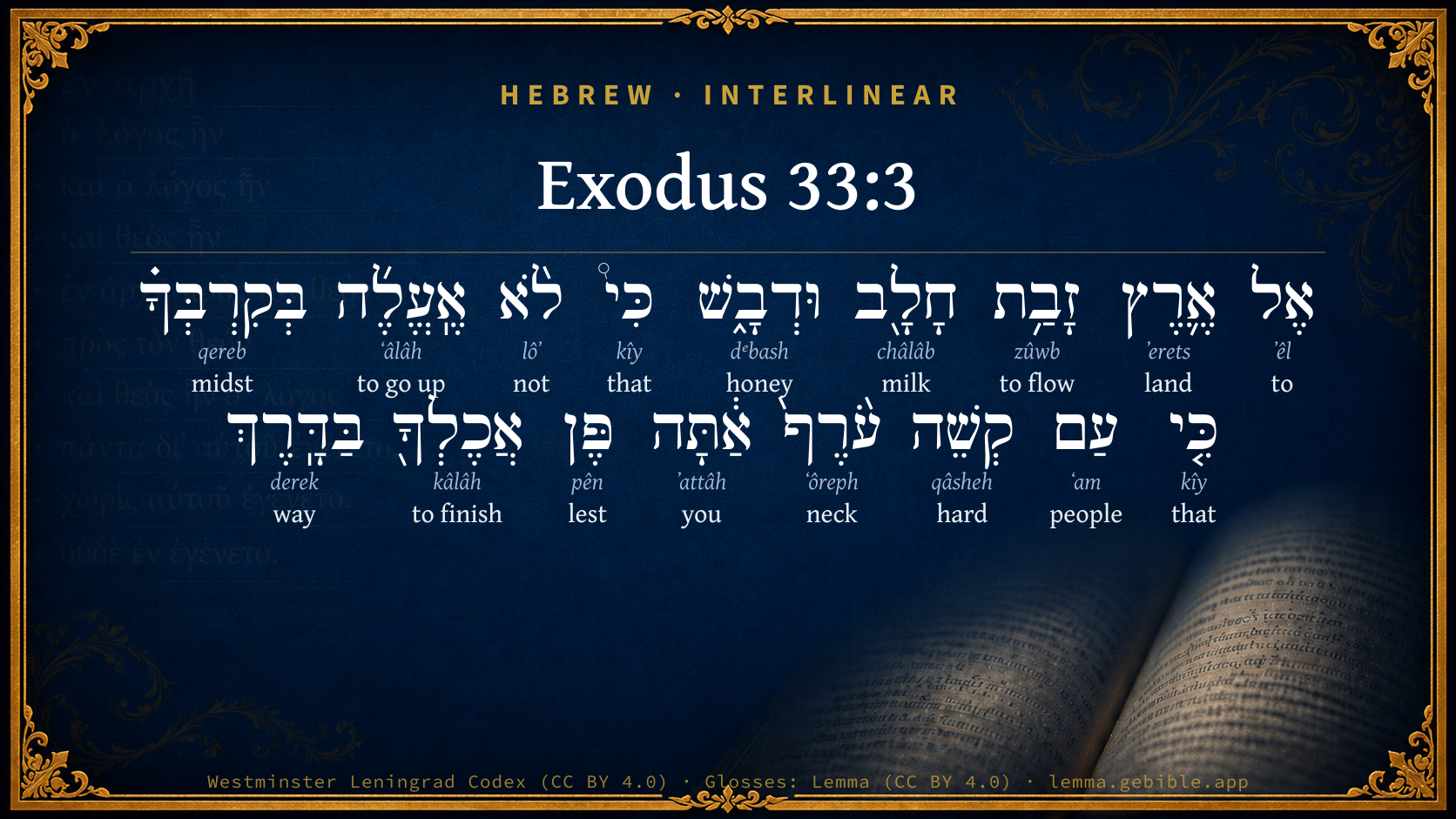
Hebrew (Westminster Leningrad Codex) Exodus 33:3 appears in the Hebrew Old Testament. The text above is from the Westminster Leningrad Codex. Each word links to its Strong’s number, a concise gloss, and parsing drawn from the Open Scriptures Hebrew Bible morphology. Click any word for its full Brown-Driver-Briggs (BDB) entry.
Download image
Cite this verse

Exodus 33:3 (World English Bible). Public Domain. Lemma interlinear Bible study tool, https://lemma.gebible.app/v/exodus/33/3.

Show BibTeX & RIS
BibTeX
RIS
English Translation
to a land flowing with milk and honey: for I will not go up in the midst of you, for you are a stiff-necked people, lest I consume you in the way."
World English Bible · Public Domain
Download a study sheet

One document with this verse’s original text, its word-by-word gloss line, the meaning frame, cross-references with their text, attributed commentary, and full source and license credits — printable, and it pastes into notes with its structure intact.

This verse Autodidact and up

Study sheet (.html) Plain text (.txt)

A passage Seminary Student

Up to 50 verses in one chapter. A passage sheet keeps up to 6 commentary sources and 12 cross-references per verse, in the order this page ranks them, and says so on the sheet whenever that leaves anything out. Ask for a single verse and you get the Autodidact verse sheet above.

Everything on this page stays free to read, with no account — the sheet is a download of what is already on screen, not access to it.

Want to remove ads? Support Godless Engineer
Compare translations 3

The same verse in 3 English versions, stacked beneath the original-language interlinear above. Click any original word for its lexicon entry.

Each is an independent rendering of the whole verse — the interlinear is not word-aligned to these translations.

Highlighted words mark where these versions differ — a whole-verse word diff, not a word-by-word alignment.

  • World English Bible Public Domain
    to a land flowing with milk and honey: for I will not go up in the midst of you, for you are a stiff-necked people, lest I consume you in the way."
  • King James Version Public Domain
    Unto a land flowing with milk and honey: for I will not go up in the midst of thee; for thou art a stiffnecked people: lest I consume thee in the way.
  • unfoldingWord Literal Text CC BY-SA 4.0
    to a land flowing milk and honey, but I will not go up in your midst, because you a people hard of neck, lest I destroy you on the way.”

unfoldingWord Literal Text — © unfoldingWord, licensed CC BY-SA 4.0. Word-aligned USFM3 via Door43 (git.door43.org/unfoldingWord/en_ult).

Versions to compare (up to 4)

3 of 4 selected

Show all 18 translations

Every available English version of this verse, each an independent rendering of the whole verse.

  • World English Bible Public Domain
    to a land flowing with milk and honey: for I will not go up in the midst of you, for you are a stiff-necked people, lest I consume you in the way."
  • Berean Standard Bible Public Domain
    Go up to a land flowing with milk and honey. But I will not go with you, because you are a stiff-necked people; otherwise, I might destroy you on the way.”
  • Majority Standard Bible Public Domain
    Go up to a land flowing with milk and honey. But I will not go with you, because you are a stiff-necked people; otherwise, I might destroy you on the way.”
  • King James Version Public Domain
    Unto a land flowing with milk and honey: for I will not go up in the midst of thee; for thou art a stiffnecked people: lest I consume thee in the way.
  • American Standard Version (1901) Public Domain
    unto a land flowing with milk and honey: for I will not go up in the midst of thee, for thou art a stiffnecked people, lest I consume thee in the way.
  • Revised Version (1885) Public Domain
    unto a land flowing with milk and honey: for I will not go up in the midst of thee; for thou art a stiffnecked people: lest I consume thee in the way.
  • Geneva Bible (1599) Public Domain
    To a lande, I say, that floweth with milke and hony: for I will not goe vp with thee, because thou art a stiffe necked people, least I consume thee in the way.
  • Douay-Rheims (1899) Public Domain
    That thou mayst enter into the land that floweth with milk and honey. For I will not go up with thee, because thou art a stiffnecked people: lest I destroy thee in the way.
  • Young's Literal Translation Public Domain
    unto a land flowing with milk and honey, for I do not go up in thy midst, for thou `art' a stiff-necked people -- lest I consume thee in the way.'
  • Literal Standard Version CC BY-SA 4.0
    [Go up] to a land flowing with milk and honey, for I do not go up in your midst, for you [are] a stiff-necked people—lest I consume you in the way.”
  • Unlocked Literal Bible CC BY-SA 4.0
    Go to that land, which is flowing with milk and honey, but I will not go up with you, because you are a stubborn people. I might destroy you on the way.”
  • unfoldingWord Literal Text CC BY-SA 4.0
    to a land flowing milk and honey, but I will not go up in your midst, because you a people hard of neck, lest I destroy you on the way.”
  • Darby Bible Public Domain
    into a land flowing with milk and honey; for I will not go up in the midst of thee, for thou art a stiff-necked people, -- lest I consume thee on the way.
  • World Messianic Bible Public Domain
    Go to a land flowing with milk and honey; but I will not go up among you, for you are a stiff-necked people, lest I consume you on the way.”
  • Webster's Bible Public Domain
    To a land flowing with milk and honey: for I will not go up in the midst of thee; for thou art a stiff-necked people: lest I consume thee in the way.
  • Free Bible Version CC BY-SA 4.0
    Enter a land flowing with milk and honey, but I will not accompany you because you are a rebellious people. Otherwise I would destroy you on the way.”
  • Bible in Basic English Public Domain
    Go up to that land flowing with milk and honey; but I will not go up among you, for you are a stiff-necked people, for fear that I send destruction on you while you are on the way.
  • JPS Tanakh (1917) Public Domain
    unto a land flowing with milk and honey; for I will not go up in the midst of thee; for thou art a stiffnecked people; lest I consume thee in the way.'

Literal Standard Version (2020), Covenant Press — licensed CC BY-SA 4.0. Text via the HelloAO Bible API (eBible.org). Unlocked Literal Bible (unfoldingWord) — licensed CC BY-SA 4.0. Text via the HelloAO Bible API (eBible.org). unfoldingWord Literal Text — © unfoldingWord, licensed CC BY-SA 4.0. Word-aligned USFM3 via Door43 (git.door43.org/unfoldingWord/en_ult). Free Bible Version, Dr. Jonathan Gallagher — licensed CC BY-SA 4.0. Text via the HelloAO Bible API (eBible.org).

Word by word

More ways to search: Search by grammar → Find every occurrence → Compare this word →

Practice this passage: Drill this verse → Learn its vocabulary →

עֹ֨רֶף֙
ʻôreph
H6203
“neck”
Noun, Common, Masculine, Singular, Absolute
Part of Speech
Noun
Type
Common
Gender
Masculine
Number
Singular
State
Absolute
Full BDB Definition

Origin: from H6202

TWOT: 1700a

neck, back of the neck, back - back of the neck - of fleeing foe - of apostasy (figuratively) - stiff of neck, obstinate (figuratively)
  1. אֶל ʼêl H413 “to” Preposition
  2. אֶ֛רֶץ ʼerets H776 “land” Noun, Common, Both, Singular, Absolute
  3. זָבַ֥ת zûwb H2100 “flowing” Verb, Qal, Participle Active, Feminine, Singular, Construct
  4. חָלָ֖ב châlâb H2461 “milk” Noun, Common, Masculine, Singular, Absolute
  5. וּדְבָ֑שׁ dᵉbash H1706 “and · honey” Conjunction + Noun, Common, Masculine, Singular, Absolute
  6. כִּי֩ kîy H3588 “that” Conjunction
  7. לֹ֨א lôʼ H3808 “not” Particle, Negative
  8. אֶֽעֱלֶ֜ה ʻâlâh H5927 “to go up” Verb, Qal, Imperfect, 1st Person, Common, Singular
  9. בְּקִרְבְּךָ֗ qereb H7130 “in/at · midst · your” Preposition + Noun, Common, Masculine, Singular, Construct + Suffix, Personal, 2nd Person, Masculine, Singular
  10. כִּ֤י kîy H3588 “that” Conjunction
  11. עַם ʻam H5971 “people” Noun, Common, Masculine, Singular, Absolute
  12. קְשֵׁה qâsheh H7186 “hard of” Adjective, Adjective, Masculine, Singular, Construct
  13. אַ֔תָּה ʼattâh H859 “you” Pronoun, Personal, 2nd Person, Masculine, Singular
  14. פֶּן pên H6435 “lest” Conjunction
  15. אֲכֶלְךָ֖ kâlâh H3615 “to finish · you” Verb, Piel, Imperfect, 1st Person, Common, Singular + Suffix, Personal, 2nd Person, Masculine, Singular
  16. בַּדָּֽרֶךְ derek H1870 “in/at the · way” Preposition, Determined + Noun, Common, Both, Singular, Absolute

About this verse

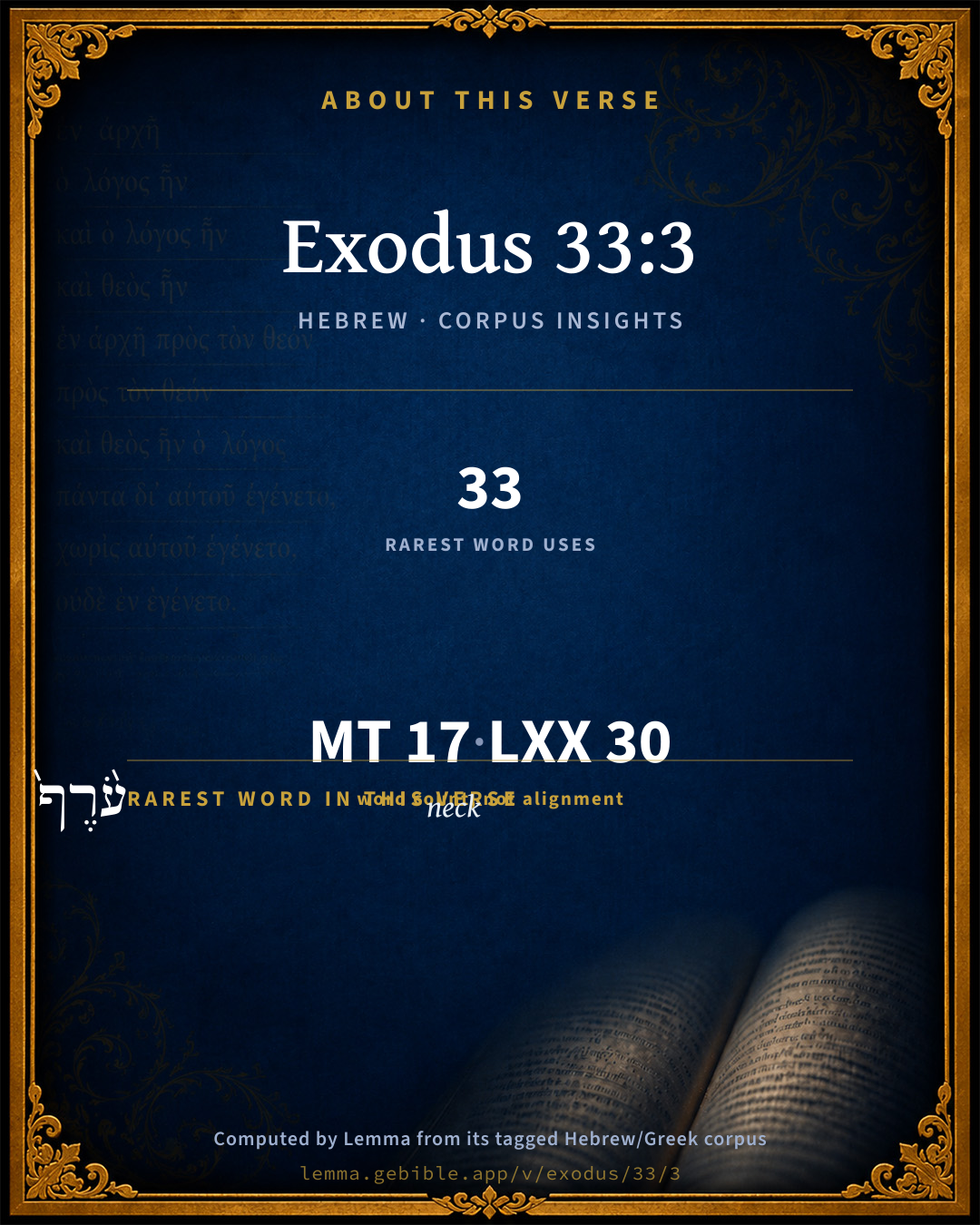
These counts appear in no published source. They are computed here, from the morphology-tagged text and Lemma’s own curated glosses. What Lemma adds →

17
words
16
distinct lemmas
Pentateuch
section

Shared distinctive vocabulary

עֹ֨רֶף֙ neck H6203 occurs in 32 verses of the Hebrew Bible. Also found in:

Grammatical profile

  • 3 verbs
  • 7 nouns
  • 1 adjective
  • 1 pronoun
  • 1 preposition
  • 3 conjunctions
  • 1 particle

Verb forms

  • זָבַ֥ת Qal · Participle Active
  • אֶֽעֱלֶ֜ה Qal · Imperfect
  • אֲכֶלְךָ֖ Piel · Imperfect

Repetition

A word recurs within this verse — often emphatic in Hebrew:

  • כִּי֩ that H3588 ×2

Hebrew & Septuagint length

In English translation the verse runs 32 words from the Hebrew and 34 from the Septuagint (LXX English) — closely comparable.

A rough comparison of the two English renderings, which tokenize alike — not a word-level alignment.

Word counts can differ between the Hebrew and the Greek without any difference in meaning — e.g. the Hebrew direct-object marker אֵת has no separate Greek word, and Greek often adds the article ὁ.

In the original languages it is 17 Hebrew tokens and 30 Greek tokens — but the two are counted differently (Hebrew bundles its prefixes and suffixes into one token; the Greek is in lemma form), so that isn’t a like-for-like length.

Cross-references

27

Topical passages linked to Exodus 33:3 in the Treasury of Scripture Knowledge — connected by theme and wording, ordered by reader-vote popularity; previews shown in the World English Bible.

  • Exodus 32:9–10 Yahweh said to Moses, "I have seen these people, and, behold, they are a stiff-necked people.
  • Exodus 3:8 I have come down to deliver them out of the hand of the Egyptians, and to bring them up out of that land to a good and large land, to a land flowing with milk and honey; to the place of the Canaanite, the Hittite, the Amorite, the Perizzite, the Hivite, and the Jebusite.
  • Deuteronomy 9:6–13 Know therefore, that Yahweh your God doesn't give you this good land to possess it for your righteousness; for you are a stiff-necked people.
  • Acts 7:51 "You stiff-necked and uncircumcised in heart and ears, you always resist the Holy Spirit! As your fathers did, so you do.
  • Exodus 33:15–17 He said to him, "If your presence doesn't go with me, don't carry us up from here.
  • Jeremiah 11:5 that I may establish the oath which I swore to your fathers, to give them a land flowing with milk and honey, as at this day. Then answered I, and said, Amen, Yahweh.
  • Numbers 16:21 Separate yourselves from among this congregation, that I may consume them in a moment.
  • Numbers 16:45 Get away from among this congregation, that I may consume them in a moment. They fell on their faces.
  • Joshua 5:6 For the children of Israel walked forty years in the wilderness, until all the nation, even the men of war who came forth out of Egypt, were consumed, because they didn't listen to the voice of Yahweh: to whom Yahweh swore that he wouldn't let them see the land which Yahweh swore to their fathers that he would give us, a land flowing with milk and honey.
  • Ezekiel 33:13–16 When I tell the righteous, that he shall surely live; if he trust to his righteousness, and commit iniquity, none of his righteous deeds shall be remembered; but in his iniquity that he has committed, therein shall he die.
  • Amos 3:13–14 "Listen, and testify against the house of Jacob," says the Lord Yahweh, the God of hosts.
  • Exodus 13:5 It shall be, when Yahweh shall bring you into the land of the Canaanite, and the Hittite, and the Amorite, and the Hivite, and the Jebusite, which he swore to your fathers to give you, a land flowing with milk and honey, that you shall keep this service in this month.
  • Exodus 23:21 Pay attention to him, and listen to his voice. Don't provoke him, for he will not pardon your disobedience, for my name is in him.
  • Exodus 32:14 Yahweh repented of the evil which he said he would do to his people.
  • Exodus 34:9 He said, "If now I have found favor in your sight, Lord, please let the Lord go in the midst of us; although this is a stiff-necked people; pardon our iniquity and our sin, and take us for your inheritance."
  • Leviticus 20:24 But I have said to you, "You shall inherit their land, and I will give it to you to possess it, a land flowing with milk and honey." I am Yahweh your God, who has separated you from the peoples.
  • Numbers 13:27 They told him, and said, We came to the land where you sent us; and surely it flows with milk and honey; and this is the fruit of it.
  • Numbers 14:8 If Yahweh delight in us, then he will bring us into this land, and give it to us; a land which flows with milk and honey.
  • Numbers 14:12 I will strike them with the pestilence, and disinherit them, and will make of you a nation greater and mightier than they.
  • Numbers 16:13 is it a small thing that you have brought us up out of a land flowing with milk and honey, to kill us in the wilderness, but you must needs make yourself also a prince over us?
  • Deuteronomy 32:26–27 I said, I would scatter them afar, I would make the memory of them to cease from among men;
  • 1 Samuel 2:30 Therefore Yahweh, the God of Israel, says, I said indeed that your house, and the house of your father, should walk before me forever: but now Yahweh says, Be it far from me; for those who honor me I will honor, and those who despise me shall be lightly esteemed.
  • Psalms 78:8 And might not be as their fathers, A stubborn and rebellious generation, A generation that didn't make their hearts loyal, Whose spirit was not steadfast with God.
  • Jeremiah 18:7–10 At what instant I shall speak concerning a nation, and concerning a kingdom, to pluck up and to break down and to destroy it;
  • Ezekiel 3:18–19 When I tell the wicked, You shall surely die; and you give him no warning, nor speak to warn the wicked from his wicked way, to save his life; the same wicked man shall die in his iniquity; but his blood will I require at your hand.
  • Jonah 3:4 Jonah began to enter into the city a day's journey, and he cried out, and said, "Yet forty days, and Nineveh shall be overthrown!"
  • Jonah 3:10 God saw their works, that they turned from their evil way. God repented of the evil which he said he would do to them, and he didn't do it.

Cross-references courtesy of OpenBible.info (CC BY 4.0).

Hebrew and Greek witnesses Masoretic Hebrew ↔ Greek Septuagint

The same verse in the two great witnesses to the Old Testament, shown verse-for-verse.

These are two independent witnesses, not word-aligned to each other, and the Septuagint is shown in lemma (dictionary) form.

Hebrew Exodus 33:3 Masoretic · Westminster Leningrad Codex

אֶל אֶ֛רֶץ זָבַ֥ת חָלָ֖ב וּדְבָ֑שׁ כִּי֩ לֹ֨א אֶֽעֱלֶ֜ה בְּקִרְבְּךָ֗ כִּ֤י עַם קְשֵׁה עֹ֨רֶף֙ אַ֔תָּה פֶּן אֲכֶלְךָ֖ בַּדָּֽרֶךְ

to a land flowing with milk and honey: for I will not go up in the midst of you, for you are a stiff-necked people, lest I consume you in the way."

World English Bible · Public Domain

Greek LXX Exodus 33:3 Septuagint · lemma form

καί εἰςἄγω σύ εἰς γῆ ῥέω γάλα καί μέλι οὐ γάρ μή συν ἀναβαίνω μετά σύ διά ὁ λαός σκληροτράχηλος σύ εἰμί ἵνα μή ἐκ ἀναἁλίσκω σύ ἐν ὁ ὁδός

And I will bring you into a land flowing with milk and honey; for I will not go up with you, because you are a stiff-necked people, lest I consume you by the way.

LXX2012 (modern English Septuagint) · Public Domain

Hebrew: Westminster Leningrad Codex (CC BY 4.0). Greek: Septuagint (public domain); English from LXX2012 (modern English Septuagint) (Public Domain). How the Septuagint differs from the Hebrew →

Targum (Aramaic paraphrase)

2

The Targum is the ancient Jewish Aramaic paraphrase of the Hebrew Scriptures — an interpretive translation, not the Hebrew text itself. Onkelos (literal) and Pseudo-Jonathan (expansive) render the Torah, and Jonathan the Prophets. Coverage is partial: where no permissively-licensed English translation exists for a verse, only the Aramaic is shown. This is verse-level text, not a word-by-word alignment to the Hebrew.

  1. Targum Onkelos Torah (Genesis–Deuteronomy)
    לְאַרְעָא עַבְדָא חֲלָב וּדְבָשׁ אֲרֵי לָא אֲסַלֵק שְׁכִנְתִּי מִבֵּינָךְ אֲרֵי עַם קְשֵׁי קְדַל אַתְּ דִילְמָא אֲשֵׁצִינָךְ בְּאָרְחָא:

    (no public-domain English translation for this verse)

    Targum Onkelos — Aramaic: “Onkelos Genesis” (public domain); “Onkelos Exodus” (public domain); “Onkelos Leviticus” (public domain); “Onkelos Numbers” (public domain); “Onkelos Deuteronomy” (public domain). English: “Sefaria Community Translation” (CC0 1.0 (public-domain dedication)); “J.W. Etheridge. The Targums of Onkelos and Jonathan Ben Uzziel on the Pentateuch. London: Longmans, Green, 1862” (public domain). Text via Sefaria.

  2. Targum Pseudo-Jonathan Torah (Genesis–Deuteronomy)
    לְאַרַע עַבְדָא חֲלָב וּדְבָשׁ אֲרוּם לֵית אֶפְשַׁר דְּאֵיסַלֵק שְׁכִינַת יְקָרִי מִבֵּינֵיכוֹן בְּרַם לָא יְהֵי יְקָרִי שְׁרֵי בְּמָדוֹר מַשְׁרִיתֵיהוֹן אֲרוּם עַם קְשֵׁי קְדַל אַנְתְּ דִּילְמָא אֵישֵׁיצִינְכוֹן בְּאָרְחָא

    to the land producing milk and honey. For the Shekinah of My Glory cannot go up among you, nor My Majesty dwell in the habitation of their camp, because thou art a hard-necked people, lest I destroy you in the way.

    Targum Pseudo-Jonathan — Aramaic: “Targum Jonathan on Genesis” (public domain); “Targum Jonathan on Exodus” (public domain); “Targum Jonathan on Leviticus” (public domain); “Targum Jonathan on Numbers” (public domain); “Targum Jonathan on Deuteronomy” (public domain). English: “The Targum of Jonathan ben Uzziel, trans. J. W. Etheridge, London, 1862” (public domain). Text via Sefaria.

Commentary

Notes on Exodus 33:3 from classic Christian and Jewish commentators (each source and its license shown beneath its notes). The classic Christian expositions comment on the surrounding passage and are grouped to its opening verse, so a note may address several verses; the Jewish commentaries on the Tanakh (Rashi and others) are per-verse, so they appear only where the commentator wrote on this verse.

Lemma curates 59 commentaries, every one of them public domain or Creative Commons licensed, each selected and text-cleaned for this edition rather than reprinted as found. About our sources →

Trapp's Complete Commentary

John Trapp

Exo 33:3 Unto a land flowing with milk and honey: for I will not go up in the midst of thee; for thou [art] a stiffnecked people: lest I consume thee in the way.

Ver. 3. I will not go up,] sc., By those visible signs of my gracious presence as heretofore.

John Trapp, A Commentary or Exposition upon All the Books of the Old and New Testament (1647–1656) — public domain. Text from a community e-Sword module.

Joseph Benson's Commentary

Exo 33:3. I will not go up in the midst of thee — By my own special and gracious presence, as hitherto I have done, but I will depart from thee. In pursuance hereof, God removes his tabernacle without the camp. I will only make good my promise to thy fathers, and send an angel to accomplish it, but I will show no particular and further kindness to thee. Lest I consume thee in the way — Lest thy sins should be aggravated by my presence and favour, and thereby I should be provoked utterly to destroy thee. So God shows that their perverseness makes this severity necessary for them, and that he, even in his judgment, remembers mercy to them.

Joseph Benson's Commentary on the Old and New Testaments (1811–1818) — public domain. Text from a community e-Sword module.

Tyndale Open Study Notes

Tyndale Open Resources

33:3 land that flows with milk and honey: Although Canaan was not as fertile as the Nile Valley in Egypt, it was a great deal more productive agriculturally than the Sinai Desert where they were. • stubborn and rebellious: They were covenant-breakers. • I would surely destroy you: As the Covenant Lord (see study note on 23:20-33), he would enforce the terms of the covenant that called for the destruction of covenant-breakers (see 24:7-8 and study notes).

Tyndale Open Study Notes — © Tyndale Open Resources, licensed CC BY-SA 4.0. Text via the HelloAO Bible API.

Jamieson, Fausset & Brown

Robert Jamieson, A. R. Fausset & David Brown

I will not go up . . . lest I consume thee--Here the Lord is represented as determined to do what He afterwards did not. (See on Exo 32:7).

Jamieson, Fausset & Brown — Commentary Critical and Explanatory on the Whole Bible (1871) — public domain (CC PDM 1.0). Text via the HelloAO Bible API.

Adam Clarke's Commentary

Verse 3. I will not go up in the midst of thee] Consequently, the angel here promised to be their guide was not that angel in whom Jehovah's name was: and so the people understood it; hence the mourning which is afterwards mentioned.

Adam Clarke's Commentary on the Bible (1810–1826) — public domain. Text from a community e-Sword/MySword module.

Ellicott's Commentary for English Readers

(3) A land flowing with milk and honey.—See Note on Exo_3:8.

Lest I consume thee.—Comp. Exo_32:10; Lev_10:2; Ps. 88:21, 31, &c. “God is a consuming fire” (Heb_12:29). His near presence, if it does not cleanse and purify, scorches and withers. The conduct of Israel in the wilderness was such as continually to provoke Him to destroy them; and but for His amazing compassion and forbearance, the result here glanced at would assuredly have followed.

A Bible Commentary for English Readers, edited by Charles John Ellicott (1878–1897) — public domain. Text from a community e-Sword module.

The Cambridge Bible for Schools and Colleges

gen. ed. J. J. S. Perowne

3. a land flowing, &c.] See on Exo_3:8.

in the midst of] v. 5, Exo_17:7, Exo_34:9, Num_11:20; Num_14:14; Num_14:42.

a stiffnecked people] Exo_32:9.

lest I consume thee, &c.] in consequence of some outburst of wilfulness or rebellion on thy part.

The Cambridge Bible for Schools and Colleges (gen. ed. J. J. S. Perowne; Cambridge University Press, 1878–1918) — public domain. Text from a community e-Sword module.

John Gill's Exposition

Unto a land flowing with milk and honey,.... Abounding with all the necessaries and good things of life, a description of the land of Canaan frequently made, see Exo 3:8,

for I will not go up in the midst of thee; would not grant them his presence in so near, visible, and respectable a manner as he had before done, though he would not utterly forsake them: the tabernacle was before in the midst of the camp, that is, that which was erected until the large one, ordered to be made, was finished, but now it was removed without the camp, Exo 33:7.

for thou art a stiffnecked people; See Gill on Exo 32:9,

lest I consume them in the way; in the way to the land of Canaan, and so never get there; the meaning is, that the Lord being in the midst of them, their sin would be the more aggravated to be committed in his presence, before his face; and the glory of his majesty would require that immediate notice be taken of it, and just punishment inflicted; so that by this step God both consulted his own honour and their safety.

John Gill's Exposition of the Whole Bible (1746–1763) — public domain (CC PDM 1.0). Text via the HelloAO Bible API.

Haydock's Catholic Bible Commentary

I will not go: "in majesty" (Chaldean) and "brightness," Arabic. The angel shall go in his own name, and shall not perform such great miracles. My tabernacle shall be removed to a respectful distance, lest, not being able to endure the barefaced impiety of the people, I slay you in my fury. God addresses Moses, as the representative of the nation, (Menochius) and adopts the language of men, appearing as a king, who cannot bear to be insulted to his face. (Haydock)

George Leo Haydock (1774–1849), Haydock's Catholic Family Bible and Commentary, 1859 edition — public domain. Excludes Psalms (Douay-Rheims chapter numbering differs from Protestant) and Deuterocanonical books (Catholic canon only).

Matthew Poole's English Annotations

I will not go up in the midst of thee by my own special and gracious presence, as hitherto I have done, but I will depart from thee. In pursuance hereof God removes his tabernacle without the camp, Exo 33:7. I will only make good my promise to thy fathers, and send an angel to accomplish it, but I will show no peculiar and further kindness to thee.

Lest I consume thee in the way; lest thy sins should be aggravated by my presence and favour, and thereby I should be provoked utterly to destroy thee. So he shows that their perverseness makes this severity necessary for them, and that God even in his judgment remembers mercy to them.

Matthew Poole's English Annotations on the Holy Bible (1683–1685) — public domain. Text from a community e-Sword/MySword module.

Whedon's Commentary on the Bible

Daniel D. Whedon

3. I will not go up in the midst of thee — This distinction between Jehovah and his Angel is not inconsistent with our doctrine of the Angel of Jehovah, as set forth in note on Gen_16:7. But Jehovah’s Angel might not at all times so bear his name (Exo_23:21) or exhibit his power as to be a consuming fire in the midst of Israel. He was rather of the nature of a mediator between Moses and Jehovah, and the statement of this verse is designed to enhance the infinite holiness of God. The hardness of the people’s heart is such that some consideration may be shown, (comp. Mat_19:8,) but the demands of infinite holiness are such that Jehovah here represents himself as withdrawing from the stiffnecked people, lest the immediate gaze of his holy eye consume them in the way. The whole manner of thought is anthropomorphic, for how else could such conceptions be then conveyed to such a sinful people? The mediating Angel may show mercy when holy wrath would destroy; and Israel may have an angel like other nations, (comp. Dan_10:13,) but lose the special presence of Jehovah himself.

Daniel D. Whedon (gen. ed.), Commentary on the Old and New Testaments (1874–1909) — public domain. Text from a community e-Sword module.

The Pulpit Commentary

Unto a land. Ver. 2 is parenthetic, and ver. 3 coheres with ver. 1 up hence, thou and the people, unto the land which I sware unto Abraham unto a land flowing," etc. On the milk and honey of Canaan, see the comment upon Exo_3:8. For I will not go up in the midst of thee. At length there was an end of ambiguity God"s purpose was made plain the people had shown themselves unfit for his near presence, and he would withdraw himself. So it would be best even for them; since, if they were about to show- themselves as perverse in the future as they had in the past, his near presence could only lead to their entire destruction. Some day they would so provoke him, that he would consume them in the way.

The Pulpit Commentary (1880–1919), ed. H.D.M. Spence-Jones & Joseph S. Exell — public domain. Text from a community e-Sword module.

Rashi

Rabbi Shlomo Yitzchaki (Rashi)

ארץ זבת חלב ודבש UNTO A LAND FLOWING WITH MILK AND HONEY do I bid you to bring them up.

כי לא אעלה בקרבך BECAUSE I WILL NOT GO UP AMONG THEE, therefore I say to thee, I will send an angel before thee.

כי עם קשה ערף אתה FOR THOU ART A STIFF-NECKED PEOPLE, and if My Shechina were in thy midst and thou rebelledst against Me, I might become exceedingly angry with thee and destroy thee on the way.

אכלך is an expression for ‘‘destroying”.

Rashi on the Tanakh — English translations: “The Judaica Press complete Tanach with Rashi, translated by A. J. Rosenberg” (CC BY 4.0); “Pentateuch with Rashi's commentary by M. Rosenbaum and A.M. Silbermann, 1929-1934” (public domain); “The Metsudah Tanach series, Lakewood, N.J” (CC BY 4.0); and “The Book of Joshua, Metsudah Publications, 1997” (CC BY 4.0). Text via Sefaria.

Sforno

Rabbi Ovadia Sforno

[You will then] enter a land. In the desert they had to be sustained through open miracles of which they were no longer worthy. Therefore they were commanded to enter the Holy Land where miracles would no longer be required.

For I will not go up. God informed them that He would not even accompany them to tell them when to camp and when to move onת

because if He went with them the punishment for every infraction would be much greater and they might be destroyed.

Sforno on the Tanakh — English translation: “Yalkut, Sifsei Chachomim Chumash, Metsudah Publications, 2009” (CC BY 4.0). Text via Sefaria.

Lesson kit

Teaching starters — assembled from the data on this page, not authored interpretation. Every prompt links to the verse data it draws on. Edit before teaching.

Exodus, in the Pentateuch, opens this verse with 17 words (16 distinct Hebrew lemmas). Its most distinctive word is ʻôreph (“neck”). A historical commentator’s framing appears above. Read the whole chapter for the surrounding context.

Discussion questions

  1. What does “neck” (ʻôreph) contribute to the verse as a whole?
  2. How does Genesis 49:8, which shares the word «neck», read alongside this verse?
  3. What does the repetition of “that” (2× in this one verse) do in this verse?
  4. The translations on this page render this verse differently — a whole-verse word diff, not a word-by-word alignment. What might account for the different wordings?
  5. «זָבַ֥ת» is a Qal Participle Active verb. How does that grammatical form shape the action described?
  6. Compare how Trapp's Complete Commentary and Joseph Benson's Commentary read this verse. Where do they agree or differ?

Things to notice

Reading settings

Reading text

Shown beneath each verse's original-language words.

Old Testament
Old Testament edition

Read the OT as the Masoretic Hebrew (MT) or the Greek Septuagint (LXX).

English shown for the Greek Septuagint (in the Hebrew ↔ Greek comparison).

Comparing translations? Open the Compare panel on any verse page to stack up to four side by side.