Exodus 8:7

Hebrew (Westminster Leningrad Codex) Exodus 8:7 appears in the Hebrew Old Testament. The text above is from the Westminster Leningrad Codex. Each word links to its Strong’s number, a concise gloss, and parsing drawn from the Open Scriptures Hebrew Bible morphology. Click any word for its full Brown-Driver-Briggs (BDB) entry.
Download image
Cite this verse

Exodus 8:7 (World English Bible). Public Domain. Lemma interlinear Bible study tool, https://lemma.gebible.app/v/exodus/8/7.

Show BibTeX & RIS
BibTeX
RIS
English Translation
The magicians did in like manner with their enchantments, and brought up frogs on the land of Egypt.
World English Bible · Public Domain
Download a study sheet

One document with this verse’s original text, its word-by-word gloss line, the meaning frame, cross-references with their text, attributed commentary, and full source and license credits — printable, and it pastes into notes with its structure intact.

This verse Autodidact and up

Study sheet (.html) Plain text (.txt)

A passage Seminary Student

Up to 50 verses in one chapter. A passage sheet keeps up to 6 commentary sources and 12 cross-references per verse, in the order this page ranks them, and says so on the sheet whenever that leaves anything out. Ask for a single verse and you get the Autodidact verse sheet above.

Everything on this page stays free to read, with no account — the sheet is a download of what is already on screen, not access to it.

Want to remove ads? Support Godless Engineer
Compare translations 3

The same verse in 3 English versions, stacked beneath the original-language interlinear above. Click any original word for its lexicon entry.

Each is an independent rendering of the whole verse — the interlinear is not word-aligned to these translations.

Highlighted words mark where these versions differ — a whole-verse word diff, not a word-by-word alignment.

  • World English Bible Public Domain
    The magicians did in like manner with their enchantments, and brought up frogs on the land of Egypt.
  • King James Version Public Domain
    And the magicians did so with their enchantments, and brought up frogs upon the land of Egypt.
  • unfoldingWord Literal Text CC BY-SA 4.0
    And the magicians did likewise with their magic, and they brought up frogs over the land of Egypt.

unfoldingWord Literal Text — © unfoldingWord, licensed CC BY-SA 4.0. Word-aligned USFM3 via Door43 (git.door43.org/unfoldingWord/en_ult).

Versions to compare (up to 4)

3 of 4 selected

Show all 18 translations

Every available English version of this verse, each an independent rendering of the whole verse.

  • World English Bible Public Domain
    The magicians did in like manner with their enchantments, and brought up frogs on the land of Egypt.
  • Berean Standard Bible Public Domain
    But the magicians did the same thing by their magic arts, and they also brought frogs up onto the land of Egypt.
  • Majority Standard Bible Public Domain
    But the magicians did the same thing by their magic arts, and they also brought frogs up onto the land of Egypt.
  • King James Version Public Domain
    And the magicians did so with their enchantments, and brought up frogs upon the land of Egypt.
  • American Standard Version (1901) Public Domain
    And the magicians did in like manner with their enchantments, and brought up frogs upon the land of Egypt.
  • Revised Version (1885) Public Domain
    And the magicians did in like manner with their enchantments, and brought up frogs upon the land of Egypt.
  • Geneva Bible (1599) Public Domain
    And the sorcerers did likewise with their sorceries, and brought frogges vp vpon the land of Egypt.
  • Douay-Rheims (1899) Public Domain
    And the magicians also by their enchantments did in like manner, and the brought forth frogs upon all the land of Egypt
  • Young's Literal Translation Public Domain
    and the scribes do so with their flashings, and cause the frogs to come up against the land of Egypt.
  • Literal Standard Version CC BY-SA 4.0
    and the enchanters do so with their secrets, and cause the frogs to come up against the land of Egypt.
  • Unlocked Literal Bible CC BY-SA 4.0
    But the magicians did the same with their magic; they brought up frogs over the land of Egypt.
  • unfoldingWord Literal Text CC BY-SA 4.0
    And the magicians did likewise with their magic, and they brought up frogs over the land of Egypt.
  • Darby Bible Public Domain
    And the scribes did so with their sorceries, and brought up frogs on the land of Egypt.
  • World Messianic Bible Public Domain
    The magicians did the same thing with their enchantments, and brought up frogs on the land of Egypt.
  • Webster's Bible Public Domain
    And the magicians did so with their enchantments, and brought up frogs upon the land of Egypt.
  • Free Bible Version CC BY-SA 4.0
    But the Egyptian magicians did the same thing using their magic arts. They brought up frogs in Egypt.
  • Bible in Basic English Public Domain
    And the wonder-workers did the same with their secret arts, making frogs come up over the land of Egypt.
  • JPS Tanakh (1917) Public Domain
    (8-3) And the magicians did in like manner with their secret arts, and brought up frogs upon the land of Egypt.

Literal Standard Version (2020), Covenant Press — licensed CC BY-SA 4.0. Text via the HelloAO Bible API (eBible.org). Unlocked Literal Bible (unfoldingWord) — licensed CC BY-SA 4.0. Text via the HelloAO Bible API (eBible.org). unfoldingWord Literal Text — © unfoldingWord, licensed CC BY-SA 4.0. Word-aligned USFM3 via Door43 (git.door43.org/unfoldingWord/en_ult). Free Bible Version, Dr. Jonathan Gallagher — licensed CC BY-SA 4.0. Text via the HelloAO Bible API (eBible.org).

Word by word

More ways to search: Search by grammar → Find every occurrence → Compare this word →

Practice this passage: Drill this verse → Learn its vocabulary →

בְּלָטֵיהֶ֑ם
lâṭ
H3909
“in/at · enchantments · their”
Preposition + Noun, Common, Masculine, Plural, Construct + Suffix, Personal, 3rd Person, Masculine, Plural
Part of Speech
Preposition + Noun
Type
Common
Gender
Masculine
Number
Plural
State
Construct
Full BDB Definition

Origin: a form of H3814 or else participle from H3874

TWOT: 1092a

secrecy, mystery, enchantment - secrecy, secretly - mystery, enchantment
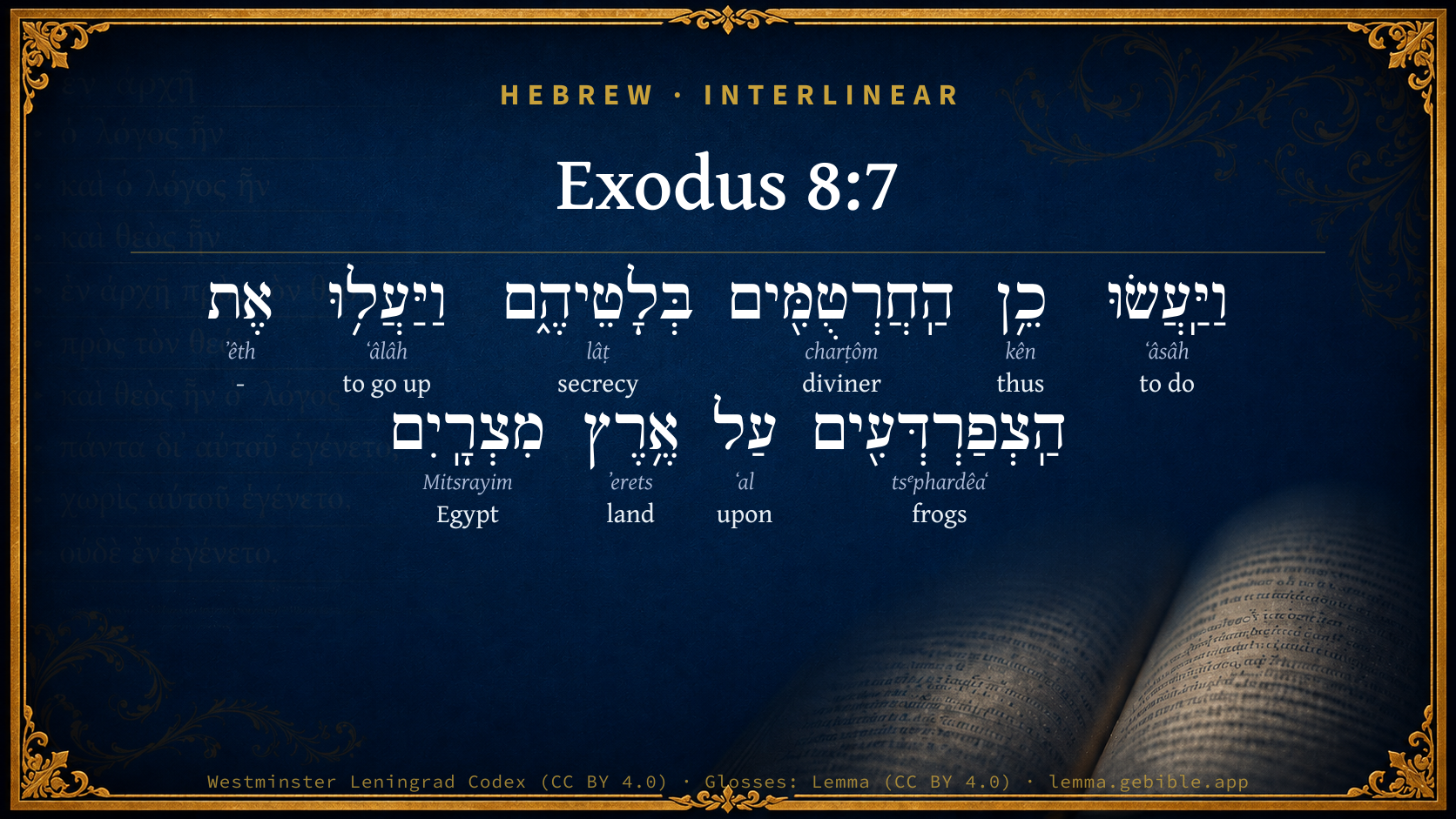
  1. וַיַּֽעֲשׂוּ ʻâsâh H6213 “and · to do” Conjunction + Verb, Qal, Sequential Imperfect, 3rd Person, Masculine, Plural
  2. כֵ֥ן kên H3651 “thus” Adverb
  3. הַֽחֲרְטֻמִּ֖ים charṭôm H2748 “the · diviners” Particle, Definite Article + Noun, Common, Masculine, Plural, Absolute
  4. וַיַּעֲל֥וּ ʻâlâh H5927 “and · to go up” Conjunction + Verb, Hiphil, Sequential Imperfect, 3rd Person, Masculine, Plural
  5. אֶת ʼêth H853 “-” Particle, Direct Object
  6. הַֽצְפַרְדְּעִ֖ים tsᵉphardêaʻ H6854 “the · frogs” Particle, Definite Article + Noun, Common, Feminine, Plural, Absolute
  7. עַל ʻal H5921 “upon” Preposition
  8. אֶ֥רֶץ ʼerets H776 “land of” Noun, Common, Both, Singular, Construct
  9. מִצְרָֽיִם Mitsrayim H4714 “Egypt” Noun, Proper

About this verse

These counts appear in no published source. They are computed here, from the morphology-tagged text and Lemma’s own curated glosses. What Lemma adds →

10
words
10
distinct lemmas
Pentateuch
section

Notable vocabulary

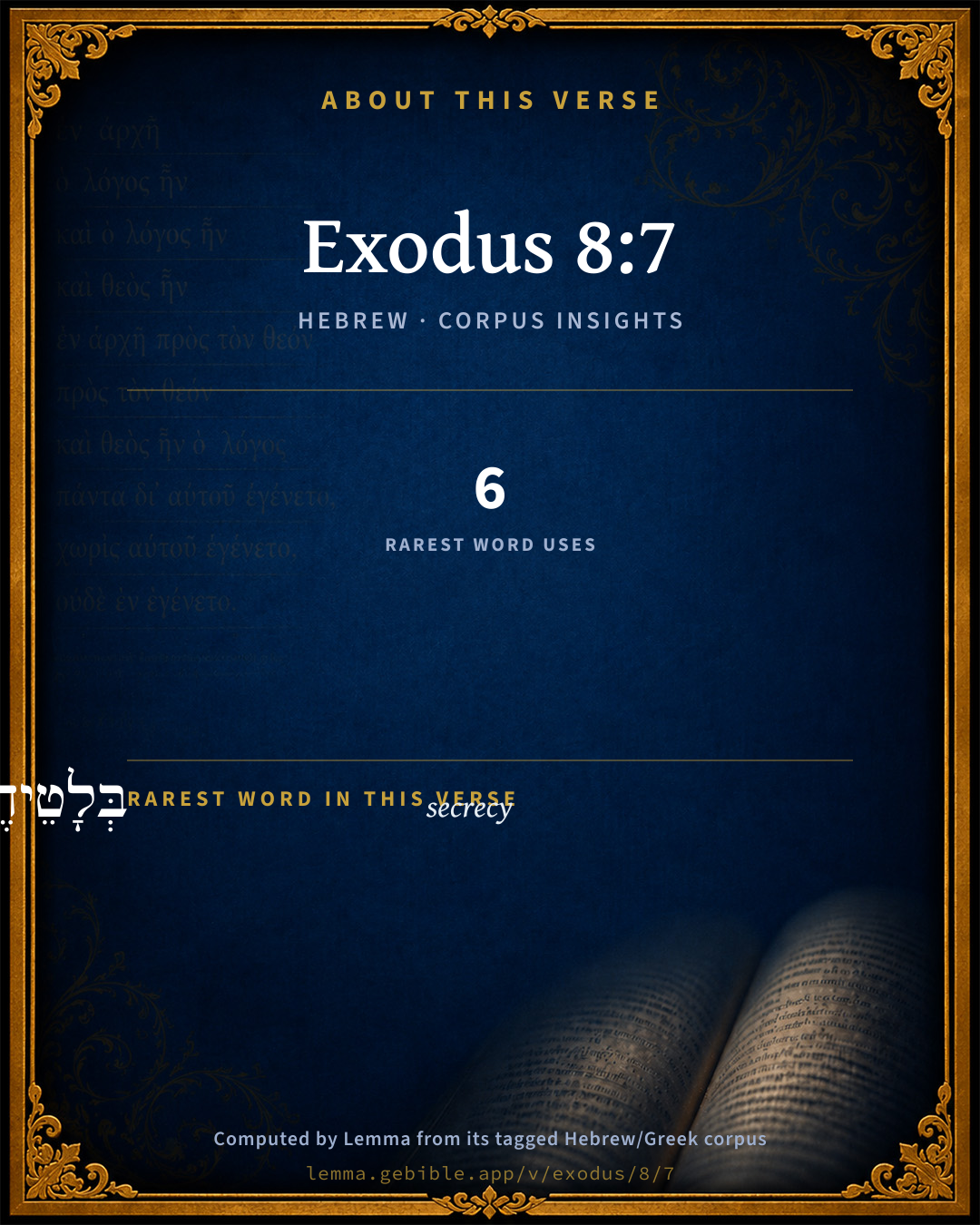
The rarest word here is בְּלָטֵיהֶ֑ם secrecy H3909 — appearing just 6 times in the whole Hebrew Bible.

Shared distinctive vocabulary

בְּלָטֵיהֶ֑ם secrecy H3909 occurs in 6 verses of the Hebrew Bible. Also found in:

Grammatical profile

  • 2 verbs
  • 5 nouns
  • 1 preposition
  • 1 adverb
  • 1 particle

Verb forms

  • וַיַּֽעֲשׂוּ Qal · Sequential Imperfect
  • וַיַּעֲל֥וּ Hiphil · Sequential Imperfect

Hebrew & Septuagint length

In English translation the verse runs 18 words from the Hebrew and 22 from the Septuagint (LXX English) — closely comparable.

A rough comparison of the two English renderings, which tokenize alike — not a word-level alignment.

Word counts can differ between the Hebrew and the Greek without any difference in meaning — e.g. the Hebrew direct-object marker אֵת has no separate Greek word, and Greek often adds the article ὁ.

Cross-references

7

Topical passages linked to Exodus 8:7 in the Treasury of Scripture Knowledge — connected by theme and wording, ordered by reader-vote popularity; previews shown in the World English Bible.

  • Exodus 7:11 Then Pharaoh also called for the wise men and the sorcerers. They also, the magicians of Egypt, did in like manner with their enchantments.
  • Exodus 7:22 The magicians of Egypt did in like manner with their enchantments; and Pharaoh's heart was hardened, and he didn't listen to them; as Yahweh had spoken.
  • Deuteronomy 13:1–3 If there arise in the midst of you a prophet, or a dreamer of dreams, and he give you a sign or a wonder,
  • Matthew 24:24 For there will arise false christs, and false prophets, and they will show great signs and wonders, so as to lead astray, if possible, even the chosen ones.
  • 2 Thessalonians 2:9–11 even he whose coming is according to the working of Satan with all power and signs and lying wonders,
  • 2 Timothy 3:8 Even as Jannes and Jambres opposed Moses, so do these also oppose the truth; men corrupted in mind, reprobate concerning the faith.
  • Revelation 13:14 He deceives my own people who dwell on the earth because of the signs he was granted to do in front of the beast; saying to those who dwell on the earth, that they should make an image to the beast who had the sword wound and lived.

Cross-references courtesy of OpenBible.info (CC BY 4.0).

Hebrew and Greek witnesses Masoretic Hebrew ↔ Greek Septuagint

The same verse in the two great witnesses to the Old Testament, shown verse-for-verse.

These are two independent witnesses, not word-aligned to each other, and the Septuagint is shown in lemma (dictionary) form.

Hebrew Exodus 8:7 Masoretic · Westminster Leningrad Codex

וַיַּֽעֲשׂוּ כֵ֥ן הַֽחֲרְטֻמִּ֖ים בְּלָטֵיהֶ֑ם וַיַּעֲל֥וּ אֶת הַֽצְפַרְדְּעִ֖ים עַל אֶ֥רֶץ מִצְרָֽיִם

The magicians did in like manner with their enchantments, and brought up frogs on the land of Egypt.

World English Bible · Public Domain

Greek LXX Exodus 8:7 Septuagint · lemma form

καί περιαἱρέω ὁ βάτραχος ἀπό σύ καί ἐκ ὁ οἰκία σύ καί ἐκ ὁ ἔπαυλις καί ἀπό ὁ θεράπων σύ καί ἀπό ὁ λαός σύ πλήν ἐν ὁ ποταμός ὑπολείπω

And the charmers of the Egyptians also did likewise with their sorceries, and brought up the frogs on the land of Egypt.

LXX2012 (modern English Septuagint) · Public Domain

Hebrew: Westminster Leningrad Codex (CC BY 4.0). Greek: Septuagint (public domain); English from LXX2012 (modern English Septuagint) (Public Domain). How the Septuagint differs from the Hebrew →

Targum (Aramaic paraphrase)

2

The Targum is the ancient Jewish Aramaic paraphrase of the Hebrew Scriptures — an interpretive translation, not the Hebrew text itself. Onkelos (literal) and Pseudo-Jonathan (expansive) render the Torah, and Jonathan the Prophets. Coverage is partial: where no permissively-licensed English translation exists for a verse, only the Aramaic is shown. This is verse-level text, not a word-by-word alignment to the Hebrew.

  1. Targum Onkelos Torah (Genesis–Deuteronomy)
    וְיֶעְדוּן עֻרְדְעָנַיָא מִנָךְ וּמִבָּתָּיךְ וּמֵעַבְדָיךְ וּמֵעַמָךְ לְחוֹד בְּנַהֲרָא יִשְׁתָּאָרָן:

    (no public-domain English translation for this verse)

    Targum Onkelos — Aramaic: “Onkelos Genesis” (public domain); “Onkelos Exodus” (public domain); “Onkelos Leviticus” (public domain); “Onkelos Numbers” (public domain); “Onkelos Deuteronomy” (public domain). English: “Sefaria Community Translation” (CC0 1.0 (public-domain dedication)); “J.W. Etheridge. The Targums of Onkelos and Jonathan Ben Uzziel on the Pentateuch. London: Longmans, Green, 1862” (public domain). Text via Sefaria.

  2. Targum Pseudo-Jonathan Torah (Genesis–Deuteronomy)
    וְיַעֲדוּן עוּרְדְעָנַיָא מִינָךְ וּמִבָּתָּךְ וּמִן עַבְדָךְ וּמִן עַמָךְ לְחוֹד מַה דִבְנַהֲרָא יִשְׁתַּיְירוּן

    And the frogs shall depart from thee, and from thy house, and from thy servants, and from thy people; and those only that are in the river shall remain.

    Targum Pseudo-Jonathan — Aramaic: “Targum Jonathan on Genesis” (public domain); “Targum Jonathan on Exodus” (public domain); “Targum Jonathan on Leviticus” (public domain); “Targum Jonathan on Numbers” (public domain); “Targum Jonathan on Deuteronomy” (public domain). English: “The Targum of Jonathan ben Uzziel, trans. J. W. Etheridge, London, 1862” (public domain). Text via Sefaria.

Commentary

Notes on Exodus 8:7 from classic Christian and Jewish commentators (each source and its license shown beneath its notes). The classic Christian expositions comment on the surrounding passage and are grouped to its opening verse, so a note may address several verses; the Jewish commentaries on the Tanakh (Rashi and others) are per-verse, so they appear only where the commentator wrote on this verse.

Lemma curates 59 commentaries, every one of them public domain or Creative Commons licensed, each selected and text-cleaned for this edition rather than reprinted as found. About our sources →

Trapp's Complete Commentary

John Trapp

Exo 8:7 And the magicians did so with their enchantments, and brought up frogs upon the land of Egypt.

Ver. 7. And the magicians did so.] {See Trapp on "Exo 7:22"}

John Trapp, A Commentary or Exposition upon All the Books of the Old and New Testament (1647–1656) — public domain. Text from a community e-Sword module.

Joseph Benson's Commentary

Exo 8:7. The magicians did so with their enchantments — Through God’s permission they added to the plague, but could not remove it.

Joseph Benson's Commentary on the Old and New Testaments (1811–1818) — public domain. Text from a community e-Sword module.

Tyndale Open Study Notes

Tyndale Open Resources

8:7-8 The magicians were able to duplicate the plague in some sense, but Pharaoh did not ask them to rid the land of the frogs. Instead, he begged Moses to ask God to take them away. He already knew where the real power was.

Tyndale Open Study Notes — © Tyndale Open Resources, licensed CC BY-SA 4.0. Text via the HelloAO Bible API.

Jamieson, Fausset & Brown

Robert Jamieson, A. R. Fausset & David Brown

the magicians did so with their enchantments--required no great art to make the offensive reptiles appear on any small spot of ground. What they undertook to do already existed in abundance all around. They would better have shown their power by removing the frogs.

Jamieson, Fausset & Brown — Commentary Critical and Explanatory on the Whole Bible (1871) — public domain (CC PDM 1.0). Text via the HelloAO Bible API.

Adam Clarke's Commentary

Verse 7. The magicians did so] A little juggling or dexterity of hand might have been quite sufficient for the imitation of this miracle, because frogs in abundance had already been produced; and some of these kept in readiness might have been brought forward by the magicians, as proofs of their pretended power and equality in influence to Moses and Aaron.

Adam Clarke's Commentary on the Bible (1810–1826) — public domain. Text from a community e-Sword/MySword module.

Ellicott's Commentary for English Readers

(7) The magicians did so.—It cannot be concluded from this that the magicians had the power of creating frogs. All that the writer means to express is, that they seemed to Pharaoh and to the Court to do on a small scale what Moses and Aaron had done on the largest possible scale. The means which they employed was probably sleight-of-hand. It has been well observed that they would have shown their own power and the power of their gods far more satisfactorily had they succeeded in taking the frogs away.

A Bible Commentary for English Readers, edited by Charles John Ellicott (1878–1897) — public domain. Text from a community e-Sword module.

The Cambridge Bible for Schools and Colleges

gen. ed. J. J. S. Perowne

7. The magicians (Exo_7:11; Exo_7:22) do the same with their arts.

The Cambridge Bible for Schools and Colleges (gen. ed. J. J. S. Perowne; Cambridge University Press, 1878–1918) — public domain. Text from a community e-Sword module.

John Gill's Exposition

Then Pharaoh called for Moses and Aaron,.... He sent for them:

and said, entreat the Lord, that he may take away the frogs from me and from my people; he begins now to know the Lord, whom he knew not before, by the judgments he executed on him, to acknowledge his hand in those judgments, and tacitly to own that none else could remove them; and his proud heart was so far humbled, as to beg the favour of Moses and Aaron to intercede with the Lord to cause this plague to cease, which was intolerable: and it may be observed from other instances in history, somewhat similar to this, that whole cities and countries have been deserted by their inhabitants on a like occasion, as those of Paeonia and Dardania, in the account above given; and Justin reports (u) of the Abderites, a people of Thrace, that because of the multitude of frogs and mice, were obliged to leave their native country, and seek new habitations; and Diodorus Siculus (w) and Aelianus (x) relate much the same of a people called Autariatae; and Varro (y) affirms, that in a city in France, the inhabitants of it were drove away by frogs; which instances, as they show how very distressing such a calamity is, so they serve to illustrate and confirm the truth of the divine history, cavilled at by infidels, when anything is related in it exceeding the common and ordinary course of things:

and I will let the people go, that they may do sacrifice unto the Lord; as had been frequently required of him, Exo 5:1.

(u) E Trogo, l. 15. c. 2. (w) Bibliothec. l. 3. p. 164. (x) De Animal. l. 17. c. 41. (y) Apud Plin. Nat. Hist. l. 8. c. 29.

John Gill's Exposition of the Whole Bible (1746–1763) — public domain (CC PDM 1.0). Text via the HelloAO Bible API.

Albert Barnes' Notes on the Bible

The magicians would seem to have been able to increase the plague, but not to remove it; hence, Pharaoh’s application to Moses, the first symptoms of yielding.

Albert Barnes' Notes on the Bible (1834–1885) — public domain. Text from a community e-Sword/MySword module.

Haydock's Catholic Bible Commentary

Frogs, few in number, and brought by the ministry of devils. (Menochius)

George Leo Haydock (1774–1849), Haydock's Catholic Family Bible and Commentary, 1859 edition — public domain. Excludes Psalms (Douay-Rheims chapter numbering differs from Protestant) and Deuterocanonical books (Catholic canon only).

Matthew Poole's English Annotations

Nor was it hard for the devil to produce them out of their own spawn, and the slime of the river.

Matthew Poole's English Annotations on the Holy Bible (1683–1685) — public domain. Text from a community e-Sword/MySword module.

The Pulpit Commentary

The magicians did so and brought up frogs. Here again, as in their imitation of the first plague, (Exo_7:22) sleight of hand may have been the means employed by the magicians; or possibly they may have merely claimed that their enchantments "brought up" frogs, which were in reality the consequence of Aaron"s act (ver. 2).

The Pulpit Commentary (1880–1919), ed. H.D.M. Spence-Jones & Joseph S. Exell — public domain. Text from a community e-Sword module.

Keil & Delitzsch

C. F. Keil & F. Delitzsch

This miracle was also imitated by the Egyptian augurs with their secret arts, and frogs were brought upon the land by them. But if they were able to bring the plague, they could not take it away. The latter is not expressly stated, it is true; but it is evident from the fact that Pharaoh was obliged to send for Moses and Aaron to intercede with Jehovah to take them away. The king would never have applied to Moses and Aaron for help if his charmers could have charmed the plague away. Moreover the fact that Pharaoh entreated them to intercede with Jehovah to take away the frogs, and promised to let the people go, that they might sacrifice to Jehovah (Exo 8:8), was a sign that he regarded the God of Israel as the author of the plague. To strengthen the impression made upon the king by this plague with reference to the might of Jehovah, Moses said to him (Exo 8:9), "Glorify thyself over me, when I shall entreat for thee," i.e., take the glory upon thyself of determining the time when I shall remove the plague through my intercession. The expression is elliptical, and לעמר (saying) is to be supplied, as in Jdg 7:2. To give Jehovah the glory, Moses placed himself below Pharaoh, and left him to fix the time for the frogs to be removed through his intercession.

Keil & Delitzsch — Biblical Commentary on the Old Testament (1861–1891) — public domain (CC PDM 1.0). Text via the HelloAO Bible API. (Old Testament only.)

Lesson kit

Teaching starters — assembled from the data on this page, not authored interpretation. Every prompt links to the verse data it draws on. Edit before teaching.

Exodus, in the Pentateuch, opens this verse with 10 words (10 distinct Hebrew lemmas). Its most distinctive word is lâṭ (“secrecy”). A historical commentator’s framing appears above. Read the whole chapter for the surrounding context.

Discussion questions

  1. What does “secrecy” (lâṭ) contribute to the verse as a whole?
  2. How does Exodus 7:22, which shares the word «secrecy», read alongside this verse?
  3. These translations render this verse differently; the difference is in the English rendering, not the original. What questions does that raise?
  4. «וַיַּֽעֲשׂוּ» is a Qal Sequential Imperfect verb. How does that grammatical form shape the action described?
  5. Compare how Trapp's Complete Commentary and Joseph Benson's Commentary read this verse. Where do they agree or differ?

Things to notice

Reading settings

Reading text

Shown beneath each verse's original-language words.

Old Testament
Old Testament edition

Read the OT as the Masoretic Hebrew (MT) or the Greek Septuagint (LXX).

English shown for the Greek Septuagint (in the Hebrew ↔ Greek comparison).

Comparing translations? Open the Compare panel on any verse page to stack up to four side by side.