
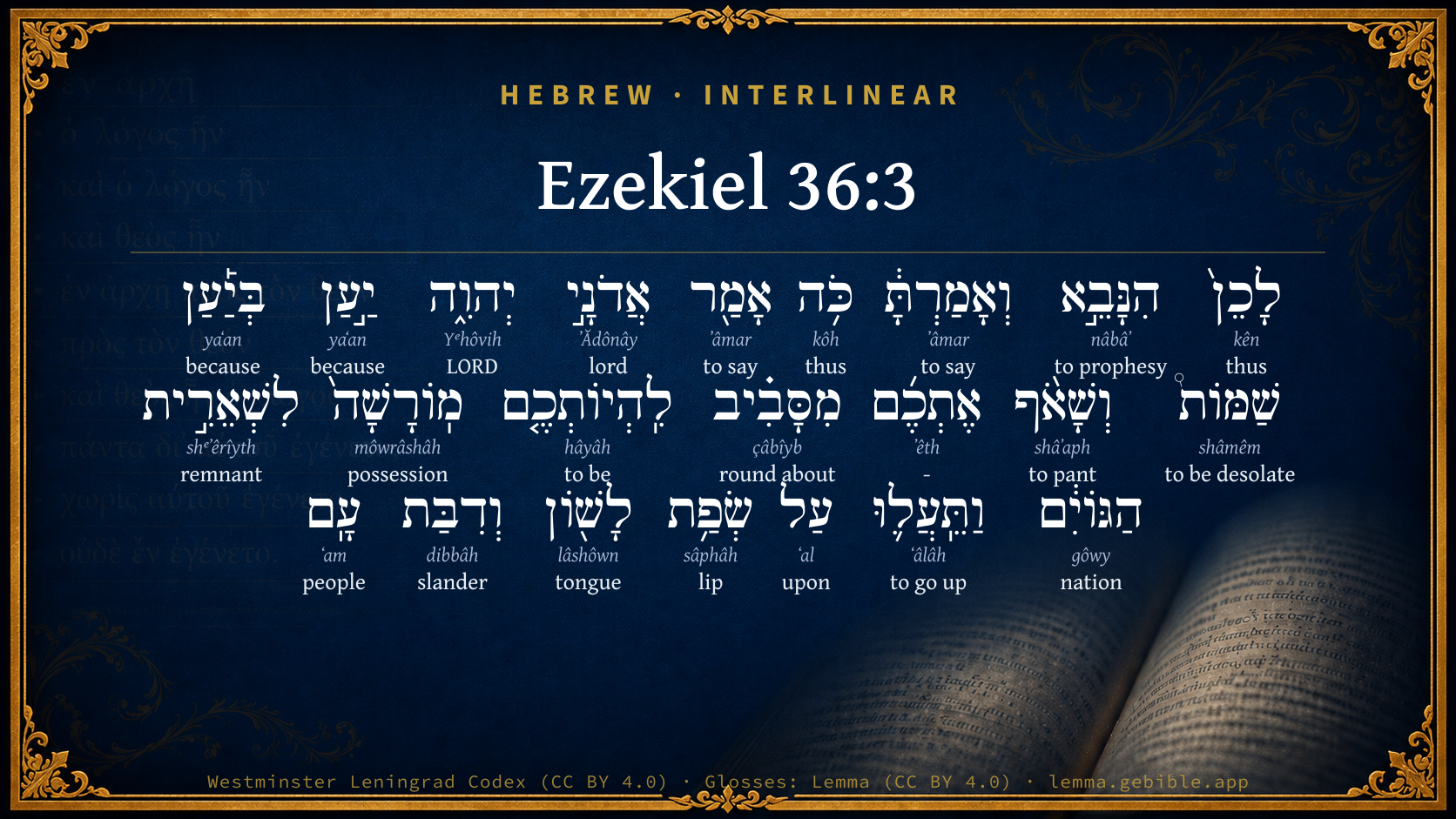
Ezekiel 36:3

Hebrew (Westminster Leningrad Codex) Ezekiel 36:3 appears in the Hebrew Old Testament. The text above is from the Westminster Leningrad Codex. Each word links to its Strong’s number, a concise gloss, and parsing drawn from the Open Scriptures Hebrew Bible morphology. Click any word for its full Brown-Driver-Briggs (BDB) entry.
Download image
Cite this verse

Ezekiel 36:3 (World English Bible). Public Domain. Lemma interlinear Bible study tool, https://lemma.gebible.app/v/ezekiel/36/3.

Show BibTeX & RIS
BibTeX
RIS
English Translation
therefore prophesy, and say, Thus says the Lord Yahweh: Because, even because they have made you desolate, and swallowed you up on every side, that you might be a possession to the residue of the nations, and you are taken up in the lips of talkers, and the evil report of the people;
World English Bible · Public Domain
Download a study sheet

One document with this verse’s original text, its word-by-word gloss line, the meaning frame, cross-references with their text, attributed commentary, and full source and license credits — printable, and it pastes into notes with its structure intact.

This verse Autodidact and up

Study sheet (.html) Plain text (.txt)

A passage Seminary Student

Up to 50 verses in one chapter. A passage sheet keeps up to 6 commentary sources and 12 cross-references per verse, in the order this page ranks them, and says so on the sheet whenever that leaves anything out. Ask for a single verse and you get the Autodidact verse sheet above.

Everything on this page stays free to read, with no account — the sheet is a download of what is already on screen, not access to it.

Want to remove ads? Support Godless Engineer
Compare translations 3

The same verse in 3 English versions, stacked beneath the original-language interlinear above. Click any original word for its lexicon entry.

Each is an independent rendering of the whole verse — the interlinear is not word-aligned to these translations.

Highlighted words mark where these versions differ — a whole-verse word diff, not a word-by-word alignment.

  • World English Bible Public Domain
    therefore prophesy, and say, Thus says the Lord Yahweh: Because, even because they have made you desolate, and swallowed you up on every side, that you might be a possession to the residue of the nations, and you are taken up in the lips of talkers, and the evil report of the people;
  • King James Version Public Domain
    Therefore prophesy and say, Thus saith the Lord GOD; Because they have made you desolate, and swallowed you up on every side, that ye might be a possession unto the residue of the heathen, and ye are taken up in the lips of talkers, and are an infamy of the people:
  • unfoldingWord Literal Text CC BY-SA 4.0
    Therefore prophesy and say, ‘The Lord Yahweh says this: Because of your desolation and because of the attacks that came on you from all sides, you have become a possession of the other nations; you have been the subject of slanderous lips and tongues, and of people’s stories.

unfoldingWord Literal Text — © unfoldingWord, licensed CC BY-SA 4.0. Word-aligned USFM3 via Door43 (git.door43.org/unfoldingWord/en_ult).

Versions to compare (up to 4)

3 of 4 selected

Show all 18 translations

Every available English version of this verse, each an independent rendering of the whole verse.

  • World English Bible Public Domain
    therefore prophesy, and say, Thus says the Lord Yahweh: Because, even because they have made you desolate, and swallowed you up on every side, that you might be a possession to the residue of the nations, and you are taken up in the lips of talkers, and the evil report of the people;
  • Berean Standard Bible Public Domain
    therefore prophesy and declare that this is what the Lord GOD says: Because they have made you desolate and have trampled you on every side, so that you became a possession of the rest of the nations and were taken up in slander by the lips of their talkers,
  • Majority Standard Bible Public Domain
    therefore prophesy and declare that this is what the Lord GOD says: Because they have made you desolate and have trampled you on every side, so that you became a possession of the rest of the nations and were taken up in slander by the lips of their talkers,
  • King James Version Public Domain
    Therefore prophesy and say, Thus saith the Lord GOD; Because they have made you desolate, and swallowed you up on every side, that ye might be a possession unto the residue of the heathen, and ye are taken up in the lips of talkers, and are an infamy of the people:
  • American Standard Version (1901) Public Domain
    therefore prophesy, and say, Thus saith the Lord Jehovah: Because, even because they have made you desolate, and swallowed you up on every side, that ye might be a possession unto the residue of the nations, and ye are taken up in the lips of talkers, and the evil report of the people;
  • Revised Version (1885) Public Domain
    therefore prophesy, and say, Thus saith the Lord GOD: Because, even because they have made you desolate, and swallowed you up on every side, that ye might be a possession unto the residue of the nations, and ye are taken up in the lips of talkers, and the evil report of the people:
  • Geneva Bible (1599) Public Domain
    Therefore prophesie, and say, Thus sayth the Lord God, Because that they haue made you desolate, and swallowed you vp on euery side, that ye might be a possession vnto the residue of the heathen, and ye are come vnto the lippes and tongues of men, and vnto the reproch of the people,
  • Douay-Rheims (1899) Public Domain
    Therefore prophesy, and say: Thus saith the Lord God: Because you have been desolate, and trodden under foot on every side, and made an inheritance to the rest of the nations, and are become the subject of the talk, and the reproach of the people:
  • Young's Literal Translation Public Domain
    therefore, prophesy, and thou hast said: Thus said the Lord Jehovah: Because, even because, of desolating, And of swallowing you up from round about, For your being a possession to the remnant of the nations, And ye are taken up on the tip of the tongue, And `are' an evil report of the people.
  • Literal Standard Version CC BY-SA 4.0
    therefore, prophesy, and you have said, Thus said Lord YHWH: Because, even because, of desolating, || And of swallowing you up from all around, || For your being a possession to the remnant of the nations, || And you are taken up on the tip of the tongue, || And [are] an evil report to the people.
  • Unlocked Literal Bible CC BY-SA 4.0
    Therefore prophesy and say, 'The Lord Yahweh says this: Because of your desolation and because of the attacks that came on you from all sides, you have become a possession of the other nations; you have been the subject of slanderous lips and tongues, and of people's stories.
  • unfoldingWord Literal Text CC BY-SA 4.0
    Therefore prophesy and say, ‘The Lord Yahweh says this: Because of your desolation and because of the attacks that came on you from all sides, you have become a possession of the other nations; you have been the subject of slanderous lips and tongues, and of people’s stories.
  • Darby Bible Public Domain
    therefore prophesy and say, Thus saith the Lord Jehovah: Because, yea, because they have made [you] desolate, and have swallowed you up on every side, that ye might be a possession unto the remnant of the nations, and ye are taken up in the lips of talkers, and in the defaming of the people:
  • World Messianic Bible Public Domain
    therefore prophesy, and say, ‘The Lord GOD says: “Because, even because they have made you desolate, and swallowed you up on every side, that you might be a possession to the residue of the nations, and you are taken up in the lips of talkers, and the evil report of the people;”
  • Webster's Bible Public Domain
    Therefore prophesy and say, Thus saith the Lord GOD; Because they have made you desolate, and swallowed you up on every side, that ye might be a possession to the residue of the heathen, and ye are taken up in the lips of talkers, and are an infamy of the people:
  • Free Bible Version CC BY-SA 4.0
    so you must prophesy and announce that this is what the Lord God says: They have turned you into a wasteland, attacking you from every direction, so that you became the property of other nations and people gossiped about you and slandered you.
  • Bible in Basic English Public Domain
    For this cause be a prophet, and say, This is what the Lord has said: Because, even because they have been glad over you and put you to shame on every side, because you have become a heritage for the rest of the nations, and you are taken up on the lips of talkers and in the evil talk of the people:
  • JPS Tanakh (1917) Public Domain
    therefore prophesy, and say: Thus saith the Lord GOD: Because, even because they have made you desolate, and swallowed you up on every side, that ye might be a possession unto the rest of the nations, and ye are taken up in the lips of talkers, and the evil report of the people;

Literal Standard Version (2020), Covenant Press — licensed CC BY-SA 4.0. Text via the HelloAO Bible API (eBible.org). Unlocked Literal Bible (unfoldingWord) — licensed CC BY-SA 4.0. Text via the HelloAO Bible API (eBible.org). unfoldingWord Literal Text — © unfoldingWord, licensed CC BY-SA 4.0. Word-aligned USFM3 via Door43 (git.door43.org/unfoldingWord/en_ult). Free Bible Version, Dr. Jonathan Gallagher — licensed CC BY-SA 4.0. Text via the HelloAO Bible API (eBible.org).

Word by word

More ways to search: Search by grammar → Find every occurrence → Compare this word →

Practice this passage: Drill this verse → Learn its vocabulary →

מֽוֹרָשָׁה֙
môwrâshâh
H4181
“possession”
Noun, Common, Feminine, Singular, Absolute
Part of Speech
Noun
Type
Common
Gender
Feminine
Number
Singular
State
Absolute
Full BDB Definition

Origin: from H4180

TWOT: 920e

a possession
  1. לָכֵן֙ kên H3651 “to/for · thus” Preposition + Adverb
  2. הִנָּבֵ֣א nâbâʼ H5012 “prophesy” Verb, Niphal, Imperative, 2nd Person, Masculine, Singular
  3. וְאָמַרְתָּ֔ ʼâmar H559 “and · to say” Conjunction + Verb, Qal, Sequential Perfect, 2nd Person, Masculine, Singular
  4. כֹּ֥ה kôh H3541 “thus” Adverb
  5. אָמַ֖ר ʼâmar H559 “to say” Verb, Qal, Perfect, 3rd Person, Masculine, Singular
  6. אֲדֹנָ֣י ʼĂdônây H136 “Lord · my” Noun, Common, Masculine, Plural, Construct + Suffix, Personal, 1st Person, Common, Singular
  7. יְהוִ֑ה Yᵉhôvih H3069 “LORD” Noun, Proper
  8. יַ֣עַן yaʻan H3282 “because” Conjunction
  9. בְּיַ֡עַן yaʻan H3282 “in/at · because” Preposition + Conjunction
  10. שַׁמּוֹת֩ shâmêm H8074 “to be desolate” Verb, Qal, Infinitive Construct
  11. וְשָׁאֹ֨ף shâʼaph H7602 “and · to pant” Conjunction + Verb, Qal, Infinitive Absolute
  12. אֶתְכֶ֜ם ʼêth H853 “- · you” Particle, Direct Object + Suffix, Personal, 2nd Person, Masculine, Plural
  13. מִסָּבִ֗יב çâbîyb H5439 “from · round about” Preposition + Noun, Common, Both, Singular, Absolute
  14. לִֽהְיוֹתְכֶ֤ם hâyâh H1961 “to be · you” Preposition + Verb, Qal, Infinitive Construct + Suffix, Personal, 2nd Person, Masculine, Plural
  15. לִשְׁאֵרִ֣ית shᵉʼêrîyth H7611 “to/for · remnant of” Preposition + Noun, Common, Feminine, Singular, Construct
  16. הַגּוֹיִ֔ם gôwy H1471 “the · nations” Particle, Definite Article + Noun, Common, Masculine, Plural, Absolute
  17. וַתֵּֽעֲל֛וּ ʻâlâh H5927 “and · to go up” Conjunction + Verb, Niphal, Sequential Imperfect, 2nd Person, Masculine, Plural
  18. עַל ʻal H5921 “upon” Preposition
  19. שְׂפַ֥ת sâphâh H8193 “lip of” Noun, Common, Feminine, Singular, Construct
  20. לָשׁ֖וֹן lâshôwn H3956 “tongue” Noun, Common, Both, Singular, Absolute
  21. וְדִבַּת dibbâh H1681 “and · slander of” Conjunction + Noun, Common, Feminine, Singular, Construct
  22. עָֽם ʻam H5971 “people” Noun, Common, Masculine, Singular, Absolute

About this verse

These counts appear in no published source. They are computed here, from the morphology-tagged text and Lemma’s own curated glosses. What Lemma adds →

23
words
21
distinct lemmas
Prophets
section

Notable vocabulary

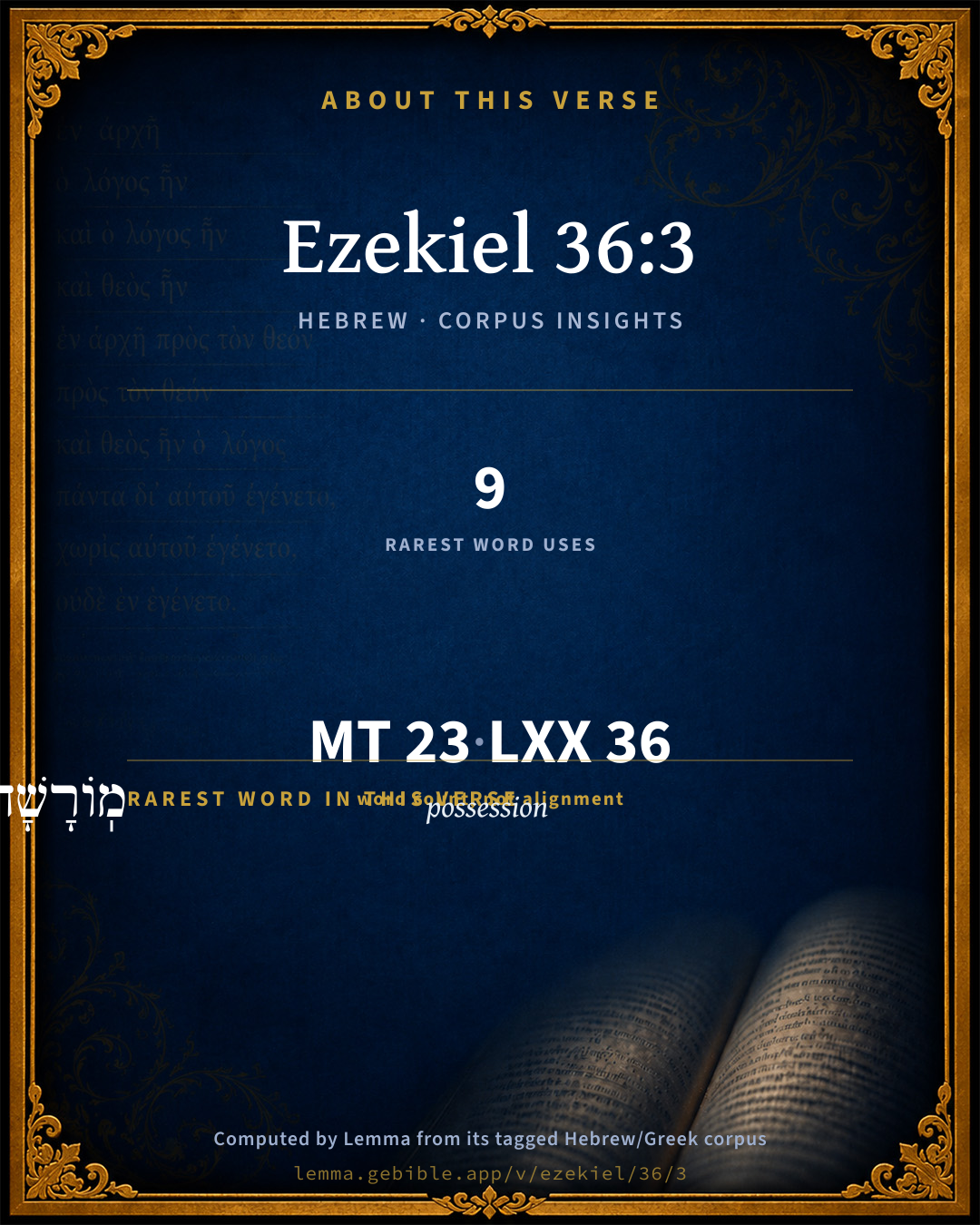
The rarest word here is מֽוֹרָשָׁה֙ possession H4181 — appearing just 9 times in the whole Hebrew Bible.

Shared distinctive vocabulary

מֽוֹרָשָׁה֙ possession H4181 occurs in 9 verses of the Hebrew Bible. Also found in:

Grammatical profile

  • 7 verbs
  • 10 nouns
  • 1 preposition
  • 2 conjunctions
  • 2 adverbs
  • 1 particle

Verb forms

  • הִנָּבֵ֣א Niphal · Imperative
  • וְאָמַרְתָּ֔ Qal · Sequential Perfect
  • אָמַ֖ר Qal · Perfect
  • שַׁמּוֹת֩ Qal · Infinitive Construct
  • וְשָׁאֹ֨ף Qal · Infinitive Absolute
  • לִֽהְיוֹתְכֶ֤ם Qal · Infinitive Construct
  • וַתֵּֽעֲל֛וּ Niphal · Sequential Imperfect

Repetition

Words recur within this verse — often emphatic in Hebrew:

  • וְאָמַרְתָּ֔ to say H559 ×2
  • יַ֣עַן because H3282 ×2

Hebrew & Septuagint length

In English translation the verse runs 53 words from the Hebrew and 44 from the Septuagint (LXX English) — closely comparable.

A rough comparison of the two English renderings, which tokenize alike — not a word-level alignment.

Word counts can differ between the Hebrew and the Greek without any difference in meaning — e.g. the Hebrew direct-object marker אֵת has no separate Greek word, and Greek often adds the article ὁ.

In the original languages it is 23 Hebrew tokens and 36 Greek tokens — but the two are counted differently (Hebrew bundles its prefixes and suffixes into one token; the Greek is in lemma form), so that isn’t a like-for-like length.

Cross-references

25

Topical passages linked to Ezekiel 36:3 in the Treasury of Scripture Knowledge — connected by theme and wording, ordered by reader-vote popularity; previews shown in the World English Bible.

  • Psalms 44:13–14 You make us a reproach to our neighbors, A scoffing and a derision to those who are around us.
  • Jeremiah 18:16 to make their land an astonishment, and a perpetual hissing; everyone who passes thereby shall be astonished, and shake his head.
  • Lamentations 2:15–16 All that pass by clap their hands at you; They hiss and wag their head at the daughter of Jerusalem, [saying], Is this the city that men called The perfection of beauty, The joy of the whole earth?
  • Leviticus 26:43 The land also will be left by them, and will enjoy its sabbaths while it lies desolate without them: and they will accept the punishment of their iniquity; because, even because they rejected my ordinances, and their soul abhorred my statutes.
  • Deuteronomy 28:37 You shall become an astonishment, a proverb, and a byword, among all the peoples where Yahweh shall lead you away.
  • 1 Kings 9:7–8 then will I cut off Israel out of the land which I have given them; and this house, which I have made holy for my name, will I cast out of my sight; and Israel shall be a proverb and a byword among all peoples.
  • Job 30:1–10 "But now those who are younger than I, have me in derision, Whose fathers I would have disdained to put with my sheep dogs.
  • Psalms 35:15–16 But in my adversity, they rejoiced, and gathered themselves together. The attackers gathered themselves together against me, and I didn't know it. They tore at me, and didn't cease.
  • Psalms 35:25 Don't let them say in their heart, "Aha! That's the way we want it!" Don't let them say, "We have swallowed him up!"
  • Psalms 61:1 Hear my cry, God. Listen to my prayer.
  • Psalms 69:12 Those who sit in the gate talk about me. I am the song of the drunkards.
  • Psalms 79:10 Why should the nations say, "Where is their God?" Let it be known among the nations, before our eyes, That vengeance for your servants' blood is being poured out.
  • Proverbs 1:12 Let's swallow them up alive like Sheol, And whole, like those who go down into the pit.
  • Jeremiah 24:9 I will even give them up to be tossed back and forth among all the kingdoms of the earth for evil; to be a reproach and a proverb, a taunt and a curse, in all places where I shall drive them.
  • Jeremiah 33:24 Don't you consider what this people has spoken, saying, The two families which Yahweh did choose, he has cast them off? thus do they despise my people, that they should be no more a nation before them.
  • Jeremiah 39:1–18 It happened when Jerusalem was taken, (in the ninth year of Zedekiah king of Judah, in the tenth month, came Nebuchadrezzar king of Babylon and all his army against Jerusalem, and besieged it;
  • Jeremiah 41:1–18 Now it happened in the seventh month, that Ishmael the son of Nethaniah, the son of Elishama, of the seed royal and [one of] the chief officers of the king, and ten men with him, came to Gedaliah the son of Ahikam to Mizpah; and there they ate bread together in Mizpah.
  • Jeremiah 51:34 Nebuchadrezzar the king of Babylon has devoured me, he has crushed me, he has made me an empty vessel, he has, like a monster, swallowed me up, he has filled his maw with my delicacies; he has cast me out.
  • Jeremiah 52:1 Zedekiah was twenty-one years old when he began to reign; and he reigned eleven years in Jerusalem: and his mother's name was Hamutal the daughter of Jeremiah of Libnah.
  • Lamentations 2:2 The Lord has swallowed up all the habitations of Jacob, and has not pitied: He has thrown down in his wrath the strongholds of the daughter of Judah; He has brought them down to the ground; he has profaned the kingdom and the princes of it.
  • Lamentations 2:5 The Lord is become as an enemy, he has swallowed up Israel; He has swallowed up all her palaces, he has destroyed his strongholds; He has multiplied in the daughter of Judah mourning and lamentation.
  • Ezekiel 13:10 Because, even because they have seduced my people, saying, Peace; and there is no peace; and when one builds up a wall, behold, they daub it with whitewash:
  • Daniel 9:16 Lord, according to all your righteousness, let your anger and please let your wrath be turned away from your city Jerusalem, your holy mountain; because for our sins, and for the iniquities of our fathers, Jerusalem and your people are become a reproach to all who are round about us.
  • Matthew 27:39–44 Those who passed by blasphemed him, wagging their heads,
  • 1 Corinthians 4:13 Being defamed, we entreat. We are made as the filth of the world, the dirt wiped off by all, even until now.

Cross-references courtesy of OpenBible.info (CC BY 4.0).

Hebrew and Greek witnesses Masoretic Hebrew ↔ Greek Septuagint

The same verse in the two great witnesses to the Old Testament, shown verse-for-verse.

These are two independent witnesses, not word-aligned to each other, and the Septuagint is shown in lemma (dictionary) form.

Hebrew Ezekiel 36:3 Masoretic · Westminster Leningrad Codex

לָכֵן֙ הִנָּבֵ֣א וְאָמַרְתָּ֔ כֹּ֥ה אָמַ֖ר אֲדֹנָ֣י יְהוִ֑ה יַ֣עַן בְּיַ֡עַן שַׁמּוֹת֩ וְשָׁאֹ֨ף אֶתְכֶ֜ם מִסָּבִ֗יב לִֽהְיוֹתְכֶ֤ם מֽוֹרָשָׁה֙ לִשְׁאֵרִ֣ית הַגּוֹיִ֔ם וַתֵּֽעֲל֛וּ עַל שְׂפַ֥ת לָשׁ֖וֹן וְדִבַּת עָֽם

therefore prophesy, and say, Thus says the Lord Yahweh: Because, even because they have made you desolate, and swallowed you up on every side, that you might be a possession to the residue of the nations, and you are taken up in the lips of talkers, and the evil report of the people;

World English Bible · Public Domain

Greek LXX Ezekiel 36:3 Septuagint · lemma form

διά οὗτος προφητεύω καί εἶπον ὅδε λέγω κύριος κύριος ἀντί ὁ ἀτιμάζω σύ καί μισέω σύ ὑπό ὁ κύκλος σύ ὁ εἰμί σύ εἰς κατάσχεσις ὁ κατάλοιπος ἔθνος καί ἀναβαίνω λάλημα γλῶσσα καί εἰς ὀνείδισμα ἔθνος

therefore prophesy, and say, Thus says the Lord God; Because you⌃ have been dishonored, and hated by those round about you, that you⌃ might be a possession to the remainder of the nations, and you⌃ became a byword, and a reproach to the nations:

LXX2012 (modern English Septuagint) · Public Domain

Hebrew: Westminster Leningrad Codex (CC BY 4.0). Greek: Septuagint (public domain); English from LXX2012 (modern English Septuagint) (Public Domain). How the Septuagint differs from the Hebrew →

Targum (Aramaic paraphrase)

1

The Targum is the ancient Jewish Aramaic paraphrase of the Hebrew Scriptures — an interpretive translation, not the Hebrew text itself. Onkelos (literal) and Pseudo-Jonathan (expansive) render the Torah, and Jonathan the Prophets. Coverage is partial: where no permissively-licensed English translation exists for a verse, only the Aramaic is shown. This is verse-level text, not a word-by-word alignment to the Hebrew.

  1. Targum Jonathan Prophets (Joshua–Malachi)
    בְּכֵן אִתְנַבֵּי וְתֵימַר כִּדְנַן אֲמַר יְיָ אֱלֹהִים חֲלַף דִי אִתְרַבְרְבוּ וַחֲלַף דַחֲשִׁיבוּ לְאַחֲרָבָא וּלְאַצְדָאָה יַתְכוֹן מִסְחוֹר סְחוֹר לְמֶהֱוֵיכוֹן יְרוּתָא לִשְׁאָרָא דְעַמְמַיָא וְאִתְאַמַרְתּוּן עַל שְׂפַת לִישָׁן וְרִנְנַת עָם:

    (no public-domain English translation for this verse)

    Targum Jonathan — Aramaic: “Mikraot Gedolot” (public domain). English: “Sefaria Community Translation” (CC0 1.0 (public-domain dedication)); “London "Chaldee Paraphrase," 1871” (public domain). Text via Sefaria.

Commentary

Notes on Ezekiel 36:3 from classic Christian and Jewish commentators (each source and its license shown beneath its notes). The classic Christian expositions comment on the surrounding passage and are grouped to its opening verse, so a note may address several verses; the Jewish commentaries on the Tanakh (Rashi and others) are per-verse, so they appear only where the commentator wrote on this verse.

Lemma curates 59 commentaries, every one of them public domain or Creative Commons licensed, each selected and text-cleaned for this edition rather than reprinted as found. About our sources →

The Cambridge Bible for Schools and Colleges

gen. ed. J. J. S. Perowne

3. Because …] lit. because, because, Eze_13:10. The passage throughout betrays passionate feeling on the part of the prophet. His patriotism is aglow as the loved mountains of his native land rise before his mind; cf. the pathetic words in reference to the exiled king, Eze_19:9. Hence the excitation and solemnity displayed in introducing the prophecy, which itself is expressed (Eze_36:7 seq.) only after four or five commands to utter it (Eze_36:3-6). For made desolate gaped for might be read, Isa_42:14.

and ye are taken up] Or, and are come up upon the lips, Deu_28:37; Lam_2:15; Dan_9:16 (niph. not unusual in this verb, Jer_37:5).

The Cambridge Bible for Schools and Colleges (gen. ed. J. J. S. Perowne; Cambridge University Press, 1878–1918) — public domain. Text from a community e-Sword module.

Trapp's Complete Commentary

John Trapp

Eze 36:3 Therefore prophesy and say, Thus saith the Lord GOD; Because they have made [you] desolate, and swallowed you up on every side, that ye might be a possession unto the residue of the heathen, and ye are taken up in the lips of talkers, and [are] an infamy of the people:

Ver. 3. Because they have.] Heb., Because and because; importing earnestness and heat of indignation. So Lev 26:43.

And ye are taken up in the lips of talkers.] Heb., Ye are made to ascend upon the lip of the tongue, and upon the evil fame of the people. God takes it extreme ill that his people should be traduced and defamed; which yet hath been their lot in all ages; but he will not fail to vindicate them, and to avenge them.

John Trapp, A Commentary or Exposition upon All the Books of the Old and New Testament (1647–1656) — public domain. Text from a community e-Sword module.

Geneva Bible (1599)

Geneva Bible translators

Ye are made a matter of talk and derision to all the world.

Geneva Bible (1599) marginal notes — public domain. Text via Bolls.life.

Jamieson, Fausset & Brown

Robert Jamieson, A. R. Fausset & David Brown

Literally, "Because, even because."

swallowed you up--literally, "panted after" you, as a beast after its prey; implying the greedy cupidity of Edom as to Israel's inheritance (Psa 56:1-2).

lips of talkers--literally, "lips of the tongue," that is, of the slanderer, the man of tongue. Edom slandered Israel because of the connection of the latter with Jehovah, as though He were unable to save them. Deu 28:37, and Jer 24:9 had foretold Israel's reproach among the heathen (Dan 9:16).

Jamieson, Fausset & Brown — Commentary Critical and Explanatory on the Whole Bible (1871) — public domain (CC PDM 1.0). Text via the HelloAO Bible API.

Ellicott's Commentary for English Readers

(3) In the lips of talkers, and are an infamy.—A phrase equivalent to a by-word and a reproach. (Comp. Deu_28:37; 1Ki_9:7, &c.) In the previous clause the words, “have swallowed you up,” should rather be “pant for you,” the word being taken from the snuffing and panting of wild beasts. It was after this fashion that “the residue of the heathen,” all those whom the conquests of Nebuchadnezzar had yet left, panted for the possession of the lands of Israel.

A Bible Commentary for English Readers, edited by Charles John Ellicott (1878–1897) — public domain. Text from a community e-Sword module.

John Gill's Exposition

Therefore prophesy and say, thus saith the Lord God,.... Who heard all the enemy said, and knew all their designs and purposes, their schemes and devices:

because they have made you desolate; ravaged their country, destroyed their cities, burnt their temple, and carried them captive, and left the land without men or cattle:

and swallowed you up on every side; all their neighbours, being their enemies, were like ravenous beasts of prey, gaping upon them with their mouths; and, observing the low condition into which they were brought by the king of Babylon, helped forward the destruction; and everyone shared in the spoil and plunder nearest to them they could conveniently come at:

that ye might be a possession to the residue of the Heathen; either to those that were left in the land by the king of Babylon, or to the rest of the Heathen nations round about them:

ye are taken up in the lips of talkers, and are an infamy of the people; reproached, defamed, and made a proverb and byword, by every foul mouthed prating fellow.

John Gill's Exposition of the Whole Bible (1746–1763) — public domain (CC PDM 1.0). Text via the HelloAO Bible API.

Albert Barnes' Notes on the Bible

The residue of the pagan - Those of the surrounding nations which had survived Jerusalem’s fall, and may have profited by it.

Albert Barnes' Notes on the Bible (1834–1885) — public domain. Text from a community e-Sword/MySword module.

Haydock's Catholic Bible Commentary

Reproach. This God had repeatedly threatened, Deuteronomy xxviii. 37., (Calmet) and Jeremias xxiv. 9. --- People talked of their distress. (Worthington)

George Leo Haydock (1774–1849), Haydock's Catholic Family Bible and Commentary, 1859 edition — public domain. Excludes Psalms (Douay-Rheims chapter numbering differs from Protestant) and Deuterocanonical books (Catholic canon only).

Matthew Poole's English Annotations

Because they, Edomites, and others with them,

have made you desolate; first broken your strength, wasted your cities, and burnt the temple, and waylaid you, to cut off them that were escaped at last.

Swallowed you up; devoured you, as hungry beasts devour the prey.

On every side; from all coasts of the land, through the whole.

That ye might be a possession unto the residue of the heathen; that such of the heathen as remained here might have, what they no where else could have, being the scum and worst of men, an inheritance and possession; so unnatural was Edom, that east out his own kindred, to bring in the vilest of men and the most barbarous strangers.

Ye are taken up in the lips of talkers; you are the subject on which wild and foul mouths discourse, which is explained, in that the people ever talked of them with reproach, and branding them as infamous. This was foretold to Israel, Jer 24:9, and they were advised to prevent it.

Matthew Poole's English Annotations on the Holy Bible (1683–1685) — public domain. Text from a community e-Sword/MySword module.

Whedon's Commentary on the Bible

Daniel D. Whedon

3. Because — The Hebrew repeats this word to make it doubly emphatic. Jehovah’s judgments are never arbitrary. (Compare “therefore,” Eze_36:4-6.)

Heathen — Rather, nations.

And are an infamy of the people — R.V., “and the evil report of the people.”

Daniel D. Whedon (gen. ed.), Commentary on the Old and New Testaments (1874–1909) — public domain. Text from a community e-Sword module.

The Pulpit Commentary

Therefore. Ewald calls attention to the fivefold repetition of this conjunction, saying, "It repeats itself five times, the reasons for God"s judgments against these enemies thrusting themselves forward, before the discourse calmly dwells upon the mountains of Israel, of which it is strictly intended to treat." As it were, the prophet"s emotion is so strong, and his indignation against Israel"s enemies so vehement, that, though he three times in succession begins to prophesy to the mountains of Israel, he on each occasion breaks off before he can get his message told, to expatiate upon the wickedness of Israel"s foes. In the prophet"s estimation that wickedness was so heinous as to inevitably carry in its bosom appropriate retribution. Because literally, because and because, or even because, a reduplication for the sake of emphasis, as in Eze_13:10 and Lev_26:43they have made you desolate, and swallowed you up on every side; literally, wasting of and panting after you (are) round about. Fairbairn, Ewald, and Smend, deriving twOmvfrom "to pant," rather than from "to lay waste," translate, "because there is snapping and puffing at you round about," which Plumptre thinks "falls in better be with the context," since "the prophet"s spirit seems to dwell throughout on the derision rather than the desolation to which his country, the mountains of Israel, had been subject." And ye are taken up; literally, ye are made to come, if an imperf., niph. of hl "to go up "(Rosenm Schroder); or, ye are come, if it be imperf., kal of ll; "to press, or go in" (Ewald, Havernick); or, ye are gone up , if it be second pers. kal of hl (Hitzig, Smend). In the lips of talkers; literally, upon the lip of the tongue the lip being regarded as the instrument or organ with which the tongue speaks. Havernick unnecessarily takes "the tongue" as equivalent to "people" in the parallel clause a signification wOvl has only in Isa_66:18; while Kliefoth views it as synonymous with "slander," as in Psa_140:11, and translates, "upon the lip of slander and of the evil report of the people." Keil sees in "the tongue" a personification for the "tongue-man" or talker of Psa_140:11; and Gesenius considers the two clauses as tautological.

The Pulpit Commentary (1880–1919), ed. H.D.M. Spence-Jones & Joseph S. Exell — public domain. Text from a community e-Sword module.

John Wesley's Explanatory Notes

Swallowed - Devoured you, as hungry beasts devour their prey. Ye are taken up - You are the subject of all their discourse. An infamy - Ever branding you as infamous.

John Wesley, Explanatory Notes Upon the Whole Bible (1754–1765) — public domain. Text via the GEBible commentary corpus.

Rashi

Rabbi Shlomo Yitzchaki (Rashi)

those around you were appalled and longed [Your neighbors] were appalled and astounded [at the opportunity] to laugh and see the end of your destruction, and were longing, pining, and looking forward to your becoming an inheritance for the remnant of the nations.

and you were brought up on the lips of every language And now in your destruction, all talk and gossip (other editions: and hawk) about you, saying, “Aha! they have become desolate.”

and the gossip of every people [Heb. וְדִבַּת,] parlemant in Old French, gossip, slander.

Rashi on the Tanakh — English translations: “The Judaica Press complete Tanach with Rashi, translated by A. J. Rosenberg” (CC BY 4.0); “Pentateuch with Rashi's commentary by M. Rosenbaum and A.M. Silbermann, 1929-1934” (public domain); “The Metsudah Tanach series, Lakewood, N.J” (CC BY 4.0); and “The Book of Joshua, Metsudah Publications, 1997” (CC BY 4.0). Text via Sefaria.

Lesson kit

Teaching starters — assembled from the data on this page, not authored interpretation. Every prompt links to the verse data it draws on. Edit before teaching.

Ezekiel, in the Prophets, opens this verse with 23 words (21 distinct Hebrew lemmas). Its most distinctive word is môwrâshâh (“possession”). A historical commentator’s framing appears above. Read the whole chapter for the surrounding context.

Discussion questions

  1. The word môwrâshâh carries the sense “possession.” How does it shape the verse?
  2. How does Exodus 6:8, which shares the word «possession», read alongside this verse?
  3. What does the repetition of “to say” (2× in this one verse) do in this verse?
  4. These translations render this verse differently. What is at stake in choosing one wording over another?
  5. «הִנָּבֵ֣א» is a Niphal Imperative verb. How does that grammatical form shape the action described?
  6. Compare how The Cambridge Bible for Schools and Colleges and Trapp's Complete Commentary read this verse. Where do they agree or differ?

Things to notice

Reading settings

Reading text

Shown beneath each verse's original-language words.

Old Testament
Old Testament edition

Read the OT as the Masoretic Hebrew (MT) or the Greek Septuagint (LXX).

English shown for the Greek Septuagint (in the Hebrew ↔ Greek comparison).

Comparing translations? Open the Compare panel on any verse page to stack up to four side by side.