
Numbers 9:17

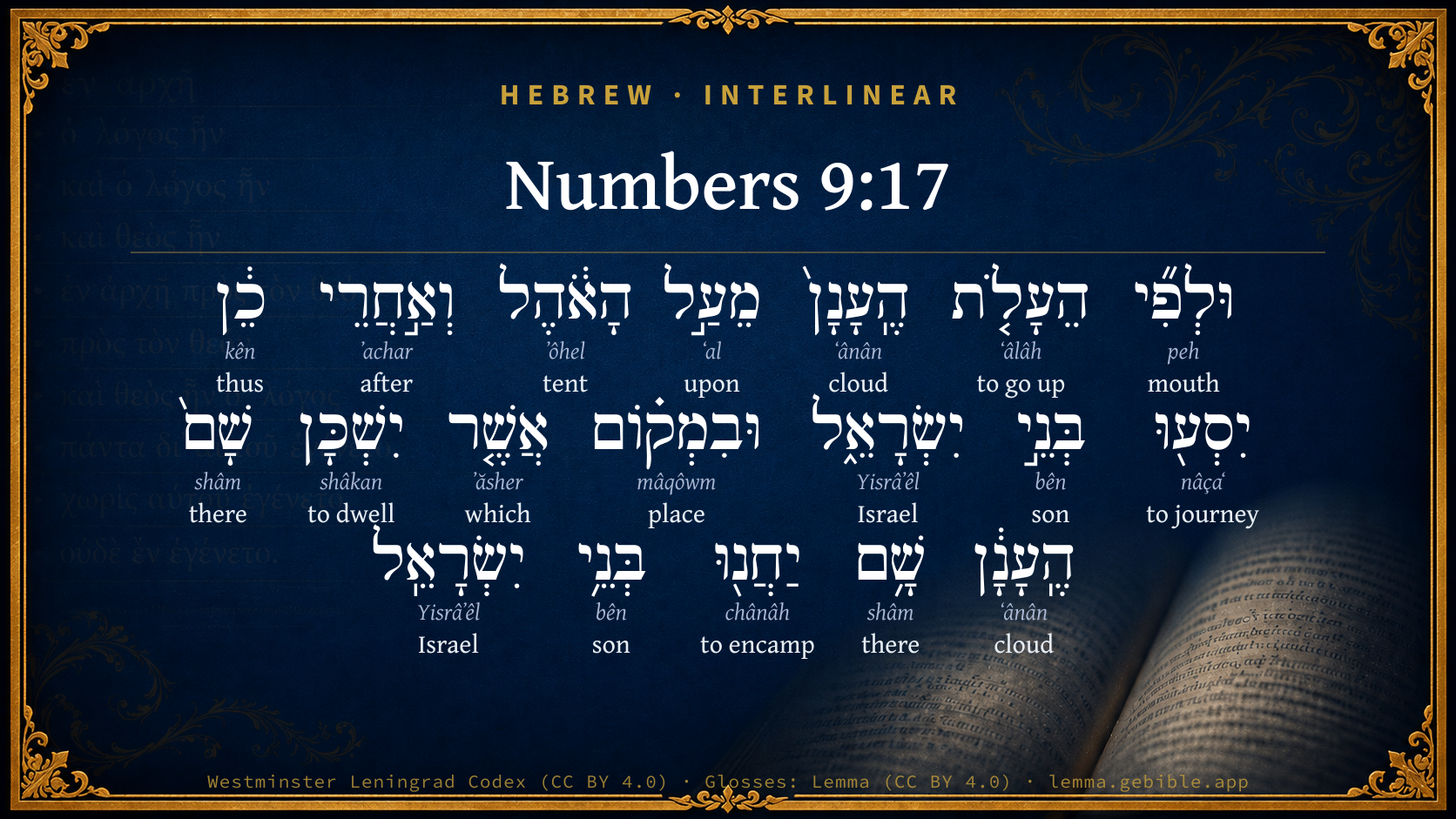
Hebrew (Westminster Leningrad Codex) Numbers 9:17 appears in the Hebrew Old Testament. The text above is from the Westminster Leningrad Codex. Each word links to its Strong’s number, a concise gloss, and parsing drawn from the Open Scriptures Hebrew Bible morphology. Click any word for its full Brown-Driver-Briggs (BDB) entry.
Download image
Cite this verse

Numbers 9:17 (World English Bible). Public Domain. Lemma interlinear Bible study tool, https://lemma.gebible.app/v/numbers/9/17.

Show BibTeX & RIS
BibTeX
RIS
English Translation
Whenever the cloud was taken up from over the Tent, then after that the children of Israel traveled; and in the place where the cloud remained, there the children of Israel encamped.
World English Bible · Public Domain
Download a study sheet

One document with this verse’s original text, its word-by-word gloss line, the meaning frame, cross-references with their text, attributed commentary, and full source and license credits — printable, and it pastes into notes with its structure intact.

This verse Autodidact and up

Study sheet (.html) Plain text (.txt)

A passage Seminary Student

Up to 50 verses in one chapter. A passage sheet keeps up to 6 commentary sources and 12 cross-references per verse, in the order this page ranks them, and says so on the sheet whenever that leaves anything out. Ask for a single verse and you get the Autodidact verse sheet above.

Everything on this page stays free to read, with no account — the sheet is a download of what is already on screen, not access to it.

Want to remove ads? Support Godless Engineer
Compare translations 3

The same verse in 3 English versions, stacked beneath the original-language interlinear above. Click any original word for its lexicon entry.

Each is an independent rendering of the whole verse — the interlinear is not word-aligned to these translations.

Highlighted words mark where these versions differ — a whole-verse word diff, not a word-by-word alignment.

  • World English Bible Public Domain
    Whenever the cloud was taken up from over the Tent, then after that the children of Israel traveled; and in the place where the cloud remained, there the children of Israel encamped.
  • King James Version Public Domain
    And when the cloud was taken up from the tabernacle, then after that the children of Israel journeyed: and in the place where the cloud abode, there the children of Israel pitched their tents.
  • unfoldingWord Literal Text CC BY-SA 4.0
    And to the mouth of the cloud being taken up from upon the tent, and after that the sons of Israel set out. And in a place where the cloud dwells there, there the sons of Israel camp.

unfoldingWord Literal Text — © unfoldingWord, licensed CC BY-SA 4.0. Word-aligned USFM3 via Door43 (git.door43.org/unfoldingWord/en_ult).

Versions to compare (up to 4)

3 of 4 selected

Show all 18 translations

Every available English version of this verse, each an independent rendering of the whole verse.

  • World English Bible Public Domain
    Whenever the cloud was taken up from over the Tent, then after that the children of Israel traveled; and in the place where the cloud remained, there the children of Israel encamped.
  • Berean Standard Bible Public Domain
    Whenever the cloud was lifted from above the Tent, the Israelites would set out, and wherever the cloud settled, there the Israelites would camp.
  • Majority Standard Bible Public Domain
    Whenever the cloud was lifted from above the Tent, the Israelites would set out, and wherever the cloud settled, there the Israelites would camp.
  • King James Version Public Domain
    And when the cloud was taken up from the tabernacle, then after that the children of Israel journeyed: and in the place where the cloud abode, there the children of Israel pitched their tents.
  • American Standard Version (1901) Public Domain
    And whenever the cloud was taken up from over the Tent, then after that the children of Israel journeyed: and in the place where the cloud abode, there the children of Israel encamped.
  • Revised Version (1885) Public Domain
    And whenever the cloud was taken up from over the Tent, then after that the children of Israel journeyed: and in the place where the cloud abode, there the children of Israel encamped.
  • Geneva Bible (1599) Public Domain
    And when the cloude was taken vp from the Tabernacle, then afterwarde the children of Israel iourneyed: and in the place where the cloude abode, there the children of Israel pitched their tents.
  • Douay-Rheims (1899) Public Domain
    And when the cloud that covered the tabernacle was taken up, then the children of Israel marched forward: and in the place where the cloud stood still, there they camped.
  • Young's Literal Translation Public Domain
    And according to the going up of the cloud from off the tent and afterwards do the sons of Israel journey; and in the place where the cloud doth tabernacle, there do the sons of Israel encamp;
  • Literal Standard Version CC BY-SA 4.0
    And according to the going up of the cloud from off the tent, then afterward the sons of Israel journey; and in the place where the cloud dwells, there the sons of Israel encamp;
  • Unlocked Literal Bible CC BY-SA 4.0
    Whenever the cloud was taken up from over the tent, the people of Israel would set out on their journey. Wherever the cloud stopped, the people would camp.
  • unfoldingWord Literal Text CC BY-SA 4.0
    And to the mouth of the cloud being taken up from upon the tent, and after that the sons of Israel set out. And in a place where the cloud dwells there, there the sons of Israel camp.
  • Darby Bible Public Domain
    And when the cloud rose from the tent, then the children of Israel journeyed; and at the place where the cloud stood still, there the children of Israel encamped.
  • World Messianic Bible Public Domain
    Whenever the cloud was taken up from over the Tent, then after that the children of Israel traveled; and in the place where the cloud remained, there the children of Israel encamped.
  • Webster's Bible Public Domain
    And when the cloud was taken up from the tabernacle, then after that the children of Israel journeyed: and in the place where the cloud abode, there the children of Israel pitched their tents.
  • Free Bible Version CC BY-SA 4.0
    When the cloud rose from over the Tent, the Israelites would move on, and where the cloud stopped, the Israelites would set up camp there.
  • Bible in Basic English Public Domain
    And whenever the cloud was taken up from over the House, then the children of Israel went journeying on; and in the place where the cloud came to rest, there the children of Israel put up their tents.
  • JPS Tanakh (1917) Public Domain
    And whenever the cloud was taken up from over the Tent, then after that the children of Israel journeyed; and in the place where the cloud abode, there the children of Israel encamped.

Literal Standard Version (2020), Covenant Press — licensed CC BY-SA 4.0. Text via the HelloAO Bible API (eBible.org). Unlocked Literal Bible (unfoldingWord) — licensed CC BY-SA 4.0. Text via the HelloAO Bible API (eBible.org). unfoldingWord Literal Text — © unfoldingWord, licensed CC BY-SA 4.0. Word-aligned USFM3 via Door43 (git.door43.org/unfoldingWord/en_ult). Free Bible Version, Dr. Jonathan Gallagher — licensed CC BY-SA 4.0. Text via the HelloAO Bible API (eBible.org).

Word by word

More ways to search: Search by grammar → Find every occurrence → Compare this word →

Practice this passage: Drill this verse → Learn its vocabulary →

הֶֽעָנָן֙
ʻânân
H6051
“the · cloud”
Particle, Definite Article + Noun, Common, Masculine, Singular, Absolute
Part of Speech
Particle + Noun
Type
Common
Gender
Masculine
Number
Singular
State
Absolute
Full BDB Definition

Origin: from H6049

TWOT: 1655a

cloud, cloudy, cloud-mass - cloud-mass (of theophanic cloud) - cloud
  1. וּלְפִ֞י peh H6310 “and · to/for · mouth of” Conjunction + Preposition + Noun, Common, Masculine, Singular, Construct
  2. הֵעָלֹ֤ת ʻâlâh H5927 “to go up” Verb, Niphal, Infinitive Construct
  3. מֵעַ֣ל ʻal H5921 “from · upon” Preposition + Preposition
  4. הָאֹ֔הֶל ʼôhel H168 “the · tent” Particle, Definite Article + Noun, Common, Masculine, Singular, Absolute
  5. וְאַ֣חֲרֵי ʼachar H310 “and · after” Conjunction + Preposition
  6. כֵ֔ן kên H3651 “thus” Adverb
  7. יִסְע֖וּ nâçaʻ H5265 “to journey” Verb, Qal, Imperfect, 3rd Person, Masculine, Plural
  8. בְּנֵ֣י bên H1121 “sons of” Noun, Common, Masculine, Plural, Construct
  9. יִשְׂרָאֵ֑ל Yisrâʼêl H3478 “Israel” Noun, Proper
  10. וּבִמְק֗וֹם mâqôwm H4725 “and · in/at · place of” Conjunction + Preposition + Noun, Common, Masculine, Singular, Construct
  11. אֲשֶׁ֤ר ʼăsher H834 “which” Particle, Relative
  12. יִשְׁכָּן shâkan H7931 “to dwell” Verb, Qal, Imperfect, 3rd Person, Masculine, Singular
  13. שָׁם֙ shâm H8033 “there” Adverb
  14. הֶֽעָנָ֔ן ʻânân H6051 “the · cloud” Particle, Definite Article + Noun, Common, Masculine, Singular, Absolute
  15. שָׁ֥ם shâm H8033 “there” Adverb
  16. יַחֲנ֖וּ chânâh H2583 “to encamp” Verb, Qal, Imperfect, 3rd Person, Masculine, Plural
  17. בְּנֵ֥י bên H1121 “sons of” Noun, Common, Masculine, Plural, Construct
  18. יִשְׂרָאֵֽל Yisrâʼêl H3478 “Israel” Noun, Proper

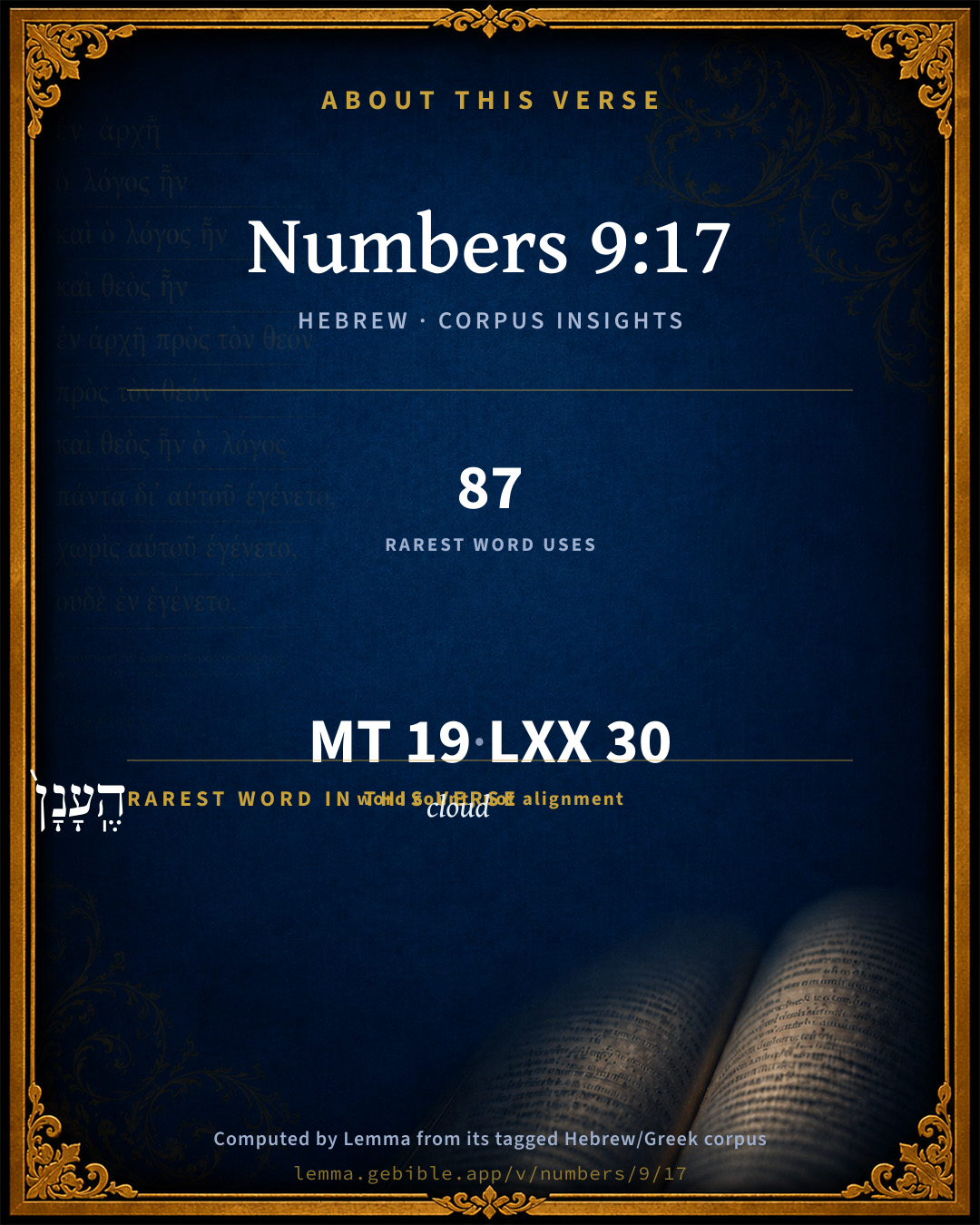
About this verse

These counts appear in no published source. They are computed here, from the morphology-tagged text and Lemma’s own curated glosses. What Lemma adds →

19
words
15
distinct lemmas
Pentateuch
section

Grammatical profile

  • 4 verbs
  • 9 nouns
  • 2 prepositions
  • 3 adverbs
  • 1 particle

Verb forms

  • הֵעָלֹ֤ת Niphal · Infinitive Construct
  • יִסְע֖וּ Qal · Imperfect
  • יִשְׁכָּן Qal · Imperfect
  • יַחֲנ֖וּ Qal · Imperfect

Repetition

Words recur within this verse — often emphatic in Hebrew:

  • הֶֽעָנָן֙ cloud H6051 ×2
  • בְּנֵ֣י son H1121 ×2
  • יִשְׂרָאֵ֑ל Israel H3478 ×2
  • שָׁם֙ there H8033 ×2

Hebrew & Septuagint length

In English translation the verse runs 32 words from the Hebrew and 30 from the Septuagint (LXX English) — closely comparable.

A rough comparison of the two English renderings, which tokenize alike — not a word-level alignment.

Word counts can differ between the Hebrew and the Greek without any difference in meaning — e.g. the Hebrew direct-object marker אֵת has no separate Greek word, and Greek often adds the article ὁ.

In the original languages it is 19 Hebrew tokens and 30 Greek tokens — but the two are counted differently (Hebrew bundles its prefixes and suffixes into one token; the Greek is in lemma form), so that isn’t a like-for-like length.

Cross-references

10

Topical passages linked to Numbers 9:17 in the Treasury of Scripture Knowledge — connected by theme and wording, ordered by reader-vote popularity; previews shown in the World English Bible.

  • Exodus 40:36–38 When the cloud was taken up from over the tent, the children of Israel went onward, throughout all their journeys;
  • Exodus 33:14–15 He said, "My presence will go with you, and I will give you rest."
  • Numbers 10:33–34 They set forward from the Mount of Yahweh three days' journey; and the ark of the covenant of Yahweh went before them three days' journey, to seek out a resting-place for them.
  • Psalms 32:8 I will instruct you and teach you in the way which you shall go. I will counsel you with my eye on you.
  • Psalms 73:24 You will guide me with your counsel, And afterward receive me to glory.
  • John 10:3–5 The gatekeeper opens the gate for him, and the sheep listen to his voice. He calls his own sheep by name, and leads them out.
  • John 10:9 I am the door. If anyone enters in by me, he will be saved, and will go in and go out, and will find pasture.
  • Numbers 10:11–12 It happened in the second year, in the second month, on the twentieth day of the month, that the cloud was taken up from over the tent of the testimony.
  • Isaiah 49:10 They shall not hunger nor thirst; neither shall the heat nor sun strike them: for he who has mercy on them will lead them, even by springs of water will he guide them.
  • Psalms 80:1–2 Hear us, Shepherd of Israel, You who lead Joseph like a flock, You who sit above the cherubim, shine forth.

Cross-references courtesy of OpenBible.info (CC BY 4.0).

Hebrew and Greek witnesses Masoretic Hebrew ↔ Greek Septuagint

The same verse in the two great witnesses to the Old Testament, shown verse-for-verse.

These are two independent witnesses, not word-aligned to each other, and the Septuagint is shown in lemma (dictionary) form.

Hebrew Numbers 9:17 Masoretic · Westminster Leningrad Codex

וּלְפִ֞י הֵעָלֹ֤ת הֶֽעָנָן֙ מֵעַ֣ל הָאֹ֔הֶל וְאַ֣חֲרֵי כֵ֔ן יִסְע֖וּ בְּנֵ֣י יִשְׂרָאֵ֑ל וּבִמְק֗וֹם אֲשֶׁ֤ר יִשְׁכָּן שָׁם֙ הֶֽעָנָ֔ן שָׁ֥ם יַחֲנ֖וּ בְּנֵ֥י יִשְׂרָאֵֽל

Whenever the cloud was taken up from over the Tent, then after that the children of Israel traveled; and in the place where the cloud remained, there the children of Israel encamped.

World English Bible · Public Domain

Greek LXX Numbers 9:17 Septuagint · lemma form

καί ἡνίκα ἀναβαίνω ὁ νεφέλη ἀπό ὁ σκηνή καί μετά οὗτος ἀποαἴρω ὁ υἱός ἰσραήλ καί ἐν ὁ τόπος οὗ ἄν ἵστημι ὁ νεφέλη ἐκεῖ παρα ἐνβάλλω ὁ υἱός ἰσραήλ

And when the cloud went up from the tabernacle, then after that the children of Israel departed; and in whatever place the cloud rested, there the children of Israel encamped.

LXX2012 (modern English Septuagint) · Public Domain

Hebrew: Westminster Leningrad Codex (CC BY 4.0). Greek: Septuagint (public domain); English from LXX2012 (modern English Septuagint) (Public Domain). How the Septuagint differs from the Hebrew →

Targum (Aramaic paraphrase)

2

The Targum is the ancient Jewish Aramaic paraphrase of the Hebrew Scriptures — an interpretive translation, not the Hebrew text itself. Onkelos (literal) and Pseudo-Jonathan (expansive) render the Torah, and Jonathan the Prophets. Coverage is partial: where no permissively-licensed English translation exists for a verse, only the Aramaic is shown. This is verse-level text, not a word-by-word alignment to the Hebrew.

  1. Targum Onkelos Torah (Genesis–Deuteronomy)
    וּלְפוּם אִסְתַּלָקוּת עֲנָנָא מֵעִלָוֵי מַשְׁכְּנָא וּבָתַר כֵּן נָטְלִין בְּנֵי יִשְׂרָאֵל וּבְאַתְרָא דְשָׁרֵי תַמָן עֲנָנָא תַּמָן שָׁרָן בְּנֵי יִשְׂרָאֵל

    (no public-domain English translation for this verse)

    Targum Onkelos — Aramaic: “Onkelos Genesis” (public domain); “Onkelos Exodus” (public domain); “Onkelos Leviticus” (public domain); “Onkelos Numbers” (public domain); “Onkelos Deuteronomy” (public domain). English: “Sefaria Community Translation” (CC0 1.0 (public-domain dedication)); “J.W. Etheridge. The Targums of Onkelos and Jonathan Ben Uzziel on the Pentateuch. London: Longmans, Green, 1862” (public domain). Text via Sefaria.

  2. Targum Pseudo-Jonathan Torah (Genesis–Deuteronomy)
    וּלְפוּם אִישׁוֹן אִסְתַּלְקוּת עֲנָנֵי יְקָרָא מֵעִלַוֵי מַשְׁכְּנָא וּבָתַר כֵּן נַטְלִין בְּנֵי יִשְרָאֵל וּבְאַתְרֵי דְשָׁרֵי תַמָן עֲנָנָא תַמָן שָׁרָן בְּנֵי יִשְרָאֵל

    And what time the Cloud of Glory was uplifted from the Tabernacle, then the children of Israel went forward; and at the place where the Cloud rested, there did the children of Israel rest.

    Targum Pseudo-Jonathan — Aramaic: “Targum Jonathan on Genesis” (public domain); “Targum Jonathan on Exodus” (public domain); “Targum Jonathan on Leviticus” (public domain); “Targum Jonathan on Numbers” (public domain); “Targum Jonathan on Deuteronomy” (public domain). English: “The Targum of Jonathan ben Uzziel, trans. J. W. Etheridge, London, 1862” (public domain). Text via Sefaria.

Commentary

Notes on Numbers 9:17 from classic Christian and Jewish commentators (each source and its license shown beneath its notes). The classic Christian expositions comment on the surrounding passage and are grouped to its opening verse, so a note may address several verses; the Jewish commentaries on the Tanakh (Rashi and others) are per-verse, so they appear only where the commentator wrote on this verse.

Lemma curates 59 commentaries, every one of them public domain or Creative Commons licensed, each selected and text-cleaned for this edition rather than reprinted as found. About our sources →

Trapp's Complete Commentary

John Trapp

Num 9:17 And when the cloud was taken up from the tabernacle, then after that the children of Israel journeyed: and in the place where the cloud abode, there the children of Israel pitched their tents.

Ver. 17. And when the cloud.] This visible sign they had of God’s presence, for their motion or station by night or by day, through all their pilgrimage. "In all thy ways acknowledge God, and he shall direct thy paths." {Pro 3:6} "When thou sittest in darkness, the Lord shall give thee light." {Mic 7:8}

John Trapp, A Commentary or Exposition upon All the Books of the Old and New Testament (1647–1656) — public domain. Text from a community e-Sword module.

Joseph Benson's Commentary

Num 9:17-19. Was taken up — Or, ascended on high, above its ordinary place, by which it became more visible to all the camp. The motion or stay of the cloud is fitly called the command of God, because it was a signification of God’s will and their duty. The charge — That is, the command of God that they should stay as long as the cloud stayed.

Joseph Benson's Commentary on the Old and New Testaments (1811–1818) — public domain. Text from a community e-Sword module.

Jamieson, Fausset & Brown

Robert Jamieson, A. R. Fausset & David Brown

when the cloud was taken up--that is, rose to a higher elevation, so as to be conspicuous at the remotest extremities of the camp. That was a signal for removal; and, accordingly, it is properly called (Num 9:18) "the commandment of the Lord." It was a visible token of the presence of God; and from it, as a glorious throne, He gave the order. So that its motion regulated the commencement and termination of all the journeys of the Israelites. (See on Exo 14:19).

Jamieson, Fausset & Brown — Commentary Critical and Explanatory on the Whole Bible (1871) — public domain (CC PDM 1.0). Text via the HelloAO Bible API.

Ellicott's Commentary for English Readers

(17) And when the cloud was taken up. . . —Only one instance is recorded of disregard of the Divine direction thus miraculously vouchsafed, viz., in Num_14:40-42. It was necessary that the hosts of Israel should be always in a watchful state, and ready to obey at once the intimations given to them of the Divine will, thus affording a striking type and pattern to the Christian Church, and teaching it both collectively and individually to seek and to follow the guidance of its Divine Head, whose promise is “Lo, I am with you alway, even unto the end of the world.”

A Bible Commentary for English Readers, edited by Charles John Ellicott (1878–1897) — public domain. Text from a community e-Sword module.

John Gill's Exposition

At the commandment of the Lord the children of Israel journeyed,.... Or "mouth of the Lord"; not that there was any command in form given, or any audible voice heard, directing when to march; but the removal of the cloud was interpretatively the order and command of God for them to move also:

and at the commandment of the Lord they pitched; their tents; when the cloud stopped, they understood that as a signal to them, as a token of the will of God that they should stop likewise; it was to them as an authoritative command, which they obeyed:

as long as the cloud abode upon the tabernacle, they rested in their tents; whether a longer or a shorter time, as is after expressed.

John Gill's Exposition of the Whole Bible (1746–1763) — public domain (CC PDM 1.0). Text via the HelloAO Bible API.

Matthew Poole's English Annotations

Was taken up, or, ascended on high, above its ordinary place, by which it became more visible to all the camp.

Matthew Poole's English Annotations on the Holy Bible (1683–1685) — public domain. Text from a community e-Sword/MySword module.

Whedon's Commentary on the Bible

Daniel D. Whedon

17. Taken up… pitched their tents — “The movement of the mysterious cloud was the signal for striking or pitching the camp. When it was taken up from off the tabernacle, the advance was sounded on silver trumpets by the Levites, Moses repeating the words, ‘Rise up, Lord, and let thine enemies be scattered; and let them that hate thee flee before thee;’ the whole host re-echoing them, far and near, in a mighty shout as the ark moved off before them, ‘to search out their next resting-place.’ In the same way the descent of the cloud to its accustomed place was the intimation to halt, and then, as the ark was once more solemnly laid down from the shoulders of the Kohathites, the prayer, caught up from the lips of Moses and intoned by the whole camp, rose with overpowering sublimity; ‘Return, O Lord, unto the many thousands of Israel.’” — Geikie. Thus during forty years there was a standing miracle before the eves of all Israel, by day and by night. Yet its moral influence upon the people, becoming semi-natural in their estimation by its long duration, seems to have been very slight. They followed whither the supernatural cloud led the way, but often with unbelieving, lustful, and rebellious hearts. Though often deserving to be abandoned by Jehovah, he continued to guide them. Nehemiah (Neh_9:19) gratefully records the divine compassion: “Yet thou in thy manifold mercies forsookest them not in the wilderness: the pillar of the cloud departed not from them by day, to lead them in the way; neither the pillar of fire by night, to show them light, and the way wherein they should go.” The sublimity of this scene transcends the most poetical imagination, especially when by night the Lord carried his lantern before his bannered hosts in the wilderness.

Daniel D. Whedon (gen. ed.), Commentary on the Old and New Testaments (1874–1909) — public domain. Text from a community e-Sword module.

The Pulpit Commentary

When the cloud was taken up. This verse and the following to the end of the chapter are an amplification of Exo_40:36-38. (cf. Exo_13:21, 22 Neh_9:12 Psa_78:14) It would appear from Exo_13:21 that there was nothing new in the fact of the cloudy fiery pillar directing the movements of the host, but only in the fact of its resting on the tabernacle when in repose. In the place where the cloud abode, or "came down." zkv. As the tabernacle was taken all to pieces, and its portions widely separated on the march, the cloud could not rest upon it as a signal for halting. We must probably picture to ourselves the cloud rising to some considerable height when it was "taken up," so as to be visible for a great distance, and as settling down again over the spot where the tabernacle was to be set up. In this way the signals given by the cloud would be immediately perceived by a vast multitude.

The Pulpit Commentary (1880–1919), ed. H.D.M. Spence-Jones & Joseph S. Exell — public domain. Text from a community e-Sword module.

John Wesley's Explanatory Notes

Was taken up - Or, ascended on high, above its ordinary place, by which it became more visible to all the camp.

John Wesley, Explanatory Notes Upon the Whole Bible (1754–1765) — public domain. Text via the GEBible commentary corpus.

Rashi

Rabbi Shlomo Yitzchaki (Rashi)

העלות הענן — Understand this as the Targum does: the departure (more lit., the raising itself). Similar is, (v. 21): תעלה הענן which means “when the cloud raised itself” (departed; in both cases the verbs are Niphal). It would not be correct to have written in these passages ולפי עֲלוֹת הענן and וְעָלָה הענן (the verbs in the Kal), because this would not be an expression denoting departure, but “springing forth” and “rising”, just as, (1 Kings 18:44): “Behold a little cloud as small as a man’s hand rises (עלה) from the sea."

Rashi on the Tanakh — English translations: “The Judaica Press complete Tanach with Rashi, translated by A. J. Rosenberg” (CC BY 4.0); “Pentateuch with Rashi's commentary by M. Rosenbaum and A.M. Silbermann, 1929-1934” (public domain); “The Metsudah Tanach series, Lakewood, N.J” (CC BY 4.0); and “The Book of Joshua, Metsudah Publications, 1997” (CC BY 4.0). Text via Sefaria.

Lesson kit

Teaching starters — assembled from the data on this page, not authored interpretation. Every prompt links to the verse data it draws on. Edit before teaching.

Numbers, in the Pentateuch, opens this verse with 19 words (15 distinct Hebrew lemmas). Its most distinctive word is ʻânân (“cloud”). A historical commentator’s framing appears above. Read the whole chapter for the surrounding context.

Discussion questions

  1. How does “cloud” (ʻânân) shape what this verse is saying?
  2. How does Exodus 40:36–38, which shares this passage’s theme, read alongside this verse?
  3. What does the repetition of “cloud” (2× in this one verse) do in this verse?
  4. These translations render this verse differently; the difference is in the English rendering, not the original. What questions does that raise?
  5. «הֵעָלֹ֤ת» is a Niphal Infinitive Construct verb. How does that grammatical form shape the action described?
  6. Compare how Trapp's Complete Commentary and Joseph Benson's Commentary read this verse. Where do they agree or differ?

Things to notice

Reading settings

Reading text

Shown beneath each verse's original-language words.

Old Testament
Old Testament edition

Read the OT as the Masoretic Hebrew (MT) or the Greek Septuagint (LXX).

English shown for the Greek Septuagint (in the Hebrew ↔ Greek comparison).

Comparing translations? Open the Compare panel on any verse page to stack up to four side by side.