
Genesis 22:2

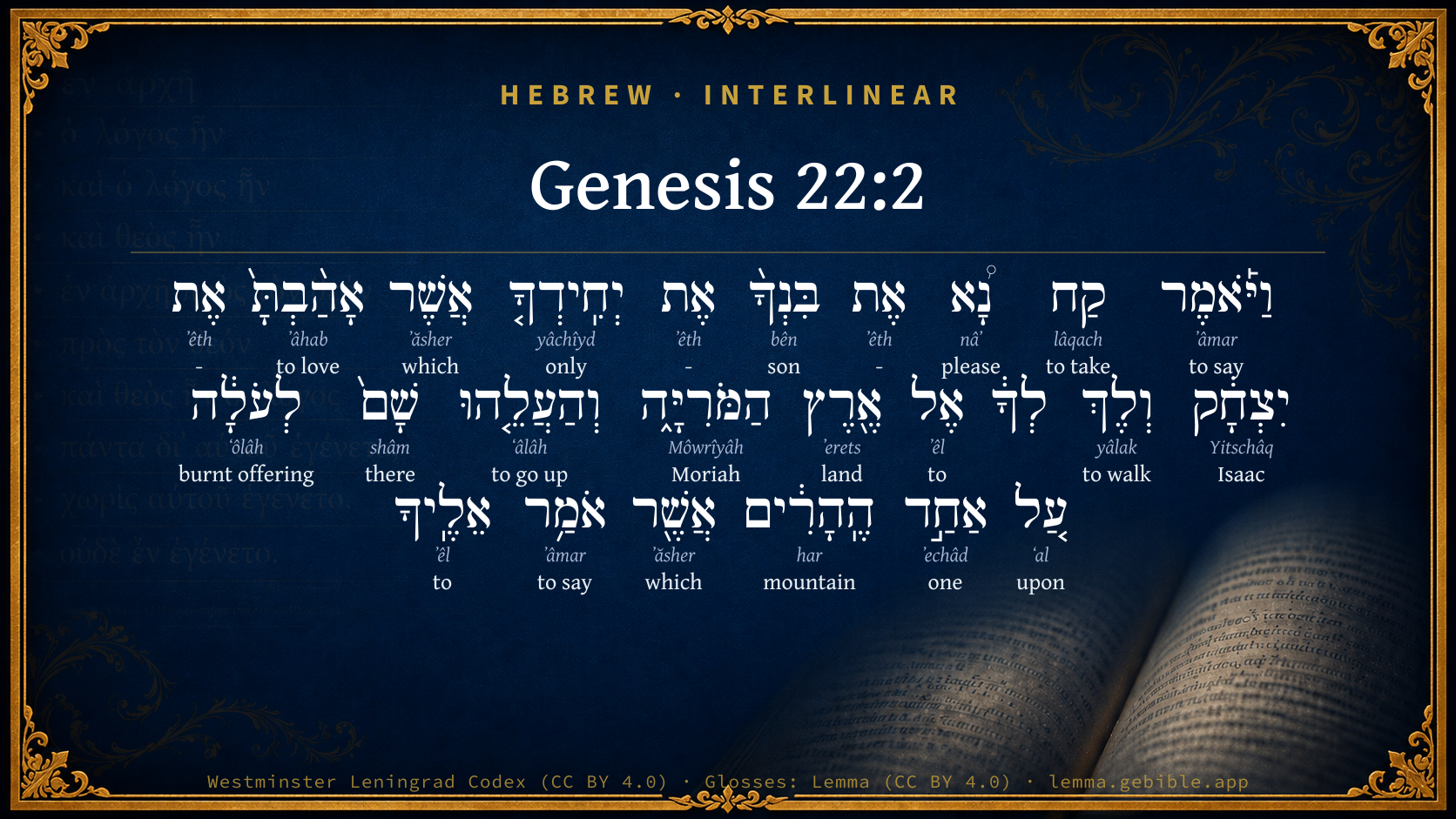
Hebrew (Westminster Leningrad Codex) Genesis 22:2 appears in the Hebrew Old Testament. The text above is from the Westminster Leningrad Codex. Each word links to its Strong’s number, a concise gloss, and parsing drawn from the Open Scriptures Hebrew Bible morphology. Click any word for its full Brown-Driver-Briggs (BDB) entry.
Download image
Cite this verse

Genesis 22:2 (World English Bible). Public Domain. Lemma interlinear Bible study tool, https://lemma.gebible.app/v/genesis/22/2.

Show BibTeX & RIS
BibTeX
RIS
English Translation
He said, "Now take your son, your only son, whom you love, even Isaac, and go into the land of Moriah. Offer him there for a burnt offering on one of the mountains which I will tell you of."
World English Bible · Public Domain
Highlights
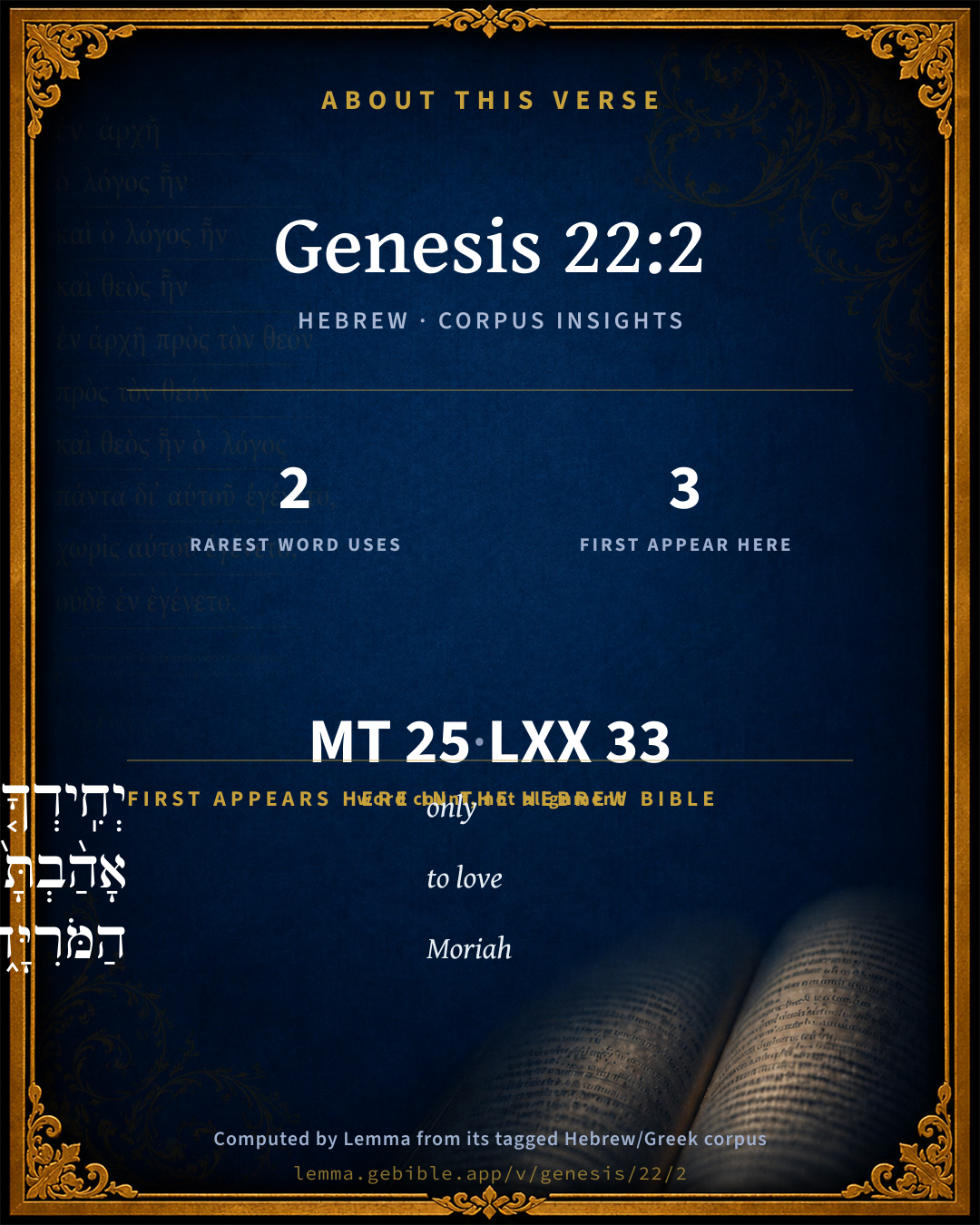
  • 3 first appearances in the Hebrew Bible
Full analysis ↓
Download a study sheet

One document with this verse’s original text, its word-by-word gloss line, the meaning frame, cross-references with their text, attributed commentary, and full source and license credits — printable, and it pastes into notes with its structure intact.

This verse Autodidact and up

Study sheet (.html) Plain text (.txt)

A passage Seminary Student

Up to 50 verses in one chapter. A passage sheet keeps up to 6 commentary sources and 12 cross-references per verse, in the order this page ranks them, and says so on the sheet whenever that leaves anything out. Ask for a single verse and you get the Autodidact verse sheet above.

Everything on this page stays free to read, with no account — the sheet is a download of what is already on screen, not access to it.

Want to remove ads? Support Godless Engineer
Compare translations 3

The same verse in 3 English versions, stacked beneath the original-language interlinear above. Click any original word for its lexicon entry.

Each is an independent rendering of the whole verse — the interlinear is not word-aligned to these translations.

Highlighted words mark where these versions differ — a whole-verse word diff, not a word-by-word alignment.

  • World English Bible Public Domain
    He said, "Now take your son, your only son, whom you love, even Isaac, and go into the land of Moriah. Offer him there for a burnt offering on one of the mountains which I will tell you of."
  • King James Version Public Domain
    And he said, Take now thy son, thine only son Isaac, whom thou lovest, and get thee into the land of Moriah; and offer him there for a burnt offering upon one of the mountains which I will tell thee of.
  • unfoldingWord Literal Text CC BY-SA 4.0
    Then he said, “Please take your son, your only whom you love, Isaac, and go yourself to the land of Moriah, and sacrifice him there as a burnt offering on one of the mountains that I will tell to you.”

unfoldingWord Literal Text — © unfoldingWord, licensed CC BY-SA 4.0. Word-aligned USFM3 via Door43 (git.door43.org/unfoldingWord/en_ult).

Versions to compare (up to 4)

3 of 4 selected

Show all 18 translations

Every available English version of this verse, each an independent rendering of the whole verse.

  • World English Bible Public Domain
    He said, "Now take your son, your only son, whom you love, even Isaac, and go into the land of Moriah. Offer him there for a burnt offering on one of the mountains which I will tell you of."
  • Berean Standard Bible Public Domain
    “Take your son,” God said, “your only son Isaac, whom you love, and go to the land of Moriah. Offer him there as a burnt offering on one of the mountains, which I will show you.”
  • Majority Standard Bible Public Domain
    “Take your son,” God said, “your only son Isaac, whom you love, and go to the land of Moriah. Offer him there as a burnt offering on one of the mountains, which I will show you.”
  • King James Version Public Domain
    And he said, Take now thy son, thine only son Isaac, whom thou lovest, and get thee into the land of Moriah; and offer him there for a burnt offering upon one of the mountains which I will tell thee of.
  • American Standard Version (1901) Public Domain
    And he said, Take now thy son, thine only son, whom thou lovest, even Isaac, and get thee into the land of Moriah. And offer him there for a burnt-offering upon one of the mountains which I will tell thee of.
  • Revised Version (1885) Public Domain
    And he said, Take now thy son, thine only son, whom thou lovest, even Isaac, and get thee into the land of Moriah; and offer him there for a burnt offering upon one of the mountains which I will tell thee of.
  • Geneva Bible (1599) Public Domain
    And he said, Take nowe thine onely sonne Izhak whom thou louest, and get thee vnto the land of Moriah, and offer him there for a burnt offering vpon one of the mountaines, which I will shewe thee.
  • Douay-Rheims (1899) Public Domain
    He said to him: Take thy only begotten son Isaac, whom thou lovest, and go into the land of vision: and there thou shalt offer him for a holocaust upon one of the mountains which I will show thee.
  • Young's Literal Translation Public Domain
    And He saith, `Take, I pray thee, thy son, thine only one, whom thou hast loved, even Isaac, and go for thyself unto the land of Moriah, and cause him to ascend there for a burnt-offering on one of the mountains of which I speak unto thee.'
  • Literal Standard Version CC BY-SA 4.0
    And He says, “Now take your son, your only one, whom you have loved, even Isaac, and go for yourself to the land of Moriah, and cause him to ascend there for a burnt-offering on one of the mountains of which I speak to you.”
  • Unlocked Literal Bible CC BY-SA 4.0
    Then God said, “Take your son, your only son, whom you love, Isaac, and go to the land of Moriah. Offer him there as a burnt offering upon one of the mountains there, which I will tell you about.”
  • unfoldingWord Literal Text CC BY-SA 4.0
    Then he said, “Please take your son, your only whom you love, Isaac, and go yourself to the land of Moriah, and sacrifice him there as a burnt offering on one of the mountains that I will tell to you.”
  • Darby Bible Public Domain
    And he said, Take now thy son, thine only [son], whom thou lovest, Isaac, and get thee into the land of Moriah, and there offer him up for a burnt-offering on one of the mountains which I will tell thee of.
  • World Messianic Bible Public Domain
    He said, “Now take your son, your only son, Isaac, whom you love, and go into the land of Moriah. Offer him there as a burnt offering on one of the mountains which I will tell you of.”
  • Webster's Bible Public Domain
    And he said, Take now thy son, thy only son Isaac, whom thou lovest, and go into the land of Moriah; and offer him there for a burnt-offering upon one of the mountains which I will name to thee.
  • Free Bible Version CC BY-SA 4.0
    God told him, “Go with your son, your only son, the one you love, to the land of Moriah and sacrifice him there as a burnt offering on one of the mountains that I'll tell you about.”
  • Bible in Basic English Public Domain
    And he said to him, Take your son, your dearly loved only son Isaac, and go to the land of Moriah and give him as a burned offering on one of the mountains of which I will give you knowledge.
  • JPS Tanakh (1917) Public Domain
    And He said: 'Take now thy son, thine only son, whom thou lovest, even Isaac, and get thee into the land of Moriah; and offer him there for a burnt-offering upon one of the mountains which I will tell thee of.'

Literal Standard Version (2020), Covenant Press — licensed CC BY-SA 4.0. Text via the HelloAO Bible API (eBible.org). Unlocked Literal Bible (unfoldingWord) — licensed CC BY-SA 4.0. Text via the HelloAO Bible API (eBible.org). unfoldingWord Literal Text — © unfoldingWord, licensed CC BY-SA 4.0. Word-aligned USFM3 via Door43 (git.door43.org/unfoldingWord/en_ult). Free Bible Version, Dr. Jonathan Gallagher — licensed CC BY-SA 4.0. Text via the HelloAO Bible API (eBible.org).

Word by word

More ways to search: Search by grammar → Find every occurrence → Compare this word →

Practice this passage: Drill this verse → Learn its vocabulary →

הַמֹּרִיָּ֑ה
Môwrîyâh
H4179
“the · Moriah”
Particle, Definite Article + Noun, Proper
Part of Speech
Particle + Noun
Type
Proper
Full BDB Definition

Origin: from H7200 and H3050

TWOT: None

Moriah = "chosen by Jehovah" - the place where Abraham took Isaac for sacrifice - the mount on the eastern edge of Jerusalem on which Solomon built the temple
  1. וַיֹּ֡אמֶר ʼâmar H559 “and · to say” Conjunction + Verb, Qal, Sequential Imperfect, 3rd Person, Masculine, Singular
  2. קַח lâqach H3947 “take” Verb, Qal, Imperative, 2nd Person, Masculine, Singular
  3. נָ֠א nâʼ H4994 “please” Particle, Exhortation
  4. אֶת ʼêth H853 “-” Particle, Direct Object
  5. בִּנְךָ֨ bên H1121 “son · your” Noun, Common, Masculine, Singular, Construct + Suffix, Personal, 2nd Person, Masculine, Singular
  6. אֶת ʼêth H853 “-” Particle, Direct Object
  7. יְחִֽידְךָ֤ yâchîyd H3173 “only · your” Adjective, Adjective, Masculine, Singular, Construct + Suffix, Personal, 2nd Person, Masculine, Singular
  8. אֲשֶׁר ʼăsher H834 “which” Particle, Relative
  9. אָהַ֨בְתָּ֙ ʼâhab H157 “to love” Verb, Qal, Perfect, 2nd Person, Masculine, Singular
  10. אֶת ʼêth H853 “-” Particle, Direct Object
  11. יִצְחָ֔ק Yitschâq H3327 “Isaac” Noun, Proper
  12. וְלֶךְ yâlak H3212 “and · walk” Conjunction + Verb, Qal, Imperative, 2nd Person, Masculine, Singular
  13. אֶל ʼêl H413 “to” Preposition
  14. אֶ֖רֶץ ʼerets H776 “land of” Noun, Common, Both, Singular, Construct
  15. וְהַעֲלֵ֤הוּ ʻâlâh H5927 “and · go up · him” Conjunction + Verb, Hiphil, Imperative, 2nd Person, Masculine, Singular + Suffix, Personal, 3rd Person, Masculine, Singular
  16. שָׁם֙ shâm H8033 “there” Adverb
  17. לְעֹלָ֔ה ʻôlâh H5930 “to/for · burnt offering” Preposition + Noun, Common, Feminine, Singular, Absolute
  18. עַ֚ל ʻal H5921 “upon” Preposition
  19. אַחַ֣ד ʼechâd H259 “one” Adjective, Cardinal number, Masculine, Singular, Absolute
  20. הֶֽהָרִ֔ים har H2022 “the · mountains” Particle, Definite Article + Noun, Common, Masculine, Plural, Absolute
  21. אֲשֶׁ֖ר ʼăsher H834 “which” Particle, Relative
  22. אֹמַ֥ר ʼâmar H559 “to say” Verb, Qal, Imperfect, 1st Person, Common, Singular
  23. אֵלֶֽיךָ ʼêl H413 “to · you” Preposition + Suffix, Personal, 2nd Person, Masculine, Singular

About this verse

These counts appear in no published source. They are computed here, from the morphology-tagged text and Lemma’s own curated glosses. What Lemma adds →

25
words
19
distinct lemmas
Pentateuch
section

Notable vocabulary

The rarest word here is הַמֹּרִיָּ֑ה Moriah H4179 — appearing just 2 times in the whole Hebrew Bible.

First appearance in Scripture

These words make their first canonical appearance in the Hebrew Bible here:

  • יְחִֽידְךָ֤ only H3173
  • אָהַ֨בְתָּ֙ to love H157
  • הַמֹּרִיָּ֑ה Moriah H4179

Shared distinctive vocabulary

הַמֹּרִיָּ֑ה Moriah H4179 occurs in 2 verses of the Hebrew Bible. Also found in:

Grammatical profile

  • 6 verbs
  • 6 nouns
  • 2 adjectives
  • 4 prepositions
  • 1 adverb
  • 6 particles

Verb forms

  • וַיֹּ֡אמֶר Qal · Sequential Imperfect
  • קַח Qal · Imperative
  • אָהַ֨בְתָּ֙ Qal · Perfect
  • וְלֶךְ Qal · Imperative
  • וְהַעֲלֵ֤הוּ Hiphil · Imperative
  • אֹמַ֥ר Qal · Imperfect

Repetition

Words recur within this verse — often emphatic in Hebrew:

  • וַיֹּ֡אמֶר to say H559 ×2
  • אֲשֶׁר which H834 ×2
  • אֶל to H413 ×2

Hebrew & Septuagint length

In English translation the verse runs 39 words from the Hebrew and 39 from the Septuagint (LXX English) — the same length.

A rough comparison of the two English renderings, which tokenize alike — not a word-level alignment.

Word counts can differ between the Hebrew and the Greek without any difference in meaning — e.g. the Hebrew direct-object marker אֵת has no separate Greek word, and Greek often adds the article ὁ.

In the original languages it is 25 Hebrew tokens and 33 Greek tokens — but the two are counted differently (Hebrew bundles its prefixes and suffixes into one token; the Greek is in lemma form), so that isn’t a like-for-like length.

Cross-references

14

Topical passages linked to Genesis 22:2 in the Treasury of Scripture Knowledge — connected by theme and wording, ordered by reader-vote popularity; previews shown in the World English Bible.

  • John 3:16 For God so loved the world, that he gave his one and only Son, that whoever believes in him should not perish, but have eternal life.
  • Romans 8:32 He who didn't spare his own Son, but delivered him up for us all, how would he not also with him freely give us all things?
  • Hebrews 11:17 By faith, Abraham, being tested, offered up Isaac. Yes, he who had gladly received the promises was offering up his one and only son;
  • 1 John 4:9–10 By this was God's love revealed in us, that God has sent his one and only Son into the world that we might live through him.
  • Genesis 17:19 God said, "No, but Sarah, your wife, will bear you a son. You shall call his name Isaac. I will establish my covenant with him for an everlasting covenant for his seed after him.
  • Genesis 22:12 He said, "Don't lay your hand on the boy, neither do anything to him. For now I know that you fear God, seeing you have not withheld your son, your only son, from me."
  • Genesis 22:16 and said, "I have sworn by myself, says Yahweh, because you have done this thing, and have not withheld your son, your only son,
  • 2 Kings 3:27 Then he took his eldest son who would have reigned in his place, and offered him for a burnt offering on the wall. There was great wrath against Israel: and they departed from him, and returned to their own land.
  • Genesis 21:12 God said to Abraham, "Don't let it be grievous in your sight because of the boy, and because of your handmaid. In all that Sarah says to you, listen to her voice. For from Isaac will your seed be called.
  • Judges 11:31 then it shall be, that whatever comes forth from the doors of my house to meet me, when I return in peace from the children of Ammon, it shall be Yahweh's, and I will offer it up for a burnt offering.
  • Judges 11:39 It happened at the end of two months, that she returned to her father, who did with her according to his vow which he had vowed: and she was a virgin. It was a custom in Israel,
  • 2 Chronicles 3:1 Then Solomon began to build the house of Yahweh at Jerusalem on Mount Moriah, where [Yahweh] appeared to David his father, which he made ready in the place that David had appointed, in the threshing floor of Ornan the Jebusite.
  • Romans 5:8 But God commends his own love toward us, in that while we were yet sinners, Christ died for us.
  • Micah 6:7 Will Yahweh be pleased with thousands of rams? With tens of thousands of rivers of oil? Shall I give my firstborn for my disobedience? The fruit of my body for the sin of my soul?

Cross-references courtesy of OpenBible.info (CC BY 4.0).

Hebrew and Greek witnesses Masoretic Hebrew ↔ Greek Septuagint

The same verse in the two great witnesses to the Old Testament, shown verse-for-verse.

These are two independent witnesses, not word-aligned to each other, and the Septuagint is shown in lemma (dictionary) form.

Hebrew Genesis 22:2 Masoretic · Westminster Leningrad Codex

וַיֹּ֡אמֶר קַח נָ֠א אֶת בִּנְךָ֨ אֶת יְחִֽידְךָ֤ אֲשֶׁר אָהַ֨בְתָּ֙ אֶת יִצְחָ֔ק וְלֶךְ לְךָ֔ אֶל אֶ֖רֶץ הַמֹּרִיָּ֑ה וְהַעֲלֵ֤הוּ שָׁם֙ לְעֹלָ֔ה עַ֚ל אַחַ֣ד הֶֽהָרִ֔ים אֲשֶׁ֖ר אֹמַ֥ר אֵלֶֽיךָ

He said, "Now take your son, your only son, whom you love, even Isaac, and go into the land of Moriah. Offer him there for a burnt offering on one of the mountains which I will tell you of."

World English Bible · Public Domain

Greek LXX Genesis 22:2 Septuagint · lemma form

καί εἶπον λαμβάνω ὁ υἱός σύ ὁ ἀγαπητός ὅς ἀγαπάω ὁ ισαακ καί πορεύομαι εἰς ὁ γῆ ὁ ὑψηλός καί ἀναφέρω αὐτός ἐκεῖ εἰς ὁλοκάρπωσις ἐπί εἷς ὁ ὄρος ὅς ἄν σύ εἶπον

And he said, Take your son, the beloved one, whom you have loved—Isaac, and go into the high land, and offer him there for a whole burnt offering on one of the mountains which I will tell you of.

LXX2012 (modern English Septuagint) · Public Domain

On this verse, The Cambridge Bible for Schools and Colleges discusses the Septuagint’s reading. Read the note in Commentary ↓

Hebrew: Westminster Leningrad Codex (CC BY 4.0). Greek: Septuagint (public domain); English from LXX2012 (modern English Septuagint) (Public Domain). How the Septuagint differs from the Hebrew →

Targum (Aramaic paraphrase)

2

The Targum is the ancient Jewish Aramaic paraphrase of the Hebrew Scriptures — an interpretive translation, not the Hebrew text itself. Onkelos (literal) and Pseudo-Jonathan (expansive) render the Torah, and Jonathan the Prophets. Coverage is partial: where no permissively-licensed English translation exists for a verse, only the Aramaic is shown. This is verse-level text, not a word-by-word alignment to the Hebrew.

  1. Targum Onkelos Torah (Genesis–Deuteronomy)
    וַאֲמַר דְּבַר כְּעַן יָת בְּרָךְ יָת יְחִידָךְ דִּי רְחַמְתָּ יָת יִצְחָק וְאִיזֵל לָךְ לְאַרְעָא פּוּלְחָנָא וְאַסְקֵהּ קֳדָמַי תַּמָּן לַעֲלָתָא עַל חַד מִן טוּרַיָּא דִּי אֵימַר לָךְ

    (no public-domain English translation for this verse)

    Targum Onkelos — Aramaic: “Onkelos Genesis” (public domain); “Onkelos Exodus” (public domain); “Onkelos Leviticus” (public domain); “Onkelos Numbers” (public domain); “Onkelos Deuteronomy” (public domain). English: “Sefaria Community Translation” (CC0 1.0 (public-domain dedication)); “J.W. Etheridge. The Targums of Onkelos and Jonathan Ben Uzziel on the Pentateuch. London: Longmans, Green, 1862” (public domain). Text via Sefaria.

  2. Targum Pseudo-Jonathan Torah (Genesis–Deuteronomy)
    וַאֲמַר דְבַר כְּדוֹן יַת בְּרָךְ יַת יְחִידָךְ דְאַתְּ רָחֵם יַת יִצְחָק וְאִיזֵל לָךְ לְאַרַע פּוּלְחָנָא וְאַסֵיקוֹהִי תַּמָן לְעַלָתָא עַל חַד מִן טַוְרַיָא דְאֵימַר לָךְ

    And He said, Take now thy son, thy only one whom thou lovest, Izhak, and go into the land of worship, and offer him there, a whole burnt offering, upon one of the mountains that I will tell thee.

    Targum Pseudo-Jonathan — Aramaic: “Targum Jonathan on Genesis” (public domain); “Targum Jonathan on Exodus” (public domain); “Targum Jonathan on Leviticus” (public domain); “Targum Jonathan on Numbers” (public domain); “Targum Jonathan on Deuteronomy” (public domain). English: “The Targum of Jonathan ben Uzziel, trans. J. W. Etheridge, London, 1862” (public domain). Text via Sefaria.

Commentary

Notes on Genesis 22:2 from classic Christian and Jewish commentators (each source and its license shown beneath its notes). The classic Christian expositions comment on the surrounding passage and are grouped to its opening verse, so a note may address several verses; the Jewish commentaries on the Tanakh (Rashi and others) are per-verse, so they appear only where the commentator wrote on this verse.

Lemma curates 59 commentaries, every one of them public domain or Creative Commons licensed, each selected and text-cleaned for this edition rather than reprinted as found. About our sources →

Trapp's Complete Commentary

John Trapp

Gen 22:2 And he said, Take now thy son, thine only [son] Isaac, whom thou lovest, and get thee into the land of Moriah; and offer him there for a burnt offering upon one of the mountains which I will tell thee of.

Ver. 2. Take now thy son, thine only son Isaac, &c.] This was the last of Abraham’s ten trials, and the sorest. All our troubles to this are but as the stivers and chips of that cross upon which this good patriarch was crucified. Origen hence persuades parents to bear patiently the loss of their children. Laetus offer filium Deo, esto sacerdos animae filii tui ,& c. Abraham was not only to kill his only son (which yet was more than to have torn out his own heart with his own hands), but to cut him in pieces, to lay him orderly on the altar, after the manner of a sacrifice, and to burn him to ashes; himself making and tending the fire, and putting him in, piece after piece, when any was out. A hard and heavy task: especially since it directly crossed the promise, that "in Isaac all nations of the earth should be blessed"; and seemed to involve the utter ruin of all mankind. Here, reason was at a stand. It was faith only that could extricate the perplexed patriarch, by giving him to know "that God was able to raise him up even from the dead". {Heb 11:19} Hoc Abrahamum fecit αμεταπτωτον. This was it that kept him from tripping.

Get thee into the land of Moriah.] Both Abraham’s great temptations began with one strain, Vade tibi , Get thee gone. {Gen 12:1; Gen 22:2} Here God led Abraham into temptation, but delivered him from evil. Have you not been tempted, saith the holy man, {a} in this or that kind? It is because God in mercy would not "lead you into temptation." Yea, this is in some sort more to be acknowledged than victory when you are tempted. For not to be tempted is more immediately from God, and less in man’s power than to prevail against temptation. Since nothing doth overcome us against our will: but without our will God doth lead us into trials: for he knoweth we would taste little of these if we might be our own carvers.

{a} Bain’s Letters.

John Trapp, A Commentary or Exposition upon All the Books of the Old and New Testament (1647–1656) — public domain. Text from a community e-Sword module.

Joseph Benson's Commentary

Gen 22:2. And he said, Take thy son — Not thy bullocks and thy lambs; how willingly would Abraham have parted with them by thousands to redeem Isaac! Not thy servant, no, not the steward of thy house. Thine only son — Thine only son by Sarah. Ishmael was lately cast out, to the grief of Abraham, and now Isaac only was left; and must he go too? Yes: take Isaac, him by name, thy laughter, that son indeed. Yea, that son whom thou lovest — The trial was of Abraham’s love to God, and therefore it must be in a beloved son: in the Hebrew it is expressed more emphatically, and might very well be rendered, Take now that son of thine, that only son of thine, whom thou lovest, that Isaac. And get thee into the land of Moriah — Distant three days’ journey, that he might have time to consider it, and if he do it, might do it deliberately. And offer him for a burnt- offering — He must not only slay his son, but slay him as a sacrifice, with all that sedateness and composedness of mind, with which he used to offer his burnt-offering.

Joseph Benson's Commentary on the Old and New Testaments (1811–1818) — public domain. Text from a community e-Sword module.

Tyndale Open Study Notes

Tyndale Open Resources

22:2 Obedience to God’s earlier call (12:1-3) was rewarded with great blessing; now Abraham had the opportunity to show even greater obedience. • Take your son . . . Isaac, whom you love so much: By this detailed description of Isaac, God reminded Abraham that the young man was his beloved son, and intensified his awareness of the cost of the sacrifice. • The name Moriah is explained by the Chronicler (2 Chr 3:1) as the place of the later Temple Mount in Jerusalem. • Go: By wording the command in this way, God helped Abraham to obey by recalling his former call (cp. 12:1-3).

Tyndale Open Study Notes — © Tyndale Open Resources, licensed CC BY-SA 4.0. Text via the HelloAO Bible API.

Geneva Bible (1599)

Geneva Bible translators

Herein stood the chiefest point of his tentation, seeing he was commanded to offer up him in whom God had promised to bless all the nations of the world.

Which signifieth the fear of God, in the which place he was honored: and Solomon afterward built the Temple.

Geneva Bible (1599) marginal notes — public domain. Text via Bolls.life.

Jamieson, Fausset & Brown

Robert Jamieson, A. R. Fausset & David Brown

Take now thy son, &c.--Every circumstance mentioned was calculated to give a deeper stab to the parental bosom. To lose his only son, and by an act of his own hand, too!--what a host of conflicting feelings must the order have raised! But he heard and obeyed without a murmur (Gal 1:16; Luk 14:26).

Jamieson, Fausset & Brown — Commentary Critical and Explanatory on the Whole Bible (1871) — public domain (CC PDM 1.0). Text via the HelloAO Bible API.

Adam Clarke's Commentary

Verse 2. Take now thy son] Bishop Warburton's observations on this passage are weighty and important. "The order in which the words are placed in the original gradually increases the sense, and raises the passions higher and higher: Take now thy son, (rather, take I beseech thee נא na,) thine only son whom thou lovest, even Isaac. Jarchi imagines this minuteness was to preclude any doubt in Abraham. Abraham desired earnestly to be let into the mystery of redemption; and God, to instruct him in the infinite extent of the Divine goodness to mankind, who spared not his own Son, but delivered him up for us all, let Abraham feel by experience what it was to lose a beloved son, the son born miraculously when Sarah was past child-bearing, as Jesus was miraculously born of a virgin. The duration, too, of the action, Ge 22:4, was the same as that between Christ's death and resurrection, both which are designed to be represented in it; and still farther not only the final archetypical sacrifice of the Son of God was figured in the command to offer Isaac, but the intermediate typical sacrifice in the Mosaic economy was represented by the permitted sacrifice of the ram offered up, Ge 22:13, instead of Isaac." See Dodd.

Only son] All that he had by Sarah his legal wife.

The land of Moriah] This is supposed to mean all the mountains of Jerusalem, comprehending Mount Gihon or Calvary, the mount of Sion and of Acra. As Mount Calvary is the highest ground to the west, and the mount of the temple is the lowest of the mounts, Mr. Mann conjectures that it was upon this mount Abraham offered up Isaac, which is well known to be the same mount on which our blessed Lord was crucified. Beer-sheba, where Abraham dwelt, is about forty-two miles distant from Jerusalem, and it is not to be wondered at that Abraham, Isaac, the two servants, and the ass laden with wood for the burnt-offering, did not reach this place till the third day; see Ge 22:4.

Adam Clarke's Commentary on the Bible (1810–1826) — public domain. Text from a community e-Sword/MySword module.

John Calvin's Commentaries

2. Take now thy son. Abraham is commanded to immolate his son. If God had said nothing more than that his son should die, even this message would have most grievously wounded his mind; because, whatever favor he could hope for from God, was included in this single promise, In Isaac shall thy seed be called. Whence he necessarily inferred, that his own salvation, and that of the whole human race, would perish, unless Isaac remained in safety. For he was taught, by that word, that God would not be propitious to man without a Mediator. For although the declaration of Paul, that ‘all the promises of God in Christ are yea and Amen,’ was not yet written, (2 Corinthians 1:20,) it was nevertheless engraven on the heart of Abraham. Whence, however, could he have had this hope, but from Isaac? The matter had come to this; that God would appear to have done nothing but mock him. Yet not only is the death of his son announced to him, but he is commanded with his own hand to slay him, as if he were required, not only to throw aside, but to cut in pieces, or cast into the fire, the charter of his salvation, and to have nothing left for himself, but death and hell. But it may be asked, how, under the guidance of faith, he could be brought to sacrifice his son, seeing that what was proposed to him, was in opposition to that word of God, on which it is necessary for faith to rely? To this question the Apostle answers, that his confidence in the word of God remained unshaken; because he hoped that God would be able to cause the promised benediction to spring up, even out of the dead ashes of his son. (Hebrews 11:19.) His mind, however, must of necessity have been severely crushed, and violently agitated, when the command and the promise of God were conflicting within him. But when he had come to the conclusion, that the God with whom he knew he had to do, could not be his adversary; although he did not immediately discover how the contradiction might be removed, he nevertheless, by hope, reconciled the command with the promise; because, being indubitably persuaded that God was faithful, he left the unknown issue to Divine Providence. Meanwhile, as with closed eyes, he goes whither he is directed. The truth of God deserves this honor; not only that it should far transcend all human means, or that it alone, even without means, should suffice us, but also that it should surmount all obstacles. Here, then, we perceive, more clearly, the nature of the temptation which Moses has pointed out. It was difficult and painful to Abraham to forget that he was a father and a husband; to cast off all human affections; and to endure, before the world, the disgrace of shameful cruelty, by becoming the executioner of his son. But the other was a far more severe and horrible thing; namely, that he conceives God to contradict Himself and His own word; and then, that he supposes the hope of the promised blessing to be cut off from him, when Isaac is torn away from his embrace. For what more could he have to do with God, when the only pledge of grace is taken away? But as before, when he expected seed from his own dead body, he, by hope, rose above what it seemed possible to hope for; so now, when, in the death of his son, he apprehends the quickening power of God, in such a manner, as to promise himself a blessing out of the ashes of his son, he emerges from the labyrinth of temptation; for, in order that he might obey God, it was necessary that he should tenaciously hold the promise, which, had it failed, faith must have perished. But with him the promise always flourished; because he both firmly retained the love with which God had once embraced him, and subjected to the power of God everything which Satan raised up to disturb his mind. But he was unwilling to measure, by his own understanding, the method of fulfilling the promise, which he knew depended on the incomprehensible power of God. It remains for every one of us to apply this example to himself. The Lord, indeed, is so indulgent to our infirmity, that he does not thus severely and sharply try our faith: yet he intended, in the father of all the faithful, to propose an example by which he might call us to a general trial of faith. For the faith, which is more precious than gold and silver, ought not to lie idle, without trial; and experience teaches, that each will be tried by God, according to the measure of his faith. At the same time, also, we may observe, that God tempts his servants, not only when he subdues the affections of the flesh, but when he reduces all their senses to nothing, that he may lead them to a complete renunciation of themselves.

Thine only son Isaac, whom thou lovest. As if it were not enough to command in one word the sacrifice of his son, he pierces, as with fresh strokes, the mind of the holy man. By calling him his only son, he again irritates the wound recently indicted, by the banishment of the other son; he then looks forward into futurity, because no hope of offspring would remain. If the death of a firstborn son is wont to be grievous, what must the mourning of Abraham be? Each word which follows is emphatical, and serves to aggravate his grief. ‘Slay’ (he says) ‘him whom alone thou lowest.’ And he does not here refer merely to his paternal love, but to that which sprung from faith. Abraham loved his son, not only as nature dictates, and as parents commonly do, who take delight in their children, but as beholding the paternal love of God in him: lastly, Isaac was the mirror of eternal life, and the pledge of all good things. Wherefore God seems not so much to assail the paternal love of Abraham, as to trample upon His own benevolence. There is equal emphasis in the name Isaac by which Abraham was taught, that nowhere besides did any joy remain for him. Certainly, when he who had been given as the occasion of joy, was taken away, it was just as if God should condemn Abraham to eternal torment. We must always remember that Isaac was not a son of the common order, but one in whose person the Mediator was promised.

Get thee into the land of Moriah. The bitterness of grief is not a little increased by this circumstance. For God does not require him to put his son immediately to death, but compels him to revolve this execution in his mind during three whole days, that in preparing himself to sacrifice his son, he may still more severely torture all his own senses. Besides, he does not even name the place where he requires that dire sacrifice to be offered, Upon one of the mountains, (he says,) that I will tell thee of. So before, when he, commanded him to leave his country he held his mind in suspense. But in this affair, the delay which most cruelly tormented the holy man, as if he had been stretched upon the rack, was still less tolerable. There was, however, a twofold use of this suspense. For there is nothing to which we are more prone than to be wise beyond our measure. Therefore, in order that we may become docile and obedient to God, it is profitable for us that we should be deprived of our own wisdom, and that nothing should be left us, but to resign ourselves to be led according to his will. Secondly, this tended also to make him persevere, so that he should not obey God by a merely sudden impulse. For, as he does not turn back in his journey, nor revolve conflicting counsels; it hence appears, that his love to God was confirmed by such constancy, that it could not be affected by any change of circumstances. Jerome explains the land of Moriah to be ‘the land of vision,’ as if the name had been derived fromראה (rahah.) But all who are skilled in the Hebrew language condemn this opinion. Nor am I better satisfied with those who interpret it the myrrh of God. It is certainly acknowledged by the consent of the greater part, that it is derived from the word ירה (yarah,) which signifies to teach or from ירא (yarai,) which signifies to fear. There is, however, even at this time, a difference among interpreters, some thinking that the doctrine of God is here specially inculcated. Let us follow the most probable opinion; namely, that it is called the land of divine worship, either because God had appointed it for the offering of the sacrifice, in order that Abraham might not dispute whether some other place should not rather be chosen; or because the place for the temple was already fixed there; and I rather adopt this second explanation; that God there required a present worship from his servant Abraham, because already in his secret counsel, he had determined in that place to fix his ordinary worship. And sacrifices properly receive their name from the word which signifies fear, because they give proof of reverence to God. Moreover, it is by no means doubtful that this is the place where the temple was. afterwards built.

John Calvin's Commentaries (1540-1563) — public domain. Text from the Calvin Translation Society English edition (1840s-50s) via the Christian Classics Ethereal Library (ccel.org). Calvin's coverage is partial (roughly two-thirds of the Bible); uncommented books and verses are honest gaps, never fabricated. The 19th-century editor's footnotes and remarks are omitted so the notes are faithfully Calvin's own voice.

Ellicott's Commentary for English Readers

(2) Take now.—Now is not an adverb of time, but an interjection of entreaty, usually coupled with requests, and intended to soften them. It thus makes the words more an exhortation than a command.

Thine only son Isaac.—The words in the original are more emphatic, being, “Take, I pray, thy son, thine only son, whom thou lovest, even Isaac.” If childlessness was so unendurable in old time to Abraham (Gen_15:2), what would it be now, after so many years of enjoyment of a son, and after giving up Ishmael for his sake (Gen_17:18)?

The land of Moriah.—Moriah may either mean Jah is teacher (see Note on Gen_12:6), or Jah is provider. The first is supported by Isa_2:3, where the verb is rendered will teach; but the second agrees best with Gen_22:8; Gen_22:14. If this be the meaning, the name would be derived from this event, and would signify the place where “Jehovah will Himself provide the sacrifice.” It has been suggested by many able commentators, that the place meant was Moreh in Sichem, and that the site of the sacrifice was, as the Samaritans affirmed, the natural altar upon the summit of Mount Gerizim. But as Abraham and Isaac reached the spot on the third day, and evidently at an early hour, Gerizim is too remote from Beer-sheba for this to be possible Even Jerusalem is distant enough, as the journey from Beer-sheba takes twenty and a half hours; and travellers in those days had to cook their own food, and prepare their own sleeping accommodation. We may notice also, that Moriah is described as “a land,” in some part of which Abraham was to be shown the special mountain intended for the sacrifice; Moreh, on the contrary, was a place where Abraham had lived, and which was therefore well known to him.

Offer him there for a burnt offering.—Hengstenberg and others have argued that Abraham was not to kill Isaac, but to surrender him spiritually to God, and sanctify him by a burnt offering. But this is contradicted by the narrative itself (Gen_22:10), and by the passage in the Epistle to the Hebrews referred to above, where the victory of Abraham’s faith is described as consisting in the belief, that even though Isaac were killed, nevertheless the promise would still in some Divine manner be fulfilled in him.

A Bible Commentary for English Readers, edited by Charles John Ellicott (1878–1897) — public domain. Text from a community e-Sword module.

The Cambridge Bible for Schools and Colleges

gen. ed. J. J. S. Perowne

2. thy son] Observe the cumulative force of the successive words, “thy son,” “only son,” “whom thou lovest,” “Isaac,” indicating the severity of the test about to be applied to Abraham’s faith.

only son] Ishmael is here disregarded, as in Gen_22:12; Gen_22:16. He is no longer considered one of the true family. The LXX τὸν ἀγαπητόν (Lat. unigenitum) is, however, perhaps due to the thought of Ishmael.

into the land of Moriah] Moriah is here the name of a country, containing mountains on one of which Abraham is to offer Isaac. The proper name “Moriah” is found elsewhere only in 2Ch_3:1, “in Mount Moriah,” i.e. the hill in Jerusalem, on which was the threshing-floor of Ornan, the Jebusite, where the Angel appeared to David. This was the site of the Temple of Solomon. Obviously the expression, “the land of Moriah,” and the reference to the mountains in it, cannot here denote Jerusalem. Jerusalem was a town in the days of the patriarchs (see Gen_14:18). More probably the Chronicler, in 2Ch_3:1, has recorded the popular tradition of his own time, according to which the scene of the appearance to David and the site of the temple at Jerusalem were identified with the place of Isaac’s sacrifice; and the name “Moriah,” occurring in this passage of Genesis was therefore popularly, although inaccurately, assigned to the Temple hill.

What “the land of Moriah” was, we can no longer determine. Possibly the word “Moriah” is the Heb. adaptation of some earlier name, which was lost in the transmission of the story. The name Moriah probably contains a play upon the words meaning “to see” and “Jehovah,” cf. Gen_22:14. It provided a puzzle to the versions. Lat. terra visionis, Sym. γῆ ὀπτασίας, Aq. τὴν γῆν τὴν καταφανῆ, LXX τὴν γῆν τὴν ὑψηλήν.

The Syriac Peshitto renders, “the land of the Amorites,” with which agrees the conjecture of Dillmann and Ball. Tuch and Bleek conjectured “the land of Moreh,” cf. Gen_12:6; but the Hebron district of “the land of Moreh” would be much too close to Beer-sheba to suit the description in Gen_22:4. Hence Wellhausen’s conjecture “the land of the Hamorites” (i.e. Shechem: cf. Genesis 34 and Jdg_9:28). Probably the name is irrecoverable by conjecture. Rabbinic interpretations called it “the place of fear,” or “of worship.” Joseph. Ant. i. § 13, τὸ Μόριον ὅρος.

for a burnt offering] A whole burnt-offering, viz. an offering of complete dedication to God. It was wholly consumed in the fire, as distinct from an offering in which the offerers themselves participated: see note on Gen_8:20. It was a propitiatory offering: cf. Lev_1:4.

The Cambridge Bible for Schools and Colleges (gen. ed. J. J. S. Perowne; Cambridge University Press, 1878–1918) — public domain. Text from a community e-Sword module.

John Gill's Exposition

And he said, take now thy son,.... Directly, immediately; not thine ox, nor thy sheep, nor thy ram, nor thy lamb, nor thy servant, but thy son:

thine only son Isaac; for, though Ishmael was his son, he was a son by his maid, by his concubine, and not by his wife; Isaac was his only legitimate son, his only son by his lawful wife Sarah; the only son of the promise, his only son, in whom his seed was to be called:

whom thou lovest; on whom his affections were strongly set, being a lovely youth, a dutiful son, and the child of promise; on whom all his hope and expectation of a numerous offspring promised him was built, and in whose line the Messiah was to spring from him; even Isaac, which stands last in the original text: so that, if what had been said was not sufficient to describe him, he is expressed by name, and the description is gradually given, and the name of his son reserved to the last, that he might be by degrees prepared to receive the shocking order; every word is emphatic and striking, and enough to pierce any tender heart, and especially when told what was to be done to him. The Jews (i) represent God and Abraham in a discourse together upon this head: God said, take now thy son; says Abraham, I have two sons; take thine only son; says he, they are both only sons to their mothers; take him whom thou lovest; I love them both, replied he; then take Isaac; thus ended the debate:

and get thee into the land of Moriah; so called by anticipation, from a mountain of that name in it; the Septuagint render it, "the high land", the hill country of the land of Canaan, particularly that part of it where Jerusalem afterwards stood, which was surrounded with hills: hence Aquila, another Greek interpreter, renders it, "conspicuous", as hills and mountains are, and a mountainous country is; Onkelos and Jonathan paraphrase it, "a land of worship", of religious worship; for in this country afterwards the people of God dwelt, the city of the living God was built, and in it the temple for divine service, and that upon Mount Moriah; and the Targum of Jerusalem has it here,"to Mount Moriah;''the Jews are divided about the reason of this name, some deriving it from a word (k) which signifies to "teach", and think it is so called, because doctrine or instruction came forth from thence to Israel; others from a word (l) which signifies "fear", and so had its name because fear or terror went from thence to the nations of the world (m); but its derivation is from another word (n), which signifies to "see", and which is confirmed by what is said Gen 22:14,

and offer him there for a burnt offering; this was dreadful work he was called to, and must be exceeding trying to him as a man, and much more as a parent, and a professor of the true religion, to commit such an action; for by this order he was to cut the throat of his son, then to rip him up, and cut up his quarters, and then to lay every piece in order upon the wood, and then burn all to ashes; and this he was to do as a religious action, with deliberation, seriousness, and devotion:

upon one of the mountains which I will tell thee of; for there were several of them adjoining to, or pretty near each other, which afterwards went by different names, as Mount Sion, Deu 4:48; the hill Acra; Mount Calvary, Luk 23:33; and Mount Moriah, Ch2 3:1; supposed to be the mount intended; and so Aben Ezra says it was the place where the temple was built, and where was the threshing floor of Araunah, Ch2 3:1. Some learned men are of opinion, that the account which Sanchoniatho (o) gives of Cronus or Saturn sacrificing his own son, refers to this affair of Abraham's; his words are,"there being a pestilence and a mortality, Cronus offered up his only son a whole burnt offering to his father Ouranus;''which Porphyry (p), from the same historian, thus relates; Cronus, whom the Phoenicians call Israel, (a grandson of Abraham's, thought, through mistake, to be put for Abraham himself,) having an only son of a nymph of that country called Anobret, (which according to Bochart (q) signifies one that conceived by grace, see Heb 11:11;) whom therefore they called Jeoud (the same with Jehid here, an only once); so an only one is called by the Phoenicians; when the country was in great danger through war, this son, dressed in a royal habit, he offered up on an altar he had prepared. But others (r) are of a different sentiment, and cannot perceive any likeness between the two cases: however, Isaac may well be thought, in the whole of this, to be a type of the Messiah, the true and proper Son of God, his only begotten Son, the dear Son of his love, in whom all the promises are yea and amen; whom God out of his great love to men gave to be an offering and a sacrifice for their sins, and who suffered near Jerusalem, on Mount Calvary, which very probably was a part of Mount Moriah; and which, with other mountains joining in their root, though having different tops, went by that common name.

(i) T. Bab. Sanhedrin, fol. 89. 2. Pirke Eliezer, c. 31. Jarchi in loc. (k) "docuit". (l) "timuit". (m) T. Bab. Taanith, fol. 16. 1. (n) "vidit". (o) Apud Euseb. Evangel. Praeparat. p. 38. (p) Apud ib. p. 40. & l. 4. c. 15. p. 156. (q) Canaan, l. 2. c. 2. col. 711, 712. (r) See Cumberland's Sanchoniatho, p. 37, 38, 134, &c.

John Gill's Exposition of the Whole Bible (1746–1763) — public domain (CC PDM 1.0). Text via the HelloAO Bible API.

Haydock's Catholic Bible Commentary

Thy only begotten, or thy most beloved, as if he had been an only child; in which sense the word is often taken, 1 Paralipomenon xxix. 1. Ismael was still living; but Isaac was the only son of Sara, the most dignified wife. --- Lovest. Hebrew, "hast loved" hitherto; now thou must consider him as dead. He has been to thee a source of joy, but now he will be one of tears and mourning. --- Of vision. Septuagint, "high," being situated on Mount Moria, by which name it was afterwards distinguished, ver. 14. (Menochius) --- Every word in this astonishing command, tended to cut Abraham to the heart; and thence we may the more admire his strength and disinterestedness of his faith. He could hope, in a manner, against hope, knowing in whom he had trusted, and convinced that God would not deceive him, though he was at a loss to explain in what manner Isaac should have children after he was sacrificed. (Haydock)

George Leo Haydock (1774–1849), Haydock's Catholic Family Bible and Commentary, 1859 edition — public domain. Excludes Psalms (Douay-Rheims chapter numbering differs from Protestant) and Deuterocanonical books (Catholic canon only).

Matthew Poole's English Annotations

Not a word here but might pierce a heart of stone, much more so tender a father as Abraham was.

Take now, without demurring or delay, I allow thee no time for thy consideration, own proper

son; not a beast, not an enemy, not a stranger, though that had been very difficult to one so kind to all strangers; not a dear servant, not a friend or familiar:

thine only son, not by birth, for so he had another, Ishmael; but this was his only son by Sarah, his first and legitimate wife; who only had the right of succession both to his inheritance, and to his covenant and promises; and this only was now left to him, for Ishmael was abandoned and gone from him: and this must be such a son as Isaac, once matter of laughter and great joy, now cause of inexpressible sorrow; thy Benoni; a son of the promise, of so great hopes, and such pregnant virtue and piety as this story shows;

whom thou lovest, peculiarly and superlatively, even as thy own soul:

and get thee into the land of Moriah; a place at a great distance, and to which thou shalt go but leisurely, Gen 22:4, that thou mayst have thy mind all that while fixed upon that bloody act, which other men’s minds can scarce once think of without horror; and so thou mayst offer him in a sort ten thousand times over before thou givest the fatal blow;

and offer him there with thine own hands, and cruelly take away the life which thou hast in some sort given him;

for a burnt-offering, wherein by the law of the burnt-offering then known to Abraham, afterwards published to all Israel, his throat was to be cut, his body dissected into quarters, his bowels taken out, as if he had been some notorious traitor, and vile malefactor and miscreant, and afterwards he was to be burnt to ashes, that if possible there might be nothing left of him: and this must be done

upon one of the mountains, which I shall tell thee of; not secretly in a corner, as if it were a work of darkness, and thou wert ashamed or afraid to own it; but in a public and open place, in the view of heaven, earth, God, angels, and men. Which horrid and stupendous act it may be easily conjectured what reproach and blasphemy it would have occasioned against the name and worship of God and the true religion, and what shame and torment to Abraham, from his own self-accusing mind, from the clamours of his wife, and all his friends and allies, and what a dangerous and mischievous example this would have been to all future generations. That faith that could surmount these and many more difficulties, and could readily and cheerfully rest upon God in the discharge of such a duty, no wonder it is so honoured by God, and celebrated by all men, yea, even by the heathens, who have translated this history into their fables. Moriah signifies the vision of God, the place where God would be seen and manifested. And so it is here called by way of anticipation, because it was so called afterwards, Gen 22:14, in regard of God’s eminent appearance there for Isaac’s deliverance; though it may also have a further respect unto Christ, because in that place God was manifested in the flesh. There were divers mountains there, as is evident from Psa 125:2; and particularly there were two eminent hills, or rather tops or parts of the same mountain; Sion, where David’s palace was; and Moriah, where the temple was built, and whence the adjoining country afterwards received its name.

Which I will tell thee of, by some visible sign, or secret admonition which I shall give thee.

Matthew Poole's English Annotations on the Holy Bible (1683–1685) — public domain. Text from a community e-Sword/MySword module.

Whedon's Commentary on the Bible

Daniel D. Whedon

2. He said — Doubtless in some open and positive way. There is no evidence that this word came by a vision of the night. Least of all should we give countenance to the strange fancy that Abraham was imposed upon by Satan, and tempted, by observing human sacrifices among the heathen, to suppose that the sacrifice of Isaac would be acceptable to God.

If such were the fact, the sacred writer fell into a most unfortunate style of recording the truth.

Take now thy son — This command is peculiarly touching. Hebrews, Take now thy son, thy only one, whom thou lovest, even Isaac. Various conjectures have been held as to Isaac’s age at this time. Josephus says twenty-five, and other numbers have been mentioned ranging from ten to thirty-seven. But all is conjecture. He was a young lad, but old and large enough to carry the wood for the burnt offering. Gen_22:6.

Land of Moriah — On the origin of this name, see on Gen_22:14. The Samaritans read land of Moreh, and so identify this Moriah with the Moreh of Gen_12:6, and Stanley and others argue that the place of Abraham’s sacrifice was on the summit of Mount Gerizim, which, after a journey of two days from Beer-sheba by way of the Philistine plain, can be seen “afar off.” Gen_22:4. But the Jewish tradition identifies this Moriah with the mountain on which the Temple was afterwards builded, (2Ch_3:1,) and there seems no sufficient reason to abandon this view. Thomson says, “It is almost absurd to maintain that Abraham could come on his loaded ass from Beer-sheba to Nablus in the time specified. On the third day he arrived early enough to leave the servants afar off, and walk with Isaac bearing the sacrificial wood to the mountain, which God had shown him; there build the altar, arrange the wood, bind his son, and stretch forth his hand to slay him; and there was time, too, to take and offer up the ram in Isaac’s place. That all this could have been done at Nablus on the third day of their journey is incredible. It has always appeared to me, since I first traveled over the country myself, that even Jerusalem was too far off from Beer-sheba for the tenor of the narrative, but Nablus is two days farther north.” — Land and Book, vol. ii, p. 212.

Offer him there for a burnt offering — There is no possibility of mistaking the plain import of these words. It is not, consecrate or dedicate him there in connexion with a burnt offering, but offer him there. Though God’s command seems to be contrary to all hope and promise and prophecy, Abraham obeys.

One of the mountains which I will tell — Was there not a divine plan and purpose, in selecting the spot for this most wonderful event, to make it identical with the place where afterwards Jehovah would record his name, and set forth his son to be a propitiation for the sins of the whole world?

Daniel D. Whedon (gen. ed.), Commentary on the Old and New Testaments (1874–1909) — public domain. Text from a community e-Sword module.

The Pulpit Commentary

And he said, Take now modifies the command, and seems to express that Elohim wished to receive the sacrifice as a free-will offering" (Lange)thy son (not a lamb, but thy child), thine only son not aJgaphton (LXX), but unigenitum (Vulgate), meaning the only son of Sarah, the only legitimate offspring he possessed, the only heir of the promise, the only child that remained to him after Ishmael"s departure (cf. oJ monogenhv, (Joh_1:18) Isaac, whom thou lovest, or, whom thou lovest, Isaac; the order and accumulation of the terms being calculated to excite the parental affection of the patriarch to the highest pitch, and to render compliance with the Divine demand a trial of the utmost severityand get thee literally, go for thyself (cf. Gen_12:1 Gen_21:16) into the land of Moriah. Moriah vision (Vulgate, Symmachus, Samaritan), worship (Onkelos, Jonathan), high (LXX), rebellious (Murphy); but rather a compound of hy and yrimo, meaning God is my instructor, alluding to the temple from which the law should afterwards proceed (Kalisch), or, better, of hy and har, and signifying "the shown of Jehovah," i.e. the revelation or manifestation of Jehovah (Hengstenberg, Kurtz, Keil, &e.); or "the chosen, i.e. "pointed out of God," with reference to its selection as the site of the Divine sanctuary (Gesenius), or rather because there God provided and pointed out the sacrifice which he elected to accept (Lange). And offer him there for a burnt offering not make a spiritual surrender of him in and through a burnt offering (Hengstenberg, Lange), but actually present him as a holocaust. That Abraham did not stagger on receiving this astounding injunction may be accounted for by remembering that the practice of offering human sacrifices prevailed among the early Chaldaeans and Canaanites, and that as yet no formal prohibition, like that of the Mosaic code, had been issued against themupon one of the mountains not Moreh in Sicbem (Tuch, Michaelis, Stanley, Grove, et alii), which was too distant, but Moriah at Jerusalem (Hengstenberg, Kurtz, Keil, Kalisch), where subsequently God appeared to David, (2Sa_24:16) and the temple of Solomon was built (2Ch_3:1) which I will tell thee of i.e. point out (probably by secret inspiration) as thou proceedest.

The Pulpit Commentary (1880–1919), ed. H.D.M. Spence-Jones & Joseph S. Exell — public domain. Text from a community e-Sword module.

John Wesley's Explanatory Notes

And he said, take thy son - Not thy bullocks and thy lambs; how willingly would Abraham have parted with them by thousands to redeem Isaac! Not thy servant, no, not the steward of thine house. Thine only son - Thine only son by Sarah. Ishmael was lately cast out, to the grief of Abraham, and now Isaac only was left and must he go too? Yes: take Isaac, him by name, thy laughter, that son indeed. Yea, that son whom thou lovest - The trial was of Abraham's love to God, and therefore it must be in a beloved son: in the Hebrew 'tis expressed more emphatically, and I think might very well be read thus, Take now that son of thine, that only son of thine, whom thou lovest, that Isaac. And get thee into the land of Moriah - Three days journey off: so that he might have time to consider it, and if he do it, must do it deliberately. And offer him for a burnt offering - He must not only kill his son, but kill him as a sacrifice, with all that sedateness and composedness of mind, with which he used to offer his burnt- offering.

John Wesley, Explanatory Notes Upon the Whole Bible (1754–1765) — public domain. Text via the GEBible commentary corpus.

Rashi

Rabbi Shlomo Yitzchaki (Rashi)

קח נא TAKE NOW — The word נא is used as a request: God said to him, “I beg of you, stand firm for me in this trial, so that people may not say that the previous trials were no real tests” (Sanhedrin 89b).

את בנך THY SON — Abraham said to God, “I have two sons”. “He answered him, “Thine only son”. Abraham said, “This one is the only son of his mother and the other is the only son of his mother”. God then said, “the one whom thou lovest”. Abraham replied, “I love both of them”. Whereupon God said “even Isaac”. Why did He not disclose this to him at the very first? So as not to confuse him suddenly lest his mind become distracted and bewildered and in his confused state he would involuntarily consent, when there would have been no merit in his sacrifice, and so that he might more highly value God’s command and that God might reward him for the increasing sacrifice demanded by obedience to each and every expression used here (Genesis Rabbah 55:7).

ארץ המוריה THE LAND OF MORIAH — This is Jerusalem, and so we find in Chronicles (2 Chronicles 3:1) “To build the house of the Lord at Jerusalem in Mount Moriah”. Our Rabbis have explained that it is called Moriah — Instruction — because from it (i.e. from the Temple built on that mountain) instruction הוראה came forth to Israel (Genesis Rabbah 55:7). Onkelos translates it by “the land of the Divine Service”. He takes it as having reference to the offering of incense brought in the Temple on Moriah in which there were myrrh (מור) nard and other spices.

והעלהו AND OFFER HIM (literally, bring him up) — He did not say, “Slay him”, because the Holy One, blessed be He, did not desire that he should slay him, but he told him to bring him up to the mountain to prepare him as a burnt offering. So when he had taken him up, God said to him, “Bring him down” (Genesis Rabbah 56:8).

אחד ההרים ONE OF THE MOUNTAINS — The Holy One, blessed be He, first makes the righteous expectant and only afterwards discloses fully to them his intention — and all this in order to augment their reward. Similarly we have (Genesis 12:1) “[Go to] the land which I will show thee”, and similarly in the case of Jonah 3:2 “Make unto it the proclamation which I shall bid thee” (Genesis Rabbah 55:7).

Rashi on the Tanakh — English translations: “The Judaica Press complete Tanach with Rashi, translated by A. J. Rosenberg” (CC BY 4.0); “Pentateuch with Rashi's commentary by M. Rosenbaum and A.M. Silbermann, 1929-1934” (public domain); “The Metsudah Tanach series, Lakewood, N.J” (CC BY 4.0); and “The Book of Joshua, Metsudah Publications, 1997” (CC BY 4.0). Text via Sefaria.

Ramban (Nachmanides)

Rabbi Moshe ben Nachman (Ramban / Nachmanides)

TAKE NOW THY SON, THINE ONLY SON. Since Isaac was the son of the mistress and he alone was to be the one to carry his name, He called him Abraham’s only son. The description was for the purpose of magnifying the command, thus saying: “Take now thy only son, the beloved one, Isaac, and bring him up before Me as a burnt-offering.”

MORIAH. Rashi comments: “This is Jerusalem, and we find it in the book of Chronicles: To build the house of the Eternal at Jerusalem on mount Moriah. Our Rabbis have explained that it is called Moriah (instruction) because from the Temple built there on that mountain, instruction came forth to Israel. ), the seat of the Great Sanhedrin, which was the highest court in Israel, was located in the Court of the Temple. See Deuteronomy 17:8-11. Onkelos translated it as “the land of Worship.” This he derived on the basis of reference to the burning of incense, which contained mor: the mountain on which mor (myrrh), as part of the incense, was to be burnt. Thus according to Rashi’s understanding of Onkelos. Ramban will later differ with this interpretation in the meaning of Onkelos. (myrrh) and other spices, [as part of the Divine Service].”Now if so, [i.e., if this be the explanation of the name Moriah], the meaning of the verse will then be, “Go into the land which will be called Moriah.” Or it may be that it was always called so on account of the future. In Bereshith Rabbah, the Sages have said thus: “The Rabbis say, Go into the land of Moriah means into the land where incense will be offered on the altar of G-d, even as it is said, I will get me to the mountain ‘hamor’ (of myrrh).” But the opinion of Onkelos, who said “the land of worship,” does not appear to be based on the myrrh in the incense, as Rashi said, for the word “service” does not refer to one of the species used in one of the Divine Services. Besides, why did not Onkelos say, “to the land of the incense of spices?” Instead, Onkelos’ intent is to say, “in the land in which they will worhip G-d.”Onkelos thus matched that which the Sages interpreted in Pirkei d’Rabbi Eliezer, where they said, “The Holy One, blessed be He, showed Abraham the altar with a finger. He said to him, ‘This is the altar on which the first man sacrificed. This is the altar on which Cain and Abel sacrificed. This is the altar on which Noah and his sons sacrificed.’ For it is said, And Abraham built ‘hamizbei’ach’ (the altar) there, mizbei’ach (an altar) is not written here, rather, hamizbei’ach (the altar). This is the altar on which the predecessors have sacrificed.” Thus far [is the interpretation of Pirkei d’Rabbi Eliezer]. And the name Moriah the Rabbis derived from the word mora (fear), for there the people feared G-d and worshipped Him.The correct interpretation, in line with the plain meaning of Scripture, is that the name Moriah is like the expression, To the mountain of myrrh, and to the hill of frankincense, for on that mountain [Moriah] are found myrrh, aloes, and cinnamon, even as the Rabbis have said: “Cinnamon grew in the Land of Israel, and goats and deers ate of it.” Or it may be that it was so called in praise of the Land of Israel. Now here Scripture calls the name of the land, the land of Moriah, and there [in the book of Chronicles, mentioned above], it appears that only the Temple mount was called mount Moriah. Perhaps, the city was called by the name of that mountain which it contains, [and the name “land of Moriah” means] the land which contains the Moriah, but it was the mountain alone that was called Moriah. Now Abraham knew the land but did not know the mountain. Hence G-d told him to go to the land of Moriah, and He will there show him one of the mountains which is called by that name. He commanded him to offer up his son in that place for that is the mountain which G-d hath desired for His abode, and He wanted the merit of the Akeidah (the Binding of Isaac) to be in the sacrifices forever, as Abraham said, The Eternal seeth. Moreover, for His righteousness’ sake, He increased the scope of the trial and wanted Abraham to do it after walking three days. Had Abraham been commanded to do so suddenly at his place, his deed would have been performed in haste and confusion, but since it was done after walking for days it was thus performed with reflection of mind and counsel. And so did the Rabbis say in Bereshith Rabbah: “Rabbi Akiba said, ‘G-d surely tried [Abraham with a clear-cut situation] so that people should not say that He confounded him and confused him and he did not know what to do.’”

Ramban (Nachmanides) on the Tanakh — English translation: “Commentary on the Torah by Ramban (Nachmanides). Translated and annotated by Charles B. Chavel. New York, Shilo Pub. House, 1971-1976” (CC BY 4.0). Text via Sefaria.

Radak

Rabbi David Kimhi (Radak)

ויאמר...את יחידך, even though he is your only one and you love him very much as he has been born to you by your beloved wife when both of you were already well into your old age, and although My request is a very difficult one, I am asking you to do this.

ולך לך, this phraseology is quite common. We have encountered it in 12,1, in Jeremiah 5,5, in Exodus 18,27 as well as in Numbers 22,34 and again in Genesis 45,19. There are more such examples.

אל ארץ המריה, Jerusalem and district are referred to as ארץ המריה, and this is why the mountain on which Yitzchok was bound is also known by that name. Compare Chronicles II 3,1 לבנות בית ה' בירושלים בהר המריה, “to build the House of G’d in Jerusalem on Mount Moriah.” Our sages, as quoted by Rashi, say that the name reflects the fact that G’d’s instructions to man are issued from that mountain. [the seat of the Jewish Supreme Court which decides when there is any doubt about the authenticity of Torah legislation. Ed.] Onkelos translates the term as לארעא פלחנא, “the land where the priests perform service.”

על אחד ההרים, even now G’d did not tell Avraham precisely on which mountain he was to offer up Yitzchok as a burnt offering. Instead, G’d only said: אשר אמר אליך, just as at the time when Avraham had been told to leave Charan and move to the Land of Canaan in 12,1 he had been told only to move to a country which G’d would specify later on. At that time Avraham had correctly assumed that he was to set out in the direction of the Land of Canaan. The absence of this detail in both instances was to show us the readers that instead of questioning G’d on details, Avraham set out to undertake difficult tasks without looking for any excuse to delay carrying out G’d’s instructions. It would have been so easy to ask G’d why, if he was to offer Yitzchok as a sacrifice, he first had to travel a long distance to the site where this was to take place. After all, we are speaking about a man of 137 years of age. Actually, if we do not err, G’d had two good reasons why He told Avraham what to do in such an ambivalent fashion. Firstly, to give Avraham additional credit for complying with a command which was wrapped in a riddle, without questioning G’d about it. If G’d had asked him to do this at once near his home, Avraham would not have had time to recover from the initial shock after hearing G’d’s instructions. If, after having had time to digest the implications of what had been asked of him, Avraham proceeded without hesitating, this is even more to his credit. The second reason why G’d worded the instructions in the manner in which the Torah records them, is to teach us that the site where this binding eventually took place is such a holy site; moreover after Avraham named the site, we know that it is one where the attribute of Justice may be changed to the attribute of Mercy due to the manner in which man relates to G’d’s commands. Not only that, but man learned that sometimes the intention behind an action is worth more to G’d than the action itself, so that the binding of Yitzchok rated in G’d’s eyes as if his father had actually sacrificed him.

Radak on the Tanakh — English translations: “Sefaria Community Translation” (CC0 1.0 (public-domain dedication)); “Eliyahu Munk, HaChut Hameshulash” (CC BY 4.0); “Rabbi Mike Feuer, Jerusalem Anthology” (CC BY 4.0); and “R. David Kimhi on the first book of Psalms, Translated by R.G. Finch, London, 1919” (public domain). Text via Sefaria.

Lesson kit

Teaching starters — assembled from the data on this page, not authored interpretation. Every prompt links to the verse data it draws on. Edit before teaching.

Genesis, in the Pentateuch, opens this verse with 25 words (19 distinct Hebrew lemmas). Its most distinctive word is Môwrîyâh (“Moriah”). A historical commentator’s framing appears above. Read the whole chapter for the surrounding context.

Discussion questions

  1. What does “Moriah” (Môwrîyâh) contribute to the verse as a whole?
  2. 3 words here appear for the first time in Scripture. What is being introduced at this debut?
  3. 2 Chronicles 3:1 shares the word «Moriah» with this verse. How do the two illuminate each other?
  4. “to say” occurs 2× in this one verse. What is the effect of the repetition?
  5. These translations render this verse differently; the difference is in the English rendering, not the original. What questions does that raise?
  6. The verb «וַיֹּ֡אמֶר» is Qal Sequential Imperfect. How does its form color the action?
  7. Reading how Trapp's Complete Commentary and Joseph Benson's Commentary read this verse, where do the two commentators agree and where do they part?

Things to notice

Reading settings

Reading text

Shown beneath each verse's original-language words.

Old Testament
Old Testament edition

Read the OT as the Masoretic Hebrew (MT) or the Greek Septuagint (LXX).

English shown for the Greek Septuagint (in the Hebrew ↔ Greek comparison).

Comparing translations? Open the Compare panel on any verse page to stack up to four side by side.