Exodus 17:10

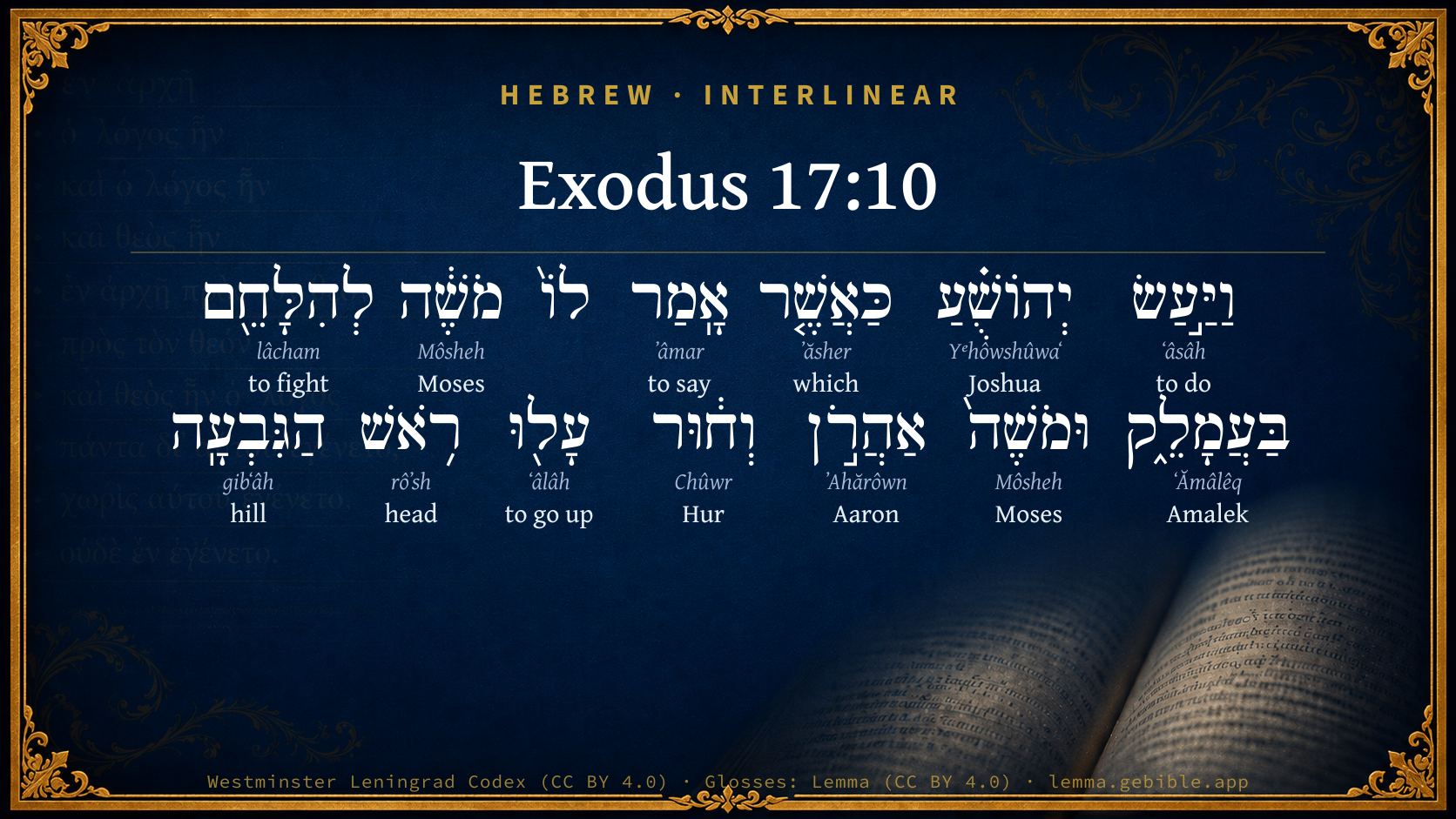
Hebrew (Westminster Leningrad Codex) Exodus 17:10 appears in the Hebrew Old Testament. The text above is from the Westminster Leningrad Codex. Each word links to its Strong’s number, a concise gloss, and parsing drawn from the Open Scriptures Hebrew Bible morphology. Click any word for its full Brown-Driver-Briggs (BDB) entry.
Download image
Cite this verse

Exodus 17:10 (World English Bible). Public Domain. Lemma interlinear Bible study tool, https://lemma.gebible.app/v/exodus/17/10.

Show BibTeX & RIS
BibTeX
RIS
English Translation
So Joshua did as Moses had told him, and fought with Amalek; and Moses, Aaron, and Hur went up to the top of the hill.
World English Bible · Public Domain
Highlights
  • 1 first appearance in the Hebrew Bible
Full analysis ↓
Download a study sheet

One document with this verse’s original text, its word-by-word gloss line, the meaning frame, cross-references with their text, attributed commentary, and full source and license credits — printable, and it pastes into notes with its structure intact.

This verse Autodidact and up

Study sheet (.html) Plain text (.txt)

A passage Seminary Student

Up to 50 verses in one chapter. A passage sheet keeps up to 6 commentary sources and 12 cross-references per verse, in the order this page ranks them, and says so on the sheet whenever that leaves anything out. Ask for a single verse and you get the Autodidact verse sheet above.

Everything on this page stays free to read, with no account — the sheet is a download of what is already on screen, not access to it.

Want to remove ads? Support Godless Engineer
Compare translations 3

The same verse in 3 English versions, stacked beneath the original-language interlinear above. Click any original word for its lexicon entry.

Each is an independent rendering of the whole verse — the interlinear is not word-aligned to these translations.

Highlighted words mark where these versions differ — a whole-verse word diff, not a word-by-word alignment.

  • World English Bible Public Domain
    So Joshua did as Moses had told him, and fought with Amalek; and Moses, Aaron, and Hur went up to the top of the hill.
  • King James Version Public Domain
    So Joshua did as Moses had said to him, and fought with Amalek: and Moses, Aaron, and Hur went up to the top of the hill.
  • unfoldingWord Literal Text CC BY-SA 4.0
    And Joshua did as Moses said to him, to fight Amalek. And Moses, Aaron, and Hur climbed up to the top of the hill.

unfoldingWord Literal Text — © unfoldingWord, licensed CC BY-SA 4.0. Word-aligned USFM3 via Door43 (git.door43.org/unfoldingWord/en_ult).

Versions to compare (up to 4)

3 of 4 selected

Show all 18 translations

Every available English version of this verse, each an independent rendering of the whole verse.

  • World English Bible Public Domain
    So Joshua did as Moses had told him, and fought with Amalek; and Moses, Aaron, and Hur went up to the top of the hill.
  • Berean Standard Bible Public Domain
    Joshua did as Moses had instructed him and fought against the Amalekites, while Moses, Aaron, and Hur went up to the top of the hill.
  • Majority Standard Bible Public Domain
    Joshua did as Moses had instructed him and fought against the Amalekites, while Moses, Aaron, and Hur went up to the top of the hill.
  • King James Version Public Domain
    So Joshua did as Moses had said to him, and fought with Amalek: and Moses, Aaron, and Hur went up to the top of the hill.
  • American Standard Version (1901) Public Domain
    So Joshua did as Moses had said to him, and fought with Amalek: and Moses, Aaron, and Hur went up to the top of the hill.
  • Revised Version (1885) Public Domain
    So Joshua did as Moses had said to him, and fought with Amalek: and Moses, Aaron, and Hur went up to the top of the hill.
  • Geneva Bible (1599) Public Domain
    So Ioshua did as Moses bad him, and fought with Amalek: and Moses, Aaron, and Hur, went vp to the top of the hill.
  • Douay-Rheims (1899) Public Domain
    Josue did as Moses had spoken, and he fought against Amalec; but Moses, and Aaron, and Hur went up upon the top of the hill.
  • Young's Literal Translation Public Domain
    And Joshua doth as Moses hath said to him, to fight with Amalek, and Moses, Aaron, and Hur, have gone up `to' the top of the height;
  • Literal Standard Version CC BY-SA 4.0
    And Joshua does as Moses has said to him, to fight with Amalek, and Moses, Aaron, and Hur have gone up [to] the top of the height;
  • Unlocked Literal Bible CC BY-SA 4.0
    So Joshua fought Amalek as Moses had instructed, while Moses, Aaron, and Hur went up to the top of the hill.
  • unfoldingWord Literal Text CC BY-SA 4.0
    And Joshua did as Moses said to him, to fight Amalek. And Moses, Aaron, and Hur climbed up to the top of the hill.
  • Darby Bible Public Domain
    And Joshua did as Moses had said to him, to fight with Amalek; and Moses, Aaron and Hur went up to the top of the hill.
  • World Messianic Bible Public Domain
    So Joshua did as Moses had told him, and fought with Amalek; and Moses, Aaron, and Hur went up to the top of the hill.
  • Webster's Bible Public Domain
    So Joshua did as Moses had said to him, and fought with Amalek: and Moses, Aaron, and Hur, went up to the top of the hill.
  • Free Bible Version CC BY-SA 4.0
    Joshua did what Moses told him and fought the Amalekites, while Moses, Aaron, and Hur climbed to the top of the hill.
  • Bible in Basic English Public Domain
    So Joshua did as Moses said to him, and went to war with Amalek: and Moses, Aaron, and Hur went up to the top of the hill.
  • JPS Tanakh (1917) Public Domain
    So Joshua did as Moses had said to him, and fought with Amalek; and Moses, Aaron, and Hur went up to the top of the hill.

Literal Standard Version (2020), Covenant Press — licensed CC BY-SA 4.0. Text via the HelloAO Bible API (eBible.org). Unlocked Literal Bible (unfoldingWord) — licensed CC BY-SA 4.0. Text via the HelloAO Bible API (eBible.org). unfoldingWord Literal Text — © unfoldingWord, licensed CC BY-SA 4.0. Word-aligned USFM3 via Door43 (git.door43.org/unfoldingWord/en_ult). Free Bible Version, Dr. Jonathan Gallagher — licensed CC BY-SA 4.0. Text via the HelloAO Bible API (eBible.org).

Word by word

More ways to search: Search by grammar → Find every occurrence → Compare this word →

Practice this passage: Drill this verse → Learn its vocabulary →

וְח֔וּר
Chûwr
H2354
“and · Hur”
Conjunction + Noun, Proper
Part of Speech
Conjunction + Noun
Type
Proper
Full BDB Definition

Origin: the same as H2353 or H2352

TWOT: None

Hur = "hole" - a chief assistant to Moses and Aaron - grandfather of Bezaleel, the chief artificer of the tabernacle; possibly the same as 1 above - the 4th of the 5 kings of Midian who were slain with Balaam after Peor - father of Rephaiah in the time of Nehemiah - father of Ben-Hur who was commissariat officer for Solomon in Mount Ephraim
  1. וַיַּ֣עַשׂ ʻâsâh H6213 “and · to do” Conjunction + Verb, Qal, Sequential Imperfect, 3rd Person, Masculine, Singular
  2. יְהוֹשֻׁ֗עַ Yᵉhôwshûwaʻ H3091 “Joshua” Noun, Proper
  3. כַּאֲשֶׁ֤ר ʼăsher H834 “like/as · which” Preposition + Particle, Relative
  4. אָֽמַר ʼâmar H559 “to say” Verb, Qal, Perfect, 3rd Person, Masculine, Singular
  5. מֹשֶׁ֔ה Môsheh H4872 “Moses” Noun, Proper
  6. לְהִלָּחֵ֖ם lâcham H3898 “to fight” Preposition + Verb, Niphal, Infinitive Construct
  7. בַּעֲמָלֵ֑ק ʻĂmâlêq H6002 “in/at · Amalek” Preposition + Noun, Proper
  8. וּמֹשֶׁה֙ Môsheh H4872 “and · Moses” Conjunction + Noun, Proper
  9. אַהֲרֹ֣ן ʼAhărôwn H175 “Aaron” Noun, Proper
  10. עָל֖וּ ʻâlâh H5927 “to go up” Verb, Qal, Perfect, 3rd Person, Common, Plural
  11. רֹ֥אשׁ rôʼsh H7218 “head of” Noun, Common, Masculine, Singular, Construct
  12. הַגִּבְעָֽה gibʻâh H1389 “the · hill” Particle, Definite Article + Noun, Common, Feminine, Singular, Absolute

About this verse

These counts appear in no published source. They are computed here, from the morphology-tagged text and Lemma’s own curated glosses. What Lemma adds →

14
words
12
distinct lemmas
Pentateuch
section

Notable vocabulary

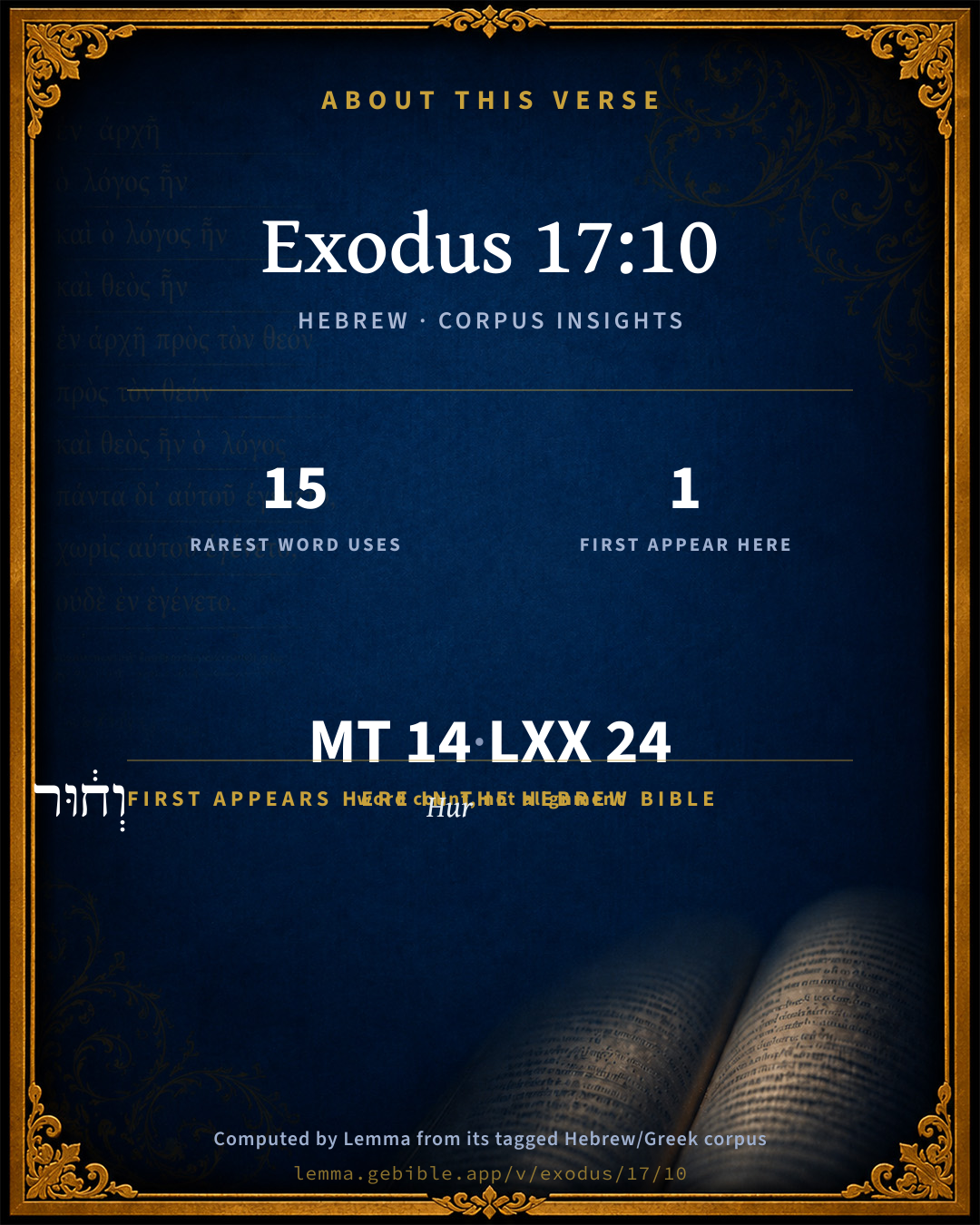
The rarest word here is וְח֔וּר Hur H2354 — appearing just 15 times in the whole Hebrew Bible.

First appearance in Scripture

This word makes its first canonical appearance in the Hebrew Bible here:

  • וְח֔וּר Hur H2354

Shared distinctive vocabulary

וְח֔וּר Hur H2354 occurs in 15 verses of the Hebrew Bible. Also found in:

Grammatical profile

  • 4 verbs
  • 8 nouns
  • 1 preposition
  • 1 particle

Verb forms

  • וַיַּ֣עַשׂ Qal · Sequential Imperfect
  • אָֽמַר Qal · Perfect
  • לְהִלָּחֵ֖ם Niphal · Infinitive Construct
  • עָל֖וּ Qal · Perfect

Repetition

A word recurs within this verse — often emphatic in Hebrew:

  • מֹשֶׁ֔ה Moses H4872 ×2

Hebrew & Septuagint length

In English translation the verse runs 25 words from the Hebrew and 34 from the Septuagint (LXX English) — closely comparable.

A rough comparison of the two English renderings, which tokenize alike — not a word-level alignment.

Word counts can differ between the Hebrew and the Greek without any difference in meaning — e.g. the Hebrew direct-object marker אֵת has no separate Greek word, and Greek often adds the article ὁ.

In the original languages it is 14 Hebrew tokens and 24 Greek tokens — but the two are counted differently (Hebrew bundles its prefixes and suffixes into one token; the Greek is in lemma form), so that isn’t a like-for-like length.

Cross-references

7

Topical passages linked to Exodus 17:10 in the Treasury of Scripture Knowledge — connected by theme and wording, ordered by reader-vote popularity; previews shown in the World English Bible.

  • Exodus 24:14 He said to the elders, "Wait here for us, until we come again to you. Behold, Aaron and Hur are with you. Whoever is involved in a dispute can go to them."
  • Exodus 17:12 But Moses' hands were heavy; and they took a stone, and put it under him, and he sat on it. Aaron and Hur held up his hands, the one on the one side, and the other on the other side. His hands were steady until sunset.
  • Exodus 31:2 "Behold, I have called by name Bezalel the son of Uri, the son of Hur, of the tribe of Judah:
  • Joshua 11:15 As Yahweh commanded Moses his servant, so did Moses command Joshua: and so did Joshua; he left nothing undone of all that Yahweh commanded Moses.
  • Matthew 28:20 teaching them to observe all things that I commanded you. Behold, I am with you always, even to the end of the age." Amen.
  • John 2:5 His mother said to the servants, "Whatever he says to you, do it."
  • John 15:14 You are my friends, if you do whatever I command you.

Cross-references courtesy of OpenBible.info (CC BY 4.0).

Hebrew and Greek witnesses Masoretic Hebrew ↔ Greek Septuagint

The same verse in the two great witnesses to the Old Testament, shown verse-for-verse.

These are two independent witnesses, not word-aligned to each other, and the Septuagint is shown in lemma (dictionary) form.

Hebrew Exodus 17:10 Masoretic · Westminster Leningrad Codex

וַיַּ֣עַשׂ יְהוֹשֻׁ֗עַ כַּאֲשֶׁ֤ר אָֽמַר לוֹ֙ מֹשֶׁ֔ה לְהִלָּחֵ֖ם בַּעֲמָלֵ֑ק וּמֹשֶׁה֙ אַהֲרֹ֣ן וְח֔וּר עָל֖וּ רֹ֥אשׁ הַגִּבְעָֽה

So Joshua did as Moses had told him, and fought with Amalek; and Moses, Aaron, and Hur went up to the top of the hill.

World English Bible · Public Domain

Greek LXX Exodus 17:10 Septuagint · lemma form

καί ποιέω ἰησοῦς καθάπερ εἶπον αὐτός μωυσῆς καί ἐκἔρχομαι παρατάσσω ὁ αμαληκ καί μωυσῆς καί ααρων καί ωρ ἀναβαίνω ἐπί ὁ κορυφή ὁ βουνός

And Joshua did as Moses said to him, and he went out and set the army in array against Amalec, and Moses and Aaron and Or went up to the top of the hill.

LXX2012 (modern English Septuagint) · Public Domain

Hebrew: Westminster Leningrad Codex (CC BY 4.0). Greek: Septuagint (public domain); English from LXX2012 (modern English Septuagint) (Public Domain). How the Septuagint differs from the Hebrew →

Targum (Aramaic paraphrase)

2

The Targum is the ancient Jewish Aramaic paraphrase of the Hebrew Scriptures — an interpretive translation, not the Hebrew text itself. Onkelos (literal) and Pseudo-Jonathan (expansive) render the Torah, and Jonathan the Prophets. Coverage is partial: where no permissively-licensed English translation exists for a verse, only the Aramaic is shown. This is verse-level text, not a word-by-word alignment to the Hebrew.

  1. Targum Onkelos Torah (Genesis–Deuteronomy)
    וַעֲבַד יְהוֹשֻׁעַ כְּמָא דְאֲמַר לֵהּ משֶׁה לְאַגָחָא קְרָבָא בַּעֲמָלֵק וּמשֶׁה אַהֲרֹן וְחוּר סְלִיקוּ לְרֵישׁ רָמָתָא:

    (no public-domain English translation for this verse)

    Targum Onkelos — Aramaic: “Onkelos Genesis” (public domain); “Onkelos Exodus” (public domain); “Onkelos Leviticus” (public domain); “Onkelos Numbers” (public domain); “Onkelos Deuteronomy” (public domain). English: “Sefaria Community Translation” (CC0 1.0 (public-domain dedication)); “J.W. Etheridge. The Targums of Onkelos and Jonathan Ben Uzziel on the Pentateuch. London: Longmans, Green, 1862” (public domain). Text via Sefaria.

  2. Targum Pseudo-Jonathan Torah (Genesis–Deuteronomy)
    וְעָבַד יְהוֹשֻׁעַ הֵיכְמָא דְאָמַר לֵיהּ משֶׁה לְאַגָחָא קְרָבָא בַּעֲמָלֵק וּמשֶׁה אַהֲרן וְחוּר סְלִיקוּ לְרֵישׁ רָמָתָא

    And Jehoshua did as Mosheh had bidden him, to wage war with Amalek. And Mosheh, and Aharon, and Hur went up to the top of the height.

    Targum Pseudo-Jonathan — Aramaic: “Targum Jonathan on Genesis” (public domain); “Targum Jonathan on Exodus” (public domain); “Targum Jonathan on Leviticus” (public domain); “Targum Jonathan on Numbers” (public domain); “Targum Jonathan on Deuteronomy” (public domain). English: “The Targum of Jonathan ben Uzziel, trans. J. W. Etheridge, London, 1862” (public domain). Text via Sefaria.

Commentary

Notes on Exodus 17:10 from classic Christian and Jewish commentators (each source and its license shown beneath its notes). The classic Christian expositions comment on the surrounding passage and are grouped to its opening verse, so a note may address several verses; the Jewish commentaries on the Tanakh (Rashi and others) are per-verse, so they appear only where the commentator wrote on this verse.

Lemma curates 59 commentaries, every one of them public domain or Creative Commons licensed, each selected and text-cleaned for this edition rather than reprinted as found. About our sources →

Trapp's Complete Commentary

John Trapp

Exo 17:10 So Joshua did as Moses had said to him, and fought with Amalek: and Moses, Aaron, and Hur went up to the top of the hill.

Ver. 10. Aaron, and Hur.] This Hur, saith Josephus, was husband to Miriam, and Moses’s deputy. {Exo 24:14}

Went up to the top of a hill.] To pray together. In the congregation where the saints are praying, there the arrow, shield, and spear are broken. {Psa 76:3} From thence shalt thou help us, said the people to David; {2Sa 18:3} that is, thy prayers shall prevail with God for our assistance. Non tam praeliando quam precando. The king of Sweden, as soon as he set foot in Germany, fell down to prayer, and he proved very victorious.

John Trapp, A Commentary or Exposition upon All the Books of the Old and New Testament (1647–1656) — public domain. Text from a community e-Sword module.

Joseph Benson's Commentary

Exo 17:10-11. Hur — A person of eminence, no doubt, but who he was is uncertain. Josephus, however, tells us, he was the husband of Miriam, Antiq., 50:3, chap. 2. And when Moses held up his hand in prayer (so the Chaldee explains it) Israel prevailed: but when he let down his hand from prayer Amalek prevailed — To convince Israel that the hand of Moses (with whom they had just now been chiding) contributed more to their safety than their own hands; the success rises and falls, as Moses lifts up or lets down his hand. The Church’s cause is ordinarily more or less successful, according as the Church’s friends are more or less fervent in prayer.

Joseph Benson's Commentary on the Old and New Testaments (1811–1818) — public domain. Text from a community e-Sword module.

Jamieson, Fausset & Brown

Robert Jamieson, A. R. Fausset & David Brown

Moses . . . went up . . . the hill . . . held up his hand--with the wonder-working rod; Moses acted as the standard bearer of Israel, and also their intercessor, praying for success and victory to crown their arms--the earnestness of his feelings being conspicuously evinced amid the feebleness of nature.

Jamieson, Fausset & Brown — Commentary Critical and Explanatory on the Whole Bible (1871) — public domain (CC PDM 1.0). Text via the HelloAO Bible API.

Adam Clarke's Commentary

Verse 10. Moses, Aaron, and Hur went up] It is likely that the Hur mentioned here is the same with that Hur mentioned 1Ch 2:19, who appears from the chronology in that chapter to have been the son of Caleb, the son of Ezron, the son of Pharez, the son of Judah. The rabbins and Josephus say he was the brother-in-law of Moses, having married his sister Miriam. He was a person in whom Moses put much confidence; for he left him conjoint governor of the people with Aaron, when he went to confer with God on the mount, Ex 24:14. His grandson Bezaleel was the chief director in the work of the tabernacle; see Ex 31:2-5.

Adam Clarke's Commentary on the Bible (1810–1826) — public domain. Text from a community e-Sword/MySword module.

Ellicott's Commentary for English Readers

(10) Moses, Aaron, and Hur went up.—Moses, we know, was eighty years of age (Exo_7:7); Aaron was eighty-three; Hur, the grandfather of Bezaleel (Exo_31:2), the architect of the Tabernacle, can scarcely have been less. Unfit for battle themselves, they felt it was by prayer and intercession that they could best help forward a good result, and so withdrew themselves from the actual conflict to a place where they could command it.

Hur.—According to Jewish tradition (Joseph., Ant. Jud., iii. 2, § 4) Hur was the husband of Miriam, and so the brother-in-law of Moses and Aaron. He was a descendant of Judah through Pharez and Hezron. (1Ch_2:3-20.) Moses left him joint regent with Aaron When he ascended up into Sinai (Exo_24:14).

A Bible Commentary for English Readers, edited by Charles John Ellicott (1878–1897) — public domain. Text from a community e-Sword module.

The Cambridge Bible for Schools and Colleges

gen. ed. J. J. S. Perowne

10. Hur] Although mentioned besides only in Exo_24:14, Hur must have been a man of some importance at the time of the Exodus. No particulars are given about his family. It is not probable that he is identical with the grandfather of Beẓal’el, of the same name, Exo_31:2, &c. Later Jewish tradition (Jos. Ant. iii. 2. 4) makes him Miriam’s husband.

The Cambridge Bible for Schools and Colleges (gen. ed. J. J. S. Perowne; Cambridge University Press, 1878–1918) — public domain. Text from a community e-Sword module.

John Gill's Exposition

So Joshua did as Moses had said to him,.... He singled out some proper persons for the battle, and arrayed them with armour, and led them forth out of the camp, and went forth at the head of them:

and fought with Amalek; upon both armies meeting, a battle ensued:

and Moses, Aaron, and Hur, went up to the top of the hill; to the top of Mount Sinai or Horeb, not so much to see the battle fought, as to be seen by Joshua and the people of Israel, especially Moses with the rod in his hand lifted up, that they might behold it, and be encouraged through it to hope for and expect victory; and the other two went up with him to assist him in holding up his hands with the rod, as appears by what follows. Aaron, it is well known, was his brother, but who Hur was is not so clear, though no doubt a very eminent and principal man. There was an Hur, the son of Caleb, who descended from Judah in the line of Phares and Hezron, and which Hur was the grandfather of Bezaleel Ch1 2:5, but whether the same with this cannot be said with certainty; it is most likely that he was the husband of Miriam, as Josephus says (w), and so the brother-in-law of Moses and Aaron; though some Jewish writers say (x) that he was their sister's son, the son of Miriam.

(w) Antiqu. l. 3. c. 2. sect. 4. (x) Pirke Eliezer, c. 45. Shalshalet Hakabala, fol. 7. 1.

John Gill's Exposition of the Whole Bible (1746–1763) — public domain (CC PDM 1.0). Text via the HelloAO Bible API.

Albert Barnes' Notes on the Bible

Hur - Again mentioned with Aaron, in Exo 24:14. He was grandfather of Bezaleel, the great sculptor and artificer of the tabernacle, Exo 31:2-5, and belonged to the tribe of Judah. (See 1Ch 2:18-20.)

Albert Barnes' Notes on the Bible (1834–1885) — public domain. Text from a community e-Sword/MySword module.

Haydock's Catholic Bible Commentary

Hur, grandfather of Beseleel, (1 Paralipomenon ii. 19,) grandson of Esron by Caleb.

George Leo Haydock (1774–1849), Haydock's Catholic Family Bible and Commentary, 1859 edition — public domain. Excludes Psalms (Douay-Rheims chapter numbering differs from Protestant) and Deuterocanonical books (Catholic canon only).

Matthew Poole's English Annotations

Hur; a person of eminency both for wisdom and experience, and for place and authority, supposed to be the husband of Miriam. See Exo 24:14.

Matthew Poole's English Annotations on the Holy Bible (1683–1685) — public domain. Text from a community e-Sword/MySword module.

The Pulpit Commentary

Hur. Hur has not been mentioned hitherto. According to one Jewish tradition, he was the son, according to another, the husband of Miriam. Scripture only tells us of him, that he was descended from Judah, through Caleb the son of Hezron, (1Ch_2:18-20) and that his grandson, Bezaleel, was the artificer of the tabernacle. (Exo_31:2) He is again associated with Aaron in Exo_24:14.

The Pulpit Commentary (1880–1919), ed. H.D.M. Spence-Jones & Joseph S. Exell — public domain. Text from a community e-Sword module.

John Wesley's Explanatory Notes

Hur is supposed to have been the husband of Miriam.

John Wesley, Explanatory Notes Upon the Whole Bible (1754–1765) — public domain. Text via the GEBible commentary corpus.

Rashi

Rabbi Shlomo Yitzchaki (Rashi)

AND MOSES AND AARON AND HUR — From this we may infer as regards a public fast that three men must pass before the Holy Ark (i. e. must officiate at prayer) — we may infer this because they (the Israelites) were then engaged in fasting (Mekhilta).

חור HUR was the son of Miriam and her husband was Caleb (Sotah 11b).

Rashi on the Tanakh — English translations: “The Judaica Press complete Tanach with Rashi, translated by A. J. Rosenberg” (CC BY 4.0); “Pentateuch with Rashi's commentary by M. Rosenbaum and A.M. Silbermann, 1929-1934” (public domain); “The Metsudah Tanach series, Lakewood, N.J” (CC BY 4.0); and “The Book of Joshua, Metsudah Publications, 1997” (CC BY 4.0). Text via Sefaria.

Lesson kit

Teaching starters — assembled from the data on this page, not authored interpretation. Every prompt links to the verse data it draws on. Edit before teaching.

Exodus, in the Pentateuch, opens this verse with 14 words (12 distinct Hebrew lemmas). Its most distinctive word is Chûwr (“Hur”). A historical commentator’s framing appears above. Read the whole chapter for the surrounding context.

Discussion questions

  1. How does “Hur” (Chûwr) shape what this verse is saying?
  2. This is the first place “Hur” appears in Scripture (first appears here). What does its debut here establish?
  3. How does Exodus 17:12, which shares the word «Hur», read alongside this verse?
  4. What does the repetition of “Moses” (2× in this one verse) do in this verse?
  5. These translations render this verse differently; the difference is in the English rendering, not the original. What questions does that raise?
  6. «וַיַּ֣עַשׂ» is a Qal Sequential Imperfect verb. How does that grammatical form shape the action described?
  7. Compare how Trapp's Complete Commentary and Joseph Benson's Commentary read this verse. Where do they agree or differ?

Things to notice

Reading settings

Reading text

Shown beneath each verse's original-language words.

Old Testament
Old Testament edition

Read the OT as the Masoretic Hebrew (MT) or the Greek Septuagint (LXX).

English shown for the Greek Septuagint (in the Hebrew ↔ Greek comparison).

Comparing translations? Open the Compare panel on any verse page to stack up to four side by side.