Exodus 40:36

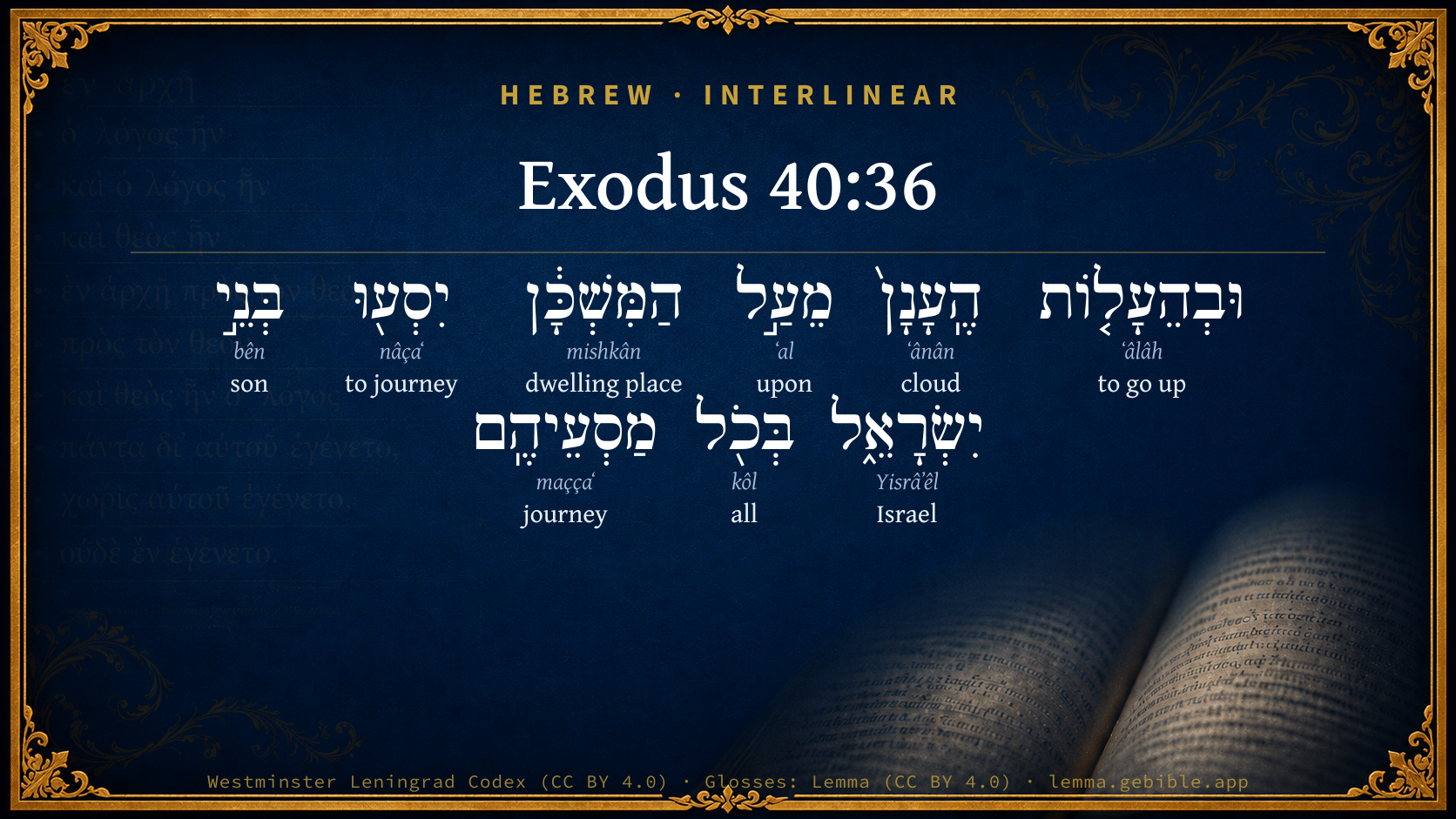
Hebrew (Westminster Leningrad Codex) Exodus 40:36 appears in the Hebrew Old Testament. The text above is from the Westminster Leningrad Codex. Each word links to its Strong’s number, a concise gloss, and parsing drawn from the Open Scriptures Hebrew Bible morphology. Click any word for its full Brown-Driver-Briggs (BDB) entry.
Download image
Cite this verse

Exodus 40:36 (World English Bible). Public Domain. Lemma interlinear Bible study tool, https://lemma.gebible.app/v/exodus/40/36.

Show BibTeX & RIS
BibTeX
RIS
English Translation
When the cloud was taken up from over the tent, the children of Israel went onward, throughout all their journeys;
World English Bible · Public Domain
Download a study sheet

One document with this verse’s original text, its word-by-word gloss line, the meaning frame, cross-references with their text, attributed commentary, and full source and license credits — printable, and it pastes into notes with its structure intact.

This verse Autodidact and up

Study sheet (.html) Plain text (.txt)

A passage Seminary Student

Up to 50 verses in one chapter. A passage sheet keeps up to 6 commentary sources and 12 cross-references per verse, in the order this page ranks them, and says so on the sheet whenever that leaves anything out. Ask for a single verse and you get the Autodidact verse sheet above.

Everything on this page stays free to read, with no account — the sheet is a download of what is already on screen, not access to it.

Want to remove ads? Support Godless Engineer
Compare translations 3

The same verse in 3 English versions, stacked beneath the original-language interlinear above. Click any original word for its lexicon entry.

Each is an independent rendering of the whole verse — the interlinear is not word-aligned to these translations.

Highlighted words mark where these versions differ — a whole-verse word diff, not a word-by-word alignment.

  • World English Bible Public Domain
    When the cloud was taken up from over the tent, the children of Israel went onward, throughout all their journeys;
  • King James Version Public Domain
    And when the cloud was taken up from over the tabernacle, the children of Israel went onward in all their journeys:
  • unfoldingWord Literal Text CC BY-SA 4.0
    And whenever the cloud was taken up from over the Dwelling, the sons of Israel would set out on all their travels,

unfoldingWord Literal Text — © unfoldingWord, licensed CC BY-SA 4.0. Word-aligned USFM3 via Door43 (git.door43.org/unfoldingWord/en_ult).

Versions to compare (up to 4)

3 of 4 selected

Show all 18 translations

Every available English version of this verse, each an independent rendering of the whole verse.

  • World English Bible Public Domain
    When the cloud was taken up from over the tent, the children of Israel went onward, throughout all their journeys;
  • Berean Standard Bible Public Domain
    Whenever the cloud was lifted from above the tabernacle, the Israelites would set out through all the stages of their journey.
  • Majority Standard Bible Public Domain
    Whenever the cloud was lifted from above the tabernacle, the Israelites would set out through all the stages of their journey.
  • King James Version Public Domain
    And when the cloud was taken up from over the tabernacle, the children of Israel went onward in all their journeys:
  • American Standard Version (1901) Public Domain
    And when the cloud was taken up from over the tabernacle, the children of Israel went onward, throughout all their journeys:
  • Revised Version (1885) Public Domain
    And when the cloud was taken up from over the tabernacle, the children of Israel went onward, throughout all their journeys:
  • Geneva Bible (1599) Public Domain
    Nowe when the cloude ascended vp from the Tabernacle, the children of Israel went forward in all their iourneyes.
  • Douay-Rheims (1899) Public Domain
    For the cloud of the Lord hung over the tabernacle by day, and a fire by night, in the sight of all the children of Israel throughout all their mansions.
  • Young's Literal Translation Public Domain
    And in the going up of the cloud from off the tabernacle the sons of Israel journey in all their journeys;
  • Literal Standard Version CC BY-SA 4.0
    And in the going up of the cloud from off the Dwelling Place the sons of Israel journey in all their journeys;
  • Unlocked Literal Bible CC BY-SA 4.0
    Whenever the cloud was taken up from over the tabernacle, the people of Israel would set out on their journey.
  • unfoldingWord Literal Text CC BY-SA 4.0
    And whenever the cloud was taken up from over the Dwelling, the sons of Israel would set out on all their travels,
  • Darby Bible Public Domain
    And when the cloud was taken up from over the tabernacle, the children of Israel journeyed in all their journeys.
  • World Messianic Bible Public Domain
    When the cloud was taken up from over the tabernacle, the children of Israel went onward, throughout all their journeys;
  • Webster's Bible Public Domain
    And when the cloud was taken up from over the tabernacle, the children of Israel went onward in all their journeys:
  • Free Bible Version CC BY-SA 4.0
    Whenever the cloud rose from the Tabernacle, the Israelites would set off again on their journey.
  • Bible in Basic English Public Domain
    And whenever the cloud was taken up from the House, the children of Israel went forward on their journey:
  • JPS Tanakh (1917) Public Domain
    And whenever the cloud was taken up from over the tabernacle, the children of Israel went onward, throughout all their journeys.

Literal Standard Version (2020), Covenant Press — licensed CC BY-SA 4.0. Text via the HelloAO Bible API (eBible.org). Unlocked Literal Bible (unfoldingWord) — licensed CC BY-SA 4.0. Text via the HelloAO Bible API (eBible.org). unfoldingWord Literal Text — © unfoldingWord, licensed CC BY-SA 4.0. Word-aligned USFM3 via Door43 (git.door43.org/unfoldingWord/en_ult). Free Bible Version, Dr. Jonathan Gallagher — licensed CC BY-SA 4.0. Text via the HelloAO Bible API (eBible.org).

Word by word

More ways to search: Search by grammar → Find every occurrence → Compare this word →

Practice this passage: Drill this verse → Learn its vocabulary →

מַסְעֵיהֶֽם
maççaʻ
H4550
“journeys · their”
Noun, Common, Masculine, Plural, Construct + Suffix, Personal, 3rd Person, Masculine, Plural
Part of Speech
Noun
Type
Common
Gender
Masculine
Number
Plural
State
Construct
Full BDB Definition

Origin: from H5265

TWOT: 1380a

a pulling up (of stakes), breaking camp, setting out, journey - pulling up, breaking camp - setting out - station, stage, journey
  1. וּבְהֵעָל֤וֹת ʻâlâh H5927 “and · in/at · to go up” Conjunction + Preposition + Verb, Niphal, Infinitive Construct
  2. הֶֽעָנָן֙ ʻânân H6051 “the · cloud” Particle, Definite Article + Noun, Common, Masculine, Singular, Absolute
  3. מֵעַ֣ל ʻal H5921 “from · upon” Preposition + Preposition
  4. הַמִּשְׁכָּ֔ן mishkân H4908 “the · dwelling place” Particle, Definite Article + Noun, Common, Masculine, Singular, Absolute
  5. יִסְע֖וּ nâçaʻ H5265 “to journey” Verb, Qal, Imperfect, 3rd Person, Masculine, Plural
  6. בְּנֵ֣י bên H1121 “sons of” Noun, Common, Masculine, Plural, Construct
  7. יִשְׂרָאֵ֑ל Yisrâʼêl H3478 “Israel” Noun, Proper
  8. בְּכֹ֖ל kôl H3605 “in/at · all of” Preposition + Noun, Common, Masculine, Singular, Construct

About this verse

These counts appear in no published source. They are computed here, from the morphology-tagged text and Lemma’s own curated glosses. What Lemma adds →

9
words
9
distinct lemmas
Pentateuch
section

Notable vocabulary

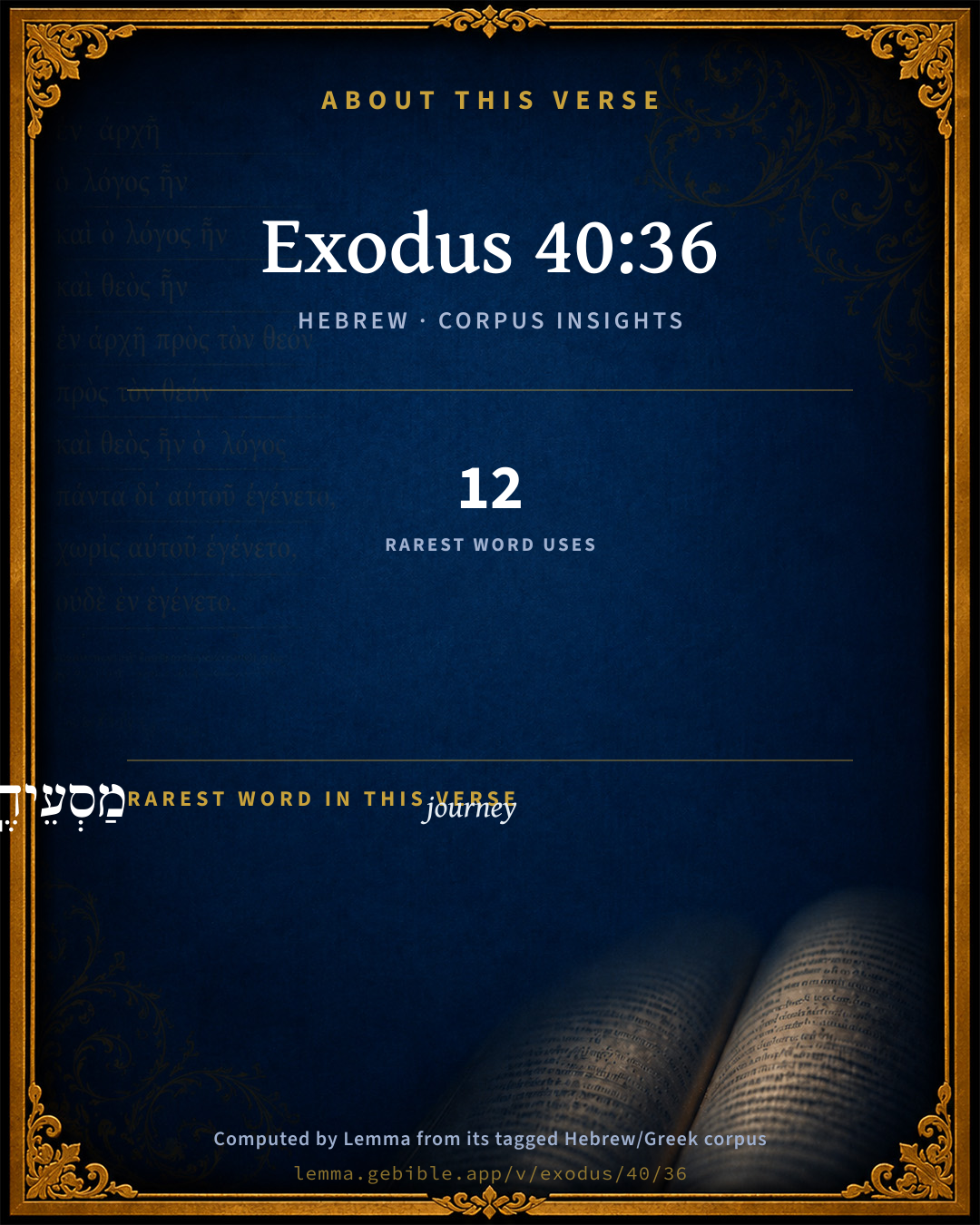
The rarest word here is מַסְעֵיהֶֽם journey H4550 — appearing just 12 times in the whole Hebrew Bible.

Shared distinctive vocabulary

מַסְעֵיהֶֽם journey H4550 occurs in 11 verses of the Hebrew Bible. Also found in:

Grammatical profile

  • 2 verbs
  • 6 nouns
  • 1 preposition

Verb forms

  • וּבְהֵעָל֤וֹת Niphal · Infinitive Construct
  • יִסְע֖וּ Qal · Imperfect

Hebrew & Septuagint length

In English translation the verse runs 20 words from the Hebrew and 19 from the Septuagint (LXX English) — closely comparable.

A rough comparison of the two English renderings, which tokenize alike — not a word-level alignment.

Word counts can differ between the Hebrew and the Greek without any difference in meaning — e.g. the Hebrew direct-object marker אֵת has no separate Greek word, and Greek often adds the article ὁ.

Cross-references

10

Topical passages linked to Exodus 40:36 in the Treasury of Scripture Knowledge — connected by theme and wording, ordered by reader-vote popularity; previews shown in the World English Bible.

  • Nehemiah 9:19 yet you in your manifold mercies didn't forsake them in the wilderness: the pillar of cloud didn't depart from over them by day, to lead them in the way; neither the pillar of fire by night, to show them light, and the way in which they should go.
  • Numbers 9:17 Whenever the cloud was taken up from over the Tent, then after that the children of Israel traveled; and in the place where the cloud remained, there the children of Israel encamped.
  • Exodus 13:21–22 Yahweh went before them by day in a pillar of cloud, to lead them on their way, and by night in a pillar of fire, to give them light, that they might go by day and by night:
  • Numbers 10:11–13 It happened in the second year, in the second month, on the twentieth day of the month, that the cloud was taken up from over the tent of the testimony.
  • Numbers 10:33–36 They set forward from the Mount of Yahweh three days' journey; and the ark of the covenant of Yahweh went before them three days' journey, to seek out a resting-place for them.
  • Numbers 19:17–22 For the unclean they shall take of the ashes of the burning of the sin-offering; and running water shall be put thereto in a vessel:
  • Psalms 78:14 In the daytime he also led them with a cloud, And all night with a light of fire.
  • Psalms 105:39 He spread a cloud for a covering, Fire to give light in the night.
  • 1 Corinthians 10:1 Now I would not have you ignorant, brothers, that our fathers were all under the cloud, and all passed through the sea;
  • 2 Corinthians 5:19–20 namely, that God was in Christ reconciling the world to himself, not reckoning to them their trespasses, and having committed to us the word of reconciliation.

Cross-references courtesy of OpenBible.info (CC BY 4.0).

Hebrew and Greek witnesses Masoretic Hebrew ↔ Greek Septuagint

The same verse in the two great witnesses to the Old Testament, shown verse-for-verse.

These are two independent witnesses, not word-aligned to each other, and the Septuagint is shown in lemma (dictionary) form.

Hebrew Exodus 40:36 Masoretic · Westminster Leningrad Codex

וּבְהֵעָל֤וֹת הֶֽעָנָן֙ מֵעַ֣ל הַמִּשְׁכָּ֔ן יִסְע֖וּ בְּנֵ֣י יִשְׂרָאֵ֑ל בְּכֹ֖ל מַסְעֵיהֶֽם

When the cloud was taken up from over the tent, the children of Israel went onward, throughout all their journeys;

World English Bible · Public Domain

Greek LXX Exodus 40:36 Septuagint · lemma form
And when the cloud went up from the tabernacle, the children of Israel prepared to depart with their baggage.

LXX2012 (modern English Septuagint) · Public Domain

Hebrew: Westminster Leningrad Codex (CC BY 4.0). Greek: Septuagint (public domain); English from LXX2012 (modern English Septuagint) (Public Domain). How the Septuagint differs from the Hebrew →

Targum (Aramaic paraphrase)

2

The Targum is the ancient Jewish Aramaic paraphrase of the Hebrew Scriptures — an interpretive translation, not the Hebrew text itself. Onkelos (literal) and Pseudo-Jonathan (expansive) render the Torah, and Jonathan the Prophets. Coverage is partial: where no permissively-licensed English translation exists for a verse, only the Aramaic is shown. This is verse-level text, not a word-by-word alignment to the Hebrew.

  1. Targum Onkelos Torah (Genesis–Deuteronomy)
    וּבְאִסְתַּלָקוּת עֲנָנָא מֵעִלָוֵי מַשְׁכְּנָא נָטְלִין בְּנֵי יִשְׂרָאֵל בְּכֹל מַטְלָנֵיהוֹן:

    (no public-domain English translation for this verse)

    Targum Onkelos — Aramaic: “Onkelos Genesis” (public domain); “Onkelos Exodus” (public domain); “Onkelos Leviticus” (public domain); “Onkelos Numbers” (public domain); “Onkelos Deuteronomy” (public domain). English: “Sefaria Community Translation” (CC0 1.0 (public-domain dedication)); “J.W. Etheridge. The Targums of Onkelos and Jonathan Ben Uzziel on the Pentateuch. London: Longmans, Green, 1862” (public domain). Text via Sefaria.

  2. Targum Pseudo-Jonathan Torah (Genesis–Deuteronomy)
    וּבְאִישׁוֹן אִסְתַּלְקוּת עֲנַן יְקָרָא מֵעִלַוֵי מַשְׁכְּנָא נַטְלִין בְּנֵי יִשְרָאֵל בְּכָל מַטְלָנֵיהוֹן

    At the time when the Cloud of Glory ascended from the tabernacle, the sons of Israel went forward in all their journeys;

    Targum Pseudo-Jonathan — Aramaic: “Targum Jonathan on Genesis” (public domain); “Targum Jonathan on Exodus” (public domain); “Targum Jonathan on Leviticus” (public domain); “Targum Jonathan on Numbers” (public domain); “Targum Jonathan on Deuteronomy” (public domain). English: “The Targum of Jonathan ben Uzziel, trans. J. W. Etheridge, London, 1862” (public domain). Text via Sefaria.

Commentary

Notes on Exodus 40:36 from classic Christian and Jewish commentators (each source and its license shown beneath its notes). The classic Christian expositions comment on the surrounding passage and are grouped to its opening verse, so a note may address several verses; the Jewish commentaries on the Tanakh (Rashi and others) are per-verse, so they appear only where the commentator wrote on this verse.

Lemma curates 59 commentaries, every one of them public domain or Creative Commons licensed, each selected and text-cleaned for this edition rather than reprinted as found. About our sources →

Trapp's Complete Commentary

John Trapp

Exo 40:36 And when the cloud was taken up from over the tabernacle, the children of Israel went onward in all their journeys:

Ver. 36. The children of Israel went.] The Jews conceive that this cloud that led Israel through the wilderness, levelled mountains, raised valleys, and laid all aflat: that it burnt up bushes, and smoothed rocks, and made all plain, &c. See Luk 3:5 Isa 4:5

John Trapp, A Commentary or Exposition upon All the Books of the Old and New Testament (1647–1656) — public domain. Text from a community e-Sword module.

Jamieson, Fausset & Brown

Robert Jamieson, A. R. Fausset & David Brown

when the cloud was taken up from over the tabernacle--In journeying through the sandy, trackless deserts of the East, the use of torches, exhibiting a cloud of smoke by day and of fire by night, has been resorted to from time immemorial. The armies of Darius and Alexander were conducted on their marches in this manner [FABER]. The Arab caravans in the present day observe the same custom; and materials for these torches are stored up among other necessary preparations for a journey. Live fuel, hoisted in chafing dishes at the end of long poles, and being seen at a great distance, serves, by the smoke in the daytime and the light at night, as a better signal for march than the sound of a trumpet, which is not heard at the extremities of a large camp [LABORDE]. This usage, and the miracle related by Moses, mutually illustrate each other. The usage leads us to think that the miracle was necessary, and worthy of God to perform; and, on the other hand, the miracle of the cloudy pillar, affording double benefit of shade by day and light at night, implies not only that the usage was not unknown to the Hebrews, but supplied all the wants which they felt in common with other travellers through those dreary regions [FABER, HESS, GRANDPIERRE]. But its peculiar appearance, unvarying character, and regular movements, distinguished it from all the common atmospheric phenomena. It was an invaluable boon to the Israelites, and being recognized by all classes among that people as the symbol of the Divine Presence, it guided their journeys and regulated their encampments (compare Psa 29:1-11; Psa. 105:1-45).

Jamieson, Fausset & Brown — Commentary Critical and Explanatory on the Whole Bible (1871) — public domain (CC PDM 1.0). Text via the HelloAO Bible API.

Adam Clarke's Commentary

Verse 36. When the cloud was taken up] The subject of these three last verses has been very largely explained in the notes on Ex 13:21, to which, as well as to the general remarks on that chapter, the reader is requested immediately to refer. See Clarke on Ex 13:21.

Adam Clarke's Commentary on the Bible (1810–1826) — public domain. Text from a community e-Sword/MySword module.

Ellicott's Commentary for English Readers

(36-38) The cloud was henceforth, in a peculiar way, attached to the Tabernacle. As a cloud it rested upon it by day; as a pillar of fire by night. Only in one case was it removed, viz., when it was the Divine will that Israel should march. (See Num_9:15-22.)

A Bible Commentary for English Readers, edited by Charles John Ellicott (1878–1897) — public domain. Text from a community e-Sword module.

The Cambridge Bible for Schools and Colleges

gen. ed. J. J. S. Perowne

36. went onward] lit. plucked up (tent-pegs), i.e. broke up camp, the usual Heb. expression for set out. The verb is cognate with ‘journeys,’ and is rendered ‘journeyed’ in v. 37. Comp. on Exo_12:37, and Exo_17:1.

36–38. The tenses are throughout frequentative (used to go onward, used not to journey, used to be), describing what was the case habitually during the journeyings in the wilderness. Cf. Num_9:16-23; Num_10:34; also Exo_10:11 f. (all P). For the divergent representations of J and E, see on Exo_13:21-22.

The Cambridge Bible for Schools and Colleges (gen. ed. J. J. S. Perowne; Cambridge University Press, 1878–1918) — public domain. Text from a community e-Sword module.

Haydock's Catholic Bible Commentary

A fire. The same cloud overshadowed the camp by day, and enlightened it by night. (Chaldean; Chap. xiii. 22.)

George Leo Haydock (1774–1849), Haydock's Catholic Family Bible and Commentary, 1859 edition — public domain. Excludes Psalms (Douay-Rheims chapter numbering differs from Protestant) and Deuterocanonical books (Catholic canon only).

The Pulpit Commentary

Vers. 36-38. And wheni.e. "whensoever." The last three verses describe the manner in which the cloud henceforth served the Israelites as guide not only directing their course, but determining when they were to move, and how long they were to rest at each encampment. For a further account of the same, see Num_9:15-23.

The Pulpit Commentary (1880–1919), ed. H.D.M. Spence-Jones & Joseph S. Exell — public domain. Text from a community e-Sword module.

unfoldingWord translationNotes

Door43 World Missions Community

was taken up from over

This can be stated in active form. AT: "rose up from" (See: Active or Passive)

that it was lifted up

This can be stated in active form. AT: "when it rose up" (See: Active or Passive)

translationWords

tabernacle

Israel

raise

Yahweh

fire

unfoldingWord translationNotes — © Distant Shores Media and the Door43 World Missions Community, licensed CC BY-SA 4.0. Source: git.door43.org/Door43/en_tn.

Lesson kit

Teaching starters — assembled from the data on this page, not authored interpretation. Every prompt links to the verse data it draws on. Edit before teaching.

Exodus, in the Pentateuch, opens this verse with 9 words (9 distinct Hebrew lemmas). Its most distinctive word is maççaʻ (“journey”). A historical commentator’s framing appears above. Read the whole chapter for the surrounding context.

Discussion questions

  1. How does “journey” (maççaʻ) shape what this verse is saying?
  2. How does Genesis 13:3, which shares the word «journey», read alongside this verse?
  3. The translations on this page render this verse differently — a whole-verse word diff, not a word-by-word alignment. What might account for the different wordings?
  4. «וּבְהֵעָל֤וֹת» is a Niphal Infinitive Construct verb. How does that grammatical form shape the action described?
  5. Compare how Trapp's Complete Commentary and Jamieson, Fausset & Brown read this verse. Where do they agree or differ?

Things to notice

Reading settings

Reading text

Shown beneath each verse's original-language words.

Old Testament
Old Testament edition

Read the OT as the Masoretic Hebrew (MT) or the Greek Septuagint (LXX).

English shown for the Greek Septuagint (in the Hebrew ↔ Greek comparison).

Comparing translations? Open the Compare panel on any verse page to stack up to four side by side.