Deuteronomy 30:12

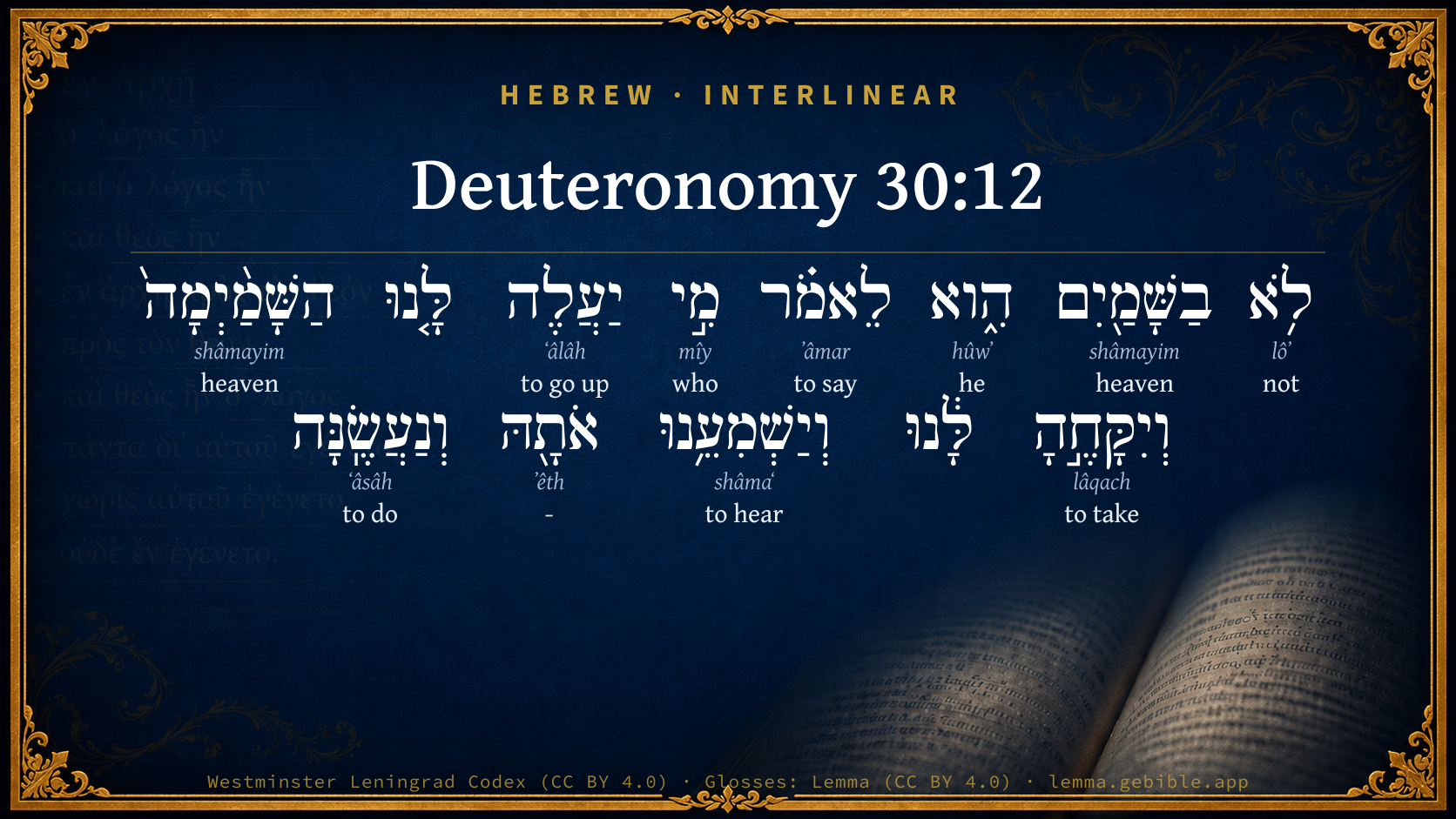
Hebrew (Westminster Leningrad Codex) Deuteronomy 30:12 appears in the Hebrew Old Testament. The text above is from the Westminster Leningrad Codex. Each word links to its Strong’s number, a concise gloss, and parsing drawn from the Open Scriptures Hebrew Bible morphology. Click any word for its full Brown-Driver-Briggs (BDB) entry.
Download image
Cite this verse

Deuteronomy 30:12 (World English Bible). Public Domain. Lemma interlinear Bible study tool, https://lemma.gebible.app/v/deuteronomy/30/12.

Show BibTeX & RIS
BibTeX
RIS
English Translation
It is not in heaven, that you should say, Who shall go up for us to heaven, and bring it to us, and make us to hear it, that we may do it?
World English Bible · Public Domain
Download a study sheet

One document with this verse’s original text, its word-by-word gloss line, the meaning frame, cross-references with their text, attributed commentary, and full source and license credits — printable, and it pastes into notes with its structure intact.

This verse Autodidact and up

Study sheet (.html) Plain text (.txt)

A passage Seminary Student

Up to 50 verses in one chapter. A passage sheet keeps up to 6 commentary sources and 12 cross-references per verse, in the order this page ranks them, and says so on the sheet whenever that leaves anything out. Ask for a single verse and you get the Autodidact verse sheet above.

Everything on this page stays free to read, with no account — the sheet is a download of what is already on screen, not access to it.

Want to remove ads? Support Godless Engineer
Compare translations 3

The same verse in 3 English versions, stacked beneath the original-language interlinear above. Click any original word for its lexicon entry.

Each is an independent rendering of the whole verse — the interlinear is not word-aligned to these translations.

Highlighted words mark where these versions differ — a whole-verse word diff, not a word-by-word alignment.

  • World English Bible Public Domain
    It is not in heaven, that you should say, Who shall go up for us to heaven, and bring it to us, and make us to hear it, that we may do it?
  • King James Version Public Domain
    It is not in heaven, that thou shouldest say, Who shall go up for us to heaven, and bring it unto us, that we may hear it, and do it?
  • unfoldingWord Literal Text CC BY-SA 4.0
    It not in heaven, saying, ‘Who will go up for us to heaven and take it to us and cause us to hear it, and let us do it?’

unfoldingWord Literal Text — © unfoldingWord, licensed CC BY-SA 4.0. Word-aligned USFM3 via Door43 (git.door43.org/unfoldingWord/en_ult).

Versions to compare (up to 4)

3 of 4 selected

Show all 18 translations

Every available English version of this verse, each an independent rendering of the whole verse.

  • World English Bible Public Domain
    It is not in heaven, that you should say, Who shall go up for us to heaven, and bring it to us, and make us to hear it, that we may do it?
  • Berean Standard Bible Public Domain
    It is not in heaven, that you should need to ask, ‘Who will ascend into heaven to get it for us and proclaim it, that we may obey it?’
  • Majority Standard Bible Public Domain
    It is not in heaven, that you should need to ask, ‘Who will ascend into heaven to get it for us and proclaim it, that we may obey it?’
  • King James Version Public Domain
    It is not in heaven, that thou shouldest say, Who shall go up for us to heaven, and bring it unto us, that we may hear it, and do it?
  • American Standard Version (1901) Public Domain
    It is not in heaven, that thou shouldest say, Who shall go up for us to heaven, and bring it unto us, and make us to hear it, that we may do it?
  • Revised Version (1885) Public Domain
    It is not in heaven, that thou shouldest say, Who shall go up for us to heaven, and bring it unto us, and make us to hear it, that we may do it?
  • Geneva Bible (1599) Public Domain
    It is not in heauen, that thou shouldest say, Who shall go vp for vs to heauen, and bring it vs, and cause vs to heare it, that we may doe it?
  • Douay-Rheims (1899) Public Domain
    Nor is it in heaven, that thou shouldst say: Which of us can go up to heaven to bring it unto us, and we may hear and fulfil it in work?
  • Young's Literal Translation Public Domain
    It is not in the heavens, -- saying, Who doth go up for us into the heavens, and doth take it for us, and doth cause us to hear it -- that we may do it.
  • Literal Standard Version CC BY-SA 4.0
    It is not in the heavens, saying, Who goes up into the heavens for us, and takes it for us, and causes us to hear it, that we may do it?
  • Unlocked Literal Bible CC BY-SA 4.0
    It is not in heaven, so that you should have to say, 'Who will go up for us to heaven and bring it down to us and make us able to hear it, so that we may do it?'
  • unfoldingWord Literal Text CC BY-SA 4.0
    It not in heaven, saying, ‘Who will go up for us to heaven and take it to us and cause us to hear it, and let us do it?’
  • Darby Bible Public Domain
    It is not in the heavens, that thou shouldest say, Who shall go up for us to the heavens, and bring it to us, that we should hear it and do it?
  • World Messianic Bible Public Domain
    It is not in heaven, that you should say, “Who will go up for us to heaven, bring it to us, and proclaim it to us, that we may do it?”
  • Webster's Bible Public Domain
    It is not in heaven, that thou shouldst say, Who shall ascend for us to heaven, and bring it to us, that we may hear it, and do it?
  • Free Bible Version CC BY-SA 4.0
    It's not in heaven so you have to ask, “Who is going to go up to heaven to get it for us and let us know what it says so we can obey it?”
  • Bible in Basic English Public Domain
    They are not in heaven, for you to say, Who will go up to heaven for us and give us knowledge of them so that we may do them?
  • JPS Tanakh (1917) Public Domain
    It is not in heaven, that thou shouldest say: 'Who shall go up for us to heaven, and bring it unto us, and make us to hear it, that we may do it?'

Literal Standard Version (2020), Covenant Press — licensed CC BY-SA 4.0. Text via the HelloAO Bible API (eBible.org). Unlocked Literal Bible (unfoldingWord) — licensed CC BY-SA 4.0. Text via the HelloAO Bible API (eBible.org). unfoldingWord Literal Text — © unfoldingWord, licensed CC BY-SA 4.0. Word-aligned USFM3 via Door43 (git.door43.org/unfoldingWord/en_ult). Free Bible Version, Dr. Jonathan Gallagher — licensed CC BY-SA 4.0. Text via the HelloAO Bible API (eBible.org).

Word by word

More ways to search: Search by grammar → Find every occurrence → Compare this word →

Practice this passage: Drill this verse → Learn its vocabulary →

בַשָּׁמַ֖יִם
shâmayim
H8064
“in/at the · heaven(s)”
Preposition, Determined + Noun, Common, Masculine, Dual, Absolute
Part of Speech
Preposition + Noun
Type
Common
Gender
Masculine
Number
Dual
State
Absolute
Full BDB Definition

Origin: from an unused root meaning to be lofty

TWOT: 2407a

heaven, heavens, sky - visible heavens, sky - as abode of the stars - as the visible universe, the sky, atmosphere, etc - Heaven (as the abode of God)
  1. לֹ֥א lôʼ H3808 “not” Particle, Negative
  2. הִ֑וא hûwʼ H1931 “he” Pronoun, Personal, 3rd Person, Feminine, Singular
  3. לֵאמֹ֗ר ʼâmar H559 “to say” Preposition + Verb, Qal, Infinitive Construct
  4. מִ֣י mîy H4310 “who” Particle, Interrogative
  5. יַעֲלֶה ʻâlâh H5927 “to go up” Verb, Qal, Imperfect, 3rd Person, Masculine, Singular
  6. הַשָּׁמַ֨יְמָה֙ shâmayim H8064 “the · heaven(s) · toward” Particle, Definite Article + Noun, Common, Masculine, Plural, Absolute + Suffix, Demonstrative
  7. וְיִקָּחֶ֣הָ lâqach H3947 “and · to take · her” Conjunction + Verb, Qal, Imperfect, 3rd Person, Masculine, Singular + Suffix, Personal, 3rd Person, Feminine, Singular
  8. וְיַשְׁמִעֵ֥נוּ shâmaʻ H8085 “and · to hear · us” Conjunction + Verb, Hiphil, Imperfect, 3rd Person, Masculine, Singular + Suffix, Personal, 1st Person, Common, Plural
  9. אֹתָ֖הּ ʼêth H853 “- · her” Particle, Direct Object + Suffix, Personal, 3rd Person, Feminine, Singular
  10. וְנַעֲשֶֽׂנָּה ʻâsâh H6213 “and · to do · her” Conjunction + Verb, Qal, Cohortative, 1st Person, Common, Plural + Suffix, Personal, 3rd Person, Feminine, Singular

About this verse

These counts appear in no published source. They are computed here, from the morphology-tagged text and Lemma’s own curated glosses. What Lemma adds →

13
words
10
distinct lemmas
Pentateuch
section

Grammatical profile

  • 5 verbs
  • 2 nouns
  • 1 pronoun
  • 2 prepositions
  • 3 particles

Verb forms

  • לֵאמֹ֗ר Qal · Infinitive Construct
  • יַעֲלֶה Qal · Imperfect
  • וְיִקָּחֶ֣הָ Qal · Imperfect
  • וְיַשְׁמִעֵ֥נוּ Hiphil · Imperfect
  • וְנַעֲשֶֽׂנָּה Qal · Cohortative

Repetition

A word recurs within this verse — often emphatic in Hebrew:

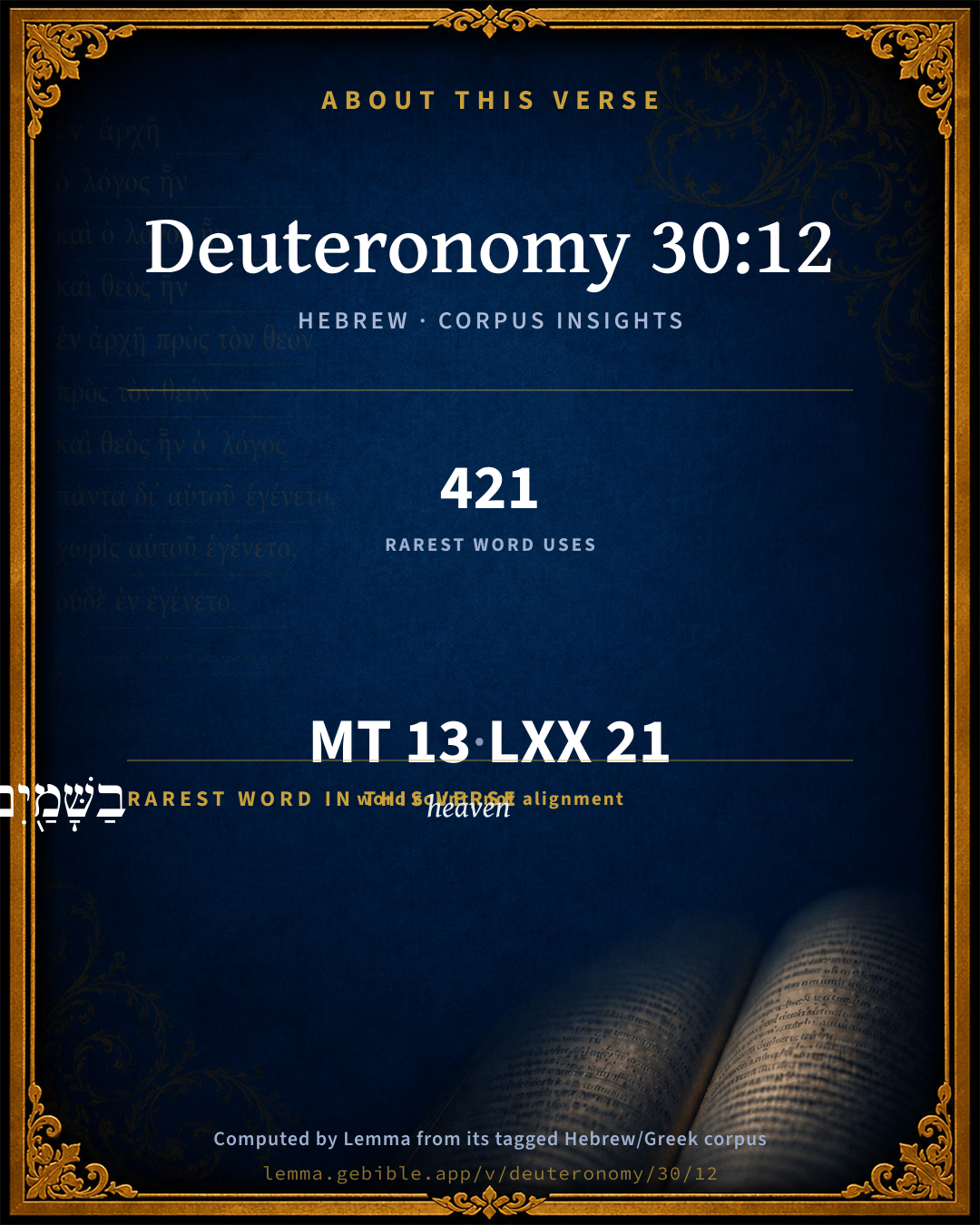
  • בַשָּׁמַ֖יִם heaven H8064 ×2

Hebrew & Septuagint length

In English translation the verse runs 33 words from the Hebrew and 33 from the Septuagint (LXX English) — the same length.

A rough comparison of the two English renderings, which tokenize alike — not a word-level alignment.

Word counts can differ between the Hebrew and the Greek without any difference in meaning — e.g. the Hebrew direct-object marker אֵת has no separate Greek word, and Greek often adds the article ὁ.

In the original languages it is 13 Hebrew tokens and 21 Greek tokens — but the two are counted differently (Hebrew bundles its prefixes and suffixes into one token; the Greek is in lemma form), so that isn’t a like-for-like length.

Cross-references

3

Topical passages linked to Deuteronomy 30:12 in the Treasury of Scripture Knowledge — connected by theme and wording, ordered by reader-vote popularity; previews shown in the World English Bible.

  • Romans 10:6–8 But the righteousness which is of faith says this, "Don't say in your heart, 'Who will ascend into heaven?' (that is, to bring Christ down);
  • Proverbs 30:4 Who has ascended up into heaven, and descended? Who has gathered the wind in his fists? Who has bound the waters in his garment? Who has established all the ends of the earth? What is his name, and what is his son's name, if you know?
  • John 3:13 No one has ascended into heaven, but he who descended out of heaven, the Son of Man, who is in heaven.

Cross-references courtesy of OpenBible.info (CC BY 4.0).

Hebrew and Greek witnesses Masoretic Hebrew ↔ Greek Septuagint

The same verse in the two great witnesses to the Old Testament, shown verse-for-verse.

These are two independent witnesses, not word-aligned to each other, and the Septuagint is shown in lemma (dictionary) form.

Hebrew Deuteronomy 30:12 Masoretic · Westminster Leningrad Codex

לֹ֥א בַשָּׁמַ֖יִם הִ֑וא לֵאמֹ֗ר מִ֣י יַעֲלֶה לָּ֤נוּ הַשָּׁמַ֨יְמָה֙ וְיִקָּחֶ֣הָ לָּ֔נוּ וְיַשְׁמִעֵ֥נוּ אֹתָ֖הּ וְנַעֲשֶֽׂנָּה

It is not in heaven, that you should say, Who shall go up for us to heaven, and bring it to us, and make us to hear it, that we may do it?

World English Bible · Public Domain

Greek LXX Deuteronomy 30:12 Septuagint · lemma form

οὐ ἐν ὁ οὐρανός ἄνω εἰμί λέγω τίς ἀναβαίνω ἐγώ εἰς ὁ οὐρανός καί λαμβάνω αὐτός ἐγώ καί ἀκούω αὐτός ποιέω

It is not in heaven above, as if there were one saying, Who shall go up for us into heaven, and shall take it for us, and we will hear and do it?

LXX2012 (modern English Septuagint) · Public Domain

Hebrew: Westminster Leningrad Codex (CC BY 4.0). Greek: Septuagint (public domain); English from LXX2012 (modern English Septuagint) (Public Domain). How the Septuagint differs from the Hebrew →

Targum (Aramaic paraphrase)

2

The Targum is the ancient Jewish Aramaic paraphrase of the Hebrew Scriptures — an interpretive translation, not the Hebrew text itself. Onkelos (literal) and Pseudo-Jonathan (expansive) render the Torah, and Jonathan the Prophets. Coverage is partial: where no permissively-licensed English translation exists for a verse, only the Aramaic is shown. This is verse-level text, not a word-by-word alignment to the Hebrew.

  1. Targum Onkelos Torah (Genesis–Deuteronomy)
    לָא בִשְׁמַיָא הִיא לְמֵימָר מָן יִסַק לָנָא לִשְׁמַיָא וְיִסְבַהּ לָנָא וְיַשְׁמְעִנָנָא יָתַהּ וְנַעְבְּדִנַהּ

    (no public-domain English translation for this verse)

    Targum Onkelos — Aramaic: “Onkelos Genesis” (public domain); “Onkelos Exodus” (public domain); “Onkelos Leviticus” (public domain); “Onkelos Numbers” (public domain); “Onkelos Deuteronomy” (public domain). English: “Sefaria Community Translation” (CC0 1.0 (public-domain dedication)); “J.W. Etheridge. The Targums of Onkelos and Jonathan Ben Uzziel on the Pentateuch. London: Longmans, Green, 1862” (public domain). Text via Sefaria.

  2. Targum Pseudo-Jonathan Torah (Genesis–Deuteronomy)
    לָא בִשְׁמַיָא הִיא לְמֵימָר מַן יִסוֹק בְּדִילָנָא בִּשְׁמַיָא וְיִסְבִינָהּ לָנָא וְיַשְׁמַע יָתָהּ לָנָא וְנַעַבְדִינָהּ

    It is not in the heavens, that thou shouldst say, Who will ascend for us into heaven, and bring it to us to make us hear, that we may do it?

    Targum Pseudo-Jonathan — Aramaic: “Targum Jonathan on Genesis” (public domain); “Targum Jonathan on Exodus” (public domain); “Targum Jonathan on Leviticus” (public domain); “Targum Jonathan on Numbers” (public domain); “Targum Jonathan on Deuteronomy” (public domain). English: “The Targum of Jonathan ben Uzziel, trans. J. W. Etheridge, London, 1862” (public domain). Text via Sefaria.

Commentary

Notes on Deuteronomy 30:12 from classic Christian and Jewish commentators (each source and its license shown beneath its notes). The classic Christian expositions comment on the surrounding passage and are grouped to its opening verse, so a note may address several verses; the Jewish commentaries on the Tanakh (Rashi and others) are per-verse, so they appear only where the commentator wrote on this verse.

Lemma curates 59 commentaries, every one of them public domain or Creative Commons licensed, each selected and text-cleaned for this edition rather than reprinted as found. About our sources →

Trapp's Complete Commentary

John Trapp

Deu 30:12 It [is] not in heaven, that thou shouldest say, Who shall go up for us to heaven, and bring it unto us, that we may hear it, and do it?

Ver. 12. Who shall go up for us to heaven?] And yet to know heavenly things, is to ascend into heaven. {Pro 30:4}

John Trapp, A Commentary or Exposition upon All the Books of the Old and New Testament (1647–1656) — public domain. Text from a community e-Sword module.

Joseph Benson's Commentary

Deu 30:12-14. In heaven — Shut up there, but it hath been thence delivered and published in thy hearing. Neither beyond the sea — The knowledge of this commandment is not to be fetched from far distant places, to which divers of the wise heathen travelled for their wisdom; but it was brought to thy very doors and ears, and declared to thee in this wilderness. In thy mouth — Thou knowest it so well, that it is the matter of thy common discourse. In thy heart — In thy mind, (as the heart is very commonly taken,) to understand and believe it. In a word, the law is plain and easy: but the gospel is much more so.

Joseph Benson's Commentary on the Old and New Testaments (1811–1818) — public domain. Text from a community e-Sword module.

Tyndale Open Study Notes

Tyndale Open Resources

30:12 not kept in heaven: The revelation of God is not known only to him but is accessible to human beings (see Rom 10:6-8).

Tyndale Open Study Notes — © Tyndale Open Resources, licensed CC BY-SA 4.0. Text via the HelloAO Bible API.

Adam Clarke's Commentary

Verse 12. It is not in heaven] Shall not be communicated in that way in which the prophets received the living oracles; but the WORD shall be made flesh, and dwell among you.

Adam Clarke's Commentary on the Bible (1810–1826) — public domain. Text from a community e-Sword/MySword module.

The Cambridge Bible for Schools and Colleges

gen. ed. J. J. S. Perowne

12. not in heaven] Not among the hidden things still with God, Deu_29:29 (28), and requiring a mediator. God has not left men to hunger for it; it has been mediated and heard.

The Cambridge Bible for Schools and Colleges (gen. ed. J. J. S. Perowne; Cambridge University Press, 1878–1918) — public domain. Text from a community e-Sword module.

John Gill's Exposition

It is not in heaven,.... The scheme of it was formed in heaven, it was hid in the heart of God there, before revealed; it was ordained before the world was for our glory; it was brought down from thence by Christ, and committed to his apostles and ministers of the word to preach it to men; and has been ever since continued on earth, and will be at the time of the conversion of the Jews:

that thou shouldest say; that there should be any occasion of saying; it forbids any such kind of speech as, follows:

who shall go up for us to heaven, and bring it to us, that we may hear it, and do it? there is no need of that, for it is brought from thence already, and may be heard, and should be obeyed; for to put such a question would be the same as to ask "to bring Christ down from above", who is come down already by the assumption of human nature, to preach the Gospel, give the sense of the law, and fulfil it, to do the will of his Father, bring in an everlasting righteousness, and save his people; so that there is no need of his coming again on the same errand, since he has obtained eternal redemption, and is the author of everlasting salvation, which is the sum and substance of the Gospel.

John Gill's Exposition of the Whole Bible (1746–1763) — public domain (CC PDM 1.0). Text via the HelloAO Bible API.

Haydock's Catholic Bible Commentary

Work. There is no need of studying the mysteries of astrology, as the Magi do, to understand the will of God. (Grotius) --- St. Paul adds, (ver. 7,) or who shall descend into the deep? which is not in [the] Hebrew. (Calmet) --- But he probably alludes to the following verse, as the sea is often styled the deep. It was not necessary for the Jews, or for Christians, (Haydock) to undertake long voyages, to discover the true God, as the ancient philosophers were obliged to do; and after they had obtained some idea of the truth, they were afraid to declare it, on account of the prejudices of the people. (Calmet) --- But the most illiterate among us, may easily obtain sufficient knowledge to regulate his life. (Haydock)

George Leo Haydock (1774–1849), Haydock's Catholic Family Bible and Commentary, 1859 edition — public domain. Excludes Psalms (Douay-Rheims chapter numbering differs from Protestant) and Deuterocanonical books (Catholic canon only).

Matthew Poole's English Annotations

In heaven, i.e. shut up there; but it hath been thence delivered and published in thy hearing.

Matthew Poole's English Annotations on the Holy Bible (1683–1685) — public domain. Text from a community e-Sword/MySword module.

John Wesley's Explanatory Notes

In heaven - Shut up there, but it hath been thence delivered and published in thy hearing.

John Wesley, Explanatory Notes Upon the Whole Bible (1754–1765) — public domain. Text via the GEBible commentary corpus.

Rashi

Rabbi Shlomo Yitzchaki (Rashi)

לא בשמים הוא IT IS NOT IN HEAVEN — for were it in heaven it would still be your duty to go up after it and to learn it (Eruvin 55a).

Rashi on the Tanakh — English translations: “The Judaica Press complete Tanach with Rashi, translated by A. J. Rosenberg” (CC BY 4.0); “Pentateuch with Rashi's commentary by M. Rosenbaum and A.M. Silbermann, 1929-1934” (public domain); “The Metsudah Tanach series, Lakewood, N.J” (CC BY 4.0); and “The Book of Joshua, Metsudah Publications, 1997” (CC BY 4.0). Text via Sefaria.

Lesson kit

Teaching starters — assembled from the data on this page, not authored interpretation. Every prompt links to the verse data it draws on. Edit before teaching.

Deuteronomy, in the Pentateuch, opens this verse with 13 words (10 distinct Hebrew lemmas). Its most distinctive word is shâmayim (“heaven”). A historical commentator’s framing appears above. Read the whole chapter for the surrounding context.

Discussion questions

  1. What does “heaven” (shâmayim) contribute to the verse as a whole?
  2. How does Romans 10:6–8, which shares this passage’s theme, read alongside this verse?
  3. What does the repetition of “heaven” (2× in this one verse) do in this verse?
  4. The translations on this page render this verse differently — a whole-verse word diff, not a word-by-word alignment. What might account for the different wordings?
  5. «לֵאמֹ֗ר» is a Qal Infinitive Construct verb. How does that grammatical form shape the action described?
  6. Compare how Trapp's Complete Commentary and Joseph Benson's Commentary read this verse. Where do they agree or differ?

Things to notice

Reading settings

Reading text

Shown beneath each verse's original-language words.

Old Testament
Old Testament edition

Read the OT as the Masoretic Hebrew (MT) or the Greek Septuagint (LXX).

English shown for the Greek Septuagint (in the Hebrew ↔ Greek comparison).

Comparing translations? Open the Compare panel on any verse page to stack up to four side by side.