
Numbers 16:13

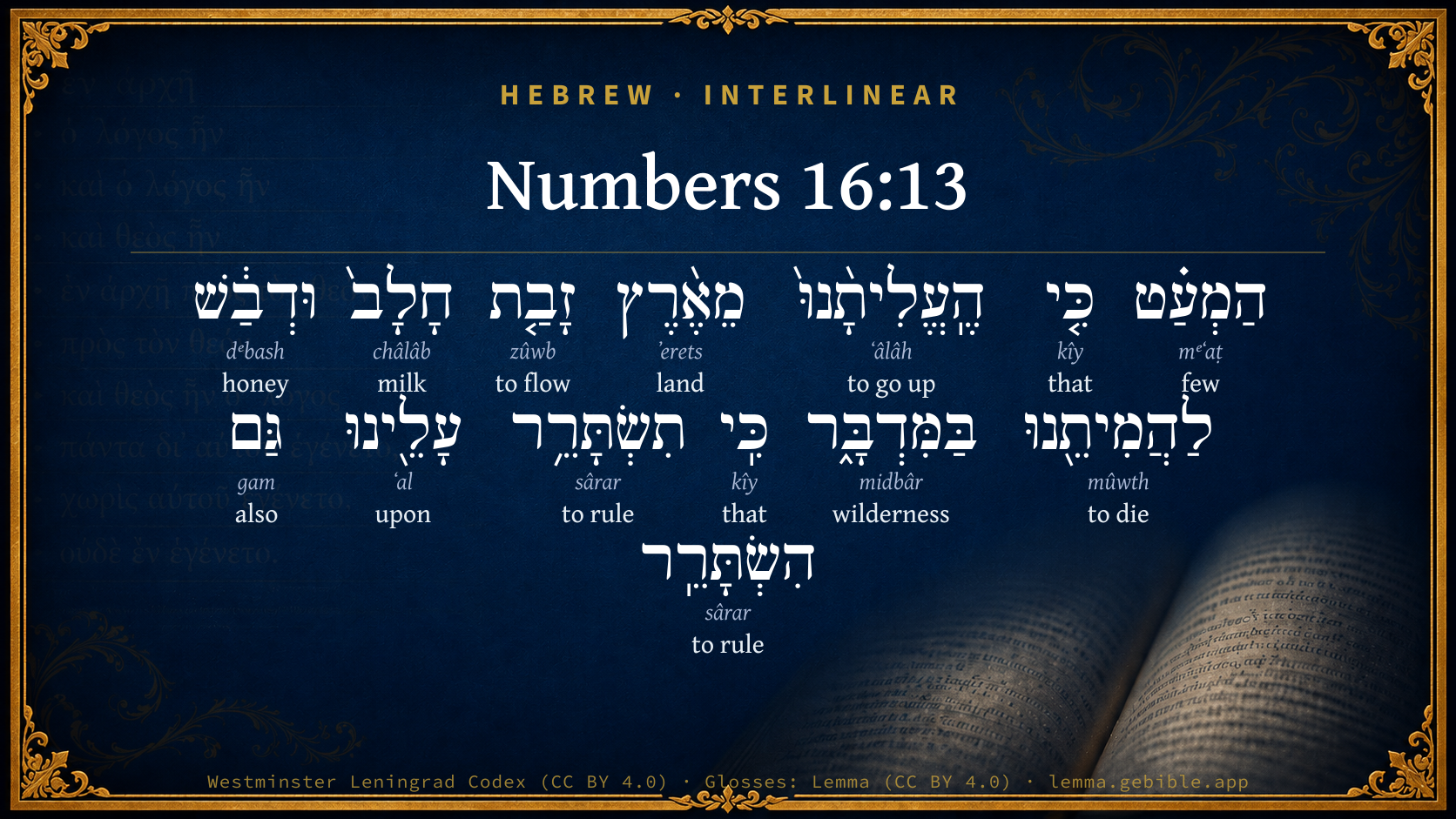
Hebrew (Westminster Leningrad Codex) Numbers 16:13 appears in the Hebrew Old Testament. The text above is from the Westminster Leningrad Codex. Each word links to its Strong’s number, a concise gloss, and parsing drawn from the Open Scriptures Hebrew Bible morphology. Click any word for its full Brown-Driver-Briggs (BDB) entry.
Download image
Cite this verse

Numbers 16:13 (World English Bible). Public Domain. Lemma interlinear Bible study tool, https://lemma.gebible.app/v/numbers/16/13.

Show BibTeX & RIS
BibTeX
RIS
English Translation
is it a small thing that you have brought us up out of a land flowing with milk and honey, to kill us in the wilderness, but you must needs make yourself also a prince over us?
World English Bible · Public Domain
Highlights
  • 1 first appearance in the Hebrew Bible
Full analysis ↓
Download a study sheet

One document with this verse’s original text, its word-by-word gloss line, the meaning frame, cross-references with their text, attributed commentary, and full source and license credits — printable, and it pastes into notes with its structure intact.

This verse Autodidact and up

Study sheet (.html) Plain text (.txt)

A passage Seminary Student

Up to 50 verses in one chapter. A passage sheet keeps up to 6 commentary sources and 12 cross-references per verse, in the order this page ranks them, and says so on the sheet whenever that leaves anything out. Ask for a single verse and you get the Autodidact verse sheet above.

Everything on this page stays free to read, with no account — the sheet is a download of what is already on screen, not access to it.

Want to remove ads? Support Godless Engineer
Compare translations 3

The same verse in 3 English versions, stacked beneath the original-language interlinear above. Click any original word for its lexicon entry.

Each is an independent rendering of the whole verse — the interlinear is not word-aligned to these translations.

Highlighted words mark where these versions differ — a whole-verse word diff, not a word-by-word alignment.

  • World English Bible Public Domain
    is it a small thing that you have brought us up out of a land flowing with milk and honey, to kill us in the wilderness, but you must needs make yourself also a prince over us?
  • King James Version Public Domain
    Is it a small thing that thou hast brought us up out of a land that floweth with milk and honey, to kill us in the wilderness, except thou make thyself altogether a prince over us?
  • unfoldingWord Literal Text CC BY-SA 4.0
    small that you have brought us up from a land flowing milk and honey to kill us in the wilderness that you make yourself rule over us, also making yourself rule?

unfoldingWord Literal Text — © unfoldingWord, licensed CC BY-SA 4.0. Word-aligned USFM3 via Door43 (git.door43.org/unfoldingWord/en_ult).

Versions to compare (up to 4)

3 of 4 selected

Show all 18 translations

Every available English version of this verse, each an independent rendering of the whole verse.

  • World English Bible Public Domain
    is it a small thing that you have brought us up out of a land flowing with milk and honey, to kill us in the wilderness, but you must needs make yourself also a prince over us?
  • Berean Standard Bible Public Domain
    Is it not enough that you have brought us up out of a land flowing with milk and honey to kill us in the wilderness? Must you also appoint yourself as ruler over us?
  • Majority Standard Bible Public Domain
    Is it not enough that you have brought us up out of a land flowing with milk and honey to kill us in the wilderness? Must you also appoint yourself as ruler over us?
  • King James Version Public Domain
    Is it a small thing that thou hast brought us up out of a land that floweth with milk and honey, to kill us in the wilderness, except thou make thyself altogether a prince over us?
  • American Standard Version (1901) Public Domain
    is it a small thing that thou hast brought us up out of a land flowing with milk and honey, to kill us in the wilderness, but thou must needs make thyself also a prince over us?
  • Revised Version (1885) Public Domain
    is it a small thing that thou hast brought us up out of a land flowing with milk and honey, to kill us in the wilderness, but thou must needs make thyself also a prince over us?
  • Geneva Bible (1599) Public Domain
    Is it a small thing that thou hast brought vs out of a lande that floweth with milke and honie, to kill vs in the wildernesse, except thou make thy selfe lord and ruler ouer vs also?
  • Douay-Rheims (1899) Public Domain
    Is it a small matter to thee, that thou hast brought us out of a land that flowed with milk and honey, to kill us in the desert, except thou rule also like a lord over us?
  • Young's Literal Translation Public Domain
    is it little that thou hast brought us up out of a land flowing with milk and honey to put us to death in a wilderness that thou also certainly makest thyself prince over us?
  • Literal Standard Version CC BY-SA 4.0
    Is it little that you have brought us up out of a land flowing with milk and honey, to put us to death in a wilderness, that you also certainly make yourself prince over us?
  • Unlocked Literal Bible CC BY-SA 4.0
    Is it a small thing that you have brought us up out of a land flowing with milk and honey, to kill us in the wilderness? Now you want to make yourself ruler over us!
  • unfoldingWord Literal Text CC BY-SA 4.0
    small that you have brought us up from a land flowing milk and honey to kill us in the wilderness that you make yourself rule over us, also making yourself rule?
  • Darby Bible Public Domain
    Is it a small thing that thou hast brought us up out of a land flowing with milk and honey, to kill us in the wilderness, that thou must make thyself altogether a ruler over us?
  • World Messianic Bible Public Domain
    Is it a small thing that you have brought us up out of a land flowing with milk and honey, to kill us in the wilderness, but you must also make yourself a prince over us?
  • Webster's Bible Public Domain
    Is it a small thing that thou hast brought us out of a land that floweth with milk and honey, to kill us in the wilderness, except thou make thyself altogether a prince over us?
  • Free Bible Version CC BY-SA 4.0
    Haven't you done enough by taking us away from a land flowing with milk and honey in order to kill us out here in the desert? Do you have to make yourself a dictator as well, someone to rule us?
  • Bible in Basic English Public Domain
    Is it not enough that you have taken us from a land flowing with milk and honey, to put us to death in the waste land, but now you are desiring to make yourself a chief over us?
  • JPS Tanakh (1917) Public Domain
    is it a small thing that thou hast brought us up out of a land flowing with milk and honey, to kill us in the wilderness, but thou must needs make thyself also a prince over us?

Literal Standard Version (2020), Covenant Press — licensed CC BY-SA 4.0. Text via the HelloAO Bible API (eBible.org). Unlocked Literal Bible (unfoldingWord) — licensed CC BY-SA 4.0. Text via the HelloAO Bible API (eBible.org). unfoldingWord Literal Text — © unfoldingWord, licensed CC BY-SA 4.0. Word-aligned USFM3 via Door43 (git.door43.org/unfoldingWord/en_ult). Free Bible Version, Dr. Jonathan Gallagher — licensed CC BY-SA 4.0. Text via the HelloAO Bible API (eBible.org).

Word by word

More ways to search: Search by grammar → Find every occurrence → Compare this word →

Practice this passage: Drill this verse → Learn its vocabulary →

תִשְׂתָּרֵ֥ר
sârar
H8323
“to rule”
Verb, Hithpael, Imperfect, 2nd Person, Masculine, Singular
Part of Speech
Verb
Stem
Hithpael
Form
Imperfect
Person
2nd Person
Gender
Masculine
Number
Singular
Full BDB Definition

Origin: a primitive root

TWOT: 2295

to be or act as prince, rule, contend, have power, prevail over, reign, govern - (Qal) to rule over, govern - (Hithpael) to lord it over
  1. הַמְעַ֗ט mᵉʻaṭ H4592 “few” Particle, Interrogative + Noun, Common, Masculine, Singular, Absolute
  2. כִּ֤י kîy H3588 “that” Conjunction
  3. הֶֽעֱלִיתָ֨נוּ֙ ʻâlâh H5927 “to go up · us” Verb, Hiphil, Perfect, 2nd Person, Masculine, Singular + Suffix, Personal, 1st Person, Common, Plural
  4. מֵאֶ֨רֶץ ʼerets H776 “from · land” Preposition + Noun, Common, Both, Singular, Absolute
  5. זָבַ֤ת zûwb H2100 “flowing” Verb, Qal, Participle Active, Feminine, Singular, Construct
  6. חָלָב֙ châlâb H2461 “milk” Noun, Common, Masculine, Singular, Absolute
  7. וּדְבַ֔שׁ dᵉbash H1706 “and · honey” Conjunction + Noun, Common, Masculine, Singular, Absolute
  8. לַהֲמִיתֵ֖נוּ mûwth H4191 “to die · us” Preposition + Verb, Hiphil, Infinitive Construct + Suffix, Personal, 1st Person, Common, Plural
  9. בַּמִּדְבָּ֑ר midbâr H4057 “in/at the · wilderness” Preposition, Determined + Noun, Common, Masculine, Singular, Absolute
  10. כִּֽי kîy H3588 “that” Conjunction
  11. עָלֵ֖ינוּ ʻal H5921 “upon · us” Preposition + Suffix, Personal, 1st Person, Common, Plural
  12. גַּם gam H1571 “also” Particle, Accusative
  13. הִשְׂתָּרֵֽר sârar H8323 “to rule” Verb, Hithpael, Infinitive Absolute

About this verse

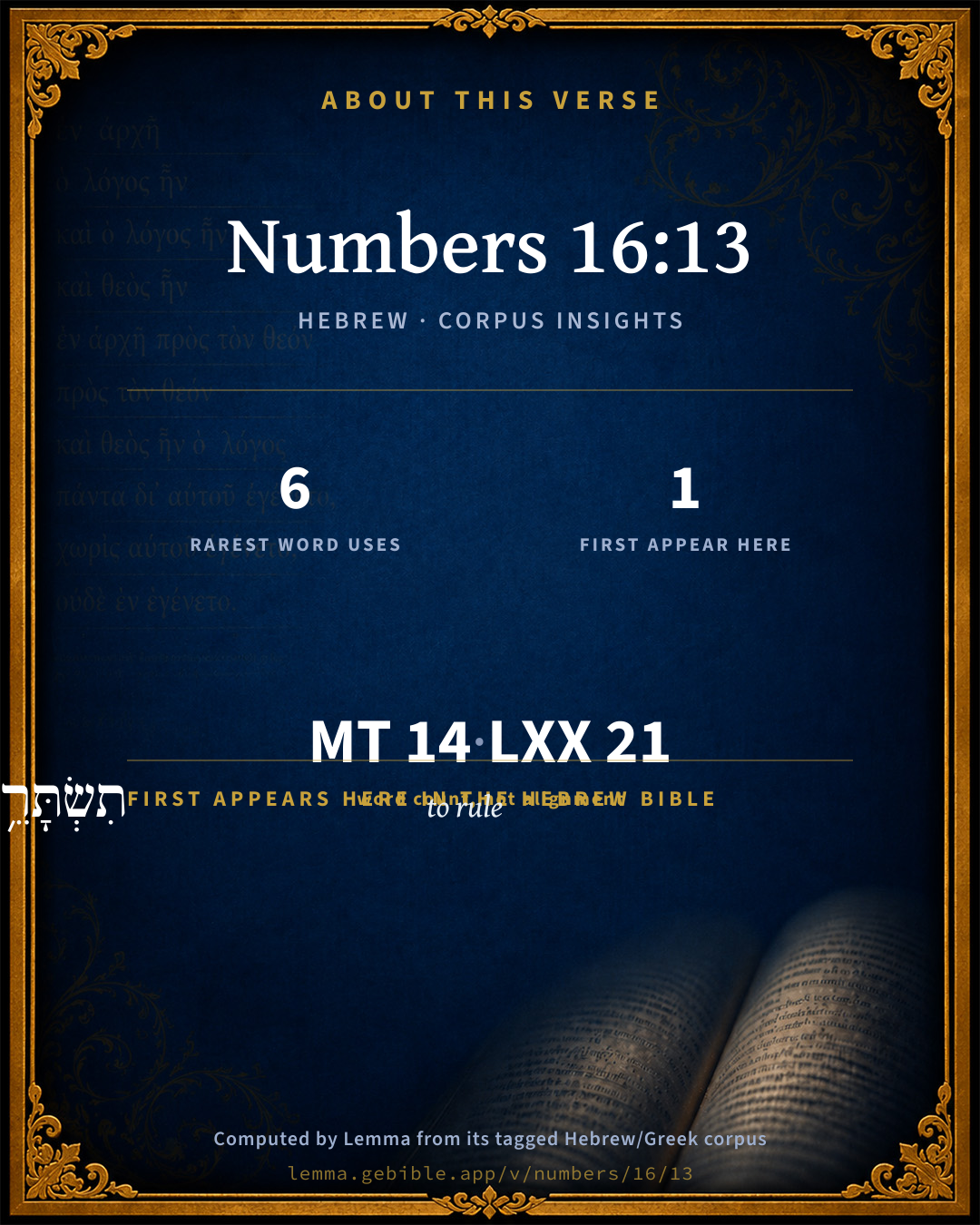
These counts appear in no published source. They are computed here, from the morphology-tagged text and Lemma’s own curated glosses. What Lemma adds →

14
words
12
distinct lemmas
Pentateuch
section

Notable vocabulary

The rarest word here is תִשְׂתָּרֵ֥ר to rule H8323 — appearing just 6 times in the whole Hebrew Bible.

First appearance in Scripture

This word makes its first canonical appearance in the Hebrew Bible here:

  • תִשְׂתָּרֵ֥ר to rule H8323

Shared distinctive vocabulary

תִשְׂתָּרֵ֥ר to rule H8323 occurs in 5 verses of the Hebrew Bible. Also found in:

Grammatical profile

  • 5 verbs
  • 5 nouns
  • 1 preposition
  • 2 conjunctions
  • 1 particle

Verb forms

  • הֶֽעֱלִיתָ֨נוּ֙ Hiphil · Perfect
  • זָבַ֤ת Qal · Participle Active
  • לַהֲמִיתֵ֖נוּ Hiphil · Infinitive Construct
  • תִשְׂתָּרֵ֥ר Hithpael · Imperfect
  • הִשְׂתָּרֵֽר Hithpael · Infinitive Absolute

Repetition

Words recur within this verse — often emphatic in Hebrew:

  • תִשְׂתָּרֵ֥ר to rule H8323 ×2
  • כִּ֤י that H3588 ×2

Hebrew & Septuagint length

In English translation the verse runs 37 words from the Hebrew and 32 from the Septuagint (LXX English) — closely comparable.

A rough comparison of the two English renderings, which tokenize alike — not a word-level alignment.

Word counts can differ between the Hebrew and the Greek without any difference in meaning — e.g. the Hebrew direct-object marker אֵת has no separate Greek word, and Greek often adds the article ὁ.

In the original languages it is 14 Hebrew tokens and 21 Greek tokens — but the two are counted differently (Hebrew bundles its prefixes and suffixes into one token; the Greek is in lemma form), so that isn’t a like-for-like length.

Cross-references

13

Topical passages linked to Numbers 16:13 in the Treasury of Scripture Knowledge — connected by theme and wording, ordered by reader-vote popularity; previews shown in the World English Bible.

  • Acts 7:35 "This Moses, whom they refused, saying, 'Who made you a ruler and a judge?'--God has sent him as both a ruler and a deliverer by the hand of the angel who appeared to him in the bush.
  • Exodus 2:14 He said, "Who made you a prince and a judge over us? Do you plan to kill me, as you killed the Egyptian?" Moses was afraid, and said, "Surely this thing is known."
  • Exodus 16:3 and the children of Israel said to them, "We wish that we had died by the hand of Yahweh in the land of Egypt, when we sat by the flesh-pots, when we ate our fill of bread, for you have brought us out into this wilderness, to kill this whole assembly with hunger."
  • Numbers 11:5 We remember the fish, which we ate in Egypt for nothing; the cucumbers, and the melons, and the leeks, and the onions, and the garlic:
  • Exodus 1:11 Therefore they set taskmasters over them to afflict them with their burdens. They built storage cities for Pharaoh: Pithom and Raamses.
  • Exodus 1:22 Pharaoh charged all his people, saying, "You shall cast every son who is born into the river, and every daughter you shall save alive."
  • Exodus 2:23 It happened in the course of those many days, that the king of Egypt died, and the children of Israel sighed because of the bondage, and they cried, and their cry came up to God because of the bondage.
  • Exodus 17:3 The people were thirsty for water there; and the people murmured against Moses, and said, "Why have you brought us up out of Egypt, to kill us, our children, and our livestock with thirst?"
  • Numbers 14:2 All the children of Israel murmured against Moses and against Aaron: and the whole congregation said to them, Would that we had died in the land of Egypt! or would that we had died in this wilderness!
  • Numbers 20:3–4 The people strove with Moses, and spoke, saying, Would that we had died when our brothers died before Yahweh!
  • Psalms 2:2–3 The kings of the earth take a stand, And the rulers take counsel together, Against Yahweh, and against his anointed, saying,
  • Luke 19:14 But his citizens hated him, and sent an envoy after him, saying, 'We don't want this man to reign over us.'
  • Acts 7:25–27 He supposed that his brothers understood that God, by his hand, was giving them deliverance; but they didn't understand.

Cross-references courtesy of OpenBible.info (CC BY 4.0).

Hebrew and Greek witnesses Masoretic Hebrew ↔ Greek Septuagint

The same verse in the two great witnesses to the Old Testament, shown verse-for-verse.

These are two independent witnesses, not word-aligned to each other, and the Septuagint is shown in lemma (dictionary) form.

Hebrew Numbers 16:13 Masoretic · Westminster Leningrad Codex

הַמְעַ֗ט כִּ֤י הֶֽעֱלִיתָ֨נוּ֙ מֵאֶ֨רֶץ זָבַ֤ת חָלָב֙ וּדְבַ֔שׁ לַהֲמִיתֵ֖נוּ בַּמִּדְבָּ֑ר כִּֽי תִשְׂתָּרֵ֥ר עָלֵ֖ינוּ גַּם הִשְׂתָּרֵֽר

is it a small thing that you have brought us up out of a land flowing with milk and honey, to kill us in the wilderness, but you must needs make yourself also a prince over us?

World English Bible · Public Domain

Greek LXX Numbers 16:13 Septuagint · lemma form

μή μικρός οὗτος ὅτι ἀναἄγω ἐγώ ἐκ γῆ ῥέω γάλα καί μέλι ἀποκτείνω ἐγώ ἐν ὁ ἔρημος ὅτι καταἄρχω ἐγώ ἄρχων

Is it a little thing that you have brought us up to a land flowing with milk and honey, to kill us in the wilderness, and that you altogether rule over us?

LXX2012 (modern English Septuagint) · Public Domain

Hebrew: Westminster Leningrad Codex (CC BY 4.0). Greek: Septuagint (public domain); English from LXX2012 (modern English Septuagint) (Public Domain). How the Septuagint differs from the Hebrew →

Targum (Aramaic paraphrase)

2

The Targum is the ancient Jewish Aramaic paraphrase of the Hebrew Scriptures — an interpretive translation, not the Hebrew text itself. Onkelos (literal) and Pseudo-Jonathan (expansive) render the Torah, and Jonathan the Prophets. Coverage is partial: where no permissively-licensed English translation exists for a verse, only the Aramaic is shown. This is verse-level text, not a word-by-word alignment to the Hebrew.

  1. Targum Onkelos Torah (Genesis–Deuteronomy)
    הַזְעֵיר אֲרֵי אַסֵקְתָּנָא מֵאַרְעָא עָבְדָא חֲלַב וּדְבָשׁ לְקַטָלוּתָנָא בְּמַדְבְּרָא אֲרֵי אִתְרַבְרַבְתְּ עֲלָנָא אַף אִתְרַבְרָבָא

    (no public-domain English translation for this verse)

    Targum Onkelos — Aramaic: “Onkelos Genesis” (public domain); “Onkelos Exodus” (public domain); “Onkelos Leviticus” (public domain); “Onkelos Numbers” (public domain); “Onkelos Deuteronomy” (public domain). English: “Sefaria Community Translation” (CC0 1.0 (public-domain dedication)); “J.W. Etheridge. The Targums of Onkelos and Jonathan Ben Uzziel on the Pentateuch. London: Longmans, Green, 1862” (public domain). Text via Sefaria.

  2. Targum Pseudo-Jonathan Torah (Genesis–Deuteronomy)
    הַזְעֵירָא הוּא אֲרוּם אַסֵיקְתָּנָא מִמִצְרַיִם אַרְעָא דְעַבְדָא חֲלַב וּדְבָשׁ לְקַטְלוּתָנָא בְּמַדְבְּרָא אֲרוּם מִתְרַבְרְבַת עֲלָנָא אוּף אִתְרַבְרְבָא

    Is it a little thing, that thou hast brought us from Mizraim, a land that produceth milk and honey, to kill us in the wilderness, that ruling thou mayest domineer over us?

    Targum Pseudo-Jonathan — Aramaic: “Targum Jonathan on Genesis” (public domain); “Targum Jonathan on Exodus” (public domain); “Targum Jonathan on Leviticus” (public domain); “Targum Jonathan on Numbers” (public domain); “Targum Jonathan on Deuteronomy” (public domain). English: “The Targum of Jonathan ben Uzziel, trans. J. W. Etheridge, London, 1862” (public domain). Text via Sefaria.

Commentary

Notes on Numbers 16:13 from classic Christian and Jewish commentators (each source and its license shown beneath its notes). The classic Christian expositions comment on the surrounding passage and are grouped to its opening verse, so a note may address several verses; the Jewish commentaries on the Tanakh (Rashi and others) are per-verse, so they appear only where the commentator wrote on this verse.

Lemma curates 59 commentaries, every one of them public domain or Creative Commons licensed, each selected and text-cleaned for this edition rather than reprinted as found. About our sources →

Trapp's Complete Commentary

John Trapp

Num 16:13 [Is it] a small thing that thou hast brought us up out of a land that floweth with milk and honey, to kill us in the wilderness, except thou make thyself altogether a prince over us?

Ver. 13. That floweth with milk and honey.] So they falsely and maliciously speak of the land of Egypt, in derision of the land of Canaan, whereunto that praise properly belonged. Those that were born in hell know no other heaven.

Altogether a prince over us.] So their quarrel was against Moses’ principality, though they pretended the priesthood only at first. If the ministry once be taken away, let the magistrate see to himself; he is next.

John Trapp, A Commentary or Exposition upon All the Books of the Old and New Testament (1647–1656) — public domain. Text from a community e-Sword module.

Tyndale Open Study Notes

Tyndale Open Resources

16:13 land flowing with milk and honey: This sarcastic allusion to the spies’ earlier description of Canaan (13:27) is a deliberate distortion of life in Egypt (see study note on 11:4-15).

Tyndale Open Study Notes — © Tyndale Open Resources, licensed CC BY-SA 4.0. Text via the HelloAO Bible API.

Geneva Bible (1599)

Geneva Bible translators

Thus they spake contemptuously, preferring Egypt to Canaan.

Geneva Bible (1599) marginal notes — public domain. Text via Bolls.life.

Ellicott's Commentary for English Readers

(13) A land that floweth with milk and honey.—The description of the land of promise is here applied perversely and ironically to the land of Egypt.

A Bible Commentary for English Readers, edited by Charles John Ellicott (1878–1897) — public domain. Text from a community e-Sword module.

The Cambridge Bible for Schools and Colleges

gen. ed. J. J. S. Perowne

13. out of a land flowing with milk and honey] The expression which Moses had applied to Canaan in persuading the people to escape from slavery (Exo_3:17) is applied by the rebels ironically to Egypt.

The Cambridge Bible for Schools and Colleges (gen. ed. J. J. S. Perowne; Cambridge University Press, 1878–1918) — public domain. Text from a community e-Sword module.

John Gill's Exposition

Is it a small thing that thou hast brought us up out of a land that floweth with milk and honey?.... Meaning Egypt, as the Targum of Jonathan expresses it; which, though a plentiful country, never had, nor deserved to have this epithet given it, which is peculiar to the land of Canaan, and is here given, in opposition to the description of that land, which the Lord himself had so described; and argues great impudence and want of reverence of the divine Being, as well as great ingratitude to Moses, the instrument of their being brought out of Egypt, where they laboured under bondage and servitude intolerable; and yet here represent it as an injury done to them, and as if the intent and design of it was purely to destroy them: for they add:

to kill us in the wilderness; with want of food, of which they had plenty in Egypt, they suggest; referring, it may be, to what the Lord by Moses had said to them, that their carcasses should fall in the wilderness; but that would not be for want of provisions, but because of their sins. It was bad enough, they intimate, to be brought out of such a plentiful country, into a barren wilderness; but what was still worse, the despotic and tyrannical government of Moses, as they represent it, they were brought under:

except thou make thyself altogether a prince over us? ruling in an arbitrary way, making laws, and setting up offices and officers at pleasure, so that it is more eligible to be in bondage in Egypt than under thy government. Aben Ezra takes their meaning to be, as if the end of bringing them out of Egypt was to assume and exercise such rule and authority over them. His words are,"hast thou brought us up out of Egypt, that thou mayest exercise dominion over us as a prince, yea, many dominions, thou and thy brother?''and who also observes, that Egypt lay to the south of the land of Israel, so that one that came from Egypt to the land of Canaan may be truly said to come up, that part of Canaan lying higher than Egypt.

John Gill's Exposition of the Whole Bible (1746–1763) — public domain (CC PDM 1.0). Text via the HelloAO Bible API.

Albert Barnes' Notes on the Bible

With perverse contempt for the promises, Dathan and Abiram designate Egypt by the terms appropriated elsewhere to the land of Canaan.

Albert Barnes' Notes on the Bible (1834–1885) — public domain. Text from a community e-Sword/MySword module.

Matthew Poole's English Annotations

i.e. Out of Egypt, a place indeed of great plenty, but to them a place of torment and intolerable slavery. They invidiously and scoffmgly use the same words wherewith God by Moses commended the land of Canaan.

Matthew Poole's English Annotations on the Holy Bible (1683–1685) — public domain. Text from a community e-Sword/MySword module.

The Pulpit Commentary

Is it a small thing. Rather, "is it too little," as in verse 9. A land that floweth with milk and honey. A description applying by right to the land of promise, (Exo_3:8 Num_13:27) which they in their studied insolence applied to Egypt. Except thou make thyself altogether a prince over us. Literally, "that (yKi) thou altogether lord it over us." The expression is strengthened in the original by the reduplication of the verb in the inf. abs., rrTchiA

The Pulpit Commentary (1880–1919), ed. H.D.M. Spence-Jones & Joseph S. Exell — public domain. Text from a community e-Sword module.

Ramban (Nachmanides)

Rabbi Moshe ben Nachman (Ramban / Nachmanides)

THAT THOU [Moses] WOULDST MAKE THYSELF A PRINCE OVER US ‘GAM HISTAREIR’ — [the repetition of this phrase — literally ‘also to rule’ means]: ‘also many forms of lordship.’ Or [it may refer to lordship by] ‘thou and thy brother Aaron.’” This is the language of Rabbi Abraham ibn Ezra. In my opinion the word gam (also) here means “even.” Similarly: There is none that doeth good, not ‘gam’ (even) one; The poor is hated ‘gam’ (even) of his own neighbor, and similar cases. Thus Dathan and Abiram said to Moses: “Is it a small thing on your part that you have done us such a great evil to kill us in the wilderness, for which we should have stoned you, that you would rule over us even in a small measure of lordship, by sending us [a summons] to appear before you, let alone that you should play the king and be elevated over us!”

Ramban (Nachmanides) on the Tanakh — English translation: “Commentary on the Torah by Ramban (Nachmanides). Translated and annotated by Charles B. Chavel. New York, Shilo Pub. House, 1971-1976” (CC BY 4.0). Text via Sefaria.

Lesson kit

Teaching starters — assembled from the data on this page, not authored interpretation. Every prompt links to the verse data it draws on. Edit before teaching.

Numbers, in the Pentateuch, opens this verse with 14 words (12 distinct Hebrew lemmas). Its most distinctive word is sârar (“to rule”). A historical commentator’s framing appears above. Read the whole chapter for the surrounding context.

Discussion questions

  1. How does “to rule” (sârar) shape what this verse is saying?
  2. This is the first place “to rule” appears in Scripture (first appears here). What does its debut here establish?
  3. How does Esther 1:22, which shares the word «to rule», read alongside this verse?
  4. What does the repetition of “to rule” (2× in this one verse) do in this verse?
  5. These translations render this verse differently; the difference is in the English rendering, not the original. What questions does that raise?
  6. «הֶֽעֱלִיתָ֨נוּ֙» is a Hiphil Perfect verb. How does that grammatical form shape the action described?
  7. Compare how Trapp's Complete Commentary and Tyndale Open Study Notes read this verse. Where do they agree or differ?

Things to notice

Reading settings

Reading text

Shown beneath each verse's original-language words.

Old Testament
Old Testament edition

Read the OT as the Masoretic Hebrew (MT) or the Greek Septuagint (LXX).

English shown for the Greek Septuagint (in the Hebrew ↔ Greek comparison).

Comparing translations? Open the Compare panel on any verse page to stack up to four side by side.