
Zechariah 14:18

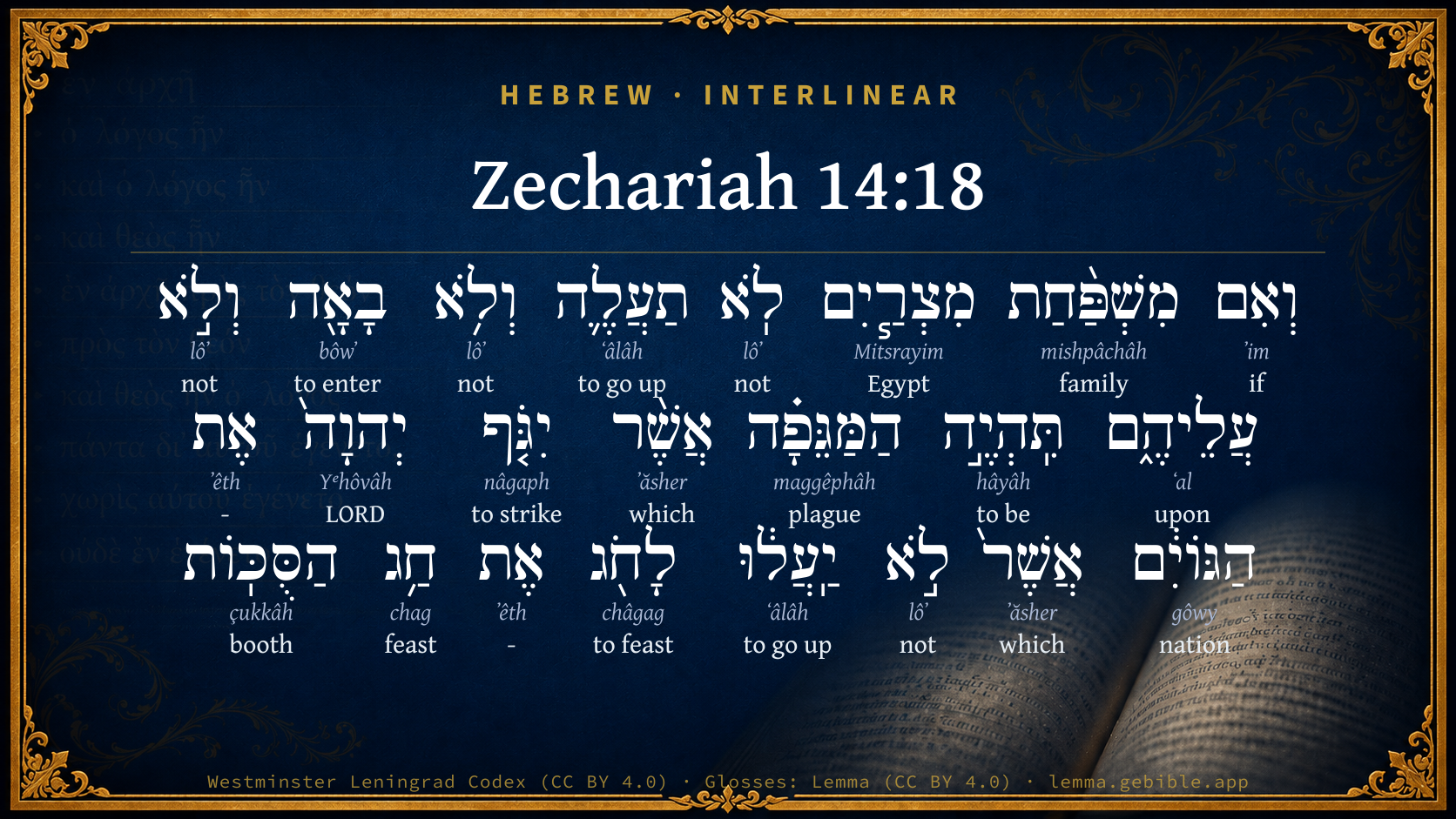
Hebrew (Westminster Leningrad Codex) Zechariah 14:18 appears in the Hebrew Old Testament. The text above is from the Westminster Leningrad Codex. Each word links to its Strong’s number, a concise gloss, and parsing drawn from the Open Scriptures Hebrew Bible morphology. Click any word for its full Brown-Driver-Briggs (BDB) entry.
Download image
Cite this verse

Zechariah 14:18 (World English Bible). Public Domain. Lemma interlinear Bible study tool, https://lemma.gebible.app/v/zechariah/14/18.

Show BibTeX & RIS
BibTeX
RIS
English Translation
If the family of Egypt doesn't go up, and doesn't come, neither will it rain on them. This will be the plague with which Yahweh will strike the nations that don't go up to keep the feast of tents.
World English Bible · Public Domain
Download a study sheet

One document with this verse’s original text, its word-by-word gloss line, the meaning frame, cross-references with their text, attributed commentary, and full source and license credits — printable, and it pastes into notes with its structure intact.

This verse Autodidact and up

Study sheet (.html) Plain text (.txt)

A passage Seminary Student

Up to 50 verses in one chapter. A passage sheet keeps up to 6 commentary sources and 12 cross-references per verse, in the order this page ranks them, and says so on the sheet whenever that leaves anything out. Ask for a single verse and you get the Autodidact verse sheet above.

Everything on this page stays free to read, with no account — the sheet is a download of what is already on screen, not access to it.

Want to remove ads? Support Godless Engineer
Compare translations 3

The same verse in 3 English versions, stacked beneath the original-language interlinear above. Click any original word for its lexicon entry.

Each is an independent rendering of the whole verse — the interlinear is not word-aligned to these translations.

Highlighted words mark where these versions differ — a whole-verse word diff, not a word-by-word alignment.

  • World English Bible Public Domain
    If the family of Egypt doesn't go up, and doesn't come, neither will it rain on them. This will be the plague with which Yahweh will strike the nations that don't go up to keep the feast of tents.
  • King James Version Public Domain
    And if the family of Egypt go not up, and come not, that have no rain; there shall be the plague, wherewith the LORD will smite the heathen that come not up to keep the feast of tabernacles.
  • unfoldingWord Literal Text CC BY-SA 4.0
    If the nation of Egypt does not go up, then they receive. A plague from Yahweh will attack the nations that do not go up to keep the Festival of Shelters.

unfoldingWord Literal Text — © unfoldingWord, licensed CC BY-SA 4.0. Word-aligned USFM3 via Door43 (git.door43.org/unfoldingWord/en_ult).

Versions to compare (up to 4)

3 of 4 selected

Show all 18 translations

Every available English version of this verse, each an independent rendering of the whole verse.

  • World English Bible Public Domain
    If the family of Egypt doesn't go up, and doesn't come, neither will it rain on them. This will be the plague with which Yahweh will strike the nations that don't go up to keep the feast of tents.
  • Berean Standard Bible Public Domain
    And if the people of Egypt will not go up and enter in, then the rain will not fall on them; this will be the plague with which the LORD strikes the nations who do not go up to celebrate the Feast of Tabernacles.
  • Majority Standard Bible Public Domain
    And if the people of Egypt will not go up and enter in, then the rain will not fall on them; this will be the plague with which the LORD strikes the nations who do not go up to celebrate the Feast of Tabernacles.
  • King James Version Public Domain
    And if the family of Egypt go not up, and come not, that have no rain; there shall be the plague, wherewith the LORD will smite the heathen that come not up to keep the feast of tabernacles.
  • American Standard Version (1901) Public Domain
    And if the family of Egypt go not up, and come not, neither `shall it be' upon them; there shall be the plague wherewith Jehovah will smite the nations that go not up to keep the feast of tabernacles.
  • Revised Version (1885) Public Domain
    And if the family of Egypt go not up, and come not, neither shall it be upon them; there shall be the plague, wherewith the LORD will smite the nations that go not up to keep the feast of tabernacles.
  • Geneva Bible (1599) Public Domain
    And if the familie of Egypt goe not vp, and come not, it shall not raine vpon them. This shall be the plague wherewith the Lord will smite all the heathen, that come not vp to keepe the feast of Tabernacles.
  • Douay-Rheims (1899) Public Domain
    And if the family of Egypt go not up nor come: neither shall it be upon them, but there shall be destruction wherewith the Lord will strike all nations that will not go up to keep the feast of tabernacles.
  • Young's Literal Translation Public Domain
    And if the family of Egypt go not up, nor come in, Then not on them is the plague With which Jehovah doth plague the nations That go not up to celebrate the feast of booths.
  • Literal Standard Version CC BY-SA 4.0
    And if the family of Egypt does not go up, nor come in, || Then on them is the plague || With which YHWH plagues the nations || That do not go up to celebrate the Celebration of Shelters.
  • Unlocked Literal Bible CC BY-SA 4.0
    If the nation of Egypt does not go up, then they will not receive rain. A plague from Yahweh will attack the nations that do not go up to keep the Festival of Shelters.
  • unfoldingWord Literal Text CC BY-SA 4.0
    If the nation of Egypt does not go up, then they receive. A plague from Yahweh will attack the nations that do not go up to keep the Festival of Shelters.
  • Darby Bible Public Domain
    And if the family of Egypt go not up, and come not, neither [shall it be] upon them; [there] shall be the plague, wherewith Jehovah will smite the nations that go not up to celebrate the feast of tabernacles.
  • World Messianic Bible Public Domain
    If the family of Egypt doesn’t go up and doesn’t come, neither will it rain on them. This will be the plague with which the LORD will strike the nations that don’t go up to keep the feast of booths.
  • Webster's Bible Public Domain
    And if the family of Egypt shall not go up, and shall not come, that have no rain; there shall be the plague, with which the LORD will smite the heathen that come not up to keep the feast of tabernacles.
  • Free Bible Version CC BY-SA 4.0
    If the Egyptian people refuse to go and attend, then the Lord will inflict on them the same plague as on the other nations who will not go celebrate the Festival of Shelters.
  • Bible in Basic English Public Domain
    And if the family of Egypt does not go up or come there, they will be attacked by the disease which the Lord will send on the nations:
  • JPS Tanakh (1917) Public Domain
    And if the family of Egypt go not up, and come not, they shall have no overflow; there shall be the plague, wherewith the LORD will smite the nations that go not up to keep the feast of tabernacles.

Literal Standard Version (2020), Covenant Press — licensed CC BY-SA 4.0. Text via the HelloAO Bible API (eBible.org). Unlocked Literal Bible (unfoldingWord) — licensed CC BY-SA 4.0. Text via the HelloAO Bible API (eBible.org). unfoldingWord Literal Text — © unfoldingWord, licensed CC BY-SA 4.0. Word-aligned USFM3 via Door43 (git.door43.org/unfoldingWord/en_ult). Free Bible Version, Dr. Jonathan Gallagher — licensed CC BY-SA 4.0. Text via the HelloAO Bible API (eBible.org).

Word by word

More ways to search: Search by grammar → Find every occurrence → Compare this word →

Practice this passage: Drill this verse → Learn its vocabulary →

לָחֹ֖ג
châgag
H2287
“to feast”
Preposition + Verb, Qal, Infinitive Construct
Part of Speech
Preposition + Verb
Stem
Qal
Form
Infinitive Construct
Full BDB Definition

Origin: a primitive root [compare H2283 , H2328 ]

TWOT: 602

to hold a feast, hold a festival, make pilgrimage, keep a pilgrim-feast, celebrate, dance, stagger - (Qal) - to keep a pilgrim-feast - to reel
  1. וְאִם ʼim H518 “and · if” Conjunction + Conjunction
  2. מִשְׁפַּ֨חַת mishpâchâh H4940 “family of” Noun, Common, Feminine, Singular, Construct
  3. מִצְרַ֧יִם Mitsrayim H4714 “Egypt” Noun, Proper
  4. לֹֽא lôʼ H3808 “not” Particle, Negative
  5. תַעֲלֶ֛ה ʻâlâh H5927 “to go up” Verb, Qal, Imperfect, 3rd Person, Feminine, Singular
  6. וְלֹ֥א lôʼ H3808 “and · not” Conjunction + Particle, Negative
  7. בָאָ֖ה bôwʼ H935 “entering” Verb, Qal, Participle Active, Feminine, Singular, Absolute
  8. וְלֹ֣א lôʼ H3808 “and · not” Conjunction + Particle, Negative
  9. עֲלֵיהֶ֑ם ʻal H5921 “upon · them” Preposition + Suffix, Personal, 3rd Person, Masculine, Plural
  10. תִּֽהְיֶ֣ה hâyâh H1961 “to be” Verb, Qal, Imperfect, 3rd Person, Feminine, Singular
  11. הַמַּגֵּפָ֗ה maggêphâh H4046 “the · plague” Particle, Definite Article + Noun, Common, Feminine, Singular, Absolute
  12. אֲשֶׁ֨ר ʼăsher H834 “which” Particle, Relative
  13. יִגֹּ֤ף nâgaph H5062 “to strike” Verb, Qal, Imperfect, 3rd Person, Masculine, Singular
  14. יְהוָה֙ Yᵉhôvâh H3068 “LORD” Noun, Proper
  15. אֶת ʼêth H853 “-” Particle, Direct Object
  16. הַגּוֹיִ֔ם gôwy H1471 “the · nations” Particle, Definite Article + Noun, Common, Masculine, Plural, Absolute
  17. אֲשֶׁר֙ ʼăsher H834 “which” Particle, Relative
  18. לֹ֣א lôʼ H3808 “not” Particle, Negative
  19. יַֽעֲל֔וּ ʻâlâh H5927 “to go up” Verb, Qal, Imperfect, 3rd Person, Masculine, Plural
  20. אֶת ʼêth H853 “-” Particle, Direct Object
  21. חַ֥ג chag H2282 “feast of” Noun, Common, Masculine, Singular, Construct
  22. הַסֻּכּֽוֹת çukkâh H5521 “the · booths” Particle, Definite Article + Noun, Common, Feminine, Plural, Absolute

About this verse

These counts appear in no published source. They are computed here, from the morphology-tagged text and Lemma’s own curated glosses. What Lemma adds →

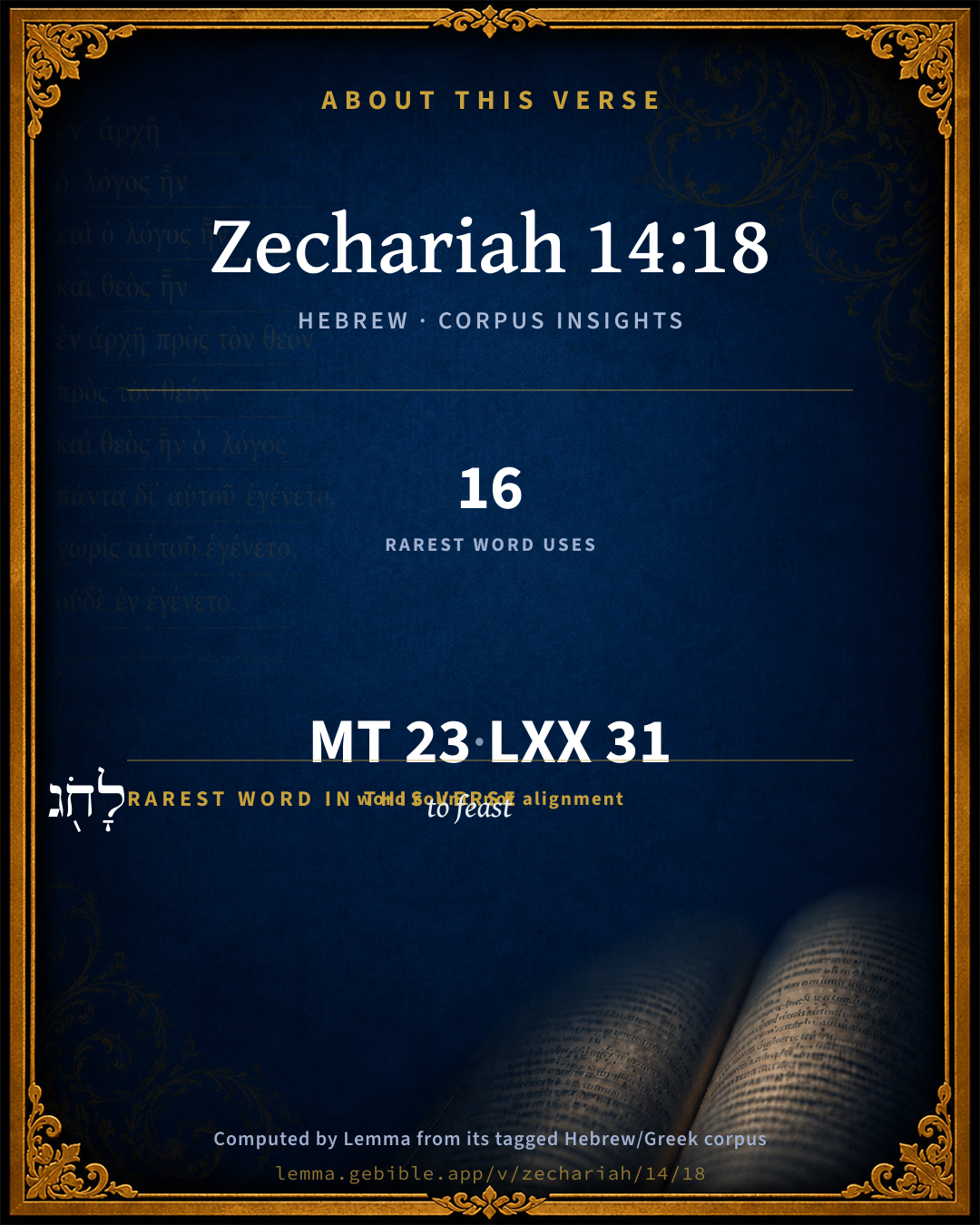
23
words
17
distinct lemmas
Prophets
section

Notable vocabulary

The rarest word here is לָחֹ֖ג to feast H2287 — appearing just 16 times in the whole Hebrew Bible.

Shared distinctive vocabulary

לָחֹ֖ג to feast H2287 occurs in 14 verses of the Hebrew Bible. Also found in:

Grammatical profile

  • 6 verbs
  • 7 nouns
  • 1 preposition
  • 1 conjunction
  • 8 particles

Verb forms

  • תַעֲלֶ֛ה Qal · Imperfect
  • בָאָ֖ה Qal · Participle Active
  • תִּֽהְיֶ֣ה Qal · Imperfect
  • יִגֹּ֤ף Qal · Imperfect
  • יַֽעֲל֔וּ Qal · Imperfect
  • לָחֹ֖ג Qal · Infinitive Construct

Repetition

Words recur within this verse — often emphatic in Hebrew:

  • תַעֲלֶ֛ה to go up H5927 ×2
  • לֹֽא not H3808 ×4
  • אֲשֶׁ֨ר which H834 ×2

Hebrew & Septuagint length

In English translation the verse runs 39 words from the Hebrew and 41 from the Septuagint (LXX English) — closely comparable.

A rough comparison of the two English renderings, which tokenize alike — not a word-level alignment.

Word counts can differ between the Hebrew and the Greek without any difference in meaning — e.g. the Hebrew direct-object marker אֵת has no separate Greek word, and Greek often adds the article ὁ.

In the original languages it is 23 Hebrew tokens and 31 Greek tokens — but the two are counted differently (Hebrew bundles its prefixes and suffixes into one token; the Greek is in lemma form), so that isn’t a like-for-like length.

Cross-references

3

Topical passages linked to Zechariah 14:18 in the Treasury of Scripture Knowledge — connected by theme and wording, ordered by reader-vote popularity; previews shown in the World English Bible.

  • Deuteronomy 11:10–11 For the land, where you go in to possess it, isn't as the land of Egypt, from whence you came out, where you sowed your seed, and watered it with your foot, as a garden of herbs;
  • Zechariah 14:12 This will be the plague with which Yahweh will strike all the peoples who have warred against Jerusalem: their flesh will consume away while they stand on their feet, and their eyes will consume away in their sockets, and their tongue will consume away in their mouth.
  • Zechariah 14:15 So will be the plague of the horse, of the mule, of the camel, and of the donkey, and of all the animals that will be in those camps, as that plague.

Cross-references courtesy of OpenBible.info (CC BY 4.0).

Hebrew and Greek witnesses Masoretic Hebrew ↔ Greek Septuagint

The same verse in the two great witnesses to the Old Testament, shown verse-for-verse.

These are two independent witnesses, not word-aligned to each other, and the Septuagint is shown in lemma (dictionary) form.

Hebrew Zechariah 14:18 Masoretic · Westminster Leningrad Codex

וְאִם מִשְׁפַּ֨חַת מִצְרַ֧יִם לֹֽא תַעֲלֶ֛ה וְלֹ֥א בָאָ֖ה וְלֹ֣א עֲלֵיהֶ֑ם תִּֽהְיֶ֣ה הַמַּגֵּפָ֗ה אֲשֶׁ֨ר יִגֹּ֤ף יְהוָה֙ אֶת הַגּוֹיִ֔ם אֲשֶׁר֙ לֹ֣א יַֽעֲל֔וּ לָחֹ֖ג אֶת חַ֥ג הַסֻּכּֽוֹת

If the family of Egypt doesn't go up, and doesn't come, neither will it rain on them. This will be the plague with which Yahweh will strike the nations that don't go up to keep the feast of tents.

World English Bible · Public Domain

Greek LXX Zechariah 14:18 Septuagint · lemma form

ἐάν δέ φυλή αἴγυπτος μή ἀναβαίνω μηδέ ἔρχομαι ἐκεῖ καί ἐπί οὗτος εἰμί ὁ πτῶσις ὅς πατάσσω κύριος πᾶς ὁ ἔθνος ὅσος ἐάν μή ἀναβαίνω ὁ ἑορτάζω ὁ ἑορτή ὁ σκηνοπηγία

And if the family of Egypt shall not go up, nor come; then upon them shall be the overthrow with which the Lord shall strike all the nations, whichever of them shall not come up to keep the feast of tabernacles.

LXX2012 (modern English Septuagint) · Public Domain

On this verse, Ellicott's Commentary for English Readers discusses the Septuagint’s reading. Read the note in Commentary ↓

Hebrew: Westminster Leningrad Codex (CC BY 4.0). Greek: Septuagint (public domain); English from LXX2012 (modern English Septuagint) (Public Domain). How the Septuagint differs from the Hebrew →

Targum (Aramaic paraphrase)

1

The Targum is the ancient Jewish Aramaic paraphrase of the Hebrew Scriptures — an interpretive translation, not the Hebrew text itself. Onkelos (literal) and Pseudo-Jonathan (expansive) render the Torah, and Jonathan the Prophets. Coverage is partial: where no permissively-licensed English translation exists for a verse, only the Aramaic is shown. This is verse-level text, not a word-by-word alignment to the Hebrew.

  1. Targum Jonathan Prophets (Joshua–Malachi)
    וְאִם מַלְכוּת מִצְרַיִם לָא תִפַּק וְלָא תֵיתֵי לָא לְהוֹן יִסַק נִילוֹס בְּרַם עֲלֵיהוֹן תְּהֵי מַחֲתָא דְיִמְחֵי יְיָ יַת עַמְמַיָא דְלָא יִסְקוּן לְמֵיחַג יַת חַגָא דִמְטָלַיָא:

    (no public-domain English translation for this verse)

    Targum Jonathan — Aramaic: “Mikraot Gedolot” (public domain). English: “Sefaria Community Translation” (CC0 1.0 (public-domain dedication)); “London "Chaldee Paraphrase," 1871” (public domain). Text via Sefaria.

Commentary

Notes on Zechariah 14:18 from classic Christian and Jewish commentators (each source and its license shown beneath its notes). The classic Christian expositions comment on the surrounding passage and are grouped to its opening verse, so a note may address several verses; the Jewish commentaries on the Tanakh (Rashi and others) are per-verse, so they appear only where the commentator wrote on this verse.

Lemma curates 59 commentaries, every one of them public domain or Creative Commons licensed, each selected and text-cleaned for this edition rather than reprinted as found. About our sources →

Trapp's Complete Commentary

John Trapp

Zec 14:18 And if the family of Egypt go not up, and come not, that [have] no [rain]; there shall be the plague, wherewith the LORD will smite the heathen that come not up to keep the feast of tabernacles.

Ver. 18. And if the family of Egypt] So called from one Aiguptos, a king there. In the Hebrew it is called mostly Mizraim, from one of that name, Gen 10:6; sometimes, for its power and pride, it is called Rahab, Psa 87:4; Psa 89:11 Isa 51:9. The family of Egypt is here put for the whole nation (see the like Amo 3:1), because, after the confusion of tongues especially, nations took their origin and denomination from the head of some family; as did the Egyptians from Mizraim, Shem’s second son.

Go not up, and come not] But they did receive the Christian religion with the first; had Christian schools, doctors, and professors, alter that St. Mark had there planted a Church at Alexandria, now called Scanderoon. This was before prophesied Isa 19:21 "The Lord shall be known to Egypt," &c. "And the Lord shall smite Egypt: he shall smite and heal it," &c., he shall cause them to pass under the rod, and so bring them into the bond of the covenant, as it is Eze 20:37.

That have no rain] Others read it thus, It shall not rain upon them. For they also needed rain in some measure, as well as other nations, see Psa 105:32, though not so much, by reason of the overflowings of the river Nile, which, if it rise to a just height, sc. of fifteen or sixteen cubits, as Pliny tells us, it makes the land very fruitful: so that they do but throw in the seed, and have four rich harvests in less than four months. Indeed, where the Nile arrives not there is nothing, they say, in Egypt, but a whitish sand, bearing no grass, but two little weeds, called Suhit and Gazul; which, burnt to ashes, and conveyed to Venice, makes the finest crystal glasses. The Chaldee renders it, Non crescet eius Nile. God loves to confute men in their confidences, to dry up their Nile, {see Eze 29:3; Eze 29:9 Isa 19:5-6} as he did for two years together in the time of Cleopatra, a little before Christ s birth, and once before for nine years’ time (Sen. Nat. Quaest. 1. xiv. c. 2).

There shall be the plague] q.d. If they escape the forethreatened evil a worse thing abides them: their preservation from famine is but a reservation to those everlasting burnings, Zec 14:12. And though here they abound even to satiety and surfeit (the Egyptians were wont to boast that they could feed all men, and feast all the gods, without any sensible diminution of their provision), yet at the last day they shall be cut short enough, eat fire, drink brimstone, God himself uttering those or the like words, Isa 65:13 "Behold, my servants shall eat, but ye shall be hungry; behold, my servants shall drink, but ye shall be thirsty; behold, my servants shall rejoice, but ye shall be ashamed; behold, my servants shall sing for joy of heart, but ye shall cry for sorrow of heart, and shall howl for vexation of spirit."

John Trapp, A Commentary or Exposition upon All the Books of the Old and New Testament (1647–1656) — public domain. Text from a community e-Sword module.

Geneva Bible (1599)

Geneva Bible translators

By the Egyptians, which were greatest enemies to true religion, he meaneth all the gentiles.

Geneva Bible (1599) marginal notes — public domain. Text via Bolls.life.

Jamieson, Fausset & Brown

Robert Jamieson, A. R. Fausset & David Brown

if . . . Egypt go not up--specified as Israel's ancient foe. If Egypt go not up, and so there be no rain on them (a judgment which Egypt would condemn, as depending on the Nile's overflow, not on rain), there shall be the plague . . . . Because the guilty are not affected by one judgment, let them not think to escape, for God has other judgments which shall plague them. MAURER translates, "If Egypt go not up, upon them also there shall be none" (no rain). Psa 105:32 mentions "rain" in Egypt. But it is not their main source of fertility.

Jamieson, Fausset & Brown — Commentary Critical and Explanatory on the Whole Bible (1871) — public domain (CC PDM 1.0). Text via the HelloAO Bible API.

Adam Clarke's Commentary

Verse 18. If the family of Egypt] This may allude to those Jews who, flying from the persecution of Antiochus Epiphanes, settled in Egypt, and built a temple at Heliopolis, under the direction of Onias, son of the high priest. Joseph. Antiq. lib. xiii., c. 6, and WAR, lib. vii., c. 36. If these do not rejoin their brethren, they shall have no rain, no interest in the favour of God.

Adam Clarke's Commentary on the Bible (1810–1826) — public domain. Text from a community e-Sword/MySword module.

John Calvin's Commentaries

But Zechariah speaks expressly of the Egyptians: and we indeed know that they were most inveterate enemies to true religion; and he might have also mentioned the Assyrians and the Chaldeans; but as the Egyptians were nearer and more contiguous to the holy land, their hatred towards the Jews was more virulent. This is the reason why Zechariah speaks of them particularly. It may at the same time appear strange that he threatens them with want of rain; for we know that Egypt expects no rain from above, because of the peculiar condition of the country; for according as the Nile overflows, do the inhabitants look for a fruitful produce of corn and of all other things. The Prophet then ought not to have thus threatened the Egyptians, for they might have justly laughed at him for saying that there would be no rain for them, the want of which is not much felt there. But the Prophet’s intention was simply what I have already explained, — that God would be a Father to the Jews, and also to others who joined in his worship according to the law. Though then the Egyptians had no need of rain, yet by this metaphor Zechariah denounced on them sterility as the punishment of impiety.

And we may further observe, that though the overflowing of the Nile irrigated the whole land and made it fruitful, yet rain was by no means useless; and it is said in Psalm 105:32, “He turned their rain into hail,” Egypt being the place spoken of; for the Lord destroyed all its fruit, because the rain was turned into hail. It appears also evident from history, that rain is desirable in Egypt in order to render the produce more abundant. But the Lord has favored that country with a peculiar benefit by supplying the want of rain by the Nile.

There is then nothing doubtful in the meaning of the Prophet, as his object was to show, that the Lord would constrain all people to become obedient to true religion, not only those Jews who were far removed from Judea, but even the Egyptians themselves, who had been always most alienated from true and pure worship.

He adds, There shall be upon them the plague. He now speaks more generally; and what he before specifically mentioned, he now declares in general terms, — that God would execute vengeance and destroy and reduce to nothing all those who took not on them the yoke, so as to worship him sincerely, together with the Jews, according to what the law prescribes. He again repeats the words, who ascended not into Jerusalem; not that he intended to confine the worship of God to ceremonies or rites under the law; but because it was necessary, until Christ abrogated all the ancient rites, that the worship of God should be thus described; nor could it then be separated from these external exercises.

But here it may be rightly inquired, why the Prophet speaks specifically of the feast of tabernacles, since the passover was deemed first among the festivals. The reason seems to me to have been this, — because it was difficult to believe that the Jews would return to their own country, that God would become again their redeemer. Many interpreters say, that the Prophet speaks of the feast of tabernacles, because it behaved them to be sojourners in the world: but a similar reason might be given for other days. We must then inquire why he mentions the feast of tabernacles and not other feasts. Now we know that when the Prophets speak of the second restoration of the people, they often call attention to that wonderful deliverance from Egypt by which God had proved that he possessed sufficient power to redeem and save his own people. To this instance does Zechariah now allude, as I think, and says, that God would restore his people by his wonderful and inexpressibly great power, so that they might justly celebrate the feast of tabernacles as their fathers formerly did: for we know why God commanded the Jews to dwell every year under the branches of trees; it was, that they might be mindful of that deliverance which had been granted to their fathers; for they had continued forty years in the desert, where they had no buildings, but huts only, made of branches of trees. When therefore they went forth from their houses, and dwelt as it were in the open air in tents, they thus revived the memory of the wonderful manner by which their fathers were delivered. Hence God, in order to show that their return from the Babylonian exile was worthy of being remembered, says here that the feast of tabernacles would be celebrated

In short, the Prophet means that God would be such a deliverer of his people, that all the nations, even from the remotest parts, would acknowledge it as a remarkable miracle: it is the sense then as though he had said, that the deliverance of the people would be an evidence of divine power so manifest and illustrious, that all nations would acknowledge that the God of Israel is the creator of heaven and earth, and is so endued with supreme power, that he governs the whole world; and, in a word, that he is the only true God who ought to be worshipped. It afterwards follows —

John Calvin's Commentaries (1540-1563) — public domain. Text from the Calvin Translation Society English edition (1840s-50s) via the Christian Classics Ethereal Library (ccel.org). Calvin's coverage is partial (roughly two-thirds of the Bible); uncommented books and verses are honest gaps, never fabricated. The 19th-century editor's footnotes and remarks are omitted so the notes are faithfully Calvin's own voice.

Ellicott's Commentary for English Readers

(18) That have no rain.—This is an impossible rendering of the original. We must read these words in connection with those which follow, and either take the clause as interrogative, and render, then will not (nonne?) the plague fall upon them wherewith, &c.,” or we must, with LXX. and six Hebrew MSS., omit the negative, and render, then shall fall on them the plague wherewith, &c. Lange (quoted by Wright) has observed rightly that if the family of Egypt were to be punished by the deficiency of water, the Abyssinians, even though they attended the feast at Jerusalem, would have to suffer at the same time, as Egypt can only suffer from scarcity of water in connection with all the lands in the south of that country. The fact, then, that the withholding of rain is described as the particular punishment of the nations that will not go up to the feast is sufficient proof that the prophecy is not to be taken in its literal sense.

A Bible Commentary for English Readers, edited by Charles John Ellicott (1878–1897) — public domain. Text from a community e-Sword module.

The Cambridge Bible for Schools and Colleges

gen. ed. J. J. S. Perowne

18. that have no rain] Rather, then not on them, &c. The words are an exact and obviously intended repetition of the first words of the clause at the end of Zec_14:17, then not on them shall there be rain. The writer, however, seems to have broken off his sentence suddenly, when he had written, then not on them, perhaps from the remembrance that Egypt was not directly dependent upon rain like other countries (Deu_11:10-11), and instead of finishing it with the words shall there be rain, to have changed its form, and written “(upon them) there shall be (in its equivalent form, and ultimately owing to the same cause—for the rising of the Nile which fertilizes Egypt is due to the rainfall) the plague, &c. The LXX. escape the difficulty by omitting the negative, καὶ ἐπὶ τούτους ἔσται ἡ πτῶσις: “even upon them shall be the plague.”

The Cambridge Bible for Schools and Colleges (gen. ed. J. J. S. Perowne; Cambridge University Press, 1878–1918) — public domain. Text from a community e-Sword module.

John Gill's Exposition

And if the family of Egypt go not up, and come not,.... To Jerusalem, the church of God; do not go thither to worship the Lord, attend his ordinances, and keep them in their purity; nor walk as becomes the people of God: by "the family of Egypt" are meant the Papists, so called for their tyranny, cruelty, and idolatry, Rev 11:8,

that have no rain; have not the pure word of God, and the ordinances thereof, only the traditions of men; yea, the doctrines of devils, and lies in hypocrisy: the allusion is to the land of Egypt, which was watered, not so much by rain as by the overflowing of the river Nile: or it may be rendered, "and upon them there shall be no rain" (w); or that which is equivalent to it. So the Targum paraphrases it,

"the Nile shall not ascend unto them.''

The sense is, as they are without the pure Gospel of Christ, they shall continue so, and be punished with, that sore judgment of a famine of hearing the word of the Lord.

There shall be the plague, wherewith the Lord will smite the heathen that come not up to keep the feast of tabernacles; they shall have the same plague of want of water, a famine; for it is a vulgar mistake that there is no rain in Egypt; it rains indeed but seldom, and only in some places, but it does rain. Monsieur Thevenot (x) says,

"it rains much at Alexandria, and Rosetta also; but at Cairo, which stands higher, it rains less; and yet (says he) I have seen it rain very hard every year, for two days together in the month of December.''

And Mr. Fuller (y) says that Sir William Paston, a patron of his, and a well accomplished traveller, was

"an eye witness of much and violent rain at Grand Cairo, but such as presaged a great mortality, which ensued, not long after.''

But it should be observed that this is only true of the lower part of Egypt, for in the upper parts it rains not, at least not very commonly: for Herodotus (z) reports that

"in the times of Psammenitus, the son of Amasis, king of Egypt, a very wonderful thing happened to the Egyptians; it rained at Thebes in Egypt, which it never had before, nor has ever since, as the Thebans say; for it never rains in the upper part of Egypt; but then it rained at Thebes in drops.''

Yet Mr. Norden (a), a late traveller in those parts, says he

"experienced at Meschie (a city in his travels to upper Egypt) a very violent rain, accompanied with thunder, for the space of a whole hour;''

though in the same place he says, at Feschna, and beyond, in the upper Egypt, the sky is always serene and clear. And in his travels from Cairo to Girge, capital of the upper Egypt, he relates, that at a certain place, as he went thither, they had little wind, and a great deal of rain (b). And in another place (c) he observes, at Menie (a place in upper Egypt) there was so thick a fog that we could perceive nothing at thirty paces distant: wherefore, since it does rain at times in some places, the same plague as before may be here meant; or want of provisions, as others, through a defect of rain; or the Nile not overflowing and watering the land, as Jarchi interprets it: but Kimchi gives another sense, and so Aben Ezra, which is, that instead of having no rain, which they need not and do not desire, they shall be smitten with the plague that the Lord will smite all the nations with that fight against Jerusalem, namely, their flesh shall consume away, &c. Zac 14:12.

(w) "super quos non est imber", Junius & Tremellius, Piscator, Drusius; "et non super illos, scil. erit imber", Burkius. (x) Travels, part 1. c. 72. p. 247. (y) Pisgah-Sight, B. 4. c. 5. p. 80. (z) Thalia, sive l. 3. c. 10. (a) Travels in Egypt and Nubia, vol. 1. p. 140. (b) Ib. vol. 2. p. 20. (c) Ib. p. 209.

John Gill's Exposition of the Whole Bible (1746–1763) — public domain (CC PDM 1.0). Text via the HelloAO Bible API.

Albert Barnes' Notes on the Bible

And if the family of Egypt go not up, and come not, that have no rain - Rather, “and there shall not be.” It may be that the prophet chose this elliptical form, as well knowing that the symbol did not hold as to Egypt, which, however it ultimately depended on the equatorial rains which overfilled the lakes which supply the Nile, did not need that fine arrangement of the rains of Autumn and Spring which were essential to the fruitfulness of Palestine. The omission leaves room for the somewhat prosaic supply of Jonathan, “The Nile shall not ascend to them.” More probably the words are left undefined with a purposed abruptness, “there shall not be upon them,” namely, whatever they need: the omission of the symbol in these two verses might the more suggest, that it is a symbol only. Egypt, the ancient oppressor of Israel, is united with Judah as one, in the same worship of God, as Isaiah had said, “In that day shall Israel be the third with Egypt and with Assyria” Isa 19:24; and since it is united in the duty, so also in the punishment for despising it.

Osorius: “Let not Egypt be proud, that it is watered by the Nile, as if it needed no rain: that is, let no one be secure in this life. For though we stand by faith, yet may we fall. For although bedewed by the efflux of divine grace, and filled with its richness, yet if we give not thanks continually for such great gifts, God will count us as the rest, to whom such copious goodness never came. The safety of all then lies in this, that while we are in these tabernacles, we cherish the divine benefits, and unceasingly praise the Lord, who hath heaped such benefits upon us.”

Cyril: “Under the one nation of the Egyptians, he understands those who are greatly deceived, and chose idolatry most unreasonably, to whom it will be a grave inevitable judgment, the pledge of destruction, that they despise the acceptable grace of salvation through Christ. For they are murderers of their own souls, if, when they could lay hold of eternal life and the divine gentleness, open to all who will choose it and put off the burden of sin, they die in their errors; the stain and pollution from transgression and error uncleansed, although the Divine Light illumined all around and called those in darkness to receive sight. Of each of these I would say, ‘Better is an untimely birth than he; for he cometh in with vanity, and departeth in darkness, and his name shall be covered with darkness” Ecc 6:3-4. “Good had it been for them, if they had never been born” Mat 26:24, is the Saviour’s word. That this is not said of the Egyptians only, but shall come true of all nations, who shall altogether be punished, if they are reckless of the salvation through Christ and honor not His festival, he will establish in these words;

Albert Barnes' Notes on the Bible (1834–1885) — public domain. Text from a community e-Sword/MySword module.

Matthew Poole's English Annotations

Egypt should think, though they had no rain, they should not be much losers by that, having the Nile to water their ground and make it fruitful. God by his prophet answers them, they shall fall under penury and famine, the very selfsame punishment which shall fall on other nations, if they neglected his worship. The Lord hath more ways than one to withhold the fruits of the earth, and send famine among people.

Matthew Poole's English Annotations on the Holy Bible (1683–1685) — public domain. Text from a community e-Sword/MySword module.

Whedon's Commentary on the Bible

Daniel D. Whedon

Zec_14:19 concludes the section with a reiteration of the threat.

Punishment — Literally, sin; here equivalent to punishment for sin (Num_32:23).

Jerusalem and Judah holy unto Jehovah, 20, 21.

From the description of the destiny of the hostile nations the prophet returns to complete the description of the glory of the city and land of Jehovah; Zec_14:20-21, therefore, are in a sense the continuation of Zec_14:11. Jerusalem and Judah will be freed from everything that is unclean and, with all their contents, will be holy unto Jehovah.

Bells of the horses — The reference may be to bells worn by the horses or to metal plates — which would make a tinkling sound when the horses moved — upon which was inscribed the name of the owner. Horses are frequently mentioned by the prophets as beasts of war and splendor (compare Zec_9:10; Zec_10:5); in the new age they will no longer be used for warlike enterprises, they will be devoted exclusively to the service of Jehovah, whose name will be inscribed upon the bells or plates as that of the owner.

Holiness — R.V., “Holy.” The noun is used in the Hebrew in the place of the adjective for the sake of emphasis (G.-K., 141c).

Unto Jehovah — The same inscription was found upon a gold plate in the mitre of the high priest (Exo_28:36; Exo_28:38), to designate him as a person consecrated to the service of Jehovah. This is the meaning here as in Zec_14:21. “When it [the word holy] is applied to things it expresses the idea that they belong to Jehovah, are used in his service or dedicated to him, or are in some special way his property” (A.B. Davidson, The Theology of the Old Testament, p. 253; see on Joe_2:1).

The pots in Jehovah’s house — The earthen vessels in which the flesh of the sacrifice was cooked for priests and laymen (1Sa_2:14; 2Ch_35:13), whose use was therefore semi-secular.

Shall be like the bowls before the altar — The vessels serving semi-secular and unimportant purposes will in the new era be as sacred and holy as the bowls in which is caught the blood of the sacrificial animals (Num_4:14; compare Zec_9:15). These bowls possessed a special degree of sanctity, because the blood was considered peculiarly sacred by the Hebrews. Some see the point of comparison not in the sanctity but in the size; but this is less probable.

In Zec_14:21 the prophet goes even further. The whole land will be Jehovah’s (Zec_14:9-11); by that very fact it will be made holy unto him (see on Zec_14:20; Joe_2:1), and this holiness will attach to everything found in the land.

Every pot — Not only the vessels in the temple, but also those used in private homes for secular purposes; they will possess in the new age the same sanctity as the former.

They that sacrifice — Strangers from the distance, who cannot carry with them sacrificial implements, but have to secure them after their arrival in the city.

Take of them — As many as they need, without fear that they will secure an unclean vessel.

Canaanite — Some take this word in a commercial sense, merchant, trafficker (see on Hos_12:7), and they interpret the passage as meaning that, since any vessel the worshiper may lay his hand on will serve his purpose, there will be no further need of merchants selling these wares in the temple (compare Mat_21:12; Joh_2:14). Others take the word literally of the inhabitants of Canaan, and they think that it refers to the Canaanites employed to perform the lowest duties in the temple. Still others expand the application of the term so as to include all unclean persons, whether Jews or foreigners. All such will disappear, for both men and things throughout Judah and Jerusalem will be holy unto Jehovah. Between these interpretations it is difficult to choose. With the second may be compared Eze_44:9; but the context favors the first.

Daniel D. Whedon (gen. ed.), Commentary on the Old and New Testaments (1874–1909) — public domain. Text from a community e-Sword module.

The Pulpit Commentary

If the family of Egypt go not up. Egypt is mentioned as the great typical enemy of God and Israel, and therefore most obnoxious to punishment if it did not obey the call. That have no rain. This rendering implies, what is not the fact, that Egypt is without rain, and is not dependent upon rain for its fertility. The expression in the text is elliptical, being merely, "then not on them," and it is obviously natural to supply, "shall there be rain." As the rise of the Nile depends upon the equinoctial rains in the interior, the failure of these would be disastrous. Another way of rendering the passage is to combine the clauses and append a note of interrogation; thus: "Shall there not be upon them the plague wherewith," etc.? The LXX and Syriac omit the negative, Kai epi toutouv estai h ptwsiv , "Even upon these shall be the plague."

The Pulpit Commentary (1880–1919), ed. H.D.M. Spence-Jones & Joseph S. Exell — public domain. Text from a community e-Sword module.

Rashi

Rabbi Shlomo Yitzchaki (Rashi)

And if the family of Egypt does not go up and they do not require rain, for the Nile comes up and waters it [i.e., the land of Egypt].

it shall not [rain] upon them Their rain shall not be upon them; i.e., the Nile will not water them, and so did Jonathan render: The Nile shall not ascend upon them.

the plague will be The plague of famine.

with which the Lord will plague This will be the punishment of Egypt and the punishment of all the nations, as He states. “upon them there shall be no rain.”

Rashi on the Tanakh — English translations: “The Judaica Press complete Tanach with Rashi, translated by A. J. Rosenberg” (CC BY 4.0); “Pentateuch with Rashi's commentary by M. Rosenbaum and A.M. Silbermann, 1929-1934” (public domain); “The Metsudah Tanach series, Lakewood, N.J” (CC BY 4.0); and “The Book of Joshua, Metsudah Publications, 1997” (CC BY 4.0). Text via Sefaria.

Lesson kit

Teaching starters — assembled from the data on this page, not authored interpretation. Every prompt links to the verse data it draws on. Edit before teaching.

Zechariah, in the Prophets, opens this verse with 23 words (17 distinct Hebrew lemmas). Its most distinctive word is châgag (“to feast”). A historical commentator’s framing appears above. Read the whole chapter for the surrounding context.

Discussion questions

  1. What does “to feast” (châgag) contribute to the verse as a whole?
  2. How does Exodus 5:1, which shares the word «to feast», read alongside this verse?
  3. What does the repetition of “to go up” (2× in this one verse) do in this verse?
  4. These translations render this verse differently. What is at stake in choosing one wording over another?
  5. «תַעֲלֶ֛ה» is a Qal Imperfect verb. How does that grammatical form shape the action described?
  6. Compare how Trapp's Complete Commentary and Geneva Bible (1599) read this verse. Where do they agree or differ?

Things to notice

Reading settings

Reading text

Shown beneath each verse's original-language words.

Old Testament
Old Testament edition

Read the OT as the Masoretic Hebrew (MT) or the Greek Septuagint (LXX).

English shown for the Greek Septuagint (in the Hebrew ↔ Greek comparison).

Comparing translations? Open the Compare panel on any verse page to stack up to four side by side.