
Deuteronomy 1:41

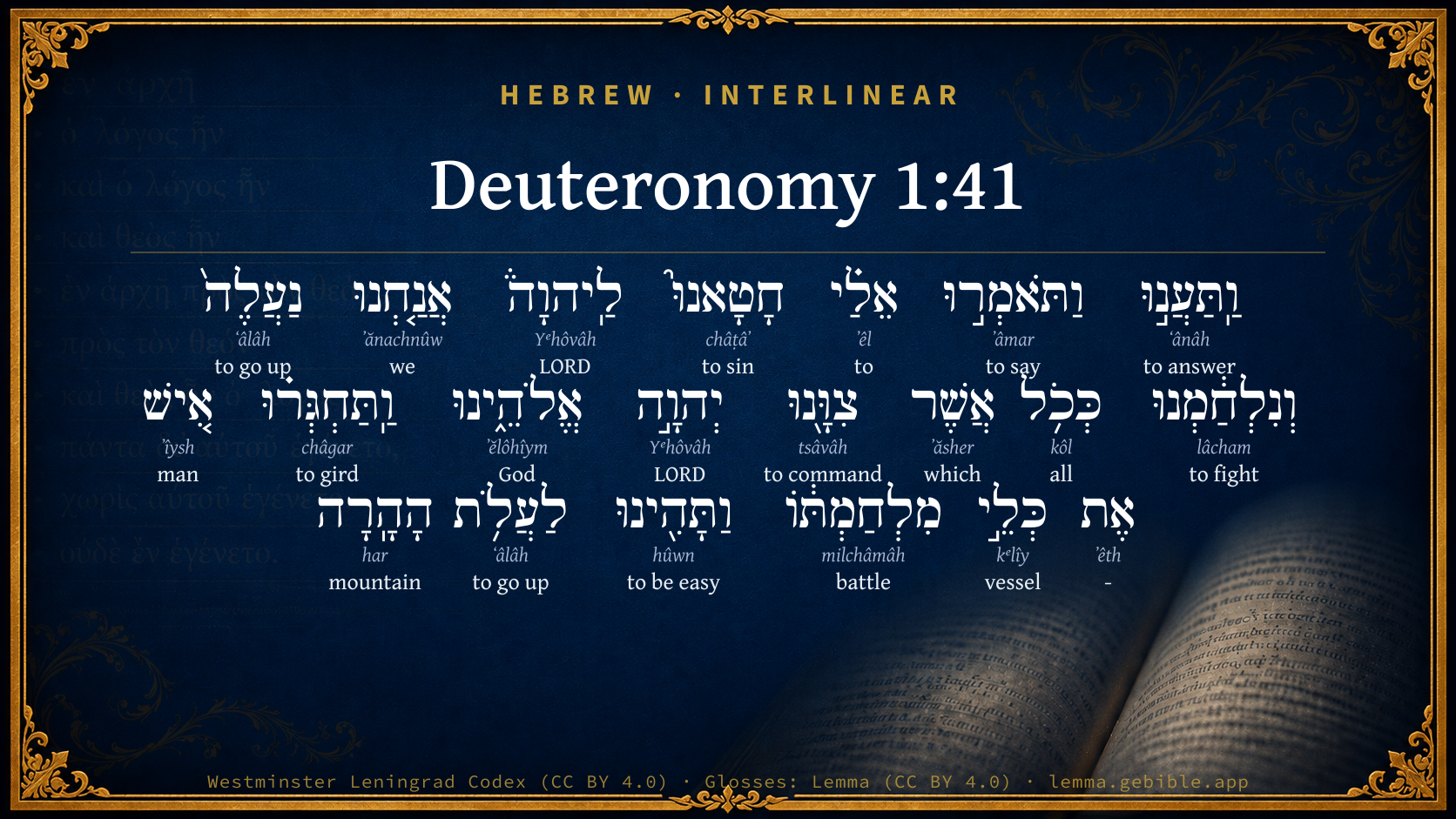
Hebrew (Westminster Leningrad Codex) Deuteronomy 1:41 appears in the Hebrew Old Testament. The text above is from the Westminster Leningrad Codex. Each word links to its Strong’s number, a concise gloss, and parsing drawn from the Open Scriptures Hebrew Bible morphology. Click any word for its full Brown-Driver-Briggs (BDB) entry.
Download image
Cite this verse

Deuteronomy 1:41 (World English Bible). Public Domain. Lemma interlinear Bible study tool, https://lemma.gebible.app/v/deuteronomy/1/41.

Show BibTeX & RIS
BibTeX
RIS
English Translation
Then you answered and said to me, We have sinned against Yahweh, we will go up and fight, according to all that Yahweh our God commanded us. You girded on every man his weapons of war, and were forward to go up into the hill-country.
World English Bible · Public Domain
Highlights
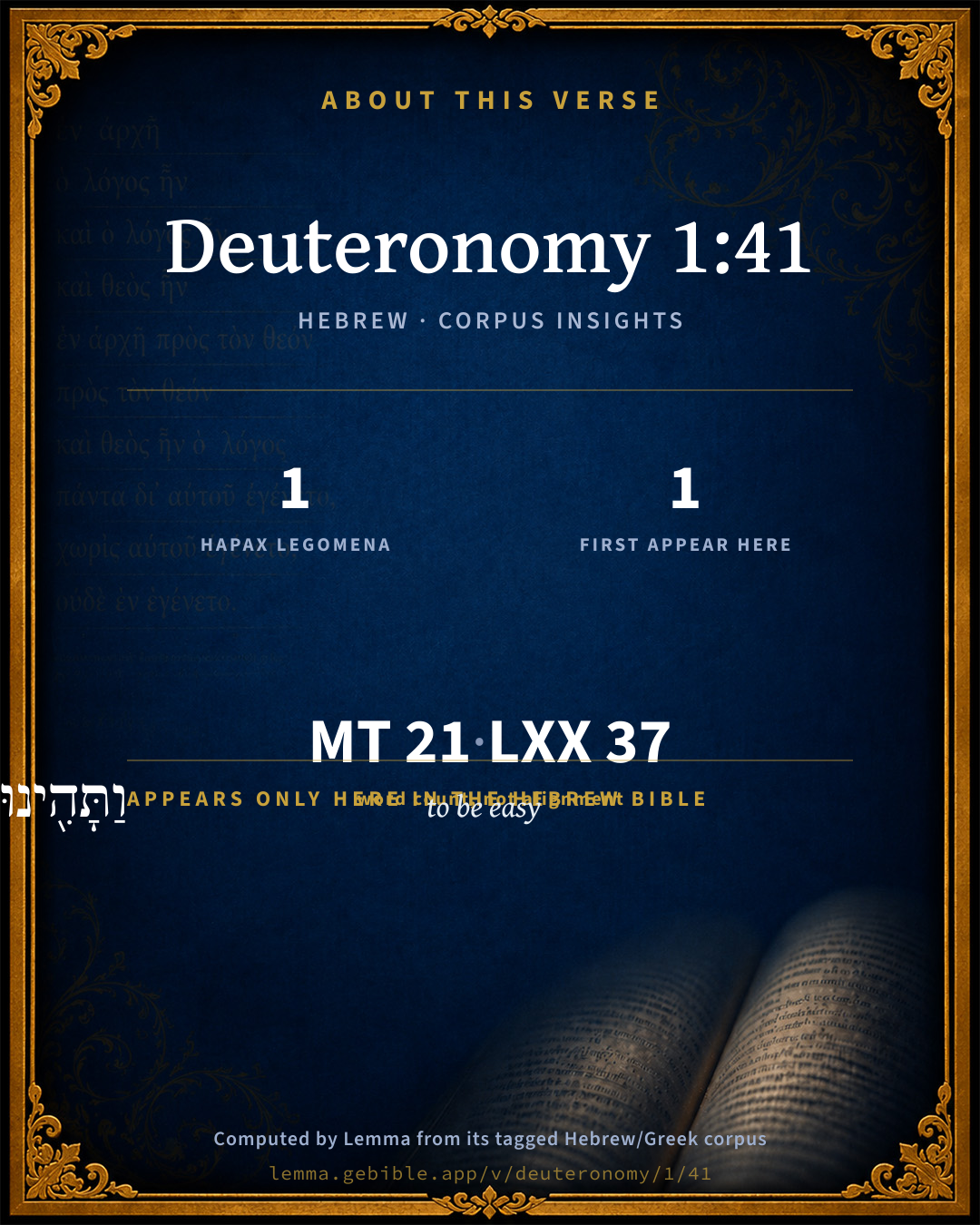
  • 1 hapax legomenon — only here in the Hebrew Bible
  • 1 first appearance in the Hebrew Bible
Full analysis ↓
Download a study sheet

One document with this verse’s original text, its word-by-word gloss line, the meaning frame, cross-references with their text, attributed commentary, and full source and license credits — printable, and it pastes into notes with its structure intact.

This verse Autodidact and up

Study sheet (.html) Plain text (.txt)

A passage Seminary Student

Up to 50 verses in one chapter. A passage sheet keeps up to 6 commentary sources and 12 cross-references per verse, in the order this page ranks them, and says so on the sheet whenever that leaves anything out. Ask for a single verse and you get the Autodidact verse sheet above.

Everything on this page stays free to read, with no account — the sheet is a download of what is already on screen, not access to it.

Want to remove ads? Support Godless Engineer
Compare translations 3

The same verse in 3 English versions, stacked beneath the original-language interlinear above. Click any original word for its lexicon entry.

Each is an independent rendering of the whole verse — the interlinear is not word-aligned to these translations.

Highlighted words mark where these versions differ — a whole-verse word diff, not a word-by-word alignment.

  • World English Bible Public Domain
    Then you answered and said to me, We have sinned against Yahweh, we will go up and fight, according to all that Yahweh our God commanded us. You girded on every man his weapons of war, and were forward to go up into the hill-country.
  • King James Version Public Domain
    Then ye answered and said unto me, We have sinned against the LORD, we will go up and fight, according to all that the LORD our God commanded us. And when ye had girded on every man his weapons of war, ye were ready to go up into the hill.
  • unfoldingWord Literal Text CC BY-SA 4.0
    And you answered and said to me, ‘We have sinned against Yahweh. We, we shall go up and fight, according to all that Yahweh our God has commanded us.’ And man girded on his weapons of war and regarded it as easy to go up to the hill.

unfoldingWord Literal Text — © unfoldingWord, licensed CC BY-SA 4.0. Word-aligned USFM3 via Door43 (git.door43.org/unfoldingWord/en_ult).

Versions to compare (up to 4)

3 of 4 selected

Show all 18 translations

Every available English version of this verse, each an independent rendering of the whole verse.

  • World English Bible Public Domain
    Then you answered and said to me, We have sinned against Yahweh, we will go up and fight, according to all that Yahweh our God commanded us. You girded on every man his weapons of war, and were forward to go up into the hill-country.
  • Berean Standard Bible Public Domain
    “We have sinned against the LORD,” you replied. “We will go up and fight, as the LORD our God has commanded us.” Then each of you put on his weapons of war, thinking it easy to go up into the hill country.
  • Majority Standard Bible Public Domain
    “We have sinned against the LORD,” you replied. “We will go up and fight, as the LORD our God has commanded us.” Then each of you put on his weapons of war, thinking it easy to go up into the hill country.
  • King James Version Public Domain
    Then ye answered and said unto me, We have sinned against the LORD, we will go up and fight, according to all that the LORD our God commanded us. And when ye had girded on every man his weapons of war, ye were ready to go up into the hill.
  • American Standard Version (1901) Public Domain
    Then ye answered and said unto me, We have sinned against Jehovah, we will go up and fight, according to all that Jehovah our God commanded us. And ye girded on every man his weapons of war, and were forward to go up into the hill-country.
  • Revised Version (1885) Public Domain
    Then ye answered and said unto me, We have sinned against the LORD, we will go up and fight, according to all that the LORD our God commanded us. And ye girded on every man his weapons of war, and were forward to go up into the mountain.
  • Geneva Bible (1599) Public Domain
    Then ye answered and sayd vnto me, We haue sinned against the Lord, we wil go vp, and fight, according to all that the Lord our God hath commanded vs: and ye armed you euery man to the warre, and were ready to goe vp into the mountaine.
  • Douay-Rheims (1899) Public Domain
    Your children, of whom you said that they should be led away captives, and your sons who know not this day the difference of good and evil, they shall go in: and to them I will give the land, and they shall possess it.
  • Young's Literal Translation Public Domain
    `And ye answer and say unto me, We have sinned against Jehovah; we -- we go up, and we have fought, according to all that which Jehovah our God hath commanded us; and ye gird on each his weapons of war, and ye are ready to go up into the hill-country;
  • Literal Standard Version CC BY-SA 4.0
    And you answer and say to me, We have sinned against YHWH; we go up and we have fought, according to all that which our God YHWH has commanded us; and you each gird on his weapons of war, and you are ready to go up into the hill-country;
  • Unlocked Literal Bible CC BY-SA 4.0
    Then you answered and said to me, 'We have sinned against Yahweh; we will go up and fight, and we will follow all that Yahweh our God has commanded us to do.' Every man among you put on his weapons of war, and you were ready to attack the hill country.
  • unfoldingWord Literal Text CC BY-SA 4.0
    And you answered and said to me, ‘We have sinned against Yahweh. We, we shall go up and fight, according to all that Yahweh our God has commanded us.’ And man girded on his weapons of war and regarded it as easy to go up to the hill.
  • Darby Bible Public Domain
    -- And ye answered and said unto me, We have sinned against Jehovah, we will go up and fight, according to all that Jehovah our God hath commanded us. And ye girded on every man his weapons of war, and ye would go presumptuously up the hill.
  • World Messianic Bible Public Domain
    Then you answered and said to me, “We have sinned against the LORD. We will go up and fight, according to all that the LORD our God commanded us.” Every man of you put on his weapons of war, and presumed to go up into the hill country.
  • Webster's Bible Public Domain
    Then ye answered and said to me, We have sinned against the LORD, we will go up and fight, according to all that the LORD our God commanded us. And when ye had girded on every man his weapons of war, ye were ready to ascend the hill.
  • Free Bible Version CC BY-SA 4.0
    But you answered and told me, “We have sinned against the Lord! We will go and we will fight and we will do everything the Lord our God has ordered us to do.” Then you all picked up your weapons and prepared for battle thinking it would be easy to go and fight in the hill country.
  • Bible in Basic English Public Domain
    Then you said to me, We have done evil against the Lord, we will go up to the attack, as the Lord our God has given us orders. And arming yourselves every one, you made ready to go up without care into the hill-country.
  • JPS Tanakh (1917) Public Domain
    Then ye answered and said unto me: 'We have sinned against the LORD, we will go up and fight, according to all that the LORD our God commanded us.' And ye girded on every man his weapons of war, and deemed it a light thing to go up into the hill-country.

Literal Standard Version (2020), Covenant Press — licensed CC BY-SA 4.0. Text via the HelloAO Bible API (eBible.org). Unlocked Literal Bible (unfoldingWord) — licensed CC BY-SA 4.0. Text via the HelloAO Bible API (eBible.org). unfoldingWord Literal Text — © unfoldingWord, licensed CC BY-SA 4.0. Word-aligned USFM3 via Door43 (git.door43.org/unfoldingWord/en_ult). Free Bible Version, Dr. Jonathan Gallagher — licensed CC BY-SA 4.0. Text via the HelloAO Bible API (eBible.org).

Word by word

More ways to search: Search by grammar → Find every occurrence → Compare this word →

Practice this passage: Drill this verse → Learn its vocabulary →

וַתָּהִ֖ינוּ
hûwn
H1951
“and · to be easy”
Conjunction + Verb, Hiphil, Sequential Imperfect, 2nd Person, Masculine, Plural
Part of Speech
Conjunction + Verb
Stem
Hiphil
Form
Sequential Imperfect
Person
2nd Person
Gender
Masculine
Number
Plural
Full BDB Definition

Origin: a primitive root

TWOT: 487

to be easy, be ready - (Hiphil) to consider as easy, make light of
  1. וַֽתַּעֲנ֣וּ ʻânâh H6030 “and · to answer” Conjunction + Verb, Qal, Sequential Imperfect, 2nd Person, Masculine, Plural
  2. וַתֹּאמְר֣וּ ʼâmar H559 “and · to say” Conjunction + Verb, Qal, Sequential Imperfect, 2nd Person, Masculine, Plural
  3. אֵלַ֗י ʼêl H413 “to · me” Preposition + Suffix, Personal, 1st Person, Common, Singular
  4. חָטָאנוּ֮ châṭâʼ H2398 “to sin” Verb, Qal, Perfect, 1st Person, Common, Plural
  5. לַֽיהוָה֒ Yᵉhôvâh H3068 “to/for · LORD” Preposition + Noun, Proper
  6. אֲנַ֤חְנוּ ʼănachnûw H587 “we” Pronoun, Personal, 1st Person, Common, Plural
  7. נַעֲלֶה֙ ʻâlâh H5927 “to go up” Verb, Qal, Imperfect, 1st Person, Common, Plural
  8. וְנִלְחַ֔מְנוּ lâcham H3898 “and · to fight” Conjunction + Verb, Niphal, Sequential Perfect, 1st Person, Common, Plural
  9. כְּכֹ֥ל kôl H3605 “like/as · all” Preposition + Noun, Common, Masculine, Singular, Absolute
  10. אֲשֶׁר ʼăsher H834 “which” Particle, Relative
  11. צִוָּ֖נוּ tsâvâh H6680 “to command · us” Verb, Piel, Perfect, 3rd Person, Masculine, Singular + Suffix, Personal, 1st Person, Common, Plural
  12. יְהוָ֣ה Yᵉhôvâh H3068 “LORD” Noun, Proper
  13. אֱלֹהֵ֑ינוּ ʼĕlôhîym H430 “God(s) · our” Noun, Common, Masculine, Plural, Construct + Suffix, Personal, 1st Person, Common, Plural
  14. וַֽתַּחְגְּר֗וּ châgar H2296 “and · to gird” Conjunction + Verb, Qal, Sequential Imperfect, 2nd Person, Masculine, Plural
  15. אִ֚ישׁ ʼîysh H376 “man” Noun, Common, Masculine, Singular, Absolute
  16. אֶת ʼêth H853 “-” Particle, Direct Object
  17. כְּלֵ֣י kᵉlîy H3627 “vessels of” Noun, Common, Masculine, Plural, Construct
  18. מִלְחַמְתּ֔וֹ milchâmâh H4421 “battle · his” Noun, Common, Feminine, Singular, Construct + Suffix, Personal, 3rd Person, Masculine, Singular
  19. לַעֲלֹ֥ת ʻâlâh H5927 “to go up” Preposition + Verb, Qal, Infinitive Construct
  20. הָהָֽרָה har H2022 “the · mountain · toward” Particle, Definite Article + Noun, Common, Masculine, Singular, Absolute + Suffix, Demonstrative

About this verse

These counts appear in no published source. They are computed here, from the morphology-tagged text and Lemma’s own curated glosses. What Lemma adds →

21
words
19
distinct lemmas
Pentateuch
section

Notable vocabulary

1 hapax legomenon — a word that appears only here in the entire Hebrew Bible:

  • וַתָּהִ֖ינוּ to be easy H1951

First appearance in Scripture

This word makes its first canonical appearance in the Hebrew Bible here:

  • וַתָּהִ֖ינוּ to be easy H1951

Shared distinctive vocabulary

וַֽתַּחְגְּר֗וּ to gird H2296 occurs in 41 verses of the Hebrew Bible. Also found in:

Grammatical profile

  • 9 verbs
  • 8 nouns
  • 1 pronoun
  • 1 preposition
  • 2 particles

Verb forms

  • וַֽתַּעֲנ֣וּ Qal · Sequential Imperfect
  • וַתֹּאמְר֣וּ Qal · Sequential Imperfect
  • חָטָאנוּ֮ Qal · Perfect
  • נַעֲלֶה֙ Qal · Imperfect
  • וְנִלְחַ֔מְנוּ Niphal · Sequential Perfect
  • צִוָּ֖נוּ Piel · Perfect
  • וַֽתַּחְגְּר֗וּ Qal · Sequential Imperfect
  • וַתָּהִ֖ינוּ Hiphil · Sequential Imperfect
  • לַעֲלֹ֥ת Qal · Infinitive Construct

Repetition

Words recur within this verse — often emphatic in Hebrew:

  • לַֽיהוָה֒ LORD H3068 ×2
  • נַעֲלֶה֙ to go up H5927 ×2

Hebrew & Septuagint length

In English translation the verse runs 45 words from the Hebrew and 49 from the Septuagint (LXX English) — closely comparable.

A rough comparison of the two English renderings, which tokenize alike — not a word-level alignment.

Word counts can differ between the Hebrew and the Greek without any difference in meaning — e.g. the Hebrew direct-object marker אֵת has no separate Greek word, and Greek often adds the article ὁ.

In the original languages it is 21 Hebrew tokens and 37 Greek tokens — but the two are counted differently (Hebrew bundles its prefixes and suffixes into one token; the Greek is in lemma form), so that isn’t a like-for-like length.

Cross-references

3

Topical passages linked to Deuteronomy 1:41 in the Treasury of Scripture Knowledge — connected by theme and wording, ordered by reader-vote popularity; previews shown in the World English Bible.

  • Numbers 14:39–45 Moses told these words to all the children of Israel: and the people mourned greatly.
  • Numbers 22:34 Balaam said to the angel of Yahweh, I have sinned; for I didn't know that you stood in the way against me: now therefore, if it displease you, I will get me back again.
  • Proverbs 19:3 The foolishness of man subverts his way; His heart rages against Yahweh.

Cross-references courtesy of OpenBible.info (CC BY 4.0).

Hebrew and Greek witnesses Masoretic Hebrew ↔ Greek Septuagint

The same verse in the two great witnesses to the Old Testament, shown verse-for-verse.

These are two independent witnesses, not word-aligned to each other, and the Septuagint is shown in lemma (dictionary) form.

Hebrew Deuteronomy 1:41 Masoretic · Westminster Leningrad Codex

וַֽתַּעֲנ֣וּ וַתֹּאמְר֣וּ אֵלַ֗י חָטָאנוּ֮ לַֽיהוָה֒ אֲנַ֤חְנוּ נַעֲלֶה֙ וְנִלְחַ֔מְנוּ כְּכֹ֥ל אֲשֶׁר צִוָּ֖נוּ יְהוָ֣ה אֱלֹהֵ֑ינוּ וַֽתַּחְגְּר֗וּ אִ֚ישׁ אֶת כְּלֵ֣י מִלְחַמְתּ֔וֹ וַתָּהִ֖ינוּ לַעֲלֹ֥ת הָהָֽרָה

Then you answered and said to me, We have sinned against Yahweh, we will go up and fight, according to all that Yahweh our God commanded us. You girded on every man his weapons of war, and were forward to go up into the hill-country.

World English Bible · Public Domain

Greek LXX Deuteronomy 1:41 Septuagint · lemma form

καί ἀποκρίνω ἐγώ καί εἶπον ἁμαρτάνω ἔναντι κύριος ὁ θεός ἐγώ ἐγώ ἀναβαίνω πολεμέω κατά πᾶς ὅσος ἐντέλλομαι κύριος ὁ θεός ἐγώ ἐγώ καί ἀναλαμβάνω ἕκαστος ὁ σκεῦος ὁ πολεμικός αὐτός καί συνἀθροίζω ἀναβαίνω εἰς ὁ ὄρος

And you⌃ answered and said, We have sinned before the Lord our God; we will go up and fight according to all that the Lord our God has commanded us: and having taken every one his weapons of war, and being gathered together, you⌃ went up to the mountain.

LXX2012 (modern English Septuagint) · Public Domain

On this verse, The Cambridge Bible for Schools and Colleges discusses the Septuagint’s reading. Read the note in Commentary ↓

Hebrew: Westminster Leningrad Codex (CC BY 4.0). Greek: Septuagint (public domain); English from LXX2012 (modern English Septuagint) (Public Domain). How the Septuagint differs from the Hebrew →

Targum (Aramaic paraphrase)

2

The Targum is the ancient Jewish Aramaic paraphrase of the Hebrew Scriptures — an interpretive translation, not the Hebrew text itself. Onkelos (literal) and Pseudo-Jonathan (expansive) render the Torah, and Jonathan the Prophets. Coverage is partial: where no permissively-licensed English translation exists for a verse, only the Aramaic is shown. This is verse-level text, not a word-by-word alignment to the Hebrew.

  1. Targum Onkelos Torah (Genesis–Deuteronomy)
    וַאֲתֶבְתּוּן וַאֲמַרְתּוּן לִי חַבְנָא קֳדָם יְיָ אֲנַחְנָא נִיסַק וּנְגִיחַ קְרָב כְּכֹל דִי פַקְדָנָא יְיָ אֱלָהָנָא וְזָרֶזְתּוּן גְבַר יָת מָנֵי קְרָבֵהּ וְשָׁרֵיתוּן לְמֵיסַק לְטּוּרָא

    (no public-domain English translation for this verse)

    Targum Onkelos — Aramaic: “Onkelos Genesis” (public domain); “Onkelos Exodus” (public domain); “Onkelos Leviticus” (public domain); “Onkelos Numbers” (public domain); “Onkelos Deuteronomy” (public domain). English: “Sefaria Community Translation” (CC0 1.0 (public-domain dedication)); “J.W. Etheridge. The Targums of Onkelos and Jonathan Ben Uzziel on the Pentateuch. London: Longmans, Green, 1862” (public domain). Text via Sefaria.

  2. Targum Pseudo-Jonathan Torah (Genesis–Deuteronomy)
    וַאֲתֵיבְתּוּן וַאֲמַרְתּוּן לִי חַבְנָא קֳדָם יְיָ אֲנַחְנָא נִיסַק וְנָגִיחַ קְרָב כְּכָל דְּפַקְדָנָא יְיָ אֱלָהָנָא וַאֲסַרְתּוּן גְּבַר יַת מָאנֵי זַיְינֵיהּ וְשָׁרֵיתוּן לְמֵיסוֹק לְטַוְורָא

    Then answered you, and said to me, We have sinned before the Lord; we will go up and fight according to all that the Lord our God commanded us. And you girded on every man his arms, and began to ascend the mountain.

    Targum Pseudo-Jonathan — Aramaic: “Targum Jonathan on Genesis” (public domain); “Targum Jonathan on Exodus” (public domain); “Targum Jonathan on Leviticus” (public domain); “Targum Jonathan on Numbers” (public domain); “Targum Jonathan on Deuteronomy” (public domain). English: “The Targum of Jonathan ben Uzziel, trans. J. W. Etheridge, London, 1862” (public domain). Text via Sefaria.

Commentary

Notes on Deuteronomy 1:41 from classic Christian and Jewish commentators (each source and its license shown beneath its notes). The classic Christian expositions comment on the surrounding passage and are grouped to its opening verse, so a note may address several verses; the Jewish commentaries on the Tanakh (Rashi and others) are per-verse, so they appear only where the commentator wrote on this verse.

Lemma curates 59 commentaries, every one of them public domain or Creative Commons licensed, each selected and text-cleaned for this edition rather than reprinted as found. About our sources →

Trapp's Complete Commentary

John Trapp

Deu 1:41 Then ye answered and said unto me, We have sinned against the LORD, we will go up and fight, according to all that the LORD our God commanded us. And when ye had girded on every man his weapons of war, ye were ready to go up into the hill.

Ver. 41. We have sinned, we will go up.] Temporaries are set upon sin in the very confession thereof. Unless to the confession of sin we add confusion of sin, we do nothing. {Pro 28:13} Yet "honour me before the people," said Saul: Give me a bribe, said trembling Felix.

John Trapp, A Commentary or Exposition upon All the Books of the Old and New Testament (1647–1656) — public domain. Text from a community e-Sword module.

Geneva Bible (1599)

Geneva Bible translators

This declareth man’s nature, who will do that which God forbiddeth, and will not do that which he commendeth.

Geneva Bible (1599) marginal notes — public domain. Text via Bolls.life.

Ellicott's Commentary for English Readers

(41) We have sinned . . . we will go up and fight.—The emphatic we of this verse may be compared with the “we” of Deu_1:28. In both instances it was we, without Jehovah. It was a change from cowardice to presumption, not from unbelief to faith.

Ye were ready to go up into the hill.—Some render, Ye made light of going up.

A Bible Commentary for English Readers, edited by Charles John Ellicott (1878–1897) — public domain. Text from a community e-Sword module.

The Cambridge Bible for Schools and Colleges

gen. ed. J. J. S. Perowne

41. We have sinned against the Lord] Sam. and LXX add our God: cp. JE, Num_14:40 b, we have sinned.

we will go up and fight] we, we Will go up, etc. We ourselves, the doomed generation, and not leave the advance to our children. JE, Behold us, we will go up.

and were forward to go up] deemed it a light thing to go up (R.V. marg.). The verb (tahînu) does not occur elsewhere in the O.T. and ancient translators gave it various meanings. In Ar. the same root is ‘to be slight’ or ‘light’ (see on Deu_1:43); the causative Heb. form is best rendered made light of. This quick revulsion of popular feeling is true to life and admirably depicted. The change was too facile to be real. It is remarkable how alike Hosea and the authors of D are in their attitude to such ethical phenomena. As Hosea declares of his generation (Deu_1:15 ff.), so the generation of Moses does not appreciate how deep is its evil disposition; and, therefore, its repentance is futile. Mere enthusiasm is no atonement for guilt. Men cannot run away from their moral unworthiness on bursts of feeling. The next verse tells that God rejected the light-minded offer; and the truth underlies both verses that He did not do so arbitrarily. Lack of the sense of the seriousness of obedience, of the difficulty of doing God’s will, of the agony which Christ supremely felt, is as great a sin as the refusal to obey. Both are equally proof of unworthiness to work with God. He can do nothing with such shallow natures.

The Cambridge Bible for Schools and Colleges (gen. ed. J. J. S. Perowne; Cambridge University Press, 1878–1918) — public domain. Text from a community e-Sword module.

John Gill's Exposition

Then ye answered, and said unto me,.... Not being willing to go into the wilderness again, though they wished they had died in it; nor to go the way of the Red sea, which was their way back again to Egypt, though they had been for appointing a captain, and returning thither; but now they repented of what they had said and done:

we have sinned against the Lord; by murmuring against his servants, and disobeying his commands:

we will go up and fight according to all that the Lord our God hath commanded us; which is more than they were bid to do; they were only ordered to go up and possess the land, and it was promised them the Lord would fight for them:

and when ye had girded on every man his weapon; his sword upon his thigh; a large number of them, for all of them were not so disposed, though many were:

ye were ready to go unto the hill; though before backward enough, when they were bid to do it. De Dieu, from the use of the word (n) in the Arabic language, renders it, "ye reckoned it easy to go up unto the hill"; before it was accounted very difficult, by reason the passes were kept and guarded by the Amorites; but now there was no difficulty, when they were bid to go another way, but were ready at once to go up, which comes to the same sense; he further observes, that the word, in another conjugation in the same language, signifies to make light of, or despise (o); and so may be rendered, "and ye despised"; that is, rejected and despised the order given them to go into the wilderness by the way of the Red sea in the preceding verse, by their attempting to go up the hill; though the word so taken will bear another sense, agreeable to the first, that they now made a light matter of it, as if it was nothing, and there was no difficulty in it to go up the hill, which before was too hard and heavy for them.

(n) "levis et facilis fuit res", Golius, col. 2593. (o) "Contempsit", ib.

John Gill's Exposition of the Whole Bible (1746–1763) — public domain (CC PDM 1.0). Text via the HelloAO Bible API.

Albert Barnes' Notes on the Bible

Ye were ready to go up into the hill - Rather, perhaps, “ye made light of going up;” i. e. “ye were ready to attempt it as a trifling undertaking.” Deu 1:43 shows the issue of this spirit in action; compare marginal references.

Albert Barnes' Notes on the Bible (1834–1885) — public domain. Text from a community e-Sword/MySword module.

Haydock's Catholic Bible Commentary

Armed. Septuagint, "in crowds." Arabic, "quickly." Syriac, "encouraging one another." Chaldean, "impiously." (Calmet) --- The conduct of these people might seem to authorize all these interpretations. The Hebrew term occurs no where else. (Haydock)

George Leo Haydock (1774–1849), Haydock's Catholic Family Bible and Commentary, 1859 edition — public domain. Excludes Psalms (Douay-Rheims chapter numbering differs from Protestant) and Deuterocanonical books (Catholic canon only).

Matthew Poole's English Annotations

Or, ye offered yourselves, or you began, or you earnestly resolved and attempted.

Matthew Poole's English Annotations on the Holy Bible (1683–1685) — public domain. Text from a community e-Sword/MySword module.

Whedon's Commentary on the Bible

Daniel D. Whedon

41. Ye were ready to go up into the hill — The Hebrew reads, You acted frivolously to go up.

Daniel D. Whedon (gen. ed.), Commentary on the Old and New Testaments (1874–1909) — public domain. Text from a community e-Sword module.

The Pulpit Commentary

Vers. 41-46. The people, appalled at the prospect of another sojourn in the wilderness, yet still rebellious and disobedient to God"s command, though professing penitence, determined, in spite of direct prohibition on the part of God by Moses, to go up and force their way into Canaan; but were punished for their presumption by being utterly defeated and put to flight by the Amorites. (comp. Num_14:40-45)

We have sinned; in Numbers it is simply said that "the people mourned greatly" (bemoaned themselves, WlBatyi); but this is not incompatible with the statement here that they confessed their sins; the one would naturally accompany the ether. Their confession, however, was in word only; their conduct showed that it was not sincere. In Numbers (Num_14:44) it is said, "They presumed to go up;" here it is said (ver. 41), Ye were ready to go up, rather, Ire acted heedlessly with levity, or rive. lonely, to go up. The verb here (WnyhiTw) occurs only in this place, and is of doubtful signification. The Rabbins compare it with the wnnh, lo we! here we be! of the people in Num_14:40. It is the Hiph. of Wh, which is supposed to be the same as the Arabic, to be light, easy; and from, this the meaning, "ye went up heedlessly, is deduced. None of the ancient versions, however, give this meaning. The LXX has sunaqroisqe ajnebainete eijv to orov; the Vulgate, instructi armis pergeretis in montem; Onk., qsml wtrvw (and ye began to ascend); Syriac, (and ye incited yourselves to go up).

Vers. 41-46. Forced back!

In the preceding paragraph we had an illustration of unbelief in doubting the promise of God, and of the effect of that unbelief in excluding from the promised rest. Here we have an illustration of a like unbelief working in precisely the opposite direction; as Israel feared to go up notwithstanding the promise of God, so now we find them resolving to go up in spite of the prohibition of God, "acting," as an expositor remarks, "in contempt of the threatening, as they had before acted in contempt of the promise, as if governed by a spirit of contradiction." The points in the history which should be noted are these.

1. As the men of that generation (two only excepted) were debarred from entering Canaan, they have to wander in the desert for forty years.

2. They rebel against this Divine arrangement, though we, who at this distance of time "see the end of the Lord," can perceive how much mercy there was in it.

3. There was a short way to Canaan, through a hill country, which to human judgment would seem preferable to a "march far wandering round.

4. In this route enemies would surely assail Amorites, Amalekites, etc.

5. Israel made light of these difficulties.

6. God forbade their going up. Moses forbade them. The ark was not moved from its place in the comp.

7. The people were resolved to go up, defiantly, insolently (Gesenius, sub verb.).

8. They paid dearly for their presumption. They were forced back.

9. They grieved and wept over their disappointment.

10. Such weeping God does not regard. "Tears of discontent must be wept over again." As they had before found out the folly of distrusting God"s strength, so now they had to bewail the uselessness of presuming on their own! We cannot be wrong in continuing to follow the apostolic teaching in regarding the Canaan of Israel"s hope as a type of the higher "rest" which "remaineth for the people of God (cf. Heb_4:1)

I THE LAW OF OLD IS IN FORCE STILL, THAT THE UNBELIEVING SHALL NOT ENTER INTO REST. This is the teaching, under varied forms, of no small part of the Old Testament and of the New. We may inquire, if we will, into the philosophy of this; and in doing so, we shall find but little difficulty in seeing the essential impossibility of one who doubts God finding rest anywhere. Doubt is unrest. But whether or no one can discern the deep reason of it, there stands the word, with its awful bar, "He that believeth not is condemned already.

II IT IS A DREARY OUTLOOK FOR THE UNBELIEVER. To wander on, and to be moving towards some destiny or other, but yet to have no prospect of rest at the end of the journey, is it not dreary? We do not deny that men may, as they say, resign them, selves to the inevitable. And we even admit that men may so far control themselves, as, with stoical unfeelingness, to take "a leap in the dark." But not all this can blind us to the misery of those who move on under the ban, "The unbeliever shall not see rest.

III THE SAME UNBELIEF WHICH DOUBTS THE PROMISE ALSO DESPISES THE THREATENING. Both promise and threatening come from one and the same God; hence whoever doubts him will be as likely to question one as the other. And it is very, very easy for unbelief to urge plausible arguments or questionings concerning the threatenings; e.g. "Has God said that?" "God will not be so severe;" "God cannot mean me;" "Who can tell whether the judgment day will ever come?" etc.

IV THIS UNBELIEF MAY MAKE A DESPERATE EFFORT TO PROVE THE THREATENING NULL AND VOID. "We WILL go up!

How much does this remind us of what our Savior says in his Sermon on the Mount! (cf. Mat_7:22) As if unbelief would carry its daring up to the very judgment seat. (see also Mat_25:10-12; Luk_13:24-26)

V AN ATTEMPT TO ENTER THE REST IN A WAY CONTRARY TO GOD"S WORD, WILL BE FORCED HELPLESSLY BACK. Israel was disastrously repulsed, and found it "hard to kick against the pricks." "Woe unto him that striveth with his Maker!" "Hath any hardened himself against God, and prospered?" (see continuation of New Testament passages referred to above). Man can do many wonderful things, but there are five things he never can do: He cannot evade the sentence of God; he cannot postpone it; he cannot nullify it; he cannot modify it; he cannot impeach it. "We are sure that the (dikaiwma) sentence of God is according to truth.

VI THE WEEPING OF DISAPPOINTMENT WILL BE UNAVAILING. "Ye returned and wept before the Lord; but the Lord would not hearken to your voice, nor give ear unto you." It will be of no use whatever trying to enter Canaan if the sentence has finally gone forth against us, "Ye shall not see my rest;" nor will it avail to try to enter by any other than God"s own appointed way; nor will the murmuring, or wailing, or gnashing of teeth at all alter the matter. There may he as much unbelief in tears as in trifling. By no other means than implicit faith in and unswerving loyalty to God in Christ, can we find rest for our souls either here or hereafter. Oh that sinful men would "hear the voice of Jesus say," "Come unto me, all ye that labor and are heavy laden, and I will give you rest!" Apart from Christ, our souls must wander in dry places, seeking rest and finding none.

The Pulpit Commentary (1880–1919), ed. H.D.M. Spence-Jones & Joseph S. Exell — public domain. Text from a community e-Sword module.

unfoldingWord translationNotes

Door43 World Missions Community

General Information:

Moses continues reminding the people of Israel what the previous generation of Israelites did.

sinned against Yahweh

"we have rebelled against Yahweh by disobeying him"

we will follow

"we will obey"

to attack the hill country

Here the metonym "hill country" represents the people that live there. AT: "to attack the people who live in the hill country" (See: Metonymy)

for I will not be with you, and you will be defeated by your enemies

This can be stated in active form. AT: "your enemies will defeat you because I will not be with you" (See: Active or Passive)

translationWords

sin

Yahweh

God

command

unfoldingWord translationNotes — © Distant Shores Media and the Door43 World Missions Community, licensed CC BY-SA 4.0. Source: git.door43.org/Door43/en_tn.

Rashi

Rabbi Shlomo Yitzchaki (Rashi)

ותהינו — This is an expression derived from the word הננו in (Numbers 14:40) "Here we are (הננו) and we will go up to the place”. This is the expression which you uttered — the expression הן, "yes”. The word, therefore, means as much as: you expressed your readiness to go up into the mountain.

Rashi on the Tanakh — English translations: “The Judaica Press complete Tanach with Rashi, translated by A. J. Rosenberg” (CC BY 4.0); “Pentateuch with Rashi's commentary by M. Rosenbaum and A.M. Silbermann, 1929-1934” (public domain); “The Metsudah Tanach series, Lakewood, N.J” (CC BY 4.0); and “The Book of Joshua, Metsudah Publications, 1997” (CC BY 4.0). Text via Sefaria.

Ramban (Nachmanides)

Rabbi Moshe ben Nachman (Ramban / Nachmanides)

ANACHNU’ (WE) ‘NA’ALEH’ (WE WILL GO UP) AND FIGHT. The purport of the word ‘anachnu’ (we) [when it is already included in the word na’aleh which means “we will go up”] is that “we ourselves” will go up and we will fight, and we will not leave the matter to our children after us, as you [Moses] have said.

Ramban (Nachmanides) on the Tanakh — English translation: “Commentary on the Torah by Ramban (Nachmanides). Translated and annotated by Charles B. Chavel. New York, Shilo Pub. House, 1971-1976” (CC BY 4.0). Text via Sefaria.

Lesson kit

Teaching starters — assembled from the data on this page, not authored interpretation. Every prompt links to the verse data it draws on. Edit before teaching.

Deuteronomy, in the Pentateuch, opens this verse with 21 words (19 distinct Hebrew lemmas). Its most distinctive word is hûwn (“to be easy”). A historical commentator’s framing appears above. Read the whole chapter for the surrounding context.

Discussion questions

  1. The word hûwn carries the sense “to be easy.” How does it shape the verse?
  2. 1 word here appears nowhere else in the Hebrew Bible. Why might the author reach for such rare wording?
  3. This is the first place “to be easy” appears in Scripture (first appears here). What does its debut here establish?
  4. How does Exodus 12:11, which shares the word «to gird», read alongside this verse?
  5. What does the repetition of “LORD” (2× in this one verse) do in this verse?
  6. The translations on this page render this verse differently — a whole-verse word diff, not a word-by-word alignment. What might account for the different wordings?
  7. «וַֽתַּעֲנ֣וּ» is a Qal Sequential Imperfect verb. How does that grammatical form shape the action described?
  8. Compare how Trapp's Complete Commentary and Geneva Bible (1599) read this verse. Where do they agree or differ?

Things to notice

  • 1 word in this verse appears nowhere else in the Hebrew Bible.
  • 1 word makes its first canonical appearance in Scripture here.
  • This verse counts 21 Hebrew ↔ 37 Greek words.
  • These translations choose different wording for 16 words in this verse.
  • “LORD” occurs 2× in this single verse.

Reading settings

Reading text

Shown beneath each verse's original-language words.

Old Testament
Old Testament edition

Read the OT as the Masoretic Hebrew (MT) or the Greek Septuagint (LXX).

English shown for the Greek Septuagint (in the Hebrew ↔ Greek comparison).

Comparing translations? Open the Compare panel on any verse page to stack up to four side by side.