Ezekiel 38:18

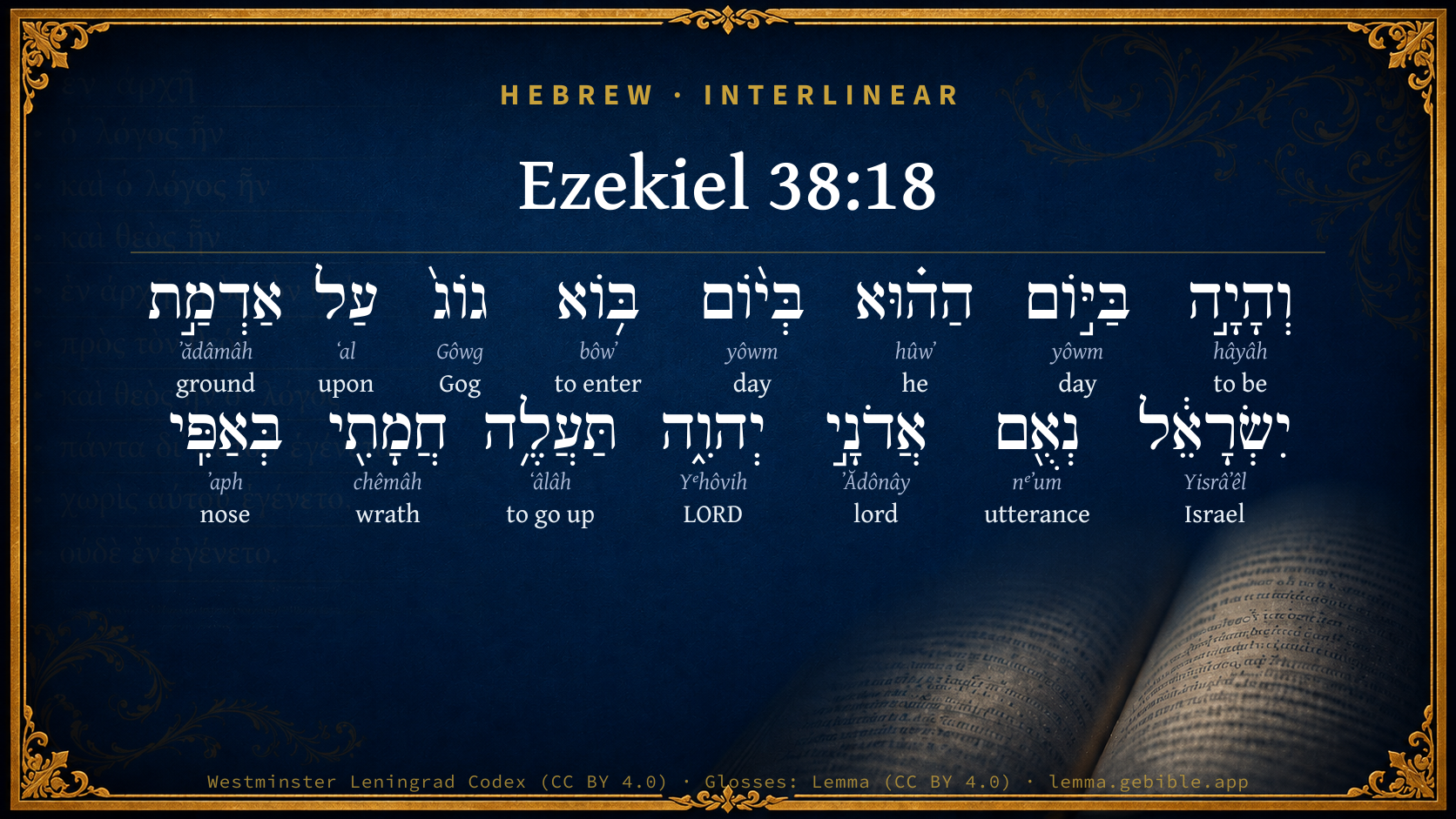
Hebrew (Westminster Leningrad Codex) Ezekiel 38:18 appears in the Hebrew Old Testament. The text above is from the Westminster Leningrad Codex. Each word links to its Strong’s number, a concise gloss, and parsing drawn from the Open Scriptures Hebrew Bible morphology. Click any word for its full Brown-Driver-Briggs (BDB) entry.
Download image
Cite this verse

Ezekiel 38:18 (World English Bible). Public Domain. Lemma interlinear Bible study tool, https://lemma.gebible.app/v/ezekiel/38/18.

Show BibTeX & RIS
BibTeX
RIS
English Translation
It shall happen in that day, when Gog shall come against the land of Israel, says the Lord Yahweh, that my wrath shall come up into my nostrils.
World English Bible · Public Domain
Download a study sheet

One document with this verse’s original text, its word-by-word gloss line, the meaning frame, cross-references with their text, attributed commentary, and full source and license credits — printable, and it pastes into notes with its structure intact.

This verse Autodidact and up

Study sheet (.html) Plain text (.txt)

A passage Seminary Student

Up to 50 verses in one chapter. A passage sheet keeps up to 6 commentary sources and 12 cross-references per verse, in the order this page ranks them, and says so on the sheet whenever that leaves anything out. Ask for a single verse and you get the Autodidact verse sheet above.

Everything on this page stays free to read, with no account — the sheet is a download of what is already on screen, not access to it.

Want to remove ads? Support Godless Engineer
Compare translations 3

The same verse in 3 English versions, stacked beneath the original-language interlinear above. Click any original word for its lexicon entry.

Each is an independent rendering of the whole verse — the interlinear is not word-aligned to these translations.

Highlighted words mark where these versions differ — a whole-verse word diff, not a word-by-word alignment.

  • World English Bible Public Domain
    It shall happen in that day, when Gog shall come against the land of Israel, says the Lord Yahweh, that my wrath shall come up into my nostrils.
  • King James Version Public Domain
    And it shall come to pass at the same time when Gog shall come against the land of Israel, saith the Lord GOD, that my fury shall come up in my face.
  • unfoldingWord Literal Text CC BY-SA 4.0
    So it will come to be in that day when Gog attacks the land of Israel—this is the Lord Yahweh’s declaration—my wrath will mount up in my anger.

unfoldingWord Literal Text — © unfoldingWord, licensed CC BY-SA 4.0. Word-aligned USFM3 via Door43 (git.door43.org/unfoldingWord/en_ult).

Versions to compare (up to 4)

3 of 4 selected

Show all 18 translations

Every available English version of this verse, each an independent rendering of the whole verse.

  • World English Bible Public Domain
    It shall happen in that day, when Gog shall come against the land of Israel, says the Lord Yahweh, that my wrath shall come up into my nostrils.
  • Berean Standard Bible Public Domain
    Now on that day when Gog comes against the land of Israel, declares the Lord GOD, My wrath will flare up.
  • Majority Standard Bible Public Domain
    Now on that day when Gog comes against the land of Israel, declares the Lord GOD, My wrath will flare up.
  • King James Version Public Domain
    And it shall come to pass at the same time when Gog shall come against the land of Israel, saith the Lord GOD, that my fury shall come up in my face.
  • American Standard Version (1901) Public Domain
    And it shall come to pass in that day, when Gog shall come against the land of Israel, saith the Lord Jehovah, that my wrath shall come up into my nostrils.
  • Revised Version (1885) Public Domain
    And it shall come to pass in that day, when Gog shall come against the land of Israel, saith the Lord GOD, that my fury shall come up into my nostrils.
  • Geneva Bible (1599) Public Domain
    At the same time also whe Gog shall come against the land of Israel, sayth the Lord God, my wrath shall arise in mine anger.
  • Douay-Rheims (1899) Public Domain
    And it shall come to pass in that day, in the day of the coming of Gog upon the land of Israel, saith the Lord God, that my indignation shall come up in my wrath.
  • Young's Literal Translation Public Domain
    And it hath come to pass, in that day, In the day of the coming in of Gog against the land of Israel, An affirmation of the Lord Jehovah, Come up doth My fury in My face,
  • Literal Standard Version CC BY-SA 4.0
    And it has come to pass in that day, || In the day of the coming in of Gog against the land of Israel, || A declaration of Lord YHWH, || My fury comes up in My face,
  • Unlocked Literal Bible CC BY-SA 4.0
    So it will come to be in that day when Gog attacks the land of Israel—this is the Lord Yahweh's declaration—my wrath will mount up in my anger.
  • unfoldingWord Literal Text CC BY-SA 4.0
    So it will come to be in that day when Gog attacks the land of Israel—this is the Lord Yahweh’s declaration—my wrath will mount up in my anger.
  • Darby Bible Public Domain
    And it shall come to pass in that day, in the day when Gog shall come against the land of Israel, saith the Lord Jehovah, [that] my fury shall come up in my face;
  • World Messianic Bible Public Domain
    It will happen in that day, when Gog comes against Eretz-Israel,” says the Lord GOD, “that my wrath will come up into my nostrils.
  • Webster's Bible Public Domain
    And it shall come to pass at the same time when Gog shall come against the land of Israel, saith the Lord GOD, that my fury shall come up in my face.
  • Free Bible Version CC BY-SA 4.0
    Now on that day, the day when Gog comes to attack the country of Israel, I will become very angry, declares the Lord God.
  • Bible in Basic English Public Domain
    And it will come about in that day, when Gog comes up against the land of Israel, says the Lord, that my wrath will come up, and my passion and my bitter feeling.
  • JPS Tanakh (1917) Public Domain
    And it shall come to pass in that day, when Gog shall come against the land of Israel, saith the Lord GOD, that My fury shall arise up in My nostrils.

Literal Standard Version (2020), Covenant Press — licensed CC BY-SA 4.0. Text via the HelloAO Bible API (eBible.org). Unlocked Literal Bible (unfoldingWord) — licensed CC BY-SA 4.0. Text via the HelloAO Bible API (eBible.org). unfoldingWord Literal Text — © unfoldingWord, licensed CC BY-SA 4.0. Word-aligned USFM3 via Door43 (git.door43.org/unfoldingWord/en_ult). Free Bible Version, Dr. Jonathan Gallagher — licensed CC BY-SA 4.0. Text via the HelloAO Bible API (eBible.org).

Word by word

More ways to search: Search by grammar → Find every occurrence → Compare this word →

Practice this passage: Drill this verse → Learn its vocabulary →

גוֹג֙
Gôwg
H1463
“Gog”
Noun, Proper
Part of Speech
Noun
Type
Proper
Full BDB Definition

Origin: of uncertain derivation

TWOT: 324

Gog = "mountain" - a Reubenite, son of Shemaiah - the prophetic prince of Rosh, Meshech and Tubal, and Magog
  1. וְהָיָ֣ה hâyâh H1961 “and · to be” Conjunction + Verb, Qal, Sequential Perfect, 3rd Person, Masculine, Singular
  2. בַּיּ֣וֹם yôwm H3117 “in/at the · day” Preposition, Determined + Noun, Common, Masculine, Singular, Absolute
  3. הַה֗וּא hûwʼ H1931 “the · he” Particle, Definite Article + Pronoun, Personal, 3rd Person, Masculine, Singular
  4. בְּי֨וֹם yôwm H3117 “in/at · day of” Preposition + Noun, Common, Masculine, Singular, Construct
  5. בּ֥וֹא bôwʼ H935 “to enter” Verb, Qal, Infinitive Construct
  6. עַל ʻal H5921 “upon” Preposition
  7. אַדְמַ֣ת ʼădâmâh H127 “ground of” Noun, Common, Feminine, Singular, Construct
  8. יִשְׂרָאֵ֔ל Yisrâʼêl H3478 “Israel” Noun, Proper
  9. נְאֻ֖ם nᵉʼum H5002 “utterance of” Noun, Common, Masculine, Singular, Construct
  10. אֲדֹנָ֣י ʼĂdônây H136 “Lord · my” Noun, Common, Masculine, Plural, Construct + Suffix, Personal, 1st Person, Common, Singular
  11. יְהוִ֑ה Yᵉhôvih H3069 “LORD” Noun, Proper
  12. תַּעֲלֶ֥ה ʻâlâh H5927 “to go up” Verb, Qal, Imperfect, 3rd Person, Feminine, Singular
  13. חֲמָתִ֖י chêmâh H2534 “wrath · my” Noun, Common, Feminine, Singular, Construct + Suffix, Personal, 1st Person, Common, Singular
  14. בְּאַפִּֽי ʼaph H639 “in/at · nose · my” Preposition + Noun, Common, Masculine, Singular, Construct + Suffix, Personal, 1st Person, Common, Singular

About this verse

These counts appear in no published source. They are computed here, from the morphology-tagged text and Lemma’s own curated glosses. What Lemma adds →

15
words
14
distinct lemmas
Prophets
section

Notable vocabulary

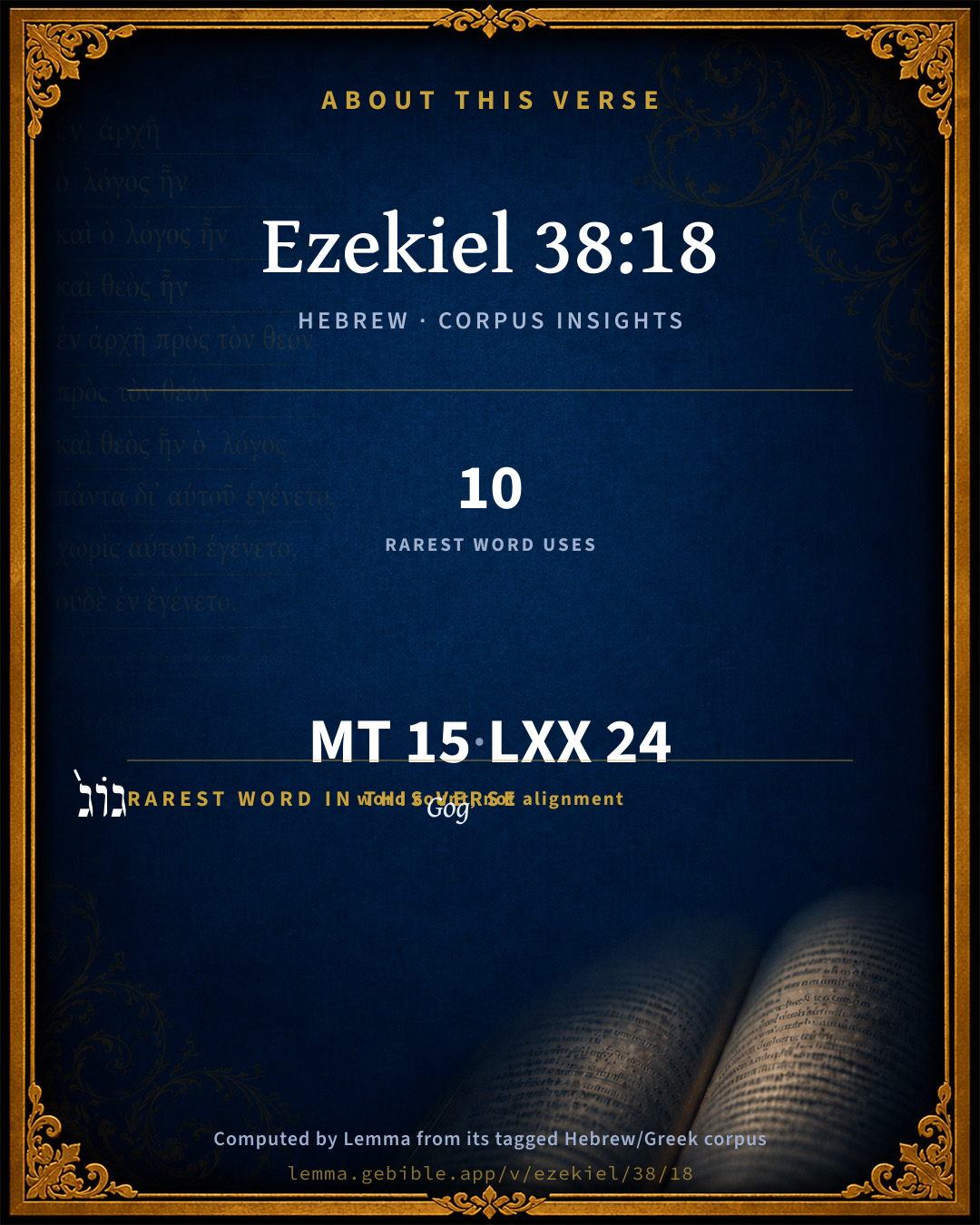
The rarest word here is גוֹג֙ Gog H1463 — appearing just 10 times in the whole Hebrew Bible.

Shared distinctive vocabulary

גוֹג֙ Gog H1463 occurs in 8 verses of the Hebrew Bible. Also found in:

Grammatical profile

  • 3 verbs
  • 10 nouns
  • 1 pronoun
  • 1 preposition

Verb forms

  • וְהָיָ֣ה Qal · Sequential Perfect
  • בּ֥וֹא Qal · Infinitive Construct
  • תַּעֲלֶ֥ה Qal · Imperfect

Repetition

A word recurs within this verse — often emphatic in Hebrew:

  • בַּיּ֣וֹם day H3117 ×2

Hebrew & Septuagint length

In English translation the verse runs 28 words from the Hebrew and 25 from the Septuagint (LXX English) — closely comparable.

A rough comparison of the two English renderings, which tokenize alike — not a word-level alignment.

Word counts can differ between the Hebrew and the Greek without any difference in meaning — e.g. the Hebrew direct-object marker אֵת has no separate Greek word, and Greek often adds the article ὁ.

In the original languages it is 15 Hebrew tokens and 24 Greek tokens — but the two are counted differently (Hebrew bundles its prefixes and suffixes into one token; the Greek is in lemma form), so that isn’t a like-for-like length.

Cross-references

6

Topical passages linked to Ezekiel 38:18 in the Treasury of Scripture Knowledge — connected by theme and wording, ordered by reader-vote popularity; previews shown in the World English Bible.

  • Ezekiel 36:5–6 therefore thus says the Lord Yahweh: Surely in the fire of my jealousy have I spoken against the residue of the nations, and against all Edom, that have appointed my land to themselves for a possession with the joy of all their heart, with despite of soul, to cast it out for a prey.
  • Deuteronomy 32:22 For a fire is kindled in my anger, Burns to the lowest Sheol, Devours the earth with its increase, Sets on fire the foundations of the mountains.
  • Psalms 89:46 How long, Yahweh? Will you hide yourself forever? Will your wrath burn like fire?
  • Nahum 1:2 Yahweh is a jealous God and avenges. Yahweh avenges and is full of wrath. Yahweh takes vengeance on his adversaries, and he maintains wrath against his enemies.
  • Hebrews 12:29 for our God is a consuming fire.
  • Psalms 18:7–8 Then the earth shook and trembled. The foundations also of the mountains quaked and were shaken, Because he was angry.

Cross-references courtesy of OpenBible.info (CC BY 4.0).

Hebrew and Greek witnesses Masoretic Hebrew ↔ Greek Septuagint

The same verse in the two great witnesses to the Old Testament, shown verse-for-verse.

These are two independent witnesses, not word-aligned to each other, and the Septuagint is shown in lemma (dictionary) form.

Hebrew Ezekiel 38:18 Masoretic · Westminster Leningrad Codex

וְהָיָ֣ה בַּיּ֣וֹם הַה֗וּא בְּי֨וֹם בּ֥וֹא גוֹג֙ עַל אַדְמַ֣ת יִשְׂרָאֵ֔ל נְאֻ֖ם אֲדֹנָ֣י יְהוִ֑ה תַּעֲלֶ֥ה חֲמָתִ֖י בְּאַפִּֽי

It shall happen in that day, when Gog shall come against the land of Israel, says the Lord Yahweh, that my wrath shall come up into my nostrils.

World English Bible · Public Domain

Greek LXX Ezekiel 38:18 Septuagint · lemma form

καί εἰμί ἐν ὁ ἡμέρα ἐκεῖνος ἐν ἡμέρα ὅς ἄν ἔρχομαι γωγ ἐπί ὁ γῆ ὁ ἰσραήλ λέγω κύριος κύριος ἀναβαίνω ὁ θυμός ἐγώ

And it shall come to pass in that day, in the day when Gog shall come against the land of Israel, says the Lord God,

LXX2012 (modern English Septuagint) · Public Domain

Hebrew: Westminster Leningrad Codex (CC BY 4.0). Greek: Septuagint (public domain); English from LXX2012 (modern English Septuagint) (Public Domain). How the Septuagint differs from the Hebrew →

Targum (Aramaic paraphrase)

1

The Targum is the ancient Jewish Aramaic paraphrase of the Hebrew Scriptures — an interpretive translation, not the Hebrew text itself. Onkelos (literal) and Pseudo-Jonathan (expansive) render the Torah, and Jonathan the Prophets. Coverage is partial: where no permissively-licensed English translation exists for a verse, only the Aramaic is shown. This is verse-level text, not a word-by-word alignment to the Hebrew.

  1. Targum Jonathan Prophets (Joshua–Malachi)
    וִיהֵי בְּעִדָנָא הַהִיא בְּיוֹם מֵיתֵי גוֹג עַל אַרְעָא דְיִשְׂרָאֵל אֲמַר יְיָ אֱלֹהִים יַדְלִיק רוּגְזִי וְחֵימְתִי:

    (no public-domain English translation for this verse)

    Targum Jonathan — Aramaic: “Mikraot Gedolot” (public domain). English: “Sefaria Community Translation” (CC0 1.0 (public-domain dedication)); “London "Chaldee Paraphrase," 1871” (public domain). Text via Sefaria.

Commentary

Notes on Ezekiel 38:18 from classic Christian and Jewish commentators (each source and its license shown beneath its notes). The classic Christian expositions comment on the surrounding passage and are grouped to its opening verse, so a note may address several verses; the Jewish commentaries on the Tanakh (Rashi and others) are per-verse, so they appear only where the commentator wrote on this verse.

Lemma curates 59 commentaries, every one of them public domain or Creative Commons licensed, each selected and text-cleaned for this edition rather than reprinted as found. About our sources →

Trapp's Complete Commentary

John Trapp

Eze 38:18 And it shall come to pass at the same time when Gog shall come against the land of Israel, saith the Lord GOD, [that] my fury shall come up in my face.

Ver. 18. My fury shall come up in my face.] Though it do not presently break forth. Ira Dei quo diuturnior, eo minacior.

“ Poena venit gravior, quo mage tarda venit. ”

God delighteth to make fools of his enemies; he lets them prevail a while, and carry the ball on the foot, as it were, that they may fall with the greater disappointment.

John Trapp, A Commentary or Exposition upon All the Books of the Old and New Testament (1647–1656) — public domain. Text from a community e-Sword module.

Joseph Benson's Commentary

Eze 38:18-20. My fury shall come up in my face — An expression taken from human passions, which cause the blood to fly up into the face. So Isaiah describes Almighty God as burning with anger, his lips being full of indignation, and his tongue as a consuming fire, Eze 22:31-31, where see the note. For in my jealousy — My zeal for the salvation and happiness of my people, and for my own glory; have I spoken — Against my enemy Gog, and his herd. Surely in that day there shall be a great shaking — A great commotion, as Dr. Waterland renders the expression; or a great disturbance, tumult, and confusion. Great changes and alterations in kingdoms and governments are often expressed in Scripture by shaking of heaven and earth, the sea and dry land: see the margin. So that the fishes of the sea, &c., shall shake at my presence — Every part of the creation shall bear its share of this calamity, as if there were a convulsion of the whole frame of nature. The prophets often describe God’s judgments upon particular countries or persons, as if a dissolution of the whole world took place, because his particular judgments are an earnest of the general judgment: see note on Isa 13:10. And the mountains shall be thrown down — The strong holds situate on the mountains, and the walls, towers, and other fortifications, shall be beat down and demolished.

Joseph Benson's Commentary on the Old and New Testaments (1811–1818) — public domain. Text from a community e-Sword module.

Whedon's Commentary on the Bible

Daniel D. Whedon

18-23. “In that day, when Gog shall come against the land” (Eze_38:18, R.V.), Jehovah’s fury shall come into his “nostrils” (Psa_18:8). He shall breathe hard, and in his hot and “jealous” anger (see Eze_21:31; note Eze_5:13) he declares that the whole of Israel shall be shaken as with an earthquake (Eze_38:19), and all nature, sea and land, shall be terrified (Eze_38:20; compare Zep_1:14; Jer_4:23-26) when he appears in judgment against the enemy (Eze_38:21), turning each man’s sword against his brother and pleading with the foes of his people no longer with words, but with bolts from heaven (Eze_38:22; Gen_19:24; Gen_13:13; Psa_11:6) until the nations shall acknowledge him for what he is: the holy, the merciful, the mighty Jehovah (Eze_38:16). This is a most graphic and fearful description, full of the symbolism which is so characteristic of Ezekiel.

Daniel D. Whedon (gen. ed.), Commentary on the Old and New Testaments (1874–1909) — public domain. Text from a community e-Sword module.

Tyndale Open Study Notes

Tyndale Open Resources

38:18-20 Instead of being the agent of divine wrath, Gog would be subject to it. The Lord would vent on Gog the jealousy and blazing anger he had earlier visited on Israel. The scene would be so frightening that even innocent bystanders would quake in terror. The earth would also tremble, destroying mountains, cliffs, and walls.

Tyndale Open Study Notes — © Tyndale Open Resources, licensed CC BY-SA 4.0. Text via the HelloAO Bible API.

Jamieson, Fausset & Brown

Robert Jamieson, A. R. Fausset & David Brown

fury shall come up in my face--literally, "nose"; in Hebrew, the idiomatic expression for anger, as men in anger breathe strongly through the nostrils. Anthropopathy: God stooping to human modes of thought (Psa 18:8).

Jamieson, Fausset & Brown — Commentary Critical and Explanatory on the Whole Bible (1871) — public domain (CC PDM 1.0). Text via the HelloAO Bible API.

The Cambridge Bible for Schools and Colleges

gen. ed. J. J. S. Perowne

18. come to pass at the same time] Rather: come to pass in that day, in the day when Gog &c.

come up in my face] lit. in my nostril. The idea is not that of the inflammation of the face from anger, but that of a fiery breath appearing in the nostrils. Deu_32:22; Psa_18:8.

The Cambridge Bible for Schools and Colleges (gen. ed. J. J. S. Perowne; Cambridge University Press, 1878–1918) — public domain. Text from a community e-Sword module.

John Gill's Exposition

For in my jealousy, and in the fire of my wrath, have I spoken,.... Not against his people Israel, but against Gog, who had thought evil against them, and now was about to put it in practice; and therefore in zeal for his own glory, and for the good of his people, and in indignation against his and their enemies, he declares, resolves, and determines:

surely in that day there shall be a great shaking in the land of Israel; not a consternation among the people of Israel frightened at the armies of Gog, and the terrible appearance they shall make, and the devastations they threaten; but in Gog himself, and his army, through the wrath of God upon them, and the vengeance he will take of them in the land of Israel, they will enter upon to destroy; not but that there may be some dread in the minds of the Jews upon the appearance of so formidable an army in their land: this shaking, according to Jarchi, will be by thunder and lightning. Kimchi understands it of an earthquake, in a literal sense, and compares with it Zac 14:4, see also Rev 16:18, which speaks of an earthquake that will be about this time.

John Gill's Exposition of the Whole Bible (1746–1763) — public domain (CC PDM 1.0). Text via the HelloAO Bible API.

Matthew Poole's English Annotations

Gog cometh up in fury against Israel, and God’s fury, i.e. hot yet just displeasure, comes up in his face against both the attempt and the attempters, against Gog and all his power, who think to find a weak people, but they shall meet with an angry God.

Matthew Poole's English Annotations on the Holy Bible (1683–1685) — public domain. Text from a community e-Sword/MySword module.

The Pulpit Commentary

Vers. 18-20. Vers. 18 and 19 are not, as Hitzig, Kliefoth, and others explain, on the ground of the perfect, "I have spoken" (ver. 19), which, however, is rather a prophetical present a free recapitulation of the earlier predictions, but a direct announcement through Ezekiel that when Gog should arrive upon the scene Jehovah should take the field against him, so that he should have to fight against Jehovah rather than against Israel. The expression, my fury shall come up in my face; or, my wrath ascends in rail nose, has parallels in Eze_24:8; Psa_18:9; and Deu_32:22, and describes the vehement breathing (inhalation and exhalation) of an angry man through his nose. The fire of Jehovah"s wrath (comp. Eze_21:3-6 Eze_36:5) should make itself known in that day by a great shaking in the land of Israel, which can hardly, as Kliefoth surmises, refer to the final judgment, or, as Keil thinks, to the trembling of the whole earth, with all the creatures, before the Lord, who comes to judgment, as in Joe_3:16 and Zec_14:4, Zec_14:5, since the locality in which this convulsion of nature is to happen is expressly defined as "the land of Israel;" but must be understood, with Schroder and Smend, as a figurative description of the terrible overthrow which Jehovah should inflict upon Gog, and which should produce within the heathen mind a feeling of consternation, as if the whole fabric of the globe were falling into ruin. Grounding upon what occurred at Sinai, (Exo_19:16-18) Hebrew writers generally depicted special interpositions of Jehovah as being witnessed to and accompanied by awe-inspiring natural convulsions (Psa_18:7, 15 46:2, 3 55:2; Isa_13:9-13 Isa_24:19-22; Jer_4:23-26; Nah_1:5; Zec_14:4) and in the same manner does Ezekiel delineate Jehovah"s intervention in behalf of Israel and against Gog, as so alarming that all living creatures, irrational as well as rationalfishes of the sea, fowls of the heaven, beasts of the field, creeping things that creep upon the earth (or, ground adamah), and men upon the face of the earth; or, ground (comp. Gen_1:26 Gen_7:21-23) should shake at its accompanying manifestations, and that even the mightiest objects in nature, such as the mountains, steep places, or, "reek-clefts" (Ewald), such elevations as can only be ascended by means of steps as by a ladder, (comp. Son_2:14) and walls, (comp. Jer_15:20) including natural ramparts as well as humanly constructed erections, should be overthrown (ver. 20).

The Pulpit Commentary (1880–1919), ed. H.D.M. Spence-Jones & Joseph S. Exell — public domain. Text from a community e-Sword module.

Lesson kit

Teaching starters — assembled from the data on this page, not authored interpretation. Every prompt links to the verse data it draws on. Edit before teaching.

Ezekiel, in the Prophets, opens this verse with 15 words (14 distinct Hebrew lemmas). Its most distinctive word is Gôwg (“Gog”). A historical commentator’s framing appears above. Read the whole chapter for the surrounding context.

Discussion questions

  1. The word Gôwg carries the sense “Gog.” How does it shape the verse?
  2. How does 1 Chronicles 5:4, which shares the word «Gog», read alongside this verse?
  3. What does the repetition of “day” (2× in this one verse) do in this verse?
  4. The translations on this page render this verse differently — a whole-verse word diff, not a word-by-word alignment. What might account for the different wordings?
  5. «וְהָיָ֣ה» is a Qal Sequential Perfect verb. How does that grammatical form shape the action described?
  6. Compare how Trapp's Complete Commentary and Joseph Benson's Commentary read this verse. Where do they agree or differ?

Things to notice

Reading settings

Reading text

Shown beneath each verse's original-language words.

Old Testament
Old Testament edition

Read the OT as the Masoretic Hebrew (MT) or the Greek Septuagint (LXX).

English shown for the Greek Septuagint (in the Hebrew ↔ Greek comparison).

Comparing translations? Open the Compare panel on any verse page to stack up to four side by side.