
Genesis 44:17

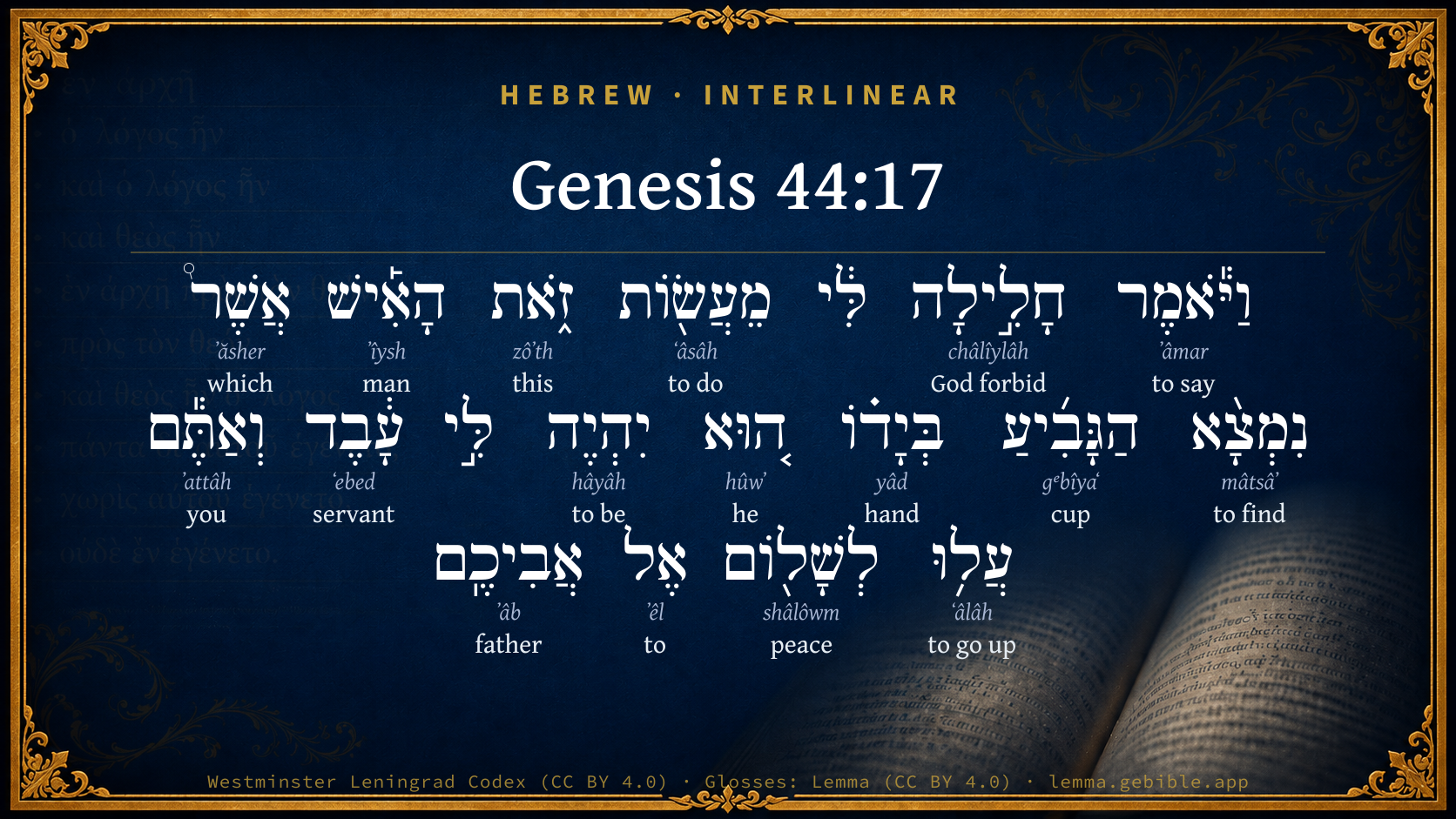
Hebrew (Westminster Leningrad Codex) Genesis 44:17 appears in the Hebrew Old Testament. The text above is from the Westminster Leningrad Codex. Each word links to its Strong’s number, a concise gloss, and parsing drawn from the Open Scriptures Hebrew Bible morphology. Click any word for its full Brown-Driver-Briggs (BDB) entry.
Download image
Cite this verse

Genesis 44:17 (World English Bible). Public Domain. Lemma interlinear Bible study tool, https://lemma.gebible.app/v/genesis/44/17.

Show BibTeX & RIS
BibTeX
RIS
English Translation
He said, "Far be it from me that I should do so. The man in whose hand the cup is found, he will be my bondservant; but as for you, go up in peace to your father."
World English Bible · Public Domain
Download a study sheet

One document with this verse’s original text, its word-by-word gloss line, the meaning frame, cross-references with their text, attributed commentary, and full source and license credits — printable, and it pastes into notes with its structure intact.

This verse Autodidact and up

Study sheet (.html) Plain text (.txt)

A passage Seminary Student

Up to 50 verses in one chapter. A passage sheet keeps up to 6 commentary sources and 12 cross-references per verse, in the order this page ranks them, and says so on the sheet whenever that leaves anything out. Ask for a single verse and you get the Autodidact verse sheet above.

Everything on this page stays free to read, with no account — the sheet is a download of what is already on screen, not access to it.

Want to remove ads? Support Godless Engineer
Compare translations 3

The same verse in 3 English versions, stacked beneath the original-language interlinear above. Click any original word for its lexicon entry.

Each is an independent rendering of the whole verse — the interlinear is not word-aligned to these translations.

Highlighted words mark where these versions differ — a whole-verse word diff, not a word-by-word alignment.

  • World English Bible Public Domain
    He said, "Far be it from me that I should do so. The man in whose hand the cup is found, he will be my bondservant; but as for you, go up in peace to your father."
  • King James Version Public Domain
    And he said, God forbid that I should do so: but the man in whose hand the cup is found, he shall be my servant; and as for you, get you up in peace unto your father.
  • unfoldingWord Literal Text CC BY-SA 4.0
    But he said, “Far be it from me to do that! The man in whose hand the cup was found, he will be a slave for me. But you, go up in peace to your father.” Judah Pleads for Benjamin’s Freedom 44:18-34

unfoldingWord Literal Text — © unfoldingWord, licensed CC BY-SA 4.0. Word-aligned USFM3 via Door43 (git.door43.org/unfoldingWord/en_ult).

Versions to compare (up to 4)

3 of 4 selected

Show all 18 translations

Every available English version of this verse, each an independent rendering of the whole verse.

  • World English Bible Public Domain
    He said, "Far be it from me that I should do so. The man in whose hand the cup is found, he will be my bondservant; but as for you, go up in peace to your father."
  • Berean Standard Bible Public Domain
    But Joseph replied, “Far be it from me to do this. The man who was found with the cup will be my slave. The rest of you may return to your father in peace.”
  • Majority Standard Bible Public Domain
    But Joseph replied, “Far be it from me to do this. The man who was found with the cup will be my slave. The rest of you may return to your father in peace.”
  • King James Version Public Domain
    And he said, God forbid that I should do so: but the man in whose hand the cup is found, he shall be my servant; and as for you, get you up in peace unto your father.
  • American Standard Version (1901) Public Domain
    And he said, Far be it from me that I should do so: the man in whose hand the cup is found, he shall be my bondman; but as for you, get you up in peace unto your father.
  • Revised Version (1885) Public Domain
    And he said, God forbid that I should do so: the man in whose hand the cup is found, he shall be my bondman; but as for you, get you up in peace unto your father.
  • Geneva Bible (1599) Public Domain
    But he answered, God forbid, that I should doe so, but the man, with whome the cuppe is founde, he shalbe my seruant, and go ye in peace vnto your father.
  • Douay-Rheims (1899) Public Domain
    Joseph answered: God forbid that should do so: he that stole the cup, he shall be my bondman: and go you away free to your father.
  • Young's Literal Translation Public Domain
    and he saith, `Far be it from me to do this; the man in whose hand the cup hath been found, he becometh my servant; and ye, go ye up in peace unto your father.'
  • Literal Standard Version CC BY-SA 4.0
    and he says, “Far be it from me to do this; the man in whose hand the cup has been found, he becomes my servant; and you, go up in peace to your father.”
  • Unlocked Literal Bible CC BY-SA 4.0
    Joseph said, “Far be it from me that I should do so. The man in whose hand the cup was found, that person will be my slave, but as for you others, go up in peace to your father.”
  • unfoldingWord Literal Text CC BY-SA 4.0
    But he said, “Far be it from me to do that! The man in whose hand the cup was found, he will be a slave for me. But you, go up in peace to your father.” Judah Pleads for Benjamin’s Freedom 44:18-34
  • Darby Bible Public Domain
    And he said, Far be it from me to do so! The man in whose hand the cup has been found, he shall be my bondman; but as for you, go up in peace to your father.
  • World Messianic Bible Public Domain
    He said, “Far be it from me that I should do so. The man in whose hand the cup is found, he will be my slave; but as for you, go up in peace to your father.”
  • Webster's Bible Public Domain
    And he said, Far be it from me that I should do so: the man in whose hand the cup is found, he shall be my servant; and as for you, go in peace to your father.
  • Free Bible Version CC BY-SA 4.0
    “I wouldn't do anything like that!” Joseph replied. “Only the man who was found with the cup will become my slave. The rest of you are free to return to your father.”
  • Bible in Basic English Public Domain
    Then he said, Far be it from me to do so: but the man who had my cup will be my servant; and you may go back to your father in peace.
  • JPS Tanakh (1917) Public Domain
    And he said: 'Far be it from me that I should do so; the man in whose hand the goblet is found, he shall be my bondman; but as for you, get you up in peace unto your father.'

Literal Standard Version (2020), Covenant Press — licensed CC BY-SA 4.0. Text via the HelloAO Bible API (eBible.org). Unlocked Literal Bible (unfoldingWord) — licensed CC BY-SA 4.0. Text via the HelloAO Bible API (eBible.org). unfoldingWord Literal Text — © unfoldingWord, licensed CC BY-SA 4.0. Word-aligned USFM3 via Door43 (git.door43.org/unfoldingWord/en_ult). Free Bible Version, Dr. Jonathan Gallagher — licensed CC BY-SA 4.0. Text via the HelloAO Bible API (eBible.org).

Word by word

More ways to search: Search by grammar → Find every occurrence → Compare this word →

Practice this passage: Drill this verse → Learn its vocabulary →

הַגָּבִ֜יעַ
gᵉbîyaʻ
H1375
“the · cup”
Particle, Definite Article + Noun, Common, Masculine, Singular, Absolute
Part of Speech
Particle + Noun
Type
Common
Gender
Masculine
Number
Singular
State
Absolute
Full BDB Definition

Origin: from an unused root

TWOT: 309b

cup, bowl
  1. וַיֹּ֕אמֶר ʼâmar H559 “and · to say” Conjunction + Verb, Qal, Sequential Imperfect, 3rd Person, Masculine, Singular
  2. חָלִ֣ילָה châlîylâh H2486 “God forbid” Particle, Interjection + Suffix, h
  3. מֵעֲשׂ֖וֹת ʻâsâh H6213 “from · to do” Preposition + Verb, Qal, Infinitive Construct
  4. זֹ֑את zôʼth H2063 “this” Pronoun, Demonstrative, Feminine, Singular
  5. הָאִ֡ישׁ ʼîysh H376 “the · man” Particle, Definite Article + Noun, Common, Masculine, Singular, Absolute
  6. אֲשֶׁר֩ ʼăsher H834 “which” Particle, Relative
  7. נִמְצָ֨א mâtsâʼ H4672 “to find” Verb, Niphal, Perfect, 3rd Person, Masculine, Singular
  8. בְּיָד֗וֹ yâd H3027 “in/at · hand · his” Preposition + Noun, Common, Both, Singular, Construct + Suffix, Personal, 3rd Person, Masculine, Singular
  9. ה֚וּא hûwʼ H1931 “he” Pronoun, Personal, 3rd Person, Masculine, Singular
  10. יִהְיֶה hâyâh H1961 “to be” Verb, Qal, Imperfect, 3rd Person, Masculine, Singular
  11. עָ֔בֶד ʻebed H5650 “servant” Noun, Common, Masculine, Singular, Absolute
  12. וְאַתֶּ֕ם ʼattâh H859 “and · you” Conjunction + Pronoun, Personal, 2nd Person, Masculine, Plural
  13. עֲל֥וּ ʻâlâh H5927 “go up” Verb, Qal, Imperative, 2nd Person, Masculine, Plural
  14. לְשָׁל֖וֹם shâlôwm H7965 “to/for · peace” Preposition + Noun, Common, Masculine, Singular, Absolute
  15. אֶל ʼêl H413 “to” Preposition
  16. אֲבִיכֶֽם ʼâb H1 “father · your” Noun, Common, Masculine, Singular, Construct + Suffix, Personal, 2nd Person, Masculine, Plural

About this verse

These counts appear in no published source. They are computed here, from the morphology-tagged text and Lemma’s own curated glosses. What Lemma adds →

19
words
17
distinct lemmas
Pentateuch
section

Notable vocabulary

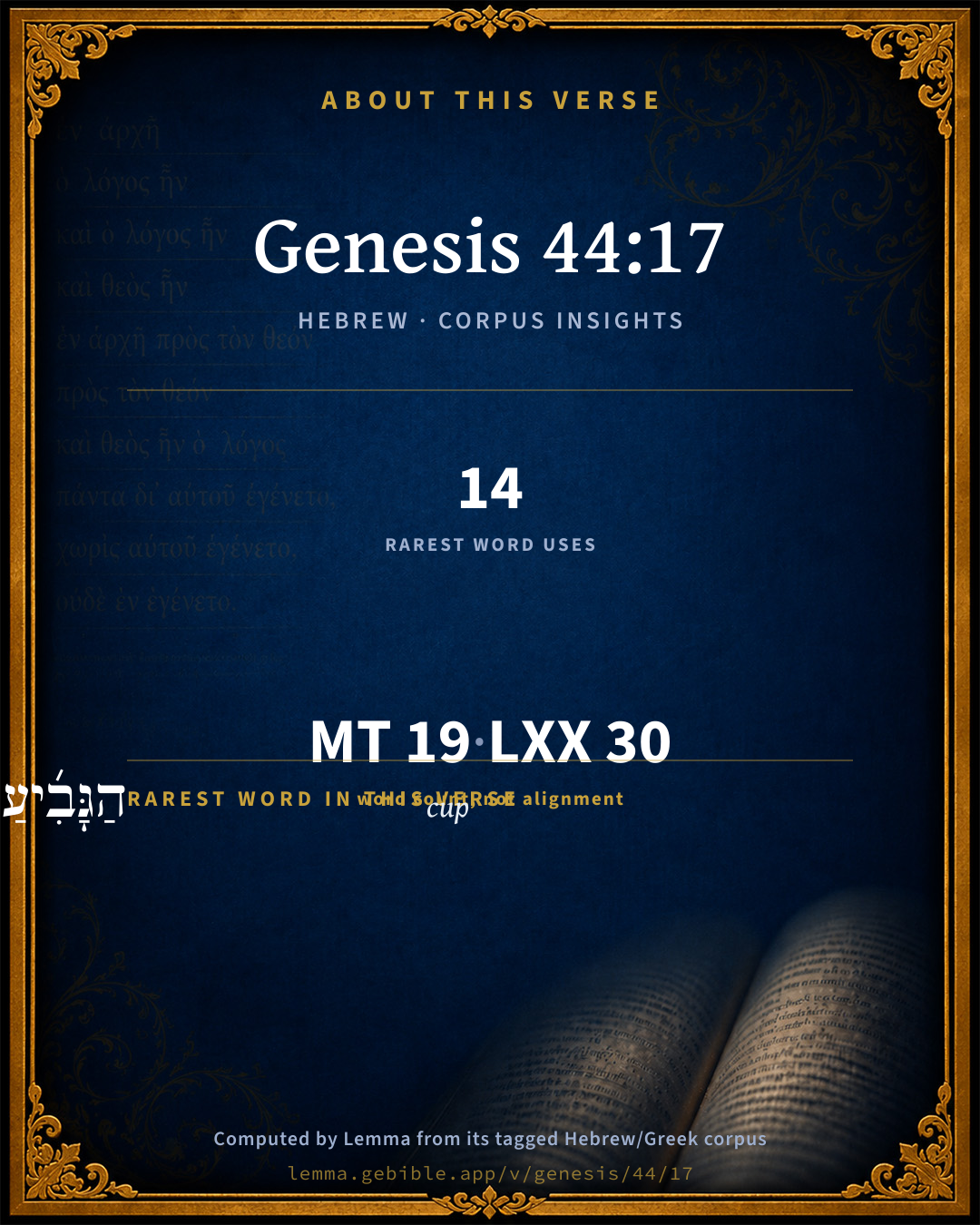
The rarest word here is הַגָּבִ֜יעַ cup H1375 — appearing just 14 times in the whole Hebrew Bible.

Shared distinctive vocabulary

הַגָּבִ֜יעַ cup H1375 occurs in 11 verses of the Hebrew Bible. Also found in:

Grammatical profile

  • 5 verbs
  • 6 nouns
  • 3 pronouns
  • 3 prepositions
  • 2 particles

Verb forms

  • וַיֹּ֕אמֶר Qal · Sequential Imperfect
  • מֵעֲשׂ֖וֹת Qal · Infinitive Construct
  • נִמְצָ֨א Niphal · Perfect
  • יִהְיֶה Qal · Imperfect
  • עֲל֥וּ Qal · Imperative

Hebrew & Septuagint length

In English translation the verse runs 37 words from the Hebrew and 36 from the Septuagint (LXX English) — closely comparable.

A rough comparison of the two English renderings, which tokenize alike — not a word-level alignment.

Word counts can differ between the Hebrew and the Greek without any difference in meaning — e.g. the Hebrew direct-object marker אֵת has no separate Greek word, and Greek often adds the article ὁ.

In the original languages it is 19 Hebrew tokens and 30 Greek tokens — but the two are counted differently (Hebrew bundles its prefixes and suffixes into one token; the Greek is in lemma form), so that isn’t a like-for-like length.

Cross-references

7

Topical passages linked to Genesis 44:17 in the Treasury of Scripture Knowledge — connected by theme and wording, ordered by reader-vote popularity; previews shown in the World English Bible.

  • Genesis 18:25 Be it far from you to do things like that, to kill the righteous with the wicked, that so the righteous should be as the wicked. May that be far from you. Shouldn't the Judge of all the earth do right?"
  • Genesis 26:29 that you will do us no harm, as we have not touched you, and as we have done to you nothing but good, and have sent you away in peace.' You are now the blessed of Yahweh."
  • Genesis 37:32–33 They took the coat of many colors, and they brought it to their father, and said, "We have found this. Examine it, now, whether it is your son's coat or not."
  • Genesis 42:18 Joseph said to them the third day, "Do this, and live, for I fear God.
  • 2 Samuel 23:3 The God of Israel said, The Rock of Israel spoke to me: One who rules over men righteously, Who rules in the fear of God,
  • Psalms 75:2 When I choose the appointed time, I will judge blamelessly.
  • Proverbs 17:15 He who justifies the wicked, and he who condemns the righteous, Both of them alike are an abomination to Yahweh.

Cross-references courtesy of OpenBible.info (CC BY 4.0).

Hebrew and Greek witnesses Masoretic Hebrew ↔ Greek Septuagint

The same verse in the two great witnesses to the Old Testament, shown verse-for-verse.

These are two independent witnesses, not word-aligned to each other, and the Septuagint is shown in lemma (dictionary) form.

Hebrew Genesis 44:17 Masoretic · Westminster Leningrad Codex

וַיֹּ֕אמֶר חָלִ֣ילָה לִּ֔י מֵעֲשׂ֖וֹת זֹ֑את הָאִ֡ישׁ אֲשֶׁר֩ נִמְצָ֨א הַגָּבִ֜יעַ בְּיָד֗וֹ ה֚וּא יִהְיֶה לִּ֣י עָ֔בֶד וְאַתֶּ֕ם עֲל֥וּ לְשָׁל֖וֹם אֶל אֲבִיכֶֽם

He said, "Far be it from me that I should do so. The man in whose hand the cup is found, he will be my bondservant; but as for you, go up in peace to your father."

World English Bible · Public Domain

Greek LXX Genesis 44:17 Septuagint · lemma form

εἶπον δέ ιωσηφ μή ἐγώ γίγνομαι ποιέω ὁ ῥῆμα οὗτος ὁ ἄνθρωπος παρά ὅς εὑρίσκω ὁ κόνδυ αὐτός εἰμί ἐγώ παῖς σύ δέ ἀναβαίνω μετά σωτηρία πρός ὁ πατήρ σύ

And Joseph said, Far be it from me to do this thing; the man with whom the cup has been found, he shall be my servant; but do you⌃ go up with safety to your father.

LXX2012 (modern English Septuagint) · Public Domain

Hebrew: Westminster Leningrad Codex (CC BY 4.0). Greek: Septuagint (public domain); English from LXX2012 (modern English Septuagint) (Public Domain). How the Septuagint differs from the Hebrew →

Targum (Aramaic paraphrase)

2

The Targum is the ancient Jewish Aramaic paraphrase of the Hebrew Scriptures — an interpretive translation, not the Hebrew text itself. Onkelos (literal) and Pseudo-Jonathan (expansive) render the Torah, and Jonathan the Prophets. Coverage is partial: where no permissively-licensed English translation exists for a verse, only the Aramaic is shown. This is verse-level text, not a word-by-word alignment to the Hebrew.

  1. Targum Onkelos Torah (Genesis–Deuteronomy)
    וַאֲמַר חַס לִי מִלְּמֶעְבַּד דָּא גַּבְרָא דִּי אִשְׁתְּכַח כַּלִּידָא בִּידֵהּ הוּא יְהֵי לִי עַבְדָּא וְאַתּוּן סָקוֹ לִשְׁלַם לְוַת אֲבוּכוֹן: ססס

    (no public-domain English translation for this verse)

    Targum Onkelos — Aramaic: “Onkelos Genesis” (public domain); “Onkelos Exodus” (public domain); “Onkelos Leviticus” (public domain); “Onkelos Numbers” (public domain); “Onkelos Deuteronomy” (public domain). English: “Sefaria Community Translation” (CC0 1.0 (public-domain dedication)); “J.W. Etheridge. The Targums of Onkelos and Jonathan Ben Uzziel on the Pentateuch. London: Longmans, Green, 1862” (public domain). Text via Sefaria.

  2. Targum Pseudo-Jonathan Torah (Genesis–Deuteronomy)
    וַאֲמַר חַס לִי מִלְמֶעֱבַד דָא גַבְרָא דְאִשְׁתְּכַח כַּלִידָא בִּידֵיהּ הוּא יְהֵי לִי עַבְדָא וְאַתּוּן סוּקוּ לִשְׁלַם לְוַת אֲבוּכוֹן

    But he said, Far be it from me to do thus; the man in whose hand the chalice hath been found shall be my slave; but you, go up in peace to your father.

    Targum Pseudo-Jonathan — Aramaic: “Targum Jonathan on Genesis” (public domain); “Targum Jonathan on Exodus” (public domain); “Targum Jonathan on Leviticus” (public domain); “Targum Jonathan on Numbers” (public domain); “Targum Jonathan on Deuteronomy” (public domain). English: “The Targum of Jonathan ben Uzziel, trans. J. W. Etheridge, London, 1862” (public domain). Text via Sefaria.

Commentary

Notes on Genesis 44:17 from classic Christian and Jewish commentators (each source and its license shown beneath its notes). The classic Christian expositions comment on the surrounding passage and are grouped to its opening verse, so a note may address several verses; the Jewish commentaries on the Tanakh (Rashi and others) are per-verse, so they appear only where the commentator wrote on this verse.

Lemma curates 59 commentaries, every one of them public domain or Creative Commons licensed, each selected and text-cleaned for this edition rather than reprinted as found. About our sources →

Trapp's Complete Commentary

John Trapp

Gen 44:17 And he said, God forbid that I should do so: [but] the man in whose hand the cup is found, he shall be my servant; and as for you, get you up in peace unto your father.

Ver. 17. But the man in whose hand, &c.] This was the heat that Joseph shot at in all this interdealing with them, - to try the truth of their love to Benjamin, and whether they would stick to him in his utmost peril God hath like ends in afflicting his children. "The king of Babylon stood at the parting way, at the head of the two ways, to use divination." {Eze 21:21} So doth God. He knows that the best divining of men is at the parting way; there every dog will show to what master he belongs. God shoots at his servants for trial, as men shoot bullets against armour of proof, not to hurt it, but to praise it.

John Trapp, A Commentary or Exposition upon All the Books of the Old and New Testament (1647–1656) — public domain. Text from a community e-Sword module.

John Calvin's Commentaries

17. God forbid that I should do so If Joseph intended to retain Benjamin alone, and to dismiss the others, he would have done his utmost, to rend the Church of God by the worst possible dissension. But I have previously shown (what may also be elicited from the context) that his design was nothing else than to pierce their hearts more deeply. He must have anticipated great mischief, if he had perceived that they did not care for their brother: but the Lord provided against this danger, by causing the earnest apology of Judah not only to soften his mind, but even to draw forth tears and weeping in profusion.

John Calvin's Commentaries (1540-1563) — public domain. Text from the Calvin Translation Society English edition (1840s-50s) via the Christian Classics Ethereal Library (ccel.org). Calvin's coverage is partial (roughly two-thirds of the Bible); uncommented books and verses are honest gaps, never fabricated. The 19th-century editor's footnotes and remarks are omitted so the notes are faithfully Calvin's own voice.

The Cambridge Bible for Schools and Colleges

gen. ed. J. J. S. Perowne

17. God forbid] As Gen_44:7. Joseph deprecates Judah’s proposal, and insists on the milder sentence already proposed by his steward. Benjamin should be kept as a slave.

The Cambridge Bible for Schools and Colleges (gen. ed. J. J. S. Perowne; Cambridge University Press, 1878–1918) — public domain. Text from a community e-Sword module.

John Gill's Exposition

And he said, God forbid that I should do so,.... This would be doing an unjust thing, Joseph suggests, should he take them all for bondmen, for the offence of one:

but the man in whose hand the cup is found, he shall be my servant; not die, as they had supposed, but become his servant:

and as for you, get ye up in peace unto your father; they had leave, yea, an order to return to their father in the land of Canaan, with their corn and cattle, in peace and plenty; there being no charge against them, nor would any hurt or damage come to them: this Joseph said to try their affection to their brother Benjamin, and see whether they would leave him to distress, and then he should know better how to conduct both towards him and them.

John Gill's Exposition of the Whole Bible (1746–1763) — public domain (CC PDM 1.0). Text via the HelloAO Bible API.

Sforno

Rabbi Ovadia Sforno

It would be degrading for me. I do not wish to be the instrument of chastisement for your earlier crimes because Hashem uses the wicked for that purpose; see I Shemuel 24:14.

Sforno on the Tanakh — English translation: “Yalkut, Sifsei Chachomim Chumash, Metsudah Publications, 2009” (CC BY 4.0). Text via Sefaria.

Radak

Rabbi David Kimhi (Radak)

אל אביכם. Who is waiting for you to bring back food.

Radak on the Tanakh — English translations: “Sefaria Community Translation” (CC0 1.0 (public-domain dedication)); “Eliyahu Munk, HaChut Hameshulash” (CC BY 4.0); “Rabbi Mike Feuer, Jerusalem Anthology” (CC BY 4.0); and “R. David Kimhi on the first book of Psalms, Translated by R.G. Finch, London, 1919” (public domain). Text via Sefaria.

Lesson kit

Teaching starters — assembled from the data on this page, not authored interpretation. Every prompt links to the verse data it draws on. Edit before teaching.

Genesis, in the Pentateuch, opens this verse with 19 words (17 distinct Hebrew lemmas). Its most distinctive word is gᵉbîyaʻ (“cup”). A historical commentator’s framing appears above. Read the whole chapter for the surrounding context.

Discussion questions

  1. The word gᵉbîyaʻ carries the sense “cup.” How does it shape the verse?
  2. Genesis 44:2 shares the word «cup» with this verse. How do the two illuminate each other?
  3. These translations render this verse differently. What is at stake in choosing one wording over another?
  4. The verb «וַיֹּ֕אמֶר» is Qal Sequential Imperfect. How does its form color the action?
  5. Reading how Trapp's Complete Commentary and John Calvin's Commentaries read this verse, where do the two commentators agree and where do they part?

Things to notice

Reading settings

Reading text

Shown beneath each verse's original-language words.

Old Testament
Old Testament edition

Read the OT as the Masoretic Hebrew (MT) or the Greek Septuagint (LXX).

English shown for the Greek Septuagint (in the Hebrew ↔ Greek comparison).

Comparing translations? Open the Compare panel on any verse page to stack up to four side by side.