
Numbers 9:21

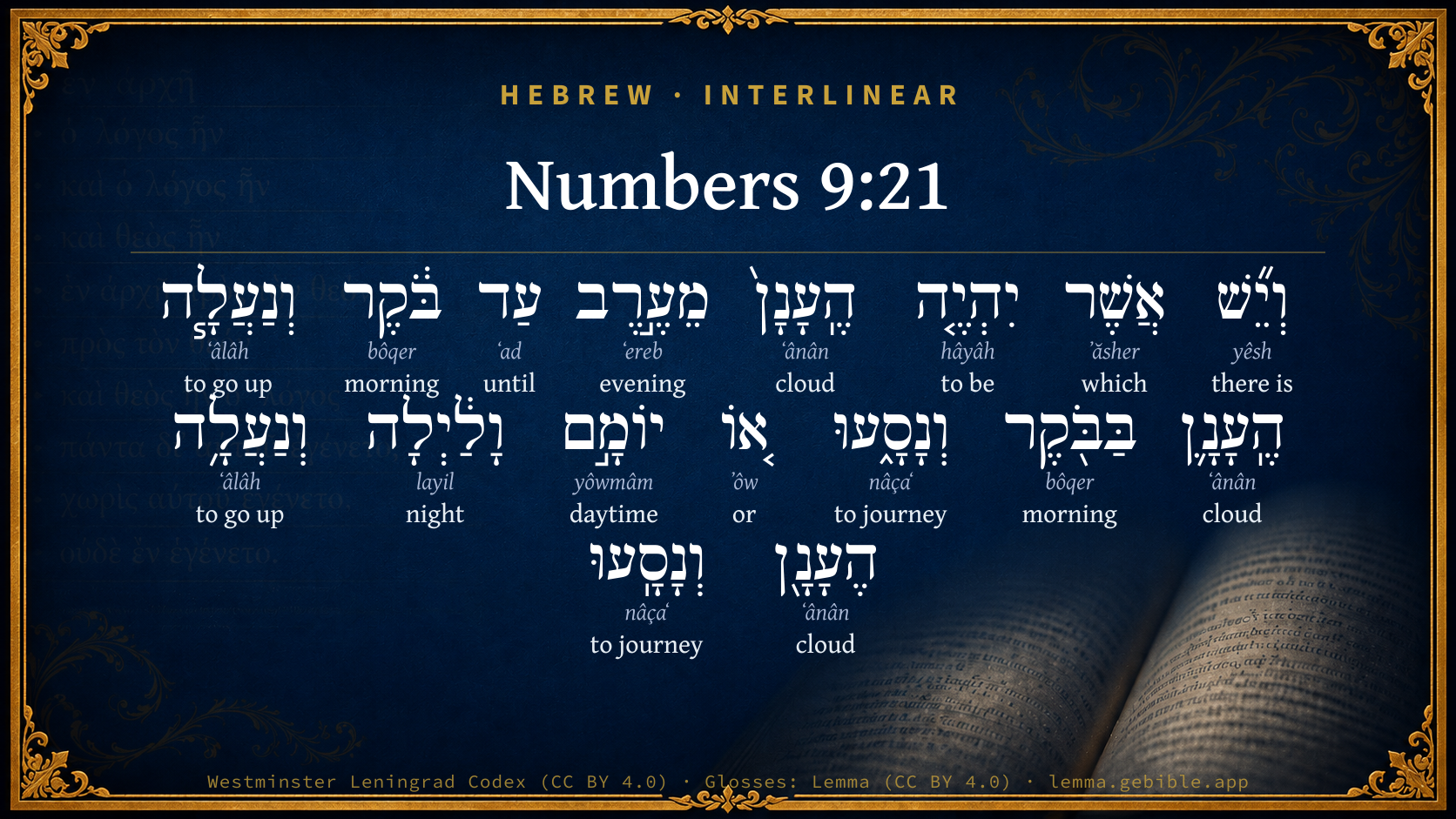
Hebrew (Westminster Leningrad Codex) Numbers 9:21 appears in the Hebrew Old Testament. The text above is from the Westminster Leningrad Codex. Each word links to its Strong’s number, a concise gloss, and parsing drawn from the Open Scriptures Hebrew Bible morphology. Click any word for its full Brown-Driver-Briggs (BDB) entry.
Download image
Cite this verse

Numbers 9:21 (World English Bible). Public Domain. Lemma interlinear Bible study tool, https://lemma.gebible.app/v/numbers/9/21.

Show BibTeX & RIS
BibTeX
RIS
English Translation
Sometimes the cloud was from evening until morning; and when the cloud was taken up in the morning, they traveled: or by day and by night, when the cloud was taken up, they traveled.
World English Bible · Public Domain
Download a study sheet

One document with this verse’s original text, its word-by-word gloss line, the meaning frame, cross-references with their text, attributed commentary, and full source and license credits — printable, and it pastes into notes with its structure intact.

This verse Autodidact and up

Study sheet (.html) Plain text (.txt)

A passage Seminary Student

Up to 50 verses in one chapter. A passage sheet keeps up to 6 commentary sources and 12 cross-references per verse, in the order this page ranks them, and says so on the sheet whenever that leaves anything out. Ask for a single verse and you get the Autodidact verse sheet above.

Everything on this page stays free to read, with no account — the sheet is a download of what is already on screen, not access to it.

Want to remove ads? Support Godless Engineer
Compare translations 3

The same verse in 3 English versions, stacked beneath the original-language interlinear above. Click any original word for its lexicon entry.

Each is an independent rendering of the whole verse — the interlinear is not word-aligned to these translations.

Highlighted words mark where these versions differ — a whole-verse word diff, not a word-by-word alignment.

  • World English Bible Public Domain
    Sometimes the cloud was from evening until morning; and when the cloud was taken up in the morning, they traveled: or by day and by night, when the cloud was taken up, they traveled.
  • King James Version Public Domain
    And so it was, when the cloud abode from even unto the morning, and that the cloud was taken up in the morning, then they journeyed: whether it was by day or by night that the cloud was taken up, they journeyed.
  • unfoldingWord Literal Text CC BY-SA 4.0
    And it is that the cloud is from evening until morning, and the cloud is taken up in the morning, then they set out; or during the day and at night, and the cloud is taken up, then they set out.

unfoldingWord Literal Text — © unfoldingWord, licensed CC BY-SA 4.0. Word-aligned USFM3 via Door43 (git.door43.org/unfoldingWord/en_ult).

Versions to compare (up to 4)

3 of 4 selected

Show all 18 translations

Every available English version of this verse, each an independent rendering of the whole verse.

  • World English Bible Public Domain
    Sometimes the cloud was from evening until morning; and when the cloud was taken up in the morning, they traveled: or by day and by night, when the cloud was taken up, they traveled.
  • Berean Standard Bible Public Domain
    Sometimes the cloud remained only from evening until morning, and when it lifted in the morning, they would set out. Whether it was by day or by night, when the cloud was taken up, they would set out.
  • Majority Standard Bible Public Domain
    Sometimes the cloud remained only from evening until morning, and when it lifted in the morning, they would set out. Whether it was by day or by night, when the cloud was taken up, they would set out.
  • King James Version Public Domain
    And so it was, when the cloud abode from even unto the morning, and that the cloud was taken up in the morning, then they journeyed: whether it was by day or by night that the cloud was taken up, they journeyed.
  • American Standard Version (1901) Public Domain
    And sometimes the cloud was from evening until morning; and when the cloud was taken up in the morning, they journeyed: or `if it continued' by day and by night, when the cloud was taken up, they journeyed.
  • Revised Version (1885) Public Domain
    And sometimes the cloud was from evening until morning; and when the cloud was taken up in the morning, they journeyed: or if it continued by day and by night, when the cloud was taken up, they journeyed.
  • Geneva Bible (1599) Public Domain
    And though the cloud abode vpon the Tabernacle from euen vnto the morning, yet if the cloude was taken vp in the morning, then they iourneyed: whether by daye or by night the cloude was taken vp, then they iourneyed.
  • Douay-Rheims (1899) Public Domain
    If the cloud tarried from evening until morning, and immediately at break of day left the tabernacle, they marched forward: and if it departed after a day and a night, they took down their tents.
  • Young's Literal Translation Public Domain
    And so when the cloud is from evening till morning, when the cloud hath gone up in the morning, then they have journeyed; whether by day or by night, when the cloud hath gone up, then they have journeyed.
  • Literal Standard Version CC BY-SA 4.0
    And so when the cloud is from evening until morning, when the cloud has gone up in the morning, then they have journeyed; whether by day or by night, when the cloud has gone up, then they have journeyed.
  • Unlocked Literal Bible CC BY-SA 4.0
    Sometimes the cloud was present in camp from evening until morning. When the cloud lifted in the morning, they journeyed. If it continued for a day and for a night, only when the cloud lifted would they journey on.
  • unfoldingWord Literal Text CC BY-SA 4.0
    And it is that the cloud is from evening until morning, and the cloud is taken up in the morning, then they set out; or during the day and at night, and the cloud is taken up, then they set out.
  • Darby Bible Public Domain
    And if it were so that the cloud was there from the evening until the morning, and that the cloud was taken up in the morning, then they journeyed; or a day and a night, and the cloud was taken up, they journeyed;
  • World Messianic Bible Public Domain
    Sometimes the cloud was from evening until morning; and when the cloud was taken up in the morning, they traveled; or by day and by night, when the cloud was taken up, they traveled.
  • Webster's Bible Public Domain
    And so it was, when the cloud abode from evening to the morning, and that the cloud was taken up in the morning, then they journeyed: whether it was by day or by night that the cloud was taken up, they journeyed.
  • Free Bible Version CC BY-SA 4.0
    Sometimes the cloud only stayed overnight, so when it rose in the morning they would move on. Whenever the cloud rose, day or night, they would leave.
  • Bible in Basic English Public Domain
    And sometimes the cloud was there only from evening to morning; and when the cloud was taken up in the morning they went on their journey again: or if it was resting there by day and by night, whenever the cloud was taken up they went forward.
  • JPS Tanakh (1917) Public Domain
    And sometimes the cloud was from evening until morning; and when the cloud was taken up in the morning, they journeyed; or if it continued by day and by night, when the cloud was taken up, they journeyed.

Literal Standard Version (2020), Covenant Press — licensed CC BY-SA 4.0. Text via the HelloAO Bible API (eBible.org). Unlocked Literal Bible (unfoldingWord) — licensed CC BY-SA 4.0. Text via the HelloAO Bible API (eBible.org). unfoldingWord Literal Text — © unfoldingWord, licensed CC BY-SA 4.0. Word-aligned USFM3 via Door43 (git.door43.org/unfoldingWord/en_ult). Free Bible Version, Dr. Jonathan Gallagher — licensed CC BY-SA 4.0. Text via the HelloAO Bible API (eBible.org).

Word by word

More ways to search: Search by grammar → Find every occurrence → Compare this word →

Practice this passage: Drill this verse → Learn its vocabulary →

יוֹמָ֣ם
yôwmâm
H3119
“daytime”
Adverb
Part of Speech
Adverb
Full BDB Definition

Origin: from H3117

TWOT: 852a

by day, in the daytime (adverb) - daytime (substantive)
  1. וְיֵ֞שׁ yêsh H3426 “and · there is” Conjunction + Particle, Demonstrative
  2. אֲשֶׁר ʼăsher H834 “which” Particle, Relative
  3. יִהְיֶ֤ה hâyâh H1961 “to be” Verb, Qal, Imperfect, 3rd Person, Masculine, Singular
  4. הֶֽעָנָן֙ ʻânân H6051 “the · cloud” Particle, Definite Article + Noun, Common, Masculine, Singular, Absolute
  5. מֵעֶ֣רֶב ʻereb H6153 “from · evening” Preposition + Noun, Common, Masculine, Singular, Absolute
  6. עַד ʻad H5704 “until” Preposition
  7. בֹּ֔קֶר bôqer H1242 “morning” Noun, Common, Masculine, Singular, Absolute
  8. וְנַעֲלָ֧ה ʻâlâh H5927 “and · to go up” Conjunction + Verb, Niphal, Sequential Perfect, 3rd Person, Masculine, Singular
  9. הֶֽעָנָ֛ן ʻânân H6051 “the · cloud” Particle, Definite Article + Noun, Common, Masculine, Singular, Absolute
  10. בַּבֹּ֖קֶר bôqer H1242 “in/at the · morning” Preposition, Determined + Noun, Common, Masculine, Singular, Absolute
  11. וְנָסָ֑עוּ nâçaʻ H5265 “and · to journey” Conjunction + Verb, Qal, Sequential Perfect, 3rd Person, Common, Plural
  12. א֚וֹ ʼôw H176 “or” Conjunction
  13. וָלַ֔יְלָה layil H3915 “and · night” Conjunction + Noun, Common, Masculine, Singular, Absolute
  14. וְנַעֲלָ֥ה ʻâlâh H5927 “and · to go up” Conjunction + Verb, Niphal, Sequential Perfect, 3rd Person, Masculine, Singular
  15. הֶעָנָ֖ן ʻânân H6051 “the · cloud” Particle, Definite Article + Noun, Common, Masculine, Singular, Absolute
  16. וְנָסָֽעוּ nâçaʻ H5265 “and · to journey” Conjunction + Verb, Qal, Sequential Perfect, 3rd Person, Common, Plural

About this verse

These counts appear in no published source. They are computed here, from the morphology-tagged text and Lemma’s own curated glosses. What Lemma adds →

17
words
12
distinct lemmas
Pentateuch
section

Shared distinctive vocabulary

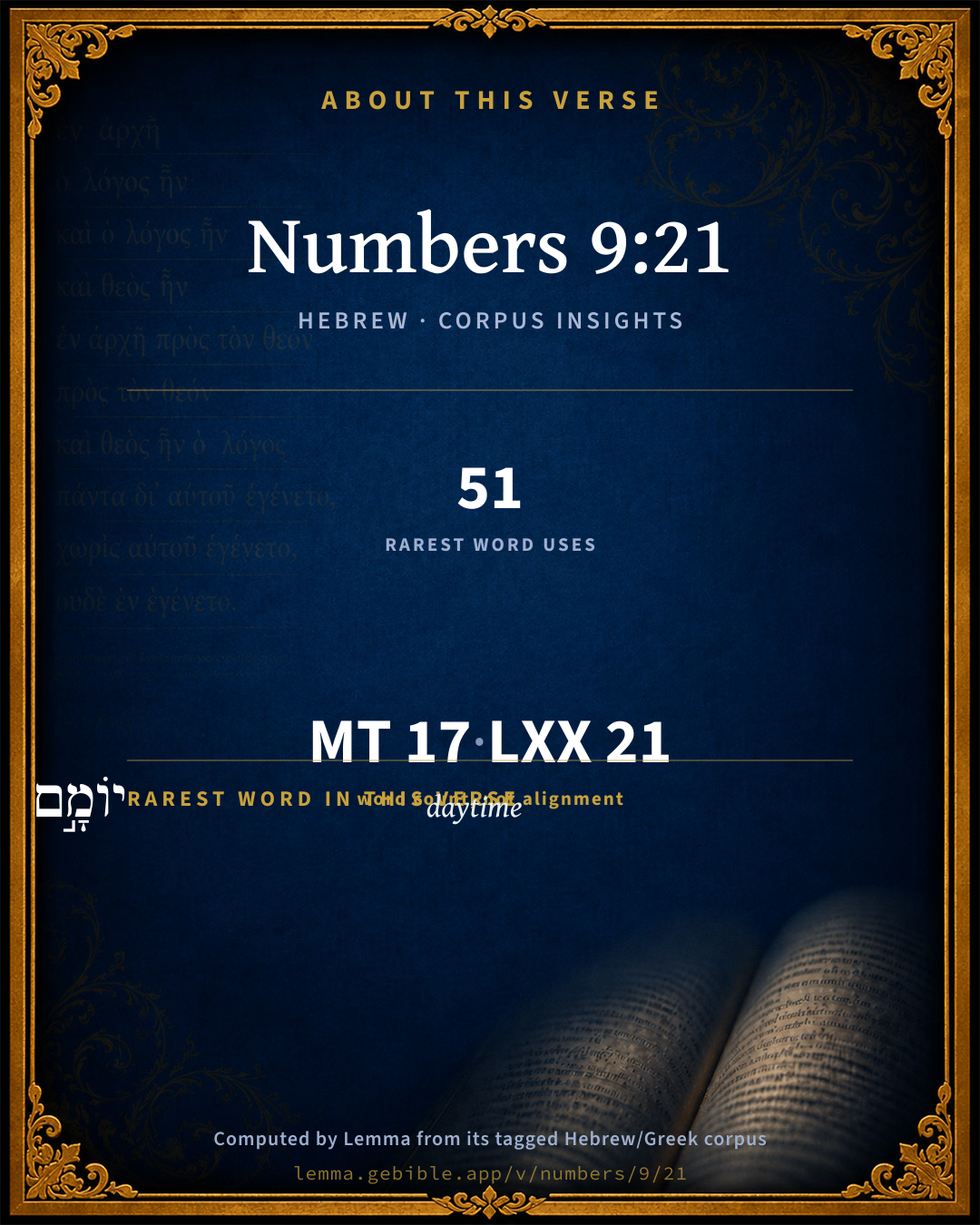
יוֹמָ֣ם daytime H3119 occurs in 50 verses of the Hebrew Bible. Also found in:

Grammatical profile

  • 5 verbs
  • 7 nouns
  • 1 preposition
  • 1 conjunction
  • 1 adverb
  • 2 particles

Verb forms

  • יִהְיֶ֤ה Qal · Imperfect
  • וְנַעֲלָ֧ה Niphal · Sequential Perfect
  • וְנָסָ֑עוּ Qal · Sequential Perfect
  • וְנַעֲלָ֥ה Niphal · Sequential Perfect
  • וְנָסָֽעוּ Qal · Sequential Perfect

Repetition

Words recur within this verse — often emphatic in Hebrew:

  • הֶֽעָנָן֙ cloud H6051 ×3
  • בֹּ֔קֶר morning H1242 ×2
  • וְנַעֲלָ֧ה to go up H5927 ×2
  • וְנָסָ֑עוּ to journey H5265 ×2

Hebrew & Septuagint length

In English translation the verse runs 34 words from the Hebrew and 20 from the Septuagint (LXX English) — the Septuagint runs noticeably shorter here. See the side-by-side →

A rough comparison of the two English renderings, which tokenize alike — not a word-level alignment.

Word counts can differ between the Hebrew and the Greek without any difference in meaning — e.g. the Hebrew direct-object marker אֵת has no separate Greek word, and Greek often adds the article ὁ.

In the original languages it is 17 Hebrew tokens and 21 Greek tokens — but the two are counted differently (Hebrew bundles its prefixes and suffixes into one token; the Greek is in lemma form), so that isn’t a like-for-like length.

Cross-references

2

Topical passages linked to Numbers 9:21 in the Treasury of Scripture Knowledge — connected by theme and wording, ordered by reader-vote popularity; previews shown in the World English Bible.

  • Nehemiah 9:19 yet you in your manifold mercies didn't forsake them in the wilderness: the pillar of cloud didn't depart from over them by day, to lead them in the way; neither the pillar of fire by night, to show them light, and the way in which they should go.
  • Nehemiah 9:12 Moreover in a pillar of cloud you led them by day; and in a pillar of fire by night, to give them light in the way in which they should go.

Cross-references courtesy of OpenBible.info (CC BY 4.0).

Hebrew and Greek witnesses Masoretic Hebrew ↔ Greek Septuagint

The same verse in the two great witnesses to the Old Testament, shown verse-for-verse.

Here the Septuagint runs noticeably shorter than the Hebrew — LXX2012 (modern English Septuagint) 20 words vs World English Bible 34. A rough length comparison of the two English translations, not a word-level alignment — read both below.

These are two independent witnesses, not word-aligned to each other, and the Septuagint is shown in lemma (dictionary) form.

Hebrew Numbers 9:21 Masoretic · Westminster Leningrad Codex

וְיֵ֞שׁ אֲשֶׁר יִהְיֶ֤ה הֶֽעָנָן֙ מֵעֶ֣רֶב עַד בֹּ֔קֶר וְנַעֲלָ֧ה הֶֽעָנָ֛ן בַּבֹּ֖קֶר וְנָסָ֑עוּ א֚וֹ יוֹמָ֣ם וָלַ֔יְלָה וְנַעֲלָ֥ה הֶעָנָ֖ן וְנָסָֽעוּ

Sometimes the cloud was from evening until morning; and when the cloud was taken up in the morning, they traveled: or by day and by night, when the cloud was taken up, they traveled.

World English Bible · Public Domain

Greek LXX Numbers 9:21 Septuagint · lemma form

καί εἰμί ὅταν γίγνομαι ὁ νεφέλη ἀπό ἑσπέρα ἕως πρωΐ καί ἀναβαίνω ὁ νεφέλη ὁ πρωΐ καί ἀποαἴρω ἡμέρα ἤ νύξ

When the cloud continues a full month overshadowing the tabernacle, the children of Israel shall encamp, and shall not depart.

LXX2012 (modern English Septuagint) · Public Domain

Hebrew: Westminster Leningrad Codex (CC BY 4.0). Greek: Septuagint (public domain); English from LXX2012 (modern English Septuagint) (Public Domain). How the Septuagint differs from the Hebrew →

Targum (Aramaic paraphrase)

2

The Targum is the ancient Jewish Aramaic paraphrase of the Hebrew Scriptures — an interpretive translation, not the Hebrew text itself. Onkelos (literal) and Pseudo-Jonathan (expansive) render the Torah, and Jonathan the Prophets. Coverage is partial: where no permissively-licensed English translation exists for a verse, only the Aramaic is shown. This is verse-level text, not a word-by-word alignment to the Hebrew.

  1. Targum Onkelos Torah (Genesis–Deuteronomy)
    וְאִית דִי הֲוָה עֲנָנָא מֵרַמְשָׁא וְעַד צַפְרָא וּמִסְתַּלֵק עֲנָנָא בְּצַפְרָא וְנָטְלִין אוֹ יֵמָם וְלֵילֵי וּמִסְתַּלֵק עֲנָנָא וְנָטְלִין

    (no public-domain English translation for this verse)

    Targum Onkelos — Aramaic: “Onkelos Genesis” (public domain); “Onkelos Exodus” (public domain); “Onkelos Leviticus” (public domain); “Onkelos Numbers” (public domain); “Onkelos Deuteronomy” (public domain). English: “Sefaria Community Translation” (CC0 1.0 (public-domain dedication)); “J.W. Etheridge. The Targums of Onkelos and Jonathan Ben Uzziel on the Pentateuch. London: Longmans, Green, 1862” (public domain). Text via Sefaria.

  2. Targum Pseudo-Jonathan Torah (Genesis–Deuteronomy)
    וְאִית זְמַן דְהַוֵי עֲנַן יְקָרָא מִן רַמְשָׁא וְעַד צַפְרָא וּמִסְתַּלֵק עֲנַן יְקָרָא בְּצַפְרָא וְנַטְלִין אוֹ יֵימָם וְלֵילֵי וּמִסְתַּלֵק עֲנָנָא וְנַטְלִין

    Or, if the Cloud of Glory (rested only) from evening until morning, and was uplifted in the morning, then went they onward; whether by day or by night, when the Cloud was lifted up they went forward;

    Targum Pseudo-Jonathan — Aramaic: “Targum Jonathan on Genesis” (public domain); “Targum Jonathan on Exodus” (public domain); “Targum Jonathan on Leviticus” (public domain); “Targum Jonathan on Numbers” (public domain); “Targum Jonathan on Deuteronomy” (public domain). English: “The Targum of Jonathan ben Uzziel, trans. J. W. Etheridge, London, 1862” (public domain). Text via Sefaria.

Commentary

Notes on Numbers 9:21 from classic Christian and Jewish commentators (each source and its license shown beneath its notes). The classic Christian expositions comment on the surrounding passage and are grouped to its opening verse, so a note may address several verses; the Jewish commentaries on the Tanakh (Rashi and others) are per-verse, so they appear only where the commentator wrote on this verse.

Lemma curates 59 commentaries, every one of them public domain or Creative Commons licensed, each selected and text-cleaned for this edition rather than reprinted as found. About our sources →

Joseph Benson's Commentary

Num 9:21. When the cloud abode — This is repeated again and again, because it was a constant miracle, and because it is a matter we should take particular notice of, as highly significant and instructive. It is mentioned long after by David, Psa 105:39; and by the people of God after their captivity, Neh 9:19. And the guidance of this cloud is spoken of, as signifying the guidance of the blessed Spirit, Isa 63:14; “The Spirit of the Lord caused him to rest, and so didst thou lead thy people.” And thus, in effect, does he guide all those who commit their ways unto the Lord. So that they may well say, Father, thy will be done! Dispose of me and mine as thou pleasest. Here I am, waiting on my God, to journey and rest at the commandment of the Lord. What thou wilt, and where thou wilt: only let me be thine, and always in the way of my duty.

Joseph Benson's Commentary on the Old and New Testaments (1811–1818) — public domain. Text from a community e-Sword module.

Adam Clarke's Commentary

Verse 21. Whether - by day or by night] As the heat of the day is very severe in that same desert, the night season is sometimes chosen for the performance of a journey; though it is very likely that in the case of the Israelites this was seldom resorted to.

Adam Clarke's Commentary on the Bible (1810–1826) — public domain. Text from a community e-Sword/MySword module.

Ellicott's Commentary for English Readers

(21) By day or by night.—It is obvious from this verse that there must have been sentinels constantly watching by night as well as by day, whose office it was to give notice when the cloud was removed. (Comp. Psa_134:1.)

A Bible Commentary for English Readers, edited by Charles John Ellicott (1878–1897) — public domain. Text from a community e-Sword module.

The Cambridge Bible for Schools and Colleges

gen. ed. J. J. S. Perowne

21. Sometimes the cloud remained only from the evening till the next morning; sometimes it remained for a whole day and the following night; sometimes (Num_9:22) much longer. It is not necessary to press the question whether the writer thought that, when the encampment was for a single night’s rest, the whole elaborate structure was erected. He wishes to state exhaustively that the signal of the cloud was invariably obeyed.

The Cambridge Bible for Schools and Colleges (gen. ed. J. J. S. Perowne; Cambridge University Press, 1878–1918) — public domain. Text from a community e-Sword module.

John Gill's Exposition

Or whether it were two days, or a month, or a year, that the cloud tarried upon the tabernacle,.... Sometimes it tarried but half a day, sometimes a whole day, sometimes two days, at other times a whole month, and even a year; a full year, as the Targum of Jonathan and Aben Ezra; or a longer time, as the Vulgate Latin version, for in one place it tarried eighteen years, as Maimonides says (g); some say (h) nineteen years, as in Kadeshbarnea:

remaining thereon, the children of Israel abode in their tents, and journeyed not; so that, as the same writer observes, it was not because the children of Israel lost their way in the wilderness and wandered about, not knowing where they were, or which way they should go; hence the Arabians call the wilderness, the wilderness of wandering, nor that they were so long wandering in it as forty years, but because it was the will of God that should stay so long at one place, and so long at another, whereby their stay in it was protracted to such a length of time, according to his sovereign will:

but when it was taken up they journeyed; though they had continued ever so long, and their situation ever so agreeable.

(g) Moreh Nevoch. par. 2. c. 50. p. 512. (h) Seder Olam Rabba, c. 8. p. 24.

John Gill's Exposition of the Whole Bible (1746–1763) — public domain (CC PDM 1.0). Text via the HelloAO Bible API.

The Pulpit Commentary

From even unto the morning. Allowing but a single night"s rest.

The Pulpit Commentary (1880–1919), ed. H.D.M. Spence-Jones & Joseph S. Exell — public domain. Text from a community e-Sword module.

John Wesley's Explanatory Notes

When the cloud abode - This is repeated again and again, because it was a constant miracle, and because it is a matter we should take particular notice of, as highly significant and instructive. It is mentioned long after by David, Psalm cv, 39, and by the people of God after their captivity, Neh. ix, 19. And the guidance of this cloud is spoken of, as signifying the guidance of the Blessed Spirit, Isaiah lxiii, 14. The Spirit of the Lord caused him to rest, and so didst thou lead the people. And thus, in effect, does he guide, all those, who commit their ways unto the Lord. So that they may well say, Father, thy will be done! Dispose of me and mine as thou pleasest. Here I am, waiting on my God, to journey and rest at the commandment of the Lord. What thou wilt, and where thou wilt: only let me be thine, and always in the way of my duty.

John Wesley, Explanatory Notes Upon the Whole Bible (1754–1765) — public domain. Text via the GEBible commentary corpus.

Lesson kit

Teaching starters — assembled from the data on this page, not authored interpretation. Every prompt links to the verse data it draws on. Edit before teaching.

Numbers, in the Pentateuch, opens this verse with 17 words (12 distinct Hebrew lemmas). Its most distinctive word is yôwmâm (“daytime”). The Greek Septuagint runs shorter here. A historical commentator’s framing appears above. Read the whole chapter for the surrounding context.

Discussion questions

  1. How does “daytime” (yôwmâm) shape what this verse is saying?
  2. Exodus 13:21 shares the word «daytime» with this verse. How do the two illuminate each other?
  3. “cloud” occurs 3× in this one verse. What is the effect of the repetition?
  4. Compared with the Hebrew, the Septuagint runs shorter here. What questions does that raise?
  5. The translations on this page render this verse differently — a whole-verse word diff, not a word-by-word alignment. What might account for the different wordings?
  6. The verb «יִהְיֶ֤ה» is Qal Imperfect. How does its form color the action?
  7. Reading how Joseph Benson's Commentary and Adam Clarke's Commentary read this verse, where do the two commentators agree and where do they part?

Things to notice

Reading settings

Reading text

Shown beneath each verse's original-language words.

Old Testament
Old Testament edition

Read the OT as the Masoretic Hebrew (MT) or the Greek Septuagint (LXX).

English shown for the Greek Septuagint (in the Hebrew ↔ Greek comparison).

Comparing translations? Open the Compare panel on any verse page to stack up to four side by side.