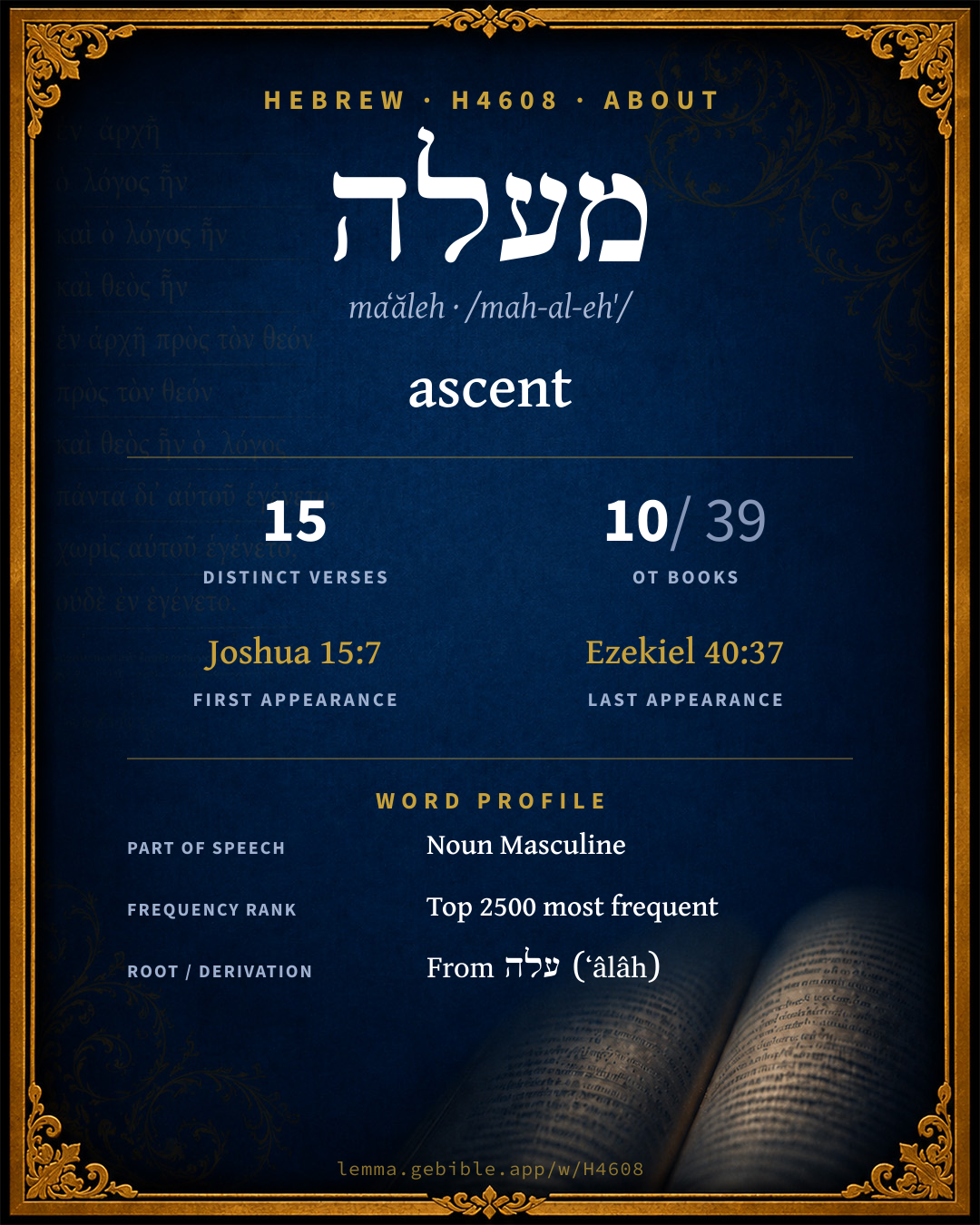
מַעֲלֶה
ascent
Full lexicon entry — Brown-Driver-Briggs (BDB)
From Brown-Driver-Briggs (BDB)
Where this word appears
See every Construct-state word in the Hebrew Bible →
Grammar key — what these labels mean
Part of speech
- Noun
- A naming word — a person, place, thing, or idea.
Noun type
- Common
- A common noun — a general class of person, place, or thing (“king,” “city,” “water”), not a specific name.
State
- Construct
- A noun bound to a following noun in a possessive / “of” relationship (the construct chain).
- Absolute
- The independent form of a noun, not bound to a following word.
Gender
- Masculine
- Grammatically masculine.
Number
- Singular
- One.
- Plural
- More than one (in Hebrew, generally three or more).
Grammatical forms
- Noun, Common, Masculine, Singular, Construct 14 times (78%)
- Noun, Common, Masculine, Plural, Construct 3 times (17%)
- Noun, Common, Masculine, Singular, Absolute 1 time (6%)
Parsed forms decoded from the imported morphology (morphhb / Westminster Leningrad Codex — WLC text public domain, morphhb tagging CC BY 4.0), counted across 18 parsed occurrences — not distinct verses.
Every verse where H4608 appears — 15 distinct verses across 10 books. Click any verse to open its interlinear word-by-word view. Verse text shown in the World English Bible for context — . Each verse’s Hebrew form is shown with its reference; the English is not keyword-highlighted, since the data carries no word-level English alignment. Use “Compare translations” on any verse to read it across multiple English versions. This concordance covers the Hebrew Bible; Septuagint (Greek Old Testament) occurrences are not indexed here.
Joshua 2 verses
- Joshua 15:7 לְ/מַעֲלֵ֣ה prep + n c ms cs and the border went up to Debir from the valley of Achor, and so northward, looking toward Gilgal, that is over against the ascent of Adummim, which is on the south side of the river; and the border passed along to the waters of En Shemesh, and the goings out of it were at En Rogel;
- Joshua 18:17 מַעֲלֵ֣ה n c ms cs and it extended northward, and went out at En Shemesh, and went out to Geliloth, which is over against the ascent of Adummim; and it went down to the stone of Bohan the son of Reuben;
Judges 1 verse
1 Samuel 1 verse
2 Samuel 1 verse
2 Kings 1 verse
2 Chronicles 2 verses
- 2 Chronicles 20:16 בְּ/מַעֲלֵ֣ה prep + n c ms cs Tomorrow go you down against them: behold, they come up by the ascent of Ziz; and you shall find them at the end of the valley, before the wilderness of Jeruel.
- 2 Chronicles 32:33 בְּֽ/מַעֲלֵה֮ prep + n c ms cs Hezekiah slept with his fathers, and they buried him in the ascent of the tombs of the sons of David: and all Judah and the inhabitants of Jerusalem did him honor at his death. Manasseh his son reigned in his place.
Nehemiah 2 verses
- Nehemiah 9:4 מַֽעֲלֵ֣ה n c ms cs Then stood up on the stairs of the Levites, Jeshua, and Bani, Kadmiel, Shebaniah, Bunni, Sherebiah, Bani, [and] Chenani, and cried with a loud voice to Yahweh their God.
- Nehemiah 12:37 בַּֽ/מַּעֲלֶ֖ה prep det + n c ms By the spring gate, and straight before them, they went up by the stairs of the city of David, at the ascent of the wall, above the house of David, even to the water gate eastward.
Isaiah 1 verse
Jeremiah 1 verse
Ezekiel 3 verses
- Ezekiel 40:31 מעל/ו מַעֲלָֽי/ו n c ms cs + sfx pers 3ms n c mp cs + sfx pers 3ms The arches of it were toward the outer court; and palm trees were on the posts of it: and the ascent to it had eight steps.
- Ezekiel 40:34 מעל/ו מַעֲלָֽי/ו n c ms cs + sfx pers 3ms n c mp cs + sfx pers 3ms The arches of it were toward the outer court; and palm trees were on the posts of it, on this side, and on that side: and the ascent to it had eight steps.
- Ezekiel 40:37 מעל/ו מַעֲלָֽי/ו n c ms cs + sfx pers 3ms n c mp cs + sfx pers 3ms The posts of it were toward the outer court; and palm trees were on the posts of it, on this side, and on that side: and the ascent to it had eight steps.
About this entry
At a glance — auto-summarized from this page’s data, not written by a person. Every figure links to its source below. This summary describes the numbers; it doesn’t interpret them.
מעלה (maʻăleh) is a Hebrew noun most often rendered “ascent.” Debuting at Joshua 15:7, it then recurs through the corpus. The Hebrew Bible uses it across 15 verses — uncommon. Related forms include עלה, מעל and מעל. The sections below give every sense, occurrence, and version rendering.
Gloss history
Strong's 1890 vs modern scholarship
About this word
Strong's H4608 catalogs a Hebrew word from the Hebrew Old Testament.
These counts are not copied from any lexicon or concordance. They are computed here, from the morphology-tagged Hebrew Old Testament. What Lemma adds →
- 15
- distinct verses
- The word appears in 15 distinct verses.
- 10 / 39
- OT books
- The word appears in 10 of 39 Old Testament books.
- #1,612
- by frequency
- Top 2500 most frequent Hebrew words (rank 1,612 of 8,640 Hebrew words by occurrence).
View all 15 occurrences in the concordance →
Most concentrated in
- Ezekiel 3 verses 20%
- Joshua 2 verses 13%
- 2 Chronicles 2 verses 13%
By section of the Old Testament
By traditional corpus
Conventional, traditional groupings — biblical authorship is debated, so this is a traditional corpus grouping, not an authorship claim. Each share is this word’s portion of its verses in that division of the Hebrew canon. Each figure is a share of the word’s 15 distinct verses.
- Prophets (Nevi'im) 11 verses · 73%
- Writings (Ketuvim) 4 verses · 27%
How translations render this word
Counts come from each version’s own published word-to-Strong’s tagging or interlinear alignment — an approximate guide to how each version renders this word, not a word-level alignment the data otherwise carries. Because each total is that version’s own tagged count, the per-version totals vary from one another and need not match the appearance or distinct-verse counts above. These counts may also differ from a printed concordance because Lemma counts each distinctly tagged rendering and does not collapse phrase taggings into a single head-word total. This is a fixed set of word-tagged versions (KJV, ASV, BSB, ULT) and does not change with the reading translation you choose elsewhere. Each version’s license is shown beside its name below (and on Sources).
BDB lists this Strong’s number as 2 distinct words (homographs). Each count above pools all of them and is not split by sense — see the Senses section below. A low-frequency rendering may belong to a different one of those words, not the primary meaning.
- King James Version†: Going up 4×, Ascent 2×, Thereof on this side and on that side and the going up 2×
- American Standard Version†: Ascent 8×, Thereof 3×
- Berean Standard Bible†: Ascent 7×, Led up to it 3×
- unfoldingWord Literal Text†: Ascent of 7×, Going up it 2×
King James Version Public Domain
Renders H4608 across 18† tagged occurrences — most commonly:
Plus 10 renderings that appear only once — usually multi-word phrases or single function words the recovered tagging swept in, not distinct renderings.
American Standard Version Public Domain
Renders H4608 across 16† tagged occurrences — most commonly:
Plus 5 renderings that appear only once — usually multi-word phrases or single function words the recovered tagging swept in, not distinct renderings.
Berean Standard Bible Public Domain
Renders H4608 across 15† tagged occurrences — most commonly:
Plus 5 renderings that appear only once — usually multi-word phrases or single function words the recovered tagging swept in, not distinct renderings. Not rendered by a distinct English word in 1 further occurrence.
unfoldingWord Literal Text CC BY-SA 4.0
Renders H4608 across 14† tagged occurrences — most commonly:
Plus 5 renderings that appear only once — usually multi-word phrases or single function words the recovered tagging swept in, not distinct renderings.
Senses in the full BDB
What do BDB’s symbols mean?
BDB uses these scholarly abbreviations:
| Symbol | Meaning |
|---|---|
| 𝔊 | the Septuagint (the ancient Greek translation, LXX) |
| 𝔙 | the Vulgate (the Latin translation) |
| 𝔖 | the Syriac version (the Peshitta) |
| 𝔗 | the Targum (the Aramaic translation) |
| ψ | the Psalms |
| √ | root (the underlying root or stem) |
| ‖ | parallel passage (a synonymous or contrasted parallel) |
| † | the dagger: every passage where the word occurs is cited |
The 2 senses and sub-senses the full Brown-Driver-Briggs lexicon distinguishes for this word, in lexicon order (not ranked by frequency), with BDB’s own verbatim wording and sub-sense lettering. Shown in Hebrew script with BDB’s own scholarly abbreviations. The condensed entry is in the Lexicon Entry tab. See also the Forms in the corpus table below.
מעלה I I, II. מַעֲלָה v. sub עלה.
מעלה II
- 1. ascent of hill or city: Ju 8:13; 1 S 9:11, to the royal sepulchres (in Jerus.) 2 Ch 32:33; מ׳ הַזֵּיתִית 2 S 15:30 (v. זַיִת 3); מ׳עַקְרַבִּים = Scorpion-pass, on S. border of Pal., Ju 1:36; Nu 34:4; Jos 15:3 (both P), i.e. prob. the Naḳb eṣ-ṣafâ SW. from Dead Sea BuhlGeogr. 16, 66 Di and GFM ad loc., and reff.; often def. by n.pr.loc.: מ׳ אֲדֻמִים 15:7; 18:17, S. of valley of Achor, between Jerusalem and Jericho, cf. mod. Telʿat ed-dâm BuhlGeogr. 98; v. also בֵּית חוֹרֹן, i. גּוּר, ii. הֶרֶם, לוּחִית, ii. ציץ. e.g. Judges 8:13
- 2. of stairs Ez 40:31, 34, 37; to a wall Ne 12:37; מַעֲלֵה הַלְּוִיִּם Ne 9:4. e.g. Ezekiel 40:31
Senses from the full Brown-Driver-Briggs lexicon (Brown, Driver, Briggs; Oxford 1906 — public domain), digitized via Sefaria, supplemented by the OpenScriptures HebrewLexicon (CC BY 4.0). Full attribution on Sources.
Word origin
I. I, II. מַעֲלָה v. sub עלה.
I. n.m. Is 15:5 ascent;—מ׳ Ne 12:37; cstr. מַעֲלֵה Jos 10:10 + 14 times; מַעֲלָו֯ Ez 40:31, 34, 37;
— Brown-Driver-Briggs (Oxford 1906, public domain), digitized via Sefaria, supplemented by the OpenScriptures HebrewLexicon (CC BY 4.0). See Sources.
Derived from עלה (ʻâlâh) (H5927) — to go up.
Jastrow Dictionary
A second Hebrew/Aramaic lexicon for comparison, covering Aramaic and post-biblical (Talmudic, Targumic, Midrashic) usage that the biblical-Hebrew BDB does not. Matched by lemma rather than by Strong’s number, so a lemma may carry more than one Jastrow headword (shown separately below), and the entries cover usage well beyond the Bible.
מַעֲלֶה I
- (part. Hif. of עָלָה); מַעֲלֵה עָשָׁן Smoke-Raiser, name of a plant used as an ingredient of frankincense (Fumitory?). Ker. 6ᵃ. Tosef. Yoma I, 8 (ref. to בענן, Lev. XVI, 2) מלמד שנותן בו מ׳ ע׳ this intimates that he must add maʿăle ʿashan. [Ib. II, 6; Y. ib. III, 41ᵃ היו בקיאין … במ׳ ע׳ understood how to make the smoke of the frankincense rise; Bab. ib. 38ᵃ להעלות ע׳.] e.g. Leviticus 16:2
מַעֲלֶה II
- preced.) ascent.—מַעֲלֵה אֲדוּמִּים (b. h.) pr. n. pl. Maălé Adummim, Maledomim between Jericho and Jerusalem. Tosef. R. Hash. I, 15; Y. ib. II, 57ᵈ bot.; Bab. ib. 22ᵇ
מַעֲלָה
- preced.)
- 1. ascent, step. Midd. II, 3 רום מ׳ the height of every step; a. e.—Pl. מַעֲלוֹת. Ib. Succ. V, 4 חמשה עשר מ׳ היורדות … שיר המ׳ fifteen steps leading down …, corresponding to the fifteen ‘Songs of Steps’ (Ps. CXX to CXXXIV). Ib. 53ᵃ הני חמש עשרה מ׳ those fifteen (Songs of) Steps. Yoma 23ᵃ מ׳ האולם the steps in front of the Temple hall (Tosef. ib. I, 12 פתח); a. fr.
- 2. rise. Num. R. s. 15 מַעֲלָתָן של צדיקים מ׳ וכ׳ the rise of the righteous is a rise without a decline; מַעֲלָתוֹ של עשו מ׳ שכולה וכ׳ Esau’s (a Roman’s) rise is a rise which may lead to degradation; a. e.
- 3. degree, gradation, superiority; preference; advantage. Yoma 44ᵃ; Num. R. s. 7 הוי מה מ׳ יש בין וכ׳ now, there is no gradation of sanctity between the interior of the Temple and the space …, except &c. Keth. 13ᵃ, a. e. מ׳ עשו ביוחסין where priestly descent is concerned, they put up a higher standard (made the law more stringent). Kidd. 70ᵇ זו מ׳ יתירה יש בין וכ׳ this is the distinction of Israelites over converts; a. fr.—Pl. as ab. Yoma 44ᵇ מ׳ דאוריתא the gradations in sanctity are of Biblical origin (v. Kel. I, 8, sq.).—3) height, on high. Mekh. Mishp. s. 15 עין של מ׳ the eye of the Lord. Tanḥ. B’shall. 23 אש של מ׳ (some ed. שֶׁלְּמַ׳), v. מַטָּה.—לְמַעֲלָה a) on high, in heaven. Ḥag. II, 1 (11) מה למ׳ (Ms. M. a. Y. ed. למעלן) what is on high; Gen. R. s. 1; a. fr.—Freq. מַעֲלָן, לְמַעֲלָן, שֶׁלְּמַעֲלָן, מִלְּמַ׳, v. מַטָּה.—b) upward, behind, beyond. Kidd. IV, 5 מן המזבח ולמ׳, v. בָּדַק; a. fr.—c) (of time) further on. Pes. 50ᵇ, a. fr. מן המנחה ולמ׳ from the minḥah time and onward. Ber. 26ᵇ; a. fr.—d) above, of superior rank. Kel. I, 2, sq. למ׳ מהם of a higher rank (in Levitical law); a. fr.
A Dictionary of the Targumim, the Talmud Babli and Yerushalmi, and the Midrashic Literature (Marcus Jastrow; London, Luzac, 1903) — Public Domain. Digitized via Sefaria. Digitized via Sefaria. Full attribution on Sources.
Forms in the corpus
The 11 distinct written forms H4608 takes in the Hebrew Bible, most frequent first — each parse links to that state’s occurrences in the concordance. Hebrew forms include their vowel points and cantillation, so a single lemma takes many written forms.
| Form | Parsing | Example | Uses |
|---|---|---|---|
| מַעֲלֵ֣ה | Noun, Common, Masculine, Singular, Construct | Isaiah 15:5 | 3 |
| מַעֲלָֽי/ו | Noun, Common, Masculine, Plural, Construct | Ezekiel 40:31 | 3 |
| מעל/ו | Noun, Common, Masculine, Singular, Construct | Ezekiel 40:31 | 3 |
| בְּ/מַעֲלֵ֣ה | Noun, Common, Masculine, Singular, Construct | 1 Samuel 9:11 | 2 |
| בְ/מַעֲלֵ֨ה | Noun, Common, Masculine, Singular, Construct | 2 Samuel 15:30 | 1 |
| בְּ/מַֽעֲלֵה | Noun, Common, Masculine, Singular, Construct | 2 Kings 9:27 | 1 |
| בְּֽ/מַעֲלֵה֮ | Noun, Common, Masculine, Singular, Construct | 2 Chronicles 32:33 | 1 |
| בַּֽ/מַּעֲלֶ֖ה | Noun, Common, Masculine, Singular, Absolute | Nehemiah 12:37 | 1 |
| לְ/מַעֲלֵ֣ה | Noun, Common, Masculine, Singular, Construct | Joshua 15:7 | 1 |
| מִֽ/לְ/מַעֲלֵ֖ה | Noun, Common, Masculine, Singular, Construct | Judges 8:13 | 1 |
| מַֽעֲלֵ֣ה | Noun, Common, Masculine, Singular, Construct | Nehemiah 9:4 | 1 |
Same root — word family
Other BDB entries built from the same root as H4608, grouped by Strong’s listed origin. These share a root / origin per the lexicon — not necessarily a shared meaning. Each links to that word’s own entry.
Derives from
Shares the same root
- מעל maʻal H4605 above
- מעל môʻal H4607 lifting
- על ʻal H5920 above
- עלה ʻâleh H5929 leaf
- עלה ʻôlâh H5930 burnt offering
- עלה ʻillâh H5931 matter
- עלי ʻĕlîy H5940 pestle
- עלי ʻillîy H5942 upper
- עליה ʻălîyâh H5944 roof chamber
- עלית ʻallîyth H5952 roof chamber
- תעלה tᵉʻâlâh H8585 conduit
Derived from this word
Proper names from this root
People and places named from this root — a name, not an additional meaning of the word.
- עילי ʻÎylay H5866 Ilai
- עלון ʻAlvân H5935 Alvan
- עלי ʻÊlîy H5941 Eli
- עליון ʻelyôwn H5945 Most High
- מעלה עקרבים Maʻălêh ʻAqrabbîym H4610 Ascent of Scorpions
Compare all same-root words → Showing 4 of 19 — not the complete family. 5 of the same-root words are proper names (people or places). They share a root, not necessarily a meaning.
Septuagint verse parallels
This word appears in 13 verses that also exist in the Greek Old Testament (Septuagint), out of the 15 Hebrew verses it occurs in. You can read those verses in Greek by switching the Old Testament edition to the Septuagint.
Read these verses in the Septuagint
- Joshua 15:7
- Judges 8:13
- 1 Samuel 9:11
- 2 Samuel 15:30
- 2 Kings 9:27
- 2 Chronicles 20:16
- Isaiah 15:5
- Jeremiah 48:5
- Ezekiel 40:31
This is a verse-level parallel only — the same verses exist in both the Hebrew and Greek Old Testaments. No word-level Hebrew↔Greek correspondence is claimed: the data carries no such alignment, so no Greek word is shown as this Hebrew word’s translation. Coverage is not total — the Septuagint omits the deuterocanon and renumbers the Psalms, so some Hebrew verses have no direct Greek parallel.