
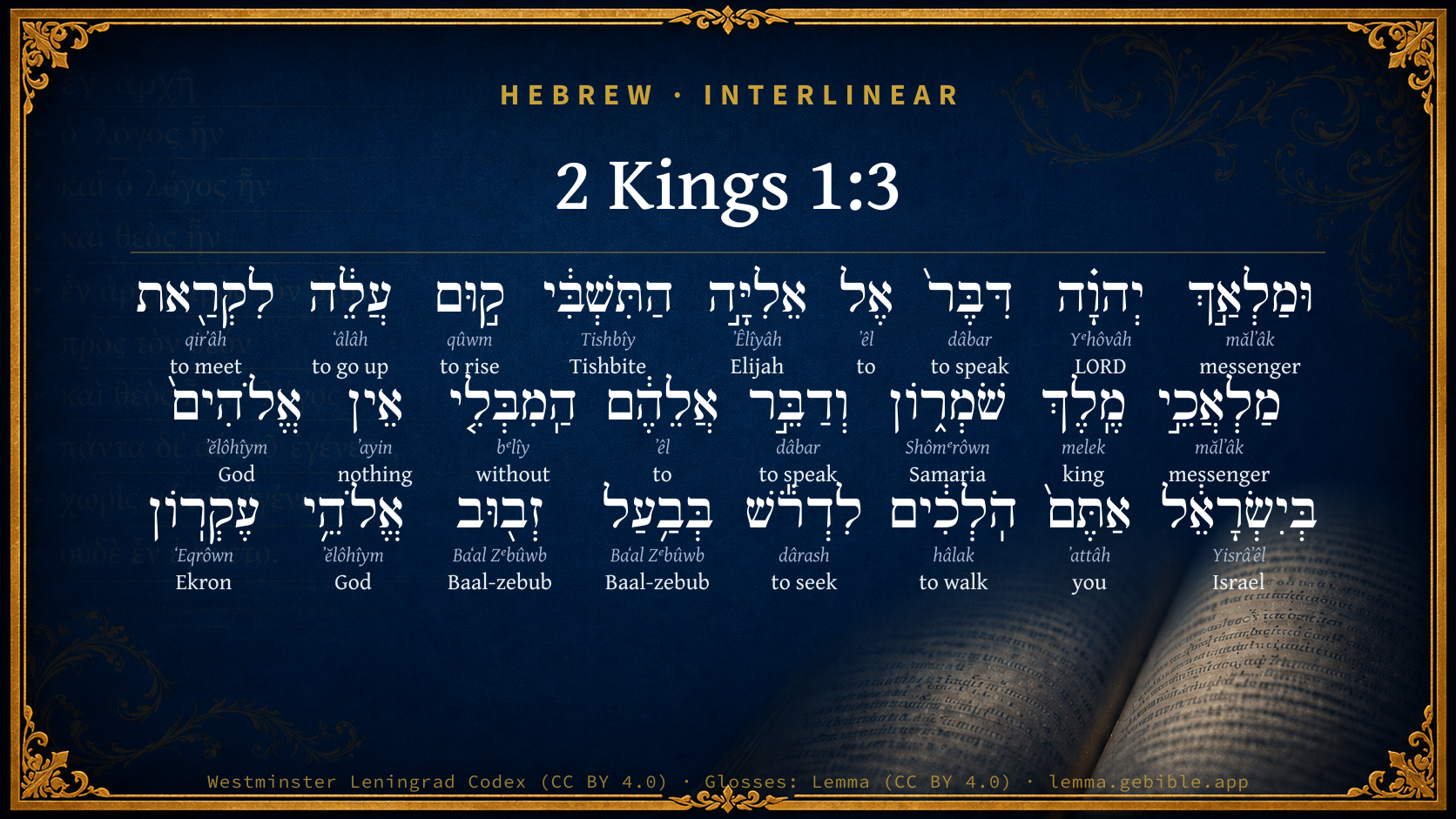
2 Kings 1:3

Hebrew (Westminster Leningrad Codex) 2 Kings 1:3 appears in the Hebrew Old Testament. The text above is from the Westminster Leningrad Codex. Each word links to its Strong’s number, a concise gloss, and parsing drawn from the Open Scriptures Hebrew Bible morphology. Click any word for its full Brown-Driver-Briggs (BDB) entry.
Download image
Cite this verse

2 Kings 1:3 (World English Bible). Public Domain. Lemma interlinear Bible study tool, https://lemma.gebible.app/v/2-kings/1/3.

Show BibTeX & RIS
BibTeX
RIS
English Translation
But the angel of Yahweh said to Elijah the Tishbite, Arise, go up to meet the messengers of the king of Samaria, and tell them, Is it because there is no God in Israel, that you go to inquire of Baal Zebub, the god of Ekron?
World English Bible · Public Domain
Download a study sheet

One document with this verse’s original text, its word-by-word gloss line, the meaning frame, cross-references with their text, attributed commentary, and full source and license credits — printable, and it pastes into notes with its structure intact.

This verse Autodidact and up

Study sheet (.html) Plain text (.txt)

A passage Seminary Student

Up to 50 verses in one chapter. A passage sheet keeps up to 6 commentary sources and 12 cross-references per verse, in the order this page ranks them, and says so on the sheet whenever that leaves anything out. Ask for a single verse and you get the Autodidact verse sheet above.

Everything on this page stays free to read, with no account — the sheet is a download of what is already on screen, not access to it.

Want to remove ads? Support Godless Engineer
Compare translations 3

The same verse in 3 English versions, stacked beneath the original-language interlinear above. Click any original word for its lexicon entry.

Each is an independent rendering of the whole verse — the interlinear is not word-aligned to these translations.

Highlighted words mark where these versions differ — a whole-verse word diff, not a word-by-word alignment.

  • World English Bible Public Domain
    But the angel of Yahweh said to Elijah the Tishbite, Arise, go up to meet the messengers of the king of Samaria, and tell them, Is it because there is no God in Israel, that you go to inquire of Baal Zebub, the god of Ekron?
  • King James Version Public Domain
    But the angel of the LORD said to Elijah the Tishbite, Arise, go up to meet the messengers of the king of Samaria, and say unto them, Is it not because there is not a God in Israel, that ye go to enquire of Baalzebub the god of Ekron?
  • unfoldingWord Literal Text CC BY-SA 4.0
    But the angel of Yahweh said to Elijah the Tishbite, “Arise, go up to meet the messengers of the king of Samaria, and say to them, ‘ because there is no God in Israel you are going to inquire of Baal Zebub, the god of Ekron?

unfoldingWord Literal Text — © unfoldingWord, licensed CC BY-SA 4.0. Word-aligned USFM3 via Door43 (git.door43.org/unfoldingWord/en_ult).

Versions to compare (up to 4)

3 of 4 selected

Show all 18 translations

Every available English version of this verse, each an independent rendering of the whole verse.

  • World English Bible Public Domain
    But the angel of Yahweh said to Elijah the Tishbite, Arise, go up to meet the messengers of the king of Samaria, and tell them, Is it because there is no God in Israel, that you go to inquire of Baal Zebub, the god of Ekron?
  • Berean Standard Bible Public Domain
    But the angel of the LORD said to Elijah the Tishbite, “Go up to meet the messengers of the king of Samaria and ask them, ‘Is it because there is no God in Israel that you are on your way to inquire of Baal-zebub, the god of Ekron?’
  • Majority Standard Bible Public Domain
    But the angel of the LORD said to Elijah the Tishbite, “Go up to meet the messengers of the king of Samaria and ask them, ‘Is it because there is no God in Israel that you are on your way to inquire of Baal-zebub, the god of Ekron?’
  • King James Version Public Domain
    But the angel of the LORD said to Elijah the Tishbite, Arise, go up to meet the messengers of the king of Samaria, and say unto them, Is it not because there is not a God in Israel, that ye go to enquire of Baalzebub the god of Ekron?
  • American Standard Version (1901) Public Domain
    But the angel of Jehovah said to Elijah the Tishbite, Arise, go up to meet the messengers of the king of Samaria, and say unto them, Is it because there is no God in Israel, that ye go to inquire of Baal-zebub, the god of Ekron?
  • Revised Version (1885) Public Domain
    But the angel of the LORD said to Elijah the Tishbite, Arise, go up to meet the messengers of the king of Samaria, and say unto them, Is it because there is no God in Israel, that ye go to inquire of Baal-zebub the god of Ekron?
  • Geneva Bible (1599) Public Domain
    Then the Angel of the Lord said to Eliiah the Tishbite, Arise, and goe vp to meete the messengers of the King of Samaria, and say vnto them, Is it not because there is no God in Israel, that ye goe to enquire of Baal-zebub the god of Ekron?
  • Douay-Rheims (1899) Public Domain
    And an angel of the Lord spoke to Elias the Thesbite, saying: Arise, and go up to meet the messengers of the king of Samaria, and say to them: Is there not a God in Israel, that ye go to consult Beelzebub the god of Accaron?
  • Young's Literal Translation Public Domain
    And a messenger of Jehovah hath spoken unto Elijah the Tishbite, `Rise, go up to meet the messengers of the king of Samaria, and speak unto them, Is it because there is not a God in Israel -- ye are going to inquire of Baal Zebub god of Ekron?
  • Literal Standard Version CC BY-SA 4.0
    And a messenger of YHWH has spoken to Elijah the Tishbite, “Rise, go up to meet the messengers of the king of Samaria, and speak to them, Is it because there is not a God in Israel—you are going to inquire of Ba‘al-Zebub god of Ekron?
  • Unlocked Literal Bible CC BY-SA 4.0
    But the angel of Yahweh said to Elijah the Tishbite, “Arise, go up to meet the messengers of the king of Samaria, and ask them, 'Is it because there is no God in Israel that you are going to consult with Baal-Zebub, the god of Ekron?
  • unfoldingWord Literal Text CC BY-SA 4.0
    But the angel of Yahweh said to Elijah the Tishbite, “Arise, go up to meet the messengers of the king of Samaria, and say to them, ‘ because there is no God in Israel you are going to inquire of Baal Zebub, the god of Ekron?
  • Darby Bible Public Domain
    And the angel of Jehovah said to Elijah the Tishbite, Arise, go up to meet the messengers of the king of Samaria, and say to them, Is it because there is not a God in Israel, that ye go to inquire of Baal-zebub the god of Ekron?
  • World Messianic Bible Public Domain
    But the LORD’s angel said to Elijah the Tishbite, “Arise, go up to meet the messengers of the king of Samaria, and tell them, ‘Is it because there is no God in Israel that you go to inquire of Baal Zebub, the god of Ekron?
  • Webster's Bible Public Domain
    But the angel of the LORD said to Elijah the Tishbite, Arise, go up to meet the messengers of the king of Samaria, and say to them, Is it not because there is not a God in Israel, that ye go to inquire of Baal-zebub the god of Ekron?
  • Free Bible Version CC BY-SA 4.0
    But the angel of the Lord told Elijah the Tishbite, “Go and meet the messengers of the king of Samaria and ask them, ‘Is it because there's no God in Israel that you're going to ask advice from Baal-Zebub, the god of Ekron?’
  • Bible in Basic English Public Domain
    But the angel of the Lord said to Elijah the Tishbite, Go now, and, meeting the men sent by the king of Samaria, say to them, Is it because there is no God in Israel, that you are going to get directions from Baal-zebub, the god of Ekron?
  • JPS Tanakh (1917) Public Domain
    But an angel of the LORD said to Elijah the Tishbite: 'Arise, go up to meet the messengers of the king of Samaria, and say unto them: Is it because there is no God in Israel, that ye go to inquire of Baal-zebub the god of Ekron?

Literal Standard Version (2020), Covenant Press — licensed CC BY-SA 4.0. Text via the HelloAO Bible API (eBible.org). Unlocked Literal Bible (unfoldingWord) — licensed CC BY-SA 4.0. Text via the HelloAO Bible API (eBible.org). unfoldingWord Literal Text — © unfoldingWord, licensed CC BY-SA 4.0. Word-aligned USFM3 via Door43 (git.door43.org/unfoldingWord/en_ult). Free Bible Version, Dr. Jonathan Gallagher — licensed CC BY-SA 4.0. Text via the HelloAO Bible API (eBible.org).

Word by word

More ways to search: Search by grammar → Find every occurrence → Compare this word →

Practice this passage: Drill this verse → Learn its vocabulary →

הַתִּשְׁבִּ֔י
Tishbîy
H8664
“the · Tishbite”
Particle, Definite Article + Noun, Gentilic, Masculine, Singular, Absolute
Part of Speech
Particle + Noun
Type
Gentilic
Gender
Masculine
Number
Singular
State
Absolute
Full BDB Definition

Origin: patrial from an unused name meaning recourse

TWOT: None

Tishbite = "captivity" - the home of Elijah - site unknown but maybe the town of Tishbe - an inhabitant of Tishbe or Tishbi or Tesheb - site unknown and name uncertain
  1. וּמַלְאַ֣ךְ mălʼâk H4397 “and · messenger of” Conjunction + Noun, Common, Masculine, Singular, Construct
  2. יְהוָ֗ה Yᵉhôvâh H3068 “LORD” Noun, Proper
  3. דִּבֶּר֙ dâbar H1696 “to speak” Verb, Piel, Perfect, 3rd Person, Masculine, Singular
  4. אֶל ʼêl H413 “to” Preposition
  5. אֵלִיָּ֣ה ʼÊlîyâh H452 “Elijah” Noun, Proper
  6. ק֣וּם qûwm H6965 “rise” Verb, Qal, Imperative, 2nd Person, Masculine, Singular
  7. עֲלֵ֔ה ʻâlâh H5927 “go up” Verb, Qal, Imperative, 2nd Person, Masculine, Singular
  8. לִקְרַ֖את qirʼâh H7125 “to meet” Preposition + Verb, Qal, Infinitive Construct
  9. מַלְאֲכֵ֣י mălʼâk H4397 “messengers of” Noun, Common, Masculine, Plural, Construct
  10. מֶֽלֶךְ melek H4428 “king of” Noun, Common, Masculine, Singular, Construct
  11. שֹׁמְר֑וֹן Shômᵉrôwn H8111 “Samaria” Noun, Proper
  12. וְדַבֵּ֣ר dâbar H1696 “and · speak” Conjunction + Verb, Piel, Imperative, 2nd Person, Masculine, Singular
  13. אֲלֵהֶ֔ם ʼêl H413 “to · them” Preposition + Suffix, Personal, 3rd Person, Masculine, Plural
  14. הַֽמִבְּלִ֤י bᵉlîy H1097 “from · without” Particle, Interrogative + Preposition + Adverb
  15. אֵין ʼayin H369 “nothing” Particle, Negative
  16. אֱלֹהִים֙ ʼĕlôhîym H430 “God(s)” Noun, Common, Masculine, Plural, Absolute
  17. בְּיִשְׂרָאֵ֔ל Yisrâʼêl H3478 “in/at · Israel” Preposition + Noun, Proper
  18. אַתֶּם֙ ʼattâh H859 “you” Pronoun, Personal, 2nd Person, Masculine, Plural
  19. הֹֽלְכִ֔ים hâlak H1980 “walking” Verb, Qal, Participle Active, Masculine, Plural, Absolute
  20. לִדְרֹ֕שׁ dârash H1875 “to seek” Preposition + Verb, Qal, Infinitive Construct
  21. בְּבַ֥עַל Baʻal Zᵉbûwb H1176 “in/at · Baal-zebub” Preposition + Noun, Proper
  22. זְב֖וּב Baʻal Zᵉbûwb H1176 “Baal-zebub” Noun, Proper
  23. אֱלֹהֵ֥י ʼĕlôhîym H430 “God(s) of” Noun, Common, Masculine, Plural, Construct
  24. עֶקְרֽוֹן ʻEqrôwn H6138 “Ekron” Noun, Proper

About this verse

These counts appear in no published source. They are computed here, from the morphology-tagged text and Lemma’s own curated glosses. What Lemma adds →

25
words
20
distinct lemmas
Historical
section

Notable vocabulary

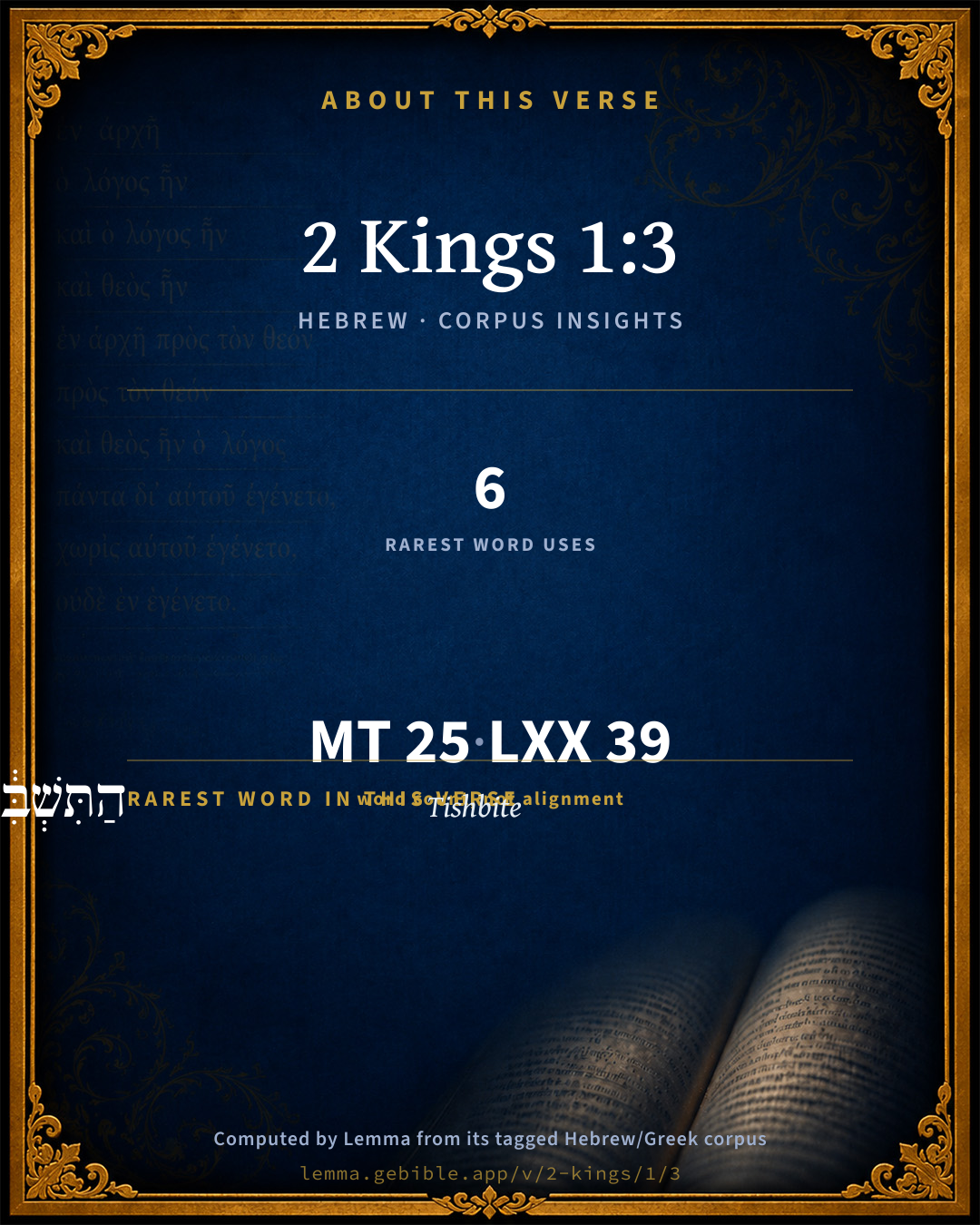
The rarest word here is הַתִּשְׁבִּ֔י Tishbite H8664 — appearing just 6 times in the whole Hebrew Bible.

Shared distinctive vocabulary

הַתִּשְׁבִּ֔י Tishbite H8664 occurs in 6 verses of the Hebrew Bible. Also found in:

Grammatical profile

  • 7 verbs
  • 13 nouns
  • 1 pronoun
  • 2 prepositions
  • 1 adverb
  • 1 particle

Verb forms

  • דִּבֶּר֙ Piel · Perfect
  • ק֣וּם Qal · Imperative
  • עֲלֵ֔ה Qal · Imperative
  • לִקְרַ֖את Qal · Infinitive Construct
  • וְדַבֵּ֣ר Piel · Imperative
  • הֹֽלְכִ֔ים Qal · Participle Active
  • לִדְרֹ֕שׁ Qal · Infinitive Construct

Repetition

Words recur within this verse — often emphatic in Hebrew:

  • וּמַלְאַ֣ךְ messenger H4397 ×2
  • דִּבֶּר֙ to speak H1696 ×2
  • אֱלֹהִים֙ God H430 ×2
  • בְּבַ֥עַל Baal-zebub H1176 ×2
  • אֶל to H413 ×2

Hebrew & Septuagint length

In English translation the verse runs 46 words from the Hebrew and 56 from the Septuagint (LXX English) — closely comparable.

A rough comparison of the two English renderings, which tokenize alike — not a word-level alignment.

Word counts can differ between the Hebrew and the Greek without any difference in meaning — e.g. the Hebrew direct-object marker אֵת has no separate Greek word, and Greek often adds the article ὁ.

In the original languages it is 25 Hebrew tokens and 39 Greek tokens — but the two are counted differently (Hebrew bundles its prefixes and suffixes into one token; the Greek is in lemma form), so that isn’t a like-for-like length.

Cross-references

19

Topical passages linked to 2 Kings 1:3 in the Treasury of Scripture Knowledge — connected by theme and wording, ordered by reader-vote popularity; previews shown in the World English Bible.

  • 1 Kings 17:1 Elijah the Tishbite, who was of the foreigners of Gilead, said to Ahab, As Yahweh, the God of Israel, lives, before whom I stand, there shall not be dew nor rain these years, but according to my word.
  • Jonah 2:8 Those who regard lying vanities forsake their own mercy.
  • Psalms 76:1 In Judah, God is known. His name is great in Israel.
  • Jeremiah 2:11–13 Has a nation changed [its] gods, which yet are no gods? but my people have changed their glory for that which does not profit.
  • Acts 12:7–11 And behold, an angel of the Lord stood by him, and a light shone in the cell. He struck Peter on the side, and woke him up, saying, "Stand up quickly!" His chains fell off from his hands.
  • Mark 3:22 The scribes who came down from Jerusalem said, "He has Beelzebul," and, "By the prince of the demons he casts out the demons."
  • Acts 8:26 But an angel of the Lord spoke to Philip, saying, "Arise, and go toward the south to the way that goes down from Jerusalem to Gaza. This is a desert."
  • 1 Samuel 17:46 This day will Yahweh deliver you into my hand; and I will strike you, and take your head from off you; and I will give the dead bodies of the host of the Philistines this day to the birds of the sky, and to the wild animals of the earth; that all the earth may know that there is a God in Israel,
  • 1 Kings 18:1 It happened after many days, that the word of Yahweh came to Elijah, in the third year, saying, Go, show yourself to Ahab; and I will send rain on the earth.
  • 1 Kings 18:36 It happened at the time of the offering of the [evening] offering, that Elijah the prophet came near, and said, Yahweh, the God of Abraham, of Isaac, and of Israel, let it be known this day that you are God in Israel, and that I am your servant, and that I have done all these things at your word.
  • 1 Kings 19:5 He lay down and slept under a juniper tree; and, behold, an angel touched him, and said to him, Arise and eat.
  • 1 Kings 19:7 The angel of Yahweh came again the second time, and touched him, and said, Arise and eat, because the journey is too great for you.
  • 1 Kings 21:17 The word of Yahweh came to Elijah the Tishbite, saying,
  • 2 Kings 1:2 Ahaziah fell down through the lattice in his upper chamber that was in Samaria, and was sick: and he sent messengers, and said to them, Go, inquire of Baal Zebub, the god of Ekron, whether I shall recover of this sickness.
  • 2 Kings 1:6 They said to him, There came up a man to meet us, and said to us, Go, turn again to the king who sent you, and tell him, Thus says Yahweh, Is it because there is no God in Israel, that you send to inquire of Baal Zebub, the god of Ekron? therefore you shall not come down from the bed where you are gone up, but shall surely die.
  • 2 Kings 1:8 They answered him, He was a hairy man, and girt with a belt of leather about his loins. He said, It is Elijah the Tishbite.
  • 2 Kings 1:15–16 The angel of Yahweh said to Elijah, Go down with him: don't be afraid of him. He arose, and went down with him to the king.
  • 2 Kings 5:15 He returned to the man of God, he and all his company, and came, and stood before him; and he said, See now, I know that there is no God in all the earth, but in Israel: now therefore, please take a present from your servant.
  • 2 Kings 5:8 It was so, when Elisha the man of God heard that the king of Israel had torn his clothes, that he sent to the king, saying, Why have you torn your clothes? let him come now to me, and he shall know that there is a prophet in Israel.

Cross-references courtesy of OpenBible.info (CC BY 4.0).

Hebrew and Greek witnesses Masoretic Hebrew ↔ Greek Septuagint

The same verse in the two great witnesses to the Old Testament, shown verse-for-verse.

These are two independent witnesses, not word-aligned to each other, and the Septuagint is shown in lemma (dictionary) form.

Hebrew 2 Kings 1:3 Masoretic · Westminster Leningrad Codex

וּמַלְאַ֣ךְ יְהוָ֗ה דִּבֶּר֙ אֶל אֵלִיָּ֣ה הַתִּשְׁבִּ֔י ק֣וּם עֲלֵ֔ה לִקְרַ֖את מַלְאֲכֵ֣י מֶֽלֶךְ שֹׁמְר֑וֹן וְדַבֵּ֣ר אֲלֵהֶ֔ם הַֽמִבְּלִ֤י אֵין אֱלֹהִים֙ בְּיִשְׂרָאֵ֔ל אַתֶּם֙ הֹֽלְכִ֔ים לִדְרֹ֕שׁ בְּבַ֥עַל זְב֖וּב אֱלֹהֵ֥י עֶקְרֽוֹן

But the angel of Yahweh said to Elijah the Tishbite, Arise, go up to meet the messengers of the king of Samaria, and tell them, Is it because there is no God in Israel, that you go to inquire of Baal Zebub, the god of Ekron?

World English Bible · Public Domain

Greek LXX 2 Kings 1:3 Septuagint · lemma form

καί ἄγγελος κύριος λαλέω πρός ηλιου ὁ θεσβίτης λέγω ἀναἵστημι δεῦρο εἰς συνάντησις ὁ ἄγγελος οχοζιας βασιλεύς σαμαρεία καί λαλέω πρός αὐτός εἰ παρά ὁ μή εἰμί θεός ἐν ἰσραήλ σύ πορεύομαι ἐπιζητέω ἐν ὁ βααλ μυῖα θεός ακκαρων

And an angel of the Lord called Eliu the Thesbite, saying, Arise, and go to meet the messengers of Ochozias king of Samaria, and you shall say to them, Is it because there is no God in Israel, that you⌃ go to enquire of Baal fly, the God of Accaron? but it shall not be so.

LXX2012 (modern English Septuagint) · Public Domain

On this verse, Ellicott's Commentary for English Readers discusses the Septuagint’s reading. Read the note in Commentary ↓

Hebrew: Westminster Leningrad Codex (CC BY 4.0). Greek: Septuagint (public domain); English from LXX2012 (modern English Septuagint) (Public Domain). How the Septuagint differs from the Hebrew →

Targum (Aramaic paraphrase)

1

The Targum is the ancient Jewish Aramaic paraphrase of the Hebrew Scriptures — an interpretive translation, not the Hebrew text itself. Onkelos (literal) and Pseudo-Jonathan (expansive) render the Torah, and Jonathan the Prophets. Coverage is partial: where no permissively-licensed English translation exists for a verse, only the Aramaic is shown. This is verse-level text, not a word-by-word alignment to the Hebrew.

  1. Targum Jonathan Prophets (Joshua–Malachi)
    וּמַלְאֲכָא דַייָ מַלֵיל עִם אֵלִיָהוּ דְמִן תּוֹשָׁב קוּם סַק לִקְדָמוּת אִזְגַדֵי מַלְכָּא דְשֹׁמְרוֹן וּמַלֵיל עִמְהוֹן הֲלָא אֱלָהָא קַיָם דִשְׁכִנְתֵּיהּ שַׁרְיָא בְּיִשְׂרָאֵל אַתּוּן אָזְלִין לְמִתְבַּע בְּבַעַל זְבוּב טַעֲוַת עֶקְרוֹן:

    (no public-domain English translation for this verse)

    Targum Jonathan — Aramaic: “Mikraot Gedolot” (public domain). English: “Sefaria Community Translation” (CC0 1.0 (public-domain dedication)); “London "Chaldee Paraphrase," 1871” (public domain). Text via Sefaria.

Commentary

Notes on 2 Kings 1:3 from classic Christian and Jewish commentators (each source and its license shown beneath its notes). The classic Christian expositions comment on the surrounding passage and are grouped to its opening verse, so a note may address several verses; the Jewish commentaries on the Tanakh (Rashi and others) are per-verse, so they appear only where the commentator wrote on this verse.

Lemma curates 59 commentaries, every one of them public domain or Creative Commons licensed, each selected and text-cleaned for this edition rather than reprinted as found. About our sources →

Trapp's Complete Commentary

John Trapp

2Ki 1:3 But the angel of the LORD said to Elijah the Tishbite, Arise, go up to meet the messengers of the king of Samaria, and say unto them, [Is it] not because [there is] not a God in Israel, [that] ye go to enquire of Baalzebub the god of Ekron?

Ver. 3. Is it not because there is not a God in Israel,] God scorneth that it should be thought that he had "said unto the seed of Jacob, Seek ye me in vain": that is enough for dumb idols. {Isa 45:16-19}

That ye go to inquire of Baalzebub the god of Ekron?] To their own Baal they sent not, belike, either because he had lately deceived his father Ahab to the loss of his life, or because men are apt to admire foreign things.

John Trapp, A Commentary or Exposition upon All the Books of the Old and New Testament (1647–1656) — public domain. Text from a community e-Sword module.

Joseph Benson's Commentary

2Ki 1:3. Is it not because, &c. — There are two negatives in the Hebrew text, which increase the sense, Is it not because there is no God, none in Israel? That is, Do you not plainly declare that you think there is no God, none at all in Israel? That he knows nothing, and can do nothing? which makes you send to Ekron, as if there were a more knowing and mighty, if not the only God there. God had expressly said, that he had given prophets to the Israelites to inform them of future events, that they might not be tempted to go to inquire of strange gods, Deu 18:14-15.

Joseph Benson's Commentary on the Old and New Testaments (1811–1818) — public domain. Text from a community e-Sword module.

Tyndale Open Study Notes

Tyndale Open Resources

1:3-4 The angel of the Lord does not seem to be a christophany in the book of Kings, as in other Old Testament texts (e.g., Judg 6:11-18). • Elijah, who had previously confronted Ahaziah’s father, Ahab, had a twofold message for the king: a condemnation for failure to acknowledge that Yahweh, not Baal, is God (see 1 Kgs 18:16-18), and a pronouncement of doom (see 1 Kgs 21:17-24).

Tyndale Open Study Notes — © Tyndale Open Resources, licensed CC BY-SA 4.0. Text via the HelloAO Bible API.

Geneva Bible (1599)

Geneva Bible translators

He showeth that idolaters have not the true God, for else they would seek to none but to him alone.

Geneva Bible (1599) marginal notes — public domain. Text via Bolls.life.

Jamieson, Fausset & Brown

Robert Jamieson, A. R. Fausset & David Brown

the angel of the Lord--not an angel, but the angel, who carried on all communications between the invisible God and His chosen people [HENGSTENBERG]. This angel commissioned Elijah to meet the king's messengers, to stop them peremptorily on the idolatrous errand, and convey by them to the king information of his approaching death. This consultation of an idol, being a breach of the fundamental law of the kingdom (Exo 20:3; Deu 5:7), was a daring and deliberate rejection of the national religion. The Lord, in making this announcement of his death, designed that he should see in that event a judgment for his idolatry.

Jamieson, Fausset & Brown — Commentary Critical and Explanatory on the Whole Bible (1871) — public domain (CC PDM 1.0). Text via the HelloAO Bible API.

Ellicott's Commentary for English Readers

(3) But the angel . . . said.—Rather, Now the angel . . . had said. “The angel” is right. (Comp. 2Ki_19:35.) Reuss strangely renders: “Mais une révélation de l’Eternel parla;” and adds the note, “Et non pas un ange” (!).

Arise, go up.—Samaria lay on a hill, and the prophet was to meet the messengers at the gates.

King of Samaria.—Not Israel, a mark of Judæan feeling.

And say.—Literally, speak. LXX., Vulgate, and Arabic add “saying,” but comp. 1Ki_21:5-6.

Is it not because.—Omit “not.” So 2Ki_1:6.

Ye go.—Are going.

A God in Israel.—Comp. Mic_4:5 : “For all peoples will walk every one in the name of his god, and we will walk in the name of Jehovah our God for ever and ever.”

A Bible Commentary for English Readers, edited by Charles John Ellicott (1878–1897) — public domain. Text from a community e-Sword module.

The Cambridge Bible for Schools and Colleges

gen. ed. J. J. S. Perowne

3. Elijah the Tishbite] See on 1Ki_17:1. For a similar message to the prophet cf. 1Ki_21:17. We know from 2Ki_4:25 that Elisha was often to be found on Mt Carmel where there was most likely a school of the prophets (see 2Ki_2:25). It may be that Elijah also made his most settled dwelling there. At this time he went and took up a position on some height (see below, verse 9) which commanded the road by which the messengers were journeying from Samaria to Ekron.

the king of Samaria] When the city of Samaria had been built and made the royal residence, the name ‘Samaria’ soon came to be used as the equivalent of ‘Israel’ for the kingdom of the ten tribes. See before 1Ki_21:1.

Is it not because there is not a God in Israel] R.V. Is it because there is no God in Israel. The Hebrew could employ a double negative, as the Greek sometimes does, but the sense intended is given in English by the single one. This rendering the A.V. employs in Exo_14:11 where the original is in the same form as in the verse before us: ‘Because there were no graves in Egypt’; and for a similar double negative in the Hebrew of Ecc_3:11 the A.V. gives ‘so that no man can find out’. The same form of phrase is repeated below in verses 6 and 16.

The LXX. takes away the first word of the Hebrew in the next sentence, וִלָכֵן = Now therefore, from its connexion and renders it as a separate phrase, and as if it had been וְלֹא כֵן = καὶ οὐχ οὔτως, putting ὄτι, which has nothing to represent it in the Hebrew, as the connecting particle of the next clause. The same misreading occurs in verses 6 and 16.

The Cambridge Bible for Schools and Colleges (gen. ed. J. J. S. Perowne; Cambridge University Press, 1878–1918) — public domain. Text from a community e-Sword module.

John Gill's Exposition

But the angel of the Lord said unto Elijah,.... One of the ministering spirits sent by the Lord to him:

arise, go up to meet the messengers of the king of Samaria: that is, the king of Israel, whose capital city was Samaria:

is it not because there is not a God in Israel; known, acknowledged, and worshipped there, of whom there had been sufficient proof of his deity and divine perfections, as omniscience, omnipotence, &c.

that ye go to inquire of Baalzebub the god of Ekron? about future things, when they had God nigh unto them, fully acquainted with them, as this message shows.

John Gill's Exposition of the Whole Bible (1746–1763) — public domain (CC PDM 1.0). Text via the HelloAO Bible API.

Matthew Poole's English Annotations

Is it not because there is not a God in Israel? Dost thou not by this action cast contempt upon the God of Israel, as if he were either ignorant of the event of thy disease, or un able to give thee any relief, and as if Baal-zebub had more skill and power than he?

Matthew Poole's English Annotations on the Holy Bible (1683–1685) — public domain. Text from a community e-Sword/MySword module.

Whedon's Commentary on the Bible

Daniel D. Whedon

3. Not a god in Israel — This inquiry of a strange god was at once a violation of the first commandment of the decalogue (Exo_20:3) and an utter rejection of Jehovah, and deserved the judgment of death.

Daniel D. Whedon (gen. ed.), Commentary on the Old and New Testaments (1874–1909) — public domain. Text from a community e-Sword module.

The Pulpit Commentary

The angel of the Lord. It would be better to translate, with the LXX, an angel (aggelov, not oJ aggelov). An angel had appeared to Elijah on a previous occasion. (1Ki_19:5, 1Ki_19:7) Elijah the Tishbite 1Ki_17:1 1Ki_21:17, 1Ki_21:28; 2Ki_1:8; and for the meaning of the expression, hat-Tishbi, see the comment on 1Ki_17:1. Arise, go up. Elijah was, apparently, in the low tract of the Shefelah, or in Sharon, when the messengers started, and was thus commanded to go up and meet them, or intercept them on their journey before they descended into the plain. God would not have the insult to his majesty, carried out. Is it not because there is not a God in Israel? rather, Is it that there is no God at all in Israel? The double negative is intensitive, and implies that the king"s consultation of Baal-zebub, god of Ekron, is a complete and absolute denial of the Divinity of Jehovah. To consult a foreign oracle is equivalent to raying that the voice of God is wholly silent in one"s own land. This was going further in apostasy than Ahab had gone. (see 1Ki_22:6-9)

The Pulpit Commentary (1880–1919), ed. H.D.M. Spence-Jones & Joseph S. Exell — public domain. Text from a community e-Sword module.

John Wesley's Explanatory Notes

And say - Dost thou not cast contempt on the God of Israel, as if he were either ignorant of the event of thy disease, or unable to give thee relief; and as if Baal-zebub had more skill and power than he?

John Wesley, Explanatory Notes Upon the Whole Bible (1754–1765) — public domain. Text via the GEBible commentary corpus.

Scofield Reference Notes

C. I. Scofield

angel

(See Scofield "Heb 1:4").

The Scofield Reference Bible (1917 edition), notes by C. I. Scofield — public domain. Text from a community e-Sword module.

unfoldingWord translationNotes

Door43 World Missions Community

Yahweh

This is the name of God that he revealed to his people in the Old Testament. See the translationWord page about Yahweh concerning how to translate this.

the Tishbite

This refers to someone from the city of Tishbe. (See: How to Translate Names)

Is it because there is no God in Israel that you are going to consult with Baal-Zebub, the god of Ekron?

This rhetorical question is asked as a rebuke for consulting Baal-Zebub. This may be written as a statement. This is irony because they are definitely aware of the God of Israel. AT: "You fools! You know there is a God in Israel, but you were acting as though you did not know when you sent men to consult Baal-Zebub, the god of Ekron!" (See: Rhetorical Question and Irony)

consult with Baal-Zebub

The word "consult" means to get the opinion of someone about a question.

Therefore Yahweh says

This is Yahweh's message to King Ahaziah. AT: "Therefore Yahweh says to King Ahaziah" (See: Assumed Knowledge and Implicit Information)

You will not come down from the bed to where you have gone up

When King Ahaziah was injured, he was placed in a bed. Yahweh said that he will never become well and be able to get out of the bed. AT: "You will not recover and you will not get up from the bed on which you are lying" (See: Assumed Knowledge and Implicit Information)

translationWords

angel

Yahweh

Elijah

king

God

unfoldingWord translationNotes — © Distant Shores Media and the Door43 World Missions Community, licensed CC BY-SA 4.0. Source: git.door43.org/Door43/en_tn.

Lesson kit

Teaching starters — assembled from the data on this page, not authored interpretation. Every prompt links to the verse data it draws on. Edit before teaching.

2 Kings, in the Historical, opens this verse with 25 words (20 distinct Hebrew lemmas). Its most distinctive word is Tishbîy (“Tishbite”). A historical commentator’s framing appears above. Read the whole chapter for the surrounding context.

Discussion questions

  1. The word Tishbîy carries the sense “Tishbite.” How does it shape the verse?
  2. 1 Kings 17:1 shares the word «Tishbite» with this verse. How do the two illuminate each other?
  3. “messenger” occurs 2× in this one verse. What is the effect of the repetition?
  4. These translations render this verse differently. What is at stake in choosing one wording over another?
  5. The verb «דִּבֶּר֙» is Piel Perfect. How does its form color the action?
  6. Reading how Trapp's Complete Commentary and Joseph Benson's Commentary read this verse, where do the two commentators agree and where do they part?

Things to notice

Reading settings

Reading text

Shown beneath each verse's original-language words.

Old Testament
Old Testament edition

Read the OT as the Masoretic Hebrew (MT) or the Greek Septuagint (LXX).

English shown for the Greek Septuagint (in the Hebrew ↔ Greek comparison).

Comparing translations? Open the Compare panel on any verse page to stack up to four side by side.