
Deuteronomy 14:7

Hebrew (Westminster Leningrad Codex) Deuteronomy 14:7 appears in the Hebrew Old Testament. The text above is from the Westminster Leningrad Codex. Each word links to its Strong’s number, a concise gloss, and parsing drawn from the Open Scriptures Hebrew Bible morphology. Click any word for its full Brown-Driver-Briggs (BDB) entry.
Download image
Cite this verse

Deuteronomy 14:7 (World English Bible). Public Domain. Lemma interlinear Bible study tool, https://lemma.gebible.app/v/deuteronomy/14/7.

Show BibTeX & RIS
BibTeX
RIS
English Translation
Nevertheless these you shall not eat of them that chew the cud, or of those who have the hoof cloven: the camel, and the hare, and the rabbit; because they chew the cud but don't part the hoof, they are unclean to you.
World English Bible · Public Domain
Download a study sheet

One document with this verse’s original text, its word-by-word gloss line, the meaning frame, cross-references with their text, attributed commentary, and full source and license credits — printable, and it pastes into notes with its structure intact.

This verse Autodidact and up

Study sheet (.html) Plain text (.txt)

A passage Seminary Student

Up to 50 verses in one chapter. A passage sheet keeps up to 6 commentary sources and 12 cross-references per verse, in the order this page ranks them, and says so on the sheet whenever that leaves anything out. Ask for a single verse and you get the Autodidact verse sheet above.

Everything on this page stays free to read, with no account — the sheet is a download of what is already on screen, not access to it.

Want to remove ads? Support Godless Engineer
Compare translations 3

The same verse in 3 English versions, stacked beneath the original-language interlinear above. Click any original word for its lexicon entry.

Each is an independent rendering of the whole verse — the interlinear is not word-aligned to these translations.

Highlighted words mark where these versions differ — a whole-verse word diff, not a word-by-word alignment.

  • World English Bible Public Domain
    Nevertheless these you shall not eat of them that chew the cud, or of those who have the hoof cloven: the camel, and the hare, and the rabbit; because they chew the cud but don't part the hoof, they are unclean to you.
  • King James Version Public Domain
    Nevertheless these ye shall not eat of them that chew the cud, or of them that divide the cloven hoof; as the camel, and the hare, and the coney: for they chew the cud, but divide not the hoof; therefore they are unclean unto you.
  • unfoldingWord Literal Text CC BY-SA 4.0
    Despite this, from chewers of the cud and from splitters of the hoof, the cloven-footed, you must not eat: the camel and the rabbit and the rock badger, because they cause the cud to go up and do not part the hoof, they unclean to you.

unfoldingWord Literal Text — © unfoldingWord, licensed CC BY-SA 4.0. Word-aligned USFM3 via Door43 (git.door43.org/unfoldingWord/en_ult).

Versions to compare (up to 4)

3 of 4 selected

Show all 18 translations

Every available English version of this verse, each an independent rendering of the whole verse.

  • World English Bible Public Domain
    Nevertheless these you shall not eat of them that chew the cud, or of those who have the hoof cloven: the camel, and the hare, and the rabbit; because they chew the cud but don't part the hoof, they are unclean to you.
  • Berean Standard Bible Public Domain
    But of those that chew the cud or have a completely divided hoof, you are not to eat the following: the camel, the rabbit, or the rock badger. Although they chew the cud, they do not have a divided hoof. They are unclean for you,
  • Majority Standard Bible Public Domain
    But of those that chew the cud or have a completely divided hoof, you are not to eat the following: the camel, the rabbit, or the rock badger. Although they chew the cud, they do not have a divided hoof. They are unclean for you,
  • King James Version Public Domain
    Nevertheless these ye shall not eat of them that chew the cud, or of them that divide the cloven hoof; as the camel, and the hare, and the coney: for they chew the cud, but divide not the hoof; therefore they are unclean unto you.
  • American Standard Version (1901) Public Domain
    Nevertheless these ye shall not eat of them that chew the cud, or of them that have the hoof cloven: the camel, and the hare, and the coney; because they chew the cud but part not the hoof, they are unclean unto you.
  • Revised Version (1885) Public Domain
    Nevertheless these ye shall not eat of them that chew the cud, or of them that have the hoof cloven: the camel, and the hare, and the coney, because they chew the cud but part not the hoof, they are unclean unto you:
  • Geneva Bible (1599) Public Domain
    But these ye shall not eate, of them that chew the cud, and of them that deuide and cleaue the hoofe onely: ye camell, nor the hare, nor the cony: for they chewe the cudde, but deuide not ye hoofe: therefore they shall be vncleane vnto you:
  • Douay-Rheims (1899) Public Domain
    But of them that chew the cud, but divide not the hoof, you shall not eat, such as the camel, the hare, and the cherogril: because they chew the cud, but divide not the hoof, they shall be unclean to you.
  • Young's Literal Translation Public Domain
    `Only, this ye do not eat, of those bringing up the cud, and of those dividing the cloven hoof: the camel, and the hare, and the rabbit, for they are bringing up the cud but the hoof have not divided; unclean they `are' to you;
  • Literal Standard Version CC BY-SA 4.0
    Only, this you do not eat, of those bringing up the cud, and of those dividing the cloven hoof: the camel, and the hare, and the hyrax, for they are bringing up the cud, but the hoof has not divided—they [are] unclean to you;
  • Unlocked Literal Bible CC BY-SA 4.0
    Nevertheless, you must not eat some animals that chew the cud or that have the hoof divided in two: the camel, the rabbit, and the rock badger; because they chew the cud but do not part the hoof, they are unclean to you.
  • unfoldingWord Literal Text CC BY-SA 4.0
    Despite this, from chewers of the cud and from splitters of the hoof, the cloven-footed, you must not eat: the camel and the rabbit and the rock badger, because they cause the cud to go up and do not part the hoof, they unclean to you.
  • Darby Bible Public Domain
    Only these ye shall not eat of those that chew the cud, or of those with hoofs cloven and split open: the camel, and the hare, and the rock-badger; for they chew the cud, but have not cloven hoofs -- they shall be unclean unto you;
  • World Messianic Bible Public Domain
    Nevertheless these you shall not eat of them that chew the cud, or of those who have the hoof split: the camel, the hare, and the rabbit. Because they chew the cud but don’t part the hoof, they are unclean to you.
  • Webster's Bible Public Domain
    Nevertheless, these ye shall not eat, of them that chew the cud, or of them that divide the cloven hoof; the camel, and the hare, and the coney: for they chew the cud, but divide not the hoof; therefore they are unclean to you.
  • Free Bible Version CC BY-SA 4.0
    But you are not allowed to eat those that either chew the cud or have a divided hoof. This includes: camels, rabbits, and rock hyraxes. Even though they chew the cud, they don't have a divided hoof. You must treat them as unclean.
  • Bible in Basic English Public Domain
    But even among these, there are some which may not be used for food: such as the camel, the hare, and the coney, which are unclean to you, because, though their food comes back, the horn of their feet is not parted in two.
  • JPS Tanakh (1917) Public Domain
    Nevertheless these ye shall not eat of them that only chew the cud, or of them that only have the hoof cloven: the camel, and the hare, and the rock-badger, because they chew the cud but part not the hoof, they are unclean unto you;

Literal Standard Version (2020), Covenant Press — licensed CC BY-SA 4.0. Text via the HelloAO Bible API (eBible.org). Unlocked Literal Bible (unfoldingWord) — licensed CC BY-SA 4.0. Text via the HelloAO Bible API (eBible.org). unfoldingWord Literal Text — © unfoldingWord, licensed CC BY-SA 4.0. Word-aligned USFM3 via Door43 (git.door43.org/unfoldingWord/en_ult). Free Bible Version, Dr. Jonathan Gallagher — licensed CC BY-SA 4.0. Text via the HelloAO Bible API (eBible.org).

Word by word

More ways to search: Search by grammar → Find every occurrence → Compare this word →

Practice this passage: Drill this verse → Learn its vocabulary →

הָאַרְנֶ֨בֶת
ʼarnebeth
H768
“the · hare”
Particle, Definite Article + Noun, Common, Feminine, Singular, Absolute
Part of Speech
Particle + Noun
Type
Common
Gender
Feminine
Number
Singular
State
Absolute
Full BDB Definition

Origin: of uncertain derivation

TWOT: 123a

hare - probably an extinct animal because no known hare chews its cud, exact meaning is unknown, and best left untranslated as " arnebeth"
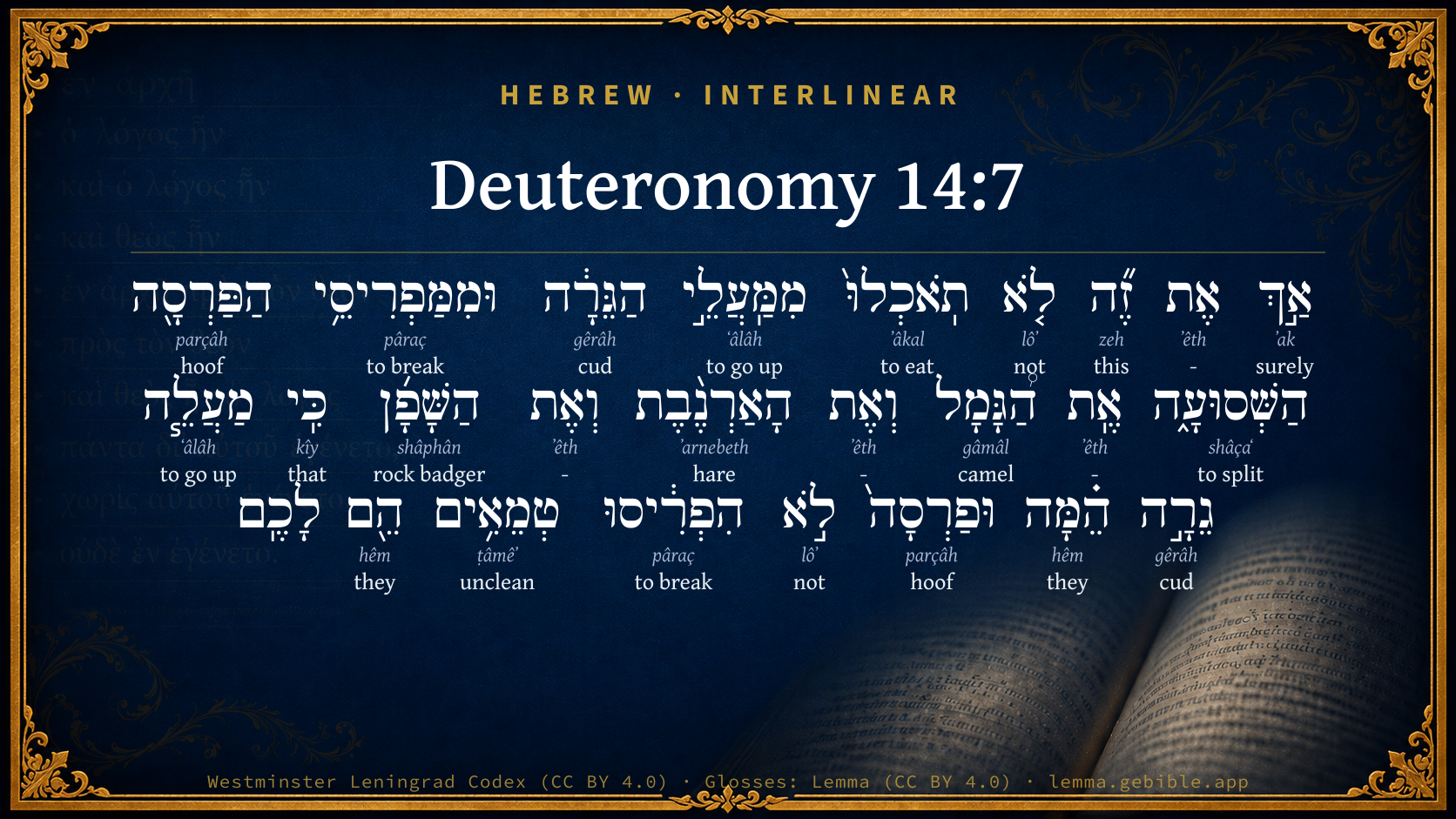
  1. אַ֣ךְ ʼak H389 “surely” Particle, Accusative
  2. אֶת ʼêth H853 “-” Particle, Direct Object
  3. זֶ֞ה zeh H2088 “this” Pronoun, Demonstrative, Masculine, Singular
  4. לֹ֤א lôʼ H3808 “not” Particle, Negative
  5. תֹֽאכְלוּ֙ ʼâkal H398 “to eat” Verb, Qal, Imperfect, 2nd Person, Masculine, Plural
  6. מִמַּֽעֲלֵ֣י ʻâlâh H5927 “from · going up” Preposition + Verb, Hiphil, Participle Active, Masculine, Plural, Construct
  7. הַגֵּרָ֔ה gêrâh H1625 “the · cud” Particle, Definite Article + Noun, Common, Feminine, Singular, Absolute
  8. וּמִמַּפְרִיסֵ֥י pâraç H6536 “and · from · breaking” Conjunction + Preposition + Verb, Hiphil, Participle Active, Masculine, Plural, Construct
  9. הַפַּרְסָ֖ה parçâh H6541 “the · hoof” Particle, Definite Article + Noun, Common, Feminine, Singular, Absolute
  10. הַשְּׁסוּעָ֑ה shâçaʻ H8156 “the · split” Particle, Definite Article + Verb, Qal, Participle Passive, Feminine, Singular, Absolute
  11. אֶֽת ʼêth H853 “-” Particle, Direct Object
  12. הַ֠גָּמָל gâmâl H1581 “the · camel” Particle, Definite Article + Noun, Common, Masculine, Singular, Absolute
  13. וְאֶת ʼêth H853 “and · -” Conjunction + Particle, Direct Object
  14. וְאֶת ʼêth H853 “and · -” Conjunction + Particle, Direct Object
  15. הַשָּׁפָ֜ן shâphân H8227 “the · rock badger” Particle, Definite Article + Noun, Common, Masculine, Singular, Absolute
  16. כִּֽי kîy H3588 “that” Conjunction
  17. מַעֲלֵ֧ה ʻâlâh H5927 “going up” Verb, Hiphil, Participle Active, Masculine, Singular, Construct
  18. גֵרָ֣ה gêrâh H1625 “cud” Noun, Common, Feminine, Singular, Absolute
  19. הֵ֗מָּה hêm H1992 “they” Pronoun, Personal, 3rd Person, Masculine, Plural
  20. וּפַרְסָה֙ parçâh H6541 “and · hoof” Conjunction + Noun, Common, Feminine, Singular, Absolute
  21. לֹ֣א lôʼ H3808 “not” Particle, Negative
  22. הִפְרִ֔יסוּ pâraç H6536 “to break” Verb, Hiphil, Perfect, 3rd Person, Common, Plural
  23. טְמֵאִ֥ים ṭâmêʼ H2931 “unclean” Adjective, Adjective, Masculine, Plural, Absolute
  24. הֵ֖ם hêm H1992 “they” Pronoun, Personal, 3rd Person, Masculine, Plural

About this verse

These counts appear in no published source. They are computed here, from the morphology-tagged text and Lemma’s own curated glosses. What Lemma adds →

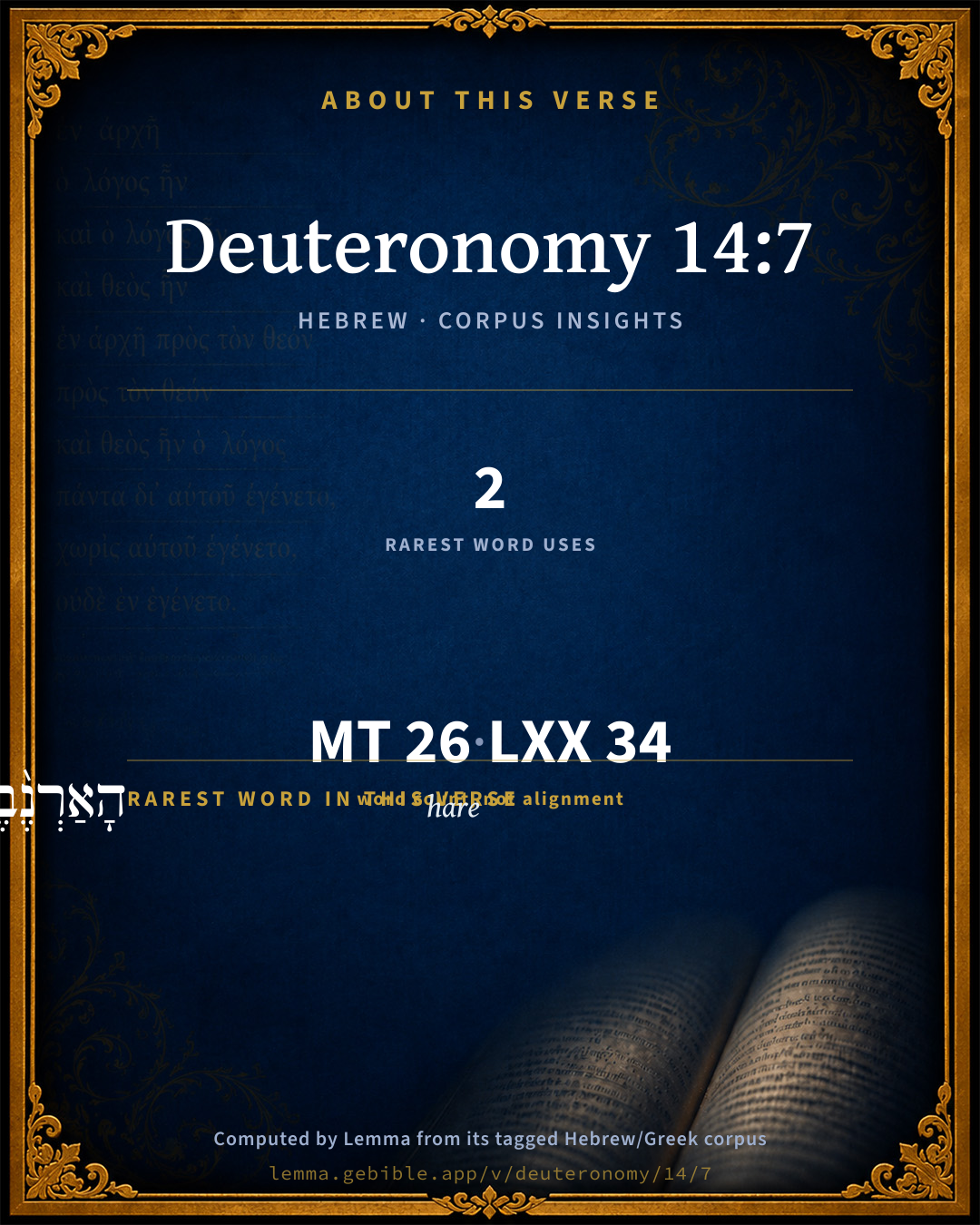
26
words
16
distinct lemmas
Pentateuch
section

Notable vocabulary

The rarest word here is הָאַרְנֶ֨בֶת hare H768 — appearing just 2 times in the whole Hebrew Bible.

Shared distinctive vocabulary

הָאַרְנֶ֨בֶת hare H768 occurs in 2 verses of the Hebrew Bible. Also found in:

Grammatical profile

  • 6 verbs
  • 7 nouns
  • 1 adjective
  • 3 pronouns
  • 1 preposition
  • 1 conjunction
  • 7 particles

Verb forms

  • תֹֽאכְלוּ֙ Qal · Imperfect
  • מִמַּֽעֲלֵ֣י Hiphil · Participle Active
  • וּמִמַּפְרִיסֵ֥י Hiphil · Participle Active
  • הַשְּׁסוּעָ֑ה Qal · Participle Passive
  • מַעֲלֵ֧ה Hiphil · Participle Active
  • הִפְרִ֔יסוּ Hiphil · Perfect

Repetition

Words recur within this verse — often emphatic in Hebrew:

  • מִמַּֽעֲלֵ֣י to go up H5927 ×2
  • הַגֵּרָ֔ה cud H1625 ×2
  • וּמִמַּפְרִיסֵ֥י to break H6536 ×2
  • הַפַּרְסָ֖ה hoof H6541 ×2
  • לֹ֤א not H3808 ×2
  • הֵ֗מָּה they H1992 ×2

Hebrew & Septuagint length

In English translation the verse runs 43 words from the Hebrew and 47 from the Septuagint (LXX English) — closely comparable.

A rough comparison of the two English renderings, which tokenize alike — not a word-level alignment.

Word counts can differ between the Hebrew and the Greek without any difference in meaning — e.g. the Hebrew direct-object marker אֵת has no separate Greek word, and Greek often adds the article ὁ.

In the original languages it is 26 Hebrew tokens and 34 Greek tokens — but the two are counted differently (Hebrew bundles its prefixes and suffixes into one token; the Greek is in lemma form), so that isn’t a like-for-like length.

Cross-references

6

Topical passages linked to Deuteronomy 14:7 in the Treasury of Scripture Knowledge — connected by theme and wording, ordered by reader-vote popularity; previews shown in the World English Bible.

  • Leviticus 11:5 The coney, because he chews the cud but doesn't have a parted hoof, he is unclean to you.
  • Matthew 7:22–23 Many will tell me in that day, 'Lord, Lord, didn't we prophesy in your name, in your name cast out demons, and in your name do many mighty works?'
  • Matthew 7:26 Everyone who hears these words of mine, and doesn't do them will be like a foolish man, who built his house on the sand.
  • 2 Timothy 3:5 holding a form of godliness, but having denied the power thereof. Turn away from these, also.
  • Titus 1:16 They profess that they know God, but by their works they deny him, being abominable, disobedient, and unfit for any good work.
  • 2 Peter 2:18–22 For, uttering great swelling words of emptiness, they entice in the lusts of the flesh, by licentiousness, those who are indeed escaping from those who live in error;

Cross-references courtesy of OpenBible.info (CC BY 4.0).

Hebrew and Greek witnesses Masoretic Hebrew ↔ Greek Septuagint

The same verse in the two great witnesses to the Old Testament, shown verse-for-verse.

These are two independent witnesses, not word-aligned to each other, and the Septuagint is shown in lemma (dictionary) form.

Hebrew Deuteronomy 14:7 Masoretic · Westminster Leningrad Codex

אַ֣ךְ אֶת זֶ֞ה לֹ֤א תֹֽאכְלוּ֙ מִמַּֽעֲלֵ֣י הַגֵּרָ֔ה וּמִמַּפְרִיסֵ֥י הַפַּרְסָ֖ה הַשְּׁסוּעָ֑ה אֶֽת הַ֠גָּמָל וְאֶת הָאַרְנֶ֨בֶת וְאֶת הַשָּׁפָ֜ן כִּֽי מַעֲלֵ֧ה גֵרָ֣ה הֵ֗מָּה וּפַרְסָה֙ לֹ֣א הִפְרִ֔יסוּ טְמֵאִ֥ים הֵ֖ם לָכֶֽם

Nevertheless these you shall not eat of them that chew the cud, or of those who have the hoof cloven: the camel, and the hare, and the rabbit; because they chew the cud but don't part the hoof, they are unclean to you.

World English Bible · Public Domain

Greek LXX Deuteronomy 14:7 Septuagint · lemma form

καί οὗτος οὐ ἐσθίω ἀπό ὁ ἀναἄγω μηρυκισμός καί ἀπό ὁ διχηλέω ὁ ὁπλή καί ὀνυχίζω ὀνυχιστήρ ὁ κάμηλος καί δασύπους καί χοιρογρύλλιον ὅτι ἀναἄγω μηρυκισμός καί ὁπλή οὐ διχηλέω ἀκάθαρτος οὗτος σύ εἰμί

And these you⌃ shall not eat of them that chew the cud, and of those that divide the hoofs, and make distinct claws; the camel, and the hare, and the rabbit; because they chew the cud, and do not divide the hoof, these are unclean to you.

LXX2012 (modern English Septuagint) · Public Domain

Hebrew: Westminster Leningrad Codex (CC BY 4.0). Greek: Septuagint (public domain); English from LXX2012 (modern English Septuagint) (Public Domain). How the Septuagint differs from the Hebrew →

Targum (Aramaic paraphrase)

2

The Targum is the ancient Jewish Aramaic paraphrase of the Hebrew Scriptures — an interpretive translation, not the Hebrew text itself. Onkelos (literal) and Pseudo-Jonathan (expansive) render the Torah, and Jonathan the Prophets. Coverage is partial: where no permissively-licensed English translation exists for a verse, only the Aramaic is shown. This is verse-level text, not a word-by-word alignment to the Hebrew.

  1. Targum Onkelos Torah (Genesis–Deuteronomy)
    בְּרַם יָת דֵין לָא תֵיכְלוּן מִמַסְקֵי פִשְׁרָא וּמִמַסְדִיקֵי פַרְסָתָא מַטִלְפֵי טִלְפַיָא יָת גַמְלָא וְיָת אַרְנְבָא וְיָת טַּפְזָא אֲרֵי מַסְקֵי פִּשְׁרָא אִנוּן וּפַרְסָתְהוֹן לָא סְדִיקָא מְסָאֲבִין אִנוּן לְכוֹן

    (no public-domain English translation for this verse)

    Targum Onkelos — Aramaic: “Onkelos Genesis” (public domain); “Onkelos Exodus” (public domain); “Onkelos Leviticus” (public domain); “Onkelos Numbers” (public domain); “Onkelos Deuteronomy” (public domain). English: “Sefaria Community Translation” (CC0 1.0 (public-domain dedication)); “J.W. Etheridge. The Targums of Onkelos and Jonathan Ben Uzziel on the Pentateuch. London: Longmans, Green, 1862” (public domain). Text via Sefaria.

  2. Targum Pseudo-Jonathan Torah (Genesis–Deuteronomy)
    בְּרַם יַת דֵּין לָא תֵיכְלוּן מִמַּסְקֵי פִּישְׁרָא וּמִסְדִיקֵי פַּרְסָתָא שְׁלִילָא דְּלֵיהּ תְּרֵין רֵישִׁין וְתַרְתֵּין שַׁדְרָאִין הוֹאִיל וְלֵית בְּזַיְנֵיהּ חָזֵי לְמִתְקַיְימָא יַת גְּמָלָא וְיַת אַרְנְבָא וְיַת טַפְּזָא אֲרוּם מַסְקֵי פִּישְׁרָא הִינוּן וּפַרְסַתְהוֹן לָא סְדִיקָן מְסָאֲבִין הִינוּן לְכוֹן

    But of these you may not eat that bring up the cud, or of those who (only) have the hoof divided, the cast thing (embryo) which hath two heads or a double back, things which are not to be perpetuated in the same species (i.e. as a species); nor the camel, the hare, or the coney, because they chew the cud, but do not divide the hoof; they are unclean to you.

    Targum Pseudo-Jonathan — Aramaic: “Targum Jonathan on Genesis” (public domain); “Targum Jonathan on Exodus” (public domain); “Targum Jonathan on Leviticus” (public domain); “Targum Jonathan on Numbers” (public domain); “Targum Jonathan on Deuteronomy” (public domain). English: “The Targum of Jonathan ben Uzziel, trans. J. W. Etheridge, London, 1862” (public domain). Text via Sefaria.

Commentary

Notes on Deuteronomy 14:7 from classic Christian and Jewish commentators (each source and its license shown beneath its notes). The classic Christian expositions comment on the surrounding passage and are grouped to its opening verse, so a note may address several verses; the Jewish commentaries on the Tanakh (Rashi and others) are per-verse, so they appear only where the commentator wrote on this verse.

Lemma curates 59 commentaries, every one of them public domain or Creative Commons licensed, each selected and text-cleaned for this edition rather than reprinted as found. About our sources →

Tyndale Open Study Notes

Tyndale Open Resources

14:7 The hyrax is a rabbit-sized, hoofed mammal.

Tyndale Open Study Notes — © Tyndale Open Resources, licensed CC BY-SA 4.0. Text via the HelloAO Bible API.

The Cambridge Bible for Schools and Colleges

gen. ed. J. J. S. Perowne

7. Nevertheless] Not raḳ with which qualifications to laws are introduced by D (see on Deu_10:15, Deu_12:15 f.) but ’ak, Deu_16:5, Deu_18:20, cp. Deu_12:22.

camel, hare, rock-badger] In Lev_11:4-6 taken separately and each with a repetition of the formula because it cheweth the cud but parteth not the hoof. The camel chews the cud but its hoof is only partly cloven (see on Deu_14:6): sacrificed and eaten by Nabateans and ancient Arabs (Wellhausen, Reste Arab. Heid. 112, W. R. Smith, Rel. Sem. 201, 263, 320) though forbidden to Christian Arabs because of its use in heathen rites (id. 265), the camel is still eaten in Arabia (Burton, Pilgr. to Med. and Mecca, ii. 217, Doughty, ii. 209, 345, Musil, Edom, i. 247, Ethn. Ber. 71, 150, 423, 453 f.); taking the place of the ox of the settled Semites (see on Deu_14:4).—The hare, ’arnebeth, Ar. ’arnob, does not chew the cud and its feet are neither hoofed nor cleft; there are several species in and round Syria (Tr. 8 f., who singles out the lepus syriacus), and the beast is common in Arabia, where it is eaten (Doughty, i. 70, 567, ii. 238); hare’s bone, foot and head were used as amulets (W. R. Smith, Rel. Sem. 362, G. Jacob, op. cit. 20).—The rock-badger, shaphan, Ar. wabr and ṭubsun; procavia (hyrax) syriaca (Tristram, 1) does not chew the cud. It seems, however, to the observer to chew the cud: ‘both the jerboa and the wabr ruminate, say the hunters, because they are often shot with the cud in their mouth’ (Doughty, ii. 238). It is eaten by all the nomads (id. i. 127); ‘about the size of a small rabbit and has a superficial resemblance to that rodent.… The zoological position of the order is obscure, there are 14 species’ (Shipley, E.B. ‘Coney,’ which see for further information). A.V. and R.V. coney, Old Eng. for rabbit. Driver (Deuteronomy 3 p. xxii) suggests the translation rock-rabbit, a name given to an allied species of the Hyrax (H. Capensis) about the Cape of Good Hope.

The Cambridge Bible for Schools and Colleges (gen. ed. J. J. S. Perowne; Cambridge University Press, 1878–1918) — public domain. Text from a community e-Sword module.

Haydock's Catholic Bible Commentary

Cherogril, or porcupine, Leviticus xi. 5. St. Barnabas and Clement of Alexandria (Pæd. ii. 10,) subjoin the hyena to the hare, though the name occur not in Moses. This animal was supposed to change sexes every year, and was a symbol of incontinency. (Menochius)

George Leo Haydock (1774–1849), Haydock's Catholic Family Bible and Commentary, 1859 edition — public domain. Excludes Psalms (Douay-Rheims chapter numbering differs from Protestant) and Deuterocanonical books (Catholic canon only).

Whedon's Commentary on the Bible

Daniel D. Whedon

7. The hare, and the coney — The coney is thought to be the Hyrax Syriacus. It is about the size of a well-grown rabbit. It is said to be more common in the peninsula of Sinai than in Palestine. On all these prohibitions see notes on Leviticus 11.

Daniel D. Whedon (gen. ed.), Commentary on the Old and New Testaments (1874–1909) — public domain. Text from a community e-Sword module.

Scofield Reference Notes

C. I. Scofield

hare

(See Scofield "Lev 11:6").

The Scofield Reference Bible (1917 edition), notes by C. I. Scofield — public domain. Text from a community e-Sword module.

Rashi

Rabbi Shlomo Yitzchaki (Rashi)

השסועה — (lit., a cleft one) is a certain animal which has two backs and two spinal columns (Chullin 60b). — Our Rabbis asked, “Why are these (the clean and unclean beasts and fowls) here repeated” since the names have already been mentioned in Leviticus XI? They replied: the repetition was necessary so far as quadrupeds are concerned because of the שסועה, and so far as fowls are concerned because of the ראה, both of which are not mentioned in Torath Cohanim (i.e. Leviticus) (Chullin 63b).

Rashi on the Tanakh — English translations: “The Judaica Press complete Tanach with Rashi, translated by A. J. Rosenberg” (CC BY 4.0); “Pentateuch with Rashi's commentary by M. Rosenbaum and A.M. Silbermann, 1929-1934” (public domain); “The Metsudah Tanach series, Lakewood, N.J” (CC BY 4.0); and “The Book of Joshua, Metsudah Publications, 1997” (CC BY 4.0). Text via Sefaria.

Lesson kit

Teaching starters — assembled from the data on this page, not authored interpretation. Every prompt links to the verse data it draws on. Edit before teaching.

Deuteronomy, in the Pentateuch, opens this verse with 26 words (16 distinct Hebrew lemmas). Its most distinctive word is ʼarnebeth (“hare”). A historical commentator’s framing appears above. Read the whole chapter for the surrounding context.

Discussion questions

  1. How does “hare” (ʼarnebeth) shape what this verse is saying?
  2. How does Leviticus 11:6, which shares the word «hare», read alongside this verse?
  3. What does the repetition of “to go up” (2× in this one verse) do in this verse?
  4. These translations render this verse differently; the difference is in the English rendering, not the original. What questions does that raise?
  5. «תֹֽאכְלוּ֙» is a Qal Imperfect verb. How does that grammatical form shape the action described?
  6. Compare how Tyndale Open Study Notes and The Cambridge Bible for Schools and Colleges read this verse. Where do they agree or differ?

Things to notice

Reading settings

Reading text

Shown beneath each verse's original-language words.

Old Testament
Old Testament edition

Read the OT as the Masoretic Hebrew (MT) or the Greek Septuagint (LXX).

English shown for the Greek Septuagint (in the Hebrew ↔ Greek comparison).

Comparing translations? Open the Compare panel on any verse page to stack up to four side by side.