Leviticus 16:9

Hebrew (Westminster Leningrad Codex) Leviticus 16:9 appears in the Hebrew Old Testament. The text above is from the Westminster Leningrad Codex. Each word links to its Strong’s number, a concise gloss, and parsing drawn from the Open Scriptures Hebrew Bible morphology. Click any word for its full Brown-Driver-Briggs (BDB) entry.
Download image
Cite this verse

Leviticus 16:9 (World English Bible). Public Domain. Lemma interlinear Bible study tool, https://lemma.gebible.app/v/leviticus/16/9.

Show BibTeX & RIS
BibTeX
RIS
English Translation
Aaron shall present the goat on which the lot fell for Yahweh, and offer him for a sin offering.
World English Bible · Public Domain
Download a study sheet

One document with this verse’s original text, its word-by-word gloss line, the meaning frame, cross-references with their text, attributed commentary, and full source and license credits — printable, and it pastes into notes with its structure intact.

This verse Autodidact and up

Study sheet (.html) Plain text (.txt)

A passage Seminary Student

Up to 50 verses in one chapter. A passage sheet keeps up to 6 commentary sources and 12 cross-references per verse, in the order this page ranks them, and says so on the sheet whenever that leaves anything out. Ask for a single verse and you get the Autodidact verse sheet above.

Everything on this page stays free to read, with no account — the sheet is a download of what is already on screen, not access to it.

Want to remove ads? Support Godless Engineer
Compare translations 3

The same verse in 3 English versions, stacked beneath the original-language interlinear above. Click any original word for its lexicon entry.

Each is an independent rendering of the whole verse — the interlinear is not word-aligned to these translations.

Highlighted words mark where these versions differ — a whole-verse word diff, not a word-by-word alignment.

  • World English Bible Public Domain
    Aaron shall present the goat on which the lot fell for Yahweh, and offer him for a sin offering.
  • King James Version Public Domain
    And Aaron shall bring the goat upon which the LORD's lot fell, and offer him for a sin offering.
  • unfoldingWord Literal Text CC BY-SA 4.0
    And Aaron shall present the goat on which the lot to Yahweh went up, and he shall make it a sin offering.

unfoldingWord Literal Text — © unfoldingWord, licensed CC BY-SA 4.0. Word-aligned USFM3 via Door43 (git.door43.org/unfoldingWord/en_ult).

Versions to compare (up to 4)

3 of 4 selected

Show all 18 translations

Every available English version of this verse, each an independent rendering of the whole verse.

  • World English Bible Public Domain
    Aaron shall present the goat on which the lot fell for Yahweh, and offer him for a sin offering.
  • Berean Standard Bible Public Domain
    he shall present the goat chosen by lot for the LORD and sacrifice it as a sin offering.
  • Majority Standard Bible Public Domain
    he shall present the goat chosen by lot for the LORD and sacrifice it as a sin offering.
  • King James Version Public Domain
    And Aaron shall bring the goat upon which the LORD's lot fell, and offer him for a sin offering.
  • American Standard Version (1901) Public Domain
    And Aaron shall present the goat upon which the lot fell for Jehovah, and offer him for a sin-offering.
  • Revised Version (1885) Public Domain
    And Aaron shall present the goat upon which the lot fell for the LORD, and offer him for a sin offering.
  • Geneva Bible (1599) Public Domain
    And Aaron shall offer the goat, vpon which the Lords lot shall fal, and make him a sinne offring.
  • Douay-Rheims (1899) Public Domain
    That whose lot fell to be offered to the Lord, he shall offer for sin:
  • Young's Literal Translation Public Domain
    and Aaron hath brought near the goat on which the lot for Jehovah hath gone up, and hath made it a sin-offering.
  • Literal Standard Version CC BY-SA 4.0
    and Aaron has brought the goat near, on which the lot for YHWH has gone up, and has made it a sin-offering.
  • Unlocked Literal Bible CC BY-SA 4.0
    Aaron must then present the goat on which the lot fell for Yahweh, and offer that goat as a sin offering.
  • unfoldingWord Literal Text CC BY-SA 4.0
    And Aaron shall present the goat on which the lot to Yahweh went up, and he shall make it a sin offering.
  • Darby Bible Public Domain
    And Aaron shall present the goat upon which the lot fell for Jehovah, and offer it [as] a sin-offering.
  • World Messianic Bible Public Domain
    Aaron shall present the goat on which the lot fell for the LORD, and offer him for a sin offering.
  • Webster's Bible Public Domain
    And Aaron shall bring the goat upon which the LORD'S lot fell, and offer him for a sin-offering.
  • Free Bible Version CC BY-SA 4.0
    He will present the goat that was chosen by lot for the Lord and sacrifice it as a sin offering.
  • Bible in Basic English Public Domain
    And the goat which is marked out for the Lord, let Aaron give for a sin-offering.
  • JPS Tanakh (1917) Public Domain
    And Aaron shall present the goat upon which the lot fell for the LORD, and offer him for a sin-offering.

Literal Standard Version (2020), Covenant Press — licensed CC BY-SA 4.0. Text via the HelloAO Bible API (eBible.org). Unlocked Literal Bible (unfoldingWord) — licensed CC BY-SA 4.0. Text via the HelloAO Bible API (eBible.org). unfoldingWord Literal Text — © unfoldingWord, licensed CC BY-SA 4.0. Word-aligned USFM3 via Door43 (git.door43.org/unfoldingWord/en_ult). Free Bible Version, Dr. Jonathan Gallagher — licensed CC BY-SA 4.0. Text via the HelloAO Bible API (eBible.org).

Word by word

More ways to search: Search by grammar → Find every occurrence → Compare this word →

Practice this passage: Drill this verse → Learn its vocabulary →

הַשָּׂעִ֔יר
sâʻîyr
H8163
“the · goat”
Particle, Definite Article + Noun, Common, Masculine, Singular, Absolute
Part of Speech
Particle + Noun
Type
Common
Gender
Masculine
Number
Singular
State
Absolute
Full BDB Definition

Origin: from H8175

TWOT: 2274c , 2274e

hairy (adjective) - he-goat, buck (noun masculine) - as sacrificial animal - satyr, may refer to a demon possessed goat like the swine of Gadara ( Mat 8:30-32 )
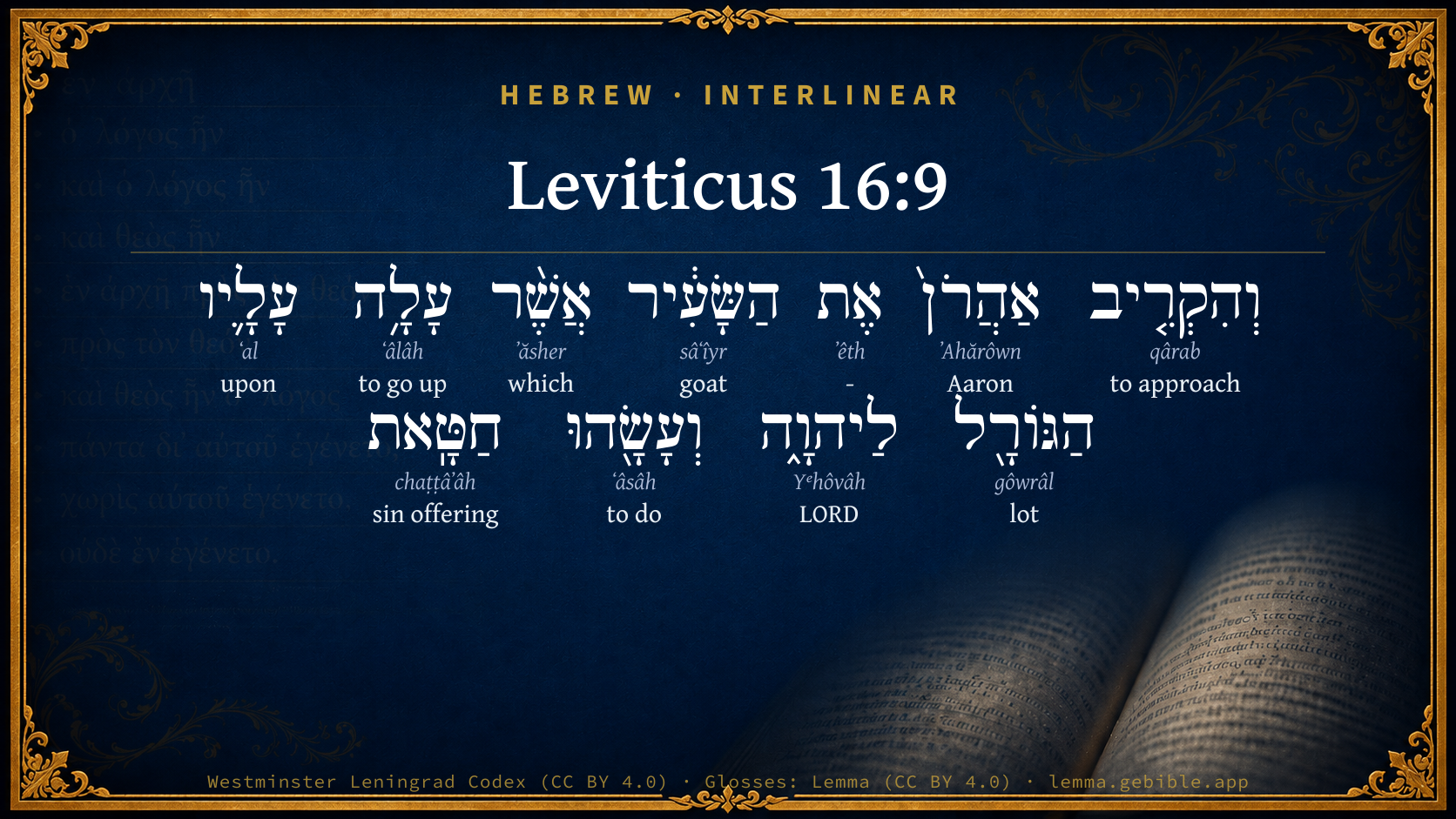
  1. וְהִקְרִ֤יב qârab H7126 “and · to approach” Conjunction + Verb, Hiphil, Sequential Perfect, 3rd Person, Masculine, Singular
  2. אַהֲרֹן֙ ʼAhărôwn H175 “Aaron” Noun, Proper
  3. אֶת ʼêth H853 “-” Particle, Direct Object
  4. אֲשֶׁ֨ר ʼăsher H834 “which” Particle, Relative
  5. עָלָ֥ה ʻâlâh H5927 “to go up” Verb, Qal, Perfect, 3rd Person, Masculine, Singular
  6. עָלָ֛יו ʻal H5921 “upon · him” Preposition + Suffix, Personal, 3rd Person, Masculine, Singular
  7. הַגּוֹרָ֖ל gôwrâl H1486 “the · lot” Particle, Definite Article + Noun, Common, Masculine, Singular, Absolute
  8. לַיהוָ֑ה Yᵉhôvâh H3068 “to/for · LORD” Preposition + Noun, Proper
  9. וְעָשָׂ֖הוּ ʻâsâh H6213 “and · to do · him” Conjunction + Verb, Qal, Sequential Perfect, 3rd Person, Masculine, Singular + Suffix, Personal, 3rd Person, Masculine, Singular
  10. חַטָּֽאת chaṭṭâʼâh H2403 “sin offering” Noun, Common, Feminine, Singular, Absolute

About this verse

These counts appear in no published source. They are computed here, from the morphology-tagged text and Lemma’s own curated glosses. What Lemma adds →

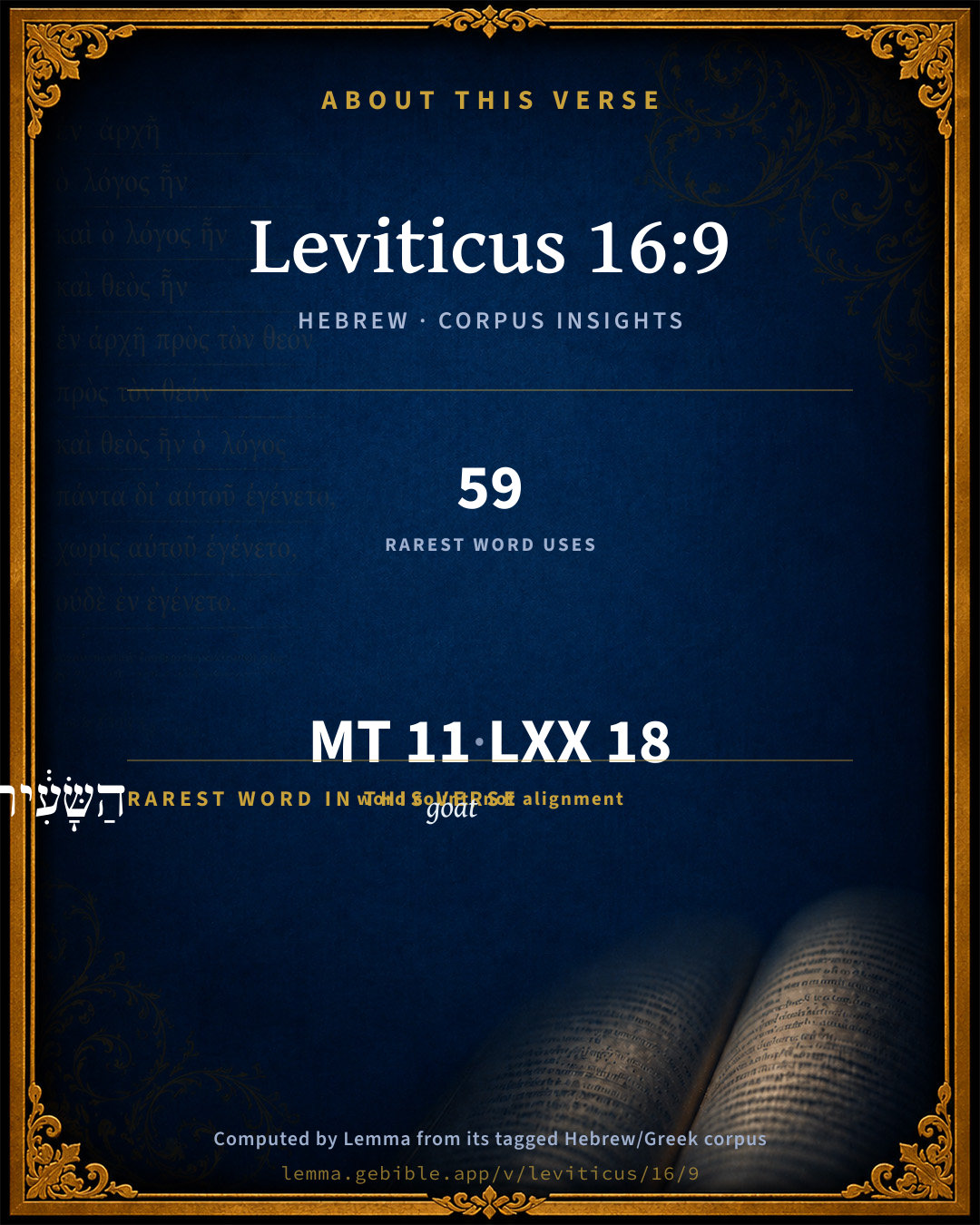
11
words
11
distinct lemmas
Pentateuch
section

Shared distinctive vocabulary

הַשָּׂעִ֔יר goat H8163 occurs in 57 verses of the Hebrew Bible. Also found in:

Grammatical profile

  • 3 verbs
  • 5 nouns
  • 1 preposition
  • 2 particles

Verb forms

  • וְהִקְרִ֤יב Hiphil · Sequential Perfect
  • עָלָ֥ה Qal · Perfect
  • וְעָשָׂ֖הוּ Qal · Sequential Perfect

Hebrew & Septuagint length

In English translation the verse runs 19 words from the Hebrew and 22 from the Septuagint (LXX English) — closely comparable.

A rough comparison of the two English renderings, which tokenize alike — not a word-level alignment.

Word counts can differ between the Hebrew and the Greek without any difference in meaning — e.g. the Hebrew direct-object marker אֵת has no separate Greek word, and Greek often adds the article ὁ.

In the original languages it is 11 Hebrew tokens and 18 Greek tokens — but the two are counted differently (Hebrew bundles its prefixes and suffixes into one token; the Greek is in lemma form), so that isn’t a like-for-like length.

Cross-references

2

Topical passages linked to Leviticus 16:9 in the Treasury of Scripture Knowledge — connected by theme and wording, ordered by reader-vote popularity; previews shown in the World English Bible.

  • Acts 2:23 him, being delivered up by the determined counsel and foreknowledge of God, you have taken by the hand of lawless men, crucified and killed;
  • Acts 4:27–28 For truly, in this city against your holy servant, Jesus, whom you anointed, both Herod and Pontius Pilate, with the Gentiles and the people of Israel, were gathered together

Cross-references courtesy of OpenBible.info (CC BY 4.0).

Hebrew and Greek witnesses Masoretic Hebrew ↔ Greek Septuagint

The same verse in the two great witnesses to the Old Testament, shown verse-for-verse.

These are two independent witnesses, not word-aligned to each other, and the Septuagint is shown in lemma (dictionary) form.

Hebrew Leviticus 16:9 Masoretic · Westminster Leningrad Codex

וְהִקְרִ֤יב אַהֲרֹן֙ אֶת הַשָּׂעִ֔יר אֲשֶׁ֨ר עָלָ֥ה עָלָ֛יו הַגּוֹרָ֖ל לַיהוָ֑ה וְעָשָׂ֖הוּ חַטָּֽאת

Aaron shall present the goat on which the lot fell for Yahweh, and offer him for a sin offering.

World English Bible · Public Domain

Greek LXX Leviticus 16:9 Septuagint · lemma form

καί προςἄγω ἀαρών ὁ χίμαρος ἐπί ὅς ἐπιἔρχομαι ἐπί αὐτός ὁ κλῆρος ὁ κύριος καί προςφέρω περί ἁμαρτία

And Aaron shall bring forward the goat on which the lot for the Lord fell, and shall offer him for a sin-offering.

LXX2012 (modern English Septuagint) · Public Domain

Hebrew: Westminster Leningrad Codex (CC BY 4.0). Greek: Septuagint (public domain); English from LXX2012 (modern English Septuagint) (Public Domain). How the Septuagint differs from the Hebrew →

Targum (Aramaic paraphrase)

2

The Targum is the ancient Jewish Aramaic paraphrase of the Hebrew Scriptures — an interpretive translation, not the Hebrew text itself. Onkelos (literal) and Pseudo-Jonathan (expansive) render the Torah, and Jonathan the Prophets. Coverage is partial: where no permissively-licensed English translation exists for a verse, only the Aramaic is shown. This is verse-level text, not a word-by-word alignment to the Hebrew.

  1. Targum Onkelos Torah (Genesis–Deuteronomy)
    וִיקָרֵב אַהֲרֹן יָת צְפִירָא דִי סְלִיק עֲלוֹהִי עַדְבָא לִשְׁמָא דַיְיָ וְיַעְבְּדִנֵהּ חַטָאתָא

    (no public-domain English translation for this verse)

    Targum Onkelos — Aramaic: “Onkelos Genesis” (public domain); “Onkelos Exodus” (public domain); “Onkelos Leviticus” (public domain); “Onkelos Numbers” (public domain); “Onkelos Deuteronomy” (public domain). English: “Sefaria Community Translation” (CC0 1.0 (public-domain dedication)); “J.W. Etheridge. The Targums of Onkelos and Jonathan Ben Uzziel on the Pentateuch. London: Longmans, Green, 1862” (public domain). Text via Sefaria.

  2. Targum Pseudo-Jonathan Torah (Genesis–Deuteronomy)
    וִיקָרֵיב אַהֲרן יַת צְפִירָא דְסָלֵק עֲלוֹי עַדְבָא לִשְׁמָא דַיְיָ וְיַעַבְדִינֵיהּ קָרְבַּן חַטָאתָא

    And Aharon shall bring the goat upon which came up the lot for the Name of the Lord, and make him a sin offering.

    Targum Pseudo-Jonathan — Aramaic: “Targum Jonathan on Genesis” (public domain); “Targum Jonathan on Exodus” (public domain); “Targum Jonathan on Leviticus” (public domain); “Targum Jonathan on Numbers” (public domain); “Targum Jonathan on Deuteronomy” (public domain). English: “The Targum of Jonathan ben Uzziel, trans. J. W. Etheridge, London, 1862” (public domain). Text via Sefaria.

Commentary

Notes on Leviticus 16:9 from classic Christian and Jewish commentators (each source and its license shown beneath its notes). The classic Christian expositions comment on the surrounding passage and are grouped to its opening verse, so a note may address several verses; the Jewish commentaries on the Tanakh (Rashi and others) are per-verse, so they appear only where the commentator wrote on this verse.

Lemma curates 59 commentaries, every one of them public domain or Creative Commons licensed, each selected and text-cleaned for this edition rather than reprinted as found. About our sources →

Trapp's Complete Commentary

John Trapp

Lev 16:9 And Aaron shall bring the goat upon which the LORD’S lot fell, and offer him [for] a sin offering.

Ver. 9. The goat.] A type of Christ’s mortal humanity, say some, as the scape goat of his immortal deity: or the one of his death, the other of his resurrection. Others are of the opinion that hereby was signified that the deity of Christ dwelling in light inaccessible gave to his humanity sufficient strength for the enduring of those things, which no other creature could have come near, for the full expiating of our sins. So he telleth the Jews first, and afterwards his disciples, "Whither I go ye cannot come." {Joh 8:22; Joh 13:36}

John Trapp, A Commentary or Exposition upon All the Books of the Old and New Testament (1647–1656) — public domain. Text from a community e-Sword module.

Ellicott's Commentary for English Readers

(9) The goat upon which the Lord’s lot fell.—Immediately after the lots decided the destiny of the two goats they were distinguished from each other by peculiar marks. The one which was “for Jehovah had a red woollen thread tied around its neck, whilst the one “for Azazel” had the scarlet thread tied on the head or on the horns.

And offer him for a sin offering.—Better, and shall present, or appoint it for a sin offering (see Lev_16:6), as the actual offering of it up took place afterwards. (See Lev_16:15.)

A Bible Commentary for English Readers, edited by Charles John Ellicott (1878–1897) — public domain. Text from a community e-Sword module.

John Gill's Exposition

And Aaron shall bring the goat on which the Lord's lot fell,.... Alluding to the manner of taking out the lot by the high priest, who, when he took it out, lifted it up with his hand, and then let it down, and put it on the head of the goat; after which he brought it to the altar to be sacrificed:

and offer him for a sin offering; an offering for the sins of the people, as a type of Christ, who made his soul an offering for sin for his people; but this was not done by Aaron until he had brought and killed the sin offering for himself; after which we read of killing this sin offering for the people, Lev 16:11; wherefore some take this offering here to be no other than a setting apart or devoting the goat for this service.

John Gill's Exposition of the Whole Bible (1746–1763) — public domain (CC PDM 1.0). Text via the HelloAO Bible API.

Matthew Poole's English Annotations

So the lot is said to

fall, Jon 1:7; Act 1:26. Heb. went up, to wit, out of the vessel, into which the lots were put, and out of which they were brought up.

Matthew Poole's English Annotations on the Holy Bible (1683–1685) — public domain. Text from a community e-Sword/MySword module.

Whedon's Commentary on the Bible

Daniel D. Whedon

9. Lot fell — Hebrew, came up out of the urn.

Sin offering — All the sins of Israel, without exception, were atoned for this day by the offering of the two goats on the condition of repentance, even sins not committed inadvertently, and therefore excluded from atonement by sacrifice on other days of the year. See Lev_4:2, note. The man who had sinned “with a high hand” — that is, defiantly, with open contempt of Jehovah and his law — was either suddenly cut off (Num_16:30) before the day of atonement or hardened himself beyond repentance. See chap. iv, including note 3.

Daniel D. Whedon (gen. ed.), Commentary on the Old and New Testaments (1874–1909) — public domain. Text from a community e-Sword module.

The Pulpit Commentary

Vers. 9, 10. These verses might be translated as follows:And Aaron shall bring in the goat upon which the lot for the Lord fell, and shall offer him for a sin offering. But the goat, upon which fell the lot for a remover of sins, shall be presented alive before the Lord, to make an atonement with him, and to send him away for a remover of sins into the wilderness.

We are justified in inserting the words, "of sins," after "a remover," because "the use of the word azal, from which the word rendered by "remover" is derived, is confined in the Hebrew dialect to the single purpose or institution which is here under consideration; so that this particular word must have conveyed to the mind of a Hebrew hearer or reader this notion of a removal of sins, and none other" (Sir W. Martin, "Semitic Languages"). The goat is both presented before the Lord, and subsequently (verse 20) offered to him, the priest laying his hands upon him and making a confession of the sins of the people. After he has thus become the Lord"s, how could he be given up to Satan? The purpose of his being set apart is to make an atonement with him (not for him, as some commentators explain it wrongly). As atonement was made by the blood of the sacrificed goat ceremonially covering sin, so it was also made by the live goat symbolically removing sin. But the atonement in both cases has reference to God. How could an atonement be made by an offering to Satan, unless Satan, not God, was the being whose wrath was to be propitiated, and with whom reconciliation was sought?

The Pulpit Commentary (1880–1919), ed. H.D.M. Spence-Jones & Joseph S. Exell — public domain. Text from a community e-Sword module.

Rashi

Rabbi Shlomo Yitzchaki (Rashi)

ועשהו חטאת means, when putting the lot upon it he names it (i.e. designates its purpose), using the words: "to the Lord as a sin offering״ (Yoma 39a).

Rashi on the Tanakh — English translations: “The Judaica Press complete Tanach with Rashi, translated by A. J. Rosenberg” (CC BY 4.0); “Pentateuch with Rashi's commentary by M. Rosenbaum and A.M. Silbermann, 1929-1934” (public domain); “The Metsudah Tanach series, Lakewood, N.J” (CC BY 4.0); and “The Book of Joshua, Metsudah Publications, 1997” (CC BY 4.0). Text via Sefaria.

Lesson kit

Teaching starters — assembled from the data on this page, not authored interpretation. Every prompt links to the verse data it draws on. Edit before teaching.

Leviticus, in the Pentateuch, opens this verse with 11 words (11 distinct Hebrew lemmas). Its most distinctive word is sâʻîyr (“goat”). A historical commentator’s framing appears above. Read the whole chapter for the surrounding context.

Discussion questions

  1. How does “goat” (sâʻîyr) shape what this verse is saying?
  2. Genesis 27:11 shares the word «goat» with this verse. How do the two illuminate each other?
  3. These translations render this verse differently. What is at stake in choosing one wording over another?
  4. The verb «וְהִקְרִ֤יב» is Hiphil Sequential Perfect. How does its form color the action?
  5. Reading how Trapp's Complete Commentary and Ellicott's Commentary for English Readers read this verse, where do the two commentators agree and where do they part?

Things to notice

Reading settings

Reading text

Shown beneath each verse's original-language words.

Old Testament
Old Testament edition

Read the OT as the Masoretic Hebrew (MT) or the Greek Septuagint (LXX).

English shown for the Greek Septuagint (in the Hebrew ↔ Greek comparison).

Comparing translations? Open the Compare panel on any verse page to stack up to four side by side.