
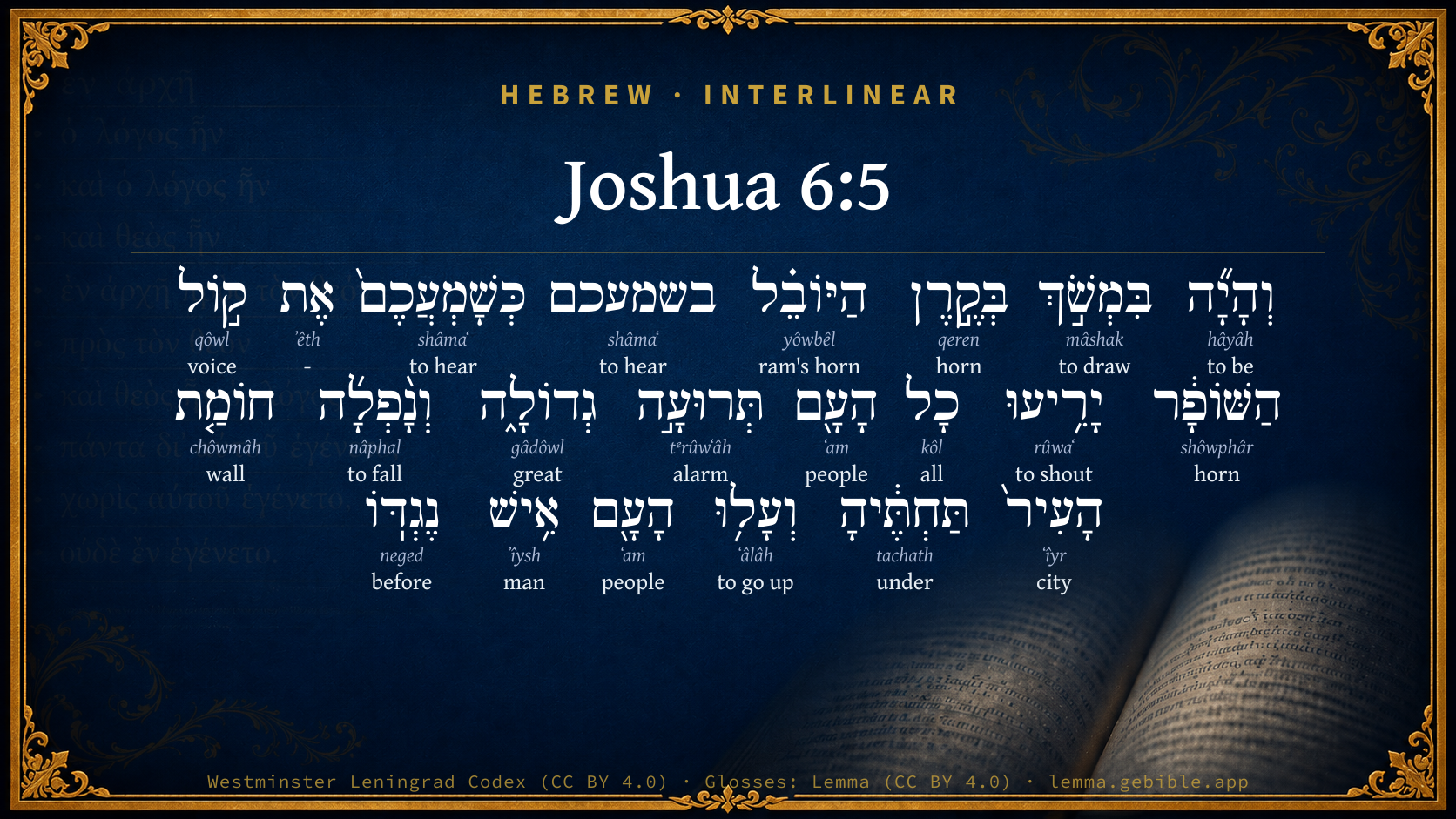
Joshua 6:5

Hebrew (Westminster Leningrad Codex) Joshua 6:5 appears in the Hebrew Old Testament. The text above is from the Westminster Leningrad Codex. Each word links to its Strong’s number, a concise gloss, and parsing drawn from the Open Scriptures Hebrew Bible morphology. Click any word for its full Brown-Driver-Briggs (BDB) entry.
Download image
Cite this verse

Joshua 6:5 (World English Bible). Public Domain. Lemma interlinear Bible study tool, https://lemma.gebible.app/v/joshua/6/5.

Show BibTeX & RIS
BibTeX
RIS
English Translation
It shall be that when they make a long blast with the ram's horn, and when you hear the sound of the trumpet, all the people shall shout with a great shout; and the wall of the city shall fall down flat, and the people shall go up every man straight before him.
World English Bible · Public Domain
Download a study sheet

One document with this verse’s original text, its word-by-word gloss line, the meaning frame, cross-references with their text, attributed commentary, and full source and license credits — printable, and it pastes into notes with its structure intact.

This verse Autodidact and up

Study sheet (.html) Plain text (.txt)

A passage Seminary Student

Up to 50 verses in one chapter. A passage sheet keeps up to 6 commentary sources and 12 cross-references per verse, in the order this page ranks them, and says so on the sheet whenever that leaves anything out. Ask for a single verse and you get the Autodidact verse sheet above.

Everything on this page stays free to read, with no account — the sheet is a download of what is already on screen, not access to it.

Want to remove ads? Support Godless Engineer
Compare translations 3

The same verse in 3 English versions, stacked beneath the original-language interlinear above. Click any original word for its lexicon entry.

Each is an independent rendering of the whole verse — the interlinear is not word-aligned to these translations.

Highlighted words mark where these versions differ — a whole-verse word diff, not a word-by-word alignment.

  • World English Bible Public Domain
    It shall be that when they make a long blast with the ram's horn, and when you hear the sound of the trumpet, all the people shall shout with a great shout; and the wall of the city shall fall down flat, and the people shall go up every man straight before him.
  • King James Version Public Domain
    And it shall come to pass, that when they make a long blast with the ram's horn, and when ye hear the sound of the trumpet, all the people shall shout with a great shout; and the wall of the city shall fall down flat, and the people shall ascend up every man straight before him.
  • unfoldingWord Literal Text CC BY-SA 4.0
    And it will happen, when they make a long blast with the horn of the ram, as soon as you hear the sound of the shofar, all of the people shall shout a great shout. And the wall of the city will fall under itself and the people shall go up, a man in front of him.”

unfoldingWord Literal Text — © unfoldingWord, licensed CC BY-SA 4.0. Word-aligned USFM3 via Door43 (git.door43.org/unfoldingWord/en_ult).

Versions to compare (up to 4)

3 of 4 selected

Show all 18 translations

Every available English version of this verse, each an independent rendering of the whole verse.

  • World English Bible Public Domain
    It shall be that when they make a long blast with the ram's horn, and when you hear the sound of the trumpet, all the people shall shout with a great shout; and the wall of the city shall fall down flat, and the people shall go up every man straight before him.
  • Berean Standard Bible Public Domain
    And when there is a long blast of the ram’s horn and you hear its sound, have all the people give a mighty shout. Then the wall of the city will collapse and all your people will charge straight into the city.”
  • Majority Standard Bible Public Domain
    And when there is a long blast of the ram’s horn and you hear its sound, have all the people give a mighty shout. Then the wall of the city will collapse and all your people will charge straight into the city.”
  • King James Version Public Domain
    And it shall come to pass, that when they make a long blast with the ram's horn, and when ye hear the sound of the trumpet, all the people shall shout with a great shout; and the wall of the city shall fall down flat, and the people shall ascend up every man straight before him.
  • American Standard Version (1901) Public Domain
    And it shall be, that, when they make a long blast with the ram's horn, and when ye hear the sound of the trumpet, all the people shall shout with a great shout; and the wall of the city shall fall down flat, and the people shall go up every man straight before him.
  • Revised Version (1885) Public Domain
    And it shall be, that when they make a long blast with the ram’s horn, and when ye hear the sound of the trumpet, all the people shall shout with a great shout; and the wall of the city shall fall down flat, and the people shall go up every man straight before him.
  • Geneva Bible (1599) Public Domain
    And when they make a long blast with the rams horne, and ye heare the sound of the trumpet, al the people shall shoute with a great shoute: then shall the wall of the citie fall downe flat, and the people shall ascend vp, euery man streight before him.
  • Douay-Rheims (1899) Public Domain
    And when the voice of the trumpet shall give a longer and broken tune, and shall sound in your ears, all the people shall shout together with a very great shout, and the walls of the city shall fall to the ground, and they shall enter in every one at the place against which they shall stand.
  • Young's Literal Translation Public Domain
    and it hath been, in the prolongation of the horn of the jubilee, in your hearing the voice of the trumpet, all the people shout -- a great shout, and the wall of the city hath fallen under it, and the people have gone up, each over-against him.'
  • Literal Standard Version CC BY-SA 4.0
    and it has been, in the prolonging of the horn of the ram, in your hearing the voice of the horn, all the people shout [with] a great shout, and the wall of the city has fallen under it, and the people have gone up, each straight before him.”
  • Unlocked Literal Bible CC BY-SA 4.0
    Then they must sound a long blast with the ram's horn, and when you hear the sound of the trumpet all the people must shout with a great shout, and the wall of the city will fall down flat. The soldiers must attack, each one going straight ahead.”
  • unfoldingWord Literal Text CC BY-SA 4.0
    And it will happen, when they make a long blast with the horn of the ram, as soon as you hear the sound of the shofar, all of the people shall shout a great shout. And the wall of the city will fall under itself and the people shall go up, a man in front of him.”
  • Darby Bible Public Domain
    And it shall come to pass when they make a long blast with the blast-horn, that all the people on hearing the sound of the trumpet shall shout with a great shout; and the wall of the city shall fall flat, and the people shall go up, each one straight before him.
  • World Messianic Bible Public Domain
    It shall be that when they make a long blast with the ram’s horn, and when you hear the sound of the shofar, all the people shall shout with a great shout; then the city wall will fall down flat, and the people shall go up, every man straight in front of him.”
  • Webster's Bible Public Domain
    And it shall come to pass, that when they make a long blast with the ram's horn, and when ye hear the sound of the trumpet, all the people shall shout with a great shout: and the wall of the city shall fall down flat, and the people shall ascend every man straight before him.
  • Free Bible Version CC BY-SA 4.0
    When you hear a long blast on the rams' horns, everyone shall give a really loud shout. The city walls will collapse, and every man can go right in.”
  • Bible in Basic English Public Domain
    And at the sound of a long note on the horns, let all the people give a loud cry; and the wall of the town will come down flat, and all the people are to go straight forward.
  • JPS Tanakh (1917) Public Domain
    And it shall be, that when they make a long blast with the ram's horn, and when ye hear the sound of the horn, all the people shall shout with a great shout; and the wall of the city shall fall down flat, and the people shall go up every man straight before him.'

Literal Standard Version (2020), Covenant Press — licensed CC BY-SA 4.0. Text via the HelloAO Bible API (eBible.org). Unlocked Literal Bible (unfoldingWord) — licensed CC BY-SA 4.0. Text via the HelloAO Bible API (eBible.org). unfoldingWord Literal Text — © unfoldingWord, licensed CC BY-SA 4.0. Word-aligned USFM3 via Door43 (git.door43.org/unfoldingWord/en_ult). Free Bible Version, Dr. Jonathan Gallagher — licensed CC BY-SA 4.0. Text via the HelloAO Bible API (eBible.org).

Word by word

More ways to search: Search by grammar → Find every occurrence → Compare this word →

Practice this passage: Drill this verse → Learn its vocabulary →

הַיּוֹבֵ֗ל
yôwbêl
H3104
“the · ram's horn”
Particle, Definite Article + Noun, Common, Masculine, Singular, Absolute
Part of Speech
Particle + Noun
Type
Common
Gender
Masculine
Number
Singular
State
Absolute
Full BDB Definition

Origin: apparently from H2986

TWOT: 835e

ram, ram's horn, trumpet, cornet - ram (only in combination) - ram's horn, trumpet - jubilee year (marked by the blowing of cornets) (metonymy)
  1. וְהָיָ֞ה hâyâh H1961 “and · to be” Conjunction + Verb, Qal, Sequential Perfect, 3rd Person, Masculine, Singular
  2. בִּמְשֹׁ֣ךְ mâshak H4900 “in/at · to draw” Preposition + Verb, Qal, Infinitive Construct
  3. בְּקֶ֣רֶן qeren H7161 “in/at · horn of” Preposition + Noun, Common, Both, Singular, Construct
  4. בשמעכם shâmaʻ H8085 “in/at · to hear · you” Preposition + Verb, Qal, Infinitive Construct + Suffix, Personal, 2nd Person, Masculine, Plural
  5. כְּשָׁמְעֲכֶם֙ shâmaʻ H8085 “like/as · to hear · you” Preposition + Verb, Qal, Infinitive Construct + Suffix, Personal, 2nd Person, Masculine, Plural
  6. אֶת ʼêth H853 “-” Particle, Direct Object
  7. ק֣וֹל qôwl H6963 “voice of” Noun, Common, Masculine, Singular, Construct
  8. הַשּׁוֹפָ֔ר shôwphâr H7782 “the · horn” Particle, Definite Article + Noun, Common, Masculine, Singular, Absolute
  9. יָרִ֥יעוּ rûwaʻ H7321 “to shout” Verb, Hiphil, Imperfect, 3rd Person, Masculine, Plural
  10. כָל kôl H3605 “all of” Noun, Common, Masculine, Singular, Construct
  11. הָעָ֖ם ʻam H5971 “the · people” Particle, Definite Article + Noun, Common, Masculine, Singular, Absolute
  12. תְּרוּעָ֣ה tᵉrûwʻâh H8643 “alarm” Noun, Common, Feminine, Singular, Absolute
  13. גְדוֹלָ֑ה gâdôwl H1419 “great” Adjective, Adjective, Feminine, Singular, Absolute
  14. וְנָ֨פְלָ֜ה nâphal H5307 “and · to fall” Conjunction + Verb, Qal, Sequential Perfect, 3rd Person, Feminine, Singular
  15. חוֹמַ֤ת chôwmâh H2346 “wall of” Noun, Common, Feminine, Singular, Construct
  16. הָעִיר֙ ʻîyr H5892 “the · city” Particle, Definite Article + Noun, Common, Feminine, Singular, Absolute
  17. תַּחְתֶּ֔יהָ tachath H8478 “under · her” Preposition + Suffix, Personal, 3rd Person, Feminine, Singular
  18. וְעָל֥וּ ʻâlâh H5927 “and · to go up” Conjunction + Verb, Qal, Sequential Perfect, 3rd Person, Common, Plural
  19. הָעָ֖ם ʻam H5971 “the · people” Particle, Definite Article + Noun, Common, Masculine, Singular, Absolute
  20. אִ֥ישׁ ʼîysh H376 “man” Noun, Common, Masculine, Singular, Absolute
  21. נֶגְדּֽוֹ neged H5048 “before · him” Preposition + Suffix, Personal, 3rd Person, Masculine, Singular

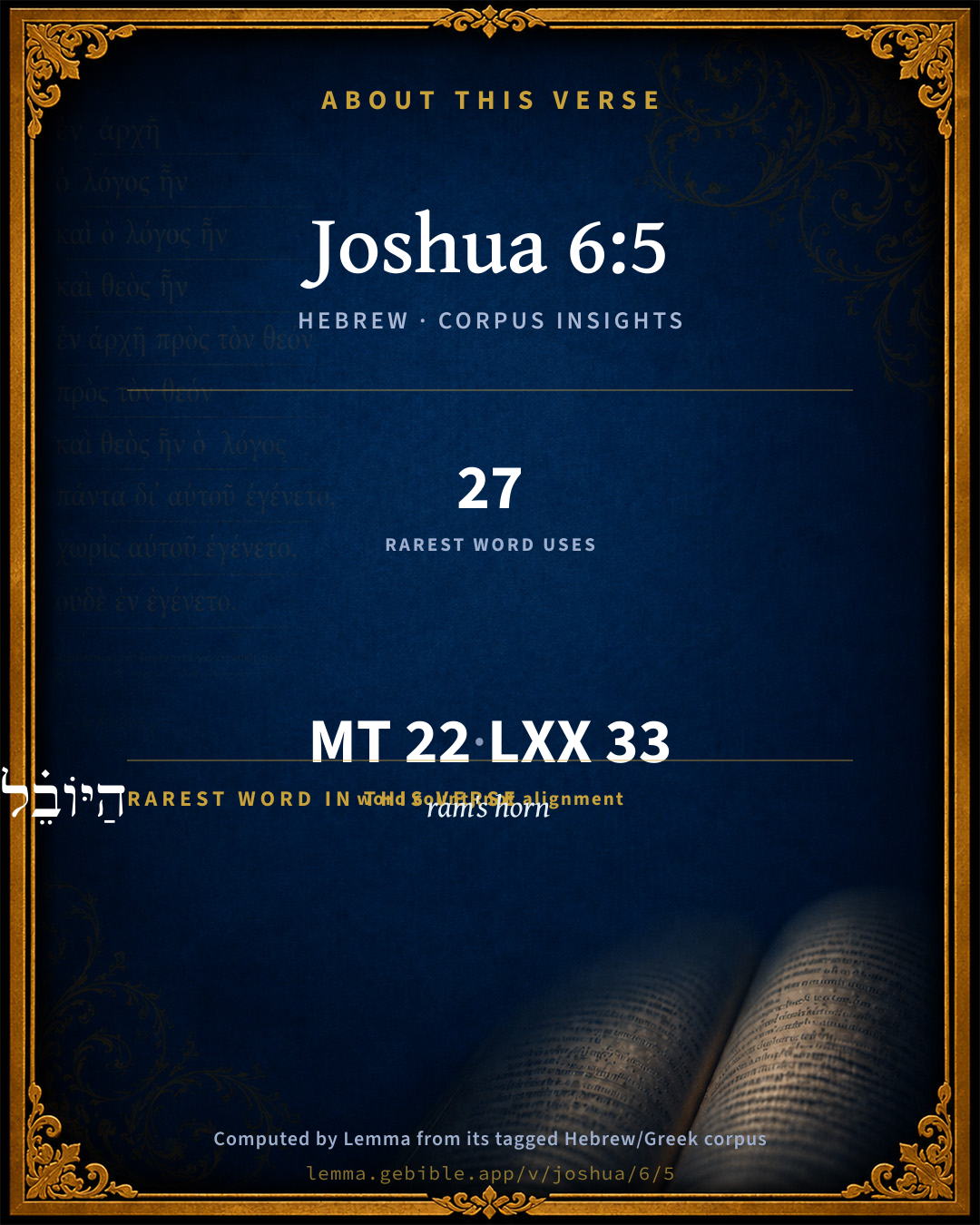
About this verse

These counts appear in no published source. They are computed here, from the morphology-tagged text and Lemma’s own curated glosses. What Lemma adds →

22
words
20
distinct lemmas
Historical
section

Shared distinctive vocabulary

הַיּוֹבֵ֗ל ram's horn H3104 occurs in 25 verses of the Hebrew Bible. Also found in:

Grammatical profile

  • 7 verbs
  • 11 nouns
  • 1 adjective
  • 2 prepositions
  • 1 particle

Verb forms

  • וְהָיָ֞ה Qal · Sequential Perfect
  • בִּמְשֹׁ֣ךְ Qal · Infinitive Construct
  • בשמעכם Qal · Infinitive Construct
  • כְּשָׁמְעֲכֶם֙ Qal · Infinitive Construct
  • יָרִ֥יעוּ Hiphil · Imperfect
  • וְנָ֨פְלָ֜ה Qal · Sequential Perfect
  • וְעָל֥וּ Qal · Sequential Perfect

Repetition

Words recur within this verse — often emphatic in Hebrew:

  • בשמעכם to hear H8085 ×2
  • הָעָ֖ם people H5971 ×2

Hebrew & Septuagint length

In English translation the verse runs 53 words from the Hebrew and 27 from the Septuagint (LXX English) — the Septuagint runs noticeably shorter here. See the side-by-side →

A rough comparison of the two English renderings, which tokenize alike — not a word-level alignment.

Word counts can differ between the Hebrew and the Greek without any difference in meaning — e.g. the Hebrew direct-object marker אֵת has no separate Greek word, and Greek often adds the article ὁ.

In the original languages it is 22 Hebrew tokens and 33 Greek tokens — but the two are counted differently (Hebrew bundles its prefixes and suffixes into one token; the Greek is in lemma form), so that isn’t a like-for-like length.

Cross-references

14

Topical passages linked to Joshua 6:5 in the Treasury of Scripture Knowledge — connected by theme and wording, ordered by reader-vote popularity; previews shown in the World English Bible.

  • 2 Corinthians 10:4–5 for the weapons of our warfare are not of the flesh, but mighty before God to the throwing down of strongholds,
  • Hebrews 11:30 By faith, the walls of Jericho fell down, after they had been encircled for seven days.
  • Exodus 19:19 When the sound of the trumpet grew louder and louder, Moses spoke, and God answered him by a voice.
  • Joshua 6:16 It happened at the seventh time, when the priests blew the trumpets, Joshua said to the people, Shout; for Yahweh has given you the city.
  • 1 Samuel 4:5 When the ark of the covenant of Yahweh came into the camp, all Israel shouted with a great shout, so that the earth rang again.
  • 2 Chronicles 13:14–15 When Judah looked back, behold, the battle was before and behind them; and they cried to Yahweh, and the priests sounded with the trumpets.
  • Joshua 6:20 So the people shouted, and [the priests] blew the trumpets; and it happened, when the people heard the sound of the trumpet, that the people shouted with a great shout, and the wall fell down flat, so that the people went up into the city, every man straight before him, and they took the city.
  • Judges 7:20–22 The three companies blew the trumpets, and broke the pitchers, and held the torches in their left hands, and the trumpets in their right hands with which to blow; and they cried, The sword of Yahweh and of Gideon.
  • 1 Samuel 17:20 David rose up early in the morning, and left the sheep with a keeper, and took, and went, as Jesse had commanded him; and he came to the place of the wagons, as the host which was going forth to the fight shouted for the battle.
  • 1 Samuel 17:52 The men of Israel and of Judah arose, and shouted, and pursued the Philistines, until you come to Gai, and to the gates of Ekron. The wounded of the Philistines fell down by the way to Shaaraim, even to Gath, and to Ekron.
  • 2 Chronicles 20:21–22 When he had taken counsel with the people, he appointed those who should sing to Yahweh, and give praise in holy array, as they went out before the army, and say, Give thanks to Yahweh; for his loving kindness endures forever.
  • Isaiah 25:12 The high fortress of your walls has he brought down, laid low, and brought to the ground, even to the dust.
  • Isaiah 30:25 There shall be on every lofty mountain, and on every high hill, brooks [and] streams of waters, in the day of the great slaughter, when the towers fall.
  • Jeremiah 50:15 Shout against her round about: she has submitted herself; her bulwarks are fallen, her walls are thrown down; for it is the vengeance of Yahweh: take vengeance on her; as she has done, do to her.

Cross-references courtesy of OpenBible.info (CC BY 4.0).

Hebrew and Greek witnesses Masoretic Hebrew ↔ Greek Septuagint

The same verse in the two great witnesses to the Old Testament, shown verse-for-verse.

Here the Septuagint runs noticeably shorter than the Hebrew — LXX2012 (modern English Septuagint) 27 words vs World English Bible 53. A rough length comparison of the two English translations, not a word-level alignment — read both below.

These are two independent witnesses, not word-aligned to each other, and the Septuagint is shown in lemma (dictionary) form.

Hebrew Joshua 6:5 Masoretic · Westminster Leningrad Codex

וְהָיָ֞ה בִּמְשֹׁ֣ךְ בְּקֶ֣רֶן הַיּוֹבֵ֗ל בשמעכם כְּשָׁמְעֲכֶם֙ אֶת ק֣וֹל הַשּׁוֹפָ֔ר יָרִ֥יעוּ כָל הָעָ֖ם תְּרוּעָ֣ה גְדוֹלָ֑ה וְנָ֨פְלָ֜ה חוֹמַ֤ת הָעִיר֙ תַּחְתֶּ֔יהָ וְעָל֥וּ הָעָ֖ם אִ֥ישׁ נֶגְדּֽוֹ

It shall be that when they make a long blast with the ram's horn, and when you hear the sound of the trumpet, all the people shall shout with a great shout; and the wall of the city shall fall down flat, and the people shall go up every man straight before him.

World English Bible · Public Domain

Greek LXX Joshua 6:5 Septuagint · lemma form

καί εἰμί ὡς ἄν σαλπίζω ὁ σάλπιγξ ἀνακράζω πᾶς ὁ λαός ἅμα καί ἀνακράζω αὐτός πίπτω αὐτόματος ὁ τεῖχος ὁ πόλις καί εἰςἔρχομαι πᾶς ὁ λαός ὁρμάω ἕκαστος κατά πρόσωπον εἰς ὁ πόλις

And when they have shouted, the walls of the city shall fall of themselves; and all the people shall enter, each one rushing direct into the city.

LXX2012 (modern English Septuagint) · Public Domain

Hebrew: Westminster Leningrad Codex (CC BY 4.0). Greek: Septuagint (public domain); English from LXX2012 (modern English Septuagint) (Public Domain). How the Septuagint differs from the Hebrew →

Targum (Aramaic paraphrase)

1

The Targum is the ancient Jewish Aramaic paraphrase of the Hebrew Scriptures — an interpretive translation, not the Hebrew text itself. Onkelos (literal) and Pseudo-Jonathan (expansive) render the Torah, and Jonathan the Prophets. Coverage is partial: where no permissively-licensed English translation exists for a verse, only the Aramaic is shown. This is verse-level text, not a word-by-word alignment to the Hebrew.

  1. Targum Jonathan Prophets (Joshua–Malachi)
    וִיהֵי בְּמֵיגַד בְּקְרַן דִכְרַיָא בְּמִשְׁמַעֲכוֹן יַת קַל שׁוֹפָרָא יְיַבְּבוּן כָּל עַמָא יַבָּבָא רַבָּא וְיִפּוֹל שׁוּרָא דְקַרְתָּא וְיִתְבְּלַע תְּחוֹתָהּ וְיִסְקוּן עַמָא גְבַר לְקִבְלֵיהּ:

    (no public-domain English translation for this verse)

    Targum Jonathan — Aramaic: “Mikraot Gedolot” (public domain). English: “Sefaria Community Translation” (CC0 1.0 (public-domain dedication)); “London "Chaldee Paraphrase," 1871” (public domain). Text via Sefaria.

Commentary

Notes on Joshua 6:5 from classic Christian and Jewish commentators (each source and its license shown beneath its notes). The classic Christian expositions comment on the surrounding passage and are grouped to its opening verse, so a note may address several verses; the Jewish commentaries on the Tanakh (Rashi and others) are per-verse, so they appear only where the commentator wrote on this verse.

Lemma curates 59 commentaries, every one of them public domain or Creative Commons licensed, each selected and text-cleaned for this edition rather than reprinted as found. About our sources →

Trapp's Complete Commentary

John Trapp

Jos 6:5 And it shall come to pass, that when they make a long [blast] with the ram’s horn, [and] when ye hear the sound of the trumpet, all the people shall shout with a great shout; and the wall of the city shall fall down flat, and the people shall ascend up every man straight before him.

Ver. 5. When they make a long blast.] Importing the triumph of their trust, the victory of faith: for it was by faith that these walls fell. {Heb 11:30}

And the wall of the city shall fall down flat.] Corruet subtus se, that is, absorbebitur a terra, saith Vatablus, it shall be swallowed up of the earth.

John Trapp, A Commentary or Exposition upon All the Books of the Old and New Testament (1647–1656) — public domain. Text from a community e-Sword module.

Joseph Benson's Commentary

Jos 6:5. The wall — Not all of it; which was unnecessary, and might have given the people better opportunity of escaping; but only a considerable part of it, where the Israelites might fitly enter: for Rahab’s house was not overthrown, Jos 6:22. Flat — Hebrew, under it. It was not battered down with engines, which would have made part of it fall out of its place, but it fell of its own accord, and therefore in the place it did formerly stand in. God chose this way to try the faith and obedience of the people; whether they would observe a precept which, to human policy, seemed foolish, and believe a promise which seemed impossible to be performed; whether they could patiently bear the reproaches of their enemies, and patiently wait for the salvation of God. Thus, by faith, not by force, the walls of Jericho fell down.

Joseph Benson's Commentary on the Old and New Testaments (1811–1818) — public domain. Text from a community e-Sword module.

Adam Clarke's Commentary

Verse 5. The wall of the city shall fall down flat] Several commentators, both Jews and Christians, have supposed that the ground under the foundation of the walls opened, and the wall sunk into the chasm, so that there remained nothing but plain ground for the Israelites to walk over. Of this the text says nothing: - ונפלה חומת העיר תחתיה venaphelah chomath hair tachteyha, literally translated, is, The wall of the city shall fall down UNDER ITSELF; which appears to mean no more than, The wall shall fall down FROM ITS VERY FOUNDATIONS. And this probably was the case in every part, though large breaches in different places might be amply sufficient to admit the armed men first, after whom the whole host might enter, in order to destroy the city.

Adam Clarke's Commentary on the Bible (1810–1826) — public domain. Text from a community e-Sword/MySword module.

The Cambridge Bible for Schools and Colleges

gen. ed. J. J. S. Perowne

5. every man straight before him] Over the prostrate walls the Israelites were to advance into Jericho, and “each one straight forward,” so that, as far as possible, their order should be preserved. Compare the march of the locusts as described by Joe_2:7, “like men of war they climb a wall, and every one marches on his way.”

The Cambridge Bible for Schools and Colleges (gen. ed. J. J. S. Perowne; Cambridge University Press, 1878–1918) — public domain. Text from a community e-Sword module.

John Gill's Exposition

And it shall come to pass, that when they make a long blast with the ram's horn,.... Continue blowing, and protracting, and drawing out the sound a long time; which they did only on the seventh day; on the other days it was but a short blast they made at a time; so that this being different, it would be a good sign and token to the people to do what they are next directed to:

and when ye hear the sound of the trumpet; drawn out to a great length:

all the people shall shout with a great shout; at once, as when an onset is made in battle, or a victory is obtained:

and the wall of the city shall fall down flat; or "under itself" (a); which Jarchi interprets, in its place; that is, where it stood, and be swallowed up in it: so the Targum,"and it shall be swallowed up under it;''yet so that somewhat of it should be seen, as an attestation and proof of the miracle, as Kimchi; who says,"it means that it should be swallowed up in its place under the earth, and a little of it appear above ground for a memorial of the miracle:"

and the people shall ascend up, every man straight before him; just as they were in the order of procession; for the wall being fallen everywhere, they would have no occasion to make up to one certain place, as when a breach is only made in one place, and the besiegers are obliged to go so many a breast to enter at it; but in this case they might go straight up from whence they were, and enter the city without any obstruction and difficulty.

(a) "sub se", Pagninus, Montanus, Vatablus; "subtus se", Tigurine version; "sabter se", Masius.

John Gill's Exposition of the Whole Bible (1746–1763) — public domain (CC PDM 1.0). Text via the HelloAO Bible API.

Haydock's Catholic Bible Commentary

Tune, with certain modulations, continued for a long time, Numbers x. 5. (Haydock) --- Ground. The Rabbins say they sink in, so that the ruins might not impede the march of the army. Some think only a large breach was made, opposite to the Israelites, as the house of Rahab upon the walls was preserved. (Calmet)

George Leo Haydock (1774–1849), Haydock's Catholic Family Bible and Commentary, 1859 edition — public domain. Excludes Psalms (Douay-Rheims chapter numbering differs from Protestant) and Deuterocanonical books (Catholic canon only).

Matthew Poole's English Annotations

When they make a long blast, as is usual in the close of musical sounds.

The wall of the city; not all of it, which was not only unnecessary, but inconvenient, and might have given the people better opportunity of escaping; but only a considerable part of it, where the Israelites might fitly enter; for Rahab’s house was not overthrown, Jos 6:22.

Flat, Heb. under it, i.e. below the place they stood in; or, in its place: it was not battered down with engines, which would have made part of it fall out of its place; but it fell out without any force, and of its own accord, and therefore in the place it did formerly stand in.

Matthew Poole's English Annotations on the Holy Bible (1683–1685) — public domain. Text from a community e-Sword/MySword module.

Whedon's Commentary on the Bible

Daniel D. Whedon

5. All the people shall shout — This was to take place during the seventh circuit, at a concerted signal. Previous to that signal they were prohibited from uttering a word; the twelve circumambulations were to be in perfect silence, save the sound of the trumpets.

The wall of the city shall fall down flat — Hebrews, shall fall under itself, that is, to its very foundations. The portion of the wall which constituted the rear wall of Rahab’s house must have been spared. See Jos_6:22.

Ascend up every man straight before him — The moving column of men was so long that it completely encircled the city. When the wall fell there was a wall of soldiers surrounding it on every side. The command is that this living wall contract by each man’s marching over the ruins towards the centre of the city. Escape would be impossible.

Daniel D. Whedon (gen. ed.), Commentary on the Old and New Testaments (1874–1909) — public domain. Text from a community e-Sword module.

The Pulpit Commentary

When they make a long blast with the ram"s horn. Literally, as they draw out with the horn of jubilee, i.e., blow a prolonged blast. (of. Exo_19:13) Here the word used is horn of jubilee, but not necessarily of ram"s horn, as our version, any more than the modern horn, though it takes the place of the more primitive instrument made of that material, must itself be a ram"s horn. So Rosenmuller. The word rq in Hebrew is used in different senses, all, however, growing out of the one original sense. Thus it is used for a musical instrument, for rays of light, for the projections extending from the corners of the altar, and in Isa_5:1, for a mountain peak (like the German Schreekhorn, Gabelhorn, Weisshorn). Origen compares the blast of the trumpet at which the walls of Jericho fell, to the sound of the last trumpet, which shall finally destroy the kingdoms of sin. When ye hear. The Keri substitute here, as in many other places, K for B but unnecessarily. The Keri means at the very moment when, the Chethibh simply and less emphatically, "when (see ver. 15). Flat. Literally, underneath it, i.e., the walls were to give way from their very foundations. Every man straight before him. There was no need to surround the city, nor to endeavour to enter it through a "practicable breach." The walls were to give way entirely, and the warriors might advance at once, in the order of battle, and from the place in which they were at the moment when they raised the shout of triumph (Wyriy) for the inhabitants of Jericho alone were evidently no match for them in numbers, (cf. Jos_10:3 Jos_11:1-3) though they might have hoped to hold out some time under the protection of their walls.

The Pulpit Commentary (1880–1919), ed. H.D.M. Spence-Jones & Joseph S. Exell — public domain. Text from a community e-Sword module.

John Wesley's Explanatory Notes

The wall - Not all of it; which was unnecessary, and might have given the people better opportunity of escaping, but only a considerable part of it, where the Israelites might fitly enter: for Rahab's house was not overthrown, ver. 22. Flat - Hebrew. under it, it was not battered down with engines which would have made part of it fall out of its place; but it fell of its own accord, and therefore in the place it did formerly stand in. God chose this way, to try the faith and obedience of the people: whether they would observe a precept, which to human policy seemed foolish, and believe a promise, which seemed impossible to be performed: whether they could patiently bear the reproaches of their enemies, and patiently wait for the salvation of God. Thus by faith, not by force, the walls of Jericho fell down.

John Wesley, Explanatory Notes Upon the Whole Bible (1754–1765) — public domain. Text via the GEBible commentary corpus.

Scofield Reference Notes

C. I. Scofield

And it shall come to pass

The central truth here is that spiritual victories are won by means and upon principles utterly foolish and inadequate in the view of human wisdom. 1Co 1:17-29; 2Co 10:3-5.

The Scofield Reference Bible (1917 edition), notes by C. I. Scofield — public domain. Text from a community e-Sword module.

unfoldingWord translationNotes

Door43 World Missions Community

Connecting Statement:

God continues telling Joshua what the people must do.

they must sound a long blast with the ram's horn ... of the trumpet

The word "they" refers to the seven priests. The "ram's horn" and "trumpet" refer to the trumpets of rams' horns that the priests were blowing in Joshua 6:4.

the wall of the city

"the outer wall of the city" or "the wall surrounding the city"

translationWords

ewe

trumpet

unfoldingWord translationNotes — © Distant Shores Media and the Door43 World Missions Community, licensed CC BY-SA 4.0. Source: git.door43.org/Door43/en_tn.

Rashi

Rabbi Shlomo Yitzchaki (Rashi)

A long blast. When the final blast is sounded, and the blower extends the sound.

In its very place [Lit. under itself] In its place.

Rashi on the Tanakh — English translations: “The Judaica Press complete Tanach with Rashi, translated by A. J. Rosenberg” (CC BY 4.0); “Pentateuch with Rashi's commentary by M. Rosenbaum and A.M. Silbermann, 1929-1934” (public domain); “The Metsudah Tanach series, Lakewood, N.J” (CC BY 4.0); and “The Book of Joshua, Metsudah Publications, 1997” (CC BY 4.0). Text via Sefaria.

Lesson kit

Teaching starters — assembled from the data on this page, not authored interpretation. Every prompt links to the verse data it draws on. Edit before teaching.

Joshua, in the Historical, opens this verse with 22 words (20 distinct Hebrew lemmas). Its most distinctive word is yôwbêl (“ram's horn”). The Greek Septuagint runs shorter here. A historical commentator’s framing appears above. Read the whole chapter for the surrounding context.

Discussion questions

  1. How does “ram's horn” (yôwbêl) shape what this verse is saying?
  2. How does Exodus 19:13, which shares the word «ram's horn», read alongside this verse?
  3. What does the repetition of “to hear” (2× in this one verse) do in this verse?
  4. The Septuagint runs shorter here than the Hebrew. What might account for the difference?
  5. These translations render this verse differently; the difference is in the English rendering, not the original. What questions does that raise?
  6. «וְהָיָ֞ה» is a Qal Sequential Perfect verb. How does that grammatical form shape the action described?
  7. Compare how Trapp's Complete Commentary and Joseph Benson's Commentary read this verse. Where do they agree or differ?

Things to notice

Reading settings

Reading text

Shown beneath each verse's original-language words.

Old Testament
Old Testament edition

Read the OT as the Masoretic Hebrew (MT) or the Greek Septuagint (LXX).

English shown for the Greek Septuagint (in the Hebrew ↔ Greek comparison).

Comparing translations? Open the Compare panel on any verse page to stack up to four side by side.