Numbers 8:2

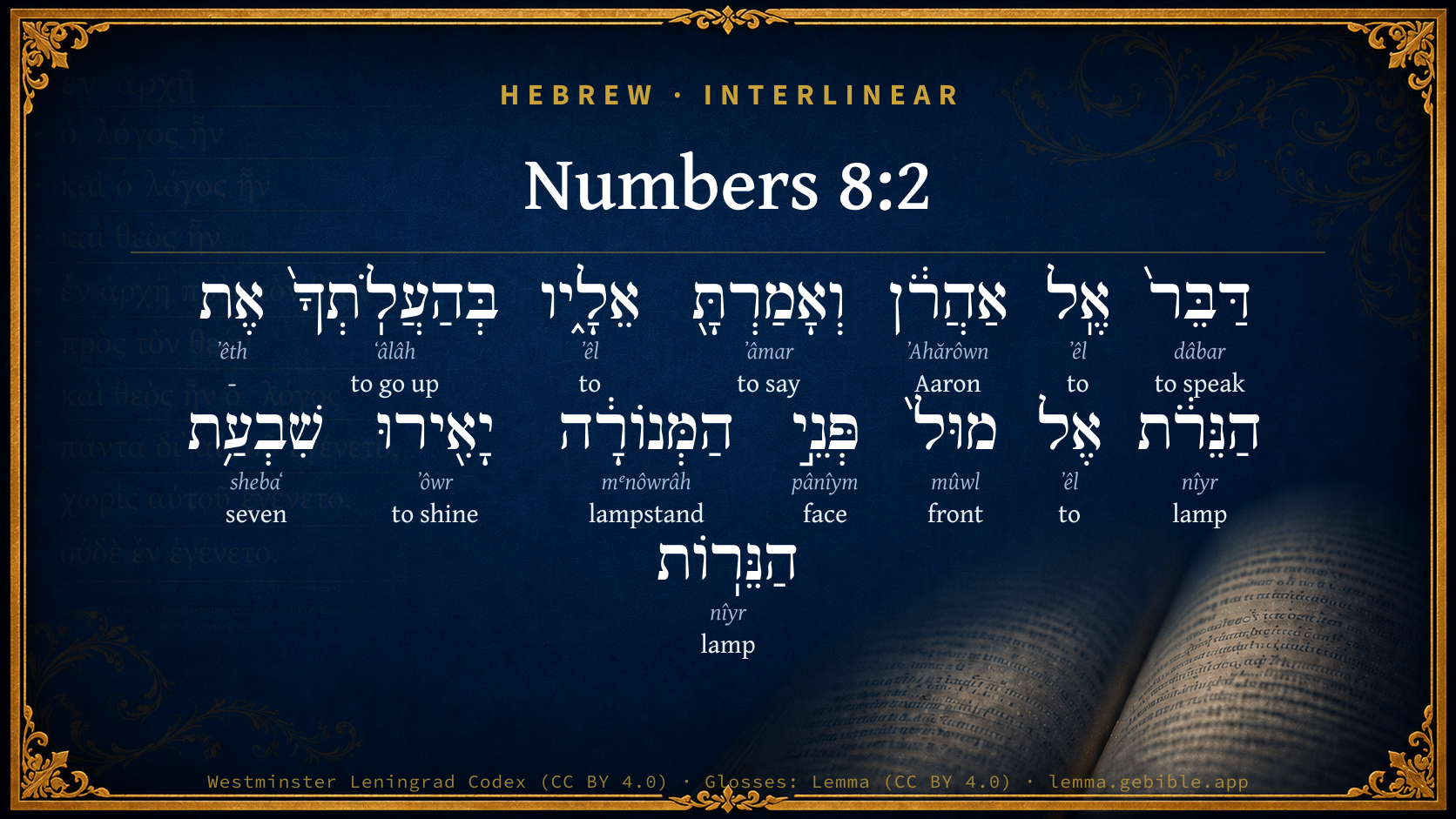
Hebrew (Westminster Leningrad Codex) Numbers 8:2 appears in the Hebrew Old Testament. The text above is from the Westminster Leningrad Codex. Each word links to its Strong’s number, a concise gloss, and parsing drawn from the Open Scriptures Hebrew Bible morphology. Click any word for its full Brown-Driver-Briggs (BDB) entry.
Download image
Cite this verse

Numbers 8:2 (World English Bible). Public Domain. Lemma interlinear Bible study tool, https://lemma.gebible.app/v/numbers/8/2.

Show BibTeX & RIS
BibTeX
RIS
English Translation
"Speak to Aaron, and tell him, 'When you light the lamps, the seven lamps shall give light in front of the lampstand.'"
World English Bible · Public Domain
Download a study sheet

One document with this verse’s original text, its word-by-word gloss line, the meaning frame, cross-references with their text, attributed commentary, and full source and license credits — printable, and it pastes into notes with its structure intact.

This verse Autodidact and up

Study sheet (.html) Plain text (.txt)

A passage Seminary Student

Up to 50 verses in one chapter. A passage sheet keeps up to 6 commentary sources and 12 cross-references per verse, in the order this page ranks them, and says so on the sheet whenever that leaves anything out. Ask for a single verse and you get the Autodidact verse sheet above.

Everything on this page stays free to read, with no account — the sheet is a download of what is already on screen, not access to it.

Want to remove ads? Support Godless Engineer
Compare translations 3

The same verse in 3 English versions, stacked beneath the original-language interlinear above. Click any original word for its lexicon entry.

Each is an independent rendering of the whole verse — the interlinear is not word-aligned to these translations.

Highlighted words mark where these versions differ — a whole-verse word diff, not a word-by-word alignment.

  • World English Bible Public Domain
    "Speak to Aaron, and tell him, 'When you light the lamps, the seven lamps shall give light in front of the lampstand.'"
  • King James Version Public Domain
    Speak unto Aaron and say unto him, When thou lightest the lamps, the seven lamps shall give light over against the candlestick.
  • unfoldingWord Literal Text CC BY-SA 4.0
    “Speak to Aaron and say to him, ‘When you lift up the lamps, the seven lamps shall shine to the front of the face of the lampstand.’”

unfoldingWord Literal Text — © unfoldingWord, licensed CC BY-SA 4.0. Word-aligned USFM3 via Door43 (git.door43.org/unfoldingWord/en_ult).

Versions to compare (up to 4)

3 of 4 selected

Show all 18 translations

Every available English version of this verse, each an independent rendering of the whole verse.

  • World English Bible Public Domain
    "Speak to Aaron, and tell him, 'When you light the lamps, the seven lamps shall give light in front of the lampstand.'"
  • Berean Standard Bible Public Domain
    “Speak to Aaron and tell him: ‘When you set up the seven lamps, they are to light the area in front of the lampstand.’”
  • Majority Standard Bible Public Domain
    “Speak to Aaron and tell him: ‘When you set up the seven lamps, they are to light the area in front of the lampstand.’”
  • King James Version Public Domain
    Speak unto Aaron and say unto him, When thou lightest the lamps, the seven lamps shall give light over against the candlestick.
  • American Standard Version (1901) Public Domain
    Speak unto Aaron, and say unto him, When thou lightest the lamps, the seven lamps shall give light in front of the candlestick.
  • Revised Version (1885) Public Domain
    Speak unto Aaron, and say unto him, When thou lightest the lamps, the seven lamps shall give light in front of the candlestick.
  • Geneva Bible (1599) Public Domain
    Speake vnto Aaron, and say vnto him, When thou lightest the lampes, the seuen lampes shall giue light towarde the forefront of the Candlesticke.
  • Douay-Rheims (1899) Public Domain
    Speak to Aaron, and thou shalt say to him: When thou shalt place the seven lamps, let the candlestick be set up on the south side. Give orders therefore that the lamps look over against the north, towards the table of the leaves of proposition, over against that part shall they give light, towards which the candlestick looketh.
  • Young's Literal Translation Public Domain
    `Speak unto Aaron, and thou hast said unto him, In thy causing the lights to go up, over-against the face of the candlestick do the seven lights give light.'
  • Literal Standard Version CC BY-SA 4.0
    “Speak to Aaron, and you have said to him: In your causing the lights to go up, the seven lights give light toward the front of the face of the lampstand.”
  • Unlocked Literal Bible CC BY-SA 4.0
    “Speak to Aaron. Say to him, 'The seven lamps must give light in front of the lampstand when you light them.'”
  • unfoldingWord Literal Text CC BY-SA 4.0
    “Speak to Aaron and say to him, ‘When you lift up the lamps, the seven lamps shall shine to the front of the face of the lampstand.’”
  • Darby Bible Public Domain
    Speak unto Aaron, and say unto him, When thou lightest the lamps, the seven lamps shall give light over against the candlestick.
  • World Messianic Bible Public Domain
    “Speak to Aaron, and tell him, ‘When you light the lamps, the seven lamps shall give light in front of the lamp stand.’”
  • Webster's Bible Public Domain
    Speak to Aaron, and say to him, When thou lightest the lamps, the seven lamps shall give light over against the candlestick.
  • Free Bible Version CC BY-SA 4.0
    “Tell Aaron, ‘When you place the seven lamps on the lampstand, make sure they shine towards the front.’”
  • Bible in Basic English Public Domain
    Say to Aaron, When you put the lights in their places, the seven lights will give light in front of the support.
  • JPS Tanakh (1917) Public Domain
    'Speak unto Aaron, and say unto him: When thou lightest the lamps, the seven lamps shall give light in front of the candlestick.'

Literal Standard Version (2020), Covenant Press — licensed CC BY-SA 4.0. Text via the HelloAO Bible API (eBible.org). Unlocked Literal Bible (unfoldingWord) — licensed CC BY-SA 4.0. Text via the HelloAO Bible API (eBible.org). unfoldingWord Literal Text — © unfoldingWord, licensed CC BY-SA 4.0. Word-aligned USFM3 via Door43 (git.door43.org/unfoldingWord/en_ult). Free Bible Version, Dr. Jonathan Gallagher — licensed CC BY-SA 4.0. Text via the HelloAO Bible API (eBible.org).

Word by word

More ways to search: Search by grammar → Find every occurrence → Compare this word →

Practice this passage: Drill this verse → Learn its vocabulary →

מוּל֙
mûwl
H4136
“front”
Preposition
Part of Speech
Preposition
Full BDB Definition

Origin: from H4135

TWOT: 1160

front (noun masculine) - front - in the opposite direction - in front of (preposition) - in front of - (with prefix) - towards the front of, to the front of, on the front of - from the front of, off the front of, close in front of, on the forefront of
  1. דַּבֵּר֙ dâbar H1696 “speak” Verb, Piel, Imperative, 2nd Person, Masculine, Singular
  2. אֶֽל ʼêl H413 “to” Preposition
  3. אַהֲרֹ֔ן ʼAhărôwn H175 “Aaron” Noun, Proper
  4. וְאָמַרְתָּ֖ ʼâmar H559 “and · to say” Conjunction + Verb, Qal, Sequential Perfect, 2nd Person, Masculine, Singular
  5. אֵלָ֑יו ʼêl H413 “to · him” Preposition + Suffix, Personal, 3rd Person, Masculine, Singular
  6. בְּהַעֲלֹֽתְךָ֙ ʻâlâh H5927 “in/at · to go up · you” Preposition + Verb, Hiphil, Infinitive Construct + Suffix, Personal, 2nd Person, Masculine, Singular
  7. אֶת ʼêth H853 “-” Particle, Direct Object
  8. הַנֵּרֹ֔ת nîyr H5216 “the · lamps” Particle, Definite Article + Noun, Common, Masculine, Plural, Absolute
  9. אֶל ʼêl H413 “to” Preposition
  10. פְּנֵ֣י pânîym H6440 “face(s) of” Noun, Common, Both, Plural, Construct
  11. הַמְּנוֹרָ֔ה mᵉnôwrâh H4501 “the · lampstand” Particle, Definite Article + Noun, Common, Feminine, Singular, Absolute
  12. יָאִ֖ירוּ ʼôwr H215 “to shine” Verb, Hiphil, Imperfect, 3rd Person, Masculine, Plural
  13. שִׁבְעַ֥ת shebaʻ H7651 “seven” Adjective, Cardinal number, Masculine, Singular, Construct
  14. הַנֵּרֽוֹת nîyr H5216 “the · lamps” Particle, Definite Article + Noun, Common, Masculine, Plural, Absolute

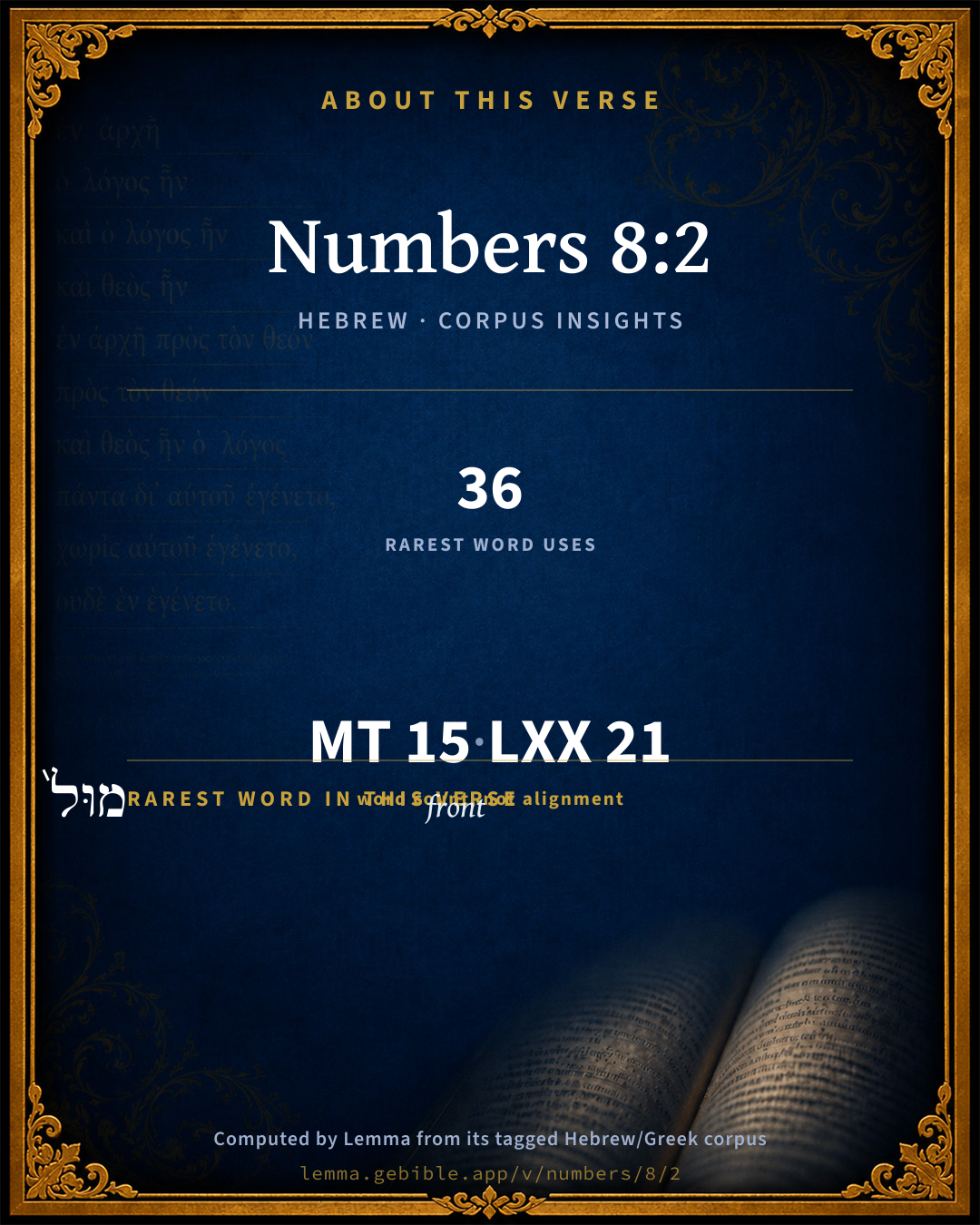
About this verse

These counts appear in no published source. They are computed here, from the morphology-tagged text and Lemma’s own curated glosses. What Lemma adds →

15
words
12
distinct lemmas
Pentateuch
section

Shared distinctive vocabulary

מוּל֙ front H4136 occurs in 34 verses of the Hebrew Bible. Also found in:

Grammatical profile

  • 4 verbs
  • 5 nouns
  • 1 adjective
  • 4 prepositions
  • 1 particle

Verb forms

  • דַּבֵּר֙ Piel · Imperative
  • וְאָמַרְתָּ֖ Qal · Sequential Perfect
  • בְּהַעֲלֹֽתְךָ֙ Hiphil · Infinitive Construct
  • יָאִ֖ירוּ Hiphil · Imperfect

Repetition

Words recur within this verse — often emphatic in Hebrew:

  • הַנֵּרֹ֔ת lamp H5216 ×2
  • אֶֽל to H413 ×3

Hebrew & Septuagint length

In English translation the verse runs 22 words from the Hebrew and 26 from the Septuagint (LXX English) — closely comparable.

A rough comparison of the two English renderings, which tokenize alike — not a word-level alignment.

Word counts can differ between the Hebrew and the Greek without any difference in meaning — e.g. the Hebrew direct-object marker אֵת has no separate Greek word, and Greek often adds the article ὁ.

In the original languages it is 15 Hebrew tokens and 21 Greek tokens — but the two are counted differently (Hebrew bundles its prefixes and suffixes into one token; the Greek is in lemma form), so that isn’t a like-for-like length.

Cross-references

15

Topical passages linked to Numbers 8:2 in the Treasury of Scripture Knowledge — connected by theme and wording, ordered by reader-vote popularity; previews shown in the World English Bible.

  • Exodus 25:37 You shall make its lamps seven, and they shall light its lamps to give light to the space in front of it.
  • Exodus 37:18–19 There were six branches going out of its sides: three branches of the lampstand out of its one side, and three branches of the lampstand out of its other side:
  • Exodus 37:23 He made its seven lamps, and its snuffers, and its snuff dishes, of pure gold.
  • Exodus 40:25 He lit the lamps before Yahweh, as Yahweh commanded Moses.
  • Leviticus 24:1–2 Yahweh spoke to Moses, saying,
  • Leviticus 24:4 He shall keep in order the lamps on the pure gold lampstand before Yahweh continually.
  • Psalms 119:105 Your word is a lamp to my feet, And a light for my path.
  • Psalms 119:130 The entrance of your words gives light. It gives understanding to the simple.
  • Matthew 5:14 You are the light of the world. A city located on a hill can't be hidden.
  • John 1:9 The true light that enlightens everyone was coming into the world.
  • 2 Peter 1:19 We have the more sure word of prophecy; whereunto you do well that you take heed, as to a lamp shining in a dark place, until the day dawns, and the day star arises in your hearts:
  • Revelation 1:12 I turned to see the voice that spoke with me. Having turned, I saw seven golden lampstands.
  • Revelation 1:20–2:1 the mystery of the seven stars which you saw in my right hand, and the seven golden lampstands. The seven stars are the angels of the seven assemblies. The seven lampstands are seven assemblies.
  • Revelation 4:5 Out of the throne proceed lightnings, sounds, and thunders. There were seven lamps of fire burning before his throne, which are the seven Spirits of God.
  • Isaiah 8:20 To the law and to the testimony! if they don't speak according to this word, surely there is no morning for them.

Cross-references courtesy of OpenBible.info (CC BY 4.0).

Hebrew and Greek witnesses Masoretic Hebrew ↔ Greek Septuagint

The same verse in the two great witnesses to the Old Testament, shown verse-for-verse.

These are two independent witnesses, not word-aligned to each other, and the Septuagint is shown in lemma (dictionary) form.

Hebrew Numbers 8:2 Masoretic · Westminster Leningrad Codex

דַּבֵּר֙ אֶֽל אַהֲרֹ֔ן וְאָמַרְתָּ֖ אֵלָ֑יו בְּהַעֲלֹֽתְךָ֙ אֶת הַנֵּרֹ֔ת אֶל מוּל֙ פְּנֵ֣י הַמְּנוֹרָ֔ה יָאִ֖ירוּ שִׁבְעַ֥ת הַנֵּרֽוֹת

"Speak to Aaron, and tell him, 'When you light the lamps, the seven lamps shall give light in front of the lampstand.'"

World English Bible · Public Domain

Greek LXX Numbers 8:2 Septuagint · lemma form

λαλέω ὁ ἀαρών καί εἶπον πρός αὐτός ὅταν ἐπιτίθημι ὁ λύχνος ἐκ μέρος κατά πρόσωπον ὁ λυχνία φωτίζω ὁ ἑπτά λύχνος

Speak to Aaron, and you shall say to him, Whenever you shall set the lamps in order, the seven lamps shall give light opposite the candlestick.

LXX2012 (modern English Septuagint) · Public Domain

On this verse, The Pulpit Commentary discusses the Septuagint’s reading. Read the note in Commentary ↓

Hebrew: Westminster Leningrad Codex (CC BY 4.0). Greek: Septuagint (public domain); English from LXX2012 (modern English Septuagint) (Public Domain). How the Septuagint differs from the Hebrew →

Targum (Aramaic paraphrase)

2

The Targum is the ancient Jewish Aramaic paraphrase of the Hebrew Scriptures — an interpretive translation, not the Hebrew text itself. Onkelos (literal) and Pseudo-Jonathan (expansive) render the Torah, and Jonathan the Prophets. Coverage is partial: where no permissively-licensed English translation exists for a verse, only the Aramaic is shown. This is verse-level text, not a word-by-word alignment to the Hebrew.

  1. Targum Onkelos Torah (Genesis–Deuteronomy)
    מַלֵל עִם אַהֲרֹן וְתֵימַר לֵהּ בְּאַדְלָקוּתָךְ יָת בּוֹצִינַיָא לָקֳבֵל אַפֵּי מְנַרְתָּא יְהוֹן מְנַהֲרִין שִׁבְעָא בוֹצִינַיָא

    (no public-domain English translation for this verse)

    Targum Onkelos — Aramaic: “Onkelos Genesis” (public domain); “Onkelos Exodus” (public domain); “Onkelos Leviticus” (public domain); “Onkelos Numbers” (public domain); “Onkelos Deuteronomy” (public domain). English: “Sefaria Community Translation” (CC0 1.0 (public-domain dedication)); “J.W. Etheridge. The Targums of Onkelos and Jonathan Ben Uzziel on the Pentateuch. London: Longmans, Green, 1862” (public domain). Text via Sefaria.

  2. Targum Pseudo-Jonathan Torah (Genesis–Deuteronomy)
    מַלֵיל עִם אַהֲרן וְתֵימַר לֵיהּ בִּזְמַן אַדְלָקוּתָךְ יַת בּוֹצִינַיָא כָּל קֳבֵיל אַפֵּי מְנַרְתָּא יְהוֹן מְנַהֲרִין שִׁבְעָתֵי בּוֹצִינַיָא תְּלַת לִקֳבֵיל רוּחַ מַעַרְבָא וּתְלַת לִקֳבֵל רוּחַ מַדִינְחָא וּשְׁבִיעָא בִּמְצִיעָאָה

    Speak with Aharon, and say to him: At the time when thou dost kindle the lamps upon the candelabrum, (all) the seven lamps shall be alight; three on the western side, and three on the eastern side, and the seventh in the midst.

    Targum Pseudo-Jonathan — Aramaic: “Targum Jonathan on Genesis” (public domain); “Targum Jonathan on Exodus” (public domain); “Targum Jonathan on Leviticus” (public domain); “Targum Jonathan on Numbers” (public domain); “Targum Jonathan on Deuteronomy” (public domain). English: “The Targum of Jonathan ben Uzziel, trans. J. W. Etheridge, London, 1862” (public domain). Text via Sefaria.

Commentary

Notes on Numbers 8:2 from classic Christian and Jewish commentators (each source and its license shown beneath its notes). The classic Christian expositions comment on the surrounding passage and are grouped to its opening verse, so a note may address several verses; the Jewish commentaries on the Tanakh (Rashi and others) are per-verse, so they appear only where the commentator wrote on this verse.

Lemma curates 59 commentaries, every one of them public domain or Creative Commons licensed, each selected and text-cleaned for this edition rather than reprinted as found. About our sources →

Joseph Benson's Commentary

Num 8:2. When thou lightest the lamps — The priests lighted the middle lamp from the fire of the altar, and the rest one from another. Thus, all light and knowledge comes from Christ, who has the seven spirits of God, signified by these seven lamps of fire. Shall give light over against the candlestick — On that part which is before the candlestick. Hebrew, over against the face; or, before the face of the candlestick. That is, in that place toward which the candlestick looked, or where it stood in full view. Or rather, the meaning of the order is, that the whole seven lamps should be lighted, which branched out from all sides of the shaft, called the candlestick, (Exo 25:35,) in order that the sanctuary might be all enlightened, there being no windows in it, so that all the light it had came from the candlestick.

Joseph Benson's Commentary on the Old and New Testaments (1811–1818) — public domain. Text from a community e-Sword module.

Geneva Bible (1599)

Geneva Bible translators

To that part which is over against the Candlestick, Exod. 25:37.

Geneva Bible (1599) marginal notes — public domain. Text via Bolls.life.

Jamieson, Fausset & Brown

Robert Jamieson, A. R. Fausset & David Brown

Speak unto Aaron, &c.--The candlestick, which was made of one solid, massive piece of pure gold, with six lamps supported on as many branches, a seventh in the center surmounting the shaft itself (Exo 25:31; Exo 37:17), and completed according to the pattern shown in the mount, was now to be lighted, when the other things in the sanctuary began to be applied to religious service. It was Aaron's personal duty, as the servant of God, to light His house, which, being without windows, required the aid of lights (Pe2 1:19). And the course he was ordered to follow was first to light the middle lamp from the altar-fire, and then the other lamps from each other--a course symbolical of all the light of heavenly truth being derived from Christ, and diffused by His ministers throughout the world (Rev 4:5).

the seven lamps shall give light over against the candlestick--The candlestick stood close to the boards of the sanctuary, on the south side, in full view of the table of showbread on the north (Exo 26:35), having one set of its lamps turned towards the east, and another towards the west; so that all parts of the tabernacle were thus lighted up.

Jamieson, Fausset & Brown — Commentary Critical and Explanatory on the Whole Bible (1871) — public domain (CC PDM 1.0). Text via the HelloAO Bible API.

Adam Clarke's Commentary

Verse 2. The seven lamps shall give light] The whole seven shall be lighted at one time, that seven may be ever burning.

Adam Clarke's Commentary on the Bible (1810–1826) — public domain. Text from a community e-Sword/MySword module.

Ellicott's Commentary for English Readers

VIII.

(2) When thou lightest the lamps.—Better, When thou settest up the lamps. (Comp. Exo_25:37.) The golden candlestick was placed against the south wall of the Tabernacle, opposite to the table of shewbread, so that its seven branches were parallel to that wall, with its branches east and west, and consequently the seven lamps, one of which rested upon each of the seven branches, threw their light in front of the candlestick, i.e., towards the north wall, by which arrangement the furniture of the holy place was more effectually lighted than it would have been had the candlestick been placed facing the entrance, with its branches north and south.

Over against.—Or, in front of.

A Bible Commentary for English Readers, edited by Charles John Ellicott (1878–1897) — public domain. Text from a community e-Sword module.

The Cambridge Bible for Schools and Colleges

gen. ed. J. J. S. Perowne

2. When thou settest up] So R.V. marg. correctly. The lamps were small bowls of oil with wicks. They stood on the top of the central stem and of the three branching arms or shafts on either side. The verb describes Aaron as reaching up to put them in their place after the wicks have been lighted.

in front of the lampstand] i.e. towards the opposite (north) side, where the table of the Presence-bread stood.

The Cambridge Bible for Schools and Colleges (gen. ed. J. J. S. Perowne; Cambridge University Press, 1878–1918) — public domain. Text from a community e-Sword module.

John Gill's Exposition

Speak unto Aaron, and say unto him,.... It being his work to light the lamps, though, as Ben Gersom observes, it was not incumbent on an high priest alone to do this, for it also belonged to the sons of Aaron, who were common priests, Exo 27:21; though it is probable that as this was the first time of lighting them, it might be done by Aaron himself, his sons attending and assisting him; in which he was an eminent type of Christ, the great High Priest, who lights the lamps in all his golden candlesticks, the churches, Rev 1:20, and from whom they have all their light and all the supplies of it:

when thou lightest the lamps; which was done at evening, Exo 30:8; pointing at the great light set up by Christ, the light of the world, in the evening of it, in the last days:

the seven lamps shall give light over against the candlestick; the Targum of Jonathan is,"at the same time of thy lighting the lamps over against the candlestick, there shall be seven lamps giving light: three on the west side and three on the east side, and the seventh in the middle:''and in the like order Jarchi places them, who observes, that the three eastward looked over against the middlemost, the wicks that were in them; and so the three westward, the tops of the wicks were over against the middlemost: and he also observes, that the middlemost lamp was no other than the body of the candlestick, and so all the rest of the lamps were over against and looked to that; and this is the sense of Maimonides (m), and other Jewish writers; but the truer meaning of the phrase is, that the seven lamps gave light, as they were to do, to that part of the holy place that was opposite to the candlestick, the north part of it, where stood the shewbread table, the candlestick being in the south, Exo 40:22; that the table of the Lord might have light, as it was proper it should; and the priests might see to set on and take off the bread, which otherwise they could not, there being no window in the place; See Gill on Exo 25:37.

(m) Hilchot Beth Hacbehirah, c. 3. sect. 8.

John Gill's Exposition of the Whole Bible (1746–1763) — public domain (CC PDM 1.0). Text via the HelloAO Bible API.

Haydock's Catholic Bible Commentary

Looketh. This candlestick stood on the south side, with one branch extending towards the altar of incense, on the east; and the other to the west, so as to give light to the loaves of proposition, on the north, Exodus xxv. 31. (Calmet) --- It was intended to illumine the holy of holies, where a sort of feast was prepared for God, and where no windows were found. (Menochius) --- Hebrew simply, "When thou lightest the lamps, the seven lamps shall give light over against," upon, or near to "the candlestick." (Haydock) --- The lamps might be separated from the branches and stem of the candlestick. (Du Hamel)

George Leo Haydock (1774–1849), Haydock's Catholic Family Bible and Commentary, 1859 edition — public domain. Excludes Psalms (Douay-Rheims chapter numbering differs from Protestant) and Deuterocanonical books (Catholic canon only).

Matthew Poole's English Annotations

i.e. Either,

1. On every side of the candlestick. So the candlestick is here put for the bulk or shaft of the candlestick, as Exo 25:31,35, and the lamps, when they were lighted, were put into the branches of the candlestick, and take it out upon occasion. Thus the meaning is, that all the lamps were to be lighted on that part which was towards the middle, looking that way whence they had their light; for the middle lamp was lighted with the fire of the altar, and from that the other lamps received light. But against this sense it is objected, that the lamps could not be otherwise ordered, but that they must give light round about the candlestick, and therefore that sense seems to make this direction idle and frivolous. Or,

2. On that part which is before the candlestick, Heb. over against the face of the candlestick, i.e. in that place towards which the candlestick looked, or where the candlestick stood in full view, i.e. upon the north side, where the table of shewbread stood, as appears from hence, because the candlestick stood close to the boards of the sanctuary on the south side, Exo 26:35. And thus the lights were on both sides of the sanctuary, which was fit and necessary, because it was wholly dark in itself, and had no window in it.

Matthew Poole's English Annotations on the Holy Bible (1683–1685) — public domain. Text from a community e-Sword/MySword module.

Whedon's Commentary on the Bible

Daniel D. Whedon

THE LAMPS, Num_8:1-4.

2. The seven lamps shall give light over against the candlestick — R.V., “in front of.” The Hebrew here is very explicit, yet it is difficult to imagine how the lamps on the candlestick are to give light over against its face or front. This face was the front shown by the seven arms, as they formed a straight line. Since the chandelier stood on the south side of the holy place, the face or front would be northward toward the table of show-bread, and not eastward toward the door of the tabernacle, so that more light was cast northward than eastward, inasmuch as a priest entering in would see the lamps all in a line as one light. The south side of the chandelier could not be called the front, because the lamps were not symmetrically constructed, the wick not being in the middle, but at the edge, so that the light was thrown upon one side, illumining this front space more than that behind. Throughout the Scriptures oil is a symbol of the Holy Spirit by which believers are filled with light and life. Zec_4:2-12; Mat_25:1-13; Act_10:38; Heb_1:9; 1Jn_2:20; 1Jn_2:27. The show-bread typifies Christ, the Bread of life. The chandelier pouring its full blaze northward upon the showbread beautifully sets forth the great office of the Spirit in the “holy place” of the sanctified heart. “He shall glorify me; for he shall receive of mine and show it unto you.” Joh_16:14, note.

Daniel D. Whedon (gen. ed.), Commentary on the Old and New Testaments (1874–1909) — public domain. Text from a community e-Sword module.

The Pulpit Commentary

When thou lightest the lamps. The command to light the lamps had been given generally ("they shall light the lamps thereof") in Exo_25:37, and the care of them had been specially confided to Aaron and his sons ("from evening to morning") in Exo_27:21. The actual lighting of the lamps for the first time by Moses is recorded in Exo_40:25. In the face of these passages it is incredible that the lamps had not been regularly lighted by Aaron for more than a month before the offering of the princes. The seven lamps shall give light over against the candlestick. It is somewhat uncertain what this expression, here repeated from Exo_25:37, means. The Targums give no explanation of it; the Septuagint merely renders verbally, kata proswpon thv lucniav fwtiousin ; the Jewish expositors seem to have thought that the light was to be thrown inward towards the central shaft; most modern commentators, with more probability, understand it to mean that the lamps were to be so placed as to throw their light across the tabernacle towards the north side.

The Pulpit Commentary (1880–1919), ed. H.D.M. Spence-Jones & Joseph S. Exell — public domain. Text from a community e-Sword module.

John Wesley's Explanatory Notes

When thou lightest the lamps - The priests lighted the middle lamp from the fire of the altar; and the rest one from another; signifying that all light and knowledge comes from Christ, who has the seven spirits of God, figured by the seven lamps of fire. Over against the candlestick - On that part which is before the candlestick, Hebrew. over against the face of the candlestick - That is, in that place towards which the candlestick looked, or where the candlestick stood in full view, that is, upon the north- side, where the table of shew-bread stood, as appears from hence, because the candlestick stood close to the boards of the sanctuary on the south-side, Exod. xxvi, 35. And thus the lights were on both sides of the sanctuary, which was necessary, because it was dark in itself, and had no window.

John Wesley, Explanatory Notes Upon the Whole Bible (1754–1765) — public domain. Text via the GEBible commentary corpus.

Rashi

Rabbi Shlomo Yitzchaki (Rashi)

בהעלתך WHEN THOU LIGHTEST [THE LAMPS] — Why is the section treating of the candelabrum put in juxtaposition with the section dealing with the offerings of the princes? Because when Aaron saw the dedication offerings of the princes, he felt distressed because neither he nor his tribe was with them in the dedication, whereupon the Holy One, blessed be He, said to him, “By your life! Your part is of greater importance than theirs, for you will kindle and set in order the lamps” (cf. Midrash Tanchuma, Beha'alotcha 5; see also Nachmanides).

בהעלתך lit., WHEN THOU MAKEST [THE LIGHTS] RISE — Because the flame rises upwards (עולה), an expression denoting “ascending” is used of kindling them (the lights), implying that one must kindle them until the light ascends of itself (Shabbat 21a). — Furthermore our Rabbis derived from here (from the expression בהעלתך) that there was a step in front of the candelabrum upon which the priest stood while preparing the lights (Sifrei Bamidbar 59).

אל מול פני המנורה OVER AGAINST THE CANDLESTICK — i.e. over against the central lamp which is not on one of the branches, like the others, but on the body (the central shaft) of the candelabrum itself (cf. Menachot 98b).

יאירו שבעת הנרות SHALL THE SEVEN LAMPS GIVE LIGHT — the seven lamps: this central lamp itself which naturally gave light over against the shaft (the פני המנורה) and the six lamps which were on the six branches, viz., the three on the east side of the central shaft should have their wicks turned towards the central one, and similarly the three on the west should have the ends of their wicks turned towards the central one (cf. Sifrei Bamidbar 59). And why was this? In order that people should not say: He (God) is in need of its (the candlestick’s) light (cf. Midrash Tanchuma, Beha'alotcha 5).

Rashi on the Tanakh — English translations: “The Judaica Press complete Tanach with Rashi, translated by A. J. Rosenberg” (CC BY 4.0); “Pentateuch with Rashi's commentary by M. Rosenbaum and A.M. Silbermann, 1929-1934” (public domain); “The Metsudah Tanach series, Lakewood, N.J” (CC BY 4.0); and “The Book of Joshua, Metsudah Publications, 1997” (CC BY 4.0). Text via Sefaria.

Ramban (Nachmanides)

Rabbi Moshe ben Nachman (Ramban / Nachmanides)

WHEN THOU LIGHTEST THE LAMPS. “Why does the section dealing with the candelabrum follow [the section which tells of] the dedication-offerings of the princes? The reason is that when Aaron saw the dedication-offerings of the princes, he became disheartened because neither he nor his tribe participated with them in the dedication; whereupon the Holy One, blessed be He, said to him: ‘By thy life! Thy contribution is [of] greater [significance] than theirs, for thou wilt kindle and trim the lamps every morning and evening.’” This is Rashi’s language, from a Midrash Agadah. 5. — “Midrash Agadah.” Rabbinic texts on the Five Books of Moses are divided into two classes: “Midrash Halachah” (texts dealing mainly with the legal parts of the Torah), which consist of the Mechilta on the Book of Exodus, Sifra [or Torath Kohanim] on the Book of Leviticus, and Sifre on the Books of Numbers and Deuteronomy. Another set of texts deal mainly with the narrative, ethical and homiletical aspects of the Scriptures. These comprise two major works — the Midrash Rabbah and Tanchuma. There is in addition a large group of smaller Midrashim that belong to this category. The generic term “Midrash Agadah” includes all this second group of texts.But it is not clear to me why G-d consoled Aaron [by reminding him of his function] in lighting the lamps, rather than consoling him with the burning of the incense every morning and evening, which is [the specific function of his] with which Scripture praised him, as it is said, they shall put incense before Thee. Or [G-d could have reminded him of] all the offerings [performed only by his descendants], and the meal-offering of baked cakes [which is brought daily by the High Priest personally], and the Service on the Day of Atonement which is only valid if done by him [i.e., Aaron and subsequent High Priests], and [by the fact that it is] he who enters into the innermost part of the Sanctuary, and he is the holy one of the Eternal, standing in His Temple to minister unto Him, and to bless in His Name, and his entire tribe minister to our G-d! Moreover, what reason was there for Aaron’s uneasiness of mind [upon seeing the offerings of the princes]? Was not his [dedication-] offering greater than that of the [other] princes, for he offered up during those days — all the [seven] days of the initiation [of the priests] — many offerings? And if you reply that [he was disheartened because] his offerings were obligatory and he had been commanded to bring them, and therefore he was dispirited because he did not bring a voluntary offering for the dedication of the altar as they did — [this cannot be so] because the lighting of the lamps with which He consoled Aaron was also a duty which he had been commanded! [Therefore what consolation did Aaron derive for not sharing in the voluntary offerings by being given a commandment which was obligatory?]But the intention of this homiletic text is to derive an allusion from this section [of the Torah] to the Chanukah (“Dedication”) of lights which occurred in the period of the Second Temple through Aaron and his sons, namely [Matithyahu] the Hasmonean, who was High Priest, and his sons. And I have found this explanation in the following text of Megillath Setharim [“the Early Scholars” of the eleventh and twelfth centuries]. It has been lost in the course of time. of Rabbeinu Nissim, who mentions this tradition, saying: “I have seen in the Midrash: When [the princes of] the twelve tribes brought the dedication-offerings and the tribe of Levi did not etc., the Holy One, blessed be He, said to Moses, Speak unto Aaron, and say unto him: When thou lightest the lamps. There is another Dedication in which there will be lighting of the lamps, when I will perform through your sons miracles and salvation for Israel, and a Dedication which will be called by their name, namely, ‘the Chanukah of the sons of the Hasmonean.’ Therefore He put this section [dealing with the lighting of the lamps] next to the section concerning the dedication of the altar.” Thus far is his [Rabbeinu Nissim’s] language.And I have further seen in Yelamdeinu, 5. On the meaning of the term Yelamdeinu, see Vol. II, p. 131, Note 196. and also in the Midrash Rabbah [the following text]: “The Holy One, blessed be He, said to Moses: Go and tell Aaron — ‘Fear not! You are designated for something of greater importance than this. The offerings are brought only as long as the Sancutary is in existence, but the lamps will give light in front of the candelabrum forever; and all the blessings that I have given you with which to bless My children will never come to an end.’” Now it is an obvious fact that when the Sanctuary is not in existence and the offerings are not brought because of its destruction, the lighting of the lamps [of the candelabrum in the Sanctuary] also ceases [so what does the Midrash mean in saying that G-d promised Aaron that the lighting of the lamps would never stop]! Therefore [we must say] that the Sages of the Midrash were alluding to the lights of the Dedication of the Hasmoneans, which applies [on the festival of Chanukah] even after the destruction of the Sanctuary, in our exile. Similarly the priestly blessing which is also juxtaposed to the dedication-offerings of the princes applies forever. Thus the Rabbis interpreted the proximity to the chapter of the dedication-offerings of the princes of both [the section] before and after it, in honor of Aaron who was not included with the princes [in those dedication-offerings].Rabbi Abraham ibn Ezra explains that this section was placed next to [the verse above, stating, And when Moses went into the Tent of Meeting that He might speak with him …], 7:89. in order “to inform us that the Divine communication [to Moses] would come at night as well, for there [in the Tent of Meeting] the lamp would be burning and would not become extinguished.” But this is not so according to the opinion of our Rabbis, who say: 2. “Did He not speak to him [Moses] only in the daytime?” And if Rabbi Abraham ibn Ezra would have understood the difference between the prophecy [experienced by] Moses and that of the other prophets, he would not have thought so [i.e., that the Divine communication also came to Moses at night]; as Scripture states, If there be a prophet among you, I the Eternal do make Myself known unto him in a vision, I do speak with him in a dream. My servant Moses is not so, for his prophecy was not through a dream, since dreams take place when it is actually night. But the order of arrangement of these sections [of the Torah] is as I have explained, 7:1. for Scripture’s purpose in this book is to complete the laws of the offerings and all that must be done in the Tent of Meeting. Now He had said originally, And thou shalt command the children of Israel, that they bring unto thee pure olive oil beaten for the light, to cause a lamp to burn continually, but He did not mention the candelabrum there, and therefore [one might have thought] that it indicates that they [only] have to kindle [the lamps] in the candelabrum when it is available, just as He said in [the section concerning] the making thereof, and he shall light the lamps thereof, to give light over against it., 25:37. But if it were perchance lost or broken [we might have thought that] they should light the lamps without the candelabrum, and that the candelabrum is not essential for the lighting, since the commandment is to cause a lamp to burn continually for all time. Therefore He commanded again afterwards, [so that it would be applicable] at once and for all generations, Command the children of Israel, that they bring unto thee pure olive oil, stating, He [Aaron] shall set in order the lamps upon the pure candelabrum, Verse 4. meaning that he may only set the lamps in order upon the pure candelabrum. And since He completed here the account of the erection of the Tabernacle, He also finished all the laws of the lamps, and commanded that the seven lamps should always be burning for all generations in front of the candelabrum, just as He had mentioned at the making of the candelabrum, and he shall light the lamps thereof, to give light over against it, 25:37. — but not without the candelabrum, and not unless all the lamps give light over against it. He did not mention the Tent of Meeting in this section, in order to instruct [us] that this [law] applies also in the Sanctuary [at Jerusalem], for one might have thought that because there were no windows in the Tent of Meeting it was necessary to have this light, whereas in the Sanctuary [at Jerusalem] where there were windows broad within, and narrow without [such a light] would not be necessary, therefore He did not mention here the Tent of Meeting.

Ramban (Nachmanides) on the Tanakh — English translation: “Commentary on the Torah by Ramban (Nachmanides). Translated and annotated by Charles B. Chavel. New York, Shilo Pub. House, 1971-1976” (CC BY 4.0). Text via Sefaria.

Lesson kit

Teaching starters — assembled from the data on this page, not authored interpretation. Every prompt links to the verse data it draws on. Edit before teaching.

Numbers, in the Pentateuch, opens this verse with 15 words (12 distinct Hebrew lemmas). Its most distinctive word is mûwl (“front”). A historical commentator’s framing appears above. Read the whole chapter for the surrounding context.

Discussion questions

  1. The word mûwl carries the sense “front.” How does it shape the verse?
  2. Exodus 18:19 shares the word «front» with this verse. How do the two illuminate each other?
  3. “lamp” occurs 2× in this one verse. What is the effect of the repetition?
  4. These translations render this verse differently; the difference is in the English rendering, not the original. What questions does that raise?
  5. The verb «דַּבֵּר֙» is Piel Imperative. How does its form color the action?
  6. Reading how Joseph Benson's Commentary and Geneva Bible (1599) read this verse, where do the two commentators agree and where do they part?

Things to notice

Reading settings

Reading text

Shown beneath each verse's original-language words.

Old Testament
Old Testament edition

Read the OT as the Masoretic Hebrew (MT) or the Greek Septuagint (LXX).

English shown for the Greek Septuagint (in the Hebrew ↔ Greek comparison).

Comparing translations? Open the Compare panel on any verse page to stack up to four side by side.