Exodus 24:5

Hebrew (Westminster Leningrad Codex) Exodus 24:5 appears in the Hebrew Old Testament. The text above is from the Westminster Leningrad Codex. Each word links to its Strong’s number, a concise gloss, and parsing drawn from the Open Scriptures Hebrew Bible morphology. Click any word for its full Brown-Driver-Briggs (BDB) entry.
Download image
Cite this verse

Exodus 24:5 (World English Bible). Public Domain. Lemma interlinear Bible study tool, https://lemma.gebible.app/v/exodus/24/5.

Show BibTeX & RIS
BibTeX
RIS
English Translation
He sent young men of the children of Israel, who offered burnt offerings and sacrificed peace-offerings of oxen to Yahweh.
World English Bible · Public Domain
Download a study sheet

One document with this verse’s original text, its word-by-word gloss line, the meaning frame, cross-references with their text, attributed commentary, and full source and license credits — printable, and it pastes into notes with its structure intact.

This verse Autodidact and up

Study sheet (.html) Plain text (.txt)

A passage Seminary Student

Up to 50 verses in one chapter. A passage sheet keeps up to 6 commentary sources and 12 cross-references per verse, in the order this page ranks them, and says so on the sheet whenever that leaves anything out. Ask for a single verse and you get the Autodidact verse sheet above.

Everything on this page stays free to read, with no account — the sheet is a download of what is already on screen, not access to it.

Want to remove ads? Support Godless Engineer
Compare translations 3

The same verse in 3 English versions, stacked beneath the original-language interlinear above. Click any original word for its lexicon entry.

Each is an independent rendering of the whole verse — the interlinear is not word-aligned to these translations.

Highlighted words mark where these versions differ — a whole-verse word diff, not a word-by-word alignment.

  • World English Bible Public Domain
    He sent young men of the children of Israel, who offered burnt offerings and sacrificed peace-offerings of oxen to Yahweh.
  • King James Version Public Domain
    And he sent young men of the children of Israel, which offered burnt offerings, and sacrificed peace offerings of oxen unto the LORD.
  • unfoldingWord Literal Text CC BY-SA 4.0
    He sent the young men of the sons of Israel, and they offered burnt offerings and sacrificed peace offerings of bulls to Yahweh.

unfoldingWord Literal Text — © unfoldingWord, licensed CC BY-SA 4.0. Word-aligned USFM3 via Door43 (git.door43.org/unfoldingWord/en_ult).

Versions to compare (up to 4)

3 of 4 selected

Show all 18 translations

Every available English version of this verse, each an independent rendering of the whole verse.

  • World English Bible Public Domain
    He sent young men of the children of Israel, who offered burnt offerings and sacrificed peace-offerings of oxen to Yahweh.
  • Berean Standard Bible Public Domain
    Then he sent out some young men of Israel, and they offered burnt offerings and sacrificed young bulls as peace offerings to the LORD.
  • Majority Standard Bible Public Domain
    Then he sent out some young men of Israel, and they offered burnt offerings and sacrificed young bulls as peace offerings to the LORD.
  • King James Version Public Domain
    And he sent young men of the children of Israel, which offered burnt offerings, and sacrificed peace offerings of oxen unto the LORD.
  • American Standard Version (1901) Public Domain
    And he sent young men of the children of Israel, who offered burnt-offerings, and sacrificed peace-offerings of oxen unto Jehovah.
  • Revised Version (1885) Public Domain
    And he sent young men of the children of Israel, which offered burnt offerings, and sacrificed peace offerings of oxen unto the LORD.
  • Geneva Bible (1599) Public Domain
    And he sent young men of the children of Israel, which offered burnt offrings of bieues, and sacrificed peace offrings vnto the Lord.
  • Douay-Rheims (1899) Public Domain
    And he sent young men of the children of Israel, and they offered holocausts, and sacrificed pacific victims of calves to the Lord.
  • Young's Literal Translation Public Domain
    and he sendeth the youths of the sons of Israel, and they cause burnt-offerings to ascend, and sacrifice sacrifices of peace-offerings to Jehovah -- calves.
  • Literal Standard Version CC BY-SA 4.0
    and he sends the youths of the sons of Israel, and they cause burnt-offerings to ascend, and sacrifice sacrifices of peace-offerings to YHWH—calves.
  • Unlocked Literal Bible CC BY-SA 4.0
    He sent some Israelite young men to offer burnt offerings and sacrifice fellowship offerings of oxen to Yahweh.
  • unfoldingWord Literal Text CC BY-SA 4.0
    He sent the young men of the sons of Israel, and they offered burnt offerings and sacrificed peace offerings of bulls to Yahweh.
  • Darby Bible Public Domain
    And he sent the youths of the children of Israel, and they offered up burnt-offerings, and sacrificed sacrifices of peace-offering of bullocks to Jehovah.
  • World Messianic Bible Public Domain
    He sent young men of the children of Israel, who offered burnt offerings and sacrificed peace offerings of cattle to the LORD.
  • Webster's Bible Public Domain
    And he sent young men of the children of Israel, who offered burnt-offerings, and sacrificed peace-offerings of oxen to the LORD.
  • Free Bible Version CC BY-SA 4.0
    Then he sent out some young Israelite men who went and offered burnt offerings and sacrificed young bulls as peace offerings to the Lord.
  • Bible in Basic English Public Domain
    And he sent some of the young men of the children of Israel to make burned offerings and peace-offerings of oxen to the Lord.
  • JPS Tanakh (1917) Public Domain
    And he sent the young men of the children of Israel, who offered burnt-offerings, and sacrificed peace-offerings of oxen unto the LORD.

Literal Standard Version (2020), Covenant Press — licensed CC BY-SA 4.0. Text via the HelloAO Bible API (eBible.org). Unlocked Literal Bible (unfoldingWord) — licensed CC BY-SA 4.0. Text via the HelloAO Bible API (eBible.org). unfoldingWord Literal Text — © unfoldingWord, licensed CC BY-SA 4.0. Word-aligned USFM3 via Door43 (git.door43.org/unfoldingWord/en_ult). Free Bible Version, Dr. Jonathan Gallagher — licensed CC BY-SA 4.0. Text via the HelloAO Bible API (eBible.org).

Word by word

More ways to search: Search by grammar → Find every occurrence → Compare this word →

Practice this passage: Drill this verse → Learn its vocabulary →

שְׁלָמִ֛ים
shelem
H8002
“peace offerings”
Noun, Common, Masculine, Plural, Absolute
Part of Speech
Noun
Type
Common
Gender
Masculine
Number
Plural
State
Absolute
Full BDB Definition

Origin: from H7999

TWOT: 2401b

peace offering, requital, sacrifice for alliance or friendship - voluntary sacrifice of thanks
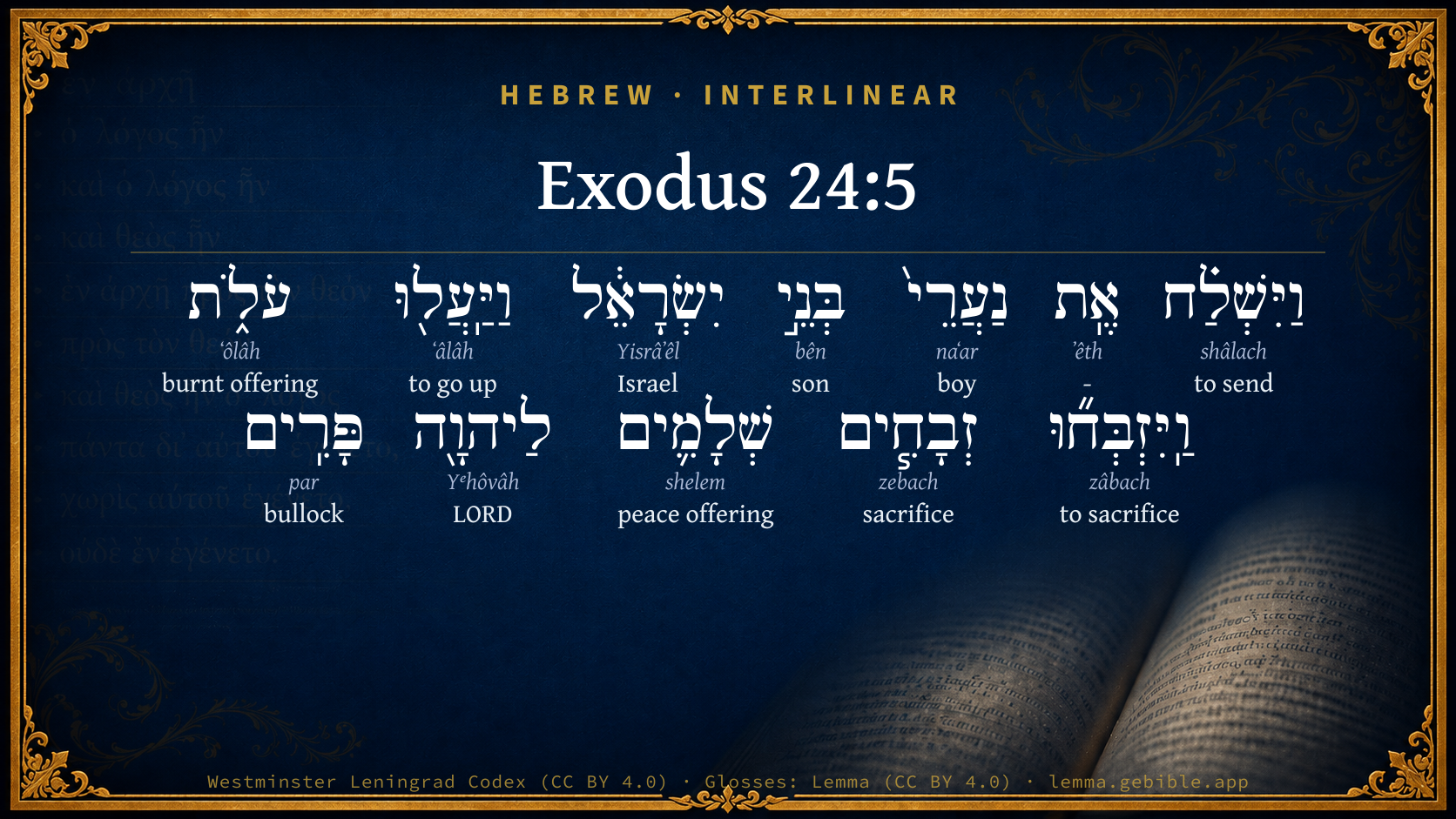
  1. וַיִּשְׁלַ֗ח shâlach H7971 “and · to send” Conjunction + Verb, Qal, Sequential Imperfect, 3rd Person, Masculine, Singular
  2. אֶֽת ʼêth H853 “-” Particle, Direct Object
  3. נַעֲרֵי֙ naʻar H5288 “boys of” Noun, Common, Masculine, Plural, Construct
  4. בְּנֵ֣י bên H1121 “sons of” Noun, Common, Masculine, Plural, Construct
  5. יִשְׂרָאֵ֔ל Yisrâʼêl H3478 “Israel” Noun, Proper
  6. וַיַּֽעֲל֖וּ ʻâlâh H5927 “and · to go up” Conjunction + Verb, Hiphil, Sequential Imperfect, 3rd Person, Masculine, Plural
  7. עֹלֹ֑ת ʻôlâh H5930 “burnt offerings” Noun, Common, Feminine, Plural, Absolute
  8. וַֽיִּזְבְּח֞וּ zâbach H2076 “and · to sacrifice” Conjunction + Verb, Qal, Sequential Imperfect, 3rd Person, Masculine, Plural
  9. זְבָחִ֧ים zebach H2077 “sacrifices” Noun, Common, Masculine, Plural, Absolute
  10. לַיהוָ֖ה Yᵉhôvâh H3068 “to/for · LORD” Preposition + Noun, Proper
  11. פָּרִֽים par H6499 “bullocks” Noun, Common, Masculine, Plural, Absolute

About this verse

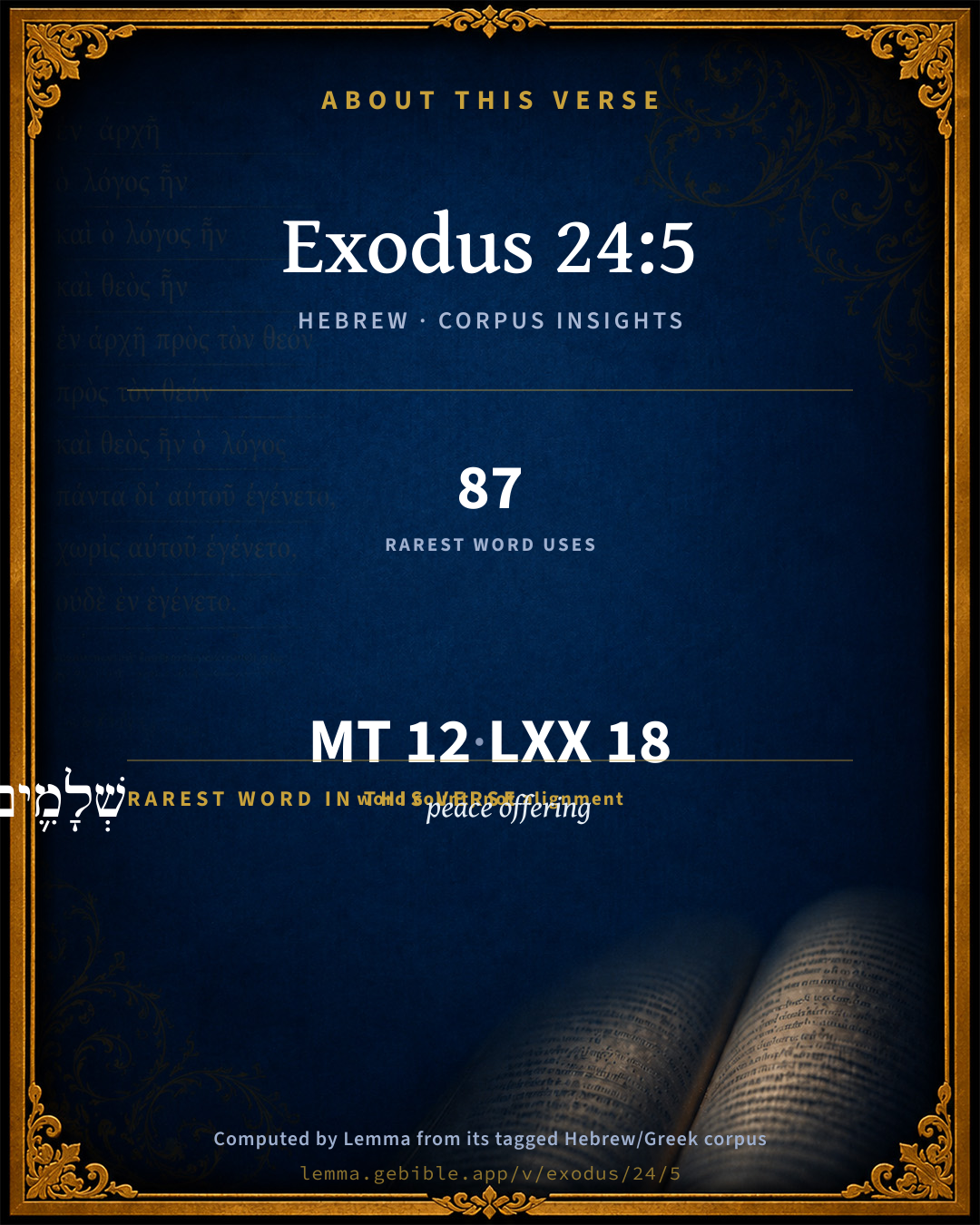
These counts appear in no published source. They are computed here, from the morphology-tagged text and Lemma’s own curated glosses. What Lemma adds →

12
words
12
distinct lemmas
Pentateuch
section

Grammatical profile

  • 3 verbs
  • 8 nouns
  • 1 particle

Verb forms

  • וַיִּשְׁלַ֗ח Qal · Sequential Imperfect
  • וַיַּֽעֲל֖וּ Hiphil · Sequential Imperfect
  • וַֽיִּזְבְּח֞וּ Qal · Sequential Imperfect

Hebrew & Septuagint length

In English translation the verse runs 20 words from the Hebrew and 28 from the Septuagint (LXX English) — the Septuagint runs noticeably longer here. See the side-by-side →

A rough comparison of the two English renderings, which tokenize alike — not a word-level alignment.

Word counts can differ between the Hebrew and the Greek without any difference in meaning — e.g. the Hebrew direct-object marker אֵת has no separate Greek word, and Greek often adds the article ὁ.

In the original languages it is 12 Hebrew tokens and 18 Greek tokens — but the two are counted differently (Hebrew bundles its prefixes and suffixes into one token; the Greek is in lemma form), so that isn’t a like-for-like length.

Cross-references

5

Topical passages linked to Exodus 24:5 in the Treasury of Scripture Knowledge — connected by theme and wording, ordered by reader-vote popularity; previews shown in the World English Bible.

  • Exodus 18:12 Jethro, Moses' father-in-law, took a burnt offering and sacrifices for God. Aaron came with all of the elders of Israel, to eat bread with Moses' father-in-law before God.
  • Exodus 19:22 Let the priests also, who come near to Yahweh, sanctify themselves, lest Yahweh break forth on them."
  • Leviticus 1:1–17 Yahweh called to Moses, and spoke to him out of the Tent of Meeting, saying,
  • Leviticus 3:1–17 "'If his offering is a sacrifice of peace offerings; if he offers it from the herd, whether male or female, he shall offer it without blemish before Yahweh.
  • Leviticus 7:11–21 "'This is the law of the sacrifice of peace offerings, which one shall offer to Yahweh.

Cross-references courtesy of OpenBible.info (CC BY 4.0).

Hebrew and Greek witnesses Masoretic Hebrew ↔ Greek Septuagint

The same verse in the two great witnesses to the Old Testament, shown verse-for-verse.

Here the Septuagint runs noticeably longer than the Hebrew — LXX2012 (modern English Septuagint) 28 words vs World English Bible 20. A rough length comparison of the two English translations, not a word-level alignment — read both below.

These are two independent witnesses, not word-aligned to each other, and the Septuagint is shown in lemma (dictionary) form.

Hebrew Exodus 24:5 Masoretic · Westminster Leningrad Codex

וַיִּשְׁלַ֗ח אֶֽת נַעֲרֵי֙ בְּנֵ֣י יִשְׂרָאֵ֔ל וַיַּֽעֲל֖וּ עֹלֹ֑ת וַֽיִּזְבְּח֞וּ זְבָחִ֧ים שְׁלָמִ֛ים לַיהוָ֖ה פָּרִֽים

He sent young men of the children of Israel, who offered burnt offerings and sacrificed peace-offerings of oxen to Yahweh.

World English Bible · Public Domain

Greek LXX Exodus 24:5 Septuagint · lemma form

καί ἐκ ἀποστέλλω ὁ νεανίσκος ὁ υἱός ἰσραήλ καί ἀναφέρω ὁλοκαύτωμα καί θύω θυσία σωτήριον ὁ θεός μοσχάριον

And he sent forth the young men of the children of Israel, and they offered whole burnt offerings, and they sacrificed young calves as a peace-offering to God.

LXX2012 (modern English Septuagint) · Public Domain

On this verse, Joseph Benson's Commentary discusses the Septuagint’s reading. Read the note in Commentary ↓

Hebrew: Westminster Leningrad Codex (CC BY 4.0). Greek: Septuagint (public domain); English from LXX2012 (modern English Septuagint) (Public Domain). How the Septuagint differs from the Hebrew →

Targum (Aramaic paraphrase)

2

The Targum is the ancient Jewish Aramaic paraphrase of the Hebrew Scriptures — an interpretive translation, not the Hebrew text itself. Onkelos (literal) and Pseudo-Jonathan (expansive) render the Torah, and Jonathan the Prophets. Coverage is partial: where no permissively-licensed English translation exists for a verse, only the Aramaic is shown. This is verse-level text, not a word-by-word alignment to the Hebrew.

  1. Targum Onkelos Torah (Genesis–Deuteronomy)
    וּשְׁלַח יָת בּוּכְרֵי בְּנֵי יִשְׂרָאֵל וְאַסִיקוּ עֲלָוָן וְקָרִיבוּ נִכְסַת קוּדְשִׁין קֳדָם יְיָ תּוֹרִין:

    (no public-domain English translation for this verse)

    Targum Onkelos — Aramaic: “Onkelos Genesis” (public domain); “Onkelos Exodus” (public domain); “Onkelos Leviticus” (public domain); “Onkelos Numbers” (public domain); “Onkelos Deuteronomy” (public domain). English: “Sefaria Community Translation” (CC0 1.0 (public-domain dedication)); “J.W. Etheridge. The Targums of Onkelos and Jonathan Ben Uzziel on the Pentateuch. London: Longmans, Green, 1862” (public domain). Text via Sefaria.

  2. Targum Pseudo-Jonathan Torah (Genesis–Deuteronomy)
    וְשַׁדַּר יַת בּוּכְרֵי בְּנֵי יִשְרָאֵל אֲרוּם עַד הַהִיא שַׁעְתָּא הֲוַות פּוּלְחָנָא בְּבוּכְרַיָא דְעַד כְּדוֹן לָא אִיתְעֲבֵיד מַשְׁכַּן זִמְנָא וְעַד כְּדוֹן לָא אִתְיְיהִיבַת כְּהוּנְתָּא לְאַהֲרן וְאַסִיקוּ עֲלַוָון וְנִכְסַת קוּדְשִׁין קֳדָם יְיָ תּוֹרִין

    And he sent the firstborn of the sons of Israel,-for until that hour had the firstborn had the (office of performing) worship, the tabernacle of ordinance not (as yet) being made, nor the priesthood given unto Aharon; and they offered burnt offerings and consecrated oblations of oxen before the Lord.

    Targum Pseudo-Jonathan — Aramaic: “Targum Jonathan on Genesis” (public domain); “Targum Jonathan on Exodus” (public domain); “Targum Jonathan on Leviticus” (public domain); “Targum Jonathan on Numbers” (public domain); “Targum Jonathan on Deuteronomy” (public domain). English: “The Targum of Jonathan ben Uzziel, trans. J. W. Etheridge, London, 1862” (public domain). Text via Sefaria.

Commentary

Notes on Exodus 24:5 from classic Christian and Jewish commentators (each source and its license shown beneath its notes). The classic Christian expositions comment on the surrounding passage and are grouped to its opening verse, so a note may address several verses; the Jewish commentaries on the Tanakh (Rashi and others) are per-verse, so they appear only where the commentator wrote on this verse.

Lemma curates 59 commentaries, every one of them public domain or Creative Commons licensed, each selected and text-cleaned for this edition rather than reprinted as found. About our sources →

Trapp's Complete Commentary

John Trapp

Exo 24:5 And he sent young men of the children of Israel, which offered burnt offerings, and sacrificed peace offerings of oxen unto the LORD.

Ver. 5. Young men.] The firstborn of the families. {Exo 13:2}

John Trapp, A Commentary or Exposition upon All the Books of the Old and New Testament (1647–1656) — public domain. Text from a community e-Sword module.

Joseph Benson's Commentary

Exo 24:5. He sent young men — So also the Septuagint, τους νεανισκους: but the Chaldee renders it, the firstborn. The firstborn were priests in every family; but, among the Israelites, they were afterward redeemed, and the tribe of Levi given to God in their stead, for his service. But the Hebrew word נערי, nagnarei, here used, signifies active as well as young, and as these persons were employed in slaying and offering up the oxen, strength and activity were necessary. As Moses himself performed the principal office of the priest, (Exo 24:6,) it cannot be concluded from this passage that these young men were priests. But it is worthy of observation, that even after the appointment of Aaron’s family to the priesthood, no man was permitted to serve at the altar after the age of fifty, see Num 8:25.

Joseph Benson's Commentary on the Old and New Testaments (1811–1818) — public domain. Text from a community e-Sword module.

Geneva Bible (1599)

Geneva Bible translators

For as yet the Priesthood was not given to Levi.

Geneva Bible (1599) marginal notes — public domain. Text via Bolls.life.

Jamieson, Fausset & Brown

Robert Jamieson, A. R. Fausset & David Brown

young men--priests (Exo 19:22), probably the oldest sons of particular families, who acted under the direction of Moses.

oxen--Other animals, though not mentioned, were offered in sacrifice (Heb 9:18-20).

Jamieson, Fausset & Brown — Commentary Critical and Explanatory on the Whole Bible (1871) — public domain (CC PDM 1.0). Text via the HelloAO Bible API.

Adam Clarke's Commentary

Verse 5. He sent young men] Stout, able, reputable young men, chosen out of the different tribes, for the purpose of killing, flaying, and offering the oxen mentioned here.

Burnt-offerings] They generally consisted of sheep and goats, Le 1:10. These were wholly consumed by fire.

Peace-offerings] Bullocks or goats; see Heb 9:19. The blood of these was poured out before the Lord, and then the priests and people might feast on the flesh.

Adam Clarke's Commentary on the Bible (1810–1826) — public domain. Text from a community e-Sword/MySword module.

Ellicott's Commentary for English Readers

(5) Young men . . . which offered burnt offerings.—It is to be noted that, even subsequently to the appointment of the Levitical priesthood, the acts of slaughtering the victims and arranging the flesh upon the altar were regarded as appropriately per formed by any Israelite (Lev_1:5-6; Lev_1:11-12, &c). The sprinkling of the blood and the lighting of the fire were the special sacrificial acts reserved to the priest (Lev_1:5; Lev_1:7; Lev_1:11; Lev_1:13). At this time, before the Levitical priest hood had been instituted, the sprinkling of the blood would seem to have been the sole act reserved. Young men were employed to slay the animals as best qualified by their strength to deal with them.

Burnt offerings . . . peace offerings.—Burnt offerings were at once expiatory and signs of self-dedication. Peace offerings were indications of man’s gratitude for mercies received. Both were now offered together, to mark (1) Israel’s thankfulness for being taken into covenant, and (2) Israel’s determination to consecrate itself wholly to the service of God.

A Bible Commentary for English Readers, edited by Charles John Ellicott (1878–1897) — public domain. Text from a community e-Sword module.

The Cambridge Bible for Schools and Colleges

gen. ed. J. J. S. Perowne

5. the young men, &c.] upon whom (cf. Jdg_17:5), as the strongest and most active members of the community (Ew., Di.), devolved in these times the duty of killing and cleaning the animal, and arranging its parts upon the altar, &c. Onk. the firstborn.

burnt offerings, and … peace offerings] see on Exo_20:24.

The Cambridge Bible for Schools and Colleges (gen. ed. J. J. S. Perowne; Cambridge University Press, 1878–1918) — public domain. Text from a community e-Sword module.

John Gill's Exposition

And he sent young men of the children Israel,.... To the altar under the hill he had these young men, according to Jarchi, were the firstborn of the children of Israel; and so the Targums Onkelos and Jonathan; and the latter adds,"for unto this hour the worship was among the firstborn, as yet the tabernacle of the covenant was not made, and as yet the priesthood was not given to Aaron.''But though this is a notion that has obtained among learned men, both Jews and Christians, it has been called in question by some, who have such reasons against it, as are not easily refuted. And very probably, as the seventy elders were such as were selected from the senior and graver part of the people, so these were choice young men, that were separated from others for this service, without any regard to birthright:

which offered burnt offerings, and sacrificed peace offerings of oxen unto the Lord; by way of thankfulness; and such were used at making covenants, when the parties ate and drank together. The Vulgate Latin version has it, "twelve calves", without any authority for it.

John Gill's Exposition of the Whole Bible (1746–1763) — public domain (CC PDM 1.0). Text via the HelloAO Bible API.

Albert Barnes' Notes on the Bible

Young men of the children of Israel - See Exo 19:22; Exo 28:1; Lev 1:5.

Burnt offerings ... peace offerings - The burnt offerings Lev. 1 figured the dedication of the nation to Yahweh, and the peace offerings Lev. 3 their communion with Yahweh and with each other.

Albert Barnes' Notes on the Bible (1834–1885) — public domain. Text from a community e-Sword/MySword module.

Haydock's Catholic Bible Commentary

Holocausts: whole burnt-offerings: in which the whole sacrifice was consumed with fire, upon the altar. (Challoner) --- It is not said that these young men were to officiate as priests. Moses acted alone in this capacity, pouring the blood. --- Calves, and he-goats also, Hebrews ix. 19. The book was also sprinkled with the blood (Calmet) mixed with water; for which purpose scarlet wool and hyssop were employed, as St. Paul learnt from tradition, or by inspiration. (Haydock)

George Leo Haydock (1774–1849), Haydock's Catholic Family Bible and Commentary, 1859 edition — public domain. Excludes Psalms (Douay-Rheims chapter numbering differs from Protestant) and Deuterocanonical books (Catholic canon only).

Matthew Poole's English Annotations

It matters not whether they were the first-born, or others; it is sufficient that they were persons appointed and authorized for the present service, not without God’s direction.

Peace-offerings of oxen; one kind, as the principal is named for all; for there were offered also goats, as appears both from Heb 9:19, and from hence, that burnt-offerings were usually made of the goats, Lev 1:10; Num 7:28.

Matthew Poole's English Annotations on the Holy Bible (1683–1685) — public domain. Text from a community e-Sword/MySword module.

Whedon's Commentary on the Bible

Daniel D. Whedon

5. Sent young men — Moses, who appropriately officiated as the priest, employed young and vigorous men, selected from the tribes, to assist him in preparing and offering the sacrifices. The Levitical arrangements for sacrifice were not yet established.

Burnt offerings, and… peace offerings — Comp. note on Exo_20:24. “The burnt offerings figured the dedication of the nation to Jehovah, and the peace offerings their communion with Jehovah and with each other.” — Speaker’s Commentary.

Daniel D. Whedon (gen. ed.), Commentary on the Old and New Testaments (1874–1909) — public domain. Text from a community e-Sword module.

The Pulpit Commentary

And he sent young men. The Levitical priesthood not being as vet instituted, either all the people were regarded as holy, and so any one might offer sacrifice, or the "young men" selected may have been of the number of the first-born, who were priests in their respective families until the appointment of Aaron and his sons to be priests of the nation. (Exo_28:1) No doubt young men were selected as most competent to deal with struggling animals.

The Pulpit Commentary (1880–1919), ed. H.D.M. Spence-Jones & Joseph S. Exell — public domain. Text from a community e-Sword module.

Keil & Delitzsch

C. F. Keil & F. Delitzsch

After the foundation and soil had been thus prepared in the place of sacrifice, for the fellowship which Jehovah was about to establish with His people; Moses sent young men of the children of Israel to prepare the sacrifices, and directed them to offer burnt-offering and sacrifice slain-offerings, viz., שׁלמים, "peace-offerings (see at Lev 3:1) for Jehovah," for which purpose פּרים, bullocks, or young oxen, were used. The young men were not first-born sons, who had officiated as priests previous to the institution of the Levitical priesthood, according to the natural right of primogeniture, as Onkelos supposes; nor were they the sons of Aaron, as Augustine maintains: they simply acted as servants of Moses; and the priestly duty of sprinkling the blood was performed by him as the mediator of the covenant. It is merely as young men, therefore, i.e., as strong and active, that they are introduced in this place, and not as representatives of the nation, "by whom the sacrifice was presented, and whose attitude resembled that of a youth just ready to enter upon his course" (Kurtz, O. C. iii. 143). For, as Oehler says, "this was not a sacrifice presented by the nation on its own account. The primary object was to establish that fellowship, by virtue of which it could draw near to Jehovah in sacrifice. Moreover, according to Exo 24:1 and Exo 24:9, the nation possessed its proper representatives in the seventy elders" (Herzog's Cyclopaedia). But even though these sacrifices were not offered by the representatives of the nation, and for this very reason Moses selected young men from among the people to act as servants at this ceremony, they had so far a substitutionary position, that in their persons the nation was received into fellowship with God by means of the sprinkling of the blood, which was performed in a peculiar manner, to suit the unique design of this sacrificial ceremony.

Keil & Delitzsch — Biblical Commentary on the Old Testament (1861–1891) — public domain (CC PDM 1.0). Text via the HelloAO Bible API. (Old Testament only.)

unfoldingWord translationNotes

Door43 World Missions Community

Moses took half of the blood and put it into basins

Moses collected half of the blood in basins in order to splash it on the people in Exodus 24:8. This would confirm the people's participation in the covenant between the people of Israel and God.

he sprinkled the other half onto the altar

Here the altar represents God. This would confirm God's participation in the covenant between God and the people of Israel.

translationWords

twelve tribes of Israel

burnt offering

sacrifice

fellowship offering

cow

Yahweh

altar

unfoldingWord translationNotes — © Distant Shores Media and the Door43 World Missions Community, licensed CC BY-SA 4.0. Source: git.door43.org/Door43/en_tn.

Rashi

Rabbi Shlomo Yitzchaki (Rashi)

את נערי THE LADS — the first-born sons (Zevachim 115b; Onkelos).

Rashi on the Tanakh — English translations: “The Judaica Press complete Tanach with Rashi, translated by A. J. Rosenberg” (CC BY 4.0); “Pentateuch with Rashi's commentary by M. Rosenbaum and A.M. Silbermann, 1929-1934” (public domain); “The Metsudah Tanach series, Lakewood, N.J” (CC BY 4.0); and “The Book of Joshua, Metsudah Publications, 1997” (CC BY 4.0). Text via Sefaria.

Ramban (Nachmanides)

Rabbi Moshe ben Nachman (Ramban / Nachmanides)

AND HE SENT ‘NA’AREI’ (THE YOUNG MEN OF) THE CHILDREN OF ISRAEL. These were the firstborns, as Onkelos rendered it, for it was they who used to offer the burnt-offerings and the peace-offerings. But I do not know why Scripture designates the firstborns by the term na’arei (the young men)? Perhaps it is because Scripture mentioned the elders who are the nobles of the children of Israel, therefore it called the firstborns ne’arim (young men), for in relation to the elders they were young. It thus indicates that Moses sent them to offer the sacrifices not because of their status in wisdom, for they were not yet advanced in age, but only an account of the birthright, through which they were set aside to offer sacrifices.In line with the plain meaning of Scripture, the young men of the children of Israel were the youth of Israel who had not tasted of sin, and had never come near a woman, for they were the most select and holy of the people, in a similar manner to that which the Rabbis have said: “The young men of Israel who have not tasted of sin, Note 6). are destined to give forth a fragrance like the Lebanon etc.” ” (ibid). The word Lebanon [of the root lavan — white] is an allusion here to the Sanctuary which “whitens” [atones for] the sins of Israel. The thought suggested then is that these young men who have not tasted of sin are as beneficial to Israel as the Sanctuary (Maharsha).

OXEN UNTO THE ETERNAL. The reason they brought oxen is that as long as Israel was in the wilderness they feared the attribute of justice, this being indeed the source of their mistake at the incident of the golden calf — as I will mention there. And so they now offered burnt-offerings and sacrificed peace-offerings all of oxen, for a similar reason to that of the bullock brought by the anointed priest [for a sin-offering], and the bullock which the court brings for an erroneous decision [which contradicts in part what the Torah enjoins], Verse 14. and the bullock for idolatry, as well as the Red Heifer., 19:2. See Ramban there: “Its redness alludes to the attribute of justice, etc.”

Ramban (Nachmanides) on the Tanakh — English translation: “Commentary on the Torah by Ramban (Nachmanides). Translated and annotated by Charles B. Chavel. New York, Shilo Pub. House, 1971-1976” (CC BY 4.0). Text via Sefaria.

Lesson kit

Teaching starters — assembled from the data on this page, not authored interpretation. Every prompt links to the verse data it draws on. Edit before teaching.

Exodus, in the Pentateuch, opens this verse with 12 words (12 distinct Hebrew lemmas). Its most distinctive word is shelem (“peace offering”). The Greek Septuagint runs longer here. A historical commentator’s framing appears above. Read the whole chapter for the surrounding context.

Discussion questions

  1. The word shelem carries the sense “peace offering.” How does it shape the verse?
  2. How does Exodus 18:12, which shares this passage’s theme, read alongside this verse?
  3. The Septuagint runs longer here than the Hebrew. What might account for the difference?
  4. These translations render this verse differently; the difference is in the English rendering, not the original. What questions does that raise?
  5. «וַיִּשְׁלַ֗ח» is a Qal Sequential Imperfect verb. How does that grammatical form shape the action described?
  6. Compare how Trapp's Complete Commentary and Joseph Benson's Commentary read this verse. Where do they agree or differ?

Things to notice

Reading settings

Reading text

Shown beneath each verse's original-language words.

Old Testament
Old Testament edition

Read the OT as the Masoretic Hebrew (MT) or the Greek Septuagint (LXX).

English shown for the Greek Septuagint (in the Hebrew ↔ Greek comparison).

Comparing translations? Open the Compare panel on any verse page to stack up to four side by side.