
Genesis 2:15

Hebrew (Westminster Leningrad Codex) Genesis 2:15 appears in the Hebrew Old Testament. The text above is from the Westminster Leningrad Codex. Each word links to its Strong’s number, a concise gloss, and parsing drawn from the Open Scriptures Hebrew Bible morphology. Click any word for its full Brown-Driver-Briggs (BDB) entry.
Download image
Cite this verse

Genesis 2:15 (World English Bible). Public Domain. Lemma interlinear Bible study tool, https://lemma.gebible.app/v/genesis/2/15.

Show BibTeX & RIS
BibTeX
RIS
English Translation
Yahweh God took the man, and put him into the garden of Eden to dress it and to keep it.
World English Bible · Public Domain
Highlights
  • 3 first appearances in the Hebrew Bible
Full analysis ↓
Download a study sheet

One document with this verse’s original text, its word-by-word gloss line, the meaning frame, cross-references with their text, attributed commentary, and full source and license credits — printable, and it pastes into notes with its structure intact.

This verse Autodidact and up

Study sheet (.html) Plain text (.txt)

A passage Seminary Student

Up to 50 verses in one chapter. A passage sheet keeps up to 6 commentary sources and 12 cross-references per verse, in the order this page ranks them, and says so on the sheet whenever that leaves anything out. Ask for a single verse and you get the Autodidact verse sheet above.

Everything on this page stays free to read, with no account — the sheet is a download of what is already on screen, not access to it.

Want to remove ads? Support Godless Engineer
Compare translations 3

The same verse in 3 English versions, stacked beneath the original-language interlinear above. Click any original word for its lexicon entry.

Each is an independent rendering of the whole verse — the interlinear is not word-aligned to these translations.

Highlighted words mark where these versions differ — a whole-verse word diff, not a word-by-word alignment.

  • World English Bible Public Domain
    Yahweh God took the man, and put him into the garden of Eden to dress it and to keep it.
  • King James Version Public Domain
    And the LORD God took the man, and put him into the garden of Eden to dress it and to keep it.
  • unfoldingWord Literal Text CC BY-SA 4.0
    And Yahweh God took the man and put him in the Garden of Eden to work it and tend it.

unfoldingWord Literal Text — © unfoldingWord, licensed CC BY-SA 4.0. Word-aligned USFM3 via Door43 (git.door43.org/unfoldingWord/en_ult).

Versions to compare (up to 4)

3 of 4 selected

Show all 18 translations

Every available English version of this verse, each an independent rendering of the whole verse.

  • World English Bible Public Domain
    Yahweh God took the man, and put him into the garden of Eden to dress it and to keep it.
  • Berean Standard Bible Public Domain
    Then the LORD God took the man and placed him in the Garden of Eden to cultivate and keep it.
  • Majority Standard Bible Public Domain
    Then the LORD God took the man and placed him in the Garden of Eden to cultivate and keep it.
  • King James Version Public Domain
    And the LORD God took the man, and put him into the garden of Eden to dress it and to keep it.
  • American Standard Version (1901) Public Domain
    And Jehovah God took the man, and put him into the garden of Eden to dress it and to keep it.
  • Revised Version (1885) Public Domain
    And the LORD God took the man, and put him into the garden of Eden to dress it and to keep it.
  • Geneva Bible (1599) Public Domain
    Then the Lord God tooke the man, and put him into the garden of Eden, that he might dresse it and keepe it.
  • Douay-Rheims (1899) Public Domain
    And the Lord God took man, and put him into the paradise for pleasure, to dress it, and keep it.
  • Young's Literal Translation Public Domain
    And Jehovah God taketh the man, and causeth him to rest in the garden of Eden, to serve it, and to keep it.
  • Literal Standard Version CC BY-SA 4.0
    And YHWH God takes the man, and causes him to rest in the Garden of Eden, to serve it and to keep it.
  • Unlocked Literal Bible CC BY-SA 4.0
    Yahweh God took the man and put him into the garden of Eden to work it and to maintain it.
  • unfoldingWord Literal Text CC BY-SA 4.0
    And Yahweh God took the man and put him in the Garden of Eden to work it and tend it.
  • Darby Bible Public Domain
    And Jehovah Elohim took Man, and put him into the garden of Eden, to till it and to guard it.
  • World Messianic Bible Public Domain
    The LORD God took the man, and put him into the garden of Eden to cultivate and keep it.
  • Webster's Bible Public Domain
    And the LORD God took the man, and put him into the garden of Eden, to dress it, and to keep it.
  • Free Bible Version CC BY-SA 4.0
    The Lord God put the man in the Garden of Eden to cultivate it and care for it.
  • Bible in Basic English Public Domain
    And the Lord God took the man and put him in the garden of Eden to do work in it and take care of it.
  • JPS Tanakh (1917) Public Domain
    And the LORD God took the man, and put him into the garden of Eden to dress it and to keep it.

Literal Standard Version (2020), Covenant Press — licensed CC BY-SA 4.0. Text via the HelloAO Bible API (eBible.org). Unlocked Literal Bible (unfoldingWord) — licensed CC BY-SA 4.0. Text via the HelloAO Bible API (eBible.org). unfoldingWord Literal Text — © unfoldingWord, licensed CC BY-SA 4.0. Word-aligned USFM3 via Door43 (git.door43.org/unfoldingWord/en_ult). Free Bible Version, Dr. Jonathan Gallagher — licensed CC BY-SA 4.0. Text via the HelloAO Bible API (eBible.org).

Word by word

More ways to search: Search by grammar → Find every occurrence → Compare this word →

Practice this passage: Drill this verse → Learn its vocabulary →

עֵ֔דֶן
ʻÊden
H5731
“Eden”
Noun, Proper
Part of Speech
Noun
Type
Proper
Full BDB Definition

Origin: the same as H5730

TWOT: 1568

Eden = "pleasure" - the first habitat of man after the creation; site unknown (noun proper masculine locative) - a Gershonite Levite, son of Joah in the days of king Hezekiah of Judah (noun proper masculine)
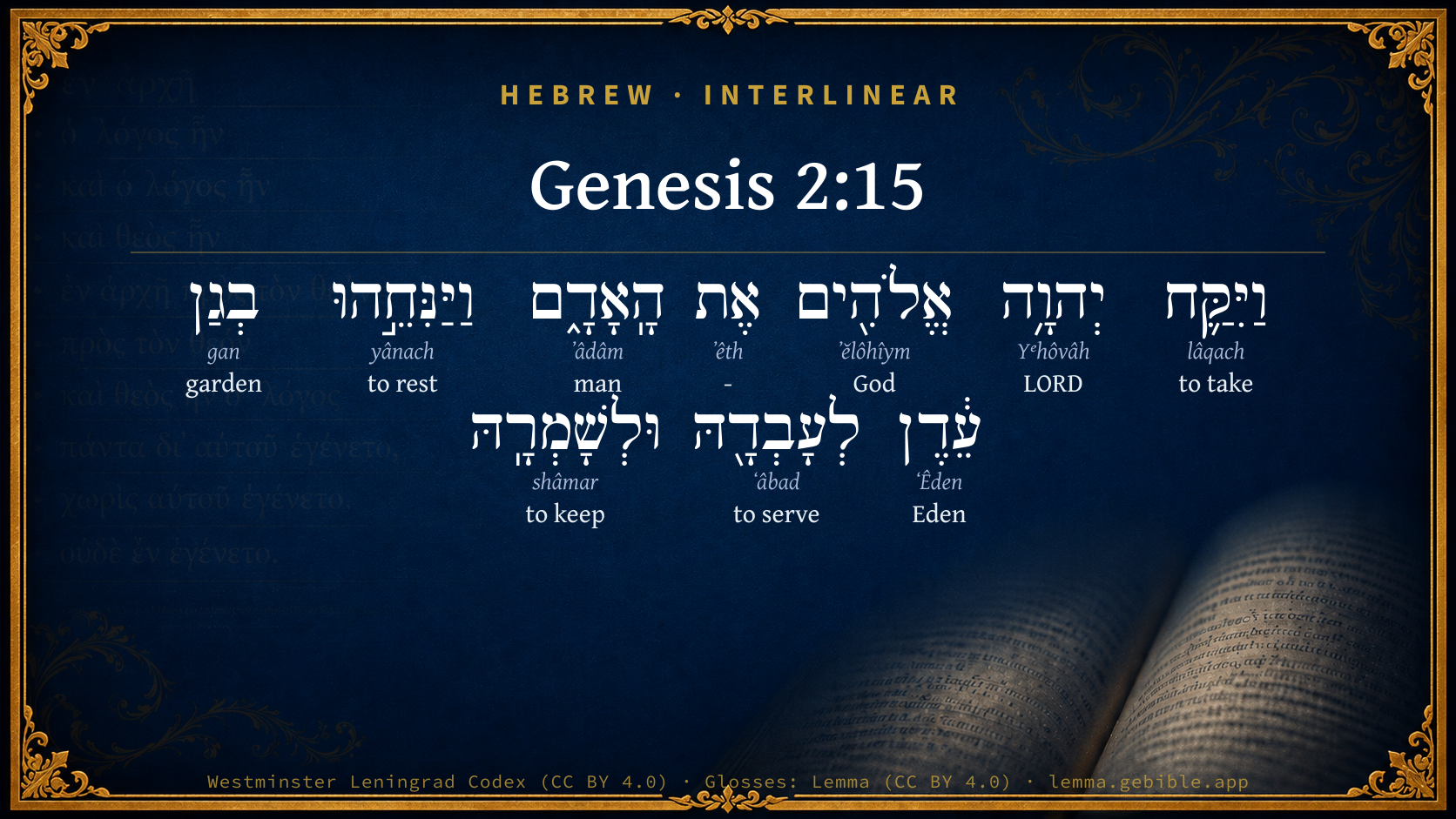
  1. וַיִּקַּ֛ח lâqach H3947 “and · to take” Conjunction + Verb, Qal, Sequential Imperfect, 3rd Person, Masculine, Singular
  2. יְהוָ֥ה Yᵉhôvâh H3068 “LORD” Noun, Proper
  3. אֱלֹהִ֖ים ʼĕlôhîym H430 “God(s)” Noun, Common, Masculine, Plural, Absolute
  4. אֶת ʼêth H853 “-” Particle, Direct Object
  5. הָֽאָדָ֑ם ʼâdâm H120 “the · man” Particle, Definite Article + Noun, Common, Masculine, Singular, Absolute
  6. וַיַּנִּחֵ֣הוּ yânach H3240 “and · to rest · him” Conjunction + Verb, Hiphil, Sequential Imperfect, 3rd Person, Masculine, Singular + Suffix, Personal, 3rd Person, Masculine, Singular
  7. בְגַן gan H1588 “in/at · garden of” Preposition + Noun, Common, Both, Singular, Construct
  8. לְעָבְדָ֖הּ ʻâbad H5647 “to serve · her” Preposition + Verb, Qal, Infinitive Construct + Suffix, Personal, 3rd Person, Feminine, Singular
  9. וּלְשָׁמְרָֽהּ shâmar H8104 “and · to keep · her” Conjunction + Preposition + Verb, Qal, Infinitive Construct + Suffix, Personal, 3rd Person, Feminine, Singular

About this verse

These counts appear in no published source. They are computed here, from the morphology-tagged text and Lemma’s own curated glosses. What Lemma adds →

10
words
10
distinct lemmas
Pentateuch
section

Notable vocabulary

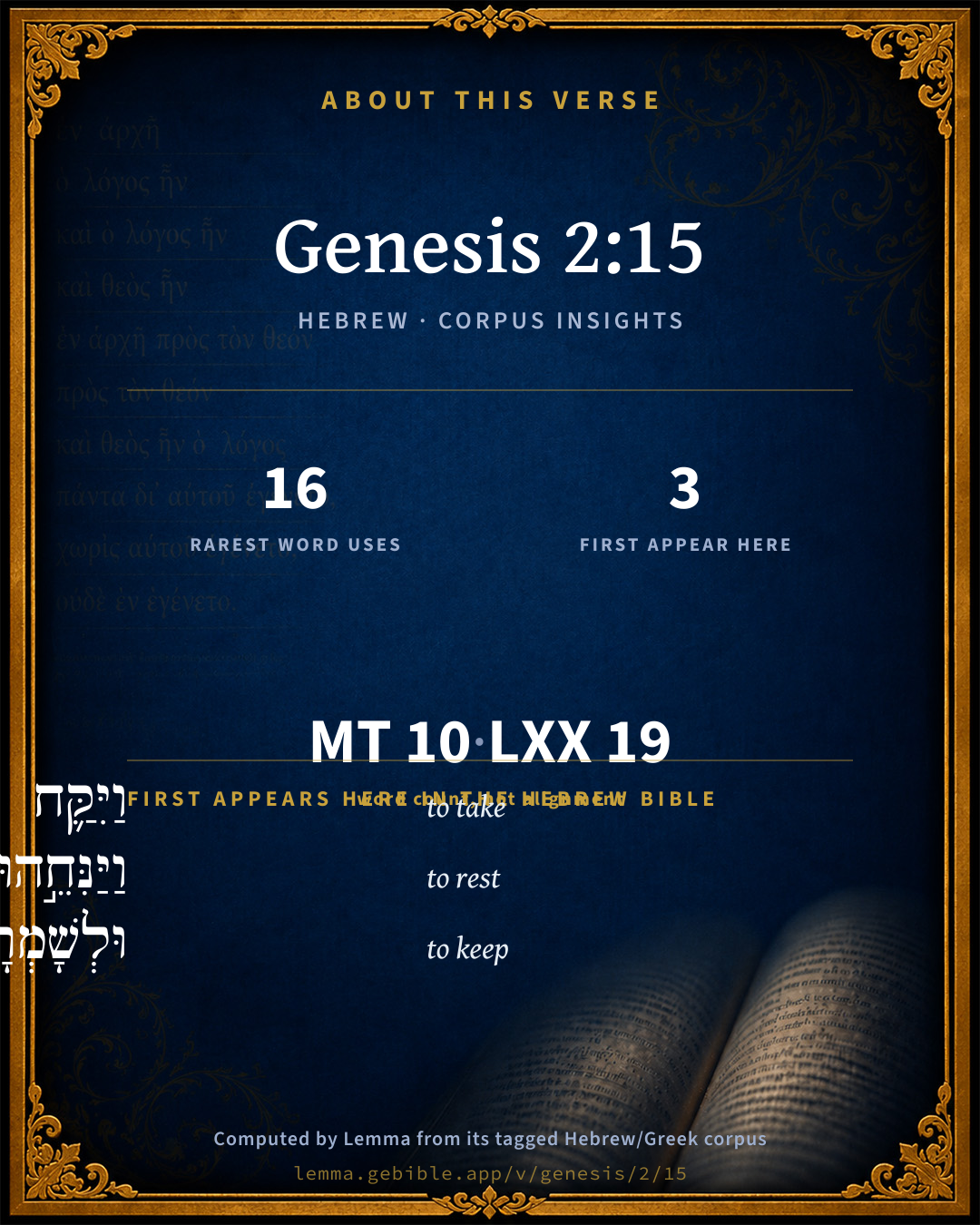
The rarest word here is עֵ֔דֶן Eden H5731 — appearing just 16 times in the whole Hebrew Bible.

First appearance in Scripture

These words make their first canonical appearance in the Hebrew Bible here:

  • וַיִּקַּ֛ח to take H3947
  • וַיַּנִּחֵ֣הוּ to rest H3240
  • וּלְשָׁמְרָֽהּ to keep H8104

Shared distinctive vocabulary

עֵ֔דֶן Eden H5731 occurs in 15 verses of the Hebrew Bible. Also found in:

Grammatical profile

  • 4 verbs
  • 5 nouns
  • 1 particle

Verb forms

  • וַיִּקַּ֛ח Qal · Sequential Imperfect
  • וַיַּנִּחֵ֣הוּ Hiphil · Sequential Imperfect
  • לְעָבְדָ֖הּ Qal · Infinitive Construct
  • וּלְשָׁמְרָֽהּ Qal · Infinitive Construct

Hebrew & Septuagint length

In English translation the verse runs 20 words from the Hebrew and 24 from the Septuagint (LXX English) — closely comparable.

A rough comparison of the two English renderings, which tokenize alike — not a word-level alignment.

Word counts can differ between the Hebrew and the Greek without any difference in meaning — e.g. the Hebrew direct-object marker אֵת has no separate Greek word, and Greek often adds the article ὁ.

In the original languages it is 10 Hebrew tokens and 19 Greek tokens — but the two are counted differently (Hebrew bundles its prefixes and suffixes into one token; the Greek is in lemma form), so that isn’t a like-for-like length.

Cross-references

4

Topical passages linked to Genesis 2:15 in the Treasury of Scripture Knowledge — connected by theme and wording, ordered by reader-vote popularity; previews shown in the World English Bible.

  • Psalms 128:2 For you will eat the labor of your hands. You will be happy, and it will be well with you.
  • Genesis 2:8 Yahweh God planted a garden eastward, in Eden, and there he put the man whom he had formed.
  • Ephesians 4:28 Let him who stole steal no more; but rather let him labor, working with his hands the thing that is good, that he may have something to give to him who has need.
  • Genesis 2:2 On the seventh day God finished his work which he had made; and he rested on the seventh day from all his work which he had made.

Cross-references courtesy of OpenBible.info (CC BY 4.0).

Hebrew and Greek witnesses Masoretic Hebrew ↔ Greek Septuagint

The same verse in the two great witnesses to the Old Testament, shown verse-for-verse.

These are two independent witnesses, not word-aligned to each other, and the Septuagint is shown in lemma (dictionary) form.

Hebrew Genesis 2:15 Masoretic · Westminster Leningrad Codex

וַיִּקַּ֛ח יְהוָ֥ה אֱלֹהִ֖ים אֶת הָֽאָדָ֑ם וַיַּנִּחֵ֣הוּ בְגַן עֵ֔דֶן לְעָבְדָ֖הּ וּלְשָׁמְרָֽהּ

Yahweh God took the man, and put him into the garden of Eden to dress it and to keep it.

World English Bible · Public Domain

Greek LXX Genesis 2:15 Septuagint · lemma form

καί λαμβάνω κύριος ὁ θεός ὁ ἄνθρωπος ὅς πλάσσω καί τίθημι αὐτός ἐν ὁ παράδεισος ἐργάζομαι αὐτός καί φυλάσσω

And the Lord God took the man whom he had formed, and placed him in the garden of Delight, to cultivate and keep it.

LXX2012 (modern English Septuagint) · Public Domain

Hebrew: Westminster Leningrad Codex (CC BY 4.0). Greek: Septuagint (public domain); English from LXX2012 (modern English Septuagint) (Public Domain). How the Septuagint differs from the Hebrew →

Targum (Aramaic paraphrase)

2

The Targum is the ancient Jewish Aramaic paraphrase of the Hebrew Scriptures — an interpretive translation, not the Hebrew text itself. Onkelos (literal) and Pseudo-Jonathan (expansive) render the Torah, and Jonathan the Prophets. Coverage is partial: where no permissively-licensed English translation exists for a verse, only the Aramaic is shown. This is verse-level text, not a word-by-word alignment to the Hebrew.

  1. Targum Onkelos Torah (Genesis–Deuteronomy)
    וּדְבַר יְיָ אֱלֹהִים יָת אָדָם וְאַשְׁרֵיהּ בְּגִינְתָא דְעֵדֶן לְמִפְלְחַהּ וּלְמִטְרַהּ

    (no public-domain English translation for this verse)

    Targum Onkelos — Aramaic: “Onkelos Genesis” (public domain); “Onkelos Exodus” (public domain); “Onkelos Leviticus” (public domain); “Onkelos Numbers” (public domain); “Onkelos Deuteronomy” (public domain). English: “Sefaria Community Translation” (CC0 1.0 (public-domain dedication)); “J.W. Etheridge. The Targums of Onkelos and Jonathan Ben Uzziel on the Pentateuch. London: Longmans, Green, 1862” (public domain). Text via Sefaria.

  2. Targum Pseudo-Jonathan Torah (Genesis–Deuteronomy)
    וּדְבַר יְיָ אֱלהִים יַת אָדָם מִן טַוָר פּוּלְחָנָא אָתַר דְאִתְבַּרְיָא מִתַּמָן וְאַשְׁרֵהּ בְּגִינוּנִיתָא דְעֵדֶן לְמֶהֱוֵי פְּלַח בְּאוֹרַיְתָא וּלְמִנְטַר פִּקוּדָהָא

    And the Lord God took the man from the mountain of worship, where he had been created, and made him dwell in the garden of Eden, to do service in the law, and to keep its commandments.

    Targum Pseudo-Jonathan — Aramaic: “Targum Jonathan on Genesis” (public domain); “Targum Jonathan on Exodus” (public domain); “Targum Jonathan on Leviticus” (public domain); “Targum Jonathan on Numbers” (public domain); “Targum Jonathan on Deuteronomy” (public domain). English: “The Targum of Jonathan ben Uzziel, trans. J. W. Etheridge, London, 1862” (public domain). Text via Sefaria.

Commentary

Notes on Genesis 2:15 from classic Christian and Jewish commentators (each source and its license shown beneath its notes). The classic Christian expositions comment on the surrounding passage and are grouped to its opening verse, so a note may address several verses; the Jewish commentaries on the Tanakh (Rashi and others) are per-verse, so they appear only where the commentator wrote on this verse.

Lemma curates 59 commentaries, every one of them public domain or Creative Commons licensed, each selected and text-cleaned for this edition rather than reprinted as found. About our sources →

John Gill's Exposition

And the Lord God took the man, and put him into the garden of Eden,.... This is observed before in Gen 2:8 and is here repeated to introduce what follows; and is to be understood not of a corporeal assumption, by a divine power lifting him up from the place where he was, and carrying him into another; rather of a manuduction, or taking him by the hand and leading him thither; so Onkelos renders it, he "led" him, that is, he ordered and directed him thither: hence Jarchi paraphrases it, he took him with good words, and persuaded him to go thither: the place from whence he is supposed by some to be taken was near Damascus, where he is by them said to be created; or the place where the temple was afterwards built, as say the Jewish writers: the Targum of Jonathan is,"the Lord God took the man from the mount of Service, the place in which he was created, and caused him to dwell in the garden of Eden.''And elsewhere (t) it is said,"the holy blessed God loved the first Adam with an exceeding great love, for he created him out of a pure and holy place; and from what place did he take him? from the place of the house of the sanctuary, and brought him into his palace, as it is said, Gen 2:15 "and the Lord God took", &c.''though no more perhaps is intended by this expression, than that God spoke to him or impressed it on his mind, and inclined him to go, or stay there:

to dress it, and to keep it; so that it seems man was not to live an idle life, in a state of innocence; but this could not be attended with toil and labour, with fatigue and trouble, with sorrow and sweat, as after his fall; but was rather for his recreation and pleasure; though what by nature was left to be improved by art, and what there was for Adam to do, is not easy to say: at present there needed no ploughing, nor sowing, nor planting, nor watering, since God had made every tree pleasant to the sight, good for food, to grow out of it; and a river ran through it to water it: hence in a Jewish tract (u), before referred to, it is said, that his work in the garden was nothing else but to study in the words of the law, and to keep or observe the way of the tree of life: and to this agree the Targums of Jonathan and of Jerusalem,"and he placed him in the garden of Eden, to serve in the law, and keep the commands of it.''And in another tract (w) it is said,"God brought Adam the law, Job 28:27 and "he put him in the garden of Eden"; that is, the garden of the law, "to dress it", to do the affirmative precepts of the law, "and to keep it", the negative precepts:''though Aben Ezra interprets this service of watering the garden, aud keeping wild beasts from entering into it. And indeed the word may be rendered to "till", as well as to dress, as it is in Gen 3:23 and by Ainsworth here; so Milton (x) expresses it; and some have thought Adam was to have planted and sowed, had he continued in the garden.

(t) Pirke Eliezer, c. 2. fol. 72. 2. (u) Pirke Eliezer, c. 2. fol. 72. 2. (w) Tikkune Zohar, correct. 54. fol. 91. 2. (x) Paradise Lost, B. 8. l. 320.

John Gill's Exposition of the Whole Bible (1746–1763) — public domain (CC PDM 1.0). Text via the HelloAO Bible API.

Trapp's Complete Commentary

John Trapp

Gen 2:15 And the LORD God took the man, and put him into the garden of Eden to dress it and to keep it.

Ver. 15. To dress it, and to keep it.] This he did as without necessity, so without pains, without weariness. It was rather his recreation than his occupation. He laboured now by an ordinance; it was after his fall laid upon him as a punishment, {Gen 3:19} to eat his bread in the sweat of his nose. God never made any, as he made Leviathan, to sport himself only; or to do, as it is said of the people of Tombutum in Africa, that they spend their whole time in piping and dancing; but to "work," either "with his hands" or his head, "in the sweat of his brow," or of his brain, "the thing that is good"; {Eph 4:28} and with how much the more cheerfulness any one goeth about his business, by so much the nearer he cometh to his paradise.

John Trapp, A Commentary or Exposition upon All the Books of the Old and New Testament (1647–1656) — public domain. Text from a community e-Sword module.

Albert Barnes' Notes on the Bible

- XII. The Command

15. נוּח nûach “rest, dwell.” עבד ‛ābad “work, till, serve.” שׁמר shāmar “keep, guard.”

We have here the education of man summed up in a single sentence. Let us endeavor to unfold the great lessons that are here taught.

Gen 2:15

The Lord God took the man. - The same omnipotent hand that made him still held him. “And put him into the garden.” The original word is “caused him to rest,” or dwell in the garden as an abode of peace and recreation. “To dress it and to keep it.” The plants of nature, left to their own course, may degenerate and become wild through the poverty of the soil on which they alight, or the gradual exhaustion of a once rich soil. The hand of rational man, therefore, has its appropriate sphere in preparing and enriching the soil, and in distributing the seeds and training the shoots in the way most favorable for the full development of the plant, and especially of its seed or fruits. This “dressing” was needed even in the garden. The “keeping” of it may refer to the guarding of it by enclosure from the depredations of the cattle, the wild beasts, or even the smaller animals. It includes also the faithful preservation of it as a trust committed to man by his bounteous Maker. There was now a man to till the soil. The second need of the world of plants was now supplied. Gardening was the first occupation of primeval man.

Gen 2:16-17

And the Lord God commanded the man, saying. - This is a pregnant sentence. It involves the first principles of our intellectual and moral philosophy.

I. The command here given in words brings into activity the intellectual nature of man. First, the power of understanding language is called forth. The command here addressed to him by his Maker is totally different from the blessings addressed to the animals in the preceding chapter. It was not necessary that these blessings should be understood in order to be carried into effect, inasmuch as He who pronounced them gave the instincts and powers requisite to their accomplishment. But this command addressed to man in words must be understood in order to be obeyed. The capacity for understanding language, then, was originally lodged in the constitution of man, and only required to be called out by the articulate voice of God. Still there is something wonderful here, something beyond the present grasp and promptitude of human apprehension. If we except the blessing, which may not have been heard, or may not have been uttered before this command, these words were absolutely the first that were heard by man.

The significance of the sentences they formed must have been at the same time conveyed to man by immediate divine teaching. How the lesson was taught in an instant of time we cannot explain, though we have a distant resemblance of it in an infant learning to understand its mother-tongue. This process, indeed, goes over a space of two years; but still there is an instant in which the first conception of a sign is formed, the first word is apprehended, the first sentence is understood. In that instant the knowledge of language is virtually attained. With man, created at once in his full though undeveloped powers, and still unaffected by any moral taint, this instant came with the first words spoken to his ear and to his soul by his Maker’s impressive voice, and the first lesson of language was at once thoroughly taught and learned. Man is now master of the theory of speech; the conception of a sign has been conveyed into his mind. This is the passive lesson of elocution: the practice, the active lesson, will speedily follow.

Not only the secondary part, however, but at the same time the primary and fundamental part of man’s intellectual nature is here developed. The understanding of the sign necessarily implies the knowledge of the thing signified. The objective is represented here by the “trees of the garden.” The subjective comes before his mind in the pronoun “thou.” The physical constitution of man appears in the process of “eating.” The moral part of his nature comes out in the significance of the words “mayest” and “shalt not.” The distinction of merit in actions and things is expressed in the epithets “good and evil.” The notion of reward is conveyed in the terms “life” and “death.” And, lastly, the presence and authority of “the Lord God” is implied in the very nature of a command. Here is at least the opening of a wide field of observation for the nascent powers of the mind. He, indeed, must bear the image of God in perceptive powers, who shall scan with heedful eye the loftiest as well as the lowest in these varied scenes of reality. But as with the sign, so with the thing signified, a glance of intelligence instantaneously begins the converse of the susceptible mind with the world of reality around, and the enlargement of the sphere of human knowledge is merely a matter of time without end. How rapidly the process of apprehension would go on in the opening dawn of man’s intellectual activity, how many flashes of intelligence would be compressed into a few moments of his first consciousness, we cannot tell. But we can readily believe that he would soon be able to form a just yet an infantile conception of the varied themes which are presented to his mind in this brief command.

Thus, the susceptible part of man’s intellect is evoked. The conceptive part will speedily follow, and display itself in the many inventions that will be sought out and applied to the objects which are placed at his disposal.

II. First. Next, the moral part of man’s nature is here called into play. Mark God’s mode of teaching. He issues a command. This is required in order to bring forth into consciousness the hitherto latent sensibility to moral obligation which was laid in the original constitution of man’s being. A command implies a superior, whose right it is to command, and an inferior, whose duty it is to obey. The only ultimate and absolute ground of supremacy is creating, and of inferiority, being created. The Creator is the only proper and entire owner; and, within legitimate bounds, the owner has the right to do what he will with his own. The laying on of this command, therefore, brings man to the recognition of his dependence for being and for the character of that being on his Maker. From the knowledge of the fundamental relation of the creature to the Creator springs an immediate sense of the obligation he is under to render implicit obedience to the Author of his being. This is, therefore, man’s first lesson in morals. It calls up in his breast the sense of duty, of right, of responsibility. These feelings could not have been elicited unless the moral susceptibility had been laid in the soul, and only waited for the first command to awaken it into consciousness. This lesson, however, is only the incidental effect of the command, and not the primary ground of its imposition.

Second. The special mandate here given is not arbitrary in its form, as is sometimes hastily supposed, but absolutely essential to the legal adjustment of things in this new stage of creation. Antecedent to the behest of the Creator, the only indefeasible right to all the creatures lay in himself. These creatures may be related to one another. In the great system of things, through the wonderful wisdom of the grand Designer, the use of some may be needful to the well-being, the development, and perpetuation of others. Nevertheless, no one has a shadow of right in the original nature of things to the use of any other. And when a moral agent comes upon the stage of being, in order to mark out the sphere of his legitimate action, an explicit declaration of the rights over other creatures granted and reserved must be made. The very issue of the command proclaims man’s original right of property to be, not inherent, but derived.

As might be expected in these circumstances, the command has two clauses, - a permissive and a prohibitive. “Of every tree of the garden thou mayst freely eat.” This displays in conspicuous terms the benignity of the Creator. “But of the tree of the knowledge of good and evil thou shalt not eat.” This signalizes the absolute right of the Creator over all the trees, and over man himself. One tree only is withheld, which, whatever were its qualities, was at all events not necessary to the well-being of man. All the others that were likely for sight and good for food, including the tree of life, are made over to him by free grant. In this original provision for the vested rights of man in creation, we cannot but acknowledge with gratitude and humility the generous and considerate bounty of the Creator. This is not more conspicuous in the bestowment of all the other trees than in the withholding of the one, the participation of which was fraught with evil to mankind.

Third. The prohibitory part of this enactment is not a matter of indifference, as is sometimes imagined, but indispensable to the nature of a command, and, in particular, of a permissive act or declaration of granted rights. Every command has a negative part, expressed or implied, without which it would be no command at all. The command, “Go work today in my vineyard,” implies thou shalt not do anything else; otherwise the son who works not obeys as well as the son who works. The present address of God to Adam, without the exceptive clause, would be a mere license, and not a command. But with the exceptive clause it is a command, and tantamount in meaning to the following positive injunction: Thou mayest eat of these trees only. An edict of license with a restrictive clause is the mildest form of command that could have been imposed for the trial of human obedience. Some may have thought that it would have been better for man if there had been no tree of the knowledge of good and evil.

But second thoughts will correct this rash and wrong conclusion. First. This tree may have had other purposes to serve in the economy of things of which we are not aware; and, if so, it could not have been absent without detriment to the general good. Second. But without any supposition at all, the tree was fraught with no evil whatever to man in itself. It was in the first instance the instrument of great good, of the most precious kind, to him. It served the purpose of calling up into view out of the depths of his nature the notion of moral obligation, with all the kindred notions of the inherent authority of the Creator and the innate subordination of himself, the creature, of the aboriginal right of the Creator alone in all the creatures, and the utter absence of any right in himself to any other creature whatsoever. The command concerning this tree thus set his moral convictions agoing, and awakened in him the new and pleasing consciousness that he was a moral being, and not a mere clod of the valley or brute of the field.

This is the first thing this tree did for man; and we shall find it would have done a still better thing for him if he had only made a proper use of it. Third. The absence of this tree would not at all have secured Adam from the possibility or the consequence of disobedience. Any grant to him whatsoever must have been made “with the reserve,” implicit or explicit, of the rights of all others. “The thing reserved” must in equity have been made known to him. In the present course of things it must have come in his way, and his trial would have been inevitable, and therefore his fall possible. Now, the forbidden tree is merely the thing reserved. Besides, even if man had been introduced into a sphere of existence where no reserved tree or other thing could ever have come within the range of his observation, and so no outward act of disobedience could have been perpetrated, still, as a being of moral susceptibility, he must come to the acknowledgment, express or implied, of the rights of the heavenly crown, before a mutual good understanding could have been established between him and his Maker. Thus, we perceive that even in the impossible Utopia of metaphysical abstraction there is a virtual forbidden tree which forms the test of a man’s moral relation to his Creator. Now, if the reserve be necessary, and therefore the test of obedience inevitable, to a moral being, it only remains to inquire whether the test employed be suitable and seasonable.

Fourth. What is here made the matter of reserve, and so the test of obedience, is so far from being trivial or out of place, as has been imagined, that it is the proper and the only object immediately available for these purposes. The immediate need of man is food. The kind of food primarily designed for him is the fruit of trees. Grain, the secondary kind of vegetable diet, is the product of the farm rather than of the garden, and therefore does not now come into use. As the law must be laid down before man proceeds to an act of appropriation, the matter of reserve and consequent test of obedience is the fruit of a tree. Only by this can man at present learn the lessons of morality. To devise any other means, not arising from the actual state of things in which man was placed, would have been arbitrary and unreasonable. The immediate sphere of obedience lies in the circumstances in which he actually stands. These afforded no occasion for any other command than what is given. Adam had no father, or mother, or neighbor, male or female, and therefore the second table of the law could not apply. But he had a relation to his Maker, and legislation on this could not be postponed. The command assumes the kindest, most intelligible, and convenient form for the infantile mind of primeval man.

Fifth. We are now prepared to understand why this tree is called the tree of the knowledge of good and evil. The prohibition of this tree brings man to the knowledge of good and evil. The products of creative power were all very good Gen 1:31. Even this tree itself is good, and productive of unspeakable good in the first instance to man. The discernment of merit comes up in his mind by this tree. Obedience to the command of God not to partake of this tree is a moral good. Disobedience to God by partaking of it is a moral evil. When we have formed an idea of a quality, we have at the same time an idea of its contrary. By the command concerning this tree man became possessed of the conceptions of good and evil, and so, theoretically, acquainted with their nature. This was that first lesson in morals of which we have spoken. It is quite evident that this knowledge could not be any physical effect of the tree, seeing its fruit was forbidden. It is obvious also that evil is as yet known in this fair world only as the negative of good. Hence, the tree is the tree of the knowledge of good and evil, because by the command concerning it man comes to this knowledge.

Sixth. “In the day of thy eating thereof, die surely shalt thou.” The divine command is accompanied with its awful sanction - death. The man could not at this time have any practical knowledge of the physical dissolution called death. We must, therefore, suppose either that God made him preternaturally acquainted with it, or that he conveyed to him the knowledge of it simply as the negation of life. The latter hypothesis is to be preferred, for several reasons. First, it is the more economical mode of instruction. Such knowledge may be imparted to man without anticipating experience. He was already conscious of life as a pure blessing. He was therefore capable of forming an idea of its loss. And death in the physical sense of the cessation of animal life and the disorganization of the body, he would come to understand in due time by experience. Secondly, death in reference to man is regarded in Scripture much more as the privation of life in the sense of a state of favor with God and consequent happiness than as the mere cessation of animal life Gen 28:13; Exo 3:6; Mat 22:32. Thirdly, the presence and privilege of the tree of life would enable man to see how easily he could be deprived of life, especially when he began to drink in its life-sustaining juices and feel the flow of vitality rushing through his veins and refreshing his whole physical nature. Take away this tree, and with all the other resources of nature he cannot but eventually droop and die. Fourthly, the man would thus regard his exclusion from the tree of life as the earnest of the sentence which would come to its fullness, when the animal frame would at length sink down under the wear and tear of life like the beasts that perish. Then would ensue to the dead but perpetually existing soul of man the total privation of all the sweets of life, and the experience of all the ills of penal death.

III. Man has here evidently become acquainted with his Maker. On the hearing and understanding of this sentence, at least, if not before, he has arrived at the knowledge of God, as existing, thinking, speaking, permitting, commanding, and thereby exercising all the prerogatives of that absolute authority over people and things which creation alone can give. If we were to draw all this out into distinct propositions, we should find that man was here furnished with a whole system of theology, ethics, and metaphysics, in a brief sentence. It may be said, indeed, that we need not suppose all this conveyed in the sentence before us. But, at all events, all this is implied in the few words here recorded to have been addressed to Adam, and there was not much time between his creation and his location in the garden for conveying any preliminary information. We may suppose the substance of the narrative contained in Gen 1:2-3, to have been communicated to him in due time. But it could not be all conveyed yet, as we are only in the sixth day, and the record in question reaches to the end of the seventh. It was not, therefore, composed until after that day had elapsed.

It is to be noticed here that God reserves to himself the administration of the divine law. This was absolutely necessary at the present stage of affairs, as man was but an individual subject, and not yet spread out into a multitude of people. Civil government was not formally constituted till after the deluge.

We can hardly overestimate the benefit, in the rapid development of his mind, which Adam thus derived from the presence and converse of his Maker. If no voice had struck his car, no articulate sentence had reached his intellect, no authoritative command had penetrated his conscience, no perception of the Eternal Spirit had been presented to his apprehension, he might have been long in the mute, rude, and imperfectly developed state which has sometimes been ascribed to primeval man. But if contact with a highly-accomplished master and a highly-polished state of society makes all the difference between the savage and the civilized, what instantaneous expansion and elevation of the primitive mind, while yet in its virgin purity and unimpaired power, must have resulted from free converse with the all-perfect mind of the Creator himself! To the clear eye of native genius a starting idea is a whole science. By the insinuation of a few fundamental and germinant notions into his mind, Adam shot up at once into the full height and compass of a master spirit prepared to scan creation and adore the Creator.

Albert Barnes' Notes on the Bible (1834–1885) — public domain. Text from a community e-Sword/MySword module.

The Biblical Illustrator

Joseph S. Exell

Gen_2:15

To dress it and to keep it

Observations

I.

EVERY SON OF ADAM IS BOUND TO SOME EMPLOYMENT OR OTHER IN A PARTICULAR CALLING. This ordinance of God concerning mans labour (as are all the rest of His laws) is both equal and good.

1. That men might exercise their love to the creatures, wherein they some ways resemble God Himself.

2. That they might have some title, in equity, to the use of the creature, which they preserve by their labour.

3. That by busying themselves about the creatures, they might the better observe God in His various works in and by them; that so they might yield Him His due honour, and quicken their hearts to more cheerfulness in His service, and settle them in a faithful dependence upon Him.

4. That their employments about the creatures might keep their hearts both from vain and idle thoughts, and from swelling with the apprehension of their lordship and sovereignty over them.

5. That the body of man being exercised as well as his mind, might at present be the better preserved in health, and hereafter be partakers of eternal glory, having been used as an instrument for Gods service.

II. MENS CALLINGS AND EMPLOYMENTS ARE BY GODS OWN APPOINTMENT. Let every man then in his calling so carry himself as Gods servant:

1. Undertaking it by His warrant, either by public or private direction, or by bestowing on us abilities for the employment, or by presenting opportunities outwardly, or moving us inwardly, by strong, constant, and regular inclinations thereunto.

2. Walking in it with fear, fidelity, and cheerfulness (Eph_6:6-8).

3. Guiding himself by the rule of Gods Word directing him, either by particular precepts or by general rules.

4. Aiming therein at the right end, seeking not so much our good as the good of community.

5. And abiding therein till God Himself discharge him (2Co_7:20)--either

(1) by taking away the use of the calling itself, as of a soldier in time of peace; or by disenabling him, either in body or mind, to follow it, as Nebuchadnezzar was forced to cease ruling, when he was mad.

(2) Or by withdrawing his needful maintenance: they cannot serve at the altar that cannot live of the altar.

(3) Or by furnishing the person with abilities, fitting him with opportunities, or urging him by just occasions to undertake some more serviceable employment.

III. DUTY, AND NOT GAIN TO OURSELVES, IS, OR SHOULD BE, THE GROUND AND SCOPE OF THE UNDERTAKING OF ALL OUR PARTICULAR CALLINGS. This duty we owe--

1. To God, whose we are, and to whom we must be accountable for all that we do; whence the apostle requires every man to continue in his place, because he is called of God (1Co_7:20), as being therein the servants of God or Christ (Eph_6:7).

2. To men, serving one another through love, labouring not so much what is good to ourselves as what is good generally to others with ourselves Eph_4:28), not seeking our own, but the profit of many (1Co_10:33).

IV. MANS LABOURS, ALTHOUGH THEY BE A MEANS OF PRESERVING THE CREATURES, YET THE BENEFIT OF THEM REDOUNDS AT LAST UNTO THEMSELVES. The plants and trees that are preserved and propagated by our labours are either our food or medicine, or serviceable to us for building; we clothe ourselves with the fleece of those flocks that we store up provision for, have the benefit of the labour of those oxen that we feed and cheer our hearts with the wine of those vines that we plant. God hath indeed been pleased to order it--

1. Because He hath made the creatures for our service.

2. That He might the more encourage us unto those services, whereof ourselves are to receive the fruit.

V. MANS EMPLOYMENT OUGHT ESPECIALLY TO BE IN THOSE PLACES, AND LABOUR WHERE IT IS MOST NEEDED, AND MAY BRING MOST BENEFIT.

VI. THE LABOUR OF MAN MAKES NOTHING AT ALL, BUT ONLY BY HIS HUSBANDRY CHERISHETH AND ORDERETH THAT WHICH IS ALREADY MADE.

1. God provides all the materials whereof we make use in our employments, as the soil, the seed, the rain, and influence of the heavens that cherish it; the timber, the stones, the metals, the wool, the flax, and the like.

2. The abilities by which they have strength to produce those effects are merely from God.

3. The understanding and wisdom by which men discern the natures and abilities of the creatures and their uses, for which, by well ordering and disposing of them, they may be made serviceable; that also is wholly from Isa_28:26).

4. The success and effect of the labour which we bestow is the fruit of this blessing (Gen_26:12; Psa_65:10). So that it is God alone that doth all in all; and man in effect doth nothing but make use of such means as God both prepares to his hand and works by to produce the desired effect. Let it then pluck down the pride of all our hearts, who are so apt to rejoice in the works of our own hands, not as in the fruits of Gods blessing, but as in the effects of our own endeavours; and let it check our vain and dangerous confidence, which makes us trust in our own wisdom and power, and burn incense to our own net and yarn, that we may ascribe the success of all our labours about the things of this life unto God alone, who is indeed pleased to make use of our heads and hands in the conservation of His creatures; but--

1. Rather to keep us doing than because He needs our help.

2. That finding by experience how little our labours work to the producing of any effect, we might rejoice in Him who worketh all things by His mighty power and not in ourselves.

3. And thereupon might be taught to depend upon Him and serve Him; when we observe the success of our labours to be the effect of His power, and not of any ability of ours.

4. To abase and humble us, in busying ourselves about the service even of those creatures that He hath put under our feet; all which He hath ordained only for a short time, whereas hereafter all mens labours, as well as all other means, shall cease with the use of those creatures which are supported by them; and God shall be all in all. (J. White, M. A.)

Mans work in the garden

Having prepared the garden, the Lord God took the man and placed him in it, that he might till it and keep it. It was made for him, and he for it, as the body is made for the soul, and the soul for the body. It was fruitful beyond anything we now know of, yet it was not so fruitful as to make any kind of care or cultivation needless. It was so fruitful as to occasion no toil nor weariness to the cultivator, yet not so fruitful as not to afford occasion to mans skill and watchfulness. No amount of skill or toil now can call up beauty, or verdure, or fruit, beyond a certain narrow limit; for man has to do with a rugged soil. But in Adams case the ground easily and gladly yielded its substance without limit to the most gentle toil. Nay, it was not toil; it was simple, pleasant occupation. No doubt the amount and kind of its actual fruit bearing was to depend upon himself; he was to regulate this according to his wants and tastes; but still the fruit-bearing source was in the soil, imparted directly by the hand of God--that all-quickening, all-fertilizing Spirit that brooded over the face of the deep. Afterwards that Spirit was grieved away from the soil by mans sin; but at first His power was most signally manifested in its fruitful richness. Man was lord of the soil, and of all that trod it or grew on it, and his daily employments were to manifest his dominion--not dominion over a rebellious earth, needing to be curbed or scourged into obedience, but a dominion over a willing world, that stood eagerly awaiting his commands. (H. Bonar, D. D.)

Exhortation to industry

If God have called you, as He called Adam, to till the ground, let your weedless field give evidence that Industry has holden the plough and the hoe in her hands. If He have called you to ply the instruments of the artizan, let your shop be musical the livelong day with the clicking of your tools. If He have called you to the pursuit of trade, let your well-arranged commodities and punctual fulfillments testify that you are not slothful in business (Rom_12:11). If He have called you to the quest of knowledge, let your well-thumbed books attest that Diligence has reigned in your study. If He have called you to the wifely duties of the matron, look well to the ways of thy household, and eat not the bread of idleness (Pro_31:27). Take care lest thy garden degenerate into the sluggards field, grown up with nettles, covered with brambles, breached with broken walls, poverty prowling around thy dwelling, thy wants leaping upon thee as armed men (Pro_24:30-34). In brief, whatever be the occupation to which the Providence of God has called thee, pursue it with enthusiasm, doing all in the name of the Lord Jesus, giving thanks to God the Father through Him (Col_3:17). (G. D.Boardman.)

Cyrus a gardener

When Lysander, the Lacedaemonian general, brought magnificent presents to Cyrus, the younger son of Darius, who piqued himself more on his integrity and politeness than on his rank and birth, the prince conducted his illustrious guest through his gardens, and pointed out to him their varied beauties. Lysander, struck with so fine a prospect, praised the manner in which the grounds were laid out, the neatness of the walks, the abundance of fruits, planted with an art which knew how to combine the useful with the agreeable, the beauty of the parterres, and the glowing variety of flowers, exhaling odours universally throughout the delightful scene. Everything charms and transports me in this place, said Lysander to Cyrus; but what strikes me most is the exquisite taste and elegant industry of the person who drew the plan of these gardens, and gave it the fine order, wonderful disposition, and happiness of arrangement which I cannot sufficiently admire. Cyrus replied, it was I that drew the plan and entirely marked it out; and many of the trees which you see were planted by my own hands. What! exclaimed Lysander, with surprise, and viewing Cyrus from head to foot, is it possible that, with those purple robes and splendid vestments, those strings of jewels and bracelets of gold, those buskins so richly embroidered; is it possible that you could play the gardener, and employ your royal hands in planting trees? Does that surprise you? said Cyrus; I assure you that, when my health permits, I never sit down to my table without having fatigued myself, either in military exercise, rural labour, or some other occupation.

The Biblical Illustrator, edited by Joseph S. Exell (c. 1880s–1900s) — public domain. Text from a community e-Sword module.

Tyndale Open Study Notes

Tyndale Open Resources

2:15 to tend and watch over: The garden required maintenance and oversight. Tending the Garden was humanity’s dignifying work. These roles in God’s garden-sanctuary were later applied to God’s Tabernacle (see Lev 8:35; Num 3:5-10; 4:46-49).

Tyndale Open Study Notes — © Tyndale Open Resources, licensed CC BY-SA 4.0. Text via the HelloAO Bible API.

Geneva Bible (1599)

Geneva Bible translators

God would not have man idle, though as yet there was no need to labor.

Geneva Bible (1599) marginal notes — public domain. Text via Bolls.life.

Jamieson, Fausset & Brown

Robert Jamieson, A. R. Fausset & David Brown

put the man into the garden of Eden to dress it--not only to give him a pleasant employment, but to place him on his probation, and as the title of this garden, the garden of the Lord (Gen 13:10; Eze 28:13), indicates, it was in fact a temple in which he worshipped God, and was daily employed in offering the sacrifices of thanksgiving and praise.

Jamieson, Fausset & Brown — Commentary Critical and Explanatory on the Whole Bible (1871) — public domain (CC PDM 1.0). Text via the HelloAO Bible API.

Adam Clarke's Commentary

Verse 15. Put him into the garden - to dress it, and to keep it.] Horticulture, or gardening, is the first kind of employment on record, and that in which man was engaged while in a state of perfection and innocence. Though the garden may be supposed to produce all things spontaneously, as the whole vegetable surface of the earth certainly did at the creation, yet dressing and tilling were afterwards necessary to maintain the different kinds of plants and vegetables in their perfection, and to repress luxuriance. Even in a state of innocence we cannot conceive it possible that man could have been happy if inactive. God gave him work to do, and his employment contributed to his happiness; for the structure of his body, as well as of his mind, plainly proves that he was never intended for a merely contemplative life.

Adam Clarke's Commentary on the Bible (1810–1826) — public domain. Text from a community e-Sword/MySword module.

John Calvin's Commentaries

15. And the Lord God took the man Moses now adds, that the earth was given to man, with this condition, that he should occupy himself in its cultivation. Whence it follows that men were created to employ themselves in some work, and not to lie down in inactivity and idleness. This labor, truly, was pleasant, and full of delight, entirely exempt from all trouble and weariness; since however God ordained that man should be exercised in the culture of the ground, he condemned in his person, all indolent repose. Wherefore, nothing is more contrary to the order of nature, than to consume life in eating, drinking, and sleeping, while in the meantime we propose nothing to ourselves to do. Moses adds, that the custody of the garden was given in charge to Adam, to show that we possess the things which God has committed to our hands, on the condition, that being content with a frugal and moderate use of them, we should take care of what shall remain. Let him who possesses a field, so partake of its yearly fruits, that he may not suffer the ground to be injured by his negligence; but let him endeavor to hand it down to posterity as he received it, or even better cultivated. Let him so feed on its fruits that he neither dissipates it by luxury, nor permits to be marred or ruined by neglect. Moreover, that this economy, and this diligence, with respect to those good things which God has given us to enjoy, may flourish among us; let every one regard himself as the steward of God in all things which he possesses. Then he will neither conduct himself dissolutely, nor corrupt by abuse those things which God requires to be preserved.

John Calvin's Commentaries (1540-1563) — public domain. Text from the Calvin Translation Society English edition (1840s-50s) via the Christian Classics Ethereal Library (ccel.org). Calvin's coverage is partial (roughly two-thirds of the Bible); uncommented books and verses are honest gaps, never fabricated. The 19th-century editor's footnotes and remarks are omitted so the notes are faithfully Calvin's own voice.

Ellicott's Commentary for English Readers

(15) And the Lord God took the man (the adam), and put him into the garden of Eden.—The narrative now reverts to Gen_2:8, but the word translated put is not the same in both places. Here it literally means He made him rest, that is, He gave it to him as his permanent and settled dwelling.

To dress it and to keep it.—The first word literally means to work it; for though a paradise, yet the garden had to be tilled and planted. Seeds must be sown and the cultivated plots kept in order; but all this really added to Adam’s happiness, because the adâmâh, as yet uncursed, responded willingly to the husbandman’s care. The other word, “to keep it,” implies, however, some difficulty and danger. Though no unpropitious weather, nor blight nor mildew, spoiled the crop, yet apparently it had to be guarded against the incursion of wild animals and birds, and protected even against the violence of winds and the burning heat of the sun.

A Bible Commentary for English Readers, edited by Charles John Ellicott (1878–1897) — public domain. Text from a community e-Sword module.

The Cambridge Bible for Schools and Colleges

gen. ed. J. J. S. Perowne

15. This verse resumes the subject matter of Gen_2:9, which has been interrupted by the description of the rivers.

to dress it and to keep it] The Lord God puts man into the garden for a life, not of indolence, but of labour. “To dress it,” that is to cultivate the soil, tend and prune the trees: “to keep it,” that is to defend it from depredation by animals, or from the evils arising from unchecked luxuriance. In other words, he is given, from the first, his work to do by which he is (1) to improve his surroundings, (2) to provide for the necessities of life, (3) to protect from waste or loss that which is committed to his care. This work will exact abundant physical effort; it will exercise his powers of observation and judgement; it will furnish him with food for his body, and with thought for his mind.

Notice, that the garden requires to be dressed and kept; it is not a place of spontaneous perfection. Man in the garden is to work, to take trouble, to practise forethought, to exercise solicitude and sympathy for the objects of his toil. “Paradise” is not a place for indolence and self-indulgence.

The Cambridge Bible for Schools and Colleges (gen. ed. J. J. S. Perowne; Cambridge University Press, 1878–1918) — public domain. Text from a community e-Sword module.

Haydock's Catholic Bible Commentary

To dress it. Behold God would not endure idleness even in Paradise. (Haydock)

George Leo Haydock (1774–1849), Haydock's Catholic Family Bible and Commentary, 1859 edition — public domain. Excludes Psalms (Douay-Rheims chapter numbering differs from Protestant) and Deuterocanonical books (Catholic canon only).

Matthew Poole's English Annotations

Put him, i.e. commanded and inclined him to go. To prune, dress, and order the trees and herbs of the garden,

and to keep it from the annoyance of beasts, which being unreasonable creatures, and allowed the use of herbs, might easily spoil the beauty of it.

Matthew Poole's English Annotations on the Holy Bible (1683–1685) — public domain. Text from a community e-Sword/MySword module.

Whedon's Commentary on the Bible

Daniel D. Whedon

15. Took the man — See note on Gen_2:8.

To dress it and to keep it — The world was made for man, and it became his noble intellect and skillful hand to give direction to its growths. Man was made for work, and labour was honourable in the primitive Eden. God himself is revealed as working, and furnishing a divine example. Hence the commandment: “Six days shalt thou labour,… for in six days the Lord made heaven and earth.” Exo_20:9; Exo_20:11. To dress, that is, to work and cultivate the garden, was one means of keeping it, for its vegetation might grow wild, and suffer also from the beasts of the field. The man was placed in paradise to keep it, (שׁמר, guard, preserve,) not to lose it. Perhaps the word may indicate that an evil enemy was lurking near.

Daniel D. Whedon (gen. ed.), Commentary on the Old and New Testaments (1874–1909) — public domain. Text from a community e-Sword module.

The Pulpit Commentary

Having prepared the garden for man"s reception, the Lord God took the man. "Not physically lifting him up and putting him down in the garden, but simply exerting an influence upon him which induced him, in the exercise of his free agency, to go. He went in consequence of a secret impulse or an open command of his Maker" (Bush). And put him into the garden; literally, caused him to rest in it as an abode of happiness and peace. To dress it. Ie. to till, cultivate, and work it. This would almost seem to hint that the aurea aetas of classical poetry was but a dream a reminiscence of Eden, perhaps, but idealized. Even the plants, flowers, and trees of Eden stood in need of cultivation from the hand of man, and would speedily have degenerated without his attention. And to keep it. Neither were the animals all so peaceful and domesticated that Adam did not need to fence his garden against their depredations. Doubtless there is here too an ominous hint of the existence of that greater adversary against whom he was appointed to watch.

The Pulpit Commentary (1880–1919), ed. H.D.M. Spence-Jones & Joseph S. Exell — public domain. Text from a community e-Sword module.

Keil & Delitzsch

C. F. Keil & F. Delitzsch

After the preparation of the garden in Eden God placed the man there, to dress it and to keep it. ינּיחהוּ not merely expresses removal thither, but the fact that the man was placed there to lead a life of repose, not indeed in inactivity, but in fulfilment of the course assigned him, which was very different from the trouble and restlessness of the weary toil into which he was plunged by sin. In paradise he was to dress (colere) the garden; for the earth was meant to be tended and cultivated by man, so that without human culture, plants and even the different varieties of corn degenerate and grow wild. Cultivation therefore preserved (שׁמר to keep) the divine plantation, not merely from injury on the part of any evil power, either penetrating into, or already existing in the creation, but also from running wild through natural degeneracy. As nature was created for man, it was his vocation not only to ennoble it by his work, to make it subservient to himself, but also to raise it into the sphere of the spirit and further its glorification. This applied not merely to the soil beyond the limits of paradise, but to the garden itself, which, although the most perfect portion of the terrestrial creation, was nevertheless susceptible of development, and which was allotted to man, in order that by his care and culture he might make it into a transparent mirror of the glory of the Creator. - Here too the man was to commence his own spiritual development. To this end God had planted two trees in the midst of the garden of Eden; the one to train his spirit through the exercise of obedience to the word of God, the other to transform his earthly nature into the spiritual essence of eternal life. These trees received their names from their relation to man, that is to say, from the effect which the eating of their fruit was destined to produce upon human life and its development. The fruit of the tree of life conferred the power of eternal, immortal life; and the tree of knowledge was planted, to lead men to the knowledge of good and evil. The knowledge of good and evil was no mere experience of good and ill, but a moral element in that spiritual development, through which the man created in the image of God was to attain to the filling out of that nature, which had already been planned in the likeness of God. For not to know what good and evil are, is a sign of either the immaturity of infancy (Deu 1:39), or the imbecility of age (Sa2 19:35); whereas the power to distinguish good and evil is commended as the gift of a king (Kg1 3:9) and the wisdom of angels (Sa2 14:17), and in the highest sense is ascribed to God Himself (Gen 3:5, Gen 3:22). Why then did God prohibit man from eating of the tree of the knowledge of good and evil, with the threat that, as soon as he ate thereof, he would surely die? (The inf. abs. before the finite verb intensifies the latter: vid., Ewald, 312a). Are we to regard the tree as poisonous, and suppose that some fatal property resided in the fruit? A supposition which so completely ignores the ethical nature of sin is neither warranted by the antithesis, nor by what is said in Gen 3:22 of the tree of life, nor by the fact that the eating of the forbidden fruit was actually the cause of death. Even in the case of the tree of life, the power is not to be sought in the physical character of the fruit. No earthly fruit possesses the power to give immortality to the life which it helps to sustain. Life is not rooted in man's corporeal nature; it was in his spiritual nature that it had its origin, and from this it derives its stability and permanence also. It may, indeed, be brought to an end through the destruction of the body; but it cannot be exalted to perpetual duration, i.e., to immortality, through its preservation and sustenance. And this applies quite as much to the original nature of man, as to man after the fall. A body formed from earthly materials could not be essentially immortal: it would of necessity either be turned to earth, and fall into dust again, or be transformed by the spirit into the immortality of the soul. The power which transforms corporeality into immortality is spiritual in its nature, and could only be imparted to the earthly tree or its fruit through the word of God, through a special operation of the Spirit of God, an operation which we can only picture to ourselves as sacramental in its character, rendering earthly elements the receptacles and vehicles of celestial powers. God had given such a sacramental nature and significance to the two trees in the midst of the garden, that their fruit could and would produce supersensual, mental, and spiritual effects upon the nature of the first human pair. The tree of life was to impart the power of transformation into eternal life. The tree of knowledge was to lead man to the knowledge of good and evil; and, according to the divine intention, this was to be attained through his not eating of its fruit. This end was to be accomplished, not only by his discerning in the limit imposed by the prohibition the difference between that which accorded with the will of God and that which opposed it, but also by his coming eventually, through obedience to the prohibition, to recognise the fact that all that is opposed to the will of God is an evil to be avoided, and, through voluntary resistance to such evil, to the full development of the freedom of choice originally imparted to him into the actual freedom of a deliberate and self-conscious choice of good. By obedience to the divine will he would have attained to a godlike knowledge of good and evil, i.e., to one in accordance with his own likeness to God. He would have detected the evil in the approaching tempter; but instead of yielding to it, he would have resisted it, and thus have made good his own property acquired with consciousness and of his own free-will, and in this way by proper self-determination would gradually have advanced to the possession of the truest liberty. But as he failed to keep this divinely appointed way, and ate the forbidden fruit in opposition to the command of God, the power imparted by God to the fruit was manifested in a different way. He learned the difference between good and evil from his own guilty experience, and by receiving the evil into his own soul, fell a victim to the threatened death. Thus through his own fault the tree, which should have helped him to attain true freedom, brought nothing but the sham liberty of sin, and with it death, and that without any demoniacal power of destruction being conjured into the tree itself, or any fatal poison being hidden in its fruit.

Keil & Delitzsch — Biblical Commentary on the Old Testament (1861–1891) — public domain (CC PDM 1.0). Text via the HelloAO Bible API. (Old Testament only.)

Kretzmann's Popular Commentary

Paul E. Kretzmann

Adam placed into the Garden

v. 15. And the Lord God took the man and put him into the Garden of Eden to dress it and to keep it. The earthly home of man being ready, he was placed there by Jehovah God to enjoy the peace and the happiness of the garden, but not in a state of inactivity. He was to be the caretaker of the park, to till and develop it, as well as to keep it, probably with reference to an existing power of evil which has as yet not been mentioned.

v. 16. And the Lord God commanded the man, saying, of every tree of the garden thou mayest freely eat;

v. 17. but of the tree of the knowledge of good and evil, thou shalt not eat of it; for in the day that thou eatest thereof thou shalt surely die. This was a very general permission or command: of every tree of the garden eating thou shalt eat. There were fruit-trees of every kind in the park, and their fruit was at the disposal of man, even the tree of life with the fruit which was intended to sustain him until the Lord was ready to make his body spiritual and to take him up to heaven. But the prohibition was absolute with regard to the tree of knowledge in the midst of the garden. This tree was placed there for the exercise of man’s obedience toward God, and the transgression of God’s command would result in man’s becoming mortal, becoming subject to death. From the day that he would eat of this forbidden fruit, the germ of death would enter his body, and his final dissolution would be inevitable. If man had stood this test, he would have been confirmed in his possession of Paradise, and through his eating of the tree of life he would finally have been enabled, without pain and death, to enter into the life of eternity. Death is the consequence of disobedience, of sin.

Paul E. Kretzmann, Popular Commentary of the Bible (1921–1924) — public domain. Text from a community e-Sword module.

unfoldingWord translationNotes

Door43 World Missions Community

the garden of Eden

"the garden that was in Eden"

to work it

"to cultivate it." This means to do everything necessary so that the plants will grow well.

to maintain it

to guard against anything bad happening in it

From every tree in the garden

"The fruit of every tree in the garden"

you

This pronoun is singular. (See: Forms of You)

you may freely eat ... you may not eat

In some languages it would be natural to first say what is not permitted and to then say what is permitted, as in the UDB.

may freely eat

"may eat without restriction"

the tree of the knowledge of good and evil

"the tree that gives people the ability to understand both good and evil" or "the tree that makes people who eat its fruit able to know good things and bad things." See how you translated this in Genesis 2:9.

you may not eat

"I will not permit you to eat" or "you must not eat"

translationWords

Lord Yahweh

Eden

good

evil

die

unfoldingWord translationNotes — © Distant Shores Media and the Door43 World Missions Community, licensed CC BY-SA 4.0. Source: git.door43.org/Door43/en_tn.

Rashi

Rabbi Shlomo Yitzchaki (Rashi)

ויקח AND HE TOOK — He took him with kind words and induced him to enter (Genesis Rabbah 16:5).

Rashi on the Tanakh — English translations: “The Judaica Press complete Tanach with Rashi, translated by A. J. Rosenberg” (CC BY 4.0); “Pentateuch with Rashi's commentary by M. Rosenbaum and A.M. Silbermann, 1929-1934” (public domain); “The Metsudah Tanach series, Lakewood, N.J” (CC BY 4.0); and “The Book of Joshua, Metsudah Publications, 1997” (CC BY 4.0). Text via Sefaria.

Radak

Rabbi David Kimhi (Radak)

ויקח ה' אלוקים, even though we have been told already in verse 8 that G’d placed Adam in Gan Eden, the Torah repeats this by stating that “G’d took man etc.,” because at this point the Torah wanted to inform us of the commandment which accompanied Adam’s taking up residence in that idyllic place. Our verse also spells out something that had not been mentioned previously, i.e. that Adam was not to treat Gan Eden as a retreat, but that he was made responsible for maintaining it in good order.

לעבדה ולשמרה, to work it and to preserve it intact. The verse makes plain that G’d removed Adam from a nearby location where he had been created, depositing him in Gan Eden The question is why G’d had not created Adam in Gan Eden in the first place, seeing He was going to transfer him there anyway? The reason is that He wanted him to appreciate the quality of that garden. Had he been created there, he would not have had any means of comparing it to another region on earth, and would not have cherished its excellence. By transferring him to Gan Eden, G’d demonstrated to Adam that He had his best interests at heart. The word ויקח may be understood as similar to G’d saying about Avraham ואקח את אביכם את אברהם מעבר הנהר, “I took your father Avraham from beyond the river Euphrates.” (Joshua 24,3) לעבדה ולשמרה, although the noun גן is masculine, the Torah treats it here as if it were in the feminine mode. The reason is that the work would be performed on the soil, אדמה of the garden, and the word אדמה is a feminine noun. Alternatively, the word “garden” appears in the Bible both in a masculine mode, גן and in a feminine mode גנה, when the letter ה is added at the end. An example of this is found in Isaiah 61,11 וכגנה זרעויה תצמיח, “and its seeds will sprout like those in a garden.” The word לעבדה refers to constructive labour, furthering the growth and fruit-bearing capability of the trees, whereas the word ולשמרה refers to the taking of preventive measures to counter invasion of the garden by predators, and other measures to prevent its deterioration. Our sages, reading into this expression also a moral/ethical teaching, understand the word לעבדה as the dedication to study of G’d’s commandments, whereas the expression לשמרה refers to the carrying out of these commandments in practice. (Sifri Eykev 21)

Radak on the Tanakh — English translations: “Sefaria Community Translation” (CC0 1.0 (public-domain dedication)); “Eliyahu Munk, HaChut Hameshulash” (CC BY 4.0); “Rabbi Mike Feuer, Jerusalem Anthology” (CC BY 4.0); and “R. David Kimhi on the first book of Psalms, Translated by R.G. Finch, London, 1919” (public domain). Text via Sefaria.

Lesson kit

Teaching starters — assembled from the data on this page, not authored interpretation. Every prompt links to the verse data it draws on. Edit before teaching.

Genesis, in the Pentateuch, opens this verse with 10 words (10 distinct Hebrew lemmas). Its most distinctive word is ʻÊden (“Eden”). A historical commentator’s framing appears above. Read the whole chapter for the surrounding context.

Discussion questions

  1. What does “Eden” (ʻÊden) contribute to the verse as a whole?
  2. 3 words here appear for the first time in Scripture. What is being introduced at this debut?
  3. Genesis 2:8 shares the word «Eden» with this verse. How do the two illuminate each other?
  4. These translations render this verse differently; the difference is in the English rendering, not the original. What questions does that raise?
  5. The verb «וַיִּקַּ֛ח» is Qal Sequential Imperfect. How does its form color the action?
  6. Reading how John Gill's Exposition and Trapp's Complete Commentary read this verse, where do the two commentators agree and where do they part?

Things to notice

Reading settings

Reading text

Shown beneath each verse's original-language words.

Old Testament
Old Testament edition

Read the OT as the Masoretic Hebrew (MT) or the Greek Septuagint (LXX).

English shown for the Greek Septuagint (in the Hebrew ↔ Greek comparison).

Comparing translations? Open the Compare panel on any verse page to stack up to four side by side.