Leviticus 2:12

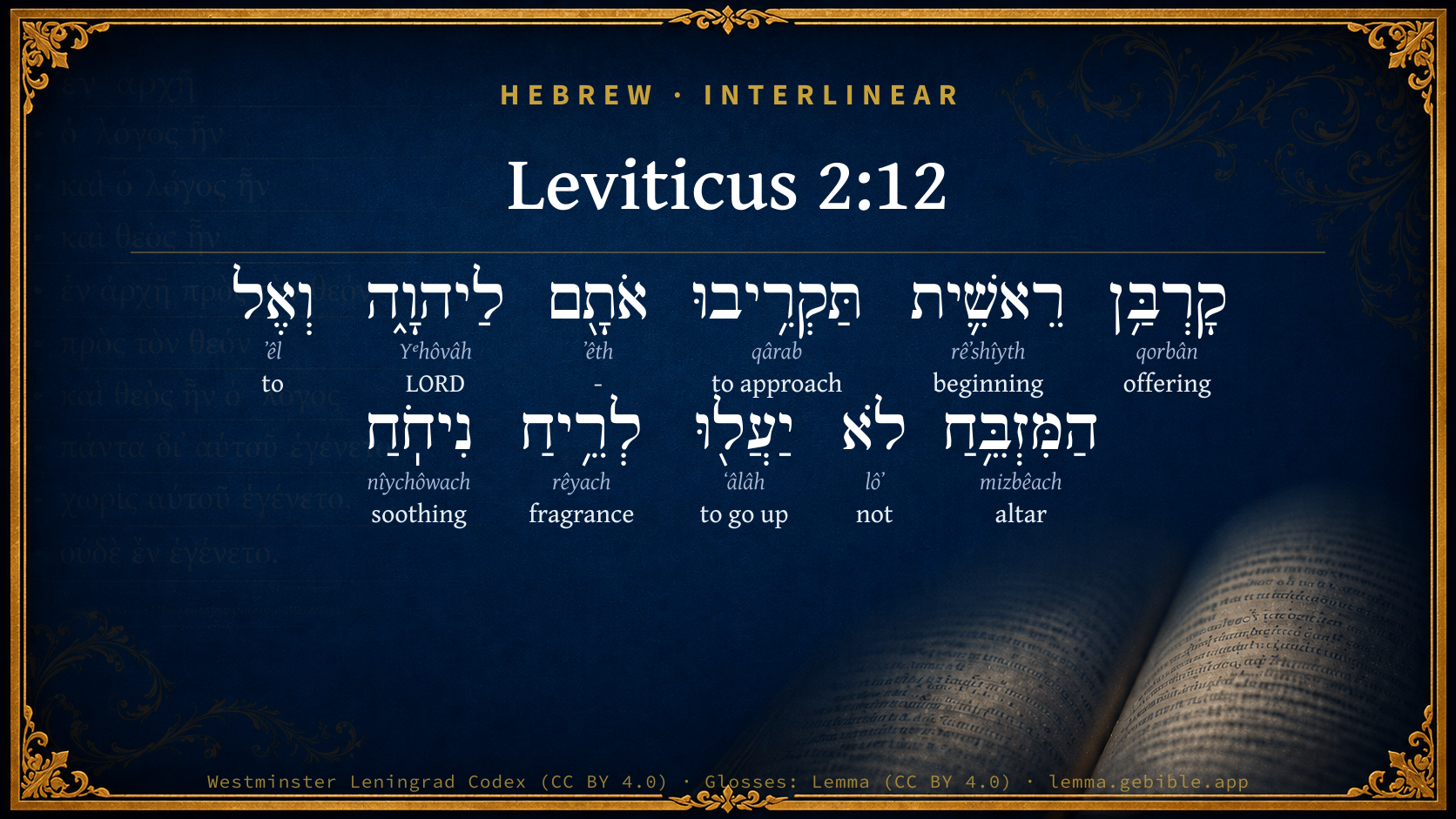
Hebrew (Westminster Leningrad Codex) Leviticus 2:12 appears in the Hebrew Old Testament. The text above is from the Westminster Leningrad Codex. Each word links to its Strong’s number, a concise gloss, and parsing drawn from the Open Scriptures Hebrew Bible morphology. Click any word for its full Brown-Driver-Briggs (BDB) entry.
Download image
Cite this verse

Leviticus 2:12 (World English Bible). Public Domain. Lemma interlinear Bible study tool, https://lemma.gebible.app/v/leviticus/2/12.

Show BibTeX & RIS
BibTeX
RIS
English Translation
As an offering of firstfruits you shall offer them to Yahweh: but they shall not come up for a sweet savor on the altar.
World English Bible · Public Domain
Download a study sheet

One document with this verse’s original text, its word-by-word gloss line, the meaning frame, cross-references with their text, attributed commentary, and full source and license credits — printable, and it pastes into notes with its structure intact.

This verse Autodidact and up

Study sheet (.html) Plain text (.txt)

A passage Seminary Student

Up to 50 verses in one chapter. A passage sheet keeps up to 6 commentary sources and 12 cross-references per verse, in the order this page ranks them, and says so on the sheet whenever that leaves anything out. Ask for a single verse and you get the Autodidact verse sheet above.

Everything on this page stays free to read, with no account — the sheet is a download of what is already on screen, not access to it.

Want to remove ads? Support Godless Engineer
Compare translations 3

The same verse in 3 English versions, stacked beneath the original-language interlinear above. Click any original word for its lexicon entry.

Each is an independent rendering of the whole verse — the interlinear is not word-aligned to these translations.

Highlighted words mark where these versions differ — a whole-verse word diff, not a word-by-word alignment.

  • World English Bible Public Domain
    As an offering of firstfruits you shall offer them to Yahweh: but they shall not come up for a sweet savor on the altar.
  • King James Version Public Domain
    As for the oblation of the firstfruits, ye shall offer them unto the LORD: but they shall not be burnt on the altar for a sweet savor.
  • unfoldingWord Literal Text CC BY-SA 4.0
    You shall present them to Yahweh an offering of first, but on the altar, they shall not go up as a scent of pleasing.

unfoldingWord Literal Text — © unfoldingWord, licensed CC BY-SA 4.0. Word-aligned USFM3 via Door43 (git.door43.org/unfoldingWord/en_ult).

Versions to compare (up to 4)

3 of 4 selected

Show all 18 translations

Every available English version of this verse, each an independent rendering of the whole verse.

  • World English Bible Public Domain
    As an offering of firstfruits you shall offer them to Yahweh: but they shall not come up for a sweet savor on the altar.
  • Berean Standard Bible Public Domain
    You may bring them to the LORD as an offering of firstfruits, but they are not to be offered on the altar as a pleasing aroma.
  • Majority Standard Bible Public Domain
    You may bring them to the LORD as an offering of firstfruits, but they must not go up on the altar as a pleasing aroma.
  • King James Version Public Domain
    As for the oblation of the firstfruits, ye shall offer them unto the LORD: but they shall not be burnt on the altar for a sweet savor.
  • American Standard Version (1901) Public Domain
    As an oblation of first -`fruits' ye shall offer them unto Jehovah: but they shall not come up for a sweet savor on the altar.
  • Revised Version (1885) Public Domain
    As an oblation of firstfruits ye shall offer them unto the LORD: but they shall not come up for a sweet savour on the altar.
  • Geneva Bible (1599) Public Domain
    In the oblation of the first fruits ye shall offer them vnto the Lord, but they shall not be burnt vpon the altar for a sweete sauour.
  • Douay-Rheims (1899) Public Domain
    You shall offer only the firstfruits of them and gifts: but they shall not be put upon the altar, for a savour of sweetness,
  • Young's Literal Translation Public Domain
    `An offering of first-`fruits' -- ye bring them near to Jehovah, but on the altar they go not up, for sweet fragrance.
  • Literal Standard Version CC BY-SA 4.0
    An offering of first-[fruits]—you bring them near to YHWH, but they do not go up on the altar for refreshing fragrance.
  • Unlocked Literal Bible CC BY-SA 4.0
    You will offer them to Yahweh as an offering of firstfruits, but they will not be used to produce a sweet aroma on the altar.
  • unfoldingWord Literal Text CC BY-SA 4.0
    You shall present them to Yahweh an offering of first, but on the altar, they shall not go up as a scent of pleasing.
  • Darby Bible Public Domain
    As to the offering of the first-fruits, ye shall present them to Jehovah; but they shall not be offered upon the altar for a sweet odour.
  • World Messianic Bible Public Domain
    As an offering of first fruits you shall offer them to the LORD, but they shall not rise up as a pleasant aroma on the altar.
  • Webster's Bible Public Domain
    As for the oblation of the first-fruits, ye shall offer them to the LORD: but they shall not be burnt on the altar for a sweet savor.
  • Free Bible Version CC BY-SA 4.0
    You may give them to the Lord when you present your offerings of firstfruits, but they must not be offered on the altar to be accepted by the Lord.
  • Bible in Basic English Public Domain
    You may give them as an offering of first-fruits to the Lord, but they are not to go up as a sweet smell on the altar.
  • JPS Tanakh (1917) Public Domain
    As an offering of first-fruits ye may bring them unto the LORD; but they shall not come up for a sweet savour on the altar.

Literal Standard Version (2020), Covenant Press — licensed CC BY-SA 4.0. Text via the HelloAO Bible API (eBible.org). Unlocked Literal Bible (unfoldingWord) — licensed CC BY-SA 4.0. Text via the HelloAO Bible API (eBible.org). unfoldingWord Literal Text — © unfoldingWord, licensed CC BY-SA 4.0. Word-aligned USFM3 via Door43 (git.door43.org/unfoldingWord/en_ult). Free Bible Version, Dr. Jonathan Gallagher — licensed CC BY-SA 4.0. Text via the HelloAO Bible API (eBible.org).

Word by word

More ways to search: Search by grammar → Find every occurrence → Compare this word →

Practice this passage: Drill this verse → Learn its vocabulary →

נִיחֹֽחַ
nîychôwach
H5207
“soothing”
Noun, Common, Masculine, Singular, Absolute
Part of Speech
Noun
Type
Common
Gender
Masculine
Number
Singular
State
Absolute
Full BDB Definition

Origin: from H5117

TWOT: 1323c

soothing, quieting, tranquillising
  1. קָרְבַּ֥ן qorbân H7133 “offering of” Noun, Common, Masculine, Singular, Construct
  2. רֵאשִׁ֛ית rêʼshîyth H7225 “beginning” Noun, Common, Feminine, Singular, Absolute
  3. תַּקְרִ֥יבוּ qârab H7126 “to approach” Verb, Hiphil, Imperfect, 2nd Person, Masculine, Plural
  4. אֹתָ֖ם ʼêth H853 “- · them” Particle, Direct Object + Suffix, Personal, 3rd Person, Masculine, Plural
  5. לַיהוָ֑ה Yᵉhôvâh H3068 “to/for · LORD” Preposition + Noun, Proper
  6. וְאֶל ʼêl H413 “and · to” Conjunction + Preposition
  7. הַמִּזְבֵּ֥חַ mizbêach H4196 “the · altar” Particle, Definite Article + Noun, Common, Masculine, Singular, Absolute
  8. לֹא lôʼ H3808 “not” Particle, Negative
  9. יַעֲל֖וּ ʻâlâh H5927 “to go up” Verb, Qal, Imperfect, 3rd Person, Masculine, Plural
  10. לְרֵ֥יחַ rêyach H7381 “to/for · fragrance of” Preposition + Noun, Common, Masculine, Singular, Construct

About this verse

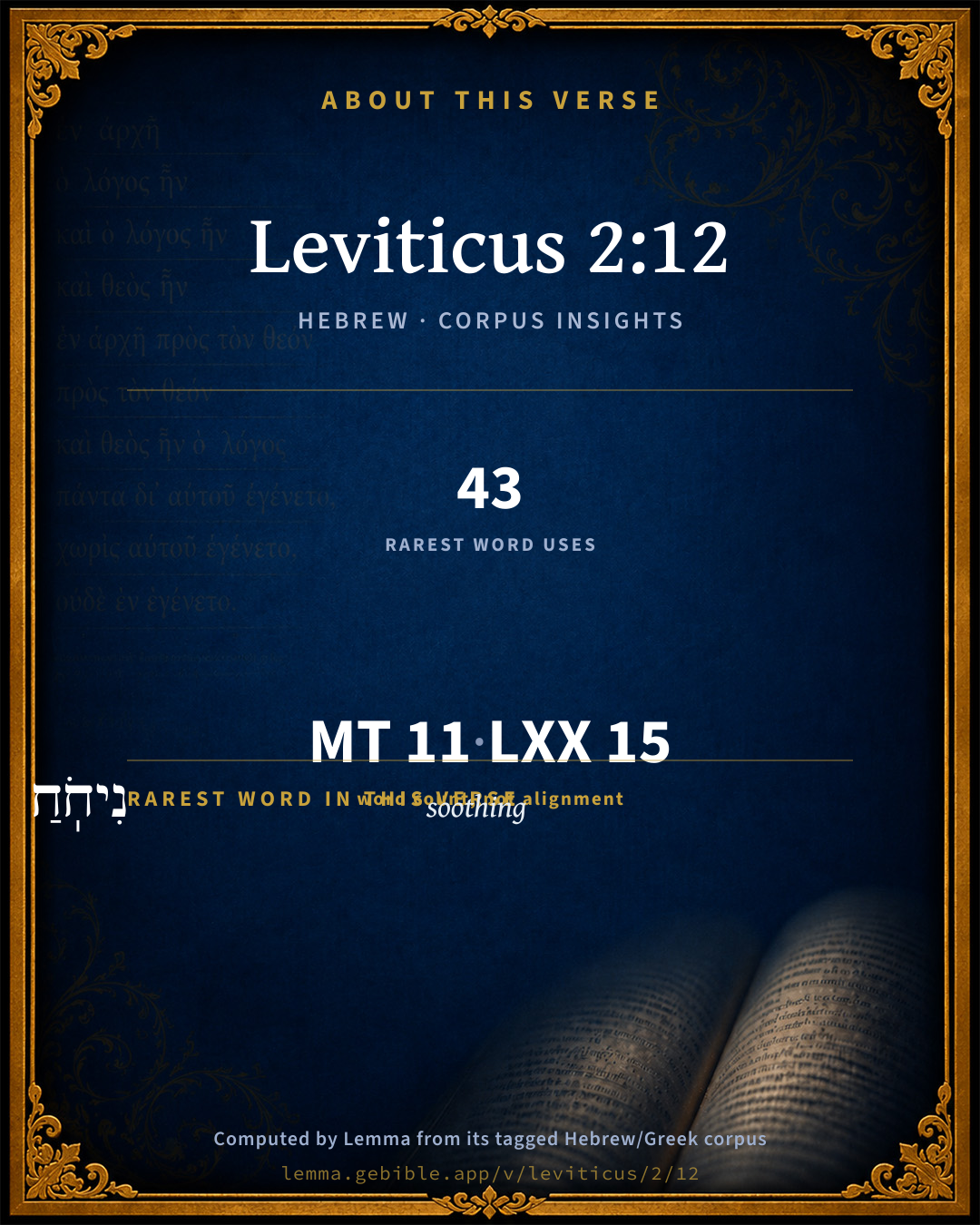
These counts appear in no published source. They are computed here, from the morphology-tagged text and Lemma’s own curated glosses. What Lemma adds →

11
words
11
distinct lemmas
Pentateuch
section

Shared distinctive vocabulary

נִיחֹֽחַ soothing H5207 occurs in 43 verses of the Hebrew Bible. Also found in:

Grammatical profile

  • 2 verbs
  • 6 nouns
  • 1 preposition
  • 2 particles

Verb forms

  • תַּקְרִ֥יבוּ Hiphil · Imperfect
  • יַעֲל֖וּ Qal · Imperfect

Hebrew & Septuagint length

In English translation the verse runs 24 words from the Hebrew and 29 from the Septuagint (LXX English) — closely comparable.

A rough comparison of the two English renderings, which tokenize alike — not a word-level alignment.

Word counts can differ between the Hebrew and the Greek without any difference in meaning — e.g. the Hebrew direct-object marker אֵת has no separate Greek word, and Greek often adds the article ὁ.

In the original languages it is 11 Hebrew tokens and 15 Greek tokens — but the two are counted differently (Hebrew bundles its prefixes and suffixes into one token; the Greek is in lemma form), so that isn’t a like-for-like length.

Cross-references

12

Topical passages linked to Leviticus 2:12 in the Treasury of Scripture Knowledge — connected by theme and wording, ordered by reader-vote popularity; previews shown in the World English Bible.

  • Exodus 23:19 The first of the first fruits of your ground you shall bring into the house of Yahweh your God. "You shall not boil a kid in its mother's milk.
  • Genesis 23:10–11 Now Ephron was sitting in the midst of the children of Heth. Ephron the Hittite answered Abraham in the hearing of the children of Heth, even of all who went in at the gate of his city, saying,
  • Genesis 23:17 So the field of Ephron, which was in Machpelah, which was before Mamre, the field, the cave which was therein, and all the trees that were in the field, that were in all the border of it round about, were made sure
  • Exodus 22:29 "You shall not delay to offer from your harvest and from the outflow of your presses. "You shall give the firstborn of your sons to me.
  • Exodus 23:10–11 "For six years you shall sow your land, and shall gather in its increase,
  • Leviticus 7:13 With cakes of leavened bread he shall offer his offering with the sacrifice of his peace offerings for thanksgiving.
  • Leviticus 23:10 "Speak to the children of Israel, and tell them, 'When you have come into the land which I give to you, and shall reap its the harvest, then you shall bring the sheaf of the first fruits of your harvest to the priest:
  • Deuteronomy 26:10 Now, behold, I have brought the first of the fruit of the ground, which you, Yahweh, have given me. You shall set it down before Yahweh your God, and worship before Yahweh your God:
  • 2 Chronicles 31:5 As soon as the commandment came abroad, the children of Israel gave in abundance the first fruits of grain, new wine, and oil, and honey, and of all the increase of the field; and the tithe of all things brought they in abundantly.
  • Revelation 14:4 These are those who were not defiled with women, for they are virgins. These are those who follow the Lamb wherever he goes. These were redeemed by Jesus from among men, the first fruits to God and to the Lamb.
  • Numbers 15:20 Of the first of your dough you shall offer up a cake for a heave-offering: as the heave-offering of the threshing floor, so shall you heave it.
  • 1 Corinthians 15:20 But now Christ has been raised from the dead. He became the first fruits of those who are asleep.

Cross-references courtesy of OpenBible.info (CC BY 4.0).

Hebrew and Greek witnesses Masoretic Hebrew ↔ Greek Septuagint

The same verse in the two great witnesses to the Old Testament, shown verse-for-verse.

These are two independent witnesses, not word-aligned to each other, and the Septuagint is shown in lemma (dictionary) form.

Hebrew Leviticus 2:12 Masoretic · Westminster Leningrad Codex

קָרְבַּ֥ן רֵאשִׁ֛ית תַּקְרִ֥יבוּ אֹתָ֖ם לַיהוָ֑ה וְאֶל הַמִּזְבֵּ֥חַ לֹא יַעֲל֖וּ לְרֵ֥יחַ נִיחֹֽחַ

As an offering of firstfruits you shall offer them to Yahweh: but they shall not come up for a sweet savor on the altar.

World English Bible · Public Domain

Greek LXX Leviticus 2:12 Septuagint · lemma form

δῶρον ἀπαρχή προςφέρω αὐτός κύριος ἐπί δέ ὁ θυσιαστήριον οὐ ἀναβιβάζω εἰς ὀσμή εὐωδία κύριος

You⌃ shall bring them in the way of fruits to the Lord, but they shall not be offered on the altar for a sweet smelling savor to the Lord.

LXX2012 (modern English Septuagint) · Public Domain

Hebrew: Westminster Leningrad Codex (CC BY 4.0). Greek: Septuagint (public domain); English from LXX2012 (modern English Septuagint) (Public Domain). How the Septuagint differs from the Hebrew →

Targum (Aramaic paraphrase)

2

The Targum is the ancient Jewish Aramaic paraphrase of the Hebrew Scriptures — an interpretive translation, not the Hebrew text itself. Onkelos (literal) and Pseudo-Jonathan (expansive) render the Torah, and Jonathan the Prophets. Coverage is partial: where no permissively-licensed English translation exists for a verse, only the Aramaic is shown. This is verse-level text, not a word-by-word alignment to the Hebrew. Some Onkelos verses here show an unreviewed machine translation (clearly flagged), not a published edition.

  1. Targum Onkelos Torah (Genesis–Deuteronomy)
    קוּרְבַּן קַדְמַי תְּקָרְבוּן יַתְהוֹן קֳדָם יְיָ וּלְמַדְבְּחָא לָא יִתַּסְקוּן לְאִתְקַבָּלָא בְּרַעֲוָא

    Unreviewed machine translation (Claude Sonnet 5) — not public domain confidence: high

    As an offering of first-fruits you shall offer them before the Lord, but they shall not be brought up upon the altar to be accepted with favor.

    Generated by an AI translate-then-audit pipeline and checked against an independent public-domain English translation of the underlying Hebrew for drift only. Not a published edition; pending human review.

    Aramaic base: public-domain Targum Onkelos (via Sefaria). The English above is the unreviewed machine translation, not public domain.

  2. Targum Pseudo-Jonathan Torah (Genesis–Deuteronomy)
    קָרְבַּן שֵׁירוּייָא תְּקַרְבוּן יַתְהוֹן קֳדָם יְיָ דִלְחֵים בִּיכּוּרַיָא חֲמִיר מִתְקָרֵיב וְתַמְרֵי בִּזְמַן בִּכּוּרֵי אִבָּא עִם דוּבְשֵׁיהּ מִתְקָרֵיב וְיֵיכְלוּן יַתְהוֹן כַּהֲנַיָא בְּרַם לְמַדְבְּחָא לָא יִתַּסְקוּן לְאִתְקַבָּלָא בְּרַעֲוָא

    When thou offerest an oblation of first fruits before the Lord, the bread of the first fruits thou mayest bring leavened, and the dates in the season of first fruits, and the fruit with its honey thou mayest bring, and the priest may eat them; but they shall not burn them at the altar as an oblation to be received with favour.

    Targum Pseudo-Jonathan — Aramaic: “Targum Jonathan on Genesis” (public domain); “Targum Jonathan on Exodus” (public domain); “Targum Jonathan on Leviticus” (public domain); “Targum Jonathan on Numbers” (public domain); “Targum Jonathan on Deuteronomy” (public domain). English: “The Targum of Jonathan ben Uzziel, trans. J. W. Etheridge, London, 1862” (public domain). Text via Sefaria.

Commentary

Notes on Leviticus 2:12 from classic Christian and Jewish commentators (each source and its license shown beneath its notes). The classic Christian expositions comment on the surrounding passage and are grouped to its opening verse, so a note may address several verses; the Jewish commentaries on the Tanakh (Rashi and others) are per-verse, so they appear only where the commentator wrote on this verse.

Lemma curates 59 commentaries, every one of them public domain or Creative Commons licensed, each selected and text-cleaned for this edition rather than reprinted as found. About our sources →

Trapp's Complete Commentary

John Trapp

Lev 2:12 As for the oblation of the firstfruits, ye shall offer them unto the LORD: but they shall not be burnt on the altar for a sweet savour.

Ver. 12. Ye shall offer them,] i.e., With the firstfruits ye shall offer both leaven {Lev 23:17} and honey. {2Ch 31:5} Both which are sometimes taken in the better part. {Mat 13:33 Son 4:11}

John Trapp, A Commentary or Exposition upon All the Books of the Old and New Testament (1647–1656) — public domain. Text from a community e-Sword module.

Joseph Benson's Commentary

Lev 2:12. Ye may offer them — Or either of them, leaven or honey. They shall not be burnt — But reserved for the priests.

Joseph Benson's Commentary on the Old and New Testaments (1811–1818) — public domain. Text from a community e-Sword module.

Tyndale Open Study Notes

Tyndale Open Resources

2:12 offering of the first crops: This offering (called “firstfruits” in many translations) was brought from the first part of the harvest (23:15-21; Num 28:26-31). Like the representative portion of the grain offering, this offering acknowledged that the entire harvest belonged to God (Lev 23:10-11; Exod 22:29; 23:19; 34:26; Num 15:18-20; Deut 18:4-5; 26:1-2). It further recognized that the land itself, not just its products, belonged to God; Israel was merely the tenant (see Lev 25:23).

Tyndale Open Study Notes — © Tyndale Open Resources, licensed CC BY-SA 4.0. Text via the HelloAO Bible API.

Geneva Bible (1599)

Geneva Bible translators

That is, fruits, which were sweet as honey, ye may offer.

But reserved for the Priests.

Geneva Bible (1599) marginal notes — public domain. Text via Bolls.life.

Jamieson, Fausset & Brown

Robert Jamieson, A. R. Fausset & David Brown

the oblation of the first-fruits--voluntary offerings made by individuals out of their increase, and leaven and honey might be used with these (Lev 23:17; Num 15:20). Though presented at the altar, they were not consumed, but assigned by God for the use of the priests.

Jamieson, Fausset & Brown — Commentary Critical and Explanatory on the Whole Bible (1871) — public domain (CC PDM 1.0). Text via the HelloAO Bible API.

Ellicott's Commentary for English Readers

(12) As for the oblation.—Better, as an oblation of firstfruits ye may offer them. This verse mentions an exception to the rule laid down in the previous one. i.e., leaven and honey, which are excluded from the meat offerings, may be used with firstfruits. Hence they are mentioned with firstfruits (Lev_23:17; 2Ch_31:5).

A Bible Commentary for English Readers, edited by Charles John Ellicott (1878–1897) — public domain. Text from a community e-Sword module.

John Gill's Exposition

As for the oblation of the firstfruits, ye shall offer them unto the Lord,.... Or "in" or "with the oblation", as some render it; that is, along with the oblation of the firstfruits leaven and honey might be offered: the Arabic version is very express, "but for a sacrifice of firstfruits ye" shall offer both to God; as they might be, as before observed; so the Targum of Jonathan,"for the leavened bread of the firstfruits shall be offered, and dates in the time of the firstfruits; the fruits with their honey shall be offered, and the priest shall eat them:"

but they shall not be burnt on the altar for a sweet savour; which they could not make, and besides were to be the portion of the priests.

John Gill's Exposition of the Whole Bible (1746–1763) — public domain (CC PDM 1.0). Text via the HelloAO Bible API.

Haydock's Catholic Bible Commentary

First-fruits, &c., to be voluntarily given to the priest, in honour of God. The honey arising from the dates might also be offered. --- It was little inferior to that of bees. (Josephus, Jewish Wars v. 3.) See Numbers xv. 19.

George Leo Haydock (1774–1849), Haydock's Catholic Family Bible and Commentary, 1859 edition — public domain. Excludes Psalms (Douay-Rheims chapter numbering differs from Protestant) and Deuterocanonical books (Catholic canon only).

Matthew Poole's English Annotations

Or, the offering, or, for the offering of the first-fruits you

shall or may offer them, or either of them, to wit, leaven or honey, which were offered and accepted in that case, Lev 23:17; 2Ch 31:5.

They shall not be burnt; but reserved for the priests, Num 18:13; Deu 18:4.

Matthew Poole's English Annotations on the Holy Bible (1683–1685) — public domain. Text from a community e-Sword/MySword module.

Whedon's Commentary on the Bible

Daniel D. Whedon

12. Firstfruits — This oblation was to be made publicly by the nation at the three great annual festivals, but individuals could make it at any time. On the morrow after the passover sabbath a sheaf, usually of barley, was waved before the altar. Before this no harvesting could be begun. Fifty days afterwards, as the word pentecost implies, two loaves made from the new flour were to be waved in like manner. The feast of ingathering, or the feast of tabernacles, was itself an acknowledgment of the gift of fruitfulness. Individuals brought the first dough for a heave offering, and a basket of firstfruits, and set it down by the altar and repeated the story of Israel in Egypt. Though the law required the offering of the firstfruits of all the harvests, only seven kinds of produce in their natural state were by usage liable to oblation — wheat, barley, grapes, figs, pomegranates, olives, and dates. The minimum oblation fixed by custom was one sixtieth part, aside from the tithes, and the corners or borders of the field left for the poor. Seven sorts of firstfruits, prepared for uses, were not required to be taken to Jerusalem, but probably to designated depositories — wine, wool, bread, oil, date-honey, and preparations of onions and of cucumbers, from a fortieth to a sixtieth of the whole product. The offerings, not only those at the altar, but those laid up elsewhere, were perquisites of the priests. Jews in foreign lands sent their firstfruits to the Holy City.

Daniel D. Whedon (gen. ed.), Commentary on the Old and New Testaments (1874–1909) — public domain. Text from a community e-Sword module.

The Pulpit Commentary

Chapter Pro_3:9 1Co_15:23 Jam_1:18. This arrangement about the firstfruits, though appended to the meat offering, demands a special notice. The meat offering, we have seen, affirms the general principle that our life-work should be dedicated to God. But here in the firstfruits we have a special portion which is to be regarded as too sacred for any but Divine use. This leads us directly to affirm

I WHILE GOD HAS A RIGHT TO ALL, HE CLAIMS A SPECIAL RIGHT TO THE FIRSTFRUITS OF ALL OUR INCREASE. The danger is in losing sight of the special claim in asserting the general principle. For instance, we must not deny God a special claim upon the first day of the week, because we acquiesce in the general principle that he has a right to all our time. Again, we must not withhold our tithes, a certain proportion of our substance, through an easy-going statement that he has a right to all our substance. We must condescend to particulars.

II THE DEDICATION OF THE FIRSTFRUITS EXTENDED TO ANIMALS AS WELL AS TO the VEGETABLE KINGDOM. The dedication of the firstborn of man and beast is manifestly part and parcel of the same principle. (Exo_13:1-16) This leads up to God"s right to the Firstborn of the human race, to him of whom the Father said, "I will make him my firstborn, higher than the kings of the earth". (Psa_89:27) Jesus is the Firstborn of humanity, the flower and firstfruits of the race. Hence we find the expression used regarding the risen Saviour, "But now is Christ risen from the dead, and become the firstfruits of them that slept". (1Co_15:23) He is also called "the firstborn from the dead". (Col_1:18) Of him, therefore, pre-eminently was the dedication of the firstfruits typical.

If God has a right to the firstfruits of the life-work of the human race, he receives in the perfectly holy life of Jesus Christ. So that, as we found the meat offering to this, so do we find this arrangement about the firstfruits.

III GOD HAS ALSO A RIGHT TO SERVICE, EVEN THOUGH IT MAY NOT BE PERFECT. This seems to be the principle underlying the "oblation of the firstfruits." This, as we from Lev_23:15-21, was presented at Pentecost, and consisted of two tenth-flour baked with leaven. Such an arrangement points to the possibility of imperfection in serving God, which was met by the sin offering accompanying it. If, then, the firstfruits at the Passover, presented with oil and frankincense, typified Christ the Firstfruits in all his perfection; the oblation at Pentecost typified believers, Gentiles and Jews, who are trying, though imperfectly, to realize a consecrated life-work. God does not reject the labours of his people, even though they are very far from perfect. He has provided a sin offering to meet the imperfections of the case and render all acceptable to him.

IV THE DEDICATION OF THE FIRSTFRUITS WAS THE EXPRESSION NOT ONLY OF THANKSGIVING BUT ALSO OF FAITH. God"s rights first, even before man"s need has been met. It was seeking God"s kingdom first, in the assurance that all the needful things shall be added. (Mat_6:33) It is most important that we should always act in this trustful spirit. This faith is, in fact, a kind of firstfruits of the spiritual life which the Lord expect s, and in rendering it to him we experience wondrous comfort and blessing. R.M.E.

The Pulpit Commentary (1880–1919), ed. H.D.M. Spence-Jones & Joseph S. Exell — public domain. Text from a community e-Sword module.

John Wesley's Explanatory Notes

Ye may offer them - Or either of them, leaven or honey. They shall not be burnt - But reserved for the priests.

John Wesley, Explanatory Notes Upon the Whole Bible (1754–1765) — public domain. Text via the GEBible commentary corpus.

Keil & Delitzsch

C. F. Keil & F. Delitzsch

The presentation of the minchah "made of these things," i.e., of the different kinds of pastry mentioned in Lev 2:4-7, resembled in the main that described in Lev 2:1-3. The מן הרים in Lev 2:9 corresponds to the מן קמץ in Lev 2:2, and does not denote any special ceremony of heaving, as is supposed by the Rabbins and many archaeological writers, who understand by it a solemn movement up and down. This will be evident from a comparison of Lev 3:3 with Lev 4:8, Lev 4:31, Lev 4:35, and Lev 7:3. In the place of ממּנּוּ ירים in Lev 4:8 we find מזּבח הקריב in Lev 4:10, חלב חוּסר כּאשׁר חוּ in Lev 4:31 and Lev 4:35; so that מן הרים evidently denotes simply the lifting off or removal of those parts which were to be burned upon the altar from the rest of the sacrifice (cf. Bhr, ii. 357, and my Archologie i. p. 244-5). - In Lev 2:11-13 there follow two laws which were applicable to all the meat-offerings: viz., to offer nothing leavened (Lev 2:11), and to salt every meat-offering, and in fact every sacrifice, with salt (Lev 2:13). Every minchah was to be prepared without leaven: "for all leaven, and all honey, ye shall not burn a firing of it for Jehovah. As an offering of first-fruits ye may offer them (leaven and honey, i.e., pastry made with them) to Jehovah, but they shall not come upon the altar." Leaven and honey are mentioned together as things which produce fermentation. Honey has also an acidifying or fermenting quality, and was even used for the preparation of vinegar (Plin. h. n. 11, 15; 21, 14). In rabbinical writings, therefore, הדבישׁ signifies not only dulcedinem admittere, but corrumpsi, fermentari, fermentescere (vid., Buxtorf, lex. chald. talm. et rabb. p. 500). By "honey" we are to understand not grape-honey, the dibs of the Arabs, as Rashi and Bhr do, but the honey of bees; for, according to Ch2 31:5, this alone was offered as an offering of first-fruits along with corn, new wine, and oil; and in fact, as a rule, this was the only honey used by the ancients in sacrifice (see Bochart, Hieroz. iii. pp. 393ff.). The loaves of first-fruits at the feast of Weeks were leavened; but they were assigned to the priests, and not burned upon the altar (Lev 23:17, Lev 23:20). So also were the cakes offered with the vow-offerings, which were applied to the sacrificial meal (Lev 7:13); but not the shew-bread, as Knobel maintains (see at Lev 24:5.). Whilst leaven and honey were forbidden to be used with any kind of minchah, because of their producing fermentation and corruption, salt on the other hand was not to be omitted from any sacrificial offering. "Thou shalt not let the salt of the covenant of thy God cease from thy meat-offering," i.e., thou shalt never offer a meat-offering without salt. The meaning which the salt, with its power to strengthen food and preserve it from putrefaction and corruption, imparted to the sacrifice, was the unbending truthfulness of that self-surrender to the Lord embodied in the sacrifice, by which all impurity and hypocrisy were repelled. The salt of the sacrifice is called the salt of the covenant, because in common life salt was the symbol of covenant; treaties being concluded and rendered firm and inviolable, according to a well-known custom of the ancient Greeks (see Eustathius ad Iliad. i. 449) which is still retained among the Arabs, by the parties to an alliance eating bread and salt together, as a sign of the treaty which they had made. As a covenant of this kind was called a "covenant of salt," equivalent to an indissoluble covenant (Num 18:19; Ch2 13:5), so here the salt added to the sacrifice is designated as salt of the covenant of God, because of its imparting strength and purity to the sacrifice, by which Israel was strengthened and fortified in covenant fellowship with Jehovah. The following clause, "upon (with) every sacrificial gift of thine shalt thou offer salt," is not to be restricted to the meat-offering, as Knobel supposes, nor to be understood as meaning that the salt was only to be added to the sacrifice externally, to be offered with or beside it; in which case the strewing of salt upon the different portions of the sacrifice (Eze 43:24; Mar 9:49) would have been a departure from the ancient law. For korban without any further definition denotes the sacrificial offerings generally, the bleeding quite as much as the bloodless, and the closer definition of על הקריב (offer upon) is contained in the first clause of the verse, "season with salt." The words contain a supplementary rule which was applicable to every sacrifice (bleeding and bloodless), and was so understood from time immemorial by the Jews themselves (cf. Josephus, Ant. iii. 9, 1).

(Note: The Greeks and Romans also regarded salt as indispensable to a sacrifice. Maxime in sacris intelligitur auctoritas salis, quando nulla conficiuntur sine mola salsa. Plin. h. n. 31, 7, (cf. 41).)

Keil & Delitzsch — Biblical Commentary on the Old Testament (1861–1891) — public domain (CC PDM 1.0). Text via the HelloAO Bible API. (Old Testament only.)

Kretzmann's Popular Commentary

Paul E. Kretzmann

The Meat-offering of the First-Fruits. —

v. 12. As for the oblation of the first-fruits, ye shall offer them unto the Lord, bring them as gifts in order to establish or to confirm the fellowship with the Lord; but they shall not be burned on the altar for a sweet savor. In such offerings, therefore, even leaven and honey might be included.

v. 13. And every oblation of thy meat-offering shalt thou season with salt, this being both a purifier and a preservative; neither shalt thou suffer the salt of the covenant of thy God to be lacking from thy meat-offering; with all thine offerings thou shalt offer salt. Cf Mar 9:49; Col 4:6. This rule applied not only to meat-offerings, but to all offerings commanded by God.

v. 14. And if thou offer a meat-offering of thy first-fruits unto the Lord, of the first grain that was ready to harvested in the early summer,thou shalt offer for the meat-offering of thy first-fruits green ears of corn dried by the fire, even corn beaten out of full ears. The stalks of the grain were cut with the maturing ears, and the grain roasted at the fire while in the ear, such dried or roasted kernels, in the form of groats, being a favorite dish in the Orient to this day.

v. 15. And thou shalt put oil upon it, and lay fankincense thereon, as in the case of the fine flour; it is a meat-offering.

v. 16. And the priest shall burn the memorial of it, part of the beaten corn thereof and part of the oil thereof, with all the frankincense thereof; it is an offering made by fire unto the Lord. It is undoubtedly well-pleasing to the Lord if we, in addition to the regular sacrifices in good works, are found willing to offer to Him in extraordinary quantities, if He has blessed us in unusual measure.

Paul E. Kretzmann, Popular Commentary of the Bible (1921–1924) — public domain. Text from a community e-Sword module.

Rashi

Rabbi Shlomo Yitzchaki (Rashi)

קרבן ראשית תקריבו אתם YE MAY OFFER THEM AS AN OFFERING OF THE FIRST FRUITS — But what is it that you have to offer of leaven and of honey? The offering of the first fruits, viz., the “two loaves’’ of the Feast of Weeks” that were brought of leavened dough, — as it is said, (Leviticus 23:16, 17) “[and ye shall offer a new meal-offering unto the Lord... two loaves] they shall be baken leavened”. — and the first ripe fruits were brought of species that contain sweet juices (דבש), such as the firstlings of figs and dates (Menachot 58a).

Rashi on the Tanakh — English translations: “The Judaica Press complete Tanach with Rashi, translated by A. J. Rosenberg” (CC BY 4.0); “Pentateuch with Rashi's commentary by M. Rosenbaum and A.M. Silbermann, 1929-1934” (public domain); “The Metsudah Tanach series, Lakewood, N.J” (CC BY 4.0); and “The Book of Joshua, Metsudah Publications, 1997” (CC BY 4.0). Text via Sefaria.

Lesson kit

Teaching starters — assembled from the data on this page, not authored interpretation. Every prompt links to the verse data it draws on. Edit before teaching.

Leviticus, in the Pentateuch, opens this verse with 11 words (11 distinct Hebrew lemmas). Its most distinctive word is nîychôwach (“soothing”). A historical commentator’s framing appears above. Read the whole chapter for the surrounding context.

Discussion questions

  1. How does “soothing” (nîychôwach) shape what this verse is saying?
  2. How does Genesis 8:21, which shares the word «soothing», read alongside this verse?
  3. These translations render this verse differently. What is at stake in choosing one wording over another?
  4. «תַּקְרִ֥יבוּ» is a Hiphil Imperfect verb. How does that grammatical form shape the action described?
  5. Compare how Trapp's Complete Commentary and Joseph Benson's Commentary read this verse. Where do they agree or differ?

Things to notice

Reading settings

Reading text

Shown beneath each verse's original-language words.

Old Testament
Old Testament edition

Read the OT as the Masoretic Hebrew (MT) or the Greek Septuagint (LXX).

English shown for the Greek Septuagint (in the Hebrew ↔ Greek comparison).

Comparing translations? Open the Compare panel on any verse page to stack up to four side by side.