1 Samuel 19:15

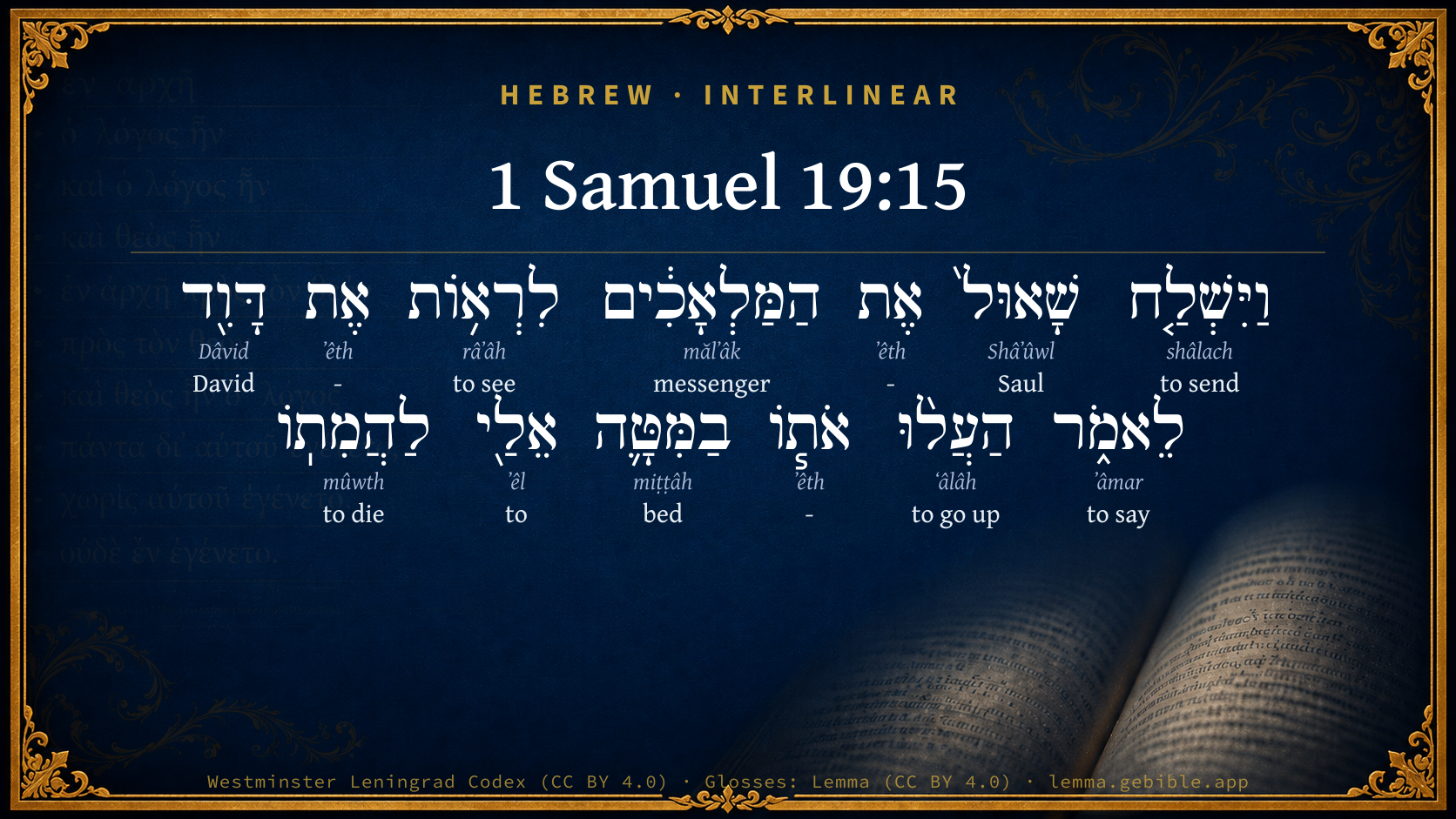
Hebrew (Westminster Leningrad Codex) 1 Samuel 19:15 appears in the Hebrew Old Testament. The text above is from the Westminster Leningrad Codex. Each word links to its Strong’s number, a concise gloss, and parsing drawn from the Open Scriptures Hebrew Bible morphology. Click any word for its full Brown-Driver-Briggs (BDB) entry.
Download image
Cite this verse

1 Samuel 19:15 (World English Bible). Public Domain. Lemma interlinear Bible study tool, https://lemma.gebible.app/v/1-samuel/19/15.

Show BibTeX & RIS
BibTeX
RIS
English Translation
Saul sent the messengers to see David, saying, Bring him up to me in the bed, that I may kill him.
World English Bible · Public Domain
Download a study sheet

One document with this verse’s original text, its word-by-word gloss line, the meaning frame, cross-references with their text, attributed commentary, and full source and license credits — printable, and it pastes into notes with its structure intact.

This verse Autodidact and up

Study sheet (.html) Plain text (.txt)

A passage Seminary Student

Up to 50 verses in one chapter. A passage sheet keeps up to 6 commentary sources and 12 cross-references per verse, in the order this page ranks them, and says so on the sheet whenever that leaves anything out. Ask for a single verse and you get the Autodidact verse sheet above.

Everything on this page stays free to read, with no account — the sheet is a download of what is already on screen, not access to it.

Want to remove ads? Support Godless Engineer
Compare translations 3

The same verse in 3 English versions, stacked beneath the original-language interlinear above. Click any original word for its lexicon entry.

Each is an independent rendering of the whole verse — the interlinear is not word-aligned to these translations.

Highlighted words mark where these versions differ — a whole-verse word diff, not a word-by-word alignment.

  • World English Bible Public Domain
    Saul sent the messengers to see David, saying, Bring him up to me in the bed, that I may kill him.
  • King James Version Public Domain
    And Saul sent the messengers again to see David, saying, Bring him up to me in the bed, that I may slay him.
  • unfoldingWord Literal Text CC BY-SA 4.0
    So Saul sent messengers to see David, saying, “Bring him up to me in the bed to kill him.”

unfoldingWord Literal Text — © unfoldingWord, licensed CC BY-SA 4.0. Word-aligned USFM3 via Door43 (git.door43.org/unfoldingWord/en_ult).

Versions to compare (up to 4)

3 of 4 selected

Show all 18 translations

Every available English version of this verse, each an independent rendering of the whole verse.

  • World English Bible Public Domain
    Saul sent the messengers to see David, saying, Bring him up to me in the bed, that I may kill him.
  • Berean Standard Bible Public Domain
    But Saul sent the messengers back to see David and told them, “Bring him up to me in his bed so I can kill him.”
  • Majority Standard Bible Public Domain
    But Saul sent the messengers back to see David and told them, “Bring him up to me in his bed so I can kill him.”
  • King James Version Public Domain
    And Saul sent the messengers again to see David, saying, Bring him up to me in the bed, that I may slay him.
  • American Standard Version (1901) Public Domain
    And Saul sent the messengers to see David, saying, Bring him up to me in the bed, that I may slay him.
  • Revised Version (1885) Public Domain
    And Saul sent the messengers to see David, saying, Bring him up to me in the bed, that I may slay him.
  • Geneva Bible (1599) Public Domain
    And Saul sent the messengers againe to see Dauid, saying, Bring him to me in the bed, that I may slay him.
  • Douay-Rheims (1899) Public Domain
    And again Saul sent to see David, saying: Bring him to me in the bed, that he may be slain.
  • Young's Literal Translation Public Domain
    And Saul sendeth the messengers to see David, saying, `Bring him up in the bed unto me,' -- to put him to death.
  • Literal Standard Version CC BY-SA 4.0
    And Saul sends the messengers to see David, saying, “Bring him up in the bed to me in order to put him to death.”
  • Unlocked Literal Bible CC BY-SA 4.0
    Then Saul sent the messengers to see David; he said, “Bring him up to me in the bed, so that I may kill him.”
  • unfoldingWord Literal Text CC BY-SA 4.0
    So Saul sent messengers to see David, saying, “Bring him up to me in the bed to kill him.”
  • Darby Bible Public Domain
    And Saul sent the messengers to see David, saying, Bring him up to me in the bed, that I may put him to death.
  • World Messianic Bible Public Domain
    Saul sent the messengers to see David, saying, “Bring him up to me in the bed, that I may kill him.”
  • Webster's Bible Public Domain
    And Saul sent the messengers again to see David, saying, Bring him to me in the bed, that I may slay him.
  • Free Bible Version CC BY-SA 4.0
    Saul sent the messengers back to see David, saying, “Bring him to me in the bed so I can kill him.”
  • Bible in Basic English Public Domain
    And Saul sent his men to see David, saying, Do not come back without him, take him in his bed, so that I may put him to death.
  • JPS Tanakh (1917) Public Domain
    And Saul sent the messengers to see David, saying: 'Bring him up to me in the bed, that I may slay him.'

Literal Standard Version (2020), Covenant Press — licensed CC BY-SA 4.0. Text via the HelloAO Bible API (eBible.org). Unlocked Literal Bible (unfoldingWord) — licensed CC BY-SA 4.0. Text via the HelloAO Bible API (eBible.org). unfoldingWord Literal Text — © unfoldingWord, licensed CC BY-SA 4.0. Word-aligned USFM3 via Door43 (git.door43.org/unfoldingWord/en_ult). Free Bible Version, Dr. Jonathan Gallagher — licensed CC BY-SA 4.0. Text via the HelloAO Bible API (eBible.org).

Word by word

More ways to search: Search by grammar → Find every occurrence → Compare this word →

Practice this passage: Drill this verse → Learn its vocabulary →

בַמִּטָּ֛ה
miṭṭâh
H4296
“in/at the · bed”
Preposition, Determined + Noun, Common, Feminine, Singular, Absolute
Part of Speech
Preposition + Noun
Type
Common
Gender
Feminine
Number
Singular
State
Absolute
Full BDB Definition

Origin: from H5186

TWOT: 1352c

couch, bed, bier
  1. וַיִּשְׁלַ֤ח shâlach H7971 “and · to send” Conjunction + Verb, Qal, Sequential Imperfect, 3rd Person, Masculine, Singular
  2. שָׁאוּל֙ Shâʼûwl H7586 “Saul” Noun, Proper
  3. אֶת ʼêth H853 “-” Particle, Direct Object
  4. הַמַּלְאָכִ֔ים mălʼâk H4397 “the · messengers” Particle, Definite Article + Noun, Common, Masculine, Plural, Absolute
  5. לִרְא֥וֹת râʼâh H7200 “to see” Preposition + Verb, Qal, Infinitive Construct
  6. אֶת ʼêth H853 “-” Particle, Direct Object
  7. דָּוִ֖ד Dâvid H1732 “David” Noun, Proper
  8. לֵאמֹ֑ר ʼâmar H559 “to say” Preposition + Verb, Qal, Infinitive Construct
  9. הַעֲל֨וּ ʻâlâh H5927 “go up” Verb, Hiphil, Imperative, 2nd Person, Masculine, Plural
  10. אֹת֧וֹ ʼêth H853 “- · him” Particle, Direct Object + Suffix, Personal, 3rd Person, Masculine, Singular
  11. אֵלַ֖י ʼêl H413 “to · me” Preposition + Suffix, Personal, 1st Person, Common, Singular
  12. לַהֲמִתֽוֹ mûwth H4191 “to die · him” Preposition + Verb, Hiphil, Infinitive Construct + Suffix, Personal, 3rd Person, Masculine, Singular

About this verse

These counts appear in no published source. They are computed here, from the morphology-tagged text and Lemma’s own curated glosses. What Lemma adds →

13
words
11
distinct lemmas
Historical
section

Shared distinctive vocabulary

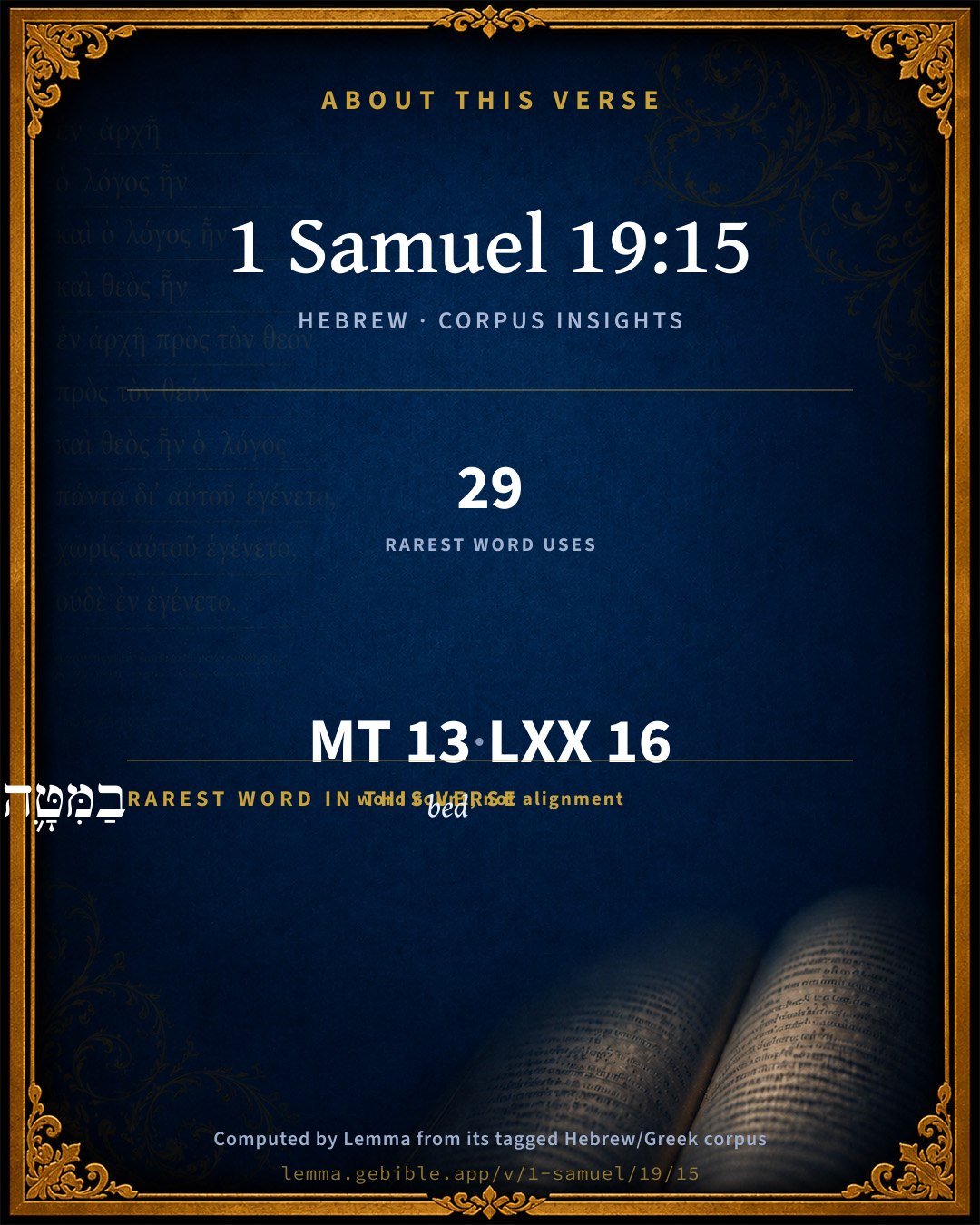
בַמִּטָּ֛ה bed H4296 occurs in 29 verses of the Hebrew Bible. Also found in:

Grammatical profile

  • 5 verbs
  • 4 nouns
  • 1 preposition
  • 3 particles

Verb forms

  • וַיִּשְׁלַ֤ח Qal · Sequential Imperfect
  • לִרְא֥וֹת Qal · Infinitive Construct
  • לֵאמֹ֑ר Qal · Infinitive Construct
  • הַעֲל֨וּ Hiphil · Imperative
  • לַהֲמִתֽוֹ Hiphil · Infinitive Construct

Hebrew & Septuagint length

In English translation the verse runs 21 words from the Hebrew and 18 from the Septuagint (LXX English) — closely comparable.

A rough comparison of the two English renderings, which tokenize alike — not a word-level alignment.

Word counts can differ between the Hebrew and the Greek without any difference in meaning — e.g. the Hebrew direct-object marker אֵת has no separate Greek word, and Greek often adds the article ὁ.

In the original languages it is 13 Hebrew tokens and 16 Greek tokens — but the two are counted differently (Hebrew bundles its prefixes and suffixes into one token; the Greek is in lemma form), so that isn’t a like-for-like length.

Cross-references

5

Topical passages linked to 1 Samuel 19:15 in the Treasury of Scripture Knowledge — connected by theme and wording, ordered by reader-vote popularity; previews shown in the World English Bible.

  • 1 Samuel 19:6 Saul listened to the voice of Jonathan: and Saul swore, As Yahweh lives, he shall not be put to death.
  • Job 31:31 If the men of my tent have not said, 'Who can find one who has not been filled with his meat?'
  • Psalms 37:12 The wicked plots against the just, And gnashes at him with his teeth.
  • Proverbs 27:3–4 A stone is heavy, And sand is a burden; But a fool's provocation is heavier than both.
  • Romans 3:15 "Their feet are swift to shed blood.

Cross-references courtesy of OpenBible.info (CC BY 4.0).

Hebrew and Greek witnesses Masoretic Hebrew ↔ Greek Septuagint

The same verse in the two great witnesses to the Old Testament, shown verse-for-verse.

These are two independent witnesses, not word-aligned to each other, and the Septuagint is shown in lemma (dictionary) form.

Hebrew 1 Samuel 19:15 Masoretic · Westminster Leningrad Codex

וַיִּשְׁלַ֤ח שָׁאוּל֙ אֶת הַמַּלְאָכִ֔ים לִרְא֥וֹת אֶת דָּוִ֖ד לֵאמֹ֑ר הַעֲל֨וּ אֹת֧וֹ בַמִּטָּ֛ה אֵלַ֖י לַהֲמִתֽוֹ

Saul sent the messengers to see David, saying, Bring him up to me in the bed, that I may kill him.

World English Bible · Public Domain

Greek LXX 1 Samuel 19:15 Septuagint · lemma form

καί ἀποστέλλω ἐπί ὁ δαυίδ λέγω ἄγω αὐτός ἐπί ὁ κλίνη πρός ἐγώ ὁ θανατόω αὐτός

And he sends to David, saying, Bring him to me on the bed, that I may kill him.

LXX2012 (modern English Septuagint) · Public Domain

Hebrew: Westminster Leningrad Codex (CC BY 4.0). Greek: Septuagint (public domain); English from LXX2012 (modern English Septuagint) (Public Domain). How the Septuagint differs from the Hebrew →

Targum (Aramaic paraphrase)

1

The Targum is the ancient Jewish Aramaic paraphrase of the Hebrew Scriptures — an interpretive translation, not the Hebrew text itself. Onkelos (literal) and Pseudo-Jonathan (expansive) render the Torah, and Jonathan the Prophets. Coverage is partial: where no permissively-licensed English translation exists for a verse, only the Aramaic is shown. This is verse-level text, not a word-by-word alignment to the Hebrew.

  1. Targum Jonathan Prophets (Joshua–Malachi)
    וּשְׁלַח שָׁאוּל יַת אִזְגַדַיָא לְמִסְעַד יַת דָוִד לְמֵימַר אַסִיקוּ יָתֵיהּ בְּעַרְסָא לְוָתִי לְמִקְטְלֵיהּ:

    (no public-domain English translation for this verse)

    Targum Jonathan — Aramaic: “Mikraot Gedolot” (public domain). English: “Sefaria Community Translation” (CC0 1.0 (public-domain dedication)); “London "Chaldee Paraphrase," 1871” (public domain). Text via Sefaria.

Commentary

Notes on 1 Samuel 19:15 from classic Christian and Jewish commentators (each source and its license shown beneath its notes). The classic Christian expositions comment on the surrounding passage and are grouped to its opening verse, so a note may address several verses; the Jewish commentaries on the Tanakh (Rashi and others) are per-verse, so they appear only where the commentator wrote on this verse.

Lemma curates 59 commentaries, every one of them public domain or Creative Commons licensed, each selected and text-cleaned for this edition rather than reprinted as found. About our sources →

Trapp's Complete Commentary

John Trapp

1Sa 19:15 And Saul sent the messengers [again] to see David, saying, Bring him up to me in the bed, that I may slay him.

Ver. 15. Bring him up to me in the bed.] So greedily did this sanguinary seek, and so fain would he have sucked David’s blood: but the bird was flown, God having better provided; and David was now making or singing that Psa 59:1, "Deliver me from mine enemies, O God," &c., as appeareth by the title. {See Trapp on "Psa 59:1"}

That I may slay him.] And then say of him as bloody Caracalla the emperor did of his brother Geta, whom he had slain and afterwards deified; Sit divus, modo non sit virus, Let him go to heaven, so that I may not be troubled with him upon earth.

John Trapp, A Commentary or Exposition upon All the Books of the Old and New Testament (1647–1656) — public domain. Text from a community e-Sword module.

Geneva Bible (1599)

Geneva Bible translators

Behold, how the tyrants to accomplish their rage, neither regard oath nor friendship, God nor man.

Geneva Bible (1599) marginal notes — public domain. Text via Bolls.life.

Jamieson, Fausset & Brown

Robert Jamieson, A. R. Fausset & David Brown

Bring him to me in the bed--a portable couch or mattress.

Jamieson, Fausset & Brown — Commentary Critical and Explanatory on the Whole Bible (1871) — public domain (CC PDM 1.0). Text via the HelloAO Bible API.

The Cambridge Bible for Schools and Colleges

gen. ed. J. J. S. Perowne

15. Bring him up] This indicates that Saul’s residence was on the hill of Gibeah, David’s in the lower town.

The Cambridge Bible for Schools and Colleges (gen. ed. J. J. S. Perowne; Cambridge University Press, 1878–1918) — public domain. Text from a community e-Sword module.

John Gill's Exposition

And Saul sent the messengers again to see David,.... Not to visit him, or to see how he was, or inquire of his health, in a kind manner, but to see his person, whether he was sick or not, and whether he was there or not; for Saul might suspect some deceit was used, because the messengers took the report of Michal, and saw not David, nor attempted to see him; but now they have strict orders to see him, and not take Michal's word as before, Sa1 19:14; wherefore the supplement again may be left out:

saying, bring him up to me in the bed; if so bad that he was not able to rise, or not fit to be taken out of his bed, his orders were, that he should be brought to him in it; resolved he was to have him, sick or well:

that I may slay him: not content that he should die a natural death, or willing to wait for it, he is in haste, being full of wrath and malice, to slay him himself.

John Gill's Exposition of the Whole Bible (1746–1763) — public domain (CC PDM 1.0). Text via the HelloAO Bible API.

Matthew Poole's English Annotations

Again to see David, or only, to see David, which they did not before, but went away satisfied (as it was fit they should) with her report and testimony of his sickness.

Matthew Poole's English Annotations on the Holy Bible (1683–1685) — public domain. Text from a community e-Sword/MySword module.

Keil & Delitzsch

C. F. Keil & F. Delitzsch

But when Saul sent the messengers again to see David, and that with the command, "Bring him up to me in the bed," and when they only found the teraphim in the bed, and Saul charged Michal with this act of deceit, she replied, "He (David) said to me, Let me go; why should I kill thee?" - "Behold, teraphim were (laid) in the bed." The verb can be naturally supplied from Sa1 19:13. In the words "Why should I kill thee?" Michael intimates that she did not mean to let David escape, but was obliged to yield to his threat that he would kill her if she continued to refuse. This prevarication she seems to have considered perfectly justifiable.

Keil & Delitzsch — Biblical Commentary on the Old Testament (1861–1891) — public domain (CC PDM 1.0). Text via the HelloAO Bible API. (Old Testament only.)

Lesson kit

Teaching starters — assembled from the data on this page, not authored interpretation. Every prompt links to the verse data it draws on. Edit before teaching.

1 Samuel, in the Historical, opens this verse with 13 words (11 distinct Hebrew lemmas). Its most distinctive word is miṭṭâh (“bed”). A historical commentator’s framing appears above. Read the whole chapter for the surrounding context.

Discussion questions

  1. How does “bed” (miṭṭâh) shape what this verse is saying?
  2. Genesis 47:31 shares the word «bed» with this verse. How do the two illuminate each other?
  3. The translations on this page render this verse differently — a whole-verse word diff, not a word-by-word alignment. What might account for the different wordings?
  4. The verb «וַיִּשְׁלַ֤ח» is Qal Sequential Imperfect. How does its form color the action?
  5. Reading how Trapp's Complete Commentary and Geneva Bible (1599) read this verse, where do the two commentators agree and where do they part?

Things to notice

Reading settings

Reading text

Shown beneath each verse's original-language words.

Old Testament
Old Testament edition

Read the OT as the Masoretic Hebrew (MT) or the Greek Septuagint (LXX).

English shown for the Greek Septuagint (in the Hebrew ↔ Greek comparison).

Comparing translations? Open the Compare panel on any verse page to stack up to four side by side.