
1 Samuel 13:5

Hebrew (Westminster Leningrad Codex) 1 Samuel 13:5 appears in the Hebrew Old Testament. The text above is from the Westminster Leningrad Codex. Each word links to its Strong’s number, a concise gloss, and parsing drawn from the Open Scriptures Hebrew Bible morphology. Click any word for its full Brown-Driver-Briggs (BDB) entry.
Download image
Cite this verse

1 Samuel 13:5 (World English Bible). Public Domain. Lemma interlinear Bible study tool, https://lemma.gebible.app/v/1-samuel/13/5.

Show BibTeX & RIS
BibTeX
RIS
English Translation
The Philistines assembled themselves together to fight with Israel, thirty thousand chariots, and six thousand horsemen, and people as the sand which is on the sea-shore in multitude: and they came up, and encamped in Michmash, eastward of Beth Aven.
World English Bible · Public Domain
Download a study sheet

One document with this verse’s original text, its word-by-word gloss line, the meaning frame, cross-references with their text, attributed commentary, and full source and license credits — printable, and it pastes into notes with its structure intact.

This verse Autodidact and up

Study sheet (.html) Plain text (.txt)

A passage Seminary Student

Up to 50 verses in one chapter. A passage sheet keeps up to 6 commentary sources and 12 cross-references per verse, in the order this page ranks them, and says so on the sheet whenever that leaves anything out. Ask for a single verse and you get the Autodidact verse sheet above.

Everything on this page stays free to read, with no account — the sheet is a download of what is already on screen, not access to it.

Want to remove ads? Support Godless Engineer
Compare translations 3

The same verse in 3 English versions, stacked beneath the original-language interlinear above. Click any original word for its lexicon entry.

Each is an independent rendering of the whole verse — the interlinear is not word-aligned to these translations.

Highlighted words mark where these versions differ — a whole-verse word diff, not a word-by-word alignment.

  • World English Bible Public Domain
    The Philistines assembled themselves together to fight with Israel, thirty thousand chariots, and six thousand horsemen, and people as the sand which is on the sea-shore in multitude: and they came up, and encamped in Michmash, eastward of Beth Aven.
  • King James Version Public Domain
    And the Philistines gathered themselves together to fight with Israel, thirty thousand chariots, and six thousand horsemen, and people as the sand which is on the sea shore in multitude: and they came up, and pitched in Michmash, eastward from Bethaven.
  • unfoldingWord Literal Text CC BY-SA 4.0
    And the Philistines gathered themselves to fight with Israel: 30,000 chariots and 6,000 horsemen and people like the sand that is on the shore of the sea for abundance. And they went up and camped at Michmash, east of Beth Aven.

unfoldingWord Literal Text — © unfoldingWord, licensed CC BY-SA 4.0. Word-aligned USFM3 via Door43 (git.door43.org/unfoldingWord/en_ult).

Versions to compare (up to 4)

3 of 4 selected

Show all 18 translations

Every available English version of this verse, each an independent rendering of the whole verse.

  • World English Bible Public Domain
    The Philistines assembled themselves together to fight with Israel, thirty thousand chariots, and six thousand horsemen, and people as the sand which is on the sea-shore in multitude: and they came up, and encamped in Michmash, eastward of Beth Aven.
  • Berean Standard Bible Public Domain
    Now the Philistines assembled to fight against Israel with three thousand chariots, six thousand horsemen, and troops as numerous as the sand on the seashore. They went up and camped at Michmash, east of Beth-aven.
  • Majority Standard Bible Public Domain
    Now the Philistines assembled to fight against Israel with three thousand chariots, six thousand horsemen, and troops as numerous as the sand on the seashore. They went up and camped at Michmash, east of Beth-aven.
  • King James Version Public Domain
    And the Philistines gathered themselves together to fight with Israel, thirty thousand chariots, and six thousand horsemen, and people as the sand which is on the sea shore in multitude: and they came up, and pitched in Michmash, eastward from Bethaven.
  • American Standard Version (1901) Public Domain
    And the Philistines assembled themselves together to fight with Israel, thirty thousand chariots, and six thousand horsemen, and people as the sand which is on the sea-shore in multitude: and they came up, and encamped in Michmash, eastward of Beth-aven.
  • Revised Version (1885) Public Domain
    And the Philistines assembled themselves together to fight with Israel, thirty thousand chariots, and six thousand horsemen, and people as the sand which is on the sea shore in multitude: and they came up, and pitched in Michmash, eastward of Beth-aven.
  • Geneva Bible (1599) Public Domain
    The Philistims also gathered themselues together to fight with Israel, thirty thousand charets, and sixe thousande horsemen: for the people was like the sand which is by the seas side in multitude, and came vp, and pitched in Michmash Eastward from Beth-auen.
  • Douay-Rheims (1899) Public Domain
    The Philistines also were assembled to fight against Israel, thirty thousand chariots, and six thousand horsemen, and a multitude of people besides, like the sand on the sea shore for number. And going up they camped in Machmas at the east of Bethaven.
  • Young's Literal Translation Public Domain
    And the Philistines have been gathered to fight with Israel; thirty thousand chariots, and six thousand horsemen, and a people as the sand which `is' on the sea-shore for multitude; and they come up and encamp in Michmash, east of Beth-Aven.
  • Literal Standard Version CC BY-SA 4.0
    And the Philistines have been gathered to fight with Israel; thirty thousand chariots, and six thousand horsemen, and a people as the sand which [is] on the seashore for multitude; and they come up and encamp in Michmash, east of Beth-Aven.
  • Unlocked Literal Bible CC BY-SA 4.0
    The Philistines gathered together to fight against Israel, with three thousand chariots, six thousand men to drive the chariots, and troops as numerous as the sand on the seashore. They came up and encamped at Michmash, east of Beth Aven.
  • unfoldingWord Literal Text CC BY-SA 4.0
    And the Philistines gathered themselves to fight with Israel: 30,000 chariots and 6,000 horsemen and people like the sand that is on the shore of the sea for abundance. And they went up and camped at Michmash, east of Beth Aven.
  • Darby Bible Public Domain
    And the Philistines were assembled together to fight with Israel, thirty thousand chariots, and six thousand horsemen, and people as the sand which is on the sea-shore in multitude; and they came up, and encamped in Michmash, eastward from Beth-Aven.
  • World Messianic Bible Public Domain
    The Philistines assembled themselves together to fight with Israel: thirty thousand chariots, six thousand horsemen, and people as the sand which is on the seashore in multitude. They came up and encamped in Michmash, eastward of Beth Aven.
  • Webster's Bible Public Domain
    And the Philistines assembled to fight with Israel, thirty thousand chariots, and six thousand horsemen, and people as the sand which is on the sea shore in multitude: and they came up, and encamped in Michmash, eastward from Beth-aven.
  • Free Bible Version CC BY-SA 4.0
    The Philistines gathered to fight against Israel. They had three thousand chariots, six thousand horsemen, and soldiers as numerous as sand on the seashore. They advanced and camped at Michmash, east of Beth-aven.
  • Bible in Basic English Public Domain
    And the Philistines came together to make war on Israel, three thousand war-carriages and six thousand horsemen and an army of people like the sands of the sea in number: they came up and took up their position in Michmash, to the east of Beth-aven.
  • JPS Tanakh (1917) Public Domain
    And the Philistines assembled themselves together to fight with Israel, thirty thousand chariots, and six thousand horsemen, and people as the sand which is on the sea-shore in multitude; and they came up, and pitched in Michmas, eastward of Beth-aven.

Literal Standard Version (2020), Covenant Press — licensed CC BY-SA 4.0. Text via the HelloAO Bible API (eBible.org). Unlocked Literal Bible (unfoldingWord) — licensed CC BY-SA 4.0. Text via the HelloAO Bible API (eBible.org). unfoldingWord Literal Text — © unfoldingWord, licensed CC BY-SA 4.0. Word-aligned USFM3 via Door43 (git.door43.org/unfoldingWord/en_ult). Free Bible Version, Dr. Jonathan Gallagher — licensed CC BY-SA 4.0. Text via the HelloAO Bible API (eBible.org).

Word by word

More ways to search: Search by grammar → Find every occurrence → Compare this word →

Practice this passage: Drill this verse → Learn its vocabulary →

קִדְמַ֖ת
qidmâh
H6926
“east of”
Noun, Common, Feminine, Singular, Construct
Part of Speech
Noun
Type
Common
Gender
Feminine
Number
Singular
State
Construct
Full BDB Definition

Origin: from H6924

TWOT: 1988a

forward, front, east, antiquity, East - in front of, over against, front - on the east of, east
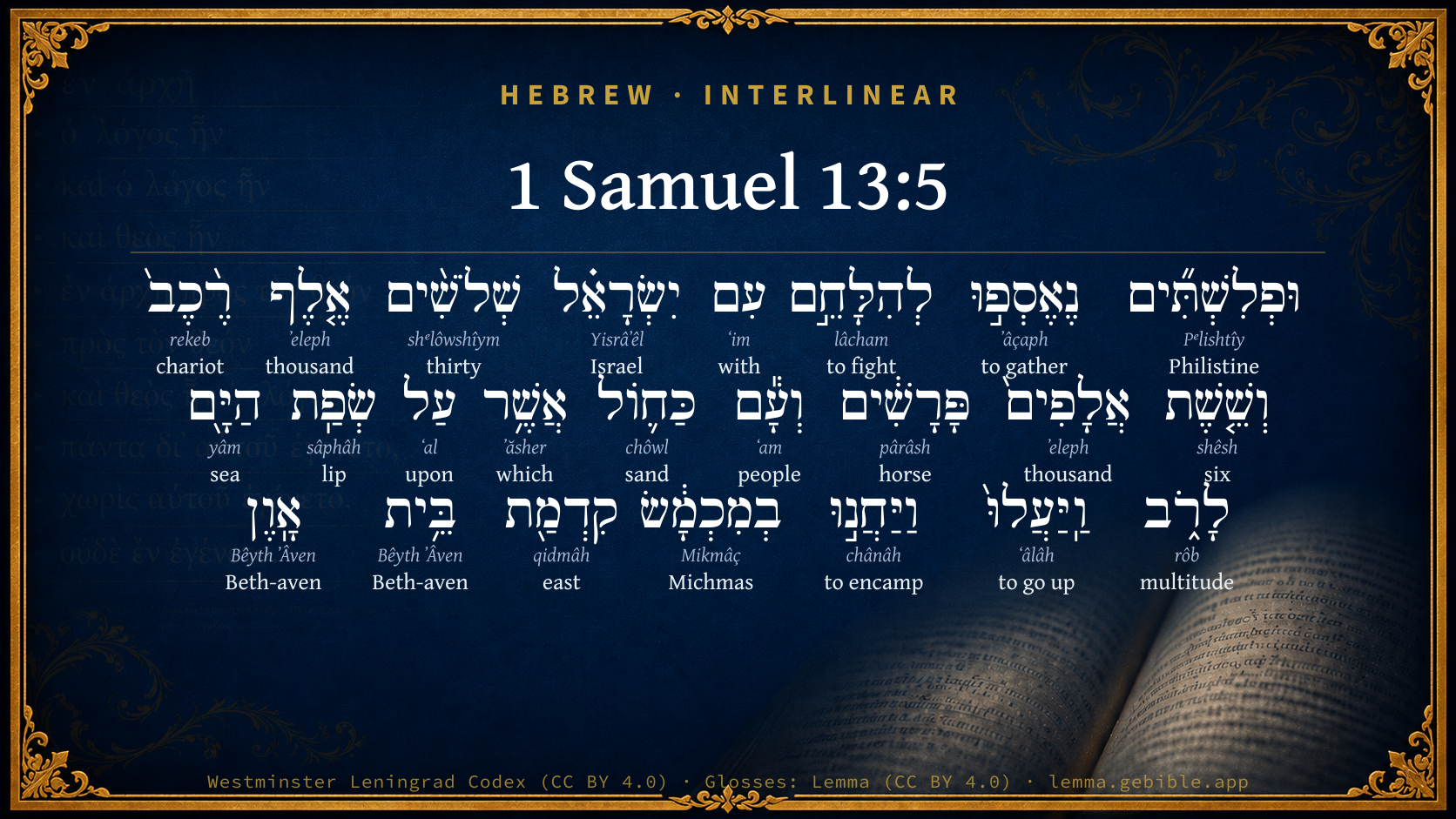
  1. וּפְלִשְׁתִּ֞ים Pᵉlishtîy H6430 “and · Philistines” Conjunction + Noun, Gentilic, Masculine, Plural, Absolute
  2. נֶאֶסְפ֣וּ ʼâçaph H622 “to gather” Verb, Niphal, Perfect, 3rd Person, Common, Plural
  3. לְהִלָּחֵ֣ם lâcham H3898 “to fight” Preposition + Verb, Niphal, Infinitive Construct
  4. עִם ʻim H5973 “with” Preposition
  5. יִשְׂרָאֵ֗ל Yisrâʼêl H3478 “Israel” Noun, Proper
  6. שְׁלֹשִׁ֨ים shᵉlôwshîym H7970 “thirty” Adjective, Cardinal number, Both, Plural, Absolute
  7. אֶ֤לֶף ʼeleph H505 “thousand” Adjective, Cardinal number, Both, Singular, Absolute
  8. רֶ֨כֶב֙ rekeb H7393 “chariot” Noun, Common, Masculine, Singular, Absolute
  9. וְשֵׁ֤שֶׁת shêsh H8337 “and · six” Conjunction + Adjective, Cardinal number, Masculine, Singular, Construct
  10. אֲלָפִים֙ ʼeleph H505 “thousand” Adjective, Cardinal number, Both, Plural, Absolute
  11. פָּרָשִׁ֔ים pârâsh H6571 “horses” Noun, Common, Masculine, Plural, Absolute
  12. וְעָ֕ם ʻam H5971 “and · people” Conjunction + Noun, Common, Masculine, Singular, Absolute
  13. כַּח֛וֹל chôwl H2344 “like/as the · sand” Preposition, Determined + Noun, Common, Masculine, Singular, Absolute
  14. אֲשֶׁ֥ר ʼăsher H834 “which” Particle, Relative
  15. עַל ʻal H5921 “upon” Preposition
  16. שְׂפַֽת sâphâh H8193 “lip of” Noun, Common, Feminine, Singular, Construct
  17. הַיָּ֖ם yâm H3220 “the · sea” Particle, Definite Article + Noun, Common, Masculine, Singular, Absolute
  18. לָרֹ֑ב rôb H7230 “to/for · multitude” Preposition + Noun, Common, Both, Singular, Absolute
  19. וַֽיַּעֲלוּ֙ ʻâlâh H5927 “and · to go up” Conjunction + Verb, Qal, Sequential Imperfect, 3rd Person, Masculine, Plural
  20. וַיַּחֲנ֣וּ chânâh H2583 “and · to encamp” Conjunction + Verb, Qal, Sequential Imperfect, 3rd Person, Masculine, Plural
  21. בְמִכְמָ֔שׂ Mikmâç H4363 “in/at · Michmas” Preposition + Noun, Proper
  22. בֵּ֥ית Bêyth ʼÂven H1007 “Beth-aven” Noun, Proper
  23. אָֽוֶן Bêyth ʼÂven H1007 “Beth-aven” Noun, Proper

About this verse

These counts appear in no published source. They are computed here, from the morphology-tagged text and Lemma’s own curated glosses. What Lemma adds →

24
words
22
distinct lemmas
Historical
section

Notable vocabulary

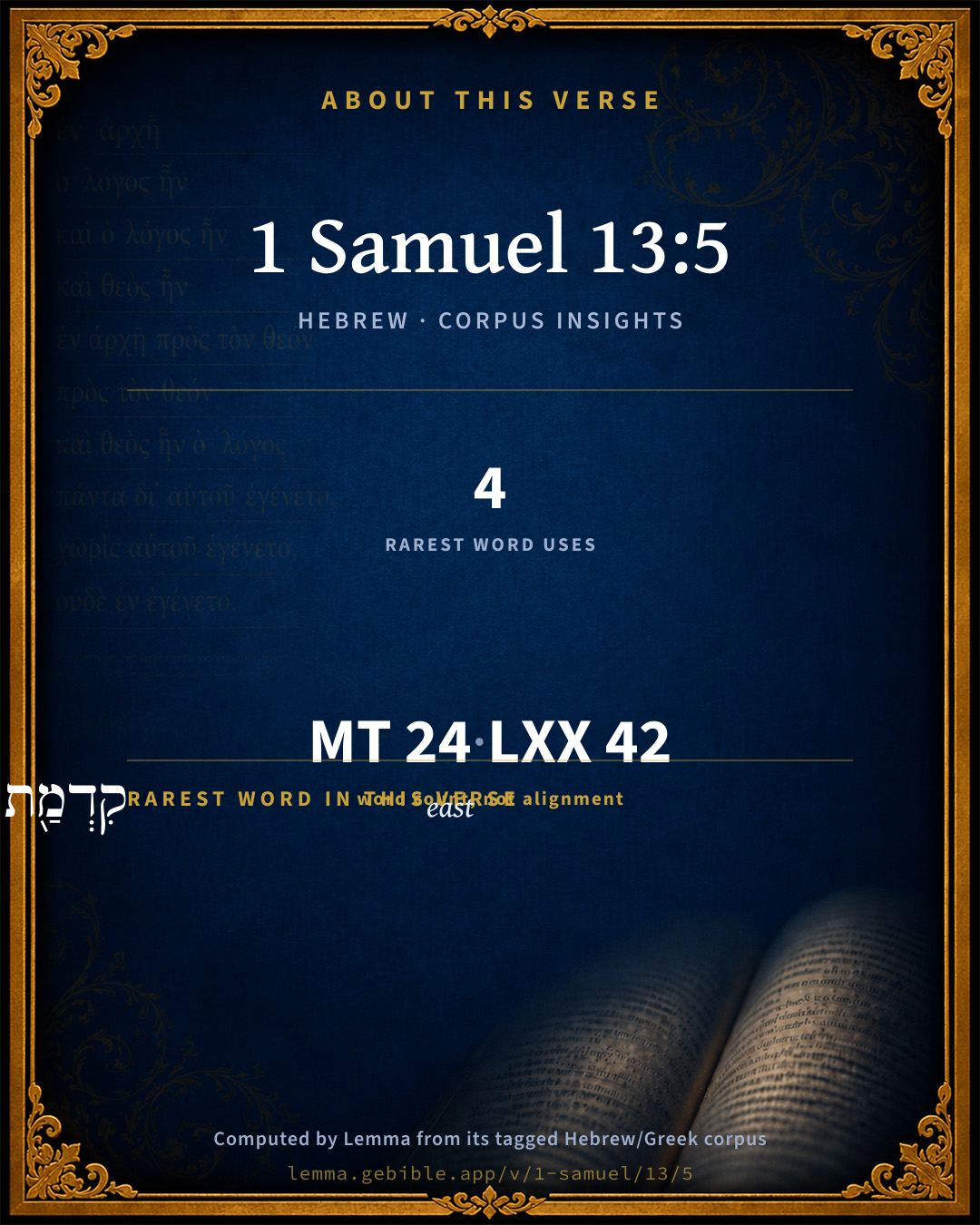
The rarest word here is קִדְמַ֖ת east H6926 — appearing just 4 times in the whole Hebrew Bible.

Shared distinctive vocabulary

קִדְמַ֖ת east H6926 occurs in 4 verses of the Hebrew Bible. Also found in:

Grammatical profile

  • 4 verbs
  • 13 nouns
  • 4 adjectives
  • 2 prepositions
  • 1 particle

Verb forms

  • נֶאֶסְפ֣וּ Niphal · Perfect
  • לְהִלָּחֵ֣ם Niphal · Infinitive Construct
  • וַֽיַּעֲלוּ֙ Qal · Sequential Imperfect
  • וַיַּחֲנ֣וּ Qal · Sequential Imperfect

Repetition

Words recur within this verse — often emphatic in Hebrew:

  • אֶ֤לֶף thousand H505 ×2
  • בֵּ֥ית Beth-aven H1007 ×2

Hebrew & Septuagint length

In English translation the verse runs 40 words from the Hebrew and 43 from the Septuagint (LXX English) — closely comparable.

A rough comparison of the two English renderings, which tokenize alike — not a word-level alignment.

Word counts can differ between the Hebrew and the Greek without any difference in meaning — e.g. the Hebrew direct-object marker אֵת has no separate Greek word, and Greek often adds the article ὁ.

In the original languages it is 24 Hebrew tokens and 42 Greek tokens — but the two are counted differently (Hebrew bundles its prefixes and suffixes into one token; the Greek is in lemma form), so that isn’t a like-for-like length.

Cross-references

13

Topical passages linked to 1 Samuel 13:5 in the Treasury of Scripture Knowledge — connected by theme and wording, ordered by reader-vote popularity; previews shown in the World English Bible.

  • Joshua 11:4 They went out, they and all their hosts with them, much people, even as the sand that is on the sea-shore in multitude, with horses and chariots very many.
  • 1 Samuel 14:23 So Yahweh saved Israel that day: and the battle passed over by Beth Aven.
  • Joshua 18:12 Their border on the north quarter was from the Jordan; and the border went up to the side of Jericho on the north, and went up through the hill-country westward; and the goings out of it were at the wilderness of Beth Aven.
  • Genesis 22:17 that in blessing I will bless you, and in multiplying I will multiply your seed as the stars of the heavens, and as the sand which is on the seashore. Your seed will possess the gate of his enemies.
  • Joshua 7:2 Joshua sent men from Jericho to Ai, which is beside Beth Aven, on the east side of Bethel, and spoke to them, saying, Go up and spy out the land. The men went up and spied out Ai.
  • Judges 7:12 The Midianites and the Amalekites and all the children of the east lay along in the valley like locusts for multitude; and their camels were without number, as the sand which is on the sea-shore for multitude.
  • 2 Chronicles 1:9 Now, Yahweh God, let your promise to David my father be established; for you have made me king over a people like the dust of the earth in multitude.
  • Isaiah 48:19 your seed also had been as the sand, and the offspring of your loins like the grains of it: his name would not be cut off nor destroyed from before me.
  • Jeremiah 15:8 Their widows are increased to me above the sand of the seas; I have brought on them against the mother of the young men a destroyer at noonday: I have caused anguish and terrors to fall on her suddenly.
  • Hosea 4:15 "Though you, Israel, play the prostitute, Yet don't let Judah offend; And don't come to Gilgal, Neither go up to Beth Aven, Nor swear, 'As Yahweh lives.'
  • Hosea 5:8 "Blow the cornet in Gibeah, And the trumpet in Ramah! Sound a battle cry at Beth Aven, behind you, Benjamin!
  • Hosea 10:5 The inhabitants of Samaria will be in terror for the calves of Beth Aven; For its people will mourn over it, Along with its priests who rejoiced over it, For its glory, because it has departed from it.
  • Romans 9:27 Isaiah cries concerning Israel, "If the number of the children of Israel are as the sand of the sea, It is the remnant who will be saved;

Cross-references courtesy of OpenBible.info (CC BY 4.0).

Hebrew and Greek witnesses Masoretic Hebrew ↔ Greek Septuagint

The same verse in the two great witnesses to the Old Testament, shown verse-for-verse.

These are two independent witnesses, not word-aligned to each other, and the Septuagint is shown in lemma (dictionary) form.

Hebrew 1 Samuel 13:5 Masoretic · Westminster Leningrad Codex

וּפְלִשְׁתִּ֞ים נֶאֶסְפ֣וּ לְהִלָּחֵ֣ם עִם יִשְׂרָאֵ֗ל שְׁלֹשִׁ֨ים אֶ֤לֶף רֶ֨כֶב֙ וְשֵׁ֤שֶׁת אֲלָפִים֙ פָּרָשִׁ֔ים וְעָ֕ם כַּח֛וֹל אֲשֶׁ֥ר עַל שְׂפַֽת הַיָּ֖ם לָרֹ֑ב וַֽיַּעֲלוּ֙ וַיַּחֲנ֣וּ בְמִכְמָ֔שׂ קִדְמַ֖ת בֵּ֥ית אָֽוֶן

The Philistines assembled themselves together to fight with Israel, thirty thousand chariots, and six thousand horsemen, and people as the sand which is on the sea-shore in multitude: and they came up, and encamped in Michmash, eastward of Beth Aven.

World English Bible · Public Domain

Greek LXX 1 Samuel 13:5 Septuagint · lemma form

καί ὁ ἀλλόφυλος συνἄγω εἰς πόλεμος ἐπί ἰσραήλ καί ἀναβαίνω ἐπί ἰσραήλ τριάκοντα χιλιάς ἅρμα καί ἕξ χιλιάς ἱππεύς καί λαός ὡς ὁ ἄμμος ὁ παρά ὁ θάλασσα ὁ πλῆθος καί ἀναβαίνω καί παρα ἐνβάλλω ἐν μαχεμας ἐκ ἐναντίος βαιθων κατά νότος

And the Philistines gather together to war with Israel; and then come up against Israel thirty thousand chariots, and six thousand horsemen, and people as the sand by the seashore for multitude: and they come up, and encamp in Machmas, opposite Baethoron southward.

LXX2012 (modern English Septuagint) · Public Domain

On this verse, Haydock's Catholic Bible Commentary discusses the Septuagint’s reading. Read the note in Commentary ↓

Hebrew: Westminster Leningrad Codex (CC BY 4.0). Greek: Septuagint (public domain); English from LXX2012 (modern English Septuagint) (Public Domain). How the Septuagint differs from the Hebrew →

Targum (Aramaic paraphrase)

1

The Targum is the ancient Jewish Aramaic paraphrase of the Hebrew Scriptures — an interpretive translation, not the Hebrew text itself. Onkelos (literal) and Pseudo-Jonathan (expansive) render the Torah, and Jonathan the Prophets. Coverage is partial: where no permissively-licensed English translation exists for a verse, only the Aramaic is shown. This is verse-level text, not a word-by-word alignment to the Hebrew.

  1. Targum Jonathan Prophets (Joshua–Malachi)
    וּפְלִשְׁתָּאֵי אִתְכְּנִישׁוּ לְאַגָחָא קְרָבָא בְיִשְׂרָאֵל תְּלָתִין אַלְפִין רְתִיכִין וְשִׁתָּא אַלְפִין פָּרָשִׁין וְעַמָא כְּחָלָא דְעַל כֵּיף יַמָא לִסְגֵי וּסְלִיקוּ וּשְׁרוֹ בְמִכְמַשׁ מַדְנַח בֵּית אָוֶן:

    (no public-domain English translation for this verse)

    Targum Jonathan — Aramaic: “Mikraot Gedolot” (public domain). English: “Sefaria Community Translation” (CC0 1.0 (public-domain dedication)); “London "Chaldee Paraphrase," 1871” (public domain). Text via Sefaria.

Commentary

Notes on 1 Samuel 13:5 from classic Christian and Jewish commentators (each source and its license shown beneath its notes). The classic Christian expositions comment on the surrounding passage and are grouped to its opening verse, so a note may address several verses; the Jewish commentaries on the Tanakh (Rashi and others) are per-verse, so they appear only where the commentator wrote on this verse.

Lemma curates 59 commentaries, every one of them public domain or Creative Commons licensed, each selected and text-cleaned for this edition rather than reprinted as found. About our sources →

Jamieson, Fausset & Brown

Robert Jamieson, A. R. Fausset & David Brown

THE PHILISTINES' GREAT HOST. (Sa1 13:5)

The Philistines gathered themselves together to fight with Israel, thirty thousand chariots, and six thousand horsemen--Either this number must include chariots of every kind--or the word "chariots" must mean the men fighting in them (Sa2 10:18; Kg1 20:21; Ch1 19:18); or, as some eminent critics maintain, Sheloshim ("thirty"), has crept into the text, instead of Shelosh ("three"). The gathering of the chariots and horsemen must be understood to be on the Philistine plain, before they ascended the western passes and pitched in the heart of the Benjamite hills, in "Michmash," (now Mukmas), a "steep precipitous valley" [ROBINSON], eastward from Beth-aven (Beth-el).

Jamieson, Fausset & Brown — Commentary Critical and Explanatory on the Whole Bible (1871) — public domain (CC PDM 1.0). Text via the HelloAO Bible API.

Trapp's Complete Commentary

John Trapp

1Sa 13:5 And the Philistines gathered themselves together to fight with Israel, thirty thousand chariots, and six thousand horsemen, and people as the sand which [is] on the sea shore in multitude: and they came up, and pitched in Michmash, eastward from Bethaven.

Ver. 5. Thirty thousand chariots.] Armed with scythes and hooks. These were a great number. Sisera had but nine hundred, Pharaoh six hundred.

And people as the sand which is on the sea shore.] Josephus saith they were three hundred thousand footmen. All these were by God’s all-disposing providence brought together to be broken in pieces. {Isa 8:9; Isa 9:12}

John Trapp, A Commentary or Exposition upon All the Books of the Old and New Testament (1647–1656) — public domain. Text from a community e-Sword module.

Joseph Benson's Commentary

1Sa 13:5. Thirty thousand chariots — The Syriac and Arabic copies mention only three thousand chariots, which seems to be the true reading; for there is no foundation for believing that the Philistines could bring into the field thirty thousand chariots of war. Indeed we read of nothing like it in all history. Or, we may suppose that most of them were but carriages for the baggage of the army.

Joseph Benson's Commentary on the Old and New Testaments (1811–1818) — public domain. Text from a community e-Sword module.

Tyndale Open Study Notes

Tyndale Open Resources

13:5 The Israelites were massively outnumbered, hence their fearful responses. • The Philistine army’s 3,000 chariots and 6,000 charioteers indicate Israel’s underdog status. Nowhere in 1 Samuel is Israel said to have had any chariots (see study note on 13:19-22).

Tyndale Open Study Notes — © Tyndale Open Resources, licensed CC BY-SA 4.0. Text via the HelloAO Bible API.

Geneva Bible (1599)

Geneva Bible translators

Which was also called Bethel, in the tribe of Benjamin.

Geneva Bible (1599) marginal notes — public domain. Text via Bolls.life.

Adam Clarke's Commentary

Verse 5. Thirty thousand chariots, and six thousand horsemen] There is no proportion here between the chariots and the cavalry. The largest armies ever brought into the field, even by mighty emperors, never were furnished with thirty thousand chariots.

I think שלשים sheloshim, THIRTY, is a false reading for שלש shalosh, THREE. The Syriac has [Syriac] telotho alpin, and the Arabic [Arabic] thalathato alf, both signifying THREE thousand; and this was a fair proportion to the horsemen. This is most likely to be the true reading.

Adam Clarke's Commentary on the Bible (1810–1826) — public domain. Text from a community e-Sword/MySword module.

Ellicott's Commentary for English Readers

(5) And the Philistines gathered themselves together to fight with Israel.—The figures here, again, of the numbers of this vast army are perfectly untrustworthy. In the rolls of ancient armies (and we possess many a one in the sacred records) the number of war chariots is always smaller than that of the horsemen; here the chariots are represented as four times as numerous. In the rolls of the most famous armies there never appear anything like this number. For instance, Jabin (Jdg_4:3) had 900 chariots. Pharaoh pursued Israel with 600. When David defeated Syria, the great Syrian army had 40,000 horsemen and 700 chariots. King Solomon is only reported (1Ki_10:26) to have possessed 1,400 chariots. Zerah the Ethiopian had but 300 in his vast army, and the Pharaoh Shishak 1,200. Here the more probable reading would be “300” not 30,000. Bishop Wordsworth endeavours to explain the vast array by a reference to Josephus, who relates that this Philistine force was composed of various nations; but this would never account for the incredible number of chariots. The Philistines evidently lost no time. While Saul was endeavouring to rally at Gilgal a Hebrew army, Philistia at once, with the aid of foreign allies, took the field, and with a large army—for it is clear their host on this occasion was very large—encamped no great distance from Gilgal, evidently determined once and for all to crush their enemies and their recently-elected daring king.

A Bible Commentary for English Readers, edited by Charles John Ellicott (1878–1897) — public domain. Text from a community e-Sword module.

The Cambridge Bible for Schools and Colleges

gen. ed. J. J. S. Perowne

5. thirty thousand chariots] This reading, though as old as the Sept., is certainly wrong. The number of chariots was always less than that of horsemen, and such an enormous force of chariots is not only quite unparalleled, but would be useless in the mountainous country. Possibly the numeral 30, expressed in Hebrew by the letter l, was due to the accidental repetition of the last letter of the word Israel, and we should read “a thousand chariots.” Jabin had “nine hundred chariots” (Jdg_4:3).

people as the sand which is on the sea shore] “People” = infantry. “The sand on the sea shore” is a common figure for an indefinite number. Cp. Gen_22:17; Gen_41:49; Jos_11:4; Psa_78:27, &c.

in Michmash, eastward from Beth-aven] Saul evacuated Michmash and withdrew to Gilgal. Jonathan however still held Gibeah (1Sa_13:16). Beth-aven (= “house of naught” i.e. idols) was near Ai, between Michmash and Bethel (Jos_7:2). The position was an important one, commanding the chief approach from Gilgal to the heart of the country.

The Cambridge Bible for Schools and Colleges (gen. ed. J. J. S. Perowne; Cambridge University Press, 1878–1918) — public domain. Text from a community e-Sword module.

John Gill's Exposition

And the Philistines gathered themselves together to fight with Israel,.... To prevent their further encroachments on them, and designs against them; for they perceived they intended to cast off their yoke, and free themselves entirely from them:

thirty thousand chariots, and six thousand horsemen; it may seem incredible that so small a people as the Philistines were, who only were possessed of five cities, or lordships, with the villages belonging to them, except what they had taken from Israel; and even if assisted by the Tyrians, the author of Sirach in the Apocrypha says:"And he destroyed the rulers of the Tyrians, and all the princes of the Philistines.'' (Sirach 46:18)though he seems to have respect not to this time, but when Samuel discomfited them, Sa1 7:10. I say it may seem incredible that they should bring such a number of chariots into the field; wherefore this must either be understood of 30,000 men that fought in chariots, as Lyra interprets it, and in which sense it is plain and certain the word chariots is sometimes used, as in Sa2 10:18, or else of some sort of carriages, not chariots of war, at least not all of them; but what were brought to carry the baggage of their infantry, which was very large, and to carry away the goods and substance of the Israelites; some have thought that there is a mistake of the copier, who instead of "three", read "thirty": so Capellus; and the rather because in the Arabic and Syriac versions it is only "three thousand"; but even this is too great a number, understood of chariots of war; for never any people in the world was known to have so many chariots of war; Pharaoh in his large host had but six hundred, Exo 14:7 Jabin king of Canaan had indeed nine hundred, Jdg 4:3 and David took from the king of Zobah one thousand chariots; but whether they were all chariots of war is not certain, Sa2 8:4. Solomon indeed had one thousand and four hundred chariots, but they do not appear to be chariots of war, but some for use, and some for state and grandeur. Wherefore, if a mistake in the copy is admitted of, and this can be confirmed by some MSS, yet we must recur to one or other of the above senses; some of them must be understood of other sort of carriages, or of men that fought in these chariots; and allowing ten men to a chariot, which seems to be the usual number by comparing Sa2 10:18 with Ch1 19:18 then 3000 men would fill three hundred chariots, which are as many as it can well be thought the Philistines had Zerah the Ethiopian, who brought into the field an army of million men, had no more than three hundred chariots, Ch2 14:9, and no more had Antiochus Eupator in his army,"And with him Lysias his protector, and ruler of his affairs, having either of them a Grecian power of footmen, an hundred and ten thousand, and horsemen five thousand and three hundred, and elephants two and twenty, and three hundred chariots armed with hooks.'' (2 Maccabees 13:2)Darius in his vast army had but two hundred (a), and in the very large one which Mithridates brought against the Romans there was but one hundred; and now 3000 men in three hundred chariots were but a proportion to 6000 horsemen, which in those times and countries was a large cavalry:

and the people as the sand which is on the sea shore in multitude; the infantry was so large as not to be numbered; however, the phrase denotes a great multitude of them; Josephus says (b) there were 300,000 footmen:

and they came up, and pitched in Michmash, eastward from Bethaven; where Saul, before he went to Gilgal, had his quarters, Sa1 13:2. Bethaven was a place near Bethel, on the east of it, Jos 7:2 though Bethel itself was afterwards so called when Jeroboam had set up the worship of the calves there, Hos 4:15 it signifying the house of vanity or iniquity.

(a) Curtius, l. 4. c. 9. (b) Antiqu, l. 6. c. 6. sect. 1.

John Gill's Exposition of the Whole Bible (1746–1763) — public domain (CC PDM 1.0). Text via the HelloAO Bible API.

Albert Barnes' Notes on the Bible

Thirty thousand chariots - Probably a copyist’s mistake for 300. (Compare, for a similar numerical variation, 1Ch 18:4 with 2Sa 8:4.)

Eastward from Bethaven - Or more simply “to the east of Bethaven,” which Jos 7:2 lay “on the east side of Bethel.” Bethaven (thought to be the same as Deir Diwan) lay between Bethel and Michmash, which had been evacuated by Saul.

Albert Barnes' Notes on the Bible (1834–1885) — public domain. Text from a community e-Sword/MySword module.

Haydock's Catholic Bible Commentary

Chariots. This number seems almost incredible, as the Philistines were but a contemptible nation, compared with various others which never brought so many chariots into the field. Zara, king of Ethiopia, in his army of a million men, had only 300, 2 Paralipomenon xiv. 9. Adarezer had 1000, and Sesac 12000 chariots, while Solomon could only boast of 1400. Hence the Syriac and Arabic read "3000;" and it is supposed that the Hebrew has im, at the end of shelosh, redundant. (Bochart, Capel, &c.) The number of horsemen would otherwise bear no proportion with the chariots. We must also observe, that under this name the Scripture denotes those who upon the chariots. They were drawn by two horses, and one man guided the horses, while another stood on the chariot; and in battle, eight other soldiers attended it. These remarks will tend to explain many difficult passages, in which we read of chariots being slain and hamstrung, which may be understood of the men and horses, 2 Kings viii. 4., and x. 18. In one place we read 700, and in another 7000 chariot were slain, (1 Paralipomenon xix. 18,) the latter number comprising the 10 attendants; so here, the Philistines might have 3000 chariots, which being each accompanied with ten men, might be counted as 30,000. (Calmet) --- Others think that there were 30,000 men fighting on chariots. (Lyranus; Salien) --- The Tyrians might have come to the assistance of their old friends, as chap. vii. 10. See 3 Kings iv. 26. (Menochius) --- Number. Josephus specifies "300,000 infantry." (Haydock) --- Bethaven. Many copies of the Septuagint read, "Bethoron," more probably, as Bethel must have been on the east of Machmas, which lay north of Gabaa, chap xiv. 5. (Calmet) "over-against Bethoron on the south." (Grabe) (Haydock) --- Hebrew also, "having Bethaven on the east." Bethel was called Bethaven after the schism of Jeroboam, so that this name seems to have been substituted by a later writer, (Calmet) unless it might have had both names long before, Josue xviii. 12. (Haydock) --- this is not contrary to chap. vii. 13, as the Philistines had been quiet for a long time. Hebrew alom, properly denotes the term of a jubilee or 50 years. (Du Hamel)

George Leo Haydock (1774–1849), Haydock's Catholic Family Bible and Commentary, 1859 edition — public domain. Excludes Psalms (Douay-Rheims chapter numbering differs from Protestant) and Deuterocanonical books (Catholic canon only).

Matthew Poole's English Annotations

Thirty thousand chariots: this number seems incredible to infidels; to whom it may be sufficient to reply, that it is far more rational to acknowledge a mistake in him that copied out the sacred text in such numeral or historical passages, wherein the doctrine of faith and good life is not directly concerned, than upon such a pretence to question the truth and divinity of the Holy Scriptures, which are so fully attested, and evidently demonstrated. And the mistake is not great in the Hebrew, schalosh for schellshim; and so indeed those two ancient translators, the Syriac and Arabic, translate it, and are supposed to have read in their Hebrew copies, three thousand. Nor is it necessary that all these should be military chariots, but many of them might be for carriages of things belonging to so great an army; for such b

Chariots here may very well be put for the men that rode upon them, and fought out of them, by a figure called a metonymy of the subject for the adjunct, or the thing containing for the thing contained in it, than which none more frequent. In the very same manner, and in the very same figure, the basket is put for the meat in it, Deu 28:5,17; the wilderness, for the wild beasts of the wilderness, Psa 29:8; the nest, for the birds in it, Deu 32:11; the cup, for the drink in it, Jer 49:12; 1Co 10:21. And, to come more closely to the point, a horse is put for a horse-load of wares laid upon it, 1Ki 10:28; and an ass of bread is put for an ass-load of bread, both in the Hebrew text of 1Sa 16:20, and in an ancient Greek poet. And, yet nearer, the word chariots is manifestly put either for the horses belonging to them, or rather for the men that fought out of them; as 2Sa 10:18, where it is said in the Hebrew that David slew seven hundred chariots; that is, seven thousand men which fought in chariots, as it is explained, 1Ch 19:18; and 1Ki 20:21, where Ahab is said to smite horses and chariots; and 1Ch 18:4; Psa 76:6, where the chariot and horse (i.e. the men that ride and fight in chariots, or upon horses) are said to be cast into a dead sleep; and Eze 39:20, where it is said, Ye shall be filled at my table with horses and chariots, (i.e. with men belonging to the chariots; for surely the chariots of iron had been very improper food,) with mighty men, &c. And let any cavilling infidel produce a wise reason why it may not, and ought not, to be so understood here also. Add to all this, that the Philistines were not alone in this expedition, but had the help of the Canaanites and the Tyrians, as is very credible, both from Sir 40:20, and from the nature of the thing. If it be further inquired, Why the Philistines should raise so great an army at this time? the answer is obvious, That not only their old and formidable enemy Samuel was yet alive, but a new enemy was risen, even king Saul, who was lately confirmed in his kingdom, and had been flushed with his good success against the Ammonites, and was likely to grow more and more potent, if not timely prevented; and they thought that now the Israelitish affairs were come to some consistency, being put into the hands of a king; and therefore they thought fit, once for all, to put forth all their strength to suppress the Israelites, and to prevent that ruin which otherwise threatened them.

Matthew Poole's English Annotations on the Holy Bible (1683–1685) — public domain. Text from a community e-Sword/MySword module.

Whedon's Commentary on the Bible

Daniel D. Whedon

5. Thirty thousand chariots, and six thousand horsemen — Here we meet another instance of manifest error of numbers in the text. “Thirty thousand war chariots bear no proportion whatever to six thousand horsemen, not only because the number of war-chariots is invariably smaller than that of the horsemen, (compare 2Sa_10:18; 1Ki_10:26; 2Ch_12:3,) but also because such a number of war chariots is never met with either in sacred or profane history, not even in the case of nations that were much more powerful than the Philistines. The number is, therefore, certainly corrupt, and we must either read three thousand, according to the Syriac and Arabic, or else simply one thousand. In the latter case the origin of the number thirty must be attributed to the fact that, through the oversight of a copyist, the ל(Hebrew numeral for thirty) of the word ישׂראל, Israel, was written twice, and consequently the second לwas taken for the numeral thirty.” — Keil.

Came up… pitched in Michmash — Thus occupying the heights from which Saul had fallen back.

Beth-aven — This place was on the east of Beth-el, (Jos_7:2,) and, as we infer from this passage, between it and Michmash; but it has not yet been satisfactorily identified with any modern site.

Daniel D. Whedon (gen. ed.), Commentary on the Old and New Testaments (1874–1909) — public domain. Text from a community e-Sword module.

The Pulpit Commentary

Long before Saul could gather Israel the Philistines had completed their preparations, and invaded the country in overwhelming numbers; but thirty thousand chariots compared with six thousand horsemen is out of all proportion. Possibly the final l in Israel has been taken by some copyists for a numeral, and as it signifies thirty, it his changed 1000 into 30, 000. Or, simpler still, shin, the numeral for 300, has been read with two dots, and so changed into 30, 000. They came up, and pitched in Michmash. Saul had withdrawn eastward to Gilgal, and the Philistines had thus placed themselves between him and Jonathan. There is a difficulty, however, in the words eastward from Beth-aven; for as this, again, was east of Bethel, it puts the Philistines" camp too much to the east. As it is not, however, the regular phrase for eastward, some commentators render, "in front of Beth-avon." "It means "the house of naught," and was the name originally given to the desert east of Bethel, because of its barren character" (Conder, "Tent Work," 2:108). The Philistines, however, had come in such numbers that their camp must have occupied a large extent of ground.

The Pulpit Commentary (1880–1919), ed. H.D.M. Spence-Jones & Joseph S. Exell — public domain. Text from a community e-Sword module.

John Wesley's Explanatory Notes

Thirty thousand chariots, &c. - Most of them, we may suppose, carriages for their baggage, not chariots of war, tho' all their allies were joined with them.

John Wesley, Explanatory Notes Upon the Whole Bible (1754–1765) — public domain. Text via the GEBible commentary corpus.

unfoldingWord translationNotes

Door43 World Missions Community

three thousand ... six thousand

"3,000 ... 6,000" (See: Numbers)

troops as numerous as the sand on the seashore

This is an exaggeration that means a group of soldiers so large that it was difficult to count them. (See: Hyperbole and Generalization)

Michmash

This is the name of a place. (See: How to Translate Names)

Beth Aven

This is the name of a place. (See: How to Translate Names)

translationWords

chariot

unfoldingWord translationNotes — © Distant Shores Media and the Door43 World Missions Community, licensed CC BY-SA 4.0. Source: git.door43.org/Door43/en_tn.

Rashi

Rabbi Shlomo Yitzchaki (Rashi)

To the east of Beis Oven. [קִדְמַת] meaning the east of Beis Oven.

Rashi on the Tanakh — English translations: “The Judaica Press complete Tanach with Rashi, translated by A. J. Rosenberg” (CC BY 4.0); “Pentateuch with Rashi's commentary by M. Rosenbaum and A.M. Silbermann, 1929-1934” (public domain); “The Metsudah Tanach series, Lakewood, N.J” (CC BY 4.0); and “The Book of Joshua, Metsudah Publications, 1997” (CC BY 4.0). Text via Sefaria.

Lesson kit

Teaching starters — assembled from the data on this page, not authored interpretation. Every prompt links to the verse data it draws on. Edit before teaching.

1 Samuel, in the Historical, opens this verse with 24 words (22 distinct Hebrew lemmas). Its most distinctive word is qidmâh (“east”). A historical commentator’s framing appears above. Read the whole chapter for the surrounding context.

Discussion questions

  1. How does “east” (qidmâh) shape what this verse is saying?
  2. How does Genesis 2:14, which shares the word «east», read alongside this verse?
  3. What does the repetition of “thousand” (2× in this one verse) do in this verse?
  4. These translations render this verse differently; the difference is in the English rendering, not the original. What questions does that raise?
  5. «נֶאֶסְפ֣וּ» is a Niphal Perfect verb. How does that grammatical form shape the action described?
  6. Compare how Jamieson, Fausset & Brown and Trapp's Complete Commentary read this verse. Where do they agree or differ?

Things to notice

Reading settings

Reading text

Shown beneath each verse's original-language words.

Old Testament
Old Testament edition

Read the OT as the Masoretic Hebrew (MT) or the Greek Septuagint (LXX).

English shown for the Greek Septuagint (in the Hebrew ↔ Greek comparison).

Comparing translations? Open the Compare panel on any verse page to stack up to four side by side.