
1 Chronicles 15:25

Hebrew (Westminster Leningrad Codex) 1 Chronicles 15:25 appears in the Hebrew Old Testament. The text above is from the Westminster Leningrad Codex. Each word links to its Strong’s number, a concise gloss, and parsing drawn from the Open Scriptures Hebrew Bible morphology. Click any word for its full Brown-Driver-Briggs (BDB) entry.
Download image
Cite this verse

1 Chronicles 15:25 (World English Bible). Public Domain. Lemma interlinear Bible study tool, https://lemma.gebible.app/v/1-chronicles/15/25.

Show BibTeX & RIS
BibTeX
RIS
English Translation
So David, and the elders of Israel, and the captains over thousands, went to bring up the ark of the covenant of Yahweh out of the house of Obed-edom with joy.
World English Bible · Public Domain
Download a study sheet

One document with this verse’s original text, its word-by-word gloss line, the meaning frame, cross-references with their text, attributed commentary, and full source and license credits — printable, and it pastes into notes with its structure intact.

This verse Autodidact and up

Study sheet (.html) Plain text (.txt)

A passage Seminary Student

Up to 50 verses in one chapter. A passage sheet keeps up to 6 commentary sources and 12 cross-references per verse, in the order this page ranks them, and says so on the sheet whenever that leaves anything out. Ask for a single verse and you get the Autodidact verse sheet above.

Everything on this page stays free to read, with no account — the sheet is a download of what is already on screen, not access to it.

Want to remove ads? Support Godless Engineer
Compare translations 3

The same verse in 3 English versions, stacked beneath the original-language interlinear above. Click any original word for its lexicon entry.

Each is an independent rendering of the whole verse — the interlinear is not word-aligned to these translations.

Highlighted words mark where these versions differ — a whole-verse word diff, not a word-by-word alignment.

  • World English Bible Public Domain
    So David, and the elders of Israel, and the captains over thousands, went to bring up the ark of the covenant of Yahweh out of the house of Obed-edom with joy.
  • King James Version Public Domain
    So David, and the elders of Israel, and the captains over thousands, went to bring up the ark of the covenant of the LORD out of the house of Obededom with joy.
  • unfoldingWord Literal Text CC BY-SA 4.0
    And it happened that David and the elders of Israel and the commanders of thousands were going to bring up the Box of the Covenant of Yahweh from the house of Obed Edom with rejoicing.

unfoldingWord Literal Text — © unfoldingWord, licensed CC BY-SA 4.0. Word-aligned USFM3 via Door43 (git.door43.org/unfoldingWord/en_ult).

Versions to compare (up to 4)

3 of 4 selected

Show all 18 translations

Every available English version of this verse, each an independent rendering of the whole verse.

  • World English Bible Public Domain
    So David, and the elders of Israel, and the captains over thousands, went to bring up the ark of the covenant of Yahweh out of the house of Obed-edom with joy.
  • Berean Standard Bible Public Domain
    So David, the elders of Israel, and the commanders of thousands went with rejoicing to bring the ark of the covenant of the LORD from the house of Obed-edom.
  • Majority Standard Bible Public Domain
    So David, the elders of Israel, and the commanders of thousands went with rejoicing to bring the ark of the covenant of the LORD from the house of Obed-edom.
  • King James Version Public Domain
    So David, and the elders of Israel, and the captains over thousands, went to bring up the ark of the covenant of the LORD out of the house of Obededom with joy.
  • American Standard Version (1901) Public Domain
    So David, and the elders of Israel, and the captains over thousands, went to bring up the ark of the covenant of Jehovah out of the house of Obed-edom with joy.
  • Revised Version (1885) Public Domain
    So David, and the elders of Israel, and the captains over thousands, went to bring up the ark of the covenant of the LORD out of the house of Obed-edom with joy:
  • Geneva Bible (1599) Public Domain
    So Dauid and the Elders of Israel and the captaines of thousandes went to bring vp the Arke of the couenant of the Lord from the house of Obed Edom with ioye.
  • Douay-Rheims (1899) Public Domain
    So David and all the ancients of Israel, and the captains over thousands, went to bring the ark of the covenant of the Lord out of the house of Obededom with joy.
  • Young's Literal Translation Public Domain
    And it is David, and the elders of Israel, and the heads of the thousands, who are going to bring up the ark of the covenant of Jehovah from the house of Obed-Edom with joy;
  • Literal Standard Version CC BY-SA 4.0
    And it is David, and [the] elderly of Israel, and the heads of the thousands, who are going to bring up the Ark of the Covenant of YHWH from the house of Obed-Edom with joy;
  • Unlocked Literal Bible CC BY-SA 4.0
    So David, the elders of Israel, and the commanders over thousands went to bring up the ark of the covenant of Yahweh out of Obed Edom's house with rejoicing.
  • unfoldingWord Literal Text CC BY-SA 4.0
    And it happened that David and the elders of Israel and the commanders of thousands were going to bring up the Box of the Covenant of Yahweh from the house of Obed Edom with rejoicing.
  • Darby Bible Public Domain
    And David, and the elders of Israel, and the captains over thousands, went to bring up the ark of the covenant of Jehovah out of the house of Obed-Edom with joy.
  • World Messianic Bible Public Domain
    So David, the elders of Israel, and the captains over thousands went to bring the ark of the LORD’s covenant up out of the house of Obed-Edom with joy.
  • Webster's Bible Public Domain
    So David and the elders of Israel, and the captains over thousands, went to bring up the ark of the covenant of the LORD from the house of Obed-edom with joy.
  • Free Bible Version CC BY-SA 4.0
    Then David, the elders of Israel, and the senior army commanders, went with great celebration to bring back the Ark of the Lord's Agreement from the home of Obed-Edom.
  • Bible in Basic English Public Domain
    So David, and the responsible men of Israel, and the captains over thousands, went with joy to get the ark of the agreement of the Lord out of the house of Obed-edom.
  • JPS Tanakh (1917) Public Domain
    So David, and the elders of Israel, and the captains over thousands, went to bring up the ark of the covenant of the LORD out of the house of Obed-edom with joy.

Literal Standard Version (2020), Covenant Press — licensed CC BY-SA 4.0. Text via the HelloAO Bible API (eBible.org). Unlocked Literal Bible (unfoldingWord) — licensed CC BY-SA 4.0. Text via the HelloAO Bible API (eBible.org). unfoldingWord Literal Text — © unfoldingWord, licensed CC BY-SA 4.0. Word-aligned USFM3 via Door43 (git.door43.org/unfoldingWord/en_ult). Free Bible Version, Dr. Jonathan Gallagher — licensed CC BY-SA 4.0. Text via the HelloAO Bible API (eBible.org).

Word by word

More ways to search: Search by grammar → Find every occurrence → Compare this word →

Practice this passage: Drill this verse → Learn its vocabulary →

עֹבֵֽד
ʻÔbêd ʼĔdôwm
H5654
“Obed-edom”
Noun, Proper
Part of Speech
Noun
Type
Proper
Full BDB Definition

Origin: from the act part of H5647 and H123

TWOT: None

Obed-edom = "servant of Edom" - a Levite and a Gittite who kept the ark after Uzzah was slain by God for touching the ark while it was being taken to Jerusalem - a Merarite Levite and a singer and gatekeeper - the family descended from him
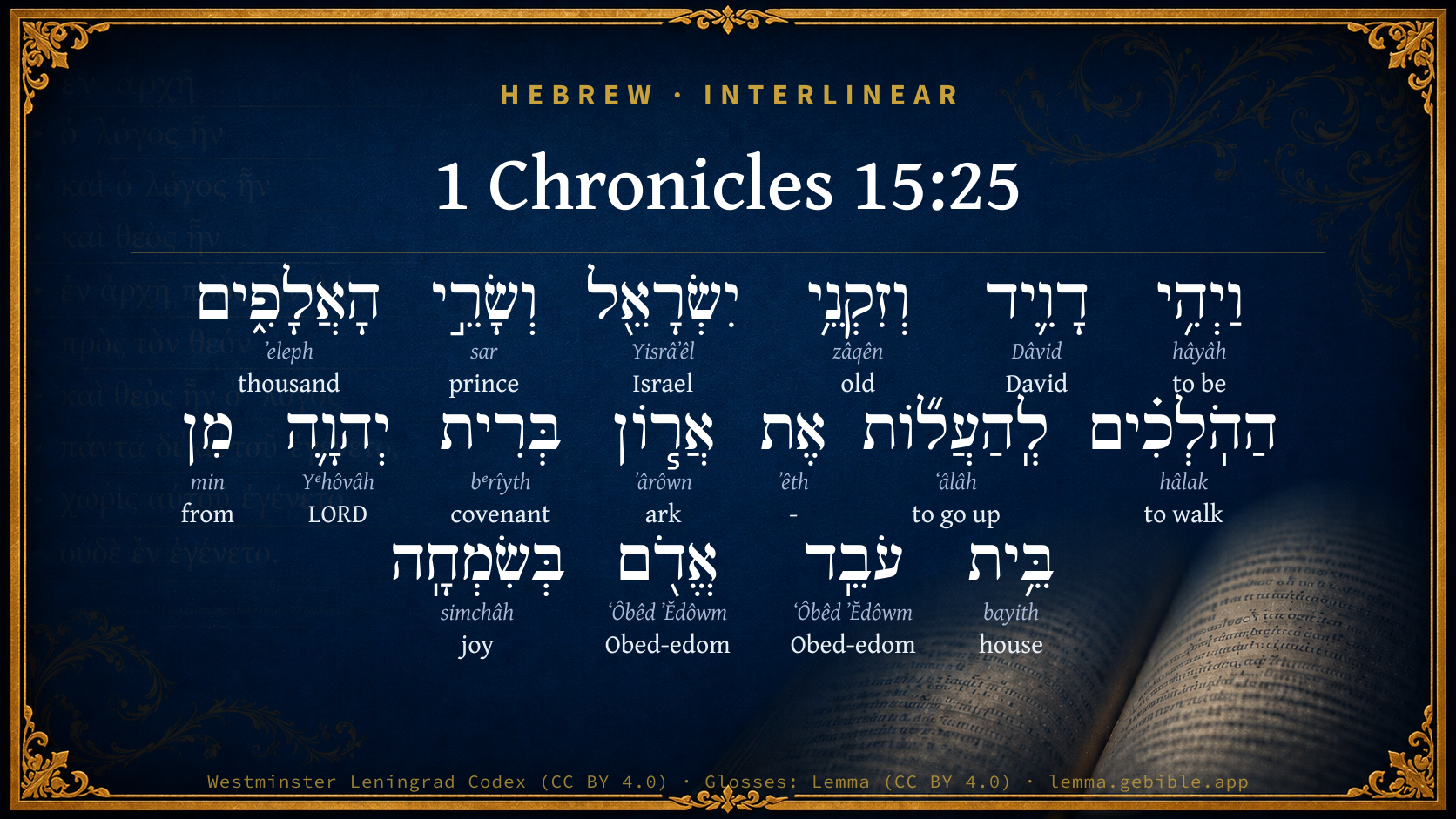
  1. וַיְהִ֥י hâyâh H1961 “and · to be” Conjunction + Verb, Qal, Sequential Imperfect, 3rd Person, Masculine, Singular
  2. דָוִ֛יד Dâvid H1732 “David” Noun, Proper
  3. וְזִקְנֵ֥י zâqên H2205 “and · old of” Conjunction + Adjective, Adjective, Masculine, Plural, Construct
  4. יִשְׂרָאֵ֖ל Yisrâʼêl H3478 “Israel” Noun, Proper
  5. וְשָׂרֵ֣י sar H8269 “and · princes of” Conjunction + Noun, Common, Masculine, Plural, Construct
  6. הָאֲלָפִ֑ים ʼeleph H505 “the · thousand” Particle, Definite Article + Adjective, Cardinal number, Both, Plural, Absolute
  7. הַהֹֽלְכִ֗ים hâlak H1980 “the · walking” Particle, Definite Article + Verb, Qal, Participle Active, Masculine, Plural, Absolute
  8. לְֽהַעֲל֞וֹת ʻâlâh H5927 “to go up” Preposition + Verb, Hiphil, Infinitive Construct
  9. אֶת ʼêth H853 “-” Particle, Direct Object
  10. אֲר֧וֹן ʼârôwn H727 “ark of” Noun, Common, Both, Singular, Construct
  11. בְּרִית bᵉrîyth H1285 “covenant of” Noun, Common, Feminine, Singular, Construct
  12. יְהוָ֛ה Yᵉhôvâh H3068 “LORD” Noun, Proper
  13. מִן min H4480 “from” Preposition
  14. בֵּ֥ית bayith H1004 “house of” Noun, Common, Masculine, Singular, Construct
  15. אֱדֹ֖ם ʻÔbêd ʼĔdôwm H5654 “Obed-edom” Noun, Proper
  16. בְּשִׂמְחָֽה simchâh H8057 “in/at · joy” Preposition + Noun, Common, Feminine, Singular, Absolute

About this verse

These counts appear in no published source. They are computed here, from the morphology-tagged text and Lemma’s own curated glosses. What Lemma adds →

17
words
16
distinct lemmas
Historical
section

Shared distinctive vocabulary

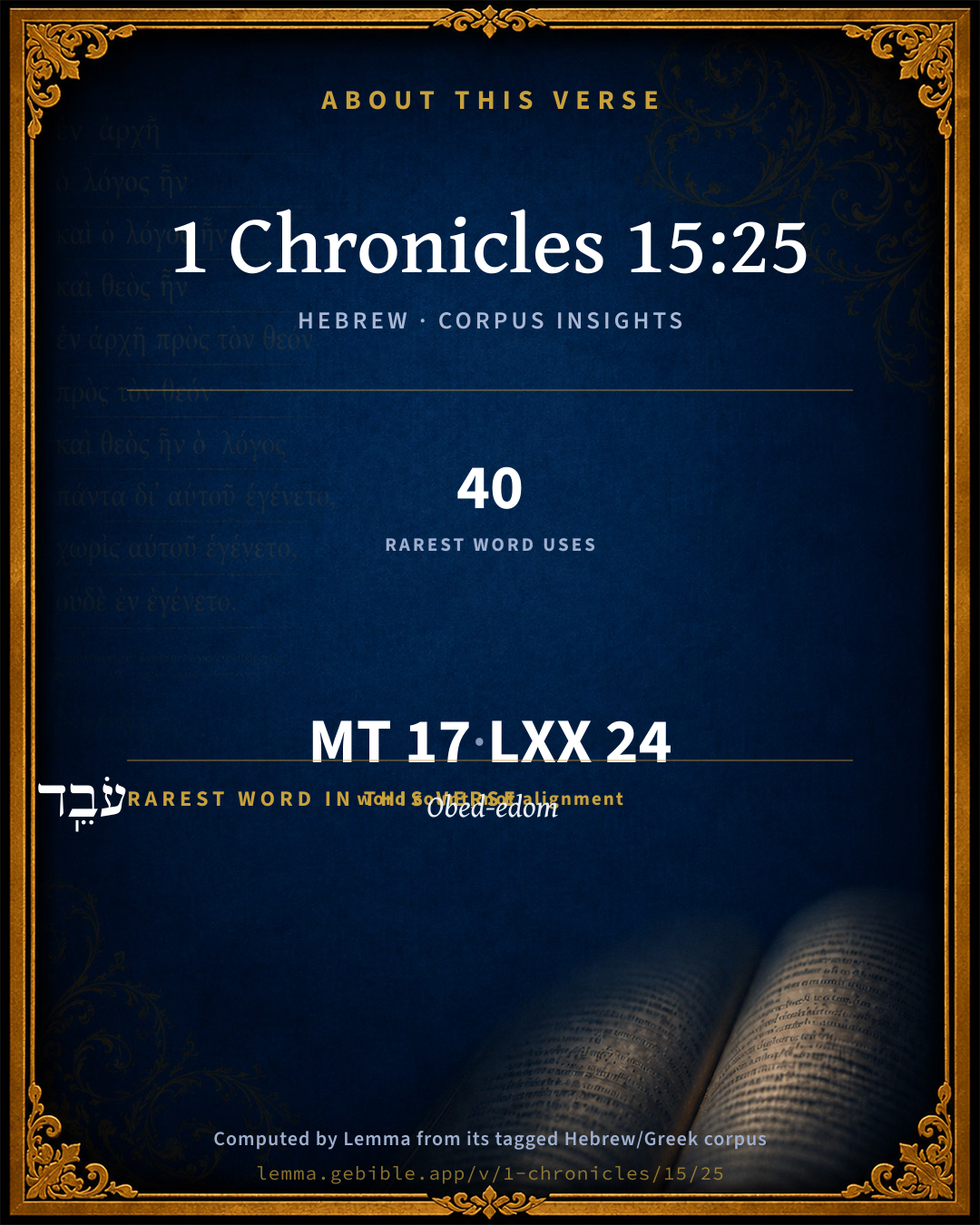
עֹבֵֽד Obed-edom H5654 occurs in 15 verses of the Hebrew Bible. Also found in:

Grammatical profile

  • 3 verbs
  • 10 nouns
  • 2 adjectives
  • 1 preposition
  • 1 particle

Verb forms

  • וַיְהִ֥י Qal · Sequential Imperfect
  • הַהֹֽלְכִ֗ים Qal · Participle Active
  • לְֽהַעֲל֞וֹת Hiphil · Infinitive Construct

Repetition

A word recurs within this verse — often emphatic in Hebrew:

  • עֹבֵֽד Obed-edom H5654 ×2

Hebrew & Septuagint length

In English translation the verse runs 31 words from the Hebrew and 28 from the Septuagint (LXX English) — closely comparable.

A rough comparison of the two English renderings, which tokenize alike — not a word-level alignment.

Word counts can differ between the Hebrew and the Greek without any difference in meaning — e.g. the Hebrew direct-object marker אֵת has no separate Greek word, and Greek often adds the article ὁ.

In the original languages it is 17 Hebrew tokens and 24 Greek tokens — but the two are counted differently (Hebrew bundles its prefixes and suffixes into one token; the Greek is in lemma form), so that isn’t a like-for-like length.

Cross-references

19

Topical passages linked to 1 Chronicles 15:25 in the Treasury of Scripture Knowledge — connected by theme and wording, ordered by reader-vote popularity; previews shown in the World English Bible.

  • 2 Samuel 6:12–23 It was told king David, saying, Yahweh has blessed the house of Obed-edom, and all that pertains to him, because of the ark of God. David went and brought up the ark of God from the house of Obed-edom into the city of David with joy.
  • 1 Chronicles 13:11–14 David was displeased, because Yahweh had broken forth on Uzza; and he called that place Perez Uzza, to this day.
  • 2 Chronicles 20:27–28 Then they returned, every man of Judah and Jerusalem, and Jehoshaphat in the forefront of them, to go again to Jerusalem with joy; for Yahweh had made them to rejoice over their enemies.
  • Ezra 6:16 The children of Israel, the priests, and the Levites, and the rest of the children of the captivity, kept the dedication of this house of God with joy.
  • Psalms 95:1–2 Oh come, let's sing to Yahweh. Let's shout aloud to the rock of our salvation!
  • Psalms 100:1–2 Shout for joy to Yahweh, all you lands!
  • Micah 5:2 But you, Bethlehem Ephrathah, Being small among the clans of Judah, Out of you one will come forth to me that is to be ruler in Israel; Whose goings forth are from of old, from everlasting.
  • Philippians 3:3 For we are the circumcision, who worship God in the Spirit, and rejoice in Christ Jesus, and have no confidence in the flesh;
  • Philippians 4:4 Rejoice in the Lord always! Again I will say, Rejoice!
  • Numbers 31:14 Moses was angry with the officers of the host, the captains of thousands and the captains of hundreds, who came from the service of the war.
  • Deuteronomy 1:15 So I took the heads of your tribes, wise men, and known, and made them heads over you, captains of thousands, and captains of hundreds, and captains of fifties, and captains of tens, and officers, according to your tribes.
  • Deuteronomy 12:7 and there you shall eat before Yahweh your God, and you shall rejoice in all that you put your hand to, you and your households, in which Yahweh your God has blessed you.
  • Deuteronomy 12:18 but you shall eat them before Yahweh your God in the place which Yahweh your God shall choose, you, and your son, and your daughter, and your man-servant, and your maid-servant, and the Levite who is within your gates: and you shall rejoice before Yahweh your God in all that you put your hand to.
  • Deuteronomy 16:11 and you shall rejoice before Yahweh your God, you, and your son, and your daughter, and your man-servant, and your maid-servant, and the Levite who is within your gates, and the foreigner, and the fatherless, and the widow, who are in the midst of you, in the place which Yahweh your God shall choose, to cause his name to dwell there.
  • Deuteronomy 16:15 Seven days shall you keep a feast to Yahweh your God in the place which Yahweh shall choose; because Yahweh your God will bless you in all your increase, and in all the work of your hands, and you shall be altogether joyful.
  • 1 Samuel 8:12 and he will appoint them to him for captains of thousands, and captains of fifties; and [he will set some] to plow his ground, and to reap his harvest, and to make his instruments of war, and the instruments of his chariots.
  • 1 Samuel 10:19 but you have this day rejected your God, who himself saves you out of all your calamities and your distresses; and you have said to him, [No], but set a king over us. Now therefore present yourselves before Yahweh by your tribes, and by your thousands.
  • 1 Samuel 22:7 Saul said to his servants who stood about him, Hear now, you Benjamites; will the son of Jesse give everyone of you fields and vineyards, will he make you all captains of thousands and captains of hundreds,
  • 1 Kings 8:1 Then Solomon assembled the elders of Israel, and all the heads of the tribes, the princes of the fathers' [houses] of the children of Israel, to king Solomon in Jerusalem, to bring up the ark of the covenant of Yahweh out of the city of David, which is Zion.

Cross-references courtesy of OpenBible.info (CC BY 4.0).

Hebrew and Greek witnesses Masoretic Hebrew ↔ Greek Septuagint

The same verse in the two great witnesses to the Old Testament, shown verse-for-verse.

These are two independent witnesses, not word-aligned to each other, and the Septuagint is shown in lemma (dictionary) form.

Hebrew 1 Chronicles 15:25 Masoretic · Westminster Leningrad Codex

וַיְהִ֥י דָוִ֛יד וְזִקְנֵ֥י יִשְׂרָאֵ֖ל וְשָׂרֵ֣י הָאֲלָפִ֑ים הַהֹֽלְכִ֗ים לְֽהַעֲל֞וֹת אֶת אֲר֧וֹן בְּרִית יְהוָ֛ה מִן בֵּ֥ית עֹבֵֽד אֱדֹ֖ם בְּשִׂמְחָֽה

So David, and the elders of Israel, and the captains over thousands, went to bring up the ark of the covenant of Yahweh out of the house of Obed-edom with joy.

World English Bible · Public Domain

Greek LXX 1 Chronicles 15:25 Septuagint · lemma form

καί εἰμί δαυίδ καί ὁ πρεσβύτερος ἰσραήλ καί ὁ χιλίαρχος ὁ πορεύομαι ὁ ἀναἄγω ὁ κιβωτός ὁ διαθήκη κύριος ἐκ οἶκος αβδεδομ ἐν εὐφροσύνη

So David, and the elders of Israel, and the captains of thousands, went to bring up the ark of the covenant from the house of Abdedom with gladness.

LXX2012 (modern English Septuagint) · Public Domain

On this verse, Ellicott's Commentary for English Readers discusses the Septuagint’s reading. Read the note in Commentary ↓

Hebrew: Westminster Leningrad Codex (CC BY 4.0). Greek: Septuagint (public domain); English from LXX2012 (modern English Septuagint) (Public Domain). How the Septuagint differs from the Hebrew →

Commentary

Notes on 1 Chronicles 15:25 from classic Christian and Jewish commentators (each source and its license shown beneath its notes). The classic Christian expositions comment on the surrounding passage and are grouped to its opening verse, so a note may address several verses; the Jewish commentaries on the Tanakh (Rashi and others) are per-verse, so they appear only where the commentator wrote on this verse.

Lemma curates 59 commentaries, every one of them public domain or Creative Commons licensed, each selected and text-cleaned for this edition rather than reprinted as found. About our sources →

The Cambridge Bible for Schools and Colleges

gen. ed. J. J. S. Perowne

25–16:3 (= 2Sa_6:12-20). The Bringing Home of the Ark. Michal despises David

25, 26. So David, and the elders … went … And it came to pass … that they etc.] Render, And it came to pass that David and the elders … who went to bring up the ark …, It came even to pass when the Lord helped the Levites … that they (i.e. David and the elders) offered seven bullocks and seven rams. The phrase, it came to pass (1Ch_15:25) is repeated in 1Ch_15:26 because of the length of the parenthesis which separates it from the words, that they offered, which complete the construction. The awkwardness of the whole sentence arises from the fact that the Chronicler has filled out the briefer statement of 2Sa_6:13.

The Cambridge Bible for Schools and Colleges (gen. ed. J. J. S. Perowne; Cambridge University Press, 1878–1918) — public domain. Text from a community e-Sword module.

Trapp's Complete Commentary

John Trapp

1Ch 15:25 So David, and the elders of Israel, and the captains over thousands, went to bring up the ark of the covenant of the LORD out of the house of Obededom with joy.

Ver. 25. With joy.] All God’s services must be performed with joy, or else they lose their lustre.

John Trapp, A Commentary or Exposition upon All the Books of the Old and New Testament (1647–1656) — public domain. Text from a community e-Sword module.

Matthew Henry's Commentary

All things being got ready for the carrying of the ark to the city of David, and its reception there, we have here an account of the solemnity of this conveyance thither from the house of Obed-edom.

I. God helped the Levites that carried it. The ark was no very great burden, that those who carried it needed any extraordinary help. But, 1. It is good to take notice of the assistance of the divine providence even in those things that fall within the compass of our natural powers: if God did not help us, we could not stir a step. 2. In all our religious exercises we must particularly derive help from heaven. See Act 26:22. All our sufficiency for holy duties is from God. 3. The Levites, remembering the breach upon Uzza, were probably ready to tremble when they took up the ark; but God helped them, that is, he encouraged them to it, silenced their fears, and strengthened their faith. 4. God helped them to do it decently and well, and without making any mistake. If we perform any religious duties so as to escape a breach, and come off with our lives, we must own it is God that helps us; for, if left to ourselves, we should be guilty of some fatal miscarriages. God's ministers that bear the vessels of the Lord have special need of divine help in their ministrations, that God in them may be glorified and his church edified. And, if God help the Levites, the people have the benefit of it.

II. When they experienced the tokens of God's presence with them they offered sacrifices of praise to him, Ch1 15:26. This also he helped them to do. They offered these bullocks and rams perhaps by way of atonement for the former error, that it might not now be remembered against them, as well as by way of acknowledgment for the help now received.

III. There were great expressions of rejoicing used: the sacred music was played, David danced, the singers sang, and the common people shouted, Ch1 15:27, Ch1 15:28. This we had before, Sa2 6:14, Sa2 6:15. Learn hence, 1. That we serve a good master, who delights to have his servants sing at their work. 2. That times of public reformation are, and should be, times of public rejoicing. Those are unworthy of the ark that are not glad of it. 3. It is not any disparagement to the greatest of men to show themselves zealous in the acts of devotion. Michal indeed despised David (Ch1 15:29); but her despising him did not make him at all despicable; he did not regard it himself, nor did any that were wise and good (and why should we covet the esteem of any but such?) think the worse of him.

Matthew Henry's Commentary on the Whole Bible (1708–1710) — public domain (CC PDM 1.0). Text via the HelloAO Bible API.

Jamieson, Fausset & Brown

Robert Jamieson, A. R. Fausset & David Brown

So David, and the elders . . . and captains . . . went--The pious design of David in ordering all his principal ministers and officers to take part in this solemn work and imparting so much pomp and imposing ceremony to the procession, was evidently to inspire the popular mind with a profound veneration for the ark and to give the young especially salutary impressions of religion, which would be renewed by the remembrance that they had been witnesses of the august solemnity in which the king and the highest aristocracy of the land participated, vying with all other classes to do honor to the God of Israel.

Jamieson, Fausset & Brown — Commentary Critical and Explanatory on the Whole Bible (1871) — public domain (CC PDM 1.0). Text via the HelloAO Bible API.

Ellicott's Commentary for English Readers

(25) SO David, and the elders of Israel.—Literally, And it was David and the elders of Israel and princes of the thousands who were walking to bring up the Ark, &c. The preparations for the ceremony are now complete, and the procession starts. A slight change in the Hebrew (omission of the article; so Syriac and one MS. of LXX.) will improve the sense: “And it came to pass, David and the elders . . . were walking to bring up the Ark.”

To bring up the ark.—“Into the city of David” (Samuel).

The ark of the covenant of the Lord.—A special title of the Ark, which has not occurred before in this history. It is not read in the parallel passage of Samuel, where we find only “ark of God,” and “ark of Jehovah.” The phrase may therefore indicate that the chronicler had another source besides that book. (Comp. Jos_3:3; Jos_3:17.) The parallel (2Sa_6:12) makes no mention of “the elders and captains,” but merely states in brief and somewhat abrupt fashion that David went and brought up the Ark, because he had heard of its bringing a blessing upon the house of Obed-edom.

With joy.—With set rejoicings and festal mirth.

A Bible Commentary for English Readers, edited by Charles John Ellicott (1878–1897) — public domain. Text from a community e-Sword module.

John Gill's Exposition

And it came to pass, when God helped the Levites that bare the ark of the covenant of the Lord,.... Not merely granted them bodily strength to carry it, which did not require a great deal; but helped them to carry it with cheerfulness, and without fear, and so as to commit no error, nor in any respect provoke his displeasure, as when it was brought before from Kirjathjearim:

that they offered seven bullocks and seven rams; by way of thanksgiving, besides what David offered; and this was done by the way, see Sa2 6:13.

John Gill's Exposition of the Whole Bible (1746–1763) — public domain (CC PDM 1.0). Text via the HelloAO Bible API.

The Pulpit Commentary

Vers. 25-29.

The clothing of the priests and Levites.

After the journey had been accomplished, the bearers and those who had brought up the ark offered thank offerings of seven bullocks and seven rams a perfect offering, denoted by the number seven. David and all the priests and Levites that accompanied the ark were clothed in white linen. The outer garments corresponded with the cleanness, the holiness, and the joy. So the white-robed multitude are represented as singing with palms in their hands, indicating the holiness and the joy, round the true Ark, the Lord Jesus Christ, in heaven. No wonder Michal should despise David. The heart of every one not experimentally acquainted with the Lord Jesus will always do the same. "The natural man understandeth not the things of the Spirit of God: they are foolishness unto him." The Michal-heart is everywhere around us. Oh the joy of knowing Jesus! W.

The Pulpit Commentary (1880–1919), ed. H.D.M. Spence-Jones & Joseph S. Exell — public domain. Text from a community e-Sword module.

Keil & Delitzsch

C. F. Keil & F. Delitzsch

And it came to pass, when God helped the Levites that bare the ark of the covenant of the Lord,.... Not merely granted them bodily strength to carry it, which did not require a great deal; but helped them to carry it with cheerfulness, and without fear, and so as to commit no error, nor in any respect provoke his displeasure, as when it was brought before from Kirjathjearim:

that they offered seven bullocks and seven rams; by way of thanksgiving, besides what David offered; and this was done by the way, see Sa2 6:13.

Keil & Delitzsch — Biblical Commentary on the Old Testament (1861–1891) — public domain (CC PDM 1.0). Text via the HelloAO Bible API. (Old Testament only.)

Kretzmann's Popular Commentary

Paul E. Kretzmann

The Removal Effected

v. 25. So David and the elders of Israel and the captains over thousands, all the foremost men of the kingdom, went to bring up the Ark of the Covenant of the Lord out of the house of Obed-edom with joy. The pomp and solemnity of the occasion, together with its evident joyous aspect, were bound to make a deep impression on the minds of all who participated and thus fill them with veneration for the ark and all it stood for.

v. 26. And it came to pass, when God helped the Levites that bare the Ark of the Covenant of the Lord, so that they did not share the fate of Uzza, that they offered seven bullocks and seven rams. Cf 2Sa 6:13.

v. 27. And David was clothed with a robe of fine linen, with a white ephod of fine byssus such as the priests wore, and all the Levites that bare the ark, and the singers, and Chenaniah, the master of the song, with the singers, he who directed the bearing of the ark. David also had upon him an ephod of linen, as the king of a priestly people.

v. 28. Thus all Israel brought up the Ark of the Covenant of the Lord with shouting, and with sound of the cornet, and with trumpets, and with cymbals, making a noise with psalteries and harps, all the various instruments being pressed into service upon this momentous occasion.

v. 29. And it came to pass, as the Ark of the Covenant of the Lord came to the City of David, the upper city of Jerusalem, that Michal, the daughter of Saul, the wife of David, looking out at a window, saw King David dancing, in a slow and solemn individual dance, and playing; and she despised him in her heart, thinking that his behavior could not be reconciled with the dignity ordinarily shown by kings. This showed the smallness of her soul; it was punished by the Lord accordingly, 2Sa 6:16. The true children of God sing and play to the Lord both in their hearts and in their anthems, being one heart and one soul, and are therefore not dissuaded by the mockery of the world.

Paul E. Kretzmann, Popular Commentary of the Bible (1921–1924) — public domain. Text from a community e-Sword module.

unfoldingWord translationNotes

Door43 World Missions Community

the commanders over thousands

Possible meanings are 1) the word "thousands" represents the exact amount of soldiers that each of these commanders and led. AT: "the commanders of 1,000 soldiers" or 2) the word translated as "thousands" does not represent an exact numbers but is the name of a large military division. AT: "the commanders of large military divisions" (See: Numbers)

Obed Edom

This is the name of a man. (See: How to Translate Names)

translationWords

elder

Israel

commander

ark of the covenant

joy

God

Levi

sacrifice

cow

ewe

unfoldingWord translationNotes — © Distant Shores Media and the Door43 World Missions Community, licensed CC BY-SA 4.0. Source: git.door43.org/Door43/en_tn.

Lesson kit

Teaching starters — assembled from the data on this page, not authored interpretation. Every prompt links to the verse data it draws on. Edit before teaching.

1 Chronicles, in the Historical, opens this verse with 17 words (16 distinct Hebrew lemmas). Its most distinctive word is ʻÔbêd ʼĔdôwm (“Obed-edom”). A historical commentator’s framing appears above. Read the whole chapter for the surrounding context.

Discussion questions

  1. The word ʻÔbêd ʼĔdôwm carries the sense “Obed-edom.” How does it shape the verse?
  2. 2 Samuel 6:10 shares the word «Obed-edom» with this verse. How do the two illuminate each other?
  3. “Obed-edom” occurs 2× in this one verse. What is the effect of the repetition?
  4. These translations render this verse differently. What is at stake in choosing one wording over another?
  5. The verb «וַיְהִ֥י» is Qal Sequential Imperfect. How does its form color the action?
  6. Reading how The Cambridge Bible for Schools and Colleges and Trapp's Complete Commentary read this verse, where do the two commentators agree and where do they part?

Things to notice

Reading settings

Reading text

Shown beneath each verse's original-language words.

Old Testament
Old Testament edition

Read the OT as the Masoretic Hebrew (MT) or the Greek Septuagint (LXX).

English shown for the Greek Septuagint (in the Hebrew ↔ Greek comparison).

Comparing translations? Open the Compare panel on any verse page to stack up to four side by side.