Numbers 27:12

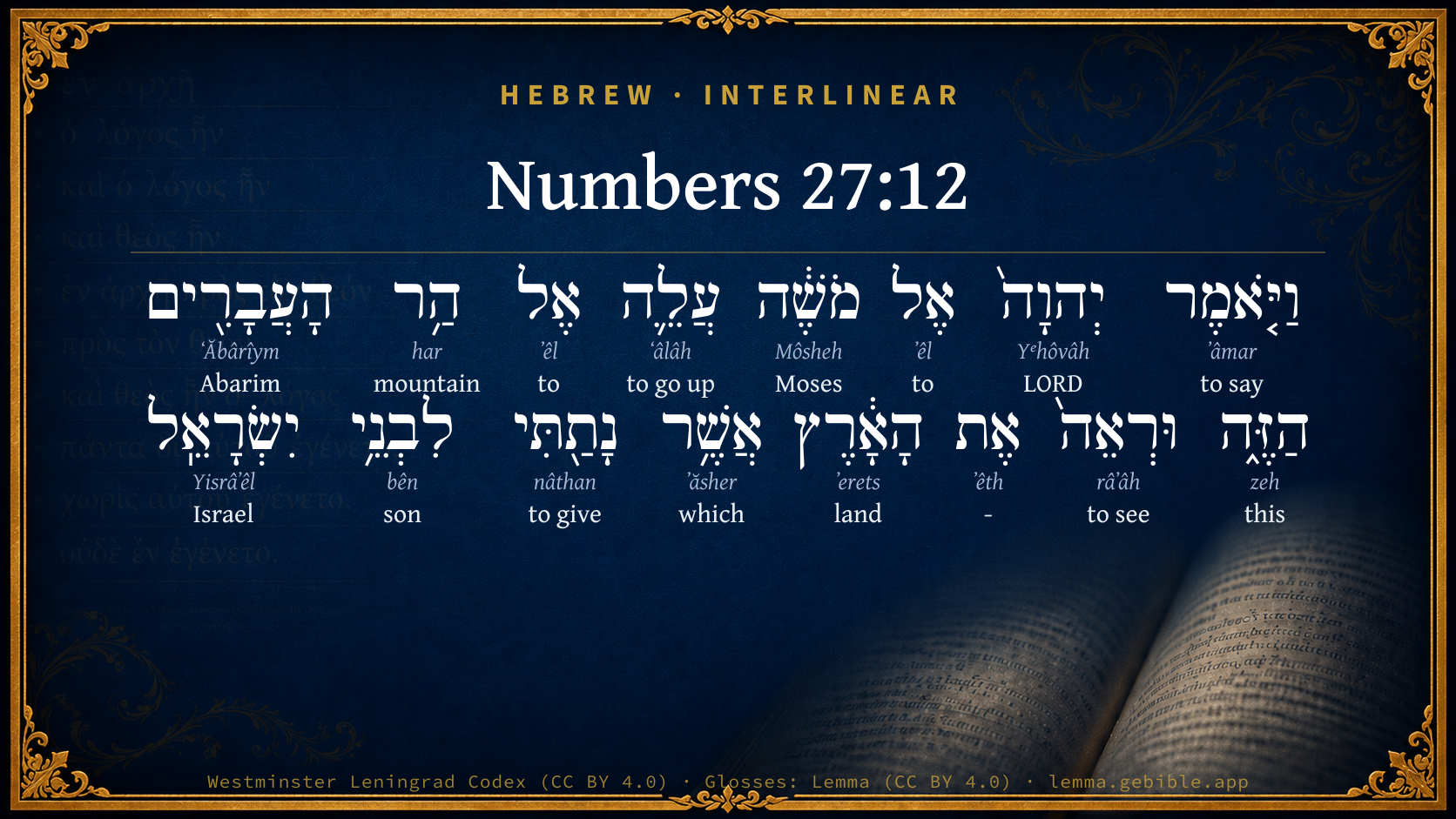
Hebrew (Westminster Leningrad Codex) Numbers 27:12 appears in the Hebrew Old Testament. The text above is from the Westminster Leningrad Codex. Each word links to its Strong’s number, a concise gloss, and parsing drawn from the Open Scriptures Hebrew Bible morphology. Click any word for its full Brown-Driver-Briggs (BDB) entry.
Download image
Cite this verse

Numbers 27:12 (World English Bible). Public Domain. Lemma interlinear Bible study tool, https://lemma.gebible.app/v/numbers/27/12.

Show BibTeX & RIS
BibTeX
RIS
English Translation
Yahweh said to Moses, Go up into this mountain of Abarim, and see the land which I have given to the children of Israel.
World English Bible · Public Domain
Highlights Full analysis ↓
Download a study sheet

One document with this verse’s original text, its word-by-word gloss line, the meaning frame, cross-references with their text, attributed commentary, and full source and license credits — printable, and it pastes into notes with its structure intact.

This verse Autodidact and up

Study sheet (.html) Plain text (.txt)

A passage Seminary Student

Up to 50 verses in one chapter. A passage sheet keeps up to 6 commentary sources and 12 cross-references per verse, in the order this page ranks them, and says so on the sheet whenever that leaves anything out. Ask for a single verse and you get the Autodidact verse sheet above.

Everything on this page stays free to read, with no account — the sheet is a download of what is already on screen, not access to it.

Want to remove ads? Support Godless Engineer
Compare translations 3

The same verse in 3 English versions, stacked beneath the original-language interlinear above. Click any original word for its lexicon entry.

Each is an independent rendering of the whole verse — the interlinear is not word-aligned to these translations.

Highlighted words mark where these versions differ — a whole-verse word diff, not a word-by-word alignment.

  • World English Bible Public Domain
    Yahweh said to Moses, Go up into this mountain of Abarim, and see the land which I have given to the children of Israel.
  • King James Version Public Domain
    And the LORD said unto Moses, Get thee up into this mount Abarim, and see the land which I have given unto the children of Israel.
  • unfoldingWord Literal Text CC BY-SA 4.0
    And Yahweh said to Moses, “Go up to this mountain of Abarim, and see the land that I have given to the sons of Israel.

unfoldingWord Literal Text — © unfoldingWord, licensed CC BY-SA 4.0. Word-aligned USFM3 via Door43 (git.door43.org/unfoldingWord/en_ult).

Versions to compare (up to 4)

3 of 4 selected

Show all 18 translations

Every available English version of this verse, each an independent rendering of the whole verse.

  • World English Bible Public Domain
    Yahweh said to Moses, Go up into this mountain of Abarim, and see the land which I have given to the children of Israel.
  • Berean Standard Bible Public Domain
    Then the LORD said to Moses, “Go up this mountain of the Abarim range and see the land that I have given the Israelites.
  • Majority Standard Bible Public Domain
    Then the LORD said to Moses, “Go up this mountain of the Abarim range and see the land that I have given the Israelites.
  • King James Version Public Domain
    And the LORD said unto Moses, Get thee up into this mount Abarim, and see the land which I have given unto the children of Israel.
  • American Standard Version (1901) Public Domain
    And Jehovah said unto Moses, Get thee up into this mountain of Abarim, and behold the land which I have given unto the children of Israel.
  • Revised Version (1885) Public Domain
    And the LORD said unto Moses, Get thee up into this mountain of Abarim, and behold the land which I have given unto the children of Israel.
  • Geneva Bible (1599) Public Domain
    Againe the Lord said vnto Moses, Go vp into this mount of Abarim, and behold ye lande which I haue giuen vnto the children of Israel.
  • Douay-Rheims (1899) Public Domain
    The Lord also said to Moses: Go up into this mountain Abarim, and view from thence the land which I will give to the children of Israel.
  • Young's Literal Translation Public Domain
    And Jehovah saith unto Moses, `Go up unto this mount Abarim, and see the land which I have given to the sons of Israel;
  • Literal Standard Version CC BY-SA 4.0
    And YHWH says to Moses, “Go up to this Mount Abarim, and see the land which I have given to the sons of Israel;
  • Unlocked Literal Bible CC BY-SA 4.0
    Yahweh said to Moses, “Go up the mountains of Abarim and look at the land that I have given to the people of Israel.
  • unfoldingWord Literal Text CC BY-SA 4.0
    And Yahweh said to Moses, “Go up to this mountain of Abarim, and see the land that I have given to the sons of Israel.
  • Darby Bible Public Domain
    And Jehovah said to Moses, Get thee up into this mount Abarim, and see the land that I have given unto the children of Israel.
  • World Messianic Bible Public Domain
    The LORD said to Moses, “Go up into this mountain of Abarim, and see the land which I have given to the children of Israel.
  • Webster's Bible Public Domain
    And the LORD said to Moses, Ascend this mount Abarim, and see the land which I have given to the children of Israel.
  • Free Bible Version CC BY-SA 4.0
    The Lord told Moses, “Go up into the Abarim mountains so you can see the land that I have given the Israelites.
  • Bible in Basic English Public Domain
    And the Lord said to Moses, Go up into this mountain of Abarim so that you may see the land which I have given to the children of Israel.
  • JPS Tanakh (1917) Public Domain
    And the LORD said unto Moses: 'Get thee up into this mountain of Abarim, and behold the land which I have given unto the children of Israel.

Literal Standard Version (2020), Covenant Press — licensed CC BY-SA 4.0. Text via the HelloAO Bible API (eBible.org). Unlocked Literal Bible (unfoldingWord) — licensed CC BY-SA 4.0. Text via the HelloAO Bible API (eBible.org). unfoldingWord Literal Text — © unfoldingWord, licensed CC BY-SA 4.0. Word-aligned USFM3 via Door43 (git.door43.org/unfoldingWord/en_ult). Free Bible Version, Dr. Jonathan Gallagher — licensed CC BY-SA 4.0. Text via the HelloAO Bible API (eBible.org).

Word by word

More ways to search: Search by grammar → Find every occurrence → Compare this word →

Practice this passage: Drill this verse → Learn its vocabulary →

הָעֲבָרִ֖ים
ʻĂbârîym
H5682
“the · Abarim”
Particle, Definite Article + Noun, Proper
Part of Speech
Particle + Noun
Type
Proper
Full BDB Definition

Origin: pl. of H5676

TWOT: None

Abarim = "regions beyond" - a mountain or range of mountains on the east of the Jordan, in the land of Moab, opposite to Jericho; Mount Nebo is part of this range
  1. וַיֹּ֤אמֶר ʼâmar H559 “and · to say” Conjunction + Verb, Qal, Sequential Imperfect, 3rd Person, Masculine, Singular
  2. יְהוָה֙ Yᵉhôvâh H3068 “LORD” Noun, Proper
  3. אֶל ʼêl H413 “to” Preposition
  4. מֹשֶׁ֔ה Môsheh H4872 “Moses” Noun, Proper
  5. עֲלֵ֛ה ʻâlâh H5927 “go up” Verb, Qal, Imperative, 2nd Person, Masculine, Singular
  6. אֶל ʼêl H413 “to” Preposition
  7. הַ֥ר har H2022 “mountain of” Noun, Common, Masculine, Singular, Construct
  8. הַזֶּ֑ה zeh H2088 “the · this” Particle, Definite Article + Pronoun, Demonstrative, Masculine, Singular
  9. וּרְאֵה֙ râʼâh H7200 “and · see” Conjunction + Verb, Qal, Imperative, 2nd Person, Masculine, Singular
  10. אֶת ʼêth H853 “-” Particle, Direct Object
  11. הָאָ֔רֶץ ʼerets H776 “the · land” Particle, Definite Article + Noun, Common, Both, Singular, Absolute
  12. אֲשֶׁ֥ר ʼăsher H834 “which” Particle, Relative
  13. נָתַ֖תִּי nâthan H5414 “to give” Verb, Qal, Perfect, 1st Person, Common, Singular
  14. לִבְנֵ֥י bên H1121 “to/for · sons of” Preposition + Noun, Common, Masculine, Plural, Construct
  15. יִשְׂרָאֵֽל Yisrâʼêl H3478 “Israel” Noun, Proper

About this verse

These counts appear in no published source. They are computed here, from the morphology-tagged text and Lemma’s own curated glosses. What Lemma adds →

16
words
15
distinct lemmas
Pentateuch
section

Notable vocabulary

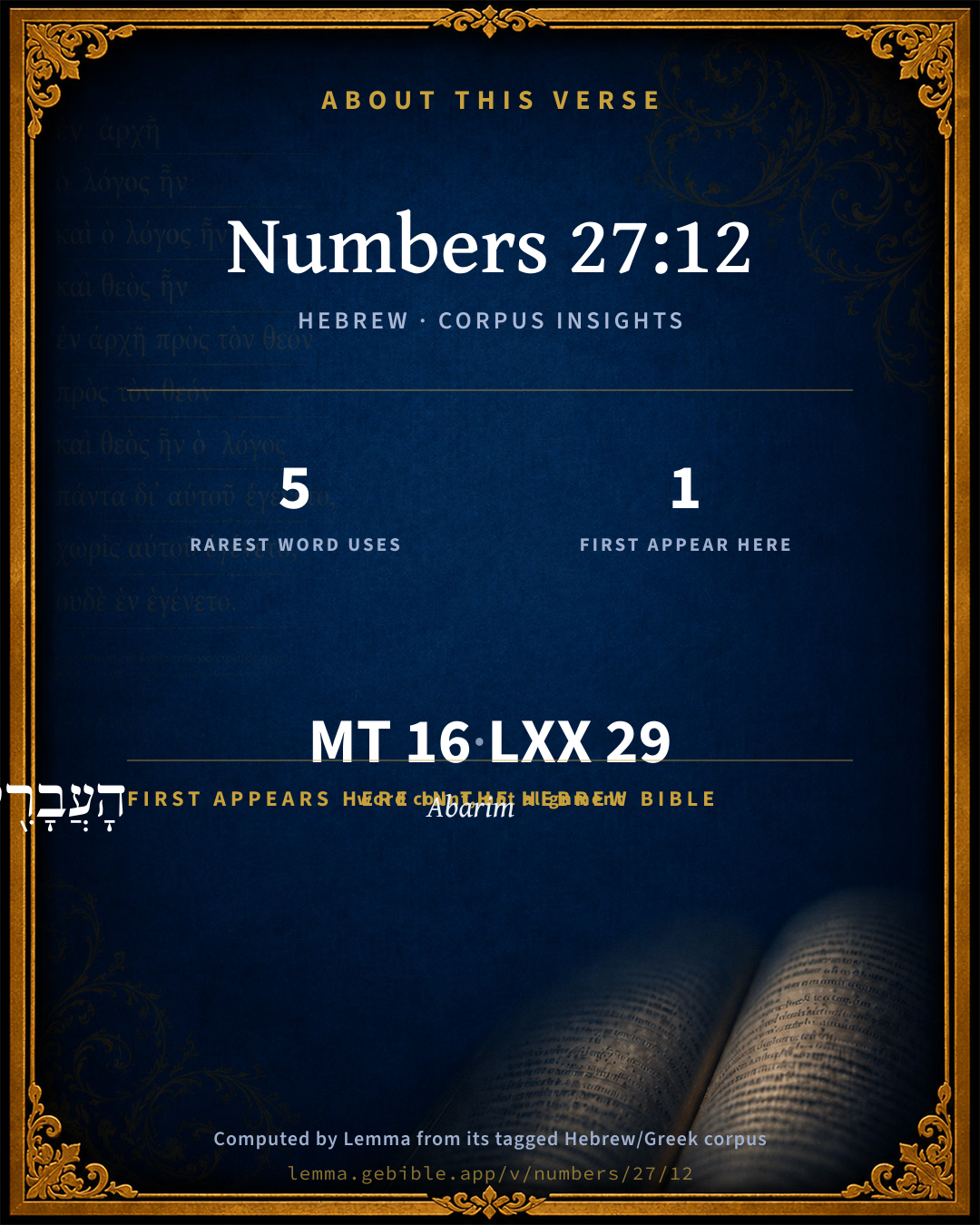
The rarest word here is הָעֲבָרִ֖ים Abarim H5682 — appearing just 5 times in the whole Hebrew Bible.

First appearance in Scripture

This word makes its first canonical appearance in the Hebrew Bible here:

  • הָעֲבָרִ֖ים Abarim H5682

Shared distinctive vocabulary

הָעֲבָרִ֖ים Abarim H5682 occurs in 5 verses of the Hebrew Bible. Also found in:

Grammatical profile

  • 4 verbs
  • 7 nouns
  • 1 pronoun
  • 2 prepositions
  • 2 particles

Verb forms

  • וַיֹּ֤אמֶר Qal · Sequential Imperfect
  • עֲלֵ֛ה Qal · Imperative
  • וּרְאֵה֙ Qal · Imperative
  • נָתַ֖תִּי Qal · Perfect

Repetition

A word recurs within this verse — often emphatic in Hebrew:

  • אֶל to H413 ×2

Hebrew & Septuagint length

In English translation the verse runs 24 words from the Hebrew and 37 from the Septuagint (LXX English) — the Septuagint runs noticeably longer here. See the side-by-side →

A rough comparison of the two English renderings, which tokenize alike — not a word-level alignment.

Word counts can differ between the Hebrew and the Greek without any difference in meaning — e.g. the Hebrew direct-object marker אֵת has no separate Greek word, and Greek often adds the article ὁ.

In the original languages it is 16 Hebrew tokens and 29 Greek tokens — but the two are counted differently (Hebrew bundles its prefixes and suffixes into one token; the Greek is in lemma form), so that isn’t a like-for-like length.

Cross-references

4

Topical passages linked to Numbers 27:12 in the Treasury of Scripture Knowledge — connected by theme and wording, ordered by reader-vote popularity; previews shown in the World English Bible.

  • Numbers 33:47–48 They traveled from Almon Diblathaim, and encamped in the mountains of Abarim, before Nebo.
  • Deuteronomy 3:23–27 I begged Yahweh at that time, saying,
  • Deuteronomy 34:1–4 Moses went up from the plains of Moab to Mount Nebo, to the top of Pisgah, that is over against Jericho. Yahweh shown him all the land of Gilead, to Dan,
  • Deuteronomy 32:48–52 Yahweh spoke to Moses that same day, saying,

Cross-references courtesy of OpenBible.info (CC BY 4.0).

Hebrew and Greek witnesses Masoretic Hebrew ↔ Greek Septuagint

The same verse in the two great witnesses to the Old Testament, shown verse-for-verse.

Here the Septuagint runs noticeably longer than the Hebrew — LXX2012 (modern English Septuagint) 37 words vs World English Bible 24. A rough length comparison of the two English translations, not a word-level alignment — read both below.

These are two independent witnesses, not word-aligned to each other, and the Septuagint is shown in lemma (dictionary) form.

Hebrew Numbers 27:12 Masoretic · Westminster Leningrad Codex

וַיֹּ֤אמֶר יְהוָה֙ אֶל מֹשֶׁ֔ה עֲלֵ֛ה אֶל הַ֥ר הָעֲבָרִ֖ים הַזֶּ֑ה וּרְאֵה֙ אֶת הָאָ֔רֶץ אֲשֶׁ֥ר נָתַ֖תִּי לִבְנֵ֥י יִשְׂרָאֵֽל

Yahweh said to Moses, Go up into this mountain of Abarim, and see the land which I have given to the children of Israel.

World English Bible · Public Domain

Greek LXX Numbers 27:12 Septuagint · lemma form

καί εἶπον κύριος πρός μωυσῆς ἀναβαίνω εἰς ὁ ὄρος ὁ ἐν ὁ πέραν οὗτος ὄρος ναβαυ καί ὁράω ὁ γῆ χανααν ὅς ἐγώ δίδωμι ὁ υἱός ἰσραήλ ἐν κατάσχεσις

And the Lord said to Moses, Go up to the mountain that is in the country beyond Jordan, this mount Nabau, and behold the land Chanaan, which I give to the sons of Israel for a possession.

LXX2012 (modern English Septuagint) · Public Domain

Hebrew: Westminster Leningrad Codex (CC BY 4.0). Greek: Septuagint (public domain); English from LXX2012 (modern English Septuagint) (Public Domain). How the Septuagint differs from the Hebrew →

Targum (Aramaic paraphrase)

2

The Targum is the ancient Jewish Aramaic paraphrase of the Hebrew Scriptures — an interpretive translation, not the Hebrew text itself. Onkelos (literal) and Pseudo-Jonathan (expansive) render the Torah, and Jonathan the Prophets. Coverage is partial: where no permissively-licensed English translation exists for a verse, only the Aramaic is shown. This is verse-level text, not a word-by-word alignment to the Hebrew.

  1. Targum Onkelos Torah (Genesis–Deuteronomy)
    וַאֲמַר יְיָ לְמשֶׁה סַק לְטוּרָא דַעֲבָרָאֵי הָדֵין וַחֲזֵי יָת אַרְעָא דִי יְהָבִית לִבְנֵי יִשִׂרָאֵל

    (no public-domain English translation for this verse)

    Targum Onkelos — Aramaic: “Onkelos Genesis” (public domain); “Onkelos Exodus” (public domain); “Onkelos Leviticus” (public domain); “Onkelos Numbers” (public domain); “Onkelos Deuteronomy” (public domain). English: “Sefaria Community Translation” (CC0 1.0 (public-domain dedication)); “J.W. Etheridge. The Targums of Onkelos and Jonathan Ben Uzziel on the Pentateuch. London: Longmans, Green, 1862” (public domain). Text via Sefaria.

  2. Targum Pseudo-Jonathan Torah (Genesis–Deuteronomy)
    וַאֲמַר יְיָ לְמשֶׁה סוֹק לְטַוְורָא דְעַבְרָאֵי הָדֵין וְחָמֵי יַת אַרְעָא דִיהָבִית לִבְנֵי יִשְרָאֵל

    And the Lord said to Mosheh, Go up to this mount, of Abaraee, and survey the land which I have given to the children of Israel.

    Targum Pseudo-Jonathan — Aramaic: “Targum Jonathan on Genesis” (public domain); “Targum Jonathan on Exodus” (public domain); “Targum Jonathan on Leviticus” (public domain); “Targum Jonathan on Numbers” (public domain); “Targum Jonathan on Deuteronomy” (public domain). English: “The Targum of Jonathan ben Uzziel, trans. J. W. Etheridge, London, 1862” (public domain). Text via Sefaria.

Commentary

Notes on Numbers 27:12 from classic Christian and Jewish commentators (each source and its license shown beneath its notes). The classic Christian expositions comment on the surrounding passage and are grouped to its opening verse, so a note may address several verses; the Jewish commentaries on the Tanakh (Rashi and others) are per-verse, so they appear only where the commentator wrote on this verse.

Lemma curates 59 commentaries, every one of them public domain or Creative Commons licensed, each selected and text-cleaned for this edition rather than reprinted as found. About our sources →

Matthew Henry's Commentary

Here, 1. God tells Moses of his fault, his speaking unadvisedly with his lips at the waters of strife, where he did not express, so carefully as he ought to have done, a regard to the honour both of God and Israel, Num 27:14. Though Moses was a servant of the Lord, a faithful servant, yet once he rebelled against God's commandment, and failed in his duty; and though a very honourable servant, and highly favoured, yet he shall hear of his miscarriage, and all the world shall hear of it too, again and again; for God will show his displeasure against sin, even in those that are nearest and dearest to him. Those that are in reputation for wisdom and honour have need to be constantly careful of their words and ways, lest at any time they say or do that which may be a diminution to their comfort, or to their credit, or both, a great while after. 2. He tells Moses of his death. His death was the punishment of his sin, and yet notice is given him of it in such a manner as might best serve to sweeten and mollify the sentence, and reconcile him to it. (1.) Moses must die, but he shall first have the satisfaction of seeing the land of promise, Num 27:12. God did not intend with this sight of Canaan to tantalize him, or upbraid him with his folly in doing that which cut him short of it, nor had it any impression of that kind upon him, but God appointed it and Moses accepted it as a favour, his sight (we have reason to think) being wonderfully strengthened and enlarged to take such a full and distinct view of it as did abundantly gratify his innocent curiosity. This sight of Canaan signified his believing prospect of the better country, that is, the heavenly, which is very comfortable to dying saints. (2.) Moses must die, but death does not cut him off; it only gathers him to his people, brings him to rest with the holy patriarchs that had gone before him. Abraham, and Isaac, and Jacob, were his people, the people of his choice and love, and to them death gathered him. (3.) Moses must die, but only as Aaron died before him, Num 27:13. And Moses had seen how easily and cheerfully Aaron had put off the priesthood first and then the body; let not Moses therefore be afraid of dying; it was but to be gathered to his people, as Aaron was gathered. Thus the death of our near and dear relations should be improved by us, [1.] As an engagement to us to think often of dying. We are not better than our fathers or brethren; if they are gone, we are going; if they are gathered already, we must be gathered very shortly. [2.] As an encouragement to us to think of death without terror, and even to please ourselves with the thoughts of it. It is but to die as such and such died, if we live as they lived; and their end was peace, they finished their course with joy; why then should we fear any evil in that melancholy valley?

Matthew Henry's Commentary on the Whole Bible (1708–1710) — public domain (CC PDM 1.0). Text via the HelloAO Bible API.

Jamieson, Fausset & Brown

Robert Jamieson, A. R. Fausset & David Brown

MOSES BEING TOLD OF HIS APPROACHING DEATH, ASKS FOR A SUCCESSOR. (Num 27:12-17)

The Lord said unto Moses, Get thee up into this mount Abarim, and see the land--Although the Israelites were now on the confines of the promised land, Moses was not privileged to cross the Jordan, but died on one of the Moabitic range of mountains, to which the general name of Abarim was given (Num 33:47). The privation of this great honor was owing to the unhappy conduct he had manifested in the striking of the rock at Meribah [Num 20:12]; and while the pious leader submitted with meek acquiescence to the divine decree, he evinced the spirit of genuine patriotism in his fervent prayers for the appointment of a worthy and competent successor [Num 27:15-17].

Jamieson, Fausset & Brown — Commentary Critical and Explanatory on the Whole Bible (1871) — public domain (CC PDM 1.0). Text via the HelloAO Bible API.

Trapp's Complete Commentary

John Trapp

Num 27:12 And the LORD said unto Moses, Get thee up into this mount Abarim, and see the land which I have given unto the children of Israel.

Ver. 12. See the land.] It was somewhat to see; but oh how fain would he have entered the land, and could not! We shall have in heaven not only vision, but fruition; we have it already in capitetenure, in Christ our head and husband, who will not be long without us, it being part of his heaven, that we shall be where he is, {Joh 17:24} and enjoy God, which is heaven itself; whence in Scripture God is called Heaven, "I have sinned against Heaven." And I had rather be in hell and have God present, than in heaven and God absent, saith Luther. {a}

{a} Malim praesente Deo esse in inferno, quam absente Deo in coelo. - Luth., in Gen. xxx.

John Trapp, A Commentary or Exposition upon All the Books of the Old and New Testament (1647–1656) — public domain. Text from a community e-Sword module.

The Biblical Illustrator

Joseph S. Exell

Num_27:12-14

Thou also shalt be gathered unto thy people, as Aaron thy brother was gathered.

Why Moses must not enter Canaan

Eminent as he was in grace and holiness, he was not allowed to enter with his people into the Land of Promise. This in itself must have been a sore trial. But it was tenfold more so on account of the cause; it was a judgment. He who was the meekest of men once spoke unadvisedly with his lips. The reason, then, why Moses could not enter into the Land of Promise is evident. Moses represents the law. Now we have seen that, as a believer, Moses could not enter the Land of Promise, because on one occasion he spake unadvisedly with his lips. But look at him as the representative of the Law, and what lesson does his inability to enter the Land of Promise rivet on our hearts? This truth, that the law cannot bring us into the Land of Promise. There was a point to which Moses could bring Israel, and then he must lie down and die, and his work must be given into other hands, into the hands of Joshua, whose very name shows that he was an eminent type of Christ. There is a point, too, up to which the law may bring us. Where is it? It is to a knowledge of sin. By the law, says St. Paul, is the knowledge of sin. I had not known sin, he says but by the law: for I had not known lust, except the law had said, Thou shalt not covet (Rom_7:7). One great purpose for which the law is given is just to teach us what we are- utterly sinful, utterly lost in ourselves. It requires perfect obedience; and, behold, in many things we offend. It makes no provision for transgression, proclaims no forgiveness. It can give no peace. The voice is terrible to the guilty. Whenever it fulfils its true purpose in the soul it empties it of self-righteousness, lays it prostrate in the dust, and makes it take the lowest place. Thus St. Paul says, I through the law am dead to the law, that I might live unto God (Gal_2:19). And, again, Wherefore the law was our schoolmaster to bring us unto Christ, that we might be justified by faith (chap. 3:24). Are you? Under Moses or Christ? What is your hope of glory? Is it that you have not sinned so much as others? that your life is very exemplary? that you leave no duty willingly unperformed, or service unattended? Do you think that somehow or other Christ must be yours, if your life is so excellent? Are these your thoughts? Then we must faithfully tell you that you are still under Moses, still clinging to a broken law; and we must remind you that the law can never bring you to heaven. It is Christ only who can save you, and bring you into the Land of Promise--Christ only who can reconcile you to God, and we can never come to Christ without utterly renouncing our own righteousness, and our own works, as entitling us to Gods favour. (G. Wagner.)

The death of Moses

Moses must die, but only as Aaron died before him (Num_27:13); and Moses had seen how easily and cheerfully Aaron had put off the priesthood first, and then the body. Let not Moses, therefore, be afraid of dying; it was but to be gathered to his people, as Aaron was gathered. Thus the death of our near and dear relations should be improved by us.

1. As an engagement to us to think often of dying. We are not better than our fathers or brethren; if they are gone, we are going; if they are gathered already, we must be gathered very shortly.

2. As an encouragement to us to think of death without terror, and even to please ourselves with the thoughts of it, it is but to die as such and such died, if we lived as they lived, and their end was peace; they finished their course with joy; why, then, should we fear any evil in that melancholy valley? (Matthew Henry, D. D.)

The Biblical Illustrator, edited by Joseph S. Exell (c. 1880s–1900s) — public domain. Text from a community e-Sword module.

Joseph Benson's Commentary

Num 27:12. Abarim — The whole tract of mountains was called Abarim, whereof one of the highest was called Nebo, and the top of that Pisgah.

Joseph Benson's Commentary on the Old and New Testaments (1811–1818) — public domain. Text from a community e-Sword module.

Whedon's Commentary on the Bible

Daniel D. Whedon

MOSES FOREWARNED OF HIS DEATH, Num_27:12-14.

12. Abarim literally signifies the farther parts, or possibly the fords or passages, as the word is translated Jer_22:20. It is a range of high lands on the east of the Jordan in Moab, facing Jericho, and forming the eastern wall of the Jordan valley. Its most prominent out-jutting or swell is Mount Nebo, head of the Pisgah.

See the land — Moses earnestly begged to be permitted to enter into Canaan, but the word of Jehovah excluding both Aaron and Moses (Num_20:12) could not be broken. He received this decisive answer, “Let it suffice thee; speak no more unto me of this matter.” Deu_3:26.

Daniel D. Whedon (gen. ed.), Commentary on the Old and New Testaments (1874–1909) — public domain. Text from a community e-Sword module.

The Pulpit Commentary

MOSES AND JOSHUA (verses Num_31:1 that the war with the Midianites occurred later, and certainly the address to the people and to Joshua in Deu_31:1-8 presupposes the formal appointment here recorded; but the chronologer of the concluding chapters of Numbers is evidently very uncertain; they may, or may not, be arranged in order of time. We may with good reason suppose that the summons to die was only separated from its fulfillment by the brief interval necessary to complete what work was yet unfinished (such as the punishment of the Midianites and the provisional settlement of the trans-Jordanic country) before the river was crossed. Into this Mount Abarim. See on Num_33:47 Deu_32:49 sq., where this command is recited more in detail. Abarim was apparently the range behind the Arboth Moab, the northern portion of which opposite to Jericho was called Pisgah, (Num_21:10 Deu_3:27) and the highest point Nebo, (Deu_32:49 Deu_34:1) after the name of a neighbouring town. (Num_33:47) And see the land. Moses had already been told that he should not enter the promised land, (Num_20:12) yet he is allowed the consolation of seeing it with his eyes before his death. It would seem from Deu_3:25-27 that this favour was accorded him in answer to his prayer.

Vers. 12-23. The outward failure and inward victory of Moses.

In this section we have two things very plainly: spiritually, we have the weakness of the row, and its inability to do what only Jesus can do for his people: morally, we have the beauty of an uncomplaining submission to the chastening hand of God, and of gladly seeing others reap where we have sown; succeed where we have failed. Consider, therefore

I THAT MOSES MUST NOT LEAD THE PEOPLE INTO THE PROMISED LAND BECAUSE OF THE PROVED IMPERFECTION OF HIS CHARACTER. It can hardly indeed be supposed that Joshua was in himself more perfect, or on the whole more dear to God, than Moses: but Joshua was not known to have failed distinctly and publicly as Moses was at Meribah; therefore he seemed to answer to the Divine ideal, to the requirement of perfect holiness, better than Moses. Even so the law made nothing per-feet, accomplished nothing fully, because it was known and felt to be imperfect. As applied to the guidance and training of human life for a better world it broke down. Therefore it must be set aside in favour of something more perfect: its glory must be done away before the glory that excelleth. (2Co_3:10 Heb_7:18, 19 10:1, &c.);

II THAT MOSES WAS NOT PERMITTED TO CROSS THE JORDAN: SO much of the inheritance of Israel as lay on the wilderness side of Jordan, he might enter and settle, but he must not cross the river. Even so it was not possible for the law to enter in any wise upon the life to come, the land which is very far off, beyond the stream of Death. This was its limitation imposed upon it by God, by reason of its weakness, that it dealt only with this life, and with such religious sanctions, joys, and consolations, as lie upon this side the grave exclusively. Immortal life was without the province of the law, and could only be entered in Jesus. (Joh_1:17 Joh_11:25 2Ti_1:10)

III THAT MOSES WAS PERMITTED TO SEE THE LAND ERE HE DEPARTED. Even so the law, which brought men to the very confines of the kingdom of heaven, but could not bring them in, (cf. Mat_11:11) had yet within itself a clear vision of the fulfillment of its own hopes. The Song of Simeon and the Voice of the Baptist are the dying testimony of the law, seeing the salvation of God to which it had led through many a weary year, and so content to pass away without enjoying it. (Luk_2:29, 30 Joh_3:29-31, and cf. Heb_11:13Jo Heb 8:56)

IV THAT MOSES CRAVED OF GOD A SUCCESSOR TO HIMSELF WHO SHOULD DO WHAT HE COULD NOT DO. Even so the law through all its voices craved for one, and demanded one of God, who should really save, who should indeed open that kingdom of heaven to which itself pointed, yet was too feeble to enter.

V THAT GOD DESIGNATED JOSHUA (Ihsouv ) TO TAKE UP AND TO FULFIL THE WORK OF MOSES. Even so, what the law could not do, in that it was weak through the flesh, that hath God accomplished by his holy servant Jesus. (Act_13:39 Rom_8:3)

VI THAT MOSES INSTITUTED JOSHUA TO HIS OFFICE BEFORE THE PEOPLE, AND DECLARED HIS WORK TO HIM. Even so was Jesus proclaimed beforehand to all the faithful by the law which pointed him out as the Captain of our salvation; and our Lord himself, in his human nature, learnt from the law what himself should be and do and suffer. (Luk_24:26, 27 Joh_19:28; cf. Mat_26:54 Act_13:27 Act_17:3 Act_26:23 Act_28:22)

Consider again, with respect to the conduct of Moses at this time, wherein he is not a foil to one greater, but a pattern to all the servants of God

I THAT HIS PUNISHMENT SEEMED VERY BITTER AT THIS TIME: much more so surely than when first announced, because then the land was far off, now it was very nigh; then there was yet hope that the Lord would repent him of his sternness, now the decree was palpably final and irrevocable. After so many additional toils, and after so many happy anticipations of victory, to find that the sentence of exclusion still held good must have been bitter indeed!

II THAT HIS PUNISHMENT WAS IN FACT INEXPLICABLE TO HIMSELF, AND TO ALL, AT THAT TIME FOR THE EXPLANATION WAS NOT TO COME FOR MANY CENTURIES. It is only in the glory of the Mount of Transfiguration that we can understand or justify the apparent severity with which Moses was treated. His sentence was "exemplary," for the sake of the people, in order to show in the most striking instance that God requireth a perfect holiness, and a sinless Mediator. But for himself, as (on the whole) a most faithful servant, the sentence was in fact reversed; the wrath was swallowed up in mercy. Moses died outside the promised land, but his body was preserved from corruption by the power of God, (cf. Deu_34:6 with Jud_1:9) and in that body he did actually stand within the inheritance of Israel and talk with Jesus of the decease (exodon ) which he should accomplish at Jerusalem. (Luk_9:31, &c.); And note, that in Moses and Joshua we may clearly see the distinction between the Divine treatment of men as types and as individuals. Moses, e.g., was made in his own time to yield to Joshua, to die in exile while Joshua led on to victory and home; and that obviously because Moses represented the weakness of the law, Joshua the power of the gospel. We, however, with the New Testament in our hands, have no difficulty in seeing that as individual servants of God, Moses is more honoured and more greatly rewarded than Joshua; for God is not extreme to mark what is done amiss by those who in the main serve him nobly, unselfishly, and patiently; nor is it in truth a righteous thing with God for one sin of temper to confiscate the rewards of many years of devotion. As a type Joshua stands higher because he was unblamed: as a man Moses is more dear to God, because his work was far more hard, his position more discouraging, and his lot less happy, than that of Joshua, and he himself not less faithful.

III THAT MOSES DID NOT COMPLAIN OR REBEL. We know indeed from his own mouth, (Deu_3:24) that he privately besought the Lord to let him go over; but when the Lord refused him (for the time present) he submitted without a word of complaint. Here was Moses" meekness; (Num_12:3) not that he was not sometimes provoked so that he forgot himself; but that he habitually humbled himself to bear meekly even what seemed most hard.

IV THAT HIS HABITUAL UNSELFISHNESS SHOWED ITSELF IN CONCERN FOR HIS PEOPLE WHEN HE WAS GONE. He did not harp upon his own fate, or brood upon his own sorrow, but thought only of the people, what should become of them.

V THAT IN HIS UNSELFISH CONCERN FOR THEM HE WAS WILLING AND ANXIOUS THAT ANOTHER SHOULD BE PLACED OVER THEM IN HIS STEAD. And this showed the highest generosity of mind, because even very noble and otherwise unselfish people constantly betray jealousy and displeasure at the thought of others taking their place. To one who had wielded absolute power for forty years, it might well have seemed impossible to ask for a successor.

VI THAT IN HIS LOYALTY TO THE KING OF ISRAEL HE GLADLY DEVOLVED HIS OWN DIGNITY UPON ONE WHO HAD BEEN HIS OWN SERVANT, AND OF ANOTHER TRIBE. Moses made no effort to advance his sons, as even Samuel did, (1Sa_8:1) nor had they any name or pre-eminence in Israel; nor did he show the least jealousy of Joshua, although he had been his own minister and (humanly speaking) owed everything to him.

Consider, again, with respect to Joshua as a figure of our Lord

I THAT HE WAS TO SUPERSEDE MOSES. (See above, and cf. Mat_5:17 Act_6:14 Heb_3:3)

II THAT HE WAS APPOINTED IN ANSWER TO THE PRAYER THAT GOD WOULD "SET A MAN OVER THE CONGREGATION." Even so the Lord is that Son of man whom God hath ordained to be the Head of the Church, the human arbiter of human destinies, the human pattern and guide of all believers. (Act_2:36 Act_10:42 Heb_2:16-18 Eph_1:22, Eph_1:23)

III THAT HE WAS TO GO OUT AND TO GO IN BEFORE HIS PEOPLE; i.e., he was to lead an active and busy life in their sight and in their behalf. Even so our Lord fulfilled his ministry before the eyes of all the people, not in solitary meditation nor in calm retirement, but in a ceaseless activity of labour for the bodies and souls of men. (Luk_2:49 Joh_4:34 Joh_9:4 Joh_18:20 Act_10:38)

IV THAT HE WAS TO LEAD HIS PEOPLE OUT, AND TO BRING THEM IN, as a shepherd does his flock. Even so our Lord goes before his own in all things whether in life or in death, leading them out of the uncertain wilderness of this world, bringing them in to the unchangeable rest of the world to come. (Psa_23:4 Joh_10:3 1Pe_2:21 Rev_1:18)

V THAT HE WAS TO BE A SHEPHERD TO THEM THAT HAD OTHERWISE BEEN SHEPHERD-LESS. (Eze_34:23 Mat_9:36 Heb_13:20 1Pe_5:4 Rev_7:17) But note, whereas Joshua was to stand before Eleazar, and seek counsel and command through him, our Saviour is both Captain and Priest of his people, and knoweth of himself the will of the Father, (Mat_11:27 Joh_1:18 Joh_10:15) and is the Shepherd and Overseer of souls as well as bodies. (1Pe_2:25)

HOMILIES BY W. BINNIE Vers. 12-14. God"s word to his dying servant.

The death of Moses was as singular as his life had been. The scene of it, a mountain-top, where he might be alone with God and yet have a wide prospect of the promised land; the manner of it, not by gradual failure of natural strength, but while he was still able to breast the steep mountain side; the mystery of it, such that no man knew where he was buried. Yet underneath this singularity there was much that is often seen in the departure of God"s servants, and which we shall find it profitable to contemplate.

I THE LORD REMINDS HIS DYING SERVANT OF HIS SIN (verse 14). Dying thoughts are serious thoughts, and it would be strange if they did not often turn on the falls and shortcomings of the past life. Thoughts about sin are of two kinds:

1. There may be the recollection of sin without any knowledge of forgiveness. It was not so that Moses remembered Meribah. The remembrance of unforgiven sin banishes peace. The soul cannot bear to look back, for the past is full of shapes of terror; it cannot bear to look up, for it sees there the face of an offended God; it cannot bear to look forward, for the future is peopled with unknown terrors.

2. There may be the recollection of sin and at the same time an assured persuasion of forgiveness. This is by no means inconsistent with peace. Not that, even thus, the remembrance of sin is pleasant. Moses is put in mind of Meribah to keep him humble. Sin remembered cannot but cause shame; yet it is quite compatible with great peace of mind. Not only so, there is a calm and soul-filling peace which is the fruit of forgiveness, and diffuses itself most abundantly when the soul expatiates on the remembrance at once of its own sin and the Lord"s forgiving grace. "Bless the Lord, oh my soul, who forgiveth all thine iniquities.

II THE LORD COMFORTS HIS SERVANT IN THE PROSPECT OF DEPARTURE.

1. By giving him a sight of the good in store for the Church. It is remarkable how often saints who have spent their strength on some great Christian enterprise, and earnestly desired to see it accomplished before their departure, have been denied this gratification. Moses did not cross the Jordan; David did not see the Temple, nor Daniel the Return, nor John the Baptist the manifestation of Christ"s glory. Yet to all those saints there was granted some such view as that which gladdened the eye of Moses on Nebo. He who knows the hearts knew how dear to Moses" heart was the good of Israel. It is an excellent token of grace in the heart when the prospect of good days in store for the Church and cause of God is a cordial in one"s last sickness.

2. By telling him of the good and congenial society that awaits him in the other world. "Thy people." When we die we go to God. The ascension of Christ in our nature has filled heaven for us with such a blaze of fresh light that we must ever think of heaven chiefly as a "being with the Lord." Yet it is a precious thought, and full of comfort, that those who fall asleep in Jesus are gathered to their people, their true kindred. Moses goes to be with Abraham and Isaac and Jacob, with Joseph, with Miriam and Aaron. B.

HOMILIES BY E.S. PROUT Vers. 12, 13. The alleviations of death.

Death a penalty even in the adopted family of God, though turned into a blessing to the believer. Some of the alleviations of the penalty suggested by this command to Moses. Through faith in Christ we may enjoy

I A CLEAR VIEW OF THE GLORIOUS FUTURE OF THE CHURCH. As Moses saw the land, not yet possessed, but already "given," so may faith anticipate the goodly heritage of the future. Illustrate Joseph"s death-bed; (Gen_1:24) David"s anticipations of an age of glory under Solomon; the bright glimpses of the future with which nearly every one of the minor prophets concludes.

II A RELEASE FROM THE GRAVE RESPONSIBILITIES OF THAT FUTURE. Moses was spared from the wars of the Lord in the conquest of Canaan. And Christians, though willing, like the aged Dr. Lyman Beecher, to "enlist again in a minute," "to begin life over again, and work once more" ("Autobiography," 2:552), are spared from the conflicts of the "perilous times" of the future.

III AN ASSURANCE THAT THE WORK OF GOD WILL BE EFFICIENTLY CARRIED ON WITHOUT us. Not even a Moses is essential to the Church of God; Joshua will do the work as well.

IV AN ADMITTANCE TO THE COMPANY OF THE PIOUS DEAD. "Thy people, who died in faith, and now live with God. With brighter hopes than any heathens, or even than Moses, we may say, "I go to the majority.

V A PEACEFUL DEPARTURE SUCH AS OTHER LOVED ONES HAVE EXPERIENCED. "As Aaron thy brother was gathered." We have seen "the end of their course", (Heb_13:7) and may expect grace for dying hours such as they enjoyed. P.

HOMILIES BY D. YOUNG Vers. 12-23. Preparing for the end.

God has kept in view this solemn departure of Moses, even from the time of sentence on him for his transgression. The heights of Abarim were visible to God from Meribah. And now Israel lies at their base, the work of Moses is done, and God intimates the immediate preparations for his departure. God had already said to him that after taking vengeance on the Midianites he should be gathered to his people. (Num_31:2) (Evidently the events of chapter 31 are earlier in time than those of Num_27:12-23)

I THE PLACE OF DEPARTURE IS ALSO THE PLACE OF A GLORIOUS VISION. The eyes of the dying leader closed upon the sight of the land which the Lord had given to the children of Israel. We may be sure that God directed the feet of Moses to the one spot where there was the most suggestive view of Canaan. Not of necessity the view of greatest geographical extent, but probably one that would sufficiently indicate the variety of surface and products, showing also something of the populous cities. There would be everything to impress on Moses a most decided and cheering contrast with the wilderness. There might be no place even in the promised land itself where he could get a better view for the purpose. He may have climbed to different heights during the sojourn of the people in Moab, and seen many things to gladden his heart, yet never found just the Abarim point of view, until God signified it to him. There are many points of wide and spirit-filling view to which we may come in our excursions through the high lands of Scriptural truth and privilege, but we must wait for God himself to give us the great Abarim point of view. Many a Moabite shepherd had wandered on those heights, and seen with the outward eye the same landscape as Moses; but it needed a Moses, with a long-instructed, experienced, and privileged heart, to see what the Lord would show him. Balaam was driven from one height to another by the unsatisfied Balak, yet from them all even he, the man of carnal and corrupt mind, saw something glorious. What then must not Moses have seen, being so different a man from Balaam. and looking from God"s own chosen point of view?

II IT IS ALSO THE PLACE FOR CHEERING ANTICIPATIONS OF THE EARTHLY FUTURE OF GOD"S PEOPLE. Moses is to see with his own eyes that the land was worth forty years" waiting and suffering for. The object stands revealed before him as worthy of the effort. And though the earthly future of Israel is not to be his future, yet how could he look upon it otherwise than with as much interest and solicitude as if it were his own? Certainly that future was assured, as far as promise could assure it, and all the tenor of experience in the past. Whatever the circumstances of Moses" death, they could not materially affect the course of the people, seeing the ever-loving, all-comprehending God had them in charge. But it became God it was a sign of loving care for a faithful servant that Moses should die as he did. Quite conceivably he might have died in the gloom caused by some fresh aberration of the people, or at the best in the ordinary circumstances of daily life, with nothing more to mark his departure than if he were one of the most obscure persons in the comp. But God orders all things so that he shall depart where and when his mind may be filled with great joy because of Israel"s coming years in Canaan. It happened not to him, as it has happened often in great crises of human affairs, that the leader has been suddenly called away with the feeling in his heart, "After me the deluge." None indeed knew better than Moses that Canaan would have its own difficulties. From the wilderness to Canaan was in many things only an exchange of difficulties, but still Canaan had things the wilderness never had, never could have, else it would not have been the promised land. Moses looks down on Canaan, and he sees not only the land, but a Joshua, with 600, 000 fighting men under him, a tabernacle, an ark of the covenant, institutions in a measure consolidated by the daily attention of forty years.

III THE SIMILAR ASSURANCES WE MAY HAVE AS TO THE FUTURE OF GOD"S WORK IN THE WORLD. We have things which our fathers had not instruments, opportunities, liberties, and successes which were denied to them. Yet they saw the bright day coming; its first streaks fell on their dying faces; and they rejoiced even in what they could not share. Aged and bone-weary Israelites who died just as the people were leaving Egypt would nevertheless rejoice with all their hearts in the deliverance of their children. And Moses, who had been born an exile, who had lived forty years among strangers in Egypt, forty years more in the second exile of Midian, and forty years in the wilderness, was just the man to appreciate the satisfactions which were coming to his brethren at last. Thus we should learn to rejoice with all our hearts in the advent of possessions and privileges which have come too late for us individually to share. It is not enough languidly to say that things will be better for the next generation than they are for the present; it should be our joy to live and work as Moses did for the attainment of this. Let all our life be a slow climbing of Abarim, then our closing days will be rewarded with Abarim"s view. It was the glory and joy of Moses that while he looked from the top of the mount, Israel was in the plain beneath. They were not far away in the wilderness of Sinai or, Worse still, in the brick-yards of Egypt. Moses had brought them with him, or rather God had brought him and them together. All humble, unselfish, and God-respecting hearts, who work through evil report and good report to make the world better, will assuredly have something of the reward of Moses from the top of Abarim. As concerns the greatest treasures of the kingdom of God, it matters not in what generation we live. It was better to be a believing Israelite in the wilderness, even though he died there, than an unbelieving one in Canaan. It will be better in the judgment for the man of two thousand years ago who looked forward longingly for the Messiah than for the man of to-day who looks back carelessly on the cross. The resources and revelations of eternity will equalize the disparities of time. All the same it will be no small matter if those who have taken part in guiding a generation through the wilderness see the earthly Canaan on which it is entering before they are gathered to their people. Each generation should leave to the next more of Canaan and less of the wilderness. Each generation, though it enters in some sort upon a Canaan, should leave it as only a wilderness compared with the brighter Canaan that is to follow. Let our confident, determined cry ever be, Out of Christ there is no hope for the world. Out of Christ the generations of men must become more and more corrupt, and give more hold for the pessimist with his dismal creed. But equally our cry must be, In Christ there is no room even for despondency, let alone despair. Black as the outlook remains on a world"s sins and sorrows, the God who showed Canaan to Moses from Abarim holds his resources undiminished still. Y. (Rom_8:28 Rom_11:33-36 Rom_15:19, 29 1Co_15:58 2Co_1:20)

The Pulpit Commentary (1880–1919), ed. H.D.M. Spence-Jones & Joseph S. Exell — public domain. Text from a community e-Sword module.

Lange's Commentary on the Holy Scriptures

FIFTH SECTION

The Consecration of Joshua introduced by the announcement of the death of Moses, with reference also to the speedy entrance of Israel into Canaan

Num_27:12-23

12And the Lord said unto Moses, Get thee up into this mount Abarim, and see the land which I have given unto the children of Israel. 13And when thou hast seen it, thou also shalt be gathered unto thy people, as Aaron thy brother was gathered. 14For ye rebelled against my commandment in the desert of Zin, in the strife of the congregation, to sanctify me at the water before their eyes: that is the water of Meribah in Kadesh in the wilderness of Zin.

15, 16And Moses spake unto the Lord, saying, Let the Lord, the God of the spirits of all flesh, set a man over the congregation, 17Which may go out before them, and which may go in before them, and which may lead them out, and which may bring them in; that the congregation of the Lord be not as sheep which have no shepherd.

18And the Lord said unto Moses, Take thee Joshua the son of Nun, a man in whom is the spirit, and lay thine hand upon him; 19And set him before Eleazar the priest, and before all the congregation; and give him a charge in their sight. 20And thou shalt put some of thine honour upon him, that all the congregation of the children of Israel may be obedient. 21And he shall stand before Eleazar the priest, who shall ask counsel for him after the judgment of Urim before the Lord: at his word shall they go out, and at his word they shall come in, both he, and all the children of Israel with him, even all the congregation. 22And Moses did as the Lord commanded him: and he took Joshua, and set him before Eleazar the priest, and before all the congregation: 23And he laid his hands upon him and gave him a charge, as the Lord commanded by the hand of Moses.

TEXTUAL AND GRAMMATICAL

[Num_27:20. Hearken, without the object. See Exo_7:16; Isa_1:19. The object is easily supplied from the context.—A. G.].

EXEGETICAL AND CRITICAL

Deuteronomy 31-34 completes this section. It is clear from the whole context, that we are not dealing here with two successive sections, but with one having two closely related divisions; and that the first, of which here, the command of Jehovah to Moses to ascend Mount Nebo before his end, the fulfilment of which is not related here, serves as an introduction to the consecration of Joshua as the successor of Moses (in his position as leader of the hosts, though not in his prophetic office), and indeed with express reference to the approaching entrance into Canaan. [The command stands here probably in its natural and chronological order. It follows naturally upon the regulations as to the inheritance of the land. It was given to bring to the mind of Moses, afresh, what he had known before, that he was not to lead the people into that land, that his career was near its close, and to stimulate him to do all that he could, while he was still living, to provide for the welfare of his people in the future. The first and most essential thing was the choice and consecration of his successor.—A. G.].

Num_27:12-14. Moses is commanded to ascend Mount Nebo, in order to finish his work with the view of Canaan before his death. Here again he is reminded of his sin in the wilderness of Zin, in which also Aaron shared. The workings of passion, which in its inward violence and agitation may have, to some extent, shortened his life, seem to have been concentrated in that passionate act. The command here is left somewhat indefinite. Get thee up into this mountain Abarim. Subsequently it becomes more definite. Abarim becomes Pisgah, and Pisgah Nebo. Comp. Com., chap. 34, the Bible Lexicons, and Num_20:12. [The double כַּאֲשֶׁר is not causal, but comparative, indicating that as he had sinned with Aaron he must die also, with only the sight of the promised land; or that as they had sinned, they must bear the penalty of that transgression. Hirsch draws the distinction between the occurrence at Rephidim and at Kadesh, not only that the one was at the beginning and the other at the close of their wanderings, but that at Rephidim the water was to flow upon the blows with the rod of Moses, while at Kadesh it was the word of Moses which was to open the fountain. When Moses used the rod he did not sanctify Jehovah. He failed to recognize the efficacy of the word, and that they were now at the transition point, passing from the immediate supernatural divine support and security, into the ordinary, natural method of life. In His view Moses and Aaron had reached the end of their course; they had led the people through this more exclusively miraculous period, and there removal therefore while it was as a punishment for their sin, was natural and necessary also, their specific work being finished.—A. G.].

Num_27:15-23. A preliminary account of the consecration of Joshua. Although Moses had for a long time previously been familiar with the thought that Joshua, already for nearly forty years his military captain, would at one time replace him in that capacity as his successor, he did not venture with his human estimation and choice, to anticipate the divine decision. It was, too, in full accordance with his noble self-forgetful disposition, to ask for the appointment of his successor.

Num_27:16. Let the LORD, the God of the spirits of all flesh set a man over the congregation.—All flesh has the same likeness, but the spirits of all flesh are endlessly different. God alone knows and tries the spirits, and therefore He alone selects the right persons. In such an emergency, too, His decision alone is satisfactory. Comp. Num_16:22. The destined man must be the shepherd or the leader, the prince or captain of the people, since the people must not be without a shepherd.

[Num_27:17. Go in and out as descriptive of the private life, while to lead out and lead in designates his public official walk; one who in his private personal, and in his official life, should be an example to the people, and so be fitted to direct and influence them in their private and public obligations.—A. G.].

Num_27:18. Upon this Jehovah designates Joshua the son of Nun as the man whom He has chosen. For in him is the Spirit.—Spirit: Knobel, “Insight and wisdom.” Keil: “The higher power breathed into his soul by God, which quickens and shapes his moral and religious life,” and here “the spiritual qualifications necessary for the office which was to be entrusted to him.” The Spirit however is a developed fulness of life, here with reference to his particular calling as a leader of the host.

Moses, however, must consecrate him before Eleazar the priest and the whole congregation, by the imposition of his hands (transferring his official dignity) and give him a charge, the instructions which were connected with this ordination service. [The spiritual gifts which he possessed did not dispense with the necessity for the external consecration, nor would this consecration have been of any avail without the gifts.—A. G.].

Num_27:20. And thou shalt put some of thine honor (הוֹר) upon him. Moses could confer upon him his princely or his judicial office, but not the prophetic calling; for that calling Jehovah reserves to Himself, and it could not be made an official institution. Elijah could initiate Elisha into the prophetic order and school, but he could not make him a prophet. Eleazar was not a prophet, although as high-priest he administered Urim and Thummim, the substitute for prophetic decisions. [The eminence and authority of Moses were not to be fully transferred to Joshua, but in part. He became vice-leader. Bible Com.: The transference of this honor to Joshua is not parallel to the communication of the spirit which rested upon Moses to the seventy elders, Num_11:17; Num_11:25; for though Moses in elevating Joshua to his new office, did not part with any of his own spiritual gifts, he yet necessarily shared henceforward with another that power which hitherto he had exercised alone.—A. G.].

Num_27:21-22. By these decisions Joshua must direct his steps when he needed divine direction. The oracle is here designated merely by the Urim, because in the administration of men so consecrated it was pre-eminently Urim, the true source of light. [Moses had direct access to God, Joshua must use the means instituted to meet such cases of doubt or perplexity—the High-priest and the Urim.—A. G.].

Num_27:23. The consecration of Joshua was carried out in accordance with the prescribed regulations, as it is more fully related in Deut. Keil: “All the congregation denotes the whole body of heads of the people, or the college of elders, representing the congregation and conducting its affairs.” But beyond doubt the commander would be presented to his whole army at his installation, and it is expressly said in Deu_31:7, before the eyes of all Israel.

DOCTRINAL AND ETHICAL

[It is not keenness of insight, or large culture or wide experience in affairs, but the gifts of the Spirit which qualify men for high official duties. Endowments, native or acquired, are not dispensed with, but neither are they sufficient. The crowning qualification is the Spirit, given by Him in whom the Spirit dwelleth without measure.]

HOMILETICAL HINTS

Wordsworth finds a typical meaning in the narrative. Moses the law, and Joshua Christ. The law brings men to the border of the promised blessing, Christ gives them actual possession, etc. God will not leave His people without a shepherd.

The ascent upon the mountain Abarim. From a mountain, the servants of God take their departure from the earth, although for the most part in a spiritual sense: Jacob, Gen_45:27. Aaron upon Mount Hor, Moses upon Nebo, Joshua at Shechem, Elijah, Christ from the mount of Olives. Moses a type also in the arrangement for his departure. Jehovah as the God of the spirits of all flesh. Behind the uniformity of the flesh and outward appearance, there lies concealed an endless variety of individual spirits which Jehovah alone can estimate according to their true worth and destination. The spirits of men, their spiritual characteristic features, are veiled by the external manifestation. Still they will be brought to the light, a. by the Spirit; b. by the age; c. in the last day or by the judgment. The consecration of Joshua and the determination of his calling. [Henry: God tells Moses of his faults, although a faithful, honorable and favored servant. He must hear of his faults and others likewise. God will show His displeasure against sin, even when in those who are nearest and dearest to Him.” The mitigation in the death of Moses. 1. He leaves his people provided for. 2. He has the sight of the promised land. 3. His death is being gathered to his people.—A. G.].

Lange's Commentary on the Holy Scriptures (Critical, Doctrinal, and Homiletical), ed. John Peter Lange, English translation edited by Philip Schaff (1864–1880) — public domain. Text from a community e-Sword module.

Tyndale Open Study Notes

Tyndale Open Resources

27:12-23 Israel would need leadership when they entered the land of Canaan. Joshua was commissioned to succeed Moses.

27:12 The mountains east of the river probably included Mount Nebo (Deut 32:49), from which Moses viewed the Promised Land just before his death (Deut 34:1).

Tyndale Open Study Notes — © Tyndale Open Resources, licensed CC BY-SA 4.0. Text via the HelloAO Bible API.

Adam Clarke's Commentary

Verse 12. Get thee up into this Mount Abarim] The mountain which Moses was commanded to ascend was certainly Mount Nebo, see De 32:49, c., which was the same as Pisgah, see De 34:1. The mountains of Abarim, according to Dr. Shaw, are a long ridge of frightful, rocky, precipitous hills, which are continued all along the eastern coast of the Dead Sea, as far as the eye can reach. As in Hebrew עבר abar signifies to pass over, Abarim here probably signifies passages and the ridge in this place had its name in all likelihood from the passage of the Israelites, as it was opposite to these that they passed the Jordan into the promised land.

Adam Clarke's Commentary on the Bible (1810–1826) — public domain. Text from a community e-Sword/MySword module.

Ellicott's Commentary for English Readers

(12) Get thee up into this mount Abarim.—The position of this command, in immediate connection with the answer returned to the request of the daughters of Zelophehad, is very remarkable. They were to enter into the land of promise, and their descendants were to inherit it. The great lawgiver himself was to be excluded on account of his transgression. He does not, however, shrink from recording the sentence of exclusion in immediate connection with an incident which brings out that exclusion into greater prominence. The fulfilment of the announcement made to Moses is related in Deu_32:48-52. The mountains of Abarim form the Moabitish table-land, the northern portion of which bore the name of Pisgah. It is here that we must look for Mount Nebo, which is sometimes described as one of the mountains of Abarim (Deu_32:49), and at other times as the top of Pisgah (Deu_3:27; Deu_34:1).

And see the land which I have given unto the children of Israel.—“The law,” says Bishop Wordsworth, “led men to ‘see the promises afar off, and to embrace them’ [rather, to see and greet the promises from afar, Heb_11:13], and it brought them to the borders of Canaan, but could not bring them into it: that was reserved for Joshua, the type of Jesus.” It must not be overlooked, however, that, although he was shut out during his lifetime from entering into the land of Canaan, Moses was permitted to stand with Elijah upon the Mount of Transfiguration (Mat_17:3).

A Bible Commentary for English Readers, edited by Charles John Ellicott (1878–1897) — public domain. Text from a community e-Sword module.

The Cambridge Bible for Schools and Colleges

gen. ed. J. J. S. Perowne

12. this mountain of the Abarim] See on Num_21:11. The spot is defined as ‘the top of the Pisgah’ in Deu_3:27 (D ), and still more closely as ‘Mount Nĕbo’ in Deu_32:49; Deu_34:1 (P ).

12–14. The command to Moses to view the land from a mountain is not obeyed till Deuteronomy 34 (P ). This long postponement might seem strange. But it must be remembered that before the greater part of Numbers 28-36 was added as an enlargement of P by later hands the book of Deut., which is represented, for the most part, as Moses’ farewell address, stood in closer proximity to the present passage. When the compilation of the documents took place, an editor seems to have felt that the interval between the command and the fulfilment was unduly long, and therefore inserted the command a second time in Deu_32:48-52, which is a repetition of the present passage in an expanded form.

The Cambridge Bible for Schools and Colleges (gen. ed. J. J. S. Perowne; Cambridge University Press, 1878–1918) — public domain. Text from a community e-Sword module.

John Gill's Exposition

And when thou hast seen it,.... Which was all he was admitted to; for to go into it and see it was not allowed him, though he importuned it, Deu 3:25,

thou shalt be gathered unto thy people, as Aaron thy brother was gathered; die as he did, in the same sudden, easy, quiet, and cheerful manner; see Num 20:26.

John Gill's Exposition of the Whole Bible (1746–1763) — public domain (CC PDM 1.0). Text via the HelloAO Bible API.

Albert Barnes' Notes on the Bible

Mount Abarim - See Num 21:20 note.

Albert Barnes' Notes on the Bible (1834–1885) — public domain. Text from a community e-Sword/MySword module.

Matthew Poole's English Annotations

The whole tract of mountains was called

Abarim, Num 33:47, whereof one of the highest was called Nebo, Deu 32:49, and the top of that, Pisgah, Deu 34:1.

Matthew Poole's English Annotations on the Holy Bible (1683–1685) — public domain. Text from a community e-Sword/MySword module.

John Wesley's Explanatory Notes

Abarim - The whole tract of mountains was called Abarim, whereof one of the highest was called Nebo, and the top of that Pisgah.

John Wesley, Explanatory Notes Upon the Whole Bible (1754–1765) — public domain. Text via the GEBible commentary corpus.

Keil & Delitzsch

C. F. Keil & F. Delitzsch

The Death of Moses Foretold. - After these instructions concerning the division of the land, the Lord announced to Moses his approaching end. From the mountains of Abarim he was to see the land which the Israelites would receive, and then like Aaron to be gathered to his people, because like him he also had sinned at the water of strife at Kadesh. This announcement was made, "that he might go forward to his death with the fullest consciousness, and might set his house in order, that is to say, might finish as much as he could while still alive, and provide as much as possible what would make up after his death for the absence of his own person, upon which the whole house of Israel was now so dependent" (Baumgarten). The fulfilment of this announcement is described in Deu 32:48-52. The particular spot upon the mountains of Abarim from which Moses saw the land of Canaan, is also minutely described there. It was Mount Nebo, upon which he also died. The mountains of Abarim (cf. Num 33:47) are the mountain range forming the Moabitish table-land, which slope off into the steppes of Moab. It is upon this range, the northern portion of which opposite to Jericho bore the name of Pisgah, that we are to look for Mount Nebo, which is sometimes described as one of the mountains of Abarim (Deu 32:49), and at other times as the top of Pisgah (Deu 3:27; Deu 34:1; see at Num 21:20). Nebo is not to be identified with Jebel Attarus, but to be sought for much farther to the north, since, according to Eusebius (s. v. Ἀβαρείμ), it was opposite to Jericho, between Livias, which was in the valley of the Jordan nearly opposite to Jericho, and Heshbon; consequently very near to the point which is marked as the "Heights of Nebo" on Van de Velde's map. The prospect from the heights of Nebo must have been a very extensive one. According to Burckhardt (Syr. ii. pp. 106-7), "even the city of Heshbon (Hhuzban) itself stood upon so commanding an eminence, that the view extended at least thirty English miles in all directions, and towards the south probably as far as sixty miles." On the expression, "gathered unto thy people," see at Gen 25:8, and on Aaron's death see Num 20:28. מריתם כּאשׁר: "as ye transgressed My commandment." By the double use of כּאשׁר (quomodo, "as"), the death of Aaron, and also that of Moses, are placed in a definite relation to the sin of these two heads of Israel. As they both sinned at Kadesh against the commandment of the Lord, so they were both of them to die without entering the land of Canaan. On the sin, see at Num 20:12-13, and on the desert of Zin, at Num 13:21.

Keil & Delitzsch — Biblical Commentary on the Old Testament (1861–1891) — public domain (CC PDM 1.0). Text via the HelloAO Bible API. (Old Testament only.)

Kretzmann's Popular Commentary

Paul E. Kretzmann

Moses Informed of his End

v. 12. And the Lord said unto Moses, Get thee up into this Mount Abarim, the range which runs parallel to the Jordan and the Dead Sea, the highest point of which, in that section which bore the name Pisgah, was Mount Nebo, from which Moses later viewed the Land of Promise, Deu 32:48-52, and see the land which I have given unto the children of Israel. This announcement was made at this time in order to remind Moses that his career was near its close and that he must prepare both himself and the people whom he had led thus far for his death, providing for their welfare and consecrating his successor.

v. 13. And when thou hast seen it, thou also shall be gathered unto thy people, as Aaron, thy brother, was gathered, Num 20:24-28.

v. 14. For ye rebelled against My commandment in the Desert of Zin, in the strife of the congregation, when the congregation was dissatisfied and murmured against the Lord, Num 20:12-13, to sanctify Me at the water before their eyes; that is the water of Meribah in Kadesh, in the Wilderness of Zin. There it was that Moses, provoked in his spirit, had spoken unadvisedly with his lips, Psa 106:33.

v. 15. And Moses spake unto the Lord, saying,

v. 16. Let the Lord, the God of the spirits of all flesh, who gives life and breath to all beings, set a man over the congregation, for the definite order of Jehovah would prevent dissatisfaction with the choice of the person,

v. 17. which may go out before them, and which may go in before them, both as they set forth from a camp and as they pitched in a new place, in all the marches and journeys which they still had before them, and which may lead them out, and which may bring them in; that the congregation of the Lord be not as sheep which have no shepherd. Till the last the love of Moses prompted him to regard the children of Israel with tender concern, such as every pastor feels concerning the people entrusted to his spiritual care.

Paul E. Kretzmann, Popular Commentary of the Bible (1921–1924) — public domain. Text from a community e-Sword module.

unfoldingWord translationNotes

Door43 World Missions Community

mountains of Abarim

This is a range of mountains in Moab. (See: How to Translate Names)

that I have given to the people of Israel

Here Yahweh speaks about the land that his is giving the Israel as if he has already given it to them. He speaks this way to emphasize that his committed to give it to them. AT: "that I will give to the people of Israel" (See: Metaphor)

you, too, must be gathered to your people

This is a euphemism that means Moses will die and his spirit will go to the place where his ancestors are. AT: "you must die" (See: Euphemism)

like Aaron your brother

You can make clear the understood information that Aaron died. AT: "like your older brother Aaron died" (See: Ellipsis)

you two rebelled

This refers to Moses and Aaron.

wilderness of Zin

See how you translated this phrase in Numbers 13:21.

when the water flowed from the rock, in your anger

This refers to an event when Yahweh made water miraculously flow out of a rock. God told Moses to speak to the rock. Instead, Moses hit the rock because he was angry with the people. (See: Assumed Knowledge and Implicit Information)

you failed to honor me as holy

"you did not treat me as holy"

before the eyes of the whole community

Here the people of the people are represented by their "eyes" to emphasize what they saw. AT: "in front of the whole community" (See: Synecdoche)

waters of Meribah

See how you translated this phrase in Numbers 20:13.

translationWords

Yahweh

Moses

Aaron

rebel

command

desert

honor

holy

Kadesh

unfoldingWord translationNotes — © Distant Shores Media and the Door43 World Missions Community, licensed CC BY-SA 4.0. Source: git.door43.org/Door43/en_tn.

Rashi

Rabbi Shlomo Yitzchaki (Rashi)

עלה אל הר העברים GO UP INTO [THIS] MOUNT ABARIM — Why does this follow immediately here? Because when the Holy One, blessed be He, said to Moses, (v. 7) “Thou shalt surely give them an inheritance in the land” he (Moses) said, “It is me that the Omnipresent has commanded to apportion the inheritance. Perhaps then the decree that I must die in the wilderness is annulled and I shall enter the Promised Land!” Whereupon God said to him, “My decree remains exactly as it was” (Midrash Tanchuma, Pinchas 9). — Another explanation: As soon as Moses entered into the territory of the sons of Gad and the sons of Reuben (the eastern side of the Jordan, which, having been assigned to these tribes, might be regarded as part of the Promised Land), he rejoiced, saying, “It seems to me that the vow regarding me has been annulled in my favour”. God, therefore, said to him, My decree remains exactly as it was. A parable! It may be compared to the case of a king who decreed against his son that he should not enter the door of his palace. He (the king) entered within the gate, and he (the son) went after him (without the father raising any objection); to the audience chamber, and he after him. But as soon as he was about to enter his sleeping-chamber (his private room) he said to him, “My son, from here and further on you may not go” (Sifrei Bamidbar 134:4).

Rashi on the Tanakh — English translations: “The Judaica Press complete Tanach with Rashi, translated by A. J. Rosenberg” (CC BY 4.0); “Pentateuch with Rashi's commentary by M. Rosenbaum and A.M. Silbermann, 1929-1934” (public domain); “The Metsudah Tanach series, Lakewood, N.J” (CC BY 4.0); and “The Book of Joshua, Metsudah Publications, 1997” (CC BY 4.0). Text via Sefaria.

Ramban (Nachmanides)

Rabbi Moshe ben Nachman (Ramban / Nachmanides)

GET THEE UP INTO THIS MOUNTAIN OF ABARIM. The name of this mountain was Mount Nebo, as is stated explicitly in the sections of Ha’azinu, and ‘V’zoth Habrachah;, 34:1. but it is [here] called the mountain of Abarim [meaning “fords”] because it is situated by the fords of the Jordan, from which one passes over into the land of Canaan, as it says here, that is over against Jericho, (32:49; 34:1). The word “here” in Ramban cannot be explained literally, since in this section here, the phrase over against Jericho is not found. It must therefore refer to the verse in Ha’azinu and V’zoth Habracha which Ramban has just referred to. and it was from there that they [actually] crossed over the Jordan, as it is said, And the people came up out of the Jordan … and encamped in Gilgal, on the east border of Jericho. Now this [statement get thee up] is not a commandment which the Holy One, blessed be He, commanded Moses to fulfill now, for if so he would have had to go up there at once [and we do not find that he did so], but it means: “you shall go up into the mountain of Abarim and shall behold the Land [but you shall not enter it].” For since He had commanded Moses, Unto these the Land shall be divided, He informed him that “it will not be divided by you, but you shall go up into the top of the mountain of Abarim before Israel journeys away from the land of Moab, and you will die therein, and all you will have of the Land will be the sight thereof.” Similarly [Verse 18 which says] Take thee Joshua the son of Nun, means that “when your time [to die] comes, you shall take Joshua,” [but is not a command to do so now]. And Scripture completed [this episode] by saying that Moses did so whole-heartedly, Verses 22-23. This refers to the fact that although Moses was only commanded (in Verse 18) to lay “his [single] hand upon him,” he laid his ‘hands’ upon him, which shows that he appointed his successor whole-heartedly, although he knew that he was now to die. and this is the [same] act which is mentioned at [the time of] Moses’ departure [from the world], when he and Hoshea the son of Nun spoke [the words of] the Song., 32:44. Thus Scripture points out there that Moses and Joshua said the Song together, with equal enthusiasm and equally whole-heartedly.

Ramban (Nachmanides) on the Tanakh — English translation: “Commentary on the Torah by Ramban (Nachmanides). Translated and annotated by Charles B. Chavel. New York, Shilo Pub. House, 1971-1976” (CC BY 4.0). Text via Sefaria.

Lesson kit

Teaching starters — assembled from the data on this page, not authored interpretation. Every prompt links to the verse data it draws on. Edit before teaching.

Numbers, in the Pentateuch, opens this verse with 16 words (15 distinct Hebrew lemmas). Its most distinctive word is ʻĂbârîym (“Abarim”). The Greek Septuagint runs longer here. A historical commentator’s framing appears above. Read the whole chapter for the surrounding context.

Discussion questions

  1. How does “Abarim” (ʻĂbârîym) shape what this verse is saying?
  2. The word “Abarim” first appears here in Scripture. What is being introduced at this debut?
  3. Numbers 33:47 shares the word «Abarim» with this verse. How do the two illuminate each other?
  4. “to” occurs 2× in this one verse. What is the effect of the repetition?
  5. Compared with the Hebrew, the Septuagint runs longer here. What questions does that raise?
  6. The translations on this page render this verse differently — a whole-verse word diff, not a word-by-word alignment. What might account for the different wordings?
  7. The verb «וַיֹּ֤אמֶר» is Qal Sequential Imperfect. How does its form color the action?
  8. Reading how Matthew Henry's Commentary and Jamieson, Fausset & Brown read this verse, where do the two commentators agree and where do they part?

Things to notice

Reading settings

Reading text

Shown beneath each verse's original-language words.

Old Testament
Old Testament edition

Read the OT as the Masoretic Hebrew (MT) or the Greek Septuagint (LXX).

English shown for the Greek Septuagint (in the Hebrew ↔ Greek comparison).

Comparing translations? Open the Compare panel on any verse page to stack up to four side by side.