Numbers 21:33

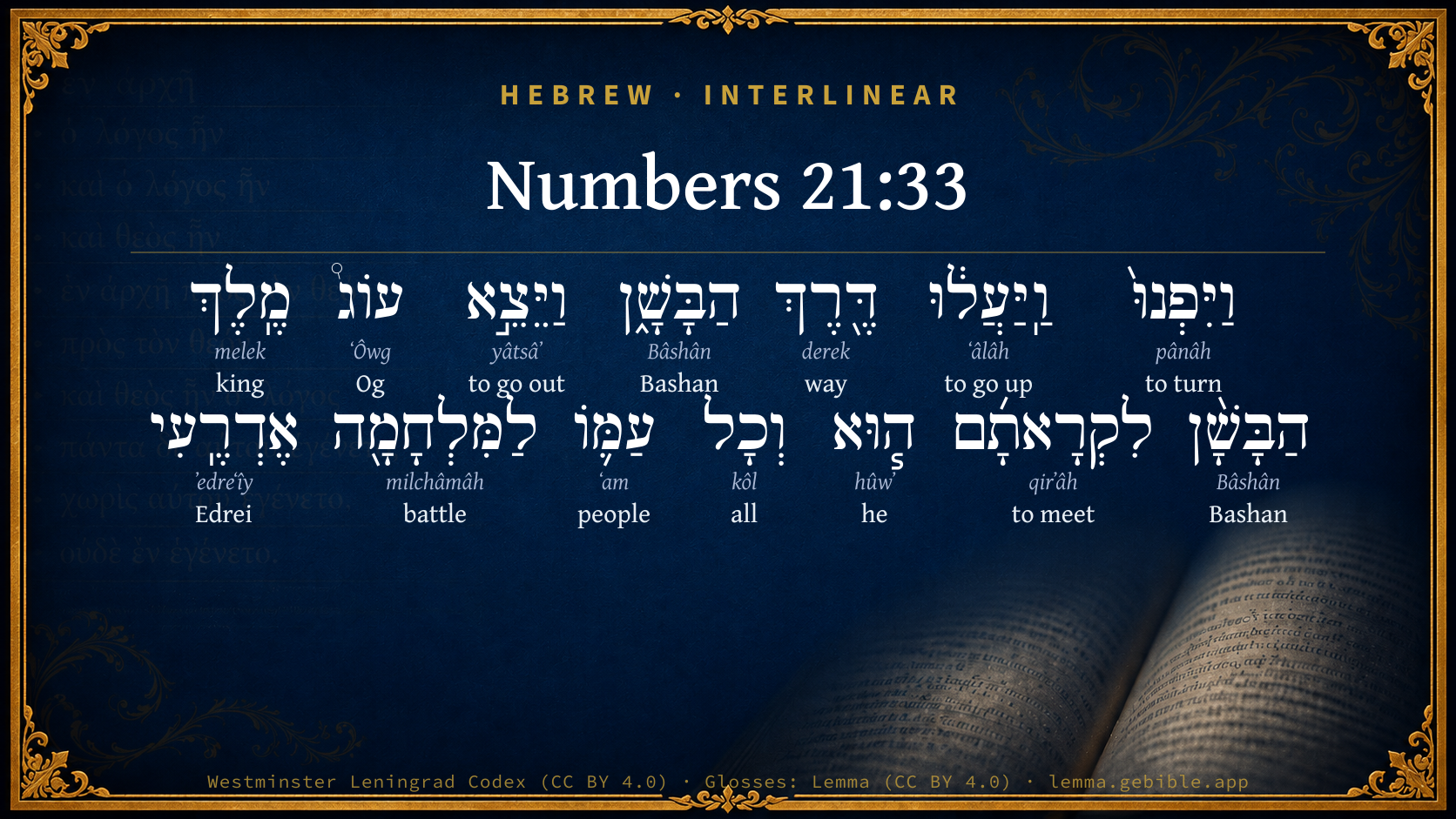
Hebrew (Westminster Leningrad Codex) Numbers 21:33 appears in the Hebrew Old Testament. The text above is from the Westminster Leningrad Codex. Each word links to its Strong’s number, a concise gloss, and parsing drawn from the Open Scriptures Hebrew Bible morphology. Click any word for its full Brown-Driver-Briggs (BDB) entry.
Download image
Cite this verse

Numbers 21:33 (World English Bible). Public Domain. Lemma interlinear Bible study tool, https://lemma.gebible.app/v/numbers/21/33.

Show BibTeX & RIS
BibTeX
RIS
English Translation
They turned and went up by the way of Bashan: and Og the king of Bashan went out against them, he and all his people, to battle at Edrei.
World English Bible · Public Domain
Highlights
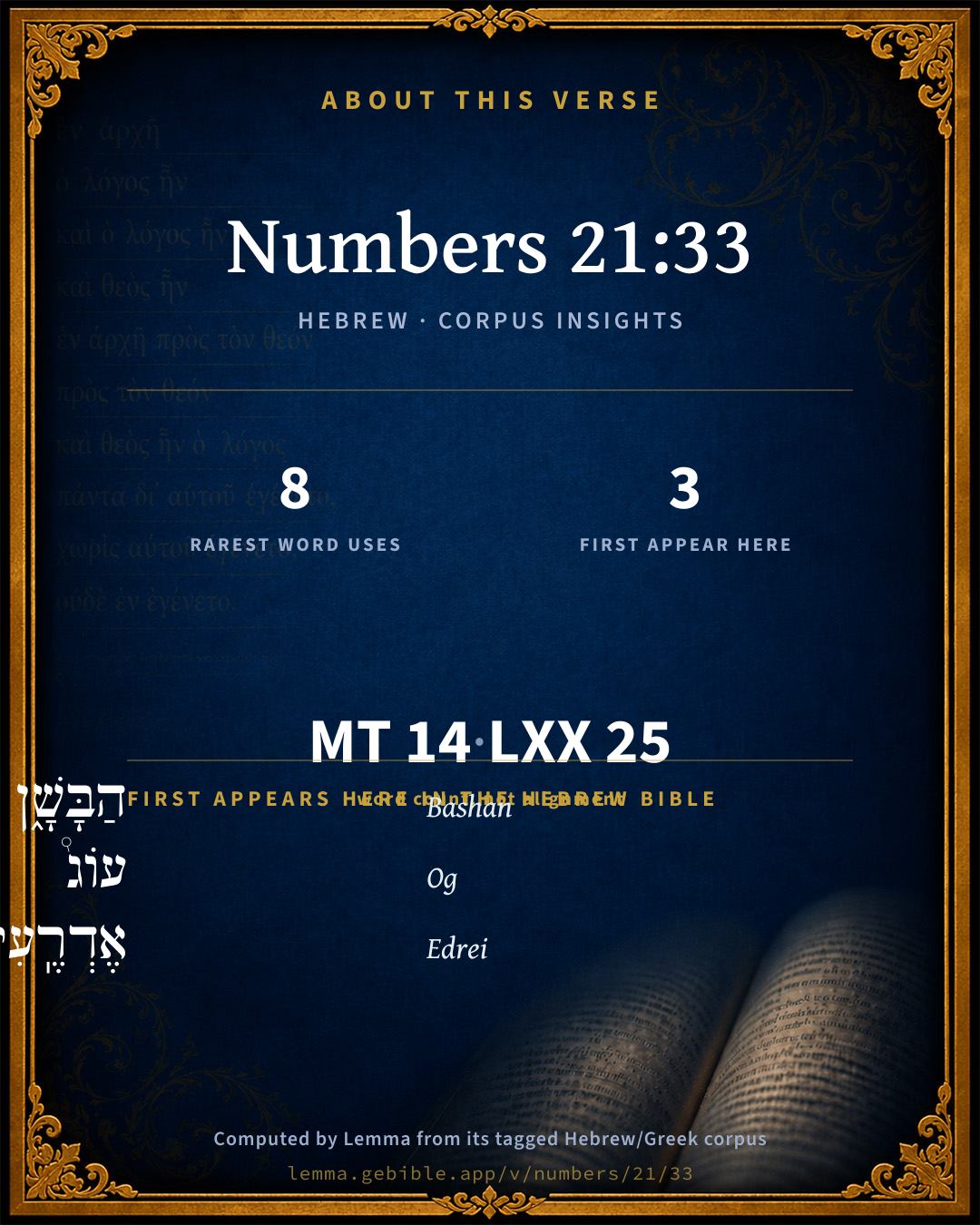
  • 3 first appearances in the Hebrew Bible
Full analysis ↓
Download a study sheet

One document with this verse’s original text, its word-by-word gloss line, the meaning frame, cross-references with their text, attributed commentary, and full source and license credits — printable, and it pastes into notes with its structure intact.

This verse Autodidact and up

Study sheet (.html) Plain text (.txt)

A passage Seminary Student

Up to 50 verses in one chapter. A passage sheet keeps up to 6 commentary sources and 12 cross-references per verse, in the order this page ranks them, and says so on the sheet whenever that leaves anything out. Ask for a single verse and you get the Autodidact verse sheet above.

Everything on this page stays free to read, with no account — the sheet is a download of what is already on screen, not access to it.

Want to remove ads? Support Godless Engineer
Compare translations 3

The same verse in 3 English versions, stacked beneath the original-language interlinear above. Click any original word for its lexicon entry.

Each is an independent rendering of the whole verse — the interlinear is not word-aligned to these translations.

Highlighted words mark where these versions differ — a whole-verse word diff, not a word-by-word alignment.

  • World English Bible Public Domain
    They turned and went up by the way of Bashan: and Og the king of Bashan went out against them, he and all his people, to battle at Edrei.
  • King James Version Public Domain
    And they turned and went up by the way of Bashan: and Og the king of Bashan went out against them, he, and all his people, to the battle at Edrei.
  • unfoldingWord Literal Text CC BY-SA 4.0
    And they turned and went up the way of Bashan. And Og, king of Bashan, went out to meet them, he and all his people, to the battle at Edrei.

unfoldingWord Literal Text — © unfoldingWord, licensed CC BY-SA 4.0. Word-aligned USFM3 via Door43 (git.door43.org/unfoldingWord/en_ult).

Versions to compare (up to 4)

3 of 4 selected

Show all 18 translations

Every available English version of this verse, each an independent rendering of the whole verse.

  • World English Bible Public Domain
    They turned and went up by the way of Bashan: and Og the king of Bashan went out against them, he and all his people, to battle at Edrei.
  • Berean Standard Bible Public Domain
    Then they turned and went up the road to Bashan, and Og king of Bashan and his whole army came out to meet them in battle at Edrei.
  • Majority Standard Bible Public Domain
    Then they turned and went up the road to Bashan, and Og king of Bashan and his whole army came out to meet them in battle at Edrei.
  • King James Version Public Domain
    And they turned and went up by the way of Bashan: and Og the king of Bashan went out against them, he, and all his people, to the battle at Edrei.
  • American Standard Version (1901) Public Domain
    And they turned and went up by the way of Bashan: and Og the king of Bashan went out against them, he and all his people, to battle at Edrei.
  • Revised Version (1885) Public Domain
    And they turned and went up by the way of Bashan: and Og the king of Bashan went out against them, he and all his people, to battle at Edrei.
  • Geneva Bible (1599) Public Domain
    And they turned and went vp toward Bashan: and Og the King of Bashan came out against them, hee, and all his people, to fight at Edrei.
  • Douay-Rheims (1899) Public Domain
    And they turned themselves, and went up by the way of Basan, and Og the king of Basan came against them with all his people, to fight in Edrai.
  • Young's Literal Translation Public Domain
    and turn and go up the way of Bashan, and Og king of Bashan cometh out to meet them, he and all his people, to battle, `at' Edrei.
  • Literal Standard Version CC BY-SA 4.0
    and turn and go up the way of Bashan, and Og king of Bashan comes out to meet them, he and all his people, to battle [at] Edrei.
  • Unlocked Literal Bible CC BY-SA 4.0
    Then they turned and went up by the road of Bashan. Og king of Bashan went out against them, he and all his army, to fight them at Edrei.
  • unfoldingWord Literal Text CC BY-SA 4.0
    And they turned and went up the way of Bashan. And Og, king of Bashan, went out to meet them, he and all his people, to the battle at Edrei.
  • Darby Bible Public Domain
    And they turned and went up by the way to Bashan; and Og the king of Bashan went out against them, he and all his people, for battle to Edrei.
  • World Messianic Bible Public Domain
    They turned and went up by the way of Bashan. Og the king of Bashan went out against them, he and all his people, to battle at Edrei.
  • Webster's Bible Public Domain
    And they turned and went up by the way of Bashan: and Og the king of Bashan went out against them, he, and all his people, to the battle at Edrei.
  • Free Bible Version CC BY-SA 4.0
    Then they continued on the road towards Bashan. Og, king of Bashan, led his whole army out to meet them head on, and fought them at Edrei.
  • Bible in Basic English Public Domain
    Then turning they went up by the way of Bashan; and Og, king of Bashan, went out against them with all his people, to the fight at Edrei.
  • JPS Tanakh (1917) Public Domain
    And they turned and went up by the way of Bashan; and Og the king of Bashan went out against them, he and all his people, to battle at Edrei.

Literal Standard Version (2020), Covenant Press — licensed CC BY-SA 4.0. Text via the HelloAO Bible API (eBible.org). Unlocked Literal Bible (unfoldingWord) — licensed CC BY-SA 4.0. Text via the HelloAO Bible API (eBible.org). unfoldingWord Literal Text — © unfoldingWord, licensed CC BY-SA 4.0. Word-aligned USFM3 via Door43 (git.door43.org/unfoldingWord/en_ult). Free Bible Version, Dr. Jonathan Gallagher — licensed CC BY-SA 4.0. Text via the HelloAO Bible API (eBible.org).

Word by word

More ways to search: Search by grammar → Find every occurrence → Compare this word →

Practice this passage: Drill this verse → Learn its vocabulary →

אֶדְרֶֽעִי
ʼedreʻîy
H154
“Edrei”
Noun, Proper
Part of Speech
Noun
Type
Proper
Full BDB Definition

Origin: from the equivalent of H153

TWOT: None

Edrei = "goodly pasture" - a chief city of Bashan, north of Jabbok river
  1. וַיִּפְנוּ֙ pânâh H6437 “and · to turn” Conjunction + Verb, Qal, Sequential Imperfect, 3rd Person, Masculine, Plural
  2. וַֽיַּעֲל֔וּ ʻâlâh H5927 “and · to go up” Conjunction + Verb, Qal, Sequential Imperfect, 3rd Person, Masculine, Plural
  3. דֶּ֖רֶךְ derek H1870 “way of” Noun, Common, Both, Singular, Construct
  4. הַבָּשָׁ֑ן Bâshân H1316 “the · Bashan” Particle, Definite Article + Noun, Proper
  5. וַיֵּצֵ֣א yâtsâʼ H3318 “and · to go out” Conjunction + Verb, Qal, Sequential Imperfect, 3rd Person, Masculine, Singular
  6. עוֹג֩ ʻÔwg H5747 “Og” Noun, Proper
  7. מֶֽלֶךְ melek H4428 “king of” Noun, Common, Masculine, Singular, Construct
  8. הַבָּשָׁ֨ן Bâshân H1316 “the · Bashan” Particle, Definite Article + Noun, Proper
  9. לִקְרָאתָ֜ם qirʼâh H7125 “to meet · them” Preposition + Verb, Qal, Infinitive Construct + Suffix, Personal, 3rd Person, Masculine, Plural
  10. ה֧וּא hûwʼ H1931 “he” Pronoun, Personal, 3rd Person, Masculine, Singular
  11. וְכָל kôl H3605 “and · all of” Conjunction + Noun, Common, Masculine, Singular, Construct
  12. עַמּ֛וֹ ʻam H5971 “people · his” Noun, Common, Masculine, Singular, Construct + Suffix, Personal, 3rd Person, Masculine, Singular
  13. לַמִּלְחָמָ֖ה milchâmâh H4421 “to/for the · battle” Preposition, Determined + Noun, Common, Feminine, Singular, Absolute

About this verse

These counts appear in no published source. They are computed here, from the morphology-tagged text and Lemma’s own curated glosses. What Lemma adds →

14
words
13
distinct lemmas
Pentateuch
section

Notable vocabulary

The rarest word here is אֶדְרֶֽעִי Edrei H154 — appearing just 8 times in the whole Hebrew Bible.

First appearance in Scripture

These words make their first canonical appearance in the Hebrew Bible here:

  • הַבָּשָׁ֑ן Bashan H1316
  • עוֹג֩ Og H5747
  • אֶדְרֶֽעִי Edrei H154

Shared distinctive vocabulary

אֶדְרֶֽעִי Edrei H154 occurs in 8 verses of the Hebrew Bible. Also found in:

Grammatical profile

  • 4 verbs
  • 9 nouns
  • 1 pronoun

Verb forms

  • וַיִּפְנוּ֙ Qal · Sequential Imperfect
  • וַֽיַּעֲל֔וּ Qal · Sequential Imperfect
  • וַיֵּצֵ֣א Qal · Sequential Imperfect
  • לִקְרָאתָ֜ם Qal · Infinitive Construct

Repetition

A word recurs within this verse — often emphatic in Hebrew:

  • הַבָּשָׁ֑ן Bashan H1316 ×2

Hebrew & Septuagint length

In English translation the verse runs 29 words from the Hebrew and 31 from the Septuagint (LXX English) — closely comparable.

A rough comparison of the two English renderings, which tokenize alike — not a word-level alignment.

Word counts can differ between the Hebrew and the Greek without any difference in meaning — e.g. the Hebrew direct-object marker אֵת has no separate Greek word, and Greek often adds the article ὁ.

In the original languages it is 14 Hebrew tokens and 25 Greek tokens — but the two are counted differently (Hebrew bundles its prefixes and suffixes into one token; the Greek is in lemma form), so that isn’t a like-for-like length.

Cross-references

16

Topical passages linked to Numbers 21:33 in the Treasury of Scripture Knowledge — connected by theme and wording, ordered by reader-vote popularity; previews shown in the World English Bible.

  • Joshua 13:12 all the kingdom of Og in Bashan, who reigned in Ashtaroth and in Edrei (the same was left of the remnant of the Rephaim); for these did Moses strike, and drove them out.
  • Deuteronomy 1:4 after he had struck Sihon the king of the Amorites, who lived in Heshbon, and Og the king of Bashan, who lived in Ashtaroth, at Edrei.
  • Deuteronomy 29:7 When you came to this place, Sihon the king of Heshbon, and Og the king of Bashan, came out against us to battle, and we struck them:
  • Deuteronomy 3:1–6 Then we turned, and went up the way to Bashan: and Og the king of Bashan came out against us, he and all his people, to battle at Edrei.
  • Numbers 32:33 Moses gave to them, even to the children of Gad, and to the children of Reuben, and to the half-tribe of Manasseh the son of Joseph, the kingdom of Sihon king of the Amorites, and the kingdom of Og king of Bashan, the land, according to the cities of it with [their] borders, even the cities of the land round about.
  • Deuteronomy 4:47 They took his land in possession, and the land of Og king of Bashan, the two kings of the Amorites, who were beyond the Jordan toward the sunrise;
  • Deuteronomy 32:14 Butter of the herd, and milk of the flock, With fat of lambs, Rams of the breed of Bashan, and goats, With the finest of the wheat; Of the blood of the grape you drank wine.
  • Joshua 9:10 and all that he did to the two kings of the Amorites, who were beyond the Jordan, to Sihon king of Heshbon, and to Og king of Bashan, who was at Ashtaroth.
  • Joshua 12:4 and the border of Og king of Bashan, of the remnant of the Rephaim, who lived at Ashtaroth and at Edrei,
  • Joshua 13:30 Their border was from Mahanaim, all Bashan, all the kingdom of Og king of Bashan, and all the towns of Jair, which are in Bashan, sixty cities:
  • Psalms 22:12 Many bulls have surrounded me. Strong bulls of Bashan have encircled me.
  • Psalms 68:15 The mountains of Bashan are majestic mountains. The mountains of Bashan are rugged.
  • Isaiah 33:9 The land mourns and languishes; Lebanon is confounded and withers away; Sharon is like a desert; and Bashan and Carmel shake off [their leaves].
  • Ezekiel 27:6 Of the oaks of Bashan have they made your oars; they have made your benches of ivory inlaid in boxwood, from the isles of Kittim.
  • Ezekiel 39:18 You shall eat the flesh of the mighty, and drink the blood of the princes of the earth, of rams, of lambs, and of goats, of bulls, all of them fatlings of Bashan.
  • Amos 4:1 Listen to this word, you cows of Bashan, who are on the mountain of Samaria, who oppress the poor, who crush the needy, who tell their lords, "Bring, and let us drink."

Cross-references courtesy of OpenBible.info (CC BY 4.0).

Hebrew and Greek witnesses Masoretic Hebrew ↔ Greek Septuagint

The same verse in the two great witnesses to the Old Testament, shown verse-for-verse.

These are two independent witnesses, not word-aligned to each other, and the Septuagint is shown in lemma (dictionary) form.

Hebrew Numbers 21:33 Masoretic · Westminster Leningrad Codex

וַיִּפְנוּ֙ וַֽיַּעֲל֔וּ דֶּ֖רֶךְ הַבָּשָׁ֑ן וַיֵּצֵ֣א עוֹג֩ מֶֽלֶךְ הַבָּשָׁ֨ן לִקְרָאתָ֜ם ה֧וּא וְכָל עַמּ֛וֹ לַמִּלְחָמָ֖ה אֶדְרֶֽעִי

They turned and went up by the way of Bashan: and Og the king of Bashan went out against them, he and all his people, to battle at Edrei.

World English Bible · Public Domain

Greek LXX Numbers 21:33 Septuagint · lemma form

καί ἐπιστρέφω ἀναβαίνω ὁδός ὁ εἰς βασαν καί ἐκἔρχομαι ωγ βασιλεύς ὁ βασαν εἰς συνάντησις αὐτός καί πᾶς ὁ λαός αὐτός εἰς πόλεμος εἰς εδραϊν

And having returned, they went up the road that leads to Basan; and Og the king of Basan went forth to meet them, and all his people to war to Edrain.

LXX2012 (modern English Septuagint) · Public Domain

Hebrew: Westminster Leningrad Codex (CC BY 4.0). Greek: Septuagint (public domain); English from LXX2012 (modern English Septuagint) (Public Domain). How the Septuagint differs from the Hebrew →

Targum (Aramaic paraphrase)

2

The Targum is the ancient Jewish Aramaic paraphrase of the Hebrew Scriptures — an interpretive translation, not the Hebrew text itself. Onkelos (literal) and Pseudo-Jonathan (expansive) render the Torah, and Jonathan the Prophets. Coverage is partial: where no permissively-licensed English translation exists for a verse, only the Aramaic is shown. This is verse-level text, not a word-by-word alignment to the Hebrew.

  1. Targum Onkelos Torah (Genesis–Deuteronomy)
    וְאִתְפְּנִיאוּ וּסְלִיקוּ לְאֹרַח מַתְנָן וּנְפַק עוֹג מַלְכָּא דְמַתְנָן לְקֳדָמוּתְהוֹן הוּא וְכָל עַמֵּיהּ לְאַגָחָא קְרָבָא לְאֶדְרֶעִי

    (no public-domain English translation for this verse)

    Targum Onkelos — Aramaic: “Onkelos Genesis” (public domain); “Onkelos Exodus” (public domain); “Onkelos Leviticus” (public domain); “Onkelos Numbers” (public domain); “Onkelos Deuteronomy” (public domain). English: “Sefaria Community Translation” (CC0 1.0 (public-domain dedication)); “J.W. Etheridge. The Targums of Onkelos and Jonathan Ben Uzziel on the Pentateuch. London: Longmans, Green, 1862” (public domain). Text via Sefaria.

  2. Targum Pseudo-Jonathan Torah (Genesis–Deuteronomy)
    וְאִתְפְּנִיאוּ וּסְלִיקוּ אוֹרַח מַתְנָן וּנְפַק עוֹג מַלְכָּא דְמַתְנָן לִקְדָמוּתָנָא הוּא וְכָל עַמֵיהּ לְאַגָחָא קְרָבָא לְאֶדְרֶעִי

    Then they turned, and went up by the way of Mathnan; and Og, the king of Mathnan, came out to meet us, he and all his people, to give battle at Edrei.

    Targum Pseudo-Jonathan — Aramaic: “Targum Jonathan on Genesis” (public domain); “Targum Jonathan on Exodus” (public domain); “Targum Jonathan on Leviticus” (public domain); “Targum Jonathan on Numbers” (public domain); “Targum Jonathan on Deuteronomy” (public domain). English: “The Targum of Jonathan ben Uzziel, trans. J. W. Etheridge, London, 1862” (public domain). Text via Sefaria.

Commentary

Notes on Numbers 21:33 from classic Christian and Jewish commentators (each source and its license shown beneath its notes). The classic Christian expositions comment on the surrounding passage and are grouped to its opening verse, so a note may address several verses; the Jewish commentaries on the Tanakh (Rashi and others) are per-verse, so they appear only where the commentator wrote on this verse.

Lemma curates 59 commentaries, every one of them public domain or Creative Commons licensed, each selected and text-cleaned for this edition rather than reprinted as found. About our sources →

Joseph Benson's Commentary

Num 21:33. Og — Who was also a king of the Amorites. And it may seem that Sihon and Og were the leaders or captains of two great colonies which came out of Canaan, and drove out the former inhabitants of these places. Bashan — A rich country, famous for its pastures and breed of cattle, and for its oaks.

Joseph Benson's Commentary on the Old and New Testaments (1811–1818) — public domain. Text from a community e-Sword module.

Tyndale Open Study Notes

Tyndale Open Resources

21:33-35 Ancient Bashan was located east of the Sea of Galilee. • King Og, like Sihon, was an Amorite (see study note on 21:13). This brief account of Israel’s defeat of Og is expanded in Deut 3:1-11.

Tyndale Open Study Notes — © Tyndale Open Resources, licensed CC BY-SA 4.0. Text via the HelloAO Bible API.

Jamieson, Fausset & Brown

Robert Jamieson, A. R. Fausset & David Brown

they turned and went up by the way of Bashan--a name given to that district from the richness of the soil--now Batanea or El-Bottein--a hilly region east of the Jordan lying between the mountains of Hermon on the north and those of Gilead on the south.

Og--a giant, an Amoritish prince, who, having opposed the progress of the Israelites, was defeated.

Jamieson, Fausset & Brown — Commentary Critical and Explanatory on the Whole Bible (1871) — public domain (CC PDM 1.0). Text via the HelloAO Bible API.

The Cambridge Bible for Schools and Colleges

gen. ed. J. J. S. Perowne

33. by the way to the Bashan] The name, which usually has the article, seems to signify ‘soft and fertile ground.’ The Bashan was ‘the broad and fertile tract of country on the E . of Jordan, bounded (somewhat roughly) on the S. by the Yarmûk and a line passing through Edre‘i and Salecah (mentioned as border cities in Deu_3:10), on the E . by the imposing range of extinct volcanoes called the Jebel Ḥaurân, on the W. by Geshur and Ma‘acah (see Jos_12:5), and on the N. stretching out towards Hermon (cf. Deu_33:22)’ (Driver, Enc. Bibl. [Note: nc. Bibl. Encyclopaedia Biblica.] 495). It was noted for its rich pastures, its well-fed herds of cattle and its oak forests.

The Cambridge Bible for Schools and Colleges (gen. ed. J. J. S. Perowne; Cambridge University Press, 1878–1918) — public domain. Text from a community e-Sword module.

Albert Barnes' Notes on the Bible

In these apparently unimportant words is contained the record of the Israelite Num 32:39 occupation of Gilead north of the Jabbok; a territory which, though populated, like southern Gilead, by the Amorites (Deu 3:9; Jos 2:10, etc.), formed part of the domain of Og king of Bashan, who was himself of a different race Deu 3:2; Jos 12:5; Jos 13:11. We are not told whether they were led there by express warrant of God, or whether their advance upon Bashan was provoked by Og and his people.

At Edrei - Now Edhra’ah, commonly Der’a; situate on a branch of the Jarmuk. This river formed the boundary between Gilead and Bashan.

Albert Barnes' Notes on the Bible (1834–1885) — public domain. Text from a community e-Sword/MySword module.

Haydock's Catholic Bible Commentary

Og, the king of the most fertile country of Basan, was of gigantic stature, Deuteronomy iii. 11. The Rabbins relate many fables concerning him. --- Edrai was 15 miles to the north of the torrent Jeboc, (Calmet) which was the southern extremity of this territory. (Haydock)

George Leo Haydock (1774–1849), Haydock's Catholic Family Bible and Commentary, 1859 edition — public domain. Excludes Psalms (Douay-Rheims chapter numbering differs from Protestant) and Deuterocanonical books (Catholic canon only).

Matthew Poole's English Annotations

Og also was a king of the Amorites, of whom see Deu 3:1,11. And it may seem that Sihon and Og were the leaders or captains of two great colonies which came out of Canaan, and drove out the former inhabitants of these places.

Bashan, a rich country, famous for its pastures and breed of cattle, Deu 32:14; Psa 22:12; Jer 1:19, and for its oaks, Eze 27:6.

Matthew Poole's English Annotations on the Holy Bible (1683–1685) — public domain. Text from a community e-Sword/MySword module.

Whedon's Commentary on the Bible

Daniel D. Whedon

33. Bashan is thus bounded: on the north by Mount Hermon, on the east by Salcah, the Geshurites, and the Maachathites, on the south by the “border of Gilead,” and on the west by the Jordan valley. This, with “half Gilead,” was allotted to the half-tribe of Manasseh. Recent explorers have discovered in this region almost fabulous wonders in the number of ruined cities, their cyclopean architecture and surprising preservation confirming the scriptural statement that the Rephaim, the giants, once flourished here. “The cities built and occupied some forty centuries ago by these old giants exist even yet. I have traversed their streets; I have opened the doors of their houses; I have slept peacefully in their long-deserted halls.” — J.L. Porter. “The richness of the whole district was of itself sufficient attraction for the invaders, for the oaks of Bashan and the vast herds of cattle that roamed its forest glades and green meadows were its boast and glory, while the landscapes and pastoral wealth of Gilead were hardly less famous. Lovely natural parks, frequent glades covered with heavy crops of wheat and barley, and with trees and shrubs grouped in charming variety, dark forests forming the background, charm the traveller even now.” — Geikie. Og, the last representative of the giant race, was lord of sixty fenced cities. Himself, his sons, and his people were defeated and exterminated by Israel at Edrei after the conquest of Sihon, his friend and ally according to Josephus. His enormous stature is corroborated by an appeal to a relic still existing in the time of the author of Deu_3:11. His unusual size and prowess as a warrior excited among the Israelites a dread which God himself alleviated by his special encouragement to Moses before the battle, “Fear him not.”

Edrei — “The Strong.” There were apparently two towns in Bashan of this name. One is mentioned in Deu_1:4, and Jos_12:4, identified as the modern Dera, or Draa, on the east of the pilgrim-road between Remtha and Mezareib. At this southern Edrei Keil supposes that the great battle was fought, from the improbability that King Og would suffer Israel’s invading army to march to the northern frontier of his kingdom, the site of the other Edrei, without contesting his advance. See Jos_13:31, note. The capital of Og was almost unassailable, being built in a hollow artificially scooped out of the top of a hill, which the deep gorge of the Hiero-max isolates from the country around. Its streets may be still seen running inall directions beneath the present town of Adraha.

Daniel D. Whedon (gen. ed.), Commentary on the Old and New Testaments (1874–1909) — public domain. Text from a community e-Sword module.

The Pulpit Commentary

They turned and went up by the way of Bashan. The brevity of the narrative does not allow us to know who went upon this expedition, or why they went. It may have been only the detachment which had reconnoitered and taken Jaazer, and they may have found themselves threatened by the forces of Og, and so led on to further conquests beyond the Jabbok. Og the king of Bashan. Og was himself of the aboriginal giant race which had left so many remnants, or at least so many memories, in these regions; (see on Deu_2:10-12, 20-23Jo 12:4 13:12) but he is classed with Sihon as a king of the Amorites (Jos_2:10) because his people were chiefly at least of that race. Bashan itself comprised the plain now known as Jaulan and Haulan beyond the Jarmuk (now Mandhur), the largest affluent of the Jordan, which joins it a few miles below the lake of Tiberias. The kingdom of Og, however, extended over the northern and larger part of Gilead, a much more fertile territory than Bashan proper. (see on Deu_3:1-17) At Edrei. Probably the modern Edhra"ah, or Der"a, situate on a branch of the Jarmuk, some twenty-four miles from Bozrah. The ancient city lies buried beneath the modern village, and was built, like the other cities of Bashan, in the most massive style of architecture. The cities of Og were so strong that the Israelites could not have dispossessed him by any might of their own if he had abode behind his walls. Either confidence in his warlike prowess or some more mysterious cause (see on Jos_24:12) impelled him to leave his fortifications, and give battle to the Israelites to his own utter defeat.

The Pulpit Commentary (1880–1919), ed. H.D.M. Spence-Jones & Joseph S. Exell — public domain. Text from a community e-Sword module.

John Wesley's Explanatory Notes

Og - Who also was a king of the Amorites. And it may seem that Sihon and Og were the leaders or captains of two great colonies which came out of Canaan, and drove out the former inhabitants of these places. Bashan - A rich country, famous for its pastures and breed of cattle, and for its oaks.

John Wesley, Explanatory Notes Upon the Whole Bible (1754–1765) — public domain. Text via the GEBible commentary corpus.

unfoldingWord translationNotes

Door43 World Missions Community

went out against them

"attacked them"

Do to him as you did to Sihon king of the Amorites

The Israelites had completely destroyed Sihon. AT: "Destroy him like you destroyed Sihon king of the Amorites"

So they killed him

"So the army of Israel killed Og"

none of his people were left alive

This can be stated in active form. AT: "all of his people were dead" (See: Active or Passive)

they took over his land

"they took control of his land"

translationWords

Bashan

king

Yahweh

fear

son

people group

life

unfoldingWord translationNotes — © Distant Shores Media and the Door43 World Missions Community, licensed CC BY-SA 4.0. Source: git.door43.org/Door43/en_tn.

Lesson kit

Teaching starters — assembled from the data on this page, not authored interpretation. Every prompt links to the verse data it draws on. Edit before teaching.

Numbers, in the Pentateuch, opens this verse with 14 words (13 distinct Hebrew lemmas). Its most distinctive word is ʼedreʻîy (“Edrei”). A historical commentator’s framing appears above. Read the whole chapter for the surrounding context.

Discussion questions

  1. The word ʼedreʻîy carries the sense “Edrei.” How does it shape the verse?
  2. 3 words make their first appearance in Scripture here. What does this debut establish?
  3. How does Deuteronomy 1:4, which shares the word «Edrei», read alongside this verse?
  4. What does the repetition of “Bashan” (2× in this one verse) do in this verse?
  5. The translations on this page render this verse differently — a whole-verse word diff, not a word-by-word alignment. What might account for the different wordings?
  6. «וַיִּפְנוּ֙» is a Qal Sequential Imperfect verb. How does that grammatical form shape the action described?
  7. Compare how Joseph Benson's Commentary and Tyndale Open Study Notes read this verse. Where do they agree or differ?

Things to notice

Reading settings

Reading text

Shown beneath each verse's original-language words.

Old Testament
Old Testament edition

Read the OT as the Masoretic Hebrew (MT) or the Greek Septuagint (LXX).

English shown for the Greek Septuagint (in the Hebrew ↔ Greek comparison).

Comparing translations? Open the Compare panel on any verse page to stack up to four side by side.