
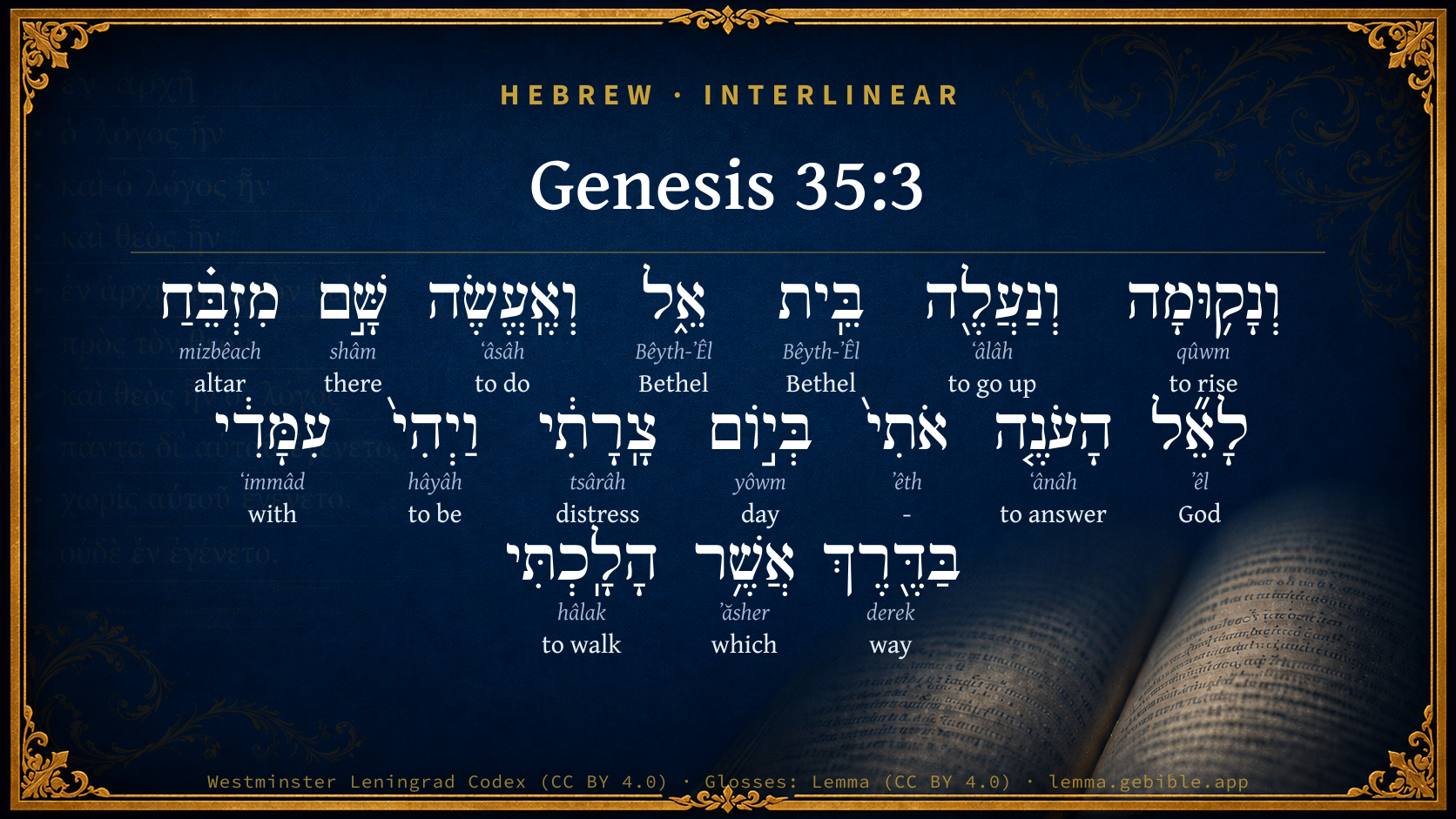
Genesis 35:3

Hebrew (Westminster Leningrad Codex) Genesis 35:3 appears in the Hebrew Old Testament. The text above is from the Westminster Leningrad Codex. Each word links to its Strong’s number, a concise gloss, and parsing drawn from the Open Scriptures Hebrew Bible morphology. Click any word for its full Brown-Driver-Briggs (BDB) entry.
Download image
Cite this verse

Genesis 35:3 (World English Bible). Public Domain. Lemma interlinear Bible study tool, https://lemma.gebible.app/v/genesis/35/3.

Show BibTeX & RIS
BibTeX
RIS
English Translation
Let us arise, and go up to Bethel. I will make there an altar to God, who answered me in the day of my distress, and was with me in the way which I went."
World English Bible · Public Domain
Highlights
  • 1 first appearance in the Hebrew Bible
Full analysis ↓
Download a study sheet

One document with this verse’s original text, its word-by-word gloss line, the meaning frame, cross-references with their text, attributed commentary, and full source and license credits — printable, and it pastes into notes with its structure intact.

This verse Autodidact and up

Study sheet (.html) Plain text (.txt)

A passage Seminary Student

Up to 50 verses in one chapter. A passage sheet keeps up to 6 commentary sources and 12 cross-references per verse, in the order this page ranks them, and says so on the sheet whenever that leaves anything out. Ask for a single verse and you get the Autodidact verse sheet above.

Everything on this page stays free to read, with no account — the sheet is a download of what is already on screen, not access to it.

Want to remove ads? Support Godless Engineer
Compare translations 3

The same verse in 3 English versions, stacked beneath the original-language interlinear above. Click any original word for its lexicon entry.

Each is an independent rendering of the whole verse — the interlinear is not word-aligned to these translations.

Highlighted words mark where these versions differ — a whole-verse word diff, not a word-by-word alignment.

  • World English Bible Public Domain
    Let us arise, and go up to Bethel. I will make there an altar to God, who answered me in the day of my distress, and was with me in the way which I went."
  • King James Version Public Domain
    And let us arise, and go up to Bethel; and I will make there an altar unto God, who answered me in the day of my distress, and was with me in the way which I went.
  • unfoldingWord Literal Text CC BY-SA 4.0
    Then let us get up and go up to Bethel, and there I will make an altar to God, who answered me in the day of my distress. And he has been with me in the way that I have gone.”

unfoldingWord Literal Text — © unfoldingWord, licensed CC BY-SA 4.0. Word-aligned USFM3 via Door43 (git.door43.org/unfoldingWord/en_ult).

Versions to compare (up to 4)

3 of 4 selected

Show all 18 translations

Every available English version of this verse, each an independent rendering of the whole verse.

  • World English Bible Public Domain
    Let us arise, and go up to Bethel. I will make there an altar to God, who answered me in the day of my distress, and was with me in the way which I went."
  • Berean Standard Bible Public Domain
    Then let us arise and go to Bethel. I will build an altar there to God, who answered me in my day of distress. He has been with me wherever I have gone.”
  • Majority Standard Bible Public Domain
    Then let us arise and go to Bethel. I will build an altar there to God, who answered me in my day of distress. He has been with me wherever I have gone.”
  • King James Version Public Domain
    And let us arise, and go up to Bethel; and I will make there an altar unto God, who answered me in the day of my distress, and was with me in the way which I went.
  • American Standard Version (1901) Public Domain
    and let us arise, and go up to Beth-el; and I will make there an altar unto God, who answered me in the day of my distress, and was with me in the way which I went.
  • Revised Version (1885) Public Domain
    and let us arise, and go up to Beth-el; and I will make there an altar unto God, who answered me in the day of my distress, and was with me in the way which I went.
  • Geneva Bible (1599) Public Domain
    For we will rise and goe vp to Beth-el, and I will make an altar there vnto God, which heard me in the day of my tribulation, and was with me in the way which I went.
  • Douay-Rheims (1899) Public Domain
    Arise, and let us go up to Bethel, that we may make there an altar to God: who heard me in the day of my affliction, and accompanied me in my journey.
  • Young's Literal Translation Public Domain
    and we rise, and go up to Bethel, and I make there an altar to God, who is answering me in the day of my distress, and is with me in the way that I have gone.'
  • Literal Standard Version CC BY-SA 4.0
    and we rise, and go up to Bethel, and I make there an altar to God, who is answering me in the day of my tribulation, and is with me in the way that I have gone.”
  • Unlocked Literal Bible CC BY-SA 4.0
    Then let us depart and go up to Bethel. I will build an altar there to God, who answered me in the day of my distress, and has been with me wherever I have gone.”
  • unfoldingWord Literal Text CC BY-SA 4.0
    Then let us get up and go up to Bethel, and there I will make an altar to God, who answered me in the day of my distress. And he has been with me in the way that I have gone.”
  • Darby Bible Public Domain
    and we will arise, and go up to Bethel; and I will make there an altar to the ùGod that answered me in the day of my distress, and was with me in the way that I went.
  • World Messianic Bible Public Domain
    Let’s arise, and go up to Bethel. I will make there an altar to God, who answered me in the day of my distress, and was with me on the way which I went.”
  • Webster's Bible Public Domain
    And let us arise, and go up to Beth-el; and I will make there an altar to God, who answered me in the day of my distress, and was with me in the way which I went.
  • Free Bible Version CC BY-SA 4.0
    We have to get ready and go to Bethel so I can build an altar to God who answered me in my time of trouble. He has been with me wherever I went.”
  • Bible in Basic English Public Domain
    And let us go up to Beth-el: and there I will make an altar to God, who gave me an answer in the day of my trouble, and was with me wherever I went.
  • JPS Tanakh (1917) Public Domain
    and let us arise, and go up to Beth-el; and I will make there an altar unto God, who answered me in the day of my distress, and was with me in the way which I went.'

Literal Standard Version (2020), Covenant Press — licensed CC BY-SA 4.0. Text via the HelloAO Bible API (eBible.org). Unlocked Literal Bible (unfoldingWord) — licensed CC BY-SA 4.0. Text via the HelloAO Bible API (eBible.org). unfoldingWord Literal Text — © unfoldingWord, licensed CC BY-SA 4.0. Word-aligned USFM3 via Door43 (git.door43.org/unfoldingWord/en_ult). Free Bible Version, Dr. Jonathan Gallagher — licensed CC BY-SA 4.0. Text via the HelloAO Bible API (eBible.org).

Word by word

More ways to search: Search by grammar → Find every occurrence → Compare this word →

Practice this passage: Drill this verse → Learn its vocabulary →

עִמָּדִ֔י
ʻimmâd
H5978
“with · me”
Preposition + Suffix, Personal, 1st Person, Common, Singular
Part of Speech
Preposition
Full BDB Definition

Origin: prol for H5973

TWOT: 1640b

with
  1. וְנָק֥וּמָה qûwm H6965 “and · to rise” Conjunction + Verb, Qal, Cohortative, 1st Person, Common, Plural
  2. וְנַעֲלֶ֖ה ʻâlâh H5927 “and · to go up” Conjunction + Verb, Qal, Cohortative, 1st Person, Common, Plural
  3. בֵּֽית Bêyth-ʼÊl H1008 “Bethel” Noun, Proper
  4. אֵ֑ל Bêyth-ʼÊl H1008 “Bethel” Noun, Proper
  5. וְאֶֽעֱשֶׂה ʻâsâh H6213 “and · to do” Conjunction + Verb, Qal, Imperfect, 1st Person, Common, Singular
  6. שָּׁ֣ם shâm H8033 “there” Adverb
  7. מִזְבֵּ֗חַ mizbêach H4196 “altar” Noun, Common, Masculine, Singular, Absolute
  8. לָאֵ֞ל ʼêl H410 “to/for the · God” Preposition, Determined + Noun, Common, Masculine, Singular, Absolute
  9. הָעֹנֶ֤ה ʻânâh H6030 “the · answering” Particle, Definite Article + Verb, Qal, Participle Active, Masculine, Singular, Absolute
  10. אֹתִי֙ ʼêth H853 “- · me” Particle, Direct Object + Suffix, Personal, 1st Person, Common, Singular
  11. בְּי֣וֹם yôwm H3117 “in/at · day of” Preposition + Noun, Common, Masculine, Singular, Construct
  12. צָֽרָתִ֔י tsârâh H6869 “distress · my” Noun, Common, Feminine, Singular, Construct + Suffix, Personal, 1st Person, Common, Singular
  13. וַיְהִי֙ hâyâh H1961 “and · to be” Conjunction + Verb, Qal, Sequential Imperfect, 3rd Person, Masculine, Singular
  14. בַּדֶּ֖רֶךְ derek H1870 “in/at the · way” Preposition, Determined + Noun, Common, Both, Singular, Absolute
  15. אֲשֶׁ֥ר ʼăsher H834 “which” Particle, Relative
  16. הָלָֽכְתִּי hâlak H1980 “to walk” Verb, Qal, Perfect, 1st Person, Common, Singular

About this verse

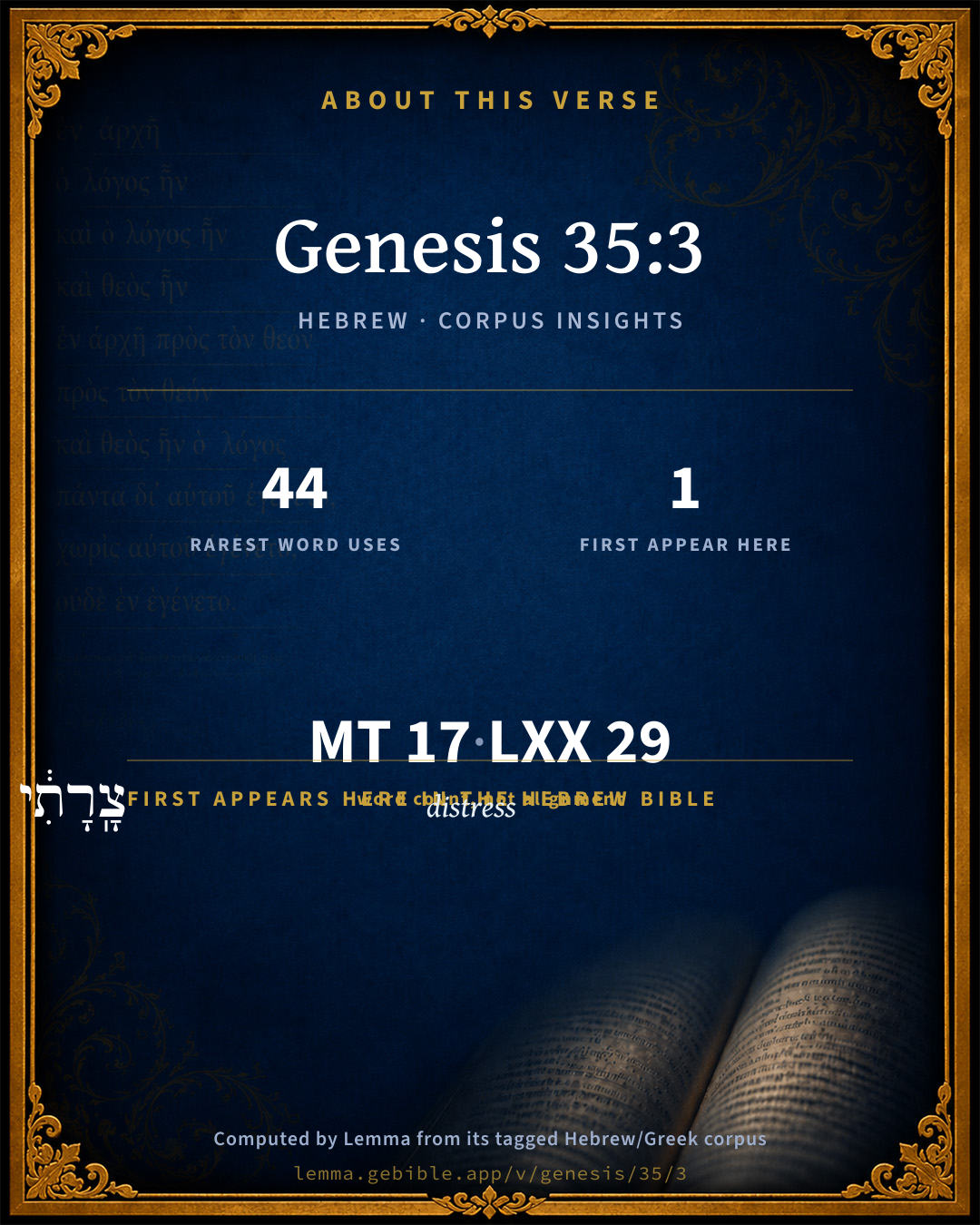
These counts appear in no published source. They are computed here, from the morphology-tagged text and Lemma’s own curated glosses. What Lemma adds →

17
words
16
distinct lemmas
Pentateuch
section

First appearance in Scripture

This word makes its first canonical appearance in the Hebrew Bible here:

  • צָֽרָתִ֔י distress H6869

Shared distinctive vocabulary

עִמָּדִ֔י with H5978 occurs in 44 verses of the Hebrew Bible. Also found in:

Grammatical profile

  • 6 verbs
  • 7 nouns
  • 1 preposition
  • 1 adverb
  • 2 particles

Verb forms

  • וְנָק֥וּמָה Qal · Cohortative
  • וְנַעֲלֶ֖ה Qal · Cohortative
  • וְאֶֽעֱשֶׂה Qal · Imperfect
  • הָעֹנֶ֤ה Qal · Participle Active
  • וַיְהִי֙ Qal · Sequential Imperfect
  • הָלָֽכְתִּי Qal · Perfect

Repetition

A word recurs within this verse — often emphatic in Hebrew:

  • בֵּֽית Bethel H1008 ×2

Hebrew & Septuagint length

In English translation the verse runs 35 words from the Hebrew and 42 from the Septuagint (LXX English) — closely comparable.

A rough comparison of the two English renderings, which tokenize alike — not a word-level alignment.

Word counts can differ between the Hebrew and the Greek without any difference in meaning — e.g. the Hebrew direct-object marker אֵת has no separate Greek word, and Greek often adds the article ὁ.

In the original languages it is 17 Hebrew tokens and 29 Greek tokens — but the two are counted differently (Hebrew bundles its prefixes and suffixes into one token; the Greek is in lemma form), so that isn’t a like-for-like length.

Cross-references

20

Topical passages linked to Genesis 35:3 in the Treasury of Scripture Knowledge — connected by theme and wording, ordered by reader-vote popularity; previews shown in the World English Bible.

  • Isaiah 43:2 When you pass through the waters, I will be with you; and through the rivers, they shall not overflow you: when you walk through the fire, you shall not be burned, neither shall the flame kindle on you.
  • Genesis 31:3 Yahweh said to Jacob, "Return to the land of your fathers, and to your relatives, and I will be with you."
  • Genesis 32:7 Then Jacob was greatly afraid and was distressed: and he divided the people who were with him, and the flocks, and the herds, and the camels, into two companies;
  • Genesis 31:42 Unless the God of my father, the God of Abraham, and the fear of Isaac, had been with me, surely now you would have sent me away empty. God has seen my affliction and the labor of my hands, and rebuked you last night."
  • Proverbs 3:6 In all your ways acknowledge him, And he will direct your paths.
  • Genesis 28:15 Behold, I am with you, and will keep you, wherever you go, and will bring you again into this land. For I will not leave you, until I have done that which I have spoken of to you."
  • Genesis 32:24 Jacob was left alone, and wrestled with a man there until the breaking of the day.
  • Psalms 50:15 Call on me in the day of trouble. I will deliver you, and you will honor me."
  • Psalms 107:6 Then they cried to Yahweh in their trouble, And he delivered them out of their distresses,
  • Isaiah 30:19 For the people shall dwell in Zion at Jerusalem; you shall weep no more; he will surely be gracious to you at the voice of your cry; when he shall hear, he will answer you.
  • Genesis 28:12–13 He dreamed. Behold, a stairway set up on the earth, and the top of it reached to heaven. Behold, the angels of God ascending and descending on it.
  • Genesis 28:20–22 Jacob vowed a vow, saying, "If God will be with me, and will keep me in this way that I go, and will give me bread to eat, and clothing to put on,
  • Psalms 46:1 God is our refuge and strength, A very present help in trouble.
  • Psalms 66:13–14 I will come into your temple with burnt offerings. I will pay my vows to you,
  • Psalms 91:15 He will call on me, and I will answer him. I will be with him in trouble. I will deliver him, and honor him.
  • Psalms 103:1–5 Praise Yahweh, my soul! All that is within me, praise his holy name!
  • Psalms 107:8 Let them praise Yahweh for his loving kindness, For his wonderful works to the children of men!
  • Psalms 116:1–2 I love Yahweh, because he listens to my voice, And my cries for mercy.
  • Psalms 116:16–18 Yahweh, truly I am your servant. I am your servant, the son of your handmaid. You have freed me from my chains.
  • Psalms 118:19–22 Open to me the gates of righteousness. I will enter into them. I will give thanks to Yah.

Cross-references courtesy of OpenBible.info (CC BY 4.0).

Hebrew and Greek witnesses Masoretic Hebrew ↔ Greek Septuagint

The same verse in the two great witnesses to the Old Testament, shown verse-for-verse.

These are two independent witnesses, not word-aligned to each other, and the Septuagint is shown in lemma (dictionary) form.

Hebrew Genesis 35:3 Masoretic · Westminster Leningrad Codex

וְנָק֥וּמָה וְנַעֲלֶ֖ה בֵּֽית אֵ֑ל וְאֶֽעֱשֶׂה שָּׁ֣ם מִזְבֵּ֗חַ לָאֵ֞ל הָעֹנֶ֤ה אֹתִי֙ בְּי֣וֹם צָֽרָתִ֔י וַיְהִי֙ עִמָּדִ֔י בַּדֶּ֖רֶךְ אֲשֶׁ֥ר הָלָֽכְתִּי

Let us arise, and go up to Bethel. I will make there an altar to God, who answered me in the day of my distress, and was with me in the way which I went."

World English Bible · Public Domain

Greek LXX Genesis 35:3 Septuagint · lemma form

καί ἀναἵστημι ἀναβαίνω εἰς βαιθηλ καί ποιέω ἐκεῖ θυσιαστήριον ὁ θεός ὁ ἐπιἀκούω ἐγώ ἐν ἡμέρα θλῖψις ὅς εἰμί μετά ἐγώ καί διασώζω ἐγώ ἐν ὁ ὁδός ὅς πορεύομαι

And let us rise and go up to Baethel, and let us there make an altar to God who listened to me in the day of calamity, who was with me, and preserved me throughout in the journey, by which I went.

LXX2012 (modern English Septuagint) · Public Domain

Hebrew: Westminster Leningrad Codex (CC BY 4.0). Greek: Septuagint (public domain); English from LXX2012 (modern English Septuagint) (Public Domain). How the Septuagint differs from the Hebrew →

Targum (Aramaic paraphrase)

2

The Targum is the ancient Jewish Aramaic paraphrase of the Hebrew Scriptures — an interpretive translation, not the Hebrew text itself. Onkelos (literal) and Pseudo-Jonathan (expansive) render the Torah, and Jonathan the Prophets. Coverage is partial: where no permissively-licensed English translation exists for a verse, only the Aramaic is shown. This is verse-level text, not a word-by-word alignment to the Hebrew.

  1. Targum Onkelos Torah (Genesis–Deuteronomy)
    וְנֵקוֹם וְנִסַּק לְבֵית אֵל וְאֶעְבֵּד תַּמָּן מַדְבְּחָא לֵאלָהָא דְקַבִּיל צְלוֹתִי בְּיוֹמָא דְעַקְתִי וַהֲוָה מֵימְרֵהּ בְּסַעְדִי בְּאָרְחָא דִי אֲזָלִית

    (no public-domain English translation for this verse)

    Targum Onkelos — Aramaic: “Onkelos Genesis” (public domain); “Onkelos Exodus” (public domain); “Onkelos Leviticus” (public domain); “Onkelos Numbers” (public domain); “Onkelos Deuteronomy” (public domain). English: “Sefaria Community Translation” (CC0 1.0 (public-domain dedication)); “J.W. Etheridge. The Targums of Onkelos and Jonathan Ben Uzziel on the Pentateuch. London: Longmans, Green, 1862” (public domain). Text via Sefaria.

  2. Targum Pseudo-Jonathan Torah (Genesis–Deuteronomy)
    וְנֵקוּם וְנִסַק לְבֵית אֵל וְאַעֲבִיד תַּמָן מַדְבְּחָא לֶאֱלָהָא דְקַבֵּל צְלוּתִי בְּיוֹמָא דְעַקְתִי וַהֲוָה מֵימְרֵיהּ בְּסַעֲדִי בְּאָרְחָא דְאָזְלִית

    And we will arise and go up to Bethel, and I will make there an altar unto Eloha, who heard my prayer in the day when I was afflicted, and whose Word was my helper in the way that I went.

    Targum Pseudo-Jonathan — Aramaic: “Targum Jonathan on Genesis” (public domain); “Targum Jonathan on Exodus” (public domain); “Targum Jonathan on Leviticus” (public domain); “Targum Jonathan on Numbers” (public domain); “Targum Jonathan on Deuteronomy” (public domain). English: “The Targum of Jonathan ben Uzziel, trans. J. W. Etheridge, London, 1862” (public domain). Text via Sefaria.

Commentary

Notes on Genesis 35:3 from classic Christian and Jewish commentators (each source and its license shown beneath its notes). The classic Christian expositions comment on the surrounding passage and are grouped to its opening verse, so a note may address several verses; the Jewish commentaries on the Tanakh (Rashi and others) are per-verse, so they appear only where the commentator wrote on this verse.

Lemma curates 59 commentaries, every one of them public domain or Creative Commons licensed, each selected and text-cleaned for this edition rather than reprinted as found. About our sources →

Trapp's Complete Commentary

John Trapp

Gen 35:3 And let us arise, and go up to Bethel; and I will make there an altar unto God, who answered me in the day of my distress, and was with me in the way which I went.

Ver. 3. And was with me in the way, &c.] Deducendo, reducendo, fraenumque socero, fratri, finitimisque Shecemi inieciendo, ne me ullo pacto laederent, saith Junius. All this called for thankfulness. Prayer and thanks should be like the double motion of the lungs. The air that is sucked in by prayer should be breathed out again by praises. God had heard Jacob; now he should hear of him.

John Trapp, A Commentary or Exposition upon All the Books of the Old and New Testament (1647–1656) — public domain. Text from a community e-Sword module.

Joseph Benson's Commentary

Gen 35:3. Who answered me in the day of my distress — He considers God’s gracious promise then made to him, and the assurance of his favour toward him, and care of him, impressed by God upon his mind, as an answer to his prayers, although he had then seen no success, nor any accomplishment of God’s word to him.

Joseph Benson's Commentary on the Old and New Testaments (1811–1818) — public domain. Text from a community e-Sword module.

Tyndale Open Study Notes

Tyndale Open Resources

35:3 He has been with me wherever I have gone: God had fulfilled his promises (28:15; 31:3), so Jacob must fulfill his vow.

Tyndale Open Study Notes — © Tyndale Open Resources, licensed CC BY-SA 4.0. Text via the HelloAO Bible API.

Adam Clarke's Commentary

Verse 3. Answered me in the day of my distress] Not only when he fled from the face of his brother, but more particularly when he was in his greatest strait at the brook of Jabbok.

Adam Clarke's Commentary on the Bible (1810–1826) — public domain. Text from a community e-Sword/MySword module.

Ellicott's Commentary for English Readers

(3) Who answered me . . . —The narrative of Jacob’s life, and the detail of God’s providential care of him, would doubtless affect strongly the minds of his followers, and make them ready to abandon their idols, “and worship the God that was Israel’s God” (Gen_33:20).

A Bible Commentary for English Readers, edited by Charles John Ellicott (1878–1897) — public domain. Text from a community e-Sword module.

The Cambridge Bible for Schools and Colleges

gen. ed. J. J. S. Perowne

3. who answered me] Jacob here refers to his flight from Esau (chap. 28), not, as some have supposed, to his flight from Laban (chap. 31).

in the day of my distress] Cf. Psa_20:1, “The Lord answer thee in the day of trouble; the name of the God of Jacob set thee up on high.”

was with me] Cf. Gen_28:20, Gen_31:3.

The Cambridge Bible for Schools and Colleges (gen. ed. J. J. S. Perowne; Cambridge University Press, 1878–1918) — public domain. Text from a community e-Sword module.

John Gill's Exposition

And let us arise and go up to Bethel,.... Thus prepared and purged, their tents clear of idols, their bodies washed with pure water, and their garments new, neat, and clean; all symbolical of inward purity, and of freedom from idolatry and evil works, as became those who go to the house of God, and are his worshippers, see Heb 10:22.

I will make there an altar unto God; as he has directed, and sacrifice to him, and worship him, and give the tenth unto him, and so make it a Bethel, an house of God indeed, as he had vowed, Gen 28:22,

who answered me in the day of my distress; on account of his brother Esau, from whose wrath he fled:

and was with me in the way which I went; from his father's house to Padanaram; in which journey he was alone and destitute, and exposed to many difficulties and dangers, but God was with him, and preserved him, and directed and brought him to Laban's house in safety.

John Gill's Exposition of the Whole Bible (1746–1763) — public domain (CC PDM 1.0). Text via the HelloAO Bible API.

Matthew Poole's English Annotations

He takes God’s gracious promise, and the comfortable hope and assurance of God’s favour to him, and care of him, impressed by God upon his mind and heart, for an answer to his prayers, though he had then seen no success nor accomplishment of God’s word to him.

Matthew Poole's English Annotations on the Holy Bible (1683–1685) — public domain. Text from a community e-Sword/MySword module.

Whedon's Commentary on the Bible

Daniel D. Whedon

3. I will make there an altar — Shechem had not been without its altar, (Gen_33:20,) but the one at Beth-el is to be a memorial altar, to the special honour of Him who answered Jacob in the day of his distress. All the awakened memories of God’s care are to enter into this new place of worship.

Daniel D. Whedon (gen. ed.), Commentary on the Old and New Testaments (1874–1909) — public domain. Text from a community e-Sword module.

Lesson kit

Teaching starters — assembled from the data on this page, not authored interpretation. Every prompt links to the verse data it draws on. Edit before teaching.

Genesis, in the Pentateuch, opens this verse with 17 words (16 distinct Hebrew lemmas). Its most distinctive word is ʻimmâd (“with”). A historical commentator’s framing appears above. Read the whole chapter for the surrounding context.

Discussion questions

  1. What does “with” (ʻimmâd) contribute to the verse as a whole?
  2. This is the first place “distress” appears in Scripture (first appears here). What does its debut here establish?
  3. How does Genesis 3:12, which shares the word «with», read alongside this verse?
  4. What does the repetition of “Bethel” (2× in this one verse) do in this verse?
  5. These translations render this verse differently. What is at stake in choosing one wording over another?
  6. «וְנָק֥וּמָה» is a Qal Cohortative verb. How does that grammatical form shape the action described?
  7. Compare how Trapp's Complete Commentary and Joseph Benson's Commentary read this verse. Where do they agree or differ?

Things to notice

Reading settings

Reading text

Shown beneath each verse's original-language words.

Old Testament
Old Testament edition

Read the OT as the Masoretic Hebrew (MT) or the Greek Septuagint (LXX).

English shown for the Greek Septuagint (in the Hebrew ↔ Greek comparison).

Comparing translations? Open the Compare panel on any verse page to stack up to four side by side.