
Joshua 6:15

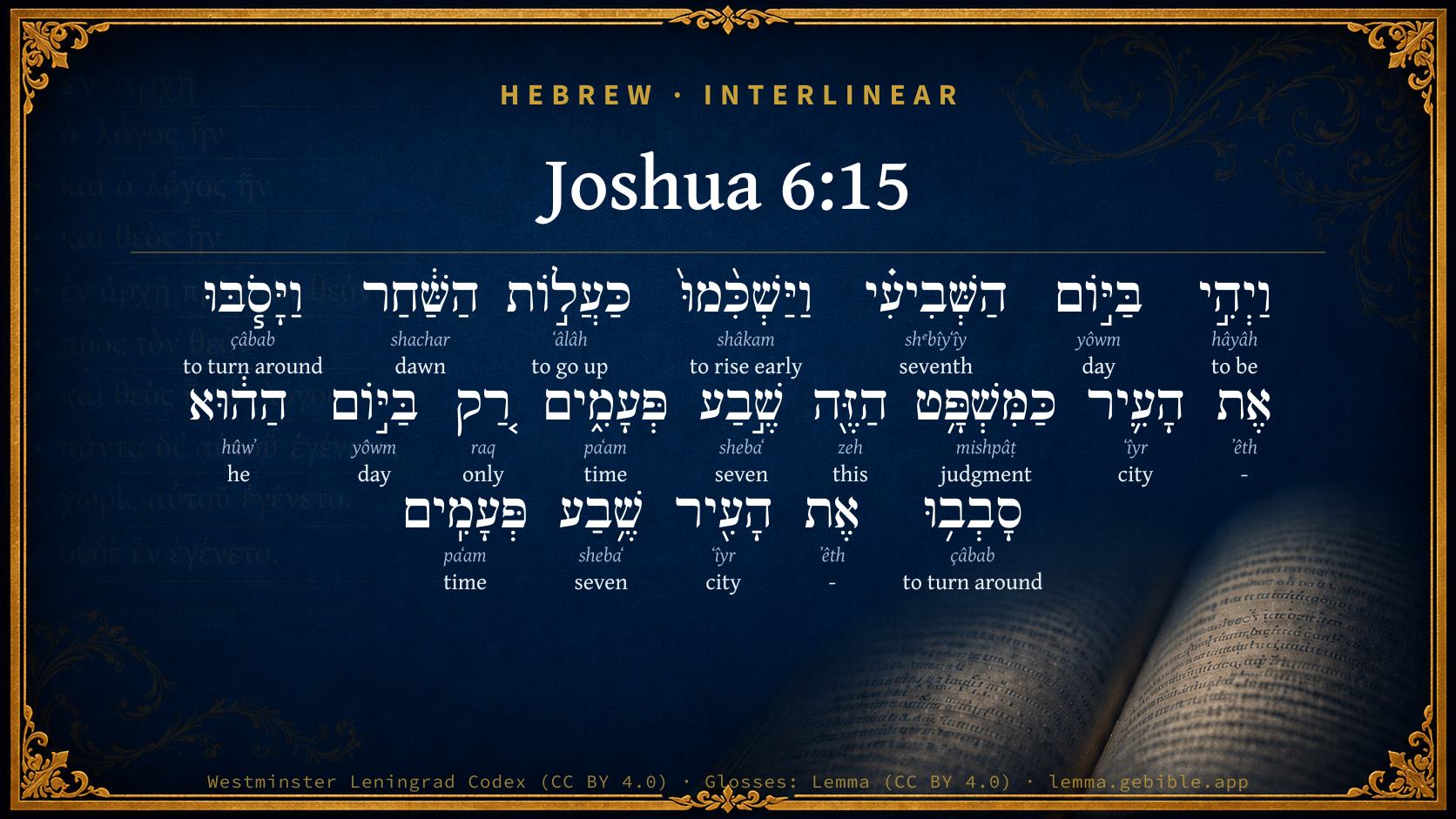
Hebrew (Westminster Leningrad Codex) Joshua 6:15 appears in the Hebrew Old Testament. The text above is from the Westminster Leningrad Codex. Each word links to its Strong’s number, a concise gloss, and parsing drawn from the Open Scriptures Hebrew Bible morphology. Click any word for its full Brown-Driver-Briggs (BDB) entry.
Download image
Cite this verse

Joshua 6:15 (World English Bible). Public Domain. Lemma interlinear Bible study tool, https://lemma.gebible.app/v/joshua/6/15.

Show BibTeX & RIS
BibTeX
RIS
English Translation
It happened on the seventh day, that they rose early at the dawning of the day, and compassed the city after the same manner seven times: only on the day they compassed the city seven times.
World English Bible · Public Domain
Download a study sheet

One document with this verse’s original text, its word-by-word gloss line, the meaning frame, cross-references with their text, attributed commentary, and full source and license credits — printable, and it pastes into notes with its structure intact.

This verse Autodidact and up

Study sheet (.html) Plain text (.txt)

A passage Seminary Student

Up to 50 verses in one chapter. A passage sheet keeps up to 6 commentary sources and 12 cross-references per verse, in the order this page ranks them, and says so on the sheet whenever that leaves anything out. Ask for a single verse and you get the Autodidact verse sheet above.

Everything on this page stays free to read, with no account — the sheet is a download of what is already on screen, not access to it.

Want to remove ads? Support Godless Engineer
Compare translations 3

The same verse in 3 English versions, stacked beneath the original-language interlinear above. Click any original word for its lexicon entry.

Each is an independent rendering of the whole verse — the interlinear is not word-aligned to these translations.

Highlighted words mark where these versions differ — a whole-verse word diff, not a word-by-word alignment.

  • World English Bible Public Domain
    It happened on the seventh day, that they rose early at the dawning of the day, and compassed the city after the same manner seven times: only on the day they compassed the city seven times.
  • King James Version Public Domain
    And it came to pass on the seventh day, that they rose early about the dawning of the day, and compassed the city after the same manner seven times: only on that day they compassed the city seven times.
  • unfoldingWord Literal Text CC BY-SA 4.0
    And it happened on the seventh day that they got up early, as soon as the dawn had risen, and they circled the city according to this manner seven times. Only on that day they circled the city seven times.

unfoldingWord Literal Text — © unfoldingWord, licensed CC BY-SA 4.0. Word-aligned USFM3 via Door43 (git.door43.org/unfoldingWord/en_ult).

Versions to compare (up to 4)

3 of 4 selected

Show all 18 translations

Every available English version of this verse, each an independent rendering of the whole verse.

  • World English Bible Public Domain
    It happened on the seventh day, that they rose early at the dawning of the day, and compassed the city after the same manner seven times: only on the day they compassed the city seven times.
  • Berean Standard Bible Public Domain
    Then on the seventh day, they got up at dawn and marched around the city seven times in the same manner. That was the only day they circled the city seven times.
  • Majority Standard Bible Public Domain
    Then on the seventh day, they got up at dawn and marched around the city seven times in the same manner. That was the only day they circled the city seven times.
  • King James Version Public Domain
    And it came to pass on the seventh day, that they rose early about the dawning of the day, and compassed the city after the same manner seven times: only on that day they compassed the city seven times.
  • American Standard Version (1901) Public Domain
    And it came to pass on the seventh day, that they rose early at the dawning of the day, and compassed the city after the same manner seven times: only on the day they compassed the city seven times.
  • Revised Version (1885) Public Domain
    And it came to pass on the seventh day, that they rose early at the dawning of the day, and compassed the city after the same manner seven times: only on that day they compassed the city seven times.
  • Geneva Bible (1599) Public Domain
    And when the seuenth day came, they rose early, euen with the dawning of the day, and compassed the citie after ye same maner seuen times: only that day they compassed the citie seuen times.
  • Douay-Rheims (1899) Public Domain
    But the seventh day, rising up early, they went about the city, as it was ordered, seven times.
  • Young's Literal Translation Public Domain
    And it cometh to pass, on the seventh day, that they rise early, at the ascending of the dawn, and compass the city, according to this manner, seven times; (only, on that day they have compassed the city seven times);
  • Literal Standard Version CC BY-SA 4.0
    And it comes to pass, on the seventh day, that they rise early, at the ascending of the dawn, and go around the city, according to this manner, seven times; (only on that day have they gone around the city seven times);
  • Unlocked Literal Bible CC BY-SA 4.0
    It was on the seventh day that they got up early at daybreak, and they marched around the city in the same way that was their pattern, this time for seven times. It was on this day that they marched around the city seven times.
  • unfoldingWord Literal Text CC BY-SA 4.0
    And it happened on the seventh day that they got up early, as soon as the dawn had risen, and they circled the city according to this manner seven times. Only on that day they circled the city seven times.
  • Darby Bible Public Domain
    And it was so that on the seventh day they rose early, about the morning-dawn, and went round the city after the same manner seven times; only on that day they went round the city seven times.
  • World Messianic Bible Public Domain
    On the seventh day, they rose early at the dawning of the day, and marched around the city in the same way seven times. On this day only they marched around the city seven times.
  • Webster's Bible Public Domain
    And it came to pass on the seventh day, that they rose early about the dawning of the day, and compassed the city after the same manner seven times: only on that day they compassed the city seven times.
  • Free Bible Version CC BY-SA 4.0
    On the seventh day they got up at dawn and marched around the city in the usual way, except that this day they circled the city seven times.
  • Bible in Basic English Public Domain
    Then on the seventh day they got up early, at the dawn of the day, and went round the town in the same way, but that day they went round it seven times.
  • JPS Tanakh (1917) Public Domain
    And it came to pass on the seventh day, that they rose early at the dawning of the day, and compassed the city after the same manner seven times; only on that day they compassed the city seven times.

Literal Standard Version (2020), Covenant Press — licensed CC BY-SA 4.0. Text via the HelloAO Bible API (eBible.org). Unlocked Literal Bible (unfoldingWord) — licensed CC BY-SA 4.0. Text via the HelloAO Bible API (eBible.org). unfoldingWord Literal Text — © unfoldingWord, licensed CC BY-SA 4.0. Word-aligned USFM3 via Door43 (git.door43.org/unfoldingWord/en_ult). Free Bible Version, Dr. Jonathan Gallagher — licensed CC BY-SA 4.0. Text via the HelloAO Bible API (eBible.org).

Word by word

More ways to search: Search by grammar → Find every occurrence → Compare this word →

Practice this passage: Drill this verse → Learn its vocabulary →

הַשַּׁ֔חַר
shachar
H7837
“the · dawn”
Particle, Definite Article + Noun, Common, Masculine, Singular, Absolute
Part of Speech
Particle + Noun
Type
Common
Gender
Masculine
Number
Singular
State
Absolute
Full BDB Definition

Origin: from H7836

TWOT: 2369a

dawn - dawn - at dawn (as adverb)
  1. וַיְהִ֣י hâyâh H1961 “and · to be” Conjunction + Verb, Qal, Sequential Imperfect, 3rd Person, Masculine, Singular
  2. בַּיּ֣וֹם yôwm H3117 “in/at the · day” Preposition, Determined + Noun, Common, Masculine, Singular, Absolute
  3. הַשְּׁבִיעִ֗י shᵉbîyʻîy H7637 “the · seventh” Particle, Definite Article + Adjective, Ordinal number, Masculine, Singular, Absolute
  4. וַיַּשְׁכִּ֨מוּ֙ shâkam H7925 “and · to rise early” Conjunction + Verb, Hiphil, Sequential Imperfect, 3rd Person, Masculine, Plural
  5. כַּעֲל֣וֹת ʻâlâh H5927 “like/as · to go up” Preposition + Verb, Qal, Infinitive Construct
  6. וַיָּסֹ֧בּוּ çâbab H5437 “and · to turn around” Conjunction + Verb, Qal, Sequential Imperfect, 3rd Person, Masculine, Plural
  7. אֶת ʼêth H853 “-” Particle, Direct Object
  8. הָעִ֛יר ʻîyr H5892 “the · city” Particle, Definite Article + Noun, Common, Feminine, Singular, Absolute
  9. כַּמִּשְׁפָּ֥ט mishpâṭ H4941 “like/as the · judgment” Preposition, Determined + Noun, Common, Masculine, Singular, Absolute
  10. הַזֶּ֖ה zeh H2088 “the · this” Particle, Definite Article + Pronoun, Demonstrative, Masculine, Singular
  11. שֶׁ֣בַע shebaʻ H7651 “seven” Adjective, Cardinal number, Feminine, Singular, Absolute
  12. פְּעָמִ֑ים paʻam H6471 “times” Noun, Common, Feminine, Plural, Absolute
  13. רַ֚ק raq H7535 “only” Particle, Accusative
  14. בַּיּ֣וֹם yôwm H3117 “in/at the · day” Preposition, Determined + Noun, Common, Masculine, Singular, Absolute
  15. הַה֔וּא hûwʼ H1931 “the · he” Particle, Definite Article + Pronoun, Personal, 3rd Person, Masculine, Singular
  16. סָבְב֥וּ çâbab H5437 “to turn around” Verb, Qal, Perfect, 3rd Person, Common, Plural
  17. אֶת ʼêth H853 “-” Particle, Direct Object
  18. הָעִ֖יר ʻîyr H5892 “the · city” Particle, Definite Article + Noun, Common, Feminine, Singular, Absolute
  19. שֶׁ֥בַע shebaʻ H7651 “seven” Adjective, Cardinal number, Feminine, Singular, Absolute
  20. פְּעָמִֽים paʻam H6471 “times” Noun, Common, Feminine, Plural, Absolute

About this verse

These counts appear in no published source. They are computed here, from the morphology-tagged text and Lemma’s own curated glosses. What Lemma adds →

21
words
15
distinct lemmas
Historical
section

Notable vocabulary

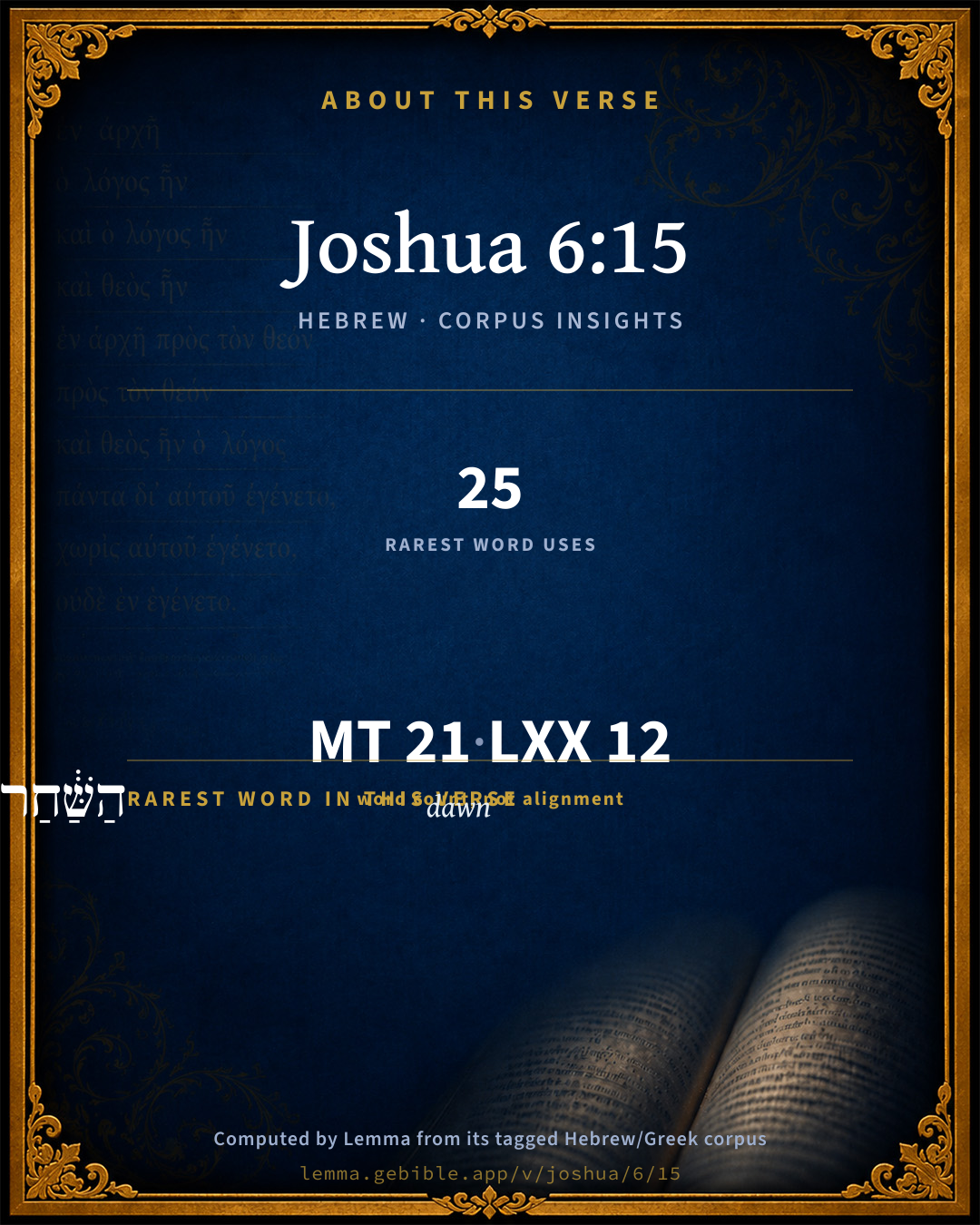
The rarest word here is הַשַּׁ֔חַר dawn H7837 — appearing just 25 times in the whole Hebrew Bible.

Shared distinctive vocabulary

הַשַּׁ֔חַר dawn H7837 occurs in 24 verses of the Hebrew Bible. Also found in:

Grammatical profile

  • 5 verbs
  • 8 nouns
  • 3 adjectives
  • 2 pronouns
  • 3 particles

Verb forms

  • וַיְהִ֣י Qal · Sequential Imperfect
  • וַיַּשְׁכִּ֨מוּ֙ Hiphil · Sequential Imperfect
  • כַּעֲל֣וֹת Qal · Infinitive Construct
  • וַיָּסֹ֧בּוּ Qal · Sequential Imperfect
  • סָבְב֥וּ Qal · Perfect

Repetition

Words recur within this verse — often emphatic in Hebrew:

  • בַּיּ֣וֹם day H3117 ×2
  • וַיָּסֹ֧בּוּ to turn around H5437 ×2
  • הָעִ֛יר city H5892 ×2
  • שֶׁ֣בַע seven H7651 ×2
  • פְּעָמִ֑ים time H6471 ×2

Hebrew & Septuagint length

In English translation the verse runs 36 words from the Hebrew and 18 from the Septuagint (LXX English) — the Septuagint runs noticeably shorter here. See the side-by-side →

A rough comparison of the two English renderings, which tokenize alike — not a word-level alignment.

Word counts can differ between the Hebrew and the Greek without any difference in meaning — e.g. the Hebrew direct-object marker אֵת has no separate Greek word, and Greek often adds the article ὁ.

In the original languages it is 21 Hebrew tokens and 12 Greek tokens — but the two are counted differently (Hebrew bundles its prefixes and suffixes into one token; the Greek is in lemma form), so that isn’t a like-for-like length.

Cross-references

3

Topical passages linked to Joshua 6:15 in the Treasury of Scripture Knowledge — connected by theme and wording, ordered by reader-vote popularity; previews shown in the World English Bible.

  • Psalms 119:147 I rise before dawn and cry for help. I put my hope in your words.
  • Matthew 28:1 Now after the Sabbath, as it began to dawn on the first day of the week, Mary Magdalene and the other Mary came to see the tomb.
  • 2 Peter 1:19 We have the more sure word of prophecy; whereunto you do well that you take heed, as to a lamp shining in a dark place, until the day dawns, and the day star arises in your hearts:

Cross-references courtesy of OpenBible.info (CC BY 4.0).

Hebrew and Greek witnesses Masoretic Hebrew ↔ Greek Septuagint

The same verse in the two great witnesses to the Old Testament, shown verse-for-verse.

Here the Septuagint runs noticeably shorter than the Hebrew — LXX2012 (modern English Septuagint) 18 words vs World English Bible 36. A rough length comparison of the two English translations, not a word-level alignment — read both below.

These are two independent witnesses, not word-aligned to each other, and the Septuagint is shown in lemma (dictionary) form.

Hebrew Joshua 6:15 Masoretic · Westminster Leningrad Codex

וַיְהִ֣י בַּיּ֣וֹם הַשְּׁבִיעִ֗י וַיַּשְׁכִּ֨מוּ֙ כַּעֲל֣וֹת הַשַּׁ֔חַר וַיָּסֹ֧בּוּ אֶת הָעִ֛יר כַּמִּשְׁפָּ֥ט הַזֶּ֖ה שֶׁ֣בַע פְּעָמִ֑ים רַ֚ק בַּיּ֣וֹם הַה֔וּא סָבְב֥וּ אֶת הָעִ֖יר שֶׁ֥בַע פְּעָמִֽים

It happened on the seventh day, that they rose early at the dawning of the day, and compassed the city after the same manner seven times: only on the day they compassed the city seven times.

World English Bible · Public Domain

Greek LXX Joshua 6:15 Septuagint · lemma form

καί ὁ ἡμέρα ὁ ἕβδομος ἀναἵστημι ὄρθρος καί περιἔρχομαι ὁ πόλις ἑξάκις

And on the seventh day they rose up early, and compassed the city on that day seven times.

LXX2012 (modern English Septuagint) · Public Domain

Hebrew: Westminster Leningrad Codex (CC BY 4.0). Greek: Septuagint (public domain); English from LXX2012 (modern English Septuagint) (Public Domain). How the Septuagint differs from the Hebrew →

Targum (Aramaic paraphrase)

1

The Targum is the ancient Jewish Aramaic paraphrase of the Hebrew Scriptures — an interpretive translation, not the Hebrew text itself. Onkelos (literal) and Pseudo-Jonathan (expansive) render the Torah, and Jonathan the Prophets. Coverage is partial: where no permissively-licensed English translation exists for a verse, only the Aramaic is shown. This is verse-level text, not a word-by-word alignment to the Hebrew.

  1. Targum Jonathan Prophets (Joshua–Malachi)
    וַהֲוָה בְּיוֹמָא שְׁבִיעָאָה וְאַקְדִימוּ כְּמִיסַק צַפְרָא וְאַסְחֲרוּ יַת קַרְתָּא כְּהִלְכָתָא הָדֵין שְׁבַע זִמְנִין לְחוֹד בְּיוֹמָא הַהוּא אַקִיפוּ יַת קַרְתָּא שְׁבַע זִמְנִין:

    (no public-domain English translation for this verse)

    Targum Jonathan — Aramaic: “Mikraot Gedolot” (public domain). English: “Sefaria Community Translation” (CC0 1.0 (public-domain dedication)); “London "Chaldee Paraphrase," 1871” (public domain). Text via Sefaria.

Commentary

Notes on Joshua 6:15 from classic Christian and Jewish commentators (each source and its license shown beneath its notes). The classic Christian expositions comment on the surrounding passage and are grouped to its opening verse, so a note may address several verses; the Jewish commentaries on the Tanakh (Rashi and others) are per-verse, so they appear only where the commentator wrote on this verse.

Lemma curates 59 commentaries, every one of them public domain or Creative Commons licensed, each selected and text-cleaned for this edition rather than reprinted as found. About our sources →

Trapp's Complete Commentary

John Trapp

Jos 6:15 And it came to pass on the seventh day, that they rose early about the dawning of the day, and compassed the city after the same manner seven times: only on that day they compassed the city seven times.

Ver. 15. They compassed the city seven times.] In sign, saith one, {a} that the perseverance and continuance in faith and the actions thereof, at last obtaineth the victory: and that the nearer the end of the combat is, the more ought the faithful man to bestir him therein.

{a} Diodorus.

John Trapp, A Commentary or Exposition upon All the Books of the Old and New Testament (1647–1656) — public domain. Text from a community e-Sword module.

Tyndale Open Study Notes

Tyndale Open Resources

6:15 Marching around Jericho seven times on the seventh day again symbolized that this was God’s battle.

Tyndale Open Study Notes — © Tyndale Open Resources, licensed CC BY-SA 4.0. Text via the HelloAO Bible API.

Geneva Bible (1599)

Geneva Bible translators

Beside every day once for the space of six days.

Geneva Bible (1599) marginal notes — public domain. Text via Bolls.life.

Jamieson, Fausset & Brown

Robert Jamieson, A. R. Fausset & David Brown

on the seventh day, that they rose early about the dawning of the day, and compassed the city . . . seven times--on account of the seven circuits they had to make that day. It is evident, however, that the militia only of the Israelites had been called to the march--for it is inconceivable that two millions of people could have gone so frequently round the city in a day.

Jamieson, Fausset & Brown — Commentary Critical and Explanatory on the Whole Bible (1871) — public domain (CC PDM 1.0). Text via the HelloAO Bible API.

Adam Clarke's Commentary

Verse 15. The seventh day - they rose early] Because on this day they had to encompass the city seven times; a proof that the city could not have been very extensive, else this going round it seven times, and having time sufficient left to sack and destroy it, would have been impossible.

It is evident that in the course of these seven days there must have been a Sabbath, and that on this Sabbath the host must have encompassed the city as on the other days: the Jews themselves allow this, and Rab. De Kimchi says "He who had ordained the observance of the Sabbath commanded it to be broken for the destruction of Jericho." But it does not appear that there could be any breach in the Sabbath by the people simply going round the city, the ark in company, and the priests sounding the sacred trumpets. This was a mere religious procession, performed at the command of God, in which no servile work was done. Therefore Marcion's objection, that the God of the Hebrews showed a changeableness of disposition in commanding the Sabbath to be kept sacred at one time, and then to be broken at another, is without foundation; for I must contend that no breach took place on this occasion, unless it could be made to appear that the day on which Jericho was taken was the Sabbath which is very unlikely, and which none can prove. But if even this were to be conceded, it is a sufficient answer to all such cavils, that the God who commanded the Sabbath to be set apart for rest and religious purposes, has always authority to suspend for a season the operation of merely ceremonial laws, or to abrogate them entirely, when the purpose of their institution is fulfilled. The Son of man is Lord even of the Sabbath.

Adam Clarke's Commentary on the Bible (1810–1826) — public domain. Text from a community e-Sword/MySword module.

John Calvin's Commentaries

15. And it came to pass on the seventh day, etc Here, also, God seemed, by leading the people so often round the city, not only to keep the matter in suspense, but purposely to sport with the miseries of the people, who were fatiguing themselves to no purpose. For why does he not order them suddenly to attack the city? Why does he keep them in their former silence, even to weariness, and not open their mouths to shout? But the happy fruit of this endurance teaches us, that there is nothing better than to leave the decisive moments and opportunities of acting at his disposal, and not, by our haste, anticipate his providence, in which, if we acquiesce not, we obstruct the course of his agency. Therefore, while the priests were sounding, God ordered a corresponding shout to be raised by the people, that in this way he might prove that he is not pleased with any impetuosity which men manifest at their own hands, but above all things requires a regulated zeal, of which the only rule is not to move either tongue, or feet, or hands, till he order. Here, the rams’ horns undoubtedly represented his authority.

John Calvin's Commentaries (1540-1563) — public domain. Text from the Calvin Translation Society English edition (1840s-50s) via the Christian Classics Ethereal Library (ccel.org). Calvin's coverage is partial (roughly two-thirds of the Bible); uncommented books and verses are honest gaps, never fabricated. The 19th-century editor's footnotes and remarks are omitted so the notes are faithfully Calvin's own voice.

The Cambridge Bible for Schools and Colleges

gen. ed. J. J. S. Perowne

15. about the dawning of the day] On this day the circuit had to be made seven times, and therefore the march had to be commenced very early.

The Cambridge Bible for Schools and Colleges (gen. ed. J. J. S. Perowne; Cambridge University Press, 1878–1918) — public domain. Text from a community e-Sword module.

John Gill's Exposition

And it came to pass on the seventh day,.... Which Jarchi says was the Sabbath day, and which is a common notion of the Jews (c); but whether it was or not, it is certain that one of these seven days must be a sabbath, in which the several things ordered were done, and the procession made. Kimchi observes, that their Rabbins say this was the sabbath day; and he adds, what is pretty remarkable,"though they slew and burnt on the sabbath day, he that commanded the sabbath commanded to profane the sabbath in the subduing of Jericho;''with which compare what our Lord says, Mat 12:3,

that they rose early, about the dawning of the day; having seven times the work to do they did on the other six days:

and compassed the city after the same manner seven times; after the same manner as they had done the six preceding days:

only on that day they compassed the city seven times; whereas on the other days they only went round it once, which distinguished this day from the rest.

(c) Seder Olam Rabba, c. 11. p. 31. Bemidbar Rabba, sect. 14. fol. 312. 2.

John Gill's Exposition of the Whole Bible (1746–1763) — public domain (CC PDM 1.0). Text via the HelloAO Bible API.

Albert Barnes' Notes on the Bible

On the seventh day - Most probably a Sabbath day. The rising early would be necessary to give time for encompassing the city seven times. Jericho appears to have been a city of considerable size and population; and each passage of the large host round it could hardly have taken less than an hour and a half. Thus, with the necessary intervals of rest, the evening would be at hand when Joshua gave the signal to shout Jos 6:16; and the work of slaughter was probably commenced just as the hours of the Sabbath were passed.

Albert Barnes' Notes on the Bible (1834–1885) — public domain. Text from a community e-Sword/MySword module.

Haydock's Catholic Bible Commentary

Seventh day. The Jews say it was the sabbath; but of this there is no proof. Marcion hence took occasion to accuse God of inconsistency, as he forbad all working, and yet ordered the people to go round Jericho on a sabbath day. But Tertullian (iv. 12,) answers very well, that servile work is forbidden, and not the works of God or of religion, and God may change the ceremonial law as he thinks proper. (Calmet) --- Sabbato opera humana prohibentur non divina. (Du Hamel)

George Leo Haydock (1774–1849), Haydock's Catholic Family Bible and Commentary, 1859 edition — public domain. Excludes Psalms (Douay-Rheims chapter numbering differs from Protestant) and Deuterocanonical books (Catholic canon only).

Whedon's Commentary on the Bible

Daniel D. Whedon

15. About the dawning of the day — Here not only Joshua rises early, as in Jos_6:12, but also the whole army, because a great day’s work was before them. It is not to be supposed that the entire camp, several millions in number, marched together in this service, but it is probable that the entire military force was engaged.

Daniel D. Whedon (gen. ed.), Commentary on the Old and New Testaments (1874–1909) — public domain. Text from a community e-Sword module.

The Pulpit Commentary

And it came to pass on the seventh day. Why did God command this long pause of suspense and expectation? Even to teach us that His ways are not as our ways, and that we had far better leave the issue in His hands, than by our impatience to anticipate, and not unfrequently frustrate, the course of His Providence. Calvin. There is a time to act and a time to wait patiently. If we seek His guidance by prayer, God will tell us when to do either. And when it is our duty not to do anything ourselves, but to wait for the deliverance which He never fails to send in His own good time, let us be careful to restrain ourselves, lest by our rash intermeddling with His designs, we bring disgrace and disaster upon ourselves and His cause. Had the Israelites disobeyed His command, and instead of the solemn procession round Jericho, ventured to attack the city at once, it would have fared worse with them than at Ai, or at the wilderness of Pavan. (Num_14:45) About the dawning. So the Chethibh. The Ken substitutes K for B, i.e., as soon as it was dawn.

Literally, "as the dawn went up." After this manner. Literally, according to this judgment, "sieur dispositum erat" (Vulg.). For a similar use of fpvmi see Gen_40:13, and compare the proverb mos pro lege.

The Pulpit Commentary (1880–1919), ed. H.D.M. Spence-Jones & Joseph S. Exell — public domain. Text from a community e-Sword module.

Kretzmann's Popular Commentary

Paul E. Kretzmann

Rahab Saved at the Overthrow of Jericho

v. 15. And it came to pass on the seventh day that they rose early about the dawning of the day, when the first indications of the new day were visible in the east, and compassed the city after the same manner seven times; only on that day they compassed the city seven times, the greater part of the day, probably till near sundown, being occupied with this marching.

v. 16. And it came to pass at the seventh time, when the priests blew with the trumpets, or, the priests had sounded the blast on the trumpets, for the description in the Hebrew is more vivid than in the translation, Joshua said unto the people, Shout; for the Lord hath given you the city.

v. 17. And the city shall be accursed, devoted to the Lord as under His curse and condemnation, even it and all that are therein, to the Lord; only Rahab, the harlot, shall live, she and all that are with her in the house, because she hid the messengers that we sent, Jos 2:4.

v. 18. And ye, in any wise, by all means, keep yourselves from the accursed thing, lest ye make yourselves accursed, become polluted with the curse which God had pronounced upon the city and all it contained, when ye take of the accursed thing, and make the camp of Israel a curse, and trouble it, since the transgression of a single person would be charged to the entire people. "A devoted thing, Num 21:2-3; Deu 7:2; Deu 20:17, was that which had been doomed to the Lord, which no man might employ for his own use, but which was either put away and destroyed utterly to the honor of God, as the men and beasts in this passage, a propitiation, as it were, to the divine justice, that this might be glorified; or it was consecrated to the special service of God, as here all precious and useful metals. " (Starke. )

v. 19. But all the silver and gold and vessels of brass and iron are consecrated unto the Lord, literally, "holiness are they to the Lord," and therefore not to be taken and used for profane purposes; they shall come into the treasury of the Lord.

v. 20. So the people shouted when the priests blew with the trumpets, at the long blast after the seventh trip around the city on this last day. And it came to pass, when the people heard the sound of the trumpet, and the people shouted with a great shout, as commanded by the Lord,

v. 5. that the wall fell down flat, toppled over and crumbled to pieces, so that the people, the attacking soldiers, went up into the city, every man straight before him, and they took the city, by an obvious, almighty interposition of the Lord.

v. 21. And they utterly destroyed all that was in the city, both man and woman, young and old, and ox, and sheep, and ass, with the edge of the sword, for it was the Lord’s war of extermination.

v. 22. But Joshua had said unto the two men that had spied out the country, Go into the harlot’s house, and bring out thence the woman, and all that she hath, as ye sware unto her, Jos 2:14.

v. 23. Arid the young men that were spies, who had performed the work of spies in the instance referred to, went in and brought out Rahab, her house having evidently not fallen, although it was built against the city wall, and her father, and her mother, and her brethren, and all that she had; and they brought out all her kindred, Jos 2:13, and left them without the camp of Israel, until they should have performed all the rites which were necessary to admit them into the congregation of the Lord.

v. 24. And they, the soldiers of Israel, burned the city with fire, and all that was therein; only the silver and the gold and the vessels of brass and of iron they put into the treasury of the house of the Lord. Thus was Jericho offered up as a first-fruits of the conquered land, because "this was the first city of Canaan which Jehovah had given into the hands of His people. This city, therefore, Israel should offer to the Lord, and even consecrate to Him as devoted, for a sign or token that they received the whole land from His hand, as a loan of what had fallen to Him, and not what they could obtain for themselves. "

v. 25. And Joshua saved Rahab, the harlot, alive, and her fathers household, and all that she had; and she dwelleth in Israel even unto this day, being alive and considered a member of the people of the Lord at the time when this account was written, Cf Mat 1:5; because she hid the messengers which Joshua sent to spy out Jericho. It was a reward of her act of faith.

v. 26. And Joshua adjured them, the soldiers of Israel, at that time, saying, Cursed be the man before the Lord that riseth up and buildeth this city Jericho; he shall lay the foundation thereof in his first-born, lose his oldest son at that time, and in his youngest son shall he set up the gates of it, he being taken by death at the completion of the building of the city. This threat was literally fulfilled, as the history of Israel shows, 1Ki 16:34.

v. 27. So the Lord was with Joshua; and his fame was noised throughout all the country, his military ability as well as his success under the guidance of Jehovah. The overthrow of Jericho showed plainly that Jehovah was battling for His people, for the walls of the city fell by faith, Heb 11:30. This faith is the victory which overcomes the world. But in the fall of Jericho we also see a type of the final overthrow of all the powers of the world, death, and hell. At the end of the world the Lord will come with the voice of the archangel, and with the trumpet of God, 1Th 4:16, and the whole world will fall down in ruins as He proceeds to carry out His judgment upon His enemies.

Paul E. Kretzmann, Popular Commentary of the Bible (1921–1924) — public domain. Text from a community e-Sword module.

unfoldingWord translationNotes

Door43 World Missions Community

the people

This refers to the people of Israel.

gave a blast with the trumpets

"sounded the trumpets loudly" or "blew into the ram's horn trumpets"

Yahweh has given you

Joshua is saying that Yahweh will definitely give them the city by saying that he has already given it to them. (See: Predictive Past)

given you

The word "you" refers to the entire nation of Israel. (See: Forms of You)

translationWords

priest

trumpet

Joshua

Yahweh

unfoldingWord translationNotes — © Distant Shores Media and the Door43 World Missions Community, licensed CC BY-SA 4.0. Source: git.door43.org/Door43/en_tn.

Rashi

Rabbi Shlomo Yitzchaki (Rashi)

On the seventh day. This was on the Shabbos.

Rashi on the Tanakh — English translations: “The Judaica Press complete Tanach with Rashi, translated by A. J. Rosenberg” (CC BY 4.0); “Pentateuch with Rashi's commentary by M. Rosenbaum and A.M. Silbermann, 1929-1934” (public domain); “The Metsudah Tanach series, Lakewood, N.J” (CC BY 4.0); and “The Book of Joshua, Metsudah Publications, 1997” (CC BY 4.0). Text via Sefaria.

Lesson kit

Teaching starters — assembled from the data on this page, not authored interpretation. Every prompt links to the verse data it draws on. Edit before teaching.

Joshua, in the Historical, opens this verse with 21 words (15 distinct Hebrew lemmas). Its most distinctive word is shachar (“dawn”). The Greek Septuagint runs shorter here. A historical commentator’s framing appears above. Read the whole chapter for the surrounding context.

Discussion questions

  1. How does “dawn” (shachar) shape what this verse is saying?
  2. Genesis 19:15 shares the word «dawn» with this verse. How do the two illuminate each other?
  3. “day” occurs 2× in this one verse. What is the effect of the repetition?
  4. Compared with the Hebrew, the Septuagint runs shorter here. What questions does that raise?
  5. These translations render this verse differently; the difference is in the English rendering, not the original. What questions does that raise?
  6. The verb «וַיְהִ֣י» is Qal Sequential Imperfect. How does its form color the action?
  7. Reading how Trapp's Complete Commentary and Tyndale Open Study Notes read this verse, where do the two commentators agree and where do they part?

Things to notice

Reading settings

Reading text

Shown beneath each verse's original-language words.

Old Testament
Old Testament edition

Read the OT as the Masoretic Hebrew (MT) or the Greek Septuagint (LXX).

English shown for the Greek Septuagint (in the Hebrew ↔ Greek comparison).

Comparing translations? Open the Compare panel on any verse page to stack up to four side by side.