
Deuteronomy 32:49

Hebrew (Westminster Leningrad Codex) Deuteronomy 32:49 appears in the Hebrew Old Testament. The text above is from the Westminster Leningrad Codex. Each word links to its Strong’s number, a concise gloss, and parsing drawn from the Open Scriptures Hebrew Bible morphology. Click any word for its full Brown-Driver-Briggs (BDB) entry.
Download image
Cite this verse

Deuteronomy 32:49 (World English Bible). Public Domain. Lemma interlinear Bible study tool, https://lemma.gebible.app/v/deuteronomy/32/49.

Show BibTeX & RIS
BibTeX
RIS
English Translation
Go up into this mountain of Abarim, to Mount Nebo, which is in the land of Moab, that is over against Jericho; and see the land of Canaan, which I give to the children of Israel for a possession;
World English Bible · Public Domain
Download a study sheet

One document with this verse’s original text, its word-by-word gloss line, the meaning frame, cross-references with their text, attributed commentary, and full source and license credits — printable, and it pastes into notes with its structure intact.

This verse Autodidact and up

Study sheet (.html) Plain text (.txt)

A passage Seminary Student

Up to 50 verses in one chapter. A passage sheet keeps up to 6 commentary sources and 12 cross-references per verse, in the order this page ranks them, and says so on the sheet whenever that leaves anything out. Ask for a single verse and you get the Autodidact verse sheet above.

Everything on this page stays free to read, with no account — the sheet is a download of what is already on screen, not access to it.

Want to remove ads? Support Godless Engineer
Compare translations 3

The same verse in 3 English versions, stacked beneath the original-language interlinear above. Click any original word for its lexicon entry.

Each is an independent rendering of the whole verse — the interlinear is not word-aligned to these translations.

Highlighted words mark where these versions differ — a whole-verse word diff, not a word-by-word alignment.

  • World English Bible Public Domain
    Go up into this mountain of Abarim, to Mount Nebo, which is in the land of Moab, that is over against Jericho; and see the land of Canaan, which I give to the children of Israel for a possession;
  • King James Version Public Domain
    Get thee up into this mountain Abarim, unto mount Nebo, which is in the land of Moab, that is over against Jericho; and behold the land of Canaan, which I give unto the children of Israel for a possession:
  • unfoldingWord Literal Text CC BY-SA 4.0
    “Go up to this mountain of the Abarim, Mount Nebo, which in the land of Moab, that on the face of Jericho. And you will see the land of Canaan, which I am giving to the sons of Israel as a possession.

unfoldingWord Literal Text — © unfoldingWord, licensed CC BY-SA 4.0. Word-aligned USFM3 via Door43 (git.door43.org/unfoldingWord/en_ult).

Versions to compare (up to 4)

3 of 4 selected

Show all 18 translations

Every available English version of this verse, each an independent rendering of the whole verse.

  • World English Bible Public Domain
    Go up into this mountain of Abarim, to Mount Nebo, which is in the land of Moab, that is over against Jericho; and see the land of Canaan, which I give to the children of Israel for a possession;
  • Berean Standard Bible Public Domain
    “Go up into the Abarim Range to Mount Nebo, in the land of Moab across from Jericho, and view the land of Canaan, which I am giving to the Israelites as their own possession.
  • Majority Standard Bible Public Domain
    “Go up into the Abarim Range to Mount Nebo, in the land of Moab across from Jericho, and view the land of Canaan, which I am giving to the Israelites as their own possession.
  • King James Version Public Domain
    Get thee up into this mountain Abarim, unto mount Nebo, which is in the land of Moab, that is over against Jericho; and behold the land of Canaan, which I give unto the children of Israel for a possession:
  • American Standard Version (1901) Public Domain
    Get thee up into this mountain of Abarim, unto mount Nebo, which is in the land of Moab, that is over against Jericho; and behold the land of Canaan, which I give unto the children of Israel for a possession;
  • Revised Version (1885) Public Domain
    Get thee up into this mountain of Abarim, unto mount Nebo, which is in the land of Moab, that is over against Jericho; and behold the land of Canaan, which I give unto the children of Israel for a possession:
  • Geneva Bible (1599) Public Domain
    Goe vp into the mountaine of Abarim, vnto the mount Nebo, which is in the lande of Moab, that is ouer against Iericho: and beholde the lande of Canaan, which I giue vnto the children of Israel for a possession,
  • Douay-Rheims (1899) Public Domain
    Go up into this mountain Abarim, (that is to say, of passages,) unto mount Nebo, which is in the land of Moab over against Jericho: and see the land of Chanaan, which I will deliver to the children of Israel to possess, and die thou in the mountain.
  • Young's Literal Translation Public Domain
    `Go up unto this mount Abarim, mount Nebo, which `is' in the land of Moab, which `is' on the front of Jericho, and see the land of Canaan which I am giving to the sons of Israel for a possession;
  • Literal Standard Version CC BY-SA 4.0
    “Go up to this Mount Abarim, Mount Nebo, which [is] in the land of Moab, which [is] on the front of Jericho, and see the land of Canaan which I am giving to the sons of Israel for a possession;
  • Unlocked Literal Bible CC BY-SA 4.0
    “Go up into this range of the mountains of Abarim, up Mount Nebo, which is in the land of Moab, opposite Jericho. You will look at the land of Canaan, which I am giving to the people of Israel as their possession.
  • unfoldingWord Literal Text CC BY-SA 4.0
    “Go up to this mountain of the Abarim, Mount Nebo, which in the land of Moab, that on the face of Jericho. And you will see the land of Canaan, which I am giving to the sons of Israel as a possession.
  • Darby Bible Public Domain
    Go up into this mountain Abarim, mount Nebo, which is in the land of Moab, which is opposite Jericho; and behold the land of Canaan, which I give unto the children of Israel for a possession,
  • World Messianic Bible Public Domain
    “Go up into this mountain of Abarim, to Mount Nebo, which is in the land of Moab, that is across from Jericho; and see the land of Canaan, which I give to the children of Israel for a possession.
  • Webster's Bible Public Domain
    Ascend this mountain Abarim, to mount Nebo, which is in the land of Moab, that is over against Jericho; and behold the land of Canaan which I give to the children of Israel for a Possession:
  • Free Bible Version CC BY-SA 4.0
    “Climb up into the Abarim mountains to Mount Nebo, in the land of Moab opposite Jericho, and look over the country of Canaan, which I am giving to the Israelites for them to own.
  • Bible in Basic English Public Domain
    Go up into this mountain of Abarim, to Mount Nebo in the land of Moab opposite Jericho; there you may see the land of Canaan, which I am giving to the children of Israel for their heritage:
  • JPS Tanakh (1917) Public Domain
    'Get thee up into this mountain of Abarim, unto mount Nebo, which is in the land of Moab, that is over against Jericho; and behold the land of Canaan, which I give unto the children of Israel for a possession;

Literal Standard Version (2020), Covenant Press — licensed CC BY-SA 4.0. Text via the HelloAO Bible API (eBible.org). Unlocked Literal Bible (unfoldingWord) — licensed CC BY-SA 4.0. Text via the HelloAO Bible API (eBible.org). unfoldingWord Literal Text — © unfoldingWord, licensed CC BY-SA 4.0. Word-aligned USFM3 via Door43 (git.door43.org/unfoldingWord/en_ult). Free Bible Version, Dr. Jonathan Gallagher — licensed CC BY-SA 4.0. Text via the HelloAO Bible API (eBible.org).

Word by word

More ways to search: Search by grammar → Find every occurrence → Compare this word →

Practice this passage: Drill this verse → Learn its vocabulary →

הָעֲבָרִ֨ים
ʻĂbârîym
H5682
“the · Abarim”
Particle, Definite Article + Noun, Proper
Part of Speech
Particle + Noun
Type
Proper
Full BDB Definition

Origin: pl. of H5676

TWOT: None

Abarim = "regions beyond" - a mountain or range of mountains on the east of the Jordan, in the land of Moab, opposite to Jericho; Mount Nebo is part of this range
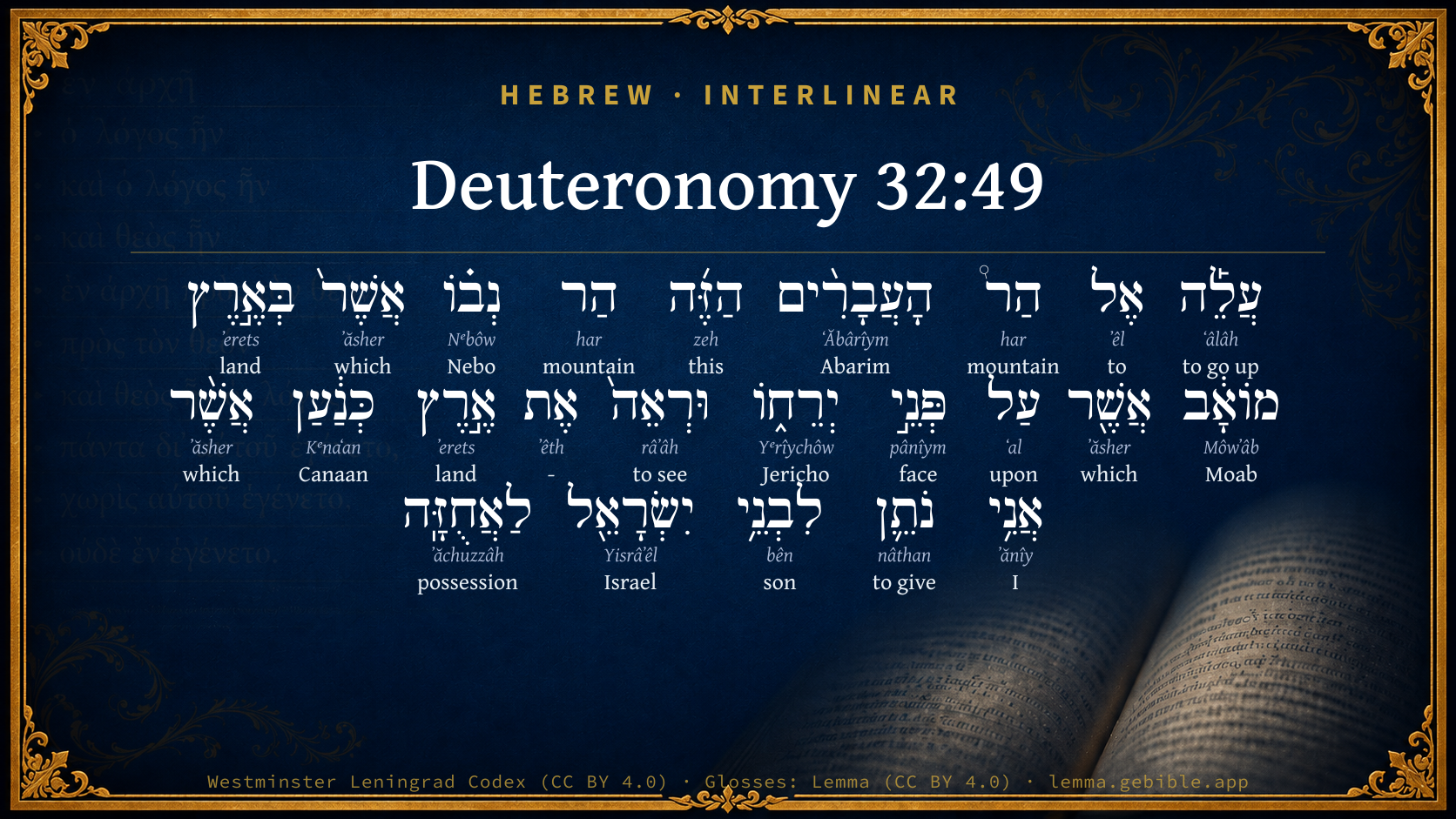
  1. עֲלֵ֡ה ʻâlâh H5927 “go up” Verb, Qal, Imperative, 2nd Person, Masculine, Singular
  2. אֶל ʼêl H413 “to” Preposition
  3. הַר֩ har H2022 “mountain of” Noun, Common, Masculine, Singular, Construct
  4. הַזֶּ֜ה zeh H2088 “the · this” Particle, Definite Article + Pronoun, Demonstrative, Masculine, Singular
  5. הַר har H2022 “mountain of” Noun, Common, Masculine, Singular, Construct
  6. נְב֗וֹ Nᵉbôw H5015 “Nebo” Noun, Proper
  7. אֲשֶׁר֙ ʼăsher H834 “which” Particle, Relative
  8. בְּאֶ֣רֶץ ʼerets H776 “in/at · land of” Preposition + Noun, Common, Both, Singular, Construct
  9. מוֹאָ֔ב Môwʼâb H4124 “Moab” Noun, Proper
  10. אֲשֶׁ֖ר ʼăsher H834 “which” Particle, Relative
  11. עַל ʻal H5921 “upon” Preposition
  12. פְּנֵ֣י pânîym H6440 “face(s) of” Noun, Common, Both, Plural, Construct
  13. יְרֵח֑וֹ Yᵉrîychôw H3405 “Jericho” Noun, Proper
  14. וּרְאֵה֙ râʼâh H7200 “and · see” Conjunction + Verb, Qal, Imperative, 2nd Person, Masculine, Singular
  15. אֶת ʼêth H853 “-” Particle, Direct Object
  16. אֶ֣רֶץ ʼerets H776 “land of” Noun, Common, Both, Singular, Construct
  17. כְּנַ֔עַן Kᵉnaʻan H3667 “Canaan” Noun, Proper
  18. אֲשֶׁ֨ר ʼăsher H834 “which” Particle, Relative
  19. אֲנִ֥י ʼănîy H589 “I” Pronoun, Personal, 1st Person, Common, Singular
  20. נֹתֵ֛ן nâthan H5414 “giving” Verb, Qal, Participle Active, Masculine, Singular, Absolute
  21. לִבְנֵ֥י bên H1121 “to/for · sons of” Preposition + Noun, Common, Masculine, Plural, Construct
  22. יִשְׂרָאֵ֖ל Yisrâʼêl H3478 “Israel” Noun, Proper
  23. לַאֲחֻזָּֽה ʼăchuzzâh H272 “to/for · possession” Preposition + Noun, Common, Feminine, Singular, Absolute

About this verse

These counts appear in no published source. They are computed here, from the morphology-tagged text and Lemma’s own curated glosses. What Lemma adds →

24
words
20
distinct lemmas
Pentateuch
section

Notable vocabulary

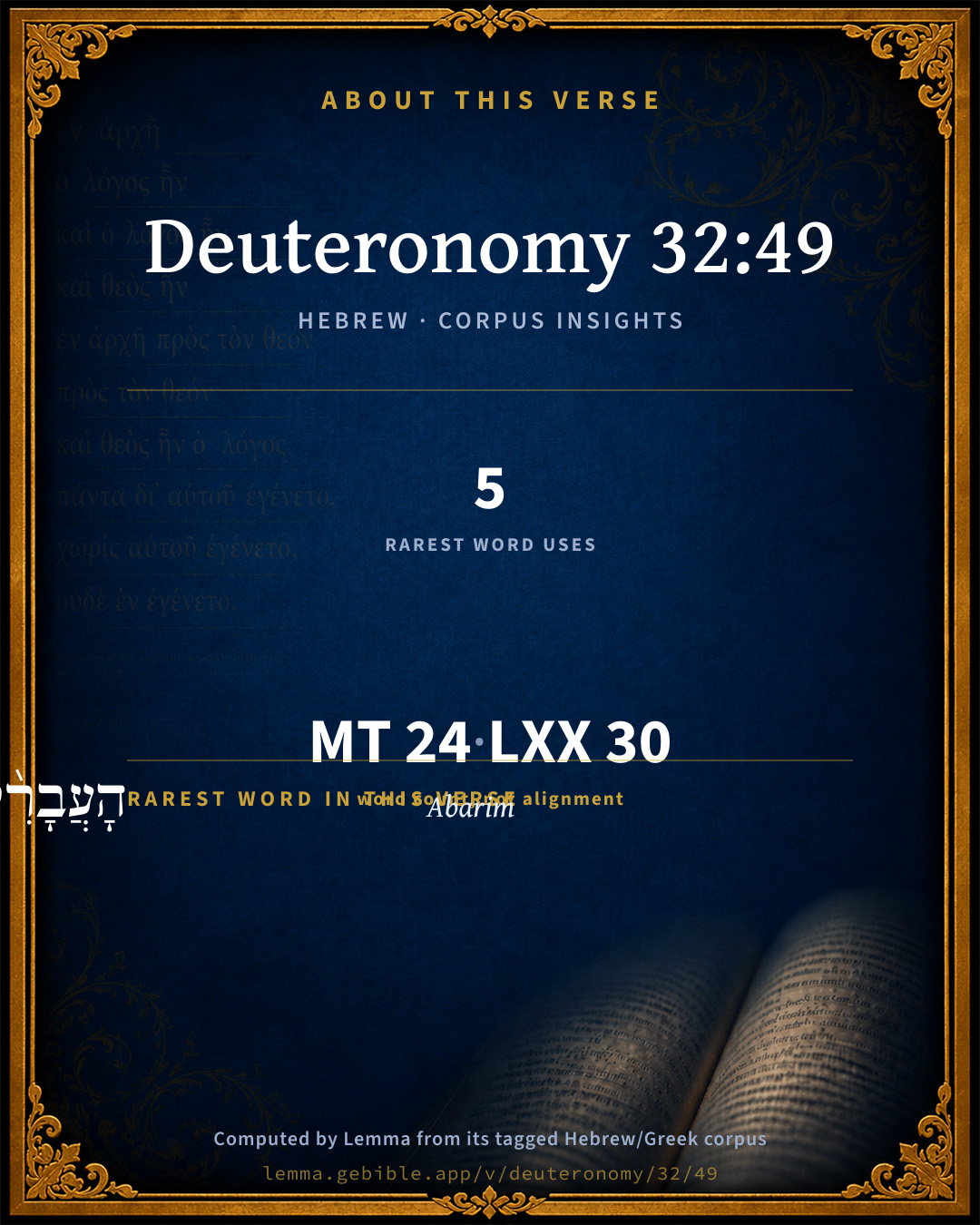
The rarest word here is הָעֲבָרִ֨ים Abarim H5682 — appearing just 5 times in the whole Hebrew Bible.

Shared distinctive vocabulary

הָעֲבָרִ֨ים Abarim H5682 occurs in 5 verses of the Hebrew Bible. Also found in:

Grammatical profile

  • 3 verbs
  • 13 nouns
  • 2 pronouns
  • 2 prepositions
  • 4 particles

Verb forms

  • עֲלֵ֡ה Qal · Imperative
  • וּרְאֵה֙ Qal · Imperative
  • נֹתֵ֛ן Qal · Participle Active

Repetition

Words recur within this verse — often emphatic in Hebrew:

  • הַר֩ mountain H2022 ×2
  • בְּאֶ֣רֶץ land H776 ×2
  • אֲשֶׁר֙ which H834 ×3

Hebrew & Septuagint length

In English translation the verse runs 39 words from the Hebrew and 33 from the Septuagint (LXX English) — closely comparable.

A rough comparison of the two English renderings, which tokenize alike — not a word-level alignment.

Word counts can differ between the Hebrew and the Greek without any difference in meaning — e.g. the Hebrew direct-object marker אֵת has no separate Greek word, and Greek often adds the article ὁ.

In the original languages it is 24 Hebrew tokens and 30 Greek tokens — but the two are counted differently (Hebrew bundles its prefixes and suffixes into one token; the Greek is in lemma form), so that isn’t a like-for-like length.

Cross-references

5

Topical passages linked to Deuteronomy 32:49 in the Treasury of Scripture Knowledge — connected by theme and wording, ordered by reader-vote popularity; previews shown in the World English Bible.

  • Numbers 27:12 Yahweh said to Moses, Go up into this mountain of Abarim, and see the land which I have given to the children of Israel.
  • Numbers 33:47–48 They traveled from Almon Diblathaim, and encamped in the mountains of Abarim, before Nebo.
  • Deuteronomy 34:1–5 Moses went up from the plains of Moab to Mount Nebo, to the top of Pisgah, that is over against Jericho. Yahweh shown him all the land of Gilead, to Dan,
  • Isaiah 33:17 Your eyes shall see the king in his beauty: they shall see a land that reaches afar.
  • 2 Corinthians 5:1 For we know that if the earthly house of our tent is dissolved, we have a building from God, a house not made with hands, eternal, in the heavens.

Cross-references courtesy of OpenBible.info (CC BY 4.0).

Hebrew and Greek witnesses Masoretic Hebrew ↔ Greek Septuagint

The same verse in the two great witnesses to the Old Testament, shown verse-for-verse.

These are two independent witnesses, not word-aligned to each other, and the Septuagint is shown in lemma (dictionary) form.

Hebrew Deuteronomy 32:49 Masoretic · Westminster Leningrad Codex

עֲלֵ֡ה אֶל הַר֩ הָעֲבָרִ֨ים הַזֶּ֜ה הַר נְב֗וֹ אֲשֶׁר֙ בְּאֶ֣רֶץ מוֹאָ֔ב אֲשֶׁ֖ר עַל פְּנֵ֣י יְרֵח֑וֹ וּרְאֵה֙ אֶת אֶ֣רֶץ כְּנַ֔עַן אֲשֶׁ֨ר אֲנִ֥י נֹתֵ֛ן לִבְנֵ֥י יִשְׂרָאֵ֖ל לַאֲחֻזָּֽה

Go up into this mountain of Abarim, to Mount Nebo, which is in the land of Moab, that is over against Jericho; and see the land of Canaan, which I give to the children of Israel for a possession;

World English Bible · Public Domain

Greek LXX Deuteronomy 32:49 Septuagint · lemma form

ἀναβαίνω εἰς ὁ ὄρος ὁ αβαριν οὗτος ὄρος ναβαυ ὅς εἰμί ἐν γῆ μωαβ κατά πρόσωπον ιεριχω καί ὁράω ὁ γῆ χανααν ὅς ἐγώ δίδωμι ὁ υἱός ἰσραήλ εἰς κατάσχεσις

Go up to the mount Abarim, this mountain Nabau which is in the land of Moab over against Jericho, and behold the land of Chanaan, which I give to the sons of Israel:

LXX2012 (modern English Septuagint) · Public Domain

Hebrew: Westminster Leningrad Codex (CC BY 4.0). Greek: Septuagint (public domain); English from LXX2012 (modern English Septuagint) (Public Domain). How the Septuagint differs from the Hebrew →

Targum (Aramaic paraphrase)

2

The Targum is the ancient Jewish Aramaic paraphrase of the Hebrew Scriptures — an interpretive translation, not the Hebrew text itself. Onkelos (literal) and Pseudo-Jonathan (expansive) render the Torah, and Jonathan the Prophets. Coverage is partial: where no permissively-licensed English translation exists for a verse, only the Aramaic is shown. This is verse-level text, not a word-by-word alignment to the Hebrew.

  1. Targum Onkelos Torah (Genesis–Deuteronomy)
    סַק לְטוּרָא דַעֲבָרָאֵי הָדֵין טוּרָא דִנְבוֹ דִי בְּאַרְעָא דְמוֹאָב דִי עַל אַפֵּי יְרֵחוֹ וַחֲזֵי יָת אַרְעָא דִכְנַעַן דִי אֲנָא יָהֵב לִבְנֵי יִשְׂרָאֵל לְאַחֲסָנָא

    (no public-domain English translation for this verse)

    Targum Onkelos — Aramaic: “Onkelos Genesis” (public domain); “Onkelos Exodus” (public domain); “Onkelos Leviticus” (public domain); “Onkelos Numbers” (public domain); “Onkelos Deuteronomy” (public domain). English: “Sefaria Community Translation” (CC0 1.0 (public-domain dedication)); “J.W. Etheridge. The Targums of Onkelos and Jonathan Ben Uzziel on the Pentateuch. London: Longmans, Green, 1862” (public domain). Text via Sefaria.

  2. Targum Pseudo-Jonathan Torah (Genesis–Deuteronomy)
    וַהֲוָה כֵיוַן דַאֲמַר לֵיהּ מֵימְרָא דַיְיָ סוּק לְטַוָור עִבְרָאֵי הָדֵין טַוְורָא דִנְבוֹ חָשֵׁב בְּלִבֵּיהּ וַאֲמַר דִלְמָא דַמְיָיא מְסוּקְתָא דָא לִמְסוּקְתָא דְטַוְורָא דְסִינַי אָמַר אִיזֵל וְאִיקְדֵישׁ יַת עַמָא אָמַר לֵיהּ מֵימְרָא דַיְיָ לָא כָּל הֵיאֵךְ אֱלָהֵן סוֹק וַחֲמֵי יַת אַרְעָא דִכְנָעַן דַאֲנָא יָהֵיב לִבְנֵי יִשְרָאֵל לְאַחְסָנָא

    It was when the Word of the Lord had said to him, Go up to this mount Ibraee, the mountain of Nebo, and he thought in his heart, and said, Perhaps this up-going will be like that to Mount Sinai; and he said, I will go and sanctify the people; but the Word of the Lord said to him, Not so at all, but, Go thou up and view the land of Kenaan, which I have given to the children of Israel for an inheritance.

    Targum Pseudo-Jonathan — Aramaic: “Targum Jonathan on Genesis” (public domain); “Targum Jonathan on Exodus” (public domain); “Targum Jonathan on Leviticus” (public domain); “Targum Jonathan on Numbers” (public domain); “Targum Jonathan on Deuteronomy” (public domain). English: “The Targum of Jonathan ben Uzziel, trans. J. W. Etheridge, London, 1862” (public domain). Text via Sefaria.

Commentary

Notes on Deuteronomy 32:49 from classic Christian and Jewish commentators (each source and its license shown beneath its notes). The classic Christian expositions comment on the surrounding passage and are grouped to its opening verse, so a note may address several verses; the Jewish commentaries on the Tanakh (Rashi and others) are per-verse, so they appear only where the commentator wrote on this verse.

Lemma curates 59 commentaries, every one of them public domain or Creative Commons licensed, each selected and text-cleaned for this edition rather than reprinted as found. About our sources →

The Biblical Illustrator

Joseph S. Exell

Deu_32:49-52

Get thee up into this mountain . . . and die in the mount.

Moses commanded to ascend the mount and die

I. The apparently hard providence which befell Moses on this occasion.

1. It was death in the presence of unaccomplished work--a work to which Moses had consecrated his life, for which he had sacrificed much, and to which he had proved preeminently faithful.

2. It was a death amid shattered plans and unfulfilled hopes.

3. It came to Moses when, although old, he was yet vigorous.

II. But it was also a wise and loving providence.

1. It was the assertion of Divine impartiality.

2. It was a striking illustration of a mans sin following him in its results even when the sin itself has been forgiven.

3. It supplied a proof of the Divine adaptation of means towards the desired end.

4. It taught men that God was not dependent even upon the greatest and most honoured of His servants for the final triumph of His cause. (D. Davies.)

The scene and circumstances of Moses death

I. The loneliness of the death on Nebo. Moses was strong in faith, and its strength was tested here. It had often been tried before, and had stood the trial. In battles, in contentions with his people, it had been tested, and had stood the test. But what is death, when the blood is heated and the passions up, compared with death alone, apart from friends and friendly sympathy, with no kindly eyes and no sounds of loving words! There was great courage here. You have read of men who, in the excitement of battle, when death was strewing the red plain with human clay, rejoiced with a joy that knew no fear, and through the hell of carnage hewed their way to victory. In such cases death was met with great courage; but it was met with greater in the case of him who, with eye undimmed and natural force unabated, quitted a high post of command, abandoned an enterprise when on the eve of accomplishment, without understanding the why or wherefore, and with life vigorous and strong within him, alone, unaccompanied, and by human eye unseen, calmly awaited death.

II. The Nebo mystery--one sows and another reaps. Have you never known a man whose youth and early manhood have been industriously spent in preparation for the serious work of life, in whose breast noble aspirations burned, of whom it was evident that the world would be the better for him, and who, with extensive acquirements, mature culture, confirmed principles, and thorough training, was about to step thus equipped into the arena of life, resolved to leave his mark for good on his age and time, when the command came, Get thee up into the mountain, and die there, etc.? And the magnificent prospect of his life passed; the tree that many a sun had ripened and many influences of earth and sky had cherished, fell as its mass of blossom was passing into fruit. Have you never known a mother who, after a long and faithful training of her children, after patient watch and ward for many a year, during which she has considered no labour too great, no struggle too hard, no suffering and pinch too severe to equip them for the competition of life--as she is about to enter into the reward of her long and patient work, and to see in the success and gratitude of her children the recompense of many an anxious day and sleepless night, hears the command, sharp and sudden, from the Master of life, Get thee up, etc.? Have you never known a merchant who, after many a year of ceaseless toil, during which, by shrewdness and patience, he had amassed fortune enough to give him ease and comfort for the remainder of his life, when about to enter his Canaan of rest, is suddenly struck down, the command having come, Get thee up, etc.?

III. The ingredient of joy that was mingled in the cup. Be gathered unto thy people. These words imply a social heaven--not heaven as a dim, vague, ethereal scene,--but as a communion, a fellowship. Were it not so, our whole nature and instincts would require to be changed on entering it. As Aaron thy brother died. Why this allusion, if not to give comfort to the old man? if not to intimate that his death would be meeting with his brother? This prospect must have taken at least one pang from death, and infused at least one drop of joy into the bitter cup he was called to drink.

IV. The scene and prospect which Moses was permitted to enjoy. (John Stuart, D. D.)

The sin and punishment of Moses

It is a remarkable circumstance, not without an obvious moral, that the greatest favourites of the Almighty have been among the persons most severely dealt with by His providence. Not to mention our Saviour Himself--the only sinless, yet the most grievously afflicted of men--Abraham, the friend of God, was put to a trial; the afflictions of Jacob were also great; Jobs are proverbial; the painful vicissitudes of Davids life outnumber its successes; and St. Paul, the most heroic servant of God in New Testament times, was subject to a long course of calamities. The real cause of the affliction is always sin. If it be asked--How can this be consistent with the fact that the sufferings of the most distinguished instruments of Gods glory have been severe beyond the common lot of mortals? the answer is--that either we may observe in such persons great crimes set against signal virtues; or, at least, sin against peculiar light, and in spite of unusual grace: moreover, such are to be raised to remarkable heights of perfection; and this is not to be done but by means of chastisement and the stern discipline of affliction. Pass we, however, from general considerations to the individual instance before us.

I. The circumstances which gave occasion to the Divine decree against Moses--that he should not live to enter the promised land (see Num_20:1-29). The ground of the whole transgression seems to have been a hasty yielding to carnal passions; which in this case, as it ever does, shut out faith and reliance on God, and substituted distrust and self-confidence. And the criminality of this conduct was doubtless increased by the eminent dignity and great endowments of the offenders. It was for the head and legislator, and for the anointed High Priest, to set an example to the people of meekness and patient confidence.

II. The doctrinal and spiritual meaning, and results, of this event.

1. The inclination of the Israelites to idolatrous worship, imbibed chiefly in that nursery of superstitions, Egypt, was strong at all early periods of their history. Profound, also, must have been their veneration for that man of wonderful gifts, who had brought them with the arm of God out of the house of bondage, and for forty years had led them in the wilderness. Hence if Moses had finished his great work in his own person, and, together with the Israelites of this generation, the children and grandchildren of his early contemporaries, had taken possession of Canaan as the design and completion of the enterprise, it is most probable that he would, in spite of himself, have been deified by his superstitious countrymen; and either substituted for, or confounded with, the Divine Liberator, whose vicegerent he was.

2. That the commission to lead into Canaan the children of the people whom Moses by the Divine power had freed from Egypt, now devolved upon Joshua--or, as he is called in the New Testament, Jesus--is an instance which I cannot wholly pass by in silence, of the typical character of all Bible history. Moses was a type of Christ, in his office and character, as the deliverer, leader, and pastor of Gods flock, through the mingled trials and mercies of the wilderness; but Joshua was more remarkably so, in prefiguring our Lords going before His people into heaven, at His ascension, to take possession for and with them of the celestial inheritance.

3. There is an obvious and sublime sense, in the fact of Moses, the giver of the Law--the administrator of that imperfect and temporary dispensation, not going over into the Promised Land. His work was now done--his function was at an end. The conducting of the people was now handed over to another--to Joshua, the type of Christ as ascending up on high and entering into His rest; the law was given by Moses, but grace and truth came by Jesus Christ.

III. This severity of God towards His servant Moses, so favoured and faithful in all His house, presents a very affecting circumstance. It admonishes us, how much of the good consequences of a life may be defeated by one act of prevarication and disobedience. It admonishes us to be careful how we finish our course, lest we lose these things which we have wrought, even within sight of the prize of our high calling. (R. Cattermole, B. D.)

What dying is

I am standing upon the seashore. A ship at my side spreads her white sails to the morning breeze and starts for the blue ocean. She is an object of beauty and strength, and I stand and watch her until at length she hangs like a speck of white cloud just where the sea and sky come down to meet and mingle with each other. Then someone at my side says: There! shes gone! Gone where? Gone from my sight, that is all. She is just as large in the mast and hull and spar as she was when she left my side, and just as able to bear her load of living freight to the place of her destination. Her diminished size is in me, and not in her. And just at that moment, when someone at my side says, There! shes gone! there are other eyes that are watching for her coming and other voices ready to take up the glad shout, There she comes! And that is--dying. (Episcopal Recorder.)

Yet thou shalt see the land before thee.--

Good cheer frown God

I. A message for Christian workers. Seed we have sown shall bear fruit when the hand that scattered it is at rest. Behind every Christian worker is God. Much of the work is hidden as yet, as Moses could not see the homesteads of the land, the divisions of the tribes, etc., but he could see the land. So can we by faith see in broad outlines the goal to which the Christian Church is travelling year by year. The evening of life shall be better than the morning.

II. A message to the Christian in his pilgrimage. The Jews could not think without regret of their life. Nor can we. What sublime mercy on Gods part! Gratitude itself grows dumb in silent wonder. We can only say, Forgive. But look forward now--what do you see? Many a failure, etc., yet the steady growth of the will of God in you--therefore the future shall be better than the past. Life ripening like harvest under the summer sun. At evening tide it shall be light--and lighter still when the veil of flesh is torn from the spirit.

III. A message to those who are not Christians. The people sitting in darkness have seen a great light,--it is turned upon you that you may see the land before you. (R. Betts.)

The happy people: who and why

We are wont to note the sayings of dying men. The testimony both of the godly and the ungodly is more valuable and reliable at such a time. Moses was specially fitted to give an estimate of Israels past experience and future prospects. He had been intimately connected with them for a lengthened period.

I. Who is Israel?

1. A perverse people. They are often rebellious, they murmur often, they bring upon themselves punishment because of their obstinacy. They are slow to learn and obey. The type and the antitype correspond. The people of God are often so; and the world often sees it. Their leader and they do not always agree.

2. A peculiar people. They are different from the nations around them.

3. A pilgrim people. They were yet in the wilderness when Moses spoke of them.

4. A protesting people. They were raised up for this very purpose. Ye are My witnesses.

5. A persecuted people. They were met by the Amalekites almost as soon as they had crossed the Red Sea. They had to encounter enmity and opposition all the way.

II. Wherein, then, consists Israels happiness? Not certainly in their worldly, external, visible circumstances. There is nothing in these to draw forth the rapturous enthusiasm of Moses. No; but his vision and his voice extend beyond things seen and temporal. Their happiness arises out of their relation to God, the only true God.

1. They are chosen by His grace. Underneath them are the everlasting arms.

2. They are redeemed by His ann.

3. They are guided by His eye. He goes before them; He is their reward.

4. They are kept by His power. He is their refuge and their strength. Jehovah-nissi: the Lord is my banner.

5. They are cheered by His presence, His promise, and His purpose.

III. There is no happiness like Israels.

1. Because none comes from so good a source. With Thee is the Fountain of Life. From this fountain flows the river of the water of life. Other sources fail; they are broken cisterns.

2. Because none can be enjoyed with so much security. The promise of God is the best security which we can possibly possess.

3. Because none is so satisfactory in its own character. Out of Christ there is no happiness to be enjoyed worthy of the nature with which we are endowed.

4. Because none is so beneficial in its effects. The world, with its pleasures and pursuits, degrades and hardens the heart that is engrossed with them.

5. Because none is so permanent in its duration. That knave, Death, as John Knox said, will take it all away--will mar the beauty, spoil the treasure, and bring the tenure to an end. (J. Smith, M. A.)

The happy people

I. Happy in their name. Israel signifies--

1. That God has chosen and prepared them to be His people.

2. That tie has privileged them with communion with Himself.

II. Happy in their salvation. Delivered from Satans yoke and dominion, etc.

III. Happy in their Divine help.

1. Protection.

2. Security.

3. Strength.

IV. Happy in the prospect of a complete conquest over all their enemies.

V. Happy in their ultimate arrival in the land of Canaan. (Homilist.)

Thine enemies shall be found liars unto thee.

The devil a liar

That arch-enemy, the devil, is a liar from the beginning; but he is so very plausible that, like mother Eve, we are led to believe him. Yet in our experience we shall prove him a liar.

1. He says that we shall fall from grace, dishonour our profession, and perish with the doom of apostates; but trusting in the Lord Jesus, we shall hold on our way and prove that Jesus loses none whom His Father gave Him.

2. He tells us that our bread will fail, and we shall starve with our children; yet the Feeder of the ravens has not forgotten us yet, and He will never do so, but will prepare us a table in the presence of our enemies.

3. He whispers that the Lord will not deliver us out of the trial which is looming in the distance, and he threatens that the last ounce will break the camels back. What a liar he is! For the Lord will never leave us, nor forsake us. Let Him deliver him now! cries the false fiend; but the Lord will silence him by coming to our rescue. He takes great delight in telling us that death will prove too much for us. How wilt thou do in the swelling of Jordan? But there also lie shall prove a liar unto us, and we shall pass through the river singing psalms of glory. (C. H. Spurgeon.)

.

The Biblical Illustrator, edited by Joseph S. Exell (c. 1880s–1900s) — public domain. Text from a community e-Sword module.

Tyndale Open Study Notes

Tyndale Open Resources

32:49 The mountains east of the river are a range of mountains overlooking the Jordan Valley. Mount Nebo, a prominent peak in this range, was the point from which Moses could view Canaan to the west and was also where he died (32:50; see 3:17).

Tyndale Open Study Notes — © Tyndale Open Resources, licensed CC BY-SA 4.0. Text via the HelloAO Bible API.

Adam Clarke's Commentary

Verse 49. Get thee up into this mountain Abarim] The mount of the passages, i. e., of the Israelites when they entered into the promised land. See Clarke on Nu 27:12.

Adam Clarke's Commentary on the Bible (1810–1826) — public domain. Text from a community e-Sword/MySword module.

Ellicott's Commentary for English Readers

(49) Get thee up into this mountain Abarim.—See Num_27:12. The same command was given there, and was answered by Moses with the prayer for a successor, which was granted. All that is narrated between that passage and this may be considered as preliminary to Moses’ departure.

Mount Nebo.—The particular peak of the “Abarim” (“mountains beyond Jordan,” or “passages of Jordan”), where Moses was to die, was not mentioned before. “The rugged summit of mount Nebo rises abruptly 4,000 feet above the plain (where the Israelites were encamped), and still retains its name, with unchanged meaning, in the Arabic Neba, or height” (Couder’s Bible Handbook, p. 254).

A Bible Commentary for English Readers, edited by Charles John Ellicott (1878–1897) — public domain. Text from a community e-Sword module.

The Cambridge Bible for Schools and Colleges

gen. ed. J. J. S. Perowne

49. Abarim] Lit. the men or regions beyond or over there. Only in P, Jer_22:20 R.V., and Eze_39:11 (where read Abarîm). The name is proof that the people who used it were settled W. of Jordan and looked across the valley of that river and the Dead Sea, to the E. range beyond. See the present writer’s ‘Abarîm’ in E. B., HGHL 53, 548, 553, and Mod. Criticism, etc., 18 f.

unto mount Nebo … Jericho] Not in Num_27:12-14, unsuitable in the mouth of the Deity, and obviously a geographical note like those in chs. 2 f. Nebo is P’s name for E’s and D’s Pisgah. See on Deu_3:17, Deu_34:1.

I] The shorter form of the Heb. pronoun as always in P, while in Deut. the longer is used, for exceptions see on Deu_12:30.

children of Israel] So throughout the passage; not as in D all Israel.

for a possession] Not the deuter. yerushah or naḥalah (inheritance), Deu_4:21, etc., but ’ahuzzah as elsewhere in P, e.g. Lev_14:34. The term is exactly equal to the Fr. law-term ‘saisine,’ the Eng. ‘seisin’ or ‘seizin,’ the act of taking corporal possession or the legal equivalent of this.

The Cambridge Bible for Schools and Colleges (gen. ed. J. J. S. Perowne; Cambridge University Press, 1878–1918) — public domain. Text from a community e-Sword module.

John Gill's Exposition

Because ye trespassed against me among the children of Israel,.... By their unbelief, doubting whether God would give water or no to such a rebellious people, and by giving way to passion and wrathful expressions: and this was done

at the waters of Meribahkadesh; so called, to distinguish it from another Meribah, where also there was a contention on account of water, Num 20:13,

in the wilderness of Zin; where Kadesh was, and further describes and distinguishes this place; of the one we read in Exo 17:7; and of the other, which is here referred to, in Num 20:1,

because ye sanctified me not in, the midst of the children of Israel; through their unbelief and disagreeable behaviour, they sanctified him not themselves, and gave no honour to him, nor were the cause of his being sanctified by the Israelites; and this was the reason why Moses and Aaron might not enter into the land of Canaan, Num 20:12.

John Gill's Exposition of the Whole Bible (1746–1763) — public domain (CC PDM 1.0). Text via the HelloAO Bible API.

Haydock's Catholic Bible Commentary

Passages. The author of the Vulgate has given this explication of Abarim. (Calmet)

George Leo Haydock (1774–1849), Haydock's Catholic Family Bible and Commentary, 1859 edition — public domain. Excludes Psalms (Douay-Rheims chapter numbering differs from Protestant) and Deuterocanonical books (Catholic canon only).

Matthew Poole's English Annotations

Nebo was a ridge or top of the mountains of Abarim. See Poole "Num 27:12"; See Poole "Deu 3:27".

Matthew Poole's English Annotations on the Holy Bible (1683–1685) — public domain. Text from a community e-Sword/MySword module.

The Pulpit Commentary

Abarim (cf. Num_21:10, Num_21:20) Nebo (cf. Num_32:3, Num_32:38) An idol Nebo was worshipped by the Moabites. (Isa_46:1)

The Pulpit Commentary (1880–1919), ed. H.D.M. Spence-Jones & Joseph S. Exell — public domain. Text from a community e-Sword module.

John Wesley's Explanatory Notes

Nebo - A ridge or top of the mountains of Abarim.

John Wesley, Explanatory Notes Upon the Whole Bible (1754–1765) — public domain. Text via the GEBible commentary corpus.

Lesson kit

Teaching starters — assembled from the data on this page, not authored interpretation. Every prompt links to the verse data it draws on. Edit before teaching.

Deuteronomy, in the Pentateuch, opens this verse with 24 words (20 distinct Hebrew lemmas). Its most distinctive word is ʻĂbârîym (“Abarim”). A historical commentator’s framing appears above. Read the whole chapter for the surrounding context.

Discussion questions

  1. What does “Abarim” (ʻĂbârîym) contribute to the verse as a whole?
  2. How does Numbers 27:12, which shares the word «Abarim», read alongside this verse?
  3. What does the repetition of “mountain” (2× in this one verse) do in this verse?
  4. These translations render this verse differently; the difference is in the English rendering, not the original. What questions does that raise?
  5. «עֲלֵ֡ה» is a Qal Imperative verb. How does that grammatical form shape the action described?
  6. Compare how The Biblical Illustrator and Tyndale Open Study Notes read this verse. Where do they agree or differ?

Things to notice

Reading settings

Reading text

Shown beneath each verse's original-language words.

Old Testament
Old Testament edition

Read the OT as the Masoretic Hebrew (MT) or the Greek Septuagint (LXX).

English shown for the Greek Septuagint (in the Hebrew ↔ Greek comparison).

Comparing translations? Open the Compare panel on any verse page to stack up to four side by side.