
Exodus 34:24

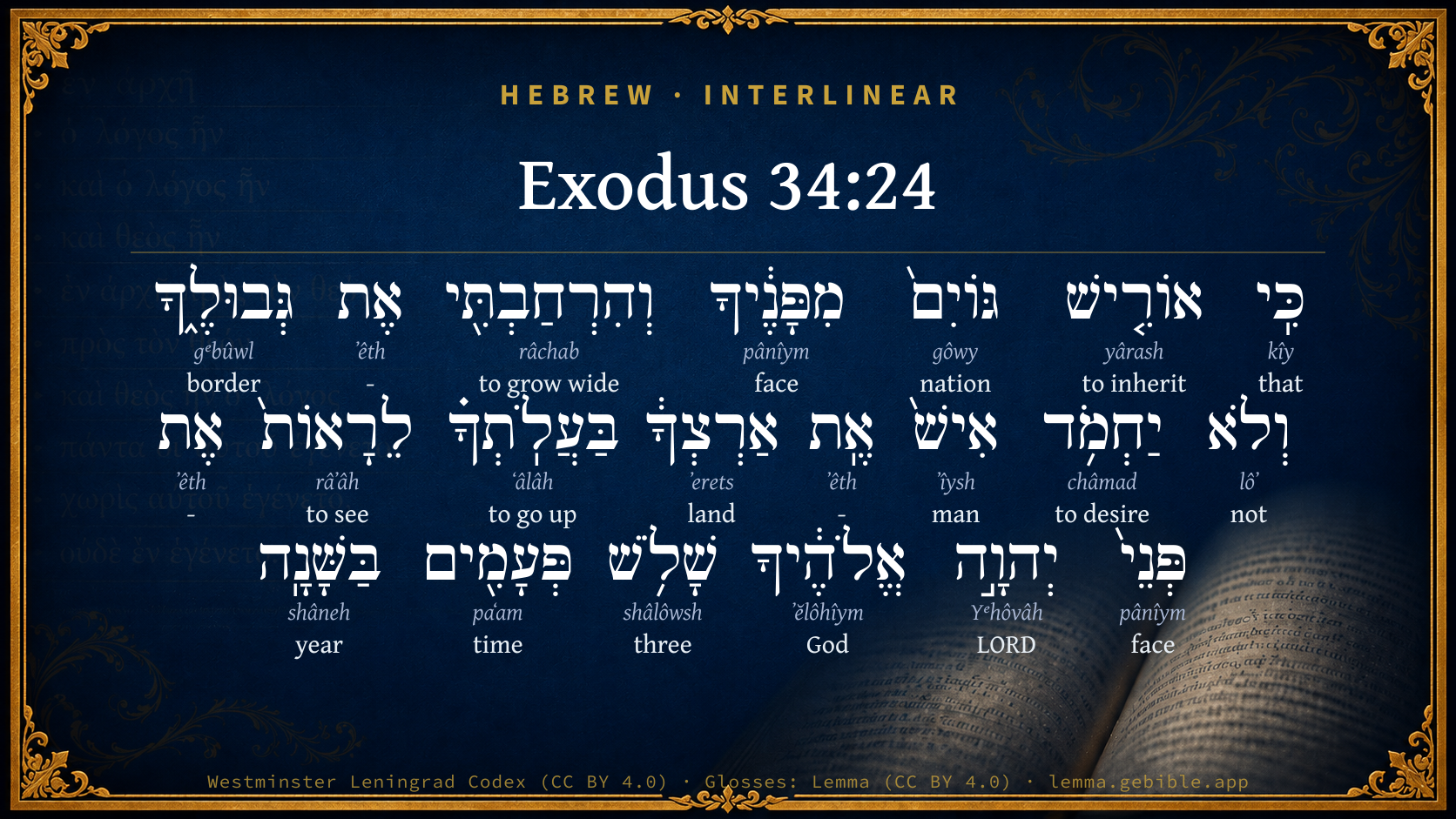
Hebrew (Westminster Leningrad Codex) Exodus 34:24 appears in the Hebrew Old Testament. The text above is from the Westminster Leningrad Codex. Each word links to its Strong’s number, a concise gloss, and parsing drawn from the Open Scriptures Hebrew Bible morphology. Click any word for its full Brown-Driver-Briggs (BDB) entry.
Download image
Cite this verse

Exodus 34:24 (World English Bible). Public Domain. Lemma interlinear Bible study tool, https://lemma.gebible.app/v/exodus/34/24.

Show BibTeX & RIS
BibTeX
RIS
English Translation
For I will drive out nations before you and enlarge your borders; neither shall any man desire your land when you go up to appear before Yahweh, your God, three times in the year.
World English Bible · Public Domain
Download a study sheet

One document with this verse’s original text, its word-by-word gloss line, the meaning frame, cross-references with their text, attributed commentary, and full source and license credits — printable, and it pastes into notes with its structure intact.

This verse Autodidact and up

Study sheet (.html) Plain text (.txt)

A passage Seminary Student

Up to 50 verses in one chapter. A passage sheet keeps up to 6 commentary sources and 12 cross-references per verse, in the order this page ranks them, and says so on the sheet whenever that leaves anything out. Ask for a single verse and you get the Autodidact verse sheet above.

Everything on this page stays free to read, with no account — the sheet is a download of what is already on screen, not access to it.

Want to remove ads? Support Godless Engineer
Compare translations 3

The same verse in 3 English versions, stacked beneath the original-language interlinear above. Click any original word for its lexicon entry.

Each is an independent rendering of the whole verse — the interlinear is not word-aligned to these translations.

Highlighted words mark where these versions differ — a whole-verse word diff, not a word-by-word alignment.

  • World English Bible Public Domain
    For I will drive out nations before you and enlarge your borders; neither shall any man desire your land when you go up to appear before Yahweh, your God, three times in the year.
  • King James Version Public Domain
    For I will cast out the nations before thee, and enlarge thy borders: neither shall any man desire thy land, when thou shalt go up to appear before the LORD thy God thrice in the year.
  • unfoldingWord Literal Text CC BY-SA 4.0
    For I will drive out nations before your face and expand your borders. And a man will not desire your land when you go up to appear before the face of Yahweh your God three times in a year.

unfoldingWord Literal Text — © unfoldingWord, licensed CC BY-SA 4.0. Word-aligned USFM3 via Door43 (git.door43.org/unfoldingWord/en_ult).

Versions to compare (up to 4)

3 of 4 selected

Show all 18 translations

Every available English version of this verse, each an independent rendering of the whole verse.

  • World English Bible Public Domain
    For I will drive out nations before you and enlarge your borders; neither shall any man desire your land when you go up to appear before Yahweh, your God, three times in the year.
  • Berean Standard Bible Public Domain
    For I will drive out the nations before you and enlarge your borders, and no one will covet your land when you go up three times a year to appear before the LORD your God.
  • Majority Standard Bible Public Domain
    For I will drive out the nations before you and enlarge your borders, and no one will covet your land when you go up three times a year to appear before the LORD your God.
  • King James Version Public Domain
    For I will cast out the nations before thee, and enlarge thy borders: neither shall any man desire thy land, when thou shalt go up to appear before the LORD thy God thrice in the year.
  • American Standard Version (1901) Public Domain
    For I will cast out nations before thee, and enlarge thy borders: neither shall any man desire thy land, when thou goest up to appear before Jehovah thy God three times in the year.
  • Revised Version (1885) Public Domain
    For I will cast out nations before thee, and enlarge thy borders: neither shall any man desire thy land, when thou goest up to appear before the LORD thy God three times in the year.
  • Geneva Bible (1599) Public Domain
    For I wil cast out the nations before thee, and enlarge thy coasts, so that no man shall desire thy land, whe thou shalt come vp to appeare before the Lord thy God thrise in the yeere.
  • Douay-Rheims (1899) Public Domain
    For when I shall have taken away the nations from thy face, and shall have enlarged thy borders, no man shall lie in wait against thy land when thou shalt go up, and appear in the sight of the Lord thy God thrice in a year.
  • Young's Literal Translation Public Domain
    for I dispossess nations from before thee, and have enlarged thy border, and no man doth desire thy land in thy going up to appear before Jehovah thy God three times in a year.
  • Literal Standard Version CC BY-SA 4.0
    for I dispossess nations from before you, and have enlarged your border, and no man desires your land in your going up to appear before your God YHWH three times in a year.
  • Unlocked Literal Bible CC BY-SA 4.0
    For I will drive out nations before you and expand your borders. No one will desire to have your land as their own when you go up to appear before Yahweh your God three times in a year.
  • unfoldingWord Literal Text CC BY-SA 4.0
    For I will drive out nations before your face and expand your borders. And a man will not desire your land when you go up to appear before the face of Yahweh your God three times in a year.
  • Darby Bible Public Domain
    For I will dispossess the nations before thee, and enlarge thy border, and no man shall desire thy land, when thou goest up to appear before the face of Jehovah thy God thrice in the year.
  • World Messianic Bible Public Domain
    For I will drive out nations before you and enlarge your borders; neither shall any man desire your land when you go up to appear before the LORD, your God, three times in the year.
  • Webster's Bible Public Domain
    For I will drive out the nations before thee, and enlarge thy borders: neither shall any man desire thy land, when thou shalt go up to appear before the LORD thy God, thrice in the year.
  • Free Bible Version CC BY-SA 4.0
    I will drive out the nations ahead of you and expand your borders, and no one will come and take your land when you go three times a year to appear before the Lord your God.
  • Bible in Basic English Public Domain
    For I will send out the nations before you and make wide the limits of your land; and no man will make an attempt to take your land while you go up to give worship to the Lord, three times in the year.
  • JPS Tanakh (1917) Public Domain
    For I will cast out nations before thee, and enlarge thy borders; neither shall any man covet thy land, when thou goest up to appear before the LORD thy God three times in the year.

Literal Standard Version (2020), Covenant Press — licensed CC BY-SA 4.0. Text via the HelloAO Bible API (eBible.org). Unlocked Literal Bible (unfoldingWord) — licensed CC BY-SA 4.0. Text via the HelloAO Bible API (eBible.org). unfoldingWord Literal Text — © unfoldingWord, licensed CC BY-SA 4.0. Word-aligned USFM3 via Door43 (git.door43.org/unfoldingWord/en_ult). Free Bible Version, Dr. Jonathan Gallagher — licensed CC BY-SA 4.0. Text via the HelloAO Bible API (eBible.org).

Word by word

More ways to search: Search by grammar → Find every occurrence → Compare this word →

Practice this passage: Drill this verse → Learn its vocabulary →

וְהִרְחַבְתִּ֖י
râchab
H7337
“and · to grow wide”
Conjunction + Verb, Hiphil, Sequential Perfect, 1st Person, Common, Singular
Part of Speech
Conjunction + Verb
Stem
Hiphil
Form
Sequential Perfect
Person
1st Person
Gender
Common
Number
Singular
Full BDB Definition

Origin: a primitive root

TWOT: 2143

to be or grow wide, be or grow large - (Qal) to be widened, be enlarged - (Niphal) broad or roomy pasture (participle) - (Hiphil) - to make large - to enlarge
  1. כִּֽי kîy H3588 “that” Conjunction
  2. אוֹרִ֤ישׁ yârash H3423 “to inherit” Verb, Hiphil, Imperfect, 1st Person, Common, Singular
  3. גּוֹיִם֙ gôwy H1471 “nations” Noun, Common, Masculine, Plural, Absolute
  4. מִפָּנֶ֔יךָ pânîym H6440 “from · face(s) · your” Preposition + Noun, Common, Both, Plural, Construct + Suffix, Personal, 2nd Person, Masculine, Singular
  5. אֶת ʼêth H853 “-” Particle, Direct Object
  6. גְּבוּלֶ֑ךָ gᵉbûwl H1366 “border · your” Noun, Common, Masculine, Singular, Construct + Suffix, Personal, 2nd Person, Masculine, Singular
  7. וְלֹא lôʼ H3808 “and · not” Conjunction + Particle, Negative
  8. יַחְמֹ֥ד châmad H2530 “to desire” Verb, Qal, Imperfect, 3rd Person, Masculine, Singular
  9. אִישׁ֙ ʼîysh H376 “man” Noun, Common, Masculine, Singular, Absolute
  10. אֶֽת ʼêth H853 “-” Particle, Direct Object
  11. אַרְצְךָ֔ ʼerets H776 “land · your” Noun, Common, Both, Singular, Construct + Suffix, Personal, 2nd Person, Masculine, Singular
  12. בַּעֲלֹֽתְךָ֗ ʻâlâh H5927 “in/at · to go up · you” Preposition + Verb, Qal, Infinitive Construct + Suffix, Personal, 2nd Person, Masculine, Singular
  13. לֵרָאוֹת֙ râʼâh H7200 “to see” Preposition + Verb, Niphal, Infinitive Construct
  14. אֶת ʼêth H853 “-” Particle, Direct Object
  15. פְּנֵי֙ pânîym H6440 “face(s) of” Noun, Common, Both, Plural, Construct
  16. יְהוָ֣ה Yᵉhôvâh H3068 “LORD” Noun, Proper
  17. אֱלֹהֶ֔יךָ ʼĕlôhîym H430 “God(s) · your” Noun, Common, Masculine, Plural, Construct + Suffix, Personal, 2nd Person, Masculine, Singular
  18. שָׁלֹ֥שׁ shâlôwsh H7969 “three” Adjective, Cardinal number, Feminine, Singular, Absolute
  19. פְּעָמִ֖ים paʻam H6471 “times” Noun, Common, Feminine, Plural, Absolute
  20. בַּשָּׁנָֽה shâneh H8141 “in/at the · year” Preposition, Determined + Noun, Common, Feminine, Singular, Absolute

About this verse

These counts appear in no published source. They are computed here, from the morphology-tagged text and Lemma’s own curated glosses. What Lemma adds →

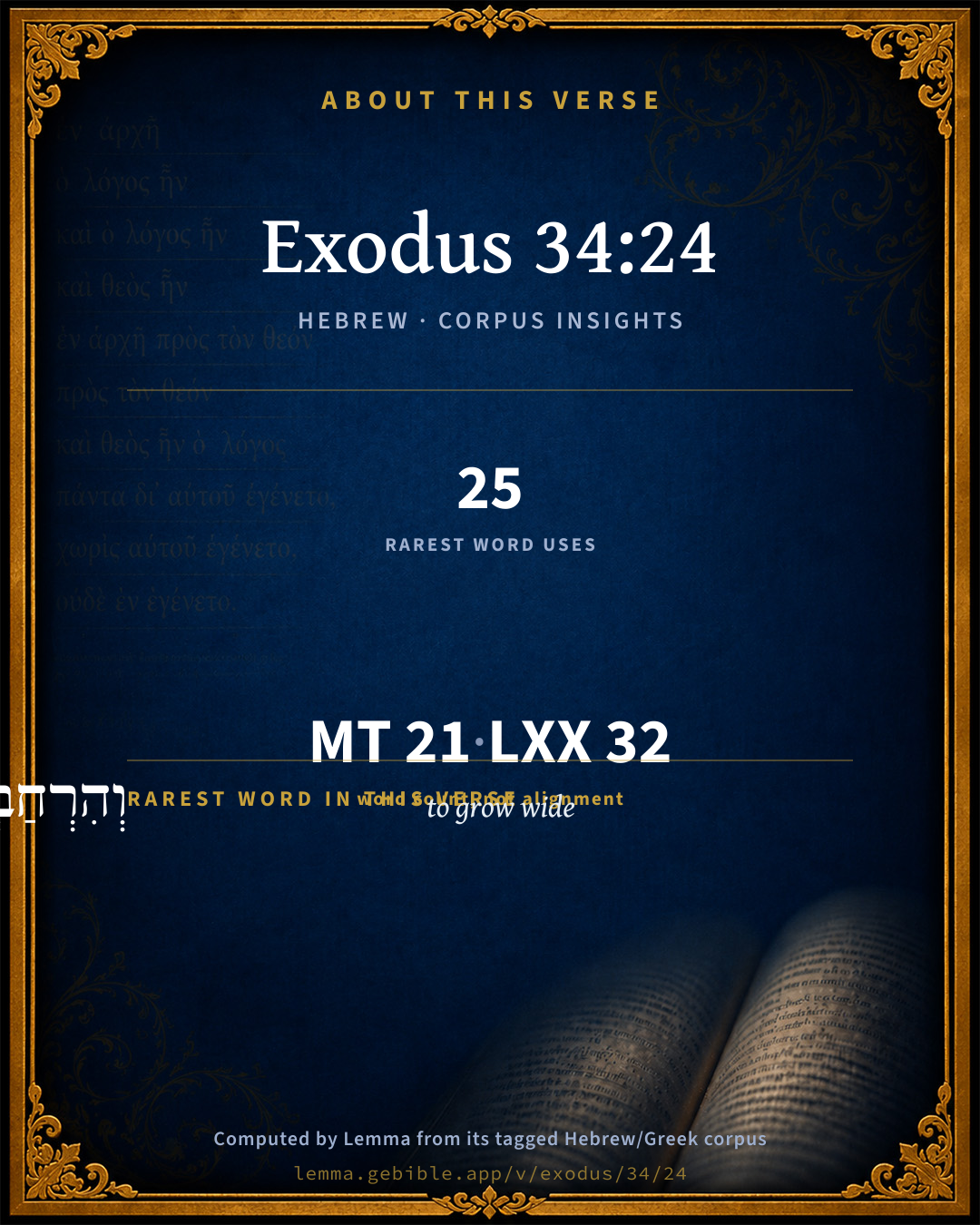
21
words
18
distinct lemmas
Pentateuch
section

Notable vocabulary

The rarest word here is וְהִרְחַבְתִּ֖י to grow wide H7337 — appearing just 25 times in the whole Hebrew Bible.

Shared distinctive vocabulary

וְהִרְחַבְתִּ֖י to grow wide H7337 occurs in 25 verses of the Hebrew Bible. Also found in:

Grammatical profile

  • 5 verbs
  • 10 nouns
  • 1 adjective
  • 1 conjunction
  • 4 particles

Verb forms

  • אוֹרִ֤ישׁ Hiphil · Imperfect
  • וְהִרְחַבְתִּ֖י Hiphil · Sequential Perfect
  • יַחְמֹ֥ד Qal · Imperfect
  • בַּעֲלֹֽתְךָ֗ Qal · Infinitive Construct
  • לֵרָאוֹת֙ Niphal · Infinitive Construct

Repetition

A word recurs within this verse — often emphatic in Hebrew:

  • מִפָּנֶ֔יךָ face H6440 ×2

Hebrew & Septuagint length

In English translation the verse runs 34 words from the Hebrew and 41 from the Septuagint (LXX English) — closely comparable.

A rough comparison of the two English renderings, which tokenize alike — not a word-level alignment.

Word counts can differ between the Hebrew and the Greek without any difference in meaning — e.g. the Hebrew direct-object marker אֵת has no separate Greek word, and Greek often adds the article ὁ.

In the original languages it is 21 Hebrew tokens and 32 Greek tokens — but the two are counted differently (Hebrew bundles its prefixes and suffixes into one token; the Greek is in lemma form), so that isn’t a like-for-like length.

Cross-references

15

Topical passages linked to Exodus 34:24 in the Treasury of Scripture Knowledge — connected by theme and wording, ordered by reader-vote popularity; previews shown in the World English Bible.

  • Psalms 78:55 He also drove out the nations before them, Allotted them for an inheritance by line, And made the tribes of Israel to dwell in their tents.
  • Exodus 33:2 I will send an angel before you; and I will drive out the Canaanite, the Amorite, and the Hittite, and the Perizzite, the Hivite, and the Jebusite:
  • Deuteronomy 12:20 When Yahweh your God shall enlarge your border, as he has promised you, and you shall say, I will eat flesh, because your soul desires to eat flesh; you may eat flesh, after all the desire of your soul.
  • 1 Chronicles 4:10 Jabez called on the God of Israel, saying, Oh that you would bless me indeed, and enlarge my border, and that your hand might be with me, and that you would keep me from evil, that it not be to my sorrow! God granted him that which he requested.
  • Proverbs 16:7 When a man's ways please Yahweh, He makes even his enemies to be at peace with him.
  • Acts 18:10 for I am with you, and no one will attack you to harm you, for I have many people in this city."
  • Genesis 35:5 They traveled: and a terror of God was on the cities that were round about them, and they didn't pursue the sons of Jacob.
  • Exodus 23:27–31 I will send my terror before you, and will confuse all the people to whom you come, and I will make all your enemies turn their backs to you.
  • Deuteronomy 7:1 When Yahweh your God shall bring you into the land where you go to possess it, and shall cast out many nations before you, the Hittite, and the Girgashite, and the Amorite, and the Canaanite, and the Perizzite, and the Hivite, and the Jebusite, seven nations greater and mightier than you;
  • Deuteronomy 19:8 If Yahweh your God enlarge your border, as he has sworn to your fathers, and give you all the land which he promised to give to your fathers;
  • Psalms 80:8 You brought a vine out of Egypt. You drove out the nations, and planted it.
  • Exodus 34:11 Observe that which I command you this day. Behold, I drive out before you the Amorite, the Canaanite, the Hittite, the Perizzite, the Hivite, and the Jebusite.
  • Leviticus 18:24 "'Don't defile yourselves in any of these things: for in all these the nations which I am casting out before you were defiled.
  • 2 Chronicles 17:10 The fear of Yahweh fell on all the kingdoms of the lands that were round about Judah, so that they made no war against Jehoshaphat.
  • Job 1:10 Haven't you made a hedge around him, and around his house, and around all that he has, on every side? You have blessed the work of his hands, and his substance is increased in the land.

Cross-references courtesy of OpenBible.info (CC BY 4.0).

Hebrew and Greek witnesses Masoretic Hebrew ↔ Greek Septuagint

The same verse in the two great witnesses to the Old Testament, shown verse-for-verse.

These are two independent witnesses, not word-aligned to each other, and the Septuagint is shown in lemma (dictionary) form.

Hebrew Exodus 34:24 Masoretic · Westminster Leningrad Codex

כִּֽי אוֹרִ֤ישׁ גּוֹיִם֙ מִפָּנֶ֔יךָ וְהִרְחַבְתִּ֖י אֶת גְּבוּלֶ֑ךָ וְלֹא יַחְמֹ֥ד אִישׁ֙ אֶֽת אַרְצְךָ֔ בַּעֲלֹֽתְךָ֗ לֵרָאוֹת֙ אֶת פְּנֵי֙ יְהוָ֣ה אֱלֹהֶ֔יךָ שָׁלֹ֥שׁ פְּעָמִ֖ים בַּשָּׁנָֽה

For I will drive out nations before you and enlarge your borders; neither shall any man desire your land when you go up to appear before Yahweh, your God, three times in the year.

World English Bible · Public Domain

Greek LXX Exodus 34:24 Septuagint · lemma form

ὅταν γάρ ἐκβάλλω ὁ ἔθνος πρό πρόσωπον σύ καί πλατύνω ὁ ὅριον σύ οὐ ἐπιθυμέω οὐδείς ὁ γῆ σύ ἡνίκα ἄν ἀναβαίνω ὁράω ἐναντίον κύριος ὁ θεός σύ τρεῖς καιρός ὁ ἐνιαυτός

For when I shall have cast out the nations before your face, and shall have enlarged your coasts, no one shall desire your land, whenever you may go up to appear before the Lord your God, three times in the year.

LXX2012 (modern English Septuagint) · Public Domain

On this verse, Haydock's Catholic Bible Commentary discusses the Septuagint’s reading. Read the note in Commentary ↓

Hebrew: Westminster Leningrad Codex (CC BY 4.0). Greek: Septuagint (public domain); English from LXX2012 (modern English Septuagint) (Public Domain). How the Septuagint differs from the Hebrew →

Targum (Aramaic paraphrase)

2

The Targum is the ancient Jewish Aramaic paraphrase of the Hebrew Scriptures — an interpretive translation, not the Hebrew text itself. Onkelos (literal) and Pseudo-Jonathan (expansive) render the Torah, and Jonathan the Prophets. Coverage is partial: where no permissively-licensed English translation exists for a verse, only the Aramaic is shown. This is verse-level text, not a word-by-word alignment to the Hebrew.

  1. Targum Onkelos Torah (Genesis–Deuteronomy)
    אֲרֵי אֲתָרֵךְ עַמְמִין מִן קֳדָמָךְ וְאַפְתֵּי יָת תְּחוּמָךְ וְלָא יַחְמֵד אֱנַשׁ יָת אַרְעָךְ בְּמִסְקָךְ לְאִתְחַזָאָה קֳדָם יְיָ אֱלָהָךְ תְּלַת זִמְנִין בְּשַׁתָּא:

    (no public-domain English translation for this verse)

    Targum Onkelos — Aramaic: “Onkelos Genesis” (public domain); “Onkelos Exodus” (public domain); “Onkelos Leviticus” (public domain); “Onkelos Numbers” (public domain); “Onkelos Deuteronomy” (public domain). English: “Sefaria Community Translation” (CC0 1.0 (public-domain dedication)); “J.W. Etheridge. The Targums of Onkelos and Jonathan Ben Uzziel on the Pentateuch. London: Longmans, Green, 1862” (public domain). Text via Sefaria.

  2. Targum Pseudo-Jonathan Torah (Genesis–Deuteronomy)
    אֲרוּם אֵיתָרֵיךְ עַמְמִין מִן קֳדָמָךְ וְאַפְתֵּי יַת תְּחוּמָךְ וְלָא יַחְמֵיד אֵינַשׁ יַת אַרְעָךְ בִּזְמַן מִיסְקָךְ לְאִתְחֲמָאָה קֳדָם יְיָ אֱלָהָךְ תְּלַת זִמְנִין בְּשַׁתָּא

    For I will drive out the nations from before thee, and enlarge thy borders; and no man shall covet thy land at the time of thy going up to appear before the Lord thy God thrice in the year.

    Targum Pseudo-Jonathan — Aramaic: “Targum Jonathan on Genesis” (public domain); “Targum Jonathan on Exodus” (public domain); “Targum Jonathan on Leviticus” (public domain); “Targum Jonathan on Numbers” (public domain); “Targum Jonathan on Deuteronomy” (public domain). English: “The Targum of Jonathan ben Uzziel, trans. J. W. Etheridge, London, 1862” (public domain). Text via Sefaria.

Commentary

Notes on Exodus 34:24 from classic Christian and Jewish commentators (each source and its license shown beneath its notes). The classic Christian expositions comment on the surrounding passage and are grouped to its opening verse, so a note may address several verses; the Jewish commentaries on the Tanakh (Rashi and others) are per-verse, so they appear only where the commentator wrote on this verse.

Lemma curates 59 commentaries, every one of them public domain or Creative Commons licensed, each selected and text-cleaned for this edition rather than reprinted as found. About our sources →

Trapp's Complete Commentary

John Trapp

Exo 34:24 For I will cast out the nations before thee, and enlarge thy borders: neither shall any man desire thy land, when thou shalt go up to appear before the LORD thy God thrice in the year.

Ver. 24. Neither shall any man desire.] A wonderful providence, since Judea was compassed about with such warlike adversaries, that they should not watch and catch at such opportunities. Pompey besieging Jerusalem, made his strongest batteries on the Sabbath day, whereon he knew the superstitious Jews would not make their defence - and took it. {a}

{a} Dio Cass.

John Trapp, A Commentary or Exposition upon All the Books of the Old and New Testament (1647–1656) — public domain. Text from a community e-Sword module.

Tyndale Open Study Notes

Tyndale Open Resources

34:24 No one will . . . conquer your land: If Israel would trust God and obey him, he would protect them.

Tyndale Open Study Notes — © Tyndale Open Resources, licensed CC BY-SA 4.0. Text via the HelloAO Bible API.

Geneva Bible (1599)

Geneva Bible translators

God promiseth to defend them and theirs, which obey his commandment.

Geneva Bible (1599) marginal notes — public domain. Text via Bolls.life.

Adam Clarke's Commentary

Verse 24. Neither shall any man desire thy land] What a manifest proof was this of the power and particular providence of God! How easy would it have been for the surrounding nations to have taken possession of the whole Israelitish land, with all their fenced cities, when there were none left to protect them but women and children! Was not this a standing proof of the Divine origin of their religion, and a barrier which no deistical mind could possibly surmount! Thrice every year did God work an especial miracle for the protection of his people; controlling even the very desires of their enemies, that they might not so much as meditate evil against them. They who have God for their protector have a sure refuge; and how true is the proverb, The path of duty is the way of safety! While these people went up to Jerusalem to keep the Lord's ordinances, he kept their families in peace, and their land in safety.

Adam Clarke's Commentary on the Bible (1810–1826) — public domain. Text from a community e-Sword/MySword module.

Ellicott's Commentary for English Readers

(24) I will . . . enlarge thy borders.—The promise of “a land” for his posterity made by God to Abraham was twofold. At first it was the “land of Canaan” alone which they were to receive (Gen_12:5-7); but subsequently the promise was extended, and made to include the entire tract of territory between “the river of Egypt” (the Nile) and “the great river, the river Euphrates” (Gen_15:18). In remarkable parallelism with this double promise was the double fulfilment. At first Canaan alone was occupied, but under David and Solomon the borders were greatly enlarged; and “Solomon reigned over all kingdoms from the river (Euphrates) unto the land of the Philistines, and unto the border of Egypt” (1Ki_4:21). The rebellion of Jeroboam, and the establishment of the “kingdom of Israel,” caused a contraction of the land to its original limits; but Menahem seems once more to have carried the dominion of Israel to the Euphrates (2Ki_15:16).

Neither shall any man desire thy land.—It was a part of the unwritten law of the Greeks that free passage should be given to all who were on their way to or from any of the great Pan-Hellenic festivals. But the present promise went beyond any such understanding. It secured the territory of Israel from all attack at such seasons, and must have been enforced miraculously by that providential government which God exercises over “all the nations upon the earth” (Psa_67:4).

A Bible Commentary for English Readers, edited by Charles John Ellicott (1878–1897) — public domain. Text from a community e-Sword module.

The Cambridge Bible for Schools and Colleges

gen. ed. J. J. S. Perowne

24. An ideal picture. The Israelites may feel quite secure in observing these pilgrimages; for their enemies will be dispossessed, and their territory enlarged, so that, even though their men are absent from their homes on pilgrimage, no one will think of invading their land.

cast out] dispossess (Jdg_11:23 EVV., 24 RV.). The thought as Exo_23:27 f.; the expression as Deu_4:38; Deu_9:4-5; Deu_11:23; Deu_18:12 (EVV. in all, drive out, which, however, confuses the word with the different one (gârash) so rendered in v. 11 here),—all with Jehovah as subject.

goest up] viz. to Jerusalem, for pilgrimages to which ‘go up’ was the technical expression (1Ki_12:27-28; Isa_2:3; Psa_122:4).

The Cambridge Bible for Schools and Colleges (gen. ed. J. J. S. Perowne; Cambridge University Press, 1878–1918) — public domain. Text from a community e-Sword module.

John Gill's Exposition

The first of the firstfruits of thy land thou shalt bring,.... This, and another law in this verse, concerning not seething a kid in his mother's milk, are repeated from Exo 23:19. See Gill on Exo 23:19.

.

Exodus 34:27

exo 34:27

exo 34:27

exo 34:27And the Lord said unto Moses,.... Being still with him on the mount:

write thou these words; expressed in the preceding verses, from Exo 34:11, as he before had written in a book all those laws, contained in Exo 21:1 called the book of the covenant, Exo 24:4 and which perhaps might be destroyed, as well as the two tables were broken; and therefore upon the renewal of the covenant here, there is a repetition made of the principal laws before given, which are ordered also to be written in a book, which may very well be called by the same name, since it follows:

for after the tenor of these words I have made a covenant with thee and with Israel, with Moses, as their representative and mediator, and with them represented by him: what is above related carries in it the form of a covenant between them, God having declared on his part what he would do for them, and what laws and rules he required to be observed on their part; which Moses assented to in their name, and was ordered to write them down, that he might repeat them to them.

John Gill's Exposition of the Whole Bible (1746–1763) — public domain (CC PDM 1.0). Text via the HelloAO Bible API.

Haydock's Catholic Bible Commentary

In wait. Hebrew and Septuagint, "shall desire." (Calmet) --- God engages to protect their land. (Menochius)

George Leo Haydock (1774–1849), Haydock's Catholic Family Bible and Commentary, 1859 edition — public domain. Excludes Psalms (Douay-Rheims chapter numbering differs from Protestant) and Deuterocanonical books (Catholic canon only).

Matthew Poole's English Annotations

I will cast out the nations; so thou shalt have no intestine enemy to do time or thine mischief. This God promised to do, but upon condition of Israel’s discharge of their duty in following God in this work of driving them out, which they neglecting, it was not fully done.

Neither shall any man desire thy land; I will not only tie their hands, that they shall make no invasion upon you, but I will take off their thoughts and affections from such an enterprise, which it was very easy for God to effect many ways.

Matthew Poole's English Annotations on the Holy Bible (1683–1685) — public domain. Text from a community e-Sword/MySword module.

The Pulpit Commentary

I will enlarge thy borders. The original promise to Abraham was to give to his seed "the land of Canaan". (Gen_12:5-7) Afterwards this promise was enlarged, and he was told that the land assigned them was the entire tract between the Nile and the Euphrates. (Gen_15:18) And practically, they took possession first of the one, while at a later date their border was enlarged, and they became masters of the other. See 1Ki_4:21, 1Ki_4:24; 2Ch_9:26. Neither shall any man desire thy land, etc. This promise is nowhere else made. It would serve as a great encouragement to the proper observance of the festivals.

The Pulpit Commentary (1880–1919), ed. H.D.M. Spence-Jones & Joseph S. Exell — public domain. Text from a community e-Sword module.

John Wesley's Explanatory Notes

Neither shalt any man desire thy land - Not only they shall not invade it, but they shall not so much as think of invading it. What a standing Miracle was this, for so many Generations?

John Wesley, Explanatory Notes Upon the Whole Bible (1754–1765) — public domain. Text via the GEBible commentary corpus.

Rashi

Rabbi Shlomo Yitzchaki (Rashi)

אוריש means as the Targum has it אתריך, I will drive out. Similar is (Deuteronomy 2:31) “Begin to drive out (רש)”; and similar is, (Numbers 21:32) “and drove out (ויורש) the Amorites” — all having the sense of expelling.

והרחבתי את גבלך [I WILL DRIVE OUT THE NATIONS BEFORE THEE] AND ENLARGE THY BOUNDARIES — and consequently you may be far from the Chosen House (the Temple) and you will then not be able to appear before Me continually; therefore I appoint for you these three seasons.

Rashi on the Tanakh — English translations: “The Judaica Press complete Tanach with Rashi, translated by A. J. Rosenberg” (CC BY 4.0); “Pentateuch with Rashi's commentary by M. Rosenbaum and A.M. Silbermann, 1929-1934” (public domain); “The Metsudah Tanach series, Lakewood, N.J” (CC BY 4.0); and “The Book of Joshua, Metsudah Publications, 1997” (CC BY 4.0). Text via Sefaria.

Lesson kit

Teaching starters — assembled from the data on this page, not authored interpretation. Every prompt links to the verse data it draws on. Edit before teaching.

Exodus, in the Pentateuch, opens this verse with 21 words (18 distinct Hebrew lemmas). Its most distinctive word is râchab (“to grow wide”). A historical commentator’s framing appears above. Read the whole chapter for the surrounding context.

Discussion questions

  1. The word râchab carries the sense “to grow wide.” How does it shape the verse?
  2. How does Genesis 26:22, which shares the word «to grow wide», read alongside this verse?
  3. What does the repetition of “face” (2× in this one verse) do in this verse?
  4. These translations render this verse differently; the difference is in the English rendering, not the original. What questions does that raise?
  5. «אוֹרִ֤ישׁ» is a Hiphil Imperfect verb. How does that grammatical form shape the action described?
  6. Compare how Trapp's Complete Commentary and Tyndale Open Study Notes read this verse. Where do they agree or differ?

Things to notice

Reading settings

Reading text

Shown beneath each verse's original-language words.

Old Testament
Old Testament edition

Read the OT as the Masoretic Hebrew (MT) or the Greek Septuagint (LXX).

English shown for the Greek Septuagint (in the Hebrew ↔ Greek comparison).

Comparing translations? Open the Compare panel on any verse page to stack up to four side by side.