
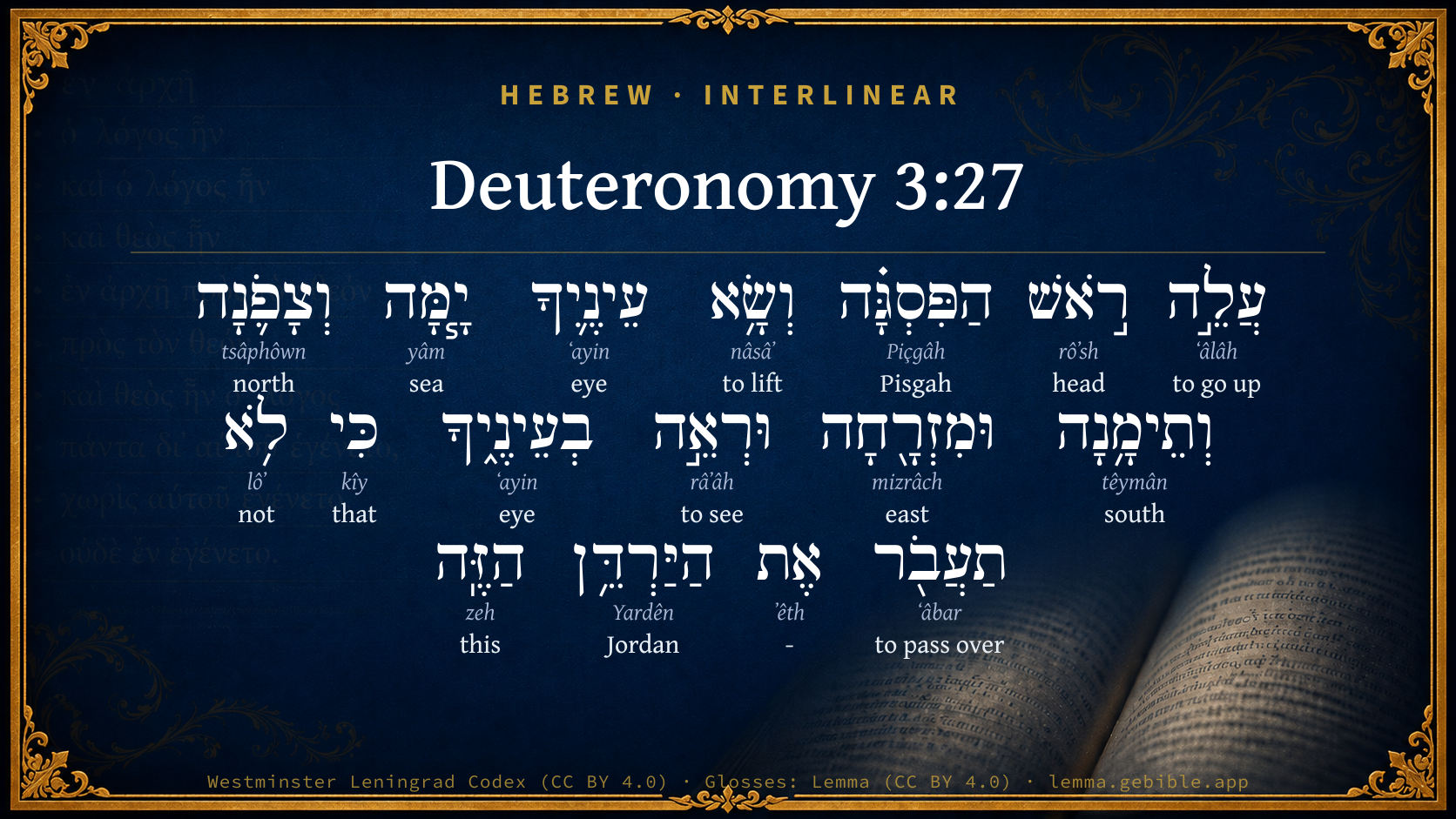
Deuteronomy 3:27

Hebrew (Westminster Leningrad Codex) Deuteronomy 3:27 appears in the Hebrew Old Testament. The text above is from the Westminster Leningrad Codex. Each word links to its Strong’s number, a concise gloss, and parsing drawn from the Open Scriptures Hebrew Bible morphology. Click any word for its full Brown-Driver-Briggs (BDB) entry.
Download image
Cite this verse

Deuteronomy 3:27 (World English Bible). Public Domain. Lemma interlinear Bible study tool, https://lemma.gebible.app/v/deuteronomy/3/27.

Show BibTeX & RIS
BibTeX
RIS
English Translation
Go up to the top of Pisgah, and lift up your eyes westward, and northward, and southward, and eastward, and see with your eyes: for you shall not go over this Jordan.
World English Bible · Public Domain
Download a study sheet

One document with this verse’s original text, its word-by-word gloss line, the meaning frame, cross-references with their text, attributed commentary, and full source and license credits — printable, and it pastes into notes with its structure intact.

This verse Autodidact and up

Study sheet (.html) Plain text (.txt)

A passage Seminary Student

Up to 50 verses in one chapter. A passage sheet keeps up to 6 commentary sources and 12 cross-references per verse, in the order this page ranks them, and says so on the sheet whenever that leaves anything out. Ask for a single verse and you get the Autodidact verse sheet above.

Everything on this page stays free to read, with no account — the sheet is a download of what is already on screen, not access to it.

Want to remove ads? Support Godless Engineer
Compare translations 3

The same verse in 3 English versions, stacked beneath the original-language interlinear above. Click any original word for its lexicon entry.

Each is an independent rendering of the whole verse — the interlinear is not word-aligned to these translations.

Highlighted words mark where these versions differ — a whole-verse word diff, not a word-by-word alignment.

  • World English Bible Public Domain
    Go up to the top of Pisgah, and lift up your eyes westward, and northward, and southward, and eastward, and see with your eyes: for you shall not go over this Jordan.
  • King James Version Public Domain
    Get thee up into the top of Pisgah, and lift up thine eyes westward, and northward, and southward, and eastward, and behold it with thine eyes: for thou shalt not go over this Jordan.
  • unfoldingWord Literal Text CC BY-SA 4.0
    Go up the head of Pisgah and lift up your eyes westward and northward and southward and eastward. And look with your eyes, for you will not cross this Jordan.

unfoldingWord Literal Text — © unfoldingWord, licensed CC BY-SA 4.0. Word-aligned USFM3 via Door43 (git.door43.org/unfoldingWord/en_ult).

Versions to compare (up to 4)

3 of 4 selected

Show all 18 translations

Every available English version of this verse, each an independent rendering of the whole verse.

  • World English Bible Public Domain
    Go up to the top of Pisgah, and lift up your eyes westward, and northward, and southward, and eastward, and see with your eyes: for you shall not go over this Jordan.
  • Berean Standard Bible Public Domain
    Go to the top of Pisgah and look to the west and north and south and east. See the land with your own eyes, for you will not cross this Jordan.
  • Majority Standard Bible Public Domain
    Go to the top of Pisgah and look to the west and north and south and east. See the land with your own eyes, for you will not cross this Jordan.
  • King James Version Public Domain
    Get thee up into the top of Pisgah, and lift up thine eyes westward, and northward, and southward, and eastward, and behold it with thine eyes: for thou shalt not go over this Jordan.
  • American Standard Version (1901) Public Domain
    Get thee up unto the top of Pisgah, and lift up thine eyes westward, and northward, and southward, and eastward, and behold with thine eyes: for thou shalt not go over this Jordan.
  • Revised Version (1885) Public Domain
    Get thee up into the top of Pisgah, and lift up thine eyes westward, and northward, and southward, and eastward, and behold with thine eyes: for thou shalt not go over this Jordan.
  • Geneva Bible (1599) Public Domain
    Get thee vp into the top of Pisgah, and lift vp thine eyes Westward, and Northwarde, and Southward, and Eastward, and behold it with thine eyes, for thou shalt not goe ouer this Iorden:
  • Douay-Rheims (1899) Public Domain
    Go up to the top of Phasga, and cast thy eyes round about to the west, and to the north, and to the south, and to the east, and behold it, for thou shalt not pass this Jordan.
  • Young's Literal Translation Public Domain
    go up `to' the top of Pisgah, and lift up thine eyes westward, and northward, and southward, and eastward, and see with thine eyes -- for thou dost not pass over this Jordan;
  • Literal Standard Version CC BY-SA 4.0
    go up [to] the top of Pisgah, and lift up your eyes westward, and northward, and southward, and eastward, and see with your eyes, for you do not pass over this Jordan;
  • Unlocked Literal Bible CC BY-SA 4.0
    go up to the top of Pisgah and lift up your eyes westward, northward, southward, and eastward; look with your eyes, for you will not go over the Jordan.
  • unfoldingWord Literal Text CC BY-SA 4.0
    Go up the head of Pisgah and lift up your eyes westward and northward and southward and eastward. And look with your eyes, for you will not cross this Jordan.
  • Darby Bible Public Domain
    Go up to the top of Pisgah, and lift up thine eyes westward, and northward, and southward, and eastward, and behold it with thine eyes; for thou shalt not go over this Jordan.
  • World Messianic Bible Public Domain
    Go up to the top of Pisgah, and lift up your eyes westward, and northward, and southward, and eastward, and see with your eyes; for you shall not go over this Jordan.
  • Webster's Bible Public Domain
    Ascend to the top of Pisgah, and lift up thy eyes westward, and northward, and southward, and eastward, and behold with thy eyes: for thou shalt not go over this Jordan.
  • Free Bible Version CC BY-SA 4.0
    Climb up to the top of Mount Pisgah and look west, north, south, and east. Take a long look at the land with your own eyes, because you're not going to cross this Jordan.
  • Bible in Basic English Public Domain
    Go up to the top of Pisgah, and turning your eyes to the west and the north, to the south and the east, see the land with your eyes: for you are not to go over Jordan.
  • JPS Tanakh (1917) Public Domain
    Get thee up into the top of Pisgah, and lift up thine eyes westward, and northward, and southward, and eastward, and behold with thine eyes; for thou shalt not go over this Jordan.

Literal Standard Version (2020), Covenant Press — licensed CC BY-SA 4.0. Text via the HelloAO Bible API (eBible.org). Unlocked Literal Bible (unfoldingWord) — licensed CC BY-SA 4.0. Text via the HelloAO Bible API (eBible.org). unfoldingWord Literal Text — © unfoldingWord, licensed CC BY-SA 4.0. Word-aligned USFM3 via Door43 (git.door43.org/unfoldingWord/en_ult). Free Bible Version, Dr. Jonathan Gallagher — licensed CC BY-SA 4.0. Text via the HelloAO Bible API (eBible.org).

Word by word

More ways to search: Search by grammar → Find every occurrence → Compare this word →

Practice this passage: Drill this verse → Learn its vocabulary →

הַפִּסְגָּ֗ה
Piçgâh
H6449
“the · Pisgah”
Particle, Definite Article + Noun, Proper
Part of Speech
Particle + Noun
Type
Proper
Full BDB Definition

Origin: from H6448

TWOT: None

Pisgah = "cleft" - mountain in Moab on the northeast shore of the Dead Sea; site uncertain
  1. עֲלֵ֣ה ʻâlâh H5927 “go up” Verb, Qal, Imperative, 2nd Person, Masculine, Singular
  2. רֹ֣אשׁ rôʼsh H7218 “head of” Noun, Common, Masculine, Singular, Construct
  3. וְשָׂ֥א nâsâʼ H5375 “and · lift” Conjunction + Verb, Qal, Imperative, 2nd Person, Masculine, Singular
  4. עֵינֶ֛יךָ ʻayin H5869 “eyes · your” Noun, Common, Both, Dual, Construct + Suffix, Personal, 2nd Person, Masculine, Singular
  5. יָ֧מָּה yâm H3220 “sea · toward” Noun, Common, Masculine, Singular, Absolute + Suffix, Demonstrative
  6. וְצָפֹ֛נָה tsâphôwn H6828 “and · north · toward” Conjunction + Noun, Common, Feminine, Singular, Absolute + Suffix, Demonstrative
  7. וְתֵימָ֥נָה têymân H8486 “and · south · toward” Conjunction + Noun, Common, Feminine, Singular, Absolute + Suffix, Demonstrative
  8. וּמִזְרָ֖חָה mizrâch H4217 “and · east · toward” Conjunction + Noun, Common, Masculine, Singular, Absolute + Suffix, Demonstrative
  9. וּרְאֵ֣ה râʼâh H7200 “and · see” Conjunction + Verb, Qal, Imperative, 2nd Person, Masculine, Singular
  10. בְעֵינֶ֑יךָ ʻayin H5869 “in/at · eyes · your” Preposition + Noun, Common, Both, Dual, Construct + Suffix, Personal, 2nd Person, Masculine, Singular
  11. כִּי kîy H3588 “that” Conjunction
  12. לֹ֥א lôʼ H3808 “not” Particle, Negative
  13. תַעֲבֹ֖ר ʻâbar H5674 “to pass over” Verb, Qal, Imperfect, 2nd Person, Masculine, Singular
  14. אֶת ʼêth H853 “-” Particle, Direct Object
  15. הַיַּרְדֵּ֥ן Yardên H3383 “the · Jordan” Particle, Definite Article + Noun, Proper
  16. הַזֶּֽה zeh H2088 “the · this” Particle, Definite Article + Pronoun, Demonstrative, Masculine, Singular

About this verse

These counts appear in no published source. They are computed here, from the morphology-tagged text and Lemma’s own curated glosses. What Lemma adds →

17
words
16
distinct lemmas
Pentateuch
section

Notable vocabulary

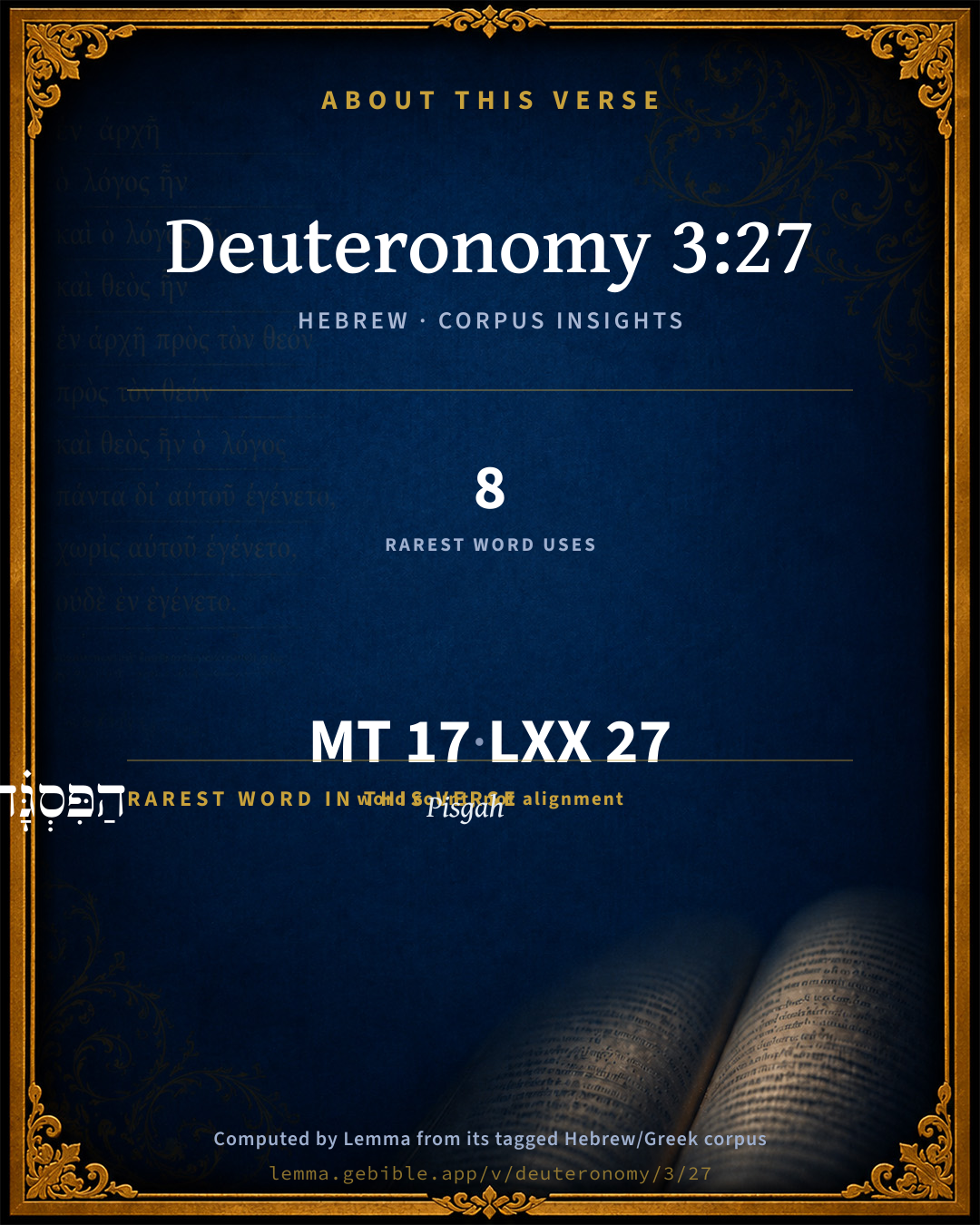
The rarest word here is הַפִּסְגָּ֗ה Pisgah H6449 — appearing just 8 times in the whole Hebrew Bible.

Shared distinctive vocabulary

הַפִּסְגָּ֗ה Pisgah H6449 occurs in 8 verses of the Hebrew Bible. Also found in:

Grammatical profile

  • 4 verbs
  • 9 nouns
  • 1 pronoun
  • 1 conjunction
  • 2 particles

Verb forms

  • עֲלֵ֣ה Qal · Imperative
  • וְשָׂ֥א Qal · Imperative
  • וּרְאֵ֣ה Qal · Imperative
  • תַעֲבֹ֖ר Qal · Imperfect

Repetition

A word recurs within this verse — often emphatic in Hebrew:

  • עֵינֶ֛יךָ eye H5869 ×2

Hebrew & Septuagint length

In English translation the verse runs 32 words from the Hebrew and 35 from the Septuagint (LXX English) — closely comparable.

A rough comparison of the two English renderings, which tokenize alike — not a word-level alignment.

Word counts can differ between the Hebrew and the Greek without any difference in meaning — e.g. the Hebrew direct-object marker אֵת has no separate Greek word, and Greek often adds the article ὁ.

In the original languages it is 17 Hebrew tokens and 27 Greek tokens — but the two are counted differently (Hebrew bundles its prefixes and suffixes into one token; the Greek is in lemma form), so that isn’t a like-for-like length.

Cross-references

3

Topical passages linked to Deuteronomy 3:27 in the Treasury of Scripture Knowledge — connected by theme and wording, ordered by reader-vote popularity; previews shown in the World English Bible.

  • Numbers 27:12 Yahweh said to Moses, Go up into this mountain of Abarim, and see the land which I have given to the children of Israel.
  • Deuteronomy 34:1–4 Moses went up from the plains of Moab to Mount Nebo, to the top of Pisgah, that is over against Jericho. Yahweh shown him all the land of Gilead, to Dan,
  • Genesis 13:14–15 Yahweh said to Abram, after Lot was separated from him, "Now, lift up your eyes, and look from the place where you are, northward and southward and eastward and westward,

Cross-references courtesy of OpenBible.info (CC BY 4.0).

Hebrew and Greek witnesses Masoretic Hebrew ↔ Greek Septuagint

The same verse in the two great witnesses to the Old Testament, shown verse-for-verse.

These are two independent witnesses, not word-aligned to each other, and the Septuagint is shown in lemma (dictionary) form.

Hebrew Deuteronomy 3:27 Masoretic · Westminster Leningrad Codex

עֲלֵ֣ה רֹ֣אשׁ הַפִּסְגָּ֗ה וְשָׂ֥א עֵינֶ֛יךָ יָ֧מָּה וְצָפֹ֛נָה וְתֵימָ֥נָה וּמִזְרָ֖חָה וּרְאֵ֣ה בְעֵינֶ֑יךָ כִּי לֹ֥א תַעֲבֹ֖ר אֶת הַיַּרְדֵּ֥ן הַזֶּֽה

Go up to the top of Pisgah, and lift up your eyes westward, and northward, and southward, and eastward, and see with your eyes: for you shall not go over this Jordan.

World English Bible · Public Domain

Greek LXX Deuteronomy 3:27 Septuagint · lemma form

ἀναβαίνω ἐπί κορυφή λαξεύω καί ἀναβλέπω ὁ ὀφθαλμός κατά θάλασσα καί βορέας καί λίψ καί ἀνατολή καί ὁράω ὁ ὀφθαλμός σύ ὅτι οὐ διαβαίνω ὁ ἰορδάνης οὗτος

Go up to the top of the quarried rock, and look with your eyes westward, and northward, and southward, and eastward, and behold it with your eyes, for you shall not go over this Jordan.

LXX2012 (modern English Septuagint) · Public Domain

Hebrew: Westminster Leningrad Codex (CC BY 4.0). Greek: Septuagint (public domain); English from LXX2012 (modern English Septuagint) (Public Domain). How the Septuagint differs from the Hebrew →

Targum (Aramaic paraphrase)

2

The Targum is the ancient Jewish Aramaic paraphrase of the Hebrew Scriptures — an interpretive translation, not the Hebrew text itself. Onkelos (literal) and Pseudo-Jonathan (expansive) render the Torah, and Jonathan the Prophets. Coverage is partial: where no permissively-licensed English translation exists for a verse, only the Aramaic is shown. This is verse-level text, not a word-by-word alignment to the Hebrew.

  1. Targum Onkelos Torah (Genesis–Deuteronomy)
    סַק לְרֵישׁ רָמָתָא וּזְקוֹף עֵינָיךְ לְמַעֲרָבָא וּלְצִפּוּנָא וְלִדְרוֹמָא וּלְמָדִינְחָא וַחֲזֵי בְעֵינָיךְ אֲרֵי לָא תְעִבַר יָת יַרְדְנָא הָדֵין

    (no public-domain English translation for this verse)

    Targum Onkelos — Aramaic: “Onkelos Genesis” (public domain); “Onkelos Exodus” (public domain); “Onkelos Leviticus” (public domain); “Onkelos Numbers” (public domain); “Onkelos Deuteronomy” (public domain). English: “Sefaria Community Translation” (CC0 1.0 (public-domain dedication)); “J.W. Etheridge. The Targums of Onkelos and Jonathan Ben Uzziel on the Pentateuch. London: Longmans, Green, 1862” (public domain). Text via Sefaria.

  2. Targum Pseudo-Jonathan Torah (Genesis–Deuteronomy)
    סוּק לְרֵישׁ רָמָתָא וּזְקַף עֵינָךְ לְמַעַרְבָא וּלְצִפּוּנָא וּלְדָרוֹמָא וּלְמַדִינְחָא וַחֲמֵי בְּעֵינָךְ אֲרוּם לָא תְעִיבַר יַת יוֹרְדְּנָא הָדֵין

    go up to the head of the mountain, and lift up thine eyes to the west, to the north, to the south, and to the east, and behold with thy eyes, for thou shalt not pass over this Jordan.

    Targum Pseudo-Jonathan — Aramaic: “Targum Jonathan on Genesis” (public domain); “Targum Jonathan on Exodus” (public domain); “Targum Jonathan on Leviticus” (public domain); “Targum Jonathan on Numbers” (public domain); “Targum Jonathan on Deuteronomy” (public domain). English: “The Targum of Jonathan ben Uzziel, trans. J. W. Etheridge, London, 1862” (public domain). Text via Sefaria.

Commentary

Notes on Deuteronomy 3:27 from classic Christian and Jewish commentators (each source and its license shown beneath its notes). The classic Christian expositions comment on the surrounding passage and are grouped to its opening verse, so a note may address several verses; the Jewish commentaries on the Tanakh (Rashi and others) are per-verse, so they appear only where the commentator wrote on this verse.

Lemma curates 59 commentaries, every one of them public domain or Creative Commons licensed, each selected and text-cleaned for this edition rather than reprinted as found. About our sources →

Geneva Bible (1599)

Geneva Bible translators

As before he saw by the spirits of prophecy the good mountain which was Zion: so here his eyes were lifted up above the order of nature to behold all the plentiful land of Canaan.

Geneva Bible (1599) marginal notes — public domain. Text via Bolls.life.

Ellicott's Commentary for English Readers

(27) Northward, and southward.—Southward, literally, Teman-ward. The negeb, or “south” of Palestine, is not named here.

A Bible Commentary for English Readers, edited by Charles John Ellicott (1878–1897) — public domain. Text from a community e-Sword module.

The Cambridge Bible for Schools and Colleges

gen. ed. J. J. S. Perowne

27. the top of Pisgah] Rather, the headland of the Pisgah. See on Deu_3:17, and cp. Deu_32:48 ff., Deu_34:1, and small print on Deu_12:2.

The Cambridge Bible for Schools and Colleges (gen. ed. J. J. S. Perowne; Cambridge University Press, 1878–1918) — public domain. Text from a community e-Sword module.

John Gill's Exposition

But charge Joshua, and encourage him, and strengthen him,.... Charge him to take the care of the children of Israel, to introduce them into the good land, and put them into the possession of it; encourage him against all fear of his and their enemies, and strengthen him with promises of the presence of God, and of his gracious help and assistance:

for he shall go over before this people; over the river Jordan, at the head of them, as their leader and commander; a type of Christ, the leader and commander of his people, who as their King goes forth at the head of them, and will introduce them all into his Father's kingdom and glory:

and he shall cause them to inherit the land which thou shalt see; and no more; not enter into, but Joshua should; and having conquered it, should divide it by lot for an inheritance to them, and their children after them; a type of Christ, in whom and by whom the saints obtain an inheritance by lot, Eph 1:11.

John Gill's Exposition of the Whole Bible (1746–1763) — public domain (CC PDM 1.0). Text via the HelloAO Bible API.

Haydock's Catholic Bible Commentary

East. It seems, if Phasga was the eastern boundary of Ruben, (ver. 17,) there was no occasion for Moses to cast his eyes that way. He is ordered to take a full view of the countries allotted by God to the Hebrews; and if we consider that the territory, as far as the Euphrates, was promised to them, if they would continue to be faithful, and that it was made tributary, under Solomon, we need not wonder if Moses should be pleased to behold it, chap. i. 7. (Haydock)

George Leo Haydock (1774–1849), Haydock's Catholic Family Bible and Commentary, 1859 edition — public domain. Excludes Psalms (Douay-Rheims chapter numbering differs from Protestant) and Deuterocanonical books (Catholic canon only).

Matthew Poole's English Annotations

Pisgah; of which see on Num 27:12. Lift up thine eyes towards the land of Canaan and its several quarters.

Matthew Poole's English Annotations on the Holy Bible (1683–1685) — public domain. Text from a community e-Sword/MySword module.

The Pulpit Commentary

Comp. Num_27:12, of which this is a rhetorical amplification. There the mountains of Abarim are mentioned; here Pisgah, the northern portion of that range, is specified. The top of Pisgah; i.e. Mount Nebo. (Deu_34:1) Westward; literally, seaward, i.e. towards the Mediterranean; northward (wOpx; hidden or dark place, where darkness gathers, as opposed to the bright and sunny south); southward, towards the right-hand quarter; (myTe from ymiy; the right hand; cf. Exo_26:18, "to the south towards the right hand eastward, towards the dawn or sun rising; cf. mi, Deu_4:47 (jrz from jrz; to shine forth).

The Pulpit Commentary (1880–1919), ed. H.D.M. Spence-Jones & Joseph S. Exell — public domain. Text from a community e-Sword module.

Rashi

Rabbi Shlomo Yitzchaki (Rashi)

וראה בעיניך [LIFT UP THINE EYES …] AND SEE IT WITH THINE EYES — Thou didst request of Me, (v. 25) “Let me see the good land”; I will let thee see the whole of it (not the good territory alone), as it is said, (Deuteronomy 34:1) “And the Lord showed him all the land״ (cf. Sifrei Bamidbar 135).

Rashi on the Tanakh — English translations: “The Judaica Press complete Tanach with Rashi, translated by A. J. Rosenberg” (CC BY 4.0); “Pentateuch with Rashi's commentary by M. Rosenbaum and A.M. Silbermann, 1929-1934” (public domain); “The Metsudah Tanach series, Lakewood, N.J” (CC BY 4.0); and “The Book of Joshua, Metsudah Publications, 1997” (CC BY 4.0). Text via Sefaria.

Lesson kit

Teaching starters — assembled from the data on this page, not authored interpretation. Every prompt links to the verse data it draws on. Edit before teaching.

Deuteronomy, in the Pentateuch, opens this verse with 17 words (16 distinct Hebrew lemmas). Its most distinctive word is Piçgâh (“Pisgah”). A historical commentator’s framing appears above. Read the whole chapter for the surrounding context.

Discussion questions

  1. How does “Pisgah” (Piçgâh) shape what this verse is saying?
  2. How does Numbers 21:20, which shares the word «Pisgah», read alongside this verse?
  3. What does the repetition of “eye” (2× in this one verse) do in this verse?
  4. The translations on this page render this verse differently — a whole-verse word diff, not a word-by-word alignment. What might account for the different wordings?
  5. «עֲלֵ֣ה» is a Qal Imperative verb. How does that grammatical form shape the action described?
  6. Compare how Geneva Bible (1599) and Ellicott's Commentary for English Readers read this verse. Where do they agree or differ?

Things to notice

Reading settings

Reading text

Shown beneath each verse's original-language words.

Old Testament
Old Testament edition

Read the OT as the Masoretic Hebrew (MT) or the Greek Septuagint (LXX).

English shown for the Greek Septuagint (in the Hebrew ↔ Greek comparison).

Comparing translations? Open the Compare panel on any verse page to stack up to four side by side.