
Numbers 20:5

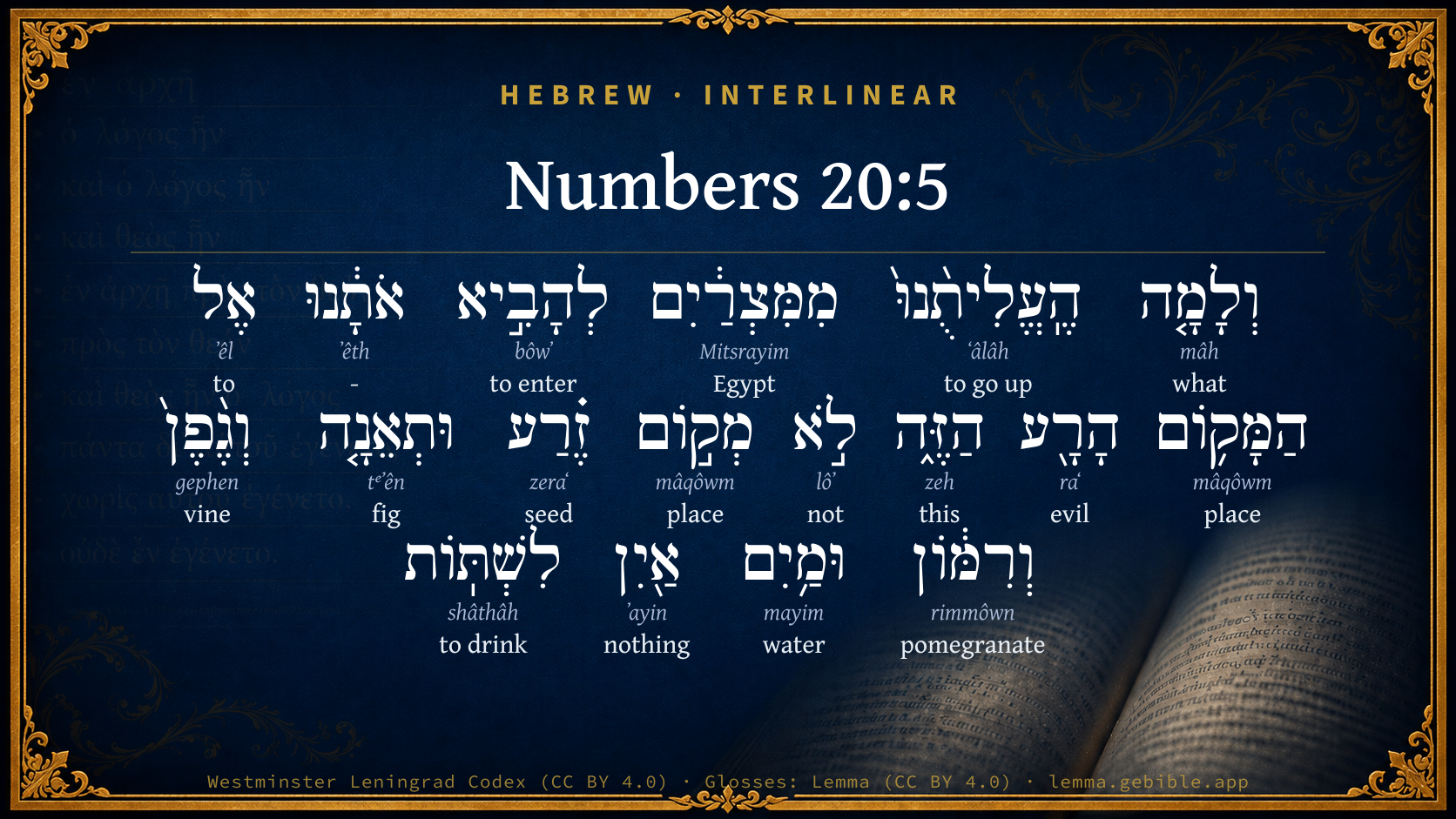
Hebrew (Westminster Leningrad Codex) Numbers 20:5 appears in the Hebrew Old Testament. The text above is from the Westminster Leningrad Codex. Each word links to its Strong’s number, a concise gloss, and parsing drawn from the Open Scriptures Hebrew Bible morphology. Click any word for its full Brown-Driver-Briggs (BDB) entry.
Download image
Cite this verse

Numbers 20:5 (World English Bible). Public Domain. Lemma interlinear Bible study tool, https://lemma.gebible.app/v/numbers/20/5.

Show BibTeX & RIS
BibTeX
RIS
English Translation
Why have you made us to come up out of Egypt, to bring us in to this evil place? it is no place of seed, or of figs, or of vines, or of pomegranates; neither is there any water to drink.
World English Bible · Public Domain
Download a study sheet

One document with this verse’s original text, its word-by-word gloss line, the meaning frame, cross-references with their text, attributed commentary, and full source and license credits — printable, and it pastes into notes with its structure intact.

This verse Autodidact and up

Study sheet (.html) Plain text (.txt)

A passage Seminary Student

Up to 50 verses in one chapter. A passage sheet keeps up to 6 commentary sources and 12 cross-references per verse, in the order this page ranks them, and says so on the sheet whenever that leaves anything out. Ask for a single verse and you get the Autodidact verse sheet above.

Everything on this page stays free to read, with no account — the sheet is a download of what is already on screen, not access to it.

Want to remove ads? Support Godless Engineer
Compare translations 3

The same verse in 3 English versions, stacked beneath the original-language interlinear above. Click any original word for its lexicon entry.

Each is an independent rendering of the whole verse — the interlinear is not word-aligned to these translations.

Highlighted words mark where these versions differ — a whole-verse word diff, not a word-by-word alignment.

  • World English Bible Public Domain
    Why have you made us to come up out of Egypt, to bring us in to this evil place? it is no place of seed, or of figs, or of vines, or of pomegranates; neither is there any water to drink.
  • King James Version Public Domain
    And wherefore have ye made us to come up out of Egypt, to bring us in unto this evil place? it is no place of seed, or of figs, or of vines, or of pomegranates; neither is there any water to drink.
  • unfoldingWord Literal Text CC BY-SA 4.0
    And why did you bring us up from Egypt to bring us to this evil place? not a place of seed and fig and vine and pomegranate, and there is no water to drink!”

unfoldingWord Literal Text — © unfoldingWord, licensed CC BY-SA 4.0. Word-aligned USFM3 via Door43 (git.door43.org/unfoldingWord/en_ult).

Versions to compare (up to 4)

3 of 4 selected

Show all 18 translations

Every available English version of this verse, each an independent rendering of the whole verse.

  • World English Bible Public Domain
    Why have you made us to come up out of Egypt, to bring us in to this evil place? it is no place of seed, or of figs, or of vines, or of pomegranates; neither is there any water to drink.
  • Berean Standard Bible Public Domain
    Why have you led us up out of Egypt to bring us to this wretched place? It is not a place of grain, figs, vines, or pomegranates—and there is no water to drink!”
  • Majority Standard Bible Public Domain
    Why have you led us up out of Egypt to bring us to this wretched place? It is not a place of grain, figs, vines, or pomegranates—and there is no water to drink!”
  • King James Version Public Domain
    And wherefore have ye made us to come up out of Egypt, to bring us in unto this evil place? it is no place of seed, or of figs, or of vines, or of pomegranates; neither is there any water to drink.
  • American Standard Version (1901) Public Domain
    And wherefore have ye made us to come up out of Egypt, to bring us in unto this evil place? it is no place of seed, or of figs, or of vines, or of pomegranates; neither is there any water to drink.
  • Revised Version (1885) Public Domain
    And wherefore have ye made us to come up out of Egypt, to bring us in unto this evil place? it is no place of seed, or of figs, or of vines, or of pomegranates; neither is there any water to drink.
  • Geneva Bible (1599) Public Domain
    Wherefore nowe haue yee made vs to come vp from Egypt, to bring vs into this miserable place, which is no place of seede, nor figges, nor vines, nor pomegranates? neither is there any water to drinke.
  • Douay-Rheims (1899) Public Domain
    Why have you made us come up out of Egypt, and have brought us into this wretched place which cannot be sowed, nor bringeth forth figs, nor vines, nor pomegranates, neither is there any water to drink?
  • Young's Literal Translation Public Domain
    and why hast thou brought us up out of Egypt to bring us in unto this evil place? no place of seed, and fig, and vine, and pomegranate; and water there is none to drink.
  • Literal Standard Version CC BY-SA 4.0
    And why have you brought us up out of Egypt to bring us to this evil place? [It is] not a place of seed, and fig, and vine, and pomegranate; and there is no water to drink.”
  • Unlocked Literal Bible CC BY-SA 4.0
    Why did you make us come up out of Egypt to bring us to this horrible place? Here there is no seed, figs, vines, or pomegranates, and there is no water to drink.”
  • unfoldingWord Literal Text CC BY-SA 4.0
    And why did you bring us up from Egypt to bring us to this evil place? not a place of seed and fig and vine and pomegranate, and there is no water to drink!”
  • Darby Bible Public Domain
    And why have ye made us to go up out of Egypt, to bring us to this evil place? it is no place of seed, or of figs, or of vines, or of pomegranates, neither is there any water to drink.
  • World Messianic Bible Public Domain
    Why have you made us to come up out of Egypt, to bring us in to this evil place? It is no place of seed, or of figs, or of vines, or of pomegranates; neither is there any water to drink.”
  • Webster's Bible Public Domain
    And why have ye conducted us from Egypt, to bring us to this evil place? it is no place of seed, or of figs, or of vines, or of pomegranates; neither is there any water to drink.
  • Free Bible Version CC BY-SA 4.0
    Why did you lead us out of Egypt to come to this awful place? Nothing grows here—no grain or figs or vines or pomegranates. And there's no water to drink!”
  • Bible in Basic English Public Domain
    Why have you made us come out of Egypt into this evil place? This is no place of seed or figs or vines or other fruits, and there is no water for drinking.
  • JPS Tanakh (1917) Public Domain
    And wherefore have ye made us to come up out of Egypt, to bring us in unto this evil place? it is no place of seed, or of figs, or of vines, or of pomegranates; neither is there any water to drink.'

Literal Standard Version (2020), Covenant Press — licensed CC BY-SA 4.0. Text via the HelloAO Bible API (eBible.org). Unlocked Literal Bible (unfoldingWord) — licensed CC BY-SA 4.0. Text via the HelloAO Bible API (eBible.org). unfoldingWord Literal Text — © unfoldingWord, licensed CC BY-SA 4.0. Word-aligned USFM3 via Door43 (git.door43.org/unfoldingWord/en_ult). Free Bible Version, Dr. Jonathan Gallagher — licensed CC BY-SA 4.0. Text via the HelloAO Bible API (eBible.org).

Word by word

More ways to search: Search by grammar → Find every occurrence → Compare this word →

Practice this passage: Drill this verse → Learn its vocabulary →

וְרִמּ֔וֹן
rimmôwn
H7416
“and · pomegranate”
Conjunction + Noun, Common, Masculine, Singular, Absolute
Part of Speech
Conjunction + Noun
Type
Common
Gender
Masculine
Number
Singular
State
Absolute
Full BDB Definition

Origin: from H7426

TWOT: 2170

pomegranate - as tree - as fruit - as pomegranate shaped ornaments in temple
  1. וְלָמָ֤ה mâh H4100 “and · to/for · what” Conjunction + Preposition + Particle, Interrogative
  2. הֶֽעֱלִיתֻ֨נוּ֙ ʻâlâh H5927 “to go up · us” Verb, Hiphil, Perfect, 2nd Person, Masculine, Plural + Suffix, Personal, 1st Person, Common, Plural
  3. מִמִּצְרַ֔יִם Mitsrayim H4714 “from · Egypt” Preposition + Noun, Proper
  4. לְהָבִ֣יא bôwʼ H935 “to enter” Preposition + Verb, Hiphil, Infinitive Construct
  5. אֹתָ֔נוּ ʼêth H853 “- · us” Particle, Direct Object + Suffix, Personal, 1st Person, Common, Plural
  6. אֶל ʼêl H413 “to” Preposition
  7. הַמָּק֥וֹם mâqôwm H4725 “the · place” Particle, Definite Article + Noun, Common, Masculine, Singular, Absolute
  8. הָרָ֖ע raʻ H7451 “the · evil” Particle, Definite Article + Adjective, Adjective, Masculine, Singular, Absolute
  9. הַזֶּ֑ה zeh H2088 “the · this” Particle, Definite Article + Pronoun, Demonstrative, Masculine, Singular
  10. לֹ֣א lôʼ H3808 “not” Particle, Negative
  11. מְק֣וֹם mâqôwm H4725 “place of” Noun, Common, Masculine, Singular, Construct
  12. זֶ֗רַע zeraʻ H2233 “seed” Noun, Common, Masculine, Singular, Absolute
  13. וּתְאֵנָ֤ה tᵉʼên H8384 “and · fig” Conjunction + Noun, Common, Feminine, Singular, Absolute
  14. וְגֶ֨פֶן֙ gephen H1612 “and · vine” Conjunction + Noun, Common, Both, Singular, Absolute
  15. וּמַ֥יִם mayim H4325 “and · water(s)” Conjunction + Noun, Common, Masculine, Plural, Absolute
  16. אַ֖יִן ʼayin H369 “nothing” Particle, Negative
  17. לִשְׁתּֽוֹת shâthâh H8354 “to drink” Preposition + Verb, Qal, Infinitive Construct

About this verse

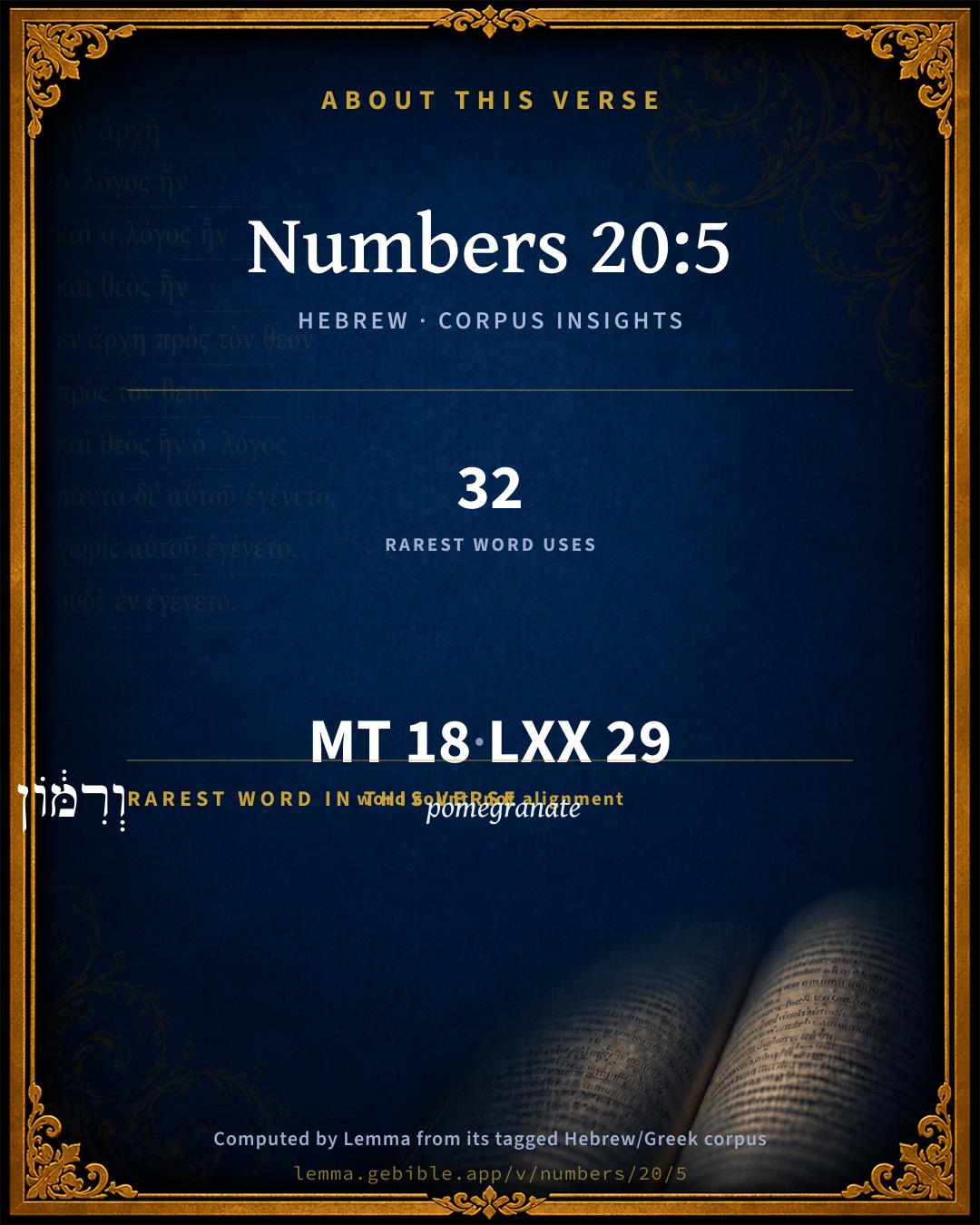
These counts appear in no published source. They are computed here, from the morphology-tagged text and Lemma’s own curated glosses. What Lemma adds →

18
words
17
distinct lemmas
Pentateuch
section

Shared distinctive vocabulary

וְרִמּ֔וֹן pomegranate H7416 occurs in 25 verses of the Hebrew Bible. Also found in:

Grammatical profile

  • 3 verbs
  • 8 nouns
  • 1 adjective
  • 1 pronoun
  • 1 preposition
  • 4 particles

Verb forms

  • הֶֽעֱלִיתֻ֨נוּ֙ Hiphil · Perfect
  • לְהָבִ֣יא Hiphil · Infinitive Construct
  • לִשְׁתּֽוֹת Qal · Infinitive Construct

Repetition

A word recurs within this verse — often emphatic in Hebrew:

  • הַמָּק֥וֹם place H4725 ×2

Hebrew & Septuagint length

In English translation the verse runs 41 words from the Hebrew and 39 from the Septuagint (LXX English) — closely comparable.

A rough comparison of the two English renderings, which tokenize alike — not a word-level alignment.

Word counts can differ between the Hebrew and the Greek without any difference in meaning — e.g. the Hebrew direct-object marker אֵת has no separate Greek word, and Greek often adds the article ὁ.

In the original languages it is 18 Hebrew tokens and 29 Greek tokens — but the two are counted differently (Hebrew bundles its prefixes and suffixes into one token; the Greek is in lemma form), so that isn’t a like-for-like length.

Cross-references

6

Topical passages linked to Numbers 20:5 in the Treasury of Scripture Knowledge — connected by theme and wording, ordered by reader-vote popularity; previews shown in the World English Bible.

  • Numbers 16:14 Moreover you haven't brought us into a land flowing with milk and honey, nor given us inheritance of fields and vineyards: will you put out the eyes of these men? we won't come up.
  • Deuteronomy 8:15 who led you through the great and terrible wilderness, [in which were] fiery serpents and scorpions, and thirsty ground where was no water; who brought you forth water out of the rock of flint;
  • Nehemiah 9:21 Yes, forty years did you sustain them in the wilderness, [and] they lacked nothing; their clothes didn't grow old, and their feet didn't swell.
  • Jeremiah 2:2 Go, and cry in the ears of Jerusalem, saying, Thus says Yahweh, I remember for you the kindness of your youth, the love of your weddings; how you went after me in the wilderness, in a land that was not sown.
  • Jeremiah 2:6 Neither said they, Where is Yahweh who brought us up out of the land of Egypt, who led us through the wilderness, through a land of deserts and of pits, through a land of drought and of the shadow of death, through a land that none passed through, and where no man lived?
  • Ezekiel 20:36 Like as I entered into judgment with your fathers in the wilderness of the land of Egypt, so will I enter into judgment with you, says the Lord Yahweh.

Cross-references courtesy of OpenBible.info (CC BY 4.0).

Hebrew and Greek witnesses Masoretic Hebrew ↔ Greek Septuagint

The same verse in the two great witnesses to the Old Testament, shown verse-for-verse.

These are two independent witnesses, not word-aligned to each other, and the Septuagint is shown in lemma (dictionary) form.

Hebrew Numbers 20:5 Masoretic · Westminster Leningrad Codex

וְלָמָ֤ה הֶֽעֱלִיתֻ֨נוּ֙ מִמִּצְרַ֔יִם לְהָבִ֣יא אֹתָ֔נוּ אֶל הַמָּק֥וֹם הָרָ֖ע הַזֶּ֑ה לֹ֣א מְק֣וֹם זֶ֗רַע וּתְאֵנָ֤ה וְגֶ֨פֶן֙ וְרִמּ֔וֹן וּמַ֥יִם אַ֖יִן לִשְׁתּֽוֹת

Why have you made us to come up out of Egypt, to bring us in to this evil place? it is no place of seed, or of figs, or of vines, or of pomegranates; neither is there any water to drink.

World English Bible · Public Domain

Greek LXX Numbers 20:5 Septuagint · lemma form

καί ἵνα τίς οὗτος ἀναἄγω ἐγώ ἐκ αἴγυπτος παραγίγνομαι εἰς ὁ τόπος ὁ πονηρός οὗτος τόπος οὗ οὐ σπείρω οὐδέ συκῆ οὐδέ ἄμπελος οὐδέ ῥοά οὐδέ ὕδωρ εἰμί πίνω

And therefore is this? You⌃ have brought us up out of Egypt, that we should come into this evil place; a place where there is no sowing, neither figs, nor vines, nor pomegranates, neither is there water to drink.

LXX2012 (modern English Septuagint) · Public Domain

On this verse, The Pulpit Commentary discusses the Septuagint’s reading. Read the note in Commentary ↓

Hebrew: Westminster Leningrad Codex (CC BY 4.0). Greek: Septuagint (public domain); English from LXX2012 (modern English Septuagint) (Public Domain). How the Septuagint differs from the Hebrew →

Targum (Aramaic paraphrase)

2

The Targum is the ancient Jewish Aramaic paraphrase of the Hebrew Scriptures — an interpretive translation, not the Hebrew text itself. Onkelos (literal) and Pseudo-Jonathan (expansive) render the Torah, and Jonathan the Prophets. Coverage is partial: where no permissively-licensed English translation exists for a verse, only the Aramaic is shown. This is verse-level text, not a word-by-word alignment to the Hebrew.

  1. Targum Onkelos Torah (Genesis–Deuteronomy)
    וּלְמָא אַסֶקְתּוּנָא מִמִצְרַיִם לְאַיְתָאָה יָתָנָא לְאַתְּרָא בִישָׁא הָדֵין לָא אֲתַר כְּשַׁר לְבֵית זְרַע וְאַף לָא תְּאֵנִין וְגוּפְנִין וְרִמוֹנִין וּמַיָא לֵית לְמִשְׁתֵּי

    (no public-domain English translation for this verse)

    Targum Onkelos — Aramaic: “Onkelos Genesis” (public domain); “Onkelos Exodus” (public domain); “Onkelos Leviticus” (public domain); “Onkelos Numbers” (public domain); “Onkelos Deuteronomy” (public domain). English: “Sefaria Community Translation” (CC0 1.0 (public-domain dedication)); “J.W. Etheridge. The Targums of Onkelos and Jonathan Ben Uzziel on the Pentateuch. London: Longmans, Green, 1862” (public domain). Text via Sefaria.

  2. Targum Pseudo-Jonathan Torah (Genesis–Deuteronomy)
    וּלְמָא אַסֵיקְתּוּנָא מִמִצְרַיִם לְאַיְתָאָה יָתָן לְאַתְרָא בִּישָׁא הָדֵין לָא אֲתַר כְּשַׁר לְבֵית דְרַע וְאוּף לָא לְמִנְצַב תֵּינִין וְגוּפְנִין וְרוֹמָנִין וּמוֹי לֵית לְמִשְׁתֵּי

    And why didst thou make us come up out of Mizraim., to bring us to this evil place, a place which is not fit for sowing, or for planting fig trees, or vines, or pomegranates, and where there is no water to drink?

    Targum Pseudo-Jonathan — Aramaic: “Targum Jonathan on Genesis” (public domain); “Targum Jonathan on Exodus” (public domain); “Targum Jonathan on Leviticus” (public domain); “Targum Jonathan on Numbers” (public domain); “Targum Jonathan on Deuteronomy” (public domain). English: “The Targum of Jonathan ben Uzziel, trans. J. W. Etheridge, London, 1862” (public domain). Text via Sefaria.

Commentary

Notes on Numbers 20:5 from classic Christian and Jewish commentators (each source and its license shown beneath its notes). The classic Christian expositions comment on the surrounding passage and are grouped to its opening verse, so a note may address several verses; the Jewish commentaries on the Tanakh (Rashi and others) are per-verse, so they appear only where the commentator wrote on this verse.

Lemma curates 59 commentaries, every one of them public domain or Creative Commons licensed, each selected and text-cleaned for this edition rather than reprinted as found. About our sources →

Trapp's Complete Commentary

John Trapp

Num 20:5 And wherefore have ye made us to come up out of Egypt, to bring us in unto this evil place? it [is] no place of seed, or of figs, or of vines, or of pomegranates; neither [is] there any water to drink.

Ver. 5. Neither is there any water to drink.] Thirst, a most eager appetite, enrageth their affections, and makes them thus hot with Moses.

John Trapp, A Commentary or Exposition upon All the Books of the Old and New Testament (1647–1656) — public domain. Text from a community e-Sword module.

John Gill's Exposition

And wherefore have ye made us to come up out of Egypt,.... They represent that affair in such a light, as if they were forced out of Egypt by Moses and Aaron against their wills; or at least were overpersuaded by them to do what they had no inclination to, namely, to come out of Egypt; though they were in the utmost bondage and slavery, and their lives were made bitter by it, and they cried by reason of their oppression, and the hardships they endured; but this was all forgot. Aben Ezra says, it is a strange word which is here used, which shows the confusion they were in:

to bring us unto this evil place; dry and barren, where there were neither food nor drink, as follows:

it is no place of seed; or fit for sowing, as the Targum of Jonathan, any sort of seed, as wheat, barley, rye, rice, &c.

or of figs, or vines, or pomegranates; it is not a soil fit to plant such trees in, nor would they grow were they planted:

neither is there any water to drink; for them and their cattle, and therefore must be a miserable place for so large a body of people to subsist in.

John Gill's Exposition of the Whole Bible (1746–1763) — public domain (CC PDM 1.0). Text via the HelloAO Bible API.

Whedon's Commentary on the Bible

Daniel D. Whedon

5. No place of seed — That is, No place for sowing seed. We call attention to the fact that in this complaint there is no mention of a lack of pasturage. They murmur because there are no arable lands, and delicious fruits, and abundant waters. Travellers agree in the opinion that before the wilderness was stripped of its trees for making charcoal for Egyptian markets, its numerous ravines were covered with grass. Revelation F.W. Holland, after spending many months in wandering on foot over the Sinaitic Peninsula, says: “It is wonderful how apparent difficulties melt away as one’s acquaintance with the country increases. I see no difficulty in the provision of sufficient pasturage for the flocks and herds if, as I have shown, there are good reasons for supposing the rainfall was in former days larger than it is at present. I have several times’ seen the whole face of the country, especially in the wadies, marvelously changed in appearance by a single shower. A slight increase to the present rainfall would produce an enormous addition to the present amount of pasturage.”

Pomegranates — Recent researches have discovered this fruit on Egyptian sculptures, thus proving that this native of Asia was cultivated in Egypt at a very early date. As its name indicates, it is a “grained apple,” red when ripe, and grows on a bush.

Daniel D. Whedon (gen. ed.), Commentary on the Old and New Testaments (1874–1909) — public domain. Text from a community e-Sword module.

The Pulpit Commentary

No place of seed. Septuagint, topov ou ou speiretai . A place where there is no sowing, and therefore no harvest.

The Pulpit Commentary (1880–1919), ed. H.D.M. Spence-Jones & Joseph S. Exell — public domain. Text from a community e-Sword module.

Scofield Reference Notes

C. I. Scofield

water

(See Scofield "Num 20:8").

The Scofield Reference Bible (1917 edition), notes by C. I. Scofield — public domain. Text from a community e-Sword module.

Lesson kit

Teaching starters — assembled from the data on this page, not authored interpretation. Every prompt links to the verse data it draws on. Edit before teaching.

Numbers, in the Pentateuch, opens this verse with 18 words (17 distinct Hebrew lemmas). Its most distinctive word is rimmôwn (“pomegranate”). A historical commentator’s framing appears above. Read the whole chapter for the surrounding context.

Discussion questions

  1. The word rimmôwn carries the sense “pomegranate.” How does it shape the verse?
  2. How does Exodus 28:33, which shares the word «pomegranate», read alongside this verse?
  3. What does the repetition of “place” (2× in this one verse) do in this verse?
  4. The translations on this page render this verse differently — a whole-verse word diff, not a word-by-word alignment. What might account for the different wordings?
  5. «הֶֽעֱלִיתֻ֨נוּ֙» is a Hiphil Perfect verb. How does that grammatical form shape the action described?
  6. Compare how Trapp's Complete Commentary and John Gill's Exposition read this verse. Where do they agree or differ?

Things to notice

Reading settings

Reading text

Shown beneath each verse's original-language words.

Old Testament
Old Testament edition

Read the OT as the Masoretic Hebrew (MT) or the Greek Septuagint (LXX).

English shown for the Greek Septuagint (in the Hebrew ↔ Greek comparison).

Comparing translations? Open the Compare panel on any verse page to stack up to four side by side.