
1 Chronicles 13:6

Hebrew (Westminster Leningrad Codex) 1 Chronicles 13:6 appears in the Hebrew Old Testament. The text above is from the Westminster Leningrad Codex. Each word links to its Strong’s number, a concise gloss, and parsing drawn from the Open Scriptures Hebrew Bible morphology. Click any word for its full Brown-Driver-Briggs (BDB) entry.
Download image
Cite this verse

1 Chronicles 13:6 (World English Bible). Public Domain. Lemma interlinear Bible study tool, https://lemma.gebible.app/v/1-chronicles/13/6.

Show BibTeX & RIS
BibTeX
RIS
English Translation
David went up, and all Israel, to Baalah, [that is], to Kiriath Jearim, which belonged to Judah, to bring up from there the ark of God Yahweh that sits [above] the cherubim, that is called by the Name.
World English Bible · Public Domain
Download a study sheet

One document with this verse’s original text, its word-by-word gloss line, the meaning frame, cross-references with their text, attributed commentary, and full source and license credits — printable, and it pastes into notes with its structure intact.

This verse Autodidact and up

Study sheet (.html) Plain text (.txt)

A passage Seminary Student

Up to 50 verses in one chapter. A passage sheet keeps up to 6 commentary sources and 12 cross-references per verse, in the order this page ranks them, and says so on the sheet whenever that leaves anything out. Ask for a single verse and you get the Autodidact verse sheet above.

Everything on this page stays free to read, with no account — the sheet is a download of what is already on screen, not access to it.

Want to remove ads? Support Godless Engineer
Compare translations 3

The same verse in 3 English versions, stacked beneath the original-language interlinear above. Click any original word for its lexicon entry.

Each is an independent rendering of the whole verse — the interlinear is not word-aligned to these translations.

Highlighted words mark where these versions differ — a whole-verse word diff, not a word-by-word alignment.

  • World English Bible Public Domain
    David went up, and all Israel, to Baalah, [that is], to Kiriath Jearim, which belonged to Judah, to bring up from there the ark of God Yahweh that sits [above] the cherubim, that is called by the Name.
  • King James Version Public Domain
    And David went up, and all Israel, to Baalah, that is, to Kirjathjearim, which belonged to Judah, to bring up thence the ark of God the LORD, that dwelleth between the cherubim, whose name is called on it.
  • unfoldingWord Literal Text CC BY-SA 4.0
    And David went up, and all of Israel, to Baalah, to Kiriath Jearim, which to Judah, to bring up from there the Box of God, Yahweh, sitter of the cherubs, which is called the name.

unfoldingWord Literal Text — © unfoldingWord, licensed CC BY-SA 4.0. Word-aligned USFM3 via Door43 (git.door43.org/unfoldingWord/en_ult).

Versions to compare (up to 4)

3 of 4 selected

Show all 18 translations

Every available English version of this verse, each an independent rendering of the whole verse.

  • World English Bible Public Domain
    David went up, and all Israel, to Baalah, [that is], to Kiriath Jearim, which belonged to Judah, to bring up from there the ark of God Yahweh that sits [above] the cherubim, that is called by the Name.
  • Berean Standard Bible Public Domain
    David and all Israel went up to Baalah of Judah (that is, Kiriath-jearim) to bring up from there the ark of God the LORD, who is enthroned between the cherubim—the ark that is called by the Name.
  • Majority Standard Bible Public Domain
    David and all Israel went up to Baalah of Judah (that is, Kiriath-jearim) to bring up from there the ark of God the LORD, who is enthroned between the cherubim—the ark that is called by the Name.
  • King James Version Public Domain
    And David went up, and all Israel, to Baalah, that is, to Kirjathjearim, which belonged to Judah, to bring up thence the ark of God the LORD, that dwelleth between the cherubim, whose name is called on it.
  • American Standard Version (1901) Public Domain
    And David went up, and all Israel, to Baalah, `that is', to Kiriath-jearim, which belonged to Judah, to bring up from thence the ark of God Jehovah that sitteth `above' the cherubim, that is called by the Name.
  • Revised Version (1885) Public Domain
    And David went up, and all Israel, to Baalah, that is, to Kiriath-jearim, which belonged to Judah, to bring up from thence the ark of God, the LORD that sitteth upon the cherubim, which is called by the Name.
  • Geneva Bible (1599) Public Domain
    And Dauid went vp and all Israel to Baalath, in Kiriath-iearim, that was in Iudah, to bring vp from thence the Arke of God the Lord that dwelleth betweene the Cherubims, where his Name is called on.
  • Douay-Rheims (1899) Public Domain
    And David went up with all the men of Israel to the hill of Cariathiarim which is in Juda, to bring thence the ark of the Lord God sitting upon the cherubims, where his name is called upon.
  • Young's Literal Translation Public Domain
    and David goeth up, and all Israel, to Baalah, unto Kirjath-Jearim that `is' to Judah, to bring up thence the ark of God Jehovah, inhabiting the cherubs, where the Name is called on.
  • Literal Standard Version CC BY-SA 4.0
    and David goes up, and all Israel, to Ba‘alah, to Kirjath-Jearim that [belongs] to Judah, to bring up from there the Ark of God, YHWH, inhabiting the cherubim, where the Name is called on.
  • Unlocked Literal Bible CC BY-SA 4.0
    David and all Israel went up to Baalah, that is, Kiriath Jearim, which belongs to Judah, to bring up from there the ark of God, which is called by Yahweh's name, Yahweh, who sits enthroned over the cherubim.
  • unfoldingWord Literal Text CC BY-SA 4.0
    And David went up, and all of Israel, to Baalah, to Kiriath Jearim, which to Judah, to bring up from there the Box of God, Yahweh, sitter of the cherubs, which is called the name.
  • Darby Bible Public Domain
    And David went up, and all Israel, to Baalah, to Kirjath-jearim, which belonged to Judah, to bring up from thence the ark of God, of Jehovah, who sitteth between the cherubim, whose name is placed [there].
  • World Messianic Bible Public Domain
    David went up with all Israel to Baalah, that is, to Kiriath Jearim, which belonged to Judah, to bring up from there God the LORD’s ark that sits above the cherubim, that is called by the Name.
  • Webster's Bible Public Domain
    And David went up, and all Israel, to Baalah, that is, to Kirjath-jearim, which belonged to Judah, to bring up thence the ark of God the LORD, that dwelleth between the cherubim, whose name is called on it.
  • Free Bible Version CC BY-SA 4.0
    So David and all of Israel went to Baalah (otherwise called Kiriath-jearim) in Judah to bring back the Ark of God the Lord, whose throne is between the cherubim and who is called by the Name.
  • Bible in Basic English Public Domain
    And David went up, with all Israel, to Baalah, that is, to Kiriath-jearim in Judah, to get up from there the ark of God, over which the holy Name is named, the name of the Lord whose place is between the winged ones.
  • JPS Tanakh (1917) Public Domain
    And David went up, and all Israel, to Baalah, that is, to Kiriath-jearim, which belonged to Judah, to bring up from thence the ark of God, the LORD that sitteth upon the cherubim, whereon is called the Name.

Literal Standard Version (2020), Covenant Press — licensed CC BY-SA 4.0. Text via the HelloAO Bible API (eBible.org). Unlocked Literal Bible (unfoldingWord) — licensed CC BY-SA 4.0. Text via the HelloAO Bible API (eBible.org). unfoldingWord Literal Text — © unfoldingWord, licensed CC BY-SA 4.0. Word-aligned USFM3 via Door43 (git.door43.org/unfoldingWord/en_ult). Free Bible Version, Dr. Jonathan Gallagher — licensed CC BY-SA 4.0. Text via the HelloAO Bible API (eBible.org).

Word by word

More ways to search: Search by grammar → Find every occurrence → Compare this word →

Practice this passage: Drill this verse → Learn its vocabulary →

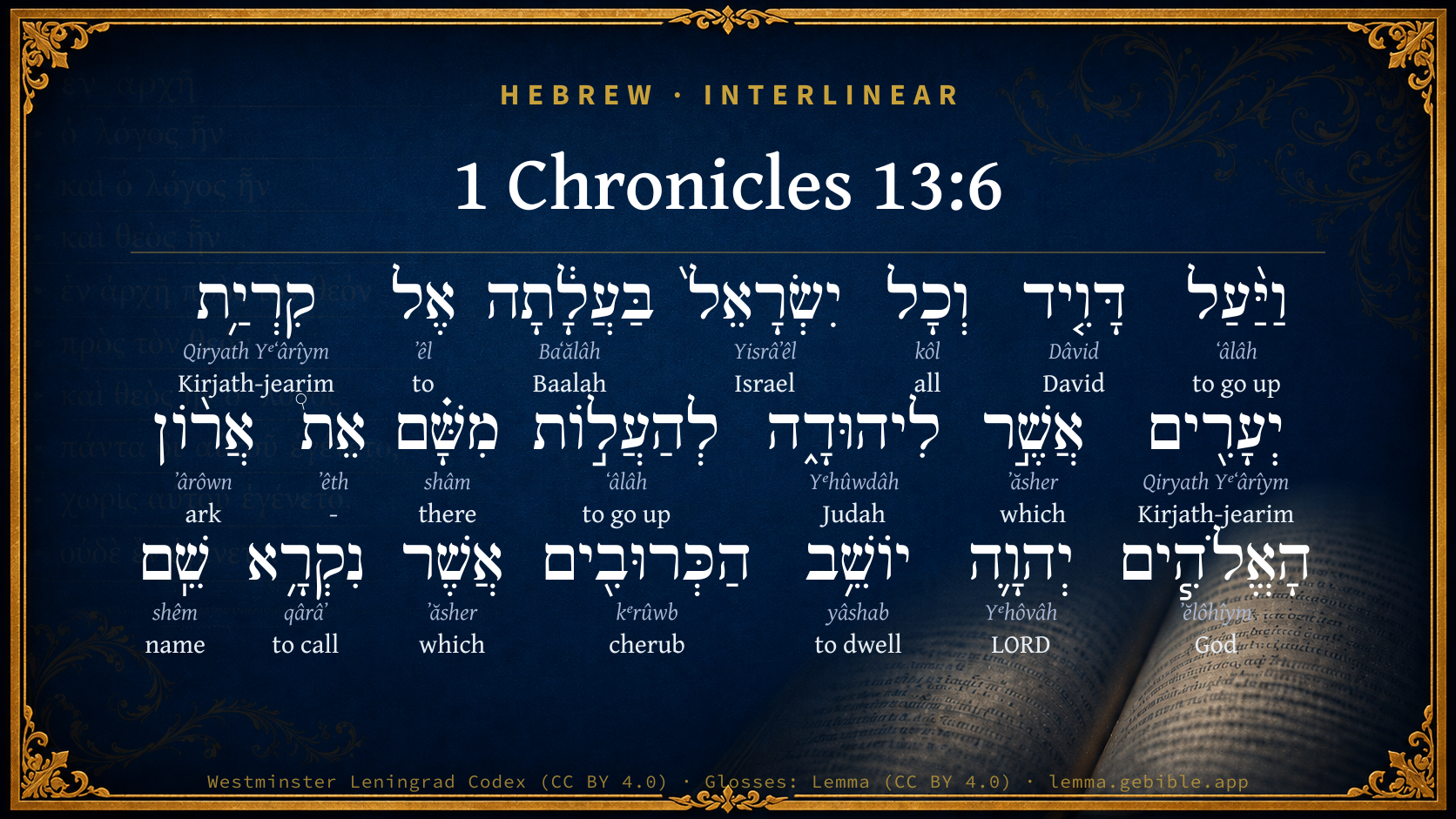
בַּעֲלָ֔תָה
Baʻălâh
H1173
“Baalah · toward”
Noun, Proper + Suffix, Demonstrative
Part of Speech
Noun
Type
Proper
Full BDB Definition

Origin: the same as H1172

TWOT: None

Baalah = "mistress" - another name for Kirjath-jearim or Kirjath-baal; modern Kuriet el Enab - a town in the south of Judah, also called Balah and Bilhah
  1. וַיַּ֨עַל ʻâlâh H5927 “and · to go up” Conjunction + Verb, Qal, Sequential Imperfect, 3rd Person, Masculine, Singular
  2. דָּוִ֤יד Dâvid H1732 “David” Noun, Proper
  3. וְכָל kôl H3605 “and · all of” Conjunction + Noun, Common, Masculine, Singular, Construct
  4. יִשְׂרָאֵל֙ Yisrâʼêl H3478 “Israel” Noun, Proper
  5. אֶל ʼêl H413 “to” Preposition
  6. קִרְיַ֥ת Qiryath Yᵉʻârîym H7157 “Kirjath-jearim” Noun, Proper
  7. יְעָרִ֖ים Qiryath Yᵉʻârîym H7157 “Kirjath-jearim” Noun, Proper
  8. אֲשֶׁ֣ר ʼăsher H834 “which” Particle, Relative
  9. לִיהוּדָ֑ה Yᵉhûwdâh H3063 “to/for · Judah” Preposition + Noun, Proper
  10. לְהַעֲל֣וֹת ʻâlâh H5927 “to go up” Preposition + Verb, Hiphil, Infinitive Construct
  11. מִשָּׁ֗ם shâm H8033 “from · there” Preposition + Adverb
  12. אֵת֩ ʼêth H853 “-” Particle, Direct Object
  13. אֲר֨וֹן ʼârôwn H727 “ark of” Noun, Common, Both, Singular, Construct
  14. הָאֱלֹהִ֧ים ʼĕlôhîym H430 “the · God(s)” Particle, Definite Article + Noun, Common, Masculine, Plural, Absolute
  15. יְהוָ֛ה Yᵉhôvâh H3068 “LORD” Noun, Proper
  16. יוֹשֵׁ֥ב yâshab H3427 “dwelling” Verb, Qal, Participle Active, Masculine, Singular, Absolute
  17. הַכְּרוּבִ֖ים kᵉrûwb H3742 “the · cherubim” Particle, Definite Article + Noun, Common, Masculine, Plural, Absolute
  18. אֲשֶׁר ʼăsher H834 “which” Particle, Relative
  19. נִקְרָ֥א qârâʼ H7121 “to call” Verb, Niphal, Perfect, 3rd Person, Masculine, Singular
  20. שֵֽׁם shêm H8034 “name” Noun, Common, Masculine, Singular, Absolute

About this verse

These counts appear in no published source. They are computed here, from the morphology-tagged text and Lemma’s own curated glosses. What Lemma adds →

21
words
18
distinct lemmas
Historical
section

Notable vocabulary

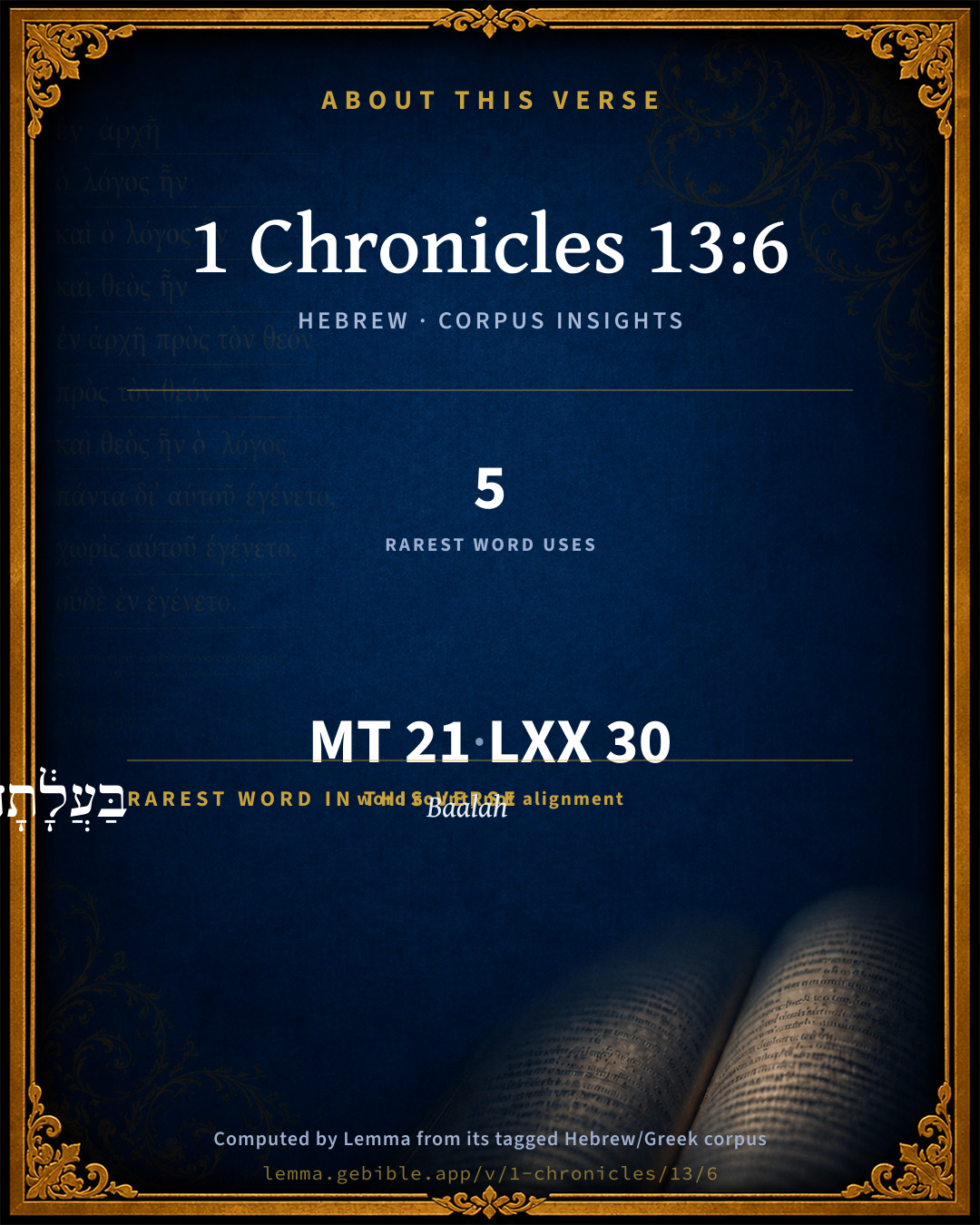
The rarest word here is בַּעֲלָ֔תָה Baalah H1173 — appearing just 5 times in the whole Hebrew Bible.

Shared distinctive vocabulary

בַּעֲלָ֔תָה Baalah H1173 occurs in 5 verses of the Hebrew Bible. Also found in:

Grammatical profile

  • 4 verbs
  • 12 nouns
  • 1 preposition
  • 1 adverb
  • 3 particles

Verb forms

  • וַיַּ֨עַל Qal · Sequential Imperfect
  • לְהַעֲל֣וֹת Hiphil · Infinitive Construct
  • יוֹשֵׁ֥ב Qal · Participle Active
  • נִקְרָ֥א Niphal · Perfect

Repetition

Words recur within this verse — often emphatic in Hebrew:

  • וַיַּ֨עַל to go up H5927 ×2
  • קִרְיַ֥ת Kirjath-jearim H7157 ×2
  • אֲשֶׁ֣ר which H834 ×2

Hebrew & Septuagint length

In English translation the verse runs 38 words from the Hebrew and 40 from the Septuagint (LXX English) — closely comparable.

A rough comparison of the two English renderings, which tokenize alike — not a word-level alignment.

Word counts can differ between the Hebrew and the Greek without any difference in meaning — e.g. the Hebrew direct-object marker אֵת has no separate Greek word, and Greek often adds the article ὁ.

In the original languages it is 21 Hebrew tokens and 30 Greek tokens — but the two are counted differently (Hebrew bundles its prefixes and suffixes into one token; the Greek is in lemma form), so that isn’t a like-for-like length.

Cross-references

14

Topical passages linked to 1 Chronicles 13:6 in the Treasury of Scripture Knowledge — connected by theme and wording, ordered by reader-vote popularity; previews shown in the World English Bible.

  • Exodus 25:22 There I will meet with you, and I will tell you from above the mercy seat, from between the two cherubim which are on the ark of the testimony, all that I command you for the children of Israel.
  • Joshua 15:9 and the border extended from the top of the mountain to the spring of the waters of Nephtoah, and went out to the cities of Mount Ephron; and the border extended to Baalah (the same is Kiriath Jearim);
  • 2 Kings 19:15 Hezekiah prayed before Yahweh, and said, Yahweh, the God of Israel, who sit [above] the cherubim, you are the God, even you alone, of all the kingdoms of the earth; you have made heaven and earth.
  • Joshua 15:60 Kiriath Baal (the same is Kiriath Jearim), and Rabbah; two cities with their villages.
  • 1 Samuel 4:4 So the people sent to Shiloh; and they brought from there the ark of the covenant of Yahweh of Hosts, who sits [above] the cherubim: and the two sons of Eli, Hophni and Phinehas, were there with the ark of the covenant of God.
  • 2 Samuel 6:2–11 David arose, and went with all the people who were with him, from Baale Judah, to bring up from there the ark of God, which is called by the Name, even the name of Yahweh of Hosts who sits [above] the cherubim.
  • Exodus 20:24 You shall make an altar of earth for me, and shall sacrifice on it your burnt offerings and your peace-offerings, your sheep and your oxen. In every place where I record my name I will come to you and I will bless you.
  • Exodus 23:21 Pay attention to him, and listen to his voice. Don't provoke him, for he will not pardon your disobedience, for my name is in him.
  • Numbers 6:27 "So they shall put my name on the children of Israel; and I will bless them."
  • Numbers 7:89 When Moses went into the Tent of Meeting to speak with Yahweh, he heard his voice speaking to him from above the mercy seat that was on the ark of the Testimony, from between the two cherubim: and he spoke to him.
  • 1 Kings 8:16 Since the day that I brought forth my people Israel out of Egypt, I chose no city out of all the tribes of Israel to build a house, that my name might be there; but I chose David to be over my people Israel.
  • Psalms 80:1 Hear us, Shepherd of Israel, You who lead Joseph like a flock, You who sit above the cherubim, shine forth.
  • Psalms 99:1 Yahweh reigns! Let the peoples tremble. He sits enthroned among the cherubim. Let the earth be moved.
  • Isaiah 37:16 Yahweh of hosts, the God of Israel, who sits [above] the cherubim, you are the God, even you alone, of all the kingdoms of the earth; you have made heaven and earth.

Cross-references courtesy of OpenBible.info (CC BY 4.0).

Hebrew and Greek witnesses Masoretic Hebrew ↔ Greek Septuagint

The same verse in the two great witnesses to the Old Testament, shown verse-for-verse.

These are two independent witnesses, not word-aligned to each other, and the Septuagint is shown in lemma (dictionary) form.

Hebrew 1 Chronicles 13:6 Masoretic · Westminster Leningrad Codex

וַיַּ֨עַל דָּוִ֤יד וְכָל יִשְׂרָאֵל֙ בַּעֲלָ֔תָה אֶל קִרְיַ֥ת יְעָרִ֖ים אֲשֶׁ֣ר לִיהוּדָ֑ה לְהַעֲל֣וֹת מִשָּׁ֗ם אֵת֩ אֲר֨וֹן הָאֱלֹהִ֧ים יְהוָ֛ה יוֹשֵׁ֥ב הַכְּרוּבִ֖ים אֲשֶׁר נִקְרָ֥א שֵֽׁם

David went up, and all Israel, to Baalah, [that is], to Kiriath Jearim, which belonged to Judah, to bring up from there the ark of God Yahweh that sits [above] the cherubim, that is called by the Name.

World English Bible · Public Domain

Greek LXX 1 Chronicles 13:6 Septuagint · lemma form

καί ἀναἄγω αὐτός δαυίδ καί πᾶς ἰσραήλ ἀναβαίνω εἰς πόλις δαυίδ ὅς εἰμί ὁ ἰουδά ὁ ἀναἄγω ἐκεῖθεν ὁ κιβωτός ὁ θεός κύριος καταἧμαι ἐπί χερουβιν ὅς ἐπικαλέω ὄνομα αὐτός

And David brought it up: and all Israel went up to the city of David, which belonged to Juda, to bring up thence the ark of the Lord God who sits between the cherubim, whose name is called on it.

LXX2012 (modern English Septuagint) · Public Domain

On this verse, Ellicott's Commentary for English Readers discusses the Septuagint’s reading. Read the note in Commentary ↓

Hebrew: Westminster Leningrad Codex (CC BY 4.0). Greek: Septuagint (public domain); English from LXX2012 (modern English Septuagint) (Public Domain). How the Septuagint differs from the Hebrew →

Commentary

Notes on 1 Chronicles 13:6 from classic Christian and Jewish commentators (each source and its license shown beneath its notes). The classic Christian expositions comment on the surrounding passage and are grouped to its opening verse, so a note may address several verses; the Jewish commentaries on the Tanakh (Rashi and others) are per-verse, so they appear only where the commentator wrote on this verse.

Lemma curates 59 commentaries, every one of them public domain or Creative Commons licensed, each selected and text-cleaned for this edition rather than reprinted as found. About our sources →

Trapp's Complete Commentary

John Trapp

1Ch 13:6 And David went up, and all Israel, to Baalah, [that is], to Kirjathjearim, which [belonged] to Judah, to bring up thence the ark of God the LORD, that dwelleth [between] the cherubims, whose name is called [on it].

Ver. 6. That is, to Kirjathjearim.] Called also Kirjathbaal. {Jos 15:60} For more notes on this and the following verses, see on 2Sa 6:2-10. {See Trapp on "2Sa 6:2"} &c

John Trapp, A Commentary or Exposition upon All the Books of the Old and New Testament (1647–1656) — public domain. Text from a community e-Sword module.

Joseph Benson's Commentary

1Ch 13:6. David went up, and all Israel, to Baalah, that is, Kirjath-jearim — Which explication is justified by Jos 15:9; Jos 15:60, where the same city is called by both names: see note on 2Sa 6:2. The ark of God the Lord, that dwelleth between the cherubim — Showing himself in a singular manner present or visible between the cherubim, before which his name was called upon, 2Sa 6:1.

Joseph Benson's Commentary on the Old and New Testaments (1811–1818) — public domain. Text from a community e-Sword module.

Geneva Bible (1599)

Geneva Bible translators

Or, Baal, read 2 Sam. 6:2.

Geneva Bible (1599) marginal notes — public domain. Text via Bolls.life.

Jamieson, Fausset & Brown

Robert Jamieson, A. R. Fausset & David Brown

David went up, and all Israel, to Baalah--(See on Sa2 6:1-11).

whose name is called on it--rather, "who is worshipped there" (Sa2 6:2).

Next: 1 Chronicles Chapter 14

Jamieson, Fausset & Brown — Commentary Critical and Explanatory on the Whole Bible (1871) — public domain (CC PDM 1.0). Text via the HelloAO Bible API.

Adam Clarke's Commentary

Verse 6. Whose name is called on it.] "Where his name is invoked." - T.

And so the Hebrew, אשר נקרא שם asher nikra shem, should be understood, his name was not called on it, but invoked at it.

Adam Clarke's Commentary on the Bible (1810–1826) — public domain. Text from a community e-Sword/MySword module.

Ellicott's Commentary for English Readers

(6) From this point our narrative coincides with that of 2Sa_6:2-11. The original text was plainly the same, whether the chronicler drew directly from the Book of Samuel, or from another source. Such differences as appear consist of abridgments, paraphrases, and corrections.

All Israel.—Samuel, “All the people that were with him.”

To Baalah.—Jos_15:60, “Kirjath-baal, which is Kirjath-jearim.” “Baas town” was doubtless the original name. “Town of woods” describes the position of the place. Our text appears more correct than that of Samuel, which has, “And David rose and went, and all the people that were with him, from BaalêJudah.” The Targum, LXX., and Syriac, translate that which the Authorised Version gives as a proper name, “The people that were with him of the cities lords men of Judah.” If this be right, perhaps “Baalah” has fallen out of the text of Samuel owing to its resemblance to the word baalê. lords. Kirjath־jearim is the modern ‘Erma, four miles east of Ain Shems (Bethshemesh).—Palestine Exploration Fund Quarterly Statement, October, 1881.

The Lord, that dwelleth between the cherubims.—Rather, Jehovah, who sitteth upon the cherubim (comp. Psa_16:11; Psa_80:2; Isa_37:16).

Whose name is called on it.—The Hebrew is, “who (or which) is called Name.” The Israelites in later days avoided all mention of the Divine name of Jehovah, and substituted hashshçm “the Name” (comp. Lev_24:16, and the Third Commandment). A comparison with 2Sa_6:2, however, suggests that a word meaning “upon it” (‘âlâw), has fallen out. In that case the literal rendering will be, upon which (i.e., the Ark) the Name (of Jehovah) is called= which is called by the name (of Jehovah). The Ark was often called “the Ark of Jehovah” (1Ch_15:3). The Hebrew and Targum of Samuel favour this. Some MSS. of Chron. read “there” (shâm) instead of “name” (shçm). This, gives the meaning, who is invoked there (at the Ark). Comp. the LXX. οὗ ἐπεκλήθη ὄνομα αὐτοῦ.

A Bible Commentary for English Readers, edited by Charles John Ellicott (1878–1897) — public domain. Text from a community e-Sword module.

The Cambridge Bible for Schools and Colleges

gen. ed. J. J. S. Perowne

6. to Baalah, that is, to Kiriath-jearim] Cp. Jos_15:9; in Jos_15:60 Kiriath-baal. Its site has not been certainly identified; cp. Kirkpatrick’s note on 2Sa_6:2.

that dwelleth between the cherubims] R.V. that sitteth upon the cherubim; cp. Eze_1:26.

whose name is called on it] R.V. which is called by the Name; the God whose is the ark is here distinguished from the gods of the nations as the God who bears the ineffable Name.

The Cambridge Bible for Schools and Colleges (gen. ed. J. J. S. Perowne; Cambridge University Press, 1878–1918) — public domain. Text from a community e-Sword module.

Haydock's Catholic Bible Commentary

Hill. Hebrew, "to Baalah," which was another name, as well as "Baslim," for Cariathiarim, 1 Kings vii. 2. (Calmet)

George Leo Haydock (1774–1849), Haydock's Catholic Family Bible and Commentary, 1859 edition — public domain. Excludes Psalms (Douay-Rheims chapter numbering differs from Protestant) and Deuterocanonical books (Catholic canon only).

Matthew Poole's English Annotations

That is, to Kirjath-jearim; which explication is justified by Jos 15:9,60, where the same city is called by both names.

Object. They are said to go from this Baale, 2Sa 6:2.

Answ. 1. Some learned men render that place also to Basle, the particle mem being sometimes used for to amongst the Hebrews, and especially amongst the Arabians.

2. Both were true; they first went to Baale for the ark, as is here said, and then went from Baale to bring, or to carry, (for the word signifies either,) or carrying, from thence the ark of God, as is there related. But of this and other difficulties or differences between these two relations, See Poole "2Sa 6:1" and following.

Matthew Poole's English Annotations on the Holy Bible (1683–1685) — public domain. Text from a community e-Sword/MySword module.

The Pulpit Commentary

To Baalah, that is, to Kirjath-jearim (see Jos_15:9-11; 1Sa_4:7; 2Sa_6:2; where the name is spelt with a final yod instead of he) A third name of this same place, Kirjath-baal , is found Jos_15:60 Jos_18:14. Probably the present Arms, a ruin (i.q. Kirjath- Ezr_2:25) on the brink of the valley of Sorek, may be the place (see Conder"s "Bible Handbook," p. 419, 2nd edit.). We read in Jos_9:17-27 how the men of Kirjath-jearim had been made by Joshua "hewers of wood and drawers of water for the congregation, and for the altar of the Lord." Hither to this Kirjath-jearim the ark had been conveyed from Bethshemesh, (1Sa_7:1, 1Sa_7:2) and here it "abode" long time, "for it was twenty years." Perhaps the word "abode" in this passage may be equivalent to abode unmoved. (1Sa_14:18, 1Sa_14:19) For though the chronology from the death of Eli, through the remainder of Samuel"s career and of Saul"s, seems almost hopelessly uncertain, yet it would appear certain that the interval exceeded twenty years, to the time that David now takes in hand to bring home, as it were, the ark. The ark of God, the Lord. Though the Authorized Version of this passage is better and cleverer than that of the parallel, (2Sa_6:2) yet it is left somewhat obscure. The comma should follow the name God. Jehovah sitting upon the cherubim then follows as a clause in apposition, while the last three words (as the name is called, rather than whose name) state that clause to contain "the Name of the Lord" (Deu_10:8 Deu_31:9; 1Sa_4:4 1Sa_5:3 1Sa_6:8) Bertheau, following Thenius, proposes to change the Hebrew into But there are abundant objections to this.

The Pulpit Commentary (1880–1919), ed. H.D.M. Spence-Jones & Joseph S. Exell — public domain. Text from a community e-Sword module.

John Wesley's Explanatory Notes

That is - The same city was called by both names.

John Wesley, Explanatory Notes Upon the Whole Bible (1754–1765) — public domain. Text via the GEBible commentary corpus.

Rashi

Rabbi Shlomo Yitzchaki (Rashi)

to Baalah, to Kirjath The meaning is: to Baalah, which is Kirjath-Jearim.

to bring up from there, etc. As it is written (II Sam. 6:2): “... which is called a name, the name of the Lord of Hosts, Who dwells upon the cherubim;” i.e., the name of the Holy One, blessed be He, was called upon the Ark. Although the Ark had been exiled to [the land of] the Philistines, this name did not leave it, because it was hallowed.

Rashi on the Tanakh — English translations: “The Judaica Press complete Tanach with Rashi, translated by A. J. Rosenberg” (CC BY 4.0); “Pentateuch with Rashi's commentary by M. Rosenbaum and A.M. Silbermann, 1929-1934” (public domain); “The Metsudah Tanach series, Lakewood, N.J” (CC BY 4.0); and “The Book of Joshua, Metsudah Publications, 1997” (CC BY 4.0). Text via Sefaria.

Lesson kit

Teaching starters — assembled from the data on this page, not authored interpretation. Every prompt links to the verse data it draws on. Edit before teaching.

1 Chronicles, in the Historical, opens this verse with 21 words (18 distinct Hebrew lemmas). Its most distinctive word is Baʻălâh (“Baalah”). A historical commentator’s framing appears above. Read the whole chapter for the surrounding context.

Discussion questions

  1. The word Baʻălâh carries the sense “Baalah.” How does it shape the verse?
  2. How does Joshua 15:9, which shares the word «Baalah», read alongside this verse?
  3. What does the repetition of “to go up” (2× in this one verse) do in this verse?
  4. These translations render this verse differently; the difference is in the English rendering, not the original. What questions does that raise?
  5. «וַיַּ֨עַל» is a Qal Sequential Imperfect verb. How does that grammatical form shape the action described?
  6. Compare how Trapp's Complete Commentary and Joseph Benson's Commentary read this verse. Where do they agree or differ?

Things to notice

Reading settings

Reading text

Shown beneath each verse's original-language words.

Old Testament
Old Testament edition

Read the OT as the Masoretic Hebrew (MT) or the Greek Septuagint (LXX).

English shown for the Greek Septuagint (in the Hebrew ↔ Greek comparison).

Comparing translations? Open the Compare panel on any verse page to stack up to four side by side.