
Genesis 41:3

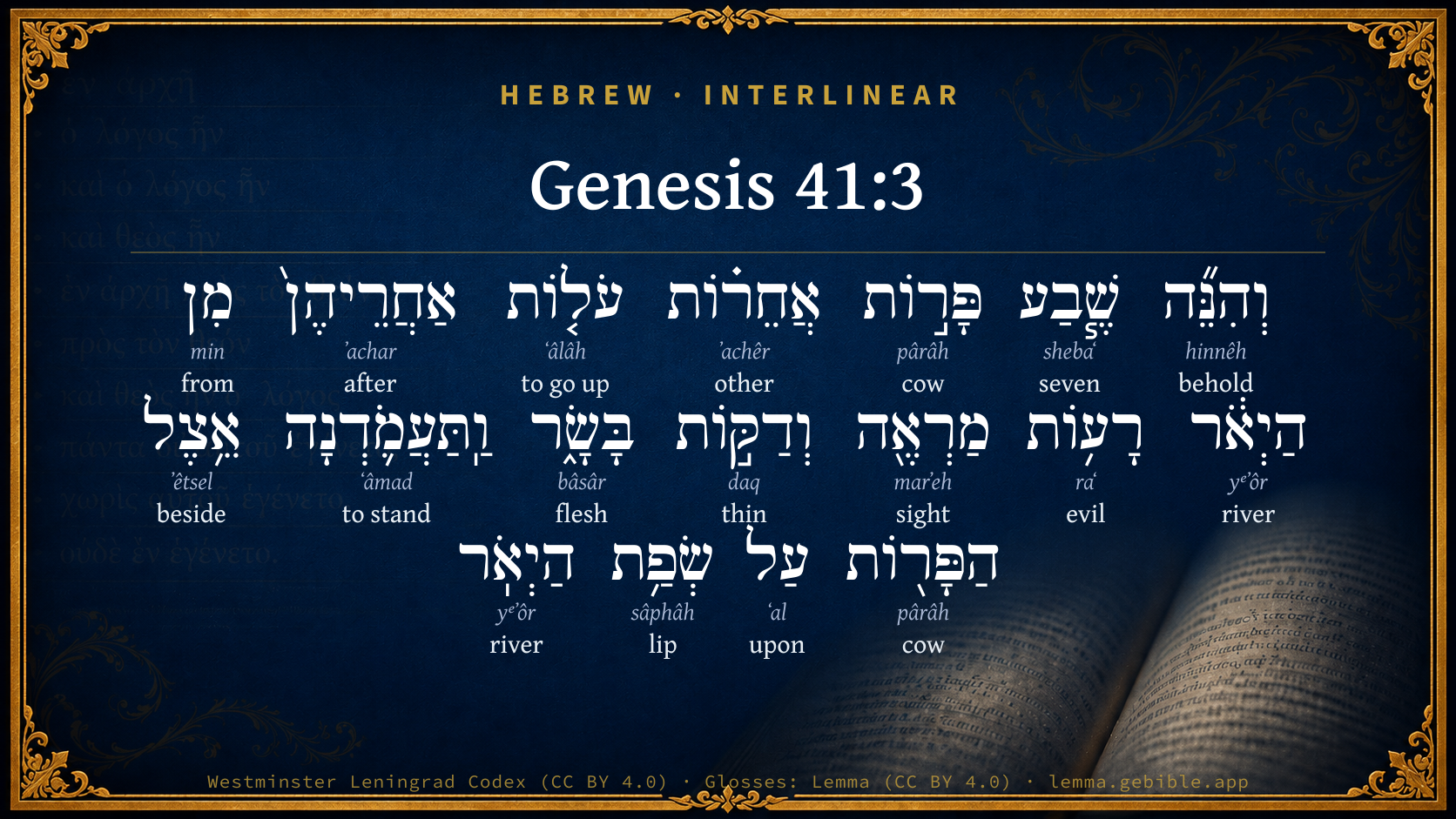
Hebrew (Westminster Leningrad Codex) Genesis 41:3 appears in the Hebrew Old Testament. The text above is from the Westminster Leningrad Codex. Each word links to its Strong’s number, a concise gloss, and parsing drawn from the Open Scriptures Hebrew Bible morphology. Click any word for its full Brown-Driver-Briggs (BDB) entry.
Download image
Cite this verse

Genesis 41:3 (World English Bible). Public Domain. Lemma interlinear Bible study tool, https://lemma.gebible.app/v/genesis/41/3.

Show BibTeX & RIS
BibTeX
RIS
English Translation
Behold, seven other cattle came up after them out of the river, ill-favored and lean-fleshed, and stood by the other cattle on the brink of the river.
World English Bible · Public Domain
Highlights
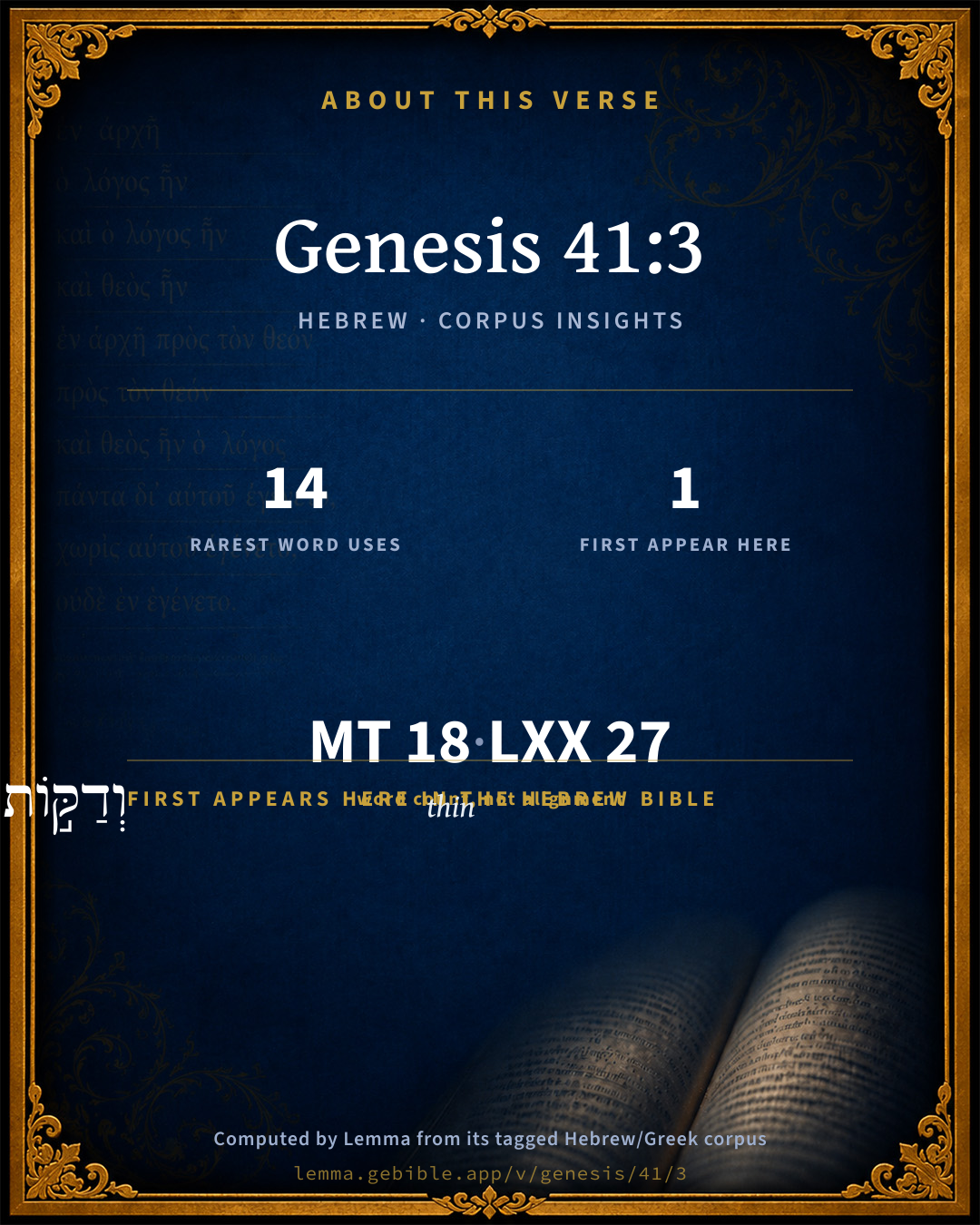
  • 1 first appearance in the Hebrew Bible
Full analysis ↓
Download a study sheet

One document with this verse’s original text, its word-by-word gloss line, the meaning frame, cross-references with their text, attributed commentary, and full source and license credits — printable, and it pastes into notes with its structure intact.

This verse Autodidact and up

Study sheet (.html) Plain text (.txt)

A passage Seminary Student

Up to 50 verses in one chapter. A passage sheet keeps up to 6 commentary sources and 12 cross-references per verse, in the order this page ranks them, and says so on the sheet whenever that leaves anything out. Ask for a single verse and you get the Autodidact verse sheet above.

Everything on this page stays free to read, with no account — the sheet is a download of what is already on screen, not access to it.

Want to remove ads? Support Godless Engineer
Compare translations 3

The same verse in 3 English versions, stacked beneath the original-language interlinear above. Click any original word for its lexicon entry.

Each is an independent rendering of the whole verse — the interlinear is not word-aligned to these translations.

Highlighted words mark where these versions differ — a whole-verse word diff, not a word-by-word alignment.

  • World English Bible Public Domain
    Behold, seven other cattle came up after them out of the river, ill-favored and lean-fleshed, and stood by the other cattle on the brink of the river.
  • King James Version Public Domain
    And, behold, seven other kine came up after them out of the river, ill favored and leanfleshed; and stood by the other kine upon the brink of the river.
  • unfoldingWord Literal Text CC BY-SA 4.0
    Then behold, seven other cows came up after them from the river, ugly-looking and thin-fleshed, and they stood beside the cows on the bank of the river.

unfoldingWord Literal Text — © unfoldingWord, licensed CC BY-SA 4.0. Word-aligned USFM3 via Door43 (git.door43.org/unfoldingWord/en_ult).

Versions to compare (up to 4)

3 of 4 selected

Show all 18 translations

Every available English version of this verse, each an independent rendering of the whole verse.

  • World English Bible Public Domain
    Behold, seven other cattle came up after them out of the river, ill-favored and lean-fleshed, and stood by the other cattle on the brink of the river.
  • Berean Standard Bible Public Domain
    After them, seven other cows, sickly and thin, came up from the Nile and stood beside the well-fed cows on the bank of the river.
  • Majority Standard Bible Public Domain
    After them, seven other cows, sickly and thin, came up from the Nile and stood beside the well-fed cows on the bank of the river.
  • King James Version Public Domain
    And, behold, seven other kine came up after them out of the river, ill favored and leanfleshed; and stood by the other kine upon the brink of the river.
  • American Standard Version (1901) Public Domain
    And, behold, seven other kine came up after them out of the river, ill-favored and lean-fleshed, and stood by the other kine upon the brink of the river.
  • Revised Version (1885) Public Domain
    And, behold, seven other kine came up after them out of the river, ill favoured and leanfleshed; and stood by the other kine upon the brink of the river.
  • Geneva Bible (1599) Public Domain
    And loe, seuen other kine came vp after the out of the riuer, euill fauoured and leane fleshed, and stoode by the other kine vpon the brinke of the riuer.
  • Douay-Rheims (1899) Public Domain
    Other seven also came up out of the river, ill favoured, and leanfleshed: and they fed on the very bank of the river, in green places:
  • Young's Literal Translation Public Domain
    and lo, seven other kine are coming up after them out of the River, of bad appearance, and lean `in' flesh, and they stand near the kine on the edge of the River,
  • Literal Standard Version CC BY-SA 4.0
    and behold, seven other cows are coming up after them out of the River, of bad appearance, and lean [in] flesh, and they stand near the cows on the edge of the River,
  • Unlocked Literal Bible CC BY-SA 4.0
    Behold, seven other cows came up after them out of the Nile, undesirable and thin. They stood by the other cows on the bank of the river.
  • unfoldingWord Literal Text CC BY-SA 4.0
    Then behold, seven other cows came up after them from the river, ugly-looking and thin-fleshed, and they stood beside the cows on the bank of the river.
  • Darby Bible Public Domain
    And behold, seven other kine came up after them out of the river, bad-looking and lean-fleshed, and stood by the kine on the bank of the river.
  • World Messianic Bible Public Domain
    Behold, seven other cattle came up after them out of the river, ugly and thin, and stood by the other cattle on the brink of the river.
  • Webster's Bible Public Domain
    And behold, seven other cows came up after them out of the river, ill-favored and lean-fleshed; and stood by the other cows upon the brink of the river.
  • Free Bible Version CC BY-SA 4.0
    Then he saw another seven cows that came up behind them. They looked ugly and skinny as they stood beside the other cows on the bank of the Nile.
  • Bible in Basic English Public Domain
    And after them seven other cows came out of the Nile, poor-looking and thin; and they were by the side of the other cows.
  • JPS Tanakh (1917) Public Domain
    And, behold, seven other kine came up after them out of the river, ill favoured and lean-fleshed; and stood by the other kine upon the brink of the river.

Literal Standard Version (2020), Covenant Press — licensed CC BY-SA 4.0. Text via the HelloAO Bible API (eBible.org). Unlocked Literal Bible (unfoldingWord) — licensed CC BY-SA 4.0. Text via the HelloAO Bible API (eBible.org). unfoldingWord Literal Text — © unfoldingWord, licensed CC BY-SA 4.0. Word-aligned USFM3 via Door43 (git.door43.org/unfoldingWord/en_ult). Free Bible Version, Dr. Jonathan Gallagher — licensed CC BY-SA 4.0. Text via the HelloAO Bible API (eBible.org).

Word by word

More ways to search: Search by grammar → Find every occurrence → Compare this word →

Practice this passage: Drill this verse → Learn its vocabulary →

וְדַקּ֣וֹת
daq
H1851
“and · thin of”
Conjunction + Adjective, Adjective, Feminine, Plural, Construct
Part of Speech
Conjunction + Adjective
Type
Adjective
Gender
Feminine
Number
Plural
State
Construct
Full BDB Definition

Origin: from H1854

TWOT: 448a

thin, small, fine, gaunt - thin - small, fine
  1. וְהִנֵּ֞ה hinnêh H2009 “and · behold” Conjunction + Particle, Demonstrative
  2. שֶׁ֧בַע shebaʻ H7651 “seven” Adjective, Cardinal number, Feminine, Singular, Absolute
  3. פָּר֣וֹת pârâh H6510 “cows” Noun, Common, Feminine, Plural, Absolute
  4. אֲחֵר֗וֹת ʼachêr H312 “other” Adjective, Adjective, Feminine, Plural, Absolute
  5. עֹל֤וֹת ʻâlâh H5927 “going up” Verb, Qal, Participle Active, Feminine, Plural, Absolute
  6. אַחֲרֵיהֶן֙ ʼachar H310 “after · them” Preposition + Suffix, Personal, 3rd Person, Feminine, Plural
  7. מִן min H4480 “from” Preposition
  8. הַיְאֹ֔ר yᵉʼôr H2975 “the · river” Particle, Definite Article + Noun, Proper
  9. רָע֥וֹת raʻ H7451 “evil of” Adjective, Adjective, Feminine, Plural, Construct
  10. מַרְאֶ֖ה marʼeh H4758 “sight” Noun, Common, Masculine, Singular, Absolute
  11. בָּשָׂ֑ר bâsâr H1320 “flesh” Noun, Common, Masculine, Singular, Absolute
  12. וַֽתַּעֲמֹ֛דְנָה ʻâmad H5975 “and · to stand” Conjunction + Verb, Qal, Sequential Imperfect, 3rd Person, Feminine, Plural
  13. אֵ֥צֶל ʼêtsel H681 “beside” Preposition
  14. הַפָּר֖וֹת pârâh H6510 “the · cows” Particle, Definite Article + Noun, Common, Feminine, Plural, Absolute
  15. עַל ʻal H5921 “upon” Preposition
  16. שְׂפַ֥ת sâphâh H8193 “lip of” Noun, Common, Feminine, Singular, Construct
  17. הַיְאֹֽר yᵉʼôr H2975 “the · river” Particle, Definite Article + Noun, Proper

About this verse

These counts appear in no published source. They are computed here, from the morphology-tagged text and Lemma’s own curated glosses. What Lemma adds →

18
words
16
distinct lemmas
Pentateuch
section

Notable vocabulary

The rarest word here is וְדַקּ֣וֹת thin H1851 — appearing just 14 times in the whole Hebrew Bible.

First appearance in Scripture

This word makes its first canonical appearance in the Hebrew Bible here:

  • וְדַקּ֣וֹת thin H1851

Shared distinctive vocabulary

וְדַקּ֣וֹת thin H1851 occurs in 13 verses of the Hebrew Bible. Also found in:

Grammatical profile

  • 2 verbs
  • 7 nouns
  • 4 adjectives
  • 4 prepositions
  • 1 particle

Verb forms

  • עֹל֤וֹת Qal · Participle Active
  • וַֽתַּעֲמֹ֛דְנָה Qal · Sequential Imperfect

Repetition

Words recur within this verse — often emphatic in Hebrew:

  • פָּר֣וֹת cow H6510 ×2
  • הַיְאֹ֔ר river H2975 ×2

Hebrew & Septuagint length

In English translation the verse runs 27 words from the Hebrew and 27 from the Septuagint (LXX English) — the same length.

A rough comparison of the two English renderings, which tokenize alike — not a word-level alignment.

Word counts can differ between the Hebrew and the Greek without any difference in meaning — e.g. the Hebrew direct-object marker אֵת has no separate Greek word, and Greek often adds the article ὁ.

In the original languages it is 18 Hebrew tokens and 27 Greek tokens — but the two are counted differently (Hebrew bundles its prefixes and suffixes into one token; the Greek is in lemma form), so that isn’t a like-for-like length.

Cross-references

2

Topical passages linked to Genesis 41:3 in the Treasury of Scripture Knowledge — connected by theme and wording, ordered by reader-vote popularity; previews shown in the World English Bible.

  • Genesis 41:4 The ill-favored and lean-fleshed cattle ate up the seven well-favored and fat cattle. So Pharaoh awoke.
  • Genesis 41:20–21 The lean and ill-favored cattle ate up the first seven fat cattle,

Cross-references courtesy of OpenBible.info (CC BY 4.0).

Hebrew and Greek witnesses Masoretic Hebrew ↔ Greek Septuagint

The same verse in the two great witnesses to the Old Testament, shown verse-for-verse.

These are two independent witnesses, not word-aligned to each other, and the Septuagint is shown in lemma (dictionary) form.

Hebrew Genesis 41:3 Masoretic · Westminster Leningrad Codex

וְהִנֵּ֞ה שֶׁ֧בַע פָּר֣וֹת אֲחֵר֗וֹת עֹל֤וֹת אַחֲרֵיהֶן֙ מִן הַיְאֹ֔ר רָע֥וֹת מַרְאֶ֖ה וְדַקּ֣וֹת בָּשָׂ֑ר וַֽתַּעֲמֹ֛דְנָה אֵ֥צֶל הַפָּר֖וֹת עַל שְׂפַ֥ת הַיְאֹֽר

Behold, seven other cattle came up after them out of the river, ill-favored and lean-fleshed, and stood by the other cattle on the brink of the river.

World English Bible · Public Domain

Greek LXX Genesis 41:3 Septuagint · lemma form

ἄλλος δέ ἑπτά βοῦς ἀναβαίνω μετά οὗτος ἐκ ὁ ποταμός αἰσχρός ὁ εἶδος καί λεπτός ὁ σάρξ καί νέμω παρά ὁ βοῦς παρά ὁ χεῖλος ὁ ποταμός

And other seven cows came up after these out of the river, ill-favoured and lean-fleshed, and fed by the other cows on the bank of the river.

LXX2012 (modern English Septuagint) · Public Domain

Hebrew: Westminster Leningrad Codex (CC BY 4.0). Greek: Septuagint (public domain); English from LXX2012 (modern English Septuagint) (Public Domain). How the Septuagint differs from the Hebrew →

Targum (Aramaic paraphrase)

2

The Targum is the ancient Jewish Aramaic paraphrase of the Hebrew Scriptures — an interpretive translation, not the Hebrew text itself. Onkelos (literal) and Pseudo-Jonathan (expansive) render the Torah, and Jonathan the Prophets. Coverage is partial: where no permissively-licensed English translation exists for a verse, only the Aramaic is shown. This is verse-level text, not a word-by-word alignment to the Hebrew.

  1. Targum Onkelos Torah (Genesis–Deuteronomy)
    וְהָא שְׁבַע תּוֹרָן אָחֳרָנְיָן סָלְקָן בַּתְרֵיהוֹן מִן נַהֲרָא בִּישָׁן לְמֶחֱזֵי וַחֲסִירַן בְּשָׂר וְקָמָן לְקִבְלֵיהוֹן דְּתוֹרָן עַל כֵּיף נַהֲרָא

    (no public-domain English translation for this verse)

    Targum Onkelos — Aramaic: “Onkelos Genesis” (public domain); “Onkelos Exodus” (public domain); “Onkelos Leviticus” (public domain); “Onkelos Numbers” (public domain); “Onkelos Deuteronomy” (public domain). English: “Sefaria Community Translation” (CC0 1.0 (public-domain dedication)); “J.W. Etheridge. The Targums of Onkelos and Jonathan Ben Uzziel on the Pentateuch. London: Longmans, Green, 1862” (public domain). Text via Sefaria.

  2. Targum Pseudo-Jonathan Torah (Genesis–Deuteronomy)
    וְהָא שְׁבַע תּוֹרָתִי חוֹרַנְיַן סַלְקַן מִן נַהֲרָא בִּישָׁן לְמֵיחֲמֵי וְחַסְכָן בְּבִשְרֵיהוֹן וְקָמַן לְקִבְלֵיהוֹן דְתוֹרָתֵי עַל כֵּיף נַהֲרָא

    And, behold, seven other oxen came up from the river, evil-looking and lean in their flesh, and stood by the side of tile oxen on the bank of the river.

    Targum Pseudo-Jonathan — Aramaic: “Targum Jonathan on Genesis” (public domain); “Targum Jonathan on Exodus” (public domain); “Targum Jonathan on Leviticus” (public domain); “Targum Jonathan on Numbers” (public domain); “Targum Jonathan on Deuteronomy” (public domain). English: “The Targum of Jonathan ben Uzziel, trans. J. W. Etheridge, London, 1862” (public domain). Text via Sefaria.

Commentary

Notes on Genesis 41:3 from classic Christian and Jewish commentators (each source and its license shown beneath its notes). The classic Christian expositions comment on the surrounding passage and are grouped to its opening verse, so a note may address several verses; the Jewish commentaries on the Tanakh (Rashi and others) are per-verse, so they appear only where the commentator wrote on this verse.

Lemma curates 59 commentaries, every one of them public domain or Creative Commons licensed, each selected and text-cleaned for this edition rather than reprinted as found. About our sources →

Trapp's Complete Commentary

John Trapp

Gen 41:3 And, behold, seven other kine came up after them out of the river, ill favoured and leanfleshed; and stood by the [other] kine upon the brink of the river.

Ver. 3. Seven other kine came up out of the river.] These, by their leanness, portended drought and dearth, though they came up out of Nile also. This river, when it overflows unto twelve cubits’ height only, causeth famine; when to thirteen scarcity; when to fourteen, cheerfulness; when to fifteen, affluence; when to sixteen, abundance, as Pliny tells us. The greatest increase ever known, was of eighteen cubits, under Claudius (we read of a general famine in his days, Act 11:28, mentioned also by Suetonius and Josephus); {a} the smallest of five cubits, in the history of the Pharsalian wars. Such a thing might happen now, to cause this sore famine. Or the river, for their sins, might be dried up, as God threatens them. {Eze 29:3; Eze 29:9 Isa 19:5-6} And as it happened in the reign of Cleopatra, that prodigiously prodigal queen, the river overflowed not for two years together, saith Seneca: as at another time it overflowed not for nine years together, saith Callimachus; and after him Ovid. {b} How easy is it for God to starve us all, by denying us a few harvests! In case of famine, let us inquire the supernatural cause; as David did, {2Sa 21:1} when he knew the natural cause to be the drought.

{a} Suet., in Claudio. Joseph., Antiq., lib. xx. cap. 2. Luc., lib. v. cap. 9.

Creditur Aegyptus caruisse iuvantibus arva

Imbribus, atque annis sicca fuisse novem. - Ovid.

{b} Sen., Nat. Quaest., lib. iv. cap. 2.

John Trapp, A Commentary or Exposition upon All the Books of the Old and New Testament (1647–1656) — public domain. Text from a community e-Sword module.

John Gill's Exposition

And, behold, seven other kine came up after them out of the river, ill favoured, and leanfleshed,.... Thin and haggard, their bones stuck out, having scarce any flesh upon them, and made a wretched figure:

and stood by the other kine; and looked so much the worse, when compared with them:

upon the brink of the river; it not being overflowed, so that there was no grass to be had, but just upon the bank, where these kept for that purpose; for the fruitfulness of Egypt was owing to the river Nile; as that overflowed or did not, there was plenty or famine; hence both these sorts of creatures came up out of that.

John Gill's Exposition of the Whole Bible (1746–1763) — public domain (CC PDM 1.0). Text via the HelloAO Bible API.

Haydock's Catholic Bible Commentary

Very bank; to shew that the Nile had not inundated far, and that consequently a great famine would prevail, as the fertility of Egypt depends greatly on the overflowing of the Nile. "When the river rises 12 cubits, sterility pervades Egypt; when 13, famine is still felt. Fourteen cubits bring joy, 15 security, 16 delight. It has never yet been known to rise above 18 cubits." (Pliny, Natural History v. 9.) This successive depression of the waters was an effect of God’s judgments, which no astrologers could foretel. (Tirinus)

George Leo Haydock (1774–1849), Haydock's Catholic Family Bible and Commentary, 1859 edition — public domain. Excludes Psalms (Douay-Rheims chapter numbering differs from Protestant) and Deuterocanonical books (Catholic canon only).

Matthew Poole's English Annotations

Which shows how sparingly the river overflowed the lands.

Matthew Poole's English Annotations on the Holy Bible (1683–1685) — public domain. Text from a community e-Sword/MySword module.

The Pulpit Commentary

And, behold, seven other kind came up after them out of the river, ill. favored and lean-fleshed. The second seven cows, "evil to look upon," i.e. bad in appearance, and "thin (beaten small, dakoth, from dakak , to crush or beat small) of flesh," also proceeded from the river, since a failure in the periodical overflow of the Nile was the usual cause of scarcity and famine in Egypt. And stood by the other kine upon the brink of the river. The use of the term lip, hp; c; for brink, common enough in Hebrew (Gen_22:17; Exo_14:30; 1Ki_5:9) occurs also in a papyrus of the nineteenth dynasty, "I sat down by the lip of the river," which appears to suggest the impression that the verse in the text was written by one who was equally familiar with both languages (Canon Cook in "Speaker s Commentary," p. 485).

The Pulpit Commentary (1880–1919), ed. H.D.M. Spence-Jones & Joseph S. Exell — public domain. Text from a community e-Sword module.

Rashi

Rabbi Shlomo Yitzchaki (Rashi)

ודקות בשר THIN-FLESHED in old French tenuis, meaning thin.

Rashi on the Tanakh — English translations: “The Judaica Press complete Tanach with Rashi, translated by A. J. Rosenberg” (CC BY 4.0); “Pentateuch with Rashi's commentary by M. Rosenbaum and A.M. Silbermann, 1929-1934” (public domain); “The Metsudah Tanach series, Lakewood, N.J” (CC BY 4.0); and “The Book of Joshua, Metsudah Publications, 1997” (CC BY 4.0). Text via Sefaria.

Ramban (Nachmanides)

Rabbi Moshe ben Nachman (Ramban / Nachmanides)

AND THEY STOOD BESIDE THE COWS. I.e., by their side and near them. This was a sign that there would be no lapse of time between the years of plenty and the years of famine even though Pharaoh did not relate this to Joseph. But perhaps the vision which Pharaoh saw and the relating of the dream to Joseph were really alike, except that Scripture did not concern itself [with mentioning all the details Pharaoh told Joseph], just as it added into the story [details not mentioned in the actual dream, as for example], And it could not be known that they had eaten them up, and also, the ears of corn came up on one stalk, which was a sign that the seven years will occur consecutively.

Ramban (Nachmanides) on the Tanakh — English translation: “Commentary on the Torah by Ramban (Nachmanides). Translated and annotated by Charles B. Chavel. New York, Shilo Pub. House, 1971-1976” (CC BY 4.0). Text via Sefaria.

Radak

Rabbi David Kimhi (Radak)

ותעמדנה, this is the first unusual thing in the dream, that the hungry, lean cows instead of grazing as did the fat, satiated cows, were simply standing around, inactive, as if helpless. Joseph, of course, draws attention to the meaning of this phenomenon in his interpretation.

Radak on the Tanakh — English translations: “Sefaria Community Translation” (CC0 1.0 (public-domain dedication)); “Eliyahu Munk, HaChut Hameshulash” (CC BY 4.0); “Rabbi Mike Feuer, Jerusalem Anthology” (CC BY 4.0); and “R. David Kimhi on the first book of Psalms, Translated by R.G. Finch, London, 1919” (public domain). Text via Sefaria.

Lesson kit

Teaching starters — assembled from the data on this page, not authored interpretation. Every prompt links to the verse data it draws on. Edit before teaching.

Genesis, in the Pentateuch, opens this verse with 18 words (16 distinct Hebrew lemmas). Its most distinctive word is daq (“thin”). A historical commentator’s framing appears above. Read the whole chapter for the surrounding context.

Discussion questions

  1. The word daq carries the sense “thin.” How does it shape the verse?
  2. The word “thin” first appears here in Scripture. What is being introduced at this debut?
  3. Genesis 41:4 shares the word «thin» with this verse. How do the two illuminate each other?
  4. “cow” occurs 2× in this one verse. What is the effect of the repetition?
  5. The translations on this page render this verse differently — a whole-verse word diff, not a word-by-word alignment. What might account for the different wordings?
  6. The verb «עֹל֤וֹת» is Qal Participle Active. How does its form color the action?
  7. Reading how Trapp's Complete Commentary and John Gill's Exposition read this verse, where do the two commentators agree and where do they part?

Things to notice

Reading settings

Reading text

Shown beneath each verse's original-language words.

Old Testament
Old Testament edition

Read the OT as the Masoretic Hebrew (MT) or the Greek Septuagint (LXX).

English shown for the Greek Septuagint (in the Hebrew ↔ Greek comparison).

Comparing translations? Open the Compare panel on any verse page to stack up to four side by side.