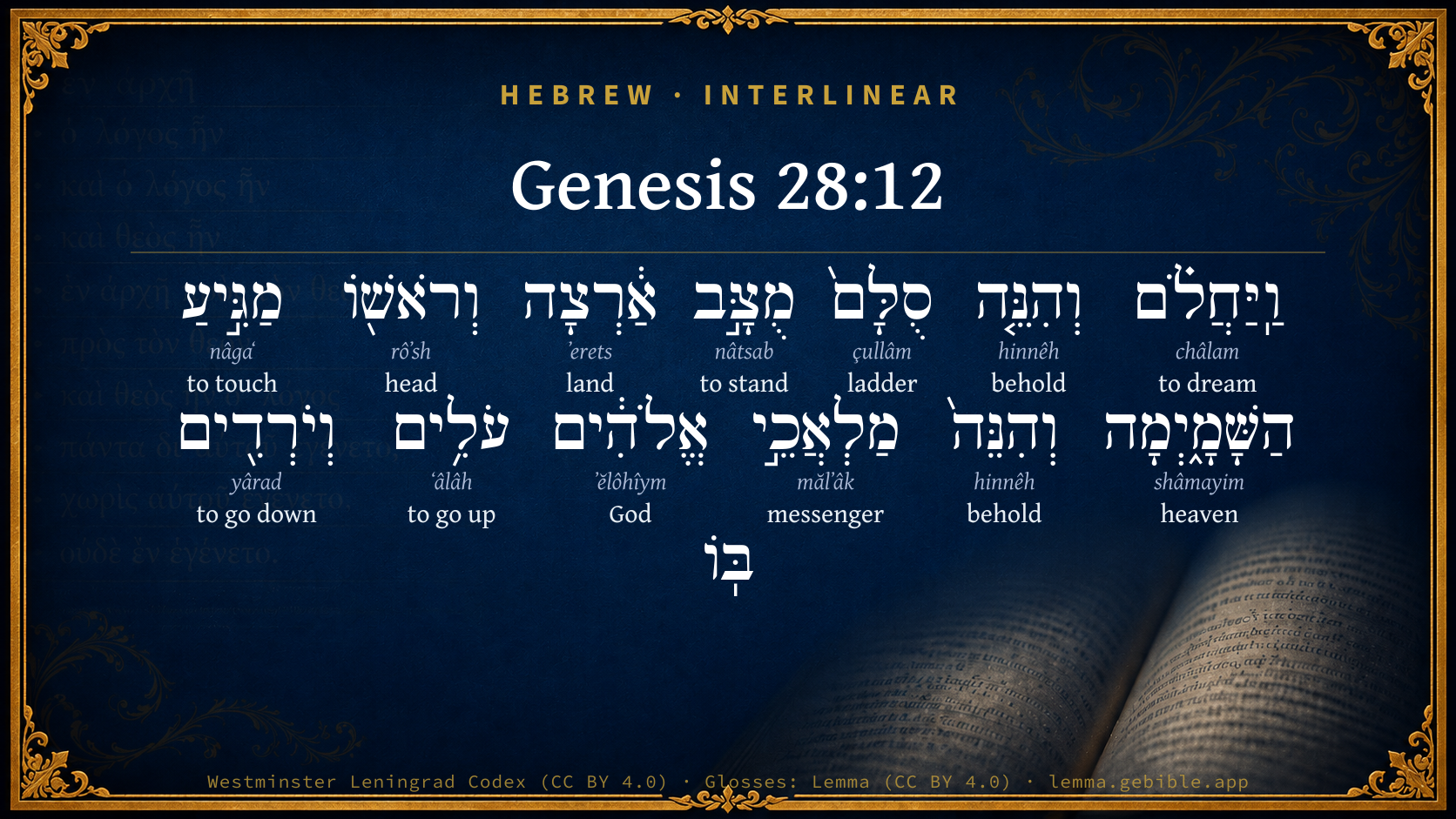
Genesis 28:12

Hebrew (Westminster Leningrad Codex) Genesis 28:12 appears in the Hebrew Old Testament. The text above is from the Westminster Leningrad Codex. Each word links to its Strong’s number, a concise gloss, and parsing drawn from the Open Scriptures Hebrew Bible morphology. Click any word for its full Brown-Driver-Briggs (BDB) entry.
Download image
Cite this verse

Genesis 28:12 (World English Bible). Public Domain. Lemma interlinear Bible study tool, https://lemma.gebible.app/v/genesis/28/12.

Show BibTeX & RIS
BibTeX
RIS
English Translation
He dreamed. Behold, a stairway set up on the earth, and the top of it reached to heaven. Behold, the angels of God ascending and descending on it.
World English Bible · Public Domain
Highlights
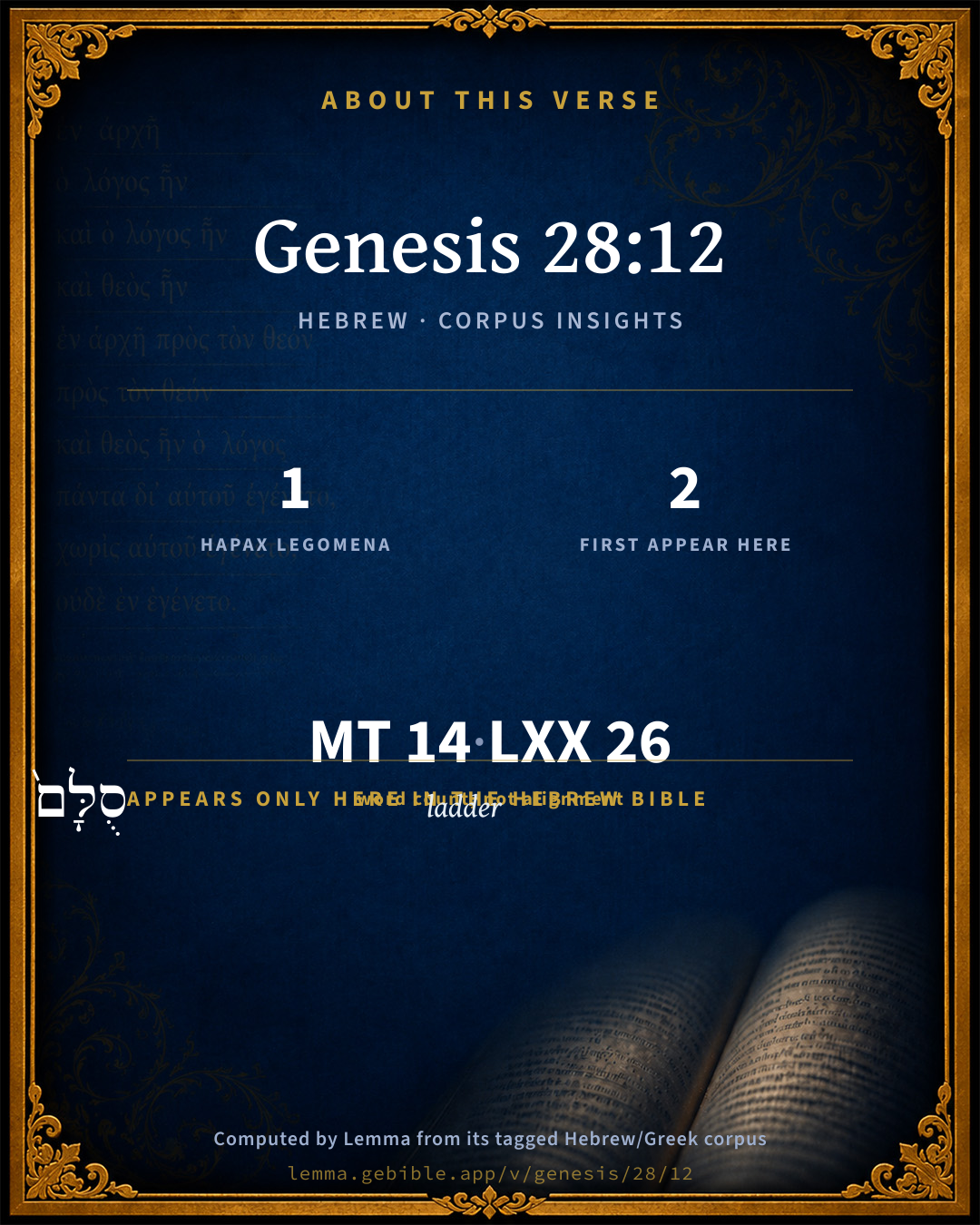
  • 1 hapax legomenon — only here in the Hebrew Bible
  • 2 first appearances in the Hebrew Bible
Full analysis ↓
Download a study sheet

One document with this verse’s original text, its word-by-word gloss line, the meaning frame, cross-references with their text, attributed commentary, and full source and license credits — printable, and it pastes into notes with its structure intact.

This verse Autodidact and up

Study sheet (.html) Plain text (.txt)

A passage Seminary Student

Up to 50 verses in one chapter. A passage sheet keeps up to 6 commentary sources and 12 cross-references per verse, in the order this page ranks them, and says so on the sheet whenever that leaves anything out. Ask for a single verse and you get the Autodidact verse sheet above.

Everything on this page stays free to read, with no account — the sheet is a download of what is already on screen, not access to it.

Want to remove ads? Support Godless Engineer
Compare translations 3

The same verse in 3 English versions, stacked beneath the original-language interlinear above. Click any original word for its lexicon entry.

Each is an independent rendering of the whole verse — the interlinear is not word-aligned to these translations.

Highlighted words mark where these versions differ — a whole-verse word diff, not a word-by-word alignment.

  • World English Bible Public Domain
    He dreamed. Behold, a stairway set up on the earth, and the top of it reached to heaven. Behold, the angels of God ascending and descending on it.
  • King James Version Public Domain
    And he dreamed, and behold a ladder set up on the earth, and the top of it reached to heaven: and behold the angels of God ascending and descending on it.
  • unfoldingWord Literal Text CC BY-SA 4.0
    And he dreamed, and behold, a stairway was set up on the earth and its top reached to the heavens, and behold, angels of God were ascending and descending on it.

unfoldingWord Literal Text — © unfoldingWord, licensed CC BY-SA 4.0. Word-aligned USFM3 via Door43 (git.door43.org/unfoldingWord/en_ult).

Versions to compare (up to 4)

3 of 4 selected

Show all 18 translations

Every available English version of this verse, each an independent rendering of the whole verse.

  • World English Bible Public Domain
    He dreamed. Behold, a stairway set up on the earth, and the top of it reached to heaven. Behold, the angels of God ascending and descending on it.
  • Berean Standard Bible Public Domain
    And Jacob had a dream about a ladder that rested on the earth with its top reaching up to heaven, and God’s angels were going up and down the ladder.
  • Majority Standard Bible Public Domain
    And Jacob had a dream about a ladder that rested on the earth with its top reaching up to heaven, and God’s angels were going up and down the ladder.
  • King James Version Public Domain
    And he dreamed, and behold a ladder set up on the earth, and the top of it reached to heaven: and behold the angels of God ascending and descending on it.
  • American Standard Version (1901) Public Domain
    And he dreamed. And behold, a ladder set up on the earth, and the top of it reached to heaven. And behold, the angels of God ascending and descending on it.
  • Revised Version (1885) Public Domain
    And he dreamed, and behold a ladder set up on the earth, and the top of it reached to heaven: and behold the angels of God ascending and descending on it.
  • Geneva Bible (1599) Public Domain
    Then he dreamed, and behold, there stoode a ladder vpon the earth, and the top of it reached vp to heauen: and loe, the Angels of God went vp and downe by it.
  • Douay-Rheims (1899) Public Domain
    And he saw in his sleep a ladder standing upon the earth, and the top thereof touching heaven: the angels also of God ascending and descending by it;
  • Young's Literal Translation Public Domain
    And he dreameth, and lo, a ladder set up on the earth, and its head is touching the heavens; and lo, messengers of God are going up and coming down by it;
  • Literal Standard Version CC BY-SA 4.0
    And he dreams, and behold, a ladder set up on the earth, and its head is touching the heavens; and behold, messengers of God are going up and coming down by it;
  • Unlocked Literal Bible CC BY-SA 4.0
    He dreamed and saw a stairway set up on the earth. Its top reached to heaven and the angels of God were ascending and descending on it.
  • unfoldingWord Literal Text CC BY-SA 4.0
    And he dreamed, and behold, a stairway was set up on the earth and its top reached to the heavens, and behold, angels of God were ascending and descending on it.
  • Darby Bible Public Domain
    And he dreamed, and behold, a ladder was set up on the earth, and the top of it reached to the heavens. And behold, angels of God ascended and descended upon it.
  • World Messianic Bible Public Domain
    He dreamed and saw a stairway set upon the earth, and its top reached to heaven. Behold, the angels of God were ascending and descending on it.
  • Webster's Bible Public Domain
    And he dreamed, and behold, a ladder set upon the earth, and the top of it reached to heaven: and behold, the angels of God ascending and descending on it.
  • Free Bible Version CC BY-SA 4.0
    He dreamed he saw a stairway that started on earth, and the top reached all the way into heaven. He saw God's angels going up and down on it.
  • Bible in Basic English Public Domain
    And he had a dream, and in his dream he saw steps stretching from earth to heaven, and the angels of God were going up and down on them.
  • JPS Tanakh (1917) Public Domain
    And he dreamed, and behold a ladder set up on the earth, and the top of it reached to heaven; and behold the angels of God ascending and descending on it.

Literal Standard Version (2020), Covenant Press — licensed CC BY-SA 4.0. Text via the HelloAO Bible API (eBible.org). Unlocked Literal Bible (unfoldingWord) — licensed CC BY-SA 4.0. Text via the HelloAO Bible API (eBible.org). unfoldingWord Literal Text — © unfoldingWord, licensed CC BY-SA 4.0. Word-aligned USFM3 via Door43 (git.door43.org/unfoldingWord/en_ult). Free Bible Version, Dr. Jonathan Gallagher — licensed CC BY-SA 4.0. Text via the HelloAO Bible API (eBible.org).

Word by word

More ways to search: Search by grammar → Find every occurrence → Compare this word →

Practice this passage: Drill this verse → Learn its vocabulary →

סֻלָּם֙
çullâm
H5551
“ladder”
Noun, Common, Masculine, Singular, Absolute
Part of Speech
Noun
Type
Common
Gender
Masculine
Number
Singular
State
Absolute
Full BDB Definition

Origin: from H5549

TWOT: 1506c

ladder
  1. וַֽיַּחֲלֹ֗ם châlam H2492 “and · to dream” Conjunction + Verb, Qal, Sequential Imperfect, 3rd Person, Masculine, Singular
  2. וְהִנֵּ֤ה hinnêh H2009 “and · behold” Conjunction + Particle, Demonstrative
  3. מֻצָּ֣ב nâtsab H5324 “stood” Verb, Hophal, Participle Passive, Masculine, Singular, Absolute
  4. אַ֔רְצָה ʼerets H776 “land · toward” Noun, Common, Both, Singular, Absolute + Suffix, Demonstrative
  5. וְרֹאשׁ֖וֹ rôʼsh H7218 “and · head · his” Conjunction + Noun, Common, Masculine, Singular, Construct + Suffix, Personal, 3rd Person, Masculine, Singular
  6. מַגִּ֣יעַ nâgaʻ H5060 “touching” Verb, Hiphil, Participle Active, Masculine, Singular, Absolute
  7. הַשָּׁמָ֑יְמָה shâmayim H8064 “the · heaven(s) · toward” Particle, Definite Article + Noun, Common, Masculine, Plural, Absolute + Suffix, Demonstrative
  8. וְהִנֵּה֙ hinnêh H2009 “and · behold” Conjunction + Particle, Demonstrative
  9. מַלְאֲכֵ֣י mălʼâk H4397 “messengers of” Noun, Common, Masculine, Plural, Construct
  10. אֱלֹהִ֔ים ʼĕlôhîym H430 “God(s)” Noun, Common, Masculine, Plural, Absolute
  11. עֹלִ֥ים ʻâlâh H5927 “going up” Verb, Qal, Participle Active, Masculine, Plural, Absolute
  12. וְיֹרְדִ֖ים yârad H3381 “and · going down” Conjunction + Verb, Qal, Participle Active, Masculine, Plural, Absolute

About this verse

These counts appear in no published source. They are computed here, from the morphology-tagged text and Lemma’s own curated glosses. What Lemma adds →

14
words
12
distinct lemmas
Pentateuch
section

Notable vocabulary

1 hapax legomenon — a word that appears only here in the entire Hebrew Bible:

  • סֻלָּם֙ ladder H5551

First appearance in Scripture

These words make their first canonical appearance in the Hebrew Bible here:

  • וַֽיַּחֲלֹ֗ם to dream H2492
  • סֻלָּם֙ ladder H5551

Shared distinctive vocabulary

וַֽיַּחֲלֹ֗ם to dream H2492 occurs in 25 verses of the Hebrew Bible. Also found in:

Grammatical profile

  • 5 verbs
  • 6 nouns
  • 1 preposition
  • 2 particles

Verb forms

  • וַֽיַּחֲלֹ֗ם Qal · Sequential Imperfect
  • מֻצָּ֣ב Hophal · Participle Passive
  • מַגִּ֣יעַ Hiphil · Participle Active
  • עֹלִ֥ים Qal · Participle Active
  • וְיֹרְדִ֖ים Qal · Participle Active

Repetition

A word recurs within this verse — often emphatic in Hebrew:

  • וְהִנֵּ֤ה behold H2009 ×2

Hebrew & Septuagint length

In English translation the verse runs 28 words from the Hebrew and 25 from the Septuagint (LXX English) — closely comparable.

A rough comparison of the two English renderings, which tokenize alike — not a word-level alignment.

Word counts can differ between the Hebrew and the Greek without any difference in meaning — e.g. the Hebrew direct-object marker אֵת has no separate Greek word, and Greek often adds the article ὁ.

In the original languages it is 14 Hebrew tokens and 26 Greek tokens — but the two are counted differently (Hebrew bundles its prefixes and suffixes into one token; the Greek is in lemma form), so that isn’t a like-for-like length.

Cross-references

22

Topical passages linked to Genesis 28:12 in the Treasury of Scripture Knowledge — connected by theme and wording, ordered by reader-vote popularity; previews shown in the World English Bible.

  • John 1:51 He said to him, "Most assuredly, I tell you, hereafter you will see heaven opened, and the angels of God ascending and descending on the Son of Man."
  • Genesis 32:1–2 Jacob went on his way, and the angels of God met him.
  • Numbers 12:6 He said, Hear now my words: if there be a prophet among you, I Yahweh will make myself known to him in a vision, I will speak with him in a dream.
  • Job 33:15–16 In a dream, in a vision of the night, When deep sleep falls on men, In slumbering on the bed;
  • Genesis 15:1 After these things the word of Yahweh came to Abram in a vision, saying, "Don't be afraid, Abram. I am your shield, your exceedingly great reward."
  • Genesis 37:5–11 Joseph dreamed a dream, and he told it to his brothers, and they hated him all the more.
  • 2 Timothy 4:16–17 At my first defense, no one came to help me, but all left me. May it not be held against them.
  • Genesis 15:12 When the sun was going down, a deep sleep fell on Abram. Now terror and great darkness fell on him.
  • Hebrews 1:14 Aren't they all ministering spirits, sent out to do service for the sake of those who will inherit salvation?
  • Daniel 7:1 In the first year of Belshazzar king of Babylon Daniel had a dream and visions of his head on his bed: then he wrote the dream and told the sum of the matters.
  • Daniel 4:1–37 Nebuchadnezzar the king, to all the peoples, nations, and languages, who dwell in all the earth: Peace be multiplied to you.
  • Hebrews 1:1 God, having in the past spoken to the fathers through the prophets at many times and in various ways,
  • Genesis 20:6–7 God said to him in the dream, "Yes, I know that in the integrity of your heart you have done this, and I also withheld you from sinning against me. Therefore I didn't allow you to touch her.
  • Job 4:12–21 "Now a thing was secretly brought to me, My ear received a whisper of it.
  • Isaiah 41:10 Don't you be afraid, for I am with you; don't be dismayed, for I am your God; I will strengthen you; yes, I will help you; yes, I will uphold you with the right hand of my righteousness.
  • Daniel 2:1–49 In the second year of the reign of Nebuchadnezzar, Nebuchadnezzar dreamed dreams; and his spirit was troubled, and his sleep went from him.
  • Genesis 20:3 But God came to Abimelech in a dream of the night, and said to him, "Behold, you are a dead man, because of the woman whom you have taken. For she is a man's wife."
  • Genesis 40:1–23 It happened after these things, that the butler of the king of Egypt and his baker offended their lord, the king of Egypt.
  • 2 Chronicles 16:9 For the eyes of Yahweh run back and forth throughout the whole earth, to show himself strong in the behalf of them whose heart is perfect toward him. Herein you have done foolishly; for from henceforth you shall have wars.
  • Matthew 1:20 But when he thought about these things, behold, an angel of the Lord appeared to him in a dream, saying, "Joseph, son of David, don't be afraid to take to yourself Mary, your wife, for that which is conceived in her is of the Holy Spirit.
  • Matthew 2:12–13 Being warned in a dream that they shouldn't return to Herod, they went back to their own country another way.
  • Matthew 2:19 But when Herod was dead, behold, an angel of the Lord appeared in a dream to Joseph in Egypt, saying,

Cross-references courtesy of OpenBible.info (CC BY 4.0).

Hebrew and Greek witnesses Masoretic Hebrew ↔ Greek Septuagint

The same verse in the two great witnesses to the Old Testament, shown verse-for-verse.

These are two independent witnesses, not word-aligned to each other, and the Septuagint is shown in lemma (dictionary) form.

Hebrew Genesis 28:12 Masoretic · Westminster Leningrad Codex

וַֽיַּחֲלֹ֗ם וְהִנֵּ֤ה סֻלָּם֙ מֻצָּ֣ב אַ֔רְצָה וְרֹאשׁ֖וֹ מַגִּ֣יעַ הַשָּׁמָ֑יְמָה וְהִנֵּה֙ מַלְאֲכֵ֣י אֱלֹהִ֔ים עֹלִ֥ים וְיֹרְדִ֖ים בּֽוֹ

He dreamed. Behold, a stairway set up on the earth, and the top of it reached to heaven. Behold, the angels of God ascending and descending on it.

World English Bible · Public Domain

Greek LXX Genesis 28:12 Septuagint · lemma form

καί ἐνὑπνιάζω καί ἰδού κλίμαξ στηρίζω ἐν ὁ γῆ ὅς ὁ κεφαλή ἀποἱκνέομαι εἰς ὁ οὐρανός καί ὁ ἄγγελος ὁ θεός ἀναβαίνω καί καταβαίνω ἐπί αὐτός

and dreamed, and behold a ladder fixed on the earth, whose top reached to heaven, and the angels of God ascended and descended on it.

LXX2012 (modern English Septuagint) · Public Domain

On this verse, The Cambridge Bible for Schools and Colleges discusses the Septuagint’s reading. Read the note in Commentary ↓

Hebrew: Westminster Leningrad Codex (CC BY 4.0). Greek: Septuagint (public domain); English from LXX2012 (modern English Septuagint) (Public Domain). How the Septuagint differs from the Hebrew →

Targum (Aramaic paraphrase)

2

The Targum is the ancient Jewish Aramaic paraphrase of the Hebrew Scriptures — an interpretive translation, not the Hebrew text itself. Onkelos (literal) and Pseudo-Jonathan (expansive) render the Torah, and Jonathan the Prophets. Coverage is partial: where no permissively-licensed English translation exists for a verse, only the Aramaic is shown. This is verse-level text, not a word-by-word alignment to the Hebrew.

  1. Targum Onkelos Torah (Genesis–Deuteronomy)
    וַחֲלַם וְהָא סֻלְמָא נָעִיץ בְּאַרְעָא וְרֵישֵׁהּ מָטֵי עַד צֵית שְׁמַיָּא וְהָא מַלְאָכַיָּא דַּיְיָ סָלְקִין וְנָחֲתִין בֵּהּ

    (no public-domain English translation for this verse)

    Targum Onkelos — Aramaic: “Onkelos Genesis” (public domain); “Onkelos Exodus” (public domain); “Onkelos Leviticus” (public domain); “Onkelos Numbers” (public domain); “Onkelos Deuteronomy” (public domain). English: “Sefaria Community Translation” (CC0 1.0 (public-domain dedication)); “J.W. Etheridge. The Targums of Onkelos and Jonathan Ben Uzziel on the Pentateuch. London: Longmans, Green, 1862” (public domain). Text via Sefaria.

  2. Targum Pseudo-Jonathan Torah (Genesis–Deuteronomy)
    וַחֲלָם וְהָא סוּלְמָא קְבוּעַ בְּאַרְעָא וְרֵישֵׁיהּ מָטֵי עַד צֵית שְׁמַיָא וְהָא תְּרֵין מַלְאָכַיָא דַאֲזָלוּ לִסְדוֹם וְאִטְרְדוּ מִן מְחִיצַתְהוֹן מִן בִּגְלַל דְגַלְיָין מַסְטִירִין דְמָרֵי עַלְמָא וַהֲווֹ מַטְרִידִין וְאָזְלִין עַד זְמַן דְנָפַק יַעֲקב מִבֵּית אָבוֹי וְהִינוּן לָוָון יָתֵיהּ בְּחִיסְדָא עַד בֵּית אֵל וּבְהַהוּא יוֹמָא סַלְקִין לִשְׁמֵי מְרוֹמָא עָנִין וְאָמְרִין אִיתוּן חָמוֹן יַעֲקב חֲסִידָא דְאִיקוּנִין דִי לֵיהּ קְבִיעָא בְּכוּרְסֵי יְקָרָא דַהֲוֵיתוּן מִתְחַמְדִין לְמֶחֱמֵי יָתֵיהּ בְּכֵן שְׁאַר מַלְאָכַיָא קַדִישַׁיָא דַיְיָ נַחֲתִין לְמִסְתַּכְּלָא בֵּיהּ

    And he dreamed, and, behold, a ladder was fixed in the ground, and the top of it reached to the height of heaven. And, behold, the two angels who went unto Sedom, and who had been expelled from the midst of them, because they had revealed the secrets of the Lord of the world; and being cast forth they had walked till the time that Jakob went out from the house of his father, and had accompanied him with kindliness unto Bethel, in that day had ascended to the high heavens, and said, Come, see Jakob the pious, whose likeness is inlaid in the throne of glory, and whom you have so greatly desired to behold. Then the rest of the angels of the holy Lord descended to look upon him.

    Targum Pseudo-Jonathan — Aramaic: “Targum Jonathan on Genesis” (public domain); “Targum Jonathan on Exodus” (public domain); “Targum Jonathan on Leviticus” (public domain); “Targum Jonathan on Numbers” (public domain); “Targum Jonathan on Deuteronomy” (public domain). English: “The Targum of Jonathan ben Uzziel, trans. J. W. Etheridge, London, 1862” (public domain). Text via Sefaria.

Commentary

Notes on Genesis 28:12 from classic Christian and Jewish commentators (each source and its license shown beneath its notes). The classic Christian expositions comment on the surrounding passage and are grouped to its opening verse, so a note may address several verses; the Jewish commentaries on the Tanakh (Rashi and others) are per-verse, so they appear only where the commentator wrote on this verse.

Lemma curates 59 commentaries, every one of them public domain or Creative Commons licensed, each selected and text-cleaned for this edition rather than reprinted as found. About our sources →

Trapp's Complete Commentary

John Trapp

Gen 28:12 And he dreamed, and behold a ladder set up on the earth, and the top of it reached to heaven: and behold the angels of God ascending and descending on it.

Ver. 12. Behold a ladder.] Scala est, piorum in hoc mundo peregrinatio , saith Pareus, after Junius. But besides this interpretation, our Saviour offereth us another, {Joh 1:51} applying it to himself, the true ladder of life, per quem solum in coelum ascendere possimus . He that will go up any other way must, as the emperor once said, erect a ladder and go up alone. He touched heaven, in respect of his Deity; earth, in respect of his humanity; and joined earth to heaven, by reconciling man to God. Gregory speaks elegantly of Christ, γεφυρωσας, that he joined heaven and earth together, as with a bridge; being the only true Pontifex , or bridge-maker. Heaven is now open and obvious, to them that acknowledge him their sole Mediator, and lay hold, by the hand of faith, on his merits, as the rungs of this heavenly ladder: these only ascend; that is, their consciences are drawn out of the depths of despair, and put into heaven, as it were, by pardon, and peace with God, rest sweetly in his bosom, calling him, Abba, Father, and have the holy angels ascending to report their needs, and descending, as messengers of mercies. We must also ascend, saith St Bernard, by those two feet, as it were, - meditation and prayer: yea, there must be continual ascensions in our hearts, as that martyr {a} said: and as Jacob saw the angels ascending, and descending, and none standing still; so must we be active, and abundant in God’s work, "as knowing that our labour is not in vain in the Lord": {1Co 15:58} and that, non proficere est deficere ,{ b} not to go forward is to go backward.

{a} M. Philpot.

{b} Bern.

John Trapp, A Commentary or Exposition upon All the Books of the Old and New Testament (1647–1656) — public domain. Text from a community e-Sword module.

Joseph Benson's Commentary

Gen 28:12. Behold a ladder set up on the earth — This might represent, 1st, The providence of God, by which there is a constant correspondence kept up between heaven and earth. The counsels of heaven are executed on earth, and the affairs of this earth are all known in heaven. Providence doth his work gradually and by steps; angels are employed as ministering spirits to serve all the designs of Providence, and the wisdom of God is at the upper end of the ladder, directing all the motions of second causes to his glory. The angels are active spirits, continually ascending and descending; they rest not day nor night. They ascend to give account of what they have done, and to receive orders; and descend to execute the orders they have received. This vision gave seasonable comfort to Jacob, letting him know that he had both a good guide and good guard; that though he was to “wander from his father’s house,” yet he was the care of Providence, and the charge of the holy angels. 2d, The mediation of Christ. He is this ladder: the foot on earth in his human nature, the top in heaven in his divine nature; or, the former is his humiliation, the latter is his exaltation. All the intercourse between heaven and earth since the fall is by this ladder. Christ is the way: all God’s favours come to us, and all our services come to him, by Christ. If God dwell with us, and we with him, it is by Christ: we have no way of getting to heaven but by this ladder; for the kind offices the angels do us, are all owing to Christ, who hath reconciled things on earth and things in heaven, Col 1:20.

Joseph Benson's Commentary on the Old and New Testaments (1811–1818) — public domain. Text from a community e-Sword module.

Tyndale Open Study Notes

Tyndale Open Resources

28:12-15 The point of the vision was that God and his angels were with Jacob on his journey. God reiterated to Jacob the covenant promises made to Abraham and Isaac, promising him land, descendants numerous as the dust (cp. 13:16; 22:17), and universal blessing through him (cp. 12:2-3; 15:5, 18; 17:3-8; 22:15-18; 35:11-12). God also promised to be with Jacob and watch over him until he returned.

28:12-13 stairway (traditionally ladder): This word occurs nowhere else in Scripture. The imagery probably reminded readers of a staircase or ramp up the front of a ziggurat that signified communication between heaven and earth (see study note on 11:4). God initiated a divine communication between heaven and earth to guide and protect Jacob, the steward of his covenant (28:13-15; see Ps 91:11-15). • Jesus said that he himself is the stairway between heaven and earth (John 1:51).

Tyndale Open Study Notes — © Tyndale Open Resources, licensed CC BY-SA 4.0. Text via the HelloAO Bible API.

Geneva Bible (1599)

Geneva Bible translators

Christ is the ladder whereby God and man are joined together, and by whom the Angels minister unto us: all graces by him are given unto us, and we by him ascend into heaven.

Geneva Bible (1599) marginal notes — public domain. Text via Bolls.life.

Jamieson, Fausset & Brown

Robert Jamieson, A. R. Fausset & David Brown

he dreamed . . . and behold a ladder--Some writers are of opinion that it was not a literal ladder that is meant, as it is impossible to conceive any imagery stranger and more unnatural than that of a ladder, whose base was on earth, while its top reached heaven, without having any thing on which to rest its upper extremity. They suppose that the little heap of stones, on which his head reclined for a pillow, being the miniature model of the object that appeared to his imagination, the latter was a gigantic mountain pile, whose sides, indented in the rock, gave it the appearance of a scaling ladder. There can be no doubt that this use of the original term was common among the early Hebrews; as JOSEPHUS, describing the town of Ptolemais (Acre), says it was bounded by a mountain, which, from its projecting sides, was called "the ladder," and the stairs that led down to the city are, in the original, termed a ladder (Neh 3:15) though they were only a flight of steps cut in the side of the rock. But whether the image presented to the mental eye of Jacob were a common ladder, or such a mountain pile as has been described, the design of this vision was to afford comfort, encouragement, and confidence to the lonely fugitive, both in his present circumstances and as to his future prospects. His thoughts during the day must have been painful--he would be his own self-accuser that he had brought exile and privation upon himself--and above all, that though he had obtained the forgiveness of his father, he had much reason to fear lest God might have forsaken him. Solitude affords time for reflection; and it was now that God began to bring Jacob under a course of religious instruction and training. To dispel his fears and allay the inward tumult of his mind, nothing was better fitted than the vision of the gigantic ladder, which reached from himself to heaven, and on which the angels were continually ascending and descending from God Himself on their benevolent errands (Joh 1:51).

Jamieson, Fausset & Brown — Commentary Critical and Explanatory on the Whole Bible (1871) — public domain (CC PDM 1.0). Text via the HelloAO Bible API.

Adam Clarke's Commentary

Verse 12. He dreamed, and behold a ladder] A multitude of fanciful things have been spoken of Jacob's vision of the ladder, and its signification. It might have several designs, as God chooses to accomplish the greatest number of ends by the fewest and simplest means possible.

1. It is very likely that its primary design was to point out the providence of God, by which he watches over and regulates all terrestrial things; for nothing is left to merely natural causes; a heavenly agency pervades, actuates, and directs all. In his present circumstances it was highly necessary that Jacob should have a clear and distinct view of this subject, that he might be the better prepared to meet all occurrences with the conviction that all was working together for his good.

2. It might be intended also to point out the intercourse between heaven and earth, and the connection of both worlds by the means of angelic ministry. That this is fact we learn from many histories in the Old Testament; and it is a doctrine that is unequivocally taught in the New: Are they not all ministering spirits, sent forth to minister for them who shall be heirs of salvation?

3. It was probably a type of CHRIST, in whom both worlds meet, and in whom the Divine and human nature are conjoined. The LADDER was set up on the EARTH, and the TOP of it reached to HEAVEN; for GOD was manifested in the FLESH, and in him dwelt all the fulness of the Godhead bodily. Nothing could be a more expressive emblem of the incarnation and its effects; Jesus Christ is the grand connecting medium between heaven and earth, and between God and man. By him God comes down to man; through him man ascends to God. It appears that our Lord applies the vision in this way himself,

1st, In that remarkable speech to Nathanael, Hereafter ye shall see the heaven opened, and the angels of God ascending and descending on the Son of man, Joh 1:51.

2dly, in his speech to Thomas, Joh 14:6: I am the WAY, and the truth, and the life; no man cometh unto the Father but by me.

Adam Clarke's Commentary on the Bible (1810–1826) — public domain. Text from a community e-Sword/MySword module.

John Calvin's Commentaries

12. And he dreamed. Moses here teaches how opportunely, and (as we may say) in the critical moment, the Lord succoured his servant. For who would not have said that holy Jacob was neglected by God, since he was exposed to the incursion of wild beasts, and obnoxious to every kind of injury from earth and heaven, and found nowhere any help or solace? But when he was thus reduced to the last necessity, the Lord suddenly stretches out his hand to him, and wonderfully alleviates his trouble by a remarkable oracle. As, therefore, Jacob’s invincible perseverance had before shone forth, so now the Lord gives a memorable example of his paternal care towards the faithful. Three things are here to be noticed in their order; first, that the Lord appeared unto Jacob in a dream; secondly, the nature of the vision as described by Moses; thirdly, the words of the oracle. When mention is made of a dream, no doubt that mode of revelation is signified, which the Lord formerly was wont to adopt towards his servants. (Numbers 12:6.) Jacob, therefore, knew that this dream was divinely sent to him, as one differing from common dreams; and this is intimated in the words of Moses, when he says that God appeared to him in a dream. For Jacob could not see God, nor perceive him present, unless his majesty had been distinguishable by certain marks.

And behold a ladder. Here the form of the vision is related, which is very pertinent to the subject of it; namely, that God manifested himself as seated upon a ladder, the extreme parts of which touched heaven and earth, and which was the vehicle of angels, who descended from heaven upon earth. The interpretation of some of the Hebrews, that the ladder is a figure of the Divine Providence, cannot be admitted: for the Lord has given another sign more suitable. But to us, who hold to this principle, that the covenant of God was founded in Christ, and that Christ himself was the eternal image of the Father, in which he manifested himself to the holy patriarchs, there is nothing in this vision intricate or ambiguous. For since men are alienated from God by sin, though he fills and sustains all things by his power; yet that communication by which he would draw us to himself is not perceived by us; but, on the other hand, so greatly are we at variance with him, that, regarding him as adverse to us, we, in our turn, flee from his presence. Moreover the angels, to whom is committed the guardianship of the human race, while strenuously applying themselves to their office, yet do not communicate with us in such a way that we become conscious of their presence. It is Christ alone, therefore, who connects heaven and earth: he is the only Mediator who reaches from heaven down to earth: he is the medium through which the fullness of all celestial blessings flows down to us, and through which we, in turn, ascend to God. He it is who, being the head over angels, causes them to minister to his earthly members. Therefore, (as we read in John 1:51,) he properly claims for himself this honor, that after he shall have been manifested in the world, angels shall ascend and descend. If, then, we say that the ladder is a figure of Christ, the exposition will not be forced. For the similitude of a ladder well suits the Mediator, through whom ministering angels, righteousness and life, with all the graces of the Holy Spirit, descend to us step by step. We also, who were not only fixed to the earth, but plunged into the depths of the curse, and into hell itself, ascend even unto God. Also, the God of hosts is seated on the ladder; because the fullness of the Deity dwells in Christ; and hence also it is, that it reaches unto heaven. For although all power is committed even to his human nature by the Father, he still would not truly sustain our faith, unless he were God manifested in the flesh. And the fact that the body of Christ is finite, does not prevent him from filling heaven and earth, because his grace and power are everywhere diffused. Whence also, Paul being witness, he ascended into heaven that he might fill all things. They who translate the particle על (al) by the word “near,” entirely destroy the sense of the passage. For Moses wishes to state that the fullness of the Godhead dwelt in the person of the Mediator. Christ not only approached unto us, but clothed himself in our nature, that he might make us one with himself. That the ladder was a symbol of Christ, is also confirmed by this consideration, that nothing was more suitable than that God should ratify his covenant of eternal salvation in his Son to his servant Jacob. And hence we feel unspeakable joy, when we hear that Christ, who so far excels all creatures, is nevertheless joined with us. The majesty, indeed, of God, which here presents itself conspicuously to view, ought to inspire terror; so that every knee should bow to Christ, that all creatures should look up to him and adore him, and that all flesh should keep silence in his presence. But his friendly and lovely image is at the same time depicted; that we may know by his descent, that heaven is opened to us, and the angels of God are rendered familiar to us. For hence we have fraternal society with them, since the common Head both of them and us has his station on earth.

John Calvin's Commentaries (1540-1563) — public domain. Text from the Calvin Translation Society English edition (1840s-50s) via the Christian Classics Ethereal Library (ccel.org). Calvin's coverage is partial (roughly two-thirds of the Bible); uncommented books and verses are honest gaps, never fabricated. The 19th-century editor's footnotes and remarks are omitted so the notes are faithfully Calvin's own voice.

Ellicott's Commentary for English Readers

(12) Behold a ladder. . . . —Isaac had confirmed Jacob in the possession of the blessing before he started on his long journey, but it was necessary that he should also have the Divine ratification of his appointment; for the chief privilege was the covenant with God previously confirmed to Isaac, his father (Gen_17:19-21). Day after day, then, he travels forward, anxious and oppressed, feeling as he went farther from his home the responsibilities attendant upon that birthright which he had coveted so eagerly. His lot was now a repetition of that of Abraham; but he had travelled from Haran with a noble following, and by express command. Jacob had at most but a few attendants, and no voice from God had ever as yet reached him. But faith in Him was growing strong, and the Divine ratification to him of the Abrahamic covenant was at length vouchsafed. In his sleep he sees a ladder, or staircase, rising from the ground at his side, and reaching up to heaven. It tells him that heaven and earth are united, and that there is a way from one to the other. Upon these stairs “messengers of Elohim are ascending and descending,” carrying up to God men’s prayers, and the tale of their wants and sorrows, of their faith and hope and trust; and bringing down to them help and comfort and blessing. At the head of the ladder Jehovah himself stands. The word is that used in Gen_24:13, and signifies that the Deity was not there accidentally, but that He holds there His permanent station. Finally, Jehovah from His heavenly post confirms to Jacob all the promises made from the time when Abraham left Ur of the Chaldees, and assures him of His constant presence and protection.

It has been pointed out that each of the three stages in the dream has emphasis given to it by the word behold, and that this rises to a climax at the third repetition, when the covenant God is seen stationed at the head of this pathway between earth and heaven. But besides this, the value of Jacob in Jehovah’s sight arises now from his being the appointed ancestor of the Mesciah, in whom all the families of the earth were to be blessed (Gen_28:14). Christ, too, is the Way symbolised by this ladder (Joh_14:6), and the bridge of union between the material and the spiritual world (1Ti_2:5). Our Lord, accordingly, Himself claims that “the angels of God ascend and descend upon Him” (Joh_1:51),

A Bible Commentary for English Readers, edited by Charles John Ellicott (1878–1897) — public domain. Text from a community e-Sword module.

The Cambridge Bible for Schools and Colleges

gen. ed. J. J. S. Perowne

12. And he dreamed] The vision, about to be described, is conveyed through the medium of a dream; cf. Gen_20:3.

a ladder] It has been suggested, e.g. by Stanley (Sinai and Palestine, p. 219) that the ledges of rock, one above the other, on the Bethel hill produced an impression on the faculties of Jacob, which took the shape, in his dream, of a flight of steps. By “a ladder,” LXX κλίμαξ, Lat. scala, we must not understand a house ladder, with uprights and rung of wood; but, rather, a stairway, or ascent by successive terraces. Possibly, the “ladder” here mentioned resembled the ascent to Babylonian and Assyrian temples, in which the shrine or sanctuary, on the summit, was reached by steps leading through seven terraces, corresponding to the seven planets: see note on Gen_11:4.

on the earth … to heaven] The distinctive feature of the vision is the communication between earth and heaven.

For the impression produced upon the mind of a modern traveller by the scenery of this spot, see footnote1[24].

[24] “One of the most singular stone formations west of the Jordan in Palestine is to be seen in the great stonefield a little to the north of the modern town of Beitin, the ancient Bethel.… Huge stones seem to be piled one upon another to make columns nine or ten feet or more in height. In reality these columns are produced by erosion, and the different density of the strata has led to greater erosion in one part than in another, so that they taper and bulge in manifold and various shapes. So strong is the resemblance to construction made by men’s hands that I myself have gone to this spot, not once but several times, and examined every stone, to make sure that there could be no mistake in my impression, and I have found that others have done the same thing. It is only after such a careful examination of the site that one convinces one’s self that in reality these stone pillars are the work of nature, not of man.… Surely it is a point at which heaven and earth meet. And there stand the pillars which the mighty heroes of antiquity erected.… It was only the giant men of olden times who could set up as memorials of communion with God these mighty stones at this point where heaven and earth are so clearly united” (Peters, Early Hebrew Story, pp. 111, 112).

the angels of God] For this unusual expression, cf. Gen_32:1-2. The expression “the angel of God” is common, but that of “the angels of God” is most rare. We are to suppose that to the sleeper’s eyes were revealed the heavenly hosts, the members and attendants of the heavenly court (see notes on Gen_1:26 and Gen_6:2).

ascending and descending] See the use made of this vision in our Lord’s words to Nathanael, Joh_1:51. “Ascending” comes before “descending,” which reminds us that the process of Divine ministration to the sons of men has been going on before it is finally revealed to their spiritual faculties. “Ascending,” with tasks completed: “descending,” with fresh commissions from above.

The Cambridge Bible for Schools and Colleges (gen. ed. J. J. S. Perowne; Cambridge University Press, 1878–1918) — public domain. Text from a community e-Sword module.

John Gill's Exposition

And he dreamed,.... As he slept; not a common dream, but under divine direction and influence:

and, behold, a ladder set upon the earth, and the top of it reached to heaven: denoting either the providence of God, and the various steps of it, bringing about his own glory and the good of his people; and which is steady, firm, and sure, and reaches to all things here on earth; and in an especial manner is concerned about the people of God, their protection and safety; and is directed and governed according to the will, counsels, and purposes of God in heaven; a view of which must be very encouraging to Jacob in his present circumstances: or else the incarnation and mediation of Christ, who in his human nature was to be in the fulness of time on earth, there to live a while, obey, suffer, and die, and so was the ladder set on earth; and his divine nature was the top of it, which reached heaven; here he was in that nature before his incarnation, and from hence he came; and indeed here he was in that when on earth; and as man, he ascended on high when he had done his work, and is now higher than the heavens; he may be fitly represented hereby as the Mediator, who has reconciled things in heaven and things on earth, and has as it were joined and united heaven and earth together: and the various rungs in this ladder, so considered, are Christ's interposition as a surety front eternity; his incarnation in time; his being under the law, and his obedience to it; his sufferings, the shedding of his blood, and the death of the cross; his resurrection from the dead, ascension to heaven, session at the right hand of God, and intercession there. Moreover this may point out to us Christ as the way to his Father, of access unto him, and acceptance with him, by which he communicates the blessings of his grace to men, and by which they ascend to God with their prayers and praises to him: as also as being the way to heaven and eternal happiness; the various steps to which are election in him, redemption by him, regeneration by his Spirit and grace, the several graces of his Spirit, faith, hope, and love, justification by his righteousness, pardon by his blood, adoption through him, and the resurrection of the dead:

and, behold, the angels of God ascending and descending on it: which may be expressive of the employment of angels in the affairs of Providence, who receive their commission from heaven, and execute it on earth, in which they are diligent, faithful, and constant; and of the ministry of them, both to Christ personal, and to his church and people, even to every particular believer; see Joh 1:51.

John Gill's Exposition of the Whole Bible (1746–1763) — public domain (CC PDM 1.0). Text via the HelloAO Bible API.

Haydock's Catholic Bible Commentary

A ladder and angels, &c. This mysterious vision tended to comfort the patriarch, with the assurance that God would now take him under his more particular protection, when he was destitute of human aid. (Haydock) --- The angels ascending, foretold that his journey would be prosperous; and descending, shewed that he would return with safety. (Menochius) --- Or rather, the ladder represented the incarnation of Jesus Christ, born of so many patriarchs from Adam, who was created by God, to the blessed Virgin. He is the way by which we must ascend, by observing the truth, till we obtain life eternal. (Haydock) --- Mercy and truth are like the two sides; the virtues of Christ are signified by the steps. Angels descend to announces this joyful mystery to men; they ascend to convey the prayers and ardent desires of the ancient saints, to hasten their redemption. (Menochius) --- Our Saviour seems to allude to this passage, John i. 51; xiv. 6. The Providence of God, watching over all things, appears here very conspicuous.

George Leo Haydock (1774–1849), Haydock's Catholic Family Bible and Commentary, 1859 edition — public domain. Excludes Psalms (Douay-Rheims chapter numbering differs from Protestant) and Deuterocanonical books (Catholic canon only).

Matthew Poole's English Annotations

This ladder may be considered, either,

1. Literally, and so it represented to Jacob the providence of God, who, though he dwell in heaven, extends his care and government to the earth, and particularly makes use of the angels as ministering spirits for the good of his people. And these angels do not appear idle, or standing still, but always in motion, either ascending to God to receive his commands, or descending to earth for the execution of them. Which was a most seasonable vision for Jacob in his sad and sorrowful condition, that he might see that though he was forsaken and persecuted by men, and forced to flee away secretly for fear of his life, yet he neither was, nor should be, neglected or forsaken by God in this whole journey. Or,

2. Mystically, and so it represents Christ, by whom heaven and earth are united, who is called the way to heaven, which this ladder was, who, as the Head of angels, is perpetually sending them forth either to God or from God to minister to the heirs of salvation, Heb 1:14; and this explication or accommodation of this vision, is warranted by our Saviour himself, Joh 1:51.

Matthew Poole's English Annotations on the Holy Bible (1683–1685) — public domain. Text from a community e-Sword/MySword module.

Whedon's Commentary on the Bible

Daniel D. Whedon

12. Behold a ladder — Or, stairway. (סלם.) The vision, manifestly, was that of a lofty passage-way, either a ladder with rounds, or a staircase with steps, or piles of mountains, one upon another, looking like a wondrous highway of passage to the skies. The great thing was an open passage-way between earth and heaven.

Angels of God — What notion of angels Jacob may have had before we know not, but here was a sudden and glorious revelation of the numerous host of ministering spirits of the heirs of salvation. Heb_1:14. Strangely have certain Rationalistic critics supposed that the Israelites first derived their ideas of angels and spirits during their Babylonian exile.

Daniel D. Whedon (gen. ed.), Commentary on the Old and New Testaments (1874–1909) — public domain. Text from a community e-Sword module.

The Pulpit Commentary

And he dreamed. This dream, which has been pronounced "beautifully ingenious," "clever" and "philosophical," the work of a later Hebrew poet and not of Jacob (De Wette), was not wonderful considering the state of mind and body in which he must have been fatigued by travel, saddened by thoughts of home, doubtless meditating on his mother, and more than likely pondering the great benediction of his aged and, to all appearance, dying father. Yet while these circumstances may account for the mental framework of the dream, the dream itself was Divinely sent. And behold a ladder the rough stones of the mountain appearing to form themselves into vast staircase (Stanley, Bush)set up on the earth, and the top of it reached to heaven: symbolically intimating the fact of a real, uninterrupted, and close communication between heaven and earth, and in particular between God in his glory and man in his solitude and sinand behold the angels of God literally, the messengers of Elohim, i.e. the angels (Psa_103:20, 21 104:4; Heb_1:14) ascending and descending on itvide Joh_1:51, which shows that Christ regarded either the ladder in Jacob"s vision as an emblem of himself, the one Mediator between God and man (Calvin, Luther, Ainsworth, "Speaker"s Commentary," Murphy), or, what is more probable, Jacob himself as type of him, the Son of man, in whom the living intercourse between earth and heaven depicted in the vision of the angel-trodden staircase was completely fulfilled (Hengstenberg, Baumgsrten, Lange, Bush).

HOMILIES BY F. HASTINGS Ver. 12.

A stairway to heaven.

he dreamed, and behold a ladder set up on the earth, and the top of it reached to heaven. Jacob in fear of his life leaves home. The last kiss of his mother is taken. During the day Jacob goes forward cheerfully. Night comes on at length. The path is no longer distinct. The wind moans sadly. A sense of loneliness creeps over him. Fear of Esau haunts him. He sees the figure of his brother behind this shrub and that rock. Had Esau outrun to murder him in that lonely spot? He trembles at every shadow, and shudders at every sound. He thinks of the God of his father and mother, and prays. He lies down in the desert; a furze-bush is his only shelter, and a stone his hard pillow. He looks up into the dark vault all glittering with the silent stars. More intense becomes his loneliness, for the stars have no voice for him. Plotting and far-seeing Jacob had deep home-longings, mystic inquirings, and a wealth of affection in his nature. Of such God can make something; to such God can reveal something. To idolatrous, carnal Esau"s how little can God make known. Selfishness hinders. Here in the desert Jacob draws his camel-hair robe more tightly over his feet, and dreams of parents and home, and heaven and God. It might surprise us that he could have such sweet dreams when he was fleeing from the one whom he had undoubtedly wronged. God would over-rule the wrong, and therefore sent him this vision.

I ALL HAVE DREAMS OF A HEAVEN. A heaven is that for which all men are seeking, whether sought in the way of business, or pleasure, or politics, or literature. Even skeptics have their heaven in their doubt and intellectual pride. That which is our highest object is our heaven. As water cannot rise above its level, so the heaven of some cannot be above their thoughts. There will be a future state answering to the highest longings of the believer, a place of existence in glory far beyond anything here.

II ACTUAL COMMUNICATION WITH HEAVEN IS POSSIBLE. One author (Hazlitt) says, "In the days of Jacob there was a ladder between heaven and earth, but now the heavens are gone further and become astronomical." True science opens up an infinite number of worlds and densely-peopled spaces. Material discoveries lessen the sense of spiritual realities. It need not be so. If the universe is great, how great also is the soul, which can embrace in its thoughts the universe! And it is in the soul that God can and does reveal heaven. Peace, hope, love is the spirit of heaven, and that is revealed by Christ. Purify the spirit and heaven comes near.

III EARNEST EFFORT IS NEEDED TO MAINTAIN COMMUNICATION WITH HEAVEN. In the dream of Jacob he saw a picture of his own struggling ascent in life. Angels might flit up and down, but man had to struggle and put forth earnest effort to maintain the union. Early in life the ascent seems easy. A mountain never appears so far to its summit as it is in reality. As we go on we become more conscious of the difficulties in the way of maintaining the open communications. Often we find ourselves with heads between our hands, pondering whether we shall ever overcome the evil and attain to the good.

IV THERE IS ALWAYS HELP FROM THE HEAVENS IN THE EFFORT TO MAINTAIN THE COMMUNICATION. A voice comes to Jacob. A promise of guidance and support was given. Christ in his conversation with Nathaniel shows us how all good comes through him. In Christ all goodness centers. All heaven rays out from him in the pardon and reconciliation he has brought. He is the Word made flesh. He is the Divine voice from above. Through him the Holy Spirit is given, and that Holy Spirit shows us things to come, makes heaven plain, and the way direct. One day we shall be called to follow the way the angels go, and after death shall ascend that stairway which "slopes through darkness up to God. H.

The Pulpit Commentary (1880–1919), ed. H.D.M. Spence-Jones & Joseph S. Exell — public domain. Text from a community e-Sword module.

John Wesley's Explanatory Notes

Behold a ladder set upon the earth, and the top of it reached heaven, the angels ascending and descending on it, and the Lord stood above it - This might represent

1. The providence of God, by which there is a constant correspondence kept up between heaven and earth. The counsels of heaven are executed on earth, and the affairs of this earth are all known in heaven. Providence doth his work gradually and by steps; angels are employed as ministering spirits to serve all the designs of providence, and the wisdom of God is at the upper end of the ladder, directing all the motions of second causes to his glory. The angels are active spirits, continually ascending and descending; they rest not day nor night. They ascend to give account of what they have done, and to receive orders; and desend to execute the orders they have received. This vision gave seasonable comfort to Jacob, letting him know that he had both a good guide and good guard; that though he was to wander from his father's house, yet he was the care of Providence, and the charge of the holy angels.

2. The mediation of Christ. He is this ladder: the foot on earth in his human nature, the top in heaven in his divine nature; or the former is his humiliation, the latter is his exaltation. All the intercourse between heaven and earth since the fall is by this ladder. Christ is the way: all God's favours come to us, and all our services come to him, by Christ. If God dwell with us, and we with him, it is by Christ: we have no way of getting to heaven but by this ladder; for the kind offices the angels do us, are all owing to Christ, who hath reconciled things on earth and things in heaven, Colossians i, 20.

John Wesley, Explanatory Notes Upon the Whole Bible (1754–1765) — public domain. Text via the GEBible commentary corpus.

Scofield Reference Notes

C. I. Scofield

angels

(See Scofield "Heb 1:4").

The Scofield Reference Bible (1917 edition), notes by C. I. Scofield — public domain. Text from a community e-Sword module.

unfoldingWord translationNotes

Door43 World Missions Community

He dreamed

"Jacob had a dream"

set up on the earth

"with the bottom of it touching the ground"

reached to heaven

This refers to the place where God lives.

Behold

The word "behold" here alerts us to pay attention to the surprising information that follows.

Yahweh stood above it

Possible meanings are 1) "Yahweh was standing at the top of the stairway" or 2) "Yahweh was standing next to Jacob"

Abraham your father

Here "father" means "ancestor." AT: "Abraham your ancestor" or "Abraham your forefather"

translationWords

dream

heaven

angel

God

Yahweh

Abraham

ancestor

Isaac

descend

unfoldingWord translationNotes — © Distant Shores Media and the Door43 World Missions Community, licensed CC BY-SA 4.0. Source: git.door43.org/Door43/en_tn.

Rashi

Rabbi Shlomo Yitzchaki (Rashi)

עלים וירדים ASCENDING AND DESCENDING — It states first ascending and afterwards descending! Those angels who accompanied him in the land of Israel were not permitted to leave the Land: they ascended to Heaven and angels which were to minister outside the Land descended to accompany him (Genesis Rabbah 68:12).

Rashi on the Tanakh — English translations: “The Judaica Press complete Tanach with Rashi, translated by A. J. Rosenberg” (CC BY 4.0); “Pentateuch with Rashi's commentary by M. Rosenbaum and A.M. Silbermann, 1929-1934” (public domain); “The Metsudah Tanach series, Lakewood, N.J” (CC BY 4.0); and “The Book of Joshua, Metsudah Publications, 1997” (CC BY 4.0). Text via Sefaria.

Ramban (Nachmanides)

Rabbi Moshe ben Nachman (Ramban / Nachmanides)

AND BEHOLD A LADDER SET UP ON THE EARTH AND THE TOP OF IT REACHED TO HEAVEN; AND BEHOLD THE ANGELS OF G-D ASCENDING AND DESCENDING ON IT. In a prophetic dream, He showed Jacob that whatever is done on earth is effected by means of the angels, and everything is by decree given to them by the Supreme One. The angels of G-d, whom the Eternal hath sent to walk to and fro through the earth, would not do anything minor or major until they return to present themselves before the Master of the whole earth, saying before Him, “We have traversed the earth, Verse 11. and behold it dwells in peace, or is steeped in war and blood,” and He commands them to return, to descend to the earth and fulfill His charge. And He further showed him [Jacob] that He, blessed be He, stands above the ladder, and promises Jacob with supreme assurance to inform him that he will not be under the power of the angels, but he will be G-d’s portion, and that He will be with him always, as He said, And, behold, I am with thee, and will keep thee wherever thou goest for his [Jacob’s] excellence is superior to that of the other righteous ones of whom it is said, For He will give His angels charge over thee, to keep thee in all thy ways. And in the opinion of Rabbi Eliezer the Great this vision was akin to the one seen by Abram at the time of the covenant “between the parts” for He also showed Jacob the dominion of the Four Kingdoms,. Jacob, like Abraham, was thus shown the events that will happen to his descendants during all the generations of their exiles. their ascent and descent. This is the meaning of angels of G-d (mentioned here), just as it is said in the visions of Daniel: the prince of the kingdom of Greece, and the prince of the kingdom of Persia., Verse 13. Similarly, the angels mentioned in the verse before us are to be understood as the representatives of the various nations. And He promised him that He, exalted be He, will be with him wherever he will go among the nations, and He will guard him and rescue him from them. Thus the Rabbis have said: “The Holy One, blessed be He, showed him the Four Kingdoms, their dominion and their destruction. He showed him the prince of the kingdom of Babylon ascending seventy rungs and then descending the ladder. Then He showed him the prince of the kingdom of Media ascending one hundred and eighty rungs and then descending. And then He showed him the prince of the kingdom of Edom ascending and not coming down. Jacob then said to the prince of Edom, Yet thou shalt be brought down to the nether-world. The Holy One, blessed be He, said to [the prince of Edom], Though thou make thy nest as high as the eagle, etc.”.

Ramban (Nachmanides) on the Tanakh — English translation: “Commentary on the Torah by Ramban (Nachmanides). Translated and annotated by Charles B. Chavel. New York, Shilo Pub. House, 1971-1976” (CC BY 4.0). Text via Sefaria.

Radak

Rabbi David Kimhi (Radak)

ויחלום, והנה סלם, there are many different opinions among our sages how best to explain this dream, as well as among other readers of the Bible. Some say that this was a preview of the revelation at Mount Sinai and that the numerical value of the letters in the word סלם equals that of the word סיני (130)

מוצב ארצה וראשו מגיע השמימה, at the revelation of Mount Sinai the angels and the Jewish people were of the same spiritual level, even though Moses and Aaron are described as ascending towards heaven, whereas the angels were descending towards earth. [the thought that Aaron too was ascending toward heaven is quoted in Shemot Rabbah 19,3. Ed.]

Radak on the Tanakh — English translations: “Sefaria Community Translation” (CC0 1.0 (public-domain dedication)); “Eliyahu Munk, HaChut Hameshulash” (CC BY 4.0); “Rabbi Mike Feuer, Jerusalem Anthology” (CC BY 4.0); and “R. David Kimhi on the first book of Psalms, Translated by R.G. Finch, London, 1919” (public domain). Text via Sefaria.

Lesson kit

Teaching starters — assembled from the data on this page, not authored interpretation. Every prompt links to the verse data it draws on. Edit before teaching.

Genesis, in the Pentateuch, opens this verse with 14 words (12 distinct Hebrew lemmas). Its most distinctive word is çullâm (“ladder”). A historical commentator’s framing appears above. Read the whole chapter for the surrounding context.

Discussion questions

  1. The word çullâm carries the sense “ladder.” How does it shape the verse?
  2. 1 word here appears nowhere else in the Hebrew Bible. Why might the author reach for such rare wording?
  3. 2 words make their first appearance in Scripture here. What does this debut establish?
  4. How does Genesis 37:5, which shares the word «to dream», read alongside this verse?
  5. What does the repetition of “behold” (2× in this one verse) do in this verse?
  6. These translations render this verse differently. What is at stake in choosing one wording over another?
  7. «וַֽיַּחֲלֹ֗ם» is a Qal Sequential Imperfect verb. How does that grammatical form shape the action described?
  8. Compare how Trapp's Complete Commentary and Joseph Benson's Commentary read this verse. Where do they agree or differ?

Things to notice

  • 1 word in this verse appears nowhere else in the Hebrew Bible.
  • 2 words make their first canonical appearance in Scripture here.
  • This verse counts 14 Hebrew ↔ 26 Greek words.
  • These translations choose different wording for 4 words in this verse.
  • “behold” occurs 2× in this single verse.

Reading settings

Reading text

Shown beneath each verse's original-language words.

Old Testament
Old Testament edition

Read the OT as the Masoretic Hebrew (MT) or the Greek Septuagint (LXX).

English shown for the Greek Septuagint (in the Hebrew ↔ Greek comparison).

Comparing translations? Open the Compare panel on any verse page to stack up to four side by side.