Genesis 46:4

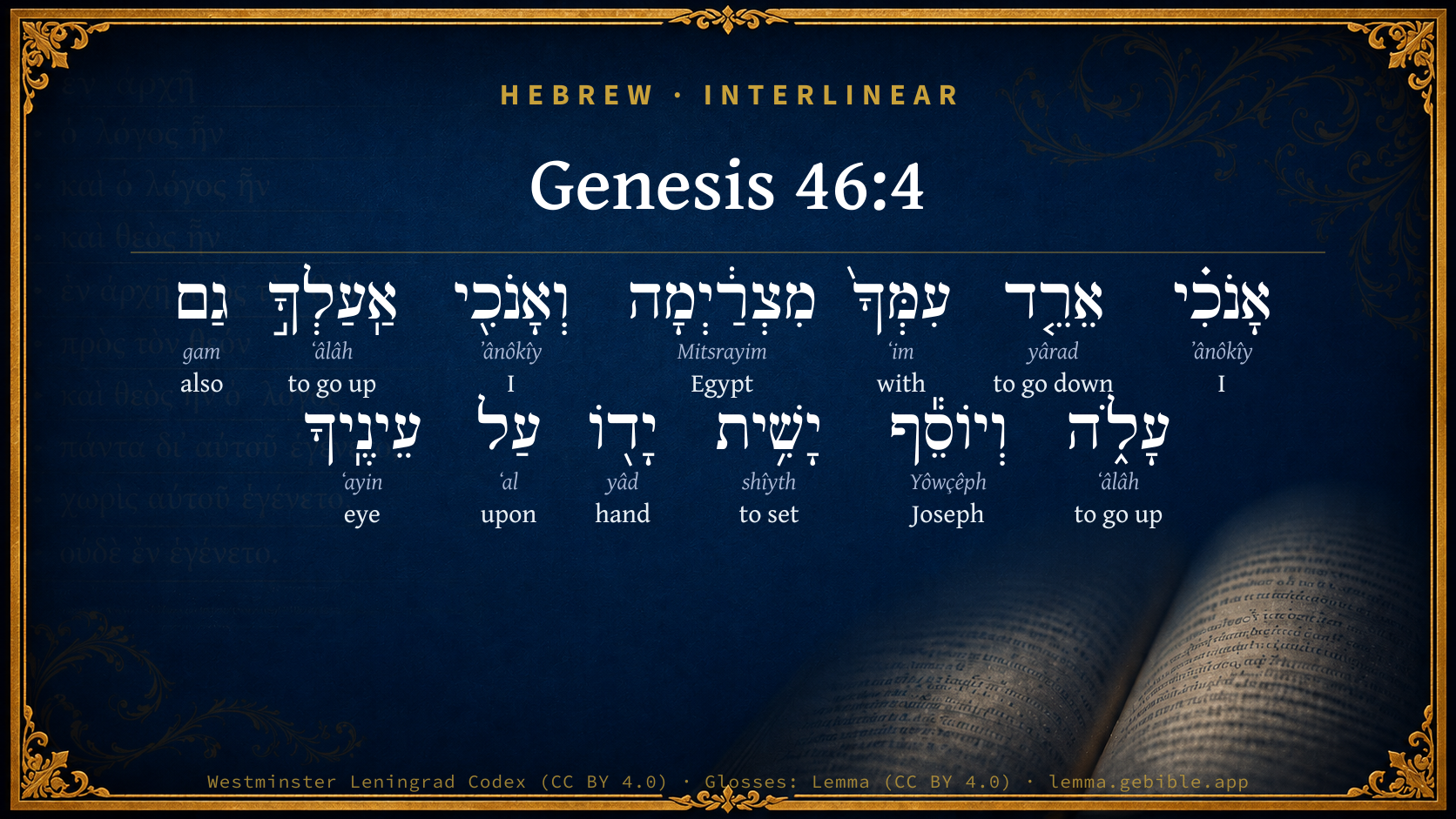
Hebrew (Westminster Leningrad Codex) Genesis 46:4 appears in the Hebrew Old Testament. The text above is from the Westminster Leningrad Codex. Each word links to its Strong’s number, a concise gloss, and parsing drawn from the Open Scriptures Hebrew Bible morphology. Click any word for its full Brown-Driver-Briggs (BDB) entry.
Download image
Cite this verse

Genesis 46:4 (World English Bible). Public Domain. Lemma interlinear Bible study tool, https://lemma.gebible.app/v/genesis/46/4.

Show BibTeX & RIS
BibTeX
RIS
English Translation
I will go down with you into Egypt. I will also surely bring you up again. Joseph will close your eyes."
World English Bible · Public Domain
Download a study sheet

One document with this verse’s original text, its word-by-word gloss line, the meaning frame, cross-references with their text, attributed commentary, and full source and license credits — printable, and it pastes into notes with its structure intact.

This verse Autodidact and up

Study sheet (.html) Plain text (.txt)

A passage Seminary Student

Up to 50 verses in one chapter. A passage sheet keeps up to 6 commentary sources and 12 cross-references per verse, in the order this page ranks them, and says so on the sheet whenever that leaves anything out. Ask for a single verse and you get the Autodidact verse sheet above.

Everything on this page stays free to read, with no account — the sheet is a download of what is already on screen, not access to it.

Want to remove ads? Support Godless Engineer
Compare translations 3

The same verse in 3 English versions, stacked beneath the original-language interlinear above. Click any original word for its lexicon entry.

Each is an independent rendering of the whole verse — the interlinear is not word-aligned to these translations.

Highlighted words mark where these versions differ — a whole-verse word diff, not a word-by-word alignment.

  • World English Bible Public Domain
    I will go down with you into Egypt. I will also surely bring you up again. Joseph will close your eyes."
  • King James Version Public Domain
    I will go down with thee into Egypt; and I will also surely bring thee up again: and Joseph shall put his hand upon thine eyes.
  • unfoldingWord Literal Text CC BY-SA 4.0
    I myself will go down with you to Egypt, and I myself will also surely bring you up. And Joseph will put his hand over your eyes.”

unfoldingWord Literal Text — © unfoldingWord, licensed CC BY-SA 4.0. Word-aligned USFM3 via Door43 (git.door43.org/unfoldingWord/en_ult).

Versions to compare (up to 4)

3 of 4 selected

Show all 18 translations

Every available English version of this verse, each an independent rendering of the whole verse.

  • World English Bible Public Domain
    I will go down with you into Egypt. I will also surely bring you up again. Joseph will close your eyes."
  • Berean Standard Bible Public Domain
    I will go down with you to Egypt, and I will surely bring you back. And Joseph’s own hands will close your eyes.”
  • Majority Standard Bible Public Domain
    I will go down with you to Egypt, and I will surely bring you back. And Joseph’s own hands will close your eyes.”
  • King James Version Public Domain
    I will go down with thee into Egypt; and I will also surely bring thee up again: and Joseph shall put his hand upon thine eyes.
  • American Standard Version (1901) Public Domain
    I will go down with thee into Egypt; and I will also surely bring thee up again: and Joseph shall put his hand upon thine eyes.
  • Revised Version (1885) Public Domain
    I will go down with thee into Egypt; and I will also surely bring thee up again: and Joseph shall put his hand upon thine eyes.
  • Geneva Bible (1599) Public Domain
    I wil go downe with thee into Egypt, and I will also bring thee vp againe, and Ioseph shall put his hand vpon thine eyes.
  • Douay-Rheims (1899) Public Domain
    I will go down with thee thither, and will bring thee back again from thence: Joseph also shall put his hands upon thy eyes.
  • Young's Literal Translation Public Domain
    I -- I go down with thee to Egypt, and I -- I also certainly bring thee up, and Joseph doth put his hand on thine eyes.'
  • Literal Standard Version CC BY-SA 4.0
    I go down with you to Egypt, and I also certainly bring you up, and Joseph puts his hand on your eyes.”
  • Unlocked Literal Bible CC BY-SA 4.0
    I will go down with you into Egypt, and I will surely bring you up again and Joseph will close your eyes with his own hand.”
  • unfoldingWord Literal Text CC BY-SA 4.0
    I myself will go down with you to Egypt, and I myself will also surely bring you up. And Joseph will put his hand over your eyes.”
  • Darby Bible Public Domain
    I will go down with thee to Egypt, and I will also certainly bring thee up; and Joseph shall put his hand on thine eyes.
  • World Messianic Bible Public Domain
    I will go down with you into Egypt. I will also surely bring you up again. Joseph’s hand will close your eyes.”
  • Webster's Bible Public Domain
    I will go down with thee into Egypt; and I will also surely bring thee up again: and Joseph shall put his hand upon thine eyes.
  • Free Bible Version CC BY-SA 4.0
    I will go to Egypt with you, and I promise to bring you back again. And Joseph will personally close your eyes when you die.”
  • Bible in Basic English Public Domain
    I will go down with you to Egypt, and I will see that you come back again, and at your death Joseph will put his hands on your eyes.
  • JPS Tanakh (1917) Public Domain
    I will go down with thee into Egypt; and I will also surely bring thee up again; and Joseph shall put his hand upon thine eyes.'

Literal Standard Version (2020), Covenant Press — licensed CC BY-SA 4.0. Text via the HelloAO Bible API (eBible.org). Unlocked Literal Bible (unfoldingWord) — licensed CC BY-SA 4.0. Text via the HelloAO Bible API (eBible.org). unfoldingWord Literal Text — © unfoldingWord, licensed CC BY-SA 4.0. Word-aligned USFM3 via Door43 (git.door43.org/unfoldingWord/en_ult). Free Bible Version, Dr. Jonathan Gallagher — licensed CC BY-SA 4.0. Text via the HelloAO Bible API (eBible.org).

Word by word

More ways to search: Search by grammar → Find every occurrence → Compare this word →

Practice this passage: Drill this verse → Learn its vocabulary →

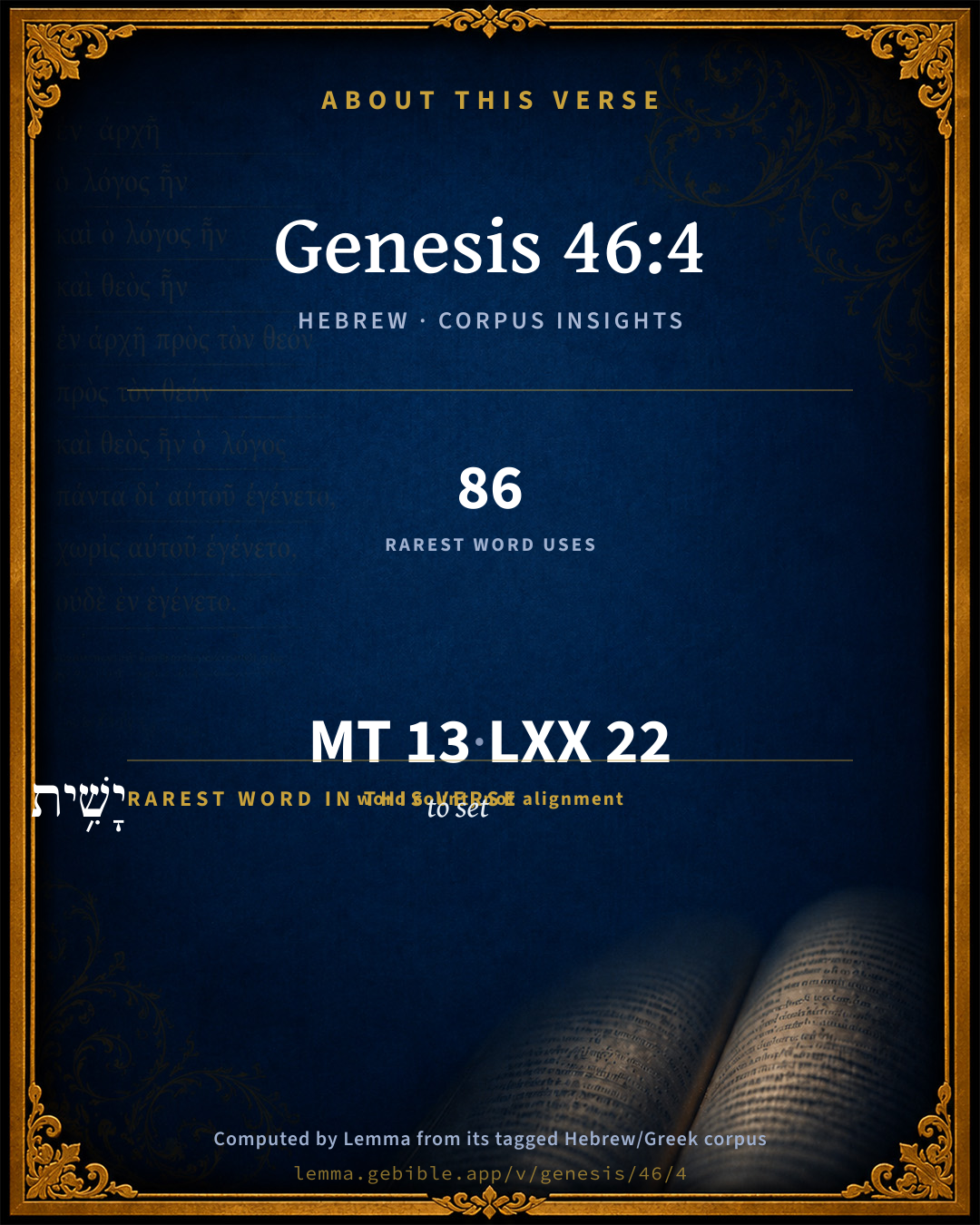
יָשִׁ֥ית
shîyth
H7896
“to set”
Verb, Qal, Imperfect, 3rd Person, Masculine, Singular
Part of Speech
Verb
Stem
Qal
Form
Imperfect
Person
3rd Person
Gender
Masculine
Number
Singular
Full BDB Definition

Origin: a primitive root

TWOT: 2380

to put, set - (Qal) - to put, lay (hand upon) - to set, station, appoint, fix, set mind to - to constitute, make (one something), make like, perform - to take one's stand - to lay waste - (Hophal) to be imposed, be set upon
  1. אָנֹכִ֗י ʼânôkîy H595 “I” Pronoun, Personal, 1st Person, Common, Singular
  2. אֵרֵ֤ד yârad H3381 “to go down” Verb, Qal, Imperfect, 1st Person, Common, Singular
  3. עִמְּךָ֙ ʻim H5973 “with · you” Preposition + Suffix, Personal, 2nd Person, Masculine, Singular
  4. מִצְרַ֔יְמָה Mitsrayim H4714 “Egypt · toward” Noun, Proper + Suffix, Demonstrative
  5. וְאָנֹכִ֖י ʼânôkîy H595 “and · I” Conjunction + Pronoun, Personal, 1st Person, Common, Singular
  6. אַֽעַלְךָ֣ ʻâlâh H5927 “to go up · you” Verb, Hiphil, Imperfect, 1st Person, Common, Singular + Suffix, Personal, 2nd Person, Masculine, Singular
  7. גַם gam H1571 “also” Adverb
  8. עָלֹ֑ה ʻâlâh H5927 “to go up” Verb, Qal, Infinitive Absolute
  9. וְיוֹסֵ֕ף Yôwçêph H3130 “and · Joseph” Conjunction + Noun, Proper
  10. יָד֖וֹ yâd H3027 “hand · his” Noun, Common, Both, Singular, Construct + Suffix, Personal, 3rd Person, Masculine, Singular
  11. עַל ʻal H5921 “upon” Preposition
  12. עֵינֶֽיךָ ʻayin H5869 “eyes · your” Noun, Common, Both, Dual, Construct + Suffix, Personal, 2nd Person, Masculine, Singular

About this verse

These counts appear in no published source. They are computed here, from the morphology-tagged text and Lemma’s own curated glosses. What Lemma adds →

13
words
11
distinct lemmas
Pentateuch
section

Grammatical profile

  • 4 verbs
  • 4 nouns
  • 2 pronouns
  • 2 prepositions
  • 1 adverb

Verb forms

  • אֵרֵ֤ד Qal · Imperfect
  • אַֽעַלְךָ֣ Hiphil · Imperfect
  • עָלֹ֑ה Qal · Infinitive Absolute
  • יָשִׁ֥ית Qal · Imperfect

Repetition

Words recur within this verse — often emphatic in Hebrew:

  • אַֽעַלְךָ֣ to go up H5927 ×2
  • אָנֹכִ֗י I H595 ×2

Hebrew & Septuagint length

In English translation the verse runs 21 words from the Hebrew and 27 from the Septuagint (LXX English) — closely comparable.

A rough comparison of the two English renderings, which tokenize alike — not a word-level alignment.

Word counts can differ between the Hebrew and the Greek without any difference in meaning — e.g. the Hebrew direct-object marker אֵת has no separate Greek word, and Greek often adds the article ὁ.

In the original languages it is 13 Hebrew tokens and 22 Greek tokens — but the two are counted differently (Hebrew bundles its prefixes and suffixes into one token; the Greek is in lemma form), so that isn’t a like-for-like length.

Cross-references

9

Topical passages linked to Genesis 46:4 in the Treasury of Scripture Knowledge — connected by theme and wording, ordered by reader-vote popularity; previews shown in the World English Bible.

  • Genesis 28:15 Behold, I am with you, and will keep you, wherever you go, and will bring you again into this land. For I will not leave you, until I have done that which I have spoken of to you."
  • Exodus 3:8 I have come down to deliver them out of the hand of the Egyptians, and to bring them up out of that land to a good and large land, to a land flowing with milk and honey; to the place of the Canaanite, the Hittite, the Amorite, the Perizzite, the Hivite, and the Jebusite.
  • Genesis 48:21 Israel said to Joseph, "Behold, I am dying, but God will be with you, and bring you again to the land of your fathers.
  • Genesis 50:1 Joseph fell on his father's face, wept on him, and kissed him.
  • Genesis 15:14–16 I will also judge that nation, whom they will serve. Afterward they will come out with great substance.
  • Genesis 50:5 'My father made me swear, saying, "Behold, I am dying. Bury me in my grave which I have dug for myself in the land of Canaan." Now therefore, please let me go up and bury my father, and I will come again.'"
  • Genesis 50:13 for his sons carried him into the land of Canaan, and buried him in the cave of the field of Machpelah, which Abraham bought with the field, for a possession of a burying-place, from Ephron the Hittite, before Mamre.
  • Genesis 50:24–25 Joseph said to his brothers, "I am dying, but God will surely visit you, and bring you up out of this land to the land which he swore to Abraham, to Isaac, and to Jacob."
  • Isaiah 43:1–2 But now thus says Yahweh who created you, Jacob, and he who formed you, Israel: Don't be afraid, for I have redeemed you; I have called you by your name, you are mine.

Cross-references courtesy of OpenBible.info (CC BY 4.0).

Hebrew and Greek witnesses Masoretic Hebrew ↔ Greek Septuagint

The same verse in the two great witnesses to the Old Testament, shown verse-for-verse.

These are two independent witnesses, not word-aligned to each other, and the Septuagint is shown in lemma (dictionary) form.

Hebrew Genesis 46:4 Masoretic · Westminster Leningrad Codex

אָנֹכִ֗י אֵרֵ֤ד עִמְּךָ֙ מִצְרַ֔יְמָה וְאָנֹכִ֖י אַֽעַלְךָ֣ גַם עָלֹ֑ה וְיוֹסֵ֕ף יָשִׁ֥ית יָד֖וֹ עַל עֵינֶֽיךָ

I will go down with you into Egypt. I will also surely bring you up again. Joseph will close your eyes."

World English Bible · Public Domain

Greek LXX Genesis 46:4 Septuagint · lemma form

καί ἐγώ καταβαίνω μετά σύ εἰς αἴγυπτος καί ἐγώ ἀναβιβάζω σύ εἰς τέλος καί ιωσηφ ἐπιβάλλω ὁ χείρ ἐπί ὁ ὀφθαλμός σύ

And I will go down with you into Egypt, and I will bring you up at the end; and Joseph shall put his hands on your eyes.

LXX2012 (modern English Septuagint) · Public Domain

On this verse, Haydock's Catholic Bible Commentary discusses the Septuagint’s reading. Read the note in Commentary ↓

Hebrew: Westminster Leningrad Codex (CC BY 4.0). Greek: Septuagint (public domain); English from LXX2012 (modern English Septuagint) (Public Domain). How the Septuagint differs from the Hebrew →

Targum (Aramaic paraphrase)

2

The Targum is the ancient Jewish Aramaic paraphrase of the Hebrew Scriptures — an interpretive translation, not the Hebrew text itself. Onkelos (literal) and Pseudo-Jonathan (expansive) render the Torah, and Jonathan the Prophets. Coverage is partial: where no permissively-licensed English translation exists for a verse, only the Aramaic is shown. This is verse-level text, not a word-by-word alignment to the Hebrew.

  1. Targum Onkelos Torah (Genesis–Deuteronomy)
    אֲנָא אֵחוֹת עִמָּךְ לְמִצְרַיִם וַאֲנָא אַסֵּקִנָּךְ אַף אַסָּקָא וְיוֹסֵף יְשַׁוֵּי יְדוֹהִי עַל עֵינָיךְ

    (no public-domain English translation for this verse)

    Targum Onkelos — Aramaic: “Onkelos Genesis” (public domain); “Onkelos Exodus” (public domain); “Onkelos Leviticus” (public domain); “Onkelos Numbers” (public domain); “Onkelos Deuteronomy” (public domain). English: “Sefaria Community Translation” (CC0 1.0 (public-domain dedication)); “J.W. Etheridge. The Targums of Onkelos and Jonathan Ben Uzziel on the Pentateuch. London: Longmans, Green, 1862” (public domain). Text via Sefaria.

  2. Targum Pseudo-Jonathan Torah (Genesis–Deuteronomy)
    אֲנָא הוּא דִבְמֵימְרִי אֵיחוֹת עִמָךְ לְמִצְרַיִם וְאֵיחְמֵי סִיגוּפֵיהוֹן דִבְנָךְ וּמֵימְרִי יַעֲלִינָךְ תַּמָן אוּף אַפִּיק יַת בְּנָךְ מִתַּמָן וּבְרַם יוֹסֵף יְשַׁוֵי יְדֵיהּ עַל עֵינָךְ

    I am He who in My Word will go down with thee into Mizraim; I will regard the affliction of thy children, and My Word shall bring thee up from thence, and cause thy children to come up; but Joseph shall lay his hand upon thine eyes.

    Targum Pseudo-Jonathan — Aramaic: “Targum Jonathan on Genesis” (public domain); “Targum Jonathan on Exodus” (public domain); “Targum Jonathan on Leviticus” (public domain); “Targum Jonathan on Numbers” (public domain); “Targum Jonathan on Deuteronomy” (public domain). English: “The Targum of Jonathan ben Uzziel, trans. J. W. Etheridge, London, 1862” (public domain). Text via Sefaria.

Commentary

Notes on Genesis 46:4 from classic Christian and Jewish commentators (each source and its license shown beneath its notes). The classic Christian expositions comment on the surrounding passage and are grouped to its opening verse, so a note may address several verses; the Jewish commentaries on the Tanakh (Rashi and others) are per-verse, so they appear only where the commentator wrote on this verse.

Lemma curates 59 commentaries, every one of them public domain or Creative Commons licensed, each selected and text-cleaned for this edition rather than reprinted as found. About our sources →

Trapp's Complete Commentary

John Trapp

Gen 46:4 I will go down with thee into Egypt; and I will also surely bring thee up [again]: and Joseph shall put his hand upon thine eyes.

Ver. 4. I will go down with thee.] That was as good security as could be. For if Caesar could say to the fearful ferryman, in a terrible storm, Be of good cheer, thou carriest Caesar, and therefore canst not miscarry; {a} how much more may he presume to be safe that hath God in his company! A child in the dark fears nothing while he hath his father by the hand.

And I will also surely bring thee up again.] So saith God to his dying people when they are to enter into the grave. He will surely bring them back from the jaws of death to the joys of eternal life. Yea, by rotting, he will refine their frail bodies; as the goldsmith melts a picture of gold, or bruised piece of plate that is out of fashion, to make it up better.

And Joseph shall put his hand upon thine eyes.] An ancient and an honourable custom, in use among the Romans also, as Pliny tells us. The eyes are commonly open, lift up to heaven, when men are dying; unless they be such as that pope was, who, breathing out his last, said, Now I shall know whether the soul be immortal, or not. {b} Or that desperate advocate in the court of Rome, mentioned by Bellarmine, who, dying, used these words, Ego propero ad inferos, neque est, ut aliquid pro me agat Deus. But Jacob had hope in his death; and Joseph had the honour of closing up those eyes, that shall shortly "see God" again "in the flesh." {Job 19:26}

{a} Perge contra tempestatem forti animo: Caesarem fers, et fortunam Caesaris.

{b} Sic Benedic. IX, Alexander VI, and Leo X. - Bell., De Arte Moriendi, lib. ii. cap. 10.

John Trapp, A Commentary or Exposition upon All the Books of the Old and New Testament (1647–1656) — public domain. Text from a community e-Sword module.

Joseph Benson's Commentary

Gen 46:4. I will go down with thee into Egypt — Those that go where God sends them shall certainly have God with them. And I will surely bring thee up again — Though Jacob died in Egypt, yet this promise was fulfilled. 1st, In the bringing up of his body to be buried in Canaan. 2d, In the bringing up of his seed to be settled in Canaan. Whatever low and darksome valley we are called into, we may be confident, if God go down with us, he will surely bring us up again. If he go with us down to death, he will surely bring us up again to glory. And Joseph shall put his hand upon thine eyes — This is a promise that Joseph should live as long as he lived, that he should be with him at his death, and close his eyes with all possible tenderness. Probably Jacob, in the multitude of his thoughts within him, had been wishing that Joseph might do this last office of love for him; and God thus answered him in the letter of his desire. Thus God sometimes gratifies the innocent wishes of his people, and makes not only their death happy, but the very circumstances of it agreeable.

Joseph Benson's Commentary on the Old and New Testaments (1811–1818) — public domain. Text from a community e-Sword module.

Tyndale Open Study Notes

Tyndale Open Resources

46:4 You will die: He would have a peaceful death, surrounded by his family and many blessings from God (49:33).

Tyndale Open Study Notes — © Tyndale Open Resources, licensed CC BY-SA 4.0. Text via the HelloAO Bible API.

Geneva Bible (1599)

Geneva Bible translators

Conducting thee by my power.

In thy posterity.

Shall shut thine eyes when thou diest: which appertained to him that was most dearest, or chief of the kindred.

Geneva Bible (1599) marginal notes — public domain. Text via Bolls.life.

Jamieson, Fausset & Brown

Robert Jamieson, A. R. Fausset & David Brown

I will also surely bring thee up again--As Jacob could not expect to live till the former promise was realized, he must have seen that the latter was to be accomplished only to his posterity. To himself it was literally verified in the removal of his remains to Canaan; but, in the large and liberal sense of the words, it was made good only on the establishment of Israel in the land of promise.

Joseph shall put his hand upon thine eyes--shall perform the last office of filial piety; and this implied that he should henceforth enjoy, without interruption, the society of that favorite son.

Jamieson, Fausset & Brown — Commentary Critical and Explanatory on the Whole Bible (1871) — public domain (CC PDM 1.0). Text via the HelloAO Bible API.

John Calvin's Commentaries

4. And Joseph shall put his hand upon thine eyes. This clause was added for the sake of showing greater indulgence. For though Jacob, in desiring that, when he died, his eyes should be closed by the hand of Joseph, showed that some infirmity of the flesh was involved in the wish; yet God is willing to comply with it, for the sake of moderating the grief of a fresh banishment. Moreover, we know that the custom of closing the eyes was of the greatest antiquity; and that this office was discharged by one most closely connected with the deceased either by blood or affection.

John Calvin's Commentaries (1540-1563) — public domain. Text from the Calvin Translation Society English edition (1840s-50s) via the Christian Classics Ethereal Library (ccel.org). Calvin's coverage is partial (roughly two-thirds of the Bible); uncommented books and verses are honest gaps, never fabricated. The 19th-century editor's footnotes and remarks are omitted so the notes are faithfully Calvin's own voice.

Ellicott's Commentary for English Readers

(4) Joseph shall put his hand upon thine eyes.—Both among the Jews and Greeks it was the duty of those nearest in blood to close the eyes of a deceased relative. The promise conveyed the assurance that Jacob would die peacefully, surrounded by his friends. For the fulfilment see Gen_1:1.

A Bible Commentary for English Readers, edited by Charles John Ellicott (1878–1897) — public domain. Text from a community e-Sword module.

The Cambridge Bible for Schools and Colleges

gen. ed. J. J. S. Perowne

4. I will go down] The promise of the Divine presence is the assurance of safety and blessing. God is no mere local god of Canaan. He will be with His people, where they are; whether in Mesopotamia (Gen_31:13), in Palestine (Gen_35:3), or in Egypt.

bring thee up again] i.e. from Egypt back into Canaan. The pronoun “thee” must surely be understood of the people descended from, and personified by, Jacob, and identified with his name. It does not predict his burial in Canaanite land. The words may best be illustrated from Gen_50:24, and not from Gen_50:13. They foretell the Exodus of the Israelites, not the burial of Jacob.

put his hand … eyes] The last tender office performed by the nearest relative. The promise is fulfilled; see Gen_50:1.

The Cambridge Bible for Schools and Colleges (gen. ed. J. J. S. Perowne; Cambridge University Press, 1878–1918) — public domain. Text from a community e-Sword module.

John Gill's Exposition

I will go down with thee into Egypt,.... Which was enough to silence all his fears; for if the presence of God went with him to protect and defend hide, to bless and prosper him, and to direct, support, and comfort, he had nothing to fear from any quarter:

and I will also surely bring thee up again: Jarchi takes this to be a promise that he should be buried in the land of Canaan, which had its fulfilment, when his corpse was carried out of Egypt to Machpelah, and there interred; but rather this refers to the bringing up of his posterity from thence in due time, for which Jacob might be most solicitous, and so the Targum of Jonathan,"and I will bring up thy children from thence:"

and Joseph shall put his hand upon thine eyes: and so close them when he was dead; this, as Aben Ezra says, was a custom of the living to the dead, and it used to be done by the nearest relations and friends, though now with us commonly by strangers, or those that are not akin: this was a custom among the Greeks and Romans, as appears from Homer (o), Virgil (p), Ovid (q), and other writers (r); and so, among the Jews, Tobias is said to shut the eyes of his wife's father and mother, and to bury them honourably,"Where he became old with honour, and he buried his father and mother in law honourably, and he inherited their substance, and his father Tobit's.'' (Tobit 14:13)Of the Vulgate Latin version: Maimonides (s) reckons this of closing the eyes of the dead, among the rites used towards them, and so in the Talmud (t): now by this expression Jacob was assured that Joseph was alive, and that he should live to see him, and that Joseph would outlive him, and do this last office for him; and, as Ben Melech observes, by this he had the good news told him that Joseph should remain behind him, to sustain and support his sons, and his sons' sons, all the years that he should live after him.

(o) Odyss. 11. (p) Aeneid. l. 9. (q) Trist. l. 1. Eleg. 2. (r) Vid. Kirchman, de Funer. Rom. l. 1. c. 6. & Kipping. Rom. Antiqu. l. 4. c. 6. (s) Hilchot Ebel, l. 4. sect. 1. (t) T. Bab. Sabbat, fol. 151. 2.

John Gill's Exposition of the Whole Bible (1746–1763) — public domain (CC PDM 1.0). Text via the HelloAO Bible API.

Haydock's Catholic Bible Commentary

Thence; in thy posterity. Septuagint add at last, or after a long time. Jacob’s bones were brought back and buried in Chanaan. (Calmet) --- Eyes, as he is the most dear to thee. Parents closed the eyes of their children in death. The Romans opened them again when the corpse was upon the funeral pire; thinking it a mark of disrespect for the eyes to be shut to heaven; "ut neque ab homine supremum eos spectari fas sit, & cœlo non ostendi, nefas." (Pliny, xi. 37.)

George Leo Haydock (1774–1849), Haydock's Catholic Family Bible and Commentary, 1859 edition — public domain. Excludes Psalms (Douay-Rheims chapter numbering differs from Protestant) and Deuterocanonical books (Catholic canon only).

Matthew Poole's English Annotations

I will bring thee up again, though not in thy person, yet in thy body, Gen 47:29-30; 50:5,13; and in thy posterity, which are a part of thyself, or thyself multiplied.

Joseph shall put his hand upon thine eyes; shall close thy eyes; which office was usually performed by the nearest and dearest relations of the dying party among the Jews, Greeks, and Romans. Hereby Jacob is assured that he should die in peace, and that Joseph both now was alive, and should survive his father.

Matthew Poole's English Annotations on the Holy Bible (1683–1685) — public domain. Text from a community e-Sword/MySword module.

Whedon's Commentary on the Bible

Daniel D. Whedon

4. I will go down with thee into Egypt — And if God be with us, who can be against us?

And I will also surely bring thee up — “Wonderfully worded promise! Personally, he was then bidding those scenes an everlasting farewell; but in the mediatorial nation which was to spring from him, and with which, as heir of God’s covenant, he was identified, he would return again. In this hope, by faith, he was to be glad though he die in Egypt, for it is added immediately, Joseph shall put his hand upon thine eyes, to close them in death; the last sad duty of love. Ancient writers of other nations frequently make pathetic allusion to this last ministration of affection. (Compare Homer’s Iliad, 11:453; Odyssey, 11:426; 24:296; Ovid, Heroides, 1:102, etc.”) — Newhall.

Daniel D. Whedon (gen. ed.), Commentary on the Old and New Testaments (1874–1909) — public domain. Text from a community e-Sword module.

The Pulpit Commentary

I will go down with thee into Egypt; not a proof that the Hebrews believed.in a local deity following them when they changed their abodes, and confined to the district in which they happened for tire time being to reside (Tuch, Bohlen), but simply a metaphorical expression for the efficiency and completeness of the Divine protection (Kalisch)and I will also surely bring thee up again (literally, and I will bring thee up also, bringing thee up; a double emphasis lying in the use of the infinitive absolute, with preceding, as in Gen_31:15, meaning that God would assuredly recover his body for interment in Canaan should he die in Egypt, and his descendants for settlement in the land of their inheritance): and Joseph shall put his hand upon thine eyes i.e. will perform for thee the last offices of affection by closing thine eyes in death, a service upon which the human heart in all ages and countries has set the highest value (vide Homer, " I1." 11. 453; "Odys.," 24:294; Virg., "AEn.," 9:487; Ovid, " Epist.," 1:162). "A father at the point of death is always very desirous that his wife, children, and grandchildren should be with him. Should there be one at a distance, he will be immediately sent for, and until he arrive the father will mourn and complain, "My son, will you not come? I cannot die without you." When he arrives, he will take the hands of his son, and kiss them, and place them on his eyes, his face, and mouth, and say, " Now I die. (Roberts" "Oriental Illustrations," p. 52).

The Pulpit Commentary (1880–1919), ed. H.D.M. Spence-Jones & Joseph S. Exell — public domain. Text from a community e-Sword module.

John Wesley's Explanatory Notes

I will go down with thee into Egypt - Those that go where God sends them shall certainly have God with them. And I will surely bring thee up again - Tho' Jacob died in Egypt, yet this promise was fulfilled,

1. In the bringing up of his body to be buried in Canaan.

2. In the bringing up of his seed to be settled in Canaan. Whatever low and darksome valley we are called into, we may be confident if God go down with us, he will surely bring us up again. If he go with us down to death, he will surely bring us up again to glory. And Joseph shall put his hand upon thine eyes - That is a promise that Joseph should live as long as he lived, that he should be with him at his death, and close his eyes with all possible tenderness. Probably Jacob, in the multitude of his thoughts within him, had been wishing that Joseph might do this last office of love for him; and God thus answered him in the letter of his desire. Thus God sometimes gratifies the innocent wishes of his people, and makes not only their death happy, but the very circumstances of it agreeable.

John Wesley, Explanatory Notes Upon the Whole Bible (1754–1765) — public domain. Text via the GEBible commentary corpus.

Rashi

Rabbi Shlomo Yitzchaki (Rashi)

ואנכי אעלך AND I MYSELF WILL ALSO SURELY BRING THEE UP AGAIN — Here He promised him that he would be buried in the Holy Land (Talmud Yerushalmi Sotah 1:10).

Rashi on the Tanakh — English translations: “The Judaica Press complete Tanach with Rashi, translated by A. J. Rosenberg” (CC BY 4.0); “Pentateuch with Rashi's commentary by M. Rosenbaum and A.M. Silbermann, 1929-1934” (public domain); “The Metsudah Tanach series, Lakewood, N.J” (CC BY 4.0); and “The Book of Joshua, Metsudah Publications, 1997” (CC BY 4.0). Text via Sefaria.

Radak

Rabbi David Kimhi (Radak)

אנכי ארד עמך, the meaning of these words is that you will not suffer a mishap on the way to Egypt.

ואנכי אעלך, as we explained already on the preceding verse. Another possible explanation: the words refer to the person of Yaakov himself, G’d promising that He would be with him on his way to burial in the land of Canaan. The reason G’d added the words: גם עלה would then be a reference to his children who would carry him from Egypt to Canaan to be buried there.

ויוסף ישית ידו על עיניך, we see that this promise was fulfilled in 50,1 when the Torah reports ויפול יוסף על פני אביו, “that Joseph fell on the face of his father.” The promise mentioned here included the fact that after Yaakov’s death Joseph would look after the economic requirements of the brothers and their families. [presumably based on Yaakov’s knowledge that the famine would start again after his death. Ed.]

Radak on the Tanakh — English translations: “Sefaria Community Translation” (CC0 1.0 (public-domain dedication)); “Eliyahu Munk, HaChut Hameshulash” (CC BY 4.0); “Rabbi Mike Feuer, Jerusalem Anthology” (CC BY 4.0); and “R. David Kimhi on the first book of Psalms, Translated by R.G. Finch, London, 1919” (public domain). Text via Sefaria.

Lesson kit

Teaching starters — assembled from the data on this page, not authored interpretation. Every prompt links to the verse data it draws on. Edit before teaching.

Genesis, in the Pentateuch, opens this verse with 13 words (11 distinct Hebrew lemmas). Its most distinctive word is shîyth (“to set”). A historical commentator’s framing appears above. Read the whole chapter for the surrounding context.

Discussion questions

  1. What does “to set” (shîyth) contribute to the verse as a whole?
  2. Genesis 28:15 shares this passage’s theme. How do the two illuminate each other?
  3. “to go up” occurs 2× in this one verse. What is the effect of the repetition?
  4. The translations on this page render this verse differently — a whole-verse word diff, not a word-by-word alignment. What might account for the different wordings?
  5. The verb «אֵרֵ֤ד» is Qal Imperfect. How does its form color the action?
  6. Reading how Trapp's Complete Commentary and Joseph Benson's Commentary read this verse, where do the two commentators agree and where do they part?

Things to notice

Reading settings

Reading text

Shown beneath each verse's original-language words.

Old Testament
Old Testament edition

Read the OT as the Masoretic Hebrew (MT) or the Greek Septuagint (LXX).

English shown for the Greek Septuagint (in the Hebrew ↔ Greek comparison).

Comparing translations? Open the Compare panel on any verse page to stack up to four side by side.