Numbers 13:31

Hebrew (Westminster Leningrad Codex) Numbers 13:31 appears in the Hebrew Old Testament. The text above is from the Westminster Leningrad Codex. Each word links to its Strong’s number, a concise gloss, and parsing drawn from the Open Scriptures Hebrew Bible morphology. Click any word for its full Brown-Driver-Briggs (BDB) entry.
Download image
Cite this verse

Numbers 13:31 (World English Bible). Public Domain. Lemma interlinear Bible study tool, https://lemma.gebible.app/v/numbers/13/31.

Show BibTeX & RIS
BibTeX
RIS
English Translation
But the men who went up with him said, We aren't able to go up against the people; for they are stronger than we.
World English Bible · Public Domain
Download a study sheet

One document with this verse’s original text, its word-by-word gloss line, the meaning frame, cross-references with their text, attributed commentary, and full source and license credits — printable, and it pastes into notes with its structure intact.

This verse Autodidact and up

Study sheet (.html) Plain text (.txt)

A passage Seminary Student

Up to 50 verses in one chapter. A passage sheet keeps up to 6 commentary sources and 12 cross-references per verse, in the order this page ranks them, and says so on the sheet whenever that leaves anything out. Ask for a single verse and you get the Autodidact verse sheet above.

Everything on this page stays free to read, with no account — the sheet is a download of what is already on screen, not access to it.

Want to remove ads? Support Godless Engineer
Compare translations 3

The same verse in 3 English versions, stacked beneath the original-language interlinear above. Click any original word for its lexicon entry.

Each is an independent rendering of the whole verse — the interlinear is not word-aligned to these translations.

Highlighted words mark where these versions differ — a whole-verse word diff, not a word-by-word alignment.

  • World English Bible Public Domain
    But the men who went up with him said, We aren't able to go up against the people; for they are stronger than we.
  • King James Version Public Domain
    But the men that went up with him said, We be not able to go up against the people; for they are stronger than we.
  • unfoldingWord Literal Text CC BY-SA 4.0
    But the men who went up with him said, “We are not able to go up against the people, for it stronger than us.”

unfoldingWord Literal Text — © unfoldingWord, licensed CC BY-SA 4.0. Word-aligned USFM3 via Door43 (git.door43.org/unfoldingWord/en_ult).

Versions to compare (up to 4)

3 of 4 selected

Show all 18 translations

Every available English version of this verse, each an independent rendering of the whole verse.

  • World English Bible Public Domain
    But the men who went up with him said, We aren't able to go up against the people; for they are stronger than we.
  • Berean Standard Bible Public Domain
    But the men who had gone up with him replied, “We cannot go up against the people, for they are stronger than we are!”
  • Majority Standard Bible Public Domain
    But the men who had gone up with him replied, “We cannot go up against the people, for they are stronger than we are!”
  • King James Version Public Domain
    But the men that went up with him said, We be not able to go up against the people; for they are stronger than we.
  • American Standard Version (1901) Public Domain
    But the men that went up with him said, We are not able to go up against the people; for they are stronger than we.
  • Revised Version (1885) Public Domain
    But the men that went up with him said, We be not able to go up against the people; for they are stronger than we.
  • Geneva Bible (1599) Public Domain
    Then Caleb stilled the people before Moses, and saide, Let vs go vp at once, and possesse it: for vndoubtedly we shall ouercome it.
  • Douay-Rheims (1899) Public Domain
    In the mean time Caleb, to still the murmuring of the people that rose against Moses, said: Let us go up and possess the land, for we shall be able to conquer it.
  • Young's Literal Translation Public Domain
    And the men who have gone up with him said, `We are not able to go up against the people, for it `is' stronger than we;'
  • Literal Standard Version CC BY-SA 4.0
    And the men who have gone up with him said, “We are not able to go up against the people, for it [is] stronger than we”;
  • Unlocked Literal Bible CC BY-SA 4.0
    But the other men who had gone with him said, “We are not able to attack the people because they are stronger than we are.”
  • unfoldingWord Literal Text CC BY-SA 4.0
    But the men who went up with him said, “We are not able to go up against the people, for it stronger than us.”
  • Darby Bible Public Domain
    But the men that went up with him said, We are not able to go up against the people, for they are stronger than we.
  • World Messianic Bible Public Domain
    But the men who went up with him said, “We aren’t able to go up against the people; for they are stronger than we.”
  • Webster's Bible Public Domain
    But the men that went up with him said, We are not able to go up against the people; for they are stronger than we.
  • Free Bible Version CC BY-SA 4.0
    But the men who had gone with him disagreed. “We can't go and fight these people! They're much stronger than us!”
  • Bible in Basic English Public Domain
    But the men who had gone up with him said, We are not able to go up against the people, for they are stronger than we.
  • JPS Tanakh (1917) Public Domain
    But the men that went up with him said: 'We are not able to go up against the people; for they are stronger than we.'

Literal Standard Version (2020), Covenant Press — licensed CC BY-SA 4.0. Text via the HelloAO Bible API (eBible.org). Unlocked Literal Bible (unfoldingWord) — licensed CC BY-SA 4.0. Text via the HelloAO Bible API (eBible.org). unfoldingWord Literal Text — © unfoldingWord, licensed CC BY-SA 4.0. Word-aligned USFM3 via Door43 (git.door43.org/unfoldingWord/en_ult). Free Bible Version, Dr. Jonathan Gallagher — licensed CC BY-SA 4.0. Text via the HelloAO Bible API (eBible.org).

Word by word

More ways to search: Search by grammar → Find every occurrence → Compare this word →

Practice this passage: Drill this verse → Learn its vocabulary →

חָזָ֥ק
châzâq
H2389
“strong”
Adjective, Adjective, Masculine, Singular, Absolute
Part of Speech
Adjective
Type
Adjective
Gender
Masculine
Number
Singular
State
Absolute
Full BDB Definition

Origin: from H2388

TWOT: 636a

strong, stout, mighty - strong - severe, sharp, hot - firm, hard - a strong one (substantive)
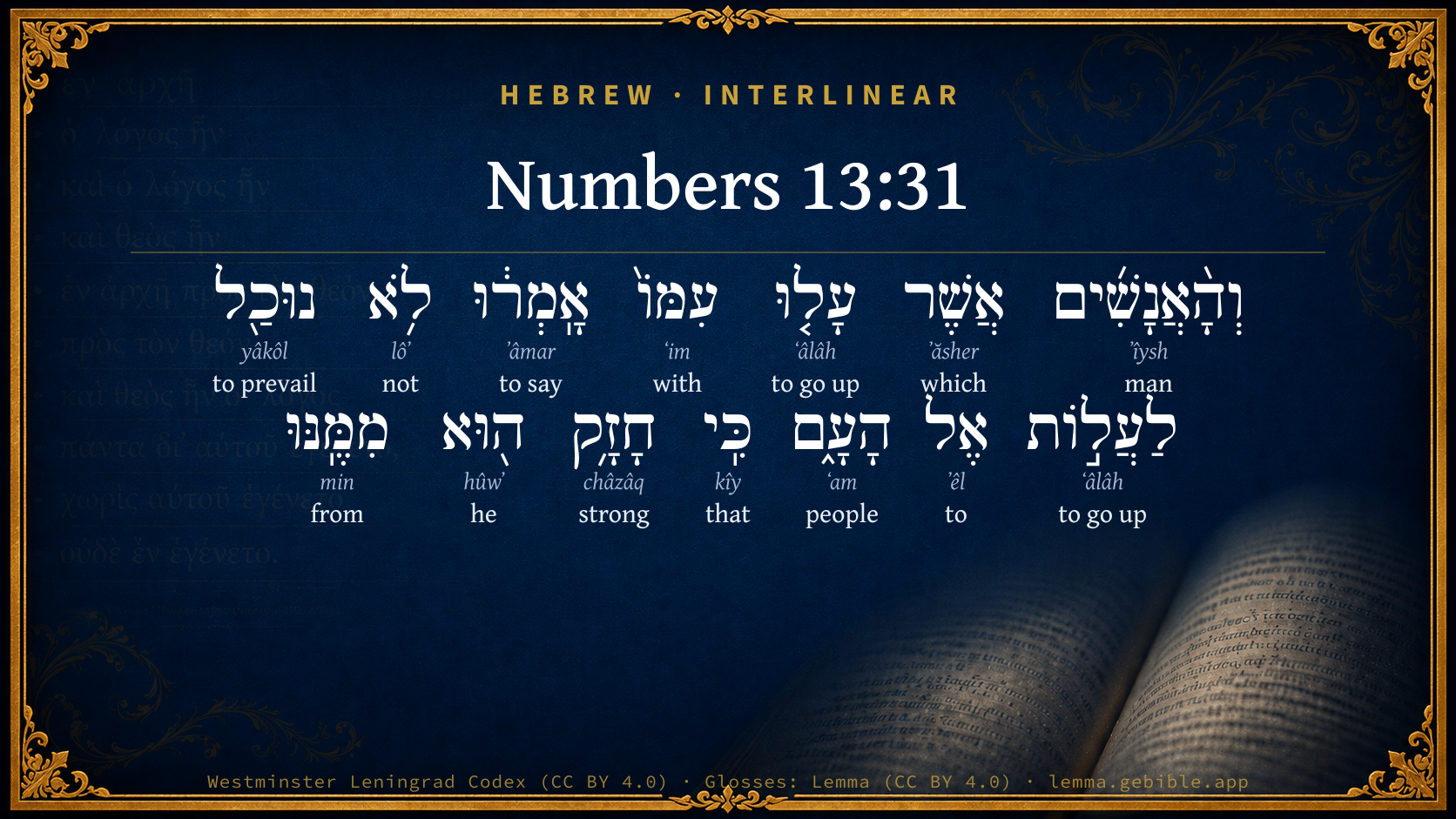
  1. וְהָ֨אֲנָשִׁ֜ים ʼîysh H376 “and · the · men” Conjunction + Particle, Definite Article + Noun, Common, Masculine, Plural, Absolute
  2. אֲשֶׁר ʼăsher H834 “which” Particle, Relative
  3. עָל֤וּ ʻâlâh H5927 “to go up” Verb, Qal, Perfect, 3rd Person, Common, Plural
  4. עִמּוֹ֙ ʻim H5973 “with · him” Preposition + Suffix, Personal, 3rd Person, Masculine, Singular
  5. אָֽמְר֔וּ ʼâmar H559 “to say” Verb, Qal, Perfect, 3rd Person, Common, Plural
  6. לֹ֥א lôʼ H3808 “not” Particle, Negative
  7. נוּכַ֖ל yâkôl H3201 “to prevail” Verb, Qal, Imperfect, 1st Person, Common, Plural
  8. לַעֲל֣וֹת ʻâlâh H5927 “to go up” Preposition + Verb, Qal, Infinitive Construct
  9. אֶל ʼêl H413 “to” Preposition
  10. הָעָ֑ם ʻam H5971 “the · people” Particle, Definite Article + Noun, Common, Masculine, Singular, Absolute
  11. כִּֽי kîy H3588 “that” Conjunction
  12. ה֖וּא hûwʼ H1931 “he” Pronoun, Personal, 3rd Person, Masculine, Singular
  13. מִמֶּֽנּוּ min H4480 “from · us” Preposition + Suffix, Personal, 1st Person, Common, Plural

About this verse

These counts appear in no published source. They are computed here, from the morphology-tagged text and Lemma’s own curated glosses. What Lemma adds →

14
words
13
distinct lemmas
Pentateuch
section

Shared distinctive vocabulary

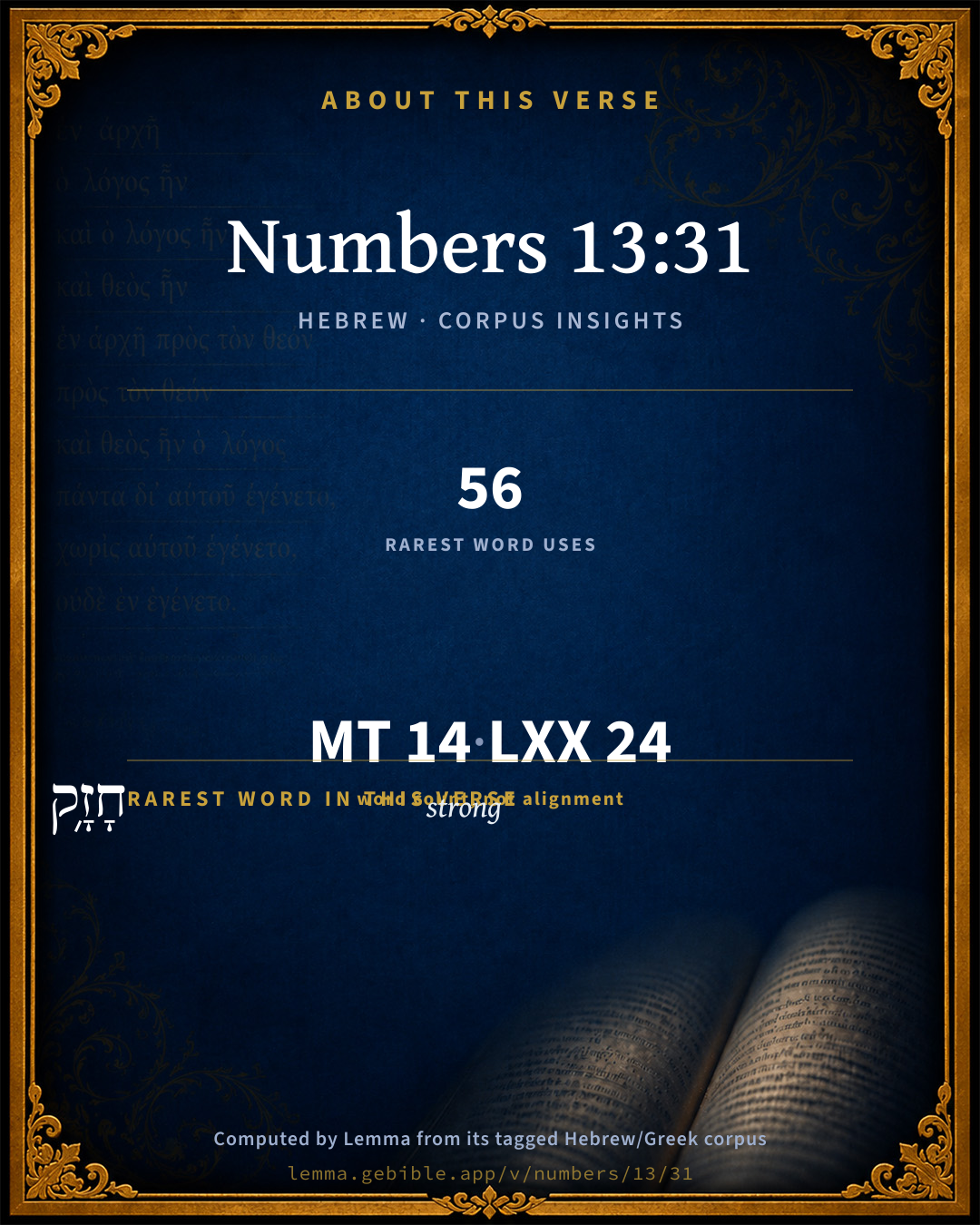
חָזָ֥ק strong H2389 occurs in 54 verses of the Hebrew Bible. Also found in:

Grammatical profile

  • 4 verbs
  • 2 nouns
  • 1 adjective
  • 1 pronoun
  • 3 prepositions
  • 1 conjunction
  • 2 particles

Verb forms

  • עָל֤וּ Qal · Perfect
  • אָֽמְר֔וּ Qal · Perfect
  • נוּכַ֖ל Qal · Imperfect
  • לַעֲל֣וֹת Qal · Infinitive Construct

Repetition

A word recurs within this verse — often emphatic in Hebrew:

  • עָל֤וּ to go up H5927 ×2

Hebrew & Septuagint length

In English translation the verse runs 24 words from the Hebrew and 33 from the Septuagint (LXX English) — closely comparable.

A rough comparison of the two English renderings, which tokenize alike — not a word-level alignment.

Word counts can differ between the Hebrew and the Greek without any difference in meaning — e.g. the Hebrew direct-object marker אֵת has no separate Greek word, and Greek often adds the article ὁ.

In the original languages it is 14 Hebrew tokens and 24 Greek tokens — but the two are counted differently (Hebrew bundles its prefixes and suffixes into one token; the Greek is in lemma form), so that isn’t a like-for-like length.

Cross-references

5

Topical passages linked to Numbers 13:31 in the Treasury of Scripture Knowledge — connected by theme and wording, ordered by reader-vote popularity; previews shown in the World English Bible.

  • Deuteronomy 1:28 Where are we going up? our brothers have made our heart to melt, saying, The people are greater and taller than we; the cities are great and fortified up to the sky; and moreover we have seen the sons of the Anakim there.
  • Joshua 14:8 Nevertheless my brothers who went up with me made the heart of the people melt; but I wholly followed Yahweh my God.
  • Hebrews 3:19 We see that they were not able to enter in because of unbelief.
  • Numbers 32:9 For when they went up to the valley of Eshcol, and saw the land, they discouraged the heart of the children of Israel, that they should not go into the land which Yahweh had given them.
  • Deuteronomy 9:1 Hear, Israel: you are to pass over the Jordan this day, to go in to dispossess nations greater and mightier than yourself, cities great and fortified up to the sky,

Cross-references courtesy of OpenBible.info (CC BY 4.0).

Hebrew and Greek witnesses Masoretic Hebrew ↔ Greek Septuagint

The same verse in the two great witnesses to the Old Testament, shown verse-for-verse.

These are two independent witnesses, not word-aligned to each other, and the Septuagint is shown in lemma (dictionary) form.

Hebrew Numbers 13:31 Masoretic · Westminster Leningrad Codex

וְהָ֨אֲנָשִׁ֜ים אֲשֶׁר עָל֤וּ עִמּוֹ֙ אָֽמְר֔וּ לֹ֥א נוּכַ֖ל לַעֲל֣וֹת אֶל הָעָ֑ם כִּֽי חָזָ֥ק ה֖וּא מִמֶּֽנּוּ

But the men who went up with him said, We aren't able to go up against the people; for they are stronger than we.

World English Bible · Public Domain

Greek LXX Numbers 13:31 Septuagint · lemma form

καί ὁ ἄνθρωπος ὁ συν ἀναβαίνω μετά αὐτός εἶπον οὐ ἀναβαίνω ὅτι οὐ μή δύναμαι ἀναβαίνω πρός ὁ ἔθνος ὅτι ἰσχυρός εἰμί ἐγώ μᾶλλον

And Chaleb stayed the people from speaking before Moses, and said to him, Nay, but we will go up by all means, and will inherit it, for we shall surely prevail against them.

LXX2012 (modern English Septuagint) · Public Domain

Hebrew: Westminster Leningrad Codex (CC BY 4.0). Greek: Septuagint (public domain); English from LXX2012 (modern English Septuagint) (Public Domain). How the Septuagint differs from the Hebrew →

Targum (Aramaic paraphrase)

2

The Targum is the ancient Jewish Aramaic paraphrase of the Hebrew Scriptures — an interpretive translation, not the Hebrew text itself. Onkelos (literal) and Pseudo-Jonathan (expansive) render the Torah, and Jonathan the Prophets. Coverage is partial: where no permissively-licensed English translation exists for a verse, only the Aramaic is shown. This is verse-level text, not a word-by-word alignment to the Hebrew.

  1. Targum Onkelos Torah (Genesis–Deuteronomy)
    וְגֻבְרַיָא דִי סְלִיקוּ עִמֵהּ אֲמָרוּ לָא נֵיכוֹל לְמֵיסַק לְוַת עַמָא אֲרֵי תַּקִיף הוּא מִנָנָא

    (no public-domain English translation for this verse)

    Targum Onkelos — Aramaic: “Onkelos Genesis” (public domain); “Onkelos Exodus” (public domain); “Onkelos Leviticus” (public domain); “Onkelos Numbers” (public domain); “Onkelos Deuteronomy” (public domain). English: “Sefaria Community Translation” (CC0 1.0 (public-domain dedication)); “J.W. Etheridge. The Targums of Onkelos and Jonathan Ben Uzziel on the Pentateuch. London: Longmans, Green, 1862” (public domain). Text via Sefaria.

  2. Targum Pseudo-Jonathan Torah (Genesis–Deuteronomy)
    וְגוּבְרַיָא דְסַלִיקוּ עִמֵיהּ אָמְרוּ לָא נֵיכוֹל לְמֵיסוֹק לְוַת עַמָא אֲרוּם תַּקִיף הוּא מִנָנָא

    But the men who had gone up with him said, We are not able to go up to the people, for they are stronger than we.

    Targum Pseudo-Jonathan — Aramaic: “Targum Jonathan on Genesis” (public domain); “Targum Jonathan on Exodus” (public domain); “Targum Jonathan on Leviticus” (public domain); “Targum Jonathan on Numbers” (public domain); “Targum Jonathan on Deuteronomy” (public domain). English: “The Targum of Jonathan ben Uzziel, trans. J. W. Etheridge, London, 1862” (public domain). Text via Sefaria.

Commentary

Notes on Numbers 13:31 from classic Christian and Jewish commentators (each source and its license shown beneath its notes). The classic Christian expositions comment on the surrounding passage and are grouped to its opening verse, so a note may address several verses; the Jewish commentaries on the Tanakh (Rashi and others) are per-verse, so they appear only where the commentator wrote on this verse.

Lemma curates 59 commentaries, every one of them public domain or Creative Commons licensed, each selected and text-cleaned for this edition rather than reprinted as found. About our sources →

Joseph Benson's Commentary

Num 13:31. The men — All of them, Joshua excepted. Stronger — Both in stature of body and numbers of people. Thus they question the power, and truth, and goodness of God, of all which they had such ample testimonies.

Joseph Benson's Commentary on the Old and New Testaments (1811–1818) — public domain. Text from a community e-Sword module.

Geneva Bible (1599)

Geneva Bible translators

Or, murmuring against Moses.

Geneva Bible (1599) marginal notes — public domain. Text via Bolls.life.

Haydock's Catholic Bible Commentary

Caleb, to whom Josue alone joined himself, to bear witness of the truth against the other ten; whom the people were, however, more inclined to believe, (chap. xiv. 6., and Ecclesiasticus xlvi. 9,) paying more attention to numbers than to authority, when it suited their humour. (Haydock)

George Leo Haydock (1774–1849), Haydock's Catholic Family Bible and Commentary, 1859 edition — public domain. Excludes Psalms (Douay-Rheims chapter numbering differs from Protestant) and Deuterocanonical books (Catholic canon only).

Matthew Poole's English Annotations

The men that went up with him; all of them, Joshua excepted.

They are stronger than we, both in stature of body and numbers of people. Thus they wickedly question the power, and truth, and goodness of God, of all which they had such ample testimonies.

Matthew Poole's English Annotations on the Holy Bible (1683–1685) — public domain. Text from a community e-Sword/MySword module.

Whedon's Commentary on the Bible

Daniel D. Whedon

31. We be not able — The majority had not asserted this before, but had left the people to draw this inference. Now they are evidently enraged at the brave words of Caleb. Faith is always a reproof to unbelief, as holiness is a rebuke to sin.

Daniel D. Whedon (gen. ed.), Commentary on the Old and New Testaments (1874–1909) — public domain. Text from a community e-Sword module.

The Pulpit Commentary

For they are stronger than we. In point of numbers the enormous superiority of the Israelites over any combination likely to oppose them must have been evident to the most cowardly. But the existence of numerous walled and fortified towns was (apart from Divine aid) an almost insuperable obstacle to a people wholly ignorant of artillery or of siege operations; and the presence of giants was exceedingly terrifying in an age when battles were a series of personal encounters. (cf. 1Sa_17:11, 1Sa_17:24)

The Pulpit Commentary (1880–1919), ed. H.D.M. Spence-Jones & Joseph S. Exell — public domain. Text from a community e-Sword module.

John Wesley's Explanatory Notes

The men - All of them, Joshua excepted. Stronger - Both in stature of body and numbers of people. Thus they question the power, and truth, and goodness of God, of all which they had such ample testimonies.

John Wesley, Explanatory Notes Upon the Whole Bible (1754–1765) — public domain. Text via the GEBible commentary corpus.

Keil & Delitzsch

C. F. Keil & F. Delitzsch

But his companions were of an opposite opinion, and declared that the people in Canaan were stronger than the Israelites, and therefore it was impossible to go up to it.

Keil & Delitzsch — Biblical Commentary on the Old Testament (1861–1891) — public domain (CC PDM 1.0). Text via the HelloAO Bible API. (Old Testament only.)

Rashi

Rabbi Shlomo Yitzchaki (Rashi)

חזק הוא ממנו [FOR] THEY ARE STRONGER ממנו — They said this, — if this were at all possible (i.e. if one may be permitted to say so of God) — with reference to the Omnipresent (ממנו, stronger than “He”, they thus uttered blasphemy) (Sotah 35a; Arakhin 15a).

Rashi on the Tanakh — English translations: “The Judaica Press complete Tanach with Rashi, translated by A. J. Rosenberg” (CC BY 4.0); “Pentateuch with Rashi's commentary by M. Rosenbaum and A.M. Silbermann, 1929-1934” (public domain); “The Metsudah Tanach series, Lakewood, N.J” (CC BY 4.0); and “The Book of Joshua, Metsudah Publications, 1997” (CC BY 4.0). Text via Sefaria.

Lesson kit

Teaching starters — assembled from the data on this page, not authored interpretation. Every prompt links to the verse data it draws on. Edit before teaching.

Numbers, in the Pentateuch, opens this verse with 14 words (13 distinct Hebrew lemmas). Its most distinctive word is châzâq (“strong”). A historical commentator’s framing appears above. Read the whole chapter for the surrounding context.

Discussion questions

  1. How does “strong” (châzâq) shape what this verse is saying?
  2. Exodus 3:19 shares the word «strong» with this verse. How do the two illuminate each other?
  3. “to go up” occurs 2× in this one verse. What is the effect of the repetition?
  4. These translations render this verse differently; the difference is in the English rendering, not the original. What questions does that raise?
  5. The verb «עָל֤וּ» is Qal Perfect. How does its form color the action?
  6. Reading how Joseph Benson's Commentary and Geneva Bible (1599) read this verse, where do the two commentators agree and where do they part?

Things to notice

Reading settings

Reading text

Shown beneath each verse's original-language words.

Old Testament
Old Testament edition

Read the OT as the Masoretic Hebrew (MT) or the Greek Septuagint (LXX).

English shown for the Greek Septuagint (in the Hebrew ↔ Greek comparison).

Comparing translations? Open the Compare panel on any verse page to stack up to four side by side.