
Habakkuk 3:16

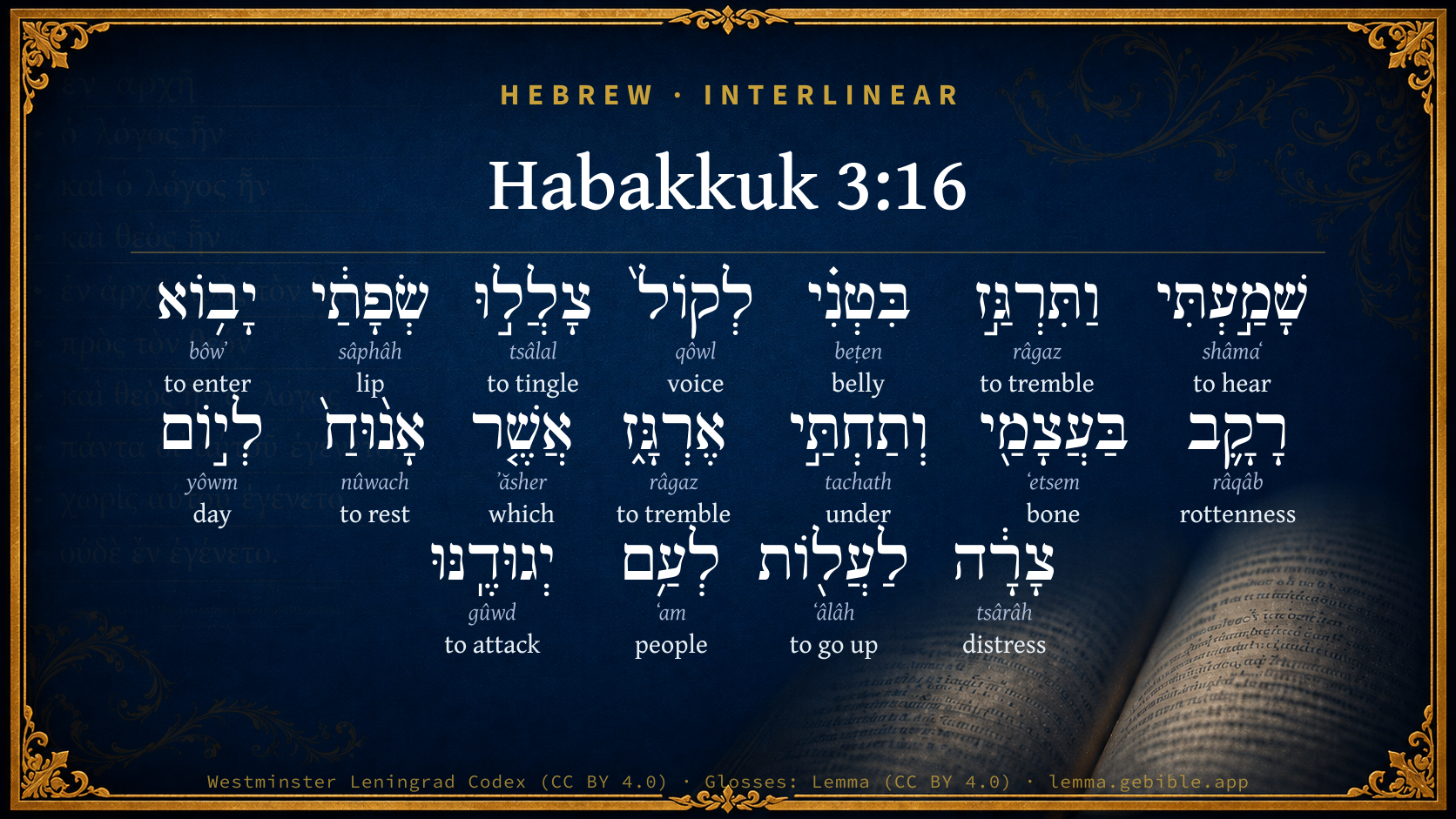
Hebrew (Westminster Leningrad Codex) Habakkuk 3:16 appears in the Hebrew Old Testament. The text above is from the Westminster Leningrad Codex. Each word links to its Strong’s number, a concise gloss, and parsing drawn from the Open Scriptures Hebrew Bible morphology. Click any word for its full Brown-Driver-Briggs (BDB) entry.
Download image
Cite this verse

Habakkuk 3:16 (World English Bible). Public Domain. Lemma interlinear Bible study tool, https://lemma.gebible.app/v/habakkuk/3/16.

Show BibTeX & RIS
BibTeX
RIS
English Translation
I heard, and my body trembled. My lips quivered at the voice. Rottenness enters into my bones, and I tremble in my place, Because I must wait quietly for the day of trouble, For the coming up of the people who invade us.
World English Bible · Public Domain
Download a study sheet

One document with this verse’s original text, its word-by-word gloss line, the meaning frame, cross-references with their text, attributed commentary, and full source and license credits — printable, and it pastes into notes with its structure intact.

This verse Autodidact and up

Study sheet (.html) Plain text (.txt)

A passage Seminary Student

Up to 50 verses in one chapter. A passage sheet keeps up to 6 commentary sources and 12 cross-references per verse, in the order this page ranks them, and says so on the sheet whenever that leaves anything out. Ask for a single verse and you get the Autodidact verse sheet above.

Everything on this page stays free to read, with no account — the sheet is a download of what is already on screen, not access to it.

Want to remove ads? Support Godless Engineer
Compare translations 3

The same verse in 3 English versions, stacked beneath the original-language interlinear above. Click any original word for its lexicon entry.

Each is an independent rendering of the whole verse — the interlinear is not word-aligned to these translations.

Highlighted words mark where these versions differ — a whole-verse word diff, not a word-by-word alignment.

  • World English Bible Public Domain
    I heard, and my body trembled. My lips quivered at the voice. Rottenness enters into my bones, and I tremble in my place, Because I must wait quietly for the day of trouble, For the coming up of the people who invade us.
  • King James Version Public Domain
    When I heard, my belly trembled; my lips quivered at the voice: rottenness entered into my bones, and I trembled in myself, that I might rest in the day of trouble: when he cometh up unto the people, he will invade them with his troops.
  • unfoldingWord Literal Text CC BY-SA 4.0
    I heard, and my belly trembled; at the sound, my lips quivered. Decay entered into my bones, and in my place I trembled. Yet I may rest for the day of distress, to come up against the people who attack us.

unfoldingWord Literal Text — © unfoldingWord, licensed CC BY-SA 4.0. Word-aligned USFM3 via Door43 (git.door43.org/unfoldingWord/en_ult).

Versions to compare (up to 4)

3 of 4 selected

Show all 18 translations

Every available English version of this verse, each an independent rendering of the whole verse.

  • World English Bible Public Domain
    I heard, and my body trembled. My lips quivered at the voice. Rottenness enters into my bones, and I tremble in my place, Because I must wait quietly for the day of trouble, For the coming up of the people who invade us.
  • Berean Standard Bible Public Domain
    I heard and trembled within; my lips quivered at the sound. Decay entered my bones; I trembled where I stood. Yet I must wait patiently for the day of distress to come upon the people who invade us.
  • Majority Standard Bible Public Domain
    I heard and trembled within; my lips quivered at the sound. Decay entered my bones; I trembled where I stood. Yet I must wait patiently for the day of distress to come upon the people who invade us.
  • King James Version Public Domain
    When I heard, my belly trembled; my lips quivered at the voice: rottenness entered into my bones, and I trembled in myself, that I might rest in the day of trouble: when he cometh up unto the people, he will invade them with his troops.
  • American Standard Version (1901) Public Domain
    I heard, and my body trembled, My lips quivered at the voice; Rottenness entereth into my bones, and I tremble in my place; Because I must wait quietly for the day of trouble, For the coming up of the people that invadeth us.
  • Revised Version (1885) Public Domain
    I heard, and my belly trembled, my lips quivered at the voice; rottenness entered into my bones, and I trembled in my place: that I should rest in the day of trouble, when it cometh up against the people which invadeth him in troops.
  • Geneva Bible (1599) Public Domain
    When I heard, my bellie trembled: my lippes shooke at the voyce: rottennesse entred into my bones, and I trembled in my selfe, that I might rest in the day of trouble: for whe he commeth vp vnto the people, he shall destroy them.
  • Douay-Rheims (1899) Public Domain
    I have heard and my bowels were troubled: my lips trembled at the voice. Let rottenness enter into my bones, and swarm under me. That I may rest in the day of tribulation: that I may go up to our people that are girded.
  • Young's Literal Translation Public Domain
    I have heard, and my belly trembleth, At the noise have my lips quivered, Rottenness doth come into my bones, And in my place I do tremble, That I rest for a day of distress, At the coming up of the people, he overcometh it.
  • Literal Standard Version CC BY-SA 4.0
    I have heard, and my belly trembles, || At the noise have my lips quivered, || Rottenness comes into my bones, || And in my place I tremble, || That I rest for a day of distress, || At the coming up of the people, he overcomes it.
  • Unlocked Literal Bible CC BY-SA 4.0
    I heard, and my inner parts trembled! My lips quivered at the sound. Decay comes into my bones, and under myself I tremble as I wait quietly for the day of distress to come upon the people who invade us.
  • unfoldingWord Literal Text CC BY-SA 4.0
    I heard, and my belly trembled; at the sound, my lips quivered. Decay entered into my bones, and in my place I trembled. Yet I may rest for the day of distress, to come up against the people who attack us.
  • Darby Bible Public Domain
    I heard, and my belly trembled; My lips quivered at the voice; Rottenness entered into my bones, and I trembled in my place, That I might rest in the day of distress, When their invader shall come up against the people.
  • World Messianic Bible Public Domain
    I heard, and my body trembled. My lips quivered at the voice. Rottenness enters into my bones, and I tremble in my place because I must wait quietly for the day of trouble, for the coming up of the people who invade us.
  • Webster's Bible Public Domain
    When I heard, my belly trembled; my lips quivered at the voice: rottenness entered into my bones, and I trembled in myself, that I might rest in the day of trouble: when he cometh up to the people, he will invade them with his troops.
  • Free Bible Version CC BY-SA 4.0
    I shook inside when I heard this; my lips quivered at the sound; my bones turned to jelly; I trembled where I stood. I wait quietly for the day of trouble that will come upon those who attacked us.
  • Bible in Basic English Public Domain
    Hearing it, my inner parts were moved, and my lips were shaking at the sound; my bones became feeble, and my steps were uncertain under me: I gave sounds of grief in the day of trouble, when his forces came up against the people in bands.
  • JPS Tanakh (1917) Public Domain
    When I heard, mine inward parts trembled, my lips quivered at the voice; rottenness entereth into my bones, and I tremble where I stand; that I should wait for the day of trouble, when he cometh up against the people that he invadeth.

Literal Standard Version (2020), Covenant Press — licensed CC BY-SA 4.0. Text via the HelloAO Bible API (eBible.org). Unlocked Literal Bible (unfoldingWord) — licensed CC BY-SA 4.0. Text via the HelloAO Bible API (eBible.org). unfoldingWord Literal Text — © unfoldingWord, licensed CC BY-SA 4.0. Word-aligned USFM3 via Door43 (git.door43.org/unfoldingWord/en_ult). Free Bible Version, Dr. Jonathan Gallagher — licensed CC BY-SA 4.0. Text via the HelloAO Bible API (eBible.org).

Word by word

More ways to search: Search by grammar → Find every occurrence → Compare this word →

Practice this passage: Drill this verse → Learn its vocabulary →

יְגוּדֶֽנּוּ
gûwd
H1464
“to attack · us”
Verb, Qal, Imperfect, 3rd Person, Masculine, Singular + Suffix, Personal, 1st Person, Common, Plural
Part of Speech
Verb
Stem
Qal
Form
Imperfect
Person
3rd Person
Gender
Masculine
Number
Singular
Full BDB Definition

Origin: a primitive root [akin to H1413 ]

TWOT: 325

to invade, attack - (Qal) to attack
  1. שָׁמַ֣עְתִּי shâmaʻ H8085 “to hear” Verb, Qal, Perfect, 1st Person, Common, Singular
  2. וַתִּרְגַּ֣ז râgaz H7264 “and · to tremble” Conjunction + Verb, Qal, Sequential Imperfect, 3rd Person, Feminine, Singular
  3. בִּטְנִ֗י beṭen H990 “belly · my” Noun, Common, Feminine, Singular, Construct + Suffix, Personal, 1st Person, Common, Singular
  4. לְקוֹל֙ qôwl H6963 “to/for · voice” Preposition + Noun, Common, Masculine, Singular, Absolute
  5. צָלֲל֣וּ tsâlal H6750 “to tingle” Verb, Qal, Perfect, 3rd Person, Common, Plural
  6. שְׂפָתַ֔י sâphâh H8193 “lips · my” Noun, Common, Feminine, Dual, Construct + Suffix, Personal, 1st Person, Common, Singular
  7. יָב֥וֹא bôwʼ H935 “to enter” Verb, Qal, Imperfect, 3rd Person, Masculine, Singular
  8. רָקָ֛ב râqâb H7538 “rottenness” Noun, Common, Masculine, Singular, Absolute
  9. בַּעֲצָמַ֖י ʻetsem H6106 “in/at · bones · my” Preposition + Noun, Common, Feminine, Plural, Construct + Suffix, Personal, 1st Person, Common, Singular
  10. וְתַחְתַּ֣י tachath H8478 “and · under · me” Conjunction + Preposition + Suffix, Personal, 1st Person, Common, Singular
  11. אֶרְגָּ֑ז râgaz H7264 “to tremble” Verb, Qal, Imperfect, 1st Person, Common, Singular
  12. אֲשֶׁ֤ר ʼăsher H834 “which” Particle, Relative
  13. אָנ֨וּחַ֙ nûwach H5117 “to rest” Verb, Qal, Imperfect, 1st Person, Common, Singular
  14. לְי֣וֹם yôwm H3117 “to/for · day of” Preposition + Noun, Common, Masculine, Singular, Construct
  15. צָרָ֔ה tsârâh H6869 “distress” Noun, Common, Feminine, Singular, Absolute
  16. לַעֲל֖וֹת ʻâlâh H5927 “to go up” Preposition + Verb, Qal, Infinitive Construct
  17. לְעַ֥ם ʻam H5971 “to/for · people” Preposition + Noun, Common, Masculine, Singular, Absolute

About this verse

These counts appear in no published source. They are computed here, from the morphology-tagged text and Lemma’s own curated glosses. What Lemma adds →

18
words
17
distinct lemmas
Prophets
section

Notable vocabulary

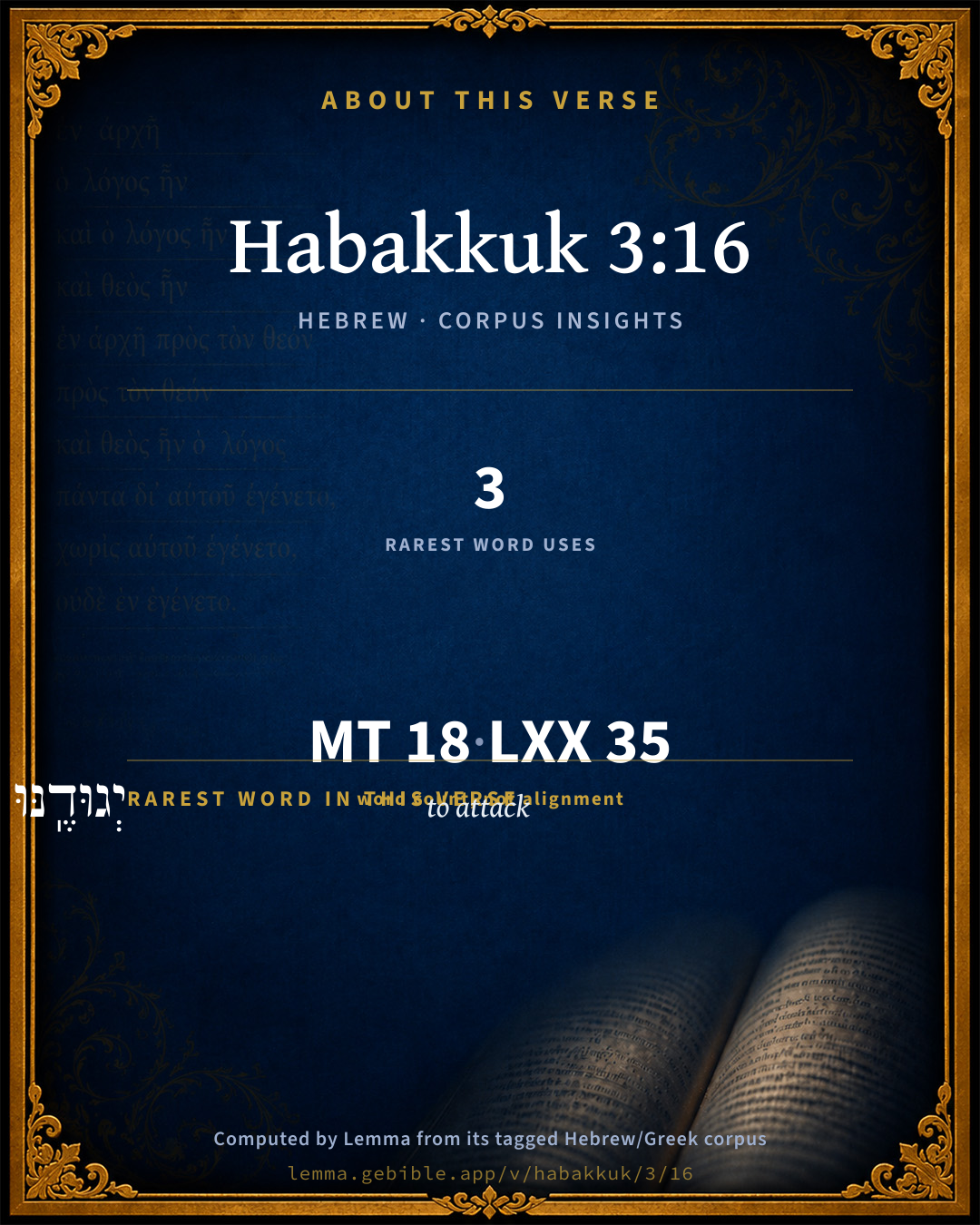
The rarest word here is יְגוּדֶֽנּוּ to attack H1464 — appearing just 3 times in the whole Hebrew Bible.

Shared distinctive vocabulary

יְגוּדֶֽנּוּ to attack H1464 occurs in 2 verses of the Hebrew Bible. Also found in:

Grammatical profile

  • 8 verbs
  • 8 nouns
  • 1 preposition
  • 1 particle

Verb forms

  • שָׁמַ֣עְתִּי Qal · Perfect
  • וַתִּרְגַּ֣ז Qal · Sequential Imperfect
  • צָלֲל֣וּ Qal · Perfect
  • יָב֥וֹא Qal · Imperfect
  • אֶרְגָּ֑ז Qal · Imperfect
  • אָנ֨וּחַ֙ Qal · Imperfect
  • לַעֲל֖וֹת Qal · Infinitive Construct
  • יְגוּדֶֽנּוּ Qal · Imperfect

Repetition

A word recurs within this verse — often emphatic in Hebrew:

  • וַתִּרְגַּ֣ז to tremble H7264 ×2

Hebrew & Septuagint length

In English translation the verse runs 43 words from the Hebrew and 45 from the Septuagint (LXX English) — closely comparable.

A rough comparison of the two English renderings, which tokenize alike — not a word-level alignment.

Word counts can differ between the Hebrew and the Greek without any difference in meaning — e.g. the Hebrew direct-object marker אֵת has no separate Greek word, and Greek often adds the article ὁ.

In the original languages it is 18 Hebrew tokens and 35 Greek tokens — but the two are counted differently (Hebrew bundles its prefixes and suffixes into one token; the Greek is in lemma form), so that isn’t a like-for-like length.

Cross-references

17

Topical passages linked to Habakkuk 3:16 in the Treasury of Scripture Knowledge — connected by theme and wording, ordered by reader-vote popularity; previews shown in the World English Bible.

  • Jeremiah 23:9 Concerning the prophets. My heart within me is broken, all my bones shake; I am like a drunken man, and like a man whom wine has overcome, because of Yahweh, and because of his holy words.
  • Daniel 10:8 So I was left alone, and saw this great vision, and there remained no strength in me; for my comeliness was turned in me into corruption, and I retained no strength.
  • Habakkuk 1:5–11 "Look among the nations, watch, and wonder marvelously; for I am working a work in your days, which you will not believe though it is told you.
  • Habakkuk 3:2 Yahweh, I have heard of your fame. I stand in awe of your deeds, Yahweh. Renew your work in the midst of the years. In the midst of the years make it known. In wrath, you remember mercy.
  • Psalms 94:12–13 Blessed is the man whom you discipline, Yah, And teach out of your law;
  • Psalms 119:120 My flesh trembles for fear of you. I am afraid of your judgments.
  • Jeremiah 25:9–11 behold, I will send and take all the families of the north, says Yahweh, and [I will send] to Nebuchadrezzar the king of Babylon, my servant, and will bring them against this land, and against the inhabitants of it, and against all these nations round about; and I will utterly destroy them, and make them an astonishment, and a hissing, and perpetual desolations.
  • Jeremiah 45:3–5 You did say, Woe is me now! for Yahweh has added sorrow to my pain; I am weary with my groaning, and I find no rest.
  • 2 Thessalonians 1:6–9 Since it is a righteous thing with God to repay affliction to those who afflict you,
  • Jeremiah 15:10–11 Woe is me, my mother, that you have borne me a man of strife and a man of contention to the whole earth! I have not lent, neither have men lent to me; [yet] everyone of them does curse me.
  • Deuteronomy 28:49–52 Yahweh will bring a nation against you from far, from the end of the earth, as the eagle flies; a nation whose language you shall not understand;
  • 2 Kings 24:1–2 In his days Nebuchadnezzar king of Babylon came up, and Jehoiakim became his servant three years: then he turned and rebelled against him.
  • Isaiah 26:20–21 Come, my people, enter you into your chambers, and shut your doors about you: hide yourself for a little moment, until the indignation be past.
  • Ezekiel 3:14 So the Spirit lifted me up, and took me away; and I went in bitterness, in the heat of my spirit; and the hand of Yahweh was strong on me.
  • Daniel 8:27 I, Daniel, fainted, and was sick certain days; then I rose up, and did the king's business: and I wondered at the vision, but none understood it.
  • Psalms 91:15 He will call on me, and I will answer him. I will be with him in trouble. I will deliver him, and honor him.
  • Ezekiel 9:4–6 Yahweh said to him, Go through the midst of the city, through the midst of Jerusalem, and set a mark on the foreheads of the men that sigh and that cry over all the abominations that are done in the midst of it.

Cross-references courtesy of OpenBible.info (CC BY 4.0).

Hebrew and Greek witnesses Masoretic Hebrew ↔ Greek Septuagint

The same verse in the two great witnesses to the Old Testament, shown verse-for-verse.

These are two independent witnesses, not word-aligned to each other, and the Septuagint is shown in lemma (dictionary) form.

Hebrew Habakkuk 3:16 Masoretic · Westminster Leningrad Codex

שָׁמַ֣עְתִּי וַתִּרְגַּ֣ז בִּטְנִ֗י לְקוֹל֙ צָלֲל֣וּ שְׂפָתַ֔י יָב֥וֹא רָקָ֛ב בַּעֲצָמַ֖י וְתַחְתַּ֣י אֶרְגָּ֑ז אֲשֶׁ֤ר אָנ֨וּחַ֙ לְי֣וֹם צָרָ֔ה לַעֲל֖וֹת לְעַ֥ם יְגוּדֶֽנּוּ

I heard, and my body trembled. My lips quivered at the voice. Rottenness enters into my bones, and I tremble in my place, Because I must wait quietly for the day of trouble, For the coming up of the people who invade us.

World English Bible · Public Domain

Greek LXX Habakkuk 3:16 Septuagint · lemma form

φυλάσσω καί πτοέω ὁ κοιλία ἐγώ ἀπό φωνή προσευχή χεῖλος ἐγώ καί εἰςἔρχομαι τρόμος εἰς ὁ ὀστέον ἐγώ καί ὑποκάτωθεν ἐγώ ταράσσω ὁ ἕξις ἐγώ ἀναπαύω ἐν ἡμέρα θλῖψις ὁ ἀναβαίνω εἰς λαός παροικία ἐγώ

I watched, and my belly trembled at the sound of the prayer of my lips, and trembling entered into my bones, and my frame was troubled within me; I will rest in the day of affliction, from going up to the people of my sojourning.

LXX2012 (modern English Septuagint) · Public Domain

On this verse, Whedon's Commentary on the Bible discusses the Septuagint’s reading. Read the note in Commentary ↓

Hebrew: Westminster Leningrad Codex (CC BY 4.0). Greek: Septuagint (public domain); English from LXX2012 (modern English Septuagint) (Public Domain). How the Septuagint differs from the Hebrew →

Targum (Aramaic paraphrase)

1

The Targum is the ancient Jewish Aramaic paraphrase of the Hebrew Scriptures — an interpretive translation, not the Hebrew text itself. Onkelos (literal) and Pseudo-Jonathan (expansive) render the Torah, and Jonathan the Prophets. Coverage is partial: where no permissively-licensed English translation exists for a verse, only the Aramaic is shown. This is verse-level text, not a word-by-word alignment to the Hebrew.

  1. Targum Jonathan Prophets (Joshua–Malachi)
    אֲמָרֵת בָּבֶל שְׁמָעֵית וְזָעוּ מַלְכַיָא מִן קֳדָם דִינָא דִי אִתְדָנוּ מִצְרַיִם לְקַל מִלַיָא אִלֵין צַלָא סִפְּוָתִי אֲחַד זִיעָא לְחַכִּימַיָא וּבְאָתַר דְשָׁרֵיָיא זָעֵית דְשַׁבְקַנִי לְיוֹם עָקָא לְעִדַן אַסְקָא גַלְוַת עַמִי מִנִי יִתְבְּרִינַנִי:

    (no public-domain English translation for this verse)

    Targum Jonathan — Aramaic: “Mikraot Gedolot” (public domain). English: “Sefaria Community Translation” (CC0 1.0 (public-domain dedication)); “London "Chaldee Paraphrase," 1871” (public domain). Text via Sefaria.

Commentary

Notes on Habakkuk 3:16 from classic Christian and Jewish commentators (each source and its license shown beneath its notes). The classic Christian expositions comment on the surrounding passage and are grouped to its opening verse, so a note may address several verses; the Jewish commentaries on the Tanakh (Rashi and others) are per-verse, so they appear only where the commentator wrote on this verse.

Lemma curates 59 commentaries, every one of them public domain or Creative Commons licensed, each selected and text-cleaned for this edition rather than reprinted as found. About our sources →

Matthew Henry's Commentary

Within the compass of these few lines we have the prophet in the highest degree both of trembling and triumphing, such are the varieties both of the state and of the spirit of God's people in this world. In heaven there shall be no more trembling, but everlasting triumphs.

I. The prophet had foreseen the prevalence of the church's enemies and the long continuance of the church's troubles; and the sight made him tremble, Hab 3:16. Here he goes on with what he had said Hab 3:2, "I have heard thy speech and was afraid. When I heard what sad times were coming upon the church my belly trembled, my lips quivered at the voice; the news made such an impression that it put me into a perfect ague fit." The blood retiring to the heart, to succour that when it was ready to faint, the extreme parts were left destitute of spirits, so that his lips quivered. Nay, he was so weak, and so unable to help himself, that he was as if rottenness had entered into his bones; he had no strength left in him, could neither stand nor go; he trembled in himself, trembled all over him, trembled within him; he yielded to his trembling, and troubled himself, as our Savior did; his flesh trembled for fear of God and he was afraid of his judgments, Psa 119:120. He was touched with a tender concern for the calamities of the church, and trembled for fear lest they should end at length in ruin, and the name of Israel be blotted out. Nor did he think it any disparagement to him, nor any reproach to his courage, but freely owned he was one of those that trembled at God's word, for to them he will look with favour: I tremble in myself, that I might rest in the day of trouble. Note, When we see a day of trouble approaching it concerns us to provide accordingly, and to lay up something in store, by the help of which we may rest in that day; and the best way to make sure rest for ourselves in the day of trouble is to tremble within ourselves at the word of God and the threatenings of that word. He that has joy in store for those that sow in tears has rest in store for those that tremble before him. Good hope through grace is founded in a holy fear. Noah, who was moved with fear, trembled within himself at the warning given him of the deluge coming, had the ark for his resting place in the day of that trouble. The prophet tells us what he said in his trembling. His fear is that, when he comes up to the people, when the Chaldean comes up to the people of Israel, he will invade them, will surround them, will break in upon them, nay (as it is in the margin), He will cut them in pieces with his troops; he cried out, We are all undone; the whole nation of the Jews is lost and gone. Note, When things look bad we are too apt to aggravate them, and make the worst of them.

II. He had looked back upon the experiences of the church in former ages, and had observed what great things God had done for them, and so he recovered himself out of his fright, and not only retrieved his temper, but fell into a transport of holy joy, with an express non obstante - notwithstanding to the calamities he foresaw coming, and this not for himself only, but in the name of every faithful Israelite.

1. He supposes the ruin of all his creature comforts and enjoyments, not only of the delights of this life, but even of the necessary supports of it, Hab 3:17. Famine is one of the ordinary effects of war, and those commonly feel it first and most that sit still and are quiet; the prophet and his pious friends, when the Chaldean army comes, will be plundered and stripped of all they have. Or he supposes himself deprived of all by blasting and unseasonable weather, or some other immediate hand of God. Or though the captives in Babylon have not that plenty of all good things in their own land. (1.) He supposes the fruit-tree to be withered and become barren; the fig-tree (which used to furnish them with much of their food; hence we often read of cakes of figs) shall not so much as blossom, nor shall fruit be in the vine, from which they had their drink, that made glad the heart: he supposes the labour of the olive to fail, their oil, which was to them as butter is to us; the labour of the olive shall lie (so it is in the margin); their expectations from it shall be disappointed. (2.) He supposes the bread-corn to fail; the fields shall yield no meat; and, since the king himself is served of the field, if the productions of that be withdrawn, every one will feel the want of them. (3.) He supposes the cattle to perish for want of the food which the field should yield and does not, or by disease, or being destroyed and carried away by the enemy: The flock is cut off from the fold, and there is no herd in the stall. Note, When we are in the full enjoyment of our creature comforts we should consider that there may come a time when we shall be stripped of them all, and use them accordingly, as not abusing them, Co1 7:29, Co1 7:30.

2. He resolves to delight and triumph in God notwithstanding; when all is gone his God is not gone (Hab 3:18): "Yet will I rejoice in the Lord; I shall have him to rejoice in, and will rejoice in him." Destroy the vines and the fig-trees, and you make all the mirth of a carnal heart to cease, Hos 2:11, Hos 2:12. But those who, when they were full, enjoyed God in all, when they are emptied and impoverished can enjoy all in God, and can sit down upon a melancholy heap of the ruins of all their creature comforts and even then can sing to the praise and glory of God, as the God of their salvation. This is the principal ground of our joy in God, that he is the God of our salvation, our eternal salvation, the salvation of the soul; and, if he be so, we may rejoice in him as such in our greatest distresses, since by them our salvation cannot be hindered, but may be furthered. Note, Joy in God is never out of season, nay, it is in a special manner seasonable when we meet with losses and crosses in the world, that it may then appear that our hearts are not set upon these things, nor our happiness bound up in them. See how the prophet triumphs in God: The Lord God is my strength, Hab 3:19. He that is the God of our salvation in another world will be our strength in this world, to carry us on in our journey thither, and help us over the difficulties and oppositions we meet with in our way. Even when provisions are cut off, to make it appear that man lives not by bread alone, we may have the want of bread supplied by the graces and comforts of God's Spirit and with the supplies of them. (1.) We shall be strong for our spiritual warfare and work: The Lord God is my strength, the strength of my heart. (2.) We shall be swift for our spiritual race: "He will make my feet like hinds' feet, that with enlargement of heart I may run the way of his commands and outrun my troubles." (3.) We shall be successful in our spiritual enterprises: "He will make me to walk upon my high places; that is, I shall gain my point, shall be restored unto my own land, and tread upon the high places of the enemy," Deu 32:13; Deu 33:29. Thus the prophet, who began his prayer with fear and trembling, concludes it with joy and triumph, for prayer is heart's ease to a gracious soul. When Hannah had prayed she went her way, and did eat, and her countenance was no more sad. This prophet, finding it so, publishes his experience of it, and puts it into the hand of the chief singer for the use of the church, especially in the day of our captivity. And, though then the harps were hung upon the willow-trees, yet in the hope that they would be resumed, and their right hand retrieve its cunning, which it had forgotten, he set his song upon Shigionoth (Hab 3:1), wandering tunes, according to the variable songs, and upon Neginoth (Hab 3:19), the stringed instruments. He that is afflicted, and has prayed aright, may then be so easy, may then be so merry, as to sing psalms.

Matthew Henry's Commentary on the Whole Bible (1708–1710) — public domain (CC PDM 1.0). Text via the HelloAO Bible API.

Trapp's Complete Commentary

John Trapp

Hab 3:16 When I heard, my belly trembled; my lips quivered at the voice: rottenness entered into my bones, and I trembled in myself, that I might rest in the day of trouble: when he cometh up unto the people, he will invade them with his troops.

Ver. 16. When I heard, my belly trembled, &c.] Heard what? That speech of thine, Hab 3:3, whereunto the prophet now returneth, after a long digression for the people’s support and comfort. Digressions in Divine discourses are not always and absolutely unlawful. God sometimes draweth aside the doctrine, to satisfy some soul which the preacher knows not; and, sparingly used, it quickeneth attention. "O Lord, I have heard thy speech" (touching Israel’s captivity, Hab 1:6-11, and after that, the Chaldeans’ calamity, Hab 2:5-18), "and was afraid," Hab 3:2. Neither was this a slight or sudden pang, and soon put over; but such as soaked to the very roots, so that my belly, or my heart in my belly, trembled; see Pro 20:27.

My lips quivered] Through want of natural heat, which in this fright was gone inward to succour the heart; as soldiers upon the approach of an enemy run into the castle.

At the voice] At the dreadful denunciations of judgments.

Rottenness entered into my bones] Poetico more ex signis describit, saith Gualther. The prophet, in manner of a poet, describeth his great fear by the gracious effects and signs thereof in his body.

That I might rest in the day of trouble] This was the fruit of his holy fear of God’s imminent judgments, and that contrition of spirit that followed thereupon; viz. that both he, and all that took part with him in those pious practices of sensibleness and self-abasement, should have peace with God, and be able to call their souls to rest in the evil day.

When he cometh up, &c.] i.e. The Chaldean spoiler.

He will invade them with his troops] Or, cut them in pieces. And that this was done see 2Ki 25:4-11. and the Book of Lamentations throughout. Howbeit in judgment God remembereth mercy, as the prophet had prayed; for, besides the favour that the Jews found at Babylon by means of Daniel and others, Cyrus, having taken that city, gave commandment that no Jews, or any that spake the Syrian tongue, should be harmed, as Xenophon relateth; and after this he gave them free leave to return home.

John Trapp, A Commentary or Exposition upon All the Books of the Old and New Testament (1647–1656) — public domain. Text from a community e-Sword module.

The Biblical Illustrator

Joseph S. Exell

Hab_3:16

And I trembled in myself.

Horror of God

I. It is an abnormal state of mind. The benevolent character of God, and the moral constitution of the soul are sufficient to show that it was never intended that man should ever dread his Maker or be touched with any servile feelings in relation to Him. Unbounded confidence, cheerful trust, loyal love, these are the normal states of mind in relation to the Creator. How has the abnormal state arisen? The history of the Fall shows this. I heard Thy voice in the garden and was afraid.

II. It is an unnecessary state of mind. God is not terrible. There is nothing in Him to dread. His voice to man--

1. In all nature is, Be not afraid.

2. In all true philosophy. Things show benevolence of intention.

3. In all true Christianity. The Christianity of Christ reveals Him as love, and love only.

III. It is a pernicious state of mind. It is pernicious to the body. Horrific feeling is inimical to physical health. But dread of God is even more pernicious to the soul.

1. It destroys its peace.

2. It depresses its powers.

3. It distorts its view.

It is fear that has given men that Calvinian Deity which frightens the millions away from the glorious Gospel of the blessed God. (Homilist.)

.

I trembled in myself, that I might rest in the day of trouble.

Trembling into rest

We know things which do tremble that they may rest--the magnet, the planet, the bird, the heart. Do not regard this text as any melancholy and prophetic foreboding. It is a wise repression of a too vehement self-consciousness--the assurance that our labour is not guaranteed by our present exuberance, but by a wise and thoughtful fear. Wise fear is forethought and safety. This prayer of Habakkuk grounds the hope of future mercy on the remembrance of the past; it is the history of a state of humbled feeling, and a hope from this to rest in the day of trouble.

I. The principle of fear is excited by the sense of God. Job said, When I consider, I am afraid of Him. When we think wisely and thoughtfully of God we may well tremble. It is the dictate of natural religion.

II. There is a use in this trembling which the Holy Spirit recognises. The apostle says, Knowing, therefore, the terror of the Lord, we persuade men; and this is ever the effect of this. Fear not to paralyse. There is a wise and healthy trembling. We are often shaken by undefined terrors. There seems nothing to make us afraid; but the spirit is overwhelmed--all within us sinks. You may tremble beneath some highly wrought sermon; but this is different to trembling beneath the Spirits touch of power.

III. What is the issue? Rest in the day of trouble. Holy fear is the guardian of the soul; it bears us into real life, into a soothed life. This trembling is a sense of the soul, the vision and knowledge of the soul,--it is all the soul,--it is within, it is ourselves. And as we tremble so we rest. Rest in the day of trouble means that a kingdom of peace is set up in our soul (E. Paxton Hood.)

The prayer of Habakkuk

1. Unfold the maxim which these words contain. Fear, excited by the threatenings of God, issues in rest, followed by the mercies of God. As a moral proverb only this maxim is susceptible of much powerful and practical illustration. The maxim presents itself in accordance with the whole Gospel of Christ.

2. The use which the Holy Spirit makes of the threatenings of the Word--the sinner is brought to tremble in himself. It was never designed that the threatenings of the Word should seize on a man with a paralysing grasp. They were intended to subserve the purpose of solemn and salutary warning. Threatening preaching is not in general effective preaching. He who trembles beneath the Spirits teaching, trembles in himself. It is an internal shock. There may be no outward sign. The converted man is one who must have trembled in himself.

3. The state into which such trembling conducts a sinner. There is a close connection between the trembling and the resting. Let the empire of Satan be overthrown, and the empire of Christ is instantly set up. The kingdom of God is righteousness and peace, and joy in the Holy Ghost. And must there not be resting then? (Henry Melvill, B. D.)

The Biblical Illustrator, edited by Joseph S. Exell (c. 1880s–1900s) — public domain. Text from a community e-Sword module.

Joseph Benson's Commentary

Hab 3:16. When I heard, my belly trembled — The prophet, having recounted, for the present encouragement of the faithful, the wonderful works which God had formerly wrought for his people, here returns again to his first subject, namely, the revelation which he had received from God, concerning the calamities which should be brought on the Jewish people by the Chaldeans. My belly trembled, my lips quivered, &c. — A consternation and shaking seized me, and I could not speak for grief and astonishment, at being informed what great miseries were coming upon my nation. Rottenness entered into my bones — I could no more stand than a person whose bones are rendered rotten by disease. That I might rest in the day of trouble — These words are interpreted in different ways: some suppose that the prophet here expresses a desire of being gathered to his fathers in peace, before the king of Babylon should invade Judea, and carry the people away captive; and that he adds, as a reason of his prayer, a description of the desolation which should then come upon the land. In this sense the clause is understood by Mr. Green, who therefore interprets it, O that I might be at rest before the day of distress, when the invader shall come up against the people with his troops! But Noldius, whose interpretation is approved by Lowth, reads, Yet I shall rest in the day of trouble, when he shall come up against the people, even he who shall invade them with his troops. The prophet may be considered as speaking in the person of every truly pious Jew; I shall rest secure under the divine protection, when the Chaldeans shall come to invade Judea. This sense of the clause accords well, perhaps better than any other, with the following verses; in which we have a plain and noble description of the confidence we ought to have in God, in the most trying times, and when involved in the greatest calamities.

Joseph Benson's Commentary on the Old and New Testaments (1811–1818) — public domain. Text from a community e-Sword module.

Whedon's Commentary on the Bible

Daniel D. Whedon

The poet’s confidence in Jehovah, the God of his salvation, Hab_3:16-19.

In the closing verses of chapter 3 the psalmist describes the feelings produced within himself by the remembrance of the divine manifestations in the past; at first, fear and trembling (16a), then joy and confidence in the God of his salvation (16b-19).

16. When I heard — R.V. simply, “I heard.” The report of thee (Hab_3:2); that is, the report of the wonderful manifestations of Jehovah in the hour of Israel’s distress (compare 3-15).

My belly trembled — R.V., “my body.” An expansion of “was afraid” (Hab_3:2). Jehovah’s approach was terrible to behold, so that all nature trembled. No wonder that even the report of it should cause the prophet and the people to quake, though they have nothing to fear.

My lips quivered — The verb is used elsewhere of the ringing of the ears (1Sa_3:11; 2Ki_21:12); in this place the poet may mean more than simply the quivering of the lips, he may have in mind also the chattering of the teeth; so that “lips” would stand for the lips plus the teeth covered by the lips.

At the voice — Since nothing is said of a voice speaking to the singer, the noun may be used in the more general sense of “report,” or of “noise” (Gen_3:8; 1Ki_1:41), made by Jehovah advancing to battle. The events are so vivid in the mind of the singer that he seems to hear Jehovah coming.

Rottenness entered into my bones — Terror robbed him of all strength; his powers became paralyzed.

I trembled in myself — R.V., “in my place”; literally, under me, that is, where I stood (Exo_16:29; 2Sa_2:23). His knees shook under him.

To this point the verse is quite clear; it describes the fear which seized the poet when he remembered the mighty works of Jehovah. The rest is exceedingly obscure. The translators were perplexed, as may be seen from the differences between the two translations: A.V., “that I might rest in the day of trouble: when he cometh up unto the people, he will invade them with his troops”; R.V., “Because I must wait quietly for the day of trouble, for the coming up of the people that invadeth us.” The translation of A.V. gives little sense, for how can the trembling produce rest in the day of trouble? R.V. is more satisfactory. It states that the trembling is due to the fact that the singer must sit down quietly and wait for the calamity that will befall his people, unable to do anything to turn it aside. But even this thought is not quite suitable; besides it is not very easy to get it from the present Hebrew text. For the last line, which is even more obscure, a third translation is offered in margin R.V., “when there shall come up against the people he that invadeth them.” Again A.V. gives the least sense; R.V. places the last line in apposition to the preceding, and the result is more satisfactory; the marginal reading expresses essentially the same idea. The whole verse becomes clearer, if in one point we follow LXX. instead of the present Hebrew text; the former does not seem to have read the relative, which the English translators reproduce as a conjunction, A.V. “that,” R.V. “because.” With this omitted the second part of Hab_3:16 marks a new beginning and is to be understood not as an expression of fear but of confidence, like Hab_3:17-19. At first the memory of the manifestations of Jehovah in the past terrified the psalmist: “I heard, and my body trembled, my lips quivered at the voice; rottenness entered into my bones, and I trembled in my place.” But soon fear was displaced by confidence. If Jehovah could help then, surely he can help now; therefore he breaks out into a song of joy and confidence, of which 16b is the beginning: “I will wait quietly for the day of trouble, for the coming up of the people that invadeth us.” This interpretation of 16b is preferable to all others.

Daniel D. Whedon (gen. ed.), Commentary on the Old and New Testaments (1874–1909) — public domain. Text from a community e-Sword module.

The Preacher's Complete Homiletical Commentary

Joseph S. Exell (gen. ed.)

CRITICAL NOTES.]

Hab_3:16. Trembled] The prophet describes his own feelings at the coming of Jehovah: first, fear and trembling; then, exulting joy (Hab_3:18-19). “The alarm pervades his whole body, belly, and bones, i.e. the softer and firmer component parts of the body, lips, and feet; i.e. the upper and lower organs of the body.”

Hab_3:17.] The trouble of the day described. The fig and vine, the noblest fruits of earth, plantations and fields yield not; folds and stalls empty through the devastation.

Hab_3:18. Yet] God is my inexhaustible source, and infinite sphere of joy. Strength] to gird me to overcome tribulation. Feet] Swift as hinds’ to escape the enemy, and reach high places of eminence and safety. Hence the formulæ at the end harmonises with that at the beginning. It is an ode of melody and joy (Isa_38:20).

HOMILETICS

A SONG OF TRIUMPH.—Hab_3:16-18

These verses form the second part of the ode, describe the feelings of the prophet under threatened judgments, and his exulting joy and confidence in God. Beginning with a sorrowful note, he closes with a burst, of jubilant melody. The birds which thrill out the sweetest music, love retirement; so this psalmist—one of the most wonderful of human singers—sings out of obscurity. We learn that—

I. God usually meets the varied wants of men by lavish provision. Fig-tree, vine, and olive; fields, flocks, and herds indicate variety and plenty. We do not enter a world unprepared for us. Ample provisions were ready beforehand. Marvellous vegetation, fierce fires, volcanic agencies, and toiling waters were pioneers for human settlers. We have an attractive view of God’s goodness and character when we think of him as the Provider. We evade the idea of a Father’s bounty by speaking vaguely of providence. What is providence but the wise action, the benevolent operation, of gigantic forces? Good comes to us through laws: but who controls the laws? Providence is the chosen way of a loving Father’s dealing. The Bible takes us directly to God, who gives lavishly out of “the riches of his goodness” (cf. Psalms 104; Jas_1:16-17). Ample provision is made for our needs and pleasure—

1. sensational;

2. intellectual;

3. social;

4. moral;

5. spiritual.

II. God must be recognized as the Absolute Proprietor in this provision. The prophet contemplates famine, failure, and desolating death. Though God usually provides abundance and variety, he can reverse this action and suspend the course of nature (Psa_107:31-43). Health may fail, friends be removed, plans be frustrated, and privation be felt. Dependent are we from first to last. Resumption of his gifts establishes God’s claim to ownership. (Illus. Abraham’s offering of Isaac.) The fig-tree without blossom, the vine without fruit, the olive destitute of oil; the barren fields, the smitten flocks, and the empty stalls; impressively tell us that the Lord God Almighty is the Absolute Proprietor.

III. In direct calamity it is our privilege to rejoice in God our Provider. Hab_3:18.

1. A victorious faith. “Yet.” Note the yets. “Yea, they may forget, yet will I not” (Isa_49:15). “Yet will I look again” (Jon_2:4). “I am poor and needy, yet” (Psa_40:17). “Truth Lord, yet” (Mat_15:27). “Though he slay me, yet” (Job_13:15). Change may take place in the manner of God’s treatment, but never in his character. “I am that I am.” If business prosper not, what then? How shall I find bread? “Man doth not live by bread alone.” God asks for entire trust. “Rest in the Lord, and wait patiently for him.” “This is the victory—even our faith.” This sublime confidence was nourished by—

2. A precious experience. “The God of my salvation,” are words that reveal manifold past deliverances. “Because thou hast been my help, therefore in the shadow of thy wings will I rejoice.” Then, in troubles, bodily, mental, and circumstantial; in family trials, business losses, and painful bereavements; expect the fulfilment of the promise. “I will never leave thee.”

3. A noble resolve. “I will rejoice in the Lord.” “Those who have the Jehovah for their strength, should make him their song. Let the fig-tree be barked, privation be felt, and the worst come; the trustful spirit may rejoice in God, and triumph over all. In suffering we may say, ‘In the night his song shall be with me’ ” [Matthew Braithwaite].

GOD THE FOUNTAIN OF PERPETUAL JOY

I. Joy in anticipated trials. The prophet heard of a gloomy future, saw one support after another fail, yet his hope brightens, and joy increases as sorrows multiply. We cannot expect freedom from trouble. Nor is it often that we are permitted to see the future. No approach of foreign foes, no threatening of famine and failure of fruit-trees, loom before us. Yet how disquieted when business fails, and family prospects darken! We fear as we enter the cloud, faint unless we see the goodness of God, and never rejoice in anticipation of trials. Not at “the bright,” but at “the dark, side” of things do we look. “All these things are against me.” But through the darkness faith discerns the light, pictures unfailing joy, and exults in the friendship of God, when all things fail beside.

II. Joy in present afflictions. The prophet not merely anticipates distress, but stands in the midst of it. Barrenness and failure, disappointment and grief, are actually seen and felt. But the sufferings do not freeze him into a misanthrope, nor sour him into wretchedness. He is hopeful, and resolved to rejoice. It is said that Dr. Priestly was one of the happiest of men. The greater his trouble, the greater was his conviction that some special good was in store for him; the darker the sorrow, the stronger grew the sentiment that joy was to succeed. “Such a way of looking at things,” says one, “literally converted every cloud that darkened his horizon into a shadow of good things to come.” In all our clouds we may find sunshine and passing scenes coloured with future glory. “Now men see not the bright light which is in the clouds: but the wind passeth, and cleanseth them.”

III. Joy in eternal duration. If the soul be immortal its happiness must be durable as its nature. The world and all in it will perish. The man of the world deeply regrets loss in trial, but the Christian rejoices in God. Those who enjoy God in all things, can enjoy all things in God. Amid the ruins of nature, they are rich in him. When all created streams are dried, God is an everlasting fountain of bliss. When the granary is empty, an assurance of joy will be better than a “harvest home” (Psa_4:7). Christ in the heart is better than grapes in the vintage. “I will greatly rejoice in the Lord, my soul shall be joyful in my God; for he hath clothed me with the garments of salvation,” &c. (Isa_61:10; Isa_41:16).

“Though vine nor fig-tree neither

Their wonted fruit should bear;

Though all the field should wither,

Nor flock nor herd be there;

Yet God the same abiding,

His praise shall tune my voice:

For while in him confiding,

I cannot but rejoice” [Cowper].

GOD ALL-SUFFICIENT IN TROUBLE.—Hab_3:19

The prophet now openly declares the source of his joy and strength, and predicts the safety and moral elevation of his people. In language borrowed from Scripture he expresses the all-sufficiency of God, the hope of support in trouble, complete deliverance from the enemy, and undisturbed possession of the land.

I. God is strength in weakness. “The Lord God is my strength.” Strength to bear trial, and to triumph in conflict. Neither spiritual nor military soldiers can do exploits in weakness. The Christian is only a hero, and the secret springs of his courage only in God. If he strengthens, nothing can weaken. “The Lord is the strength of my life.”

II. God is safety in danger. In this language we have—

1. Deliverance from the enemy. He is the God of salvation, rises up to judge the nations, and deliver his people. Assailed on every side, yet delivered from the strong enemy (Psa_18:17). When rescued we must remember our weakness, and ascribe all to God. “Behold, God is my salvation; I will trust, and not be afraid: for the Lord Jehovah is my strength and my song.”

2. Pursuit of the enemy. “He will make my feet like hinds’ feet.” Celerity of motion was deemed a necessity in the hero of antiquity. He must suddenly attack and vigorously pursue the enemy. Achilles was swift-footed. The men who came to David had not only faces like lions, but were “swift as the roes upon the mountains,” to pursue or escape the foes (1Ch_12:8; cf. 2Sa_1:19; 2Sa_2:18).

3. Security from the enemy. “He will make me to walk upon mine high places.” As David climbed rocks and steep cliffs to be safe from pursuit, so God’s people are sheltered in mountain fastnesses in spiritual war. They are swift to pursue and agile to climb. Ascending into impregnable heights we are preserved from falling, and made to stand where the wild goat can find no footing. “He maketh my feet like hinds’ feet and setteth me upon my high places.”

HOMILETIC HINTS AND OUTLINES

Hab_3:16. That I may rest.

1. Rest in trouble. Peace of conscience, calmness of mind, because the mind is stayed upon God in distress. “Thou wilt keep him in perfect peace, whose mind is stayed on thee, because he trusteth in thee.

2. Rest through fear. “The true and only path to rest,” says Calvin, “is through such fear. Whoever is securely torpid and hardened towards God will be tumultuously agitated in the day of affliction, and so will bring on himself a worse destruction; but he who in time meets God’s wrath, and trembles at his threats, prepares the best rest for himself in the day of tribulation.”

“Nor peace nor ease the heart can know,

Which, like the needle true,

Turns at the touch of joy or woe,

But turning, trembles too” [Mrs. Greville].

Hab_3:17-18. Fortitude in affliction. “The power of habit and character,” says Sir J. Macintosh, “to struggle against outward evils, has been proved by experience to be in some instances so prodigious, that no man can presume to fix the utmost limit of possible increase.”

Hab_3:18-19.

1. God the source of joy.

2. God the source of strength.

3. God the source of salvation. In both verses we have dangerous positions, wonderful achievements, and secure dwelling-places.

Hab_3:19. “Mine high places.” The “high places” are called “mine,” to imply that Israel shall be restored to his own land, a land of hills, which are places of safety and of eminence (cf. Gen_19:17, “escape to the mountain;” and Mat_24:16) [Fausset]. Morally, high places of knowledge, holiness, usefulness, and progress heavenwards—“heavenly places in Christ Jesus.”

Chief singer. Servants of God do not despise music, but only give directions how it should be properly used in the praise of God [Lange].

We too have our high places, of honour, service, temptation, and danger, but hitherto we have been kept from falling. Bring hither the harp, and let us emulate the psalmist’s joyful thanksgiving; had we fallen, our wailings must have been terrible; since we have stood, let our gratitude be fervent [Spurgeon]. “The Lord was ready to save me; therefore we will sing my songs to the stringed instruments all the days of our life in the house of the Lord” (Isa_38:20).

“If music be the food of love, play on,

Give me excess of it” [Shakspere].

The Preacher's Complete Homiletical Commentary (gen. ed. Joseph S. Exell; Funk & Wagnalls, c. 1892) — public domain (pre-1929). A full-Bible homiletical/sermon-outline anthology covering 65 of 66 books (2 John is absent from the source module). Text from a community e-Sword module.

Keil & Delitzsch

C. F. Keil & F. Delitzsch

Hab 3:16-19 form the second part of the psalm, in which the prophet describes the feelings that are produced within himself by the coming of the Lord to judge the nations, and to rescue His own people; viz., first of all, fear and trembling at the tribulation (Hab 3:16, Hab 3:17); then exulting joy, in his confident trust in the God of salvation (Hab 3:18, Hab 3:19). Hab 3:16. "I heard it, then my belly trembled, at the sound my lips yelled; rottenness forces itself into my bones, and I tremble under myself, that I am to wait quietly for the day of tribulation, when he that attacketh it approacheth the nation. Hab 3:17. For the fig-tree will not blossom, and there is no yield on the vines; the produce of the olive-tree disappoints, and the corn-fields bear no food; the flock is away from the fold, and no ox in the stalls." שׁמעתּי is not connected with the theophany depicted in Hab 3:3-15, since this was not an audible phenomenon, but was an object of inward vision, "a spectacle which presented itself to the eye." "I heard" corresponds to "I have heard" in Hab 3:2, and, like the latter, refers to the report heard from God of the approaching judgment. This address goes back to its starting-point, to explain the impression which it made upon the prophet, and to develop still how he "was afraid." The alarm pervades his whole body, belly, and bones, i.e., the softer and firmer component parts of the body; lips and feet, i.e., the upper and lower organs of the body. The lips cried leqōl, at the voice, the sound of God, which the prophet heard. Tsâlal is used elsewhere only of the ringing of the ears (Sa1 3:11; Kg2 21:12; Jer 19:3); but here it is applied to the chattering sound produced by the lips, when they smite one another before crying out, not to the chattering of the teeth. Into the bones there penetrates râqâbh, rottenness, inward consumption of the bones, as an effect of alarm or pain, which paralyzes all the powers, and takes away all firmness from the body (cf. Pro 12:4; Pro 14:30). Tachtai, under me, i.e., in my lower members, knees, feet: not as in Exo 16:29; Sa2 2:23, on the spot where I stand (cf. Ewald, 217, k). אשׁר אנוּח might mean, "I who was to rest;" but it is more appropriate to take 'ăsher as a relative conjunction, "that I," since the clause explains the great fear that had fallen upon him. אשׁר is used in a similar way viz., as a conjunction with the verb in the first person, in Ezek. 29:29. Nūăch, to rest, not to rest in the grave (Luther and others), nor to bear quietly or endure (Ges., Maurer), but to wait quietly or silently. For it could hardly occasion such consuming pain to a God-fearing man as that which the prophet experienced, to bear misfortune quietly, when it has already come, and cannot be averted; but it might be to wait quietly and silently, in constant anticipation. Tsârâh, the trouble which the Chaldaeans bring upon Judah. לעלות is not subordinate to ליום צרה, but co-ordinate with it, and is still dependent upon אנוּח; and יגוּדנּוּ, as a relative clause (who oppresses it), is the subject to לעלות: "that I am to wait quietly for him that attacketh to approach my nation." For if לעלוי were dependent upon ליום, it would be necessary to supply יום as the subject: "when it (the day) comes." But this is precluded by the fact that עלה is not used for the approach or breaking of day. לעם, to the people, dativ. incomm., is practically equivalent to על עם, against the people. עם, used absolutely, as in Isa 26:11; Isa 42:6, is the nation of Israel. Gūd, as in Gen 49:19-20, i.e., gâdad, to press upon a person, to attack him, or crowd together against him (cf. Psa 94:21). In Hab 3:17 the trouble of this day is described; and the sensation of pain, in the anticipation of the period of calamity, is thereby still further accounted for. The plantations and fields yield no produce. Folds and stalls are empty in consequence of the devastation of the land by the hostile troops and their depredations: "a prophetic picture of the devastation of the holy land by the Chaldaean war" (Delitzsch). Fig-tree and vine are mentioned as the noblest fruit-trees of the land, as is frequently the case (see Joe 1:7; Hos 2:14; Mic 4:4). To this there is added the olive-tree, as in Mic 6:15; Deu 6:11; Deu 8:8, etc. Ma‛asēh zayith is not the shoot, but the produce or fruit of the olive-tree, after the phrase עשׂה פרי, to bear fruit. Kichēsh, to disappoint, namely the expectation of produce, as in Hos 9:2. Shedēmôth, which only occurs in the plural, corn-fields, is construed here as in Isa 16:8, with the verb in the singular, because, so far as the sense was concerned, it had become almost equivalent to sâdeh, the field (see Ewald, 318, a). Gâzar, to cut off, used here in a neuter sense: to be cut off or absent. מכלה, contracted from מכלאה: fold, pen, an enclosed place for sheep. Repheth, ἁπ. λεγ., the rack, then the stable or stall.

Keil & Delitzsch — Biblical Commentary on the Old Testament (1861–1891) — public domain (CC PDM 1.0). Text via the HelloAO Bible API. (Old Testament only.)

Tyndale Open Study Notes

Tyndale Open Resources

3:16 Although the full realization of God’s mighty power sapped Habakkuk’s strength to the point that he trembled, he would wait quietly (see 2:3) for God’s judgment to descend.

Tyndale Open Study Notes — © Tyndale Open Resources, licensed CC BY-SA 4.0. Text via the HelloAO Bible API.

Geneva Bible (1599)

Geneva Bible translators

That is, the enemy, but the godly shall be quiet, knowing that all things shall turn to good unto them.

He returneth to that which he spake in the second verse, and showeth how he was afraid of God’s judgments.

He showeth that the faithful can never have true rest, except they feel before the weight of God’s judgments.

Geneva Bible (1599) marginal notes — public domain. Text via Bolls.life.

Jamieson, Fausset & Brown

Robert Jamieson, A. R. Fausset & David Brown

When I heard . . . trembled--namely, at the judgments which God had declared (Hab. 1:1-17) were to be inflicted on Judea by the Chaldeans.

belly--The bowels were thought by the Hebrews to be the seat of yearning compassion (Jer 31:20). Or "heard" may refer to Hab 3:2, "When I heard as to Jehovah's coming interposition for Israel against the Chaldeans being still at some distance" (Hab 2:3); so also the voice" [MAURER].

at the voice--of the divine threatenings (Hab 1:6). The faithful tremble at the voice alone of God before He inflicts punishment. Habakkuk speaks in the person of all the faithful in Israel.

trembled in myself--that is, I trembled all over [GROTIUS].

that I might rest in the day of trouble--The true and only path to rest is through such fear. Whoever is securely torpid and hardened towards God, will be tumultuously agitated in the day of affliction, and so will bring on himself a worse destruction; but he who in time meets God's wrath and trembles at His threats, prepares the best rest for himself in the day of affliction [CALVIN]. HENDERSON translates, "Yet I shall have rest." Habakkuk thus consoling his mind, Though trembling at the calamity coming, yet I shall have rest in God (Isa 26:3). But that sentiment does not seem to be directly asserted till Hab 3:17, as the words following at the close of this verse imply.

when he cometh up unto the people, he will invade--rather (as English Version is a mere truism), connected with the preceding clause, "that I might rest . . . when he (the Chaldean foe) cometh up unto the people (the Jews), that he may cut them off" [CALVIN]. The Hebrew for "invade" means, to rush upon, or to attack and cut off with congregated troops.

Jamieson, Fausset & Brown — Commentary Critical and Explanatory on the Whole Bible (1871) — public domain (CC PDM 1.0). Text via the HelloAO Bible API.

Adam Clarke's Commentary

Verse 16. When I heard, my belly trembled] The prophet, having finished his account of the wonders done by Jehovah, in bringing their fathers from Egypt into the promised land, now returns to the desolate state of his countrymen, who are shortly to be led into captivity, and suffer the most grievous afflictions; and although he had a sure word of prophecy that they should be ultimately delivered, yet the thoughts of the evils they must previously endure filled his soul with terror and dismay; so that he wishes to be removed from earth before this tribulation should come, that his eyes might not behold the desolations of his country.

When he (Nebuchadnezzar) cometh up unto the people, (the Jews,) he will invade them (overpower and carry them away captive) with his troops.

Adam Clarke's Commentary on the Bible (1810–1826) — public domain. Text from a community e-Sword/MySword module.

John Calvin's Commentaries

Those interpreters are mistaken in my view, who connect the verb, “I have heard,” with the last verse, as though the Prophet had said, that he had conceived dread from those evidences of God’s power: for the Prophet had no occasion to fear in regarding God as armed with unexpected power for the salvation of his people; there was no reason for such a thing. Hence these things do not agree together. But he returns again to that dread which he had entertained on account of God’s voice in those terrific threatenings which we before referred to. We must always bear in mind the Prophet’s design—that his object was to humble the faithful, that they might suppliantly acknowledge to God their sins and solicit his forgiveness. His purpose also was to animate them with strong hope, that they might nevertheless look for deliverance. He had already said at the beginning, “Lord, I have heard thy voice; I feared.” He now repeats the same thing: for if he had spoken only of that terrific voice, the faithful might have been overwhelmed with despair; he therefore wished opportunely to prevent this evil, by interposing what might have comforted them. For this reason he recited these histories, by which God had proved that he was armed with invincible power to save his Church. Having done this, he applies his general doctrine to present circumstances, and says, “I have heard.” What had he heard? even those judgements with which God had determined to visit the contumacy of his people. Since, then, God had threatened his people with a horrible destruction, the Prophet says now, that he had heard and trembled, so that he had been confounded. He speaks in the singular number; but this was done, as we have said, because he represented the whole people, as was the case before (which escaped my notice) when he said, his enemies came like whirlwind to cast him down; for certainly he did not then speak of himself but of the ancient people. As, then, the Prophet here undertakes the cause of the whole Church, he speaks as though he were the collective body of the people: and so he says that he had heard; but the faithful speak here as with one mouth, that they had heard, and that their inside trembled

Some read, “I was dismayed, or I feared, and my inside trembled at his voice.” He takes קול, kul, voice, not for report, but, as it has been said, for threatening. The faithful, then, declare here, that they dreaded the voice of God, before he had executed his judgements, or before he inflicted the punishment which he had threatened. He says, quiver did my lips. The verb צלל, tsalel, means sometimes to tingle, and so some render it here, “Tingle did my lips;” but this is not suitable, and more tolerable is the rendering of others, “Palpitate did my lips.” The Hebrews say that what is meant is that motion in the lips which fear or trembling produces. I therefore render the words, “quiver did my lips;” as when one says in our language, Mes levres ont barbate; that is, when the whole body shakes with trembling, not only a noise is made by the clashing of the teeth, but an agitation is also observed in the lips.

Enter, he says, did rottenness into my bones and within myself I made a noise, (it is the verb רגז, regaz, again,) or I trembled. No doubt the Prophet describes here the dread, which could not have been otherwise than produced by the dreadful vengeance of God. It hence follows that he does not treat here of those miracles which were, on the contrary, calculated to afford an occasion of rejoicing both to the Prophet and to the whole of the chosen people; but that the vengeance of God, such as had been predicted, is described here.

He now adds, That I may rest in the day of affliction There seems to be here an inconsistency—that the Prophet was affected with grief even to rottenness, that he trembled throughout his members with dread, and now that all this availed to produce rest. But we must inquire how rest is to be obtained through these trepidations, and dreads, and tremblings. We indeed know that the more hardened the wicked become against God, the more grievous ruin they ever procure for themselves. But there is no way of obtaining rest, except for a time we tremble within ourselves, that is, except God’s judgement awakens us, yea, and reduces us almost to nothing. Whosoever therefore securely slumbers, will be confounded in the day of affliction; but he who in time anticipates the wrath of God, and is touched with fear, as soon as he hears that God the judge is at hand, provides for himself the most secure rest in the day of affliction. We now then see, that the right way of seeking rest is set forth here by the Prophet, when he says, that he had been confounded, and that rottenness had entered into his bones that he could have no comfort, except he pined away as one half-dead: and the design of the Prophet, as I have already said, was to exhort the faithful to repentance. But we cannot truly and from the heart repent, until our sins become displeasing to us: and the hatred of sin proceeds from the fear of God, and that sorrow which Paul regards as the mother of repentance. (2 Corinthians 7:10.)

This exhortation is also very necessary for us in the present day. We see how inclined we are by nature to indifference; and when God brings before us our sins, and then sets before us his wrath, we are not moved; and when we entertain any fear, it soon vanishes. Let us, then, know that no rest can be to us in the day of distress, except we tremble within ourselves, except dread lays hold on all our faculties, and except all our soul becomes almost rotten. And hence it is said in Psalm 4:4, “Tremble, and ye shall not sin.” And Paul also shows that the true and profitable way of being angry is, when one is angry with his sins (Ephesians 4:26,) and when we tremble within ourselves. In the same manner does the Prophet describe the beginnings of repentance, when he says, that the faithful trembled in their bowels, and were so shaken within, that even their lips quivered, and, in short, (and this is the sum of the whole,) that all their senses felt consternation and fear.

He says, When he shall ascend: he speaks, no doubt, of the Chaldeans; When therefore the enemy shall ascend against the people, that he may cut them off: for גדה or גוד, gade or gud, means to cut off, and it means also to gather, and so some render it, “that he may gather them:” but the other meaning is better, “when the enemy shall ascend, that he may cut them off.” If one would have the word God to be understood, I do not object: for the Prophet does not otherwise speak of the Chaldeans than as the ministers and executioners of God’s wrath.

In short, he intimates, that they who had been moved and really terrified by God’s vengeance, would be in a quiet state when God executed his judgements. How so? because they would calmly submit to the rod, and look for a happy deliverance from their evils; for their minds would be seasonably prepared for patience, and then the Lord would also console them, as it is said in Psalm 51:17, that he despises not contrite hearts. When, therefore, the faithful are in a suitable time humbled, and when they thus anticipate the judgement of God, they then find a rest prepared for them in his bosom. It follows—

John Calvin's Commentaries (1540-1563) — public domain. Text from the Calvin Translation Society English edition (1840s-50s) via the Christian Classics Ethereal Library (ccel.org). Calvin's coverage is partial (roughly two-thirds of the Bible); uncommented books and verses are honest gaps, never fabricated. The 19th-century editor's footnotes and remarks are omitted so the notes are faithfully Calvin's own voice.

Ellicott's Commentary for English Readers

(16) That I might rest . . .—Better, that I should be resting quiet in the day of trouble, when he cometh up against the people who is to oppress them.

(16-19) Habakkuk now reverts abruptly to the Divine sentence of Hab_1:5 et seq., and describes with what emotion he meditates on the coming disasters, and on his own inability to prevent them. His anxiety is, however, swept aside by a joyful and overpowering confidence in God. These verses are a kind of appendix to the preceding poem.

A Bible Commentary for English Readers, edited by Charles John Ellicott (1878–1897) — public domain. Text from a community e-Sword module.

John Gill's Exposition

When I heard, my belly trembled,.... His bowels, his heart within him, at the report made of what would come to pass in future time; and not so much at hearing of the judgments of God that should come upon the enemies of his Church, antichrist and his followers; though even these are awful and tremendous to good men; see Psa 119:120 but upon hearing what troubles and distresses would come upon the churches of Christ, previous to these, afterwards called a day of trouble in this verse, and more particularly described in the next Hab 3:17,

my lips quivered at the voice; at the voice of these words, as the Targum; at the voice of the Lord, expressing and foretelling these calamities, through fear and dread, consternation and amazement; under which circumstances the natural heat of the outward parts of the body retires to defend the heart, and leaves them trembling and quivering, particularly the lips, so that they lose their use for a time; and a person in such a case can hardly speak:

rottenness entered into my bones; he became weak and without strength, as if he had long been in a wasting consumption; or was at once deprived of all his strength, and it was turned into corruption; see Dan 10:8,

and I trembled in myself; within himself, in all his inward parts, as well as in his outward parts: or, "under myself" (x); was not able to keep his place, could not stand upon the ground that was under him; his knees trembled, as the Syriac version:

that I might rest in the day of trouble; rather, as Noldius (y) renders the particle, "yet", or "notwithstanding, I shall rest in the day of trouble"; which had been represented to him in vision; and which he had a sight of by a spirit of prophecy, as coming upon the church of Christ, and had given him that concern before expressed. The Syriac version of this and the next clause, which it joins, is, "he showed me the day of calamity, which is about to come upon the people". Here begins the prophet's expression of his strong faith and joy in the midst of all the distresses he saw were at hand; herein representing the church, and all true believers helped to exercise faith in those worst of times. This "day of trouble" is the same with the hour of temptation that shall come upon all the earth to try the inhabitants of it; the time of the slaying of the witnesses, which will be such a time of trouble as never was in the world; see Rev 3:10. The "rest" the people of God will have then, which the prophet had faith in for them, will lie in the Lord's protection and keeping of his people; his perfections, power, and providence, are the chambers of rest and safety he will call them unto, and the shadow of his wings, which they will make their refuge till these calamities and indignation be overpast, Isa 26:20

when he cometh up unto the people, he will invade them with his troops; or rather "him"; not "the people"; the people of God, "he" the Lord or Christ comes unto; but the enemy of them: this is the ground of the prophet's faith and confidence before expressed, or of the church's he personated; namely, that when Christ, Michael the great Prince, should come up to his people, appear for them, and stand on their side, he would lead his troops and march his army against their grand enemy antichrist; and "cut him to pieces" (z), as some render the word: so Christ is represented as a mighty warrior, marching at the head of his troops, the armies of heaven following him upon white horses, clothed in fine linen, white and clean, who are the called, chosen, and faithful; and with these he will fall upon the beast, the false prophet, and the kings of the earth, gathered together at Armageddon, and utterly destroy them, Rev 16:14.

(x) "subtus me", Drusius, De Dieu; "subter me", Cocceius, Van Till. (y) Ebr. Concord. Part p. 108. No. 550. (z) "ut excidat eum", Calvin; "succidet eum", Vatablus.

John Gill's Exposition of the Whole Bible (1746–1763) — public domain (CC PDM 1.0). Text via the HelloAO Bible API.

Albert Barnes' Notes on the Bible

When I heard - , better, “I heard and ...” The prophet sums up, resuming that same declaration with which he had begun, “I heard, I was afraid.” Only now he expresses far more strongly both his awe at God’s judgments and his hopes. He had just beheld the image of the destruction of Pharaoh, the end of the brief triumphing of the wicked and of the trials of God’s people. But awful as are all the judgments of God upon the enemies of His people, it was not this alone which was the object of his terror. This was deliverance. It was the whole course of God’s dispensations, which he had heard; God’s punishment of His people for their sins, and the excision of their oppressors, who, in His Providence, fulfilling their own evil end, executed His chastisements upon them. The deliverances, which shadowed out the future, had their dark side, in that they were deliverances. The whole course of this world is one series of man’s unfaithfulnesses or sins, God’s chastisements of them through their fellow-sinners, and His ultimate overt brow of the aggressors. Those first three centuries of glorious martyrdoms were, on the one side, the malice and hatred of Satan and the world against the truth; on the other side, the prophets of those days told their people that they were the chastisements of their sins. Future deliverance implies previous chastisement of those delivered. The prophet then, at the close, in view of all, for himself and all whose perplexities he represented and pleaded before God, chooses his and their portion. “Suffer here and rest forever!” “Endure here any terror, any failure of hopes, yet trust wholly in God, have rest in the day of trouble and sing the endless song!” Again he casts himself back amid all the troubles of this life.

I heard - (i. e. that speech of God uttering judgments to come) “and my belly,” the whole inward self, bodily and mental, all his hidden powers, trembled , “vibrated” as it were, “Sin every fibre of his frame,” at the wrath of God; “my lips quivered at the voice of God,” so that they almost refused their office and could hardly fulfill the prophetic duty and utter the terrors which he had heard; his very strongest parts, the bones, which keep the whole frame of man together, that he be not a shapeless mass, and which remain unconsumed long after the rest has wasted away in the grave, “rottenness entered into them,” corruption and mouldering eating into them; and “I trembled in myself” (literally under me) so that he was a burden to himself and sank unable to support himself, “that I might rest in the day of trouble.”

All up to this time was weariness and terror, and now at once all is repose; the prophet is carried, as it were, over the troubles of this life and the decay of the grave to the sweetness of everlasting rest I, the same, suffer these things, terror, quivering, rottenness in the very bones themselves. “I (literally) who shall rest in the day of trouble.” I who had not rest until then, shall enter into rest then in the very day of trouble to all who found their rest in the world not in God, the day of judgment Psa 94:12-13.. “Blessed is the man whom Thou chastenest, O Lord, and teachest him in Thy law, that Thou mayest give him patience in time of adversity, until the pit be digged up for the ungodly.”

“O my soul; had we daily to bear tortures, had we for a long time to endure hell itself, that we might see Christ in His glory and be the companion of His saints, were it not worth enduring all sorrow, that we might be partakers of so exceeding a good, such exceeding glory?”

When he cometh up unto the people, he shall invade them with his troops - or, which is probably meant, “when he cometh up who shall invade them.” It is a filling out of “the day of trouble.” However, near the trouble came, he, under the protection of God and in firm trust in Him, would be at rest in Him. The troubles of God’s prophets are not the outward troubles, but the sins of their people which bring those troubles, the offence against the majesty of God, the loss of souls. Jeremiah was more at rest in the court of the prison, than when all the people did curse him Jer 15:10 for telling them God’s truth. He who fears God and His judgments betimes, shall rest in perfect tranquility when those judgments come. The immediate trouble was the fierce assault of the Chaldees whose terror he had described; and this, picturing, as through the prophecy, all other judgments of God even to the last, when devils shall contend about the souls of people, as Satan did about the body of Moses.

Albert Barnes' Notes on the Bible (1834–1885) — public domain. Text from a community e-Sword/MySword module.

Haydock's Catholic Bible Commentary

I have heard, &c., viz., the evils that are now coming upon the Israelites for their sins; and that shall come hereafter upon all impenitent sinners: and the foresight that I have of these miseries makes me willing to die, that I may be at rest, before this general tribulation comes, in which all good things shall be withdrawn from the wicked. (Challoner) --- The five woes denounced [in] chap. ii. make the deepest impression upon me. (Haydock) --- I fear lest I should sin. (St. Jerome) --- The thought of so many wonders makes me speechless. (Calmet) --- Me. Let me find rest in the grave, like Job. (Haydock) --- I trust that God will raise me up. (Calmet) --- Hebrew, "rottenness hath entered,....and I trembled in myself." Septuagint, (15) "horses, troubling many waters: (16) I watched, and my belly was filled with fear at the voice of the prayer of my lips, and trembling entered my bones, and under me my strength (or frame, Greek: exis; some read Greek: ischus) was troubled. I shall rest in the day of my tribulation, to go up to the people of my parish," or neighbourhood; Greek: paroikias. (Haydock) --- People, &c. That I may join the happy company in the bosom of Abraham, that are girded; that is, prepared for their journey, by which they shall attend their Lord, when he shall ascend into heaven. To which high and happy place, my Jesus, that is, my Saviour, the great conqueror of death and hell, shall one day conduct me rejoicing and singing psalms of praise, ver. 18., and 19. (Challoner) --- Girded. Hebrew, "transmigration or desolation." Habacuc was mercifully allowed by Providence to dwell in Juda, when almost all were led away. He was transported through the air to feed Daniel, (Daniel xiv. 32.) where he might see his brethren, as he here insinuates, having relied on God’s mercy, ver. 2. (Calmet) --- Protestants, "when he cometh up unto the people, he will invade them with his troops; (marg.[marginal note,] "cut them in pieces") 17. Although the," &c. When all shall be ravaged, I will still hope. (Haydock) --- All must be patiently endured, that we may rest at last. (Worthington)

George Leo Haydock (1774–1849), Haydock's Catholic Family Bible and Commentary, 1859 edition — public domain. Excludes Psalms (Douay-Rheims chapter numbering differs from Protestant) and Deuterocanonical books (Catholic canon only).

Matthew Poole's English Annotations

When I heard, what dreadful desolations God threatened against Israel, Hab 1:5-11, for of those he now speaketh and meditateth, having finished his elegant description of God’s wonderful works of mercy toward Israel of old, and left them as a foundation of comfort and hope.

My belly, or heart, or bowels, or inward parts, Pro 20:27, trembled; another effect and sign of surprising fears and astonishment.

At the voice; at the mere report. Rottenness entered into my bones; a consumption and decay of all my strength; a languishing of my spirits, and a declining of my rigour: a very usual effect of great fears.

I trembled in myself; I was all shaken, as with an earthquake, no part was free or unshaken. That I might rest in the day of trouble; these fears awakened my remembrance of that God, and those wonders which I have recounted; these fears have occasioned my search into this mystery of Providence, that, understanding it I might, as I do, betake myself to God, and his covenanted mercies, that I may rest in him, who will make it go well with the righteous, even with those righteous who shall live to see and feel the troubles of those days.

When he cometh up; the king of Babylon, with all his bitter and cruel nations, bent on violence and rapine.

Unto the people; against the Jews, my people, saith the prophet.

He will invade them with mighty force, and cut in pieces, make most bloody work among them.

With his troops; with numerous armies, and spoil in troops, where what one leaves another will take; where none escape the fury of some or other in the troops: see this accomplished 2Ki 25.

Matthew Poole's English Annotations on the Holy Bible (1683–1685) — public domain. Text from a community e-Sword/MySword module.

The Pulpit Commentary

Vers. 16, 174. The contemplation of the Divine judgments produces in the people of God at first, fear and trembling at the prospect of chastisement

When I heard. "When" is better omitted. "I heard" the report of thee (vex. 2). The LXX refers to Hab_2:1, rendering, "I watched." If the former part is the paean of the congregation, the present is the prophet"s own utterance expressive of his dismay at the prospect before him. My belly trembled. My inmost part, my inward self, trembled with fear. (comp. Isa_16:11) My lips quivered at the voice. My lips quivered with fear at the voice of God that sounded in me, (Hab_2:1) proclaiming these awful judgments. The word rendered" quivered" (tsalal) is applied to the tingling of the ears (1Sa_3:11; 2Ki_21:12) and implies that the prophet"s lips so trembled that he was scarcely able to utter speech. The LXX renders, "from the voice of the prayers of my lips." Rottenness entered into my bones. This is a hyperbolical expression, denoting that the firmest, strongest parts of his body were relaxed and weakened with utter fear, as if his very bones were cankered and corrupted, and there was no marrow in them. And I trembled in myself. The last word (tachtai) is rendered variously: "under me," according to the Greek and Latin Versions, i.e. in my knees and feet, so that I reeled and stumbled; or, "in my place," on the spot where I stand. (Exo_16:29) That I might rest in the day of trouble; better, I who shall rest in the day of tribulation. The prophet suddenly expresses his confidence that he shall have rest in this affliction; amid this terror and awe he is sure that there remaineth a rest for the people of God. This sentiment leads naturally to the beautiful expression of hope in the concluding paragraph (ver. 17, etc.). Keil and others render, "tremble that I am to wait quietly for the day of tribulation;" that I am to sit still and await the day of affliction. But Pusey denies that the verb (nuach) ever means "to wait patiently for," or "to be silent about;" its uniform signification is "to rest" from labour or from trouble. Thus the Septuagint, jAnapausomai ejn hJmera qliyewv, "I will rest in the day of affliction;" Vulgate, Ut requiescam in die tribulationis. When he cometh up unto the people, he will invade them with his troops. This should be, When he that invades with bands comes up against the people; i.e. in the day when the Chaldeans attack the Israelites. comp. 2Ki_24:2, where the word "bands" is also used Septuagint, Tou ajnabhnai eijv laoav mou: "To go up against the people of my sojourning;" Vulgate, Ut ascendam ad populum aecinctum nostrum, which is thus explained: "I will bear all things patiently, even death itself, that I may attain to the happy company of those blessed heroes who fought for their country and their God." It is obvious to remark that this is a gloss, not on the original text, but on the erroneous version.

Horror of God.

I heard, my belly trembled; my lips quivered at the voice: rottenness entered into my bones, and I trembled in myself, that I might rest in the day of trouble: when he cometh up unto the people, he will invade them with his troops." "Having finished the poetic rehearsal of the mighty acts of Jehovah on behalf of his people in ancient times, which he had composed in order to inspire the pious with unshaken confidence in him as their covenant God, Habakkuk reverts to the fear which had seized him on hearing of the judgments that were to be inflicted upon his country by the Chaldeans" (Henderson). Our subject is horror of God; and we offer three remarks on this state of mind.

I IT IS AN ABNORMAL STATE OF MIND. The benevolent character of God, and the moral constitution of the soul are sufficient to show that it was never intended that man should ever dread his Maker or be touched with any servile feelings in relation to him. Unbounded confidence, cheerful trust, loyal love, these are the normal states of mind in relation to the Creator. How has the abnormal state arisen? The history of the Fall shows this, "I heard thy voice in the garden, and was afraid." Having sinned, a sense of guilt came to the conscience, and conscience under the sense of guilt invested almighty love with attributes of terror. Horror of God springs from a sense of guilt.

II IT IS AN UNNECESSARY STATE OF MIND. God is not terrible. There is nothing in him to dread. "Fury is not in me." He is love. His voice to man:

1. In all nature is, "Be not afraid." The smiling heavens, the blooming earth, the warbling songsters of the air, in all he says to man, "Be not afraid.

2. In all true philosophy is, "Be not afraid." All things which true philosophy looks into show benevolence m intention, and breathe the genius of love.

3. In all true Christianity is, "Be not afraid." Corrupt Christianity, it is true, makes him horrific; but the Christianity of Christ reveals him in love and in love only. In Christ he comes down in man to man, and demonstrates his love.

III IT IS A PERNICIOUS STATE OF MIND. Horror is a pernicious state of mind in every way. It is pernicious to the body. The language of the text implies this, "When I heard, my belly trembled; my lips quivered at the voice: rottenness entered into my bones, and I trembled in myself." The prophet"s alarm drove back the blood from the extremities to the heart, his flesh grew cold, contracted, his voice quivered, and his very bones seemed to rot. Horrific feeling is inimical to physical health. But dread of God is even more pernicious to soul.

1. It destroys its peace. Fear shakes every power of the soul as the winds shake the leaves of the forest.

2. It depresses its powers. All the faculties of the soul shrink and shiver under the influence of fear, as the herds of the mountain at the approaching thunderstorm.

3. It distorts its views. Fear of God gives men horrid ideas of him. It has forged all the theologies, both in heathendom and Christendom, that have frightened men. It is fear that has given men that Calvin Deity which frightens the millions away from the glorious gospel of the blessed God.

CONCLUSION. Let us preach to men the God of Christ, the God who says to all men, "It is I: be not afraid D.T.

The Pulpit Commentary (1880–1919), ed. H.D.M. Spence-Jones & Joseph S. Exell — public domain. Text from a community e-Sword module.

John Wesley's Explanatory Notes

When I heard - What dreadful desolations God threatened against Israel. My heart trembled - Another effect of surprising fears and astonishment. Rottenness - A decay of all my strength. That I might rest - These fears made me betake myself to God, that I might rest in him. He - The king of Babylon. The people - The Jews.

John Wesley, Explanatory Notes Upon the Whole Bible (1754–1765) — public domain. Text via the GEBible commentary corpus.

Kretzmann's Popular Commentary

Paul E. Kretzmann

A Plea for Mercy

v. 16. When I heard, my belly trembled, namely, with terror at the revelation of the mighty judgment of Jehovah, my lips quivered at the voice, so that he was unable to steady them; rottenness entered into my bones, a feeling of overpowering weakness, and I trembled in myself that I might rest in the day of trouble, quietly, in silent submission, awaiting the day of distress. When he cometh up unto the people, he will invade them with his troops, or, "when he comes up against the people who will attack it," when the conquest on the part of the invader may be expected.

v. 17. Although the fig-tree shall not blossom, neither shall fruit be in the vines; the labor of the olive, as it brings forth its blossoms and yields its fruit, shall fail, shriveling up, and the fields shall yield no meat, no grain for food. the flock shall be cut off from the fold, and there shall be no herd in the stalls, orchards and cultivated fields are barren, granaries and barns are empty in consequence of the desolation of the land caused by the enemy;

v. 18. yet I will rejoice in the Lord, in spite of all these afflictions. I will joy in the God of my salvation, exulting in Him on whom the salvation of all mankind rests.

v. 19. The Lord God is my Strength, Psa 27:1, and He will make my feet like hinds’ feet, strong and sure-footed, and He will make me to walk upon mine high places, on the heights of salvation to which one climbs from the valley of affliction on the basis of the confidence of faith. To the chief singer on my stringed instruments, this being a note to the leader of the Temple-music, directing him to have the psalm accompanied by music on stringed instruments. The God of salvation is on the side of His children, so that they are safe in the midst of all their enemies and will eventually enjoy the fullness of the redemption earned and prepared by the Messiah.

Paul E. Kretzmann, Popular Commentary of the Bible (1921–1924) — public domain. Text from a community e-Sword module.

unfoldingWord translationNotes

Door43 World Missions Community

General Information:

Habakkuk describes his reaction to his vision of Yahweh.

I heard

You may indicate what it is that Habakkuk heard. Possible meanings are 1) "I heard everything in that vision" or 2) "I heard Yahweh approach like a great storm" (See: Assumed Knowledge and Implicit Information)

my inner parts trembled

The word translated here as "inner parts" is literally "belly." If your language has a specific internal organ that it uses to express the feeling of great fear, you can consider using it here. AT: "my heart beat rapidly" or "my stomach turned" (See: Assumed Knowledge and Implicit Information)

My lips quivered at the sound

Quivering lips is another spontaneous response that comes with great fear.

Decay comes into my bones

Habakkuk speaks of having no strength in his body as if his bones began to decay. You may consider using an idiom from your own language here. AT: "My body goes limp, as if my bones were rotting" (See: Idiom and Assumed Knowledge and Implicit Information)

under myself I tremble

The words "under myself" refer to what is below him. Possible meanings for the idiom are 1) "my legs tremble" or 2) "I tremble where I stand." (See: Idiom)

unfoldingWord translationNotes — © Distant Shores Media and the Door43 World Missions Community, licensed CC BY-SA 4.0. Source: git.door43.org/Door43/en_tn.

Rashi

Rabbi Shlomo Yitzchaki (Rashi)

I heard, and my inward parts trembled Jonathan rendered. Said Babylon, “I heard, and the kings trembled before the judgement meted out upon the Egyptians.”

my lips quivered at the sound At the sound of the report, trembling took hold of me until my lips knocked one against the other and their sound was heard.

quivered An expression of (Zech. 14:20) “The bells of the horses.” Tentir in O.F., to tinkle.

and I quaked in my place In my place, I quake.

that [the time] I would rest is destined for a day of trouble That this tranquility of mine is destined for a day of trouble.

to bring up a people that will troop back For the day that He said to bring up from there the people that He will cause to troop back, to return with its troops to its land.

Rashi on the Tanakh — English translations: “The Judaica Press complete Tanach with Rashi, translated by A. J. Rosenberg” (CC BY 4.0); “Pentateuch with Rashi's commentary by M. Rosenbaum and A.M. Silbermann, 1929-1934” (public domain); “The Metsudah Tanach series, Lakewood, N.J” (CC BY 4.0); and “The Book of Joshua, Metsudah Publications, 1997” (CC BY 4.0). Text via Sefaria.

Lesson kit

Teaching starters — assembled from the data on this page, not authored interpretation. Every prompt links to the verse data it draws on. Edit before teaching.

Habakkuk, in the Prophets, opens this verse with 18 words (17 distinct Hebrew lemmas). Its most distinctive word is gûwd (“to attack”). A historical commentator’s framing appears above. Read the whole chapter for the surrounding context.

Discussion questions

  1. How does “to attack” (gûwd) shape what this verse is saying?
  2. Genesis 49:19 shares the word «to attack» with this verse. How do the two illuminate each other?
  3. “to tremble” occurs 2× in this one verse. What is the effect of the repetition?
  4. These translations render this verse differently; the difference is in the English rendering, not the original. What questions does that raise?
  5. The verb «שָׁמַ֣עְתִּי» is Qal Perfect. How does its form color the action?
  6. Reading how Matthew Henry's Commentary and Trapp's Complete Commentary read this verse, where do the two commentators agree and where do they part?

Things to notice

Reading settings

Reading text

Shown beneath each verse's original-language words.

Old Testament
Old Testament edition

Read the OT as the Masoretic Hebrew (MT) or the Greek Septuagint (LXX).

English shown for the Greek Septuagint (in the Hebrew ↔ Greek comparison).

Comparing translations? Open the Compare panel on any verse page to stack up to four side by side.