
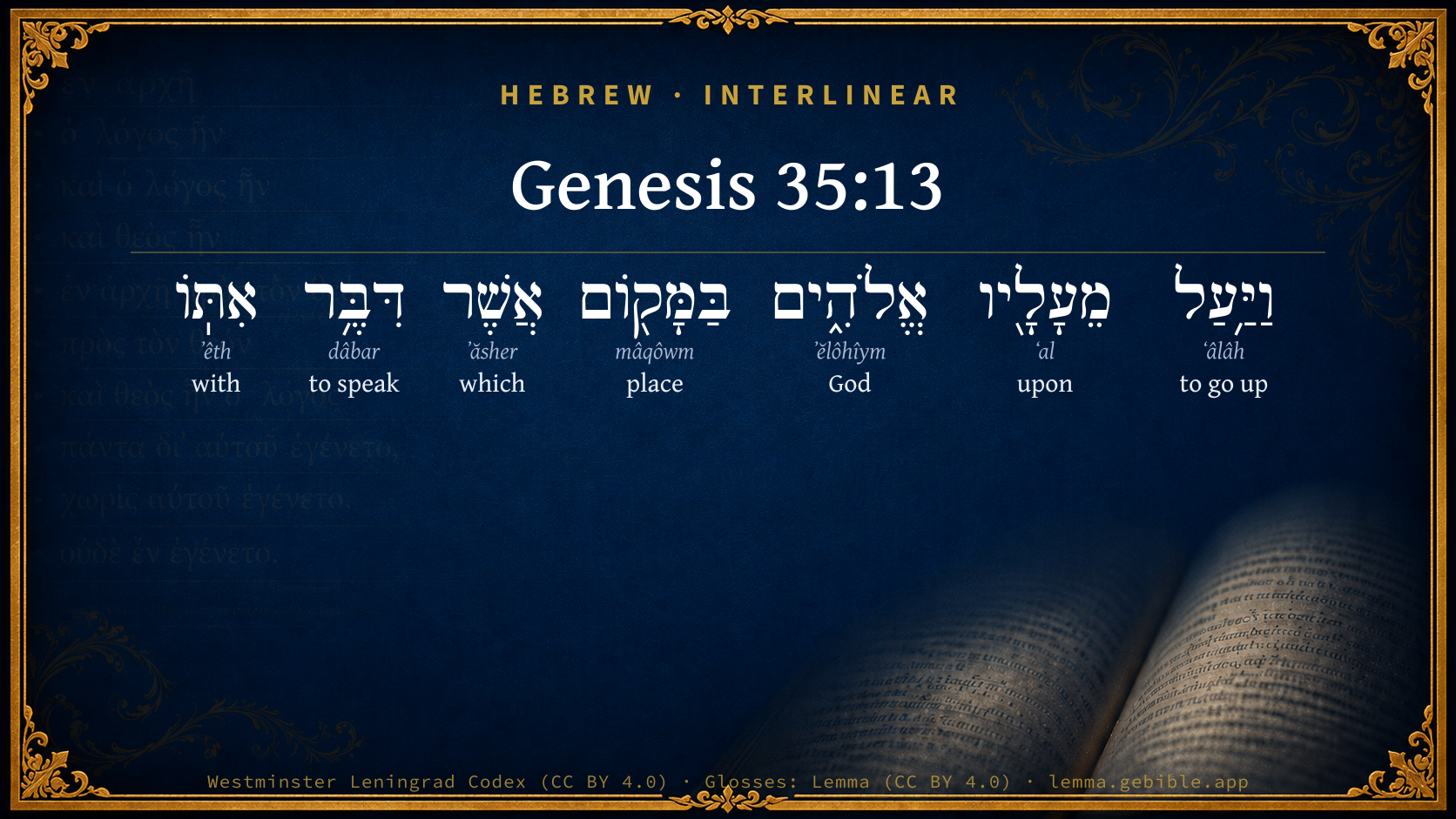
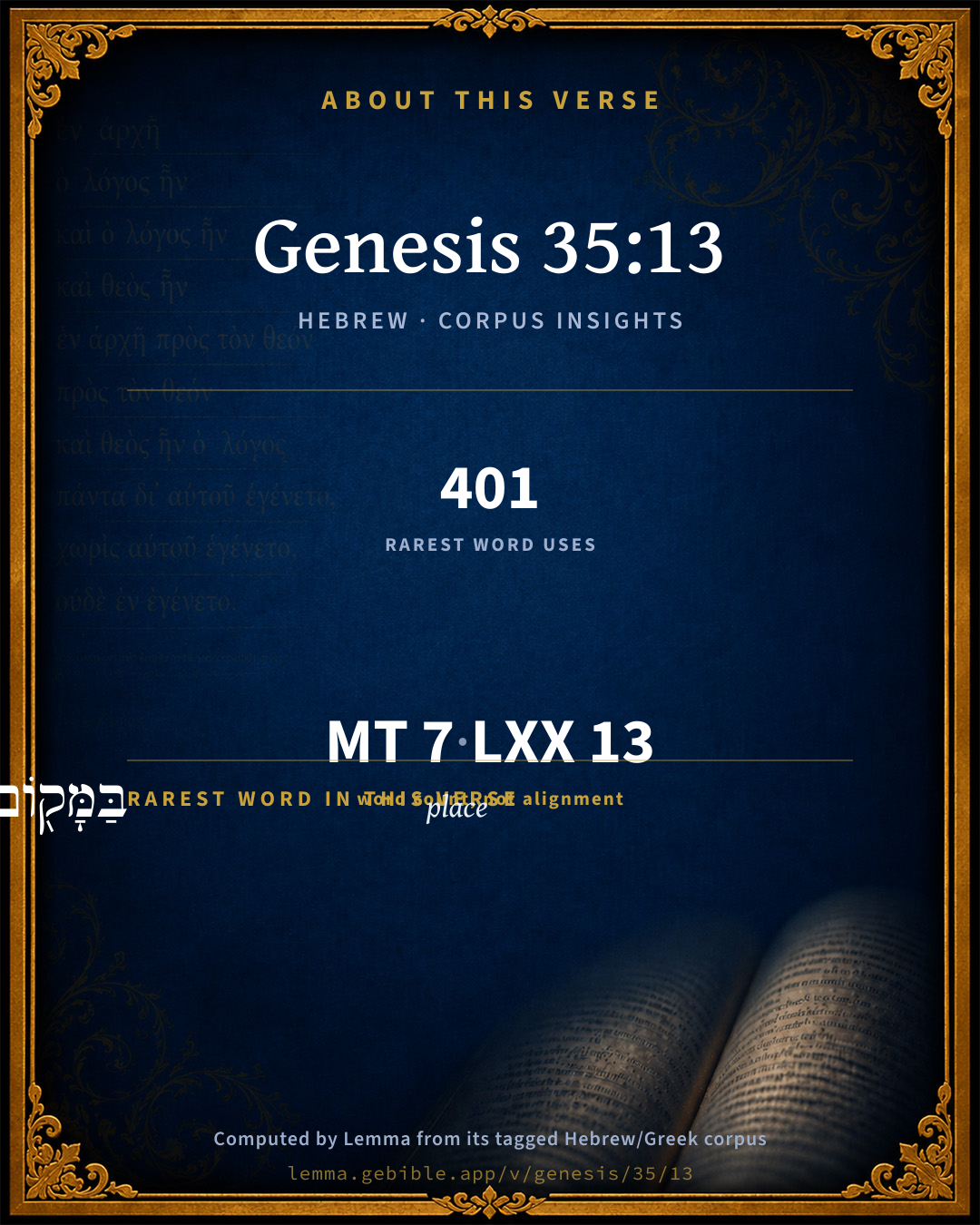
Genesis 35:13

Hebrew (Westminster Leningrad Codex) Genesis 35:13 appears in the Hebrew Old Testament. The text above is from the Westminster Leningrad Codex. Each word links to its Strong’s number, a concise gloss, and parsing drawn from the Open Scriptures Hebrew Bible morphology. Click any word for its full Brown-Driver-Briggs (BDB) entry.
Download image
Cite this verse

Genesis 35:13 (World English Bible). Public Domain. Lemma interlinear Bible study tool, https://lemma.gebible.app/v/genesis/35/13.

Show BibTeX & RIS
BibTeX
RIS
English Translation
God went up from him in the place where he spoke with him.
World English Bible · Public Domain
Download a study sheet

One document with this verse’s original text, its word-by-word gloss line, the meaning frame, cross-references with their text, attributed commentary, and full source and license credits — printable, and it pastes into notes with its structure intact.

This verse Autodidact and up

Study sheet (.html) Plain text (.txt)

A passage Seminary Student

Up to 50 verses in one chapter. A passage sheet keeps up to 6 commentary sources and 12 cross-references per verse, in the order this page ranks them, and says so on the sheet whenever that leaves anything out. Ask for a single verse and you get the Autodidact verse sheet above.

Everything on this page stays free to read, with no account — the sheet is a download of what is already on screen, not access to it.

Want to remove ads? Support Godless Engineer
Compare translations 3

The same verse in 3 English versions, stacked beneath the original-language interlinear above. Click any original word for its lexicon entry.

Each is an independent rendering of the whole verse — the interlinear is not word-aligned to these translations.

Highlighted words mark where these versions differ — a whole-verse word diff, not a word-by-word alignment.

  • World English Bible Public Domain
    God went up from him in the place where he spoke with him.
  • King James Version Public Domain
    And God went up from him in the place where he talked with him.
  • unfoldingWord Literal Text CC BY-SA 4.0
    Then God went up from him at the place where he spoke with him.

unfoldingWord Literal Text — © unfoldingWord, licensed CC BY-SA 4.0. Word-aligned USFM3 via Door43 (git.door43.org/unfoldingWord/en_ult).

Versions to compare (up to 4)

3 of 4 selected

Show all 18 translations

Every available English version of this verse, each an independent rendering of the whole verse.

  • World English Bible Public Domain
    God went up from him in the place where he spoke with him.
  • Berean Standard Bible Public Domain
    Then God went up from the place where He had spoken with him.
  • Majority Standard Bible Public Domain
    Then God went up from the place where He had spoken with him.
  • King James Version Public Domain
    And God went up from him in the place where he talked with him.
  • American Standard Version (1901) Public Domain
    And God went up from him in the place where he spake with him.
  • Revised Version (1885) Public Domain
    And God went up from him in the place where he spake with him.
  • Geneva Bible (1599) Public Domain
    So God ascended from him in the place where he had talked with him.
  • Douay-Rheims (1899) Public Domain
    And he departed from him.
  • Young's Literal Translation Public Domain
    And God goeth up from him, in the place where He hath spoken with him.
  • Literal Standard Version CC BY-SA 4.0
    And God goes up from him, in the place where He has spoken with him.
  • Unlocked Literal Bible CC BY-SA 4.0
    God went up from him in the place where he spoke with him.
  • unfoldingWord Literal Text CC BY-SA 4.0
    Then God went up from him at the place where he spoke with him.
  • Darby Bible Public Domain
    And God went up from him in the place where he had talked with him.
  • World Messianic Bible Public Domain
    God went up from him in the place where he spoke with him.
  • Webster's Bible Public Domain
    And God went up from him, in the place where he talked with him.
  • Free Bible Version CC BY-SA 4.0
    Then God left the place where he had been speaking to Jacob.
  • Bible in Basic English Public Domain
    Then God went up from him in the place where he had been talking with him.
  • JPS Tanakh (1917) Public Domain
    And God went up from him in the place where He spoke with him.

Literal Standard Version (2020), Covenant Press — licensed CC BY-SA 4.0. Text via the HelloAO Bible API (eBible.org). Unlocked Literal Bible (unfoldingWord) — licensed CC BY-SA 4.0. Text via the HelloAO Bible API (eBible.org). unfoldingWord Literal Text — © unfoldingWord, licensed CC BY-SA 4.0. Word-aligned USFM3 via Door43 (git.door43.org/unfoldingWord/en_ult). Free Bible Version, Dr. Jonathan Gallagher — licensed CC BY-SA 4.0. Text via the HelloAO Bible API (eBible.org).

Word by word

More ways to search: Search by grammar → Find every occurrence → Compare this word →

Practice this passage: Drill this verse → Learn its vocabulary →

בַּמָּק֖וֹם
mâqôwm
H4725
“in/at the · place”
Preposition, Determined + Noun, Common, Masculine, Singular, Absolute
Part of Speech
Preposition + Noun
Type
Common
Gender
Masculine
Number
Singular
State
Absolute
Full BDB Definition

Origin: from H6965

TWOT: 1999h

standing place, place - standing place, station, post, office - place, place of human abode - city, land, region - place, locality, spot - space, room, distance - region, quarter, direction - give place to, instead of
  1. וַיַּ֥עַל ʻâlâh H5927 “and · to go up” Conjunction + Verb, Qal, Sequential Imperfect, 3rd Person, Masculine, Singular
  2. מֵעָלָ֖יו ʻal H5921 “from · upon · him” Preposition + Preposition + Suffix, Personal, 3rd Person, Masculine, Singular
  3. אֱלֹהִ֑ים ʼĕlôhîym H430 “God(s)” Noun, Common, Masculine, Plural, Absolute
  4. אֲשֶׁר ʼăsher H834 “which” Particle, Relative
  5. דִּבֶּ֥ר dâbar H1696 “to speak” Verb, Piel, Perfect, 3rd Person, Masculine, Singular
  6. אִתּֽוֹ ʼêth H854 “with · him” Preposition + Suffix, Personal, 3rd Person, Masculine, Singular

About this verse

These counts appear in no published source. They are computed here, from the morphology-tagged text and Lemma’s own curated glosses. What Lemma adds →

7
words
7
distinct lemmas
Pentateuch
section

Grammatical profile

  • 2 verbs
  • 2 nouns
  • 2 prepositions
  • 1 particle

Verb forms

  • וַיַּ֥עַל Qal · Sequential Imperfect
  • דִּבֶּ֥ר Piel · Perfect

Hebrew & Septuagint length

In English translation the verse runs 13 words from the Hebrew and 14 from the Septuagint (LXX English) — closely comparable.

A rough comparison of the two English renderings, which tokenize alike — not a word-level alignment.

Word counts can differ between the Hebrew and the Greek without any difference in meaning — e.g. the Hebrew direct-object marker אֵת has no separate Greek word, and Greek often adds the article ὁ.

In the original languages it is 7 Hebrew tokens and 13 Greek tokens — but the two are counted differently (Hebrew bundles its prefixes and suffixes into one token; the Greek is in lemma form), so that isn’t a like-for-like length.

Cross-references

6

Topical passages linked to Genesis 35:13 in the Treasury of Scripture Knowledge — connected by theme and wording, ordered by reader-vote popularity; previews shown in the World English Bible.

  • Genesis 17:22 When he finished talking with him, God went up from Abraham.
  • Genesis 18:33 Yahweh went his way, as soon as he had finished communing with Abraham, and Abraham returned to his place.
  • Genesis 11:5 Yahweh came down to see the city and the tower, which the children of men built.
  • Judges 6:21 Then the angel of Yahweh put forth the end of the staff that was in his hand, and touched the flesh and the unleavened cakes; and there went up fire out of the rock, and consumed the flesh and the unleavened cakes; and the angel of Yahweh departed out of his sight.
  • Judges 13:20 For it happened, when the flame went up toward the sky from off the altar, that the angel of Yahweh ascended in the flame of the altar: and Manoah and his wife looked on; and they fell on their faces to the ground.
  • Luke 24:31 Their eyes were opened, and they recognized him, and he vanished out of their sight.

Cross-references courtesy of OpenBible.info (CC BY 4.0).

Hebrew and Greek witnesses Masoretic Hebrew ↔ Greek Septuagint

The same verse in the two great witnesses to the Old Testament, shown verse-for-verse.

These are two independent witnesses, not word-aligned to each other, and the Septuagint is shown in lemma (dictionary) form.

Hebrew Genesis 35:13 Masoretic · Westminster Leningrad Codex

וַיַּ֥עַל מֵעָלָ֖יו אֱלֹהִ֑ים בַּמָּק֖וֹם אֲשֶׁר דִּבֶּ֥ר אִתּֽוֹ

God went up from him in the place where he spoke with him.

World English Bible · Public Domain

Greek LXX Genesis 35:13 Septuagint · lemma form

ἀναβαίνω δέ ὁ θεός ἀπό αὐτός ἐκ ὁ τόπος οὗ λαλέω μετά αὐτός

And God went up from him from the place where he spoke with him.

LXX2012 (modern English Septuagint) · Public Domain

Hebrew: Westminster Leningrad Codex (CC BY 4.0). Greek: Septuagint (public domain); English from LXX2012 (modern English Septuagint) (Public Domain). How the Septuagint differs from the Hebrew →

Targum (Aramaic paraphrase)

2

The Targum is the ancient Jewish Aramaic paraphrase of the Hebrew Scriptures — an interpretive translation, not the Hebrew text itself. Onkelos (literal) and Pseudo-Jonathan (expansive) render the Torah, and Jonathan the Prophets. Coverage is partial: where no permissively-licensed English translation exists for a verse, only the Aramaic is shown. This is verse-level text, not a word-by-word alignment to the Hebrew.

  1. Targum Onkelos Torah (Genesis–Deuteronomy)
    וְאִסְתַּלַּק מֵעִלָּוֹהִי יְקָרָא דַיְיָ בְּאַתְרָא דִי מַלֵּיל עִמֵּהּ

    (no public-domain English translation for this verse)

    Targum Onkelos — Aramaic: “Onkelos Genesis” (public domain); “Onkelos Exodus” (public domain); “Onkelos Leviticus” (public domain); “Onkelos Numbers” (public domain); “Onkelos Deuteronomy” (public domain). English: “Sefaria Community Translation” (CC0 1.0 (public-domain dedication)); “J.W. Etheridge. The Targums of Onkelos and Jonathan Ben Uzziel on the Pentateuch. London: Longmans, Green, 1862” (public domain). Text via Sefaria.

  2. Targum Pseudo-Jonathan Torah (Genesis–Deuteronomy)
    וְאִסְתְּלֵק מֵעִילוֹי שְׁכִינְתָּא דַיְיָ בְּאַתְרָא דְמַלֵיל עִמֵיהּ

    And the Shekinah of the Lord ascended from him in the place where He had spoken with him

    Targum Pseudo-Jonathan — Aramaic: “Targum Jonathan on Genesis” (public domain); “Targum Jonathan on Exodus” (public domain); “Targum Jonathan on Leviticus” (public domain); “Targum Jonathan on Numbers” (public domain); “Targum Jonathan on Deuteronomy” (public domain). English: “The Targum of Jonathan ben Uzziel, trans. J. W. Etheridge, London, 1862” (public domain). Text via Sefaria.

Commentary

Notes on Genesis 35:13 from classic Christian and Jewish commentators (each source and its license shown beneath its notes). The classic Christian expositions comment on the surrounding passage and are grouped to its opening verse, so a note may address several verses; the Jewish commentaries on the Tanakh (Rashi and others) are per-verse, so they appear only where the commentator wrote on this verse.

Lemma curates 59 commentaries, every one of them public domain or Creative Commons licensed, each selected and text-cleaned for this edition rather than reprinted as found. About our sources →

Trapp's Complete Commentary

John Trapp

Gen 35:13 And God went up from him in the place where he talked with him.

Ver. 13. And God went up from him.] Not by local ascension; for he is everywhere; but in respect of that visible sign of his glory, which he now withdrew from over, or from upon Jacob. For the righteous are as God’s chariot, say the Hebrews on this text. Compare Son 6:12.

Where he talked with him.] Prayer is a free and familiar conference or intercourse with God; a parling with his Majesty, as St Paul calls it; {εντευξις, 1Ti 2:1} a standing upon interrogatories with him; especially when Satan, sin, and conscience accuse. It was a part of the Persian kings’ silly glory, to keep their greatest subjects from coming near them without special licence. {Est 4:11} To God we have free access upou all occasions, and are bid to "come boldly." {Heb 4:16} If Seneca could say, Audacter Deum roges, nihil illum de alieno rogaturus; how much more may the faithful Christian, since all is his, God and all! {1Co 3:22} Moses and Luther could have what they would of God. Fiat voluntas mea, saith Luther; and then he adds, Mea voluntas, Domine, quia tua: Let my will be done; but no otherwise mine, than as thine, Lord.

John Trapp, A Commentary or Exposition upon All the Books of the Old and New Testament (1647–1656) — public domain. Text from a community e-Sword module.

Joseph Benson's Commentary

Gen 35:13. God went up from him — In some visible display of his glory, which had hovered over him while he talked with him; or by withdrawing the signs of his special presence, as Gen 17:22, and Jdg 13:20; as, on the contrary, God is said to come down, not by change of place, but by some signal manifestation of his presence and favour, Exo 3:8; Num 11:17.

Joseph Benson's Commentary on the Old and New Testaments (1811–1818) — public domain. Text from a community e-Sword module.

Geneva Bible (1599)

Geneva Bible translators

As God is said to descend when he showeth some sign of his presence: so he is said to ascend when vision is ended.

Geneva Bible (1599) marginal notes — public domain. Text via Bolls.life.

Jamieson, Fausset & Brown

Robert Jamieson, A. R. Fausset & David Brown

God went up from him--The presence of God was indicated in some visible form and His acceptance of the sacrifice shown by the miraculous descent of fire from heaven, consuming it on the altar.

Jamieson, Fausset & Brown — Commentary Critical and Explanatory on the Whole Bible (1871) — public domain (CC PDM 1.0). Text via the HelloAO Bible API.

Adam Clarke's Commentary

Verse 13. And God went up from him] This was not a vision, nor a strong mental impression, but a real manifestation of God. Jacob saw and heard him speak, and before his eyes he went up - ascended to heaven. This was no doubt the future Saviour, the Angel of the covenant. See Ge 16:7.

Adam Clarke's Commentary on the Bible (1810–1826) — public domain. Text from a community e-Sword/MySword module.

John Calvin's Commentaries

13. And God went up from him. This ascent of God is analogous to his descent; for God, who fills heaven and earth, is yet said to descend to us, though he changes not his place, whenever he gives us any token of his presence; a mode of expression adopted in accommodation to our littleness. He went up, therefore, from Jacob, when he disappeared from his sight, or when the vision ended. By the use of such language, God shows us the value of his word, because, indeed, he is near to us in the testimony of his grace; for, seeing that there is a great distance between us and his heavenly glory, he descends to us by his word. This, at length, was fully accomplished in the person of Christ; who while, by his own ascension to heaven, he raised our faith thither; nevertheless dwells always with us by the power of his Spirit.

John Calvin's Commentaries (1540-1563) — public domain. Text from the Calvin Translation Society English edition (1840s-50s) via the Christian Classics Ethereal Library (ccel.org). Calvin's coverage is partial (roughly two-thirds of the Bible); uncommented books and verses are honest gaps, never fabricated. The 19th-century editor's footnotes and remarks are omitted so the notes are faithfully Calvin's own voice.

Ellicott's Commentary for English Readers

(13) God went up from him.—This formula, used before in Gen_17:22; Gen_18:33, shows that this manifestation of God’s presence was more solemn than any of those previous occasions upon which the Deity had revealed Himself to Jacob. It was, in fact, the acknowledgment of the patriarch as the heir of the Abrahamic covenant.

A Bible Commentary for English Readers, edited by Charles John Ellicott (1878–1897) — public domain. Text from a community e-Sword module.

The Cambridge Bible for Schools and Colleges

gen. ed. J. J. S. Perowne

13. And God went up] An expression descriptive of the manifestation in some external form, in which God appeared to Jacob. Cf. Gen_18:33, “And the Lord went his way.”

The Cambridge Bible for Schools and Colleges (gen. ed. J. J. S. Perowne; Cambridge University Press, 1878–1918) — public domain. Text from a community e-Sword module.

John Gill's Exposition

And God went up from him,.... Or "from above" him (x); by this it seems that there was a visible appearance of the glory of the Lord, as Onkelos, or of the Shechinah, as Jonathan; even of the Son of God in an human form, who either appeared just above him, or on the same spot with him, conversing with him as above related; and when he had done, ascended in a visible manner from him, till he disappeared:

in the place where he talked with him; whether it was over him, or by him; thence he removed from him, and ceased talking with him; for communion with a divine Person is not constant and uninterrupted in the present state.

(x) "desuper eum", Montanus.

John Gill's Exposition of the Whole Bible (1746–1763) — public domain (CC PDM 1.0). Text via the HelloAO Bible API.

Matthew Poole's English Annotations

God went up from him; either locally and visibly, to wit, in that human shape in which he appeared to him; or by withdrawing the signs of his special presence, as Gen 17:22; Jdg 13:20; as on the contrary God is said to come down, not by change of place, but by some signal manifestation of his presence and favour, as Exo 3:8; Num 11:17.

Matthew Poole's English Annotations on the Holy Bible (1683–1685) — public domain. Text from a community e-Sword/MySword module.

Whedon's Commentary on the Bible

Daniel D. Whedon

13. God went up from him — This implies the visible appearance of the Angel of Jehovah. Comp. Jdg_13:20.

Daniel D. Whedon (gen. ed.), Commentary on the Old and New Testaments (1874–1909) — public domain. Text from a community e-Sword module.

The Pulpit Commentary

And God went up from him showing this to have been a visible manifestation (cf. Gen_17:22) in the place where he talked with him.

The Pulpit Commentary (1880–1919), ed. H.D.M. Spence-Jones & Joseph S. Exell — public domain. Text from a community e-Sword module.

John Wesley's Explanatory Notes

And God went up from him - Or, from over him - In some visible display of glory, which had hovered over him, while he talked with him.

John Wesley, Explanatory Notes Upon the Whole Bible (1754–1765) — public domain. Text via the GEBible commentary corpus.

Rashi

Rabbi Shlomo Yitzchaki (Rashi)

במקום אשר דבר אתו AT THE PLACE WHERE HE SPAKE WITH HIM — I do not know what this is intended to tell us.

Rashi on the Tanakh — English translations: “The Judaica Press complete Tanach with Rashi, translated by A. J. Rosenberg” (CC BY 4.0); “Pentateuch with Rashi's commentary by M. Rosenbaum and A.M. Silbermann, 1929-1934” (public domain); “The Metsudah Tanach series, Lakewood, N.J” (CC BY 4.0); and “The Book of Joshua, Metsudah Publications, 1997” (CC BY 4.0). Text via Sefaria.

Ramban (Nachmanides)

Rabbi Moshe ben Nachman (Ramban / Nachmanides)

AND G-D WENT UP FROM HIM. I.e., just as it said with respect to Abraham, And G-d went up from Abraham. In both cases, it serves to inform us that this was no mere vision or prophetic dream alone, or something like, And it brought me in the visions of G-d to Jerusalem, but that the Divine Presence rested upon him in the place where he stood. And by way of the Truth, [that is, the mystic lore of the Cabala], “G-d went up from him,” from the place where He spoke with him, this being similar in purport to that which is said, Blessed be the glory of the Eternal from His place., 3:12. Scripture is thus stating that which the Sages have mentioned: “It is the patriarchs that constitute the Divine Chariot.”

Ramban (Nachmanides) on the Tanakh — English translation: “Commentary on the Torah by Ramban (Nachmanides). Translated and annotated by Charles B. Chavel. New York, Shilo Pub. House, 1971-1976” (CC BY 4.0). Text via Sefaria.

Radak

Rabbi David Kimhi (Radak)

ויעל מעליו, just as we have been told in 17,22 when G’d departed from Avraham. The manifestation of His Presence revealed to the patriarchs in a vision came to an end. Yaakov had a visual impression of G’d as He was withdrawing His presence from him. In Bereshit Rabbah 82,6 Rabbi Shimon ben Lakish points out the appropriate nature of this expression for G’d “rising, as it confirms that the patriarchs were the “carriers” of G’d’s Presence on earth (merkavah).

במקום אשר דבר אתו, to inform us that the site in question was especially suitable for receiving prophetic insights. G’d spoke to Yaakov at this site already for a second time, as pointed out to him by the angel. He would speak to prophets at that location also in the future as we know from Hoseah 12,5. The site under discussion here is the one where Yaakov at the time when he had the dream with the ladder had anointed the stone which had served as his pillow. The words ויעל מעליו, are a hint that the day would come-after the sin of the golden calf- when the Presence of G’d will withdraw from the Jewish people.

Radak on the Tanakh — English translations: “Sefaria Community Translation” (CC0 1.0 (public-domain dedication)); “Eliyahu Munk, HaChut Hameshulash” (CC BY 4.0); “Rabbi Mike Feuer, Jerusalem Anthology” (CC BY 4.0); and “R. David Kimhi on the first book of Psalms, Translated by R.G. Finch, London, 1919” (public domain). Text via Sefaria.

Lesson kit

Teaching starters — assembled from the data on this page, not authored interpretation. Every prompt links to the verse data it draws on. Edit before teaching.

Genesis, in the Pentateuch, opens this verse with 7 words (7 distinct Hebrew lemmas). Its most distinctive word is mâqôwm (“place”). A historical commentator’s framing appears above. Read the whole chapter for the surrounding context.

Discussion questions

  1. How does “place” (mâqôwm) shape what this verse is saying?
  2. Genesis 17:22 shares this passage’s theme. How do the two illuminate each other?
  3. The translations on this page render this verse differently — a whole-verse word diff, not a word-by-word alignment. What might account for the different wordings?
  4. The verb «וַיַּ֥עַל» is Qal Sequential Imperfect. How does its form color the action?
  5. Reading how Trapp's Complete Commentary and Joseph Benson's Commentary read this verse, where do the two commentators agree and where do they part?

Things to notice

Reading settings

Reading text

Shown beneath each verse's original-language words.

Old Testament
Old Testament edition

Read the OT as the Masoretic Hebrew (MT) or the Greek Septuagint (LXX).

English shown for the Greek Septuagint (in the Hebrew ↔ Greek comparison).

Comparing translations? Open the Compare panel on any verse page to stack up to four side by side.